
Preprint
Article

This version is not peer-reviewed.

Polyamine Content of Enteral Nutrition Formulas. Effect of Daily Intake on the Feeding Tolerance of Patients During the First Week in the Intensive Care Unit

A peer-reviewed article of this preprint also exists.

Submitted:

05 December 2024

Posted:

06 December 2024

You are already at the latest version

Abstract

Enteral nutrition (EN) formulas are necessary for critically ill patients to meet their metabolic requirements. Polyamines (putrescine, spermidine and spermine) are crucial dietary components, with spermidine being particularly interesting due to its proposed multiple benefits. The requirements for and intake of polyamines have yet to be investigated in adult patients hospitalised in intensive care units (ICUs) exclusively fed via commercial EN formulas. The aim of this study was to determine the polyamine content of EN formulas and the total intake and gastric residual volume (GRV) in adult ICU patients during their first seven days of hospitalisation. Polyamines were analysed in 17 EN formulas using high-performance liquid chromatography (HPLC). The clinical data of 8 patients of both sexes aged 47 to 77 admitted to the ICU were analysed. Differences existed among the analysed EN formulas. The N-acetyl putrescine content was higher than the remaining amines. The daily intake in the ICU was less than 100 μmol (the dietary intake is above 400 μmol). An inverse correlation existed between total daily polyamine intake and daily GRV. Polyamine intake in critically ill patients receiving EN is low and could impact these patients’ feeding tolerance. These findings underscore the need for further research to explore the clinical implications of increasing the polyamine content of EN formulas.

Keywords: 
;  ;  ;  ;  ;  ;  

1. Introduction

Adequate nutrition is crucial to health at all stages of life [1]. Consequently, when a patient cannot consume food orally, alternatives, such as enteral nutrition (EN) formulas, are necessary, especially for critically ill patients [2]. Parenteral nutrition is only considered when EN is contraindicated, as occurs in certain pathological circumstances [3]. The importance of EN is determined by the fact that the intestinal epithelium does not have blood vessels and mainly relies on nutrients obtained from the intestinal lumen to maintain gastrointestinal homeostasis [4]. Therefore, a prolonged absence of EN can lead to gut atrophy, luminal starvation, dysbiosis of the microbiota and impaired immune functions [5]. Several EN formulations are available to provide essential nutrients to hospitalised patients, which are administered by different methods [2,6]. These EN formulas, with their particular characteristics, should meet patients’ metabolic requirements and provide them with essential nutrients and trace elements tailored to different clinical situations [7].
EN formulas are expected to contain polyamines (putrescine, spermidine and spermine), since they are present in all macronutrients [8]. These compounds are essential dietary components, also produced by the microbiota. They contribute to the development and growth of the gastrointestinal mucosa and facilitate wound healing [9,10]. Additionally, they serve as a direct energy source for the intestinal cells [11], promote a healthy microbiota (which also produces polyamines as metabolites) [12], stimulate the intestinal immune system [13] and modulate gastrointestinal motility [14,15], thereby facilitating digestion and the absorption of nutrients from birth onwards [16,17].
Intestinal polyamines are absorbed, complementing the endogenous synthesis carried out by the enzyme ornithine decarboxylase. This enzyme converts ornithine into putrescine, which is subsequently transformed into spermidine and then into spermine [18]. The cellular homeostasis of polyamines is tightly regulated, and any disruption in this balance is associated with various pathologies. Polyamines’ importance extends to their systemic effects, including DNA replication, RNA transcription, protein synthesis and post-translational modification. Consequently, polyamines are crucial for regulating cellular proliferation and differentiation [19].
Studies in experimental models [20,21] and epidemiological research [22,23] have found that a higher intake of polyamines is associated with a reduced risk of age-related diseases and a potential increase in longevity. Among the different polyamines, spermidine has garnered particular interest in relation to these effects by eliciting autophagy [21] and hypusination of the translational regulator eukaryotic initiation factor 5A (eIF5A) [24]. Nonetheless, the requirements for and intake of polyamines remain the subject of debate. Depending on the study, and likely also on the country, the daily intake of total polyamines, the sum of putrescine, spermidine and spermine, has been found to range from 200 to 410 μmol per person [25,26,27,28,29]. These values may be below the optimal level. Based on an ideal diet, this has been estimated to be 541 μmol from the Swedish Nutrition Recommendations Objectified [30].
Despite their essential biological functions, polyamine intake and its effects in critically ill patients fed with EN formulas have not been previously investigated. These patients may experience acute organ dysfunction and post-intensive care syndrome [31]. Maintaining adequate polyamine homeostasis, particularly spermidine, could produce beneficial effects in these patients, given their protective role on various organs, including the kidney [32], heart [33,34], lungs [35,36,37], immune system [38], and brain [39], among others.
This study aimed to determine, for the first time, the daily intake of polyamines during the first seven days of hospitalisation for critically ill adult patients in intensive care units (ICUs) who were exclusively fed through commercial enteral nutrition (EN) formulas. First, it was necessary to analyse the polyamine content per mL of various EN formulas currently administered to these patients using high-performance liquid chromatography (HPLC). Additionally, to evaluate the impact of polyamine intake on nutrition tolerance by examining its relationship with gastric residual volume (GRV).

2. Materials and Methods

2.1. Determination of the Polyamine Content of Commercial EN Formulas via HPLC

Seventeen commercial EN formulas, all currently being administered to patients in the ICU at the Hospital Universitario Central de Asturias in Spain, were obtained to analyse their polyamine content. Multiple samples were analysed when available.
The amines were determined by means of HPLC using a pre-column derivatisation method, as previously described [40]. From each EN formula sample, 950 μL was taken and treated with perchloric acid for 10 minutes at 4°C to reach a final concentration of 15.8%. The extracts were then centrifuged at 10,000 x g for 30 minutes at 4°C, and 0.2 mL of supernatants were collected, and the standard concentration (1.25 μL of a concentration of 1 mM) was added. The sample was neutralised with 0.3 mL of a saturated solution of NaHCO3, and the samples were dansylated overnight (~16 h) with 0.5 mL of a solution containing 5 mg/mL of dansyl chloride in acetone. The next day, proline 0.1 ml of 100 mg/mL was added for 30 minutes, and then 0.5 mL of toluene was added. Finally, 0.4 mL of the organic phase was removed and dried under a nitrogen atmosphere at 42°C in a thermoblock and then resuspended in 0.2 mL of acetonitrile (VWR, Rosny-sous-Bois, France).
The samples were chromatographed in an HPLC (Shimadzu Prominence, Kyoto, Japan) using a C18 (2.5 μm, 3.0 x 75 mm) reverse-phase column (XBridge, Waters, Milford, MA, USA) at a room temperature between 21 and 23°C and equipped with two LC-20AD pumps, a fluorescence detector (RF-20A), a SIL-20AD HT autosampler injector at 4°C and a DGU-20A3 degasser. The binary gradient used a flow rate of 0.55 mL/minutes as follows: 0–0.5 minutes, 0% B; 0.5–10 minutes, 75% B; 10–11.30 minutes, 75% B; and 11.3–11.50 minutes, 0% B, where solvent A was 45% acetonitrile and solvent B was 100% acetonitrile. The injection volume was 5 μL.
The duration of the chromatogram was 14 minutes. The identification of the compounds was performed using their retention time in minutes (standard: 5.88, N-acetyl putrescine: 1.56, N-acetyl spermidine: 6.11, β-phenylethylamine: 6.82, isoamylamine: 7.04, putrescine: 7.38, cadaverine: 7.83, N-acetyl spermine: 9.41, tyramine: 9.89, spermidine: 10.38, spermine: 12.41) and a wavelength of excitation of 365 nm and emission of 510 nm. All measurements were made using the Shimadzu LCsolution Version 1.25 software. The data analysed were the means of duplicate injections. Quantification of the biogenic amines was performed using 1,3-Diamino-2-hydroxypropane as an internal standard, expressed as nmol/mL of the EN formulas.

2.2. Characteristics of the EN Formulas

The formula characteristics were obtained from the manufacturers, enabling the subsequent EN classification to be analysed (Table 1).
The following chemicals were used: putrescine (tetramethylenediamine dihydrochloride), spermidine (N-(3-aminopropyl)-1,4-butanediamine), spermine (N,N′-bis (3-aminopropyl)-1,4-butanediamine), N-acetyl putrescine (N-(4-aminobutyl)acetamide hydrochloride), N-acetyl spermidine (N8-acetylspermidine dihydrochloride), N-acetyl spermine (N1-acetylspermine trihydrochloride), isoamylamine (isopentylamine: 1-amino-3-methylbutane), cadaverine (cadaverine dihydrochloride), tyramine (2-(4-hydroxyphenyl)ethylamine), β-phenylethylamine and 2-hydroxydiaminopropane, which were purchased from Sigma-Aldrich (St. Louis, MO, USA). The compounds were dissolved in purified water with a 10–15 MΩ·cm resistance.

2.4. Study Design, Patient Population and Clinical Data

This retrospective observational study was approved by the Research Ethics Committee of the Principality of Asturias, Spain (reference: CElmPA No. 2023.089) and conducted among patients of both sexes aged 18 to 70 who were admitted to the ICU between 1 January 2022 and 31 January 2023.
This study focused on patients who received continuous administration of an EN formula as their sole source of nutrition. The inclusion criteria for the study were a minimum of a seven-day stay in the ICU and the same EN formula administered for at least five days, excluding COVID-19 patients. Eight patients met this criterion. The reasons for admission to the ICU was the need for exhaustive and constant monitoring of the patient's clinical situation. The primary pathologies were abdominal origin sepsis, liver transplant, sepsis, ketoacidosis, haemodynamic instability, cardiorespiratory arrest, cerebral haemorrhage and rhombencephalitis. Patients admitted to the ICU during the study period who did not meet the inclusion criteria were excluded.
The daily intake of polyamines in the patients included in the study was estimated based on the volume of the EN formula administered. Clinical information was obtained for each patient, including age, sex, body mass index (BMI), EN formula prescribed, volume of EN and water administered, GRV (considered for the entire day), vomiting and number and volume of stools.

2.5. Statistical Analyses

The variables analysed in this study are expressed as the mean ± the standard error of the mean. The total polyamines were calculated as the sum of the putrescine, spermidine and spermine values. A one-way analysis of variance (ANOVA) was used to determine the potential differences in the polyamine content between the EN formulas.
Bivariate correlation was used to determine the relationship between daily biogenic amine intake and daily GRV. The analyses were performed using IBM SPSS Statistics 27.0 (IBM, Armonk, NY, USA).

3. Results

3.1. Polyamine Content of the EN Formulas

The analysis showed differences in the polyamine content across the 17 EN formulas included in this study. Significant differences in the total polyamine content (ANOVA, p < 0.001) (putrescine, spermidine and spermine) were observed, being higher in the Impact, Impact Enteral, Nutrison, Nutrison Advanced Diason Energy, Nutrison Energy and Nutrison Energy Multifibre formulas, ranging from 41.69 to 22.92 nmol/mL. No significant differences existed between them (in those with at least three determinations in different samples) when adjusted for multiple comparisons. The polyamine content of these EN formulas was significantly higher than what was found in Fresubin Original Fibre, Isosource Protein Fibre, Nepro LP, Novasource Gi Protein and Nutricomp Hepa Osmolite Plus, and presumably than what was found in the Nepro, Osmolite and Protein NM formulas, which ranged from 3.38 to 1.05 nmol/mL, because these had less than three different determinations (Table 2).
The EN formulas with the highest putrescine content were Nutrison Energy Multifibre, Isosource Protein Fibre and Nutrison Advanced Diason Energy HP. For spermidine, the highest contents were found in Nutrison Advanced Diason Energy HP, Nutrison Energy Multifibre, Nutrison, Impact and Isosource Protein Fibre. The Impact formula had a significantly higher spermine content than the other formulas, followed by Nutrison Advanced Diason, Fresubin Original Fibre and Nutrison Energy Multifibre. In all the analysed EN formulas, the polyamine with the highest content was N-acetyl putrescine, without significant differences among the formulas studied. Nutricomp Hepa had the highest content of N-acetyl spermidine and Impact of N-acetyl spermine (Table 2; p values in Supplementary Table S1).
The ANOVA conducted on the remaining biogenic amines present in the EN formulas revealed significant differences in the levels of cadaverine and β-phenylethylamine (p < 0.001), while no significant differences were found for isoamylamine and tyramine. The post hoc analysis indicated that the β-phenylethylamine content was significantly higher in the Nutricomp Hepa formula compared to the other formulas. Additionally, cadaverine levels were significantly higher in the Nutrison Advanced Diason Energy HP formula than in all other EN formulas, except for Nutrison Energy Multifibre, which had a significantly higher cadaverine content than Nepro LP, Novasource GI Protein, Nutricomp Hepa and Nutrison (Table 3). The protein content, caloric density, osmolarity and chemistry of the nutrients of the EN formulas were not associated with the differences in polyamine composition.

3.2. Patients and Daily Polyamine Intake via EN Formulas

The study included eight patients, six males and two females, with an average age of 64.1 ± 3.6 years and an average BMI of 27.12 ± 1.81 Kg/m2. The average daily intake of EN formula varied between 857 mL and 1085 mL. By considering the daily volume administered and the polyamine content of the EN formula given to each patient, we calculated the total daily intake of polyamines (Figure 1A) and for putrescine (Figure 1B), spermidine (Figure 1C) and spermine (Figure 1D) for each patient.
The patients' average total polyamine intake was 17.18 ± 4.79 µmol/day. The intake of putrescine was 4.04 ± 1.01 µmol/day, spermidine 11.53 ± 3.42 µmol/day and spermine 1.62 ± 0.49 µmol/day. These intakes, in µmol/day, correspond to 2.36 ± 0.67 mg/day for total polyamines, 0.36 ± 0.09 mg/day for putrescine, 1.67 ± 0.49 mg/day for spermidine and 0.33 ± 0.1 mg/day for spermine. Among the main polyamines, spermidine was the most important, although the intake of N-acetyl putrescine was the highest. Regarding the remaining amines, isoamylamine intake was higher than others (Table 4).
The bivariate correlation analysis of the patients’ daily GRV regarding the total quantity of polyamines provided by the EN formulas showed a significant negative correlation (r = 0.003, p = -0.437, n = 45), as well as for the polyamines putrescine (r = -0.407, p = 0.006, n = 45), spermidine (r = -0.434, p = 0.003, n = 45), spermine (r = -0.409, p = 0.005, n = 45) and N-acetyl spermine (r = -0.359, p = 0.015, n = 45). No significant correlation was found between N-acetyl putrescine and N-acetyl spermidine. Tyramine also showed an inverse correlation (r = -0.386, p = 0.009, n = 45) and was positive for β-phenylethylamine (r = 0.513, p < 0.001, n = 45) and isoamylamine (r = 0.525, p < 0.001, n = 45).

4. Discussion

This study found that commercially available EN formulas may not meet the daily polyamine requirements of critically ill patients, compared with a similar population’s average dietary intake [8]. Daily intake may be associated with gastrointestinal effects. To the best of our knowledge, this is the first study to determine the composition of polyamines in EN formulas.
Significant differences in polyamine composition were found among the 17 EN formulas analysed in this study. These differences were not associated with the nutritional characteristics of the formulas, such as the protein content, caloric density, osmolarity or chemistry of the nutrients. Commercial preparation processes may be responsible for the variations in the polyamine content in the tested EN formulas. The polyamine content of the EN formulas was notably lower than that found in most foods of equivalent weight [41].
The analysis of eight patients admitted to the ICU for diverse pathologies revealed that the average daily polyamine intake from the EN formulas administered to the patients during their first seven days in the ICU was only 12–25 µmol/day (considering the sum of putrescine, spermidine and spermine). Even if patients were to ingest higher EN infusion rates—up to 63 mL/minute, supplying 1,512 mL/day—the estimated polyamine intake would still be only 6–63 µmol per day, depending on the EN formula administered. These values are considerably lower than the estimated daily dietary intake in the same population (around 400 µmol/day) [8] and also for the polyamines considered individually. The average daily intake of putrescine (4.04 µmol/day), spermidine (11.53 µmol/day), and spermine (1.62 µmol/day) were much lower than the average content in a regular diet, which was 273.05 µmol/day, 87.71 µmol/day, and 49.82 µmol/day, respectively [8].
In the short term, the daily intake of polyamines may influence tolerance to EN formulas. This is suggested by the observed inverse correlation between total and individual polyamines—such as putrescine, spermidine and N-acetyl spermine—and daily GRV [6]. The total polyamine and spermidine contents in the EN formulas were associated with contributing close to 20% of the variations in GRV in these patients. Additionally, tyramine also showed an inverse correlation, while β-phenylethylamine and isoamylamine were associated with worse EN tolerance. The association between polyamines and gastrointestinal tolerance aligns with their reported effects of modulating gastrointestinal motility [14,15] and maintaining gastrointestinal homeostasis, as described in experimental models [42,43]. Some of these gastrointestinal effects have been attributed to spermidine [44].
This study focused on determining the content of polyamines in EN formulas and their local effect on the gastrointestinal tract. It cannot be ruled out that additional clinical effects could arise if there is a prolonged reduction in the administration of polyamines due to their role as an energy source for the epithelium [11], their involvement in epithelial growth [45], their stimulation of the gut immune system [46], and their contribution to microbiota homeostasis [47]. Moreover, such a reduced intake could have a broader impact on cellular polyamine homeostasis, potentially influencing the protective roles attributed to polyamines, especially spermidine, in vital organs such as the kidneys [32], lungs [35,36,37], heart [33,34], brain [39] and immune system [38]. These changes may be particularly significant for critically ill patients who are on mechanical ventilation and may experience persistent organ dysfunction after intensive care [31]. Therefore, investigating the effects of polyamine supplementation in these patients would be worthwhile.
Variations also existed in the amount of the other biogenic amines, considered trace amines, which have been reported to produce biological effects [48,49], some on the gastrointestinal tract via trace amine associated receptors (TAAR) [50,51]. However, the quantities administered may be below the levels for activating receptors [51] and causing effects, since they were less than 1 mg per day.
The study has some limitations due to its retrospective design and should be considered preliminary as it involved a small number of patients. However, the significantly low intake of polyamines highlights the necessity for further research to investigate the clinical implications of increasing the polyamine content in EN formulas and its administration among critically ill patients in ICUs.

5. Conclusions

The findings of this study confirm that critically ill patients who receive EN formulas have a low polyamine intake, which may result in polyamine deprivation. If this continues for a long period, it could adversely impact the patient’s health and recovery due to the multiple effects of polyamines on the gastrointestinal system, immunity and protein synthesis. To help address this issue, future studies should examine the clinical implications of increasing the polyamine content of EN formulas on organ protection and reducing the health decline in critically ill patients.

Supplementary Materials

The following supporting information can be downloaded at the website of this paper posted on Preprints.org.

Author Contributions

All authors were involved in the conception and design of the study. ERH, LS, MS and BC analyzed polyamines in EN formulas. MGG and ERH consulted the clinical data of the patients. BC, MGG and MS wrote the article, and all authors provided comments on previous manuscript versions. All authors read and approved the final manuscript.

Funding

This research was funded by a Grant from Instituto de Investigación Sanitaria del Principado de Asturias (ISPA) (Convocatoria Intramural para el Fomento de Proyectos de Investigación 2018).

Institutional Review Board Statement

The study was conducted in accordance with the Declaration of Helsinki and approved by the Research Ethics Committee of the Principality of Asturias, Spain (reference: CElmPA No. 2023.089).

Informed Consent Statement

Informed consent was not applicable since was a retrospective study.

Data Availability Statement

Data is available on request.

Conflicts of Interest

The authors declare no conflicts of interest.

References

  1. Mozaffarian, D.; Rosenberg, I.; Uauy, R. History of modern nutrition science-implications for current research, dietary guidelines, and food policy. Bmj 2018, 361, k2392. [Google Scholar] [CrossRef] [PubMed]
  2. Mohamed Elfadil, O.; Velapati, S.R.; Patel, J.; Hurt, R.T.; Mundi, M.S. Enteral Nutrition Therapy: Historical Perspective, Utilization, and Complications. Curr Gastroenterol Rep 2024. [Google Scholar] [CrossRef] [PubMed]
  3. Wischmeyer, P.E.; Klek, S.; Berger, M.M.; Berlana, D.; Gray, B.; Ybarra, J.; Ayers, P. Parenteral nutrition in clinical practice: International challenges and strategies. Am J Health Syst Pharm 2024, 81, S89–s101. [Google Scholar] [CrossRef] [PubMed]
  4. Kong, S.; Zhang, Y.H.; Zhang, W. Regulation of Intestinal Epithelial Cells Properties and Functions by Amino Acids. Biomed Res Int 2018, 2018, 2819154. [Google Scholar] [CrossRef]
  5. Demehri, F.R.; Barrett, M.; Ralls, M.W.; Miyasaka, E.A.; Feng, Y.; Teitelbaum, D.H. Intestinal epithelial cell apoptosis and loss of barrier function in the setting of altered microbiota with enteral nutrient deprivation. Front Cell Infect Microbiol 2013, 3, 105. [Google Scholar] [CrossRef]
  6. Doyle, D.J.; Hendrix, J.M.; Garmon, E.H. American Society of Anesthesiologists Classification [Updated 2023 Aug 17]. 2024.
  7. Yang, H.; Hou, L.; Sun, H.M.; Ye, S.H. Comparison of micronutrients in adult enteral formulas widely used in clinical practice. Food Sci Nutr 2023, 11, 6096–6105. [Google Scholar] [CrossRef]
  8. Cantabrana, B.; Peña-Iglesias, P.; Castro-Estrada, P.; Suárez, L.; Bordallo, J.; Barreiro-Alonso, E.; Sánchez, M. Dietary intake of polyamines in a Spanish adult population: Age-dependent correlation with Healthy Eating Index and Dietary Inflammatory Index scores. Nutrition 2024, 130, 112608. [Google Scholar] [CrossRef]
  9. Liu, B.; Jiang, X.; Cai, L.; Zhao, X.; Dai, Z.; Wu, G.; Li, X. Putrescine mitigates intestinal atrophy through suppressing inflammatory response in weanling piglets. J Anim Sci Biotechnol 2019, 10, 69. [Google Scholar] [CrossRef]
  10. Minetti, A.; Omrani, O.; Brenner, C.; Allies, G.; Imada, S.; Rösler, J.; Khawaled, S.; Cansiz, F.; Meckelmann, S.W.; Gebert, N.; et al. Polyamines sustain epithelial regeneration in aged intestines by modulating protein homeostasis. bioRxiv 2024. [Google Scholar] [CrossRef]
  11. Bardócz, S.; Grant, G.; Brown, D.S.; Pusztai, A. Putrescine as a source of instant energy in the small intestine of the rat. Gut 1998, 42, 24–28. [Google Scholar] [CrossRef]
  12. Tofalo, R.; Cocchi, S.; Suzzi, G. Polyamines and Gut Microbiota. Front Nutr 2019, 6, 16. [Google Scholar] [CrossRef] [PubMed]
  13. Hesterberg, R.S.; Cleveland, J.L.; Epling-Burnette, P.K. Role of Polyamines in Immune Cell Functions. Med Sci (Basel) 2018, 6. [Google Scholar] [CrossRef] [PubMed]
  14. Sánchez, M.; Suárez, L.; Andrés, M.T.; Flórez, B.H.; Bordallo, J.; Riestra, S.; Cantabrana, B. Modulatory effect of intestinal polyamines and trace amines on the spontaneous phasic contractions of the isolated ileum and colon rings of mice. Food Nutr Res 2017, 61, 1321948. [Google Scholar] [CrossRef] [PubMed]
  15. Kim, Y.C.; Sim, J.H.; Kim, Y.H.; Kwon, S.C.; Lee, S.J.; Kim, S.R.; Kim, D.W.; Park, S.M.; Youn, S.J.; Lee, S.J.; et al. Effects of polyamines on contractility of guinea-pig gastric smooth muscle. J Korean Med Sci 2007, 22, 48–56. [Google Scholar] [CrossRef]
  16. ter Steege, J.C.; Buurman, W.A.; Forget, P.P. Spermine induces maturation of the immature intestinal immune system in neonatal mice. J Pediatr Gastroenterol Nutr 1997, 25, 332–340. [Google Scholar] [CrossRef]
  17. van Wettere, W.H.; Willson, N.L.; Pain, S.J.; Forder, R.E. Effect of oral polyamine supplementation pre-weaning on piglet growth and intestinal characteristics. Animal 2016, 10, 1655–1659. [Google Scholar] [CrossRef]
  18. Schibalski, R.S.; Shulha, A.S.; Tsao, B.P.; Palygin, O.; Ilatovskaya, D.V. The role of polyamine metabolism in cellular function and physiology. American journal of physiology. Cell physiology 2024, 327, C341–c356. [Google Scholar] [CrossRef]
  19. Xuan, M.; Gu, X.; Li, J.; Huang, D.; Xue, C.; He, Y. Polyamines: their significance for maintaining health and contributing to diseases. Cell Communication and Signaling 2023, 21, 348. [Google Scholar] [CrossRef]
  20. Soda, K.; Dobashi, Y.; Kano, Y.; Tsujinaka, S.; Konishi, F. Polyamine-rich food decreases age-associated pathology and mortality in aged mice. Exp Gerontol 2009, 44, 727–732. [Google Scholar] [CrossRef]
  21. Eisenberg, T.; Knauer, H.; Schauer, A.; Büttner, S.; Ruckenstuhl, C.; Carmona-Gutierrez, D.; Ring, J.; Schroeder, S.; Magnes, C.; Antonacci, L.; et al. Induction of autophagy by spermidine promotes longevity. Nat Cell Biol 2009, 11, 1305–1314. [Google Scholar] [CrossRef]
  22. Kim, J.; Baek, Y.; Lee, S. Dietary polyamine intake lowers the risk of all-cause and cardiovascular disease-related mortality: Follow-up of the Korean National health and nutrition Examination survey 2007–2015. Journal of Functional Foods 2024, 119, 106268. [Google Scholar] [CrossRef]
  23. Soda, K.; Kano, Y.; Chiba, F. Food polyamine and cardiovascular disease--an epidemiological study. Glob J Health Sci 2012, 4, 170–178. [Google Scholar] [CrossRef] [PubMed]
  24. Madeo, F.; Hofer, S.J.; Pendl, T.; Bauer, M.A.; Eisenberg, T.; Carmona-Gutierrez, D.; Kroemer, G. Nutritional Aspects of Spermidine. Annu Rev Nutr 2020, 40, 135–159. [Google Scholar] [CrossRef] [PubMed]
  25. Ralph, A.; Englyst, K.; Bardocz, S. Polyamine content of the human diet. In In Polyamines in Health and Nutrition, Bardócz, S., White, A., Eds.; Kluwer Academic Publishers: London, UK, 1999. [Google Scholar]
  26. Atiya Ali, M.; Poortvliet, E.; Strömberg, R.; Yngve, A. Polyamines in foods: development of a food database. Food & Nutrition Research 2011, 55, 5572. [Google Scholar] [CrossRef]
  27. Zoumas-Morse, C.; Rock, C.L.; Quintana, E.L.; Neuhouser, M.L.; Gerner, E.W.; Meyskens, F.L., Jr. Development of a polyamine database for assessing dietary intake. J Am Diet Assoc 2007, 107, 1024–1027. [Google Scholar] [CrossRef]
  28. Nishibori, N.; Fujihara, S.; Akatuki, T. Amounts of polyamines in foods in Japan and intake by Japanese. Food Chemistry 2007, 100, 491–497. [Google Scholar] [CrossRef]
  29. Buyukuslu, N.; Hizli, H.; Esin, K.; Garipagaoglu, M. A Cross-Sectional Study: Nutritional Polyamines in Frequently Consumed Foods of the Turkish Population. Foods 2014, 3, 541–557. [Google Scholar] [CrossRef]
  30. Atiya Ali, M.; Poortvliet, E.; Strömberg, R.; Yngve, A. Polyamines: total daily intake in adolescents compared to the intake estimated from the Swedish Nutrition Recommendations Objectified (SNO). Food Nutr Res 2011, 55. [Google Scholar] [CrossRef]
  31. Martín-Vicente, P.; López-Martínez, C.; Rioseras, B.; Albaiceta, G.M. Activation of senescence in critically ill patients: mechanisms, consequences and therapeutic opportunities. Annals of intensive care 2024, 14, 2. [Google Scholar] [CrossRef]
  32. Luo, D.; Lu, X.; Li, Y.; Xu, Y.; Zhou, Y.; Mao, H. Metabolism of Polyamines and Kidney Disease: A Promising Therapeutic Target. Kidney Dis (Basel) 2023, 9, 469–484. [Google Scholar] [CrossRef]
  33. Eisenberg, T.; Abdellatif, M.; Schroeder, S.; Primessnig, U.; Stekovic, S.; Pendl, T.; Harger, A.; Schipke, J.; Zimmermann, A.; Schmidt, A.; et al. Cardioprotection and lifespan extension by the natural polyamine spermidine. Nat Med 2016, 22, 1428–1438. [Google Scholar] [CrossRef] [PubMed]
  34. Wang, T.; Li, N.; Zeng, Y. Protective effects of spermidine levels against cardiovascular risk factors: An exploration of causality based on a bi-directional Mendelian randomization analysis. Nutrition 2024, 127, 112549. [Google Scholar] [CrossRef] [PubMed]
  35. Yarova, P.; Al-Zadjali, R.B.A.; Scott, J.; Josiah, E.; Turnbull, E.; Ebbern, C.E.; Telezhkin, V.S.; Rostron, A.; Riccardi, D.; Simpson, A.J. Polyamines as regulators of pulmonary inflammation. European Respiratory Journal 2024, 64, PA5327. [Google Scholar] [CrossRef]
  36. Luo, J.; Kim, Y.J.; An, X.; Fan, L.; Erb, C.; Lou, D.; Yao, Y.; Ferguson, A.A.; Pan, Y.; Chen, K. Spermidine dampens inflammation by directly inhibiting Th17 cytokine production through a PRDX1 associated antioxidant pathway. 2021, 2021.2008.2031.458409. [CrossRef]
  37. Baek, A.R.; Hong, J.; Song, K.S.; Jang, A.S.; Kim, D.J.; Chin, S.S.; Park, S.W. Spermidine attenuates bleomycin-induced lung fibrosis by inducing autophagy and inhibiting endoplasmic reticulum stress (ERS)-induced cell death in mice. Experimental & Molecular Medicine 2020, 52, 2034–2045. [Google Scholar] [CrossRef]
  38. Chia, T.Y.; Zolp, A.; Miska, J. Polyamine Immunometabolism: Central Regulators of Inflammation, Cancer and Autoimmunity. Cells 2022, 11. [Google Scholar] [CrossRef]
  39. Arthur, R.; Jamwal, S.; Kumar, P. A review on polyamines as promising next-generation neuroprotective and anti-aging therapy. European Journal of Pharmacology 2024, 978, 176804. [Google Scholar] [CrossRef]
  40. Escribano, M.I.; Legaz, M.E. High performance liquid chromatography of the dansyl derivatives of putrescine, spermidine, and spermine. Plant Physiol 1988, 87, 519–522. [Google Scholar] [CrossRef]
  41. Cantabrana, B.; Peña-Iglesias, P.; Castro-Estrada, P.; Suarez, L.; Bordallo, J.; Barreiro-Alonso, E.; Sánchez, M. Dietary intake of polyamines in a Spanish adult population: Age-dependent and correlation with the healthy dietary index and dietary inflammatory index scores. Nutrition (Burbank, Los Angeles County, Calif.) 2024, 112608. [CrossRef]
  42. Kasahara, N.; Teratani, T.; Yokota, S.; Sakuma, Y.; Sasanuma, H.; Fujimoto, Y.; Ijichi, T.; Urahashi, T.; Yoshitomi, H.; Kitayama, J.; et al. Dietary polyamines promote intestinal adaptation in an experimental model of short bowel syndrome. Scientific Reports 2024, 14, 4605. [Google Scholar] [CrossRef]
  43. Tan, B.; Xiao, D.; Wang, J.; Tan, B. The Roles of Polyamines in Intestinal Development and Function in Piglets. Animals (Basel) 2024, 14. [Google Scholar] [CrossRef]
  44. Wang, Z.; Jiang, D.; Wang, X.; Jiang, Y.; Sun, Q.; Ling, W.; An, X.; Ji, C.; Li, S.; Qi, Y.; et al. Spermidine improves the antioxidant capacity and morphology of intestinal tissues and regulates intestinal microorganisms in Sichuan white geese. Front Microbiol 2023, 14, 1292984. [Google Scholar] [CrossRef]
  45. Rao, J.N.; Xiao, L.; Wang, J.Y. Polyamines in Gut Epithelial Renewal and Barrier Function. Physiology (Bethesda, Md.) 2020, 35, 328–337. [Google Scholar] [CrossRef] [PubMed]
  46. Chamoto, K.; Zhang, B.; Tajima, M.; Honjo, T.; Fagarasan, S. Spermidine - an old molecule with a new age-defying immune function. Trends Cell Biol 2024, 34, 363–370. [Google Scholar] [CrossRef] [PubMed]
  47. Yu, L.; Zhang, C.; Zhai, Q. Gut Microbes Participate in Host Polyamine Metabolism. Proc Natl Acad Sci U S A 2024, 121, e2419368121. [Google Scholar] [CrossRef] [PubMed]
  48. Kovács, T.; Mikó, E.; Vida, A.; Sebő, É.; Toth, J.; Csonka, T.; Boratkó, A.; Ujlaki, G.; Lente, G.; Kovács, P.; et al. Cadaverine, a metabolite of the microbiome, reduces breast cancer aggressiveness through trace amino acid receptors. Scientific Reports 2019, 9, 1300. [Google Scholar] [CrossRef]
  49. Teng, Y.; Mu, J.; Xu, F.; Zhang, X.; Sriwastva, M.K.; Liu, Q.M.; Li, X.; Lei, C.; Sundaram, K.; Hu, X.; et al. Gut bacterial isoamylamine promotes age-related cognitive dysfunction by promoting microglial cell death. Cell Host Microbe 2022, 30, 944–960.e948. [Google Scholar] [CrossRef]
  50. Moiseenko, V.I.; Apryatina, V.A.; Gainetdinov, R.R.; Apryatin, S.A. Trace Amine-Associated Receptors’ Role in Immune System Functions. Biomedicines 2024, 12, 893. [Google Scholar] [CrossRef]
  51. Berry, M.D.; Gainetdinov, R.R.; Hoener, M.C.; Shahid, M. Pharmacology of human trace amine-associated receptors: Therapeutic opportunities and challenges. Pharmacol Ther 2017, 180, 161–180. [Google Scholar] [CrossRef]
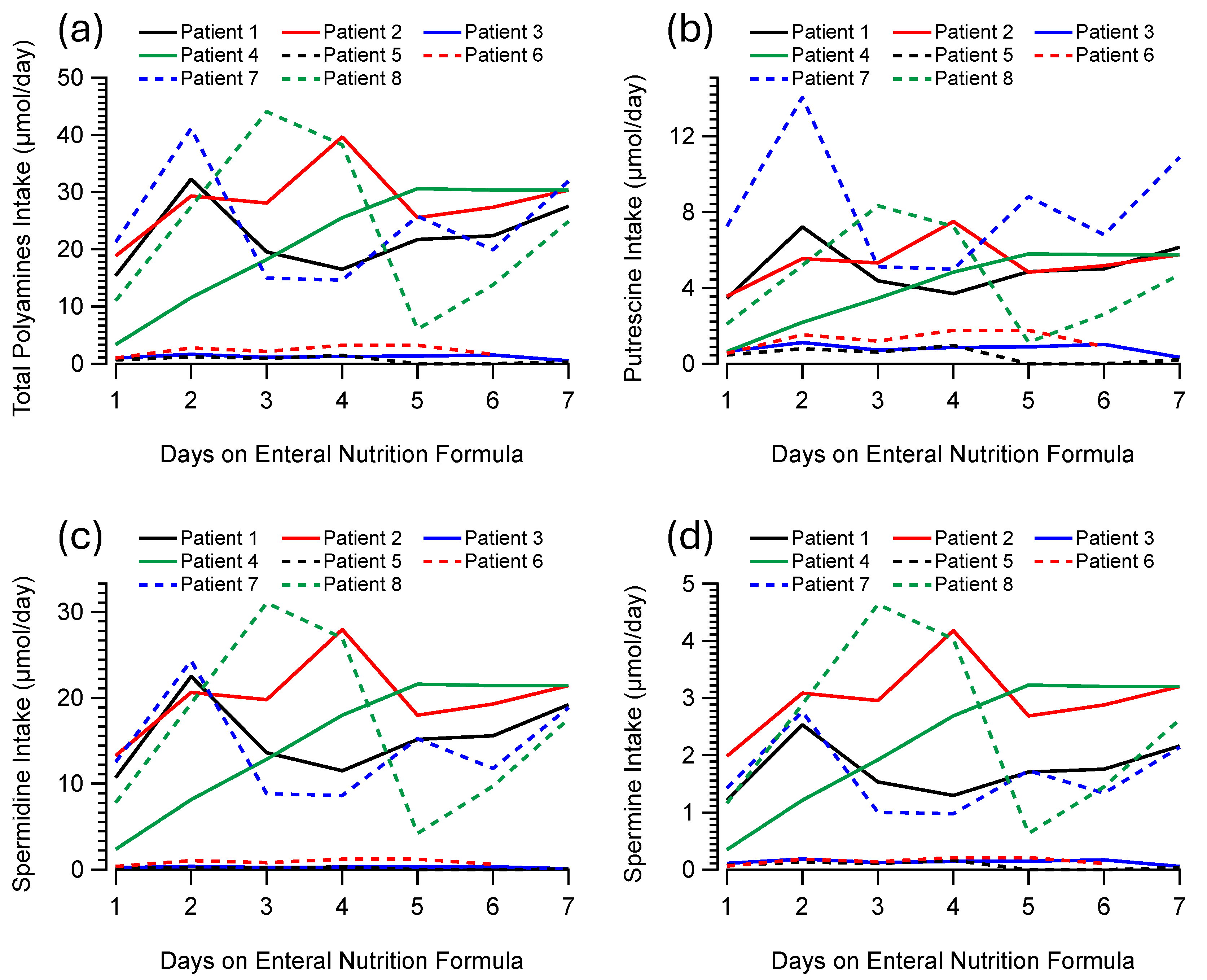
Figure 1. Daily total polyamine intake (sum of putrescine, spermidine and spermine) (a), putrescine (b), spermidine (c) and spermine (d) in µmol, determined in each of the eight patients. The EN formula administrated and pathologies of patients were: Patient 1 – Nutrison (abdominal origin sepsis), Patient 2 - Nutrison Advanced Diason Energy HP (liver transplant), Patient 3 - Nutricomp Hepa (sepsis), Patient 4 - Nutrison Advanced Diason Energy HP (ketoacidosis), Patient 5 - Nutricomp HEPA (haemodynamic instability), Patient 6 - Novasource GI Protein (cardiorespiratory arrest), Patient 7 - Nutrison Energy Multifibre (cerebral haemorrhage) and Patient 8 - Nutrison Advanced Diason Energy HP (rhombencephalitis).
Preprints 141963 g001
Table 1. Enteral nutrition formulas analysed.
Formula Type Name Manufacturer
Complete, polymeric
    Hyperproteic and hypercaloric Fresubin Thickened Fresnius kabi
Isosource Protein Fibre Nestlé
Novasource GI Protein Nestlé
Osmolite Plus Abbott
    Normoproteic and hypercaloric Nutrison Energy Nutricia
Nutrison Energy Multi Fibre Nutricia
    Normoproteic and normocaloric Fresubin Original Fibre Fresnius kabi
Nutrison Nutricia
Osmolite Abbott
    Hyperproteic and normocaloric Impact Enteral Nestlé
Complete, special
    Hyperproteic and hypercaloric Impact Nestlé
Nepro HP Abbott
Nutrison Advanced Diason Nutricia
        Energy HP
    Normoproteic and hypercaloric Nutricomp Hepa B. Braun
Oxepa Abbott
    Hypoproteic and hypercaloric Nepro LP Abbott
Proteic Protein NM Cantabria Labs
Table 2. Polyamine content and total polyamines (considering the sum of putrescine, spermidine and spermine) in EN formulas in nmol/mL (standard error of mean).
EN Formulas (n) Putrescine Spermidine Spermine N-Acetyl Putrescine N-Acetyl Spermidine N-Acetyl Spermine Total Polyamines
Fresubin Original Fibre (8)
    (Fresenius Kabi)
1.87(0.2) 11.46(0.66) 2.55(0.17) 42.39(3.72) 0.58(0.05) 0.28(0.04) 15.88(0.95)
Fresubin Thickened (1)
    (Fresenius Kabi)
2.73 1.37 0.52 176.69 3.76 0.67 4.62
Impact (4)
    (Nestle Health Science)
5.81(0.4) 12.48(1.27) 10.82(0.99) 20.81(0.58) 1.45(0.3) 1.47(0.33) 29.1(2.48)ǂ
Impact Enteral (1)
    (Nestle Health Science)
10.67 18.24 12.78 29.74 3.75 2.62 41.69
Isosource Protein Fibre (6)
    (Nestle Health Science)
5.88(1.04) 10.04(1.72) 1.52(0.27) 22.71(9.99) 0.66(0.07) 0.2(0.02) 17.43(2.58)
Nepro HP (2) (Abbott) 4.91(1.26) 2.24(0.63) 0.55(0.26) 53.45(7.08) 1.27(0.73) 0.14(0.11) 7.7(2.15)
Nepro LP (6) (Abbott) 1.33(0.44) 0.89(0.23) 0.35(0.1) 28.5(1.44) 1.66(0.78) 0.07(0.01) 2.57(0.65)
Novasource GI Protein (3)
    (Nestle Health Science)
1.18(0.28) 0.81(0.22) 0.14(0.09) 21.2(5.73) 0.48(0.32) 0.02 2.13(0.56)
Nutricomp HEPA (9)
    (B Braun Sharing Expertise)
3.28(1.21) 1.09(0.27) 0.55(0.24) 307.99(177.85) 6.93(1.22) 0.32(0.17) 4.92(1.46)
Nutrison (5) (Nutricia) 5.13(0.87) 15.99(3.89) 1.8(0.41) 177.59(64.52) 1.63(0.91) 0.26(0.12) 22.92(5.02)ǂ
Nutrison Advanced Diason
    Energy HP (10) (Nutricia)
5.75(0.74) 21.42(1.36) 3.2(0.21) 35.15(3.43) 1.49(0.13) 0.54(0.07) 30.37(1.98)ǂ
Nutrison Energy (1) (Nutricia) 11.13 13.91 1.16 287.73 1.25 0.18 26.19
Nutrison Energy Multifibre (3)
    (Nutricia)
10.8(0.86) 18.69(2.26) 2.12(0.4) 311.19(6.73) 1.12(0.16) 0.29(0.04) 31.61(2.2)ǂ
Osmolite (1) (Abbott) 1.7 1.2 0.16 19.82 0.39 0.22 3.06
Osmolite Plus (3) (Abbott) 1.96(0.03) 1.25(0.08) 0.17(0.01) 19.43(0.96) 0.38(0.02) 0.09(0.01) 3.38(0.11)
Oxepa (2) (Abbott) 1.5(0.05) 3.06(0.41) 0.3(0.04) 24.41(0.78) 0.75(0.05) 0.26(0.07) 4.86(0.4)
Proteina NM (2) (Cantabria Labs) 0.53(0.1) 0 0.52(0.01) 7.45(0.2) 0.48(0.05) 2.21 1.05(0.09)
Values are presented as the mean (standard error of the mean) for a determined number (n) of different samples of the nmol/mL content of amines in enteral nutrition (EN) formulas. For total polyamines: ǂ significantly higher (with different values of p) regarding Fresubin Original Fibre, Isosource Protein Fibre (except Nutrison), Nepro LP, Novasource GI Protein, Nutricomp HEPA and Osmolite Plus.
Table 3. Average biogenic amines content in EN formulas in nmol/mL (standard error of mean).
EN Formulas (n) Cadaverine Tyramine β-phenyl-
#ethylamine
Isoamylamine
Fresubin Original Fibre (8)
    (Fresenius Kabi)
1.21(0.1)*** 0.97(0.08) 0.26(0.03)*** 7.78(2.94)
Fresubin Thickened (1)
    (Fresenius Kabi)
1.66 4.01 0 8.43
Impact (4) (Nestle Health Science) 1.32(0.1)* 1.59(0.08) 0.55(0.02)*** 1.71(0.25)
Impact Enteral (1)
    (Nestle Health Science)
2.88 3.03 0.54 7.26
Isosource Protein Fibre (6)
    (Nestle Health Science)
1.4(0.32)* 2.25(0.5) 0.34(0.03)*** 5.22(1.43)
Nepro HP (2) (Abbott) 1.72(0.67) 4(0.41) 1.42(0.48) 14.27(7.14)
Nepro LP (6) (Abbott) 0.58(0.19)*** ɸɸ 2.17(1.48) 1.32(0.68)*** 5.11(1.92)
Novasource GI Protein (3)
    (Nestle Health Science)
0.6(0.14)*** ɸ 0.78(0.26) 0.05 4.32(0.31)
Nutricomp HEPA (9)
    (B Braun Sharing Expertise)
1.62(0.35)* 2.44(0.51) 6.87(1.01)*** 63.33(29.49)
Nutrison (5) (Nutricia) 0.81(0.18)*** ɸ 1.82(0.39) 0.6(0.33)*** 7.08(1.36)
Nutrison Advanced Diason Energy
    HP (10) (Nutricia)
2.67(0.22) 1.5(0.15) 0.65(0.09)*** 5.23(1.12)
Nutrison Energy (1) (Nutricia) 1.04 3.47 0.34 8
Nutrison Energy Multifibre (3)
    (Nutricia)
2.47(0.13) 1.32(0.21) 0.56(0.08)*** 4.13(1.98)
Osmolite (1) (Abbott) 0.62 0.71 0.46 2.32
Osmolite Plus (3) (Abbott) 0.68(0.02) 0.79(0.07) 0.39(0.01)*** 2.07(0.62)
Oxepa (2) (Abbott) 0.53(0.05) 0.71 0.6(0.07) 1.42(0.08)
Proteina NM (2) (Cantabria Labs) 3.74 0 0.56(0.02) 4.44(0.87)
Values are presented as the mean (standard error of the mean) for a determined number (n) of different samples of the nmol/mL content of amines in enteral nutrition (EN) formulas. For cadaverine *** p < 0.001 by comparison with Nutrison Advanced Diason Energy HP; ɸ p < 0.05 and ɸɸ p < 0.01 by comparison with Nutrison Energy Multifibre. For β-phenylethylamine *** p < 0.001 by comparison with Nutricomp Hepa.
Table 4. Average daily (standard error) intake of biogenic amines via enteral nutrition (EN) in µmol.
Biogenic Amines Daily Intake via EN (Standard Error) (µmol) Range of Daily Intake via EN (µmol)
Putrescine 4.04 (1.01) 0.21–14.06
Spermidine 11.53 (3.42) 0.07–32.39
Spermine 1.62 (0.49) 0.03–4.84
Total Polyamines 17.18 (4.79) 0.31–45.92
N-Acetyl putrescine 81.59 (27.35) 3.87–405.17
N -Acetyl spermidine 1.26 (0.14) 0.16–2.36
N -Acetyl spermine 0.27 (0.08) 0.01–0.82
Cadaverine 1.47 (0.38) 0.1–4.04
Tyramine 1.11 (0.16) 0.15–2.56
β-Phenyletylamine 0.73 (0.18) 0.02–2.34
Isoamylamine 7.05 (1.49) 0.58–21.53
Disclaimer/Publisher’s Note: The statements, opinions and data contained in all publications are solely those of the individual author(s) and contributor(s) and not of MDPI and/or the editor(s). MDPI and/or the editor(s) disclaim responsibility for any injury to people or property resulting from any ideas, methods, instructions or products referred to in the content.
Copyright: This open access article is published under a Creative Commons CC BY 4.0 license, which permit the free download, distribution, and reuse, provided that the author and preprint are cited in any reuse.
Prerpints.org logo

Preprints.org is a free preprint server supported by MDPI in Basel, Switzerland.

Subscribe

Disclaimer

Terms of Use

Privacy Policy

Privacy Settings

© 2025 MDPI (Basel, Switzerland) unless otherwise stated
