

Submitted:
03 December 2024
Posted:
04 December 2024
You are already at the latest version
Abstract
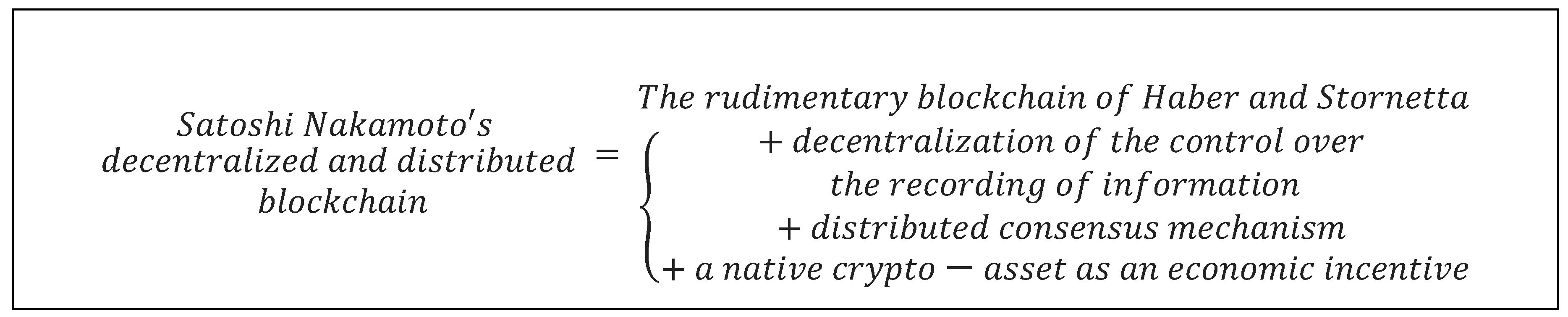
This article explores the potential of Distributed Ledger Technology (DLT), with a focus on blockchain, to address key challenges related to the security, ownership, and management of personal data. We trace the foundational work of Haber and Stornetta, who introduced the core principles of blockchain to secure digital records within the real economy. Building on this, Nakamoto’s innovations in blockchain technology introduced a native crypto-asset, which not only aligns and concentrates the interests of network participants but also resolves the previously unsolved “double-spending problem.” This breakthrough decentralizes the verification and control of recorded information, enhancing security in monetary transactions Migrants often face challenges related to rights protection, identity management, and limited access to financial services. Blockchain applications, with their strengths in secure data storage, transparent transactions, and reliable identity verification, offer promising solutions. In this article, we examine real-world blockchain applications that enhance identity management and foster financial inclusion for migrants. Blockchain provides an infrastructure that empowers individuals with greater control over their financial and personal data, particularly through self-sovereign identity (SSI) and the use of stablecoins as global currencies. These innovations are becoming foundational components of a new digital ecosystem for information and finance.
Keywords:
1. Introduction
2. Understanding Blockchain: How It Can Secure and Empower Migrants’ Real and Monetary Data
2.1. The Invention of Haber and Stornetta: A Solution for the Security and Integrity of Digital Documents in the Real Economy
2.1.1. The Challenge of Document Integrity in the Digital Age
2.1.2. Haber and Stornetta’s Solution for Preventing Digital Document Falsification
Cryptographic Hashing for Security
Cryptographic Linking
Secure Timestamping
2.1.3. Leveraging Blockchain for Migrant Integration into the Real Economy
2.2. The Invention of Nakamoto: A Solution for the Integrity of Financial Transactions in the Monetary Sphere of Economic Activities
2.2.1. Nakamoto’s Solution to Double-Spending: Ensuring Financial Transaction Integrity
2.2.2. Nakamoto’s Decentralized Solution: Consensus Mechanism and Native Crypto-Asset
2.2.3. Nakamoto’s Blockchain for Migrants’ Financial Inclusion, Cross-Border Payments, and Remittances
3. Blockchain and Self-Sovereign Identity (SSI) for Migrants’ Identity Management
3.1. The Importance of Identity Management for Migrants: Enhancing Data Privacy and Security with Self-Sovereign Identity (SSI)
3.2. Blockchain-Based Solutions for Self-Sovereign Ident Ity (SSI): Concrete Examples and Initiatives
4. Stablecoins, Cryptocurrencies and Blockchain: Revolutionizing Cross-Border Payments and Remittances for Migrant Financial Inclusion
4.1. Current Challenges and Importance of Traceability for Financial Inclusion
4.2. Blockchain-Based Solutions for Remittances and Cross-Border Payments: Concrete Examples and Initiatives Using Stablecoins and Cryptocurrencies
5. Concluding Remarks
| 1 | “DLT is a set of technological infrastructure and applications. It allows simultaneous access, validation, and record updating in a secure and unchangeable way across a network spread across multiple entities or locations (as opposed to a central ledger, where a single entity records transactions and ownership). Cryptography is a technique for protecting information by transforming it into a secure format.” (Bank of England, 2022, p5) |
| 2 | The MD5 hash generator is available at: https://www.md5hashgenerator.com/
|
References
- Ahad, M. T., & Emon, Y. R. (2023), “Securing Refugee Identity: A Literature Review on Blockchain-based Smart Contract”, arXiv preprint arXiv:2310.19018.
- Akerlof, G.A. (1970), “The Market for Lemons: Quality Uncertainty and the Market Mechanism”, Quarterly Journal of Economics, Vol. 84, p. 488–500.
- Alchian, A. A., & Demsetz, H. (1972), “Production, information costs, and economic organization”, The American economic review, 62(5), p. 777-795. [CrossRef]
- Allen, D. W., Berg, C., Markey-Towler, B., Novak, M., & Potts, J. (2020). “Blockchain and the evolution of institutional technologies: Implications for innovation policy”, Research Policy, 49(1). [CrossRef]
- Auinger, A., & Riedl, R. (2018). “Blockchain and trust: Refuting some widely-held misconceptions”. https://web.archive.org/web/20200709120622id_/https://aisel.aisnet.org/cgi/viewcontent.cgi?article=1246&context=icis2018.
- Bank of America Institute. (2023). Beyond crypto: Tokenization. https://institute.bankofamerica.com/content/dam/bank-of-america-institute/transformation/beyond-crypto-tokenization.pdf.
- Bank of England. (2022), Financial Stability in Focus: Cryptoassets and decentralized finance. https://www.bankofengland.co.uk/financial-stability-in-focus/2022/march-2022.
- Bezovski, Z. (2016). “The future of the mobile payment as electronic payment system”, European Journal of Business and Management, 8(8), p. 127-132. ISSN 2222-1905.
- BIS, (2020). “Enhancing cross-border payments: Building blocks of a global roadmap”, Committee on Payments and Market Infrastructures, CPMI, ISBN 978-92-9259-399-5 (online): https://www.bis.org/cpmi/publ/d193.pdf.
- Boukhali, S., Dauner Gardiol, I., (2020). “Financial Inclusion of Migrants. Exploration paper”, Federal Department of Foreign Affairs FDFA, Swiss Agency for Development and Cooperation SDC.
- https://www.shareweb.ch/site/EI/Documents/FSD/Topics/Inclusive%20Finance/SDC%20-%20exploration%20paper%20-%20Financial%20inclusion%20of%20migrants%20-%202020-01%20(en).pdf.
- Chainalysis, (2023). The 2023 geography of cryptocurrency report, October.
- Chohan, U. W. (2021). “The double spending problem and cryptocurrencies”, c10.2139/ssrn.3090174.
- Choi, J. P., Jeon, D. S., & Kim, B. C. (2019). “Privacy and personal data collection with information externalities”, Journal of Public Economics, 173, p. 113-124. [CrossRef]
- Coase, R. 1937. “The Nature of the Firm”, Economica 16(4): P. 386-405. [CrossRef]
- Conroy, J. (2005). “APEC and financial exclusion: Missed opportunities for collective action?”, Asia Pacific Development Journal, 12(1), p. 53-80.
- https://econpapers.repec.org/RePEc:unt:jnapdj:v:12:y:2005:i:1:p:53-79.
- Cunliffe, J. (2020), “Cross-border payment systems have been neglected for too long”, Financial Times.
- https://www.ft.com/content/a241d7e0-e1de-4812-b214-b350cbb7d046.
- Dhananjay, S., Kumar, V., Agrawal, H., Patankar, P., & Jain, S. A. (2019). “Distributed Ledger Technology based data minimization of digital identities”, International Journal of Advance Research, Ideas and Innovations in Technology.
- Di Iorio, A., Kosse, A., & Mattei, I. (2024). “Embracing diversity, advancing together-results of the 2023 BIS survey on central bank digital currencies and crypto”. https://www.bis.org/publ/bppdf/bispap147.pdf.
- Flore, M. (2018). “How blockchain-based technology is disrupting migrants’ remittances: A preliminary assessment”, Luxembourg. [CrossRef]
- Haber, S., & Stornetta, W. S. (1991). “How to time-stamp a digital document”, p. 437-455. Springer Berlin Heidelberg.
- IOM. (2024). World Migration Report 2024. International Organization for Migration. https://www.iom.int/world-migration-report-2024.
- Jackson, T. (2015). « Could Bitcoin ease the pain of Africa's migrant workforce? », BBC Business. https://www.bbc.com/news/business-31735976.
- Kosse, A., Glowka, M., Mattei, I., & Rice, T. (2023). “Will the real stablecoin please stand up?”, BIS Papers. https://www.bis.org/publ/bppdf/bispap141.pdf.
- Kuperberg, M. (2019). “Blockchain-based identity management: A survey from the enterprise and ecosystem perspective”, IEEE Transactions on Engineering Management, 67(4), p. 1008-1027.
- Kulabukhova, N., Ivashchenko, A., Tipikin, I., & Minin, I. (2019). “Self-sovereign identity for iot devices”, in Computational Science and Its Applications–ICCSA 2019: 19th International Conference, Saint Petersburg, Russia, July 1–4, Proceedings, Part II 19, p. 472-484. Springer International Publishing.
- Lotz, S., & Vasselin, F. (2019). “A New Monetarist Model of Fiat And E-Money”. Economic Inquiry, 57(1), 498-514. [CrossRef]
- Löfgren, K. G., Persson, T., & Weibull, J. W. (2002). Markets with asymmetric information: The contributions of George Akerlof, Michael Spence and Joseph Stiglitz, The Scandinavian Journal of Economics, p. 195-211. [CrossRef]
- Maimbo, M. S. M., El Qorchi, M. M., & Wilson, M. J. F. (2003). Informal Funds Transfer Systems: An analysis of the informal hawala system, IMF-World Bank occasional paper 222, International Monetary Fund, Washington, DC.
- McKinsey. (2024). “What is economic inclusion?”, https://www.mckinsey.com/featured-insights/mckinsey-explainers/what-is-economic-inclusion.
- Medina, L. & Schneider, F. (2017). “Shadow economies around the world: New results.
- for 158 countries over 1991-2015”, CESifo Working Paper, n° 6430. [CrossRef]
- Mühle, A., Grüner, A., Gayvoronskaya, T., & Meinel, C. (2018). “A survey on essential components of a self-sovereign identity”, Computer Science Review, 30, p. 80-86. [CrossRef]
- Nakamoto, S. (2008). “Bitcoin: A Peer-to-Peer Electronic Cash System”, www.bitcoin.org.
- Ndlovu, R. (2022). “Four out of five diasporan zimbabweans live in south africa.” Bloomberg. URL: https://www. bloomberg. com/news/articles/2022-09-06/four-out-of-fivediasporan-zimbabweans-live-in-south-africaxj4y7vzkg.
- Potts, J., & Rennie, E. (2019). “Web3 and the creative industries: How blockchains are reshaping business models”, in A research agenda for creative industries, p. 93-111, Edward Elgar Publishing.
- Rühmann, F., Konda, S. A., Horrocks, P., & Taka, N. (2020). “Can blockchain technology reduce the cost of remittances?”. https://www.oecd-ilibrary.org/content/paper/d4d6ac8f-en.
- Sarma, M., & Pais, J. (2011). “Financial inclusion and development”, Journal of international development, 23(5), p. 613-628. [CrossRef]
- Satybaldy, A., Ferdous, M. S., & Nowostawski, M. (2024). “A taxonomy of challenges for self-sovereign identity systems”, IEEE Access.
- Schneier, B. (2015). Data and Goliath: The hidden battles to collect your data and control your world. WW Norton & Company.
- Shoemaker, E., Kristinsdottir, G. S., Ahuja, T., Baslan, D., Pon, B., Currion, P., ... & Dell, N. (2019). “Identity at the margins: Examining refugee experiences with digital identity systems in Lebanon, Jordan, and Uganda”, in Proceedings of the 2nd ACM SIGCAS Conference on Computing and Sustainable Societies, p. 206-217.
- Shou, L., Bai, H., Chen, K., & Chen, G. (2012). « Supporting privacy protection in personalized web search”, IEEE transactions on knowledge and data engineering, 26(2), p. 453-467.
- TechPression, (2023). “Uhuru Wallet, Flexid offer Zimbabweans remittance services”. https://techpressionmedia.com/uhuru-wallet-flexid-offer-zimbabweans-remittance-services/.
- Tobin, A., & Reed, D. (2016). “The inevitable rise of self-sovereign identity. The Sovrin Foundation”, 29, 18. https://sovrin.org/wp-content/uploads/2018/03/The-Inevitable-Rise-of-Self-Sovereign-Identity.pdf.
- United Nations High Commissioner for Refugees (UNHCR). (2023). “UNHCR wins award for innovative use of blockchain solutions to provide cash to forcibly displaced in Ukraine”. https://www.unhcr.org/news/press-releases/unhcr-wins-award-innovative-use-blockchain-solutions-provide-cash-forcibly.
- Vasselin, F. (2020). “Analysis of the Competition Between Cash and Mobile Payments in Markets with Mobile Partnerships: A Monetary Search Model Point of View”, Bankers, Markets & Investors, 160(1), p. 2-15. [CrossRef]
- Wang, F., & De Filippi, P. (2020). “Self-sovereign identity in a globalized world: Credentials-based identity systems as a driver for economic inclusion”, Frontiers in Blockchain, 2, 28. https://ssrn.com/abstract=3524367.
- Williamson, O. E. (1981). “The economics of organization: The transaction cost approach”, American journal of sociology, 87(3), p. 548-577. [CrossRef]
- World Bank (2021). “Central bank digital currencies for cross-border payments: A review of current experiments and ideas”. https://documents1.worldbank.org/curated/en/369001638871862939/pdf/Central-Bank-Digital-Currencies-for-Cross-border-Payments-A-Review-of-Current-Experiments-and-Ideas.pdf.
- World Bank (2022), “Remittance prices worldwide”. https://remittanceprices.worldbank.org/corridor/South-Africa/Zimbabwe.
- Yeasmin, S., & Baig, A. 2019. “Unblocking the potential of blockchain”, in 2019 international conference on electrical and computing technologies and applications (ICECTA), p. 1-5. IEEE. [CrossRef]
- Zak, P. J., & Knack, S. (2001). “Trust and growth”, The economic journal, 111(470), p. 295-321. [CrossRef]
- Zhao, Z., & Liu, Y. (2019). “A blockchain based identity management system considering reputation”, in 2019 2nd International Conference on Information Systems and Computer Aided Education (ICISCAE), p. 32-36. IEEE. available: https://drive.google.com/file/d/1HE6541km1Dj0n7pZONJnNJEYCcBTTVUQ/view.
- Zhuo, X., Irresberger, F.,and Bostandzic, D., (2023). “Blockchain for Cross-border Payments and Financial Inclusion: The Case of Stellar Network”. [CrossRef]


| Variables | Centralized cloud | Decentralized blockchain |
| Examples | Google Drive, Dropbox | Sovrin |
| Price | Free for 15 G0 (Google drive) and for 2 G0 (Dropbox) | Often free for migrants, not for other end users: costs may be associated with infrastructure |
| Decentralization and risk of failure | Centralized, high risk of single point of failure | Decentralized, reduced risk of failure due to distributed nodes |
| Security with cryptography | Uses cryptography, but remains vulnerable to centralized attacks | Uses robust cryptographic algorithms, high level of security due to decentralization |
| Control and ownership of data | Data is controlled and owned by the company (Google, Dropbox) | Users have control and ownership of their own data (self-sovereign identity) |
| Transparency and auditability | Low transparency, relies on the company for auditing | Transparent and immutable history, ease of auditing, reduces fraud risks and increases trust |
| Initiatives | Description | Focus |
| Sovrin | Public-permissioned blockchain for Decentralized Identifiers (DIDs), DID documents, and Verifiable Credentials (VCs) | Secure storage and management of identity data |
| IBM & Visa | Digital identity system based on blockchain | Providing secure and verifiable identities for everyone, including migrants |
| ID2020 Alliance | Global partnership using blockchain to create digital identities for underserved populations | Secure, privacy-protecting, and user-controlled digital IDs for migrants and refugees |
| BanQu | Blockchain-based economic identity platform | Helping refugees and migrants establish a digital identity linked to their transaction history for financial inclusion |
| Category | Backing | Examples | Advantages | Disadvantages |
| Fiat-backed | Fiat currency | USD Coin (USDC), Tether (USDT), Binance USD (BUSD), GUSD (Gemini Dollar), USDP (Pax Dollar) | Price stability, transparency | Centralized (third-party custodian) Counterparty risk, Cost of external audits, Off chain |
| Commodity-backed | Physical commodity | Digix Gold (DGX), Pax Gold (PAXG) | Hedge against inflation, portfolio diversification | Commodity price volatility |
| Crypto-backed | Crypto-asset | MakerDAO (DAI), Synthetix (SNX), Frax (FXS), LUSD (Liquity USD) | Decentralization (smart contract), capital efficiency (cost-effective exchangeability) | Risk associated with collateral cryptocurrency volatility (need of over-collateralization to absorb price fluctuations) |
| Algorithmic (unbacked) | Algorithm | USDD (USDD), TerraClassicUSD (USTC), USDX [Kava] (USDX), sUSD (SUSD) | Decentralization, no collateral required (runs on the application layer using dual coin to match the demand and supply of the stablecoin) | Algorithmic failure risk |
Disclaimer/Publisher’s Note: The statements, opinions and data contained in all publications are solely those of the individual author(s) and contributor(s) and not of MDPI and/or the editor(s). MDPI and/or the editor(s) disclaim responsibility for any injury to people or property resulting from any ideas, methods, instructions or products referred to in the content. |
© 2024 by the authors. Licensee MDPI, Basel, Switzerland. This article is an open access article distributed under the terms and conditions of the Creative Commons Attribution (CC BY) license (http://creativecommons.org/licenses/by/4.0/).