

Submitted:
03 December 2024
Posted:
04 December 2024
You are already at the latest version
Abstract
Energy is the most carbon-intensive industry in Russia. At the same time, the carbon footprint of electricity generation or produced electricity significantly affects the total carbon footprint of a wide variety of materials and products, which is especially relevant for products of energy-intensive industries (aluminum, platinum, carbon fiber reinforced plastics, etc.) and hydrogen energy. According to various sources, the average carbon footprint of electricity generated and consumed in Russia ranges from 310 to 634 g CO2-eq./kWh. In addition, it is necessary to take into account significant differences in the generation structure of individual energy systems and regions of Russia, which causes huge variance in the values of the carbon footprint of electricity. Thus, the main type of fuel used at energy facilities in Russia is natural gas, the share of which is 71% of all fossil fuel consumption by generation facilities. There are also differences in the generation structure between regions within one integrated energy system (IES). The paper analyzes methodological approaches to determining grid emission factors for Russian electricity. It has been established that different principles of territorial division of the Russian energy system can be used to determine grid emission factors (national average grid emission factor, grid emission factors for the unified energy system, grid emission factors for price and non-price zones of the wholesale electricity market).
Keywords:
carbon footprint
; electricity generation
; grid emission factor
1. Introduction
Ensuring carbon neutrality while maintaining sustainable economic growth is the main idea of the Strategy for the socio-economic development of the Russian Federation with low greenhouse gas emissions until 2050 [1]. In accordance with Decree of the President of the Russian Federation No. 666 of 04.11.2020, by 2030, greenhouse gas emissions must be reduced to 70% relative to the 1990 level [2].
The Russian Federation accounts for 7% of global carbon dioxide emissions. At the same time, the energy sector makes the largest contribution to the total greenhouse gas emissions in the Russian Federation [3,4]. In 1990, the contribution of the energy sector to the total anthropogenic greenhouse gas emissions (excluding the Land Use, Land-Use Change and Forestry sector), expressed in CO2 equivalent, was 81.5%, and in 2020 it was 77.9% [5].
Data on the carbon intensity of Russian energy is currently published in reports by international organizations and analytical centers, in addition, such data is contained in various scientific publications, reviews and reports [6,7,8,9,10,11,12,13,14,15,16]. These data were obtained at different periods of time, based on different methodological approaches using data from different sources, which should be taken into account when using certain numerical values when determining the carbon footprint of electricity.
It is also important to consider that the carbon footprint depends on the method of energy generation and can vary significantly across regions of the world depending on the prevailing technologies [17,18,19,20,21,22]. In Norway, around 90% of all electricity produced comes from hydropower [23,24], with an average national carbon footprint of 18 g CO2-eq./kWh as of 2023 [25]. The main source of electricity production in China is coal-fired thermal power plants (more than 62%) [26], so on average, electricity in China has a fairly high carbon footprint 582 g CO2-eq./kWh in 2023 [27,28].
In countries with a small territory, the generation structure is more homogeneous than in large ones [29]. For example, in some countries with a relatively small area (Iceland, Costa Rica), the entire energy system can be taken as a single one with common characteristics [30].
The carbon footprint of electricity produced in countries with large territory usually varies significantly across regions, which also needs to be taken into account. For example, in the United States, the carbon footprint of electricity is determined using factors that are calculated at the level of individual eGRID subregions. eGRID emission factors take into account greenhouse gas emissions directly prodused by generation facilities, but do not include imports/exports of electricity to a into a specific state or any other grouping of plants. Also, they do not take into account energy losses during transmission and distribution between generation points and consumption points, or electricity purchases. In addition, eGRID does not take into account any pre-combustion emissions associated with the extraction, processing, and transportation of fuels and other materials used in plants, or any emissions associated with the construction of plants [31,32,33,34,35].
The Russian energy system also has a complex structure, since individual integrated energy systems and regions have their own characteristics of electricity generation, which is important to take into account when determining the carbon footprint of electricity.
The carbon footprint of electricity has a significant impact on the carbon footprint of products that use electrical energy in their production. In the context of the need to address the problem of global climate change, tightening environmental legislation, and legislative regulation of greenhouse gas emissions, determining the carbon footprint of products is an important tool for managing climate risks. Calculating the carbon footprint allows organizations to report on greenhouse gas emissions as part of climate regulation, assess their environmental burden, identify activities and processes in which greenhouse gas emissions can be reduced, and develop measures to reduce the negative impact on the climate system.
Hydrogen is currently a promising energy resource for industrial decarbonization. However, most of the hydrogen currently produced is considered as «grey» because its production is accompanied by significant consumption of electricity obtained from fossil fuels (e.g. steam methane reforming and coal gasification), and leads to additional CO2 emissions [36]. Thus, for the use of hydrogen in the energy sector to be promising, it is necessary to use low-carbon sources of electricity for hydrogen production.
Today, mechanisms of economic responsibility for greenhouse gas emissions are being introduced (quotas for exceeding greenhouse gas emission standards, greenhouse gas emissions trading). Therefore, assessing the carbon footprint and effectively using mechanisms to reduce it will allow organizations to mitigate economic risks (fines, reduced sales of products, etc.) along with reputational risks (image, competitiveness of products).
Accounting for the carbon footprint of electricity is especially important in the production of energy-intensive materials and goods, such as aluminum, platinum and other metals, carbon fiber reinforced plastics, etc. [37,38,39,40,41].
For example, in the production of aluminum at the Krasnoyarsk Aluminum Plant RUSAL (Russia) uses its own generating capacities (hydroelectric power plants) [42], so in this case, assessing the carbon footprint of products does not present significant methodological difficulties. However, for most other products manufacturing, external electricity is used, from the general network or from third-party suppliers. In this regard, there is a need to obtain adequate data on the carbon footprint of the electricity used. Often in practice, difficulties arise with justifying the carbon footprint of the electricity used in the products manufacturing due to the lack of data that would be approved or recommended by government authorities.
The market or regional method can be used to assess the carbon footprint of electricity [43]. The market method is applicable only in those regions where markets for «green» contractual instruments have been formed, which allow consumers to choose electricity differentiated by origin.
Organizations mainly use electricity from public grids. In this case, the carbon footprint should be calculated using regional grid emission factors calculated by the organization based on statistical data on fuel consumption and on the volumes of electricity and heat supplied from all external generating facilities located in the regional energy system of the constituent entity of the Russian Federation. However, the mechanism for calculating regional grid emission factors is not transparent enough, and the data presented in open sources have varying degrees of validity and often contradict each other. This creates difficulties in determining indirect energy emissions for organizations. Thus, a relevant task is a comparative analysis of greenhouse gas emission factors and approaches to establishing them in order to justify the use of the most adequate (legitimate) data for calculating the carbon footprint of consumed electricity.
The article presents an overview of the approaches used to assess the carbon footprint and available data on the carbon footprint of electricity produced in the Russian Federation, and their comparative analysis, identifies problems with the quality of data and the calculation of greenhouse gas emission factors, and provides recommendations for substantiating methodological approaches to assessing the carbon footprint of electricity in products manufacturing and for the use of certain data.
Since the energy complex of the Russian Federation is not homogeneous and has a complex territorial structure, when determining the carbon footprint of electricity, it is important to take into account the specifics of the electric power industry functioning both at the level of the state (at a level of Unified Energy System of Russia) and at the level of integrated energy systems or at a level of a single regions.
2. Materials and Methods
The research involved collecting and systematizing of information on the structure and features of electric power generation in the Russian Federation at different levels, from the Unified Energy System (UES) to the integrated energy systems which are part of UES. In addition, the features of generation in individual regions (using the Perm region as an example) and at enterprises were analyzed. The considered structure of electric power generation in the Russian Federation is presented in Figure 1.
Comparison of the generation structure at the level of the Unified Energy System of Russia, the Ural Interconnected Energy System, the energy system of Perm region and individual generating capacities (electricity sources of large enterprises, thermal power plants, small and medium-sized generation facilities, etc.) is carried out in order to establish differences in the technologies used in electricity generation, types of fuel combusted. The generation structure, the amount and type of fossil fuel consumed to generate electricity ultimately determine its carbon intensity. Therefore, when determining the electricity carbon footprint, it is important to take into account the generation features characteristic of different territories of the Russian Federation.
For a comparative analysis of existing methodological approaches to assessing the electricity carbon footprint, information from open sources publishing grid emission factors for the Russian Federation was collected and systematized.
The possibility and feasibility of using data on grid emission factors was assessed based on the requirements of environmental legislation and the specifics of the generation structure in different territories of Russia.
3. Results and Discussion
3.1. Structure and Features of the Energy System of the Russian Federation
The Unified energy system (UES) operates on the territory of the Russian Federation, representing one of the largest and unique energy system associations in the world energy sector in terms of its quantitative and qualitative characteristics. The UES was created through the step-by-step unification and organization of parallel operation of regional energy systems, and the creation of interregional integrated energy systems. The UES of Russia consists of 7 integrated energy systems: the East, Siberia, the Urals, the Middle Volga, the South, the Center and the Northwest, which are further divided into 75 regional energy systems. In addition to the UES, the Energy Complex of Russia includes five technologically isolated territorial energy systems (TITES) of the Kamchatka region, the Magadan and Sakhalin regions, the Chukotka Autonomous okrug, as well as the Norilsk-Taimyr technologically isolated energy system in the Krasnoyarsk Region [44]. In addition, the UES of Russia is conditionally divided into two synchronous zones. The first synchronous zone includes all the unified energy systems, except for the integrated energy system of the East. The second synchronous zone includes the integrated energy system of the East, which operates in isolation from the first synchronous zone [45]. Centralized operational dispatch control of the technological regime of the UES of Russia on the territory of the constituent entities of the Russian Federation is carried out by JSC «System Operator of the Unified Energy System».
As of January 1, 2024, the total installed capacity of power plants of the UES of Russia amounted to 248 164.88 MW, of which thermal power plants account for 65.98%, hydroelectric power plants - 20.24%, nuclear power plants - 11.9%, wind power plants - 1.01%), solar power plants - 0.87% [46]. The main fuel used at power facilities in Russia is natural gas. It accounts for about 71% of all fuel consumption in the electric power industry. At the generation facilities of the second synchronous zone, coal is predominantly used (up to 60% of consumption), which is due to a lower level of gasification. A comparative characteristic of the generation structure of the UES of Russia as a whole and individual IESs at the beginning of 2024 is presented in Table 1 [47].
As can be seen from the presented data, thermal power plants prevail in the generation structure of all integrated power system, however, the integrated power system of Siberia, the integrated power system of the East and the TITES are characterized by a relatively high share of hydroelectric power plants, since the largest hydroelectric power plants in Russia are located in Siberia (Sayano-Shushenskaya, Krasnoyarsk, Bratskaya) [48]. The share of hydroelectric power plants in the generation structure of thermal power plants is high, while the main type of fuel for the production of electricity in isolated power systems is diesel fuel [49], which is used in low-power diesel units, which leads to low efficiency rates of electricity supply and high costs of electricity production. TITES is characterized by complex logistics of fuel delivery with limited timeframes for seasonal delivery to hard-to-reach areas [50].
There are no nuclear power facilities in the IES of Siberia and the IES of the East, the largest share of nuclear power plants generation is typical for the IES of the Center (27.3%), the IES of the North-West (24.4%). Nuclear power plants in Russia are considered as promising sources of generation in terms of ensuring low-carbon development of the economy, along with hydroelectric power plants. At the same time, in Europe the question of recognizing nuclear power plants as a «sustainable» source of energy remains open [51].
The share of renewable energy sources in Russia is quite low, and their territorial distribution is extremely uneven. Most renewable energy sources are located in the IES of the South, since the South of Russia and the North Caucasus have a high level of insolation and acceptable wind loads for the development of wind energy.
According to the forecast presented in the Scheme and program for the development of electric power systems of Russia for 2024–2029 [52] energy consumption is expected to grow. It is planned to commission additional power units at the Kursk nuclear power plant, and to build a wind power plant and a solar power plant.
3.2. Structure and Features of the Energy System of the UES of the Urals
The IES of the Urals is located on the territory of the Ural and Volga Federal Districts, the IES of the Urals includes 11 regions of the Russian Federation: the Republic of Bashkortostan, the Udmurt Republic, the Khanty-Mansi and Yamalo-Nenets Autonomous Okrugs, the Perm, the Kirov, Orenburg, Sverdlovsk, Kurgan, Tyumen and Chelyabinsk Regions.
The total installed capacity of power plants of the IES of the Urals, as of the beginning of 2024, is 53,318 MW. The IES of the Urals is characterized by the highest energy consumption among other IES. According to data for 2023, electricity consumption in the IES of the Urals amounted to 260.8 billion kWh (23% of the total electricity consumption in the UES of Russia). The generation structure of the IES of the Urals includes thermal power plants (92.68%), hydroelectric power stations (3.64%), nuclear power plants (2.79%), renewable energy sources (0.89%) [53].
The largest generating facilities in the structure of the IES of the Urals are Surgut state district power plants (SDPP) - 1 and 2, Reftinskaya State District Power Plant (SDPP), Perm SDPP, etc. [54]. The Beloyarsk NPP, located in the city of Zarechny (Sverdlovsk Region), operates as part of IES of the Urals and its capacity is being expanded [55].
Solar power plants are located in the Orenburg region. Also in 2024, measures were taken to put the Artinskaya and Chekmashskaya solar power plants into operation. The Artinsky district of the Sverdlovsk region is characterized by a greater number of sunny days per year than other territories of the region. With the introduction of two new solar power plants in the Sverdlovsk region, the total installed capacity of all solar power plants in the Ural IES reached 515 MW. The wind power plant «Tyupkildy» (Republic of Bashkortostan) operates in the IES of the Urals [56].
3.3. Structure and Features of the Energy System of the Perm Region
The energy system of the Perm region is one of the largest and most developed energy systems of the constituent entities of the Russian Federation and is part of the IES of the Urals. The total installed capacity of the generating equipment of the power plants of the Perm region at the beginning of 2022 was 7797.5 MW. The main energy hubs of the electric power system of the Perm region are: Permsko-Zakamsky, Bereznikovsko-Solikamsky, Kizelovsko-Chusovskoy, Kungursky, Yuzhny [57].
All thermal power plants in Perm region use natural gas as their main fuel. The growth potential of large hydropower in the region has been exhausted. Water resources allow only the development of small hydropower.
The energy system of the Perm region is energy surplus. In 2021, 26,501.3 million kWh of electric energy were generated in the Perm region, of which 3,214 million kWh (12.1%) were transmitted to neighboring regions. The energy system of the Perm region is connected to the energy systems of the Kirov Region, Sverdlovsk Region, Udmurt Republic, and the Republic of Bashkortostan [58]. Electricity consumption in the Perm region in 2021 amounted to 25,745 million kWh [59].
A distinctive feature of the energy sector of the Perm region is a relatively high share of hydroelectric power plants (21.3 %) [58] and the absence of nuclear power plants. In general, the Perm region, as well as Russia and the world, is characterized by a high share of thermal power plants in the generation structure. Compared with the global indicator, generation in Russia is characterized by a lower level of renewable energy sources [53].
Since 2017, most enterprises in the Perm region have conducted energy audits, developed energy saving programs, introduced automated energy consumption metering systems, new energy saving technologies and equipment, and are building their own energy sources.
At the current level of energy prices, in order to reduce the energy intensity of production in the economy, it is advisable to focus on domestic energy sources [57].
3.3. Generating Capacities Owned by Companies
The creation of their own generating facilities by Russian industrial enterprises is primarily associated with the need to reduce energy costs. Examples of projects to create their own generating capacities of companies in the Perm region are presented in Table 2.
Companies in the Perm region are investing in newly created facilities of their own generation (PJSC «LUKOIL», JSC «SIBUR-Khimprom», PJSC «Uralkali») and purchasing and subsequent reconstruction of previously created facilities (JSC «Solikamskbumprom»).
The goal of creating our own generating capacities is to ensure the stability and reliability of technological equipment operation and reduce energy costs. Individual generation facilities often have a higher efficiency and are located in close proximity to energy-consuming devices, which eliminates the construction of expensive heating networks and power lines. Thus, the costs of transporting energy over long distances are eliminated. Additionally, individual generation facilities enable companies to reduce the carbon footprint of their products.
3.4. «Green» Certificates
Purchasing «green» energy from renewable energy sources is possible using the «green» certificates tool (certificates of energy origin). With the help of such certificates, electricity consumers acquire rights to positive environmental and social effects from electricity production using renewable energy sources. Purchasing and redeeming «green» certificates allows energy consumers to apply green labeling to their products and declare a reduction in the carbon footprint of their products. By selling green certificates, generating companies can invest in the construction of new renewable energy production facilities [66,67].
The system of «green» certificates in Russia is at the implementation stage. On February 1, 2024, Federal Law No. 489 of 04.08.2023 "On Amendments to the Federal Law «On Electric Power Industry [68]», came into force, aimed at creating a Russian certification system for low-carbon electricity sources.
Carbon Zero LLC maintains a register of Intergovernmental Panel on Climate Change (IPCC) certificates, in which it records all transactions, including transfer and redemption, in relation to each certificate. The register of certificates is maintained electronically [66].
According to the data [69] the subsidiaries of PJSC EL5-Energo, «Azovskaya VES» LLC and «Kolskaya VES» LLC, have concluded contracts for the sale and purchase of green certificates for the fact of electricity production at renewable energy sources with «LUKOIL-ENERGOSETI» LLC. The Azov and Kolsky wind farms of PJSC «EL5-Energo» were registered in February 2024 in the Register of qualified generating facilities operating on the basis of renewable energy sources.
Thus, the system of «green» contractual instruments in Russia is at the implementation stage. In connection with the tightening of carbon regulation, an increase in the number of companies acquiring attributes of low-carbon generation should be expected.
3.5. Existing Approaches to Assessing Greenhouse Gas Emissions of Electricity Production
Greenhouse gas emissions of electricity production are estimated based on the recommendations of international standards and methodologies. International standards contain general requirements and approaches to calculating emissions. Methodologies are formed based on the requirements of the standards and contain a calculation algorithm, necessary formulas and requirements for the initial data. Table А.1 presents existing approaches to estimating greenhouse gas emissions from electricity production.
In accordance with the IPCC Guidelines for National Greenhouse Gas Inventories [70,71] the calculation can be made at three tiers.
Tier 1 approach based on calculations for each source category and fuel. The IPCC emission factors for carbon dioxide in kg CO2-eq./TJ reflect the carbon content of the fuel and the assumption that the carbon oxidation factor is one. These factors depend only on the type of fuel combusted; their value does not depend on the industry where the combustion takes place. Thus, for crude oil, the emission factor is 73,300 kg CO2-eq./TJ for both crude oil combustion in the power industry and its combustion in industrial processes. The factors for methane and nitrous oxide have different numerical values for different source categories, since they depend on the combustion technology used at the source.
Tier 2 approach involves estimating emissions based on country-specific emission factors. Tier 3 approach involves splitting the fuel combustion statistics over the different possibilities and using emission factors that are dependent upon these differences.At this tier, when calculating country-specific emission factor, the possibility of taking into account emissions of greenhouse gases other than carbon dioxide is indicated, data on emissions of which can also be obtained through plant-specific data on emissions. However, these factors can only be used to calculate direct emissions from fuel combustion at a generation facility and cannot estimate indirect emissions from electricity consumption.
Based on the IPCC Guidelines, the National Inventory Report [72]. developed emission factors for fuel types that reflect the total carbon content minus unoxidized carbon that passes into ash, soot and particulate matter.
The IPCC Guidelines formed the basis for determining the carbon intensity of the Russian energy sector in a number of other sources [7,8,9], for example, data on IPCC factors for types of fuel were used in the researches of Saneev et al. [7], and Brander et al. [9]. The methodology in force in Russia for quantitative determination of the volumes of greenhouse gas emissions and greenhouse gas absorption [73] also contains emission factors for different type of combusted fuel in the electricity generation from the IPCC Guidelines and the National Inventory [72].
The GHG Protocol [43] and ISO 14064-1:2018 [74] provide requirements for organizations to determine greenhouse gas emissions from generated electricity that they consumed. Grid emission factors in accordance with the recommendations of these standards do not take into account the stage of fuel production and construction of power plants. The GHG Protocol provides for the accounting of electricity flows across regional boundaries.
The recommendations given in these standards have found their application in the Guidelines for the quantitative determination of the volume of indirect energy greenhouse gas emissions [75]. In addition, the principles for accounting for indirect greenhouse gas emissions are contained in GOST R ISO 140641-2021 [76]. In accordance with the Methodological Guidelines, organizations themselves determine emission factors using a regional or market approach. Regional grid emission factors are calculated by the organization based on statistical data on fuel consumption and on the quantity of supplied electric power from all external generating objects located in the regional energy system of the constituent entity of the Russian Federation in which the organization consuming this electric power is located. The calculations also take into account the volumes of electric power receipt and fuel consumption from neighboring regional energy systems for the reporting period.
In the case of an organization consuming electric energy on the basis of bilateral contracts and sale agreements, a market approach for the quantitative assessment of indirect energy emissions is provided.
Calculation of grid emission factors for the energy system of the Russian Federation in the context of individual constituent entities is carried out by HPB Solution LLC. To date, the company has patented regional emission factors for 85 subjects of the Russian Federation. The database contains: calculation blocks for determining regional emission factors with the calculation methodology, an archive of initial data used for calculations, a summary table with the calculation results for all constituent entities and a list of assumptions. The emission factors are intended for calculating indirect greenhouse gas emissions at the corporate level, and assessing the life cycle of products. The database is provided by HPBS LLC on a commercial basis [77].
Regional energy emission factors for the Russian Federation are published by Carbon Footprint Ltd. [14] taking into account the generation structure and quantitative data on the types of fuel combusted. Carbon Footprint Ltd data includes information on the GHG emission factor for electricity generation in the Russian Federation, the emission factor for transmission and distribution of electricity (emissions that occur when delivering electricity from power plants to end consumers due to electricity losses in the transmission and distribution network), the factor for the extraction, refining and transportation of fuel before its use in the power plant.
Emission factors for the Russian Federation are also published by a number of foreign sources. The International Energy Agency (IEA) develops GHG emission factors from electricity generation taking into account electricity trade with neighboring countries and taking into account losses during transmission and distribution of electricity [13]. In accordance with the IEA methodology, factors are calculated for electricity generation, factors for cogeneration of thermal and electrical energy, factors taking into account losses during its transportation and distribution, etc. The factors developed by the IEA are provided to users on a commercial basis.
The United Nations Framework Convention on Climate Change (UNFCCC) methodology is designed to calculate the reduction in emissions from electricity generation during the implementation of Clean Development Mechanism (CDM) projects. Based on the methodological approaches of UNFCCC methodology, carbon emission factors were determined by Lahmeyer International in cooperation with the European Bank for Reconstruction and Development. The carbon emission factors were determined for the period from 2009 to 2020 based on an analysis of data on electricity generation and transmission in the energy system, and an analysis of electricity demand. The carbon emission factors were determined for the period up to 2020 based on the creation of a Power System Simulation Model [15].
A similar approach is used by the IFI Technical Working Group (IFITWG) [5]. The methodology [78] takes into account electricity generation without the interconnections of the country energy system with the energy systems of other countries. The methodology involves dividing energy sources into power plants of the Operating margine and Build margine. The power plants of the Operating margine include plants with the highest operating costs, operating on fossil energy sources. Build margin power plants are newly introduced power plants, the construction and operation of which may be affected by a renewable energy project, based on an assessment of planned and expected new generating capacities. When determining the Combined Margin Emission Factor Operating Margin and Build margin was taken into account, the weighting ratios specified in the relevant industry documents are observed.
The emission factors for 2020 of the European Bank for Reconstruction and Development report are currently given in PNST 646-2022 Preliminary national standard of the Russian Federation. «Green» standards. «Green» products and «green» technologies. Methodology for assessing the reduction of the carbon footprint [79]. The standard was developed due to the need for an effective and visual tool for assessing the impact of «green» technologies and «green» products on the reduction of greenhouse gas emissions during their production and use. The methodology takes into account both direct and indirect greenhouse gas emissions excluding emissions from the combustion of biogas, biomass and its processed products, loses associated with fuel distribution, emissions in emergency situations.
Since September 1, 2021, the Association «NP Market Council» together with JSC «TSA» launched a pilot project to calculate and publish grid emission factors. Within the framework of this project, the Concept for Calculating and Publicating Emission Factors of the Russian Power System was developed [80]. When developing the concept, the authors were guided by the requirements of the GHG Protocol and ISO 14064-1:2018 standards, as well as international methodologies of the IEA, CDM, AIB. The authors of the Concept defined the boundaries for aggregation into subregions at the level of price and non-price zones of the wholesale electricity and capacity market, as well as at the level of isolated systems initially formed based on the principle of the absence or presence of a minimal flow of electricity between these parts of the power system [8].
The publication of grid emission factors developed on the basis of the Concept [80] is carried out on the resource of JSC «TSA» for informational purposes [12]. The resource presents the actual grid emission factors of the energy system. Their calculation is carried out annually on the basis of actual data on the functioning of electric power facilities for the past year, and the publication is in April of the year following the reporting year.
Actual values can be used to assess the carbon footprint of organizations and to form non-financial reports, while planned emission factors can be used for informational and analytical purposes. The Association «NP Market Council» and JSC «TSA» take into account actual volumes of electricity export/import, as well as existing electricity flows between price and non-price zones.
The Ecoinvent database contains energy emission factors by generation facility types for the Russian Federation [81]. The database contains over 20,000 life cycle inventory data sets not only in the energy sector. The carbon footprint of electricity production in the Ecoinvent database is determined based on average electricity production conditions in Russia, rather than on data for the production of a specific company or territory. Data on specific emissions per unit of electricity generation are differentiated by generation types (coal, oil, natural gas, nuclear power plants, hydroelectric power plants, renewable energy sources). Average market data are also provided, taking into account the transmission of electricity between energy systems and the transmission of electricity from the distribution station to the consumer, taking into account the additional carbon footprint of transformation and distribution of electricity through networks.
Most methodological approaches to determining energy system emission factors (with the exception of Ecoinvent) take into account only emissions from fuel combustion. Thus, the carbon footprint of renewable energy sources, hydroelectric power plants and nuclear power plants is assumed to be zero.
There are no unified approved energy emission factors at the level of the entire country or individual regions in the Russian Federation. In accordance with the Letter published by the Ministry of Energy of Russia on January 23, 2020 No. MU-644/09, currently not a single federal executive body is vested with the authority to approve grid emission factors for all regional and integreted energy systems, as well as greenhouse gas emission factors for all types of thermal coal, fuel oil and natural gas used in Russia [82].
Independent calculation of grid emission factors is complicated by the lack of necessary data in the public domain, for example, data on the amount and types of fuel consumed in the energy system. Therefore, for emission calculations, they resort to using grid emission factors published in the public domain.
In the case of energy consumption under bilateral contracts and sale agreements (e.g. from small-scale generation facilities), greenhouse gas emissions are determined using the market approach. In this case, grid emission factors are contained in contracts and sale agreements or in certificates of electricity origin («green» certificates). If, along with electricity received under bilateral contracts, additional electricity is consumed (in excess of the volumes specified in the agreement), then energy emissions from this amount of electricity are determined using the Residual emission fator. At the moment, Residual emission fator is not determined for the Russian Federation, probably due to the fact that the system of «green» certificates is only just emerging. Therefore, a grid emission factor can be used for the uncertified balance of generation.
Thus, at present there are many sources of data on grid emission factors, the calculation of which is carried out with varying degrees of detail, using different methodological approaches in determining the boundaries of the life cycle of electricity generation, different sources of initial data. Grid emission factors are published on the resources of international organizations, reports of analytical centers, scientific publications. Determination of factors for conditionally balanced zones with minimal flows is carried out by NP «Market Council» together with JSC «TSA». Factors are published in the public domain for information purposes in accordance with the developed Concept, which has passed validation and at this stage the actual values of the factors can be used to assess the carbon footprint of electricity and the formation of climate reporting.
3.6. Carbon Footprint of Electricity Genereted in Russia
The data available today on the carbon footprint of electricity in Russia are obtained on the basis of different methodological approaches to calculation and relate to different time periods. Summary data on the carbon footprint of electricity generated in the Russian Federation are presented in Table A2.
Thus, according to Climate Transparency data [11] for 2021, 321.8 g CO₂-eq. is emitted for every kilowatt-hour of electricity in Russia, which is lower than the average for G20 countries, which is 444.7 g CO2-eq./kWh. This is due to the use of relatively low-carbon natural gas in the electricity generation at traditional thermal power plants, as well as a significant share of nuclear and hydroelectric power in Russia.
A report by global energy think tank Ember found that with emissions of 441 g CO2-eq./kWh in 2023, Russia's electricity generation is less carbon-intensive than the global average (480 g CO2-eq./kWh). However, the figure for Russian energy is significantly higher than the European average (300 g CO2-eq./kWh) [10].
It should be noted that the data from sources on the generation structure in the Russian Federation for the same period of time differ from each other. Thus, in the Ember report, the share of coal in the fuel balance of Russia in 2023 is 17%, according to The Energy Institute Statistical Review of World Energy™ – 12% [83].
Inconsistencies in the initial data of different sources ultimately lead to different numerical values when calculating grid emission factors. Most factors do not take into account the stages of fuel production and power plant construction, thus, emissions from low-carbon generation facilities (hydroelectric power plants and nuclear power plants) and renewable energy sources are assumed to be zero. An exception is the Ecoinvent database data, which contains specific greenhouse gas emissions by generation types and types of fuel combusted, taking into account all stages of the electricity life cycle. In addition, the factors have different intended purposes. For example, emission factors developed by the IFI Technical Working Group (IFITWG) and Lahmeyer International using the CDM methodology were intended to calculate emissions from electricity production in Russia to develop a baseline scenario for activities under Joint Implementation Projects (JIP).
Operating Margin Grid Emission factors take into account emissions from power plants with the highest variable operating costs (thermal power plants on natural gas, oil and coal) and for Russia are 476 g CO2-eq./kWh. The emission factor for power plants of the operating range for the Unified Energy System of Russia, determined in the report of the European Bank for Reconstruction and Development Lahmeyer International in 2010 based on the forecast is 634 g CO2-eq./kWh.
Carbon Footprint Ltd. data can be used to determine greenhouse gas emissions associated with electricity generation in the Russian energy system; the emission factor take into account both electricity generation and its transmission and distribution. Country-level grid emission factor for the Russian energy system are also published by Climate Transparency and IRENA. However, they do not take into account the differences in the generation structure of integrated energy systems and regions of the country. Using grid emission factors that take into account the generation structure allows for a more accurate assessment of greenhouse gas emissions, which is especially important for the complex and multi-level structure of the Russian energy system.
The carbon footprint of generated electricity has a wide range of values and varies depending on the territory structure, the fuel used, the stages of the electricity life cycle taken into account, etc. (Figure 2) [7,9,10,11,12,13,14,15,16,79,80,81,82,83,84,85,86,87,88,89,90,91,92].
Thus, the database of JSC «TSA» is currently the priority source of initial data on emission factors for the energy system of the Russian Federation, despite the fact that today, at the legislative level, there is no single source for publishing energy emission factors and the factors of JSC «TSA» are of an informational purposes.
It is worth noting that in Russia, the system of «green» certificates is at the implementation stage, emissions from the generation and consumption of electricity are determined using regional grid emission factors. The market approach is not currently used, the residual emission factors are not published.
4. Discussion
A comparative description of the generation structure and the carbon footprint of generated electricity in the world, Russia, the IES of the Urals, the Perm region and the individual generating capacities is presented in Figure 3 [6,10,15,47,93].
As can be seen from the presented data, the carbon footprint of electricity (generated mainly by thermal power plants) generated in Russia is lower than average carbon footprint of electricity generated in the world, while the carbon footprint of electricity produced in different territories of the Russian Federation may also differ. The carbon footprint of electricity generated in the IES of the Urals is lower than the Russian average due to the use of natural gas as the predominant fuel at thermal power plants. In the Perm region, the carbon footprint of electricity is lower than the carbon footprint of electricity produced in the IES of the Urals due to the higher share of hydroelectric power plants.
The carbon footprint of electricity produced by individual generating capacities of companies will depend on the generation technology implemented. According to the research results [93], it was found that the carbon footprint of electricity generated by a gas turbine unit (using natural gas and methane-hydrogen fuel) has a higher value than when generating energy at gas turbine power plants, which is explained by the additional generation of heat, thereby reducing the carbon footprint of the electricity produced. The use of hydrogen in the fuel mixture in the energy sector will be promising if low-carbon electricity sources are used to produce hydrogen.
5. Conclusions
The Russian energy system has a complex territorial structure; each territorial zone has its own generation specifics, which is important to take into account when calculating energy emissions.
The use of a country-level grid emission factor for the entire energy system of the Russian Federation will not allow obtaining reliable data, since it does not take into account the characteristics of generating facilities in individual territories; in this regard, it is preferable to use grid emission factors determined for individual territorial entities within the framework of the unified energy system.
Grid emission factors published in open sources were developed using different initial data and taking into account different boundaries of the life cycle of electricity. At the same time, all of them are of an informational purpose., since no federal executive body has the authority to approve grid emission factors for all regional and integrated energy systems, as well as emission factors for all types of energy coal, fuel oil and natural gas used in Russia. The database of JSC «TSA» is currently the priority source of initial data on grid emission factors for the energy system of the Russian Federation, despite the fact that at present, a single source for the publication of energy emission factors is not established at the legislative level and the factors of JSC «TSA» are of an informational purpose.
The carbon footprint of electricity produced in the IES of the Urals is below the average carbon footprint of Russian electricity, due to the use of natural gas at thermal power plants and the presence of nuclear power plants in the generation structure. Due to the high share of hydroelectric power plants in the generation structure, electricity produced in the Perm region has a lower carbon footprint than electricity produced in the IES of the Urals. The carbon footprint of electricity produced by individual generating capacities of companies will depend on the generation technology being implemented. Thus, it is necessary to create a unified system for determining and publishing grid emission factors and approve unified grid emission factors at the legislative level.
Supplementary Materials
The following supporting information can be downloaded at the website of this paper posted on Preprints.org Table S1: Existing approaches to assessing greenhouse gas emissions from electricity generation; Table S2: Data on the carbon footprint of electricity generated in the Russian Federation.
Author Contributions
Conceptualization, E.S. and Y.M.; methodology, Y.M. and G.I.; validation, E.S. and G.I; investigation, E.S.; resources, V.K.; data curation, Y.M. and G.I.; writing—original draft preparation E.S. and Y.M.; writing—review and editing, V.K.; visualization, Y.M. and G.I.; supervision, E.S.; project administration, V.K.; funding acquisition, V.K. All authors have read and agreed to the published version of the manuscript.
Funding
The research was carried out with the financial support of the Ministry of Science and Higher Education of the Russian Federation (project No. FSNM-2023-0004 “Hydrogen energy. Materials and technology for storing, transporting and using hydrogen and hydrogen-containing mixtures”).
Institutional Review Board Statement
Not applicable.
Informed Consent Statement
Not applicable.
Data Availability Statement
Data are contained within the article and Supplementary Materials.
Conflicts of Interest
The authors declare no conflict of interest.
References
- Order of the Government of the Russian Federation of October 29, 2021 No. 3052-r "On approval of the Strategy for the socio-economic development of the Russian Federation with low greenhouse gas emissions until 2050.". Available online: http://publication.pravo.gov.ru/Document/View/0001202111010022 (accessed on 02 October 2024).
- Decree of the President of the Russian Federation of 04.11.2020 No. 666 "On the reduction of greenhouse gas emissions". Available online: http://www.kremlin.ru/acts/bank/45990 (accessed on 04 October 2024).
- Tsvetkov, P.; Andreichyk, A.; Kosarev, O. The impact of economic development of primary and secondary industries on national CO2 emissions: The case of Russian regions. Journal of Environmental Management 2024, 351, 119881. [Google Scholar]
- The Carbon Brief Profile: Russia. Available online: https://www.carbonbrief.org/the-carbon-brief-profile-russia (accessed on 14 October 2024).
- Russian Federation. National Communication (NC). NC 8. Biennial Reports (BR). BR 5. Available online: https://unfccc.int/documents/624780 (accessed on 02 September 2024).
- Schreider, A.; Eckert, P.; Bonneschky, A. Development of the Russian Electricity Carbon Emission Factors for the Period 2010-2020. Russia Power 2011, Moscow, 28th - 30th March 2011, 13 p. Available online: https://www.researchgate.net/publication/319626357_Development_of_the_Russian_Electricity_Carbon_Emission_Factors_for_the_Period_2010-2020 (accessed on 19 November 2024).
- Saneev, B.; Ivanova, I.; Izhbuldin, A.; Maysyuk, E. Assessment of the spatial distribution of greenhouse gas emissions from energy facilities in Russia. Energy Policy 2022, 11, 92–103. [Google Scholar]
- Senchuk, D.; Korotchenko, V. Calculation of indirect energy greenhouse gas emissions: international standards, practice of calculating emission factors, current state in Russia. News in Electric Power Engineering 2023, 3(125), 66–73. [Google Scholar]
- Brander, M.; Sood, A.; Wylie, Ch.; Haughton, A.; Lovell, J. Technical Paper «Electricity-specific emission factors for grid electricity». Ecometrica 2011. Available online: https://ecometrica.com/assets/Electricity-specific-emission-factors-for-grid-electricity.pdf (accessed on 19 November 2024).
- Global Electricity Review 2024. Ember; 2024; 191 p. Available online: https://ember-energy.org/app/uploads/2024/05/Report-Global-Electricity-Review-2024.pdf (accessed on 12 November 2024).
- RUSSIAN FEDERATION. CLIMATE TRANSPARENCY REPORT: COMPARING G20 CLIMATE ACTION; 2022; 20 p. Available online: https://www.climate-transparency.org/wp-content/uploads/2022/10/CT2022-Russia-web.pdf (accessed on 02 September 2024).
- Greenhouse gas emission factors of the Russian energy system. JSC “TSA”. Available online: https://www.atsenergo.ru/results/co2all (accessed on 02 October 2024).
- Emissions Factors 2023. Annual GHG emission factors for World countries from electricity and heat generation. IEA. Available online: https://www.iea.org/data-and-statistics/data-product/emissions-factors-2023 (accessed on 02 October 2024).
- International Electricity Factors. Carbon Footprint. Available online: https://www.carbonfootprint.com/international_electricity_factors.html (accessed on 02 October 2024).
- Development of the electricity carbon emission factors for Russia. European Bank for Reconstruction and Development. Report; 2010; 102 p. Available online: https://www.ebrd.com/downloads/sector/eecc/Baseline_Study_Russia_Final_Russian.pdf (accessed on 10 October 2024).
- Energy Profile. Russian Federation. IRENA. Report; 2024; 4 p. Available online: https://www.irena.org/-/media/Files/IRENA/Agency/Statistics/Statistical_Profiles/Eurasia/Russian-Federation_Eurasia_RE_SP.pdf (accessed on 02 October 2024).
- Abulibdeh, A.; Jawarneh, R.N.; Al-Awadhi, T.; Abdullah, M.M.; Abulibdeh, R.; Kenawy, A.M. Assessment of carbon footprint in Qatar’s electricity sector: A comparative analysis across various building typologies. Renewable and Sustainable Energy Reviews 2024, 189, 114022. [Google Scholar] [CrossRef]
- Li, X.; Zhao, Zh.; Zhao, Yu.; Zhou, Sh.; Zhang, Yi. Prediction of energy-related carbon emission intensity in China, America, India, Russia, and Japan using a novel self-adaptive grey generalized Verhulst model. Journal of Cleaner Production 2023, 423, 138656. [Google Scholar] [CrossRef]
- Kiehbadroudinezhad, M.; Hosseinzadeh-Bandbafha, H.; Rosen, M.A.; Gupta, V.K.; Peng, W.; Tabatabaei, M.; Aghbashlo, M. The role of energy security and resilience in the sustainability of green microgrids: Paving the way to sustainable and clean production. Sustainable Energy Technologies and Assessments 2023, 60, 103485. [Google Scholar] [CrossRef]
- Ji, L.; Liang, S.; Qu, Sh.; Zhang, Y.; Xu, M.; Jia, X.; Jia, Y.; Niu, D.; Yuan, J.; Hou, Y.; Wang, H.; Chiu, A.S.F.; Huj, X. Greenhouse gas emission factors of purchased electricity from interconnected grids. Applied Energy 2016, 184, 751–758. [Google Scholar] [CrossRef]
- Kilinc-Ata, N.; Proskuryakova, L. N. Empirical analysis of the Russian power industry’s transition to sustainability. Utilities Policy 2023, 82, 101586. [Google Scholar] [CrossRef]
- Melekh, D. Development of a model for calculation greenhouse gas emissions in the category "Manufacturing industries and construction" in the "Energy" sector. Bulletin of Polotsk State University. Series F 2020, 16, 25–36. [Google Scholar]
- Norway. IEA. Available online: https://www.iea.org/countries/norway/electricity (accessed on 23 October 2024).
- Electricity in Norway in 2023/2024. Low-Carbon Power. Available online: https://lowcarbonpower.org/region/Norway (accessed on 23 October 2024).
- Current emissions in Norway. Nowtricity. Available online: https://www.nowtricity.com/country/norway/#:~:text=In%202023%20the%20average%20emissions,countries%20in%20renewable%20energy%20production (accessed on 23 October 2024).
- China. Ember. Available online: https://ember-energy.org/countries-and-regions/china/ (accessed on 23 October 2024).
- Jiaa, M.; Zhangb, Z.; Zhangc, L.; Zhaod, L.; Lud, X.; Lie, L.; Ruang, J.; Wuh, Y.; Heg, Z.; Liud, M.; Jiangi, L.; Gaod, Y.; Wuj, P.; Zhub, Sh.; Niuk, M.; Zhenga, H.; Caib, B.; Tangg, L.; Shul, Y.; Wangb, J. Optimization of electricity generation and assessment of provincial grid emission factors from 2020 to 2060 in China. Applied Energy 2024, 373, 123838. [Google Scholar] [CrossRef]
- Carbon intensity of the power sector in China from 2000 to 2023. Available online: https://www.statista.com/statistics/1300419/power-generation-emission-intensity-china/ (accessed on 23 October 2024).
- Arevalo, P.; Cano, A.; Jurado, F. Mitigation of carbon footprint with 100% renewable energy system by 2050: The case of Galapagos islands. Energy 2022, 245, 123247. [Google Scholar] [CrossRef]
- 11 Countries leading the charge on renewable energy. Available online: https://www.climatecouncil.org.au/11-countries-leading-the-charge-on-renewable-energy/ (accessed on 23 October 2024).
- Robinson, S.; Sullivan, G. Proposed guidelines for U.S. Scope 2 GHG reduction claims with renewable energy certificates. The Electricity Journal 2022, 35, 107160. [Google Scholar] [CrossRef]
- Chen, L.; Wemhoff, A.P. Predicting embodied carbon emissions from purchased electricity for United States counties. Applied Energy 2021, 292, 116898. [Google Scholar] [CrossRef]
- Lueken, R.; Klima, K.; Griffin, W.M.; Apt, J. The climate and health effects of a USA switch from coal to gas electricity generation. Energy 2016, 109, 1160–1166. [Google Scholar] [CrossRef]
- Millstein, D.; O’Shaughnessy, E.; Wiser, R. Climate and air quality benefits of wind and solar generation in the United States from 2019 to 2022. Cell Reports Sustainability 2024, 1(6), 100105. [Google Scholar] [CrossRef]
- THE EMISSIONS & GENERATION RESOURCE INTEGRATED DATABASE. Available online: https://www.epa.gov/system/files/documents/2024-01/egrid2022_technical_guide.pdf (accessed on 23 October 2024).
- Sosna, M.; Maslennikova, M.; Kryuchkov, M.; Pustovalov, M. «Green» and/or «Blue» Hydrogen. Neftegazokhimiia. Petrochemicals 2020, 34, 21–23. Available online: https://cyberleninka.ru/article/n/zelenyy-i-ili-goluboy-vodorod/viewer (accessed on 19 November 2024).
- Hwang, H.; Kweon, T.; Kang, H.; Hwang, Y. Resource and Greenhouse Gas Reduction Effects through Recycling of Platinum Containing Waste. Sustainability 2024, 16, 80. [Google Scholar] [CrossRef]
- Rajulwar, V. V.; Shyrokykh, T.; Stirling, R.; Jarnerud, T.; Korobeinikov, Y.; Bose, S.; Bhattacharya, B.; Bhattacharjee, D.; Sridhar, S. Steel, Aluminum, and FRP-Composites: The Race to Zero Carbon Emissions. Energies 2023, 16(19), 6904. [Google Scholar] [CrossRef]
- Ekman Nilsson, A.; Macias Aragonés, M.; Arroyo Torralvo, F.; Dunon, V.; Angel, H.; Komnitsas, K.; Willquist, K. A Review of the Carbon Footprint of Cu and Zn Production from Primary and Secondary Sources. Minerals 2017, 7(9), 168. [Google Scholar] [CrossRef]
- Cao, Q.; Song, J.; Liu, Ch.; Yang, W. Evolving water, energy and carbon footprints in China's food supply chain. Journal of Cleaner Production 2023, 423, 138716. [Google Scholar] [CrossRef]
- Aluminium Sector Greenhouse Gas Emissions. Available online: https://international-aluminium.org/statistics/greenhouse-gas-emissions-aluminium-sector/ (accessed on 19 September 2024).
- Sustainability. RUSAL. Available online: https://rusal.ru/en/sustainability/ (accessed on 27 September 2024).
- Sotos, M. GHG Protocol Scope 2 Guidance. An amendment to the GHG Protocol Corporate Standard; 2024; 120 p. Available online: https://ghgprotocol.org/sites/default/files/2023-03/Scope%202%20Guidance.pdf (accessed on 14 October 2024).
- The system operator and technologically isolated power systems have taken an important step towards centralizing operational dispatch control. Available online: https://www.so-ups.ru/news/press-release/press-release-view/news/22171/ (accessed on 22 October 2024).
- Resolution of the Government of the Russian Federation of 13.08.2018 N 937 "On approval of the Rules for the technological functioning of electric power systems and on amendments to certain acts of the Government of the Russian Federation. Available online: http://publication.pravo.gov.ru/Document/View/0001201808160007 (accessed on 22 October 2024).
- Russian Power System Operator. Available online: http://www.so-ups.ru (accessed on 22 October 2024).
- Report on the implementation of the General Scheme for the placement of electric power facilities until 2035; Russian Power System Operator; 2024; 23 p. Available online: https://www.so-ups.ru/fileadmin/files/company/future_plan/genshema/genshena_reports/genshema_2023_report_.pdf (accessed on 20 October 2024).
- Hydropower in Russia. Available online: https://www.hydropower.ru/hydropower/analitics.php (accessed on 22 October 2024).
- Generation facilities in isolated and hard-to-reach areas in Russia. Analytical Center under the Government of the Russian Federation; 2020; 78 p. Available online: https://ac.gov.ru/uploads/2-Publications/analitika/%D0%B3%D0%B5%D0%BD%D0%B5%D1%80%D0%B0%D1%86%D0%B8%D0%B8_%D0%B2_%D0%98%D0%A2%D0%A2.pdf (accessed on 22 October 2024).
- Khondoshko, Y.; Vorobyov, A. Technologically isolated energy systems of Russia. Bulletin of Amur State University. Series: Natural and Economic Sciences 2023, 101, 88–91. [Google Scholar] [CrossRef]
- Novak, A. Nuclear energy development is a prerequisite for the global climate agenda. Energy Policy 2021, 9(163), p. 148. Available online: https://energypolicy.ru/razvitie-atomnoj-energetiki-neobhodimoe-uslovie-globalnoj-klimaticheskoj-povestki/business/2021/14/08/ (accessed on 19 November 2024).
- Scheme and program for the development of the Electric Power Systems of Russia for 2024–2029. Substantiating materials. Consolidated report on the Unified Energy System of Russia. Russian Power System Operator; 2024; 224 p. Available online: https://www.so-ups.ru/fileadmin/files/company/future_plan/public_discussion/2024/final/sipr_ups_2024-29_fin.pdf (accessed on 22 October 2024).
- Report on the implementation of the General Scheme for the placement of electric power facilities until 2035; Russian Power System Operator; 2024; 23 p. Available online: https://www.so-ups.ru/fileadmin/files/company/future_plan/genshema/genshena_reports/genshema_2023_report_.pdf (accessed on 20 October 2024).
- Operating Area. Russian Power System Operator. Available online: https://www.so-ups.ru/odu-ural/odu-ural-zone/ (accessed on 22 October 2024).
- Beloyarsk NPP. Russian Power System Operator. Available online: https://www.so-ups.ru/odu-ural/odu-ural-zone/krupneishie-obekty-ehlektrogeneracii-oehs-urala/belojarskaja-aehs/ (accessed on 20 October 2024).
- Electricity consumption in the IES of the Urals for the first 9 months of 2022 increased by 1.8% compared to the same period in 2021. Russian Power System Operator. Available online: https://www.so-ups.ru/odu-ural/news/odu-ural-news-view/news/19792/ (accessed on 25 October 2024).
- Resolution of the Government of Perm region dated 04.12.2023 No. 953-p "On approval of the regional program "Energy saving and increasing energy efficiency of Perm region for 2023 - 2027". Available online: https://permkrai.ru/upload/iblock/483/8o2kzhdt5hrhdevw07xfe1u2yxl8nk2q/953_p.pdf (accessed on 28 October 2024).
- Supporting materials. Scheme and Program for the Development of Russian Electric Power Systems for 2023–2028. Perm Region. Russian Power System Operator. Available online: https://www.so-ups.ru/fileadmin/files/company/future_plan/public_discussion/support_materials/38_Permskii_krai.pdf (accessed on 25 October 2024).
- Electrical Balance. Federal State Statistics Service. Available online: https://rosstat.gov.ru/search?q=%D1%8D%D0%BB%D0%B5%D0%BA%D1%82%D1%80%D0%BE%D0%B1%D0%B0%D0%BB%D0%B0%D0%BD%D1%81 (accessed on 24 October 2024).
- OJSC Uralkali begins construction of power plants. Available online: https://www.uralkali.com/ru/press_center/press_releases/item216/ (accessed on 22 October 2024).
- Sulimov, D. D.; Kapralov, D. A. The largest thermal power plant based on Russian GTES-25PA was commissioned in Perm. Turbine and Disel 2015, Nov.-Dec., 4-7. Available online: http://www.turbine-diesel.ru/sites/default/files/n6-2015/Aviadvigatel.pdf (accessed on 22 October 2024).
- Lukoil launched a power plant in Perm Region for beneficial utilization of associated petroleum gas. Available online: https://lukoil.ru/PressCenter/Pressreleases/Pressrelease/lukoil-zapustil-v-permskom-krae-elektrostantsiiu (accessed on 20 October 2024).
- A power plant for the useful utilization of associated petroleum gas has been launched in Perm Krai. Available online: https://www.permkrai.ru/news/v-permskom-krae-zapushchena-elektrostantsiya-dlya-poleznoy-utilizatsii-poputnogo-neftyanogo-gaza/ (accessed on 15 October 2024).
- Solikamsk papermakers completed construction of new thermal power plant for 4 billion rubles. Available online: https://www.kommersant.ru/doc/4041398 (accessed on 22 October 2024).
- “Aviadvigatel” Launches New Power Plant at “Sibur”. Available online: https://www.kr-media.ru/news/dvigatelestroenie/aviadvigatel-zapustil-novuyu-elektrostantsiyu-na-sibure/ (accessed on 22 October 2024).
- Green Electricity Certificates. Carbon Zero. Available online: https://carbonzero.ru/sertifikaty-zelenoj-elektroenergii/ (accessed on 11 November 2024).
- Carbon Tax. Russian Power System Operator. Available online: https://www.so-ups.ru/fileadmin/files/company/markets/dr/carbon_dr/carbon_dr_021221.pdf (accessed on 11 November 2024).
- Federal Law of 04.08.2023 N 489-FZ "On Amendments to the Federal Law "On Electric Power Industry" and Certain Legislative Acts of the Russian Federation". Available online: http://www.kremlin.ru/acts/bank/49679 (accessed on 15 November 2024).
- The first agreements on the sale of green certificates for the Azov and Kola wind farms under the national certification system have been signed. Available online: https://www.ruscable.ru/news/2024/03/18/Podpisany_pervye_dogovory_o_prodazhe_zelenyx_serti/ (accessed on 15 November 2024).
- 2006 IPCC Guidelines for National Greenhouse Gas Inventories. Available online: https://www.ipcc-nggip.iges.or.jp/public/2006gl/russian/vol2.html (accessed on 11 November 2024).
- IPCC updates methodology for greenhouse gas inventories. Available online: https://www.ipcc-nggip.iges.or.jp/public/2019rf/vol2.html (accessed on 15 November 2024).
- NATIONAL INVENTORY REPORT of anthropogenic emissions by sources and removals by sinks of greenhouse gases not controlled by the Montreal Protocol for 1990 - 2020. Part I; 468 p. Available online: http://downloads.igce.ru/kadastr/RUS_NIR-2022_v1_rev.pdf (accessed on 01 November 2024).
- Order No. 371 of the Ministry of Natural Resources and Environment of Russia dated 27.05.2022 "On approval of methods for quantitative determination of greenhouse gas emissions and greenhouse gas absorption". Available online: https://docs.cntd.ru/document/350962750 (accessed on 12 November 2024).
- ISO 14064-1:2018; Greenhouse gases. Part 1: Specification with guidance at the organization level for quantification and reporting of greenhouse gas emissions and removals. International Organization for Standardization: Geneva, Switzerland, 2018.
- Order, No. 330 of the Ministry of Natural Resources and Environment of Russia dated 29.06.2017 “On approval of methodological guidelines for quantification of indirect energy emissions of greenhouse gases”. Available online: https://docs.cntd.ru/document/456079014 (accessed on 09 November 2024).
- GOST R ISO 14064-1-2021; Greenhouse gases. Part 1. Specification with guidance at the organization level for quantification and reporting of greenhouse gas emissions and removals. Russian Institute of Standardization: Moscow, Russian Federation, 2021.
- Grid Emission Factors. Available online: https://hpb-s.com/news/energeticheskie-koefficzienty/ (accessed on 10 November 2024).
- Methodological Approach for the Common Default Grid Emission Factor Dataset. Available online: https://unfccc.int/climate-action/sectoral-engagement/ifis-harmonization-of-standards-for-ghg-accounting/ifi-twg-list-of-methodologies (accessed on 02 October 2024).
- PNST 646-2022 Preliminary national standard of the Russian Federation. "Green" standards. "Green" products and "green" technologies. Methodology for assessing the reduction of carbon footprint (approved and put into effect by Order of Rosstandart dated 26.04.2022 N 35-pnst. Available online: https://gostassistent.ru/doc/0508f291-bfa8-46d3-86c3-cf7403ef7091 (accessed on 02 October 2024).
- The concept of calculation and publication of greenhouse gas emission factors for the energy system of the Russian Federation. Association "NP Market Council" and JSC "TSA"; 2022; 41 p. Available online: https://www.np-sr.ru/sites/default/files/koncepciya_kev.pdf (accessed on 02 October 2024).
- Ecoinvent Database, version 3.8; Ecoinvent: Zurich, Switzerland, 2021.
- Council of the Federation Federal Assembly of the Russian Federation, (2020, Jan. 23). Implementation of recommendations of parliamentary hearings (Ministry of Energy of Russia, letter dated 23.01.2020 No. MU-644/09). Available online: http://council.gov.ru/media/files/r5ZuW1lJGbzvzueXVYaBUAMbu8FCVQlK.pdf (accessed on 02 October 2024).
- Statistical Review of World Energy. Energy Institute. Available online: https://www.energyinst.org/statistical-review (accessed on 02 October 2024).
- Harmonized IFI Default Grid Factors 2021 v3.1. Available online: https://unfccc.int/climate-action/sectoral-engagement/ifis-harmonization-of-standards-for-ghg-accounting/ifi-twg-list-of-methodologies (accessed on 25 October 2024).
- BROWN TO GREEN. The G20 transition to a low-carbon economy. Climate Transparency; 2017; 36 p. Available online: https://www.climate-transparency.org/wp-content/uploads/2017/07/Brown-to-Green-Report-2017_web.pdf (accessed on 12 November 2024).
- Emission Factor. Electricity supplied from grid. Available online: https://www.climatiq.io/data/emission-factor/e47f88bd-e04f-4304-bd96-58746cc9e7b9 (accessed on 05 November 2024).
- Gimadi, V.; Kudrin, A.; Kutuzova, A.; Zvyagintsev, A.; Amiraghyan, A.; Kolobov, O.; Kolojanov, S.; Pominova, I.; Martynyuk, A.; Podlesnaya, A. Carbon intensity of electricity in the world and in Russia. Energy Bulletin 2019, 28 p. Available online: https://ac.gov.ru/archive/files/publication/a/22245.pdf (accessed on 06 October 2024).
- Hirschberg, S.; Wiemer, S.; Burgherr P. Seismic Risk. Energy from the Earth. Deep Geothermal as a Resource for the Future? vdf Hochschulverlag AG an der ETH Zürich; 2015; 54 p.
- Dones, R.; Bauer, C.; Bolliger, R.; Burger, B.; Faist Emmenegger, M.; Frischknecht, R.; Heck, T.; Jungbluth, N.; Röder, A. “Life Cycle Inventories of Energy Systems: Results for Current Systems in Switzerland and other UCTE Countries,” Ecoinvent report No. 5, Paul Scherrer Institut Villigen, Swiss Centre for Life Cycle Inventories, Dübendorf, Switzerland, 2007.
- Dormann, C.F.; McPherson, J.M.; Araújo, M.B.; Bivand, R.; Bolliger, J.; Carl, G.; et al. Methods to Account for Spatial Autocorrelation in the Analysis of Species Distributional Data: A Review. Ecography 2007, 30, 609–628. [Google Scholar] [CrossRef]
- Jungbluth, N.; Büsser, S.; Frischknecht, R.; Flury, K.; Stucki, M. Feasibility of Environmental Product Information Based on Life Cycle Thinking and Recommendations for Switzerland. Journal of Cleaner Production 2012, 28, 187–197. [Google Scholar] [CrossRef]
- Frischknecht, R.; Althaus, H.-J.; Bauer, C.; Doka, G.; Heck, T.; Jungbluth, N.; Kellenberger, D.; Nemecek, T. The Environmental Relevance of Capital Goods in Life Cycle Assessments of Products and Services. The International Journal of Life Cycle Assessment 2007, 12. [Google Scholar]
- Mozzhegorova, Y.; Ilinykh, G.; Korotaev, V. Life Cycle Assessment of a Gas Turbine Installation. Energies 2024, 17, 345. [Google Scholar] [CrossRef]
Figure 1.
Structure of electric energy generation in the Russian Federation.
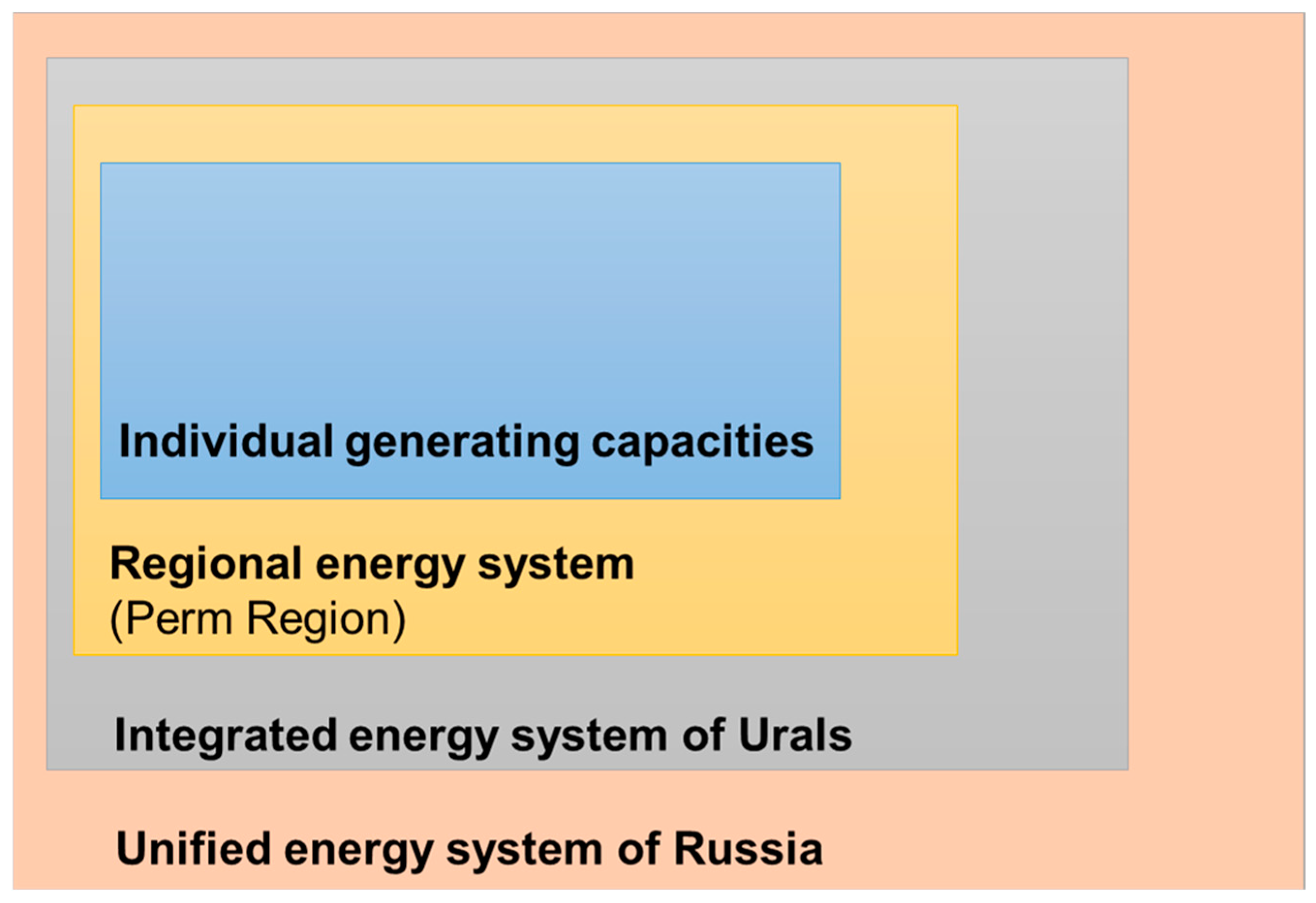
Figure 2.
Carbon footprint of generated electricity.
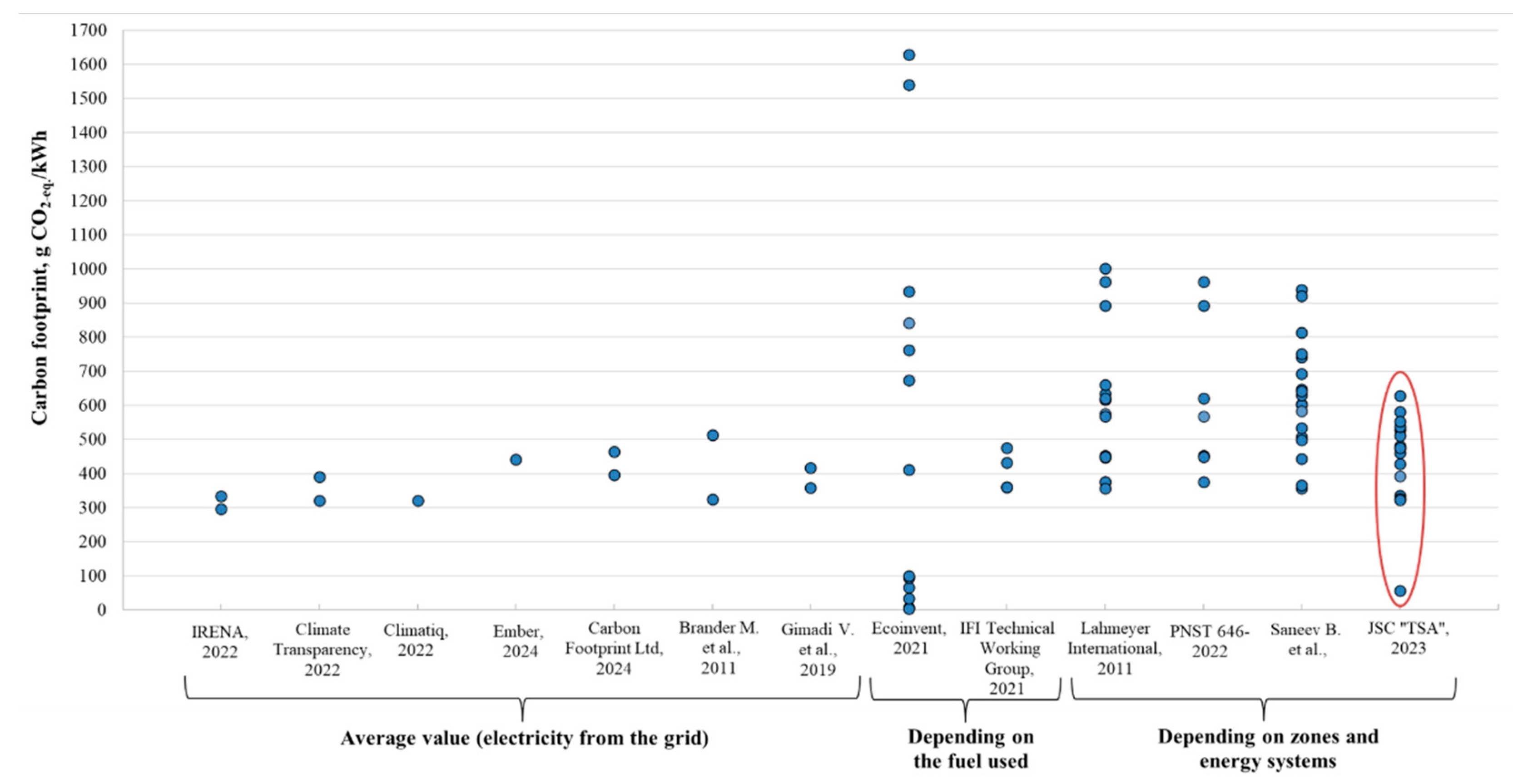
Figure 3.
Comparative characteristics of the generation structure and carbon footprint of produced electricity.
Figure 3.
Comparative characteristics of the generation structure and carbon footprint of produced electricity.
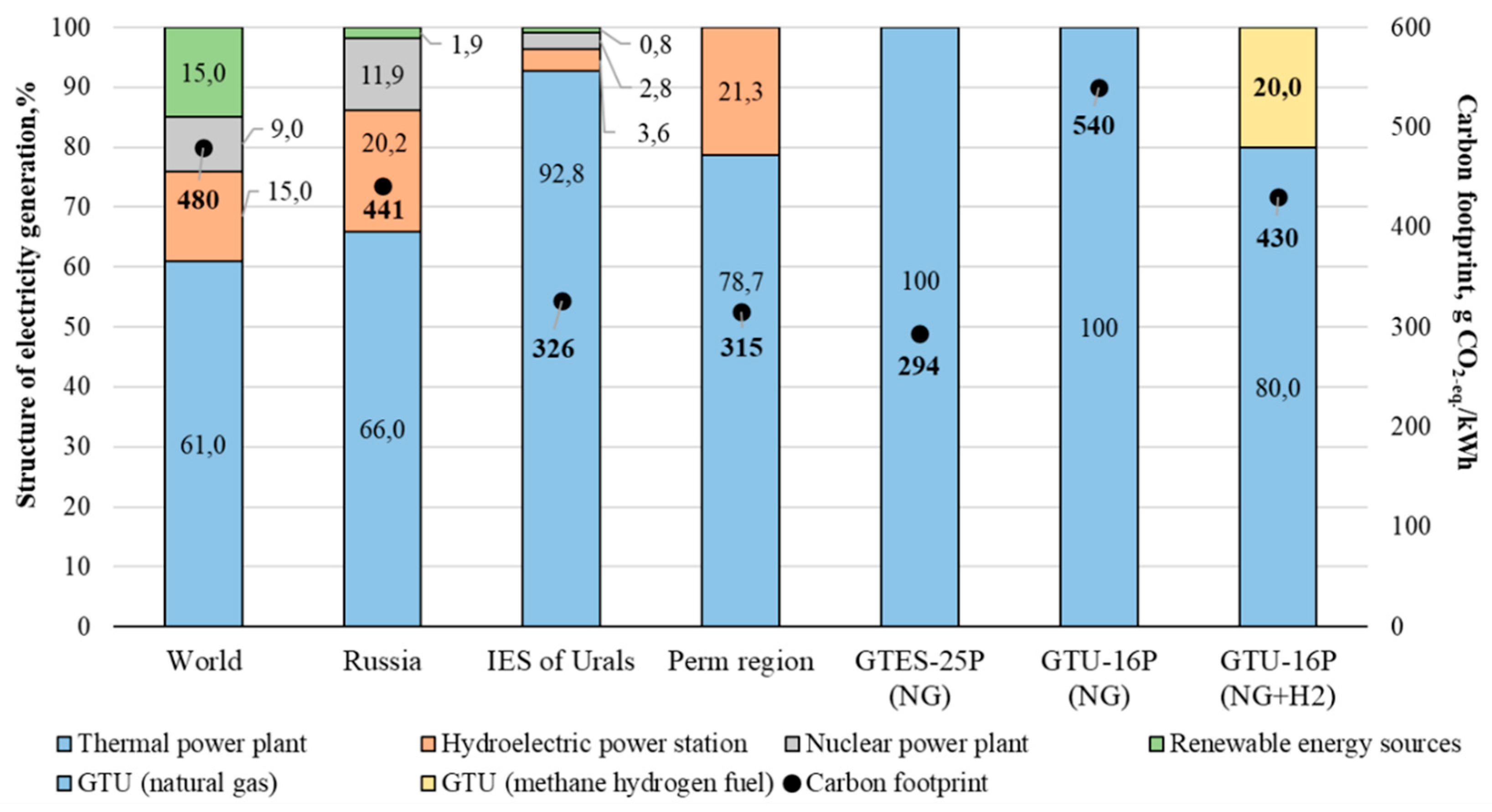

Table 1.
Comparative characteristics of the structure of generation of energy systems of Russia.
| Energy system | Share of actual installed capacity of the generating facility, % | |||
|---|---|---|---|---|
| Nuclear power plant | Hydroelectric power plants and pumped storage power plants | Thermal power plant | Renewable energy sources | |
| UES of Russia | 11.9 | 20.2 | 66.0 | 1.9 |
| IES of North-West | 24.4 | 11.8* | 62.9 | 0.8 |
| IES of the Center | 27.3 | 3.6 | 69.1 | – |
| IES of the Middle Volga | 14.5 | 25.2 | 59.3 | 0.9 |
| IES of South | 14.7 | 23.3 | 49.9 | 12.1 |
| IES of the Urals | 2,8 | 3.6* | 92.7 | 0.9 |
| IES of Siberia | – | 48.5* | 50.8 | 0.8 |
| IES of the East | 41.2 | 58.8* | – | – |
| TITES | 2.0 | 48.7* | 49.2 | 0.04 |
* only hydroelectric power station.
Table 2.
Own generating capacities of companies in the Perm region.
| Object name | Commissioning year | Power | Equipment | Source |
|---|---|---|---|---|
| PJSC «Uralkali», BKPRU-4 | 2005 | 12.9 MW (1 GTU) |
4 GTU (Siemens SGT-400), waste-heat boilers (JSC Belenergomash) | [60] |
| LLC «LUKOIL-Permnefteorgsintez», GTPP | 2012 | 200 MW, 40 t/h (steam) |
8 power units GTES-25PA (JSC «UEC-Aviadvigatel»), waste-heat boilers MZ (JSC «ZiO-Podolsk») | [61] |
| PJSC LUKOIL, GTPP «Chashkino» | 2020 | 16 MW | GTU-16 (JSC «UEC-Aviadvigatel»), 4 synchronous turbogenerators of 4 MW each (OOO «Elektrotyazhmash-Privod») | [62,63] |
| JSC «Solikamskbumprom» | 2019 | 55 MW | 3 gas-piston units (Wartsila, Finland) | [64] |
| JSC «SIBUR-Khimprom» | 2014 | 6 MW (1 GTPP), 420 ths tons/year (steam) |
3 GTES «Ural-6000» (JSC "UEC-Aviadvigatel"), 3 waste-heat boilers (JSC «Belenergomash») | [65] |
Disclaimer/Publisher’s Note: The statements, opinions and data contained in all publications are solely those of the individual author(s) and contributor(s) and not of MDPI and/or the editor(s). MDPI and/or the editor(s) disclaim responsibility for any injury to people or property resulting from any ideas, methods, instructions or products referred to in the content. |
© 2024 by the authors. Licensee MDPI, Basel, Switzerland. This article is an open access article distributed under the terms and conditions of the Creative Commons Attribution (CC BY) license (http://creativecommons.org/licenses/by/4.0/).
Copyright: This open access article is published under a Creative Commons CC BY 4.0 license, which permit the free download, distribution, and reuse, provided that the author and preprint are cited in any reuse.