
Submitted:
02 December 2024
Posted:
03 December 2024
You are already at the latest version
Abstract
By designing a conceptual framework that intertwines the use of fire in agricultural activities, the occurrence of wildfires, and the perception of wildfire risk, this article analyses the relationship between these three elements in both wet and dry Puna grasslands. It focuses on two peasant and agropastoral communities, Vilcabamba and Apachaco, both located in Cusco, the region with the highest number of wildfires in Peru. This study highlights the sociocultural significance and persistence of agricultural burnings in Puna agropastoral communities; the necessity of considering changes in agricultural activity, mutual aid systems, and communal institutions—especially concerning land ownership—to explain the occurrence of wildfires; and the widespread perception of wildfire risk among community members, who are aware of the likelihood and severity of wildfire events, while government policies to address this hazard focus primarily on raising awareness and prohibiting burnings.
Keywords:
land tenure
; burnings
; wildfires
; risk perception
; Andes
1. Introduction
In recent years, reports indicate an increase in the number and magnitude of wildfires [REFERENCIAS]. In the Latin American region, this situation has led to questions about the causes of a predominantly anthropogenic hazard that affects already vulnerable populations, such as indigenous or peasant communities and small farmers. The academic literature indicates that the uses of fire are closely linked to agricultural activities through burning, and that the loss of its control is the main cause of wildfires in various ecosystems [1,2,3,4,5,6,7,8,9,10]. In Peru, official monitoring has reported a notable increase in the occurrence of wildfires in the last five years [11], especially in Puna grasslands ecosystems, which support agropastoral systems and peasant communities.
Pastoral systems, viewed as adaptive networks of biophysical and social interactions, are primarily shaped by socio-economic and political factors that influence their capacity to sustain and create habitats [12]. In Peru, agropastoral activity is concentrated in the vulnerable Puna region, where climate change, agricultural intensification, overgrazing, and mining threaten ecosystem services [13]. Studies on Peruvian pastoral systems [14,15] highlight how changes are driven by agricultural technification, urbanization, investment, and climate variability. Moreover, the shift towards individual land tenure and the weakening of communal organizations plays a significant role, though peasant communities continue to defend their resources [15].
In medium and small-scale agriculture, which is part of pastoral systems, fire —through agricultural burnings— remains a widely used and low-cost sociocultural practice for multiple purposes (clearing agricultural residues, expanding land, adding nutrients, face climate risk [4,5,6,16]), despite regulations that prohibit its use (Article 207 of the Forestry Management Regulation - Supreme Decree No. 018-2015-MINAGRI, Article 27 of the Solid Waste Management Regulation of the Agricultural Sector - Supreme Decree No. 016-2012-AG, Article 310 of Legislative Decree No. 1237 of 2015 amending the Penal Code) and the awareness of wildfire risk [16].
This article aims to analyze the relationship between fire use in agricultural activities, wildfire occurrences, and the perception of fire risk in wet and dry Puna grasslands, focusing on two agropastoral communities (Apachaco and Vilcabamba) in the Cusco region, Peru. To address this, it is necessary to link sociocultural and ecological processes at local and mayor scale; in this way, this article emphasizes in how changes in land tenure and management contribute to wildfire occurrences, linking them to broader land use and technological shifts.
While some studies focus on physical factors affecting wildfires [17,18], research on social and cultural factors is limited, even though more than 90% of wildfires in Peru are anthropogenic [4], primarily related to agricultural activities in grasslands and pastures in the Peruvian Andes with a high combustibility level in wildfire risk assessments [19].
1.1. Background
1.1.1. Livestock activity and social changes in the Puna
The Puna ecoregion, divided into wet and dry (xerophytic) Puna, is significant due to its high biological and agrobiodiversity, as well as the ecosystem services it offers, such as food and fiber production, carbon sequestration, and water regulation [13]. In Peru, high Andean grasslands, or pajonales, cover 14.2% of the territory and support 73% of the national cattle population [20]. Additionally, natural pastures, managed and unmanaged, represent 85% of the agricultural land in the Puna altitudinal zone [21], and are predominantly used by peasant families for extensive livestock farming.
Historically, livestock farming in Peru has been concentrated in the Sierra, with grazing as a key activity. Pastoral communities were characterized by mobility, which allowed them to maintain autonomy [22] and manage risks more effectively [12,23], as their main resource—livestock—was mobile. While agriculture has often been considered a risky activity due to its vulnerability to market and climate conditions, it is common for Puna communities to engage in both livestock farming and agriculture, forming agropastoral systems [13].
Flores Ochoa's study [24] highlights three key characteristics of high Puna societies (above 4,200 m.a.s.l.): seasonal transhumance (moving residences to ensure adequate pastures for herds), dispersed settlement patterns without urban centers, and social organization based on kinship ties. In the middle Puna (4,000 to 4,200 m.a.s.l.), societies practice mixed farming, mainly growing tubers. Currently, these characteristics reveal both changes and continuities in agropastoral systems, particularly in middle Puna societies
Livestock production systems involving native and criollo animals are primarily traditional and managed by small, often impoverished peasant producers who focus more on farming than breeding, particularly with introduced animals [25, p. 274]. These systems are savings-oriented, with minimal investment and a focus on risk avoidance rather than productivity, relying on natural pastures or limited seasonal forage, and utilizing communal grazing areas [25, pp. 274, 275]. Thus, this peasant livestock farming was mainly for subsistence or local markets, where quantity was preferred over quality for social prestige; and while pastures were communally owned and managed by communal institutions, livestock was private or family-owned [26].
Previous studies linked livestock farming in the Puna to mobility, low technification, minimal investment, and reliance on natural pastures and communal management. However, recent research [13,14,15,27,28,29,30] highlights significant changes: increased specialization in livestock farming, a shift from extensive to semi-intensive systems, greater focus on market-oriented crops, a reduced redistributive capacity of peasant communities due to the rise of private-family management, and the gradual abandonment of both cultivated areas and natural pastures.
The shift from extensive to semi-intensive livestock farming has been driven by early 20th-century political projects that introduced purebred livestock like the Brown Swiss, adaptable up to 4,000 m.a.s.l. [14]. This transition aimed to improve livestock quality for market dairy products [31]. Families have responded by expanding cultivated pasture areas and investing in infrastructure such as irrigation systems and fencing, reflecting increased specialization and investment in livestock care.
Suarez [14] identifies several factors facilitating the adoption of the Brown-Swiss breed, including land subdivision, irrigation systems, stables, and fenced enclosures. The transition from extensive to semi-intensive livestock farming is marked by delineated grazing lands managed by families aiming to establish micro-enterprises, focusing on improving livestock quality and its derivatives. This land delimitation means that the livestock —now Brown Swiss— now performs its technological and ecological functions within the delimited plot rather than in the natural pastures of the high areas. In other cases, such as Huamantanga in the Lima highlands, the increase in “improved” livestock over chusco or criollo livestock and the privatization of communal land are linked to the construction of a road connecting Huamantanga to Lima [30]. To mitigate livestock feed risks, the Peruvian state and NGOs have promoted pasture cultivation to address climatic hazards [32,33]. In some areas of the Puna, market-oriented crops like maca and quinoa are becoming more prominent due to higher demand, leading to intensified agriculture, reduced fallow periods, and diminished grazing areas [13].
Changes in Puna livestock communities involve shifts in pasture use and management, with studies [29,34,35] noting a mix of communal and private/family tenure, with private tenure prevailing in subdivision. While livestock farming remains subsistence-oriented, there is increasing specialization and economic investment, as evidenced by the adoption of “improved” livestock and cultivated pastures, which is leading to the gradual abandonment of natural pastures in remote areas.
1.1.2. Uses of Fire in Agricultural Activities
Controlled burnings, practiced globally on lands suitable for pasture and agricultural production, involve the deliberate use of fire for managing livestock, agricultural, and forestry resources [4]. Conducted under low-risk conditions by knowledgeable individuals [36], these burnings serve multiple purposes: removing dry, unpalatable grass to promote regrowth [37], controlling woody plants, replenishing soil nutrients with rainfall, reducing fuel loads from agricultural residues, and managing fauna by enhancing or conserving habitats [36,38,39,40]. They also expand grazing areas [41] and create firebreaks to combat wildfires [2,42].
Agricultural burning, traditionally based on oral knowledge [37], has been altered or abandoned in some communities. In Colombia's Sáliva indigenous community, Huertas Herrera et al. [3] found that younger generations lack ancestral fire knowledge, shifting from native savannas to monocultures. Similarly, in Venezuela's Pemón community, Bilbao et al. [2] observed that population growth and settlement changes have disrupted traditional burning, raising wildfire risk. In Bale, Ethiopia, Johansson et al. [42] noted that stopping controlled burning reduces grazing potential and increases large-scale wildfire risk. These studies underscore the impact of societal changes on wildfire dynamics, including vegetation accumulation and loss of traditional fire knowledge.
Anthropogenic wildfires arise when fire control is lost during burning activities. Physical and social factors, such as land-use changes and strict fire prohibition policies, influence wildfire occurrence and intensity. These factors have reduced the understanding of burning's ecological and social roles, leading to the loss of traditional fire knowledge [36,37].
Myers [37] notes that many countries have implemented policies categorizing all wildfires as harmful, banning prescribed burnings, and criminalizing agricultural fire use, often without considering subsistence farmers' needs or providing alternatives, as seen in Peru. These measures demonstrate a lack of understanding of traditional agricultural fire practices [37, p. 15].
1.1.3. Wildfires in Peru
According to SERFOR [43], while agricultural fire use is linked to wildfires, causes differ across Peru. In the Amazon, fire clears vegetation in deforested areas for crops, exacerbated by road construction. In the Andes, fire renews pastures, including wetlands, for livestock. In the inter-Andean zone, fire manages crops by clearing weeds. In the North, mieleros (honey hunters) burn tree bases for honey collection, and fire is also used for land preparation in agriculture.
Manta Nolasco [4] classifies wildfire causes in the Peruvian Andes, highlighting negligence in livestock activities. The author notes that the loss of fire control in these areas often leads to its spread into "natural forests," making pastures the most affected ecosystem. SERFOR wildfire records (2017-2020) identified fourteen probable causes, with over 50% attributed to "unknown causes", agricultural residue burnings account for 35.8%, pasture burnings to attract rain 6.2%, and intentional fires due to conflicts 1.4% [44].
In the Peruvian highlands, the wildfire season from July to November coincides with the agricultural calendar and is inversely related to the rainy season [4,5], with most wildfires occurring during the dry period. In the Puna, overgrazing and excessive fire use degrade soil conditions, reduce plant diversity, and threaten the economic value of native pastures [13].
Research on fire use and wildfires at the communal level in Peru is still limited but growing. Alvarez Rios [5] found in Cusco that fire use, as a cultural practice, is influenced by crop type and geography. The practice persists due to its low cost and multiple benefits, including land expansion, agricultural clearing, and fertilization. Additionally, identified that the rise in fires in 2020 was linked to community members returning during the COVID-19 pandemic, leading to the opening or recovery of agricultural lands.
In the wet Puna of Ayacucho, Arones [6] identifies wildfires as anthropogenic, caused by new field openings, stubble burning, and burning ichu grass for pasture regrowth, as well as cultural practices like children playing. The author also notes that cold-resistant oat crops have gradually expanded into the Puna zone, where agricultural burnings were used to clear land, occasionally leading to wildfires.
In Peru, the group involved in wildfire risk management is small. At the national level, regulations penalize agricultural burnings and assign responsibility for wildfires (DS No. 018-2015-MINAGRI, DS No. 016-2012-AG, Article 310° of DL No. 1237), and SERFOR has developed a Wildfire Prevention and Reduction Plan [43], due for an update in 2023. Regional governments, such as Cusco, have designed limited wildfire prevention projects due to budget constraints and implemented a risk prevention and reduction plan for 2022-2026. NGOs like PREDES in Cusco have reportedly worked with peasant communities on wildfire prevention by integrating norms and sanctions into communal statutes, though these efforts remain undocumented.
In Peru, while research on fire use and wildfires is still emerging, it is clear that wildfires, particularly affecting pastures, are linked to agricultural burnings used for land clearing, fertilization, and pest control. Politically, responses have focused on punitive measures to suppress or reduce wildfires, both from governmental and non-governmental actors. This approach hinders the adoption of a comprehensive fire management policy; for this, a broader understanding of the cultural, environmental, and economic aspects of fire use, along with the involvement of rural communities, is necessary [38].
1.1.4. Wildfire Risk Perception
Risk perception refers to how residents assess the probability and severity of wildfires affecting themselves and their surroundings, including people, livelihoods, and landscapes [45,46]. Schneiderbauer et al. [47] reviewed studies on risk perception and adaptive behavior, finding no clear link between awareness and adaptive actions. The review also highlights a research gap on how mountain-specific factors (bio-physical, economic, social, or cultural) influence risk perception.
Gordon et al. [48] found that wildfire risk perception in the Eastern U.S. is shaped by social, cultural, and bio-physical factors, with direct experience and ecological conditions driving concern. In Colorado, Champ and Brenkert-Smith [49] observed that while perceptions of wildfire probability remained unchanged post-fire, concerns about its severity increased. Similarly, Champ et al. [45] also noted no clear link between perceived risk and mitigation behavior, a complexity also confirmed by Larsen et al. [50], who found that despite low perceived vulnerability in Colorado’s Animas Valley, residents still engaged in mitigation actions.
McCaffrey [51], in a review of wildfire response research from 2000 to 2010, concludes that perception alone does not drive protective action. Christianson [36] notes that in indigenous communities in Australia, Canada, and the U.S., other social issues often take precedence over wildfire risk, despite their vulnerability due to remoteness and weak connectivity. Additionally, Christianson [36] highlights negative perceptions of prescribed burns due to health and disaster risks, a view shared by the Sáliva in Colombia, who link fire use to property damage and ecosystem degradation [3].
Despite high wildfire risk perception, societies do not always take preventive actions, such as abandoning agricultural fire use, and several studies [45,46,47,48,49,50,51] indicate that risk perception does not consistently lead to mitigation actions. Christianson [36] suggests that pressing social issues may sustain risky practices, while the lack of affordable alternatives can also prevent the adoption of safer measures [1,38].
1.2. Conceptual Framework
Bollig and Göbel [23] highlight that pastoral communities manage risk effectively through livestock mobility, often maintaining dual residences in urban and rural areas. However, recent studies on Andean livestock indicate reduced mobility in semi-intensive systems with "improved" cattle, which depend more on cultivated pastures.
This study's primary data indicates that cultivated pastures and improved livestock are kept near irrigation systems and primary residences, often close to populated areas with greater accessibility. Improved cattle are raised in lower areas, functioning in enclosed pastures [14], leading to the abandonment of higher areas and vegetation accumulation. In contrast, criollo cattle remain in higher regions, where grass no longer grows tall enough for traditional uses, like house roofs. Due to the proximity of cultivated agricultural areas and pastures, uncontrolled fires from agricultural burns can spread more easily, particularly during the dry season or when vegetation moisture is low, and when winds are stronger [4,5,6,16].
Research by Gordon et al. [48] and Champ & Brenkert-Smith [49] reveals a direct link between wildfire occurrence and risk perception, shaped by ecological, socioeconomic, and political factors. However, a high perception of risk does not always translate into mitigation measures, such as halting agricultural burns. Therefore, understanding agricultural fire use and wildfire risk in pastures necessitates examining the ecological, socioeconomic, and cultural context of the study area, alongside larger processes affecting peasant families and organizations in the Andes.
The conceptual model of fire use in agriculture and wildfire risk perception (Figure 1) illustrates the interconnection of key components. Socioeconomic, cultural, and ecological factors, along with agricultural practices, are essential for understanding fire use and assessing wildfire risk in terms of hazard, vulnerability, and perception in the study areas.
2. Research Methods
2.1. Research Methods
This research employed both qualitative (participant observation, interviews) and quantitative (surveys, monitoring records review) methodologies. Initially formulated in 2023 as a thesis on a case study in the dry Puna (Apachaco) [16], the study expanded to include the wet Puna (Vilcabamba) to explore differences and similarities. The research followed three main stages: selecting study areas and cases, conducting ethnographic work, and applying the Fire Use and Wildfire Risk Perception Questionnaire (CUFPER).
a. Selection of area and cases
Historical records from 2003 by the Ministry of the Environment [11] and the National Institute of Civil Defense (INDECI) through SINPAD show that Cusco has the highest number of wildfires. From 2003 to 2023, MINAM reported 4877 fires (13.2% of national cases), while INDECI recorded 1472 wildfire-related emergencies. The difference in numbers likely arises from SINPAD only registering emergencies that received a response, while MINAM records both attended and unattended fires.
The selection of the Apachaco and Vilcabamba communities for ethnographic work was based on three factors: their location in the Puna grassland ecosystem, the scale of social organization, and the significance of agriculture. To identify fire-affected grasslands used for livestock, MINAM's wildfire records were cross-referenced with the National Ecosystems Map [55] and CENAGRO data [56]. The peasant community was chosen as the scale of social and spatial organization to explore its potential influence on fire use.
Between 2003 and 2023, MINAM recorded 251 wildfires in dry Puna grasslands and 2113 in wet Puna grasslands in Cusco (Figure 2). At the peasant community level, Apachaco (Coporaque district) had 17 wildfire incidents in dry Puna, while Vilcabamba had 42 in wet Puna. Both districts are significant for livestock, with Cusco ranking third in agricultural units, where natural pastures dominate the agricultural surface (1,647,508.70 ha) [56].
b. Development of ethnographic work
Ethnographic work for this research took place from July 2023 to June 2024. Initial visits in July confirmed the community selections, while fieldwork began in August during land preparation, when fire is used. Regular visits and participation in communal and family activities helped ease the reluctance to discuss fire use, where the local leaders' support was also essential.
A semi-structured guide was used for the interviews, covering four sections: interviewee and family characteristics, agricultural activity, fire use, and wildfire risk perception. A total of 35 interviews were conducted with household heads (both men and women), communal authorities, and civil defense staff from district municipalities responsible for local risk management (Table 1).
c. Fire Use and Fire Risk Perception Questionnaire (CUFPER)
The CUFPER aimed to collect data on fire use and wildfire risk perception through closed-ended questions. It was designed using KoboToolbox, an open-source platform for data collection, management, and visualization.
The final questionnaire, with 36 questions, was applied in Apachaco between September and November 2023, and in Vilcabamba in June 2024. It was conducted during communal assemblies, with translation help from community members (2 in Apachaco and 3 in Vilcabamba) for Quechua-speaking participants. Data from 172 household heads was collected through valid CUFPER questionnaires (see Table 1).
2.2. Study Cases
a. The peasant community of Apachaco
Apachaco, located at 3900–4100 m.a.s.l., is characterized by extensive natural grasslands despite notable cultivation on flat areas and slopes (Figure 3). The community consists of six sectors—Pisccatuyo, Machaccoyo, Pucará, Chilarana, Apachaco, and Machupuente—within the dry Puna grassland ecosystem.
Two major events have shaped Apachaco's recent history. The first was the separation of its annexes, Tarucuyo and Checcane, into new communities, significantly reducing Apachaco's territory. The second, and most impactful, was the land parceling process, which began in 2000 and lasted about six years. This aimed to address extreme disparities in the distribution of cultivated and grazing areas, promoting "equality" among community members.
"Others had larger plots, while some of us had none; there was inequality. Therefore, as approved in the meeting, we divided the land into parcels. I had nothing. No one had anything. So, we had to borrow to farm, paying a small rent, just like that. [...] Only a minority had land, and it produced good potatoes. That’s why it was decided to parcel the land for equality." (M.C.C. –female, 49 years old, member of the Apachaco Communal Board)
Ultimately, the land granted during parceling depended on property type (cultivation or grazing) and the family's residence duration in the community. As a result, many members who had migrated to Cusco, Lima, or Arequipa returned during the 2000s. Today, the community comprises 228 registered families and nearly 1000 inhabitants, including non-members (who does not hold the condition of comunero). Parceling limited land to 10 hectares per family, but it led to treating collective land as private/family-owned, evidenced by fences and weakened communal land management decisions. Also, livestock practices shifted, with fewer camelids and sheep and a preference for cattle (up to 30 heads). Additionally, the criollo breed was replaced by Brown Swiss cattle, influenced by public and private investment projects. Since 2013, at least 24 public investment projects related to cattle management and genetic improvement have been executed in Espinar province [57]. Privately, the mining company Antapaccay -formerly Tintaya-, under a framework agreement with Espinar since 2003, has invested heavily in agriculture, providing Brown Swiss cattle, livestock fencing, reservoirs, irrigation channels, and tractors to communities [58]. In Apachaco, many community members have shifted to semi-intensive farming for higher income, leading to cattle being kept in the middle and lower areas, close to the houses.
Although ayni, the traditional mutual aid system, is still practiced, most interviewees noted its decline, with families increasingly opting to cultivate smaller areas or hire labor. This decline may be due to the availability of the communal tractor service, introduced in 2006, which is more cost-effective (40 soles or 10.5 dollars) compared to manual labor (50 soles or 13.2 dollars per day) or providing food and beverages during ayni.
In Apachaco, all families participate in agriculture to some degree, diversifying through temporary work. Most (82%) produce primarily for self-consumption, but milk and dairy products from livestock are notably intended for sale.
In Apachaco, crops include potatoes, quinoa, cañihua, fava beans, oca, oats, barley, and an increasing amount of cultivated pastures (38% have both natural and cultivated pastures), with rest periods of 2 to 10 years. While most agriculture is rain-fed, 37% of families have irrigation systems, which are highly valued. Additionally, 75% of surveyed families own livestock, including cattle, sheep, and camelids.
b. The peasant community of Vilcabamba
The community is divided into 9 sectors: Vilcabamba, Salinas, Collpa, Challcha, Pampaconas, Minasmayo, Vista Alegre, Coylluychu, and Atoqsaico. It also includes the Concevidayoc and Chancavine valleys, accessible via the VRAEM region in Ayacucho. Parts of Vilcabamba, Challcha, Collpa, Salinas, and Pampaconas sectors are within the wet Puna grassland ecosystem (Figure 3).
Over the past 40 years, three key events have impacted the community. First, the internal armed conflict during the 1980s and 1990s involved clashes between the Armed Forces, Shining Path, and the Tupac Amaru Revolutionary Movement (MRTA), causing many families to flee. Second, the construction of a road to the Pampaconas sector led to a new settlement pattern, with most residents moving closer to the road. This development caused the decline of the laymi cultivation system, where families farmed collectively under the ayni mutual aid system, which still persists. The most recent event was the COVID-19 pandemic, which prompted many who had migrated since the 1980s to return to Vilcabamba. In 2020 alone, the population increased from 650 to 800 families currently residing in the community.
Some families frequently travel to or settle in Pucyura, part of the Lucma Peasant Community, which offers more services. Although the road arrived nearly 20 years ago, it doesn't connect all sectors; Pucyura is 30 minutes by road, but some sectors are only accessible on foot, with trips taking up to 3 days. The community also lacks phone signal, with connectivity only available to families with satellite Internet antennas.
Vilcabamba has not experienced a parceling process, leading to significant variation in land tenure, from small housing areas (150 m²) to over 80 hectares per family. Despite complaints, the communal authority stated that parceling would be difficult. The community still has “free” communal land, mainly used for grazing 60 head of criollo cattle, and renting land for grazing or cultivation is rare.
In Vilcabamba, where 95% of the population engages in agriculture, 67% of surveyed families own cattle or sheep, and 68% use their agricultural production for self-consumption. Unlike Apachaco, Vilcabamba has forested areas with Pinus radiata and Pinus patula from public investment projects. Temporary work in construction, cleaning and other services offers highly valued income, due to increasing risks from climate hazards and livestock diseases in agriculture.
Agriculture in the area is mostly rain-fed, with only 3% of families using irrigation. In the humid Puna, main crops include potatoes, oca, lisas, tarwi, and fava beans, while in the valley, where slash-and-burn is practiced and shrubs predominate, coffee and maize are grown. In the high zone (wet Puna), land rests for 2 to 6 years between crop cycles, and natural pastures recover in about a year. Planting pastures after potato harvests has become common. Agriculture remains manual, using the traditional plough, the chaquitaclla.
Livestock activity is extensive, focused on criollo cattle, primarily grazed on natural pastures in communal or family-owned open fields, where cattle are left for weeks. Families own between 4 and 30 cattle. 72% of respondents have natural pastures, while 24% have both natural and cultivated pastures. Regardless of the type of pasture, to support grazing, some families have expanded grazing areas and built fences in formerly shrubby or grassland areas.
3. Results
3.1. Uses of fire in the Wet and Dry Puna
While this article focuses on fire use in agriculture, it's important to note its significant role in daily life, particularly for cooking. Fire is used for household cooking and during busy agricultural periods like sowing and harvesting, when huatias (small earth ovens) are used to cook tubers in the fields. In Apachaco, as in other dry Puna communities, fuel consists of dry grass and cow dung, while in Vilcabamba, in the wet Puna, wood is used.
In the dry Puna (Apachaco), 52% of families report having used fire in agriculture, while in the wet Puna (Vilcabamba), the figure is 42%. The next sections will detail fire use in these activities.
3.2.1. The use of fire in the agricultura cycle
a. Purposes
Fire serves multiple purposes, primarily soil fertilization. In the dry Puna, it's common to burn wild grass, shrubs that grow during the fallow period, or crop residues from the previous season, which also helps with the secondary purpose of field cleaning. A third purpose is to open new areas for cultivation or grazing when there are still “free” land; in this case, vegetation (grass and shrubs) is burned, with a particular practice in the wet Puna of leaving taller shrubs or trees to provide shade for livestock and promote grass growth.
A fourth use of fire is pest and disease control, particularly the known as rancha, which affects potatoes in both regions. In the dry Puna, community members reported dealing with an animal pest, the poroncoe (Cavia tschudii), a rodent whose urine harms cultivated grasses and cattle. The fifth purpose is to alleviate the effects of frost and hail, especially in the dry Puna, during critical crop growth periods. This use is more controlled and involves controlled "smoking" of residues and debris in containers or small mounds. A sixth, nearly abandoned purpose, is pasture rejuvenation ("re-sprouting"). In the dry Puna, interviewees mentioned that this practice was common when criollo cattle fed only on natural grass. In the wet Puna, where extensive livestock farming is still practiced, interviewees noted that re-sprouting burns should occur before the rainy season.
b. Locations for burning
In the dry Puna of Apachaco, burning is conducted in cultivation plots for tubers, grains, or pastures. Due to the shift to semi-intensive livestock farming, fire is no longer used in the high grasslands of the community but in plots closer to homes or paths, where improved livestock has also been relocated. In the wet Puna of Vilcabamba, although criollo cattle graze freely in higher areas with natural pastures, fire is mainly used in cultivation plots. In both cases, plots are near grasslands, so uncontrolled burns can lead to wildfires. To prevent this, community members apply location, timing, and prevention techniques.
Location techniques involve placing the burn away from edges or boundaries. Community members report making piles of residues or vegetation in a lateral, central, or dispersed area of the cultivation or grazing plot, but always away from edges. Timing techniques involve evaluating the time of day with favourable conditions for burning but without increased risk. This technique varies between the two regions: in the dry Puna, afternoons are avoided for burning due to wind speeds, while in the wet Puna, afternoons are preferred for the wind to aid in the burning process. Prevention Techniques involve reducing the risk of fire with edge cleaning, preparing tools in case of uncontrolled burns (buckets of water and cloths to "kill" the fire), and monitoring the burn until it is finished.
c. Timing of burns
Burning periods are linked to the agricultural cycle and purposes (Figure 4). In both the dry and wet Puna, it is observed that the period between July and September (dry season) features the highest number of burns aimed at fertilizing the soil with ashes from burned residues, cleaning plots, and eliminating pests (especially rancha). A second burn period, specific to the dry Puna, according to CUFPER data, occurs from January to March (cold and rainy season) aimed at alleviating the effects of hail and frost.
The timing of burns depends on the purpose and environmental conditions. To mitigate frost and hail effects, burns occur when hazards are identified as imminent, guided by traditional indicators called señas or lomasas. For fertilization, cleaning, or opening new areas, burns in the dry Puna are conducted early morning (61%) before 6 a.m. due to low wind and higher humidity, making the fire "slower." In the wet Puna, burning is done in the afternoon (73%) to take advantage -be “assisted”- of wind and heat. It is important to note that in Vilcabamba's community, the timing changes in the valley area, where such conditions (wind and heat) are avoided due to the land's slope.
3.2.2. Relationship Between Changes in Agricultural Activity And The Use Of Fire
In both cases, interviewees noted changes in seasonal patterns, with a more intense dry season and frosts and hail occurring throughout the agricultural cycle, beyond the cold season. Figure 4 shows increased fire use in both the dry and wet Puna for soil preparation and sowing, particularly at the end of the cold season and during the dry season. Fire use decreases during cultivation and harvest, especially in the wet Puna. CUFPER data records uses to alleviate the effects of frost and hail only in the dry Puna, while interviews indicate that huatia fire use is practiced in both wet and dry Puna.
Although it remains a widespread practice, the use of fire in agricultural activities or agricultural burning has evolved due to new socioeconomic and political processes. In the case of these pastoral communities in the Peruvian Puna, the purpose of rejuvenating pastures (re-sprouting) has been abandoned where semi-intensive livestock farming is practiced (as in Apachaco in the dry Puna) because community members report that re-sprouted pastures are detrimental to "improved" cattle. In contrast, in extensive livestock farming (as in Vilcabamba in the wet Puna), community members indicate that due to the location of natural grasslands in rugged and sloped areas, cattle may fall and die; losing a head of cattle—whether criollo or "improved"—is a significant blow to the economy of these families who are no longer willing to take the risk.
Another notable change in fire use is its decreasing frequency. In both cases, community members reported that over time, fire has been used less frequently due to alternative methods for achieving the same purposes. For instance, cleaning plots is increasingly replaced by machinery, such as tractors, which allows for residue accumulation in cultivation or grazing plots, providing greater control over fire use. This shift is more common in areas with better connectivity through paved or improved roads.
Community members report that penalties, especially at the communal level (as in Vilcabamba), have reduced fire use or encouraged more caution. As family agriculture decreases and participation in agricultural activities declines, fewer people are involved in burning. In the dry Puna, 3 to 5 participants are common (35%), while in the wet Puna, it's typically 2 (47%). Additionally, in both cases, families consisting only of elderly members report that they prefer not to use fire due to the fear of causing a wildfire and because "there is no strength" to control it.
Nonetheless, the positive assessment of agricultural burning in the dry Puna is slightly higher (49% compared to 48% of families who consider it not beneficial), while in the wet Puna, the majority consider it not beneficial (59%). Finally, in the last five years, local governments have undertaken awareness campaigns to restrict agricultural burning; in Vilcabamba, interviewees reported that these campaigns aimed to "exercise caution" during burns as a wildfire could affect reforested pine areas, a species highly valued in the community for housing construction.
3.3. Relationship Between The Use Of Fire In Agricultural Activities And The Occurrence Of Wildfires
a. Experiences with wildfires
Out of the 150 wildfires recorded in the Coporaque district between 2002 and 2023, 20 occurred in the community of Apachaco, and of the 124 in the Vilcabamba district, 42 occurred in the eponymous community1. In both communities, records are noted between July and December, largely during the dry season, with the highest number of wildfires occurring in 2020, coinciding with the COVID-19 pandemic when many migrants returned to the community.
All interviewees reported having witnessed a wildfire, but not all indicated that they had caused or been affected by one. In Apachaco, nearly half of the respondents surveyed by CUFPER (48%) stated that their initial reaction to the last wildfire they remembered was "Concern"; in Vilcabamba, this was the sentiment of at least 70% of surveyed families, followed by "Fear" in both cases (19% in Apachaco and 25% in Vilcabamba).
b. Causes of wildfires associated with agricultural activities
All interviewees stated that wildfires are not intentional, even those caused by children and the elderly playing. In the experiences with wildfires in the grasslands, we can identify that these fires result from poor practices (“carelessness”) in agricultural burning, carelessness in playing with fire, carelessness in food preparation (with huatias), and natural causes (lightning). According to the community members, such situations could affect anyone involved in agricultural activities and life.
“I thought I was free from such things, ‘it won’t burn me’, I said, and it happened to me.” (D.H.V. – male, 64 years old, Chilarana sector, Apachaco Community, Dry Puna)
“We must be well-prepared, […] as you see with this climate change, when we burn our forests, we are contributing to climate change. Also, even when we burn, we do not replace the damaged plants; they re-sprout on their own, but we must be responsible. I also consider future generations, they will pay the consequences. So, that’s what I mean. No one is free, nor is it the case that they won’t burn, so at any moment, there could be a fire.” (M.D.Q. – male, 54 years old, Challcha sector, Vilcabamba Community, Wet Puna)
The “carelessness” in fire management during agricultural burns is linked to the loss of fire management knowledge, including understanding safe burning conditions, positioning people, wind direction, and proper extinguishment. This “carelessness” also occurs during huatias in the fields and when using fire in pastures to remove poroncoy in the dry Puna or to create new grazing or cultivation lands in the wet Puna.
“The wildfire occurs because they don’t know how to burn. […], there are people who burn from wherever and it gets out of control.” (S.E. – female, community member of Lucma, Pillaupata sector, Wet Puna)
Perceptions regarding the role of environmental factors in wildfire occurrence were also recorded, especially high temperatures (heat) and dangerous winds (totoca and soqawayra) present during the dry season, which form the “fire triangle.” However, it should be noted that in the wet Puna, high temperature is a condition, albeit risky, necessary for conducting a burn given the area’s humidity.
“Mostly because of the wind, that causes it. […] Sometimes, the wind blows more. There’s a wind we call totoca, in whirlwinds that blow; those are the dangerous ones. It can come any time, starting around 10 in the morning.” (A.C. – male, 56 years old, Chilarana sector, Apachaco Community, Dry Puna)
“My father said that August and September are ‘pregnant,’ and that’s why there’s always fire because the wind escapes. [M:] In Quechua, they say ‘Chichu’, just as a woman is pregnant, fire behaves the same way, they say. [D:] That’s why they say it always gives birth or escapes.” (D.H.V. – male, 64 years old; M.C.H. – female, 60 years old, Chilarana sector, Apachaco Community, Dry Puna)
“Now it’s stronger, and with that heat, the fire spreads more. […] When the wind comes, it’s fatal. […] When we burn, the wind always comes from the middle and lifts it up, ‘Fiuu!’ Soqawayra, they say. That evil wind, they say. On the little hills, there are always qariwas, yellow ones, from there it lifts up, they say. ‘There, in that part, there’s qariwa, that’s why it lifted up.’ […] [Qariwa is] a little lizard that raises the wind, you see. […] From here, it can go up to the top, it can burn the whole house.” (M.C.H. – female, 60 years old, Chilarana sector, Apachaco Community, Dry Puna)
“[E:] Because of carelessness, perhaps. [K:] Sometimes they don’t gather the clearings properly. Or they don’t gather them to burn in one place. So, they set fire everywhere. [E:] For example, here in July and August, there’s quite a bit of wind. Here, they say August is the month of wind. And they always tend to go dig their potatoes or plant their potatoes in August, and they set a small fire to cook something. And maybe due to carelessness, they might leave it, the wind blows, and ‘Fua!’ it catches fire. Mostly, here there aren’t many wildfires because, as they say here, there are neighborhood meetings, and municipal staff come to provide training, and this is avoided.” (K.C. – female; E. – male, community members from Pampaconas sector, Vilcabamba Community, Humid Puna)
Regarding environmental conditions, it should be noted that there are also wildfires caused by natural factors, specifically lightning; however, there is little trust in the validity of this cause because community members believe that the real culprits would avoid paying the penalties they owe.
A particularity of Apachaco in the dry Puna is that “envy” regarding the larger accumulation of resources such as pastures and cattle, even land despite parceling, and restrictions on movement between parcels, has been noted as a cause of wildfires. According to the classification of causes developed by SERFOR [44], a wildfire in grasslands can be provoked in the context of conflicts between families or communities.
3.4. Perception of Wildfire Risk
a. Probability
In Apachaco, part of the dry Puna, 94% of the surveyed population indicated that a fire is likely to occur in the community, whereas in part of the wet Puna, 72% of the surveyed population in Vilcabamba agreed with this probability. The probability rating may be influenced by the period in which the instrument is applied (rainy or cold months), but it may also be influenced by the characteristics of the sectors and plots of the respondents. For example, in the case of Vilcabamba, where a lower probability rating was recorded, respondents indicated that if burning is conducted on a clean plot with few bushes or pajonal tussocks, the risk of wildfire occurrence is lower, as well as in higher sectors, where they report higher humidity.
b. Severity
In this study, severity is linked to the qualification of magnitude, danger, and risk of impact on the assets and livelihoods of the respondent as the head of the household. As a result, we find that in both cases, the severity rating is higher than the probability rating; in Apachaco, this rating corresponds to 98% of the surveyed families, while in Vilcabamba it is 93%. That is, in the wet Puna, it is perceived that a wildfire is less likely to occur than in the dry Puna, but in both cases, it is perceived that a wildfire would be severe.
It is important to note that the assets and livelihoods present a differentiated risk rating. In Apachaco, CUFPER results indicate that it is highly likely that in the event of a wildfire, livestock (92%) would be the most affected due to the burning of natural and cultivated pastures. In Vilcabamba, the population considers it very likely that crops (77%) would be affected, given that most communal and district-level wildfires occur in lowland areas.
c. Perception of changes in fire occurrence
Based on the experiences of the community members of Apachaco, it can be stated that the perception regarding frequency is that there are currently fewer wildfires, but "there are always wildfires" during the dry season. In contrast, perceptions of wildfire intensity vary.
“In every community, it always happens, but why is that? I wonder. But sometimes also, no. They also say it’s because of a good year. How does it escape? It always happens, we are not free here.” (D.H.V. – male, 64 years old, Chilarana sector, Apachaco Community, dry Puna)
The largest group of respondents indicated that wildfires are currently less intense. The community members attribute this higher intensity in the past to the fact that burns were more frequent, and that land management (for cultivation and grazing) was communal, resulting in less control by each family/producer over the care of burns.
“There were always wildfires. They were stronger, bigger. One day, two days they lasted. Now, almost not, people no longer burn as much, before it was more. [And why do you think the wildfires were stronger before?] Before there were no plots, it was the whole community, so now each one has their little plot, we no longer have to extinguish a lot.” (T.C. – male, 60 years old, Apachaco sector, Apachaco Community, dry Puna)
In line with the perception of greater wildfire intensity in the past (at least before the land parceling), it was found that with the division, some families work their plots more intensively, so there is no dry vegetation or residues that pose a danger for wildfire occurrence or that could intensify one.
Another factor in the reduction of burns and wildfires is the establishment and dissemination of rules and sanctions, especially when applied at the communal level, as is the case in Vilcabamba (wet Puna), where it was established in the communal statute in 2022 that the "indiscriminate burning of forests or natural pastures" will result in a fine of no less than S/.1000 soles (equivalent to 263 dollars) and that, depending on the severity, it will be reported to the competent authority.
“[H:] It is decreasing. People are reflecting on all this a little more, the fines. Now there are fines, sanctions. I think there’s even a prison sentence, with all this, people are reflecting more. Before, the fire would run, in the valley they would light it, even if unintentionally, but now no longer.” (J. – female, H. – male, Pampaconas sector, Vilcabamba Community, wet Puna)
Hector Maletta (1990, p. 39) identified a direct link between the regulation of pasture use and the conservation behavior of community members. While this case does not involve specific regulations, communal normative mechanisms still seem to influence and control the behavior of community members as expected.
4. Discussion
Despite a high perception of wildfire risk in terms of probability (on average, 83%) and severity (on average, 96%), as well as the perception of the progressive reduction in its use and the punitive approach within the Peruvian institutional framework at both national and, in some cases, communal levels, agricultural burning remains a current practice. In this regard, Pismel et al. [10], in their work on the governance of native wildfires in the Madre de Dios, Acre, and Pando regions, find that a barrier to reducing wildfires is the low or non-existent cost of burning as an economic land management tool in subsistence agricultural areas, such as the Puna. Concerning the punitive treatment of burns, Myers [37] points out that it is necessary to understand that burns, under conditions considered highly risky by experts, are driven by economic outcomes that agricultural producers expect in that particular environment. Therefore, suggested changes in fire management are unlikely to be adopted by producers if they negatively affect their subsistence and already risky activity, or if the cost of implementation exceeds its benefits. Carmenta et al. [1], in their study of burns among smallholders in Brazil, Madagascar, and the Philippines, find that a prohibitive approach to burning is inconsistent with reducing wildfire risk, and, at worst, such an approach can compromise conservation efforts and local food security. Thus, it remains a challenge to find and disseminate an option that meets the purposes of agricultural burning, as controlled by the community families themselves, and which involves low costs and minimal execution time.
Records from specialized entities such as MINAM and INDECI show an increase in wildfires, which occur during the drier months. However, primary information indicates different perceptions regarding the quantity and intensity of wildfires. The perception of a decrease in these emergencies, supported by memories of experiences, suggests that official figures may underreport the actual numbers; even during fieldwork, there were two wildfires that are not listed in the historical record. Additionally, community members perceive that wildfires were more intense, which relates to the fact that fire use was conducted over larger land areas, and therefore the effects of the wildfires were more extensive.
Even if fire use is decreasing in grasslands, as noted in both cases, the question remains: why has the number of wildfires increased? At one point, specialists from the risk management office of Cusco indicated that this increase could be related to greater monitoring efficiency, but the hotspots records from SERFOR confirmed that the increase occurred irrespective of improvements in occurrence recording.
Based on the findings of this article, we can state that land use and changes in land management systems (from collective to private/family), changes in community composition (increase due to returnees during the pandemic), changes in the composition of participants in agricultural activities (concentration of adults and elderly), and diversification of economic income sources (temporary jobs and progressive abandonment of agricultural activity) have implications for the social conditions of wildfire occurrence, specifically in grasslands.
In the case of a community where semi-intensive livestock farming is practiced and there is greater private/family management of communal land (Apachaco), it is possible to affirm that the increase in wildfires is related to changes in agricultural activity. Natural grass growing in high areas, where there is no longer much livestock presence, or in plots during rest periods or without the intention of cultivation, represents fuel for wildfires caused by lightning or carelessness during burning in cultivation or grazing plots. Here, livestock no longer fulfils its role as a “pasture collector, an aid in valuing natural vegetation, harvest residues, and weeds” [25, p. 275], as is still the case in extensive livestock farming. In the case of a community with extensive livestock farming and greater communal land management, such as Vilcabamba, carelessness may occur during recovery (after the rest period) or the opening of cultivation or grazing areas, exacerbated when dealing with families that have lost knowledge for controlled burning and with fewer participants in agricultural activities.
This study finds that Puna community families perceive a high risk of wildfire occurrence, and if it occurs, it would be severe. Thus, nadie está libre (no one is safe) from a wildfire despite the techniques and measures that may be taken before or during burning to prevent it.
5. Conclusions
Agricultural burning constitutes a current sociocultural practice in agropastoral communities of the Puna, both extensive and transitioning to semi-intensive livestock farming, even though community members indicate its progressive abandonment, and it is not widely valued as a beneficial practice. It is used to fertilize the land, clear vegetable residues, open new areas for cultivation or grazing, control pests or diseases affecting crops, and alleviate the effects of climatic hazards (frosts and hailstorms). Although literature suggests another purpose is to rejuvenate or resprout grasses, this study finds that in the cases of the wet and dry Puna, fire is no longer used for this purpose due to the risk of affecting crops (including cultivated grasses) and livestock.
Anthropogenic causes of wildfires are primarily non-intentional. Starting a wildfire due to “carelessness” during burning, huatias, or smoking could happen to anyone, hence “no one is safe” and the perception of wildfire risk (with an 83% perception of probability) is high, although respondents state that fire use is decreasing and wildfires are no longer as frequent or severe as before.
In addition to environmental factors, socio-economic and cultural changes affecting peasant communities, such as land parceling, elimination of the laymi cultivation system, weakening of the ayni system, erosion of the communal institution, loss of ancestral knowledge, technological advancements in agriculture, reduced mobility and land use in livestock activities, and the imposition of sanctions are factors to consider in explaining the occurrence and increase of wildfires. As human-nature interactive systems [12], changes in agropastoral systems—such as those discussed in this article—will have effects on the socioecosystem, which in turn will affect the conditions for wildfire occurrence. Therefore, it is necessary to develop in-depth research on technological, cultural, economic, and social changes that agricultural societies undergo, linking local scales and their unique characteristics with broader processes that influence and respond to them, to understand the occurrence of wildfires.
The risk perception of wildfire is widespread among community members, who would be the main ones affected if an emergency occurs and constitute the primary response. This does not imply the abandonment of agricultural burning, which plays an important role in the agricultural and livestock production cycle. To reduce the risk of wildfire occurrence, community (as collective and individuals) apply techniques for use, prevention, and— in some cases—sanctions. Thus, agricultural burning is characterized by control; apathy is not the norm but an exception that, combined with favourable environmental conditions, results in wildfires in the Puna grasslands. Hence, we reiterate the need for more interdisciplinary and transdisciplinary research to understand current fire use and how it could be leveraged to reduce wildfire risk.
Supplementary Materials
The following supporting information can be downloaded at the website of this paper posted on Preprints.org. Data can be shared with researchers by request for the purpose of further academic research, under commitment of identity confidentiality of research participants.
Author Contributions
Conceptualization, R.T. and A.M.; methodology, R.T.; investigation, R.T. and A.M; data curation, R.T.; writing—original draft preparation, R.T.; writing—review and editing, A.M; supervision, A.M.; funding acquisition, A.M. All authors have read and agreed to the published version of the manuscript.”
Funding
Please add: This work was supported by the Programa Presupuestal 068 “Reducción de la Vulnerabilidad y Atención de Emergencias por Desastres” of the Peruvian Government.
Institutional Review Board Statement
Not applicable.
Informed Consent Statement
Informed consent was obtained from all subjects involved in the study.
Data Availability Statement
The data supporting the findings of this study consist of interviews that contain confidential and sensitive information from participants. As such, these data are not publicly available. However, upon reasonable request, anonymized excerpts of the interview data can be shared with researchers for the purpose of further academic research, provided confidentiality agreements are maintained
Acknowledgments
The authors thank the Peasant Communities of Apachaco and Vilcabamba in Cusco for their kindness and permission for the development of this research. In particular, we thank the local leaders Martina Ccama Huaypuna in Apachaco, and Marcelino Diaz Quispicusi and Crisólogo Torres Quispicusi in Vilcabamba, who provided invaluable support for addressing a topic that is approached with caution.
Conflicts of Interest
The authors declare no conflicts of interest.
References
- R. Carmenta, F. Cammelli, W. Dressler, C. Verbicaro, and J. G. Zaehringer, ‘Between a rock and a hard place: The burdens of uncontrolled fire for smallholders across the tropics’, World Development, vol. 145, p. 105521, Sep. 2021. [CrossRef]
- B. A. Bilbao, A. V. Leal, and C. L. Méndez, ‘Indigenous Use of Fire and Forest Loss in Canaima National Park, Venezuela. Assessment of and Tools for Alternative Strategies of Fire Management in Pemón Indigenous Lands’, Hum Ecol, vol. 38, no. 5, pp. 663–673, Oct. 2010. [CrossRef]
- A. Huertas Herrera et al., ‘Manejo de la quema de pastizales de sabana inundable: una mirada del pueblo originario Sáliva en Colombia’, Chungará (Arica), vol. 51, no. 1, pp. 167–176, Mar. 2019. [CrossRef]
- M. I. Manta Nolasco, Contribución al conocimiento de la prevención de los incendios forestales en la sierra peruana. Universidad Nacional Agraria La Molina, 2017. Accessed: Apr. 10, 2023. [Online]. Available: http://repositorio.lamolina.edu.pe/handle/20.500.12996/4302.
- S. A. Alvarez Rios, ‘Percepción frente a la ocurrencia de incendios forestales en los pobladores de la comunidad Chanka, Huanoquite – Paruro y del centro poblado Arín-Huarán, Calca – Calca’, 2022, Accessed: Apr. 11, 2023. [Online]. Available: https://repositorio.unsaac.edu.pe/handle/20.500.12918/7125.
- A. Aronés Cisneros, A. Badia Perpinyà, J. Nadal Tersa, and V. Bonnesoeur, ‘Incendios forestales en ecosistemas de la puna húmeda en los Andes de Ayacucho, Perú’, Investigaciones Regionales - Journal of Regional Research, vol. 2024, Feb. 2024, Accessed: Feb. 29, 2024. [Online]. Available: https://investigacionesregionales.org/es/article/incendios-forestales-en-ecosistemas-de-la-puna-humeda-en-los-andes-de-ayacucho-peru/.
- D. Armenteras et al., ‘Incendios en ecosistemas del norte de Suramérica: avances en la ecología del fuego tropical en Colombia, Ecuador y Perú’, Caldasia, vol. 42, no. 1, pp. 1–16, Jun. 2020. [CrossRef]
- C. P. Betancourt Cuadrado, ‘Adaptación al cambio climático y la contribución de los mecanismos financieros para la gestión integral del fuego e incendios forestales en Ecuador’, May 2021, Accessed: Sep. 14, 2024. [Online]. Available: http://repositorio.flacsoandes.edu.ec/handle/10469/17814.
- E. Mendoza Ferrufino, L. Olguín Montero, and P. Gallizioli, ‘Programa Amazonía sin Fuego: una propuesta de prácticas agropecuarias alternativas y sostenibles en la región amazónica de Bolivia’, Books, Accessed: Sep. 26, 2024. [Online]. Available: https://ideas.repec.org//b/dbl/dblbks/831.html.
- G. O. Pismel, V. Marchezini, G. Selaya, Y. A. P. de Paula, E. Mendoza, and L. O. Anderson, ‘Wildfire governance in a tri-national frontier of southwestern Amazonia: Capacities and vulnerabilities’, International Journal of Disaster Risk Reduction, vol. 86, p. 103529, Feb. 2023. [CrossRef]
- Ministerio del Ambiente, ‘Monitoreo de las condiciones favorables para la ocurrencia de incendios forestales - CFOI’, Geoservidor. Accessed: Feb. 06, 2024. [Online]. Available: https://geoservidorperu.minam.gob.pe/geocfoi/minam/home/index.
- G. Dean, M. G. Rivera-Ferre, M. Rosas-Casals, and F. Lopez-i-Gelats, ‘Nature’s contribution to people as a framework for examining socioecological systems: The case of pastoral systems’, Ecosystem Services, vol. 49, p. 101265, Jun. 2021. [CrossRef]
- J. L. Rolando, C. Turin, D. A. Ramírez, V. Mares, J. Monerris, and R. Quiroz, ‘Key ecosystem services and ecological intensification of agriculture in the tropical high-Andean Puna as affected by land-use and climate changes’, Agriculture, Ecosystems & Environment, vol. 236, pp. 221–233, Jan. 2017. [CrossRef]
- C. Suarez Bellido, ‘Generadores de cultura en base a la producción del ganado brown swiss en la comunidad Pulpera - Condes de la provincia de Chumbivilcas - Cusco’, Universidad Nacional de San Antonio Abad del Cusco, 2015, Accessed: Jun. 02, 2023. [Online]. Available: https://repositorio.unsaac.edu.pe/handle/20.500.12918/153.
- J. Urrutia, M. I. Remy Simatovic, and M. L. Burneo, Comunidades campesinas y nativas en el contexto neoliberal peruano: una lectura del CENAGRO 2012 y las hojas de información complementarias. in (Estudios de la Sociedad Rural, no. 51). Lima: Instituto de Estudios Peruanos, IEP: Centro Peruano de Estudios Sociales, CEPES, 2019.
- R. Taboada Hermoza, ‘Fuego en el pastizal: usos del fuego y percepción del riesgo de incendios en la comunidad campesina de Apachaco (Espinar, Cusco)’, Tesis para optar el título profesional de licenciada en Antropología, Universidad Nacional Mayor de San Marcos, Lima, 2024. [Online]. Available: In press.
- R. Zubieta et al., ‘Potential conditions for fire occurrence in vegetation in the Peruvian Andes’, Int. J. Wildland Fire, vol. 30, no. 11, pp. 836–849, Oct. 2021. [CrossRef]
- R. Zubieta et al., ‘The role of drought conditions on the recent increase in wildfire occurrence in the high Andean regions of Peru’, Int. J. Wildland Fire, vol. 32, no. 4, pp. 531–544, Jan. 2023. [CrossRef]
- Centro Nacional de Estimación, Prevención y Reducción del Riesgo de Desastres - CENEPRED, ‘Escenario de Riesgo por Incendios Forestales’, Sistema de Información para la Gestión del Riesgo de Desastres - SIGRID. Accessed: Apr. 27, 2023. [Online]. Available: https://sigrid.cenepred.gob.pe/sigridv3/documento/10471.
- H. Valverde, B. Fuentealba, L. Blas, and T. Oropeza, ‘La importancia de los pastizales altoandinos peruanos’. Instituto Nacional de Investigación en Glaciares y Ecosistemas de Montaña (DIEM-INAIGEM), 2022. Accessed: Feb. 20, 2024. [Online]. Available: https://repositorio.inaigem.gob.pe/server/api/core/bitstreams/8f8bf505-e241-4af0-91ae-4c9e9033ee15/content.
- Instituto Nacional de Estadística e Informática, ‘Resultados Definitivos: IV Censo Nacional Agropecuario - 2012’, Instituto Nacional de Estadística e Informática, Lima, Text, 2013. Accessed: Jun. 09, 2023. [Online]. Available: https://sinia.minam.gob.pe/documentos/resultados-definitivos-iv-censo-nacional-agropecuario-2012-0.
- X. Medinaceli, ‘Los pastores andinos: una propuesta de lectura de su historia. Ensayo bibliográfico de etnografía e historia’, Bulletin de l’Institut français d’études andines, no. 34 (3), Art. no. 34 (3), Dec. 2005. [CrossRef]
- M. Bollig and B. Göbel, ‘Risk, Uncertainty and Pastoralism: An Introduction’, Nomadic Peoples, vol. 1, pp. 5–21, Jun. 1997. [CrossRef]
- J. Flores Ochoa, ‘Pastores de alpaca de los Andes’, in Pastores de puna. Uywamichiq punarunakuna, Jorge Flores Ochoa., in Estudios de la sociedad rural, no. 5. , Lima, Perú|: Instituto de Estudios Peruanos, 1977, pp. 15–51.
- B. Fulcrand Terrisse, ‘Las dos zootecnias y el desarrollo agropecuario en el Perú’, in Perú: el problema agrario en debate. Sepia XII, Lima: Seminario Permanente de Investigación Agraria - SEPIA, 2008, pp. 261–326. [Online]. Available: https://sepia.org.pe/publicaciones/problemaagrarioendebate-sepiaxii-tarapoto2007/.
- H. Maletta, ‘El arte de contar ovejas: intensidad del pastoreo en la ganadería altoandina’, Debate Agrario, no. 8, pp. 35–81, 1990.
- K. Bell et al., ‘The fences of Chuschi: The impacts of land enclosure on an Andean indigenous community’, Journal of Rural Studies, vol. 97, pp. 224–234, Jan. 2023. [CrossRef]
- D. Rosas Morales, ‘Productores ganaderos, proyectos de desarrollo y poder: cambios en la orientación ganadera de Ocongate entre 1990-2014’, in IV Censo Nacional Agropecuario: Resúmenes de investigaciones, experiencias y lecciones aprendidas, in Programa de becas para jóvenes investigadores y tesis de maestría 2014-2015. , Lima: Seminario Permanente de Investigación Agraria - SEPIA, 2015, pp. 197–232. [Online]. Available: https://sepia.org.pe/publicaciones/iv-censo-nacional-agropecuario-resumenes-de-investigaciones-experiencias-y-lecciones-aprendidas/.
- I. Hall, ‘De la colectividad a la comunidad. Reflexiones acerca del derecho de propiedad en Llanchu, Perú’, Revista de antropología social, vol. 26, no. 2, pp. 379–398, 2017.
- T. Karpouzoglou et al., ‘From present to future development pathways in fragile mountain landscapes’, Environmental Science & Policy, vol. 114, pp. 606–613, Dec. 2020. [CrossRef]
- C. Aubron, ‘Productores andinos de queso artesanal y liberalización del mercado de los lácteos en el Perú’, Debate Agrario, no. 40/41, pp. 119–139, Jul. 2006.
- F. Hurtado Huamán, Un modelo de manejo sostenible de recursos naturales en ecosistemas de alta montaña. Lima: Soluciones Prácticas, 2010. Accessed: Jul. 17, 2024. [Online]. Available: https://www.unsaac.edu.pe/wp-content/uploads/2023/03/ManejoSostenible.pdf.
- Ministerio de Agricultura y Riego, ‘Desarrollo de técnicas agropecuarias ante peligros hidrometeorológicos a través de la instalación de pastos cultivados’, Lima, 2017. Accessed: Jul. 17, 2024. [Online]. Available: https://www.midagri.gob.pe/portal/download/pdf/dg-ganaderia/pastos-cultivados.pdf.
- ‘La tenencia y el control comunal de la tierra: el caso de Laraos’, in Casa, chacra y dinero. Economías domésticas y ecología en los Andes, in Estudios de la sociedad rural, no. 28. , Lima, Perú: Instituto de Estudios Peruanos, 2004, pp. 303–336.
- K. S. Zimmerer, ‘Agricultura de barbecho sectorizada en las alturas de Paucartambo: luchas sobre la ecología del espacio productivo durante los siglos XVI y XX’, Allpanchis, no. 38, pp. 189–226, 1991.
- A. Christianson, ‘Social science research on Indigenous wildfire management in the 21st century and future research needs’, Int. J. Wildland Fire, vol. 24, no. 2, pp. 190–200, Jul. 2014. [CrossRef]
- R. Myers, Convivir con el fuego - Manteniendo los ecosistemas y los medios de subsistencia mediante el Manejo Integral del Fuego, The Nature and Conservancy. 2006. Accessed: Apr. 10, 2023. [Online]. Available: https://www.conservationgateway.org/Files/Pages/convivir-con-el-fuego%E2%80%94-ma.aspx.
- S. Alvarez, A. G. Martínez, R. Zubieta, and Y. Ccanchi, ‘Rethinking the Agricultural Use of Fire and its Influence on the Occurrence of Wildfire in High Andean Communities of Cusco, Peru’, Enviado al International Journal of Disaster Risk Reduction, 2024. [CrossRef]
- J. Casillo, ‘Quemas controladas en pastizales: una herramienta para el manejo de pastizales con fines productivos y conservacionistas’. Aves argentinas AOP; Fundación Vida Silvestre, 2013. [Online]. Available: https://wwfar.awsassets.panda.org/downloads/kit_pampas__cartilla_quemas_controladas_en_pastizales.pdf.
- L. López-Mársico, F. Lezama, and A. Altesor, ‘¿Qué sabemos sobre los efectos del fuego en pastizales?’, 2019, pp. 97–107.
- D. Marini, ‘The political ecology of fire in the Andean-Patagonian region of Argentina.’, Tropical Resources Bulletin, vol. 31, pp. 31–40, 2012.
- M. U. Johansson, M. Fetene, A. Malmer, and A. Granström, ‘Tending for Cattle: Traditional Fire Management in Ethiopian Montane Heathlands’, Ecology and Society, vol. 17, no. 3, 2012, Accessed: May 02, 2023. [Online]. Available: https://www.jstor.org/stable/26269071.
- Servicio Nacional Forestal y de Fauna Silvestre - SERFOR, ‘Plan de Prevención y Reducción de Riesgos de Incendios Forestales’. Accessed: Apr. 27, 2023. [Online]. Available: https://www.gob.pe/institucion/serfor/informes-publicaciones/1122794-plan-de-prevencion-y-reduccion-de-riesgos-de-incendios-forestales.
- Congreso de la República del Perú, Proyecto de ley N°6575/2023-CR que modifica la Ley N°29763, Ley forestal y de fauna silvestre, a fin de asignar funciones en materia de incendios forestales. 2023.
- P. A. Champ, G. H. Donovan, and C. M. Barth, ‘Living in a tinderbox: wildfire risk perceptions and mitigating behaviours’, International Journal of Wildland Fire. 22: 832-840., pp. 832–840, 2013. [CrossRef]
- K. Dickinson, H. Brenkert-Smith, P. Champ, and N. Flores, ‘Catching Fire? Social Interactions, Beliefs, and Wildfire Risk Mitigation Behaviors’, Society & Natural Resources, vol. 28, no. 8, pp. 807–824, Aug. 2015. [CrossRef]
- S. Schneiderbauer et al., ‘Risk perception of climate change and natural hazards in global mountain regions: A critical review’, Science of The Total Environment, vol. 784, p. 146957, Aug. 2021. [CrossRef]
- J. S. Gordon, A. Luloff, and R. C. Stedman, ‘A Multisite Qualitative Comparison of Community Wildfire Risk Perceptions’, Journal of Forestry, vol. 110, no. 2, pp. 74–78, Mar. 2012. [CrossRef]
- P. A. Champ and H. Brenkert-Smith, ‘Is Seeing Believing? Perceptions of Wildfire Risk Over Time’, Risk Analysis, vol. 36, no. 4, pp. 816–830, 2016. [CrossRef]
- L. N. D. Larsen et al., ‘Risk perceptions and mitigation behaviors of residents following a near-miss wildfire’, Landscape and Urban Planning, vol. 207, p. 104005, Mar. 2021. [CrossRef]
- S. McCaffrey, ‘Community Wildfire Preparedness: a Global State-of-the-Knowledge Summary of Social Science Research’, Curr Forestry Rep, vol. 1, no. 2, pp. 81–90, Jun. 2015. [CrossRef]
- B. Wisner, J. C. Gaillard, and I. Kelman, ‘Framing disaster: theories and stories seeking to understand Hazards, vulnerability and risk’, Handbook of Hazards and Disaster Risk Reduction, pp. 18–34, Jan. 2012.
- D. Paton, P. T. Buergelt, and M. Flannigan, ‘Chapter 13 - Ensuring That We Can See the Wood and the Trees: Growing the Capacity for Ecological wildfire Risk Management’, in Wildfire Hazards, Risks and Disasters, J. F. Shroder and D. Paton, Eds., Oxford: Elsevier, 2015, pp. 247–262. [CrossRef]
- S. Oliveira, J. Rocha, and A. Sá, ‘Wildfire risk modeling’, Current Opinion in Environmental Science & Health, vol. 23, p. 100274, Oct. 2021. [CrossRef]
- Ministerio del Ambiente, ‘Mapa Nacional de Ecosistemas del Perú’, Sistema Nacional de Información Ambiental - SINIA. Accessed: Nov. 19, 2024. [Online]. Available: https://sinia.minam.gob.pe/mapas/mapa-nacional-ecosistemas-peru.
- Instituto Nacional de Estadística e Informática, ‘IV Censo Nacional Agropecuario 2012 - Base de Datos REDATAM’, Sistema de consulta de base de datos Versión 1.0. Accessed: Jun. 14, 2019. [Online]. Available: http://censos.inei.gob.pe/Cenagro/redatam/#.
- Ministerio de Economía y Finanzas, ‘Banco de Inversiones. Consulta Avanzada de Inversiones’, Invierte.pe. Accessed: Aug. 14, 2024. [Online]. Available: https://ofi5.mef.gob.pe/inviertePub/ConsultaPublica/ConsultaAvanzada.
- Antapaccay, ‘Responsabilidad Social: Convenio Marco Espinar’, May 2014. Accessed: Aug. 12, 2024. [Online]. Available: https://www.osinergmin.gob.pe/empresas/electricidad/Paginas/ICongresoGFE/pdf/2014OSI_1CRS_D202_ANTAPACAY_PDPVZ.pdf.
| 1 | It is worth mentioning that more than half of the fire records (28) in the wet Puna of the Vilcabamba community occurred in what is now the Totora Community (not titled), which was formerly part of Vilcabamba. In Totora, where access to roads is much less, the main activity is cattle ranching, with the presence of potato crops. |
Figure 1.
Conceptual Model of Fire Use in Agricultural Activities and Perception of Wildfire Risk in Pastures. Based on Wisner B. et al. [52], Paton D. et al. [53], Oliveira S. et al. [54] and Taboada Hermoza [16].
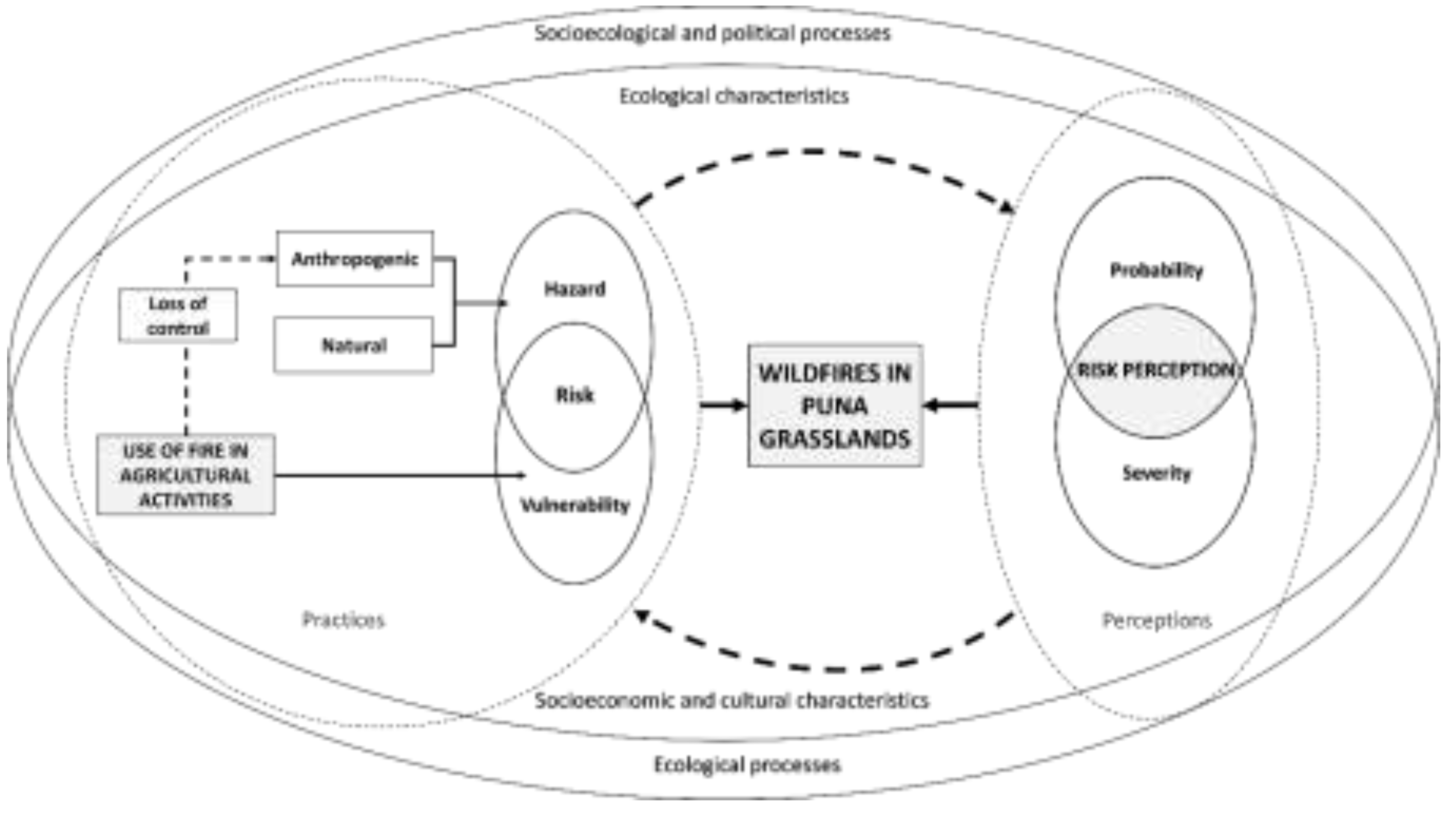
Figure 2.
Distribution of wildfires in dry and humid Puna grasslands in Cusco
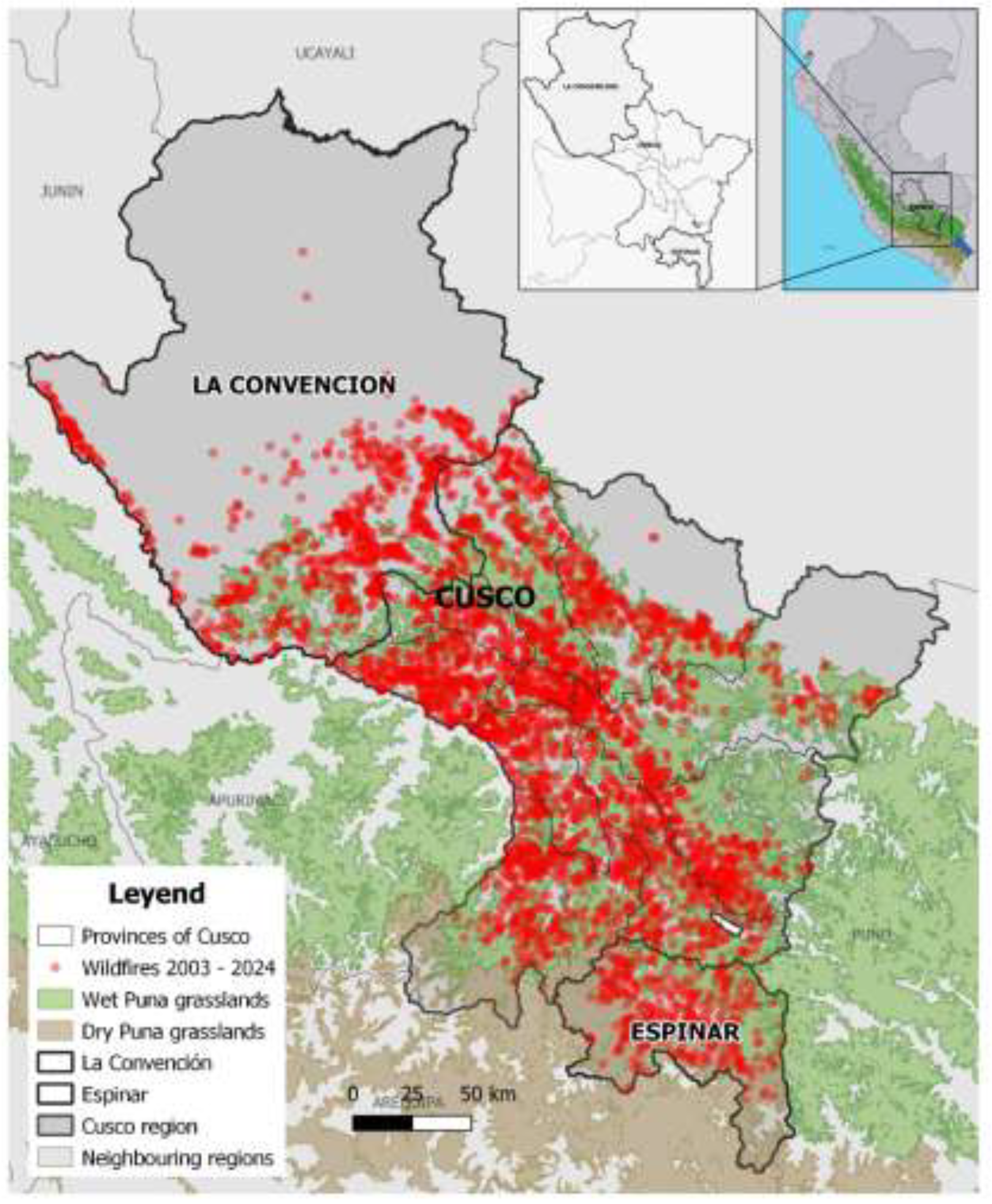
Figure 3.
Map of the Location of Vilcabamba and Apachaco Communities in Cusco.
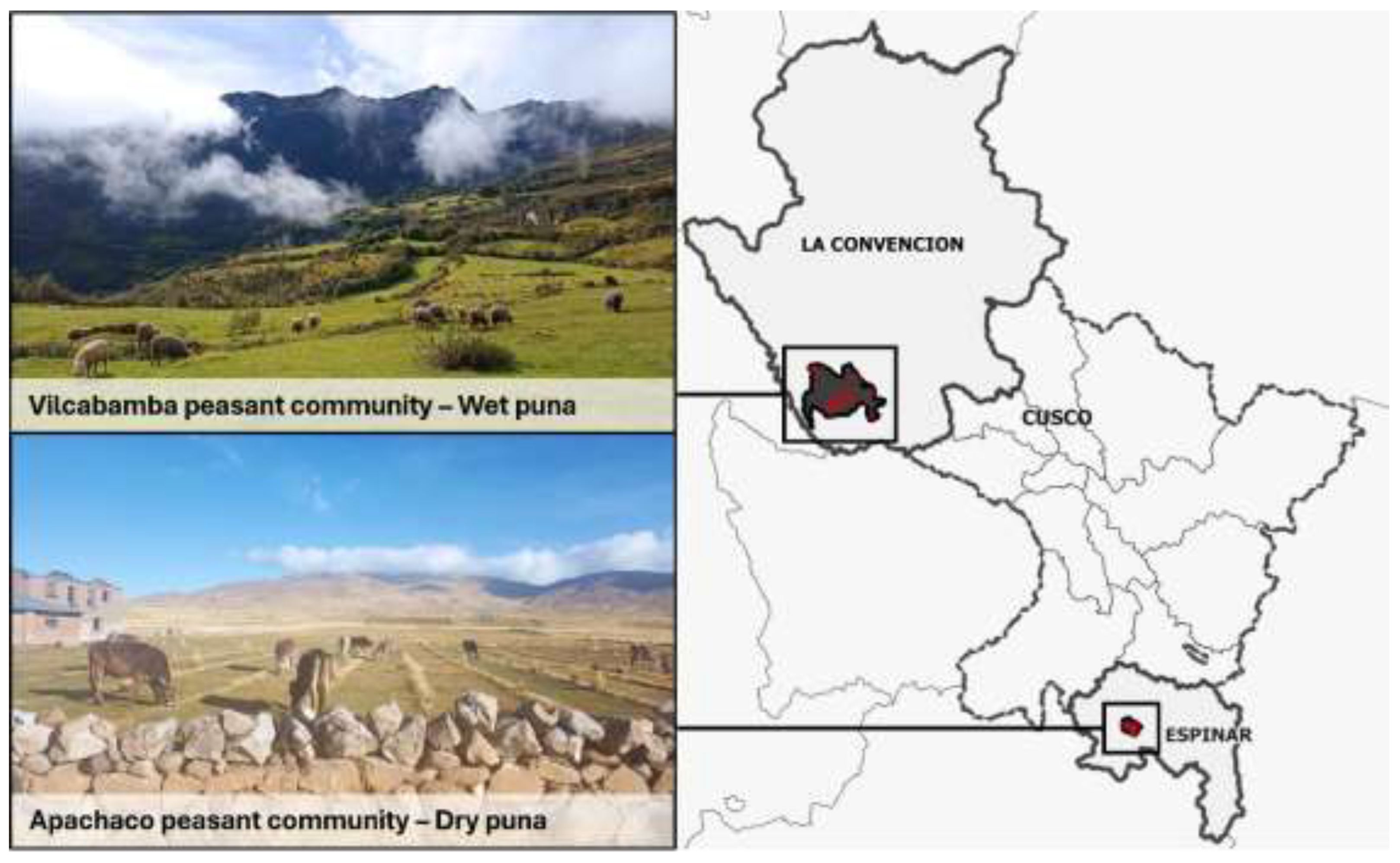
Figure 4.
Relationship Between Agricultural Cycle Activities and Uses of Fire in the Dry Puna (DP) and Wet Puna (WP).
Figure 4.
Relationship Between Agricultural Cycle Activities and Uses of Fire in the Dry Puna (DP) and Wet Puna (WP).
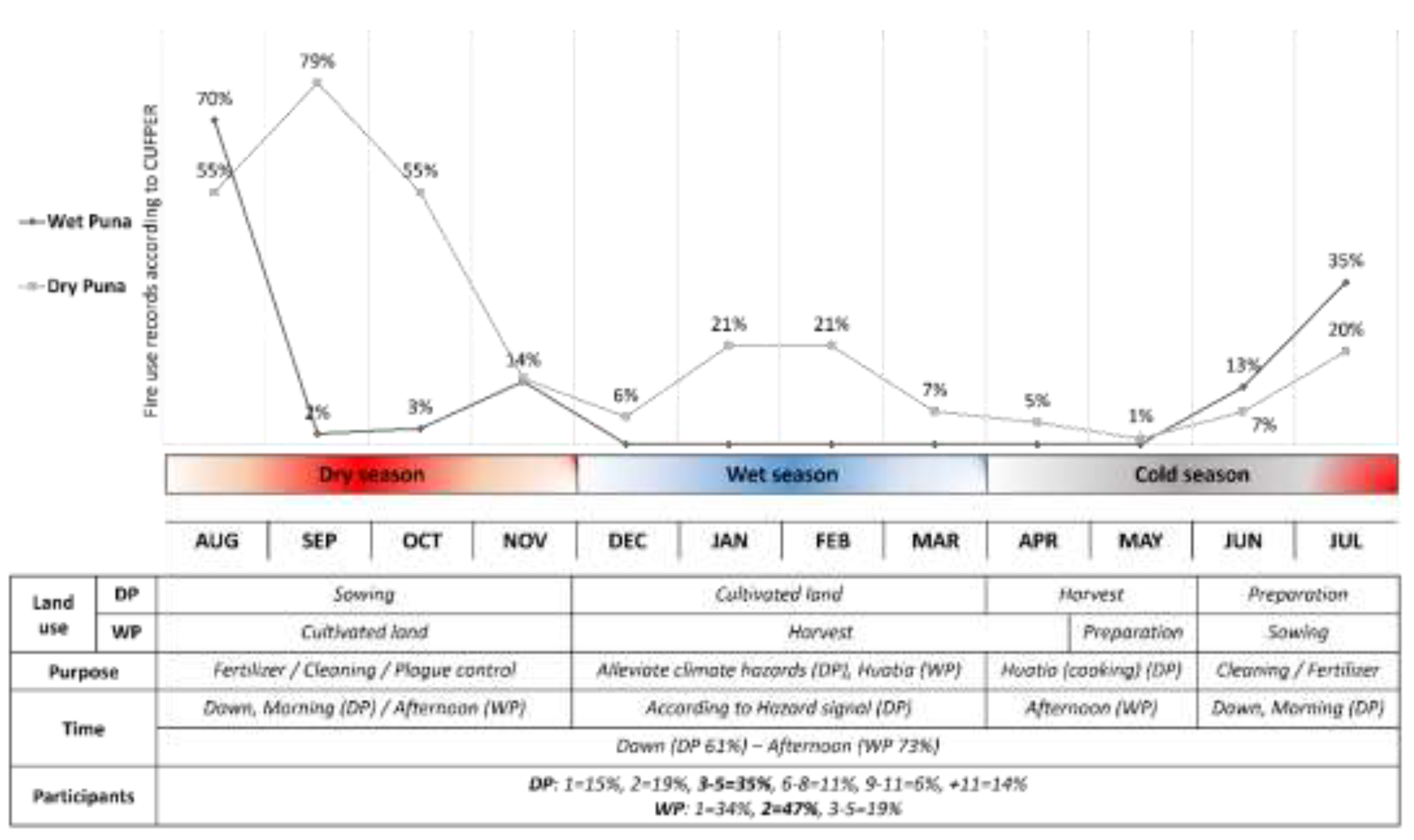

Table 1.
Characteristics of CUFPER interviewees1.
| Community | Apachaco | Vilcabamba |
|---|---|---|
| Interviews | 22 | 13 |
| Sex | F (5) – M (17) | F (6) – M (7) |
| Age range | 28 – 73 | 32 -70 |
| Average age | 56.8 | 49.4 |
| CUFPER | 84 | 88 |
| Sex | F (55%) – M (45%) | F (45%) – M (55%) |
| Age range | 23 -75 | 22 – 78 |
| Average age | 47.6 | 47.8 |
| Distribution per sector | Chiralana (30%), Machu Puente (21%), Machaccoyo (18%), Pucará (15%), Apachaco (13%), Pisccatuyo (2%) | Vilcabamba (27%), Pampaconas (15%), Salinas (11%), Minasmayo (8%), Collpa (8%), Atoqsaico (7%), Vista Alegre (7%), Valle Chancavine (6%), Valle Concevidayoc (5%), Challcha (5%), Coylluychu (2%) |
1 At the start of each interview, informed consent was explained, and approval for recording was requested. All interviews were transcribed and analyzed using Atlas.ti 8 (free trial version) software, applying 16 codes to organize the data.
Disclaimer/Publisher’s Note: The statements, opinions and data contained in all publications are solely those of the individual author(s) and contributor(s) and not of MDPI and/or the editor(s). MDPI and/or the editor(s) disclaim responsibility for any injury to people or property resulting from any ideas, methods, instructions or products referred to in the content. |
© 2024 by the authors. Licensee MDPI, Basel, Switzerland. This article is an open access article distributed under the terms and conditions of the Creative Commons Attribution (CC BY) license (http://creativecommons.org/licenses/by/4.0/).
Copyright: This open access article is published under a Creative Commons CC BY 4.0 license, which permit the free download, distribution, and reuse, provided that the author and preprint are cited in any reuse.


