

Submitted:
03 December 2024
Posted:
04 December 2024
You are already at the latest version
Abstract
Burnout is a factor that affects organizational performance. Researchers have not determined whether an ethical climate and adequate work autonomy provide sufficient emotional stability to dampen burnout or, conversely, increase it. In addition, the abundant literature analyzing the relationship between work autonomy and burnout does not sufficiently establish whether it acts as a stress-reducing resource or a stress-increasing demand. It is also unknown to what extent work autonomy contributes to explaining the relationship between ethical climate and burnout. Therefore, the main aim of this study is to examine the relationship between an ethical climate based on principles and norms and burnout using the moderating effect of work autonomy. We approached this question using a multivariate moderation analysis. The sample consists of 448 employees in the Colombian electric sector. The results show that an ethical climate of principles and work autonomy are positively related to burnout, measured by the dimensions of emotional exhaustion and depersonalization. However, the relationship between an ethical climate of principles and burnout shifts from positive to negative when a rule-demanding work environment is associated with a high perception of work autonomy. In conclusion, when employees have considerable control over their usual tasks, they develop a pattern of behaviour that incorporates both the organization's internal standards and the principles that shape individual morality. In this case, employees are able to balance the workload with the high psychological demands of an ethical climate of principles, without it being a disturbance to their emotional well-being. The results of this research are particularly relevant because they show for the first time that an ethical climate of principles can have opposite effects on employee burnout, both positive and negative, depending on the degree of work autonomy.
Keywords:
Ethical climate of principles
; burnout
; work autonomy
; emotional exhaustion
; depersonalization
; ethical climate
1. Introduction
Ethical climate is defined as a shared understanding of what behaviors are ethically correct and how to deal with behaviors that are ethically deviant. An ethical climate is an environment that fosters ethical thinking, trust and mutual respect in an organization and allows both the questioning and expression of different opinions [1]. Being associated with the promotion of positive behaviors and the prevention of irregular or deviant work behaviors, it plays a key role in organizational regulation and is indispensable for interpreting the emotions, feelings and attitudes of individuals. [2,3,4]. Therefore, the analysis of the ethical climate of the workplace is fundamental to assessing the influence of ethics on workers’ health [1].
Several authors have highlighted the benefits associated with ethical climates, for example, Sillero-Sillero et al. [5] suggest that promoting an ethical climate in the work environment is related to improved employee satisfaction and commitment, which are key factors in increasing happiness and work performance [5,6,7]. Similarly, Ayub et al. [8] establish a negative relationship between ethical climate and burnout through the theory of role stress. According to this perspective, an ethical climate is a key factor that mitigates the effects of ambiguity in work roles and prevents excessive emotional tension. Similarly, Rivaz et al. [9] and Saleh et al. [10] argue that an ethical climate functions as a context that counteracts the negative effects of emotional exhaustion and depersonalization, thanks to a high perception of organizational support. However, the first study analyzes ethical climate in general terms. That is, it does not propose a differentiation between its dimensions. The second study only analyses ethical climate at an individual level i.e., ethical reasoning is located within the individual and is alien to the rest of the organization. Therefore, key aspects such as cooperation, group interest or external laws and codes are not taken into account [10].
In contrast, some studies show the negative effects associated with ethical climates, for example, Atabay et al. [11] observe a positive correlation between a rules-based ethical climate and moral discomfort. An ethical climate whose primary concern is norm compliance and specific organizational regulation criteria builds a work environment that prevents employees from feeling autonomous [12]. This rigidity may clash with the employees’ perceptions of autonomy and be associated with higher levels of moral distress [13]. In fact, moral distress arises when personal ethics conflict with institutional constraints, such as autonomy. What employees consider correct faces organizational barriers, and this situation limits the ethical course of action they deem appropriate. Under such circumstances, moral distress often leads to a growing concern among organizations which is burnout [14]. Burnout is a psychological state that affects the way people perceive themselves and others at work. Burnout is divided into three dimensions: emotional exhaustion, depersonalization and personal realization [1]. Emotional exhaustion is defined as a sustained decline in the reserves that workers have. This context leads the employee to become emotionally distanced from work and to gradually reduce his or her performance. Depersonalization is defined as the gradual distancing of the employee from the rest of his colleagues, leading to a decrease in his emotional capacity. Finally, personal realization refers to the level of satisfaction employees feel with their job performance [15,16]. The study of burnout in organizations is important because it is an occupational health problem that, in addition to causing negative consequences at work, can generate feelings of helplessness, negative attitudes towards others, low self-confidence and a generalized loss of interest in the organization [2,3].
The research here presented follows the approach of Elçi et al. [3], omitting the evaluation of the perception of personal realization as it is considered a consequence of the first two dimensions. Burnout is therefore a phenomenon that affects the emotional health of workers and significantly reduces not only their productivity but also their self-esteem [1]. According to Elçi et al. [3], burnout it is a significant factor in employee behavior and represents one of the most damaging outcomes at the organizational level. In fact, burnout at work has been recognized by the World Health Organization as an occupational disease. In that sense, the direct relationship between an ethical climate and burnout can be a key indicator for the occupational health of any organization. According to authors like Tomczak & Kulikowski [17], burnout frequently results in serious consequences for both individuals and the organization. These consequences can include issues affecting the mental or physical health of employees, absenteeism, high turnover, and a strong sense of inability to adequately address a problem that negatively affects workers’ performance. From this perspective, the impact of specific ethical climates, e.g., principled, on burnout is an emerging issue that requires further research due to the lack of theoretical and practical evidence. In fact, this relationship may offer unexpected results that need to be analyzed in depth [18].
Victor and Cullen [19] suggest that an ethical climate of principles is nurtured not only by personal ethics but also by organizational rules and procedures along with the legal system in place in the country. In other words, an ethical climate of principles must be aligned with the moral personality of employees in order to be efficient. In fact, the perception of organizational justice is an expectation that motivates employees by considering that their actions will be treated with a fair balance between punishments and responsibilities [2,9,15]. However, when an ethical climate of principles imposes moral obligations that may disregard or conflict with the employees’ values, it triggers a process of moral demotivation, as they perceive this situation as a demand [20]. This disproportionate context can have strong emotional impacts that overwhelm employees and cause them to lose valuable personal resources. The conservation of resources theory (COR) by Hobfoll & Lilly [21] proposes that when individuals exercise their profession under difficult emotional conditions and depleted coping resources, they commonly enter a spiral of energy loss and mental fatigue. In fact, the theory suggests that organizational policies directly impact the employees’ ability to respond to factors that lead to emotional stress.
To our knowledge the relationship between ethical climate and burnout, although it has aroused considerable interest in occupational health sciences, remains unclear. For example, Bao et al. [22]; Barr [23]; Huhtala et al. [24]; Maffoni et al. [25]; Plouffe et al. [26] and Rivaz et al. [9] highlight ethical climate as a protective factor for burnout. In contrast, Dal Corso et al. [27] and Tehranineshat et al. [28] suggest that ethical climate is a predictor of burnout. These contradictory results might be explained by the lack of publications that have examined the underlying mechanisms that strengthen or weaken the relationship between highly regulated ethical climates (e.g., principles) and burnout, for which the inclusion of other related variables turns out to be crucial. In this regard, Ghasempour Ganji et al. [29] and Santiago-Torner [18] consider, in recent studies, the role of job autonomy as a necessary condition for employees to be able to interpret the rules within an ethical scenario.
Work autonomy has a positive impact on individuals in several ways. First, it emotionally relieves employees and gives them the authority to decide and choose the best way to perform tasks according to their own criteria [30]. Therefore, work autonomy is a factor that can prevent burnout. Work autonomy shows an inverse relationship with emotional exhaustion, which helps prevent burnout by significantly affecting work satisfaction [31]. In this sense, the job demands-resources theory suggested by Bakker & Demerouti [32] considers that work autonomy is a resource that only affects work results positively. However, this positive impact depends not only on employees accepting greater job responsibility but also on their level of self-efficacy. The self-determination theory by Deci et al. [33], applied to the organizational context, suggests that work autonomy is a primary job characteristic that is related to individual interests and values. Work autonomy goes beyond the feeling of support that employees receive as it often leads to greater job satisfaction and self-efficacy. In that sense, Ryan et al. [34] suggest that when employees have a strong perception of autonomy they find ways to satisfy their basic needs for competence and relatedness. In addition, Liang et al. [35] consider that work autonomy buffers a scenario of abusive supervision.
However, work autonomy can represent an opportunity or an obstacle for employees’ emotional well-being. Autonomy is, in principle, a key aspect of both occupational health and human motivation [36]. However, the perception of self-control becomes a psychosocial risk when limits, about the possible demands, between control and resources, are not clearly established. When the organizational climate is based solely on norms, which can be perceived as demands, and the work schedule is not clearly defined, work intensity, task overload, and time pressure may become part of the employees’ daily lives [37]. This context, which is not necessarily voluntary, poses a risk that may ultimately translate into burnout.
1.2. Contextualization of the Study
Colombia is a unique country that requires special attention because it has been hit for years not only by an armed conflict but also by constant political and institutional corruption. This situation has emptied the values of the citizens, who have finally integrated this hostile culture into their daily habits as accepted. This high perception of immorality jeopardizes interpersonal relationships, deteriorates the social bonds of trust and dilutes ethical responsibility to such an extent that the individual no longer feels excluded when defying the norms [38].
In most developing countries, corruption and political opportunism are important factors that often lead to inefficiency throughout the national territory, but especially in the electricity sector. The Colombian electricity sector has wanted to break with these negative dynamics since its current situation demands that organizational rules and norms become the basic principles of its internal restructuring. The Colombian electricity sector is one of the main axes on which the country’s development is based due to its contribution in the generation of employment and by financing an important part of the national budget that is dedicated to social investment. The creation of a collective action on ethics and transparency was born as an initiative that aims to transform the Colombian electricity sector through good practices and a strict regulatory framework that strengthens the ethical principles of employees [39]. Consequently, there is a clear need to know if a climate defined by demanding norms and by breaking with previous paradigms, has a positive or negative effect on the emotional health of employees. In addition, for the Colombian electricity sector it is also critical to know whether work autonomy has an impact on this relationship since its workforce, with a high level of university education, is characterized by being granted with well-paid jobs and a strong autonomy.
In addition, as of 2020 the Colombian electricity sector introduced new work modalities, e.g., teleworking, which had been virtually unexplored before. By 2024, high-intensity teleworking has been combined with hybrid work models that alternate face-to-face and virtual work. These constant adjustments have increased employee responsibilities and put pressure on organizations to adapt to all these changes without delaying the delivery of important projects. However, high job demands can turn into excessive obligations that increase the employee’s emotional stress [40].
1.3. Objective and Hypotheses
Taking the above considerations in mind, the objective of this study is to analyze the relationship between an ethical climate of principles and burnout by considering the moderating effect of work autonomy in the Colombian electricity sector. In coherence with this objective, three different hypotheses have been formulated. We depart from the fact that, first of all, a rigid climate focused on norm compliance is usually subject to high psychological demands and low perception of support [41,42]. Besides affecting employee motivation, this mismatch between resources and demands can lead to negative emotional processes that significantly harm employee health. Strict discipline and imposing a climate aimed at rules compliance induce more bureaucratic and impersonal processes and often result in repetitive and stressful work. In fact, an environment with weak feedback is likely insufficient to develop new values that change behaviors internalized by employees [43]. When an ethical climate of principles proposes moral obligations that possibly ignore or disagree with the employees’ values, a process of moral demotivation opens as this situation is perceived as a demand [20]. This disproportionate context can have strong emotional impacts that overwhelm employees and cause them to lose valuable personal resources.
In that sense, Hobfoll & Lilly [21] propose that when individuals practice their profession under difficult emotional conditions and with depleted coping resources, they commonly enter a spiral of energy loss and mental fatigue. Therefore, the following hypothesis is proposed: H1. An ethical climate of principles relates positively to burnout syndrome.
Secondly, work autonomy is a key factor in proper job design [30]. In this sense, the tension between autonomy and control becomes more evident in organizational climates that pressure employees to conform to normative expectations. This intentional constraint can undermine the beneficial approach that many authors attribute to flexibility in performing tasks [31]. Physical and emotional strain increases as job demands become more evident and employees lack sufficient resources to cope with them successfully. According to Luna et al. [44], the degree of autonomy may be a detrimental factor for the emotional well-being of professionals. Work autonomy may be related to certain work conditions, including lack of support and time pressure, as common detrimental effects [45]. Indeed, when a work environment focuses on the pursuit of uniform codes of conduct, it exerts external control over employees. The increasing need to monitor the achievement of specific goals and project the value or direction of work become demands that generate stress, ambiguity, and uncertainty in highly regulated environments [46]. In that sense, Mazmanian et al. [47] specify that a higher level of autonomy implies a greater dedication to work, which leads employees to lose control over their lives in favor of the employing entity [48]. This situation can have important implications for employees’ work-life balance. Therefore, work autonomy can lead to stress levels that result in burnout. Consequently, the following hypothesis is proposed: H2. Work autonomy is positively related to burnout.
Thirdly, the true nature of an ethical climate of principles considers the moral values of employees and not just organizational norms. This integrative approach prevents the role conflict that arises when personal values are misaligned with organizational expectations. In fact, providing clear signals about institutional ethical intentions becomes a key aspect to reduce stress levels if employees consider them acceptable [49]. Emotional energy is depleted not only through demanding work conditions but also when sufficient resources do not back work. In this sense, both the conservation of resources theory [50] and the Job demands-resources theory [32] consistently suggest that the loss of resources results in permanent stress leading to burnout. However, the importance of an ethical climate to facilitate or hinder the achievement of specific basic needs, such as autonomy, remains difficult to assess. According to the self-determination theory [33,51,52], autonomy is a work resource that activates and guides human behavior by covering a basic psychological need. Therefore, autonomy is an aspect of work that can explain the relationship between job demands and burnout [53].
Autonomy is the individual’s ability to choose how a specific process or task will be carried out. Autonomous individuals have the freedom to initiate their own actions; that is, they choose their goals and the course of action to achieve them. Self-determination theory suggests that some external factors, e.g., excessive supervision or a very rigid work climate tend to decrease the sense of autonomy, causing a shift in perceived locus of control from internal to external [33,34]. Locus of control is a personality variable that establishes a relationship between effort and behavior. In this sense, the internal locus of control occurs when the person perceives that what happens externally is due to his or her behavior and has control over these external consequences. In fact, internal locus of control is associated with higher self-esteem and emotional well-being [51]. Therefore, self-determination theory not only suggests that people need to feel autonomous in order to develop their individual potential but also to be able to interact adequately with their environment and have some control over it [33].
When an ethical climate of principles is able to integrate the employee’s moral character with organizational rules, taking into account the importance of individual values, it limits uncertainty, strengthens the perception of internal locus of control and avoids a possible breach of the rules [41]. For this reason, a climate with a less rigid orientation that provides the employee with the necessary tools to face an ethical dilemma can protect his or her emotional well-being by satisfying the basic need for autonomy.
In fact, when employees perceive that the environment surrounding them does not limit or pressure their behavior or way of thinking, their psychological resources improve through a greater feeling of autonomy. In this sense, work autonomy can activate different motivational processes and a certain psychological freedom that prevents burnout. On the other hand, rules linked to an ethical climate of principles can prevent employees from being exposed to a succession of overwhelming demands that exceed both their autonomy and emotional limits, leading to burnout [54]. Examples of such overwhelming demands may include role overload, work settings with excessive work, or abusive leadership styles.
Although we expect a positive relationship between an ethical climate of principles and burnout, we suggest that this positive effect will be attenuated when there is an adequate interaction between organizational norms and work autonomy. That is, the employee’s understanding and internalization of the regulatory aspects proposed by the organization will enhance the positive effect of work autonomy. Therefore, the intersection between norms and autonomy will determine when or under what circumstances (moderation) the positive relationship between an ethical climate of principles and burnout diminishes or even stops [55]. Consequently, the following hypothesis is proposed: H3. Work autonomy inversely moderates the positive relationship between an ethical climate of principles and burnout.
This study aims to contribute to the existing literature on occupational health in different ways. Firstly, there are very few studies that have not been developed among health care workers in rich countries. Therefore, the present study, carried out with employees in the electricity sector in an emerging country such as Colombia, constitutes a novelty. Secondly, our results may provide a previously unstudied perspective on the relationship between an ethical climate of principles and burnout by considering also the negative impact the former might have on the latter. In fact, we suggest that a highly normative climate may be sometimes perceived as an emotionally overwhelming demand on behalf of the employee. Thirdly, our results can make a significant contribution to the field of occupational health and safety since increased work autonomy is not necessarily associated with increased psychological well-being. For example, Wu et al. [56] suggest that high work autonomy increases employee pressure and constant adaptation to artificial intelligence, which can lead to anxiety and job insecurity. Finally, and most importantly, this study aims to provide evidence, in a novel way, of the extent to which an ethical climate of principles that integrates moral-related behaviors and rules, can be a motivational force capable of preventing the emergence of emotional exhaustion and depersonalization through different perceptions of work autonomy [30]. This opens the door to new strategies for organizations to prevent certain psychosocial occupational risks, such as burnout, which often have a serious impact on employees’ mental health.
1.4. Research Model
The direct effect of both an ethical climate of principles and work autonomy on burnout represents an important advance in our knowledge of ethical climates. In addition, the inverse moderating effect of job autonomy indicates that a strong perception of autonomy can develop a pattern of behavior that allows for the adjustment of workload with the high psychological demands of ethical climate of principles. Therefore, a work context capable of balancing norms, personal morality and autonomy prevents burnout. Figure 1 shows the research model and the direction, positive or negative, of the three hypotheses put forward.
2. Method
2.1. Data Collection and Sample
A cluster sample was used, including Colombia’s main cities (clusters). The sample selection of organizations had a confidence level of 95%. Most of the companies in the Colombian electric sector concentrate in the five capitals of the country’s key departments (Cundinamarca, Antioquia, Valle del Cauca, Risaralda, and Caldas). The research project was presented at the Colombian electric sector’s community action meeting in mid-2021. More than 50% of the 35 selected organizations in the first instance expressed interest in the study, precisely 18. The selection process of the organizations took into account factors such as market share, location, seniority, and the number of employees. Ultimately, their sector visibility and countrywide location led to the selection of six collaborating organizations out of 18. Data collection took place between October and December 2021. We established only two selection criteria when choosing the participants: a minimum of one year of seniority and an indefinite contract type. These criteria aimed to guarantee that the employee understood the work environment and that a fixed-duration contract did not influence their responses.
During this second stage, confidentiality agreements were signed, and the following documents were sent: voluntary consent and waiver, data protection, and objectives presentation. The questionnaire was supervised by a group of experts and sent to the participants online using the Google Forms tool. The survey was written in Spanish by a bilingual researcher using the conventional “back translation” method [57]. All the research was subject to an ethics committee at the end of 2021. The survey took an estimated time of about 35 minutes to be completed.
We took into account the suggestions of Podsakoff et al.‘s last article [58] to minimize the effects of common method bias (CMB). Firstly, we collected data from various organizations. This technique decreases biases associated with transient mood states and also reduces the tendency to respond in a socially desirable manner. Second, the principal investigator was present in all six data collection processes. The participating organizations allocated one hour of work time for their employees to complete the survey. To eliminate possible ambiguity in the items on each scale evaluated, the principal investigator provided additional information to make the questions in the questionnaire as simple and specific as possible. Third, the principal investigator guaranteed the anonymity of the respondents. The objective of this technique is to reduce the distrust or fear that the respondent may experience when giving personal information.
The final sample is formed by 448 professionals who work in the Colombian electric sector, specifically in six organizations with central offices in Bogotá, Cali, Medellín, Manizales, and Pereira. Regarding gender, 175 (39%) participants were women, and 273 (61%) were men. The average age is 37.18 years (SD = 10.059; range: 20-69). A total of 448 professionals have permanent work contracts (100%), Mean seniority in the organization is 13.06 years (SD = 8.82; range: 0-38 years). Regarding work activity, 86.6% (308) are analysts, 8.9% (40) have intermediate jobs, and 4.5% (20) are managers. All (100%) of survey participants have university studies, and 57.4% (257) have graduate studies. Some 58% (260) have children
2.2. Instruments
Control Variables: Seniority and gender are treated as control variables. In fact, seniority may be a critical occupational factor linked to chronic stress [59]. Furthermore, considering the different backgrounds, it is possible to assume that women experience higher levels of emotional exhaustion than men. The imbalance in domestic workloads between men and women is likely to be a key factor justifying women’s greater physical and mental exhaustion [60]. To measure seniority, survey participants were asked to indicate how long they had been working using a scale with one year as the minimum. Gender was coded as 0 for men and 1 for women.
Ethical climate based on principles: One of the subscales proposed by Victor & Cullen [19] was used to evaluate the ethical climate of principles, composed of 11 items organized into three subdimensions: (1) Personal morale (three items), (2) Rules and procedures (four items) and (3) Laws and professional codes (four items). The Cronbach’s Alpha obtained through the original scale was 0.72, using a five-point Likert scale. This research used a six-point scale instead ranging from “strongly disagree” to “strongly agree.” Items for example include: “Individuals are expected to follow the law and professional standards above other considerations.” The present research obtained a Cronbach’s Alpha of 0.74 (see Table 2). Bonett & Wright [61] consider a Cronbach’s alpha value equal to or greater than 0.70 as standard. Likewise, composite reliability (CR) and average variance extracted (AVE) were calculated. The results indicate that CR is optimal (CR = 0.74) and AVE is adequate (AVE = 53%). According to Bagozzi et al. [51] and Chin [52], these two values are relevant as they are above 0.70 and 50% respectively.
Work Autonomy: The one-dimensional scale suggested by Spreitzer [62] was used to measure work autonomy using three items. The Cronbach’s Alpha obtained through the original scale was 0.72, using a five-point Likert scale. It assesses whether employees have sufficient independence to decide the direction and intensity of their efforts when performing their work and to assume firm control over it. The present research used a six-point scale instead ranging from “strongly disagree” to “strongly agree.” Items for example include: “I can decide on my own how to do my work.”. This research reaches a Cronbach’s Alpha of 0.87 (see Table 2). Additionally, results indicate that CR is optimal (CR = 0.73), and AVE is adequate (AVE = 80%).
Maslach Burnout Inventory: Multidimensional model that differentiates between emotional exhaustion and depersonalization. Both emotional exhaustion and depersonalization have positive correlations with burnout [16].
(1). Emotional Exhaustion: Emotional exhaustion was measured using the five items proposed by Schaufeli et al. [63]. The Cronbach’s Alpha obtained through the original scale was 0.85, using a five-point Likert scale. The effect of the workload on individuals’ emotional resources is evaluated. This research used instead a six-point scale ranging from “strongly disagree” to “strongly agree.” Items for example include: “I am emotionally exhausted at my job.” This research achieved a Cronbach’s Alpha of 0.90 (see Table 2). The results indicate that CR is optimal (CR = 0.81), and AVE is adequate (AVE = 68%).
(2). Depersonalization: Depersonalization was measured using the five items proposed by Schaufeli et al. [63]. The Cronbach’s Alpha obtained through the original scale was 0.78, using a five-point Likert scale. It assesses whether the workload gradually consumes employees’ emotional resources until a distance is created between them and the rest of the organization’s members. This research used a six-point scale instead ranging from “strongly disagree” to “strongly agree.” Items for example include: “I have become more cynical about whether my work contributes anything.” Used by Salanova & Schaufeli [64] with a Cronbach’s Alpha of 0.84. These authors eliminated item number 13 due to its low factor loading. The same criteria apply in this study. The present research achieved a Cronbach’s Alpha of 0.90 (see Table 2). The results indicate that CR is optimal (CR = 0.86), and AVE is adequate (AVE = 66%).
2.3. Data Analysis
First, descriptive analyses of the evaluated variables were conducted, including means, standard deviation, Kurtosis, and Skewness. Second, a correlation analysis between the study variables was done. Third, model 1 (simple moderation) proposed by Hayes [65] was used and tested with a regression-based analysis, with a confidence interval (CI) of 95% and a total of 10,000 bootstrapping samples. Moderation analysis is a type of multivariate analysis in which an independent variable predicts a dependent variable by taking into account the causal strength of a third variable that interacts between the two, called the moderating variable [66]. In this line, the moderating variable affects the strength and/or direction in the relationship between the predictor variable and the output variable. Unlike mediation analysis that tries to quantify how or why a certain phenomenon occurs, moderation analysis tries to quantify especially when or under what circumstances it occurs. The PROCESS Macro Hayes [65] of the SPSS statistical program is used for this end.
Before the moderation analysis, the data was checked in terms of linearity, normality, and multicollinearity issues. Kurtosis, asymmetry, and Mahalanobis distance scores were examined to determine linearity and normality. Variance Inflation Factors (VIF) and Condition Index were used to assess multicollinearity issues. Condition Index values must be below 30 and VIF values below 10 to meet the assumption of normality. Outliers were verified using Mahalanobis distances as suggested by [67]. No multicollinearity issues were identified, and the data was normally distributed.
3.1. Confirmatory Analysis
We performed confirmatory factor analysis (CFA) to give empirical validity to the conceptual structure of this research. To evaluate the goodness of fit, we analyzed that: (a) the SBχ2 index over the degrees of freedom (SBχ2/gl) was less than 5; (b) that the Goodness of Fit Index (GFI), the Comparative Fit Index (CFI), the Tucker Lewis Index (TLI), the Normalized Fit Index (NFI), the Incremental Fit Index (IFI) reach values equal to or greater than 0.90; (c) the Root Mean Square Error of Approximation (RMSEA) was less than 0.05 [68].
The theoretical model obtained good results. The incremental fit indices gave excellent values (NFI=0.91; TLI=0.91; CFI=0.92; IFI=0.94). On the other hand, the absolute fit indices showed acceptable values (RMSEA and GFI (0.076 and 0.92, respectively). Finally, AIC, ECVI and the χ2/gl ratio presented optimal values: 645.19; 1.44 and 3.56, respectively). Although RMSEA values below 0.05 are considered a good fit, values up to 0.08 represent reasonable errors of approximation [69].
3.2. Descriptive Statistics
Table 1 presents the first calculated descriptive analyses. Negative skewness values indicate a slight rightward skew in the data distribution. Kurtosis values below 2 indicate a distribution similar to the normal distribution. However, the positive sign indicates a leptokurtic distribution. Indeed, data values are closer to the mean and outliers are rarer. Generally, the data are considered normal when kurtosis is between -7 and +7, and skewness is between -2 and + 2 [70].
The correlation analysis conducted second showed that the gender control variable (G) did not correlate significantly to the analyzed scales or subscales. In contrast, seniority (SE) was related to work autonomy (WA) (r = 0.12; p < 0.01) and to emotional exhaustion (EE) (r = 0.13; p < 0.01). The ethical climate of principles (ECP) showed a positive relationship with WA, EE, and depersonalization (DE). Finally, WA is related to EE and DE (see Table 2).

Table 2.
Correlations between variables and discriminant validity.
| Constructs | N | G | SE | ECP | WA | EE | DE | ||
|---|---|---|---|---|---|---|---|---|---|
| Gender (G) | 1 | x | |||||||
| Seniority (SE) | 1 | 0.04 | x | ||||||
| Ethical Climate of Princ. (ECP) | 11 | 0.08 | 0.04 | 0.72 | |||||
| Work Autonomy (WA) | 3 | 0.04 | 0.12* | 0.24* | 0.89 | ||||
| Emotional Exhaustion (EE) | 5 | 0.03 | 0.13* | 0.16* | 0.20* | 0.82 | |||
| Depersonalization (DE) | 4 | 0.04 | 0.07 | 0.23* | 0.14* | 0.59* | 0.81 | ||
| Note: The table shows the Pearson correlations and also includes discriminant validity (diagonal). Discriminant validity depends on the square root of AVE being greater than the different correlations between variables [71]. (N) Number of items. Significant correlations * (p < 0.05). CI (95%) (n=448). | |||||||||
3.3. Moderation Analysis
Figure 2 and Table 3 and Table 4 reveal the results of the double analysis of simple moderation. The regression coefficients used are not standardized. Bootstrapping samples are over 10,000, and confidence intervals are around 95%. The LLCI and ULCI values operate as lower and upper bounds. Hypothesis 1 proposed that an ethical climate of principles would relate positively to burnout syndrome. The linear regressions corresponding to effect a1i of model 1 (β = 0.11, SE = 0.15, p = 0.01) and of model 2 (β = 0.12, SE = 0.17, p = 0.01) justify this assumption (see tables 3 and 4). Hypothesis 2 proposed that work autonomy would relate positively to burnout syndrome. The linear regressions corresponding to effect a2i of model 1 (β = 0.57, SE = 0.25, p = 0.01) and of model 2 (β = 0.69, SE = 0.35, p = 0.01) validate this assumption (see tables 3 and 4). Hypothesis 3 proposed that work autonomy would inversely moderate the positive relationship between an ethical climate of principles and burnout. The linear regressions corresponding to effect a3i of model 1 (β = -0.02, SE = 0.05, p = 0.01) and of model 2 (β = -0.02, SE = 0.04, p = 0.01) confirm this assumption. Low, medium, and high indirect effects confirm work autonomy’s moderating effect (see Table 3 and Table 4).
Figure 2, shows the proposed statistical diagram and the results of the simple moderation.
Figure 3 shows the moderating effect of work autonomy on the relationship between an ethical climate of principles and emotional exhaustion. The macro-PROCESS provides three independent values (low, medium, and high). The graph shows that low and medium autonomy levels are not statistically significant. In other words, these two autonomy levels do not influence the impact of an ethical climate of principles (X) on emotional exhaustion (Y). However, a high perception of autonomy changes the meaning of the relationship between X and Y. Therefore, when an ethical climate of principles coexists with high autonomy, it has a buffering effect on emotional exhaustion.
Figure 4 details the impact of an ethical climate of principles (X) on emotional exhaustion (Y), through the multiple moderating values assumed by work autonomy. Work autonomy changes the orientation of X over Y, starting from value 10.054. That is, the influence changes from negative to positive.
Figure 5 shows the moderating effect of work autonomy on the relationship between an ethical climate of principles and depersonalization. The graph shows that low autonomy levels are not statistically significant. In other words, this autonomy range does not influence the impact of an ethical climate of principles (X) on depersonalization (Y). However, a high or medium perception of autonomy changes the meaning of the relationship between X and Y. Therefore, when an ethical climate of principles coexists with a medium or high level of autonomy, it has a buffering effect on depersonalization.
Figure 6 explains the impact of an ethical climate of principles (X) on depersonalization (Y), through the multiple moderating values assumed by work autonomy. Work autonomy changes the orientation of X over Y, starting from value 9.517. That is, the influence changes from adverse to favorable.
4. Discussion
This study analyses the impact of an ethical climate of principles on employees’ emotional exhaustion and depersonalization, considering work autonomy as a relevant moderating factor in this relationship. The findings revealed a positive correlation between an ethical climate of principles and these two subdimensions of the Maslach Burnout Inventory. Furthermore, it was observed that the influence of an ethical climate of principles on burnout was conditioned by the level of work autonomy of employees. That is, a higher presence of autonomy was related to lower levels of burnout.
This research makes valuable contributions to the literature for being one of the first articles to detail how an ethical climate based on principles affects employees’ emotional exhaustion and depersonalization, helping fill an important knowledge gap. Although there is information on the effect an ethical climate can have on burnout, for example, Ayub et al. [8], Rivaz et al. [9], Saleh et al. [10], none of these studies address a model focused on the role of an ethical climate of principles as a key component of employees’ emotional well-being. Therefore, the results obtained in this research represent an important step in understanding ethical climates and their effects.
The findings of this research highlight the detrimental effect of an ethical climate of principles on employees’ emotional exhaustion and depersonalization (H1). These results suggest that rules generally enable coherent employee behavior. However, when individual behaviors clash with a highly hierarchical and bureaucratic organizational structure, for instance the Colombian electric sector with its rigid attitudes towards rules, the independence and dynamic skills needed by professionals tend to be reduced [28]. This mechanical, controlled context with little room for proactivity can lead to moral distress and burnout [43]. In fact, through the development and implementation of its comprehensive anti-corruption program, the Colombian electric sector has defined an ethical climate of principles conditioned by strict policies to counteract bribery, which in turn restricts employee actions [18].
In this sense, Atabay et al. [11] consider that a rules-based climate may be related to higher levels of moral distress. According to these authors, when employees perceive that their intentions, the product of personal interpretation of what is appropriate behavior, are interrupted by a lack of freedom and feel obliged to follow a path with which they disagree, they repress emotions and consume resources until becoming exhausted. Along these lines, Bernuzzi et al. [72] suggest that moral distress is actively related to emotional exhaustion when it is not refocused positively.
The imposition of a strict work environment, in addition to attacking personal morale, causes professionals to confront this stressor with psychological regulation that tends to the expressive suppression of emotions. This strategy modifies the emotions expressed rather than the internal feelings [1]. Therefore, a maladaptive and contrary effect generates an external and internal discrepancy, which ends in negative emotional experiences. According to the COR theory, a work context that recurrently imposes demands, drives subordinates to a progressive energy loss until they become emotionally exhausted, and their emotional well-being deteriorates [73].
A work climate that is excessively strict with rules conditions the employee’s emotional regulation and may clash with people who consider that they have little control over their emotions [74,75]. In this sense, COR theory explains that significant efforts must be preceded by sufficient resources for the employee to recover and build a sustainable resource pool over time [50]. According to Hobfoll et al. [21] stressful conditions are the result of a sequence of complex events that impact the employee. From that perspective, constantly facing organizational rules and norms requires an investment of energy that is hardly sustainable. In fact, COR theory states that the loss of resources is more influential than the gain of resources in terms of employee emotional responses. Therefore, a work climate disconnected from the employee’s needs imposes coping strategies with a low perception of social support [76]. People with little social support have fewer options for coping efficiently with stressful situations. In that sense, an ethical climate of principles can contribute to employee burnout.
On the other hand, independence to make decisions based on one’s criteria can lead to ignoring formal rules [77]. For example, the Colombian electric sector depends on strong efficiency to solve problems and provide services quickly. Therefore, personal morale may disagree with organizational rules when employees face ethical dilemmas affecting organizational performance, e.g., early delivery of an electrical certification with strong social undertones if such is rapid. A rigid climate stops what personal morale, or codes of conduct consider good intentions, and these types of ethical conflicts can emotionally frustrate employees in addition to requiring more resources. In fact, failure to accept stressors contributes to employees being more vulnerable to emotional exhaustion and depersonalization [78,79]. Furthermore, the Colombian electric sector faces added complexity as its progress depends on continuous innovation. This static context of a climate with a rigid moral guide, through a set of rules with only one meaning, limits organizational development. Disruptive processes and individual creativity are incompatible with the classical moral theory, which seeks to impose a climate in which the highest aspiration is to prevent bad practices [80]. Rigid postures prevent morale change and likely undermine employees’ emotional health [72].
The self-determination theory, previously addressed in this article, allows to better understand the association between an ethical climate of principles and burnout. First, employees in the Colombian electricity sector face a high social responsibility since public institutions are expected to have a supportive character and strong moral purposes. It is likely that these social expectations exert a strong influence on the emotional management of employees in this sector [81]. From a moral perspective, emotions become more intense in industrial sectors associated with individual needs and more so in developing countries where extreme poverty rates are very high.
On the other hand, self-determination theory suggests that an overly authoritarian and controlling climate limits the basic psychological competencies of autonomy, competence and relatedness. The work climate is a contextual factor that acts as a resource or demand for the three basic psychological needs. The need for autonomy requires congruence between action and personal values. The need for competence requires a supportive and interactive environment. Finally, the need for relatedness involves a sense of belonging and having significant others nearby. Neglecting the satisfaction of these needs will have a negative impact on the individual psychological development and well-being of the individual. Therefore, a specific context with multiple demands such as that from a rigid and normative ethical climate can become a challenge for the employee that avoids certain positive motivational regulations and makes him/her more susceptible to burnout [33,34].
This research has introduced work autonomy as an aspect to explain emotional exhaustion and depersonalization (H2). The results indicate that work autonomy, far from playing a protective role, contributes to increased stress and negative factors linked to the job position. It is important to contextualize these results, considering that the main characteristic of the Colombian electric sector is the high academic training of its personnel. This differential factor, in this specific sector, is likely to turn the work intensity effort into an aspect valued for possible promotions. In this case, work flexibility can become a stressor because tasks control employees. In other words, work autonomy can become a demand when employees lose certain decision freedom [45,82].
This result can be explained by “the autonomy paradox” proposed by Mazmanian et al. [47] according to which there is a significant relationship between a greater degree of work autonomy and an increase in the hours dedicated to work, which can lead to a culture of extended work shifts [48]. Task heterogeneity added to deadlines probably influences the low regulation of the time allocated to their completion. In addition, the Colombian electric sector is obliged to justify all its processes, which entails intense administrative work. The strictness imposed by the sector studied since 2015, with the aim of preventing part of the operation from being diverted into private hands, requires presenting multiple almost immediate reports to demonstrate proper management of the processes.
According to COR theory work autonomy may compel individuals to alter their interpersonal interactions. Specifically, when autonomy transforms into a demand employees tend to minimize their emotional expenditure by limiting their relationships with others [21,50]. Consequently, emotional exhaustion and depersonalization may serve as extreme defense mechanisms against the depletion of emotional resources elucidating the positive correlation between work autonomy and burnout. Conversely prolonged working hours which arise from the ineffective utilization of autonomy hinder positive interactions with family and friends [75,79]. Furthermore, they diminish the perception of competence as an exhausted individual exhibits reduced efficiency and necessitates additional time to manage the same workload.
Finally, when work autonomy assumes a moderating role, the impact of the ethical climate of principles on emotional exhaustion and depersonalization progressively changes (H3). In other words, a gradual increase in work autonomy reduces the positive impact of an ethical climate of principles on employees’ emotional exhaustion due to the mentioned reason. In essence, rules and ethical codes seek to regulate individual behavior through a perspective of equity [41]. Thus, when an ethical climate of principles strives to understand the perceptions of its members towards the norms, it is easier for individual behavior to be more stable [83,84].
Considering personal morale as a critical organizational aspect prevents employees from intentionally deviating from the norm. Therefore, balancing rules and individual ethical codes will likely influence the employees’ emotional health [15]. However, this effect is significant across different perceptions of autonomy (low, medium, and high). First, when an ethical climate of principles coexists with low autonomy, its positive effect on emotional exhaustion and depersonalization does not occur. This scenario is coherent with the model proposed by Karasek [85], which studies the relationship between the volume of work demands and the degree of autonomy required to handle them. When linked to low autonomy, a rigid and rule-based work climate fosters greater resource consumption, such as extended work shifts. In this context, an ethical climate of principles represents a demand that causes tension and emotional discomfort.
In this regard the perception of low work autonomy affects at least two of the three fundamental psychological needs outlined by self-determination theory. Specifically low work autonomy restricts the employee’s ability to exert control over their tasks. This situation compels the worker to expend additional emotional resources in an effort to achieve a sense of competence thereby hindering adequate psychological satisfaction [34]. Moreover, the positive correlation between the excessive utilization of resources that the individual is unable to recuperate and the phenomenon of burnout aligns with the Conservation of Resources (COR) theory [50].
Second, when an ethical climate of principles coexists with medium or high autonomy, its positive impact on emotional exhaustion and depersonalization changes from positive to negative. In other words, medium and high work autonomy levels, when combined with an ethical climate of principles, have a buffering effect on emotional exhaustion and depersonalization. In this sense, when employees have greater control over the task, they develop new patterns of behavior, which integrate the organization’s internal rules and standards with the external criteria and principles responsible for shaping personal morale. Employees under such circumstances can establish a positive relationship between workload and work autonomy, achieving work goals or acquiring new knowledge without it leading to mental health deterioration [86]. Finally, Zeuge et al. [87] suggest that education level is a relevant characteristic about the responsible use of autonomy.
On the other hand, the Colombian electricity sector is making real efforts to implement strategies to reduce the hierarchical distance between leader and subordinate [18]. In that sense, Guo et al. [88] suggest that work autonomy is particularly advantageous in mitigating burnout among employees who experience low authority distance. Authority distance refers to the extent to which less powerful members of a social group accept power inequality. The perception of low authority distance diminishes inequalities among individuals; that is the interdependence between those in power and their subordinates is heightened. This context of proximity enables the integrity and moral considerations of the employee to be regarded as valuable assets to the organization. Indeed, one of the principal characteristics of low authority distance is that all individuals within the organization possess equal rights and responsibilities. Consequently, personal values and organizational norms are harmonized through mutual respect [89]. This more accommodating environment allows employees to feel less overwhelmed and to adhere to the personal care guidelines established by the organization thereby preventing role overload or excessive work conditions.
The correlation between low authority distance and the reduction of burnout through high perceived work autonomy aligns with Conservation of Resources theory. This theory posits that individuals with abundant emotional resources are less likely to deplete them. Conversely individuals with limited emotional resources are more susceptible to becoming ensnared in a downward spiral of resource depletion that culminates in burnout [50]. Therefore, dignity and respect foster a closer connection between the employee and the organization resulting in the restoration and enhancement of emotional resources. In fact, this scenario also positively influences the employee’s perception of competence and interpersonal relationships [33,34].
Although it is not part of any research hypothesis in this study, results suggest that job seniority poses a risk for employees in the Colombian electric sector, as it is positively related to burnout. This result differs from the findings of Taranu et al. [90]. These authors consider that lack of experience in the job position is a factor that leads to emotional exhaustion. In other words, an inexperienced person may be subject to longer work shifts due to a lack of maturity in their usual duties and to greater emotional exposure related to burnout.
The Colombian electric sector is subject to multiple social pressures, such as the country’s growing economic slowdown leading to strong social instability or the numerous corruption cases recently discovered. In this sense, employees with more seniority are likely to assume these situations as emotional burdens that require constant consumption of resources through coping strategies, which, if not proactive, lead to excessive stress, negative emotions, emotional exhaustion, and depersonalization. In fact, low-proactive strategies are maladaptive and involve strong emotional disconnections. That is, these strategies are unable to face the challenges posed by a stressor and to obtain additional resources to face future complex scenarios [91]. Therefore, when these strategies do not help to manage emotions adequately, they are not very effective to buffer burnout as the work context demands, instead of acting as a resource that encourages self-development, become demands that are impossible to assume [92].
To conclude, the results indicate no significant relationship between gender and burnout, which agrees with the findings of Palupi & Findyartini [93]. Traditionally, women have been more likely to suffer from emotional exhaustion at work than men [60]. This could be because women tend to hold back emotions while men tend to release their negative emotions, particularly under pressure. However, the strict and strongly normative climate surrounding the Colombian electric sector causes men and women to control their emotions equally, which may be a valid argument explaining the absence of a relationship between gender and burnout. In fact, emotional displays are generally associated with psychological distress, while emotional suppression behaviors are usually related to strength and balance [94]. This context is crucial as it suggests that burnout may go unnoticed, both in men and women, under a climate that is particularly demanding on standards.
5. Limitations and Future Research
This study has several limitations. First, it was transversal and targeted to a specific industrial sector. However, data collection was obtained from different sources, namely from the six participating organizations. Thus, the results are consistent and probably generalizable to other similar sectors. Second, the sample is gender biased as 61% of respondents were men. Third, prior awareness-raising by each participating organization helped mitigate the social desirability bias by explaining the importance of answering all questions with complete transparency. However, the need for social approval is a concept that is difficult to control despite the efforts posed to minimize common bias regarding survey data collection described in the method section.
Future research could aim at a longitudinal study, through different waves and with intervals equal to or greater than six months, to strengthen the conclusions obtained regarding the causality of the relationships. Additionally, future research could include other moderating effects such as intrinsic motivation, affective commitment, or psychological empowerment, which could attenuate the impact of burnout as they are individual strengths in principle.
6. Conclusions
This research contributes to the existing literature on burnout by exploring the impact that an ethical climate of principles and work autonomy can have on mental health. In this sense, organizational ethics is a resource when it is aligned with the individuals’ values and behavioral patterns. In fact, it is necessary to establish what is and what is not correct within any institution. However, when a climate is defined exclusively through norms, it can saturate employees emotionally. Furthermore, work environment rigidity tends to increase the hours dedicated to work, and work autonomy changes from being a resource to being a demand. Instead, when a climate of principles becomes more flexible by combining personal morale with specific rules or laws, and also transits through a high level of autonomy, its direction changes from positive to negative and buffers the harmful effects of burnout.
The findings of this research support the concept of the “dark side” of the ethical climate of principles and work autonomy. Disproportionately demanding work environments that address problems through strict rules can lead to inefficient resolutions that frustrate and emotionally exhaust employees. Furthermore, high accessibility to work through the constant use of certain technological advances is likely to cause an imbalance between resources and demands, reversing work autonomy’s positive effect. In fact, this prioritization of work, detrimental to non-work life, leads, in the end, to burnout.
6.1. Theoretical Implications
The significance of ethical climates as a metric for the promotion and prevention of the health and safety culture within organizations represents a critical issue that has been examined to a limited extent. Ethical climates serve as fundamental components of organizational functionality as they exert a direct influence on the actions and behaviors of individuals. Indeed, ethical climates can function as valuable instruments for the effective emotional regulation of employees. Nevertheless, to the best of our knowledge there exists no research that establishes a connection between an ethical climate of principles and burnout taking into account a moderation process, for which our findings are particularly important and contribute significantly not only to existing knowledge about ethical climates. For instance, Bao et al. [22] employ the triaxial value model developed by Dolan et al. [95] to assess ethical climate. Barr [23]; Maffoni et al. [25]; Rivaz et al. [9]; and Tehranineshat et al. [28] utilize the Hospital Ethical Climate Survey (HECS) scale devised by Olson [96]. Huhtala et al. [24] evaluate the ethical climate through the corporate ethical virtues questionnaire. Plouffe et al. [26] implement the ethical environment questionnaire [97]. Finally, Saleh et al. [10] are the pioneering authors to apply one of the scales proposed by Victor and Cullen [19]. However, their research is limited to measuring the ethical climate at the individual level without taking into account other organizational aspects.
Secondly, this study integrates an ethical climate of principles with resource conservation theory and self-determination theory by responding to earlier calls in the literature on the importance of exploring potential mechanisms linking ethical climates with employee health [98]. From a resource conservation perspective, our results show that a greater degree of work autonomy changes the relationship between an ethical climate of principles and burnout from positive to negative. Therefore, the integration between an ethical climate of principles and adequate work autonomy provides psychological resources to the employee. Thus, work autonomy is linked to clear work objectives and limited working hours. Indeed, the role of work autonomy is key to enhancing employee health, e.g., in the workplace by increasing emotional health or reducing stress levels through a greater perception of control over tasks and their possible solutions.
Thirdly, this study offers a robust model that makes a significant contribution to existing knowledge related to human psychology and organizational management. The model of moderation proposed in this article can be replicated in other Latin American countries with similar characteristics to those of Colombia or transferred to rich countries.
6.2. Practical Implications
This research contributes to the field of organizational health and the prevention of psychosocial risks in the Colombian electrical sector from at least four points of view. First, in a developing country like Colombia and specifically within its electricity sector, an ethical climate of principles can contribute to the development of burnout among employees. This result is particularly valuable since ethical climates have usually been considered as factors that dampen burnout in organizations [22,23,24].This scenario suggests that the set of ethical rules and procedures that define the nature of the Colombian electricity sector rather than becoming a resource, which helps the employee to solve an ethical dilemma, becomes a demand that excessively increases individual stress levels to the point of burnout. Burnout not only affects organizational results through a drastic drop in motivation levels, employee’s commitment or productivity but also deteriorates personal health levels through symptoms of chronic fatigue or with recurrent psychosomatic alterations, e.g., the lack of a good health, muscle aches, migraines, gastrointestinal problems and even dysregulation or loss of the menstrual cycle [72,99]. From the perspective of preventing negative impacts on workers’ health, this result is a wake-up call for the Colombian electricity sector and its managers.
Secondly, several ethics experts agree that burnout comes from moral obligations that are incompatible with the ethical principles of the employee [100,101].. Burnout, in addition to producing organizational detachment, induces a loss of empathy which builds up a cynical and meaningless culture of organizational care. The Colombian electricity sector has the opportunity to balance the ethical discomfort of its employees and reduce their discontent through real policies that respond to real problems. Current trends that prioritize immediacy and outcomes lead to overwork climates that directly impact the physical and mental health of employees. In this sense, autonomy must be regulated through a flexible but limited regulatory framework. That is, the Colombian electricity sector can be key in a systematic change of values that point towards the emotional health of employees.
Thirdly, the Colombian electricity sector is suggested to follow up with internal or external professionals on people diagnosed with burnout. The perception of organizational support often becomes a useful psychological resource for the employee in his recovery period. In addition, the Colombian electricity sector can train its workers in stress management, improving communication skills or promoting physical and mental self-care.
Fourthly, one of the main objectives of an ethical climate of principles is to encourage members of the organization to report irregularities. However, for this to happen the Colombian electricity sector needs to increase the perception of organizational support from the employee. Organizational support is an affective variable which bases its effectiveness on the theory of social exchange; that is, employees only respond positively to institutional expectations when they receive favorable treatment from the organization. A strong perception of organizational support can satisfy the emotional needs for self-confidence and belonging that employees have. It also creates the expectation that greater dedication is recognized and rewarded. Therefore, the Colombian electricity sector should focus its efforts on creating a strong fit between personal and organizational values so that the employee feels valued. This compatibility can improve the mental health of employees [102].
Author Contributions
Conceptualization, C.S.-T., M.G-C., R.-A.M.-A.; methodology, C.S.-T., M.G-C., R.-A.M.-A. validation, C.S.-T.; formal analysis, C.S.-T.; investigation, C.S.-T., M.G-C., R.-A.M.-A.; resources, C.S.-T., M.G-C., R.-A.M.-A.; data curation, C.S.-T.; writing—original draft preparation, C.S.-T.; writing—review and editing, C.S.-T., M.G-C., R.-A.M.-A.; visualization, C.S.-T.,M.G.-C. and R.M.-A.; supervision, C.S.-T., M.G-C., R.-A.M.-A.; project administration, C.S.-T., M.G-C., R.-A.M.-A.; funding acquisition, C.S-T. All authors have read and agreed to the published version of the manuscript.
Funding
This research received no external funding.
Institutional Review Board Statement
Approval was obtained from the Research Ethics Committee of the University of Vic—Central University of Catalonia on July 7, 2021.
Informed Consent Statement
Informed consent was obtained from all subjects involved in the study. Data Availability Statement: The original data presented in the study and the questionnaire used are openly available at: The Open Science Framework repository at https://osf.io/w2g5b/?view_only=f8b9995262ed469eab5413f302dd83c4.
Conflicts of Interest
The authors declare no conflicts of interest.
References
- Borrelli, I., Rossi, M. F., Melcore, G., Perrotta, A., Santoro, P. E., Gualano, M. R., & Moscato, U. (2023). Workplace Ethical Climate and Workers’ Burnout: a systematic review. Clinical Neuropsychiatry, 20(5), 405-414. [CrossRef]
- Teresi, M., Pietroni, D. D., Barattucci, M., Giannella, V. A., & Pagliaro, S. (2019). Ethical Climate(s), Organizational Identification, and Employees’ Behavior. Frontiers in Psychology, 10, 1356. [CrossRef]
- Elçi, M., Karabay, M. E., & Akyüz, B. (2015). Investigating the Mediating Effect of Ethical Climate on Organizational Justice and Burnout: A Study on Financial Sector. Procedia - Social and Behavioral Sciences, 207(1), 587–597. [CrossRef]
- Elçi, M., & Alpkan, L. (2009). The Impact of Perceived Organizational Ethical Climate on Work Satisfaction. Journal of Business Ethics, 84(3), 297–311. [CrossRef]
- Sillero-Sillero, A., Ayuso Margañon, R., Moreno-Segura, N., Carrasco, J. J., Atef, H., Ayuso Margañon, S., & Marques-Sule, E. (2023, September). Physiotherapists’ Ethical Climate and Work Satisfaction: A STROBE-Compliant Cross-Sectional Study. In Healthcare ,11 (19), 2631. [CrossRef]
- Asgari, S., Shafipour, V., Taraghi, Z., & Yazdani-Charati, J. (2019). Relationship between moral distress and ethical climate with job satisfaction in nurses. Nursing Ethics, 26(2), 346–356. [CrossRef]
- Okpara, J. O., & Wynn, P. (2008). The impact of ethical climate on job satisfaction, and commitment in Nigeria. Journal of Management Development, 27(9), 935–950. [CrossRef]
- Ayub, A., Khan, A. J., Ahmed, T., & Ansari, M. A. A. (2022). Examining the Relationship between Ethical Climate and Burnout Using Role Stress Theory. Review of Education, Administration & LAW, 5(1), 01–09. [CrossRef]
- Rivaz, M., Asadi, F., & Mansouri, P. (2020). Assessment of the Relationship between Nurses’ Perception of Ethical Climate and Job Burnout in Intensive Care Units. Investigación y Educación En Enfermería, 38(3, e12. [CrossRef]
- Saleh, T. A., Sarwar, A., Islam, Md. A., Mohiuddin, M., & Su, Z. (2022). Effects of Leader Conscientiousness and Ethical Leadership on Employee Turnover Intention: The Mediating Role of Individual Ethical Climate and Emotional Exhaustion. International Journal of Environmental Research and Public Health, 19(15), 8959. [CrossRef]
- Atabay, G., Çangarli, B. G., & Penbek, Ş. (2015). Impact of ethical climate on moral distress revisited. Nursing Ethics, 22(1), 103–116. [CrossRef]
- Lee, N., & Wu, Y. K. (2024). Work-Related Stress and Psychological Distress among Law Enforcement Officers: The Carolina Blue Project. In Healthcare, 12(6), 688. [CrossRef]
- Noh, Y. G., & Kim, S. Y. (2024, February). Factors of Hospital Ethical Climate among Hospital Nurses in Korea: A Systematic Review and Meta-Analysis. In Healthcare, 12(3), 372. [CrossRef]
- Dzeng, E., & Curtis, J. R. (2018). Understanding ethical climate, moral distress, and burnout: a novel tool and a conceptual framework. BMJ Quality & Safety, 27(10), 766–770. [CrossRef]
- Santiago-Torner, C., Corral-Marfil, J. A., & Tarrats-Pons, E. (2024). Relationship between Personal Ethics and Burnout: The Unexpected Influence of Affective Commitment. Administrative Sciences, 14(6), 123. [CrossRef]
- Maslach, C., Schaufeli, W. B., & Leiter, M. P. (2001). Job Burnout. Annual Review of Psychology, 52(1), 397–422. [CrossRef]
- Tomczak, M. T., & Kulikowski, K. (2024). Toward an understanding of occupational burnout among employees with autism–the Job Demands-Resources theory perspective. Current Psychology, 43(2), 1582-1594. [CrossRef]
- Santiago-Torner, C. (2023). Ethical Climate and Creativity: The Moderating Role of Work Autonomy and the Mediator Role of Intrinsic Motivation. Cuadernos de Gestión, 23(2), 93-105. [CrossRef]
- Victor, B., & Cullen, J. B. (1988). The Organizational Bases of Ethical Work Climates. Administrative Science Quarterly, 33(1), 101-125. [CrossRef]
- Besser-Jones, L. (2008). Personal Integrity, Morality and Psychological Well-Being: Justifying the Demands of Morality. Journal of Moral Philosophy, 5(3), 361–383. [CrossRef]
- Hobfoll, S. E., & Lilly, R. S. (1993). Resource conservation as a strategy for community psychology. Journal of Community Psychology, 21(2), 128–148. [CrossRef]
- Bao, Y., Vedina, R., Moodie, S., & Dolan, S. (2013). The relationship between value incongruence and individual and organizational well-being outcomes: An exploratory study among Catalan nurses. Journal of Advanced Nursing, 69(3), 631–641. [CrossRef]
- Barr, P. (2021). Moral distress and considering leaving in NICU nurses: direct effects and indirect effects mediated by burnout and the hospital ethical climate. Neonatology, 117(5), 646-649. [CrossRef]
- Huhtala, M., Kaptein, M., Muotka, J., & Feldt, T. (2022). Longitudinal Patterns of Ethical Organisational Culture as a Context for Leaders’ Well-Being: Cumulative Effects Over 6 Years. Journal of Business Ethics, 177(2), 421– 442 . [CrossRef]
- Maffoni, M., Sommovigo, V., Giardini, A., Velutti, L., & Setti, I. (2022). Well-being and professional efficacy among health care professionals: The role of resilience through the mediation of ethical vision of patient care and the moderation of managerial support. Evaluation & the health professions, 45(4), 381-396. [CrossRef]
- Plouffe, R. A., Nazarov, A., Forchuk, C. A., Gargala, D., Deda, E., Le, T., ... & Richardson, J. D. (2021). Impacts of morally distressing experiences on the mental health of Canadian health care workers during the COVID-19 pandemic. European Journal of Psychotraumatology, 12(1), 1984667. [CrossRef]
- Dal Corso, L., Carluccio, F., Scarcella, M., Bartolucci, G. B., Bizzotto, R., Vianello, L., ... & De Carlo, N. A. (2019). How to improve performance and prevent burnout in safety representatives. La Medicina Del Lavoro, 110(2), 142. 10.23749/mdl.v110i2.7224.
- Tehranineshat, B., Torabizadeh, C., & Bijani, M. (2020). A study of the relationship between professional values and ethical climate and nurses’ professional quality of life in Iran. International journal of nursing sciences, 7(3), 313-319. [CrossRef]
- Ghasempour Ganji, S. F., Johnson, L. W., Babazadeh Sorkhan, V., & Banejad, B. (2021). The effect of employee empowerment, organizational support, and ethical climate on turnover intention: The mediating role of job satisfaction. Interdisciplinary Journal of Management Studies (Formerly known as Iranian Journal of Management Studies), 14(2), 311-329. 10.22059/ijms.2020.302333.674066.
- Zhang, N., & He, X. (2022). Role Stress, Job Autonomy, and Burnout: The Mediating Effect of Job Satisfaction among Social Workers in China. Journal of Social Service Research, 48(3), 365–375. [CrossRef]
- Farfán, J., Peña, M., Fernández-Salinero, S., & Topa, G. (2020). The Moderating Role of Extroversion and Neuroticism in the Relationship between Autonomy at Work, Burnout, and Job Satisfaction. International Journal of Environmental Research and Public Health, 17(21), 8166. [CrossRef]
- Bakker, A. B., & Demerouti, E. (2017). Job demands–resources theory: Taking stock and looking forward. Journal of Occupational Health Psychology, 22(3), 273–285. [CrossRef]
- Deci, E. L., Olafsen, A. H., & Ryan, R. M. (2017). Self-Determination Theory in Work Organizations: The State of a Science. Annual Review of Organizational Psychology and Organizational Behavior, 4(1), 19–43. [CrossRef]
- Ryan, R. M., i, E. L., Vansteenkiste, M., & Soenens, B. (2021). Building a science of motivated persons: Self-determination theory’s empirical approach to human experience and the regulation of behavior. Motivation Science, 7(2), 97–110. [CrossRef]
- Liang, Y., Wu, T. J., & Wang, Y. (2024). Forced shift to teleworking: how abusive supervision promotes counterproductive work behavior when employees experience COVID-19 corporate social responsibility. Journal of Organizational Change Management, 37(1), 192-213. [CrossRef]
- Ryan, R. M., & Deci, E. L. (2019). Research on intrinsic and extrinsic motivation is alive, well, and reshaping 21st-century management approaches: Brief reply to Locke and Schattke (2019). Motivation Science, 5(4), 291–294. [CrossRef]
- Pérez-Zapata, O., Pascual, A. S., Álvarez-Hernández, G., & Collado, C. C. (2016). Knowledge work intensification and self-management: the autonomy paradox. Work Organisation, Labour and Globalisation, 10(2), 27-49. [CrossRef]
- Santiago-Torner, C., González-Carrasco, M., & Miranda Ayala, R. A. (2024). Ethical Leadership and Emotional Exhaustion: The Impact of Moral Intensity and Affective Commitment. Administrative Sciences, 14(9), 233. [CrossRef]
- Santiago-Torner, C. (2024). Creativity and Emotional Exhaustion in Virtual Work Environments: The Ambiguous Role of Work Autonomy. European Journal of Investigation in Health, Psychology and Education, 14(7), 2087-2100. [CrossRef]
- Santiago Torner, C. (2023). The influence of teleworking on creative performance by employees with high academic training: The mediating role of work autonomy, self-efficacy, and creative self-efficacy. Revista Galega de Economía, 32(1), 1-26. [CrossRef]
- Borry, E. L. (2017). Ethical climate and rule bending: how organizational norms contribute to unintended rule consequences. Public Administration, 95(1), 78–96. [CrossRef]
- McLinton, S. S., Jamieson, S. D., Tuckey, M. R., Dollard, M. F., & Owen, M. S. (2023, December). Evidence for a Negative Loss Spiral between Co-Worker Social Support and Burnout: Can Psychosocial Safety Climate Break the Cycle?. In Healthcare, 11(24), 3168. [CrossRef]
- Lindeberg, S. I., Rosvall, M., Choi, B., Canivet, C., Isacsson, S.-O., Karasek, R., & Ostergren, P.-O. (2011). Psychosocial working conditions and exhaustion in a working population sample of Swedish middle-aged men and women. The European Journal of Public Health, 21(2), 190–196. [CrossRef]
- Luna, D., Figuerola-Escoto, R. P., Sienra-Monge, J. J. L., Hernández-Roque, A., Soria-Magaña, A., Hernández-Corral, S., & Toledano-Toledano, F. (2023). Burnout and Its Relationship with Work Engagement in Healthcare Professionals: A Latent Profile Analysis Approach. In Healthcare, 11(23), 3042. [CrossRef]
- Kubicek, B., Paškvan, M., & Bunner, J. (2017). The Bright and Dark Sides of Job Autonomy. In Job Demands in a Changing World of Work (pp. 45–63). Springer International Publishing. [CrossRef]
- Johlke, M. C., & Iyer, R. (2013). A model of retail job characteristics, employee role ambiguity, external customer mind-set, and sales performance. Journal of Retailing and Consumer Services, 20(1), 58–67. [CrossRef]
- Mazmanian, M., Orlikowski, W. J., & Yates, J. (2013). The Autonomy Paradox: The Implications of Mobile Email Devices for Knowledge Professionals. Organization Science, 24(5), 1337–1357. [CrossRef]
- Shevchuk, A., Strebkov, D., & Davis, S. N. (2019). The Autonomy Paradox: How Night Work Undermines Subjective Well-Being of Internet-Based Freelancers. ILR Review, 72(1), 75–100. [CrossRef]
- Mulki, J. P., Jaramillo, J. F., & Locander, W. B. (2008). Effect of Ethical Climate on Turnover Intention: Linking Attitudinal- and Stress Theory. Journal of Business Ethics, 78(4), 559–574. [CrossRef]
- Hobfoll, S. E., Halbesleben, J., Neveu, J.-P., & Westman, M. (2018). Conservation of Resources in the Organizational Context: The Reality of Resources and Their Consequences. Annual Review of Organizational Psychology and Organizational Behavior, 5(1), 103–128. [CrossRef]
- Adams, N., Little, T. D., & Ryan, R. M. (2017). Self-Determination Theory. In Development of Self-Determination Through the Life-Course (pp. 47–54). Springer Netherlands. [CrossRef]
- Ryan, R. M., & Deci, E. L. (2000). Intrinsic and Extrinsic Motivations: Classic Definitions and New Directions. Contemporary Educational Psychology, 25(1), 54–67. [CrossRef]
- Fernet, C., Austin, S., Trépanier, S.-G., & Dussault, M. (2013). How do job characteristics contribute to burnout? Exploring the distinct mediating roles of perceived autonomy, competence, and relatedness. European Journal of Work and Organizational Psychology, 22(2), 123–137. [CrossRef]
- Edú-Valsania, S., Laguía, A., & Moriano, J. A. (2022). Burnout: A Review of Theory and Measurement. International Journal of Environmental Research and Public Health, 19(3), 1780. [CrossRef]
- Rego, A., Yam, K. C., Owens, B. P., Story, J. S., Pina e Cunha, M., Bluhm, D., & Lopes, M. P. (2019). Conveyed leader PsyCap predicting leader effectiveness through positive energizing. Journal of Management, 45(4), 1689-1712. [CrossRef]
- Wu, T. J., Liang, Y., & Wang, Y. (2024). The Buffering Role of Workplace Mindfulness: How Job Insecurity of Human-Artificial Intelligence Collaboration Impacts Employees’ Work–Life-Related Outcomes. Journal of Business and Psychology, 1-17. [CrossRef]
- Brislin, R. W. (1980). Cross-Cultural Research Methods. In Environment and Culture (pp. 47–82). Springer US. [CrossRef]
- Podsakoff, P. M., Podsakoff, N. P., Williams, L. J., Huang, C., & Yang, J. (2024). Common method bias: It’s bad, it’s complex, it’s widespread, and it’s not easy to fix. Annual Review of Organizational Psychology and Organizational Behavior, 11(1), 17-61. [CrossRef]
- Vargas, C., Cañadas, G. A., Aguayo, R., Fernández, R., & de la Fuente, E. I. (2014). Which occupational risk factors are associated with burnout in nursing? A meta-analytic study. International Journal of Clinical and Health Psychology, 14(1), 28-38. [CrossRef]
- Artz, B., Kaya, I., & Kaya, O. (2022). Gender role perspectives and job burnout. Review of Economics of the Household, 20(2), 447-470. [CrossRef]
- Bonett, D. G., & Wright, T. A. (2015). Cronbach’s alpha reliability: Interval estimation, hypothesis testing, and sample size planning. Journal of Organizational Behavior, 36(1), 3–15. [CrossRef]
- Spreitzer, G. M. (1995). Psychological Empowerment in the Workplace: Dimensions, Measurement, and Validation. Academy of Management Journal, 38(5), 1442–1465. [CrossRef]
- Schaufeli, W. B. , Leiter, M. P. , Maslach, C. Y., & Jackson, S. E. (1996). Maslach Burnout Inventory - General Survey. En C. Maslach, S.E. Jackson y M.P. Leiter (Eds.) The Maslach Burnout Inventory-Test Manual (3rd ed.) Palo Alto, CA: Consulting Psychologists Press. Consulting Psychologists Press.
- Salanova, M., & Schaufeli, W. B. (2000). Exposure to information technology and its relation to burnout. Behaviour & Information Technology, 19(5), 385–392. [CrossRef]
- Hayes, A. F. (2018). Partial, conditional, and moderated moderated mediation: Quantification, inference, and interpretation. Communication Monographs, 85(1), 4–40. [CrossRef]
- Galindo-Domínguez, H. (2019). El análisis de moderación en el ámbito socioeducativo a través de la macro Process en SPSS Statistics. REIRE Revista d’Innovació i Recerca en Educació, 12(1), 1-11. [CrossRef]
- Aguinis, H., Edwards, J. R., & Bradley, K. J. (2017). Improving Our Understanding of Moderation and Mediation in Strategic Management Research. Organizational Research Methods, 20(4), 665–685. [CrossRef]
- Hair, Jr., J.F., Sarstedt, M., Matthews, L.M. and Ringle, C.M. (2016), “Identifying and treating unobserved heterogeneity with FIMIX-PLS: part I – method”, European Business Review, 28 (1), 63-76. [CrossRef]
- Byrne, B. M. (2001). Structural equation modeling with AMOS, EQS, and LISREL: Comparative approaches to testing for the factorial validity of a measuring instrument. International journal of testing, 1(1), 55-86. [CrossRef]
- Hair, J. F., Ringle, C. M., & Sarstedt, M. (2011). PLS-SEM: Indeed, a Silver Bullet. Journal of Marketing Theory and Practice, 19(2), 139–152. [CrossRef]
- Fornell, C., & Larcker, D. F. (1981). Structural Equation Models with Unobservable Variables and Measurement Error: Algebra and Statistics. Journal of Marketing Research, 18(3), 382–388. [CrossRef]
- Bernuzzi, C., Setti, I., Maffoni, M., & Sommovigo, V. (2022). From moral distress to burnout through work-family conflict: the protective role of resilience and positive refocusing. Ethics & Behavior, 32(7), 578–600. [CrossRef]
- Chi, S.-C. S., & Liang, S.-G. (2013). When do subordinates’ emotion-regulation strategies matter? Abusive supervision, subordinates’ emotional exhaustion, and work withdrawal. The Leadership Quarterly, 24(1), 125–137. [CrossRef]
- Al Shbail, M. O., Salleh, Z., & Nor, M. N. M. (2018). The effect of ethical tension and time pressure on job burnout and premature sign-off. Journal of Business and Retail Management Research, 12(4), 43-53. 10.24052/JBRMR/V12IS04/ART-05.
- Santiago Torner, C. (2023). Teleworking and emotional exhaustion in the Colombian electricity sector: The mediating role of affective commitment and the moderating role of creativity. Intangible Capital, 19(2), 207-258. [CrossRef]
- Sklar, M., Ehrhart, M. G., & Aarons, G. A. (2021). COVID-related work changes, burnout, and turnover intentions in mental health providers: A moderated mediation analysis. Psychiatric rehabilitation journal, 44(3), 219. [CrossRef]
- Vardaman, J. M., Gondo, M. B., & Allen, D. G. (2014). Ethical climate and pro-social rule breaking in the workplace. Human Resource Management Review, 24(1), 108–118. [CrossRef]
- Potard, C., & Landais, C. (2021). Relationships between frustration intolerance beliefs, cognitive emotion regulation strategies and burnout among geriatric nurses and care assistants. Geriatric Nursing, 42(3), 700–707. [CrossRef]
- Santiago-Torner, C., Tarrats-Pons, E., & Corral-Marfil, J. A. (2023). Effects of Intensity of Teleworking and Creative Demands on the Cynicism Dimension of Job Burnout. Employee Responsibilities and Rights Journal, 1-23. [CrossRef]
- Brenkert, G. G. (2009). Innovation, rule breaking and the ethics of entrepreneurship. Journal of Business Venturing, 24(5), 448–464. [CrossRef]
- Santiago-Torner, C. (2023). Curvilinear relationship between ethical leadership and creativity within the Colombian electricity sector. The mediating role of work autonomy, affective commitment, and intrinsic motivation. Revista iberoamericana de estudios de desarrollo= Iberoamerican journal of development studies, 12(1), 74-100. [CrossRef]
- Gerdenitsch, C., Kubicek, B., & Korunka, C. (2015). Control in Flexible Working Arrangements. Journal of Personnel Psychology, 14(2), 61–69. [CrossRef]
- Santiago-Torner, C. (2023). Selfish Ethical Climate and Teleworking in the Colombian Electricity Sector. The Moderating Role of Ethical Leadership. Acta Colombiana de Psicología, 26(2), 169-182. [CrossRef]
- Santiago-Torner, C. (2023). Ethical leadership and benevolent climate. The mediating effect of creative self-efficacy and the moderator of continuance commitment. Revista Galega de Economía, 32(3), 1-29. [CrossRef]
- Karasek, R. A. (1979). Job Demands, Job Decision Latitude, and Mental Strain: Implications for Job Redesign. Administrative Science Quarterly, 24(2), 285-308. [CrossRef]
- Ng, T. W. H., & Feldman, D. C. (2015). The Moderating Effects of Age in the Relationships of Job Autonomy to Work Outcomes. Work, Aging and Retirement, 1(1), 64–78. [CrossRef]
- Zeuge, A., Lemmer, K., Klesel, M., Kordyaka, B., Jahn, K., & Niehaves, B. (2023). To be or not to be stressed: Designing autonomy to reduce stress at work. Work, 75(4), 1199–1213. [CrossRef]
- Guo, W., Hancock, J., Cooper, D., & Caldas, M. (2023). Job autonomy and employee burnout: the moderating role of power distance orientation. European Journal of Work and Organizational Psychology, 32(1), 79-94. [CrossRef]
- Kaptein, M. (2008). Developing and testing a measure for the ethical culture of organizations: The Corporate Ethical Virtues model. Journal of Organizational Behavior, 29(7), 923–947. [CrossRef]
- Taranu, S. M., Ilie, A. C., Turcu, A. M., Stefaniu, R., Sandu, I. A., Pislaru, A. I., ... & Alexa-Stratulat, T. (2022). Factors associated with burnout in healthcare professionals. International Journal of Environmental Research and Public Health, 19(22), 14701. [CrossRef]
- Pyhältö, K., Pietarinen, J., Haverinen, K., Tikkanen, L., & Soini, T. (2021). Teacher burnout profiles and proactive strategies. European Journal of Psychology of Education, 36(1), 219-242. [CrossRef]
- Otto, M. C., Hoefsmit, N., Van Ruysseveldt, J., & van Dam, K. (2019). Exploring proactive behaviors of employees in the prevention of burnout. International journal of environmental research and public health, 16(20), 3849. [CrossRef]
- Palupi, R., & Findyartini, A. (2019). The relationship between gender and coping mechanisms with burnout events in first-year medical students. Korean Journal of Medical Education, 31(4), 331-342. [CrossRef]
- Purvanova, R. K., & Muros, J. P. (2010). Gender differences in burnout: A meta-analysis. Journal of vocational behavior, 77(2), 168-185. [CrossRef]
- Dolan S.L., Diez-Pinol M., Fernandez-Alles M., Martin-Prius A. & Martinez-Fierro S. (2004) Exploratory study of within-country differences in work and life values: the case of Spanish business students. International Journal of Cross-Cultural Management, 4(2), 157–180. [CrossRef]
- Olson, L. L. (1998). Hospital nurses’ perceptions of the ethical climate of their work setting. Image: the Journal of Nursing Scholarship, 30(4), 345-349. [CrossRef]
- McDaniel, C. (1997). Development and psychometric properties of the ethics environment questionnaire. Medical Care, 35(9), 901–914. [CrossRef]
- Delcea, C., Rad, D., Toderici, O. F., & Bululoi, A. S. (2023, November). Posttraumatic growth, maladaptive cognitive schemas and psychological distress in individuals involved in road traffic accidents—A conservation of resources theory perspective. In Healthcare, 11(22), 2959. [CrossRef]
- Santiago-Torner, C., Tarrats-Pons, E., & Corral-Marfil, J. A. (2023). Teleworking and emotional exhaustion. The curvilinear role of work intensity. International and Multidisciplinary Journal of Social Sciences, 12(2), 123-156. [CrossRef]
- Hlubocky, F. J., Taylor, L. P., Marron, J. M., Spence, R. A., McGinnis, M. M., Brown, R. F., ... & Kamal, A. H. (2020). A call to action: Ethics committee roundtable recommendations for addressing burnout and moral distress in oncology. JCO Oncology Practice, 16(4), 191-199. [CrossRef]
- Lyon, T. R., & Galbraith, A. (2023, October). Mindful Self-Compassion as an Antidote to Burnout for Mental Health Practitioners. In Healthcare, 11(20), 2715. [CrossRef]
- Tartakovsky, E., & Cohen, E. (2014). Values in the bank: Value preferences of bank frontline workers and branch managers. European Journal of Work and Organizational Psychology, 23(5), 769-782. [CrossRef]
Figure 1.
Research model.
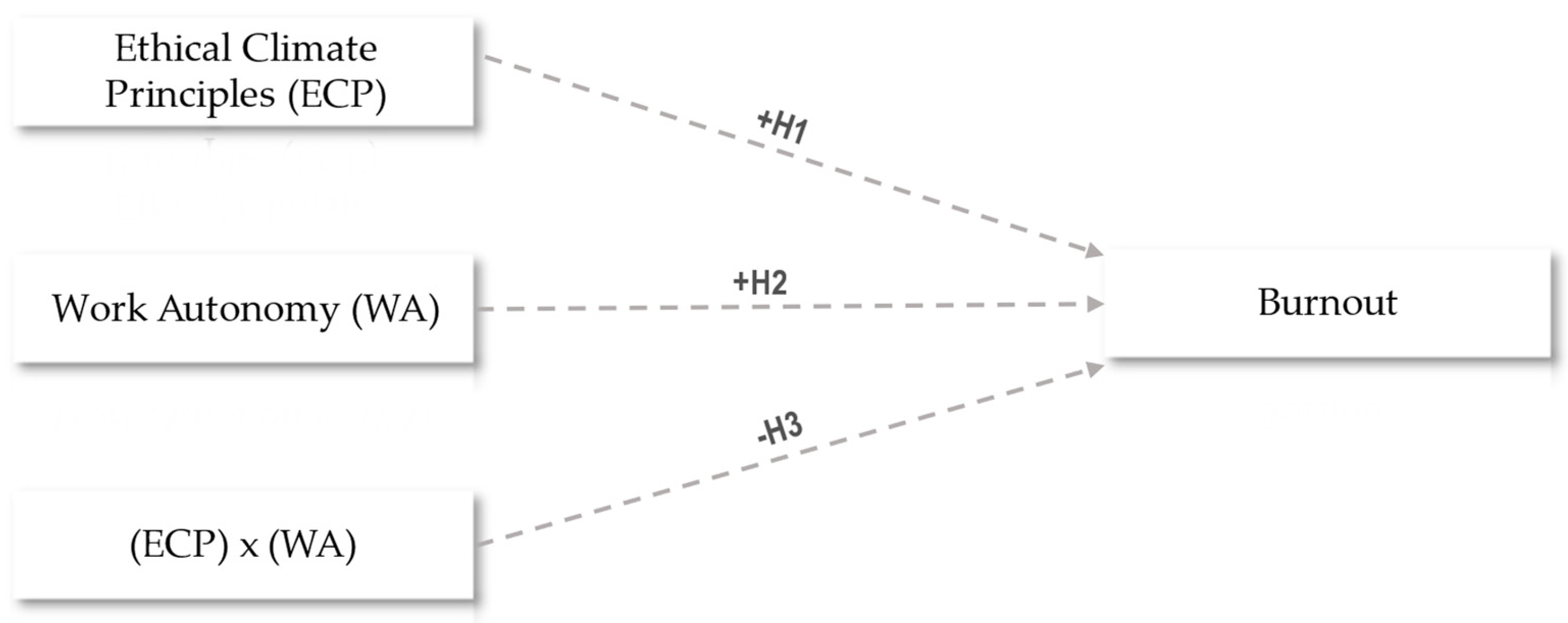
Figure 2.
Regression analysis results, model 1 (mod.1) and model 2 (mod.2).
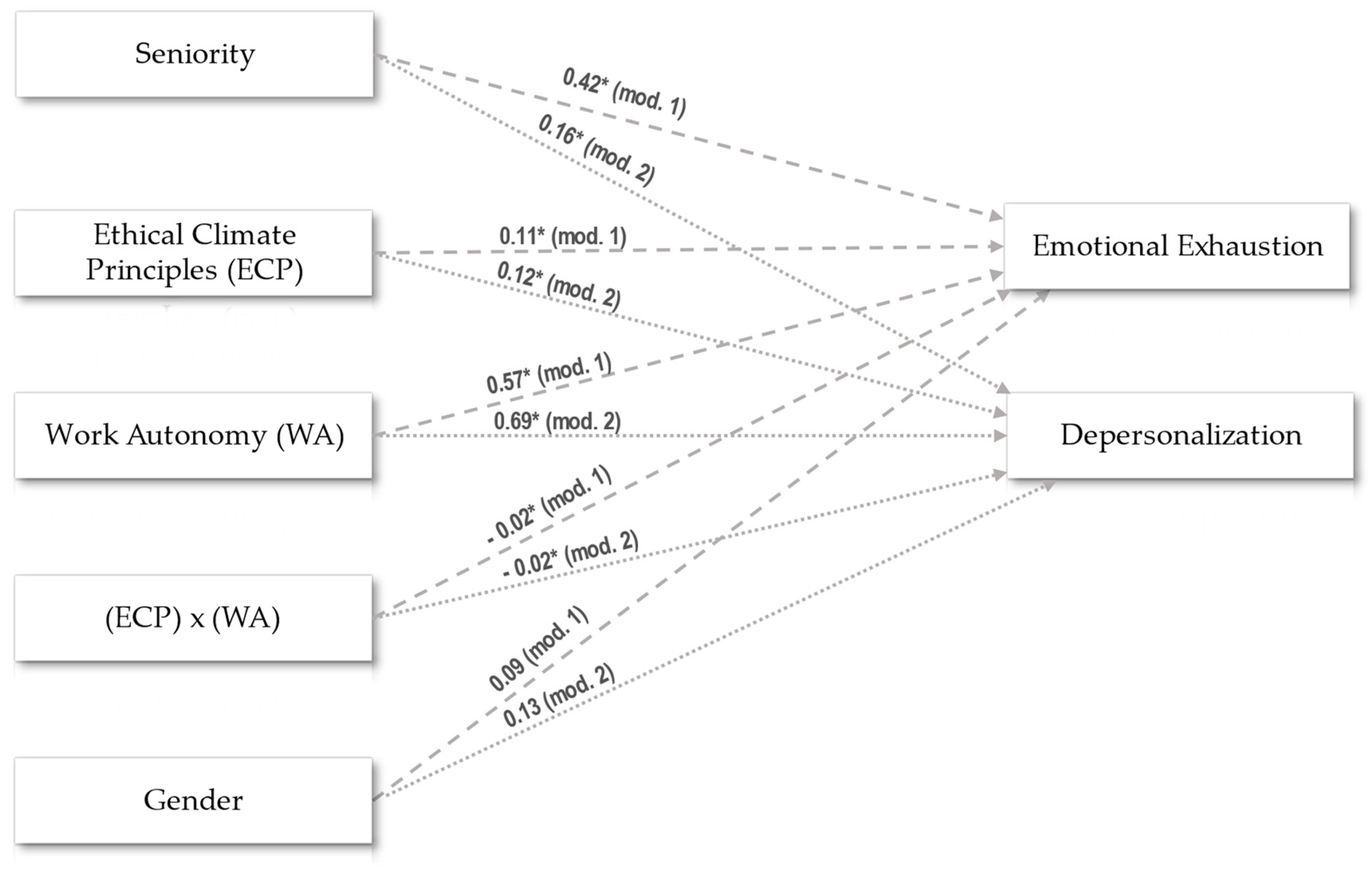
Figure 3.
Moderating effect of the work autonomy variable (model 1).
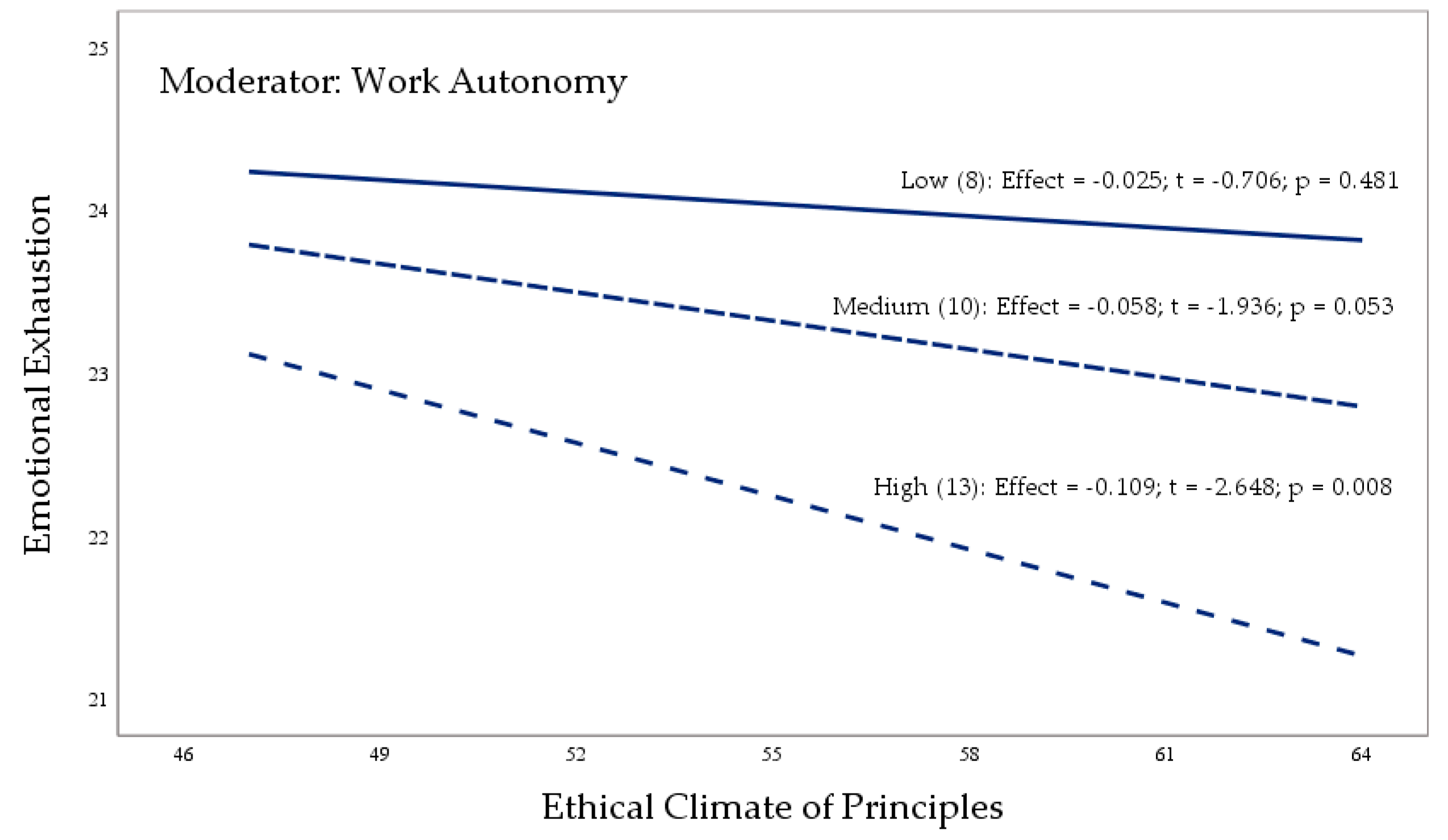
Figure 4.
Conditional effect of work autonomy based on the Johnson-Neyman technique. The Johnson-Neyman technique indicates areas of non-significance (interval represented by dashed lines) and areas of significance (interval represented by solid lines).
Figure 4.
Conditional effect of work autonomy based on the Johnson-Neyman technique. The Johnson-Neyman technique indicates areas of non-significance (interval represented by dashed lines) and areas of significance (interval represented by solid lines).
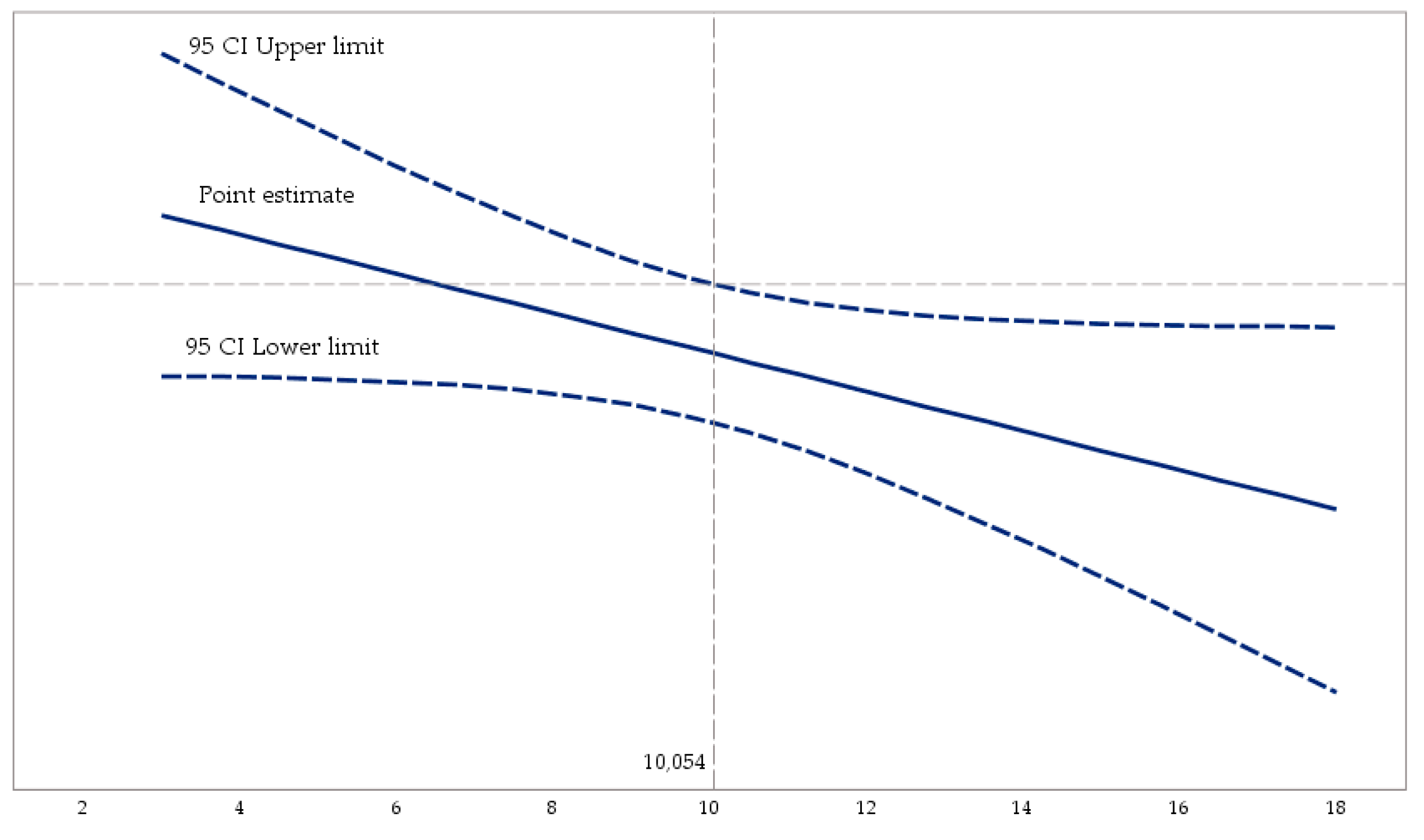
Figure 5.
Moderating effect of work autonomy variable (model 2).
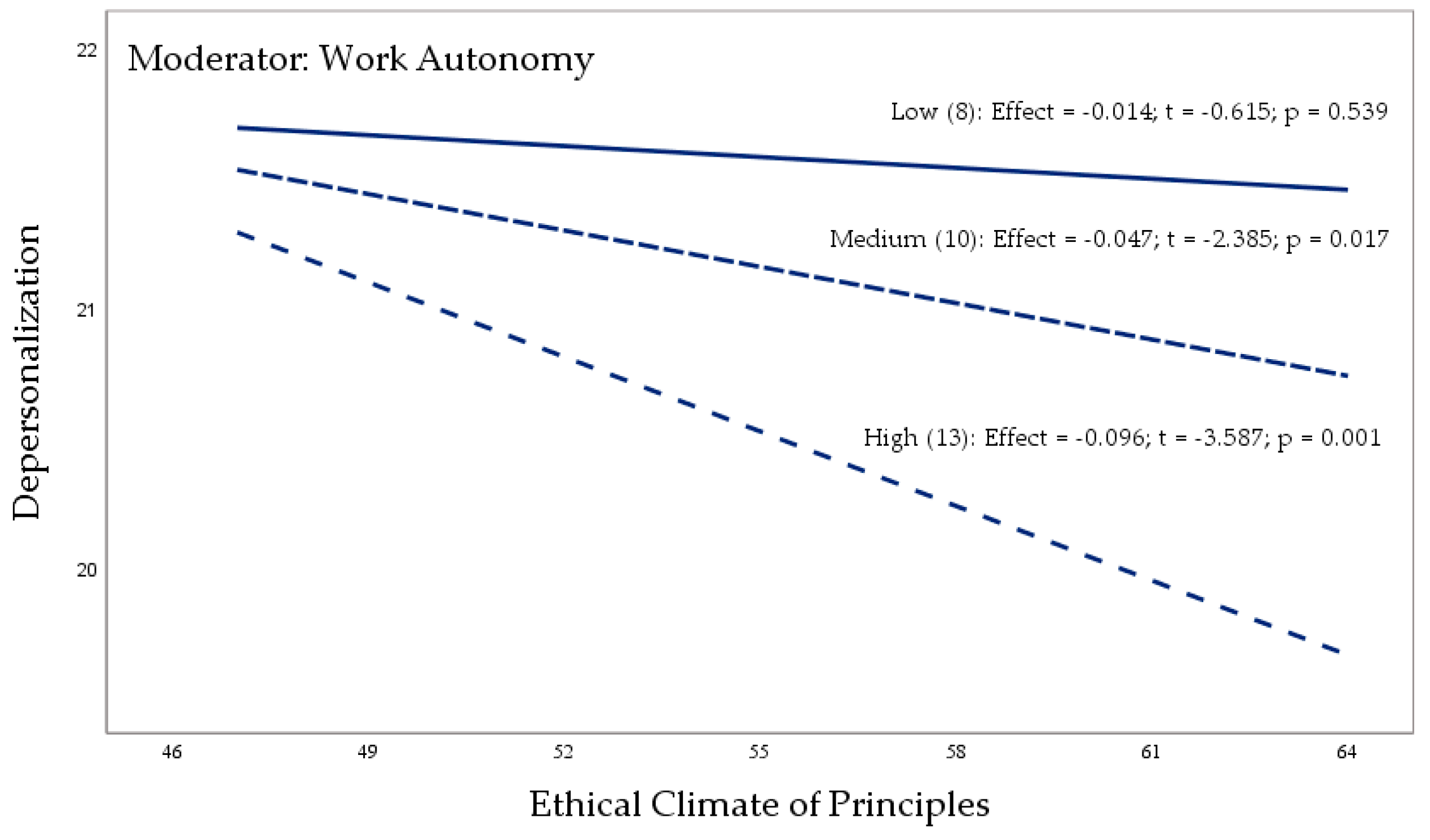
Figure 6.
Conditional effect of work autonomy based on the Johnson-Neyman technique.
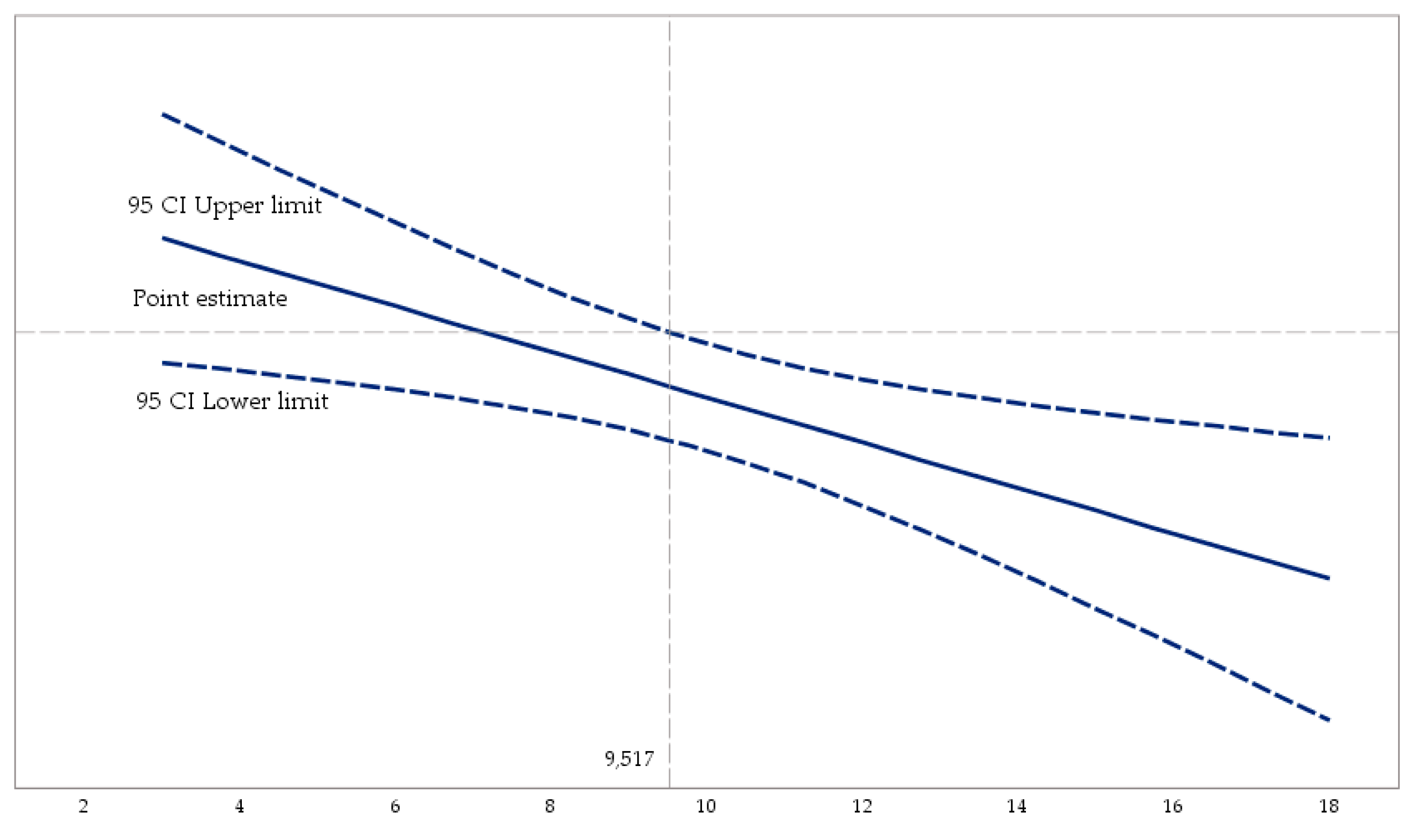
Table 1.
Descriptive Analysis.
| Constructs | M | SD | Skewness | Kurtosis |
|---|---|---|---|---|
| Ethical Climate of Principles (ECP) | 49.94 | 2.43 | -0.24 | 1.28 |
| Work Autonomy (WA) | 1.91 | 2.54 | -0.33 | 1.27 |
| Emotional Exhaustion (EE) | 23.11 | 2.56 | -0.40 | 1.25 |
| Depersonalization (DE) | 20.97 | 3.60 | -0.44 | 1.32 |
Table 3.
Model 1, moderation of ethical climate of principles– emotional exhaustion 95% (CI) (R2 = 0.232).
Table 3.
Model 1, moderation of ethical climate of principles– emotional exhaustion 95% (CI) (R2 = 0.232).
| Effect | Route | β | p | t | SE | LLCI | ULCI | |||
| ECP on EE | a1i | 0.11 | 0.01 | 5.16 | 0.15 | 0.15 | 0.69 | |||
| WA on EE | a2i | 0.57 | 0.01 | 5.32 | 0.25 | 0.12 | 0.63 | |||
| ECP x WA on EE | a3i | -0.02 | 0.01 | -3.62 | 0.05 | -0.05 | -0.01 | |||
| Covariable S | 0.42 | 0.01 | 3.02 | 0.12 | 0.15 | 0.69 | ||||
| Covariable G | 0.09 | 0.86 | 0.18 | 0.14 | -0.94 | 1.12 | ||||
| Moderation WA (ECP -EE) | Low (8) | -0.03 | 0.48 | -0.71 | 0.03 | -0.09 | 0.04 | |||
| Med. (10) | -0.06 | 0.05 | -1.94 | 0.03 | -0.12 | 0.01 | ||||
| High (13) | -0.11 | 0.01 | -2.65 | 0.04 | -0.19 | -0.03 | ||||
| Note. ECP: Ethical climate of principles. EE: Emotional exhaustion. WA: Work autonomy. S: Seniority. G: Gender. | ||||||||||
Table 4.
Model 2, moderation of ethical climate of principles - depersonalization 95% (CI) (R2 = 0.236).
Table 4.
Model 2, moderation of ethical climate of principles - depersonalization 95% (CI) (R2 = 0.236).
| Effect | Route | β | p | t | SE | LLCI | ULCI | |||
| ECP on DE | a1i | 0.12 | 0.01 | 5.34 | 0.17 | 0.23 | 0.79 | |||
| WA on DE | a2i | 0.69 | 0.01 | 4.72 | 0.35 | 0.01 | 1.37 | |||
| ECP x WA on DE | a3i | -0.02 | 0.01 | -2.75 | 0.01 | -0.03 | -0.01 | |||
| Covariable S | 0.16 | 0.08 | 1.75 | 0.08 | -0.02 | 0.34 | ||||
| Covariable G | 0.13 | 0.71 | 0.37 | 0.34 | -0.94 | 1.12 | ||||
| Moderation WA (ECP - DE) | Low (8) | -0.01 | 0.54 | -0.61 | 0.02 | -0.06 | 0.03 | |||
| Med. (10) | -0.05 | 0.02 | -2.38 | 0.02 | -0.08 | -0.01 | ||||
| High (13) | -0.10 | 0.01 | -3.59 | 0.03 | -0.15 | -0.04 | ||||
| Note. ECP: Ethical climate of principles. DE: Depersonalization. WA: Work autonomy. S: Seniority. G: Gender | ||||||||||
Disclaimer/Publisher’s Note: The statements, opinions and data contained in all publications are solely those of the individual author(s) and contributor(s) and not of MDPI and/or the editor(s). MDPI and/or the editor(s) disclaim responsibility for any injury to people or property resulting from any ideas, methods, instructions or products referred to in the content. |
© 2024 by the authors. Licensee MDPI, Basel, Switzerland. This article is an open access article distributed under the terms and conditions of the Creative Commons Attribution (CC BY) license (http://creativecommons.org/licenses/by/4.0/).
Copyright: This open access article is published under a Creative Commons CC BY 4.0 license, which permit the free download, distribution, and reuse, provided that the author and preprint are cited in any reuse.


