

Submitted:
01 December 2024
Posted:
02 December 2024
You are already at the latest version
Abstract
The global demand for coastal urbanization is rising with the increasing population. Alas, living close to the ocean threatens human endeavors with high currents, waves, and increasing storm frequency. Accordingly, the need for more coastal defense structures (CDS) rises. Structures built from complex units meant to block and divert waves and currents energy are constructed on and near natural habitats where they alter local ecosystems. Traditional CDS mostly fail to harbor diverse and abundant communities. However, this can be changed by eco-friendly methodologies and designs that are being tested and implemented to improve CDS ecological value. Some of these can be implemented during the construction period while others can fit on existing structures, such as wavebreakers and seawalls. Effective methods include augmenting surface rugosity through strategic perforations, integrating artificial panels for increased complexity, implementing soft engineering solutions such as geotextile, replacing industrial mixtures for CDS construction with ecologically friendly mixtures, and using alternative, eco-friendly, units in CDS erections. By integrating these sustainable practices into coastal development, we can significantly mitigate the ecological damage caused by traditional CDS and promote more harmonious relationships between human construction and the marine environment. This shift towards environmentally conscious coastal defenses is essential and a responsibility for ensuring the long-term sustainability of our coastal communities and the health of our oceans.
Keywords:
Ecological enhancement
; Ecological engineering
; Coastal protection
; Ecosystem complexity
; Urban ecology
; Ecosystem services
; Reconciliation ecology
; Blue Economy
1. Introduction
Coastal zones are highly populated environments that constitute various economic activities [1]. These include harbors and shipping, fisheries industries, aqua- and mariculture, power and desalination facilities, communication infrastructures, recreation and tourism on or near the shoreline [2]. Concurrently, shallow marine coastal environments constitute diverse ecosystems that also provide critical ecologic and economic services such as coral reefs, fish nursery habitats, oyster reefs, seagrass beds, wetlands and mangroves habitats [3,4]. These total services were estimated at 125 trillion USD per year [5,6]. Nowadays, due to the increase in flooding frequency, sea level rise, shore erosion, and increased use for anthropogenic activities, coastal defense structures are being placed across vast sections of natural coastlines [7,8].
Coastal defense structures (CDS) are designed to mitigate wave energy, currents, and other marine forces. They can be onshore or offshore, constructed from various materials (such as concrete, wood, sand, and quarry rock), and are configured to meet specific objectives. Onshore CDS, like sea dikes, revetments, and seawalls, are built at the coastline, protecting shorelines coastal infrastructure. (Figure 1, [9]).
Offshore CDS, like breakwaters, jetties, and groynes, are built to protect coastal areas from waves and currents. They can start on land and extend into the water or be built directly offshore (Figure 1).
CDS construction can significantly alter natural marine environments, both physically and biologically. Physical changes include substrate modification, altered currents and wave patterns, sand erosion or accumulation, and coastline erosion [3,10]. These can disrupt biological processes like recruitment, survival, reproduction, and dispersal [11]. Previous studies reported that CDS establishment resulted in habitat loss for local marine communities [12], disruption of species life cycles, loss of native species assemblages (alga, invertebrates, and benthic species), and attraction of invasive species [13].
On the other hand, establishing some CDS (including breakwaters) has provided new habitat opportunities. Due to their structural complexity, by providing shelter and additional hard substrate [14], some CDS increased local biodiversity and species richness [15,16,17].
In Taiwan, Viyakarn et al. (2009) [18] demonstrated that live coral cover on breakwaters was similar to that at nearby natural reefs. Moreover, fish communities around the breakwater were as abundant and diverse as at the natural reefs, with only a few absent species. They suggested that these fish species could not inhabit the artificial structures due to the absence of structural elements, such as rubble and sand [18].
With that, establishing marine fauna on CDS does not necessarily replicate and augment local communities. Studying coral settlement in the Azores archipelago, Martins et al. (2009) [19] found significant differences in species assemblages between a new breakwater and a nearby natural rocky habitat. Algae dominated the breakwater, while the natural site had more barnacles. This shift changed the ecosystem based on filter feeders into one dominated by producers.
Predicting the ecological effects of CDS on marine habitats, reducing negative ones and promoting ecological integration, are crucial for coastal management but remain challenging due to numerous variables [11]. Over the past three decades, there has been a rising interest in research and commercial endeavors to fostering biological and ecological enrichment through the deployment of CDS [20] – a practice referred to as Reconciliation Ecology [21].
These efforts aim to turn habitats lost due to construction into thriving ecosystems, benefiting organisms like bivalves, oysters, mussels, and corals while providing coastal protection. This review will present and discuss current solutions focusing on the ecological enhancement of breakwaters that are achieved through specialized eco-friendly construction materials and designs [22].
2. Breakwaters
2.1. Background
Breakwaters present an appealing research area due to their prevalence, accessibility, durability, and long-lasting nature.
Traditional breakwaters are constructed mostly from local or quarry-originated boulders of different sizes. Modern breakwaters are mostly made of concrete units of different types, such as antifers, accropode, cubes, dolos, tetrapods, and more [23,24]. Quarry-originated boulders are usually characterized by smooth surfaces [25] and, as such, are less suited for sessile organisms, such as bivalves and corals, that prefer to settle on porous and coarse surfaces [26]. The same applies to concrete units used in modern breakwaters, where special chemical treatment is added to strengthen and smooth the unit’s surfaces.
2.2. Low Recruitment Rates to Breakwaters
The chain of ecological succession in benthic marine habitats starts with microorganisms settling on the substrate, creating microbial and microalgal biofilms or mats [27,28]. Further stages follow with the settlement of more larger sessile species (both calcifying algae and mollusks), creating an additional 3D biogenic layer to the original substrate, thus called “habitat-forming species” [29]. The ongoing recruitment of organisms will then attract grazing and predatory species, consequently establishing a new community in the habitat [30]. If local conditions are less favorable for those crucial habitat-forming species, the natural recruitment chain will demise, leading to low biodiversity and species abundance [31,32].
However, where one struggles, another prospers, and often, invasive species take advantage of the new habitats and niches created by breakwaters and the low competition by local species found in them. CDS’s individual units are relatively simple in shape and, as mentioned, have surfaces that are less fit for recruitment [13,26]. In cases where the natural source of larvae is far from the breakwater (such as in large, sandy areas), local species may fail to settle in the new habitat, allowing invasive species, that are better suited for such niches, to recruit on the breakwater and take advantage of the new habitat [33].
Breakwaters rarely foster diverse fauna or support a large community of species, contingent on their ability to recruit species [19,34,35]. An extensive examination of breakwaters’ impact on local ecosystems, tested breakwaters in Spain, Italy, Denmark, and the UK [36] and in Thailand [18], showed lower overall species richness on breakwaters compared to natural rocky shores. In Taiwan, large sections of the natural coastline were replaced by artificial structures. Wen at al. (2010) [37] found that due to the breakwater’s alteration of the intertidal habitats, many local species, mainly reef-associated species, did not occupy the artificial structure, leading to a decline in local biodiversity.
This relatively low biodiversity is due to the fact that the breakwaters’ purpose is to protect human endeavors from sea stressors and not to function as a habitat for marine life. They are built with hard structure units [25], which mostly lack sufficient surface roughness and rugosity, and minimize the abilty of marine species to penetrate and attach onto them [38]. Further, quarry and concrete molded units lack complexity in spaces between the units. Construction favors using large units, where space between them is limited and relatively simple. The ongoing shift from tetrapod’s to anifers further reduces the structural complexity of the breakwaters. Habitat physical complexity has been observed as a primary factor in community composition as it influences predation mediation, reduction of niche overlaps, and provision of shelter for vulnerable small organisms [39]. However, in some cases, breakwaters made of natural rocks created complex environments resembling nearby rocky habitats, allowing colonization of similar organisms [11]. This led to a conjecture that the low settlement rates of breakwater primarily affect the outer parts of a structure, while inner (sheltered) areas may support more diverse and abundant marine life [8,40]. Sherrard et al. (2016) [8] suggested that the inner areas of breakwaters may be shielded from stressors such as currents, waves, and sediment, resulting in high biodiversity and species abundance among both flora and invertebrate fauna.
The chemical omposite of the construction material is another factor affecting recruitment of organisms onto breakwaters. Most industrial cement mixtures have high surface alkalinity, making them a poor biological recruitment substrate and especially limiting laying of their intial exoskeletons [41]. In addition, colonizing biotas, from bacteria to corals and even egg-laying fishes, have preferences regarding aspects of the substrate surface (i.e., texture, color, alkalinity, or specific attracting chemicals) [42].
2.3. Prevalent Solutions
Nowadays, researchers and commercial maritime companies aim to modify and increase the ecological value of the breakwaters’ by implementing “Ecological Services Enhancement” (ESE) solutions. Attempts are made to modify the breakwater substrate and make it more suitable for the recruitment of mobile species, such as fish [43,44], and the settlement of benthic species, such as bivalves [25] and corals [45], and are achieved in several ways (Figure 3):
- (a)
- Altering boulder surface by hole-drilling, chiseling, and creating slots to break the smooth surface and provide the necessary roughness [46].
- (b)
- Combining add-ons onto artificial structures such as engineered blocks or terracotta plates attached to the breakwater.
- (c)
- Using soft engineering construction elements and units [47].
- (d)
- Using ecologically friendly cement mixtures in unit construction [41].
- (e)
- Creating a whole or sections of breakwaters from environmentally friendly units.
Figure 2. Objectives and practices of ecological services enhancement (ESE) of coastal defense structures (CDS).
Figure 3.
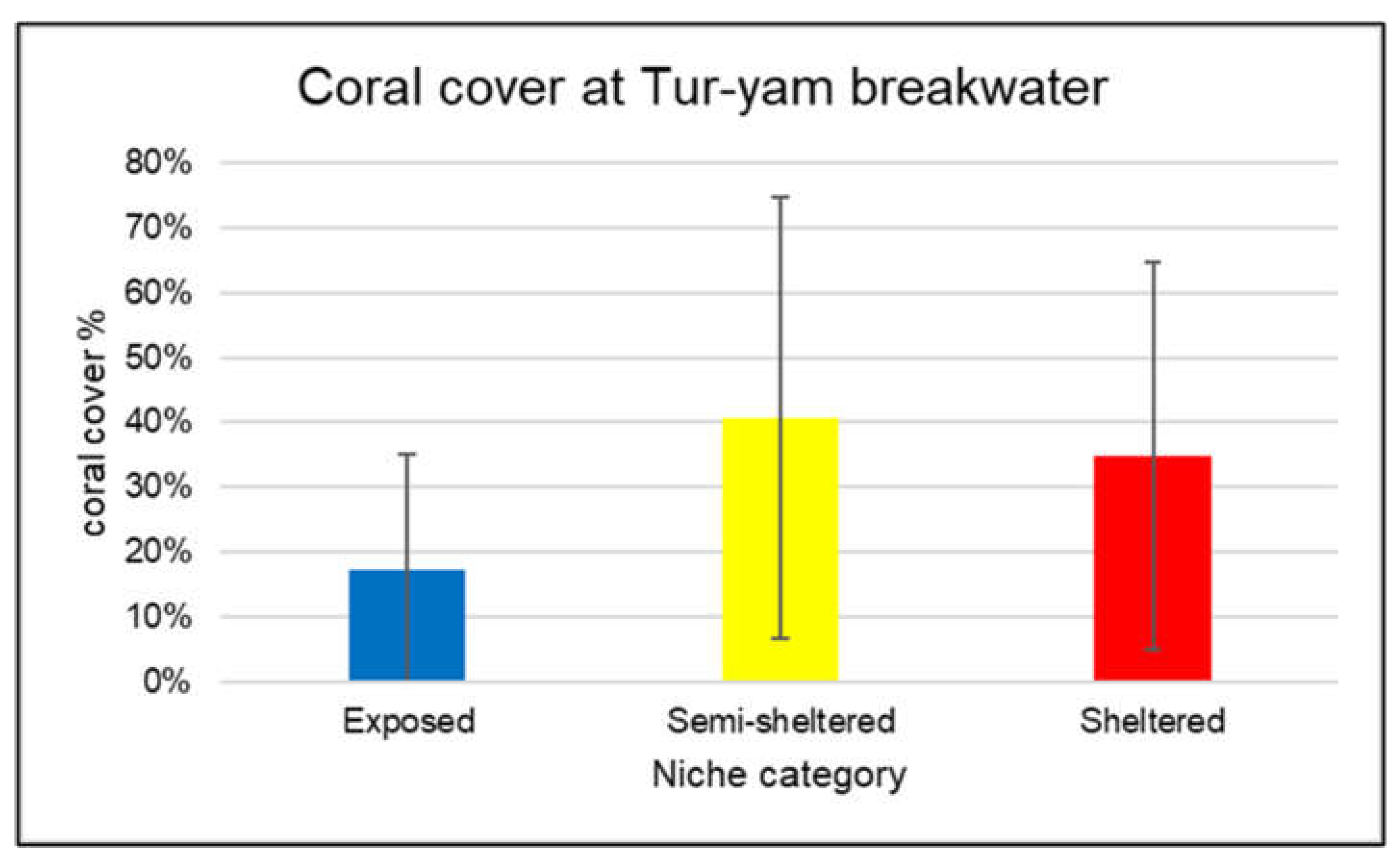
Coral coverage (average ± STD) at niches of different exposure to currents and waves, at the Tur-Yam breakwater, Eilat, Israel.
Figure 3.
Coral coverage (average ± STD) at niches of different exposure to currents and waves, at the Tur-Yam breakwater, Eilat, Israel.
Most studies on breakwaters’ ESE were made along the coasts of temperate zones such as the Mediterranean, Northern Atlantic, North American West Coast, and Eastern Australia. These studies were driven by the research team’s financial capability, or the applicability of the methods examined. Here, we review several approaches and cases used for ESE of breakwaters, in the context of increasing sessile species’ biodiversity and abundance.
3. Ecological Enhancement Methods
3.1. Surface Rugosity
These methods physically alter the surface of the breakwater unit using mechanical tools to create holes, grooves, and slots to enhance structure surface roughness [48]. These alterations can be implemented at any stage of the structure construction, including on existing structures. They can be used in moderate and high wave energy environments, where attached features such as tiles and artificial rockpools might not be suitable. Furthermore, this method’s main advantage is its low-cost solution. Many biological enhancement attempts fail due to insufficient funding, especially in developing economies, and unsubstantial research support [49,50].
Hall et al. (2018) [25] tested the technique of hole-drilling and groove graving onto two breakwaters on the UK coast. One made from granite boulders and the other from limestone. After one year, there was an increase in both biodiversity and abundance of sessile species in the breakwaters compared to the control sites. However, they reported that the holes and crevasses created did not fit all the local species as some could not physically fit into the holes drilled [25].
3.2. Unit Surface Complexity
In other studies, artificial small and complex concrete or ceramic elements increased the outer surface complexity of breakwaters or seawalls [31].
An example of such elements is artificial concrete block mattresses (ACBM) designed by ECOncrete and implemented in port Everglades, Florida, USA. These small artificial concrete units add structural complexity, and water-retaining features to a CDS [51]. As with all modifications to breakwaters, these mattresses require the necessary strength and integrity to withstand the pressure on the wave breakers; therefore, they are limited to mainly low- to medium-wave environments.
A popular and widespread technique is the application of hardened tiles, bolted to the structure unit and able to withstand heavy weather conditions (Example: Living Seawalls, Figure 3). Tile design should consider various elements such as pits, grooves, crevices, and overhangs to increase the complexity to increase marine fauna settlement. Habitat complexity affects community structure as animals of different sizes utilize habitat spaces differently [52,53].
Loke and Todd (2016) [54] tested different tile designs on two seawalls in Singapore to determine the effect of complexity on community biodiversity, abundance, and structure. The two seawalls were divided to low- and high-tide areas. Three types of tiles were compared; concrete tiles of simple and complex designs, and granite tiles as control since they mimicked the seawall surface. After 13 months, complex tiles harbored higher species richness and individual abundance. Complex tiles showed a range of different-sized species that utilized different parts of the tiles according to their size and shape and therefore had a complex community structure compared to the simple tiles and granite controls.
Another design consideration is retaining water during low tide conditions. This is important in intertidal zones, where water retention is crucial for species survival and recruitment [55]. In an experiment in Sydney, Australia, five tiles with distinct characteristics were compared in their ability to enhance settlement onto a seawall. The results of a 24-month survey showed that the majority of organisms favored tiles with complex features and that tiles with water-retaining abilities had the most diverse and abundant recruitment [56].
Complexity enhancement-oriented projects produce a blend of coastal engineering with ecological elements solutions [22,41,57,58,59]. These allow researchers to investigate the effects and importance of different complexity factors on biodiversity, abundance, and community structure in harsh, artificial structures.
3.3. Soft Engineering
With global efforts shifting from traditional hard engineering to soft and eco-engineering, geotextiles have become increasingly common [47]. Geotextiles are either woven or non-woven permeable fabrics or synthetic materials that can be used in combination with geotechnical engineering material (Figure 3). Geotextiles have a wide range of applications in breakwater; they can act as a filter or installation layer and even as a replacement for the rock fill of a breakwater by using Geo-containers and “Geo-bags” filled with sand and/or rocks [60], and as a result of their diverse applications, ensuring the durability and resilience of geotextiles against environmental stressors like saltwater, UV radiation, and sand abrasion. Selecting the appropriate material for specific ecological and engineering conditions is a key factor for the long-term success of any geotextiles project.
Wetzel (2011) [61] tested geotextile ecological performance in Germany by comparing the settlement of sessile organisms to woven fabric, non-woven fabric, and ceramic tile two years post-deployment. Results showed that woven geotextiles showed a similar species richness, abundance, and biomass to ceramic tiles (commonly used to represent natural hard substrates) and that non-woven geotextiles did not show growth of encrusting species. These findings emphasize the importance of surface rugosity and woven geotextiles as an alternative to hard structures.
3.4. Ecological Concrete Composition
Concrete marine structures face many physical-chemical challenges from different tidal regimes, currents, and the chemical composition of the sea. While erosion, wetting–drying, and freezing–thawing are some physical effects, exposure to sulfate, chloride, magnesium, and carbonic acid attacks are some of the possible chemical effects [62].
Chemical attacks can cause corrosion (chlorides react with the reinforcement steel inside the concrete), Alkali-silica reactions (reactive silica in the concrete aggregates with the alkaline pore solution leading to a gel product, which expands, causing cracking and spalling), and sulfate attacks (external/ internal sources of sulfate react with aluminate phases and calcium hydroxide in the concrete) [63]. To address these phenomena, companies have concentrated their resources on developing robust, resilient concrete mixtures rather than considering the ecological impact of their cement. Indeed, the chemical composition of concrete can influence parameters determining the type and diversity of microorganism settlement, such as roughness, pH, and hydrophilic/hydrophobic characteristics of the unit’s surface [64].
A range of studies examined modifications to concrete composition that will maintain structures resilience while improving settlement of marine organisms [65,66,67]. These used either supplementary cementitious materials (SCMs) or alternatives to concrete. Different alterations have been suggested (Table 1); however, in a study by [68], no differences were found in biofilm development or composition between 5 concrete compositions during 1 year of deployment at Port Haliguen, Brittany, France.
Marine “Portland concrete” is the dominant compound in breakwater construction and gradually covers increasing coastline sections [71]. Its mixture has a pH range from 9 to 13 before curing, creating a habitat favoring alkaliphilic organisms [72].
Sella & Perkol-Finkel (2015) [72] installed ecologically engineered concrete blocks on a newly insulted breakwater in Haifa, Israel. The units were manufactured from an ecological cement mix (ECOncrete® Antifers – EA) with lower surface pH than Portland cement. In addition, the unit’s surface was designed to include holes and slots to recruit sessile species. Biodiversity, abundance, invasive species rate, and overall community structure of both the sessile and fish communities were compared to an untouched breakwater section that functioned as a control. Results showed high recruitment and increased biodiversity and abundance on the new units, after 24 months, with a lower rate of invasive species [72].
3.5. Environmentally Friendly Units
A growing number of CDS and coastal construction projects include environmentally friendly units as the core or a significant part of breakwaters. These include submerged structures, which act as wave breakers and artificial reefs (Figure 1; [45]). An example are Reef-balls are hollow, hemispherical-shaped artificial units designed to improve biological growth and coral reef or mangrove restoration, while acting as a coastal protection structure [45]. In 1998, approximately 450 reef-ball units were placed in the Dominican Republic for shoreline stabilization, environmental enhancement, and ecotourism. Three years after their installation, during which hurricane Georges occurred (1998), the shoreline survived the erosion and expanded in size by gaining new ground [73].
3.6. Shelter Oriented Studies
The crypted, sheltered, parts of breakwater have been theorized to harbor higher diversity than other surfaces as they provide additional protection from outside stressors [8]. Sherrard (2016) [8] examined the outer and inner parts of groynes around Christchurch Bay, UK and evaluated their marine fauna. Results showed that internal surfaces supported twice as many species of invertebrates and algae as the external environment, particularly mobile species.
To test this theory on habitat forming species, differences in niche-based distribution of coral on breakwaters were documented by us on an exposed breakwater in Eilat, Israel (Tur yam; 29o51’49”07N, 34o92’65”26E). We assessed niches formed by breakwater boulders, categorized by the level of shelter they provide to coral colonies. A shelter/protection niche was defined as a physical barrier protecting the coral’s volume from the oncoming current. The niche levels examined were exposed (no protection), partially sheltered (1 or 2 sides of the coral colony are sheltered), and fully sheltered (3 or 4 sides are protected). Quadrat surveys, to determent coral over percentage difference among niches, were conducted on the Tur-yam breakwater. Using a 20x20 cm quadrat, with 10 random samples of each niche, were taken (overall 30 samples). Survey results revealed significant differences in coral coverage across these niches, with the highest coverage in semi- sheltered niches (ANOVA, p<0.05, Figure 3); which were higher from both sheltered and exposed areas (TukeyHSD, p<0.05).
4. Discussion
As human activities along shorelines increase, the construction of new coastal defense structures (CDS) and the replacement of natural habitats with artificial ones are inevitable. Growing awareness of the ecological impacts of CDS has heightened the demand for environmentally friendly engineering solutions, making ecological considerations a prominent factor in CDS design and planning. However, most efforts focus on enhancing future CDS, leaving existing structures largely neglected [74,75]. While some initiatives, such as ECOncrete and “Living Seawalls,” have successfully modified existing CDS to support local biodiversity, the sheer number of existing structures necessitates greater attention toward their ecological enhancement.
Whether addressing new or existing CDS, the techniques outlined in this review must align with the dual objectives of maintaining CDS’s primary protective function and enhancing ecological value. To achieve this balance, project planning should involve multidisciplinary teams, including coastal engineers, ecologists, and policymakers, ensuring ecological goals complement structural integrity and shoreline protection.
Interest in environmental engineering and ecological enhancement within marine construction is growing globally [76]. The adoption of ecological directives, such as the EU Marine Strategy Framework Directive (2008/56/EC) [76] and Britain’s 25-Year Environment Plan (25YEP) [77], highlights efforts to incorporate ecological considerations into urban coastal development. These directives emphasize integrating nature-based solutions and sustainable practices into construction while mitigating the risks associated with traditional “grey” infrastructure. International bodies, including the UN and the World Bank, have also underscored the economic and ecological risks of conventional solutions, promoting financial and legislative support for green alternatives [77,78].
Despite these advancements, legislation often lacks the authority to enforce ecological measures, leaving ecological considerations dependent on the political and economic priorities of local councils and private stakeholders [79]. Although international organizations provide recommendations and guidelines, the absence of mandatory regulations means that ecological enhancements remain sporadic rather than standard practice.
For CDS ecological enhancement to become mainstream, it must transcend opportunistic projects and align with long-term community involvement, education, and management. Integrating ecological principles into coastal stewardship programs and training, as seen in Australia’s vocational courses on “Marine Habitat Conservation and Restoration,” can foster community support and project sustainability. Such initiatives not only educate stakeholders but also build local ownership of projects, ensuring their success over time. Moreover, collaboration between regional councils, local governments, businesses, and communities is vital for maintaining these projects and embedding ecological reconciliation into broader coastal management strategies [4,50,80].
5. Conclusions
The rising demand for coastal development is driving the construction of numerous coastal defense structures, often replacing natural habitats with artificial ones. Ecological enhancement methods can be incorporated into future projects and existing structures to reduce these adverse effects. These methods have proven effective in increasing biodiversity and ecosystem health. By adopting such approaches, we can turn what was once an ecological loss into a new opportunity for marine conservation.
6. Future directions
Methods for ecological enhancement of CDS are being advanced within a growing community of diverse practitioners. New approaches are being explored to streamline modifications to existing CDS, leveraging their protected and often cryptic sections. Over time, cracks, pores, and crevices form in CDS due to their proximity to one another, creating sheltered areas that facilitate recruitment [8]. Ecological Services Enhancement (ESE) techniques often mimic these natural processes to support early and rapid recruitment. Most ESE techniques focus on the exposed sections of CDS, which are designed to withstand harsh conditions. However, developing tools for use on the inner, protected sides of the CDS could be beneficial, as they are simpler to access, and they can replace and accelerate slow natural process perceptive to stressors.
For broader adoption of these ecological techniques, eco-friendly engineering principles must be integrated into regulatory frameworks for future coastal construction and development. Without these regulatory requirements, minimizing the ecological impact of CDS on coastal environments will be challenging. In this regard, practitioners and planners should be well-versed in these methods.
With the global rise in environmental awareness, technological advancements, and strengthened alliances between engineers and marine ecologists, the vision of a greener, eco-friendly coastline is set in stone. The future of sustainable coastal defense lies in our ability to harmonize human needs with marine ecosystems, ensuring that our protective structures serve as both barriers and habitats. Here, we present initial grounds for coastlines that safeguard human endeavors while nurturing the ocean’s rich biodiversity.
Author Contributions
ABN: Conceptualizing, data collection and analyzing, and writing original draft. NS: Conceptualization, methodology data analyzing, original draft review.
Data Availability Statement
Not applicable.
Acknowledgments
Natalie Chernihovsky, Dor Shafi, Asa Oren, Giovanni Giallongo, Mayan Edri, and Mayan Ben-Natan greatly assisted in this study and in developing the ideas presented. Reuven Yosef highly contributed to the writing and organizing of this paper.
Conflict of Interest
The authors declare no conflict of interest.
References
- Levy, M. Percentage of total population living in coastal areas. Global Coastal Statistics 2011. [Google Scholar]
- Rao, N.S.; Ghermandi, A.; Portela, R.; Wang, X. Global values of coastal ecosystem services: A spatial economic analysis of shoreline protection values. Ecosyst. Serv. 2015, 11, 95–105. [Google Scholar] [CrossRef]
- Barbier, E.B.; Hacker, S.D.; Kennedy, C.; Koch, E.W.; Stier, A.C.; Silliman, B.R. The value of estuarine and coastal ecosystem services. Ecol. Monogr. 2011, 81(2), 169–193. [Google Scholar] [CrossRef]
- Barbier, E.B. Valuing ecosystem services for coastal wetland protection and restoration: Progress and challenges. Resources 2013, 2(3), 213–230. [Google Scholar] [CrossRef]
- De Groot, R.; Brander, L.; van der Ploeg, S.; Costanza, R.; Bernard, F.; Braat, L.; van Beukering, P. Global estimates of the value of ecosystems and their services in monetary units. Ecosyst. Serv. 2012, 1(1), 50–61. [Google Scholar] [CrossRef]
- Costanza, R.; de Groot, R.; Sutton, P.; van der Ploeg, S.; Anderson, S.J.; Kubiszewski, I.; Farber, S.; Turner, R.K. Changes in the global value of ecosystem services. Glob. Environ. Chang. 2014, 26, 152–158. [Google Scholar] [CrossRef]
- Nicholls, R.J.; Cazenave, A. Sea-level rise and its impact on coastal zones. Science 2010, 328(5985), 1517–1520. [Google Scholar] [CrossRef]
- Sherrard, T.R.; Hawkins, S.J.; Barfield, P.; Kitou, M.; Bray, S.; Osborne, P.E. Hidden biodiversity in cryptic habitats provided by porous coastal defence structures. Coast. Eng. 2016, 118, 12–20. [Google Scholar] [CrossRef]
- Schoonees, T.; Gijón Mancheño, A.; Scheres, B.; Bouma, T.J.; Silva, R.; Schlurmann, T.; Schüttrumpf, H. Hard structures for coastal protection, towards greener designs. Estuaries Coast. 2019, 42, 1709–1729. [Google Scholar] [CrossRef]
- Spanier, E., & Zviely, D. (2022). Key environmental impacts along the Mediterranean coast of Israel in the last 100 years. Journal of Marine Science and Engineering, 11(1), 2. [CrossRef]
- Airoldi, L.; Abbiati, M.; Beck, M.W.; Hawkins, S.J.; Jonsson, P.R.; Martin, D.; Moschella, P.S.; Sundelöf, A.; Thompson, R.C.; Åberg, P. An ecological perspective on the deployment and design of low-crested and other hard coastal defence structures. Coastal Engineering 2005, 52(10–11), 1073–1087. [CrossRef]
- Connell, S.D.; Glasby, T.M. Do urban structures influence local abundance and diversity of subtidal epibiota? A case study from Sydney Harbour, Australia. Mar. Environ. Res. 1999, 47(4), 373–387. [Google Scholar] [CrossRef]
- Masucci, G.D.; Acierno, A.; Reimer, J.D. Eroding diversity away: Impacts of a tetrapod breakwater on a subtropical coral reef. Aquat. Conserv. Mar. Freshw. Ecosyst. 2020, 30(2), 290–302. [Google Scholar] [CrossRef]
- Fadli, N.; Muchlisin, Z.A.; Sofyan, H.; El-Rahimi, S.A.; Dewiyanti, I.; Pratama, F.O.; Siti-Azizah, M.N. The composition of reef-associated fishes in Ulee Lheue breakwater Banda Aceh, Aceh, Indonesia. In Proceedings of the IOP Conference Series: Earth and Environmental Science, Banda Aceh, Indonesia, December 2018; Volume 216, p. 012021. [CrossRef]
- Tan, Y.Z.; Ng, C.S.L.; Chou, L.M. Natural colonisation of a marina seawall by scleractinian corals along Singapore’s east coast. Nature Singap. 2012, 5, 177–183. [Google Scholar]
- Wen, C.K.C.; Chen, K.S.; Hsieh, H.J.; Hsu, C.M.; Chen, C.A. High coral cover and subsequent high fish richness on mature breakwaters in Taiwan. Mar. Pollut. Bull. 2013, 72(1), 55–63. [Google Scholar] [CrossRef] [PubMed]
- Burt, J.A. The environmental costs of coastal urbanization in the Arabian Gulf. City 2014, 18(6), 760–770. [Google Scholar] [CrossRef]
- Viyakarn, V.; Chavanich, S.; Raksasab, C.; Loyjiw, T. New coral community on a breakwater in Thailand. Coral Reefs 2009, 28, 427. [Google Scholar] [CrossRef]
- Martins, G.M.; Amaral, A.F.; Wallenstein, F.M.; Neto, A.I. Influence of a breakwater on nearby rocky intertidal community structure. Mar. Environ. Res. 2009, 67(4–5), 237–245. [CrossRef]
- Strain, E.M.; Olabarria, C.; Mayer-Pinto, M.; Cumbo, V.; Morris, R.L.; Bugnot, A.B.; Bishop, M.J. Eco-engineering urban infrastructure for marine and coastal biodiversity: Which interventions have the greatest ecological benefit? J. Appl. Ecol. 2018, 55(1), 426–441. [Google Scholar] [CrossRef]
- Rosenzweig, M. Win-win Ecology, How the Earth’s Species Can Survive in the Midst of Human Enterprise; Oxford University Press: Oxford, UK, 2003.
- Moosavi, S. Ecological coastal protection: pathways to living shorelines. Procedia Eng. 2017, 196, 930–938. [CrossRef]
- Bakker, P.; van den Berge, A.; Hakenberg, R.; Klabbers, M.; Muttray, M.; Reedijk, B.; Rovers, I. Development of concrete breakwater Armour Units. In Proceedings of the 1st Coastal Estuary and Offshore Engineering Specialty Conference of the Canadian Society for Civil Engineering, 2003.
- Muttray, M.; Reedijk, B. Design of concrete armour layers. Hansa Int. Marit. J. 2009, 6, 111–118. [Google Scholar]
- Hall, A.E.; Herbert, R.J.; Britton, J.R.; Hull, S.L. Ecological enhancement techniques to improve habitat heterogeneity on coastal defence structures. Estuar. Coast. Shelf Sci. 2018, 210, 68–78. [Google Scholar] [CrossRef]
- Sedano, F.; Navarro-Barranco, C.; Guerra-García, J.M.; Espinosa, F. Understanding the effects of coastal defence structures on marine biota: The role of substrate composition and roughness in structuring sessile, macro- and meiofaunal communities. Mar. Pollut. Bull. 2020, 157, 111334. [Google Scholar] [CrossRef] [PubMed]
- Balqadi, A.A.; Salama, A.J.; Satheesh, S. Microfouling development on artificial substrates deployed in the central Red Sea. Oceanologia 2018, 60(2), 219–231. [Google Scholar] [CrossRef]
- Lee, J.W.; Nam, J.H.; Kim, Y.H.; Lee, K.H.; Lee, D.H. Bacterial communities in the initial stage of marine biofilm formation on artificial surfaces. J. Microbiol. 2008, 46, 174–182. [Google Scholar] [CrossRef]
- Dean, R.L.; Connell, J.H. Marine invertebrates in an algal succession. III. Mechanisms linking habitat complexity with diversity. J. Exp. Mar. Biol. Ecol. 1987, 109(3), 249–273. [Google Scholar] [CrossRef]
- Toledo, M.I.; Torres, P.; Díaz, C.; Zamora, V.; López, J.; Olivares, G. Ecological succession of benthic organisms on niche-type artificial reefs. Ecol. Process. 2020, 9(1), 1–10. [Google Scholar] [CrossRef]
- Chee, S.Y.; Yee, J.C.; Cheah, C.B.; Evans, A.J.; Firth, L.B.; Hawkins, S.J.; Strain, E.M.A. Habitat complexity affects the structure but not the diversity of sessile communities on tropical coastal infrastructure. Front. Ecol. Evol. 2021, 9, 673227. [Google Scholar] [CrossRef]
- González-Duarte, M.M.; Fernández-Montblanc, T.; Bethencourt, M.; Izquierdo, A. Effects of substrata and environmental conditions on ecological succession on historic shipwrecks. Estuar. Coast. Shelf Sci. 2018, 200, 301–310. [Google Scholar] [CrossRef]
- Vaselli, S.; Bulleri, F.; Benedetti-Cecchi, L. Hard coastal-defence structures as habitats for native and exotic rocky-bottom species. Mar. Environ. Res. 2008, 66(4), 395–403. [Google Scholar] [CrossRef] [PubMed]
- Airoldi, L.; Turon, X.; Perkol-Finkel, S.; Rius, M. Corridors for aliens but not for natives: effects of marine urban sprawl at a regional scale. Diversity and Distributions 2015, 21(7), 755–768. [Google Scholar] [CrossRef]
- Oricchio, F.T.; Pastro, G.; Vieira, E.A.; Flores, A.A.; Gibran, F.Z.; Dias, G.M. Distinct community dynamics at two artificial habitats in a recreational marina. Mar. Environ. Res. 2016, 122, 85–92. [Google Scholar] [CrossRef]
- Moschella, P.S.; Abbiati, M.; Åberg, P.; Airoldi, L.; Anderson, J.M.; Bacchiocchi, F.; Hawkins, S.J. Low-crested coastal defence structures as artificial habitats for marine life: using ecological criteria in design. Coastal Eng. 2005, 52(10–11), 1053–1071. [CrossRef]
- Wen, C.C.; Pratchett, M.S.; Shao, K.T.; Kan, K.P.; Chan, B.K.K. Effects of habitat modification on coastal fish assemblages. J. Fish Biol. 2010, 77(7), 1674–1687. [Google Scholar] [CrossRef] [PubMed]
- Köhler, J.; Hansen, P.D.; Wahl, M. Colonization patterns at the substratum-water interface: How does surface microtopography influence recruitment patterns of sessile organisms? Biofouling 1999, 14(3), 237–248. [Google Scholar] [CrossRef]
- Smith, R.S.; Johnston, E.L.; Clark, G.F. The role of habitat complexity in community development is mediated by resource availability. PLoS ONE 2014, 9(7), e102920. [Google Scholar] [CrossRef]
- Santin, S.; Willis, T.J. Direct versus indirect effects of wave exposure as a structuring force on temperate cryptobenthic fish assemblages. Mar. Biol. 2007, 151, 1683–1694. [Google Scholar] [CrossRef]
- Perkol-Finkel, S.; Hadary, T.; Rella, A.; Shirazi, R.; Sella, I. Seascape architecture—Incorporating ecological considerations in design of coastal and marine infrastructure. Ecol. Eng. 2018, 120, 645–654. [Google Scholar] [CrossRef]
- Spieler, R.E.; Gilliam, D.S.; Sherman, R.L. Artificial substrate and coral reef restoration: What do we need to know to know what we need. Bull. Mar. Sci. 2001, 69(2), 1013–1030. [Google Scholar]
- Porter, A.G.; Ferrari, R.L.; Kelaher, B.P.; Smith, S.D.A.; Coleman, R.A.; Byrne, M.; Figueira, W. Marine infrastructure supports abundant, diverse fish assemblages at the expense of beta diversity. Mar. Biol. 2018, 165, 1–13. [Google Scholar] [CrossRef]
- Fowler, A.M.; Booth, D.J. Seasonal dynamics of fish assemblages on breakwaters and natural rocky reefs in a temperate estuary: consistent assemblage differences driven by sub-adults. PLoS ONE 2013, 8(9), e75790. [CrossRef]
- Safari, M. D. (2018). A short review of submerged breakwaters. In MATEC Web of Conferences (Vol. 203, p. 01005). EDP Sciences.
- Evans, A.J.; Firth, L.B.; Hawkins, S.J.; Morris, E.S.; Goudge, H.; Moore, P.J. Drill-cored rock pools: an effective method of ecological enhancement on artificial structures. Mar. Freshw. Res. 2015, 67(1), 123–130. [Google Scholar] [CrossRef]
- Masria, A.; Iskander, M.; Negm, A. Coastal protection measures, case study (Mediterranean zone, Egypt). J. Coast. Conserv. 2015, 19, 281–294. [Google Scholar] [CrossRef]
- Firth, L.B.; Thompson, R.C.; Bohn, K.; Abbiati, M.; Airoldi, L.; Bouma, T.J.; Hawkins, S.J. Between a rock and a hard place: environmental and engineering considerations when designing coastal defence structures. Coastal Eng. 2014, 87, 122–135. [Google Scholar] [CrossRef]
- Bayraktarov, E., Saunders, M. I., Abdullah, S., Mills, M., Beher, J., Possingham, H. P., Mumby, P. J., & Lovelock, C. E. (2016). The cost and feasibility of marine coastal restoration. Ecological Applications, 26(4), 1055–1074. [CrossRef]
- McAfee, D.; Costanza, R.; Connell, S.D. Valuing marine restoration beyond the ‘too small and too expensive’. Trends Ecol. Evol. 2021, 36(11), 968–971. [Google Scholar] [CrossRef] [PubMed]
- Sella, I.; Hadary, T.; Rella, A.J.; Riegl, B.; Swack, D.; Perkol-Finkel, S. Design, production, and validation of the biological and structural performance of an ecologically engineered concrete block mattress: A nature-inclusive design for shoreline and offshore construction. Integr. Environ. Assess. Manag. 2022, 18(1), 148–162. [Google Scholar] [CrossRef] [PubMed]
- Raffaelli, D.G.; Hughes, R.N. The effects of crevice size and availability on populations of Littorina rudis and Littorina neritoides. J. Anim. Ecol. 1978, 47, 71–83. [Google Scholar] [CrossRef]
- Reichstein, B.; Schröder, A.; Persson, L.; Roos, A.M. Habitat complexity does not promote coexistence in a size-structured intraguild predation system. J. Anim. Ecol. 2013, 82, 55–63. [Google Scholar] [CrossRef]
- Loke, L.H.; Todd, P.A. Structural complexity and component type increase intertidal biodiversity independently of area. Ecology 2016, 97(2), 383–393. [Google Scholar] [CrossRef] [PubMed]
- Loke, L.H.; Heery, E.C.; Lai, S.; Bouma, T.J.; Todd, P.A. Area-independent effects of water-retaining features on intertidal biodiversity on eco-engineered seawalls in the tropics. Front. Mar. Sci. 2019, 6, 16. [Google Scholar] [CrossRef]
- Bishop, M. J., Vozzo, M. L., Mayer-Pinto, M., & Dafforn, K. A. (2022). Complexity–biodiversity relationships on marine urban structures: reintroducing habitat heterogeneity through eco-engineering. Philosophical Transactions of the Royal Society B, 377(1857), 20210393.
- Morris, R.L.; Heery, E.C.; Loke, L.H.; Lau, E.; Strain, E.; Airoldi, L.; Leung, K.M. Design options, implementation issues and evaluating success of ecologically engineered shorelines. Oceanogr. Mar. Biol. 2019, 57, 175–212. [Google Scholar]
- Chai, Y.J.; Firth, L.B.; Ban, C.C.; Strain, E.; Hwai, A.T.S.; Yin, C.S. It is in the details: Simple structural complexity modification could restore ecological function on seawall. In Proceedings of the 11th IMT-GT UNINET Conference 2018—Bioscience for a Sustainable Future, January 2018; pp. 1–6.
- Foley, M.; Stender, Y.; Singh, A.; Jokiel, P.; Rodgers, K.U. Ecological engineering considerations for coral reefs in the design of multifunctional coastal structures. Coastal Eng. 2014, 2, 1–15. [Google Scholar]
- Ashis, M. Application of geotextiles in coastal protection and coastal engineering works: an overview. Int. Res. J. Environ. Sci. 2015, 4(4), 96–103. [Google Scholar]
- Wetzel, M.A.; Wiegmann, M.; Koop, J.H. The ecological potential of geotextiles in hydraulic engineering. Geotext. Geomembr. 2011, 29(4), 440–446. [Google Scholar] [CrossRef]
- Yiğiter, H.; Yazıcı, H.; Aydın, S. Effects of cement type, water/cement ratio, and cement content on sea water resistance of concrete. Build. Environ. 2007, 42(4), 1770–1776. [Google Scholar] [CrossRef]
- Hosseinzadeh, N.; Ghiasian, M.; Andiroglu, E.; Lamere, J.; Rhode-Barbarigos, L.; Sobczak, J.; Suraneni, P. Concrete seawalls: A review of load considerations, ecological performance, durability, and recent innovations. Ecol. Eng. 2022, 178, 106573. [Google Scholar] [CrossRef]
- Hayek, M.; Salgues, M.; Souche, J.C.; De Weerdt, K.; Pioch, S. How to improve the bioreceptivity of concrete infrastructure used in marine ecosystems? Literature review for mechanisms, key factors, and colonization effects. J. Coast. Res. 2023, 39(3), 553–568. [Google Scholar] [CrossRef]
- McManus, R.S.; Archibald, N.; Comber, S.; Knights, A.M.; Thompson, R.C.; Firth, L.B. Partial replacement of cement for waste aggregates in concrete coastal and marine infrastructure: a foundation for ecological enhancement? Ecol. Eng. 2018, 120, 655–667. [Google Scholar] [CrossRef]
- Natanzi, A.S.; Thompson, B.J.; Brooks, P.R.; Crowe, T.P.; McNally, C. Influence of concrete properties on the initial biological colonization of marine artificial structures. Ecol. Eng. 2021, 159, 106104. [Google Scholar] [CrossRef]
- Dennis, H.D.; Evans, A.J.; Banner, A.J.; Moore, P.J. Reefcrete: Reducing the environmental footprint of concretes for eco-engineering marine structures. Ecol. Eng. 2018, 120, 668–678. [Google Scholar] [CrossRef]
- Lapinski, M.; Perrot, M.; Sauleau, P. Can port concrete infrastructures be optimized to promote algal and macrofaunal colonization in the marine intertidal zone? Case study of Port Haliguen (Brittany, France). In Proceedings of the IOP Conference Series: Materials Science and Engineering, Port Haliguen, Brittany, France, July 2022; Volume 1245, p. 012001. [CrossRef]
- Bernard, E.; Lothenbach, B.; Le Goff, F.; Pochard, I.; Dauzères, A. Effect of magnesium on calcium silicate hydrate (CSH). Cement Concr. Res. 2017, 97, 61–72. [Google Scholar] [CrossRef]
- Li, S.; Yin, J.; Zhang, G.; Gao, T. Research on reducing alkalinity of an ecological porous concrete mixture with carbonization. Mater. Tehnol. 2019, 53, 575–581. [Google Scholar] [CrossRef]
- Cooke, S.J.; Bergman, J.N.; Nyboer, E.A.; Reid, A.J.; Gallagher, A.J.; Hammerschlag, N.; Van de Riet, K.; Vermaire, J.C. Overcoming the concrete conquest of aquatic ecosystems. Biol. Conserv. 2020, 247, 108589. [Google Scholar] [CrossRef]
- Sella, I.; Perkol-Finkel, S. Blue is the new green–Ecological enhancement of concrete-based coastal and marine infrastructure. Ecol. Eng. 2015, 84, 260–272. [Google Scholar] [CrossRef]
- Harris, L.E. Submerged reef structures for habitat enhancement and shoreline erosion abatement. Coastal Eng. Tech. Note 2001, 1, 1–12. [Google Scholar]
- Dyson, K.; Yocom, K. Ecological design for urban waterfronts. Urban Ecosyst. 2015, 18(1), 189–208. [Google Scholar] [CrossRef]
- Risinger, J.D. Biologically Dominated Engineered Coastal Breakwaters; Ph.D. Thesis, Louisiana State University and Agricultural & Mechanical College, 2012. [CrossRef]
- Singhvi, A.; Luijendijk, A.P.; van Oudenhoven, A.P. The grey–green spectrum: A review of coastal protection interventions. J. Environ. Manag. 2022, 311, 114824. [Google Scholar] [CrossRef]
- Chaplin, L. The 15th Biodiversity Conference. Socialist Lawyer 2023, 92, 30–33. [Google Scholar]
- Davis, J.D.; MacKnight, S.; IMO Staff. Transport and the Environment Series; World Bank Technical Paper; ISSN 0253-7494: No. 126, 1990.
- Cooper, J.A.G.; O’Connor, M.C.; McIvor, S. Coastal defences versus coastal ecosystems: a regional appraisal. Mar. Policy 2020, 111, 102332. [Google Scholar] [CrossRef]
- Reguero, B.G.; Beck, M.W.; Agostini, V.N.; Kramer, P.; Hancock, B. Coral reefs for coastal protection: A new methodological approach and engineering case study in Grenada. J. Environ. Manag. 2018, 210, 146–161. [Google Scholar] [CrossRef]
Figure 1.
Coastal defense structures, classified by their proximity to the coastline (onshore vs. offshore).
Figure 1.
Coastal defense structures, classified by their proximity to the coastline (onshore vs. offshore).
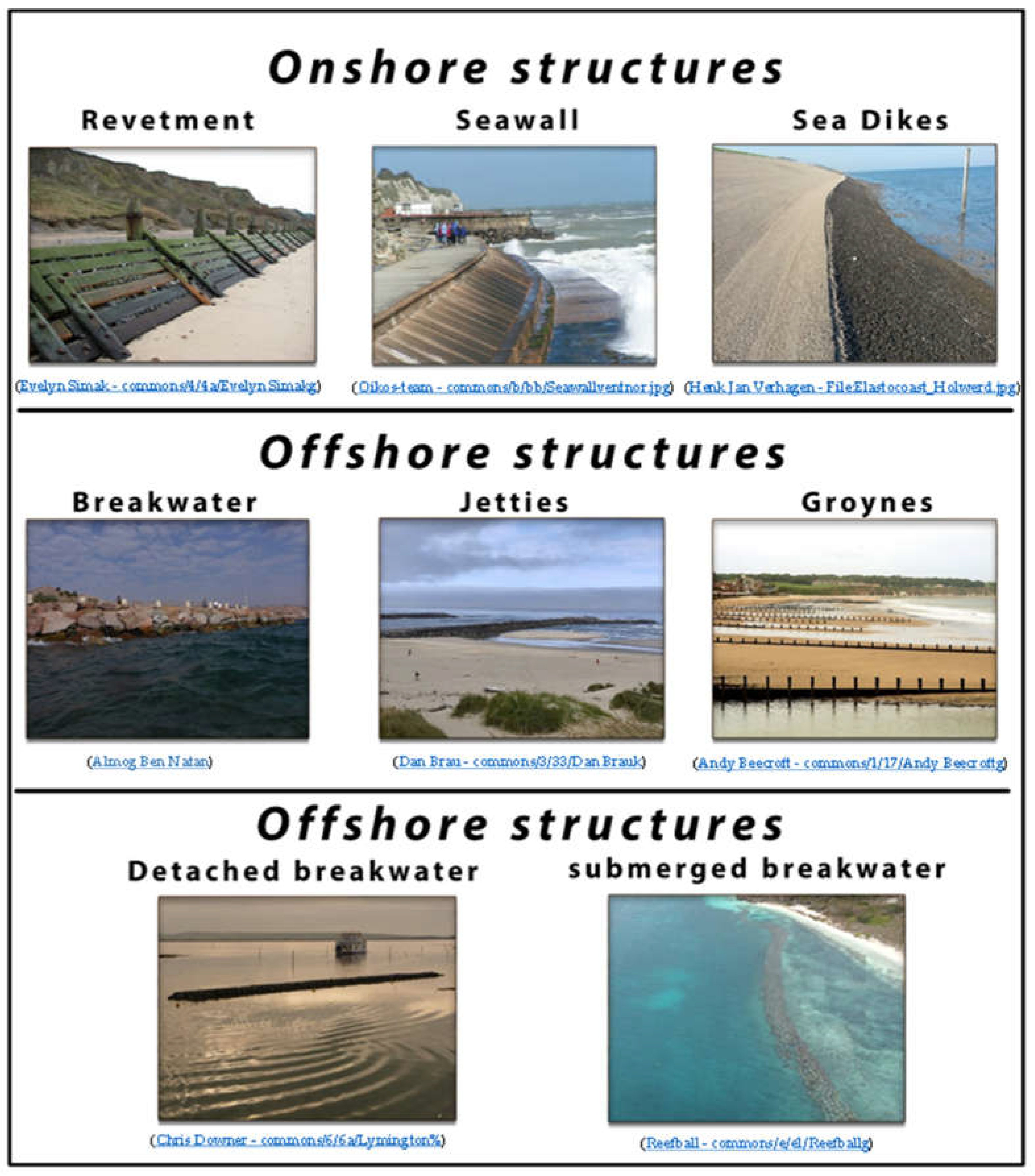

Table 1.
Concrete alteration methods and their biological effects.
| Alteration | Specific compound used | Effect | Reference |
|---|---|---|---|
| Reduce surface alkalinity | A CEMI /GGBS concrete mixture | 50%CEMI /50%GGBS tiles aggregate significantly more Diatoms, green algae, and cyanobacteria biomass than 100% CEMI tiles after one month. | [66] |
| Reduce chemical leaching | PFA/GGBS concrete mixture | Increased biofilms cover rate by double that of commercial concrete mixture. | [65] |
| Lower carbon footprint | Hemp fibers and recycled shell material in the concrete mixture. | After 12 months deployment in the intertidal environment, the hemp and shell concrete tiles supported significantly higher live cover of marine organisms than the GGBS concrete. | [67] |
| Increase small- scale porosity | Usage of Tuff boulders and cobbles instead of smoothed rocks in concrete aggregates | Increased corals recruitment | N. Shashar- unpublished data |
| Increase iron availability | Iron dust in cement mix | Increased biofilm and algal growth | N. Shashar- unpublished data |
| Minimize deterioration of concrete under seawater attack | Magnesium ion as a replacement of calcium in Portland concrete | The addition of MgCl2 to synthetic calcium silicate hydrate (C-S-H) lowers the pH value below 10 | [69] |
| Lower pH | Accelerated carbonization | Accelerated carbonization and additions of mineral admixtures considerably reduced alkalinity (lowest pH value was 8.57) and showed no harmful effect on the compressive strength | [70] |
Disclaimer/Publisher’s Note: The statements, opinions and data contained in all publications are solely those of the individual author(s) and contributor(s) and not of MDPI and/or the editor(s). MDPI and/or the editor(s) disclaim responsibility for any injury to people or property resulting from any ideas, methods, instructions or products referred to in the content. |
© 2024 by the authors. Licensee MDPI, Basel, Switzerland. This article is an open access article distributed under the terms and conditions of the Creative Commons Attribution (CC BY) license (http://creativecommons.org/licenses/by/4.0/).
Copyright: This open access article is published under a Creative Commons CC BY 4.0 license, which permit the free download, distribution, and reuse, provided that the author and preprint are cited in any reuse.


