
Submitted:
28 November 2024
Posted:
29 November 2024
You are already at the latest version
Abstract
Mg alloys, renowned for their lightweight and exceptional mechanical properties, hold promise for widespread applications in aerospace, automotive manufacturing, and biomedical fields. However, their limited corrosion resistance has hindered their practical usage. MAO (MAO) technology serves as an effective coating method to enhance the corrosion resistance of Mg alloys, yet the inherent porosity of MAO coatings remains a performance bottleneck. To optimize coating performance, pre-processing and post-processing have emerged as research hotspots. pre-processing regulates the surface state thereby promoting uniform growth of the MAO coating, while post-processing further reduces coating porosity and enhances corrosion resistance. This paper comprehensively reviews the impact of various pre-processing and post-processing methods, such as shot peening pre-processing and immersion post-processing, on the microstructure, composition, and performance of Mg alloy MAO coatings. Utilizing electrochemical testing and scanning electron microscopy (SEM) characterization techniques, the paper reveals the crucial role of pre-processing in optimizing interfacial bonding and post-processing in enhancing coating density.Finally, the paper concludes with a prospect on the development of pre-processing and post-processing techniques.
Keywords:
Pre-processing and post-processing
; Corrosion resistance
; Porosity
; Interface bonding
; Density
; Composition and constituents
1. Introduction
Magnesium alloys exhibit broad application prospects in aerospace, automotive, and biomedical fields due to their light weight, high specific strength, and excellent vibration damping properties, as shown in Figure 1, Mg alloys have different properties and are widely used in various fields including aerospace, military, and orthopedic fixation for fractures[1,2,3,4,5,6,7,8,9,10,11,12,13,14,15,16,17,18,19,20,21,22,23,24,25,26,27]. However, Mg is a highly reducing metal with a standard electrode potential of -2.37V, which is more negative than that of commonly used metals such as iron (-0.45V), titanium (-1.63V), and aluminum (-1.66V). In the air, pure Mg readily forms a brittle and porous MgO film, while in humid environments or electrolytes, it tends to generate a protective Mg(OH)2 layer with low solubility. Nevertheless, the Mg(OH)2 layer is prone to detachment, re-exposing the Mg matrix and accelerating corrosion. Mg alloys undergo various forms of corrosion, and their corrosion mechanism involves galvanic corrosion between the second phase in the matrix (e.g., Mg17Al12 phase in Mg-Al systems [28, 29] ) or impurities and the matrix, forming unstable hydroxide films, thereby leading to the dissolution of matrix Mg. Consequently, the inferior corrosion resistance of Mg and its alloys limits their range of applications [30,31,32]. Currently, the primary methods to enhance the corrosion resistance of Mg and its alloys include alloying[33,34,35] and applying surface protective coatings[36, 37].
For pure Mg, the addition of elements such as Zr, As, and Li can enhance its corrosion resistance. In the case of Mg alloys, the incorporation of elements like Al[42], Mn[43], Zn[42, 43], Ca[34, 42, 43], and Y[44]can improve corrosion resistance to varying degrees. This improvement can be attributed to two possible mechanisms: firstly, alloying elements can inhibit cathodic reactions or galvanic corrosion, thereby enhancing the corrosion resistance of the matrix; secondly, they can form a dense passivation film on the surface of the matrix, effectively blocking the erosion of corrosive media. Figure 2[45] illustrates the effects of different alloying elements and their contents on the corrosion potential and corrosion current density of pure Mg. Notably, the Mg-0.2Sb alloy exhibits slightly higher corrosion resistance than pure Mg, whereas the Mg-0.3Sb alloy shows slightly lower corrosion resistance. Therefore, alloying can indeed enhance the corrosion resistance of Mg alloys to a certain extent, underscoring the importance of selecting the appropriate alloy element content. Secondly, alloying is primarily employed to improve the mechanical properties of Mg alloys, with limited enhancement in corrosion resistance[34, 35].
The preparation of corrosion-resistant protective coatings on the surface of Mg alloys commonly involves a number of different methods, including conversion coating[36, 46–49], sol-gel method[50,51,52], electroless plating[53,54,55], electroplating[56], anodic oxidation[57], and micro-arc oxidation (MAO) [58,59,60]. MAO technology has gained widespread attention for its simplicity, high efficiency, and environmentally friendly nature. It is capable of producing composite oxide coatings with good adhesion and high thickness on valve metals and their alloys including aluminium, Mg, and titanium[61,62,63,64,65,66,67,68,69,70,71]. By utilizing plasma generated by instantaneous high-voltage discharges, it enables the in-situ growth of thicker and more corrosion-resistant protective coatings on the surface of Mg alloys. Table 1 presents the corrosion potentials and corrosion current densities of MAO coatings prepared on the surface of Mg and its alloys (Ahmad Keyvani et al.). [72] A ceramic coating of composite hydroxyapatite nanoparticles was prepared on the surface of AZ31 Mg alloy using MA. The study revealed that the electrochemical corrosion potential (Ecorr) of the coating was -1.156 V, significantly higher than that of the AZ31 matrix, which exhibited an Ecorr of -1.536 V. In a related study, Y. Vangölü et al. [58] developed a Zn-doped MAO coating on AZ31 Mg alloy, resulting in an enhanced electrochemical corrosion potential of -0.71 V. It can be inferred that the MAO technique may effectively improve the corrosion resistance of Mg alloys to some extent.
As illustrated in Figure 3(a), the MAO apparatus is configured to use the sample and stainless steel container as electrodes through a dual-polarity pulse power supply. The positive pole of the power supply is connected to the sample, and the negative pole is connected to the stainless steel container. In addition, a refrigeration system is typically incorporated to regulate the temperature of the electrolyte throughout the oxidation process. The addition of a stirrer to the electrolyte enhances the uniformity of the coating composition. Furthermore, incorporating a stirrer helps maintain the coating preparation at a constant temperature. Figure 3(b) illustrates the MAO coating preparation process, where the voltage changes over time can be roughly divided into three stages: (Ⅰ) the formation of the passivation film and the anodic oxidation stage; (Ⅱ) the spark discharge stage; (Ⅲ) the MAO stage. When the voltage is less than the breakdown voltage, the sample undergoes the formation of the passivation film and the anodic oxidation process; when the voltage exceeds the breakdown voltage, the insulating oxide film is disrupted, causing numerous tiny white sparks to appear on the material surface. This stage is referred to as the spark discharge stage. Upon further voltage increase, large red arc points are observed on the surface, exhibiting movement. After a designated period of time, the red arc points grow in size and depth, eventually forming an orange-red spark. Figure 3(c) shows the schematic diagram of the MAO coating preparation process for Mg alloy, where the basic process of MAO includes: passivation stage, anodic oxidation stage, spark discharge stage, and MAO stage. Prior to reaching the critical breakdown potential, the material surface undergoes ordinary passivation and ordinary anodic oxidation, resulting in the formation of a thin insulating oxide film.
Based on the operational principle of MAO technology, it is inevitable that inherent defects such as micro-pores and microcracks will be formed within the MAO coatings, as illustrated in Figure 4 [71], which can result in the infiltration of corrosive media into the Mg substrate, thereby compromising its ability to offer long-term corrosion protection in challenging environments. The formation of micropores and cracks can be attributed to a number of factors, including: Firstly the rapid solidification of molten oxides in the electrolyte can induce thermal stresses, thereby generating microcracks in the coating structure [82]. Secondly, continuous micro-arc discharge creating micro-channels on the coating surface; and thirdly, a Pilling-Bedworth ratio (PBR) value of 0.81 < 1 for MgO, which is the primary component of the MAO layer and determines its porous structure[83]. The presence of pores and microcracks within the coatings serves as fast pathways for corrosive ions to diffuse through, thus diminishing their effective barrier effect against corrosive chemical media and consequently diminishing their corrosion resistance. In light of this understanding, researchers both domestically and internationally are inclined towards enhancing the corrosion resistance of Mg alloys by either pre-processing the substrate or post-processing the MAO coating.
As shown in Figure 5, there are numerous factors that affect the performance of MAO coatings, including the substrate, electrolyte, electrical parameters, additives, pre-processing. The content and types of alloy elements in different Mg alloys can influence the phase composition, microstructure, and properties of MAO coatings. For instance, the Mg17Al12 intermetallic compound in AZ91D alloy can lead to the formation of vertical pores, while AZ31 alloy tends to form spherical pores. Different power supply operating modes also have an impact: MAO films formed under constant voltage mode exhibit the greatest roughness, thickness, and uniform corrosion resistance; whereas films obtained under constant power mode have the lowest surface roughness, are dense, and possess the best pitting corrosion resistance[84, 85]. Electrical parameters play a crucial role in the corrosion resistance of Mg alloy MAO coatings. For example, applying a negative voltage in constant voltage mode can enhance the coating's density, thereby increasing its corrosion resistance. The termination voltage is closely related to the coating's thickness and density[86]; as the termination voltage increases, the coating's roughness increases but its density decreases. An increase in frequency results in a reduction in energy per breakdown event, which in turn leads to a decrease in the size of the discharge pores in the coating, an increase in film density, and an enhancement in corrosion resistance. [87, 88] The electrolyte is one of the most direct factors influencing the MAO layer of Mg alloys. Here, we categorize electrolytes into common electrolytes and electrolytes with additives. Among the most commonly used electrolytes, silicates and phosphates have been demonstrated to significantly enhance corrosion resistance. The conductivity and concentration of the electrolyte affect the arc initiation voltage, which in turn affects the size of the micropores in the film and subsequently the film's structure and corrosion resistance. An excessively high pH value of the electrolyte can affect the dissolution of the MAO coating on Mg alloys, reducing its corrosion resistance. Pre-processing enhances the corrosion resistance of MAO coatings by improving the interfacial bonding strength between the coating and the substrate and reducing defects such as porosity and microcracks on the surface of the MAO coating [89, 90]. Post-processing improves the density of the MAO coating on Mg alloys by sealing pores or forming composite coatings, thereby enhancing corrosion resistance. Among the factors influencing MAO coatings on Mg alloys, other factors have been extensively studied over the past decade[91,92,93]. In recent years, there has been a surge in research on the impact of pre-processing and post-processing on the corrosion resistance of MAO coatings on Mg alloys. Therefore, this review focuses on the influence of pre-processing and post-processing on the corrosion resistance of MAO coatings on Mg alloys.
The prevalent methodologies for assessing the corrosion resistance of MAO coatings on Mg alloys encompass salt spray testing, electrochemical testing techniques, and immersion tests. The salt spray test involves artificially creating a saline environment to induce metal corrosion, with regular monitoring of the degree of corrosion to evaluate metallic durability against corrosive elements. The underlying corrosion mechanism is attributed to the electrochemical reaction between chloride ions penetrating through the protective layer and the substrate metal; furthermore, the equipment requirements for this test are relatively straightforward. While it effectively simulates most real-world corrosive environments, its duration can be extensive and susceptible to environmental influences. Conversely, immersion tests entail submerging Mg alloy samples in corrosive media at specified temperatures and concentrations (e.g., NaCl solution), evaluating corrosion resistance via mass loss or changes in metal ion concentration within the solution.Although these experimental conditions are uncomplicated and capable of mimicking various corrosive scenarios, they also require prolonged exposure periods that complicate rapid assessments of coating performance.Commonly employed electrochemical testing methods include Electrochemical Impedance Spectroscopy (EIS) and Potentiodynamic Polarization (PDP).Corrosion resistance is assessed by analyzing obtained values such as Ecorr and Icorr; this approach offers high sensitivity for identifying defects and elucidating corrosion mechanisms while providing swift results due to shorter testing durations.Consequently, EIS and PDP have been selected as measurement techniques for evaluating corrosion resistance in this study.
This paper presents a comprehensive review of the impact of pre-processing (e.g., laser processing, magnetron sputtering (MS), cold spraying (CS), etc.) and post-processing (e.g., impregnation, sol-gel treatment, hydrothermal treatment (HT), etc.) on the composition, structure, and corrosion resistance of MAO coatings on Mg alloys. The focus is to elucidate the role and mechanism of pre-processing in optimizing the interfacial bonding between MAO coatings and substrates, as well as post-processing in enhancing the densification of MAO coatings. Furthermore, it outlines current challenges in this field and anticipates future development prospects.
2. Effect of Pre-Processing on the Corrosion Resistance of MAO Coatings on Mg Alloys
The pre-processing process involves the implementation of a targeted treatment regimen on the Mg alloy substrate in advance of the MAO procedure. This is undertaken with the objective of optimizing the surface microstructure and overall structure. The utilization of an appropriate pre-processing method has the potential to enhance the interfacial bonding strength between the coating and substrate, as well as reduce surface porosity, microcracks, and other defects in the MAO coating, thereby improving its corrosion resistance. Commonly employed pre-processing techniques for Mg alloy MAO include laser treatment[94,95,96,97,98], MS[99, 100], CS[101, 102], etc. Table 2 presents a summary of the ways in which these pre-processing methods contribute to enhancing the corrosion resistance of Mg alloy MAO coatings.
As depicted in Figure 6, the pre-processing stage encompasses a diverse array of methodologies, primarily laser treatment, MS and Shot peening(SP) among others. These techniques are primarily employed to enhance the adhesive strength of the subsequent coating, which is achieved by altering the microstructural characteristics of the Mg alloy surface. In the case of MS, a thin coating layer is deposited onto the Mg alloy surface, serving as a foundational layer upon which the MAO coating is subsequently formed.
2.1. Surface Laser Process
Laser processing technology involves the use of high-power laser beams to heat, melt, and evaporate materials from the surface, resulting in changes to the grain size and chemical composition of the substrate surface layer due to high thermal gradient and rapid cooling rates [112,113]. This technique has garnered significant attention in the field of material preparation due to its high efficiency and precision. Laser treatment of Mg alloys not only homogenizes the surface microstructure but also dissolves the second phase in the matrix [114], creating favorable conditions for the preparation of MAO coatings with excellent comprehensive performance.
Laser Shock Processing (LSP), also known as laser peening (LP), generates intense shock waves on the surface using high-power pulsed laser beams. This process can induce compressive residual stresses in the material[114], thereby enhancing the surface structure of Mg alloys and positively impacting the generation of MAO coatings[94, 95]. As shown in Figure 7, during the LSP process, the sample surface is covered with an absorbing layer and a limiting layer, and the pulsed laser beam is focused on the absorbing layer, which absorbs the laser energy and generates a high-temperature and high-pressure plasma. Various physical processes that occur during the generation and expansion of nanosecond laser-generated plasma into the ambient gaseous medium, due to the presence of a limiting layer, the outward diffusion of the plasma is limited, resulting in a shock wave transmitted to the target material. When the shock pressure exceeds the Hugoniot elastic limit of the material, plastic deformation occurs, creating deep compressive residual stress in the surface area. Defects such as twins and dislocations are formed. These defective structures enhance the stability of residual stress through pinning effect. In addition, the crystal structure within the material is refined.Xiong et al. [96] further demonstrated that the combination of LSP pre-processing and MAO technology significantly improves the corrosion resistance of AZ80 Mg alloys. This enhancement is primarily attributed to LSP pre-processing refining grain size and forming a nanocrystalline film, which effectively reduces the adsorption of Cl- ions on the surface and promotes the formation of a MgO passivation layer, as a result of LSP pre-processing. Upon penetration of the MAO coating by a Simulated Body Fluid (SBF) solution, a dense passivation film is immediately formed on damaged portions in the vicinity of the exposed surface of the nanocrystalline layer, thereby acting as a self-healing agent.
In addition to LSP, the corrosion resistance of MAO coatings on Mg alloys can be further enhanced through Laser Surface Melting (LSM). The LSM technique allows for precise control over the microstructure of the material, thereby optimizing the surface structure and grain size of Mg alloys[97, 98]. Research by Wang [109] and Liu[110] demonstrated that LSM pre-processing significantly improved the corrosion resistance of MAO coatings on AZ91D alloys. Figure 8 illustrates the cross-sectional morphology of unpretreated and pretreated MAO coatings, revealing a significant reduction in micropores in the pretreated coatings. Furthermore, Chen et al.[116] successfully produced a denser MAO coating on AZ91D alloy surfaces using LSM pre-processing, resulting in a substantial improvement in corrosion resistance. The dissolution and redistribution of β-phase (Mg17Al12) induced by LSM led to a reduction in its content, effectively mitigating galvanic coupling corrosion between α-Mg matrix and β-phase. This reduction in galvanic coupling corrosion prevents concentrated corrosion on large areas of α-Mg matrix, thus averting severe localized corrosion. However, the effect of laser treatment technology on the enhancement of the corrosion resistance of Mg alloy MAO coatings is usually not very significant (Icorr is reduced by about 1 order of magnitude), most critically, due to the low elastic limit of Mg, even at low laser intensities can lead to a large intrinsic deformation of the material, which can affect the fatigue life of the material.
2.2. Magnetron Sputtering
MS offers a significant advantage as a pre-processing process for Mg alloys, resulting in a relatively dense, uniform, and stable surface for the MAO process. This leads to improved coating quality and ensures even distribution throughout the Mg alloy surface with minimal defects or weak areas. Furthermore, this technology enhances the bonding force between the coating and substrate, effectively extending the service life of the coating. Additionally, by adjusting the composition and structure of the sputtered layer, it is possible to optimize the performance of the MAO coating to meet diverse application requirements[99, 100]. As shown in Figure 9, The principle of MS is that the potential difference in the deposition chamber causes argon ions (plasma) to ionize, accelerate and Orient to the target. These plasma ions can move the target atom or molecule by directly colliding or triggering a "collision cascade" that causes the atom to emit, which then condenses into a film on the substrate (anode) . Wei et al. [99] demonstrated that MS of a pure aluminum layer prior to MAO on AZ31 Mg alloy can produce coatings with varying morphologies and phase compositions. The coating prepared with aluminates as the MAO electrolyte primarily consists of irregular nodules and fine pores of α-Al2O3 and γ-Al2O3, lacking a pancake-like structure. In contrast, the coating prepared with silicates as the MAO electrolyte is characterized by a porous and pancake-like structure dominated by γ-Al2O3. Furthermore, compared to direct MAO on the AZ31 substrate, MAO carried out on a MS Al layer results in the formation of denser γ-Al2O3, leading to improved compactness. The oxidation process yields a more dense Al2O3 (PBR of 1.28[118]), indicating that MS can enhance the corrosion resistance of Mg alloy MAO coatings. Hu et al. [100] demonstrated that the initial deposition of a dense pure aluminium layer approximately 11 μm thick via MS onto the surface of an AZ31 substrate followed by obtaining an oxide layer dominated by γ-Al2O3 through MAO resulted in significantly improved corrosion resistance for the MAO coating, as evidenced by an Icorr value of only 3.93×10⁻⁶A·cm−2 after 5 minutes, in comparison to 2.54×10⁻⁴A·cm−2 for the substrate.
2.3. Cold Spray
Figure 11 illustrates the operating mechanism of the CS technology. Initially, a compression device pressurizes the gas, which then flows through a heater to increase its temperature. At the nozzle outlet, the gas undergoes rapid expansion, reaching velocities beyond the speed of sound. By utilizing the high-pressure and heated gas at the front of the spray gun, metal particles are accelerated to supersonic speeds and ultimately impact and adhere to the surface of the substrate material. The CS method, powered by gas, achieves plastic deformation and particle deposition through the high-speed collision of micron-sized solid particles with the substrate. This process leads to the solidification of particles, resulting in a coating formed through mechanical interlocking and local metallurgical bonding between the particles[120, 121], thereby enhancing the corrosion resistance of the material. In the realm of Mg alloy corrosion protection, CS has garnered widespread attention due to its exceptional corrosion resistance. CS is capable of depositing a layer of metal or alloy with similar physicochemical properties as the substrate onto the surface of Mg alloys, such as Cu and Al layers. This deposited layer not only closely integrates with the substrate but also plays a pivotal role in subsequent MAO processes by improving bonding between the substrate and MAO coatings, thus enhancing adhesion and durability. Simultaneously, the metal deposition layer itself may possess properties such as corrosion resistance and wear resistance, which are preserved and further enhanced during the MAO process, thereby significantly improving the overall performance of the Mg alloy. As depicted in Figure 10, Rao et al. [101] fabricated a composite coating on AZ31 Mg alloy through the application of CS and MAO techniques; notably, the coating in the CS pretreated group exhibited greater density than that in the unpretreated group, effectively obstructing the intrusion of corrosive media. Following CS pre-processing, the Ecorr of MAO increased from -1.453 V to -1.153 V, indicating that CS pre-processing substantially bolstered the corrosion resistance of Mg alloy after MAO treatment. This not only validates the efficacy of CS technology in safeguarding Mg alloys against corrosion but also offers novel insights and strategies for developing high-performance protective coatings for Mg alloys.
2.4. Other Treatments
In the context of pre-processing methods, SP and UCFT are both effective in inducing plastic deformation of the substrate's surface. This manipulation accomplishes grain refinement and establishes the foundation for a high-quality substrate that is conducive to MAO processes[103, 122, 123]. Research conducted by Daniel et al. [106] has demonstrated that Mg alloys treated with SP are capable of generating denser coatings during MAO. The micro-pits and imperfections introduced by SP serve as nucleation sites for the coating material, leading to a more dense structure. Moreover, a meticulously controlled SP regimen enhances the substrate's surface reactivity, resulting in a proliferation of sites with favorable thermodynamic properties. This manipulation ultimately enhances the overall performance and efficiency of the system, thereby creating propitious conditions for the formation of MAO coating nuclei. Compared to MAO without pre-processing, SP followed by MAO resulted in a decrease in the Icorr of the coating from 7.11×10⁻⁷A.cm−2 to 2.14×10⁻⁷A.cm−2. Chen et al. [107] demonstrated that UCFT pre-processing combined with MAO significantly enhanced the corrosion resistance of AZ31B Mg alloy. As depicted in Figure 12, the surface structure of the samples treated with UCFT and MAO was notably improved, and the grain size was refined to 30-80 nm. The corrosion resistance of the samples treated with the combination of UCFT and MAO was enhanced compared to those treated with single MAO due to a variety of phases present in the coatings, such as Mg3(PO4)2、tertiary calcium phosphate (TCP)、CaHPO4·2H2O(DCPD)、HA(Ca10(PO4)6(OH)2)、Mg and MgAl2O4, among other compounds, which contributed to an enhanced chemical stability and corrosion resistance.
The method of chemical conversion coatings plays a crucial role as a pre-processing prior to the MAO of Mg alloys, achieving the effect of cleaning and activation through the reaction or adsorption of active ingredients in the solution with the surface of Mg alloys. This process may lead to the formation of a chemical conversion film on the substrate surface[108]. The study by Hariprasad et al. [108] has fully demonstrated the advantage of utilizing the chemical conversion coatings method in pre-processing Mg alloy MAO. The corrosion current (Icorr) of the composite coating, formed by combining cerium conversion (CC) and MAO on the surface of AZ31 Mg alloy, is 2 orders of magnitude lower than that of a coating prepared by MAO alone. This significant enhancement can be primarily attributed to the high thickness and densification of the composite coatings. In conclusion, employing chemical conversion coatings as a pre-processing for MAO can markedly enhance corrosion resistance in coatings.
2.4. Conclusions
The pre-processing process plays a crucial role in the preparation of MAO coatings, as it has the capability to modify the microstructure of the alloy, enhance the bonding force between the coating and the substrate, and improve the coating performance to meet the requirements of complex application environments. Therefore, when selecting the pre-processing process, consideration should be given to alloy composition, application scenarios, performance requirements and cost-effectiveness in order to optimize coating performance[96–100, 109, 110, 116].
3. Effect of Post-Processing on the Corrosion Resistance of MAO Coatings on Mg Alloys
The enhancement of corrosion resistance in Mg alloy MAO coatings is currently a key focus of research, with post-processing technology being a significant area of interest[124,125,126,127,128,129,130,131,132,133,134,135,136,137,138,139,140]. Post-processing techniques serves to effectively seal surface defects such as micropores and microcracks, thereby forming a composite coating with the underlying MAO coating. Commonly employed post-processing methods include impregnation[59], sol-gel technology[140], electrophoretic deposition(EPD)[59, 141, 142], and HT[143,144,145]. The schematic diagram of different post-processing processes is shown in Figure 13, and the coatings produced by the different post-processing are described in detail below.The effects of different post-processing techniques on the corrosion potential and corrosion current density of Mg alloy MAO coatings are summarized in Table 3. The results demonstrate that post-processing can indeed contribute to an improvement in the corrosion resistance of MAO coatings to some extent.
3.1. Impregnation Treatment
Following the implementation of impregnation, hydroxides or other compounds may form on the surface of Mg alloy MAO coatings. These compounds serve to fill the micropores and microcracks in the coatings, effectively preventing the penetration of corrosive media. Simultaneously, impregnation strengthens the adhesion between the coating and the substrate, resulting in an overall enhancement of coating performance[124,125,126,127,128,129,130].
Phosphate-based buffers are commonly utilized under acidic conditions and are frequently employed in impregnation due to their unique chemical properties. It has been observed that while phosphate-based solutions may result in partial coating dissolution, precise control of the impregnation time can effectively manage the degree of coating dissolution and deposition, thereby achieving optimal coating performance[124, 125]. This is evidenced by the work of Qian et al.[124], who immersed Mg samples post MAO into phosphate solutions containing various cations, leading to a notable reduction in micropore size on the coating surface and an enhancement in densification. Figure 14 visually depicts the corrosion mechanism of MAO coatings following impregnation with NaH2PO4 solution, wherein HPO42- from H2PO4- ionization reacts with Mg2+ to form a deposit layer of MgHPO4, which effectively seals the pores of the coating and improves its corrosion resistance. Qian et al. [125] demonstrated that the impregnation with a solution containing copper salts and phosphate salts substantially improved the corrosion resistance of MAO coatings on AZ91D Mg alloy. The presence of MgHPO4 crystalline phase in the coating after sealing treatment in a solution with added NaH2PO4 resulted in a considerable reduction in the depth of corrosion pores and the number of corrosion products in the severely corroded area, compared to unimpregnated MAO coatings, after 384 hours of immersion in 3.5 ωt% NaCl. In a similar study, Qian et al.[126] conducted phosphate impregnation on AZ91D Mg alloy MAO coatings and observed that the surface became smoother and pore size decreased post-processing. Furthermore, upon sealing for 15 minutes, the coating obtained a dense structure with MgHPO4 as its main composition. The Icorr value for phosphate phosphate-impregnated MAO was approximately one order of magnitude lower than that for unimpregnated treatment.
Rare earth elements, renowned for their exceptional physicochemical properties, exhibit significant potential in enhancing the overall performance of Mg alloy MAO coatings. Recently, researchers have focused specifically on studying how incorporating rare earth elements into the sealing treatment affects the corrosion resistance of Mg alloy MAO coatings. Mohedano et al.[127] observed that a Ce-rich layer could be formed on the surface of MAO coatings on Mg-Y-Zn alloy substrates following treatment with Ce salts, effectively reducing coating pores. This is due to the oxidation of Ce3+ ions by H2O2 in the sealing solution (Eq. (1)) and partial dissolution of MgO and Mg2SiO4 in acid, resulting in local alkalinity and the formation of insoluble CeO2 (Eqs. (2)-(4)). The enhanced corrosion resistance is attributed to pore blockage by the accumulation of CeO2 within the coating structure.”
Mingo et al. [129] conducted a study that further validated the beneficial impact of Ce-based sealing on the corrosion resistance of Mg alloy MAO coatings. The researchers observed that Ce salt treatment induced a dissolution/precipitation reaction on the MAO surface, leading to the formation of Ce-rich compounds (CeO2). These compounds effectively obstructed the ingress of corrosive media into the coating, thereby augmenting its corrosion resistance. Additionally, Sun et al. [130] demonstrated a significant reduction in Icorr for MAO-Ce(NO3)3 coatings treated with impregnation, compared to unimpregnated MAO coatings, when exposed to 3.5 ωt% NaCl solution. This improvement can be primarily attributed to the insoluble cerium oxide formed during the MAO process, which efficiently sealed micropores in the MAO coating and prevented penetration of corrosive solutions into the substrate region, consequently enhancing its corrosion resistance. Phuong et al. [131] conducted an investigation on the impact of sealing AZ31 Mg alloys coated with MAO coatings using Ce and phosphate solutions. The study results demonstrated that the Icorr of the samples after sealing treatment with cerium salt decreased by one order of magnitude compared to the Icorr of MAO 125.9 × 10⁻⁸A cm-2, leading to a significant enhancement in corrosion resistance. Pezzato et al. [128] assessed the influence of Nd salt sealing post-processing on the corrosion resistance of AZ91-coated Mg alloy samples through electrochemical tests. The findings indicated that the Nd salt sealing treatment notably improved the coatings' corrosion resistance, primarily attributed to the effective physical barrier provided by the sealing layer, which effectively obstructed penetration by corrosive substances.
The preference for organic coatings among researchers is based on their exceptional chemical resistance and advanced protective properties. These coatings have become a prevalent post-processing method for enhancing the corrosion resistance of Mg and its alloy MAO coatings. In comparison to traditional inorganic electrolytes, organic electrolytes are environmentally friendly and meet the criteria of the requirements of clean production[132,133,134,135]. Liu et al. [132] successfully fabricated MAO-(SA+Ce) coatings for AZ31 Mg alloys by impregnating them with stearic acid, hydrogen peroxide, and cerium nitrate dissolved in ethanol. The self-healing mechanism of MAO-(SA+Ce) composite coatings was characterized in Figure 15, depicting the cross-sectional morphology consisting of a MAO layer (≈4.0μm) and a newly formed Ce conversion film (≈2.5μm) on the exterior. Additionally, the Icorr of the MAO-(SA+Ce) composite coating was reduced by 3-4 orders of magnitude compared to direct MAO coating. Dou et al. [133] conducted a study on the impact of chitosan (CS) on the corrosion resistance of Mg alloy MAO coatings, and observed that the sealing film effectively closed the micropores of the MAO coatings, thereby enhancing their corrosion resistance. Štrbák et al. [134], on the other hand, investigated the effect of aqueous-based preservative containing corrosion inhibitors on the corrosion behavior of MAO coatings and found that the sealing treatment was capable of retaining water-based corrosion inhibitor-containing preservatives in MAO porous coatings, thus effectively preventing corrosion in aqueous solutions with varying aggressive chloride ions. Pak et al. [135] utilized phytic acid/3-aminopropyltrimethoxysilane as an effective corrosion inhibitor to prevent the corrosion of MAO coatings. Through aminopropyltrimethoxysilane hybridization for surface treatment of Mg alloys, composite coatings were obtained exhibiting excellent corrosion resistance with an Ecorr value of -1.566 V in 3.5% NaCl solution. Gnedenkov et al.[136] treated MA alloys using 8-hydroxyquinoline (8-HQ) solution to modify the MAO coating, resulting in significantly enhanced protective properties of the coating. The corrosion current value of the treated coating was 86 nA/cm2, which is one order of magnitude lower than that of the MAO layer (810 nA/cm2), indicating an enhanced corrosion resistance after post-processing. Xue et al. [137] developed a MAO/CIP-PMTMS composite coating, leveraging the hydrophobicity and barrier effect of organics to achieve an Icorr of 7.13×10⁻⁸A/cm2, significantly lower than that of the MAO coating (3.54×10⁻⁷A/cm2). Toorani et al.[138] further improved the corrosion resistance of Mg alloy MAO coatings by treating them with a three-layer composite coating of silane and epoxy, resulting in coatings with higher densification and thickness.
3.2. Sol-Gel Treatment
The sol-gel method, when used as a post-processing, effectively seals the holes in the MAO coating of Mg alloys, offering advantages such as strong coating adhesion, good barrier effect, and environmental protection[139]. For instance, Li et al. [140] demonstrated the preparation of HDTMS/SiO2 composite coatings on AZ91 Mg alloy surfaces pretreated with MAO through hydrophobicity and sol-gel processes. The study revealed that the interface between the MAO coating and the gel hydrophobic layer was not distinct, indicating that the overall coating treated by the sol-gel process was relatively dense and significantly improved the corrosion resistance of the samples. This improvement can be attributed to two possible reasons: firstly, by replacing hydrogen in hydroxyl groups with Si-(CH2)15CH3 the capillary pressure within silica networks is increased by transforming Si-OH into Si-O chains, effectively preventing gel coating cracking and reducing substrate corrosion tendency; secondly, grafting a long carbon chain (-(CH2)15CH3) onto silica forms a hydrophobic layer, enhancing the ability of the sol-gel layer to inhibit corrosive ion penetration. Furthermore, Li et al. [153] utilized a combination of MAO technology and sol-gel method to enhance corrosion resistance in Mg-lithium alloys. The findings indicated that the composite coatings, prepared using MAO technology and the sol-gel method, exhibited favorable densification, minimal defects, and significantly enhanced corrosion resistance in Mg alloys. Malayoglu et al.[154] employed sol-gel treatment as a post-processing technique to develop composite coatings for Mg alloys with micro-oxidation coatings, aiming to improve their corrosion resistance.The results demonstrated that the sol-gel post-processing effectively sealed the MAO coatings, resulting in enhanced corrosion resistance.
3.3. Hydrothermal Treatment
HT, which is recognized as an environmentally sustainable and cost-effective method, has attracted significant attention from both domestic and international researchers and scholars [143, 155]. Malekkhouyan et al. [155] conducted the synthesis of LDH coatings on AZ31 Mg alloy based on MAO coatings through HT. Their salt spray experiments revealed that no substantial changes were observed on the sample surfaces after 7 days of MAO treatment followed by HT, while the coating of a single MAO sample had been completely deteriorated.”. Consequently, it can be concluded that HT effectively enhances the corrosion resistance of Mg alloy MAO coatings. Zhang et al. [100] employed HT for the post-processing of Mg alloy MAO samples. The findings revealed a six-order increase in the RCT value (a measure of corrosion resistance) of the hydrothermally treated Mg alloy MAO coating compared to that of the direct MAO coating without HT. Dai et al. [144] successfully prepared a new MgAlY Layered Double Hydroxides-LDHs film containing salicylate on the surface of AZ31 alloy MAO coating by using one-step hydrothermal method and intercalation method. The reaction process for in situ growth of MgAlY-LDHs/salicylate film on AZ31 alloy was analyzed as depicted in Eqs. (5)-(11):
The MLYS specimen (salicylic acid embedded + HT + MAO) exhibited a significantly high film resistance value of 1.83 ×10⁶ Ω·cm2. The MgAlY-LDHs/salicylic acid films grown on MAO and post-treated Mg alloys demonstrated excellent corrosion resistance, attributed to the enhanced densification and self-healing properties of the coatings, thereby ensuring the corrosion protection of the Mg alloys. Wang et al.[145] employed a hydrothermal growth method for in situ formation of MgAl-LDHs film on the surface of MAO-coated Mg alloy. The composite film of MAO-HT demonstrated superior short-term and long-term protective properties compared to the MAO coating. The Rct value of the composite film increased by one order of magnitude in comparison to that of the MAO film, which can be attributed to the sealing effect of LDHs on the micropores of the MAO film. Consequently, HT has been shown to enhance the corrosion resistance of Mg alloy MAO coatings. In addition to sealing micropores, HT exhibits ion exchange properties between LDH layers, enabling attraction or adsorption of corrosive ions such as Cl-, thereby further mitigating their corrosive impact on Mg alloy substrates.
3.4. Spraying and Electrodeposition
The coating method involves the utilization of electrodeposition, Air Plasma Sprayed (APS), and other techniques to create a protective layer on the surface of a metal or other material. This is primarily employed to enhance the material corrosion resistance, abrasion resistance, electrical conductivity, and other properties. Farshid et al.[152] utilized MAO and electrodeposition on AZ91 Mg alloy substrate to fabricate MAO/PDA composite coatings with self-healing capabilities, improved corrosion resistance, and bioactivity. A uniform, rough, dense, and hydrophilic MAO-PDA coating was electrodeposited at a dopamine concentration of 1 mg/ml (120 T-1C) with an Icorr of 4.31×10⁻¹⁰A/cm2, which was significantly lower than that of the MAO sample (3.53×10⁻⁸A/cm2). Nadaraia et al.[46] combined MAO and fluorinated polymer spraying to prepare coatings on Mg-Mn-Ce alloys. The application of SPTFE resulted in a significant reduction in coating porosity from 18% to 2% after three applications. The incorporation of fluorine into the MAO layer validates the effectiveness of the fluoropolymer in sealing micro-defects within the MAO coating, indicating that the composite method can greatly enhance the corrosion resistance of the alloy[156]. Additionally, Mohammadreza et al. [156] utilized APS as a post-processing after MAO for improving the corrosion resistance and antimicrobial activity of Mg alloys.The APS-treated coating comprises an inner barrier layer, an outer porous layer, and a nano-structured zirconium dioxide layer. Furthermore, it was observed that molten zirconium dioxide particles infiltrated into the outer porous layer of the MAO coating, effectively expelling air present in micropores and thereby sealing the MAO coating, thus improving its corrosion resistance.
3.5. Other Treatments
Laser surface processing as a post-processing can effectively address the surface treatment challenges of various materials. Wang et al. [132] demonstrated that laser processing can significantly reduce the number and size of pores on the surface of MAO coatings, thereby enhancing the corrosion resistance of the coatings. EPD is an electrochemical method used to deposit charged particles onto the electrode surface to form a coating[157]. The porous structure of MAO coatings necessitates additional polymer deposition at the bottom of the pores, and electrophoresis embeds particles into the pores to create a robust composite coating. Studies have shown that EPD of ZnO nanoparticles [59], Polytetrafluoroethylene (PTFE)[141], and Graphene oxide (GO)[142] in MAO coatings has resulted in pore sealing effects. The findings indicate that ZnO nanoparticles can be embedded in coating pores to form a dual-layered coating through physical interlocking, thereby improving corrosion resistance[59]. Polytetrafluoroethylene was utilized to seal the pores, thereby increasing the coating thickness and barrier property to enhance corrosion resistance[141].Graphene oxide effectively seals MAO micropores and microcracks, leading to a more dense coating and improved corrosion resistance[142]. MS, a widely employed method of physical vapor deposition (PVD), offers numerous advantages including high film purity, efficient deposition, uniformity of deposited film, and uniform and effective coverage of the sample[158].
3.6. Conclusions
Suitable post-processing processes can effectively fill the surface micropores and microcracks of the MAO coatings, thereby enhancing their densification and corrosion resistance. The sol-gel technique has been shown to significantly improve both the densification and bonding strength of the coating, leading to enhanced long-term corrosion resistance. HT and plating methods are effective in improving the corrosion resistance of MAO coatings because they provide superior sealing and can achieve substantial coating thickness. Hence, when selecting appropriate methods, it is essential to comprehensively consider these factors along with application requirements in order to optimize both the corrosion resistance and overall performance of the coating.
4. Summary and Prospect
A In conclusion, the combination of Mg alloy MAO treatment with pre-processing or post-processing can significantly enhance the corrosion resistance of Mg alloys in various corrosive environments. Firstly, pre-processing (laser treatment, SP, UCFT) optimizes the microstructure of the Mg alloy surface and improves coating adhesion and densification, thereby enhancing corrosion resistance. Secondly, pre-processing (MS, CS) deposits a film layer (such as Al layer) on the Mg alloy surface to modify the composition of the MAO film layer and form a more dense substance for improved corrosion resistance. Thirdly, post-processing techniques (impregnation, sol-gel, EPD, MS and HT) seal micropores and microcracks on the MAO coating surface to regulate its structure and improve corrosion resistance. Some post-processing techniques also generate a denser layer on the MAO coating surface to provide an additional corrosion barrier.
As this research field progresses, it is anticipated that this technique will be adopted more widely in industries where corrosion resistance is a critical requirement. Nevertheless, there remains scope for further investigation and optimization in the long-term efficacy of Mg alloy MAO and the combined application of pre-processing and post-processing coatings. This can be achieved by maximizing the utilization of the composite treatment method through strategic pre-processing timing and methods, as well as post-processing agents, techniques, and duration. Currently, post-processing agents primarily consist of inorganic compounds; however, due to the intricate nature and diverse performance of organic matter, further comprehensive exploration is warranted for its potential use as a post-processing agent for Mg alloys. There is a paucity of research examining the impact of factors such as temperature and stress for long-term corrosion resistance. It is of the utmost importance to address these issues in order to establish an industrial basis for experimental use. It is imperative to select environmentally friendly post-processing agents that meet experimental requirements. The development of eco-friendly post-processing techniques or utilization of natural compounds will not only contribute to sustainable coating preparation but also significantly positively impact the industrialization process.
Author Contributions
Conceptualization, J.C.(Jiuwei Chi); methodology, J.C.(Jiuwei Chi); investigation, S.S.(Shuyu Song), W.Z.(Weisheng Zhang); data curation, X.H.(Xingyu He), S.S.(Shuyu Song); writing—original draft preparation, J.C.(Jiuwei Chi); writing—review and editing, H.Z. (Hongliang Zhang); supervision, H.Z. (Hongliang Zhang), Z.N.(Zhisheng Nong), T.L.(Teng Liu), X.C.(Xue Cui), T.M.(Tiannan Man). All authors have read and agreed to the published version of the manuscript.
Funding
This study was supported by the Fundamental Research Funds for the Universities of Liaoning Province(No. LJ232410143034 and No. LJ232410143005), Basic scientific research project of higher education Department of Liaoning Province (No. LJKZ0170), Liaoning Provincial Natural Science Foundation of China (No. 2024-BS-152) and College Student Innovation Project of Shenyang Aerospace University(No. X202410143026).
Institutional Review Board Statement
Not applicable.
Informed Consent Statement
Not applicable.
Data Availability Statement
No new data were created or analyzed in this study. Data sharing is not applicable to this article.
Conflicts of Interest
The authors declare that they have no known competing financial interests or personal relationships that could have appeared to influence the work reported in this paper.
References
- Yang, Y.; Xiong, X.; Chen, J.; Peng, X.; Chen, D.; Pan, F. Research advances in Mg and Mg alloys worldwide in 2020 J. Mg Alloys 2021, 9, 705–747. [Google Scholar] [CrossRef]
- Luo, A.A.; Sachdev, A.K., 12 - Applications of Mg alloys in automotive engineering, in Advances in Wrought Mg Alloys, C. Bettles, M. Barnett Eds., Woodhead Publishing, 2012, pp. 393–426 978-1-84569-968-0. [CrossRef]
- Liu, B.; Yang, J.; Zhang, X.; Yang, Q.; Zhang, J.; Li, X. Development and application of Mg alloy parts for automotive OEMs: A review J. Mg Alloys 2023, 11, 15–47. [Google Scholar] [CrossRef]
- Tong, G.-d.; Liu, H.-f.; Liu, Y.-h. Effect of rare earth additions on microstructure and mechanical properties of AZ91 Mg alloys Trans. Nonferrous Met. Soc. China 2010, 20, s336–s340. [Google Scholar] [CrossRef]
- Zhang, Z.-Q.; Tong, P.-D.; Wang, L.; Qiu, Z.-H.; Li, J.-A.; Li, H.; Guan, S.-K.; Lin, C.-G.; Wang, H.-Y. One-step fabrication of self-healing poly(thioctic acid) coatings on ZE21B Mg alloys for enhancing corrosion resistance, anti-bacterial/oxidation, hemocompatibility and promoting re-endothelialization Chemical Engineering Journal 2023, 451, 139096. [CrossRef]
- Wilson, J., 1 - Metallic biomaterials: State of the art and new challenges, in Fundamental Biomaterials: Metals, P. Balakrishnan, S. M S, S. Thomas Eds., Woodhead Publishing, 2018, pp. 1–33 978-0-08-102205-4. [CrossRef]
- Sezer, N.; Evis, Z.; Kayhan, S.M.; Tahmasebifar, A.; Koç, M. Review of Mg-based biomaterials and their applications J. Mg Alloys 2018, 6, 23–43. [Google Scholar] [CrossRef]
- Chen, Y.; Xu, Z.; Smith, C.; Sankar, J. Recent advances on the development of Mg alloys for biodegradable implants Acta Biomater. 2014, 10, 4561–4573. [CrossRef]
- Tsakiris, V.; Tardei, C.; Clicinschi, F.M. Biodegradable Mg alloys for orthopedic implants – A review J. Mg Alloys 2021, 9, 1884–1905. [Google Scholar] [CrossRef]
- Brown, A.; Zaky, S.; Ray, H.; Sfeir, C. Porous Mg/PLGA composite scaffolds for enhanced bone regeneration following tooth extraction Acta Biomater. 2015, 11, 543–553. [CrossRef]
- Kayhan, S.M.; Tahmasebifar, A.; Koç, M.; Usta, Y.; Tezcaner, A.; Evis, Z. Experimental and numerical investigations for mechanical and microstructural characterization of micro-manufactured AZ91D Mg alloy disks for biomedical applications Mater. Des. 2016, 93, 397–408. [Google Scholar] [CrossRef]
- Li, N.; Zheng, Y. Novel Mg Alloys Developed for Biomedical Application: A Review J. Mater. Sci. Technol. 2013, 29, 489–502. [Google Scholar] [CrossRef]
- Dorozhkin, S.V. Calcium orthophosphate coatings on Mg and its biodegradable alloys Acta Biomater. 2014, 10, 2919–2934. [CrossRef]
- Zhang, W.; Sheng, X.; Zhang, B.; Fu, Y.; Wang, Q.; Yang, K.; Tan, L.; Zhang, Q. A novel design Mg alloy suture anchor promotes fibrocartilaginous enthesis regeneration in rabbit rotator cuff repair J. Mg Alloys 2024. [Google Scholar] [CrossRef]
- Li, S.; Li, X.; Zhao, C.; Liang, H.; Liu, K.; Du, X.; Du, W. Recent progress of electrolytes for Mg-air batteries: A review J. Mg Alloys 2024. [Google Scholar] [CrossRef]
- Setiawan, D.; Lee, H.; Pyun, J.; Nimkar, A.; Shpigel, N.; Sharon, D.; Hong, S.-T.; Aurbach, D.; Chae, M.S. Mg alloys as alternative anode materials for rechargeable Mg-ion batteries: Review on the alloying phase and reaction mechanisms J. Mg Alloys 2024. [Google Scholar] [CrossRef]
- Smirnova, M. Mars transportation vehicle concept Acta Astronaut. 2014, 103, 250–256. [CrossRef]
- Liu, L.; Chen, X.; Pan, F. A review on electromagnetic shielding Mg alloys J. Mg Alloys 2021, 9, 1906–1921. [Google Scholar] [CrossRef]
- Sun, L.; Ma, Y.; Fan, B.; Wang, S.; Wang, Z. Investigation of anti-corrosion property of hybrid coatings fabricated by combining PEC with MAO on pure Mg J. Mg Alloys 2022, 10, 2875–2888. [Google Scholar] [CrossRef]
- Ni, J.; Jin, L.; Zeng, J.; Li, J.; Wang, F.; Wang, F.; Dong, S.; Dong, J. Development of high-strength Mg alloys with excellent ignition-proof performance based on the oxidation and ignition mechanisms: A review J. Mg Alloys 2023, 11, 1–14. [Google Scholar] [CrossRef]
- Shi, H.; Xu, C.; Hu, X.; Gan, W.; Wu, K.; Wang, X. Improving the Young's modulus of Mg via alloying and compositing – A short review J. Mg Alloys 2022, 10, 2009–2024. [Google Scholar] [CrossRef]
- Meier, J.M.; Caris, J.; Luo, A.A. Towards high strength cast Mg-RE based alloys: Phase diagrams and strengthening mechanisms J. Mg Alloys 2022, 10, 1401–1427. [Google Scholar] [CrossRef]
- Wu, G.; Wang, C.; Sun, M.; Ding, W. Recent developments and applications on high-performance cast Mg rare-earth alloys J. Mg Alloys 2021, 9, 1–20. [Google Scholar] [CrossRef]
- Veeramuthuvel, P.; Shankar, K.; Sairajan, K.K. Application of particle damper on electronic packages for spacecraft Acta Astronaut. 2016, 127, 260–270. [CrossRef]
- Sugawara, Y.; Nakasuka, S.; Higashi, K.; Kobayashi, C.; Koyama, K.; Okada, T. Structure and thermal control of panel extension satellite (PETSAT) Acta Astronaut. 2009, 65, 958–966. [CrossRef]
- Wu, D.; Ren, W.; NuLi, Y.; Yang, J.; Wang, J. Recent progress on selenium-based cathode materials for rechargeable Mg batteries: A mini review J. Mater. Sci. Technol. 2021, 91, 168–177. [Google Scholar] [CrossRef]
- Yang, J.; Zhu, Z.; Han, S.; Gu, Y.; Zhu, Z.; Zhang, H. Evolution, limitations, advantages, and future challenges of Mg alloys as materials for aerospace applications J. Alloys Compd. 2024, 1008, 176707. [Google Scholar] [CrossRef]
- Shao, Z.; Nishimoto, M.; Muto, I.; Sugawara, Y. Fabrication of a model specimen for understanding micro-galvanic corrosion at the boundary of α-Mg and β-Mg17Al12 J. Mg Alloys 2023, 11, 137–153. [Google Scholar] [CrossRef]
- Weiler, J.P. The role of the Mg17Al12-phase in the high-pressure die-cast Mg-aluminum alloy system J. Mg Alloys 2023, 11, 4235–4246. [Google Scholar] [CrossRef]
- Li, C.-q.; Tong, Z.-p.; He, Y.-b.; Huang, H.-p.; Dong, Y.; Zhang, P. Comparison on corrosion resistance and surface film of pure Mg and Mg−14Li alloy Trans. Nonferrous Met. Soc. China 2020, 30, 2413–2423. [Google Scholar] [CrossRef]
- Savaedi, Z.; Mirzadeh, H.; Aghdam, R.M.; Mahmudi, R. Thermal stability, grain growth kinetics, mechanical properties, and bio-corrosion resistance of pure Mg, ZK30, and ZEK300 alloys: A comparative study Mater. Today Commun. 2022, 33, 104825. [Google Scholar] [CrossRef]
- Zeng, R.-c.; Zhang, J.; Huang, W.-j.; Dietzel, W.; Kainer, K.U.; Blawert, C.; Ke, W. Review of studies on corrosion of Mg alloys Trans. Nonferrous Met. Soc. China 2006, 16, s763–s771. [Google Scholar] [CrossRef]
- Yin, M.; Hou, L.; Liu, X.; Wang, Z.; Liu, B.; Jia, J.; Zhang, S.; Wei, Y. Tailoring the micromorphology of the as-cast Mg–Sn–In alloys to corrosion-resistant microstructures via adjusting In concentration J. Alloys Compd. 2019, 811, 152024. [Google Scholar] [CrossRef]
- Zhang, Y.; Li, J.; Li, J. Effects of calcium addition on phase characteristics and corrosion behaviors of Mg-2Zn-0.2Mn-xCa in simulated body fluid J. Alloys Compd. 2017, 728, 37–46. [CrossRef]
- Wei, L.; Li, J.; Zhang, Y.; Lai, H. Effects of Zn content on microstructure, mechanical and degradation behaviors of Mg-xZn-0.2Ca-0.1Mn alloys Mater. Chem. Phys. 2020, 241, 122441. [CrossRef]
- Zhou, P.; Yang, L.; Hou, Y.; Duan, G.; Yu, B.; Li, X.; Zhai, Y.; Zhang, B.; Zhang, T.; Wang, F. Grain refinement promotes the formation of phosphate conversion coating on Mg alloy AZ91D with high corrosion resistance and low electrical contact resistance Corrosion Communications 2021, 1, 47–57. [CrossRef]
- Li, J.; Wang, L.; Bai, H.; Chen, C.; Liu, L.; Guo, H.; Lei, B.; Meng, G.; Yang, Z.; Feng, Z. Development of an eco-friendly waterborne polyurethane/catecholamine/sol-gel composite coating for achieving long-lasting corrosion protection on Mg alloy AZ31 Prog. Org. Coat. 2023, 183, 107732. [Google Scholar] [CrossRef]
- Bai, J.; Yang, Y.; Wen, C.; Chen, J.; Zhou, G.; Jiang, B.; Peng, X.; Pan, F. Applications of Mg alloys for aerospace: A review J. Mg Alloys 2023, 11, 3609–3619. [Google Scholar] [CrossRef]
- Akbarzadeh, F.Z.; Sarraf, M.; Ghomi, E.R.; Kumar, V.V.; Salehi, M.; Ramakrishna, S.; Bae, S. A state-of-the-art review on recent advances in the fabrication and characteristics of Mg-based alloys in biomedical applications J. Mg Alloys 2024, 12, 2569–2594. [Google Scholar] [CrossRef]
- Liu, H.; Zhang, T.a. Development of aqueous Mg–air batteries: From structure to materials J. Alloys Compd. 2024, 988, 174262. [Google Scholar] [CrossRef]
- Choo, J.T.; Lai, S.H.S.; Tang, C.Q.Y.; Thevendran, G. Mg-based bioabsorbable screw fixation for hallux valgus surgery – A suitable alternative to metallic implants Foot and Ankle Surgery 2019, 25, 727–732. [CrossRef]
- Zeng, R.C.; Cui, L.Y.; Ke, W.Biomedical Mg Alloys: Composition, Microstructure and Corrosion ACTA METALLURGICA SINICA 2018, 54, 1215–1235. [CrossRef]
- Meng, Y.; Gao, H.; Hu, J.; Gao, L. Effect of pH value on the corrosion and corrosion fatigue behavior of AM60 Mg alloy J. Mater. Res. 2019, 34, 1054-1063. [CrossRef]
- Ran, Q.; Lukas, H.L.; Effenberg, G.; Petzow, G. Thermodynamic optimization of the Mg-Y system Calphad 1988, 12, 375–381. [CrossRef]
- Liu, R.L.; Scully, J.R.; Williams, G.; Birbilis, N. Reducing the corrosion rate of Mg via microalloying additions of group 14 and 15 elements Electrochim. Acta 2018, 260, 184–195. [Google Scholar] [CrossRef]
- Brunelli, K.; Dabalà, M.; Calliari, I.; Magrini, M. Effect of HCl pre-processing on corrosion resistance of cerium-based conversion coatings on Mg and Mg alloys Corrosion Science 2005, 47, 989–1000. [CrossRef]
- Zhao, M.; Wu, S.; Luo, J.; Fukuda, Y.; Nakae, H. A chromium-free conversion coating of Mg alloy by a phosphate–permanganate solution Surf. Coat. Technol. 2006, 200, 5407–5412. [Google Scholar] [CrossRef]
- Zhang, Y.; Wang, W. A facile fabrication of Ag/SiC composite coating with high mechanical properties and corrosion resistance by electroless plating Materials Today Communications 2023, 36, 106737. [CrossRef]
- Dabalà, M.; Brunelli, K.; Napolitani, E.; Magrini, M. Cerium-based chemical conversion coating on AZ63 Mg alloy Surf. Coat. Technol. 2003, 172, 227–232. [Google Scholar] [CrossRef]
- Li, Q., 17 - Sol-gel coatings to improve the corrosion resistance of Mg (Mg) alloys, in Corrosion Prevention of Mg Alloys, G.-L. Song Ed., Woodhead Publishing, 2013, pp. 469–485 978-0-85709-437-7. [CrossRef]
- Nezamdoust, S.; Seifzadeh, D.; Rajabalizadeh, Z. Application of novel sol–gel composites on Mg alloy J. Mg Alloys 2019, 7, 419–432. [Google Scholar] [CrossRef]
- Castro, Y.; Durán, A.Control of degradation rate of Mg alloys using silica sol–gel coatings for biodegradable implant materials J. Sol-Gel Sci. Technol. 2019, 90, 198-208.
- Wang, Z.C.; Yu, L.; Qi, Z.B.; Song, G.L., 13 - Electroless nickel-boron plating to improve the corrosion resistance of Mg (Mg) alloys, in Corrosion Prevention of Mg Alloys, G.-L. Song Ed., Woodhead Publishing, 2013, pp. 370–392 978-0-85709-437-7. [CrossRef]
- Xie, Z.-H.; Xu, D.; Shu, Y.; Yong, Q.; Wu, L.; Yu, G. Environmentally friendly and facile Mg(OH)2 film for electroless nickel plating on Mg alloy for enhanced galvanic corrosion inhibition Surf. Coat. Technol. 2024, 478, 130371. [Google Scholar] [CrossRef]
- Zhang, H.; Wang, S.; Yao, G.; Hua, Z. Electroless Ni–P plating on Mg–10Li–1Zn alloy J. Alloys Compd. 2009, 474, 306–310. [Google Scholar] [CrossRef]
- Chen, X.B.; Easton, M.A.; Birbilis, N.; Yang, H.Y.; Abbott, T.B., 11 - Corrosion-resistant electrochemical plating of Mg (Mg) alloys, in Corrosion Prevention of Mg Alloys, G.-L. Song Ed., Woodhead Publishing, 2013, pp. 315–346 978-0-85709-437-7. [CrossRef]
- Kang, Y.X.; Yan, S.F.; Li, Z.L.; Wang, Z.G.; Yang, A.; Ma, W.; Chen, W.D.; Qu, Y.H.Influence of Anodic Oxidation on the Organizational Structure and Corrosion Resistance of Oxide Film on AZ31B Mg Alloy COATINGS 2024, 14. [CrossRef]
- Vangölü, Y.; Bozkurt, Y.B.; Kovacı, H.; Çelik, A. A comparative study of the bio-tribocorrosion behaviour of PEO coated AZ31 Mg alloy in SBF: Assessing the effect of B, Cu and Zn doping Ceramics International 2023, 49, 19513–19522. [CrossRef]
- Bordbar-Khiabani, A.; Yarmand, B.; Mozafari, M. Effect of ZnO pore-sealing layer on anti-corrosion and in-vitro bioactivity behavior of plasma electrolytic oxidized AZ91 Mg alloy Materials Letters 2020, 258, 126779. [CrossRef]
- Khan, M.A.; Safira, A.R.; Aadil, M.; Kaseem, M. Development of anti-corrosive coating on AZ31 Mg alloy modified by MOF/LDH/PEO hybrids J. Mg Alloys 2024, 12, 586–607. [Google Scholar] [CrossRef]
- Li, H.; Wang, Z. Corrosion behavior and incorporation mechanism of Y2O3-TiO2 composite coatings fabricated on TC4 titanium alloy by plasma electrolytic oxidation Chem. Phys. Lett. 2024, 841, 141170. [Google Scholar] [CrossRef]
- Yang, C.-p.; Meng, X.-z.; Li, X.-r.; Li, Z.-x.; Yan, H.-j.; Wu, L.-k.; Cao, F.-h. Effect of electrolyte composition on corrosion behavior and tribological performance of plasma electrolytic oxidized TC4 alloy Trans. Nonferrous Met. Soc. China 2023, 33, 141–156. [Google Scholar] [CrossRef]
- Shi, L.; Jiang, C.; Zhao, R.; Si, T.; Li, Y.; Qian, W.; Gao, G.; Chen, Y. Effect of Al2O3 nanoparticles additions on wear resistance of plasma electrolytic oxidation coatings on TC4 alloys Ceramics International 2024, 50, 18484–18496. [CrossRef]
- Lv, Y.; Zhang, C.; Zhang, Y.; Wang, Q.; Zhang, X.; Dong, Z. Microstructure and Corrosion Resistance of Plasma Electrolytic Oxidized Recycled Mg Alloy Acta Metall. Sin. (Engl. Lett.) 2022, 35, 961-974. [CrossRef]
- Nachtsheim, J.; Ma, S.; Burja, J.; Batič, B.Š.; Markert, B. Tuning the long-term corrosion behaviour of biodegradable WE43 Mg alloy by PEO coating Surf. Coat. Technol. 2023, 474, 130115. [Google Scholar] [CrossRef]
- Zehra, T.; Dikici, B.; Dafali, A.; Kaseem, M. Chromophores assisted phytochemicals and pheromones coatings on porous inorganic layers for enhancing anti-corrosion and photocatalytic properties Prog. Org. Coat. 2023, 182, 107677. [Google Scholar] [CrossRef]
- Barati Darband, G.; Aliofkhazraei, M.; Hamghalam, P.; Valizade, N. Plasma electrolytic oxidation of Mg and its alloys: Mechanism, properties and applications J. Mg Alloys 2017, 5, 74–132. [Google Scholar] [CrossRef]
- da Silva Rodrigues, J.; Marasca Antonini, L.; da Cunha Bastos, A.A.; Zhou, J.; de Fraga Malfatti, C. Corrosion resistance and tribological behavior of ZK30 Mg alloy coated by plasma electrolytic oxidation Surf. Coat. Technol. 2021, 410, 126983. [Google Scholar] [CrossRef]
- Arrabal, R.; Matykina, E.; Viejo, F.; Skeldon, P.; Thompson, G.E. Corrosion resistance of WE43 and AZ91D Mg alloys with phosphate PEO coatings Corrosion Science 2008, 50, 1744–1752. [CrossRef]
- Anawati, A.; Hidayati, E.; Purwanto, S. Effect of Cation Incorporation in the Plasma Electrolytic Oxide Layer Formed on AZ31 Mg Alloy Applied Surface Science Advances 2023, 17, 100444. [CrossRef]
- Zhu, L.; Ke, X.; Zhang, B.; Zhang, Y.; Sui, M. Self-repairing capability of Mg alloy during the plasma electrolytic oxidation process J. Alloys Compd. 2018, 766, 88–94. [Google Scholar] [CrossRef]
- Keyvani, A.; Kamkar, N.; Chaharmahali, R.; Bahamirian, M.; Kaseem, M.; Fattah-alhosseini, A. Improving anti-corrosion properties AZ31 Mg alloy corrosion behavior in a simulated body fluid using plasma electrolytic oxidation coating containing hydroxyapatite nanoparticles Inorganic Chemistry Communications 2023, 158, 111470. [CrossRef]
- Huang, S.-Y.; Chu, Y.-R.; Yang, S.-H.; Lee, Y.-L. Effect of pause time on microstructure and corrosion resistance in AZ31 Mg Alloy's MAO coating Surf. Coat. Technol. 2023, 475, 130164. [Google Scholar] [CrossRef]
- Ma, Y.; Wang, P.; Ji, W.; Chen, R. Effect of adding Sr(OH)2 on the formation process of 2024 aluminum alloy MAO coatings Materials Letters 2024, 377, 137522. [CrossRef]
- Jin, S.; Ma, X.; Wu, R.; Wang, G.; Zhang, J.; Krit, B.; Betsofen, S.; Liu, B. Advances in MAO coatings on Mg-Li alloys Applied Surface Science Advances 2022, 8, 100219. [CrossRef]
- Zhang, X.; Zhang, Y.; Lv, Y.; Dong, Z.; Hashimoto, T.; Zhou, X. Enhanced corrosion resistance of AZ31 Mg alloy by one-step formation of PEO/Mg-Al LDH composite coating Corrosion Communications 2022, 6, 67–83. [CrossRef]
- Park, J.; Seo, E.; Lee, M.; Kim, D. Fabrication of a CuO composite PEO and effect of post-processing on improving its thermal properties and corrosion resistance of Mg alloy AZ31 Surf. Coat. Technol. 2022, 447, 128828. [Google Scholar] [CrossRef]
- Luo, H.; Cai, Q.; Wei, B.; Yu, B.; Li, D.; He, J.; Liu, Z. Effect of (NaPO3)6 concentrations on corrosion resistance of plasma electrolytic oxidation coatings formed on AZ91D Mg alloy J. Alloys Compd. 2008, 464, 537–543. [Google Scholar] [CrossRef]
- Tian, P.; Liu, X.; Ding, C. In vitro degradation behavior and cytocompatibility of biodegradable AZ31 alloy with PEO/HT composite coating Colloids and Surfaces B: Biointerfaces 2015, 128, 44–54. [CrossRef]
- Zhao, J.; Ouyang, K.; Xie, X.; Zhang, J. Influence of Y2O3/Nd2O3 Particles Additive on the Corrosion Resistance of MAO Coating on AZ91D Mg Alloy International Journal of Electrochemical Science 2017, 12, 2400–2411. [CrossRef]
- Yang, C.; Sheng, L.; Zhao, C.; Chen, P.; Ouyang, W.; Xu, D.; Zheng, Y.; Chu, P.K. Improved lubricating and corrosion resistance of MAO coatings on ZK61 Mg alloy by co-doping with graphite and nano-zirconia J. Mater. Res. and Technology 2024, 33, 2275–2291. [Google Scholar] [CrossRef]
- Dou, J.; Chen, Y.; Yu, H.; Chen, C. Research status of Mg alloys by MAO: a review Surface Engineering 2017, 33, 731–738. [CrossRef]
- Xu, J.; Cai, Q.; Lian, Z.; Yu, Z.; Ren, W.; Yu, H. Research Progress on Corrosion Resistance of Mg Alloys with Bio-inspired Water-repellent Properties: A Review Journal of Bionic Engineering 2021, 18, 735-763. [CrossRef]
- Jiang, Y.; Zhenxing, Y.; Xia, Q.; Zhang, Y.; Jiang, Z.; Yao, Z.; Wu, Z.Structure and Corrosion Resistance of PEO Ceramic Coatings on AZ91D Mg Alloy Under Three Kinds of Power Modes International Journal of Applied Ceramic Technology 2013, 10,.
- Yao, Z.; Wang, D.; Xia, Q.; Zhang, Y.; Jiang, Z.; Wang, F. Effect of PEO power modes on structure and corrosion resistance of ceramic coatings on AZ91D Mg alloy Surface Engineering 2012, 28, 96-101. [CrossRef]
- Zhang, R.F.; Shan, D.Y.; Chen, R.S.; Han, E.H. Effects of electric parameters on properties of anodic coatings formed on Mg alloys Mater. Chem. Phys. 2008, 107, 356–363. [Google Scholar] [CrossRef]
- Song, X.; Lu, J.; Yin, X.; Jiang, J.; Wang, J. The effect of pulse frequency on the electrochemical properties of micro arc oxidation coatings formed on Mg alloy J. Mg Alloys 2013, 1, 318–322. [Google Scholar] [CrossRef]
- Zou, B.; LÜ, G.-h.; Zhang, G.-l.; Tian, Y.-y. Effect of current frequency on properties of coating formed by microarc oxidation on AZ91D Mg alloy Trans. Nonferrous Met. Soc. China 2015, 25, 1500–1505. [Google Scholar] [CrossRef]
- Ximei, W.; Liqun, Z.; Huicong, L.; Weiping, L. Influence of surface pretreatment on the anodizing film of Mg alloy and the mechanism of the ultrasound during the pretreatment Surf. Coat. Technol. 2008, 202, 4210–4217. [Google Scholar] [CrossRef]
- Rama Krishna, L.; Poshal, G.; Jyothirmayi, A.; Sundararajan, G. Compositionally modulated CGDS+MAO duplex coatings for corrosion protection of AZ91 Mg alloy J. Alloys Compd. 2013, 578, 355–361. [Google Scholar] [CrossRef]
- Cui, L.-Y.; Gao, S.-D.; Li, P.-P.; Zeng, R.-C.; Zhang, F.; Li, S.-Q.; Han, E.-H. Corrosion resistance of a self-healing MAO/polymethyltrimethoxysilane composite coating on Mg alloy AZ31 Corrosion Science 2017, 118, 84–95. [CrossRef]
- Mohedano, M.; Blawert, C.; Zheludkevich, M.L. Cerium-based sealing of PEO coated AM50 Mg alloy Surf. Coat. Technol. 2015, 269, 145–154. [Google Scholar] [CrossRef]
- Rehman, Z.U.; Shin, S.H.; Hussain, I.; Koo, B.H. Structure and corrosion properties of the two-step PEO coatings formed on AZ91D Mg alloy in K2ZrF6-based electrolyte solution Surf. Coat. Technol. 2016, 307, 484–490. [Google Scholar] [CrossRef]
- Wang, G.-q.; Wang, S.-r.; Yang, X.-f.; Wen, D.-s.; Guo, Y. Microstructure, mechanical properties and fretting corrosion wear behavior of biomedical ZK60 Mg alloy treated by laser shock peening Trans. Nonferrous Met. Soc. China 2023, 33, 1715–1728. [Google Scholar] [CrossRef]
- Xiong, Y.; Hu, Q.; Song, R.; Hu, X. LSP/MAO composite bio-coating on AZ80 Mg alloy for biomedical application Materials Science and Engineering: C 2017, 75, 1299–1304. [CrossRef]
- Xiong, Y.; Shen, Y.; He, L.; Yang, Z.; Song, R. Stress corrosion cracking behavior of LSP/MAO treated Mg alloy during SSRT in a simulated body fluid J. Alloys Compd. 2020, 822, 153707. [Google Scholar] [CrossRef]
- Guan, Y.C.; Zhou, W.; Li, Z.L.; Zheng, H.Y. Study on the solidification microstructure in AZ91D Mg alloy after laser surface melting Applied Surface Science 2009, 255, 8235–8238. [CrossRef]
- Banerjee, P.C.; Raman, R.K.S.; Durandet, Y.; McAdam, G. Electrochemical investigation of the influence of laser surface melting on the microstructure and corrosion behaviour of ZE41 Mg alloy – An EIS based study Corrosion Science 2011, 53, 1505–1514. [CrossRef]
- Wei, B.-j.; Cheng, Y.-l.; Liu, Y.-y.; Zhu, Z.-d.; Cheng, Y.-l. Corrosion and wear resistance of AZ31 Mg alloy treated by duplex process of magnetron sputtering and plasma electrolytic oxidation Trans. Nonferrous Met. Soc. China 2021, 31, 2287–2306. [Google Scholar] [CrossRef]
- Hu, P.-f.; Wei, B.-j.; Cheng, Y.-l.; Cheng, Y.-l. Discharge channel structure revealed by plasma electrolytic oxidation of AZ31Mg alloy with magnetron sputtering Al layer and corrosion behaviors of treated alloy Trans. Nonferrous Met. Soc. China 2024, 34, 139–156. [Google Scholar] [CrossRef]
- Rao, Y.; Wang, Q.; Chen, J.; Ramachandran, C.S. Abrasion, sliding wear, corrosion, and cavitation erosion characteristics of a duplex coating formed on AZ31 Mg alloy by sequential application of cold spray and plasma electrolytic oxidation techniques Materials Today Communications 2021, 26, 101978. [CrossRef]
- Li Zhongsheng; Wu Ranger; Ding Star; Huang An-tai; Song Kaiqiang; Zhan Qingqing; Corrosion Resistance of Aluminum/Micro Arc Oxidation Composite Coatings for Cold Spraying on the Surface of Tuandalong AZ80. Magnes. Alloys 2021, 49, 57–64. [CrossRef]
- Peral, L.B.; Zafra, A.; Bagherifard, S.; Guagliano, M.; Fernández-Pariente, I. Effect of warm shot peening treatments on surface properties and corrosion behavior of AZ31 Mg alloy Surf. Coat. Technol. 2020, 401, 126285. [Google Scholar] [CrossRef]
- Lv, L.; Shao, W.; Tang, J.; Zhao, J.; Zhou, Z. Correlation between shot peening coverage and surface microstructural evolution in AISI 9310 steel: An EBSD and surface morphology analysis Surf. Coat. Technol. 2024, 494, 131406. [Google Scholar] [CrossRef]
- Suh, C.-M.; Song, G.-H.; Suh, M.-S.; Pyoun, Y.-S. Fatigue and mechanical characteristics of nano-structured tool steel by ultrasonic cold forging technology Materials Science and Engineering: A 2007, 443, 101–106. [CrossRef]
- Kajánek, D.; Pastorek, F.; Hadzima, B.; Bagherifard, S.; Jambor, M.; Belány, P.; Minárik, P. Impact of shot peening on corrosion performance of AZ31 Mg alloy coated by PEO: Comparison with conventional surface pre-processings Surf. Coat. Technol. 2022, 446, 128773. [Google Scholar] [CrossRef]
- Chen, L.; Gu, Y.; Liu, L.; Liu, S.; Hou, B.; Liu, Q.; Ding, H. Effect of ultrasonic cold forging technology as the pretreatment on the corrosion resistance of MAO Ca/P coating on AZ31B Mg alloy J. Alloys Compd. 2015, 635, 278–288. [Google Scholar] [CrossRef]
- S, H.; S, G.; S, A.; M, A.; N, R. Fabrication of duplex coatings on biodegradable AZ31 Mg alloy by integrating cerium conversion (CC) and plasma electrolytic oxidation (PEO) processes J. Alloys Compd. 2017, 722, 698–715. [Google Scholar] [CrossRef]
- Wang, L.; Zhou, J.; Liang, J.; Chen, J. Microstructure and corrosion behavior of plasma electrolytic oxidation coated Mg alloy pre-treated by laser surface melting Surf. Coat. Technol. 2012, 206, 3109–3115. [Google Scholar] [CrossRef]
- Liu, C.; Liang, J.; Zhou, J.; Li, Q.; Wang, L. Characterization of AZ31 Mg alloy by duplex process combining laser surface melting and plasma electrolytic oxidation Applied Surface Science 2016, 382, 47–55. [CrossRef]
- Li, Y.; Guan, Y.; Zhang, Z.; Ynag, S. Enhanced bond strength for MAO coating on Mg alloy via laser surface microstructuring Applied Surface Science 2019, 478, 866–871. [CrossRef]
- Tan, C.Y.; Wen, C.; Ang, H.Q. Influence of laser parameters on the microstructures and surface properties in laser surface modification of biomedical Mg alloys J. Mg Alloys 2024, 12, 72–97. [Google Scholar] [CrossRef]
- Dutta Majumdar, J.; Galun, R.; Mordike, B.L.; Manna, I. Effect of laser surface melting on corrosion and wear resistance of a commercial Mg alloy Materials Science and Engineering: A 2003, 361, 119–129. [CrossRef]
- Fattah-alhosseini, A.; Chaharmahali, R. Impressive strides in amelioration of corrosion behavior of Mg-based alloys through the PEO process combined with surface laser process: A review J. Mg Alloys 2023, 11, 4390–4406. [Google Scholar] [CrossRef]
- Jia, M.; Wang, Y.; Yue, J.; Cao, C.; Li, K.; Yu, Y.; Li, Y.; Lu, Z. Recent progress in laser shock peening: Mechanism, laser systems and development prospects Surfaces and Interfaces 2024, 44, 103757. [CrossRef]
- Chen, L.X.; Liu, Y.; Liu, Z.Y.; Zhao, X.Y.; Li, W. Improving corrosion resistance of AZ91D Mg alloy by laser surface melting and MAO MATERIALS AND CORROSION-WERKSTOFFE UND KORROSION 2015, 66, 963-970. [CrossRef]
- Ma, Y.; Li, L.; Qian, J.; Qu, W.; Luo, R.; Wu, F.; Chen, R. Materials and structure engineering by magnetron sputtering for advanced lithium batteries Energy Storage Materials 2021, 39, 203–224. [CrossRef]
- Birks, N.; Meier, G.H.; Pettit, F.S. , Introduction to the High Temperature Oxidation of Metals, Cambridge University Press, Cambridge, 2006, ISBN 9780521480420 DOI.
- Lv, D.; Zhang, T.; Gong, F. Study on Properties of Cold-Sprayed Al-Zn Coating on S135 Drill Pipe Steel Advances in Materials Science and Engineering 2020, 2020, 9209465. [CrossRef]
- Yin, S.; Fan, N.; Huang, C.; Xie, Y.; Zhang, C.; Lupoi, R.; Li, W. Towards high-strength cold spray additive manufactured metals: Methods, mechanisms, and properties J. Mater. Sci. Technol. 2024, 170, 47–64. [Google Scholar] [CrossRef]
- Assadi, H.; Kreye, H.; Gärtner, F.; Klassen, T. Cold spraying – A materials perspective Acta Materialia 2016, 116, 382–407. [CrossRef]
- Gu, Y.; Ma, H.; Yue, W.; Tian, B.; Chen, L.; Mao, D. Microstructure and corrosion model of MAO coating on nano grained AA2024 pretreated by ultrasonic cold forging technology J. Alloys Compd. 2016, 681, 120–127. [Google Scholar] [CrossRef]
- Ciuffini, A.F.; Barella, S.; Martinez, L.B.P.; Mapelli, C.; Pariente, I.F. Influence of Microstructure and Shot Peening Treatment on Corrosion Resistance of AISI F55-UNS S32760 Super Duplex Stainless Steel MATERIALS 2018, 11. [CrossRef]
- Qian, K.; Dong, Q.; Zhang, Y.; Shao, Y.; Cheng, Z.; Xia, D.; Ju, J.; Xue, F.; Chu, C.; Bai, J. Corrosion prevention for PEO-coated Mg by phosphate-based sealing treatment with added cation Applied Surface Science 2023, 629, 157351. [CrossRef]
- Qian, K.; Zhang, Y.; Dong, Q.; Shao, Y.; Cheng, Z.; Ju, J.; Xue, F.; Chu, C.; Xia, D.; Bai, J. Enhancement of corrosion resistance and antibacterial properties of PEO coated AZ91D Mg alloy by copper- and phosphate-based sealing treatment Corrosion Science 2023, 219, 111218. [CrossRef]
- Qian, K.; Li, W.; Lu, X.; Han, X.; Jin, Y.; Zhang, T.; Wang, F. Effect of phosphate-based sealing treatment on the corrosion performance of a PEO coated AZ91D mg alloy J. Mg Alloys 2020, 8, 1328–1340. [Google Scholar] [CrossRef]
- Mohedano, M.; Pérez, P.; Matykina, E.; Pillado, B.; Garcés, G.; Arrabal, R. PEO coating with Ce-sealing for corrosion protection of LPSO Mg–Y–Zn alloy Surf. Coat. Technol. 2020, 383, 125253. [Google Scholar] [CrossRef]
- Pezzato, L.; Babbolin, R.; Cerchier, P.; Marigo, M.; Dolcet, P.; Dabalà, M.; Brunelli, K. Sealing of PEO coated AZ91Mg alloy using solutions containing neodymium Corrosion Science 2020, 173, 108741. [CrossRef]
- Mingo, B.; Arrabal, R.; Mohedano, M.; Llamazares, Y.; Matykina, E.; Yerokhin, A.; Pardo, A. Influence of sealing post-processings on the corrosion resistance of PEO coated AZ91 Mg alloy Applied Surface Science 2018, 433, 653–667. [CrossRef]
- Sun, M.; Matthews, A.; Yerokhin, A. Plasma electrolytic oxidation coatings on cp-Mg with cerium nitrate and benzotriazole immersion post-processings Surf. Coat. Technol. 2018, 344, 330–341. [Google Scholar] [CrossRef]
- Phuong, N.V.; Fazal, B.R.; Moon, S. Cerium- and phosphate-based sealing treatments of PEO coated AZ31 Mg alloy Surf. Coat. Technol. 2017, 309, 86–95. [Google Scholar] [CrossRef]
- Liu, Y.; Yong, Q.; Wu, L.; Yu, G.; Xie, Z.-H. Cerium nitrate and stearic acid modified corrosion-resistant MAO coating on Mg alloy Surf. Coat. Technol. 2024, 478, 130461. [Google Scholar] [CrossRef]
- Dou, J.; Yu, H.; Chen, C.; Lok-Wang Ma, R.; Ming-Fai Yuen, M. Preparation and microstructure of MAO/CS composite coatings on Mg alloy Materials Letters 2020, 271, 127729. [CrossRef]
- Štrbák, M.; Pastorek, F.; Scheber, P. Corrosion behaviour of PEO coating sealed by water based preservative containing corrosion inhibitors Transportation Research Procedia 2021, 55, 752–759. [CrossRef]
- Pak, S.-N.; Jiang, Z.; Yao, Z.; Ju, J.-M.; Ju, K.-S.; Pak, U.-J. Fabrication of environmentally friendly anti-corrosive composite coatings on AZ31B Mg alloy by plasma electrolytic oxidation and phytic acid/3-aminopropyltrimethoxysilane post-processing Surf. Coat. Technol. 2017, 325, 579–587. [Google Scholar] [CrossRef]
- Gnedenkov, A.S.; Sinebryukhov, S.L.; Mashtalyar, D.V.; Gnedenkov, S.V. Protective properties of inhibitor-containing composite coatings on a Mg alloy Corrosion Science 2016, 102, 348–354. [CrossRef]
- Xue, K.; Liang, L.-X.; Cheng, S.-C.; Liu, H.-P.; Cui, L.-Y.; Zeng, R.-C.; Li, S.-Q.; Wang, Z.-L. Corrosion resistance, antibacterial activity and drug release of ciprofloxacin-loaded MAO/silane coating on Mg alloy AZ31 Prog. Org. Coat. 2021, 158, 106357. [Google Scholar] [CrossRef]
- Toorani, M.; Aliofkhazraei, M.; Mahdavian, M.; Naderi, R. Effective PEO/Silane pretreatment of epoxy coating applied on AZ31B Mg alloy for corrosion protection Corrosion Science 2020, 169, 108608. [CrossRef]
- Talha, M.; Ma, Y.C.; Xu, M.J.; Wang, Q.; Lin, Y.H.; Kong, X.W. Recent Advancements in Corrosion Protection of Mg Alloys by Silane-Based Sol-Gel Coatings INDUSTRIAL & ENGINEERING CHEMISTRY RESEARCH 2020, 59, 19840-19857. [CrossRef]
- Li, T.; Sun, F.; Zhao, Y.; Chen, M. The corrosion resistance of SiO2-hexadecyltrimethoxysilane hydrophobic coating on AZ91 alloy pretreated by plasma electrolytic oxidation Prog. Org. Coat. 2023, 174, 107232. [Google Scholar] [CrossRef]
- Gnedenkov, S.V.; Sinebryukhov, S.L.; Mashtalyar, D.V.; Imshinetskiy, I.M. Composite fluoropolymer coatings on Mg alloys formed by plasma electrolytic oxidation in combination with electrophoretic deposition Surf. Coat. Technol. 2015, 283, 347–352. [Google Scholar] [CrossRef]
- Bordbar Khiabani, A.; Rahimi, S.; Yarmand, B.; Mozafari, M. Electrophoretic deposition of graphene oxide on plasma electrolytic oxidized-Mg implants for bone tissue engineering applications Materials Today: Proceedings 2018, 5, 15603–15612. [CrossRef]
- Zhang, D.; Tan, J.; Du, H.; Qian, S.; Liu, X. Comparison study of Mg(OH)2, Mg-Fe LDH, and FeOOH coatings on PEO-treated Mg alloy in anticorrosion and biocompatibility Applied Clay Science 2022, 225, 106535. [CrossRef]
- Dai, X.; Wu, L.; Ci, W.; Yao, W.; Yuan, Y.; Xie, Z.; Jiang, B.; Wang, J.; Andrej, A.; Pan, F. Dual self-healing effects of salicylate intercalated MgAlY-LDHs film in-situ grown on the MAO coating on AZ31 alloys Corrosion Science 2023, 220, 111285. [CrossRef]
- Wang, H.; Song, Y.; Chen, X.; Tong, G.; Zhang, L. Microstructure and corrosion behavior of PEO-LDHs-SDS superhydrophobic composite film on Mg alloy Corrosion Science 2022, 208, 110699. [CrossRef]
- Li, J.; Li, S.; Chen, C.; Guo, H.; Lei, B.; Zhang, P.; Meng, G.; Feng, Z. Dopamine self-polymerized sol-gel coating for corrosion protection of AZ31 Mg Alloy Colloids and Surfaces A: Physicochemical and Engineering Aspects 2023, 666, 131283. [CrossRef]
- He, H.; Du, J.; Sang, J.; Hirahara, H.; Aisawa, S.; Chen, D. Superhydrophobic coatings by electrodeposition on Mg–Li alloys: Attempt of armor-like Ni patterns to improve the robustness Mater. Chem. Phys. 2023, 304, 127902. [Google Scholar] [CrossRef]
- Gaur, A.; Pandel, U.; Sharma, S. A study of investigating the effects of variables and assessing the efficiency of air plasma spray as a coating technique Materials Today: Proceedings 2023. [CrossRef]
- Küçükosman, R.; Emine Şüküroğlu, E.; Totik, Y.; Şüküroğlu, S. Investigation of wear behavior of graphite additive composite coatings deposited by micro arc oxidation-hydrothermal treatment on AZ91 Mg alloy Surfaces and Interfaces 2021, 22, 100894. [CrossRef]
- Kaseem, M.; Zehra, T.; Hussain, T.; Ko, Y.G.; Fattah-alhosseini, A. Electrochemical response of MgO/Co3O4 oxide layers produced by plasma electrolytic oxidation and post-processing using cobalt nitrate J. Mg Alloys 2023, 11, 1057–1073. [Google Scholar] [CrossRef]
- Cai, L.; Song, X.; Liu, C.-B.; Cui, L.-Y.; Li, S.-Q.; Zhang, F.; Bobby Kannan, M.; Chen, D.-C.; Zeng, R.-C. Corrosion resistance and mechanisms of Nd(NO3)3 and polyvinyl alcohol organic-inorganic hybrid material incorporated MAO coatings on AZ31 Mg alloy Journal of Colloid and Interface Science 2023, 630, 833–845. [CrossRef]
- Farshid, S.; Kharaziha, M.; Atapour, M. A self-healing and bioactive coating based on duplex plasma electrolytic oxidation/polydopamine on AZ91 alloy for bone implants J. Mg Alloys 2023, 11, 592–606. [Google Scholar] [CrossRef]
- Li, Z.; Jing, X.; Yuan, Y.; Zhang, M. Composite coatings on a Mg–Li alloy prepared by combined plasma electrolytic oxidation and sol–gel techniques Corrosion Science 2012, 63, 358–366. [CrossRef]
- Malayoglu, U.; Tekin, K.C.; Shrestha, S. Influence of post-processing on the corrosion resistance of PEO coated AM50B and AM60B Mg alloys Surf. Coat. Technol. 2010, 205, 1793–1798. [Google Scholar] [CrossRef]
- Malekkhouyan, R.; Van Renterghem, L.; Bonnaud, L.; Paint, Y.; Gonon, M.; Cornil, D.; Cornil, J.; Raquez, J.-M.; Olivier, M.-G. Effect of surface pretreatment on the production of LDH for post-processing with benzoxazine resin Surf. Coat. Technol. 2024, 479, 130538. [Google Scholar] [CrossRef]
- Daroonparvar, M.; Mat Yajid, M.A.; Kumar Gupta, R.; Mohd Yusof, N.; Bakhsheshi-Rad, H.R.; Ghandvar, H.; Ghasemi, E. Antibacterial activities and corrosion behavior of novel PEO/nanostructured ZrO2 coating on Mg alloy Trans. Nonferrous Met. Soc. China 2018, 28, 1571–1581. [Google Scholar] [CrossRef]
- Zhang, C.; Uchikoshi, T. Novel synthesized alumino-silicate geopolymer suitably used for electrophoretic deposition process (EPD) as an inorganic binder Advanced Powder Technology 2023, 34, 104236. [CrossRef]
- Qadir, M.; Li, Y.; Wen, C. Ion-substituted calcium phosphate coatings by physical vapor deposition magnetron sputtering for biomedical applications: A review Acta Biomater. 2019, 89, 14–32. [CrossRef]
Figure 1.
Mg alloy properties and applications. It includes:spacecraft structural materials[38]; internal fracture fixation material[39]; rechargeable Mg batteries[40]; coronary stent implantation[41].
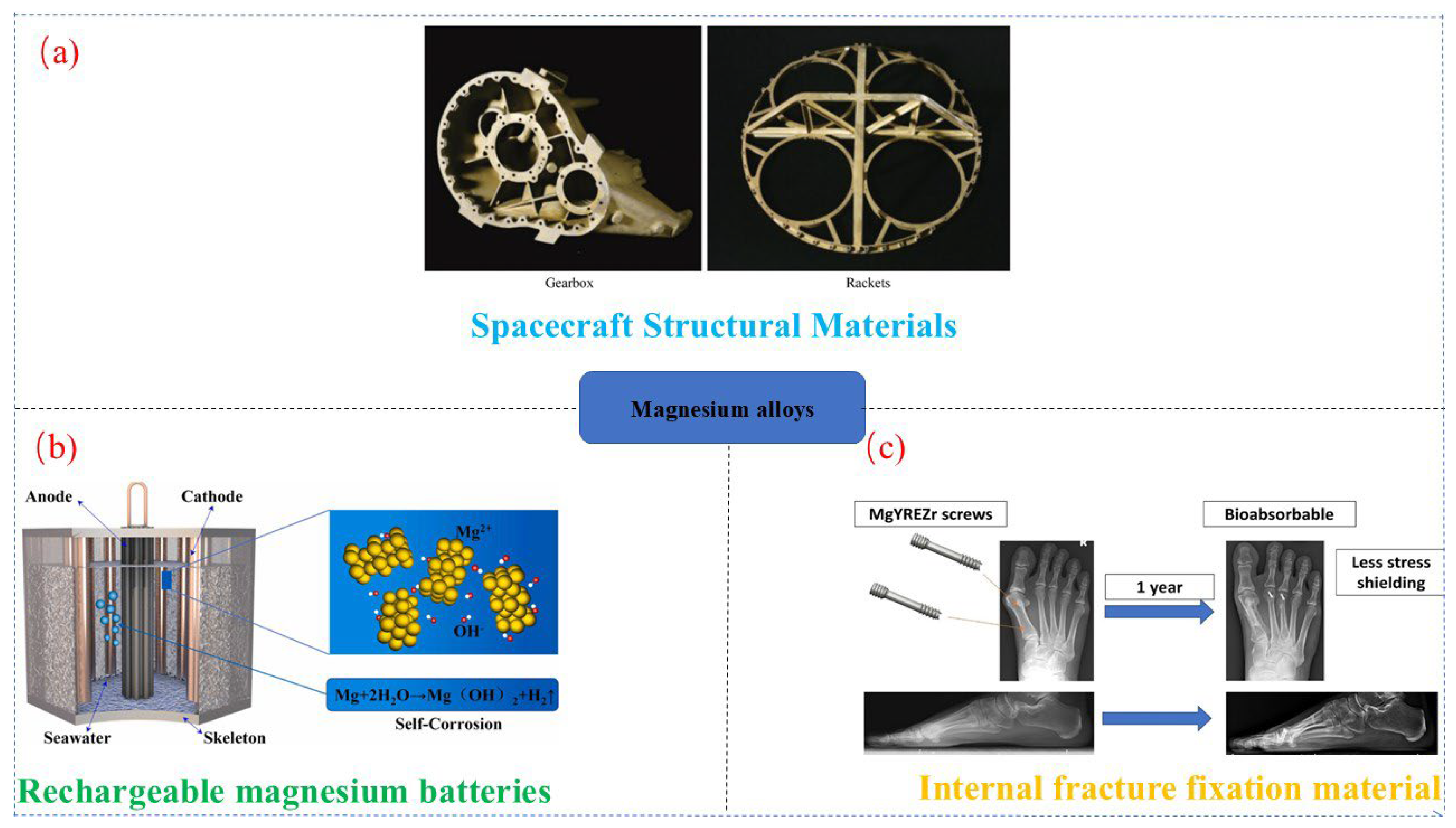
Figure 2.
Results from potentiodynamic polarisation in 0.1 M NaCl (pH =6) for pure Mg and the binary Mg alloys produced herein containing group 14 and 15 element additions. Legend provides nominal alloy compositions in ωt. %.[45].
Figure 2.
Results from potentiodynamic polarisation in 0.1 M NaCl (pH =6) for pure Mg and the binary Mg alloys produced herein containing group 14 and 15 element additions. Legend provides nominal alloy compositions in ωt. %.[45].
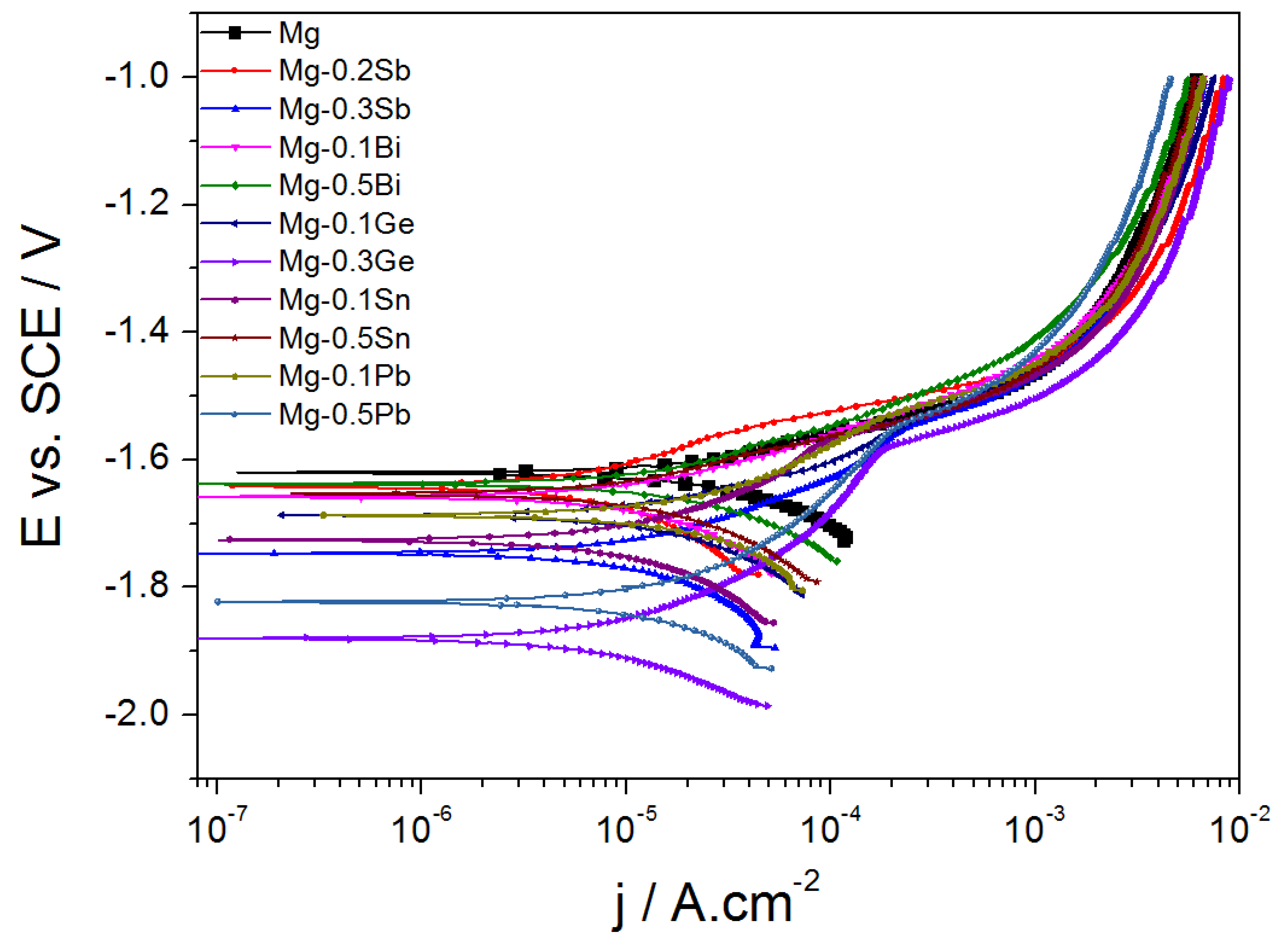
Figure 3.
(a) Schematic diagram of MAO equipment.[73] (b) Voltage curve of MAO process over time.[74, 75] (c) Schematic diagram of the mechanism of MAO of Mg alloys.
Figure 3.
(a) Schematic diagram of MAO equipment.[73] (b) Voltage curve of MAO process over time.[74, 75] (c) Schematic diagram of the mechanism of MAO of Mg alloys.
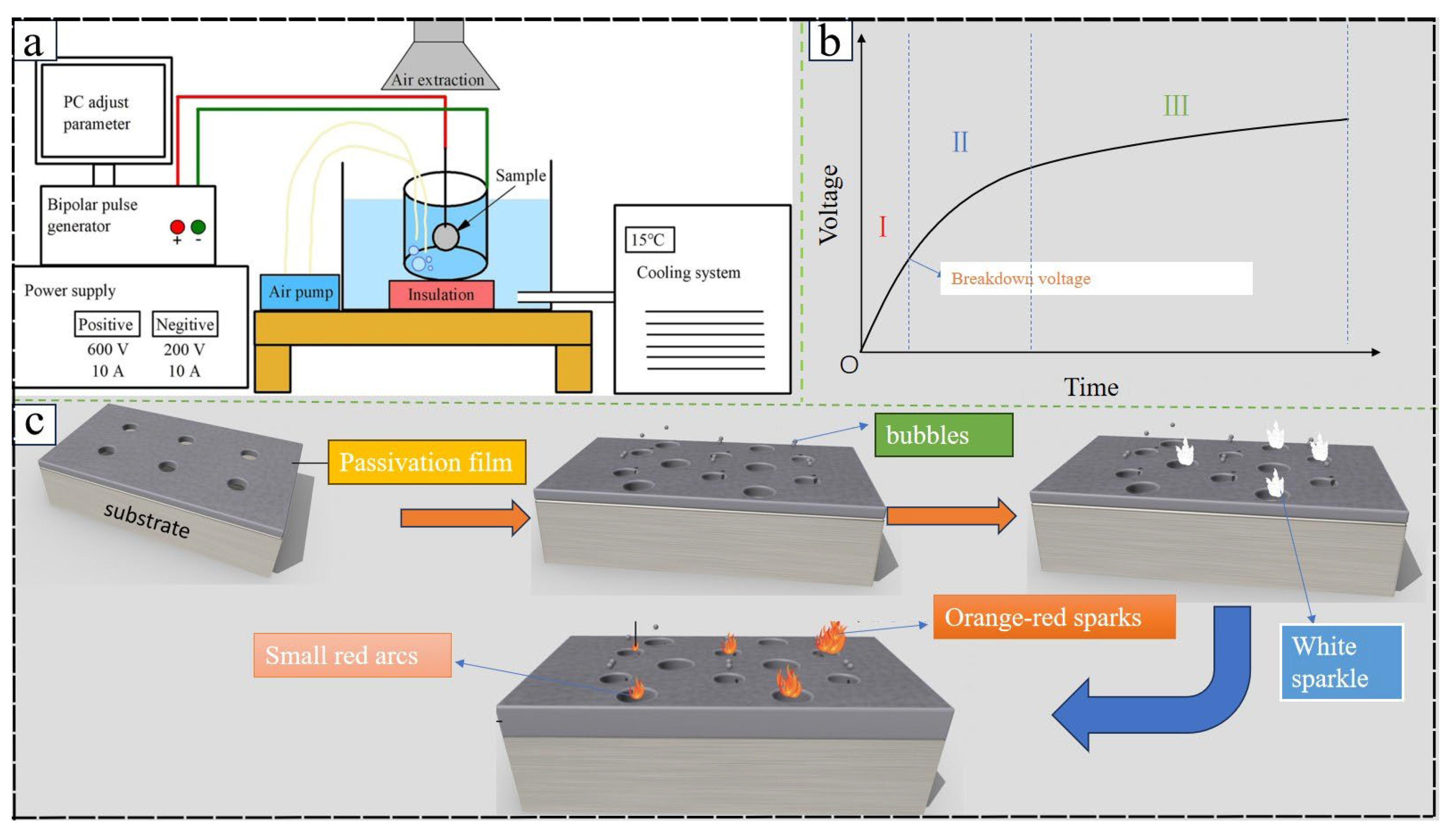
Figure 4.
SEM images of sample surfaces a PEO-coated WE43 specimen[65].
Figure 4.
SEM images of sample surfaces a PEO-coated WE43 specimen[65].
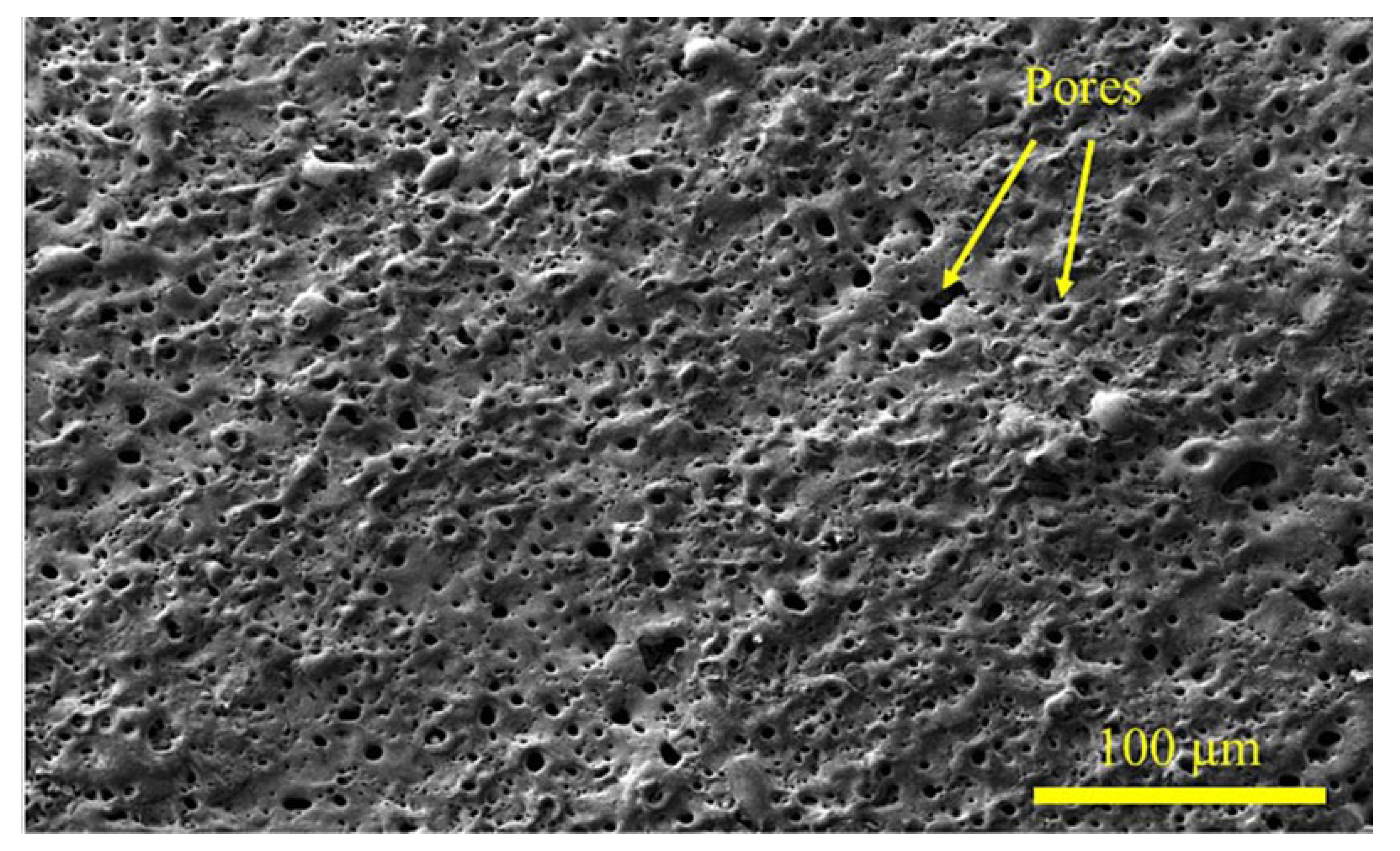
Figure 5.
Influence factors on quality of MAO coating of Mg alloy.
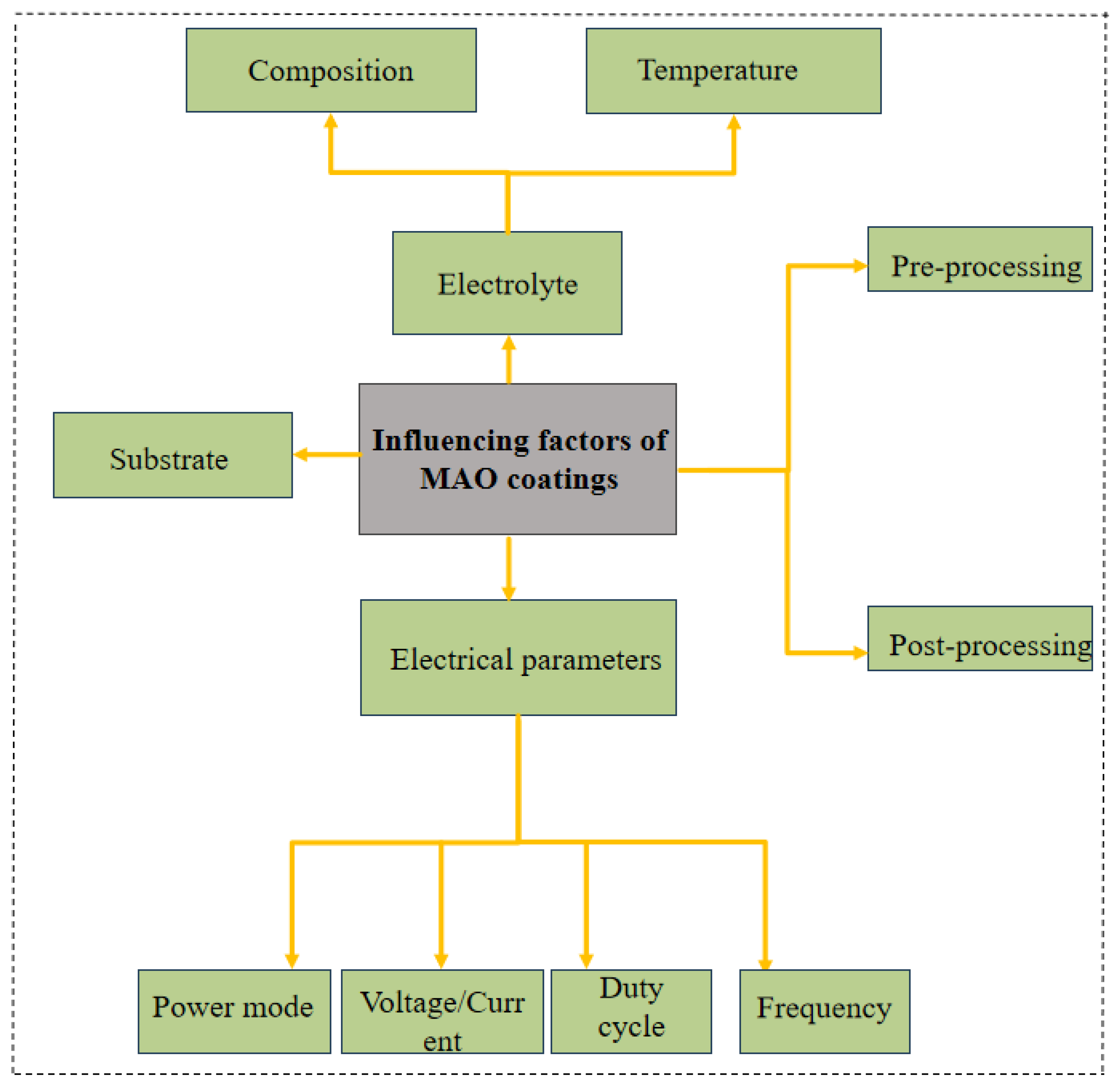
Figure 6.
Equipment and schematic diagrams for several common pre-processing methods: (a) schematic diagram of SP process and the Results [103, 104]; (b) Schematic diagram of MS apparatus and Its operational performance [105].
Figure 6.
Equipment and schematic diagrams for several common pre-processing methods: (a) schematic diagram of SP process and the Results [103, 104]; (b) Schematic diagram of MS apparatus and Its operational performance [105].
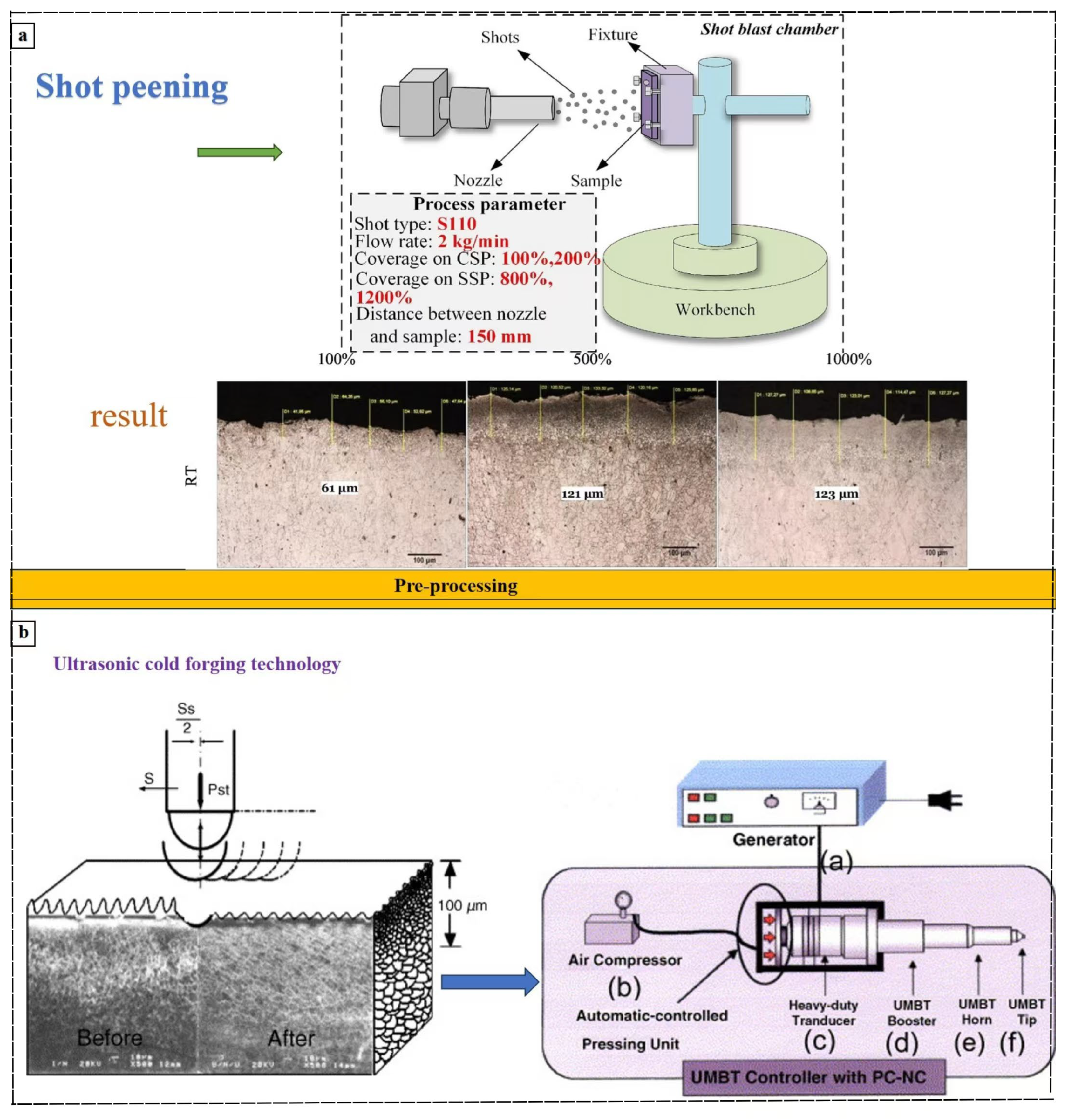
Figure 7.
Schematic view of the LSP experimental setup[115].
Figure 7.
Schematic view of the LSP experimental setup[115].
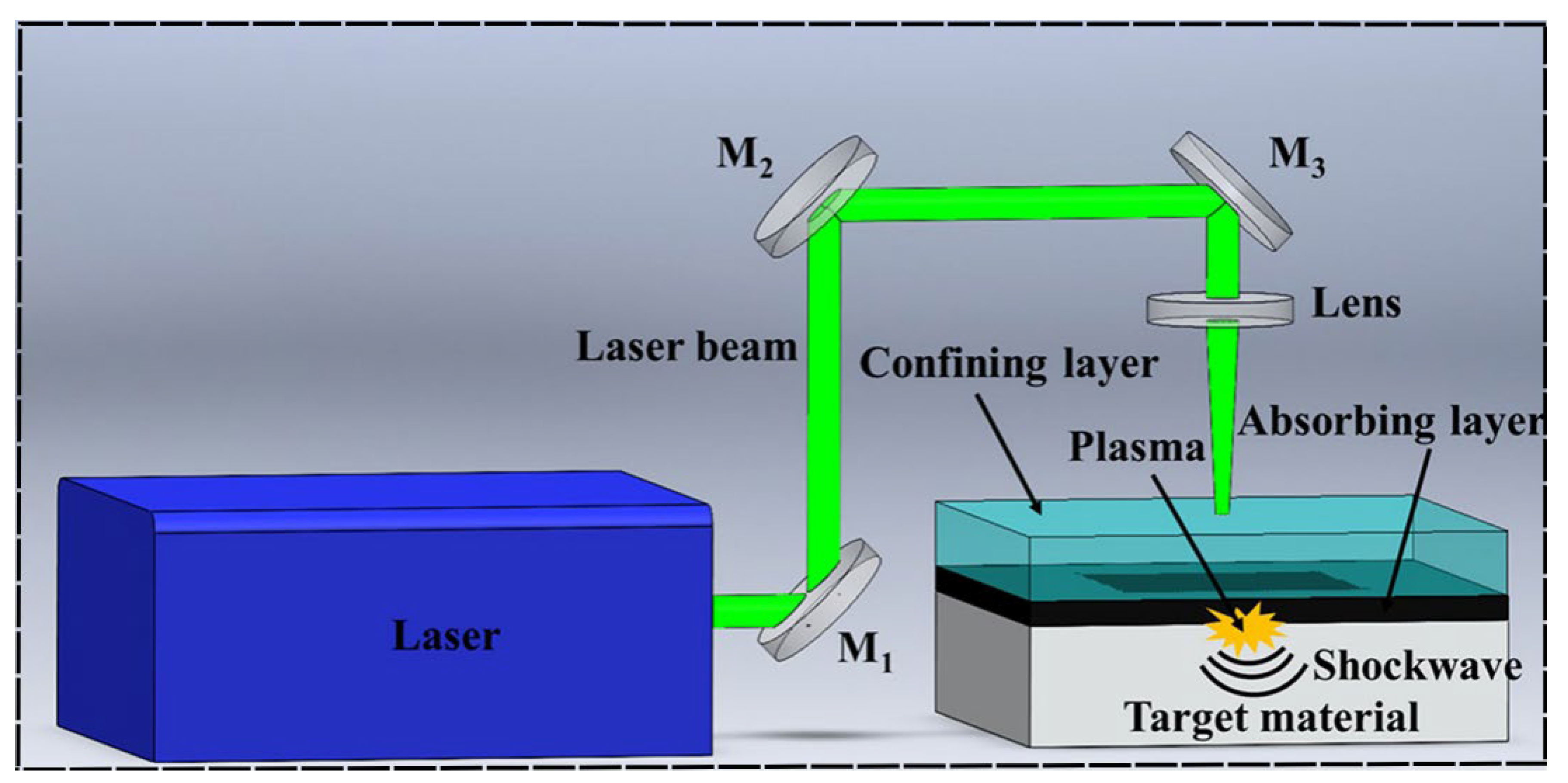
Figure 8.
Cross-sectional SEM micrographs of (a) MAO and (b) LSM–MAO treated specimens. [109].
Figure 8.
Cross-sectional SEM micrographs of (a) MAO and (b) LSM–MAO treated specimens. [109].
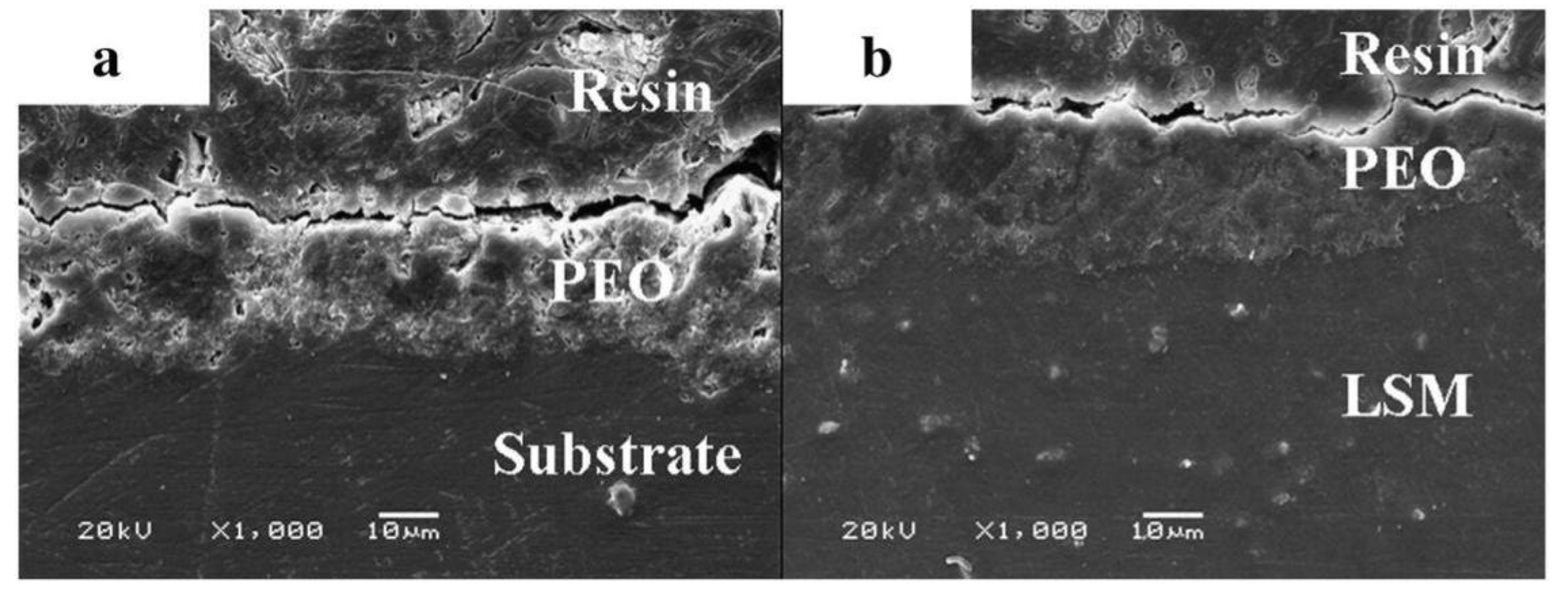
Figure 9.
Schematic view of the MS experimental setup. [117].
Figure 9.
Schematic view of the MS experimental setup. [117].
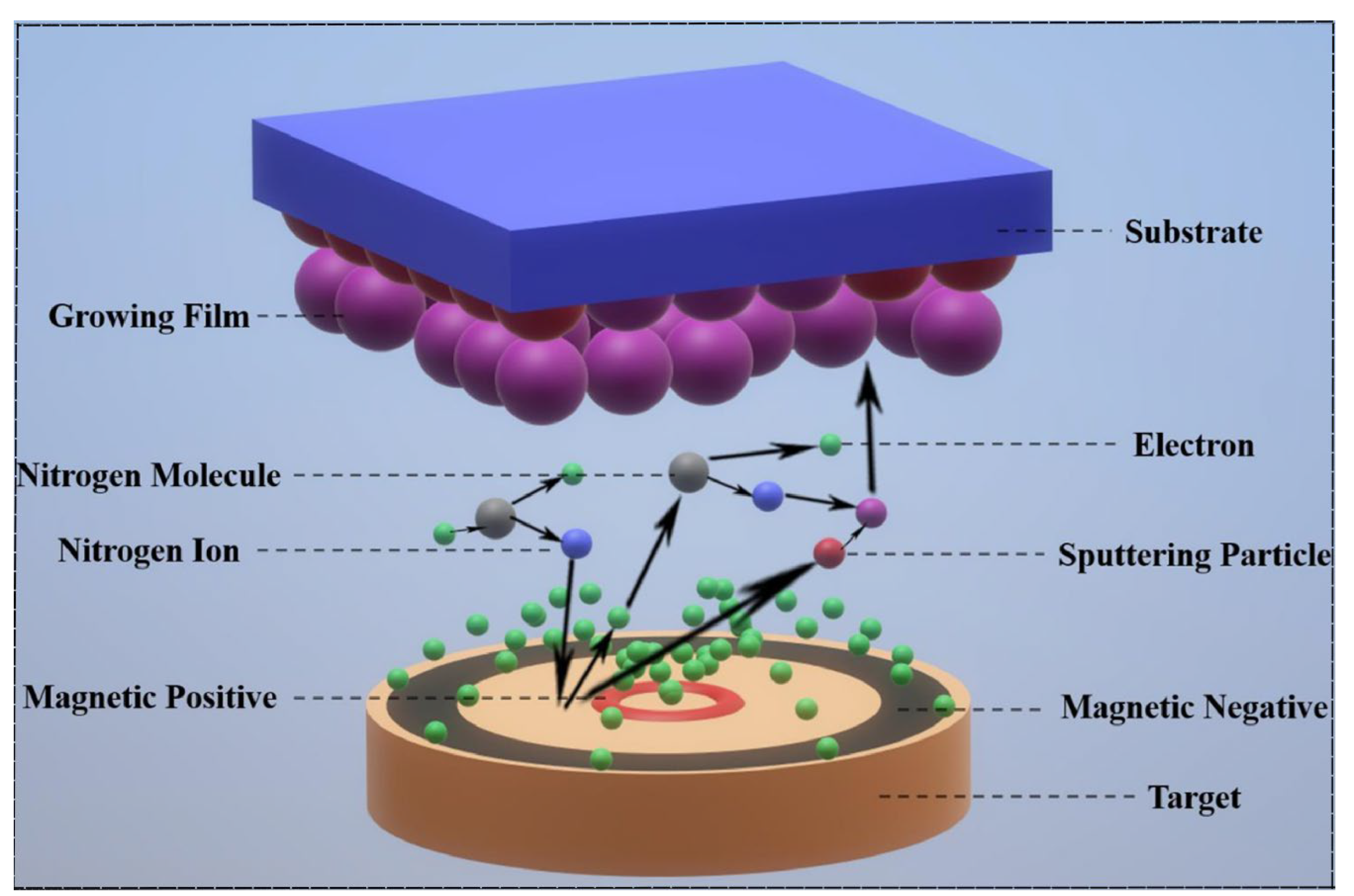
Figure 10.
Principle diagram of CS process.[119].
Figure 10.
Principle diagram of CS process.[119].
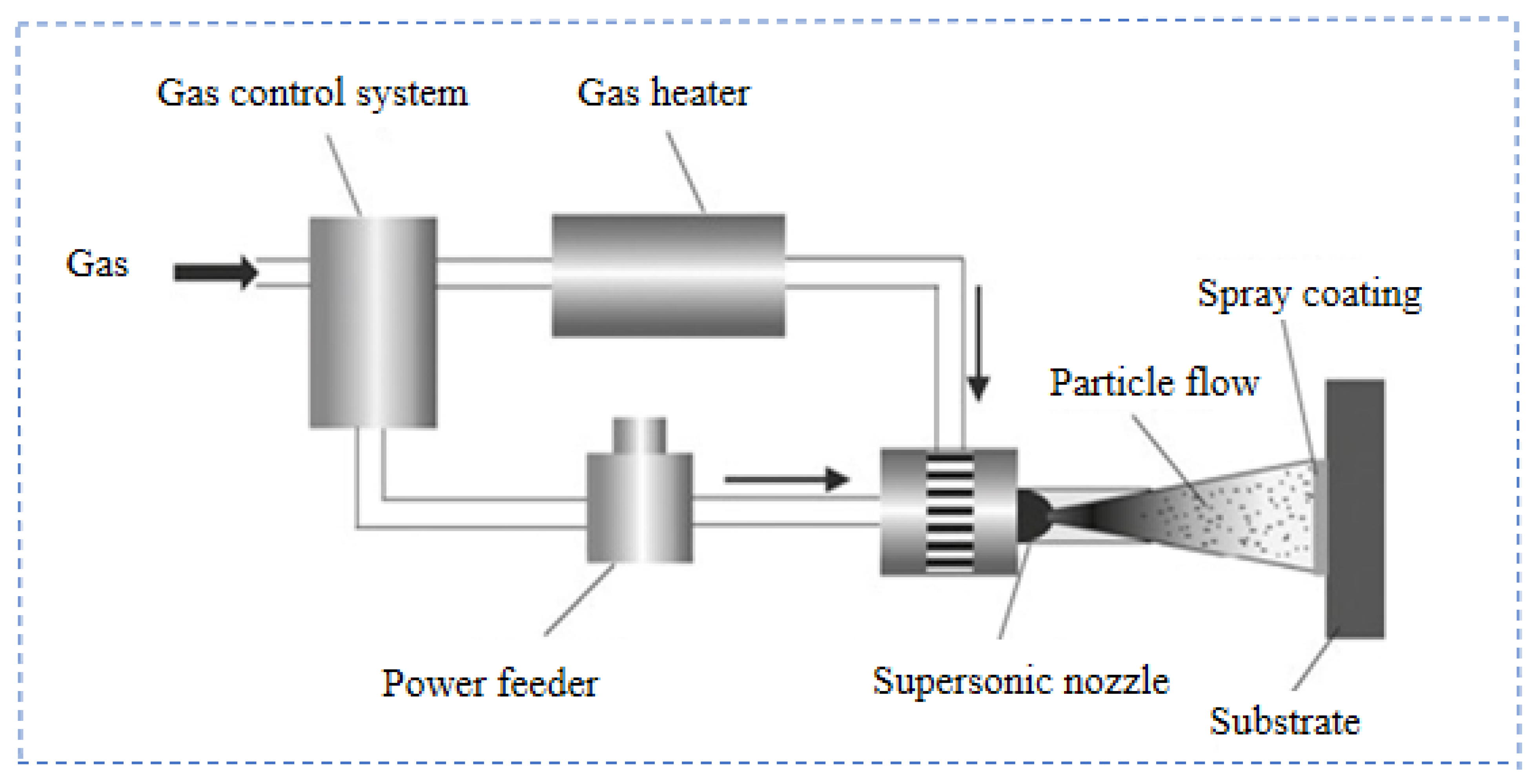
Figure 11.
Cross-sectional schematics of the corrosion process in chloride solution: (a) AR-MAO sample; (b) AR-CS-MAO sample; (c)The XRD patterns of CS, and MAO coatings[101].
Figure 11.
Cross-sectional schematics of the corrosion process in chloride solution: (a) AR-MAO sample; (b) AR-CS-MAO sample; (c)The XRD patterns of CS, and MAO coatings[101].
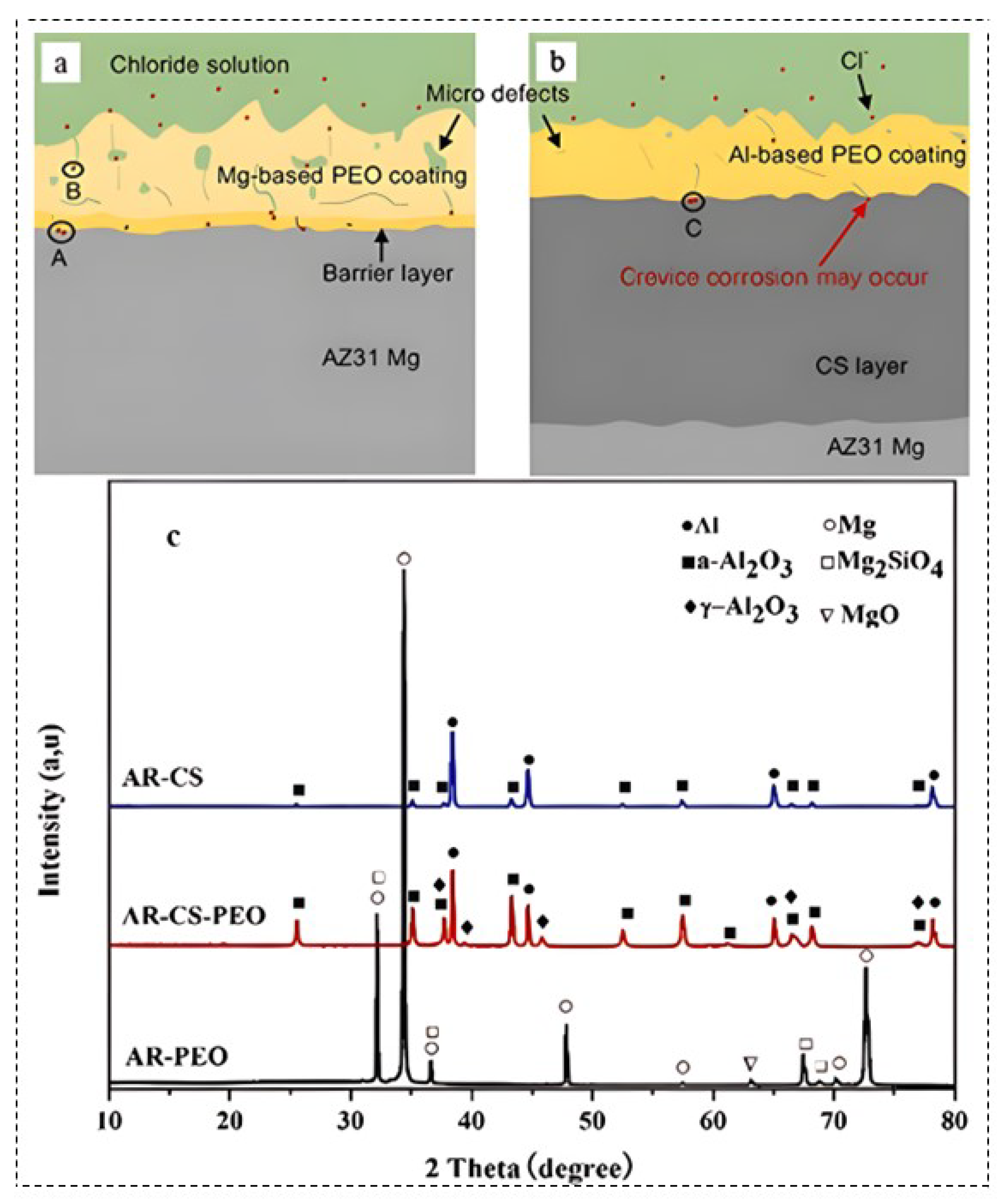
Figure 12.
(a)Grain size of the sample treated by UCFT, (b) micro-hardness variation along the depth[107].
Figure 12.
(a)Grain size of the sample treated by UCFT, (b) micro-hardness variation along the depth[107].
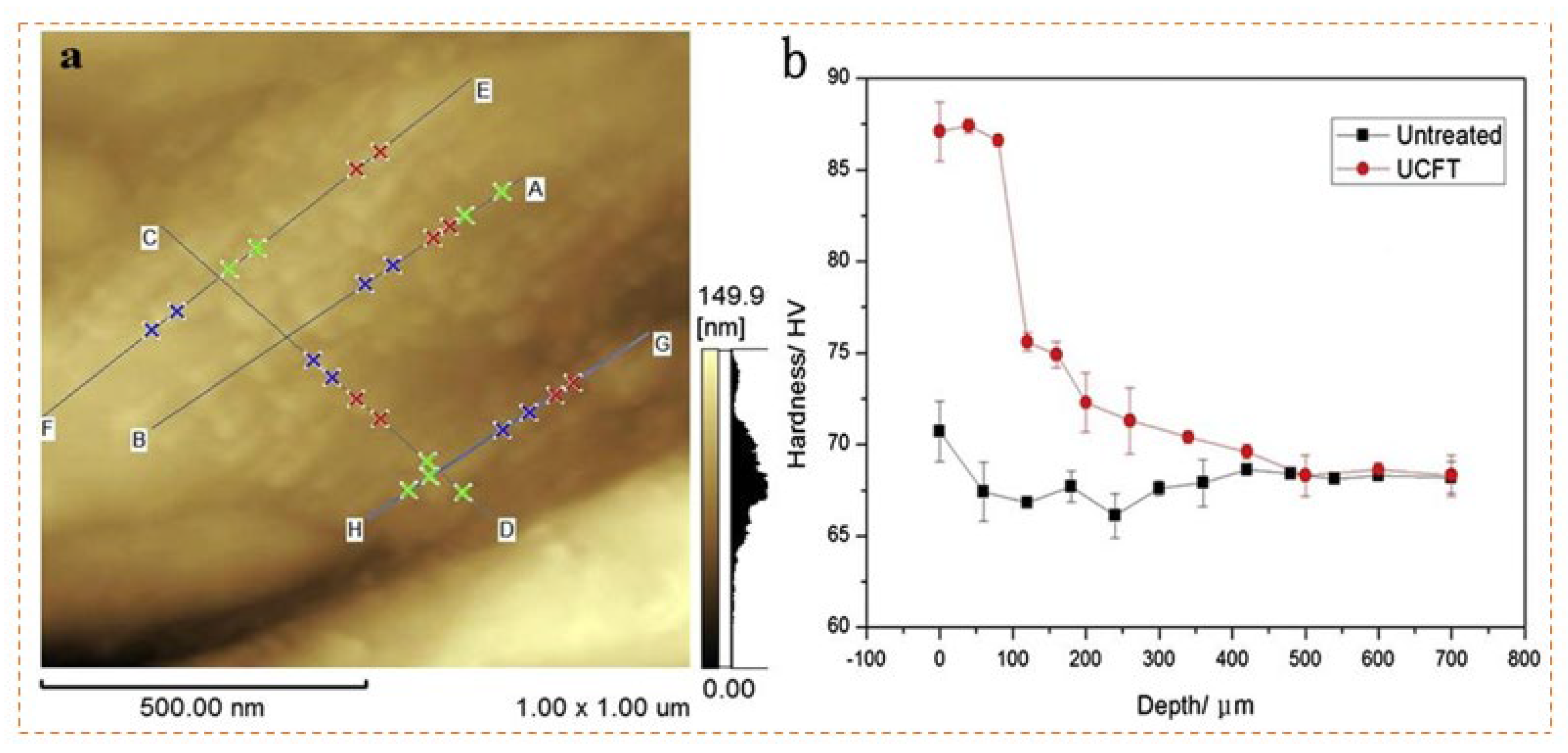
Figure 13.
Schematic diagram of post-processing operation for MAO of Mg alloy.(a) Sol-gel[146].(b) EPD.[147](c) Air plasma spray[148].(d) HT[149].
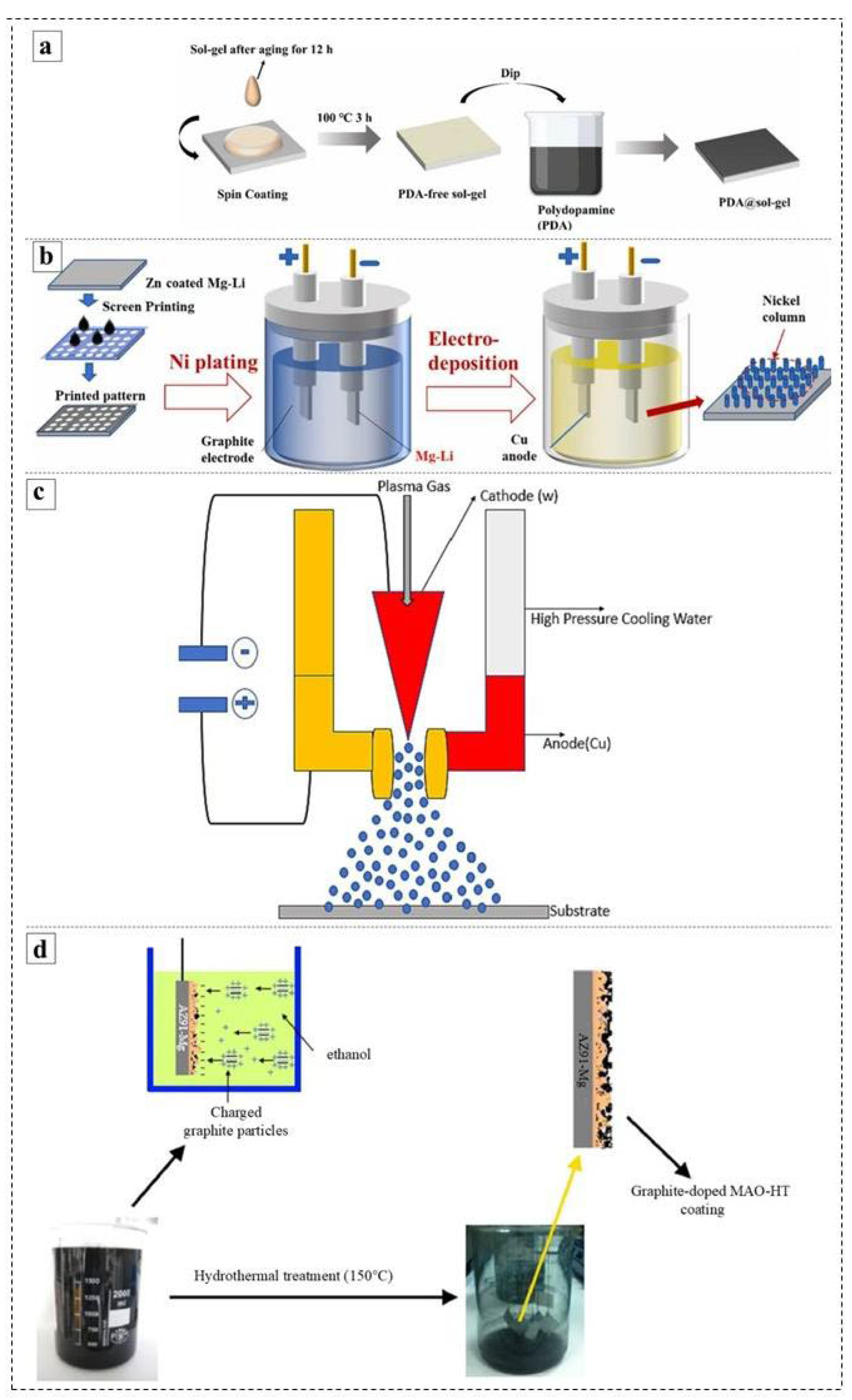
Figure 14.
Schematic diagram of the sealing process for (a) P-MAO; (b) Mg-P-MAO; (c) Ca-P-MAO; (d) Mn-P-MAO; (e) Zn-P-MAO[124].
Figure 14.
Schematic diagram of the sealing process for (a) P-MAO; (b) Mg-P-MAO; (c) Ca-P-MAO; (d) Mn-P-MAO; (e) Zn-P-MAO[124].
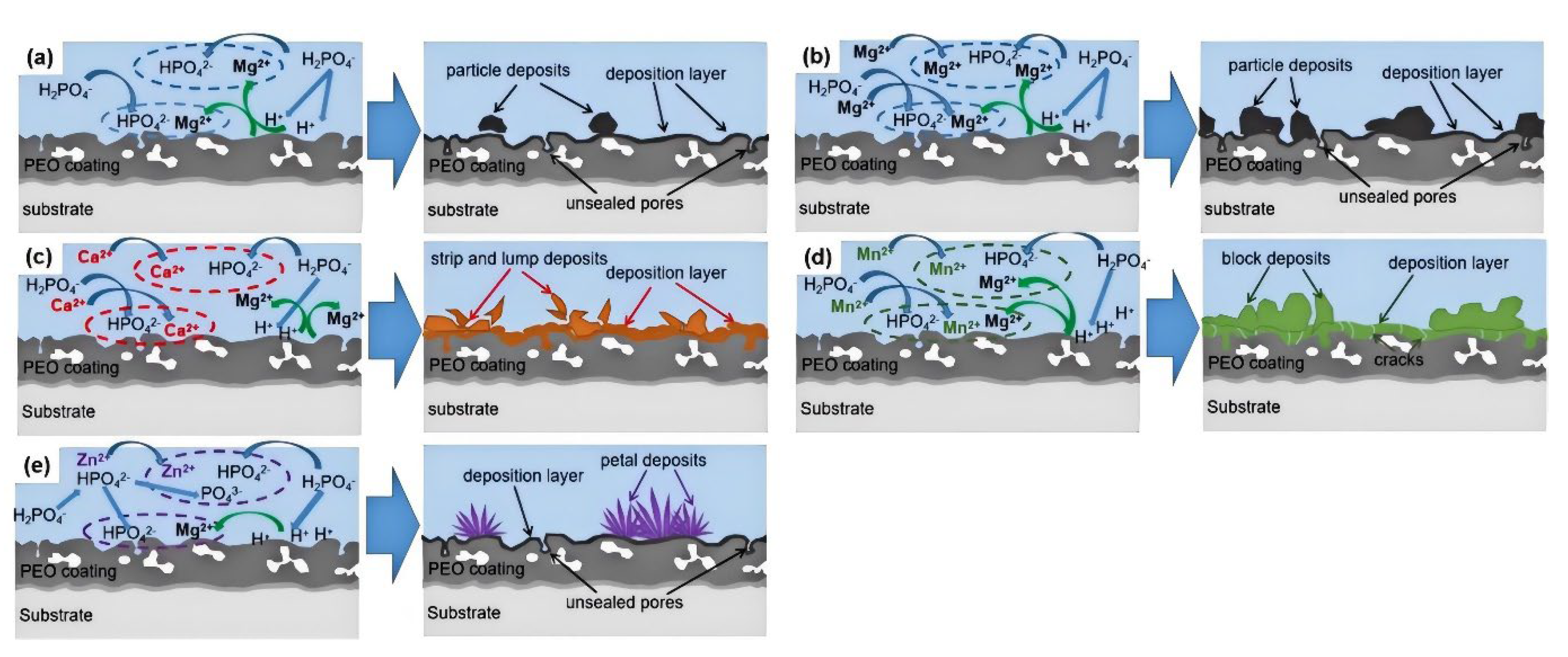
Figure 15.
Cross-sectional SEM images and corresponding elemental distribution maps of the MAO-(SA + Ce) composite[132].
Figure 15.
Cross-sectional SEM images and corresponding elemental distribution maps of the MAO-(SA + Ce) composite[132].
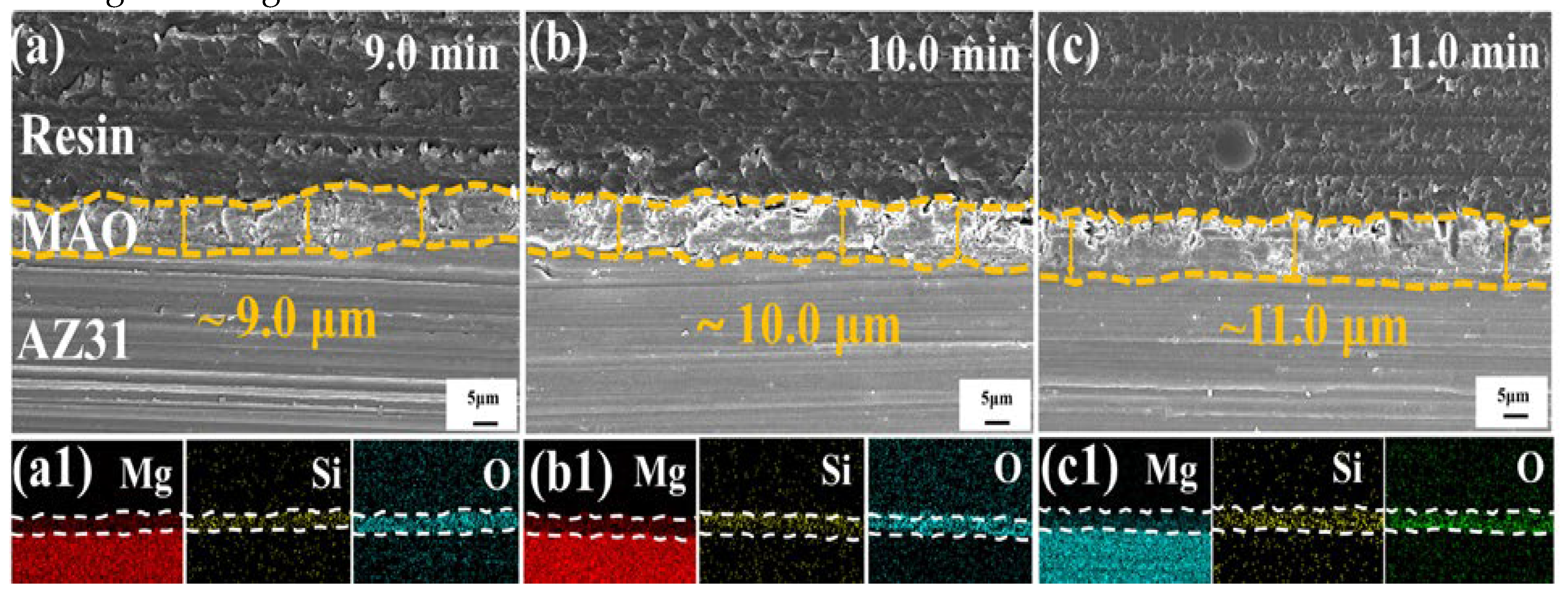

Table 1.
Corrosion current density and corrosion potential of untreated substrates and MAO coatings.
Table 1.
Corrosion current density and corrosion potential of untreated substrates and MAO coatings.
| Substrate | Electrolyte | Electrical parameters | Substrate | MAO | Ref. | |||
|---|---|---|---|---|---|---|---|---|
| Ecorr/V | Icorr(μA/cm2) | Ecorr/V | Icorr(μA/cm2) | |||||
| AZ31 | 12g/L Na3PO4∙12H2O +6g/LNaOH |
Voltage:400 V Duty cycle: 10% Frequency:100 Hz Oxidation time:600 s |
-1.57 | 151 | -1.51 | 0.017 | [76] | |
| AZ31 | 15 g/L Na2SiO3 +5 g/LKF | Voltage:430V Oxidation time:15min Temperature:20℃ |
-1.48 | 3.77 | -1.42 | 0.031 | [77] | |
| AZ31 | 10g/L Na2SiO3; 4 g/L NaOH; 5 g/L NaF 5g/L的(NaPO3)6 |
Voltage:400 V; frequency:1000 Hz; duty cycle:10%, temperature: 20 - 40 ℃, time 10 min |
-1.21 | 26.72 | -1.425 | 0.034 | [78] | |
| AZ31 | 0.04M Na2SiO3· H2O, 0.1 M KOH + 0.2 M KF·2H2O. |
Current density:50 mA/cm2 frequency:300 Hz duty cycle:10% time:15 min. |
-1.51 | 14.02 | -1.64 | 0.047 | [79] | |
| AZ31 | 3g/L Na3PO4⋅12H2O +3g/LKOH +2g/LZnO +3g/LHA | Current density:300mA/m2 Time:7 min frequency:1000 Hz duty cycle:50% |
-1.54 | 7.034 | -1.156 | 0.034 | [72] | |
| AZ91D | 25g/L Na2SiO3.9H2O + 20g/L KOH + 5g/L KF. 2H2O + 5g/L C6H5Na3O7 . 2H2O + 10mL/L+5g/L Y2O3 C3H8O3, PH=14 |
Current density:50mA/cm2, the duty cycle :10%, the frequency: 300Hz, the temperature :20 and 30℃ |
-1.55 | 37 | -1.391 | 0.053 | [80] | |
| ZK61 | 20 g·L-1 (NaPO3)6 +3 g·L-1 NaOH+5 g·L-1 EDTA-2Na, and 5 g·L-1 NaF |
current density = 5A·dm-2, frequency = 200 Hz, duty cycle = 15%, discharge time = 10 min |
-1.53 | 112.1 | -1.482 | 6.327 | [81] | |
Table 2.
Corrosion potential and current of Mg alloy MAO coating under different pre-processing methods.
Table 2.
Corrosion potential and current of Mg alloy MAO coating under different pre-processing methods.
| Substrate | MAO Film Composition |
MAO coatings | Pre-processing Method |
MAO coatings with Pre-processing | Ref. | ||
|---|---|---|---|---|---|---|---|
|
Ecorr (V) |
Icorr (A/cm2) |
Ecorr (V) |
Icorr (A/cm2) |
||||
| AZ31 | CS | -1.15 | 5.18×10⁻⁷ | [101] | |||
| AZ31 | -1.611 | 7.11×10⁻⁷ | SP | -1.62 | 2.14×10⁻⁷ | [106] | |
| AZ31 | MS | -1.46 | 1.552×10⁻⁶ | [99] | |||
| AZ31 | MS | -1.25 | 3.93×10⁻⁶ | [100] | |||
| AZ31B | Mg, Mg3(PO4) 2, TCP (tricalcium phosphate–whitlockite, Ca3(PO4)2), DCPD (calcium phosphate dehydrate–brushite, CaHPO4·2H2O), HA (hydroxyapatite, Ca10(PO4)6(OH)2), MgO and MgAl2O4 |
-1.415 | 18.6×10⁻⁶ | UCFT | -1.31 | 9.20×10⁻⁶ | [107] |
| AZ31 | Mg, Mg2SiO4 | -0.395 | 0.34×10⁻⁶ | CCP | -0.25 | 1.18×10⁻⁹ | [108] |
| AZ91D | MgO, Mg3(PO 4)2 MgAl2O4 | -0.148 | 6.4×10⁻⁸ | LSP | -1.47 | 5.00×10⁻⁹ | [109] |
| AZ91 |
LSP |
-1.39 | 4.22×10⁻⁷ | [110] | |||
| Mg alloy | LSM | -1.49 | 8.24×10⁻⁷ | [111] | |||
| Mg alloy | LSM | -1.51 | 8.91×10⁻⁷ | [111] | |||
Table 3.
Corrosion potential and corrosion current density of Mg alloy MAO coatings under different post-processing methods.
Table 3.
Corrosion potential and corrosion current density of Mg alloy MAO coatings under different post-processing methods.
| Substrate | MAO Film Composition |
MAO coatings | Pre-processing Method |
MAO coatings with Post-processing | Ref. | ||
|---|---|---|---|---|---|---|---|
|
Ecorr (V) |
Icorr (A/cm2) |
Ecorr (V) |
Icorr (A/cm2) |
||||
| Mg | Mg, MgO, Mg2SiO4 | 1.349 | 7.72 × 10− 7 | Impregnation | -1.29 | 5.87×10⁻⁸ | [124] |
| AZ31 | Mg3(PO4)2, MgO Mg | Impregnation | -0.69 | 6.72×10⁻⁶ | [150] | ||
| AZ31 | Mg, MgO | 2.47 ×10⁻⁶ | Impregnation | 9.28×10⁻⁸ | [151] | ||
| AZ91D | Mg, Mg2SiO4, MgO | -1.32 | 5.72×10⁻⁷ | Impregnation | -1.31 | 3.34×10⁻⁸ | [126] |
| LPSO Mg-Y-Zn | Mg MgO | -1.61 | 7.1×10⁻⁸ | Impregnation | -1.2 | 2×10⁻⁹ | [127] |
| cp-Mg | Mg MgO Mg2SiO4 | -1.59 | 1.4×10⁻⁵ | Impregnation | -1.61 | 3.7×10⁻⁶ | [130] |
| AZ31 | -1.38 | 1.259×10⁻⁶ | Impregnation | -1.36 | 1.34×10⁻⁷ | [131] | |
| AZ31B | -1.44 | 3.9×10⁻⁷ | Impregnation | -1.32 | 1.81×10⁻⁸ | [135] | |
| MA8 | -1.51 | 8.1×10⁻⁷ | Impregnation | -1.44 | 8.6×10⁻⁸ | [136] | |
| AZ31 | -0.66 | 2.33×10⁻⁶ | Impregnation | -0.59 | 8.95×10⁻¹⁰ | [136] | |
| AZ31B | MgO, Mg3(PO4)2, Mg(OH)2, Al12Mg17, Mg |
-1.60 | 3.53×10⁻⁸ | HT | -1.35 | 1.27×10⁻⁸ | [152] |
| AZ31 | Mg3(PO4)2 Mg MgO | HT | 2.98×10⁻¹⁰ | [144] | |||
| AZ31 | MgAl2O4 Mg | -1.29 | 7.62×10⁻⁸ | HT | -1.33 | 1.97×10⁻⁹ | [145] |
| AZ31 | Mg MgO | -1.33 | 1.54×10⁻⁶ |
Sol- gel |
-1.09 | 1.05×10⁻⁷ | [140] |
| Mg3(PO4)2 Mg MgO | -1.75 | 6.17×10⁻⁶ | EPD | -1.42 | 4×10⁻⁸ | [59] | |
| AZ91 | Mg MgO Mg3(PO4)2 | -1.54 | 9.86×10⁻⁶ | EPD | -0.87 | 1.75×10⁻⁷ | [142] |
| Mg-Li | -1.38 | 5.64×10⁻⁷ | Sol- gel | -1.38 | 5.64×10⁻⁷ | [153] | |
| AM50B | Periclase (MgO) Snipel MgAl2O4 Mg |
Sol- gel | -1.39 | 6.57×10⁻⁹ | [154] | ||
Disclaimer/Publisher’s Note: The statements, opinions and data contained in all publications are solely those of the individual author(s) and contributor(s) and not of MDPI and/or the editor(s). MDPI and/or the editor(s) disclaim responsibility for any injury to people or property resulting from any ideas, methods, instructions or products referred to in the content. |
© 2024 by the authors. Licensee MDPI, Basel, Switzerland. This article is an open access article distributed under the terms and conditions of the Creative Commons Attribution (CC BY) license (http://creativecommons.org/licenses/by/4.0/).
Copyright: This open access article is published under a Creative Commons CC BY 4.0 license, which permit the free download, distribution, and reuse, provided that the author and preprint are cited in any reuse.


