
Submitted:
26 November 2024
Posted:
27 November 2024
You are already at the latest version
Abstract
Recently published academic paper, small pieces of plastic (microplastics and nanoplastics) are generated from the fragmentation of larger plastic pieces, synthetic fibers from clothing, and microbeads used in consumer products. Additionally, microplastics and nanoplastics are emerging as significant issues as they act as sources of exposure in drinking water and food. Recent studies suggest that microplastics and nanoplastics can cross the blood-brain barrier (BBB), potentially affecting protein folding at the molecular level and inducing the formation of abnormal amyloid proteins, which may lead to the development of systemic and localized amyloidosis. However, the association with transport proteins is still under investigation. This study investigates the effects of polystyrene nanoplastics 50 nm (PSNP) exposure after 24 hours 100, 200 ㎍/ml on the expression of LRP1, RAGE, and P-gp in the BBB and BCB cells. Our findings indicate that PSNP (50 nm) treatment 200 ug/mL significantly increases P-gp protein expression to Z310 cells in a concentration-dependent manner. To RBE4 cells, P-gp expression also increased with PSNP treatment, although the increase was not statistically significant. These results suggest that PSNP exposure may influence Aβ transport mechanisms, potentially impacting AD progression.
Keywords:
1. Introduction
2. Materials and Methods
2.1. Polystyrene Microplastics
2.2. Cell Culture
RBE4 Cell
Z310 Cell
2.3. Treatment PSNP
2.4. Cell Viability
2.5. Western Blot
2.6. Statistics
3. Results
3.1. Characterization of the PSNPs 50 nm
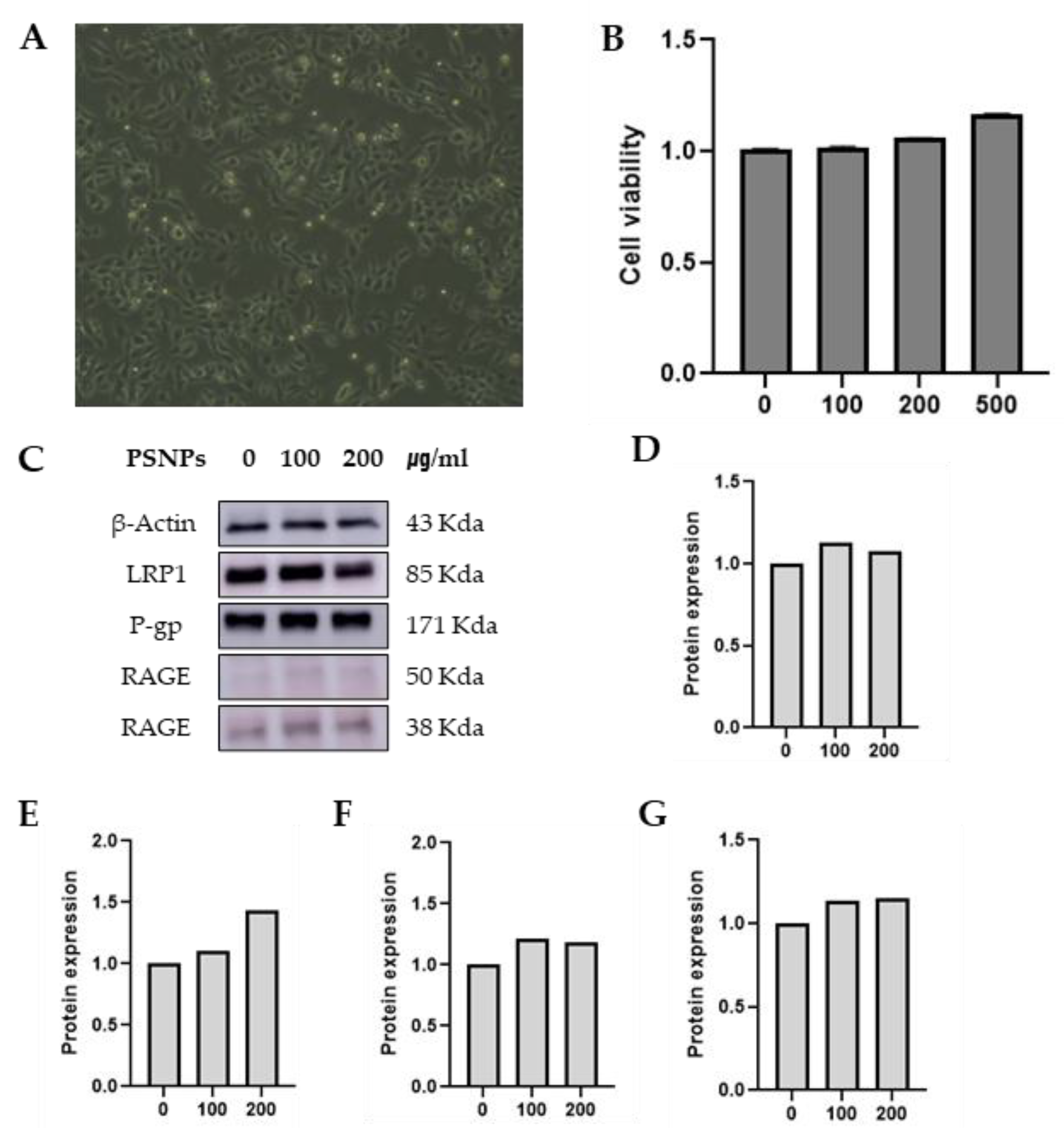
3.2. Viability of the RBE4 Cells with Treatment PSNP
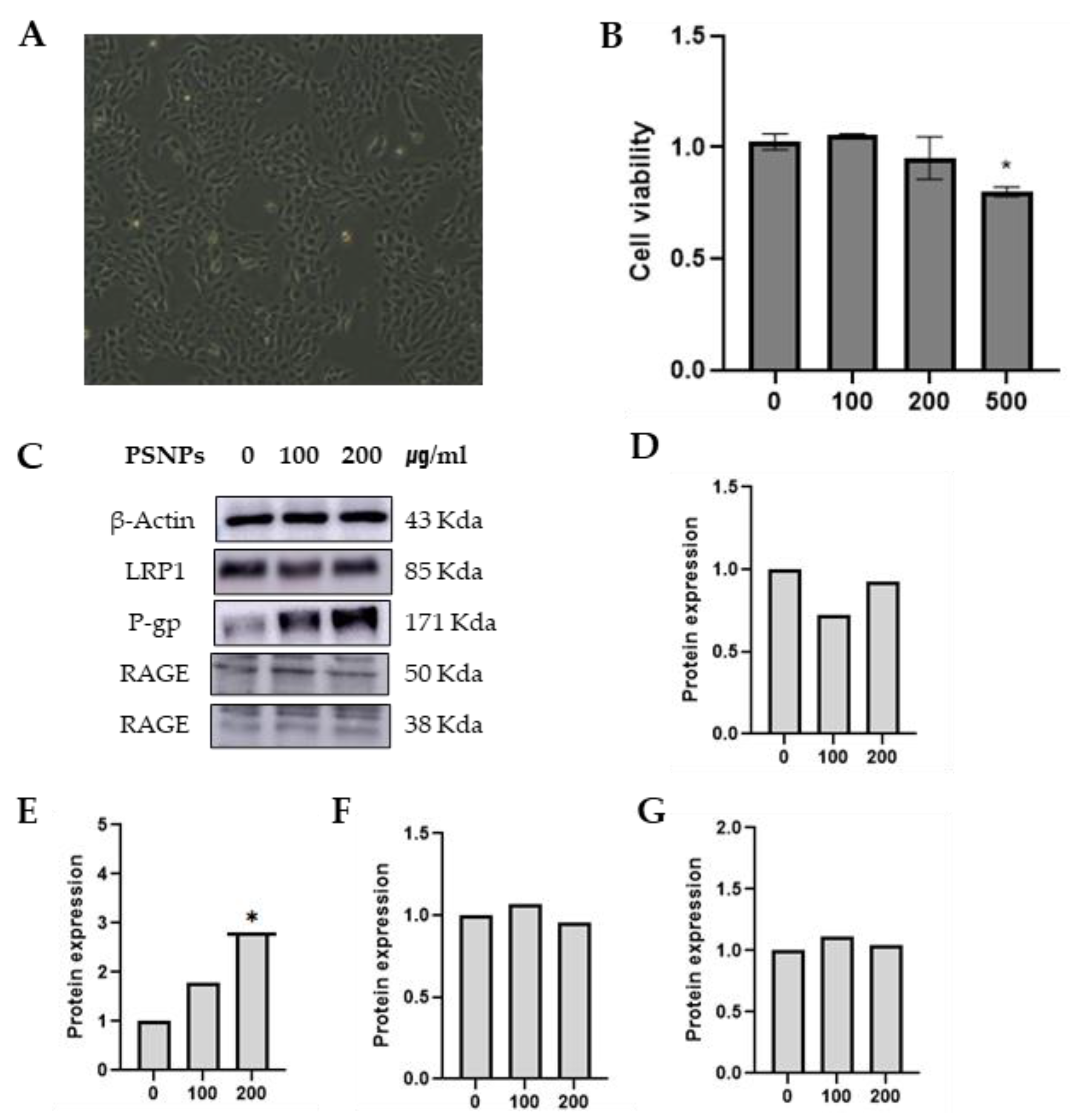
3.3. Viability of the Z310 cells with Treatment PSNP
3.4. Effects of Membrane Transport Protein Expression of RBE4 Cells with PSNP
3.5. Effects of Membrane Transport Protein Expression of Z310 Cells with PSNP
4. Discussion
RAGE (Receptor for Advanced Glycation Endproducts)
Supplementary Materials
Author Contributions
Funding
Institutional Review Board Statement
Informed Consent Statement
Acknowledgments
Conflicts of Interest
References
- Kik, Kinga, Bożena Bukowska, and Paulina Sicińska. “Polystyrene nanoparticles: Sources, occurrence in the environment, distribution in tissues, accumulation and toxicity to various organisms.” Environmental Pollution 262 (2020): (p. 114297).
- Vethaak, A. Dick, and Juliette Legler. “Microplastics and human health.” Science 371.6530 (2021): (p. 672-674).
- Nguyen, Brian, et al. “Separation and analysis of microplastics and nanoplastics in complex environmental samples.” Accounts of chemical research 52.4 (2019): (p. 858-866).
- Jabbar, Abdullah Hasan, et al. “Green Synthesis of Silver/Polystyrene Nano Composite (Ag/PS NCs) via Plant Extracts Beginning a New Era in Drug Delivery.” Indian J. Sci. Technol 11.22 (2018): (p. 1-9).
- Rahman, Md Ataur, et al. “Exposure to environmental arsenic and emerging risk of Alzheimer’s Disease: Perspective mechanisms, management strategy, and future directions.” Toxics 9.8 (2021): (p. 188).
- Li, Chao, et al. “Inhibiting ferroptosis in brain microvascular endothelial cells: A potential strategy to mitigate polystyrene Nanoplastics‒Induced blood‒Brain barrier dysfunction.” Environmental Research (2024): (p. 118506).
- Jedlitschky, G., S. Vogelgesang, and H. K. Kroemer. “MDR1–P-glycoprotein (ABCB1)-Mediated Disposition of Amyloid-β Peptides: Implications for the Pathogenesis and Therapy of Alzheimer’s Disease.” Clinical Pharmacology & Therapeutics 88.4 (2010): 441-443.
- Chai, Amanda B., et al. “P-glycoprotein: a role in the export of amyloid-β in Alzheimer’s disease?.” The FEBS journal 287.4 (2020): (p. 612-625).
- Ucar, A.; Parlak, V.; Ozgeris, F. B.; Yeltekin, A. C.; Arslan, M. E.; Alak, G.; Turkez, H.; Kocaman, E. M.; Atamanalp, M. Magnetic nanoparticles-induced neurotoxicity and oxidative stress in brain of rainbow trout: Mitigation by ulexite through modulation of antioxidant, anti-inflammatory, and antiapoptotic activities. Sci. Total Environ. 2022, (p. 838), No. 155718.
- Tan, M. S.; Yu, J. T.; Jiang, T.; Zhu, X. C.; Tan, L. The NLRP3 inflammasome in Alzheimer’s disease. Mol. Neurobiol. 2013, 48, (p. 875− 882). [CrossRef] [PubMed]
- Calderón-Garcidueñas, L.; Solt, A. C.; Henriquez-Roldan, C.; Torres-Jardon, R.; Nuse, B.; Herritt, L.; Villarreal-Calderon, R.; Osnaya, N.; Stone, I.; Garcia, R.; Brooks, D. M.; Gonzalez-Maciel, A.; Reynoso-Robles, R.; Delgado-Chavez, R.; Reed, W. Long-term air pollution exposure is associated with neuroinflammation, an altered innate immune response, disruption of the blood-brain barrier, ultrafine particulate deposition, and accumulation of amyloid beta-42 and alpha-synuclein in children and young adults. Toxicol. Pathol. 2008, 36, (p. 289−310).
- Calderón-Garcidueñas, L.; Azzarelli, B.; Acuna, H.; Garcia, R.; Gambling, T. M.; Osnaya, N.; Monroy, S.; Del Rosario Tizapantzi, M.; Carson, J. L.; Villarreal-Calderon, A.; Rewcastle, B. Air pollution and brain damage. Toxicol. Pathol. 2002, 30, (p. 373−389) . [CrossRef]
- Calderón-Garcidueñas, L.; Maronpot, R. R.; Torres-Jardon, R.; Henriquez-Roldan, C.; Schoonhoven, R.; Acuna-Ayala, H.; VillarrealCalderon, A.; Nakamura, J.; Fernando, R.; Reed, W.; Azzarelli, B.; Swenberg, J. A. DNA damage in nasal and brain tissues of canines exposed to air pollutants is associated with evidence of chronic brain inflammation and neurodegeneration. Toxicol. Pathol. 2003, 31, (p. 524− 538). [CrossRef]
- Wang, Genghuan, Yingcong Lin, and Heping Shen. “Exposure to polystyrene microplastics promotes the progression of cognitive impairment in Alzheimer’s disease: association with induction of microglial pyroptosis.” Molecular Neurobiology 61.2 (2024): (p. 900-907).
- Xu, Jun-Li, et al. “A review of potential human health impacts of micro-and nanoplastics exposure.” Science of the Total Environment 851 (2022): (p. 158111).
- Ivleva, Natalia P. “Chemical analysis of microplastics and nanoplastics: challenges, advanced methods, and perspectives.” Chemical reviews 121.19 (2021): (p.11886-11936).
- Li, Yu, Zeqian Wang, and Baohong Guan. “Separation and identification of nanoplastics in tap water.” Environmental Research 204 (2022): (p. 112134).
- Yin, Kai, et al. “A comparative review of microplastics and nanoplastics: Toxicity hazards on digestive, reproductive and nervous system.” Science of the total environment 774 (2021): (p. 145758).
- Yang, Seonguk, et al. “Cationic nanoplastic causes mitochondrial dysfunction in neural progenitor cells and impairs hippocampal neurogenesis.” Free Radical Biology and Medicine 208 (2023): (p. 194-210).
- Windheim, Joseph, et al. “Micro-and nanoplastics’ effects on protein folding and amyloidosis.” International journal of molecular sciences 23.18 (2022): (p.10329).
- Paing, Yunn Me Me, et al. “Neurotoxic effects of polystyrene nanoplastics on memory and microglial activation: Insights from in vivo and in vitro studies.” Science of the Total Environment924 (2024): (p. 171681).
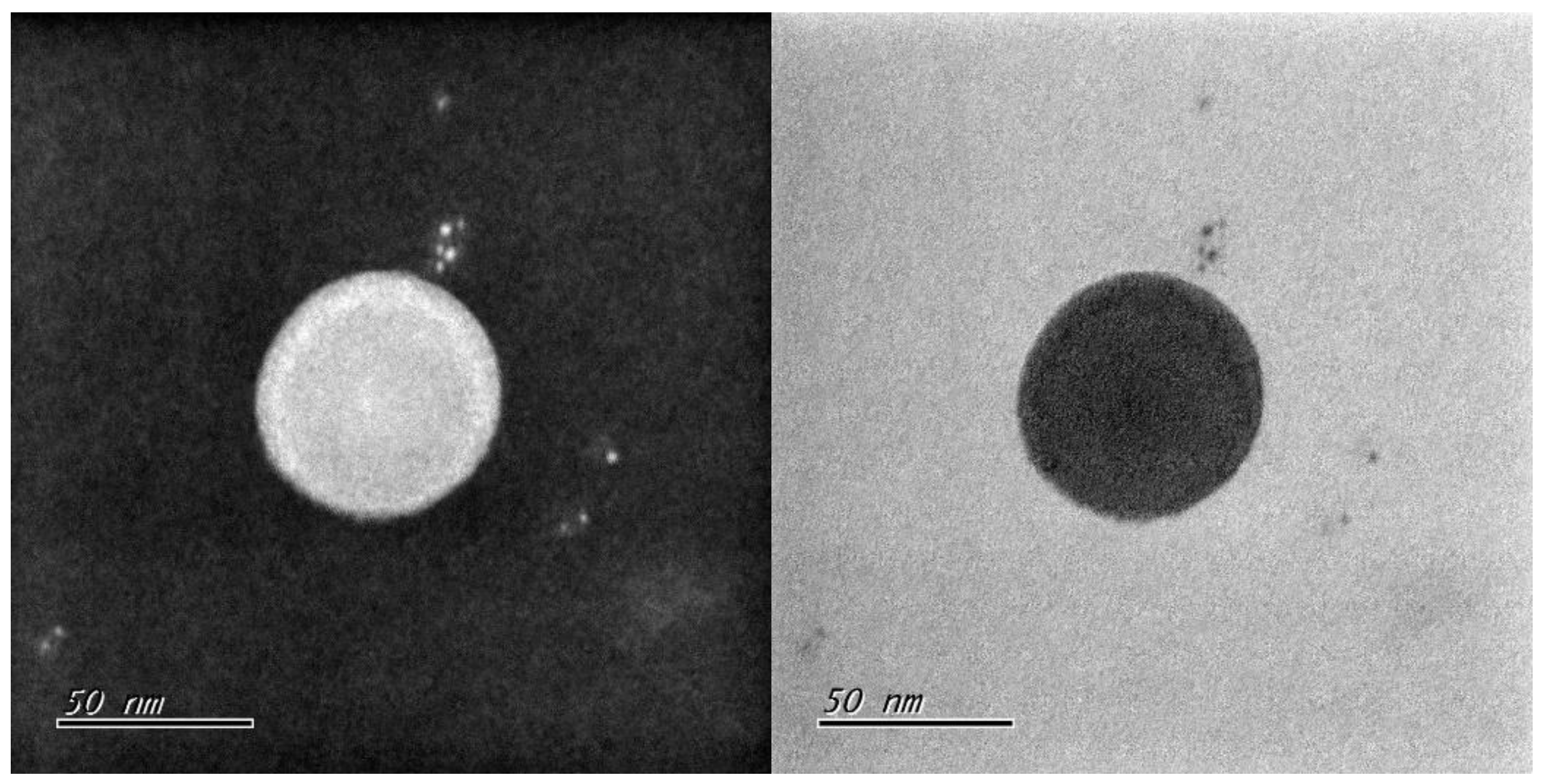

| Specification | Unit of measure | Value | Method of analysis |
|---|---|---|---|
| Certified Mean Diameter | 50 ± (3~5) | nm | Scattering principle from photometer |
| Standard Deviation | 0.5 - 5 | % | |
| Density | 1.00 | g/L | |
| Index of Refraction | 1.57 – 1.61 | - | Laser diffraction |
| Approximate Concentration | 1 | % | |
| pH | 3-7 | % | Glass electrode method |
Disclaimer/Publisher’s Note: The statements, opinions and data contained in all publications are solely those of the individual author(s) and contributor(s) and not of MDPI and/or the editor(s). MDPI and/or the editor(s) disclaim responsibility for any injury to people or property resulting from any ideas, methods, instructions or products referred to in the content. |
© 2024 by the authors. Licensee MDPI, Basel, Switzerland. This article is an open access article distributed under the terms and conditions of the Creative Commons Attribution (CC BY) license (http://creativecommons.org/licenses/by/4.0/).


