

Submitted:
20 December 2024
Posted:
24 December 2024
You are already at the latest version
Abstract
In a foundational study, dos Santos Bernardes 2024 explored how connecting points on a triangle's midsegment to its vertices forms triangles that conform to the Pythagorean theorem in both two- and three-dimensional spaces, unveiling deeper geometric relationships and extending Pythagorean principles to spatial geometry with an implicit solution. Building on this work, I present the derivation of an explicit solution, further elucidating these geometric relationships and enhancing our understanding of their spatial applications.
Keywords:
Pythagorean theorem
; three-dimensional space
; triangles
; three-dimensional geometric shape
; triangle midsegment theorem
1. Introduction
The Pythagorean theorem has long been a cornerstone of mathematical thought, underpinning numerous geometric principles in two-dimensional spaces. Recent advancements, such as the work of [1], have demonstrated that these principles can be extended to three-dimensional geometry, revealing intricate relationships between triangles formed by connecting midsegment points to their respective vertices. This earlier study established a foundation by presenting implicit solutions that adhere to the Pythagorean theorem in both planar and spatial contexts.
Building upon this groundwork, the current paper introduces an explicit solution that provides greater clarity and accessibility to these geometric relationships. By refining the mathematical framework, we extend the practical understanding of these principles in spatial geometry, paving the way for broader applications in mathematics and beyond. This explicit solution serves not only to deepen theoretical insights but also to bridge the gap between abstract formulations and tangible geometric applications.
2. Derivation of an explicit equation for the pythagorean tetrahedron
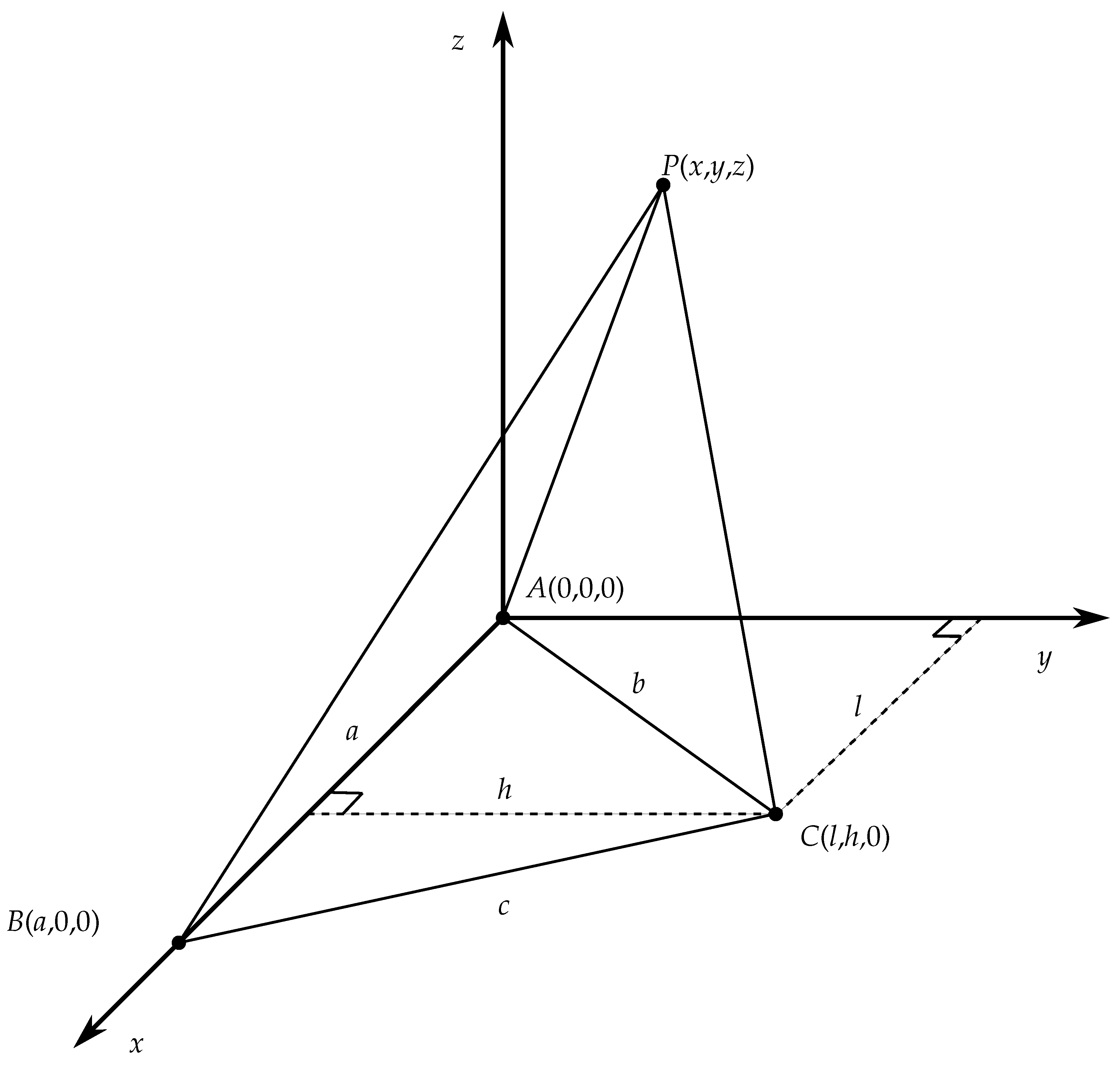
Here, we reintroduce the parameters h and l, as originally defined in [1]. Referring to Fig. Figure 1, these parameters can be expressed as follows::
Equations (1)–(4)
yields three distinct implicit solutions for the Pythagorean Tetrahedron, depicted in Fig. Figure 1, namely:
To solve Equation 5 for z, we first multiply both sides by 2 to simplify the expression, thereby isolating some radicals on the left-hand side.
Both sides of the equation are squared initially to minimize the number of square root terms.
Any remaining radical expressions are then isolated on the left-hand side.
The sides are squared a second time to completely eliminate the square roots.
The equation is subsequently transformed into a quartic polynomial, which is rearranged to ensure it is expressed in standard form.
The quartic equation is solved for z, with simplifications applied to powers and products as needed, ultimately yielding four potential solutions for z.
Among these solutions, two yield real numbers (with no imaginary components).
References
- dos Santos Bernardes, M. A. Introducing Novel Geometric Insights and Three-Dimensional Depictions of the Pythagorean Theorem for Any Triangles. International Journal of Pure and Applied Mathematics Research 2024, 4(2), 47–58. [Google Scholar] [CrossRef]
Figure 1.
Pythagorean Tetrahedron: 3D Pythagorean composition from .
Disclaimer/Publisher’s Note: The statements, opinions and data contained in all publications are solely those of the individual author(s) and contributor(s) and not of MDPI and/or the editor(s). MDPI and/or the editor(s) disclaim responsibility for any injury to people or property resulting from any ideas, methods, instructions or products referred to in the content. |
© 2024 by the authors. Licensee MDPI, Basel, Switzerland. This article is an open access article distributed under the terms and conditions of the Creative Commons Attribution (CC BY) license (http://creativecommons.org/licenses/by/4.0/).
Copyright: This open access article is published under a Creative Commons CC BY 4.0 license, which permit the free download, distribution, and reuse, provided that the author and preprint are cited in any reuse.


