

Submitted:
23 November 2024
Posted:
25 November 2024
You are already at the latest version
Preprints on COVID-19 and SARS-CoV-2
Abstract
Post-COVID-19 produced significant triage modification in emergency hospital medical care. Previous scoping reviews investigated triage changes during COVID-19. This scoping review is novel in considering the post-pandemic effects. It searches the parameters “COVID-19, triage, hospital, emergency medical care” in four primary databases, one register, and a supplementary database to determine the range of emergency hospital triage changes. Following PRISMA guidelines, those studies included are post-2023 publications, those in English, and research studies. Excluded were duplicates, reviews, books, and reports lacking research studies or including irrelevant information on COVID-19, triage, hospital, or emergency medical care. Identified are 1,071 records: OVID (n = 20), PubMed (n = 2), Scopus (n = 46), Web of Science (n = 20), Cochrane COVID-19 Register (n = 18), and Google Scholar (n = 965). The studies included are six. Web of Science (n = 1) and Google Scholar (n = 5). One study includes reports from six different countries—thus, the reports were 11. The modification of triage was concerning four ways, with each country focusing on a specific triage change. Adaptive changes were proactive rather than reactive. The suggestions for future research include considering the four triage aspects, additional international comparisons, and longitudinal triage change.
Keywords:
COVID-19
; triage
; hospital
; emergency medical care
; PRISMA
1. Introduction
Shortly before the first recognized case of severe acute respiratory syndrome coronavirus 2 [1]—the SARS-CoV-2 virus that resulted in the COVID-19 pandemic [2] over a series of waves and variants [3]—the assessment was that intensive care clinicians were often uncertain regarding the meaning of triage in disaster situations [4].
Defined as a combination of three components related to the order in which patients are processed, including sorting, prioritizing, allocating resources, triage during disasters just before the COVID-19 pandemic was recognized to be based on patient survival, quality of life, and resource consumption [4].
With the arrival of COVID-19, there was a refinement to the understanding of the three aspects of triage to survival regarding the virus, post-pandemic quality of life, and consumption of medical resources required to achieve the set pandemic goals—decisions that were considered best based on a protocol [5].
The World Health Organization ended The COVID-19 pandemic with a statement on 4 May 2023 [6]. With the ending of the pandemic, the question is, what are the triage changes in hospitals regarding emergency medical care post-COVID-19?
The aim is to answer this question through a scoping review. Although several scoping reviews have been conducted regarding emergency hospital triage changes during the pandemic—among them [7,8,9,10]—there has yet to be a scoping review of triage changes post-COVID-19. The principal conclusion is that the changes adopted to hospital-based triage during post-COVID-19 are regarding four different aspects of triage, and which of these are the focus is country-dependent. Those countries that made these changes proactively rather than reactively report more successful outcomes for healthcare delivery.
2. Materials and Methods
A scoping review was selected as the method for this search because the intent was to find the range and depth of research that has been conducted on this subject since the end of the pandemic rather than to examine the PICO (population, intervention, comparison, and outcome) of the studies, requiring a systematic review [11]. The scoping review undertaken searches four primary databases (OVID, PubMed, Scopus, and Web of Science), one register (the Cochrane COVID-19 Register), and one supplementary database (Google Scholar) selected for their relevance and reach [12]. The initial keywords searched are “COVID-19, triage, hospital, emergency medical care” for each database, with additional keywords added relevant to the specific database. Following PRISMA guidelines [13,14,15], those included were post-2023 publications, those in English, and research studies. Excluded were reviews, books, reports of irrelevant information (including those that included the keywords in the references alone). As this is a COVID-19-related study, consideration is of PROSPERO requirements; however, as a scoping review, the study is not to be registered [16].
The searches undertaken on 7 November 2024 were of all databases, excluding Google Scholar. Among those databases included in the OVID search were "Embase Classic+Embase 1947 to 2024 November 06", "Ovid Healthstar 1966 to September 2024", "Journals@Ovid Full Text November 05, 2024", and "Ovid MEDLINE(R) ALL 1946 to November 06, 2024". The additional limits for OVID to ensure the most relevant returns were “English Language” and “2023-present”. For PubMed, the additional limit was “2023-2024”. Scopus required this limit plus others—“Medicine”, “Article”, “English”, and “Humans”. “English” was also an extra limit for Web of Science. Furthermore, adding “Emergency medicine” was necessary to produce relevant results. Finally, for the Cochrane COVID-19 Study Register, the additional limits were “Created: 4 May ’23–7 Nov ‘24”, “Journal Article”, and “Reports Results”. For this register “COVID-19” was removed from the keywords searched to reduce the extraneous returns. The Google Scholar search was the only one on 10 November 2024. The other limits were “No citations”, and “Since 2023”. To improve search accuracy, additionally, a modification of the parameter included “Post-COVID-19, triage changes, hospital, emergency medical care, 2023, 2024”.
Following the PRISMA requirements for the search, the reports excluded from those assessed for eligibility included those returns that, although containing each of the keywords of the parameter, mentioned any of the keywords only in the reference list and were thus irrelevant. Also, part of what was considered irrelevant were those articles that, although published in either 2023 or 2024, reported on studies conducted during COVID-19 rather than following the pandemic.
Figure 1 documents the PRISMA charting process.
3. Results
The results are regarding the searches for the databases and the register performed on 7 November 2024, plus the additional database search on 10 November 2024. These results are comprehensively recorded in Supplementary 1 with the exclusions color-coded and a legend to the color-coding provided at the end of this nine-page document. After the following examination of the results of the searches performed, the included studies are examined.
3.1. Searches Performed
Of the four databases and one register searched on 7 November 2024, the first search was for OVID. The keywords were “COVID-19, triage, hospital, emergency medical care” with the additional limits of “English Language, 2023-present”. Twenty records were returned. The exclusions, following the PRISMA process, are duplicates (n = 0), not in English (n = 0), not peer reviewed (n = 3), literature review (n = 1), not a research study (n = 3), no mention of COVID-19 (n = 3), no mention of triage (n = 0), no mention of hospital (n = 0), no mention of emergency medical care (n = 0), not retrieved (n = 1), irrelevant information on COVID-19 (n = 9), irrelevant information on triage (n = 0), irrelevant information on hospital (n = 0), irrelevant information on emergency medical care (n = 0). The result of the exclusions left no included studies from the OVID search.
The keywords of the PubMed search were “COVID-19, triage, hospital, emergency medical care” with the additional limit of “2023-2024”. Two records were returned. The exclusions, following the PRISMA process, are duplicates (n = 0), not in English (n = 0), not peer reviewed (n = 0), literature review (n = 2), not a research study (n = 0), no mention of COVID-19 (n = 0), no mention of triage (n = 0), no mention of hospital (n = 0), no mention of emergency medical care (n = 0), not retrieved (n = 0), irrelevant information on COVID-19 (n = 0), irrelevant information on triage (n = 0), irrelevant information on hospital (n = 0), irrelevant information on emergency medical care (n = 0). The result of the exclusions left no included studies from the PubMed search.
The Scopus keywords were “COVID-19, triage, Hospital, Emergency medical care” with the additional limits of “2023-2024, Medicine, Article, English, Humans”. Forty-six records were returned. The exclusions, following the PRISMA process, are duplicates (n = 1, duplicated and counted with Google Scholar), not in English (n = 1), not peer reviewed (n = 0), literature review (n = 0), not a research study (n = 2), no mention of COVID-19 (n = 1), no mention of triage (n = 0), no mention of hospital (n = 0), no mention of emergency medical care (n = 1), not retrieved (n = 4), irrelevant information on COVID-19 (n = 36), irrelevant information on triage (n = 0), irrelevant information on hospital (n = 0), irrelevant information on emergency medical care (n = 0). The result of the exclusions left no included studies from the Scopus search.
Web of Science had the keywords “COVID-19, triage, Hospital, Emergency medical care” with the additional limits of “Article, English, Emergency medicine”. Twenty records were returned. The exclusions, following the PRISMA process, are duplicates (n = 0), not in English (n = 0), not peer reviewed (n = 0), literature review (n = 1), not a research study (n = 0), no mention of COVID-19 (n = 2), no mention of triage (n = 0), no mention of hospital (n = 0), no mention of emergency medical care (n = 0), not retrieved (n = 2), irrelevant information on COVID-19 (n = 14), irrelevant information on triage (n = 0), irrelevant information on hospital (n = 0), and irrelevant information on emergency medical care (n = 0). The exclusions left one included study from the Web of Science search.
For the Cochrane COVID-19 Study Register search, the keywords were modified to “triage, Hospital, Emergency medical care” because when “COVID-19” was included among the keywords there were over 32,000 returns. The additional limits were “created: 4 May '23 - 7 Nov '24, Journal Article, Report Results”. Eighteen records were returned. The exclusions, following the PRISMA process, are duplicates (n = 8, all duplicated and counted with Scopus), not in English (n = 0), not peer-reviewed (n = 0), literature review (n = 0), not a research study (n = 0), no mention of COVID-19 (n = 0), no mention of triage (n = 1), no mention of hospital (n = 0), no mention of emergency medical care (n = 0), not retrieved (n = 3), irrelevant information on COVID-19 (n = 6), irrelevant information on triage (n = 0), irrelevant information on hospital (n = 0), irrelevant information on emergency medical care (n = 0). The result of the exclusions left no included studies from the Cochrane COVID-19 Study Register search.
The Google Scholar search of 10 November 2024 produced an extensive number of returns at 16,800 when the keywords searched were “COVID-19, triage, Hospital, Emergency medical care” with the additional limits of “no citations, since 2023”. To improve the relevance of the returned results, the parameters were modified to “Post-COVID-19, triage changes, hospital, emergency medical care, 2023, 2024, no citations, since 2023”, producing 965 returns. The decision was made to examine the first 100 results alone. Of those 100, the exclusions, following the PRISMA process, are duplicates (n = 0), not in English (n = 0), not peer reviewed (n = 1), literature review (n = 7), not a research study (n = 7), no mention of COVID-19 (n = 0), no mention of triage (n = 18), no mention of hospital (n = 3), no mention of emergency medical care (n = 5), not retrieved (n = 5), irrelevant information on COVID-19 (n = 30), irrelevant information on triage (n = 19), irrelevant information on hospital (n = 0), irrelevant information on emergency medical care (n = 0). The result of the exclusions left five included studies from the Google Scholar search.
Given the PRISMA method of reporting, what is not evident from Figure 1 is that before screening occurred, but after the decision was made to screen only the first 100 returns of the Google Scholar search, there were 206 studies in total. Of these, there were nine duplicates. All were duplicated with Scopus—one with Google Scholar and the other eight with the Cochrane COVID-19 Study Register. The one duplicate with Google Scholar is recorded with that search while the other eight are recorded with Scopus. None of these duplicates were included. As noted in Figure 1, significantly, 94 of the returns mentioned unrelated information regarding COVID-19. Either the virus is stated merely as occurring, the study data were before the end of COVID-19, or the mention of it is found only in the reference list. Irrelevant information for the same reasons was also found in 19 articles regarding triage. It is noteworthy that none of the returned articles have irrelevant information concerning hospitals or emergency medical care. Although Google Scholar has been categorized as a supplementary database because its returns are inconsistent [12], this database returned the most relevant results, returning these results at the top of the results. For the other search engines, either there were no relevant returns or, in the case of Web of Science—which returned one included study—the return was 18th of 20. Although 100 records were screened in the Google Scholar search, the last record to be included was the 51st (see Supplementary 1). As such, the final five pages of returns were unnecessary to screen. From these results, the conclusion is that although Google Scholar provides inconsistent returns, it is the most productive search engine for this search.
3.2. Included Studies
Six publications mention COVID-19, triage, hospital and emergency medical care as integral to the study. Web of Science returned the first study—the next five, Google Scholar. The search was of 2023 and 2024 peer reviewed publications, yet publication of only one article concerning this topic was in 2023—the remainder from 2024. This result suggests that additional studies on this topic might be forthcoming. This conclusion is particularly so because a significant portion of the articles excluded were those published in 2023 or 2024 but concerning studies conducted between 2020-2022, grouped as part of irrelevant information on COVID-19.
It is valuable that the data of these included studies is from the results of various countries. These countries include the USA (two studies), Canada, Kazakhstan, six European countries (Austria, the Czech Republic, Denmark, Germany, Italy and the Netherlands), and Finland. As such, several perspectives unique to countries can consider the information provided regarding the modified practices in emergency hospital triage post-pandemic.

Table 1.
Citation Number, Title of Study, Study Authors, Database Returning the Study, and Date of the Publication for Included Studies From a 7-November Search of the First Study and a 10-November Search Of the Remaining Six.
Table 1.
Citation Number, Title of Study, Study Authors, Database Returning the Study, and Date of the Publication for Included Studies From a 7-November Search of the First Study and a 10-November Search Of the Remaining Six.
| Cit # | Title | Authors | Database | Date |
|---|---|---|---|---|
| [18] | Quality improvement in the era of boarding and burnout: A postpandemic blueprint | Schwartz, H.; Huen, W.; Kanzaria, H.K.; Peabody, C.R. | Web of Science | 2024 |
| [19] | Post-Pandemic Growth in 9-1-1 Paramedic Calls and Emergency Department Transports Surpasses Pre-Pandemic Rates in the COVID-19 Era: Implications for Paramedic Resource Planning | Strum, R.P.; McLeod, B.; Mondoux, S.; Miller, P.; Costa A.P. |
Google Scholar | 2024 |
| [20] | Lessons of the COVID-19 Pandemic for Ambulance Service in Kazakhstan |
Messova, A..; Pivina, L.; Ygiyeva, D.; Batenova, G.; Dyussupov, A.; Jamedinova, U.; Syzdykbayev, M.; Adilgozhina, S.; Bayanbaev, A. |
Google Scholar | 2024 |
| [21] | Post-COVID health policy responses to healthcare workforce capacities: A comparative analysis of health system resilience in six European countries | Burau, V., Mejsner, S. B., Falkenbach, M., Fehsenfeld, M., Kotherová, Z., Neri, S., Wallenburg, I., & Kuhlmann, E. |
Google Scholar | 2024 |
| [22] | American Society of Echocardiography COVID-19 Statement Update: Lessons Learned and Preparation for Future Pandemics |
Kirkpatrick, J. N., Swaminathan, M., Adedipe, A., Garcia-Sayan, E., Hung, J., Kelly, N., Kort, S., Nagueh, S., Poh, K. K., Sarwal, A., Strachan, G. M., Topilsky, Y., West, C., & Wiener, D. H. |
Google Scholar | 2023 |
| [23] | Patient experience of non-conveyance in the EMS of Southwest Finland: a descriptive survey study | Skaffari, E., Iirola, T. & Nordquist, H. | Google Scholar | 2024 |
Table 2 provides the relevant details regarding hospital triage modifications for emergency medical care post-COVID-19 for each included study. Notable from this table is that triage in this regard involves several aspects. These include a rethinking of the triage systems and structures at the administrative level [18], reducing the use of emergency services by patients through increased and improved telephone/online assistance, a focus on transporting the patient to the hospital more efficiently [19,20,23], and particular efforts to streamline the triage process once at the hospital [22]. Two reports mention, to a significant extent, that the changes made post-COVID-19 resulted from the increased use of emergency services by patients with chronic diseases after the pandemic was over [19,20].
Table 3 offers a categorization by country and triage modification for each of the eleven individual reports of the six studies. A checkmark indicates that the triage modification was the focus of the article. It does not imply that this modification was necessarily the only one employed in the hospital—merely the one examined in the article. Notably, most European countries concentrated on creating online or other pre-hospital triage methods that kept some patients from believing they needed hospital emergency services [21]. This solution is in contrast to the USA where, even if increased online services were relevant, the focus was a rethinking of all systems and structures related to triage [18] and streamlining the process once patients were at the hospital [22]—a method that also differentiated the Netherlands from the other European countries studied [21]. These proactive methods were not utilized in Canada [19] where there was a reactive meeting of the escalating emergency room visits as the numbers increased [24,25], causing additional burdens on triaged healthcare delivery [26]. This type of response is in contrast to that of Kazakhstan and Finland, where hospital transportation changes were found to decrease the triage burden [20,23].
4. Discussion
Several points are evident in determining what the changes to triage were in hospitals regarding emergency medical care post-COVID-19. The first is that search engines of primary databases recommended for scoping reviews [27,28] were generally ineffective in finding relevant articles. This ineffectiveness extends to the Cochrane COVID-19 Study Register, which might be presumed to have been most appropriate. Google Scholar continues to be recognized as a supplementary database for grey literature [29]; however, recent research indicates that it far outperforms other databases regarding the extent of its searches [30]. For the search of the keywords “COVID-19, triage, hospital, emergency medical care”, without the search of Google Scholar, ten of the eleven reports on this topic would have been overlooked.
The next recognizable point is that post-COVID-19, hospital triage is not exclusive to the measures taken by hospitals once patients are physically present in the emergency department. It includes assessments of how to make the entire system and structures of triage work effectively [18]— methods that can extend to global considerations [31], keeping patients from coming to the hospital from the use of telephone/online services [21]— one meaning of self-triage referred to in a recent study [32], improvements to transportation by ambulance to the hospital [19,20,23] through web-based applications [33] and other means particularly notable with reduced time in serving stroke patients [34], and various methods of streamlining the process of triage once the patient is at the hospital [21,22]— here, self-triage entails checking oneself into the hospital once at the emergency department through the use of kiosks [35] or having easily transportable diagnostic equipment, moveable where and when needed [33].
Thirdly, changes to triage post-COVID-19 differed by country. Those countries that were proactive in improving triage in anticipation of the influx of chronic patients to the emergency departments after the end of pandemic limitations were more satisfied with their efforts [18,20,21,22,23]. In contrast, when a country was reactive to the increase, the healthcare system suffered [19], at least partially resulting from resistance by chronic disease patients to using online self-help methods [36].
4.1. Limitations
Although the PRISMA extension for scoping reviews provides a recommended framework for methodological issues [37], the charting process structure and synthesis limits the information recorded [38]. Therefore, in following the PRISMA guidelines for this scoping review, the information provided on the chart is limited. For this reason, the text offers additional details on the exclusion process.
Cognitive bias is a possibility, with conducting research independently by one researcher [39]. Measures are necessary to overcome this possibility [40]. The author has included the record provided by the database of studies returned for each search conducted to mitigate cognitive bias. These records are in Supplementary 1. Creating a detailed color-coded system identifies and differentiates articles following the PRISMA process. By making the decisions regarding each of the 206 studies considered for inclusion available for inspection and by including the Preferred Reporting Items for Systematic Reviews and Meta-Analyses Extension for Scoping Reviews (PRISMA-ScR) Checklist as Supplementary 2, the author actively intends to alleviate cognitive bias.
4.2. Future Research Directions
As is evident from this study, there is currently little research on how emergency hospital triage has changed post-COVID-19. Proactive changes can improve the healthcare system, while reactive ones are detrimental [41]. As a result, research in this area is imperative to encourage proactive measures. The research areas available for consideration are various. One area is investigating the four triage modification areas. (1) System and structural changes, (2) self-triage to keep patients from believing they need emergency department admittance, (3) improved speed and efficiency of the ambulance service, and (4) changes to the efficiency of triage practices at the hospital. Studies focused on all four aspects simultaneously would be novel and valuable. Other suggested research directions pertain to an international comparison of changes that have taken place regarding triage. The comparison of six European countries has started this process; however, there is no research on changes in Great Britain, several other European countries, Southeast and East Asian countries, Australasia, Latin America, or Africa. In all, comparative work to undertake remains, including revisiting the sites included in this study for assessment to conduct longitudinal research. More research regarding Google Scholar as a database search engine concerning its applicability as a primary database for medically-related matters is also necessary and suggested. Overall, the research aim is to improve the proactive triage responses to post-COVID-19 hospital emergency medical care.
Supplementary Materials
The following supporting information can be downloaded at the website of this paper posted on Preprints.org, Supplementary 1. Search Results and Outcomes for This Study of the Four Primary Databases, a Register, and a Supplementary Database, and Supplementary 2. Preferred Reporting Items for Systematic Reviews and Meta-Analyses Extension for Scoping Reviews (PRISMA-ScR) Checklist.
Funding
This research received no external funding.
Institutional Review Board Statement
Not applicable.
Informed Consent Statement
Not applicable.
Data Availability Statement
No new data were created.
Conflicts of Interest
The author declares no conflicts of interest.
References
- Coronaviridae Study Group of the International Committee on Taxonomy of Viruses; Gorbalenya, A. E.; Baker, S.C.; Baric, R.S.; De Groot, R.J.; Drosten, C.; Gulyaeva, A.A.; Haagmans, B.L.; Lauber, C.; Leontovich, A.M.; et al. The Species Severe Acute Respiratory Syndrome-Related Coronavirus: Classifying 2019-nCoV and Naming It SARS-CoV-2. Nat Microbiol 2020, 5, 536–544. [Google Scholar] [CrossRef] [PubMed]
- Matheson, N.J.; Lehner, P.J. How Does SARS-CoV-2 Cause COVID-19? Science 2020, 369, 510–511. [Google Scholar] [CrossRef] [PubMed]
- Thakur, V.; Bhola, S.; Thakur, P.; Patel, S.K.S.; Kulshrestha, S.; Ratho, R.K.; Kumar, P. Waves and Variants of SARS-CoV-2: Understanding the Causes and Effect of the COVID-19 Catastrophe. Infection 2022, 50, 309–325. [Google Scholar] [CrossRef] [PubMed]
- Christian, M.D. Triage. Critical Care Clinics 2019, 35, 575–589. [Google Scholar] [CrossRef] [PubMed]
- Kucewicz-Czech, E.; Damps, M. Triage during the COVID-19 Pandemic. ait 2020, 52, 312–315. [Google Scholar] [CrossRef]
- World Health Organization Statement on the Fifteenth Meeting of the IHR (2005) Emergency Committee on the COVID-19 Pandemic. World Health Organization: Geneva, Switzerland 2023.
- Roque Mazoni, S.; Andrade, J.; Da Silva Antonio, P.; Baraldi, S.; Frates Cauduro, F.L.; Fernandes Dos Santos, P.H.; Ribeiro De Sousa, P.; Moura Pinho, D.L. Triage Strategies for COVID-19 Cases: A Scope Review. INQUIRY 2022, 59, 00469580221095824. [Google Scholar] [CrossRef]
- Hirner, S.; Pigoga, J.L.; Naidoo, A.V.; Calvello Hynes, E.J.; Omer, Y.O.; Wallis, L.A.; Bills, C.B. Potential Solutions for Screening, Triage, and Severity Scoring of Suspected COVID-19 Positive Patients in Low-Resource Settings: A Scoping Review. BMJ Open 2021, 11, e046130. [Google Scholar] [CrossRef]
- Kim, K.; Oh, B. Prehospital Triage in Emergency Medical Services System: A Scoping Review. International Emergency Nursing 2023, 69, 101293. [Google Scholar] [CrossRef]
- Laparidou, D.; Curtis, F.; Wijegoonewardene, N.; Akanuwe, J.; Weligamage, D.D.; Koggalage, P.D.; Siriwardena, A.N. Emergency Medical Service Interventions and Experiences during Pandemics: A Scoping Review. PLoS ONE 2024, 19, e0304672. [Google Scholar] [CrossRef]
- Smith, S.A.; Duncan, A.A. Systematic and Scoping Reviews: A Comparison and Overview. Seminars in Vascular Surgery 2022, 35, 464–469. [Google Scholar] [CrossRef]
- Gusenbauer, M.; Haddaway, N.R. Which Academic Search Systems Are Suitable for Systematic Reviews or Meta-analyses? Evaluating Retrieval Qualities of Google Scholar, PubMed, and 26 Other Resources. Research Synthesis Methods 2020, 11, 181–217. [Google Scholar] [CrossRef] [PubMed]
- Peters, M.D.J.; Godfrey, C.; McInerney, P.; Khalil, H.; Larsen, P.; Marnie, C.; Pollock, D.; Tricco, A.C.; Munn, Z. Best Practice Guidance and Reporting Items for the Development of Scoping Review Protocols. JBI Evidence Synthesis 2022, 20, 953–968. [Google Scholar] [CrossRef] [PubMed]
- Tricco, A.C.; Lillie, E.; Zarin, W.; O’Brien, K.K.; Colquhoun, H.; Levac, D.; Moher, D.; Peters, M.D.J.; Horsley, T.; Weeks, L.; et al. PRISMA Extension for Scoping Reviews (PRISMA-ScR): Checklist and Explanation. Ann Intern Med 2018, 169, 467–473. [Google Scholar] [CrossRef]
- Peters, M.D.J.; Marnie, C.; Tricco, A.C.; Pollock, D.; Munn, Z.; Alexander, L.; McInerney, P.; Godfrey, C.M.; Khalil, H. Updated Methodological Guidance for the Conduct of Scoping Reviews. JBI Evidence Synthesis 2020, 18, 2119–2126. [Google Scholar] [CrossRef] [PubMed]
- National Institute for Health and Care Research International Prospective Register of Systematic Reviews. PROSPERO 2020.
- Page, M.J.; McKenzie, J.E.; Bossuyt, P.M.; Boutron, I.; Hoffmann, T.C.; Mulrow, C.D.; Shamseer, L.; Tetzlaff, J.M.; Akl, E.A.; Brennan, S.E.; et al. The PRISMA 2020 Statement: An Updated Guideline for Reporting Systematic Reviews. BMJ 2021, n71. [Google Scholar] [CrossRef]
- Schwartz, H.; Huen, W.; Kanzaria, H.K.; Peabody, C.R. Quality Improvement in the Era of Boarding and Burnout: A Postpandemic Blueprint. JACEP Open 2024, 5, e13234. [Google Scholar] [CrossRef]
- Strum, R.P.; McLeod, B.; Mondoux, S.; Miller, P.; Costa, A.P. Post-Pandemic Growth in 9-1-1 Paramedic Calls and Emergency Department Transports Surpasses Pre-Pandemic Rates in the COVID-19 Era: Implications for Paramedic Resource Planning. Prehospital Emergency Care 2024, 1–8. [Google Scholar] [CrossRef]
- Messova, A.; Pivina, L.; Ygiyeva, D.; Batenova, G.; Dyussupov, A.; Jamedinova, U.; Syzdykbayev, M.; Adilgozhina, S.; Bayanbaev, A. Lessons of the COVID-19 Pandemic for Ambulance Service in Kazakhstan. Healthcare 2024, 12, 1568. [Google Scholar] [CrossRef]
- Burau, V.; Mejsner, S.B.; Falkenbach, M.; Fehsenfeld, M.; Kotherová, Z.; Neri, S.; Wallenburg, I.; Kuhlmann, E. Post-COVID Health Policy Responses to Healthcare Workforce Capacities: A Comparative Analysis of Health System Resilience in Six European Countries. Health Policy 2024, 139, 104962. [Google Scholar] [CrossRef]
- Kirkpatrick, J.N.; Swaminathan, M.; Adedipe, A.; Garcia-Sayan, E.; Hung, J.; Kelly, N.; Kort, S.; Nagueh, S.; Poh, K.K.; Sarwal, A.; et al. American Society of Echocardiography COVID-19 Statement Update: Lessons Learned and Preparation for Future Pandemics. Journal of the American Society of Echocardiography 2023, 36, 1127–1139. [Google Scholar] [CrossRef] [PubMed]
- Skaffari, E.; Iirola, T.; Nordquist, H. Patient Experience of Non-Conveyance in the EMS of Southwest Finland: A Descriptive Survey Study. BMC Emerg Med 2024, 24, 42. [Google Scholar] [CrossRef] [PubMed]
- McSween-Cadieux, E.; Lane, J.; Hong, Q.N.; Houle, A.-A.; Lauzier-Jobin, F.; Saint-Pierre Mousset, E.; Prigent, O.; Ziam, S.; Poder, T.; Lesage, A.; et al. Production and Use of Rapid Responses during the COVID-19 Pandemic in Quebec (Canada): Perspectives from Evidence Synthesis Producers and Decision Makers. Health Res Policy Sys 2024, 22, 22. [Google Scholar] [CrossRef] [PubMed]
- Kong, E. Moving from a Reactive to a Proactive Society: Recognizing the Role of Environmental Public Health Professionals. Environ. Health Rev. 2022, 65, 41–43. [Google Scholar] [CrossRef]
- Haas, R.; Brundisini, F.; Barbara, A.; Darvesh, N.; Ritchie, L.; MacDougall, D.; Spry, C.; Mason, J.; Hall, J.; Ma, W.; et al. Emergency Department Overcrowding: An Environmental Scan of Contributing Factors and a Summary of Systematic Review Evidence on Interventions. cjht 2023, 3. [Google Scholar] [CrossRef]
- Gusenbauer, M.; Haddaway, N.R. Which Academic Search Systems Are Suitable for Systematic Reviews or Meta-analyses? Evaluating Retrieval Qualities of Google Scholar, PubMed, and 26 Other Resources. Research Synthesis Methods 2020, 11, 181–217. [Google Scholar] [CrossRef]
- Gusenbauer, M. Google Scholar to Overshadow Them All? Comparing the Sizes of 12 Academic Search Engines and Bibliographic Databases. Scientometrics 2019, 118, 177–214. [Google Scholar] [CrossRef]
- Gonzales, A.; Guruswamy, G.; Smith, S.R. Synthetic Data in Health Care: A Narrative Review. PLOS Digit Health 2023, 2, e0000082. [Google Scholar] [CrossRef]
- Healey, M.; Healey, R.L. Searching the Literature on Scholarship of Teaching and Learning (SoTL): An Academic Literacies Perspective: Part 1. TLI 2023, 11. [Google Scholar] [CrossRef]
- Williams, B.A.; Jones, C.H.; Welch, V.; True, J.M. Outlook of Pandemic Preparedness in a Post-COVID-19 World. npj Vaccines 2023, 8, 178. [Google Scholar] [CrossRef]
- Ziebart, C.; Kfrerer, M.L.; Stanley, M.; Austin, L.C. A Digital-First Health Care Approach to Managing Pandemics: Scoping Review of Pandemic Self-Triage Tools. J Med Internet Res 2023, 25, e40983. [Google Scholar] [CrossRef] [PubMed]
- Savani, N. Understanding Web 3.0: Opportunities and Challenges for Developers. IJCTT 2024, 71, 72–76. [Google Scholar] [CrossRef]
- Roper, M.; Cerilo, P.; Bena, J.; Morrison, S.; Siegmund, L.A. Patient Factors Associated with Treatment Time for Stroke before and after the Onset of COVID-19. Geriatric Nursing 2024, 56, 1–6. [Google Scholar] [CrossRef]
- Joseph, M.J.; Summerscales, M.; Yogesan, S.; Bell, A.; Genevieve, M.; Kanagasingam, Y. The Use of Kiosks to Improve Triage Efficiency in the Emergency Department. npj Digit. Med. 2023, 6, 19. [Google Scholar] [CrossRef] [PubMed]
- Kaseweter, K.; Nazemi, M.; Gregoire, N.; Louw, W.F.; Walsh, Z.; Holtzman, S. Physician Perspectives on Chronic Pain Management: Barriers and the Use of eHealth in the COVID-19 Era. BMC Health Serv Res 2023, 23, 1131. [Google Scholar] [CrossRef]
- McGowan, J.; Straus, S.; Moher, D.; Langlois, E.V.; O’Brien, K.K.; Horsley, T.; Aldcroft, A.; Zarin, W.; Garitty, C.M.; Hempel, S.; et al. Reporting Scoping Reviews—PRISMA ScR Extension. Journal of Clinical Epidemiology 2020, 123, 177–179. [Google Scholar] [CrossRef]
- Bradbury-Jones, C.; Aveyard, H.; Herber, O.R.; Isham, L.; Taylor, J.; O’Malley, L. Scoping Reviews: The PAGER Framework for Improving the Quality of Reporting. International Journal of Social Research Methodology 2022, 25, 457–470. [Google Scholar] [CrossRef]
- Neal, T.M.S.; Lienert, P.; Denne, E.; Singh, J.P. A General Model of Cognitive Bias in Human Judgment and Systematic Review Specific to Forensic Mental Health. Law and Human Behavior 2022, 46, 99–120. [Google Scholar] [CrossRef]
- Soprano, M.; Roitero, K.; La Barbera, D.; Ceolin, D.; Spina, D.; Demartini, G.; Mizzaro, S. Cognitive Biases in Fact-Checking and Their Countermeasures: A Review. Information Processing & Management 2024, 61, 103672. [Google Scholar] [CrossRef]
- Sacco, P.L.; Valle, F.; De Domenico, M. Proactive vs. Reactive Country Responses to the COVID-19 Pandemic Shock. PLOS Glob Public Health 2023, 3, e0001345. [Google Scholar] [CrossRef]
Figure 1.
The Preferred Reporting Items for Systematic Review and Meta-Analyses (PRISMA) Flow of Information Chart (Page et al. 2020 [17]) for a 7 November Search of OVID, Pubmed, Scopus, Web Of Science, and Cochrane COVID-19 Study Register, and a 10 November 2024 Search of Google Scholar. The Parameters Searched Were “COVID-19, Triage, Hospital, Emergency Medical Care”, with Additional Limitations and Modifications Made Dependent on the Database to Ensure the Relevance of the Returns.
Figure 1.
The Preferred Reporting Items for Systematic Review and Meta-Analyses (PRISMA) Flow of Information Chart (Page et al. 2020 [17]) for a 7 November Search of OVID, Pubmed, Scopus, Web Of Science, and Cochrane COVID-19 Study Register, and a 10 November 2024 Search of Google Scholar. The Parameters Searched Were “COVID-19, Triage, Hospital, Emergency Medical Care”, with Additional Limitations and Modifications Made Dependent on the Database to Ensure the Relevance of the Returns.
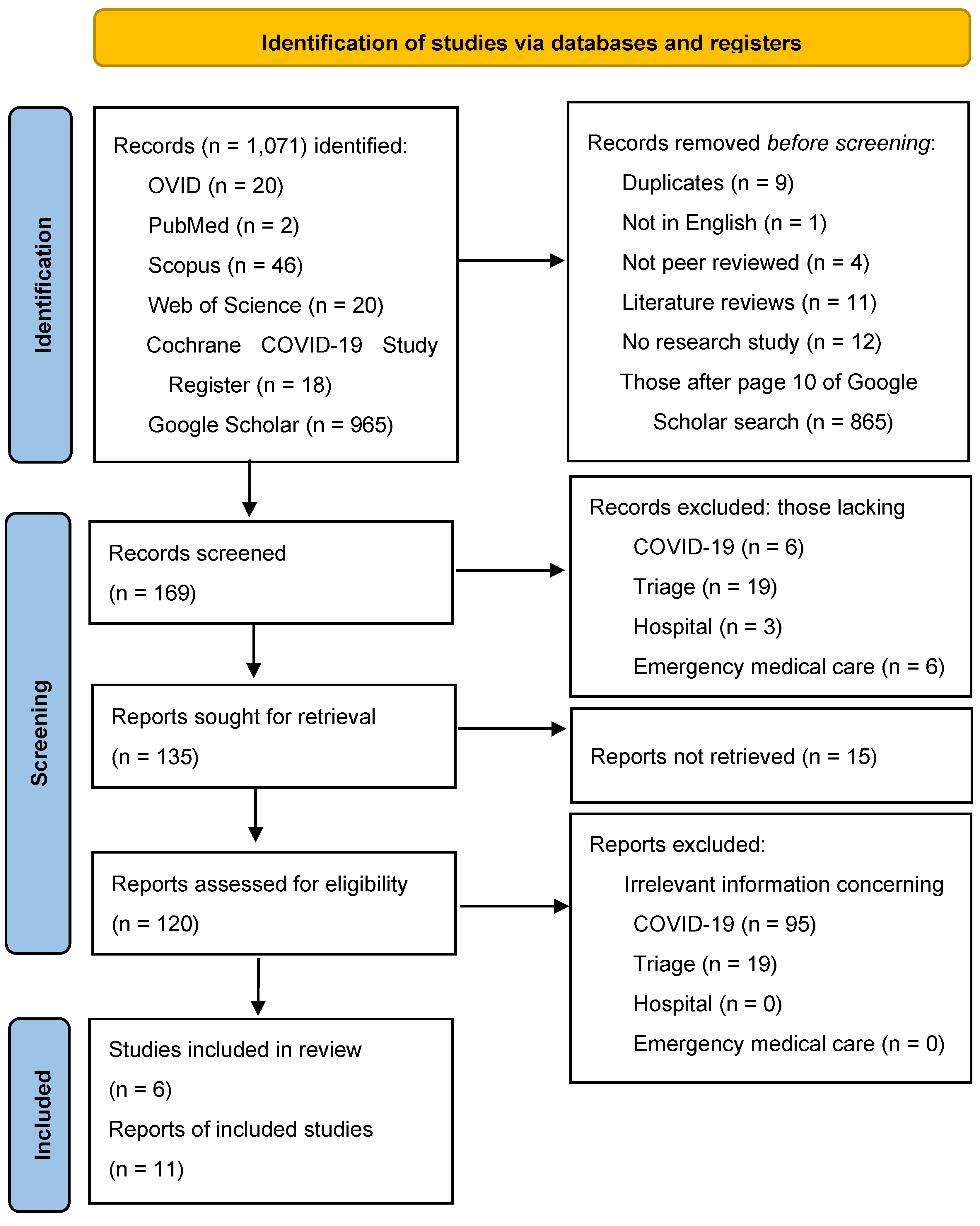
Table 2.
Citation Number, Title of Study, and How Emergency Care Hospital Triage Was Modified Post-COVID-19 Regarding Each Study.
Table 2.
Citation Number, Title of Study, and How Emergency Care Hospital Triage Was Modified Post-COVID-19 Regarding Each Study.
| Cit # | Title | How Emergency Care Hospital Triage Was Modified Post-COVID-19 |
|---|---|---|
| [18] | Quality improvement in the era of boarding and burnout: A postpandemic blueprint | Developed robust value stream map leveraging electronic health record throughput data to visualize the triage process at a detailed level. This outcome resulted in a “left without being seen” rate dropping from 7.4% to 5.4%, with 50% of staff “strongly agreed” and 42% “agreed” there was an improvement in triage resulting from this reconceptualization of triage. |
| [19] | Post-Pandemic Growth in 9-1-1 Paramedic Calls and Emergency Department Transports Surpasses Pre-Pandemic Rates in the COVID-19 Era: Implications for Paramedic Resource Planning | Post-pandemic, 911-initiated paramedic calls experienced a substantial increase, surpassing pre-pandemic rates. Emergency department (ED) transports returned to a steeper and continuous growth pattern compared with pre-pandemic levels, resulting in an urgent need to develop new care models addressing paramedic responses to 911 calls and transport to overcrowded EDs. |
| [20] | Lessons of the COVID-19 Pandemic for Ambulance Service in Kazakhstan | There was a significant increase in ambulance calls in which there is no current or potential threat to the patient’s life and health post-pandemic in 2022 and 2023 of 4.7 and 4.5 times, respectively, compared with 2019. People with chronic comorbid diseases who did not come to the emergency deparment during the pandemic began to seek medical help. |
| [21] | Post-COVID health policy responses to healthcare workforce capacities: A comparative analysis of health system resilience in six European countries | In Austria, the Czech Republic, Denmark, Germany, and Italy, telephone/video services reduced emergency visits. The Netherlands focused on reducing emergency demand through organizational and systems change with triage patient questionnaires and discouraging patient access during the holidays, especially by referring potential admissions to online (‘self-help’) information. |
| [22] | American Society of Echocardiography COVID-19 Statement Update: Lessons Learned and Preparation for Future Pandemics |
There was a maintenance of the cardiac point-of-care ultrasound (POCUS) tirage protocols developed during COVID-19 regarding assessing the need for ancillary testing. Chest POCUS exams act as first-line imaging to guide the need for further imaging and limit exposure. Technology and protocols in place to allow remote image interpretation and instruction. |
| [23] | Patient experience of non-conveyance in the EMS of Southwest Finland: a descriptive survey study |
In Finland, the general standard for paramedics is to reach low-urgency patients triaged by the Emergency Response Centre within two hours. Patients triaged as more urgently in need of care receive help faster. |
Table 3.
Citation Number and the Four Means by Which Triage Was Modified in the Reports of Eleven Countries in the Six Included Studies Where “✓“ Indicates the Means was the Focus of the Report.
Table 3.
Citation Number and the Four Means by Which Triage Was Modified in the Reports of Eleven Countries in the Six Included Studies Where “✓“ Indicates the Means was the Focus of the Report.
| Cit # | Country | Rethinking of Systems and Structures | Reduce Use Through Online Services | Changes to Transportation to Hospital | Streamlined Processes at Hospital |
|---|---|---|---|---|---|
| [18] | USA | ✓ | |||
| [19] | Canada | ✓ | |||
| [20] | Kazakhstan | ✓ | |||
| [21] | Austria | ✓ | |||
| [21] | Czech Republic | ✓ | |||
| [21] | Denmark | ✓ | |||
| [21] | Italy | ✓ | |||
| [21] | Germany | ✓ | |||
| [21] | Netherlands | ✓ | |||
| [22] | USA | ✓ | |||
| [23] | Finland | ✓ |
Disclaimer/Publisher’s Note: The statements, opinions and data contained in all publications are solely those of the individual author(s) and contributor(s) and not of MDPI and/or the editor(s). MDPI and/or the editor(s) disclaim responsibility for any injury to people or property resulting from any ideas, methods, instructions or products referred to in the content. |
© 2024 by the authors. Licensee MDPI, Basel, Switzerland. This article is an open access article distributed under the terms and conditions of the Creative Commons Attribution (CC BY) license (http://creativecommons.org/licenses/by/4.0/).
Copyright: This open access article is published under a Creative Commons CC BY 4.0 license, which permit the free download, distribution, and reuse, provided that the author and preprint are cited in any reuse.


