

Submitted:
22 November 2024
Posted:
25 November 2024
You are already at the latest version
Abstract
The rapid growth of cities and their populations in recent years has resulted in significant tidal passenger flow characteristics, primarily manifested in the imbalance of passenger numbers in both directions. This imbalance often leads to a shortage of train capacity in one direction and an inefficient use of capacity in the other. To accommodate the tidal passenger flow demand of ur-ban rail transit, this paper proposes a timetable optimization method that combines multiple strategies, aimed at reducing operating costs and enhancing the quality of passenger service. The multi-strategy optimization method primarily involves the two key strategies: the unpaired oper-ation strategy and the express/local train operation strategy, both of which can flexibly adapt to time-varying passenger demand. Based on the decision variables of headway, running time be-tween stations and dwell time, a mixed integer linear programming model (MILP) is established. Taking the shanghai suburban railway airport link line as an example, the simulations under dif-ferent passenger demands are realized to illustrate the effectiveness and correctness of the pro-posed multi-strategy method and model. The results demonstrate that the multi-strategy optimi-zation method achieves a 38.59% reduction in total costs for both the operator and passengers, and effectively alleviates train congestion.
Keywords:
1. Introduction
2. Problem Description
3. Mathematical Modeling
3.1. Train Traffic Dynamic Model
3.2. Passenger Flow Dynamic Model
3.3. Linearization of the Model
3.4. Problem Model
4. Method
5. Case Study
5.1. Simulation Setting
5.2. Optimization of Timetable During Trial Operation
5.3. Optimization of Timetable to Address Varying Passenger Demands
6. Conclusions
Author Contributions
Funding
Data Availability Statement
Acknowledgments
Conflicts of Interest
References
- Tang, L; Zhao, Y; Cabrera, J; Ma, J; Tsui, L. Forecasting Short-Term Passenger Flow: An Empirical Study on Shenzhen Metro. IEEE Trans. Intell. Transp. Syst. 2019, 20, 3613-3622.
- Yin, J.; Yang, L.; Tang, T; Gao, Z.; Ran, B. Dynamic passenger demand oriented metro train scheduling with energy-efficiency and waiting time minimization: Mixed-integer linear programming approaches. Transp. Res. B-Meth. 2017, 97, 182-213.
- Zhuo, S.; Miao, J.; Meng, L.; Yang, L.; Shang, P. Demand-driven integrated train timetabling and rolling stock scheduling on urban rail transit line. Transportmetrica A. 2024, 20, 2181024.
- Chen, Z.; Li, X.; Zhou, X. Operational design for shuttle systems with modular vehicles under oversaturated traffic: continuous modeling method. Transp. Res. B-Meth. 2020, 132, 76–100.
- Yang, L.; Qi, J.; Li, S.; Gao Y. Collaborative optimization for train scheduling and train stop planning on high-speed railways. Omega. 2016, 64, 57-76.
- Xu, X; Li, C.L; Xu, Z. Train timetabling with stop-skipping, passenger flow, and platform choice considerations. Transp. Res. B-Meth. 2021, 150, 52-74.
- Sun, L.; Jin, J.; Lee, D.; Axhausen, K.; Erath A. Demand-driven timetable design for metro services. Transp. Res. Part C Emerg. Technol. 2014, 46, 284–299.
- Li, S.; Xu, R; Han, K. Demand-oriented train services optimization for a congested urban rail line: integrating short turning and heterogeneous headways. Transportmetrica A. 2019, 15(2), 1459-1486.
- Zhang, F.; Li, S.; Yuan, Y; Zhang, J.; Yang, L. Approximate dynamic programming approach to efficient metro train timetabling and passenger flow control strategy with stop-skipping. Eng. Appl. Artif. Intell. 2024, 127, 107393.
- Jin, B; Guo, Y.; Wang, Q. Integrated scheduling method of timetable and rolling stock assignment scheme considering long and short routing. China Railway Science. 2022, 43(3), 173-181.
- Sun, P.; Yao, B.; Wang, Q.; Chen, S.; Lin, X.; Huang, Z. Optimization of unpaired timetable with express/local mode for the phenomenon of tidal passenger flow. IEEE 10th International Power Electronics and Motion Control Conference, Chengdu, China, 2024.
- Yuan, Y; Li, S; Liu, R. Decomposition and approximate dynamic programming approach to optimization of train timetable and skip-stop plan for metro networks. Transp. Res. Part C Emerg. Technol. 2023, 157, 104393.
- Liu, Z.; Pan, J.; Yang, Y.; Chi X. An energy-efficient timetable optimization method for express/local train with on-board passenger number considered. IEEE Trans. Intell. Transp. Syst. 2024, 18, 2068-1088.
- Zhang, R.; Yin, S.; Ye, M.; Yang, Z.; He, S. A Timetable Optimization Model for Urban Rail Transit with Express/Local Mode. J. Adv. Transport. 2021, 1–15.
- Shi, J.; Yang, J; Yang, L.; Tao, L. Safety-oriented train timetabling and stop planning with time-varying and elastic demand on overcrowded commuter metro lines. Transp. Res. E-Log. 2023, 175, 103136.
- Zhou, H.; Qi, J.; Yang, L.; Shi, J.; Pan, H.; Gao, Y. Joint optimization of train timetabling and rolling stock circulation planning: A novel flexible train composition mode. Transp. Res. B-Meth. 2022, 162, 352-385.
- Zhao, S; Yang, H; Wu, Y. An integrated approach of train scheduling and rolling stock circulation with skip-stopping pattern for urban rail transit lines. Transp. Res. Part C Emerg. Technol. 2021, 128, 103170.
- Mo, P; Yang, L.; D'Ariano, A; Energy-Efficient Train Scheduling and Rolling Stock Circulation Planning in a Metro Line: A Linear Programming Approach. IEEE Trans. Intell. Transp. Syst. 2021, 21(9), 3621-3633.
- Tang, L; Xu, X. Optimization for operation scheme of express and local trains in suburban rail transit lines based on station classification and bi-level programming. J. Rail. Transport. Pla. 2022, 21, 100283.
- Cao, Z.; Ceder, A. (Avi); Li, D.; Zhang, S. Robust and optimized urban rail timetabling using a marshaling plan and skip-stop operation. Transportmetrica A. 2020, 16(3), 1217–1249.
- Qi, J.; Li, S.; Gao, Y; Yang, K; Liu, P. Joint optimization model for train scheduling and train stop planning with passengers distribution on railway corridors. J. Oper. Res. Soc. 2018, 69(4), 556-570.
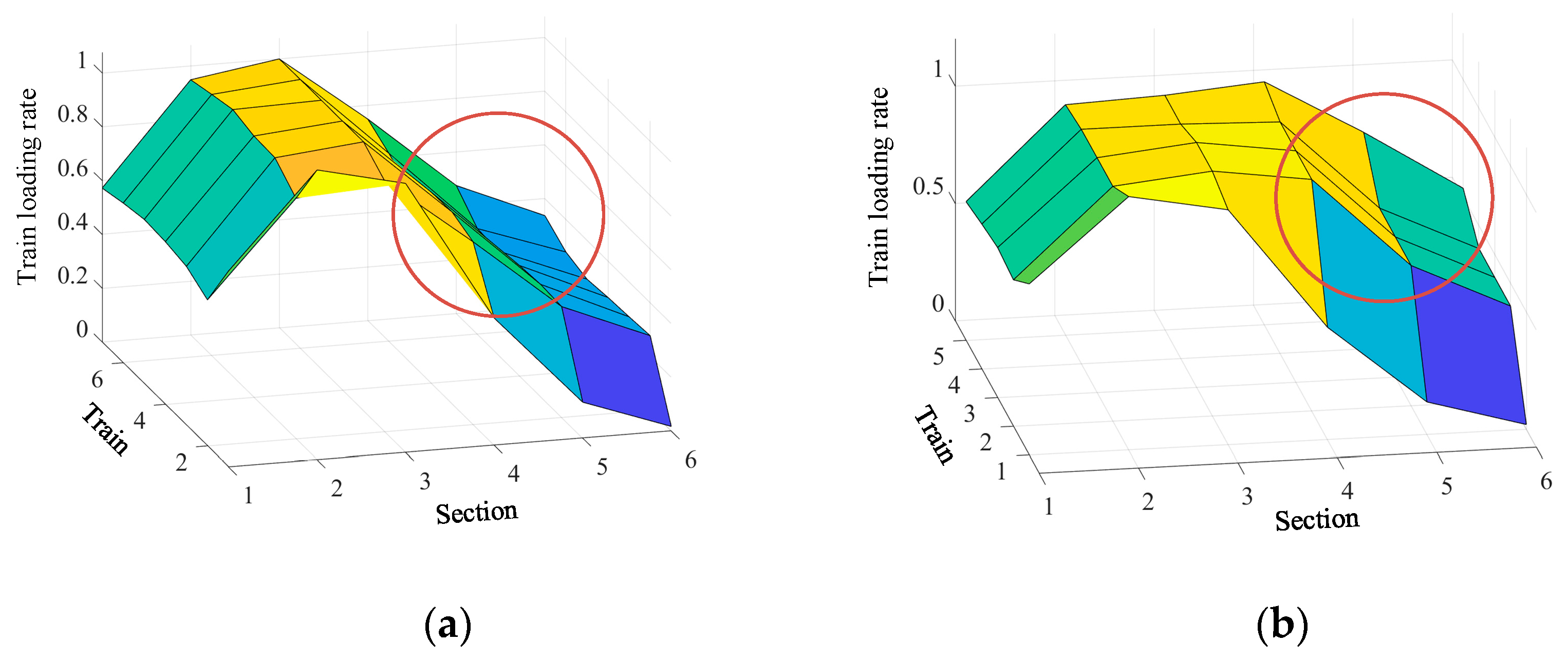
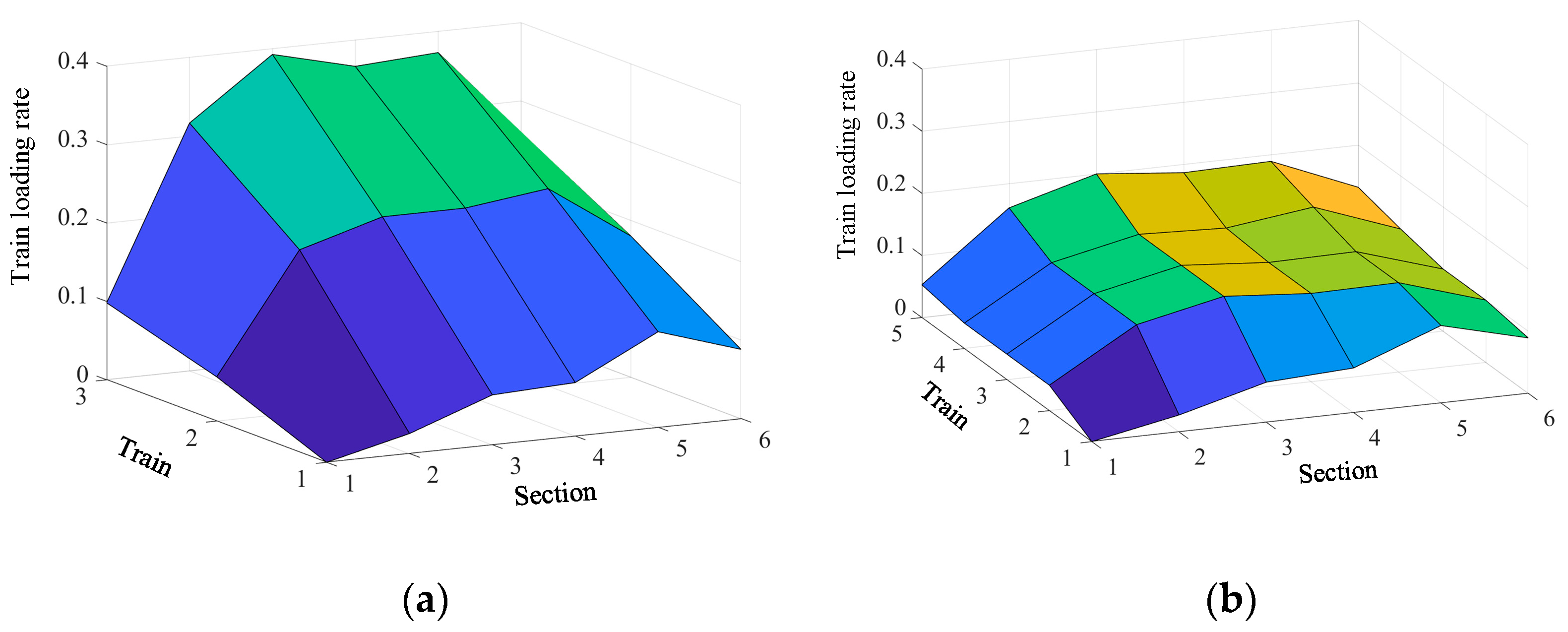
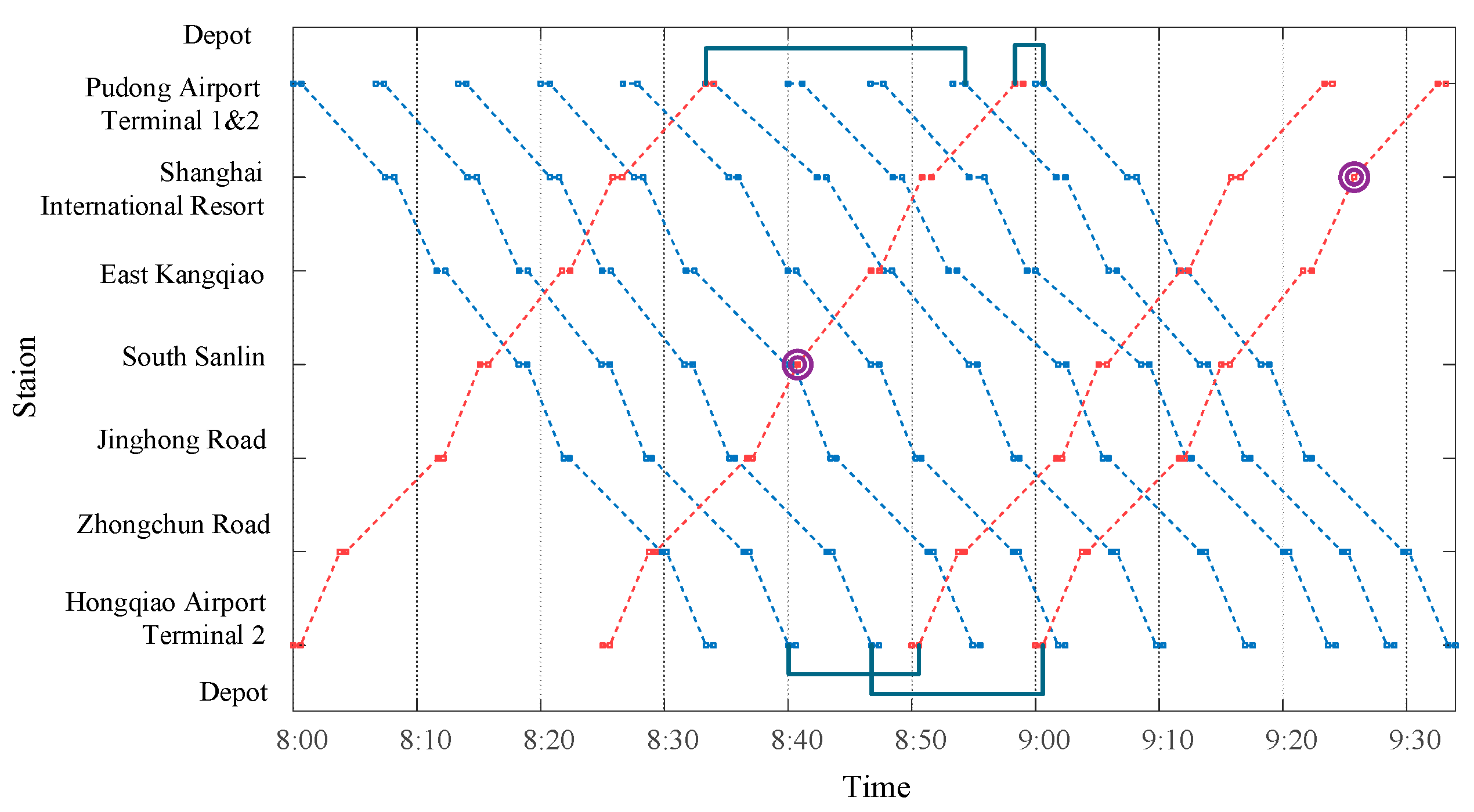
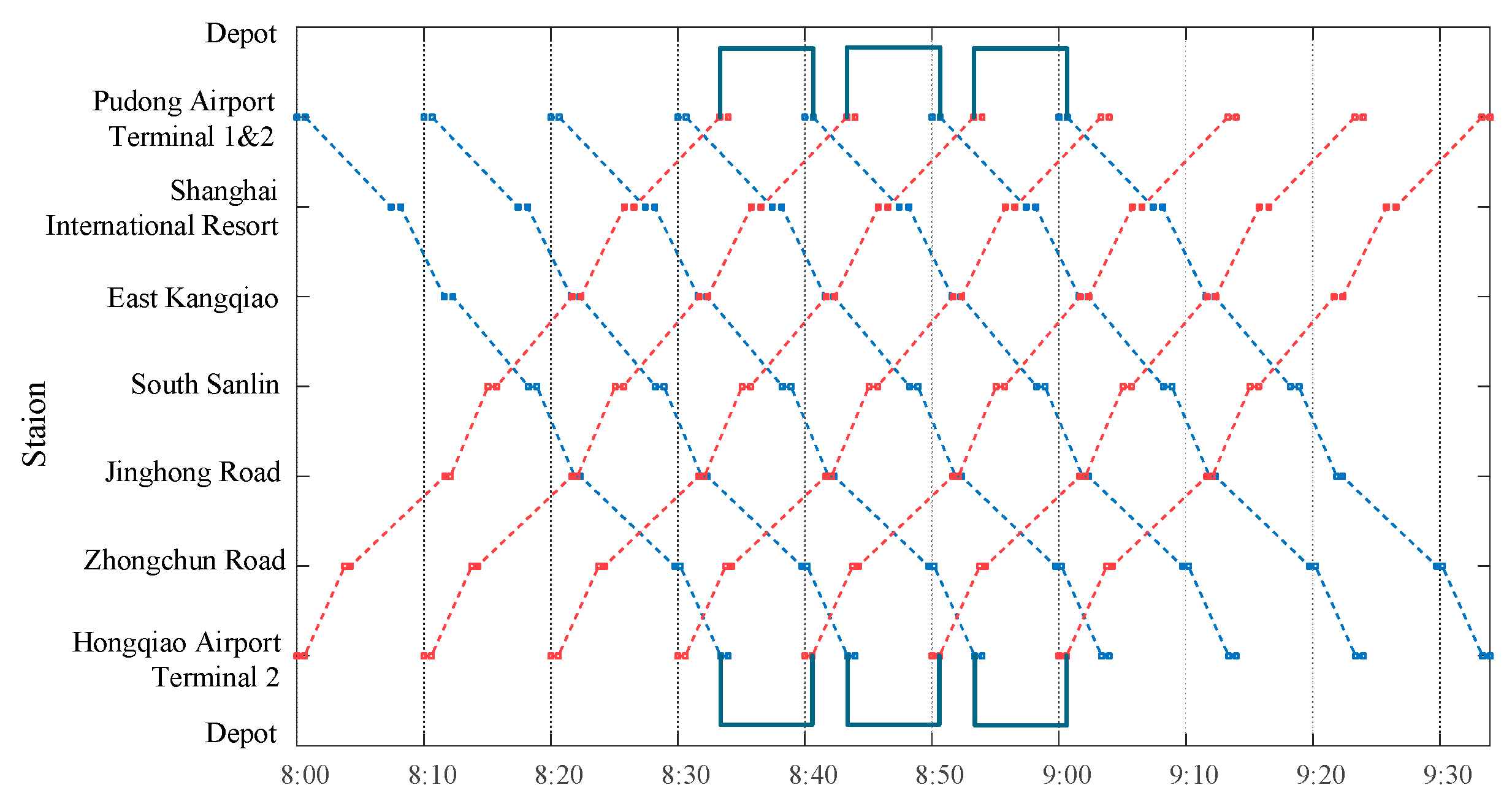

| Station | Minimum dwell time (s) |
Maximum dwell time (s) |
Maximum running time (s) |
minimum running time (s) |
|---|---|---|---|---|
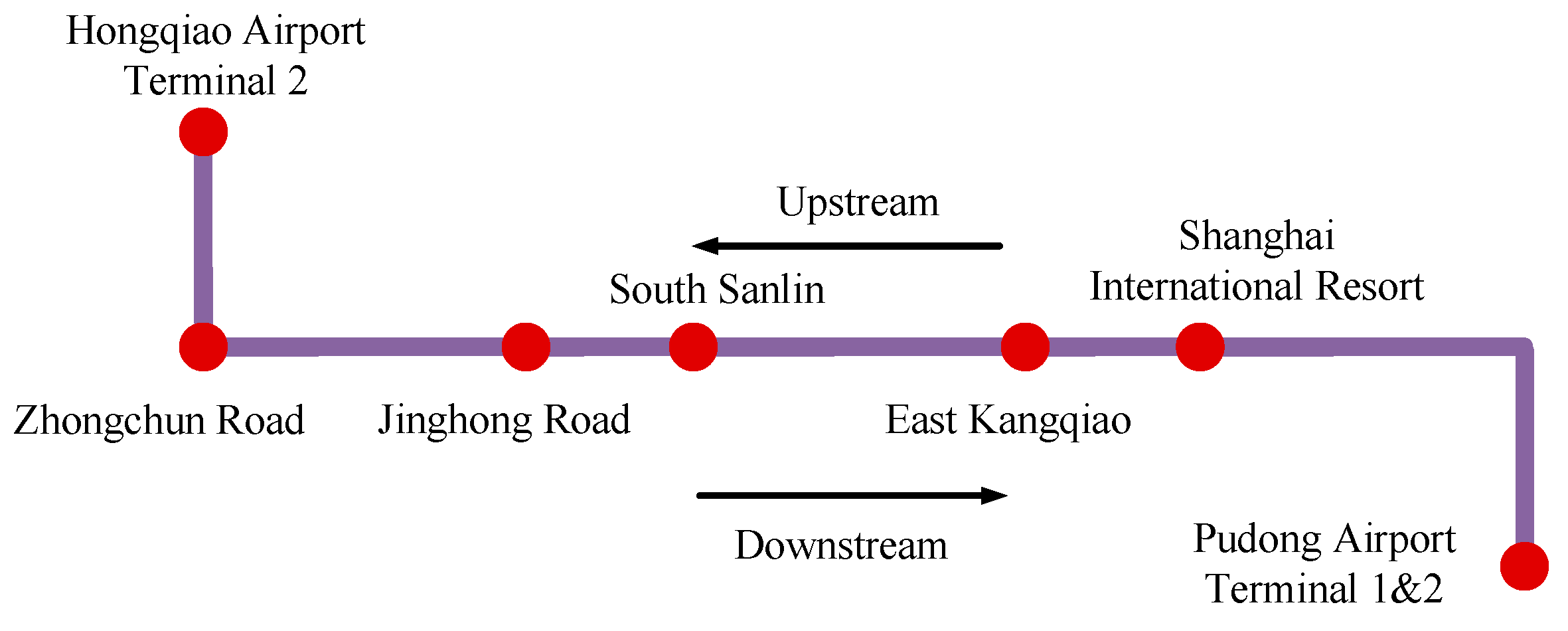
| Hongqiao Airport Terminal 2 |
35 | 65 | - | - |
| Zhongchun Road | 27 | 57 | 382 | 191 |
| Jinghong Road | 27 | 57 | 890 | 445 |
| South Sanlin | 40 | 70 | 356 | 178 |
| East Kangqiao | 41 | 71 | 714 | 357 |
| Shanghai International Resort | 45 | 75 | 412 | 206 |
| Pudong Airport Terminal 1&2 |
39 | 69 | 812 | 406 |
| 1800 (s) | 400 (s) | 90 (s) | 90 (s) | 90 (s) | 90 (s) |
| Total travel time(s) | Number of stops | Stranded passengers |
Objective value (Yuan) | ||||
| Upstream* | Downstream* | Upstream* | Downstream* | Upstream* | Downstream* | ||
| TUOS-ELS | 14886 | 6139 | 49 | 20 | 196 | 91 | 34245 |
| T-TPOS | 10185 | 10185 | 35 | 35 | 2489 | 0 | 55760 |
| Total waiting time(h) | Total on-board time(h) | Calculation time(s) | Gap of GUROBI | |||
| Upstream | Downstream | Upstream | Downstream | |||
| TUOS-ELS | 1841.1 | 723.6 | 2666.5 | 330.8 | 1000 | 0.45% |
| T-TPOS | 2581.1 | 388.7 | 2189.9 | 338.8 | - | - |
| Total travel time(s) | Number of stops | Stranded passengers |
Objective value (Yuan) | ||||
| Upstream* | Downstream* | Upstream* | Downstream* | Upstream* | Downstream* | ||
| TUOS-ELS | 21293 | 8111 | 70 | 26 | 866 | 210 | 54564 |
| T-TPOS | 14259 | 14259 | 49 | 49 | `4109 | 0 | 84380 |
| Total waiting time(h) | Total on-board time(h) | Calculation time(s) | Gap of GUROBI | |||
| Upstream | Downstream | Upstream | Downstream | |||
| TUOS-ELS | 2059.4 | 804.3 | 3876.2 | 437.8 | 1000 | 0.5% |
| T-TPOS | 2770.1 | 421.1 | 3121.4 | 496.2 | - | - |
Disclaimer/Publisher’s Note: The statements, opinions and data contained in all publications are solely those of the individual author(s) and contributor(s) and not of MDPI and/or the editor(s). MDPI and/or the editor(s) disclaim responsibility for any injury to people or property resulting from any ideas, methods, instructions or products referred to in the content. |
© 2024 by the authors. Licensee MDPI, Basel, Switzerland. This article is an open access article distributed under the terms and conditions of the Creative Commons Attribution (CC BY) license (http://creativecommons.org/licenses/by/4.0/).


