
Submitted:
22 November 2024
Posted:
22 November 2024
You are already at the latest version
Abstract
Garden cress (Lepidium sativum) seeds, from the Brassicaceae family, are rich in essential fatty acids and possess medicinal properties due to their phenol and flavonoid content. Oil extraction was performed using Soxhlet extraction with hexane as the solvent, investigating the effects of heat treatment, particle size, and extraction time on oil yield. A maximum predicted oil yield of 28.65% was achieved using Design Expert software (version 12.0.0), validated with an actual yield of 28.53%. The physical properties of the oil were determined as density (700 ± 10 kg/m³), viscosity (67.65 ± 1.15 mm²/s), and refractive index (1.47). Chemical properties included a free fatty acid value of 0.64%, peroxide value of 3.59 meq/kg, iodine value of 127 g I₂/100 g, and saponification value of 183.84 mg KOH/g. GC-MS analysis revealed that the oil contains 47.81% monounsaturated, 37.88% polyunsaturated, and 14.26% saturated fatty acids.
Keywords:
Garden cress seed oil
; Soxhlet extraction
; Essential fatty acids
; Process optimization
; GC-MS analysis
1. Introduction
Garden cress (Lepidium sativum), an annual plant belonging to the Brassicaceae family, is widely cultivated in various regions, including the United States, Europe, India (Sachin et al., 2020), and parts of Africa, such as Ethiopia and Eritrea. Known as "Fetto" in Amharic language, the plant is characterized by its upright growth, reaching about 45 cm in height, with a leafy appearance and white flowers arranged in long racemes. The pods are obovate, rounded, and elliptic, with a notched apex and winged edges, contributing to its distinctive morphology (Singh & Paswan, 2017).
Garden cress is valued for its diverse applications across various fields, including culinary, and medicinal uses. All parts of the plant such as seeds, leaves, and roots hold economic importance. However, the plant is primarily cultivated for its seeds, which are particularly rich in essential nutrients. The seeds of Garden cress comprise approximately 80–85% endosperm, 12–17% seed coat, and 2–3% embryo, and are known to contain about 25% protein, 14–24% lipids, 33–54% carbohydrates, and 8% crude fiber (Sofowora, 1993). Additionally, these seeds are rich in polyunsaturated and monounsaturated fatty acids, including linolenic, linoleic, and oleic acids, which are vital for human health (Chatoui et al., 2020).
In the culinary world, Garden cress leaves are prized for their peppery, tangy flavor, often used as a garnish in salads. Medicinally, the plant has been used for a variety of purposes, such as promoting menstruation, stimulating breast milk production, cleansing the bowels, and functioning as a free radical scavenger (Singh & Paswan, 2017). The seeds have also been utilized in the preparation of iron-rich cookies and health drinks, showcasing their versatility and nutritional value. Furthermore, Garden cress seeds contain a significant amount of oil, with content ranging from 9.33% to 24.7%, depending on the extraction methods used (Musara et al., 2020).
Despite its nutritional and therapeutic potential, Garden cress remains underutilized in Ethiopia, where its applications are mostly confined to traditional medicine. This underutilization could be attributed to a lack of awareness and limited research on the plant's full potential, particularly concerning the extraction and characterization of its seed oil. The specific growing conditions and varieties found in Ethiopia may influence the oil's composition and yield, yet these aspects remain largely unexplored in existing studies, which predominantly focus on other regions.
This study aims to address this research gap by optimizing the extraction process of Garden cress seed oil from seeds grown in Ethiopia, specifically from West Hararghe, Chiro, using hexane as the solvent. The research will also characterize the physical and chemical properties of the extracted oil, providing valuable insights into its potential applications in various industries. The findings of this study will contribute to the broader understanding of Garden cress seed oil, promoting its cultivation and utilization in Ethiopia and potentially influencing its economic and health-related significance.
2. Materials and Methods
2.1. Experimental Design
The experiment was structured using a face-centered central composite design (FCCD) using design Expert Software 12.0.0 trial version to examine the influence of three independent variables: particle size, heat treatment time, and extraction time, with the objective of maximizing oil yield. FCCD is particularly suited for exploring the relationships between multiple factors and their effects on the response variables, allowing for efficient optimization with a reduced number of experiments. This design was chosen due to its ability to provide robust results in process optimization, especially when the exact nature of factor interactions is not well understood.
The experiment generated a total of twenty runs, consisting of six axial points, eight fractional factorial points, and six central points which was provided in Table 1 below.
2.2. Preparation of Sample
Garden cress seeds were sourced from local farmers in selected region of Ethiopia. The seeds were cleaned to remove any impurities, such as dust and foreign materials, and were then air-dried to a consistent moisture content. The drying process was carefully monitored to ensure uniformity across all samples. The dried sample then ground using a coffee grinder. The resulting flour was then sieved using an analytical sieve with aperture sizes of 600, 425, and 250 µm. The flour was treated in an air oven at 100 °C for 30, 40, and 50 minutes. The modified flour was then stored in polyethylene plastic bags for further analysis. The specific parameters such as temperature, time and aperture size were chosen based on preliminary experiments.
2.3. Determination of Moisture Content
The moisture content of Lepidium sativum seeds was determined using the method described by Chen, (2003). An empty dried dish was first weighed, then a 5 g sample was placed in the dish and evenly distributed. The sample was then dried in an oven at 105℃ for 4 hours. After drying, the sample was cooled in a desiccator for 30 minutes, and its weight was measured.
The moisture content of the seed was calculated using the formula below:
Where:
W1= weight of sample before drying measured in grams
W2=weight of sample after drying measured in grams
2.4. Extraction
The extraction of Garden cress seed oil was carried out using a Soxhlet extraction apparatus. A specific quantity of seeds (600g) was ground to a fine powder to increase the surface area for extraction. The powdered seeds were then placed in the Soxhlet apparatus, and hexane was used as the solvent due to its efficiency in extracting oil from seeds.
The extraction was performed at three different temperatures (30°C, 40°C, and 50°C) for varying time durations (30, 40, and 50 minutes) as per the experimental design. These temperature and time ranges were selected based on preliminary studies, indicating their effectiveness in maximizing oil yield while preserving the oil’s quality. After the extraction, the hexane-oil mixture was subjected to rotary evaporation to remove the solvent, leaving behind pure Garden cress seed oil. The rotary evaporator was set to a temperature of 69 ℃, which is at the boiling point of hexane, ensuring complete solvent removal without degrading the oil’s quality. The extracted oil was then weighed to determine the yield, and samples were stored in amber bottles at 4°C to prevent oxidation until further analysis. The oil yield was calculated as a percentage using the formula provided by Olowokere et al., (2019).
Where: Wo is weight of oil obtained
Ws is weight of cress seed sample
2.5. Physical Characteristics
The physical characteristics of the oil, including density, kinematic viscosity, and refractive index, were measured which was obtained at the optimal extraction conditions.
2.5.1. Determination of the Density of Oil
The relative density of the oil was measured using a digital density meter (model: A. KRUSS Optronic GmbH-DS7800), with the result displayed directly on the screen. The density of Garden cress seed oil was then calculated using the following formula provided by Kyei et al., (2019).
Where: ρc is density of cress seed oil
ρrc is relative density of cress seed oil
ρw is the density of distilled water.
2.5.2. Kinematic Viscosity
A rotational viscometer (model: NDJ-1B Rotational Viscometer) was used to measure the dynamic viscosity. The sample was placed in a beaker, and the dynamic viscosity was determined using the viscometer with a spindle II at 60 RPM, following the method described by Chen et al., (2015).
The kinematic viscosity of Garden cress seed oil was then calculated as follows:
Where: ν is kinematic viscosity (mm2/s)
μ is dynamic viscosity (mPa sec)
ρc density of cress seed oil (kg/m3).
2.5.3. Refractive Index
A digital refractometer (A. KRUSS Optronic GmbH-DR6200-T) was utilized to measure the refractive index of the oil sample. Prior to calibration with distilled water, the sample holder was cleaned using soft tissue and water. The oil sample was then placed in the holder, and the refractive index was recorded on the display at a temperature of 20℃ (Kyei et al., 2019).
2.6. Chemical Characteristics
The chemical properties of the oil sample extracted under optimal conditions were analyzed, including the free fatty acid value, peroxide value, iodine value, and saponification value.
2.6.1. Free Fatty Acid Value
The free fatty acid content in garden cress seed oil was measured following the procedure outlined by Mahesar et al., (2014). Approximately 7.05 grams of the extracted oil was placed into a conical flask, followed by the addition of 75 ml of hot neutral ethyl alcohol (98% purity) and 2 ml of phenolphthalein indicator. The mixture was then shaken thoroughly to ensure complete dissolution. It was subsequently titrated with 0.25N NaOH while shaking vigorously until a pink color appeared. The free fatty acid value was calculated as a percentage of oleic acid using the following formula:
Where: FFA = Free fatty acid
ml = Volume of NaOH consumed during titration, expressed in milliliters
N = Normality of NaOH
F = Equivalent weight in which FFA was expressed (282)
2.6.2. Peroxide Value
The peroxide value of garden cress seed oil extracted under optimal conditions was measured following the procedure outlined by Zhang et al., (2021). In this method, 5 ml of the oil sample was placed into a conical flask, followed by the addition of 30 ml of an acetic acid-chloroform mixture (3:2) and 0.5 ml of saturated potassium iodide. The contents were shaken for 1 minute and then kept in the dark for 5 minutes. Afterward, 30 ml of distilled water was added, and the mixture was shaken for 1 minute. A blank was prepared in the same manner as the sample, except without the oil. Both the sample and the blank were titrated with 0.1N sodium thiosulfate, using 1% starch as an indicator. The titration was carried out until the blue-black color disappeared. The peroxide value was then calculated as follows:
Where: S = Volume of sodium thiosulfate required by the sample
N = Normality of sodium thiosulfate
B = Volume of titrant in the blank
W = Weight of the sample
1000 = Unit conversion factor
2.6.3. Iodine Value
The iodine value of garden cress seed oil was determined, following the method described by Firestone, (1994). To prepare the sample, 0.15 g of the oil was placed into a flask, followed by the addition of 25 ml of carbon tetrachloride. Then, 25 ml of Wiji solution was added, and the flask was shaken and rotated to ensure thorough mixing.
The sample was then stored in the dark for approximately 30 minutes after potassium iodide crystals were placed around the stopper. A blank was prepared in the same way as the sample, except using the oil sample. The titration was then carried out using 0.1 normal sodium thiosulfate, with a 1% starch solution serving as an indicator. The endpoint of the titration was indicated by a milky white color. The iodine value of the garden cress seed oil was calculated using the following formula:
Where: VB = volume of sodium thiosulfate used to titrate blank
VS= volume of sodium thiosulfate used to titrate sample
N= normality of sodium thiosulfate
Ws= weight of sample
2.6.4. Saponification Value
The saponification value of garden cress seed oil extracted under optimal conditions was determined following the method described by Michael et al., (2014). In a saponification flask, 2.53 g of the oil sample was mixed with 25 ml of 4% ethanolic KOH. A separate flask containing 25 ml of the same 4% ethanolic KOH served as a blank. Both the sample and the blank were then saponified for about 30 minutes using a reflux condenser. Titration was performed with 0.5N hydrochloric acid, using phenolphthalein as an indicator. The endpoint of the titration was marked by the disappearance of the pink color. The saponification value was calculated using the following formula:
Where: VB= volume of HCl used to titrate blank
VS=volume of HCl used to titrate the sample 28
N=Normality of HCl
Ws= weight of the sample
2.7. Functional group analysis
The functional groups of garden cress seed oil were identified using an attenuated total reflection Fourier transform infrared (FTIR-ATR) spectrometer, specifically the iS50 ABX model from Thermo Scientific, Germany. During the setup, the FTIR was preheated and stabilized with a solvent. Signals were captured over 32 scans with a resolution of 250 cm⁻¹. The oil sample was placed between two well-polished KBr disks, forming a thin film. Spectra were recorded across a range of 4000 to 500 cm⁻¹ and processed using the Spectrum for Windows software (Perkin-Elmer) as described by Olowokere et al., (2019). After 10 minutes, a graph of transmittance (%) versus absorption number (cm⁻¹) was displayed, and the results were analyzed.
2.8. Determination of fatty acid composition
The qualitative analysis of the fatty acid composition of garden cress seed oil was conducted using a gas chromatography-mass spectrometer (GC-MS). The method was based on the procedure described by Gokavi et al., (2004). The sample was injected using a sample injector, with the oven temperature set as follows: 60°C, increasing by 6°C/min for 10 minutes, then 180°C, increasing by 3°C/min for 15 minutes, and finally 250°C, increasing by 3°C/min for 6 minutes, resulting in a total run time of 60 minutes. Helium served as the carrier gas at a flow rate of 1 ml/min, with a transfer line temperature of 300°C and an MS ion source temperature of 230°C. The sample preparation prior to analysis followed the method outlined by Gokavi et al., (2004).
Reagent Preparation:
To prepare 0.5 M methanolic KOH, 2.8 g of potassium hydroxide pellets were dissolved in 100 ml of methanol and stored in a dry, cool place. Methanolic HCl (HCl: Methanol = 4:1) was prepared by mixing 5 ml of methanol with 20 ml of HCl.
Sample Preparation:
Approximately 600 microliters of the oil sample were added to a saponification flask, along with 12 ml of the 0.5 M methanolic KOH solution. The mixture was then saponified for about 15 minutes, after which 5 ml of methanolic HCl solution was added, and saponification continued for another 25 minutes. Following saponification, methyl extraction was carried out using n-hexane, and the mixture was then filtered through Whatman No. 1 filter paper and sodium sulfate anhydrous. The prepared sample was then injected into the GC for analysis. The percentage composition of fatty acids in garden cress seed oil was calculated using the formula provided by Ghazal et al., (2017). The formula is as follows:
Where: AX=area of fatty acid methyl esters
AT=total area of the chromatogram
2.9. Statistical Analysis
The experimental data were analyzed using Design-Expert software, trial version 12.0.0. The software facilitated the development of response surface models and the identification of optimal conditions for oil extraction. Analysis of variance (ANOVA) was used to assess the significance of the model terms, and the adequacy of the model was evaluated using R-squared values and lack-of-fit tests.
3. Results and Discussions
3.1. Moisture Content
The moisture content of Garden cress seeds was measured to be 6.48% in this study. However, Sachin et al., (2020) found that Garden cress seeds had a moisture content of 3.1%, which differs from our findings. Similarly, Zia-Ul-Haq et al., (2012) reported a moisture content of 3.92%. These discrepancies can be attributed to various factors such as soil type, harvesting stage, species, and climatic conditions in which the seeds were grown. It is important to note that the studies by Sachin et al., (2020) and Zia-Ul-Haq et al., (2012) were conducted in India whereas the present study were conducted in Ethiopia, which may have further contributed to the variation. Additionally, differences in the drying techniques employed and the methods used to evaluate moisture content could also account for the observed differences. In another study conducted in Saudi Arabia, Al-Jasass and Al-Jasser, (2012) reported a moisture content of 2.88% and Rezig et al., (2022a) reported 2.63% , further highlighting the variability in moisture content across different regions and conditions.
3.2. Interpretation of Response Surface Methodology
3.2.1. Interpretation of Statistical Analysis
The effects of three independent processing variables such as particle size, heat treatment time, and extraction time on oil yield were investigated using response surface methodology (RSM). The study employed a face-centered central composite design (FCCD) to explore both the main effects and the interaction effects of these variables on the oil yield. This approach enabled a comprehensive analysis of how each factor individually and in combination influences the efficiency of oil extraction.
The highest actual oil yield (28.33%) was achieved with a particle size of 250 µm, a heat treatment time of 30 Min, and an extraction time of 7Hr. Conversely, the lowest yield (12.38%) was obtained with a particle size of 600 µm, a heat treatment time of 50 Min, and an extraction time of 3Hr.Table 2 illustrates the result of analysis of variance.
The model's F-value of 461.80 indicates that the model is highly significant. P-values less than 0.0500 signify that the corresponding model terms are significant. In this case, the terms A (particle size), C (extraction time), AC (interaction between particle size and extraction time), and A² (the square of particle size) are significant. P-values greater than 0.1000 suggest that the model terms are not significant. If there are numerous insignificant terms (excluding those necessary to maintain model hierarchy), reducing the model could potentially improve its accuracy.
The Lack of Fit F-value of 3.41 suggests that the Lack of Fit is not significant relative to the pure error, with a 10.24% chance that a Lack of Fit F-value this large could be due to random noise. Therefore, particle size, extraction time, the interaction between particle size and extraction time, and the quadratic term of particle size significantly influence the yield of Garden cress seed oil.
Development of Regression Model Equation
The regression model equation that relates the oil yield (response) to the process variables in terms of actual values has been developed. The quality of the model can be assessed by examining the coefficients of correlation. A quadratic polynomial model was determined to be the most appropriate for describing the extraction of Garden cress seed oil using hexane as the solvent. This conclusion is supported by the adjusted R² value of the quadratic model, which is 0.9954 significantly higher than that of the linear (0.7801) and two-factor interaction (0.7322) models.The cubic model was found to be aliased and therefore unsuitable.
As a result, a second-order polynomial (quadratic) model was employed to express the oil yield as a function of the independent process variables. The equation for the model in terms of coded values is as follows:
Yield=25.19-6.85A-0.244B+0.848C- 0.146AB+0.351AC+0.0537BC-4.983A2+0.361B2+0.311C²
Where: A=Particle size
B=Heating time
C=Extraction time
Model Adequacy Check
The adequacy of the model was evaluated by examining the coefficient of determination (R²) and the adjusted coefficient of determination (R²_adj). The values obtained were 0.9976 and 0.9954, respectively, indicating an excellent fit of the estimated model with the experimental data. An R² value of 0.9976 implies that 99.76% of the total variation in the oil yield can be attributed to the experimental variables studied. According to Draper and Smith, (1998), for a model to be considered a good fit, the R² value should be at least 0.8. Since the obtained R² value (0.9976) is significantly higher than 0.8, it suggests that the regression model accurately explains the actual response.
Additionally, the predicted R² value of 0.9807 is in close agreement with the adjusted R² (0.9954), with a difference of less than 0.1, indicating that the model can be reliably used for interpolation. The figure below presents the normal plot and the graph of actual versus predicted oil yield, both of which display a linear relationship, further confirming the model's adequacy.
The Effect of Individual Factors on Oil Yield
The influence of individual independent process variables on the yield of Garden cress seed oil was investigated, focusing on particle size, heating time, and extraction time. The results are presented in the following sections.
Effect of Particle Size on Oil Yield
The highest oil yield (27.37%) was obtained with a particle size of 250 µm, while the lowest yield (12.85%) occurred with a particle size of 600 µm. The higher yield at smaller particle sizes is due to the larger surface area available for contact with the solvent, allowing oil to diffuse out more efficiently. In contrast, larger particle sizes have a reduced surface area, creating resistance to solvent penetration and making it more difficult for the oil to diffuse out.
However, it is important to note that if the particle size becomes too small, it can lead to agglomeration and the formation of a paste-like structure, which can reduce the solvent’s ability to effectively contact the particles' surface. This phenomenon aligns with findings from Nagy and Simándi, (2008),who studied the effect of particle size on the extraction efficiency of oil using the supercritical fluid extraction method and found that extraction efficiency was highest with particle sizes ranging between 100 and 700 µm.
Effect of heat treatment time on oil yield
A higher oil yield (26.01%) was achieved with a heat treatment time of 30 Min, while a lower yield (24.9%) was observed at a heat treatment time of 50 Min.
This finding is consistent with previous studies. For instance, (Uquiche et al., 2008), investigated the effect of microwave pretreatment on the mechanical extraction of oil from Chilean hazelnuts. They found that treating the nuts under 400W for 240 seconds resulted in a 45.3% oil yield, which was significantly higher than the yield from untreated samples (6.1%). Similarly, Moreau et al., (1999), studied the effect of heat pretreatment using a convection oven and reported a slight increase in oil yield, further supporting the notion that optimal heat treatment can enhance oil extraction efficiency.
Effect of extraction time on oil yield
The highest yield (26%) was achieved with an extraction time of 7Hr., while the lowest yield (24.81%) was observed with an extraction time of 3Hr. This suggests that extending the extraction time allows for more thorough extraction of the oil, likely due to increased contact time between the solvent and the seed particles, leading to a higher oil yield but Ntalikwa, (2021) reported that there was not significant increase on the oil yield after 7Hr. of extraction time.
Effect of the interaction of process variables on oil yield
Based on the analysis of variance (ANOVA), the interaction between particle size (A) and heat treatment time (B) (Figure 1) was found to be insignificant, with a p-value of 0.2957. Conversely, the interaction between particle size (A) and extraction time (C) (Figure 2) was significant, with a p-value of 0.0243, indicating that this combination of variables significantly influences oil yield. Lastly, the interaction between heat treatment time (B) and extraction time (C) ) was also found to be insignificant, with a p-value of 0.6936.
Optimal Process Variables for the Extraction of Garden Cress Seed Oil
After ensuring an accurate estimate of the true response through statistical analysis and diagnostic graphs, the optimization of process variables to achieve the highest oil yield was conducted. The predicted optimal combination of process variables included a particle size of 319.22 µm, a heat treatment time of 48.87 Min, and an extraction time of 6.99Hr., which resulted in a predicted oil yield of 28.65% with a desirability of 1.
To validate the model, Garden cress seed oil was extracted using hexane under the predicted optimal conditions three times, resulting in an average oil yield of 28.53%. The difference between the predicted and actual yields was minimal, at just 0.12%, confirming the accuracy and reliability of the model.
3.2.2. Physical Properties of Garden Cress Seed Oil
Density of Garden Cress Seed Oil
The density of Garden cress seed oil was measured to be 700kg/m³. In comparison, Sachin et al., (2020), reported densities of 900 kg/m³ for oil extracted using hexane solvent and 1010 kg/m³ for oil extracted with petroleum ether solvent. Musara et al., (2020) reported densities of 900 kg/m³ and 910 kg/m³ for oil extracted by solvent extraction and cold press methods, respectively. These values are higher than the density of Garden cress seed oil obtained in this study. The differences in density values reported by different researchers and the value obtained in this study may be attributed to factors such as the extraction method, seed variety, soil type, and climatic conditions in which the seeds were grown. However, the obtained density of 700 kg/m³ falls within the typical range of densities for most edible oils, which generally range from 700 kg/m³ to 950 kg/m³.
Kinematic Viscosity of Garden Cress Seed Oil
The kinematic viscosity of Garden cress seed oil was found to be 67.85mm²/s. Diwakar et al., (2010) reported a viscosity of 64.3 mm²/s, which is lower than the value obtained in this study. Sachin et al., (2020) also reported viscosities of 52.9 mm²/s and 50.1 mm²/s for oil extracted using hexane and petroleum ether, respectively. These values are also lower than the value found in this study. The variation in viscosity values may be due to differences in the methods used for determining viscosity, the extraction methods, seed species, climatic conditions, and the harvest time of the seeds.
Refractive Index of Garden Cress Seed Oil
The refractive index of Garden cress seed oil at 20℃ was found to be 1.473. Musara et al., (2020) reported a similar refractive index of 1.47, which aligns closely with the results of this study. Sachin et al., (2020) found refractive indices of 1.25 and 1.3 for oil extracted using hexane and petroleum ether solvents, respectively. Another study by Diwakar et al., (2010) and by Rezig et al., (2022a) also reported a refractive index of 1.47, consistent with the results of this study.
The physical properties of Garden cress seed oil, such as refractive index, viscosity, and density, are crucial in determining various properties of food products developed from this oil (Musara et al., 2020). For instance, the refractive index serves as an indicator of unsaturation and the presence of unusual components, such as hydroxyl groups, in Garden cress seed oil (Sachin et al., 2020). Therefore, the higher refractive index of 1.47 falls within the range of typical of edible oils and indicates potential use for food fortification (Musara et al., 2020).
3.2.3. Chemical Properties of Garden Cress Seed Oil
Free Fatty Acid Value of Garden Cress Seed Oil
The free fatty acid (FFA) value of Garden cress seed oil (GCSO), expressed as a percentage of oleic acid, was found to be 0.64%. Various studies have reported differing FFA values for GCSO. For example, Musara et al., (2020) reported FFA values of 0.28%, 0.39%, and 1.52% for GCSO extracted using cold press, Soxhlet, and supercritical CO₂ extraction methods, respectively. Sachin et al., (2020) found FFA values of 0.41% and 0.37% for GCSO extracted using hexane and petroleum ether, respectively. The FFA value obtained in this study is close to those reported in the literature, although slight differences exist, likely due to variations in the determination methods, seed species, extraction temperature, and solvents used.
Peroxide Value of Garden Cress Seed Oil
The peroxide value of GCSO was determined to be 3.59 meq.kg⁻¹. Musara et al., (2020) reported peroxide values of 2.63 meq.kg⁻¹ for oil extracted using supercritical CO₂ extraction and 1.27 meq.kg⁻¹ for oil extracted using solvent extraction. Additionally, they reported a peroxide value range of 2.53–4.09 meq.kg⁻¹ for oil extracted using the Soxhlet method. Sachin et al., (2020) reported peroxide values of 4.03 and 3.9 meq.kg⁻¹ for oil extracted using hexane and petroleum ether, respectively, while Diwakar et al., (2010) found a peroxide value of 4.09 meq.kg⁻¹ for oil extracted using the Soxhlet method and 2.4 meq.kg⁻¹ was reported by Rezig et al., (2022a). Although there are slight differences in the peroxide values reported in this study and by other authors, the values are all within the range expected for fresh oils, which should have peroxide values below 10 meq.kg⁻¹.
Iodine Value of Garden Cress Seed Oil
The iodine value obtained in this study was 127g I₂ absorbed/100 g. This value is consistent with those reported by other researchers. For example, Sachin et al., (2020) reported iodine values of 125 and 122 g I₂ absorbed/100 g for GCSO extracted using hexane and petroleum ether, respectively. Diwakar et al., (2010) reported iodine values of 122, 131, and 123 g I₂ absorbed/100g for GCSO extracted using cold press, Soxhlet, and supercritical CO₂ extraction methods, respectively. Rezig et al., (2022a) reported iodine value of 165 (gI2/100g).
Saponification Value of Garden Cress Seed Oil
The saponification value of GCSO was found to be 183.84mg KOH/g. Diwakar et al., (2010) reported saponification values of 178.85 mg KOH/g for GCSO extracted using the cold press method, and 182.23 mg KOH/g and 174 mg KOH/g for oil extracted using Soxhlet and supercritical CO₂ extraction methods, respectively. Sachin et al., (2020) reported saponification values of 182.5 mg KOH/g and 170.2 mg KOH/g for oil extracted using hexane and petroleum ether, respectively. Rezig et al., (2022a) reported a saponification value of 179 (mg KOH/g oil).The physicochemical properties of GCSO are summarized in Table 3.
3.2.4. FTIR Analysis of GCSO
The significance of IR spectroscopy in identifying molecular structures lies in its rich information content and its ability to assign specific absorption bands to functional groups. In the spectra of fats and oils, most bands and shoulders can be attributed to distinct functional groups (Rezig et al., 2022). The IR spectral analysis of Garden Cress Seed Oil (GCSO) confirms the presence of several functional groups in the sample:
Saturated Ester (C=O Stretch): A peak at 1743.16 cm⁻¹, within the characteristic range of 1750-1730 cm⁻¹, indicates the presence of C=O stretching vibrations of saturated esters, suggesting ester groups in the oil, likely contributing to its triglyceride content.
Aliphatic Functional Groups: Peaks at 2853.35 cm⁻¹ and 2922.39 cm⁻¹ correspond to CH₂ absorption within the ranges of 2870-2840 cm⁻¹ and near 2930 cm⁻¹, respectively. These indicate the presence of aliphatic chains, typical of the long hydrocarbon chains found in fatty acids. Additionally, a peak at 1459.84 cm⁻¹, within the range of 1470-1440 cm⁻¹, suggests the presence of CH₃ asymmetric deformation vibrations, indicating methyl groups (-CH₃) within the fatty acid chains. A further peak at 1372.82 cm⁻¹, within the range of 1390-1370 cm⁻¹, confirms symmetric CH₃ vibration splitting, suggesting branched chains. The peak at 1158.74 cm⁻¹, associated with isopropyl group vibrations (1170-1145 cm⁻¹), points to the presence of isopropyl groups, hinting at a more complex structure in the fatty acid chains or other minor components in the oil.
Olefinic Functional Groups: A peak at 3008.53 cm⁻¹, within the range typically associated with C-H stretching vibrations in olefinic compounds, indicates the presence of C-H stretching in olefinic (C=C) bonds. This suggests unsaturated components in GCSO, likely due to unsaturated fatty acids such as oleic or linoleic acid, which contain double bonds (C=C) in their hydrocarbon chains.
(CH₂)_n- Rocking Absorption: A peak at 719.55 cm⁻¹, near 720 cm⁻¹, is typical of long methylene (-CH₂-) chains in fatty acids. This absorption suggests the presence of long-chain fatty acids, which are common in many vegetable oils. This finding is consistent with the finding by Rezig et al., (2022).The FTIR analysis of GCSO was supported with the Figure 4 below.
3.2.5. Fatty acid Composition of Garden Cress Seed Oil.
The GC-MS analysis of garden cress seed oil (GCSO) extracted using hexane revealed the presence of sixteen different fatty acids. The oil comprises approximately 47.81% monounsaturated fatty acids (MUFA), 14.26% saturated fatty acids (SFA), and 37.88% polyunsaturated fatty acids (PUFA). The study's finding of 14.26% saturated fatty acids is close to 14.93% which was reported by Rezig et al., (2022a) and 17.51% reported by Ghazal et al., (2017). Another study by Singh & Paswan, (2017) reported slightly different values, with PUFA at 46.8% and MUFA at 37.6%. The study conducted by Rezig et al., (2022a) reported PUFA of 46.48% and MUFA of 38.59%. The discrepancies between these results and those in the current study could be attributed to factors such as soil type, climatic conditions, and the specific species of garden cress used.
Saturated fatty acids
This study identified eight saturated fatty acids. Based on their peak areas, the saturated fatty acids identified were palmitic acid, stearic acid, behenic acid, arachidic acid, and lignoceric acid, with percentage compositions of 6.47%, 2.50%, 1.49%, 2.59%, and 1.00%, respectively. The remaining three fatty acids, caprylic acid, myristic acid, and azelaic acid, were present only in trace amounts. According to Singh & Paswan, (2017), the saturated fatty acids found in Garden Cress Seed Oil (GCSO) were arachidic acid, stearic acid, and palmitic acid, with percentage compositions of 2.10%, 1.90%, and 10.30%, respectively. The study conducted by Rezig et al., (2022a), identified saturated fatty acids such as stearic acid , arachidic fatty acid, palmitic acid with percentage composition of 2.38, 3.1 and 9.45%. The palmitic acid composition (6.47%) in this study was notably different from the 10.30% which was reported by Singh & Paswan, (2017) and 9.45% reported by Rezig et al., (2022a). The stearic acid composition 2.50% also varied slightly from the 1.90% and 2.38% which was reported by Singh & Paswan, (2017) and Rezig et al., (2022a) respectively and the arachidic acid composition 2.59% was somewhat different from the 2.10% and 3.1% which was reported by Singh & Paswan, (2017) and Rezig et al., (2022a) respectively. Additionally, Ghazal et al., (2017) reported saturated fatty acids in GCSO, including palmitic acid, stearic acid, behenic acid, and arachidic acid, with percentages of 8.27%, 3.09%, 2.14%, and 4.01%, respectively.
Monounsaturated Fatty Acids
This study identified five monounsaturated fatty acids in garden cress seeds, accounting for a total of 47.81% of the fatty acids. Oleic acid was the most prevalent, making up about 28.13%. Other monounsaturated fatty acids present included erucic acid (8.01%), gondoic acid (9.95%), and nervonic acid (1.63%). The percentage composition of palmitoleic acid was present in only in trace amounts. According to Ghazal et al., (2017), the monounsaturated fatty acids found in Garden Cress Seed Oil (GCSO) included oleic acid, erucic acid, and palmitoleic acid, with abundances of 20.53%, 5.79%, and 0.19%, respectively. Singh & Paswan, (2017) reported that GCSO contained oleic acid and palmitoleic acid with percentages of 30.50% and 0.70%, respectively. Rezig et al., (2022a) reported oleic acid of 21.14%, erucic acid of 3.7% and nervonic acid of 3.45 and gondoic acid of 10.3%.
Polyunsaturated fatty acids
In garden cress seeds, only two polyunsaturated fatty acids were identified: linoleic acid and linolenic acid, with abundances of approximately 6.82% and 31.05%, respectively. Ghazal et al., (2017) reported linoleic and linolenic acids with compositions of 31.29% and 11.04%, respectively. Additionally, Singh & Paswan, (2017) reported linoleic and linolenic acids with percentages of 8.60% and 32.18%, respectively. Linoleic and linolenic fatty acids had percentage abundance of 10.89 and 35.59% respectively as reported by Rezig et al., (2022a).The fatty acid composition of garden cress seed oil, as determined by GC-MS analysis, is summarized in the Table 4 below.
Where; SFA= saturated fatty acids, MUFAs= Monounsaturated fatty acids and PUFAs =Polyunsaturated fatty acids. The percent composition of fatty acids was shown in the figure below that have values greater than 1.00 %. Garden cress seed oil contains highest amount of mono unsaturated fatty acids in which the major mono unsaturated fatty acid was oleic acid. Poly unsaturated fatty acids were present in minor quantity in GCSO. The GC-MS analysis of garden cress seed oil was provided in the Figure 5 below.
Conclusions
The research focused on extracting oil from garden cress seed using Soxhlet extraction technology with hexane as the solvent. Using a face-centered central composite design, the effect of heat treatment time, particle size, and extraction time on oil yield was investigated and maximum yield (28.65%) was obtained at a combination of optimum process variables (particle size=319.22μm , heat treatment time= 48.87 Min and extraction time = 6.99Hr.). The physicochemical and fatty acid composition, were all determined. The physical properties of garden cress seed oil such as density, viscosity and refractive index was studied and had values of 700±10 kg/m3, 67.65±1.15 mm2/s, and 1.47 respectively. The chemical properties such as free fatty acid value, peroxide value, iodine value, and saponification value were found with a value of 0.64±0.03 % of oleic acid, 3.59±0.026 meq.kg-1,127.00±3.605gI2absorbed/100g, and 183.84±2.496 mg KOH/g respectively. The fatty acid composition of garden cress seed oil was also determined. During the analysis of the fatty acid composition of garden cress seed oil, monounsaturated fatty acids such as oleic acid, erucic acid, gondoic acid, and nervonic acid were found to be the dominant, accounting for approximately 47.82%. Polyunsaturated fatty acids such as linoleic and linolenic acid account for approximately 37.92 %, while saturated fatty acids such as palmitic acid, stearic acid, behenic acid, arachidic acid, and lignoceric acid account for approximately 14.25%.
Author Contributions
EG designed the study, conducted the experiment and analyzed the result and wrote the manuscript draft. HD guided the experiment process, result analysis and edited the manuscript.
Acknowledgments
We would like to acknowledge, Chemical Engineering department, Industrial chemistry department and Central research laboratory of Addis Ababa Science and Technology University for the provision of chemicals and instruments.
Conflicts of Interest
we have declared no conflict of interest.
References
- Al-Jasass, F. M. , & Al-Jasser, M. S. (2012). Chemical composition and fatty acid content of some spices and herbs under Saudi Arabia conditions. The Scientific World Journal 2012, 859892. [Google Scholar] [CrossRef]
- Chatoui, K. , Harhar, H., El Kamli, T., & Tabyaoui, M. (2020). Chemical Composition and Antioxidant Capacity of Lepidium sativum Seeds from Four Regions of Morocco. Evidence-Based Complementary and Alternative Medicine 2020, 32–35. [Google Scholar] [CrossRef]
- Chen, C. (2003). Evaluation of Air Oven Moisture Content Determination Methods for Rough Rice. Biosystems Engineering 2003, 86, 447–457. [Google Scholar] [CrossRef]
- Chen, Z. , Zhao, X., Wang, Z., & Fu, M. (2015). A comparative study of inorganic alkaline/polymer flooding and organic alkaline/polymer flooding for enhanced heavy oil recovery. Colloids and Surfaces A: Physicochemical and Engineering Aspects. [CrossRef]
- Diwakar, B. T. , Dutta, P. K., Lokesh, B. R., & Naidu, K. A. (2010). Physicochemical properties of garden cress (lepidium sativum l.) seed oil. JAOCS, Journal of the American Oil Chemists’ Society 2010, 87, 539–548. [Google Scholar] [CrossRef]
- Draper, N. R. , & Smith, H. (1998). The General Regression Situation. In Applied Regression Analysis (pp. 135–148). [CrossRef]
- Firestone, D. (1994). Determination of the Iodine Value of Oils and Fats: Summary of Collaborative Study. Journal of AOAC INTERNATIONAL 1994, 77, 674–676. [Google Scholar] [CrossRef]
- Ghazal, M. S. , Kalyoubi, M. H., Mahmoud, R. M., Khallaf, M. M., & Almoselhy, R. I. M. Pomegranate and Garden Cress Seed Oils as Potential Sources of Omega Fatty Acids for Oil Blends By. Journal of Biological Chemistry & Environmental Sciences 2017, 12, 15–26. [Google Scholar]
- Gokavi, S. S. , Malleshi, N. G., & Guo, M. (2004). Chemical composition of garden cress (Lepidium sativum) seeds and its fractions and use of bran as a functional ingredient. Plant Foods for Human Nutrition (Dordrecht, Netherlands) 2004, 59(3), 105–111. [Google Scholar] [CrossRef] [PubMed]
- Kyei, S. K. , Akaranta, O., Darko, G., & Chukwu, U. J. (2019). Extraction, Characterization and Application of Cashew Nut Shell Liquid from Cashew Nut Shells. Chemical Science International Journal 2019, 28, 1–10. [Google Scholar] [CrossRef]
- Mahesar, S. A. , Sherazi, S. T. H., Khaskheli, A. R., Kandhro, A. A., & Uddin, S. (2014). Analytical approaches for the assessment of free fatty acids in oils and fats. Analytical Methods 2014, 6, 4956–4963. [Google Scholar] [CrossRef]
- Michael, A. , Fausat, A., & Doyinsola, I. (2014). >Extraction and physicochemical analysis of some selected seed oils. International Journal of Advanced Chemistry 2014, 2, 70–73. [Google Scholar] [CrossRef]
- Moreau, R. A. , Hicks, K. B., & Powell, M. J. (1999). Effect of heat pretreatment on the yield and composition of oil extracted from corn fiber. Journal of Agricultural and Food Chemistry 1999, 47, 2869–2871. [Google Scholar] [CrossRef] [PubMed]
- Musara, C. , Maroyi, A., Cheikhyoussef, N., & Cheikhyoussef, A. (2020). Cold pressed garden cress (Lepidium sativum L.) seed oil. (M. F. B. T.-C. P. O. Ramadan (ed.); pp. 477–489). Academic Press. [CrossRef]
- Nagy, B. , & Simándi, B. (2008). Effects of particle size distribution, moisture content, and initial oil content on the supercritical fluid extraction of paprika. The Journal of Supercritical Fluids 2008, 46, 293–298. [Google Scholar] [CrossRef]
- Ntalikwa, J. W. (2021). Solvent Extraction of Jatropha Oil for Biodiesel Production: Effects of Solvent-to-Solid Ratio, Particle Size, Type of Solvent, Extraction Time, and Temperature on Oil Yield. Journal of Renewable Energy 2021, 1–8. [Google Scholar] [CrossRef]
- Olowokere, J. A. , Onen, A. I., Odineze, M. C., B’aga, I. D., & Akoji, J. N. (2019). Extraction and Characterization of Oil from African Locust Bean (Parkia biglobosa) Seed. Asian Journal of Applied Chemistry Research 2019, 2, 1–11. [Google Scholar] [CrossRef]
- Rezig, L. , Chemkhi, H., Gharsallah, K., Mokbli, S., B’chir, F., Ben Achour, N., Bourgou, S., & Chouaibi, M. (2022a). Profile characterization and biological activities of cold pressed Garden Cress (Lepidium sativum) seed oil. Arabian Journal of Chemistry 2022, 15(8), 103958. [Google Scholar] [CrossRef]
- Rezig, L. , Chemkhi, H., Gharsallah, K., Mokbli, S., B’chir, F., Ben Achour, N., Bourgou, S., & Chouaibi, M. (2022b). Profile characterization and biological activities of cold pressed Garden Cress (Lepidium sativum) seed oil. Arabian Journal of Chemistry 2022, 15(8), 103958. [Google Scholar] [CrossRef]
- Sachin, M. , Raj, J. D., Paresh, D., & Avdhut, P. Studies and extraction of garden cress seed oil by different solvent. Journal of Pharmacognosy and Phytochemistry 2020, 9, 1633–1637. [Google Scholar]
- Singh, C. S. , & Paswan, V. K. (2017). The Potential of Garden Cress (Lepidium sativum L.) Seeds for Development of Functional Foods. Advances in Seed Biology 2017. [Google Scholar] [CrossRef]
- Sofowora, A. (1993). Medicinal Plants and Traditional Medicine in Africa. Spectrum Books. https://books.google.com.et/books?id=ZdaxQwAACAAJ.
- Uquiche, E. , Jeréz, M., & Ortíz, J. (2008). Effect of pretreatment with microwaves on mechanical extraction yield and quality of vegetable oil from Chilean hazelnuts (Gevuina avellana Mol). Innovative Food Science & Emerging Technologies 2008, 9, 495–500. [Google Scholar] [CrossRef]
- Zhang, N. , Li, Y., Wen, S., Sun, Y., Chen, J., Gao, Y., Sagymbek, A., & Yu, X. (2021). Analytical methods for determining the peroxide value of edible oils: A mini-review. Food Chemistry 2021, 358, 129834. [Google Scholar] [CrossRef]
- Zia-Ul-Haq, M. , Ahmad, S., Calani, L., Mazzeo, T., Del Rio, D., Pellegrini, N., & De Feo, V. (2012). Compositional study and antioxidant potential of Ipomoea hederacea Jacq. and Lepidium sativum L. seeds. Molecules 2012, 17, 10306–10321. [Google Scholar] [CrossRef] [PubMed]
Figure 1.
Interaction effect of particle size and heat treatment time on oil yield.
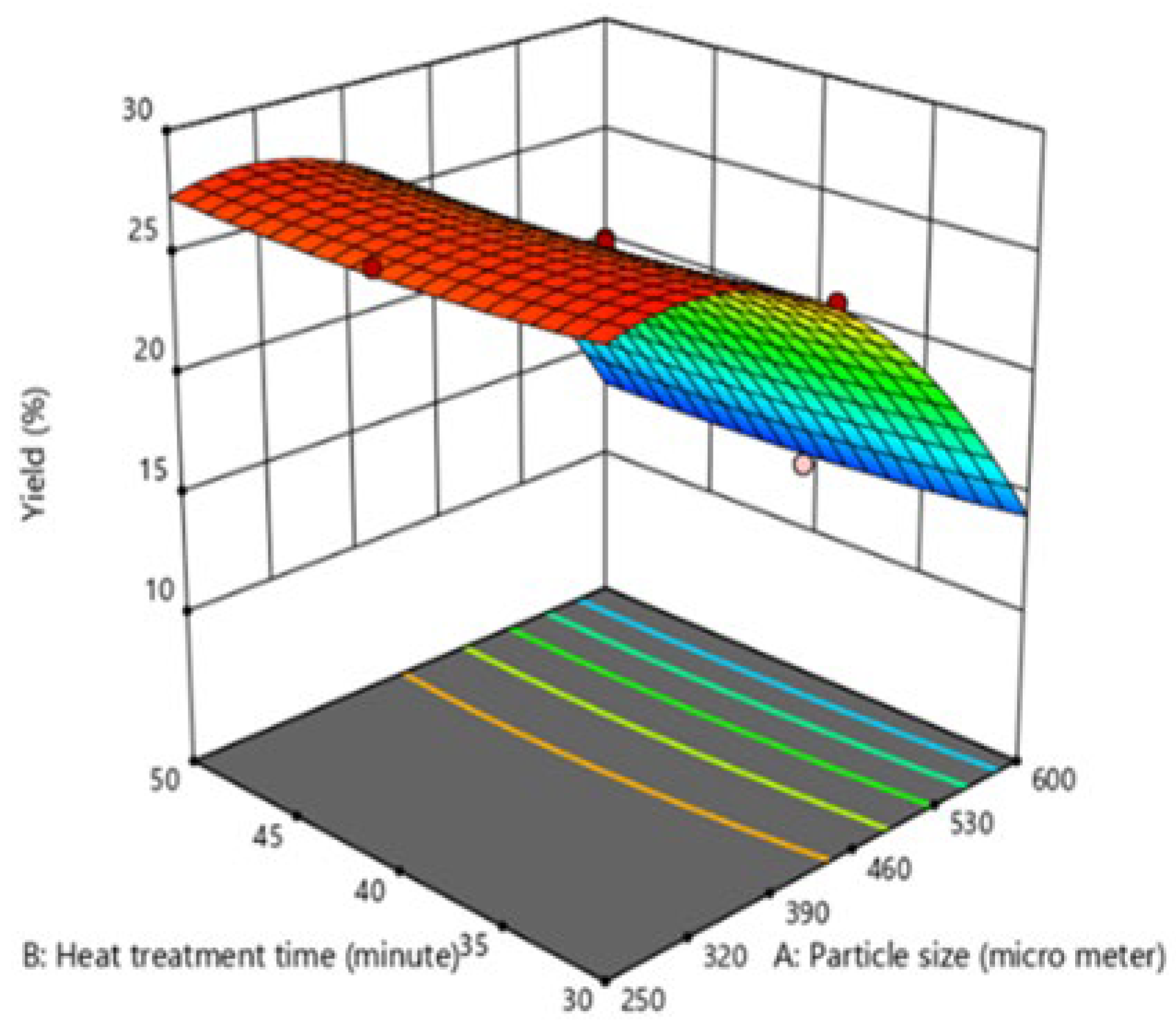
Figure 2.
Interaction effect of particle size and extraction time on oil yield.
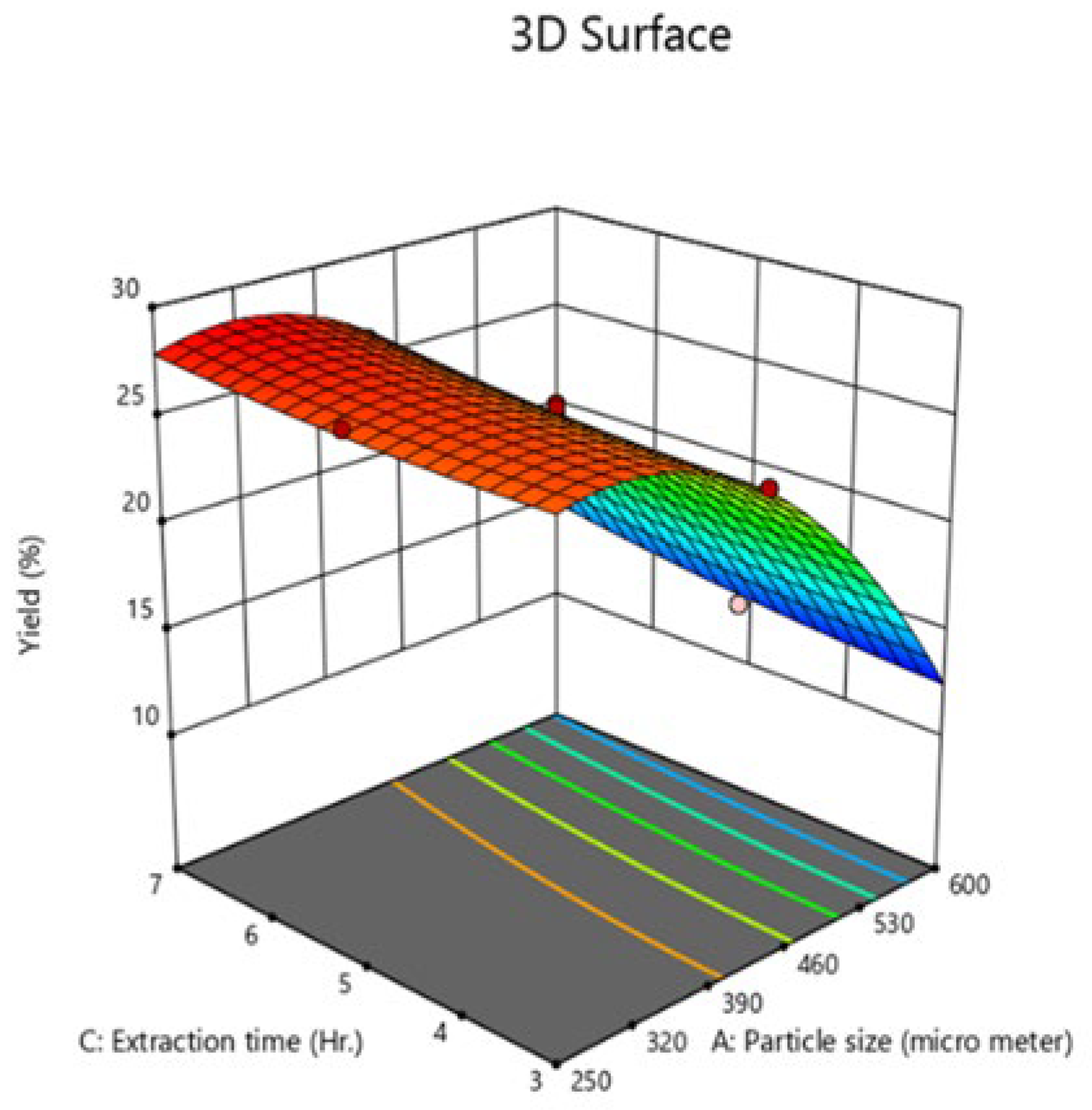
Figure 3.
Effect of extraction time and heat treatment time on oil yield.
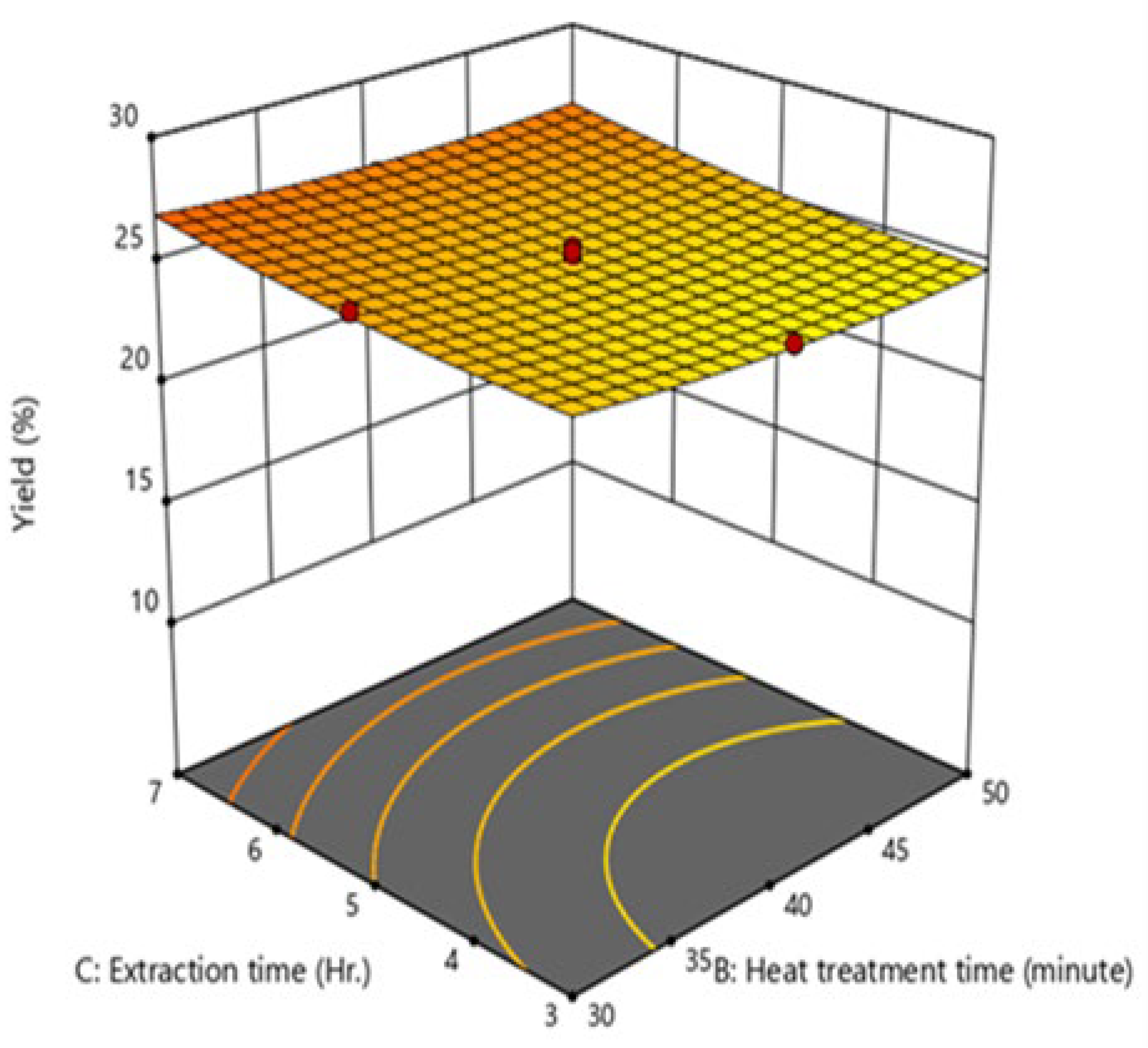
Figure 4.
FTIR analysis of garden cress seed oil.

Figure 5.
GC-MS analysis of garden cress seed oil.
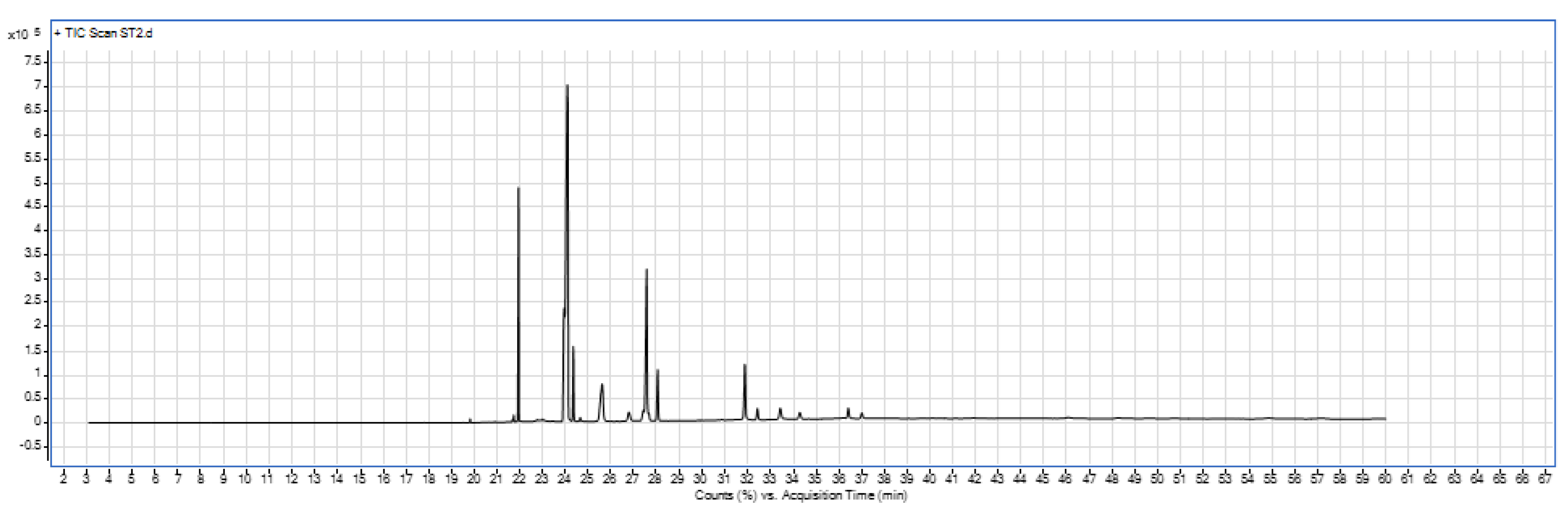

Table 1.
Experimental design for Garden cress seed oil extraction.
| Factors | Unit | -1 | 0 | 1 |
| Particle size | µm | 250 | 425 | 600 |
| Heating time | Min | 30 | 40 | 50 |
| Extraction time | Hr. | 3 | 5 | 7 |
Table 2.
Results of the analysis of variance.
| Source | Sum of Squares | Df | Mean Square | F-value | p-value | |
|---|---|---|---|---|---|---|
| Model | 584.21 | 9 | 64.91 | 461.80 | < 0.0001 | Significant |
| A-Particle size | 469.36 | 1 | 469.36 | 3339.14 | < 0.0001 | |
| B-Heat treatment time | 0.5954 | 1 | 0.5954 | 4.24 | 0.0666 | |
| C-Extraction time | 7.19 | 1 | 7.19 | 51.16 | < 0.0001 | |
| AB | 0.1711 | 1 | 0.1711 | 1.22 | 0.2957 | |
| AC | 0.9870 | 1 | 0.9870 | 7.02 | 0.0243 | |
| BC | 0.0231 | 1 | 0.0231 | 0.1644 | 0.6937 | |
| A² | 68.30 | 1 | 68.30 | 485.91 | < 0.0001 | |
| B² | 0.3591 | 1 | 0.3591 | 2.55 | 0.1410 | |
| C² | 0.26366 | 1 | 0.2666 | 1.90 | 0.1985 | |
| Residual | 1.41 | 10 | 0.1406 | |||
| Lack of Fit | 1.09 | 5 | 0.2173 | 3.41 | 0.1024 | Not significant |
| Pure Error | 0.3191 | 5 | 0.0638 | |||
| Cor Total | 585.62 | 19 |
A, B and C are particle size, heating time and extraction time respectively.
Table 3.
Physicochemical properties of garden cress seed.
| Parameters | Values |
| Moisture content (%) | 6.48±0.30 |
| Density (Kg m-3) | 700±10 |
| Kinematic viscosity (mm2/s) | 67.65±1.15 |
| Refractive index | 1.47±0.00 |
| Free fatty acid value %Oleic acid | 0.64±0.03 |
| Peroxide value (meq.kg-1) | 3.59±0.03 |
| Iodine value (gI2 absorbed/100g) | 127.00±3.61 |
| Saponification value (mg KOH/g) | 183.84±2.49 |
Values are means ± Standard Deviations (SD) of three determinations.
Table 4.
Fatty acid composition of garden cress seed oil.
| Numerical Symbol | Common name | GCSO (%) |
| C12:0 | Lauric acid | _ |
| C9:0 | Azelaic acid | _ |
| C14:0 | Myristic acid | _ |
| C16:0 | Palmitic acid | 6.47±0.08 |
| C18:0 | Stearic acid | 2.50±0.01 |
| C22:0 | Behenic acid | 1.49±0.12 |
| C20:0 | Arachidic acid | 2.59±0.04 |
| C24:1 | Nervonic acid | 1.63±0.03 |
| C24:0 | Lignoceric acid | 1.00±0.01 |
| C16:1 | Palmitoleic acid | _ |
| C18:2 | Linoleic acid | 6.82±0.02 |
| C18:1 | Oleic acid | 28.13±0.03 |
| C22:1 | Erucic acid | 8.01±0.01 |
| C8:0 | Caprylic acid | _ |
| C20:1 | Gondoic acid | 9.95±0.03 |
| C18:3 | Linolenic acid | 31.05±0.03 |
| ΣPUFA s | 37.88±0.04 | |
| ΣMUFAs | 47.81±0.04 | |
| ΣSFA | 14.26±0.13 |
Values are means ± Standard Deviations (SD) of three determinations.
Disclaimer/Publisher’s Note: The statements, opinions and data contained in all publications are solely those of the individual author(s) and contributor(s) and not of MDPI and/or the editor(s). MDPI and/or the editor(s) disclaim responsibility for any injury to people or property resulting from any ideas, methods, instructions or products referred to in the content. |
© 2024 by the authors. Licensee MDPI, Basel, Switzerland. This article is an open access article distributed under the terms and conditions of the Creative Commons Attribution (CC BY) license (http://creativecommons.org/licenses/by/4.0/).
Copyright: This open access article is published under a Creative Commons CC BY 4.0 license, which permit the free download, distribution, and reuse, provided that the author and preprint are cited in any reuse.


