

Submitted:
19 November 2024
Posted:
20 November 2024
You are already at the latest version
Abstract
Both virtual reality (VR) and aromatherapy have shown significant potential in enhancing the health and well-being of older adults. Aromatherapy has been noted to improve the immersive quality of VR experiences. However, the combined use of these interventions for older adults has not been systematically explored. This scoping review aims to identify existing VR programs supported by aromatherapy and evaluate their outcomes on older adults' well-being. Following the Joanna Briggs Institute methodology and PRISMA-ScR guidelines, the review included both published and unpublished studies. A search across ten databases yielded 901 publications, from which six studies were analyzed, involving 94 participants with a mean age of 70 to 83 years. Results revealed positive impacts on well-being, cognition, and social engagement. Outcome measures included physical, psychological, emotional, and cognitive aspects like special orientation, stress, happiness, memory, and social interaction. Benefits included enhanced spatial awareness, memory, happiness, and reduced stress. Multisensory VR environments also fostered socialization through shared experiences and nostalgia. However, the individual differences in VR experiences indicate a need for personalized content. Despite promising findings, limited evidence supports clinical application in nursing practice. Further research is required to validate the health benefits of combining VR with aromatherapy.
Keywords:
Virtual reality
; Aromatherapy
; Older adults
; Multisensory interventions
; Well-being
; Stress reduction
; Memory
; Social engagement
1. Introduction
Virtual reality (VR) uses sight and hearing stimuli to provide users with immersive, stimulating, and interactive experiences [1]. It has been increasingly used in elder care settings, including long-term care [2]. It was used to facilitate mobility exercises [3,4,5], cognitive stimulation [6,7], and social engagement [8], which were found to enhance older adults’ physical health (e.g., improving balance and mobility), cognitive functioning (e.g., enhancing memories and attention span), and psychosocial well-being (e.g., reducing the sense of loneliness).
VR provides sight and hearing stimuli. Sometimes, VR is used with different therapies to provide users with other stimuli, which is called multisensory VR. One type of therapy used with VR is aromatherapy, which provides olfactory stimuli.
Aromatherapy is a complementary therapy that uses smell or fragrance [9], usually from essential oils [10] extracted from plants [11], to provide olfactory stimuli to users. It was used in elder care and was found to improve sleeping [12], physical pain [13], mental health [13,14], and cognition and memories [15] in older adults. Aromatherapy is less applied among older adults living with dementia, and studies show inconclusive findings on its impacts on this population [16].
Using aromatherapy with VR gives users a multi-sensory experience [17]. The experience of using VR becomes more immersive when aromatherapy matches VR [18]. For instance, users feel like they are in a real forest when they see a VR forest and smell the scent of pine [19]. Integrating aromatherapy into VR was found to enhance older adults’ physical health (e.g., improving blood pressure, heart rate, and sleeping quality) and mental health (e.g., alleviating stress, increasing positive emotions, decreasing negative emotions, and increasing life satisfaction) [19,20,21].
Previous systematic reviews have been conducted to examine evidence on the impacts of VR [2,5,7,22] or aromatherapy [12,16,23] on older adults [2,5,12,22,23] or people living with dementia [7,16]. Ball et al. [16] looked into the outcomes and outcome measures of aromatherapy for people living with dementia. Some outcome measures include the Cohen-Mansfield Agitation Inventory (CMAI), the Cornell Scale for Depression in Dementia (CSDD), and Blau Quality of Life. One primary outcome found was that aromatherapy could improve the mental health of users living with dementia, such as reducing their agitation and behavioral issues.
Among these systematic reviews, only the one by Guan et al. [24] examines studies integrating complementary therapies (e.g., meditation, Taichi) into VR. In their review, only one study by Cheng et al.[21] explored integrating aromatherapy into VR. The study by Cheng et al. [21] found the combination of aromatherapy and VR enhances older adults’ life satisfaction, happiness, sleep quality, and stress.
Considering the benefits VR and aromatherapy bring to older adults and the limited literature examining their integration into elder care, we conducted this scoping review. The questions of this scoping review are as follows:
- How have VR programs for older adults been supported by aromatherapy?
- What outcomes measures and outcomes of VR programs for older adults supported by aromatherapy have been reported in the literature?
2. Methods
2.1. Design
The scoping review was conducted following the Joanna Briggs Institute (JBI) methodology for scoping reviews [25]. This methodology was chosen for its comprehensive framework, which systematically incorporates a variety of study designs and emphasizes the provision of practical evidence to guide healthcare practice and policy development. This ensures a thorough and transparent approach to synthesizing the available literature. The scoping review is particularly well-suited to our research questions, as it facilitates an extensive exploration of the emerging field of VR and assesses the extent of research activity to inform both current practice and future research directions. The protocol for this study is currently under peer review (PONE-S-24-30733). The scoping review follows the PRISMA-ScR (Preferred Reporting Items for Systematic Reviews and Meta-Analysis Extension for Scoping Reviews) checklist (Table S1).
2.2. Inclusion Criteria
2.2.1. Participants
This review focuses on studies examining the combined use of aromatherapy and VR specifically for older adults, excluding studies that involve other age groups. While there is significant variability in the physical, psychological, cognitive, and social functions of older adults, which cannot be fully captured by chronological age [26], aging is typically measured by age in years. Conventionally, individuals aged 65 years or older are categorized as 'older adults' [27,28,29]. This scoping review follows the widely accepted criteria established by the World Health Organization (WHO) and the United Nations (UN) in their epidemiological reports, considering individuals aged 65 and above as older adults.
2.2.2. Concept
Our review focuses on studies that utilize fully immersive VR technology combined with olfactory stimuli for older adults. Olfactory cues have been shown to enhance the immersive experience of VR by increasing spatial presence and realism, thus influencing participants' physiological and psychological responses [30] as well as their affective and behavioral reactions [17]. As such, we include studies that address both VR and olfactory stimuli simultaneously while excluding those that focus on only one of these two components. Studies utilizing less immersive technologies, such as 2D simulations and virtual environment-based VR interventions, are also excluded. Mixed reality (MR), which blends the physical and digital worlds and allows for real-time interaction between physical and digital objects, can be achieved through head-mounted displays [31]. Given its immersive and interactive nature, this scoping review includes studies that incorporate MR alongside VR. In contrast, augmented reality (AR), which primarily engages users via a 2D flat screen, offers a less immersive and interactive experience [31]. Therefore, studies focusing solely on AR are excluded from this review.
2.2.3. Context
This review includes literature examining the application of VR enhanced by aromatherapy for older adults across various settings, including hospitals, long-term care homes, assisted living facilities, communities, and private homes, regardless of country or cultural/ethnic background.
2.3. Types of Studies
This scoping review includes quantitative, qualitative, and mixed research designs. In addition to experimental and quasi-experimental study designs, it considers analytical observational studies, such as prospective and retrospective cohort studies, case-control studies, and cross-sectional studies. Descriptive observational study designs, including case series, individual case reports, and descriptive cross-sectional studies, are also included. Qualitative study designs, such as phenomenology, grounded theory, ethnography, qualitative description, action research, and feminist research, are considered. Systematic reviews, as well as text and opinion papers, are also included.
2.4. Research Team for the Scoping Review
The research team consists of student trainees, interdisciplinary academic scholars from nursing, occupational medicine, and computer science, as well as two patient partners. This diverse team composition has enhanced the researchers' understanding of the topic and emphasized the importance of incorporating perspectives from lived experiences. All team members, including the patient partners, actively participate in discussions and data analysis from the selected studies during research meetings.
2.5. Search Strategy
The search strategy aims to identify both published and unpublished studies. A preliminary search was conducted in the MEDLINE database and Google Scholar to locate articles relevant to the topic. Terms found in article titles, abstracts, and index terms were then used to develop a comprehensive search strategy for English-based search engines, including CINAHL, MEDLINE, Embase, Scopus, Web of Science, ACM Digital Library, IEEE Xplore Digital Library, Compendex, ProQuest, and Google Scholar (first 200 results). The search strategy follows logical expressions adjusted for each database's specific search features, including auto-stemming, wildcard usage, truncation, and quotation marks. The search terms used were Title/Abstract/Keywords/Subject Headings ((older adult OR senior OR elderly) AND (aromatherapy OR essential oil OR fragrance OR odor OR olfactory OR scent OR smell) AND (virtual reality OR mixed reality OR VR)). A Cochrane Library search using these keywords yielded no relevant systematic reviews on this topic.
In the next phase, electronic databases were searched for relevant articles using identified keywords in the titles, abstracts, and index terms. The following databases were included: ACM Digital Library (1985 to May 20, 2024); IEEE Xplore Digital Library (1988 to May 20, 2024); Compendex (via Engineering Village, 1884 to May 20, 2024); CINAHL (via EBSCOhost, 1982 to May 20, 2024); MEDLINE (via EBSCOhost, 1946 to May 20, 2024); Scopus (1788 to May 20, 2024); EMBASE (via Ovid, 1974 to May 20, 2024); Conference Proceedings Citation Index – Science (via Web of Science, 1990 to May 20, 2024); Conference Proceedings Citation Index – Social Science & Humanities (via Web of Science, 1990 to May 20, 2024); Emerging Sources Citation Index (via Web of Science, 2015 to May 20, 2024); ProQuest Dissertations and Theses Global (via ProQuest, 1861 to May 20, 2024); and Google Scholar (up to May 20, 2024). The search strategies applied keywords and subject headings to gather relevant literature on aromatherapy and VR program development for older adults. No articles required contacting original authors for additional identification. Finally, the reference lists of all included articles were screened for additional relevant studies. A full description of the search strategy can be found in Table S2.
We are collaborating with two medical librarians to further refine the search strategy, ensuring comprehensive inclusion of all relevant and key articles. As this is a scoping review, we aim to include all potentially relevant studies. For instance, studies involving participants both younger and older than 65 years will be included, with relevant data manually extracted during the data extraction stage. The inclusion criteria cover studies in any language with English abstracts, with a cut-off date of May 2024. However, only full-text articles in English and Chinese will undergo full-text screening due to the language proficiency of the research team. Unpublished studies and grey literature are also explored through Google Scholar.
2.6. Study/Source of Evidence Selection
All identified citations were collected and uploaded into the Covidence systematic review tool (Veritas Health Innovation Ltd, AU) [32], where duplicates were removed. After a pilot test to ensure consistency in evidence selection among the review team, two independent reviewers screened titles and abstracts against the inclusion criteria. Sources deemed potentially relevant were retrieved in full, and their citation details were imported into the Covidence tool. Two independent reviewers then performed a thorough assessment of the full texts against the inclusion criteria. Reasons for excluding sources at the full-text stage were documented and included in the scoping review report. Any disagreements between reviewers were resolved through group discussions. The outcomes were detailed comprehensively in the final scoping review and illustrated in a flow diagram based on the Preferred Reporting Items for Systematic Reviews and Meta-Analyses extension for scoping reviews [33].
The initial database search yielded 901 publications. After removing duplicates (n=72), 829 articles were screened by title and abstract, and 106 articles were identified as potentially relevant. At the full-text screening stage, 100 articles were excluded for the following reasons: no aromatherapy (n=30), no VR (n=9), wrong intervention (n=5), wrong population (n=42), and unspecified population (n=14). After discussing the eligibility of the articles with participants and family partners, the final review included six publications. See Figure 1 for the PRISMA flow diagram detailing the review process.
2.7. Data Extraction
Data extraction from the selected articles was conducted by two independent reviewers using the Garrard Matrix method, which involved inputting data into a designated spreadsheet that captured detailed information such as participants, study designs, interventions, outcomes, outcome measures, impacts, and key results relevant to the review questions [34].
2.8. Data Synthesis
Extracted data were organized into a literature table and accompanied by a narrative summary that tied the findings back to the study objectives and research questions. This narrative summary organized the tabulated results into thematic categories relevant to the scope of the review. Our comprehensive review presented both qualitative and quantitative data, ensuring a thorough examination of the existing literature on the topic. The data were extracted by two researchers independently, followed by collaborative discussions and synthesis involving the entire research group. This approach ensured a rigorous and comprehensive analysis of the data, as multiple perspectives were considered and synthesized collectively to enhance the validity and reliability of the findings.
2.9. Ethical Considerations
This scoping review did not require research ethics approval or consent to participate because the methodology only involved analyzing data from articles in the public domain.
3. Results
The scoping review identified six studies that met the eligibility criteria for examining the combination of aromatherapy and VR interventions targeting older adults. These studies, summarized in Table 1, were conducted across various countries: the UK (n=2) [35,36], Taiwan (n=2) [37,38], the USA (n=1) [39], and Denmark (n=1) [40]. Study designs varied, encompassing qualitative (n=3) [35,36,40]), quantitative (n=2), one of which was a randomized controlled trial (RCT) [38], and another a quasi-experimental study [37], and mixed methods (n=1) [39]. The diverse methodologies reflect a broad exploration of how aromatherapy and VR can potentially improve psychological well-being, quality of life, and therapeutic outcomes in older populations.
3.1. Design
Of the two quantitative studies, one conducted an RCT to determine whether multisensory stimulation could enhance spatial perception and memory among older adults when using wheelchairs [38]. The other study used a quasi-experimental design to measure the effectiveness of VR combined with aromatherapy on outcomes such as stress reduction, happiness, sleep quality, meditation, and life satisfaction [37]. The three qualitative studies focused on the experiential and perceptual aspects of VR and sensory stimulation among older adults through observations and interviews [35,36,40]. These studies explored users’ experiences and the potential benefits of VR combined with sensory elements, such as nature-themed visuals, sounds, and scents, to enhance social engagement, mobility, and overall well-being. One of them was based on findings from interviews with nurses who facilitated the program [35]. The mixed-method study investigated the sensory and occupational experiences of individuals living in retirement communities using a pre-post design [39]. It included both interviews with participants and physiological assessments of stress, heart rate, and blood pressure.
3.2. Population, Sample Size, Setting
The sample sizes of the studies were relatively small, with a total sample of 94 participants recruited across the six studies selected. Study sample sizes ranged between 6 to 48 participants. The participants had a mean age ranging between 70 and 83 years old, and the majority of the ratio of sex was even. Three of the studies did not report the sex of the participants. One of the studies included older adults with mobility constraints [40] , and another study focused on National Health Service (NHS) patients living with dementia [35]. One study first assessed the mental health and cognitive performance of older adults, inviting participants scoring higher than 27 on the revised Hasegawa’s Dementia scale (HDS-R) with normal cognitive functioning [38], while three studies included older adults broadly with an unspecified diagnosis of dementia or other cognitive and physical impairments [36,37,39]. In regard to setting, the studies predominantly took place in senior facilities such as nursing homes [37], care homes [36], retirement communities [39], and NHS [35]. The remaining two studies did not specify the setting in which the study took place [38,40].
3.3. Interventions
This scoping review synthesizes findings from studies that combined VR headsets with aromatherapy interventions to create immersive sensory experiences for recreational and therapeutic purposes. The VR hardware used in these studies included a range of devices, each contributing to different types of virtual environments. Vanzo [39] employed the Oculus Quest VR headset to offer immersive nature-based experiences. Cheng [37] utilized 3D VR helmets, pairing these with virtual environments but without specifying the associated aromas. Kang [38] used a Head-Mounted Display (HMD) paired with Xiaomi VR glasses to create a market environment, integrating fruit and meat aromas into the experience. Abraham [35] designed a bespoke VR system with 360-degree video, which was complemented by pine scents to enhance the virtual environment. Bagger [40] employed VR-Nature™ alongside a nature-centric setting, incorporating pine needle scents and essential oils. One study by Scarles [36] did not specify the VR hardware used, but it involved a virtual green environment enhanced with woodland aromas via an aroma diffuser.
The aromatherapy interventions varied widely across studies. Some focused on nature-related aromas, such as pine scents, which were used in studies by Abraham [35] and Bagger [40], the latter also incorporating essential oils. Kang [38] explored a more diverse approach, using fruit and meat aromas to enhance the sensory impact of a virtual market. Scarles [36] employed woodland-based aromas, which were released through an aroma diffuser within the virtual environment, while Vanzo [39] also used nature-based aromas, though no specific scents were detailed. These aromatherapy interventions were often tailored to match the virtual setting, enriching the multisensory experience.
The combination of VR and aromatherapy led to unique immersive experiences. For instance, Bagger [40] created a forest bathing experience where participants listened to nature sounds, held stones, and inhaled pine scents while engaging with the VR-Nature™ system. Abraham [35] similarly combined pine aromatherapy with tactile interactions, providing participants with forest objects like twigs and leaves to enhance the sensory experience. Scarles [36] compared VR with a multisensory sensory environment (MSSE) by having participants view virtual woodland or coastland settings on a 180-degree screen, touch objects related to the scene, and inhale corresponding aromas released from an aroma diffuser. These studies highlight the innovative ways in which VR and aromatherapy are integrated to offer immersive and therapeutic experiences.
3.4. Outcome Measures
The studies employed a range of outcome measures to assess the effects of combining VR and aromatherapy on older adults’ physical, cognitive, and emotional well-being. These measures included psychological scales, physiological assessments, cognitive tests, self-reported questionnaires, interviews, and observations. Two studies used the Perceived Stress Scale (PSS-14) to evaluate stress [37,39]. In addition to the PSS-14, heart rate and blood pressure were measured as physiological stress indicators to track changes before and after intervention sessions [39]. Beyond stress assessment, other emotional and psychological well-being outcomes—such as happiness (Oxford Happiness Inventory), sleep quality (Pittsburgh Sleep Quality Index), meditation experiences (EOM-DM scale), and life satisfaction (Life Satisfaction Index A)—were also evaluated using standardized self-reported tools in one study [37]. To assess cognitive functions, one study applied the Cosine Similarity theorem to evaluate spatial orientation perception and a standardized test for shape perception [38]. Memory capacity was assessed with a four-item questionnaire measuring participants' recall and retention abilities following the interventions.
Qualitative studies employed semi-structured interviews and observations to explore well-being, quality of life, participant engagement, and the adoption of the intervention [35,36,40]. Well-being and quality of life were assessed through interviews capturing participants' perceptions of how the VR sessions influenced their mood, sense of purpose, and social connectedness. One study employed nurses’ observations during interventions to evaluate participants’ subjective well-being [35]. Participant engagement and adoption levels in VR and multisensory environments were assessed through interviews and observational data, focusing on participants' interactions and responses to the immersive environment [36].
3.5. Outcomes and Impacts
The main outcomes of VR programs with aromatherapy intervention for older adults include improved emotional well-being, enhanced memory and cognition, greater engagement with VR programs, improved physiological functioning, and promoted socialization. Due to the heterogeneity in study designs, interventions, populations, and outcome measures, a meta-analysis could not be conducted on these studies. We conducted some comparisons and data synthesis when the studies reported on the same outcome measures.
3.5.1. Improved Physical Awareness and Decreased Physiological Stress
Aging can lead to declines in spatial navigation and memory, often resulting in reduced confidence in leaving home, which may increase loneliness and lower quality of life [38]. One study combined fruit and meat olfactory stimuli with HMD and Xiaomi glasses to enhance spatial orientation in older adults using wheelchairs in a virtual supermarket setting [38]. Participants were randomized into a control group, viewing only the virtual supermarket, and an experimental group, which experienced added olfactory and auditory stimuli. The experimental group showed improved spatial orientation, shape perception, and memory scores compared to the control group, particularly in identifying locations and sketching sequences [38]. These findings suggest that multisensory stimuli, including aromatherapy, can strengthen the link between memory and physical awareness in older adults.
In terms of perceived stress, two quantitative studies reported differing outcomes. One study showed improvement in perceived stress levels with weekly 2-hour sessions over 9 weeks [37], while another study found no improvement with shorter, 5-minute sessions conducted over 4 weeks [39]. These findings suggest that both the duration and frequency of sessions may impact stress reduction, with longer and more frequent sessions potentially yielding better effects on perceived stress. Although shorter sessions did not result in improvements in perceived stress, physiological stress indicators, such as heart rate and blood pressure, showed a noticeable reduction [39]. These findings align with other studies that used longer sessions, suggesting that while perceived stress may not improve in shorter sessions, physiological stress responses can still be effectively reduced with brief interventions.
3.5.2. Improved Mental and Emotional Well-Being
Several studies reported increased happiness and quality of life following VR programs combined with aromatherapy [35,37,40]. One quantitative study assigned participants to control and experimental groups, with the experimental group engaging in hands-on aromatherapy preparation alongside 3D VR helmet sessions. Over 8 weeks, significant improvements were observed in sleep quality, happiness, meditation, and life satisfaction in the experimental group [37].
One qualitative study combined aromatherapy and VR to create a forest bathing experience for participants [40]. They listened to nature sounds, held a stone, and inhaled pine needle scents while viewing VR-Nature. Interviews suggested increased relaxation and improved mood, attributed to feelings of connection with nature, the blending of space and time, and VR evoking memories and inspiring storytelling. Despite some participants having difficulty detecting scents due to masks, COVID-19, or age-related smell loss, the multisensory experience helped reduce agitation by immersing participants in a virtual therapeutic nature setting. Positive memories were often triggered, although some participants experienced negative emotions or disturbances. Overall, VR and aromatherapy were found to complement each other in improving well-being. Another qualitative study investigated the effects of multisensory VR and aromatherapy on the well-being of older adults in acute care hospitals [35]. Participants wore VR headsets to view tailored forest trails they had frequented before mobility challenges while also handling forest objects and experiencing pine aromas. The multisensory program helped alleviate distress and restore a sense of autonomy, inducing joyful emotions as participants reconnected with experiences they thought they would never have again.
3.5.3. Engagement of VR Programs and Promoted Socialization
Aromatherapy played a key role in enhancing the immersive experience of VR programs by engaging viewers on a deeper level and stimulating conversation. One study developed two immersive prototypes—VR and MSSE—to explore their recreational implementation [36]. In the MSSE, participants viewed a 180-degree screen in woodland or coastland settings, touched objects related to the scenes, and experienced relevant aromas through an aroma diffuser. These additional sensory stimuli heightened the realism of the experience, sparking personal connections such as reminiscences of past travels and hobbies, which led to increased social interaction and storytelling. Participants in the same space could engage with each other through shared experiences, fostering social engagement. In contrast, the VR-only prototype was less effective in encouraging social interaction. The study highlighted a preference for MSSE, as the combination of physical and digital stimuli fully immersed participants in the experience. Another qualitative study suggested that multisensory VR immersion evoked nostalgia in participants [35]. Overall, multisensory programs enhanced immersion and encouraged socialization.
3.5.4. Enhanced Memory and Cognition
Several studies have suggested how the addition of senses, such as olfactory stimuli, can improve remembrance in older adults [36,38,40]. By integrating aromatherapy with other visual and auditory inputs, a holistic sensory environment is created that positively influences cognition as well as emotional well-being. Furthermore, as an individual is exposed to more external stimuli, the expectation is that memory is retained more effectively as “physical feeling” is increased [38]. In Kang et al.’s study, the combination of participants moving on wheelchairs and other auditory and olfactory scents allowed for greater recall of fine characteristics in one’s memory [38]. For example, the aroma of oranges and meat became strongly associated with the location and name of the corresponding fruit and meat booths in the supermarket for the participants [38]. Therefore, adding aromatherapy along with other stimuli promotes the memory of fine details that are necessary for the daily lives of older adults.
4. Discussion
This scoping review examined the existing literature on how VR programs for older adults have been supported by aromatherapy, the outcome measures, and the outcomes of these programs. The six studies reviewed were conducted from 2020 to 2024. Alongside the use of head-mounted VR devices, researchers used essential oils and actual objects to provide the smell. For example, Bagger et al. [40] used a glass with pine needles and essential oils, Kang and Lee [38] set up the fruit and meat booths, while some other researchers used aroma diffusers [36]. Overall, VR interventions with aromatherapy were positive for older adults regarding emotional well-being, memory and cognition, engagement, physiological functioning, and socialization. Most studies had small sample sizes, with some papers mentioning the gender and age of participants. Only Abraham’s [35] study focused on the experiences of older adults living with dementia. Among the six studies reviewed, one paper by Bagger et al. [40] provided information about other demographics of older adults participating in the study. For example, professional backgrounds and morbidities.
There are two interesting findings from the reviewed studies for further discussions regarding shared experiences and combined intervention. One paper compared VR experiences with experiences using a projection, where the projection intervention allowed for a shared experience [36]. With the advancement of VR technologies, we question whether a shared experience can also be experienced with VR head-mounted devices. There have been examples where participants can share VR experiences with their head-mounted devices [41]. With the positive feedback from older adults on how they value shared experiences [36], future researchers explore the potential of shared experiences of VR with aromatherapy via VR head-mounted devices.
Another interesting point to note is how VR and aromatherapy can support each other. Most papers described their simultaneous use to provide multisensory experiences. However, in the paper by Cheng et al. [37], VR acted as a teaching tool to support older adults in better participating and engaging in the subsequent hands-on sessions to produce aromatherapy products. The combined impact of these interventions (the aromatherapy products) enhanced older adults’ level of happiness, perceived stress, sleep quality, meditation experience and life satisfaction [37]. These examples of simultaneous and sequential uses of VR and aromatherapy can stimulate reflections on the potential of how VR and aromatherapy can support each other for older adults.
Although both VR and aromatherapy have been increasingly adopted by the older adult population, our review shows that there is still limited evidence and knowledge gaps regarding their combined usage.
First, there are limited details describing how VR programs with aromatherapy can be set up. Although a few papers mentioned their choice of smells by using actual objects and aroma diffusers, there is a lack of documentation on details such as how the researchers chose the smell, the surrounding environment, the aroma concentration, and the distance of placement of aroma. These factors may impact the experiences of older adult participants who may have decreased olfactory sensations. Bagger [40] mentioned the impact and limitations for older adults to experience the effect of having aroma added to their VR multisensory experiences due to the masks worn by participants. As most studies describe multisensory experiences, including tactile, sound, visual and olfactory senses, researchers lack the focus on providing details of how older adults’ experience of each sense can be supported during the intervention. The size and ventilation of the environment may also affect the aroma diffusion [42]. For example, having the intervention done in a public area in a hospital unit may provide a different sense of smell compared to a controlled area in a small room setting. The impact of aromatherapy and VR on older adults can also differ when the intervention is conducted in a controlled and unfamiliar environment versus a real-life environment such as a hospital and long-term care setting or a more familiar setting such as a home setting. Future researchers who are conducting studies regarding VR and aromatherapy should have detailed descriptions of their choice of aroma and how they set up the environment. They can also compare and explore the appropriate environment that best supports older adults in experiencing the impact of smell with VR.
Furthermore, the papers reviewed show that the aims of the VR programs with aromatherapy are different for older adults in different settings. For example, older adults living in long-term care (LTC) may need VR and aromatherapy to support their exposure to outdoor experiences as they have limited opportunities to enjoy outdoor spaces due to their physical constraints [36,40]. Older adults in hospitals may have different needs than the populations in LTC. Abraham [35] mentioned that these individuals would face uncertainty in their prognosis, separation from families and unfamiliar environments. Thus, the role of VR and aromatherapy will be different. Instead of bringing them to the outdoor spaces, VR and aromatherapy serve as a tool to help older adult patients escape from their stressful situations for a short time, removing their worries and achieving happiness and well-being. The older population is heterogeneous and has diverse needs along its care continuum, from community to acute care settings. Future research can explore how VR and aromatherapy achieve different purposes to support the well-being of older adults in diverse contexts.
Besides diverse contexts, there is also limited analysis of how the impact of VR programs supported by aromatherapy can be affected by the intersecting identities of older adults. The reviewed studies have limited information on the demographics of older adult participants. Besides a few mentioned their gender and age, no information is provided regarding their cultural backgrounds. Older adults from diverse backgrounds may respond differently to specific smells and VR technologies [43]. Despite the positive impacts shown in the included studies, the demographic information and analysis will provide an extra layer of understanding into how VR with aromatherapy can support older adults from diverse backgrounds and if there are specific considerations when implementing these interventions for certain groups of older adult communities. Notably, there is a limited focus on older adults living with dementia. With the growing population of older adults living with dementia and the increasing complexity of the needs of these individuals in different care settings, researchers can further explore the impact of VR with aromatherapy for older adults living with dementia and compare their perceptions of this combined intervention with older adults who do not have cognitive impairment.
Another scoping review on essential oils highlighted several outcomes, including antistress, antianxiety, analgesic, cognitive, and autonomic effects [44]. It examined both physiological and pathophysiological outcome measures. Physiological outcomes investigated included the arousal, cognitive performance, circadian eating behavior, emotional modulation, consumer acceptance, preferences, and purchasing intentions. Pathophysiological conditions assessed included pain, depression, anxiety, stress, sleep disorders, mental fatigue, agitated behavior, and quality of life. The review concluded that essential oils showed promising effects on the nervous system, suggesting their potential applications in functional foods, beverages, and alternative therapies. A separate systematic review focused on aromatherapy for older adults with dementia, examining outcomes such as agitation (n=10), behavioral symptoms (n=8), quality of life, mood, sleep, and activities of daily living across 13 studies [16]. While these findings indicate the potential benefits of aromatherapy, it is important to note that the current scoping review on the combination of VR and aromatherapy addressed similar outcomes. However, it only covered a small portion of the benefits associated with essential oils. This limitation highlights the need for further research to more thoroughly explore the therapeutic potential of combining VR and aromatherapy for older adults, pointing to valuable directions for future studies.
Among the outcomes explored in the literature, memory warrants specific attention. It is believed that the close connection between the olfactory system and brain regions involved in emotion and memory—such as the amygdala and hippocampus—plays a significant role in the powerful memories often triggered by smells or tastes. This phenomenon is known as the "Proustian effect" [45], which aligns with the psychological concept of episodic memory, where specific sensory cues evoke vivid, autobiographical memories. Studies have shown that olfactory and auditory cues in virtual environments enhance users' sense of presence and memory of the environment, an effect that visual stimuli alone cannot achieve [46]. Additionally, research indicates that the introduction of smells can help focus users' gaze on specific areas related to the scent, making it easier to remember those areas compared to scentless environments [47].
While haptic feedback has been incorporated into multisensory VR systems, the integration of smell and taste remains underexplored, especially in traditional VR setups that primarily rely on audiovisual stimuli. A systematic review of 105 studies noted that olfactory displays are not as readily or affordably available as visual and auditory systems in immersive media experiences [48]. The primary challenge to the inclusion of olfactory stimuli in these environments is the lack of accessible and cost-effective olfactory displays [49]. Given that memory and cognitive training have shown moderate to large beneficial effects in conditions like mild cognitive impairment and dementia [50], the combination of VR and aromatherapy offers a promising avenue for further exploration and potential therapeutic applications in these areas.
4.1. Strengths and Limitations
This scoping review provides three key contributions: (1) it highlights the innovative integration of VR and aromatherapy as a promising approach to enhancing the well-being of older adults by engaging multiple senses, (2) it ensures scientific rigor by following the JBI guidelines, and (3) it strengthens credibility through the involvement of patient partners and interdisciplinary clinicians to ensure relevance. One limitation of the review is the exclusion of studies published in languages other than English or Chinese, potentially overlooking relevant research from other linguistic contexts.
5. Conclusion
This scoping review provides useful evidence that the combination of VR and aromatherapy can positively influence the physical, psychological, cognitive, and emotional well-being of older adults. The multi-sensory experiences created by these interventions offer potential benefits for enhancing memory, reducing stress, improving mood, and fostering social interaction. Future research should involve diverse participants, including those with various types and stages of dementia, and provide more detailed descriptions of intervention. Additionally, exploring the long-term effects and the impact of different settings (e.g., home care vs. hospital) will be crucial in optimizing these interventions for diverse older adult populations. Overall, VR and aromatherapy hold promise as valuable tools in enhancing the well-being of older adults, but further investigation is needed to fully understand their potential and refine their application.
Supplementary Materials
The following supporting information can be downloaded at the website of this paper posted on Preprints.org, Table S1: PRISMA-ScR Checklist; Table S2: Search Strategies.
Author Contributions
Conceptualization, L.H.; methodology, L.H. and Y.Z.; formal analysis, L.H., J.W., K.W., R.S., M.V., B.M., A.L., J.B., and Y.Z.; writing—original draft preparation, L.H., J.W., K.W., R.S., M.V. and Y.Z.; writing—review and editing, L.H., B.M., A.L., J.B., C.W.; supervision, L.H.; project administration, Y.Z.; funding acquisition, L.H. All authors have read and agreed to the published version of the manuscript.
Funding
This research was funded by the Canada Research Chair in Senior Care, grant number GR021222.
Institutional Review Board Statement
Not applicable.
Informed Consent Statement
Not applicable.
Data Availability Statement
All data are in the manuscript and supporting information files.
Patient and Public Involvement
Christine Wallsworth, a patient partner, has been integral to the conception and planning of the scoping review and has continued to be actively involved in the literature screening and data analysis stages. As an older adult, her firsthand experiences provide invaluable insights, particularly concerning VR programs and aromatherapy. Her perspectives have been shared with the entire review team and incorporated into our discussions. Additionally, Christine has participated in staff meetings where the main findings are disseminated. In recognition of her valuable contributions and time, she is invited to co-author the scoping review report article.
Acknowledgments
The authors acknowledge and thank librarian Katherine Miller and Aubrey Geyer at the University of British Columbia for their assistance. We would like to extend our sincere gratitude to our team members from the University of British Columbia (UBC), who are undergraduate and graduate students from various disciplines. Their dedicated efforts in the early stages of this scoping review, particularly in screening and data extraction, have been invaluable. A special thank you to Albin Soni, Shambhavi Arora, Ilan Meghelli, Anmol Kaur, Tiffany Wu, Sena Kholmatov, and Swastika Mondol for their hard work and commitment, which has been essential to the progress we’ve made thus far.
Conflicts of Interest
The authors declare no conflicts of interest.
References
- National Library of Medicine. Virtual Reality. Available online: https://www.ncbi.nlm.nih.gov/mesh/2023512 (accessed on 3 June 2024).
- Li, G.; Li, X.; Chen, L. Effects of Virtual Reality-Based Interventions on the Physical and Mental Health of Older Residents in Long-Term Care Facilities: A Systematic Review. Int J Nurs Stud 2022, 136, 104378. [Google Scholar] [CrossRef] [PubMed]
- Laufer, Y.; Dar, G.; Kodesh, E. Does a Wii-Based Exercise Program Enhance Balance Control of Independently Functioning Older Adults? A Systematic Review. Clin Interv Aging 2014, 1803. [Google Scholar] [CrossRef] [PubMed]
- Bergmann, J.; Krewer, C.; Bauer, P.; Koenig, A.; Riener, R.; Müller, F. Virtual Reality to Augment Robot-Assisted Gait Training in Non-Ambulatory Patients with a Subacute Stroke: A Pilot Randomized Controlled Trial. Eur J Phys Rehabil Med 2018, 54. [Google Scholar] [CrossRef] [PubMed]
- Campo-Prieto, P.; Cancela, J.M.; Rodríguez-Fuentes, G. Immersive Virtual Reality as Physical Therapy in Older Adults: Present or Future (Systematic Review). Virtual Real 2021, 25, 801–817. [Google Scholar] [CrossRef]
- Maggio, M.G.; Latella, D.; Maresca, G.; Sciarrone, F.; Manuli, A.; Naro, A.; De Luca, R.; Calabrò, R.S. Virtual Reality and Cognitive Rehabilitation in People With Stroke: An Overview. Journal of Neuroscience Nursing 2019, 51, 101–105. [Google Scholar] [CrossRef]
- Moulaei, K.; Sharifi, H.; Bahaadinbeigy, K.; Dinari, F. Efficacy of Virtual Reality-Based Training Programs and Games on the Improvement of Cognitive Disorders in Patients: A Systematic Review and Meta-Analysis. BMC Psychiatry 2024, 24, 116. [Google Scholar] [CrossRef]
- Lee, L.N.; Kim, M.J.; Hwang, W.J. Potential of Augmented Reality and Virtual Reality Technologies to Promote Wellbeing in Older Adults. Applied Sciences 2019, 9, 3556. [Google Scholar] [CrossRef]
- Ali, B.; Al-Wabel, N.A.; Shams, S.; Ahamad, A.; Khan, S.A.; Anwar, F. Essential Oils Used in Aromatherapy: A Systemic Review. Asian Pac J Trop Biomed 2015, 5, 601–611. [Google Scholar] [CrossRef]
- Buckle, J. THE ROLE OF AROMATHERAPY IN NURSING CARE. Nursing Clinics of North America 2001, 36, 57–72. [Google Scholar] [CrossRef]
- Dunning, T. Aromatherapy: Overview, Safety and Quality Issues. OA Alternative Medicine 2013, 1. [Google Scholar] [CrossRef]
- Her, J.; Cho, M.-K. Effect of Aromatherapy on Sleep Quality of Adults and Elderly People: A Systematic Literature Review and Meta-Analysis. Complement Ther Med 2021, 60, 102739. [Google Scholar] [CrossRef] [PubMed]
- Tang, S.K.; Tse, M.Y.M. Aromatherapy: Does It Help to Relieve Pain, Depression, Anxiety, and Stress in Community-Dwelling Older Persons? Biomed Res Int 2014, 2014, 1–12. [Google Scholar] [CrossRef] [PubMed]
- Mehrabian, M.S.; Tirgari, P.B.; Azizzadeh Forouzi, M.M.; Tajadini, P.H.; Jahani, P.Y. Effect of Aromatherapy Massage on Depression and Anxiety of Elderly Adults: A Randomized Controlled Trial. International Journal of Therapeutic Massage & Bodywork: Research, Education, & Practice 2022, 15, 37–45. [Google Scholar] [CrossRef]
- Yang, H.; Luo, Y.; Hu, Q.; Tian, X.; Wen, H. Benefits in Alzheimer’s Disease of Sensory and Multisensory Stimulation. Journal of Alzheimer’s Disease 2021, 82, 463–484. [Google Scholar] [CrossRef]
- Ball, E.L.; Owen-Booth, B.; Gray, A.; Shenkin, S.D.; Hewitt, J.; McCleery, J. Aromatherapy for Dementia. Cochrane Database of Systematic Reviews 2020, 2020. [Google Scholar] [CrossRef]
- Flavián, C.; Ibáñez-Sánchez, S.; Orús, C. The Influence of Scent on Virtual Reality Experiences: The Role of Aroma-Content Congruence. J Bus Res 2021, 123, 289–301. [Google Scholar] [CrossRef]
- Toimela, N. Incorporating Scents into Virtual Experiences. Tampere University, 2020.
- Kaimal, G.; Carroll-Haskins, K.; Ramakrishnan, A.; Magsamen, S.; Arslanbek, A.; Herres, J. Outcomes of Visual Self-Expression in Virtual Reality on Psychosocial Well-Being With the Inclusion of a Fragrance Stimulus: A Pilot Mixed-Methods Study. Front Psychol 2020, 11. [Google Scholar] [CrossRef]
- Yu, C.-P.; Lee, H.-Y.; Luo, X.-Y. The Effect of Virtual Reality Forest and Urban Environments on Physiological and Psychological Responses. Urban For Urban Green 2018, 35, 106–114. [Google Scholar] [CrossRef]
- Cheng, V.Y.-W.; Huang, C.-M.; Liao, J.-Y.; Hsu, H.-P.; Wang, S.-W.; Huang, S.-F.; Guo, J.-L. Combination of 3-Dimensional Virtual Reality and Hands-On Aromatherapy in Improving Institutionalized Older Adults’ Psychological Health: Quasi-Experimental Study. J Med Internet Res 2020, 22, e17096. [Google Scholar] [CrossRef]
- Baragash, R.S.; Aldowah, H.; Ghazal, S. Virtual and Augmented Reality Applications to Improve Older Adults’ Quality of Life: A Systematic Mapping Review and Future Directions. Digit Health 2022, 8, 205520762211320. [Google Scholar] [CrossRef]
- Lakhan, S.E.; Sheafer, H.; Tepper, D. The Effectiveness of Aromatherapy in Reducing Pain: A Systematic Review and Meta-Analysis. Pain Res Treat 2016, 2016, 1–13. [Google Scholar] [CrossRef] [PubMed]
- Guan, H.; Xu, Y.; Zhao, D. Application of Virtual Reality Technology in Clinical Practice, Teaching, and Research in Complementary and Alternative Medicine. Evidence-Based Complementary and Alternative Medicine 2022, 2022, 1–12. [Google Scholar] [CrossRef] [PubMed]
- Peters, M.; Godfrey, C.; McInerney, P.; Munn, Z.; Tricco, A.; Khalil, H. Chapter 11: Scoping Reviews. In JBI Manual for Evidence Synthesis; Aromataris, E., Munn, Z., Eds.; JBI, 2020. [Google Scholar]
- Levine, M.E. Modeling the Rate of Senescence: Can Estimated Biological Age Predict Mortality More Accurately Than Chronological Age? J Gerontol A Biol Sci Med Sci 2013, 68, 667–674. [Google Scholar] [CrossRef] [PubMed]
- OECD and World Health Organization Ageing. Health at a Glance: Asia/Pacific 2020: Measuring Progress Towards Universal Health Coverage; OECD Publishing: Paris, 2020. [Google Scholar]
- Singh, S.; Bajorek, B. Defining “Elderly” in Clinical Practice Guidelines for Pharmacotherapy. Pharmacy Practice (Internet) 2014, 12, 0–0. [Google Scholar] [CrossRef] [PubMed]
- United Nations, D. of E. and S.A.P.D. World Population Ageing 2019; New York, 2020;
- Archer, N.S.; Bluff, A.; Eddy, A.; Nikhil, C.K.; Hazell, N.; Frank, D.; Johnston, A. Odour Enhances the Sense of Presence in a Virtual Reality Environment. PLoS One 2022, 17, e0265039. [Google Scholar] [CrossRef]
- Aloqaily, M.; Bouachir, O.; Karray, F. Digital Twin for Healthcare Immersive Services: Fundamentals, Architectures, and Open Issues. In Digital Twin for Healthcare; Elsevier, 2023; pp. 39–71. [Google Scholar]
- Covidence: The World’s Number 1 Systematic Review Tool Available online:. Available online: https://www.covidence.org/ (accessed on 19 May 2024).
- Tricco, A.C.; Lillie, E.; Zarin, W.; O’Brien, K.K.; Colquhoun, H.; Levac, D.; Moher, D.; Peters, M.D.J.; Horsley, T.; Weeks, L.; et al. PRISMA Extension for Scoping Reviews (PRISMA-ScR): Checklist and Explanation. Ann Intern Med 2018, 169, 467–473. [Google Scholar] [CrossRef]
- Garrard J CHAPTER 5 Review Matrix Folder: How to Abstract the Research Literature. Health Sciences Literature Review Made Easy; Jones & Bartlett Learning: Burlington, MA, 2022; pp. 120–138. [Google Scholar]
- Abraham, N. Wonder VR: Interactive Storytelling through VR 360 Video with NHS Patients Living with Dementia. Contemporary Theatre Review 2020, 30, 474–489. [Google Scholar] [CrossRef]
- Scarles, C.; Klepacz, N.; van Even, S.; Guillemaut, J.-Y.; Humbracht, M. Bringing The Outdoors Indoors: Immersive Experiences of Recreation in Nature and Coastal Environments in Residential Care Homes. E-Review of Tourism Research 2020, 17. [Google Scholar]
- Cheng, V.Y.-W.; Huang, C.-M.; Liao, J.-Y.; Hsu, H.-P.; Wang, S.-W.; Huang, S.-F.; Guo, J.-L. Combination of 3-Dimensional Virtual Reality and Hands-On Aromatherapy in Improving Institutionalized Older Adults’ Psychological Health: Quasi-Experimental Study. J Med Internet Res 2020, 22, e17096. [Google Scholar] [CrossRef]
- Kang, M.-W.; Lee, I.-J. Applying Virtual Reality Technology and Physical Feedback on Aging in Spatial Orientation and Memory Ability. In; 2023; pp. 564–576.
- Vanzo, R.; Moore, M.; Mantell, B. Application of Simulated Nature Intervention Using Virtual Reality and Aromatherapy on Experiences of Residents in a Retirement Community. In Proceedings of the 2020 Graduate Showcase; James Medison University: Harrisonburg, USA; 2020. [Google Scholar]
- Bagger, B.; Sillesen, A.; Jeppesen, E.M.; Kledal, T. Virtual Reality Technology and Digitalized Forest Bathing in Nursing Care – The Experience of Well-Being and Quality of Life. Nordisk sygeplejeforskning 2024, 14, 1–12. [Google Scholar] [CrossRef]
- Appel, L.; Appel, E.; Bogler, O.; Wiseman, M.; Cohen, L.; Ein, N.; Abrams, H.B.; Campos, J.L. Older Adults With Cognitive and/or Physical Impairments Can Benefit From Immersive Virtual Reality Experiences: A Feasibility Study. Front Med (Lausanne) 2020, 6. [Google Scholar] [CrossRef] [PubMed]
- Angulo-Milhem, S.; Verriele, M.; Nicolas, M.; Thevenet, F. Indoor Use of Essential Oils: Emission Rates, Exposure Time and Impact on Air Quality. Atmos Environ 2021, 244, 117863. [Google Scholar] [CrossRef]
- Cheok, A.D.; Karunanayaka, K. Virtual Taste and Smell Technologies for Multisensory Internet and Virtual Reality; Springer International Publishing: Cham, 2018; ISBN 978-3-319-73863-5. [Google Scholar]
- Sattayakhom, A.; Wichit, S.; Koomhin, P. The Effects of Essential Oils on the Nervous System: A Scoping Review. Molecules 2023, 28, 3771. [Google Scholar] [CrossRef] [PubMed]
- Hughes, M. Olfaction, Emotion, and the Amygdala: Arousal-Dependent Modulation of Long-Term Autobiographical Memory and Its Association with Olfaction: Beginning to Unravel the Proust Phenomenon? . Impulse: The Premier Journal for Undergraduate Publications in the Neurosciences 2004, 1, 1–58. [Google Scholar]
- Dinh, H.Q.; Walker, N.; Hodges, L.F. ; Chang Song; Kobayashi, A. In Evaluating the Importance of Multi-Sensory Input on Memory and the Sense of Presence in Virtual Environments. In Proceedings of the Proceedings IEEE Virtual Reality (Cat. No. 99CB36316); IEEE Comput. Soc; 1999; pp. 222–228. [Google Scholar]
- Tomono, A.; Kanda, K.; Otake, S. Effect of Smell Presentation on Individuals with Regard to Eye Catching and Memory. Electronics and Communications in Japan 2011, 94, 9–19. [Google Scholar] [CrossRef]
- Melo, M.; Goncalves, G.; Monteiro, P.; Coelho, H.; Vasconcelos-Raposo, J.; Bessa, M. Do Multisensory Stimuli Benefit the Virtual Reality Experience? A Systematic Review. IEEE Trans Vis Comput Graph 2022, 28, 1428–1442. [Google Scholar] [CrossRef]
- Howell, M.J.; Herrera, N.S.; Moore, A.G.; McMahan, R.P. A Reproducible Olfactory Display for Exploring Olfaction in Immersive Media Experiences. Multimed Tools Appl 2016, 75, 12311–12330. [Google Scholar] [CrossRef]
- Gates, N.J.; Sachdev, P.S.; Fiatarone Singh, M.A.; Valenzuela, M. Cognitive and Memory Training in Adults at Risk of Dementia: A Systematic Review. BMC Geriatr 2011, 11, 55. [Google Scholar] [CrossRef]
Figure 1.
PRISMA Flow Diagram.
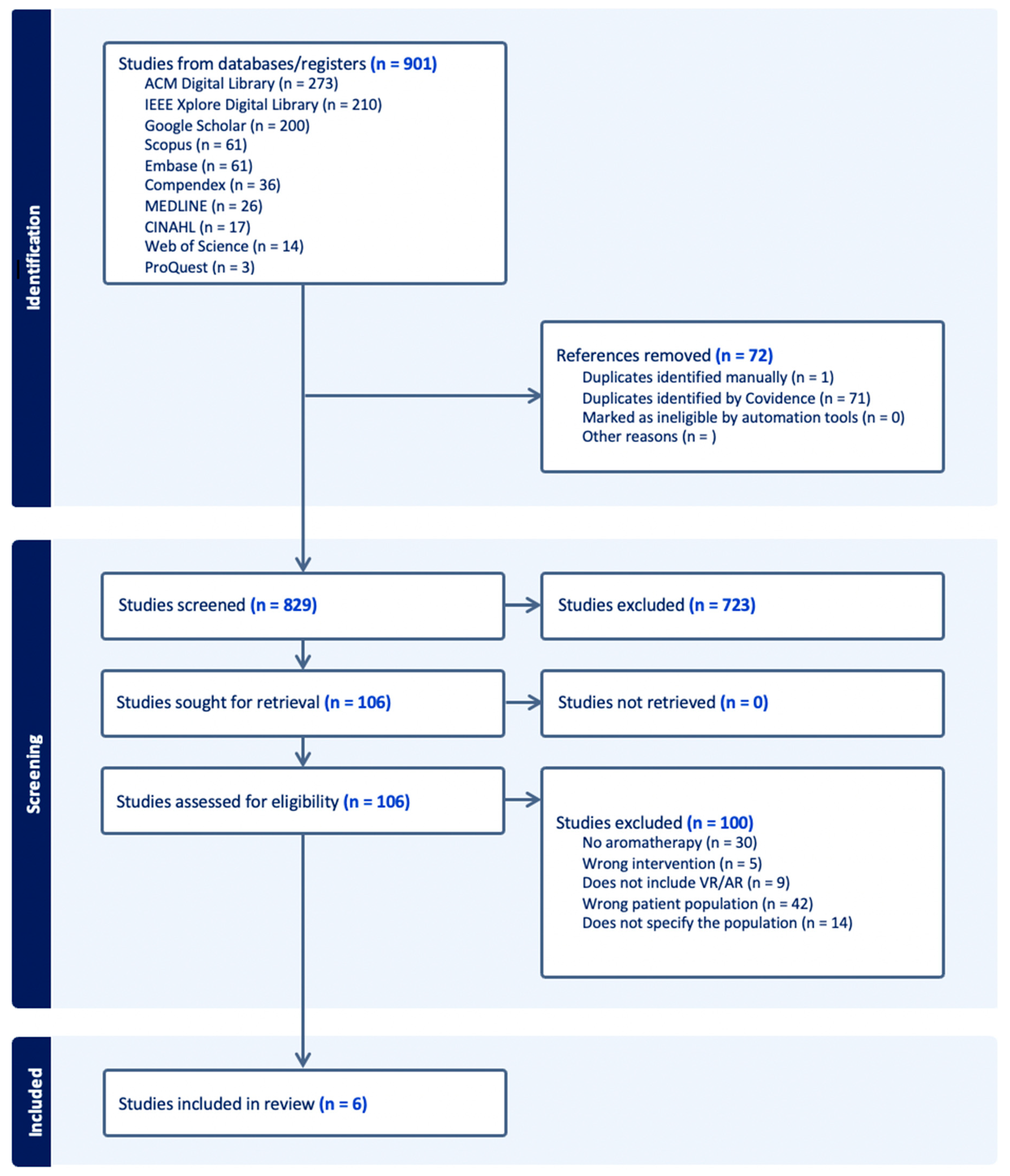

Table 1.
Summary of Studies in Scoping Review.
| Author, Year, Country | Aim | Design | Population | Settings | Aromatherapy | VR Intervention | Outcome Measures | Results | Impacts |
| Kang (2023) Taiwan | To assess whether multisensory stimulation during wheelchair use enhance spatial perception and memory in older adults | Quantitative, RCT | Older adults (N=6); 3 Females; Mean age 70 | Not specified | Fruit scent and meat aroma | HMD paired with Xiaomi VR glasses | Spatial orientation perception (Cosine Similarity theorem) Shape perception Memory capacity (four-item questionnaire) |
Physical feedback and multisensory stimulation during wheelchair operation improved spatial orientation perception, shape perception, and memory for older adults compared to video watching alone. | Exposure to external stimuli helps older adults remember their surroundings more effectively, and incorporating olfactory stimulation further strengthens the connection between physical awareness and memory capacity. |
| Cheng (2020) Taiwan | To evaluate the effectiveness of combing VR and aromatherapy in reducing stress and enhancing happiness, sleep, meditation, and life satisfaction among older adults | Quantitative, quasi-experimental | Older adults (N=48); 24 for each group; Mean Age: 83.03 (81.92 in the control group) | Nursing home | Not specified | 3D VR helmets | Happiness (Oxford Happiness Inventory) stress (PSS – 14) sleep (Pittsburgh Sleep Quality Index) meditation (EOM-DM scale) life satisfaction (Life Satisfaction Index A) |
Significant improvements in happiness, stress reduction, sleep quality, meditation, and life satisfaction were observed, with similar results found among adults aged 80 and older. | The combination of 3D VR and aromatherapy enhances psychological health in older adults, with 3D VR offering greater learning opportunities than aromatherapy alone. |
| Vanzo (2020) USA | To understand the sensory and occupational experiences of individuals living in retirement communities | Mixed design, pre-post design and interviews | Older adults (N=11); gender and age not given | Retirement Communities | Nature-based aromas (not specified) | All-In-One Oculus Quest VR headset | Stress (PSS – 14) Heart rate Blood pressure |
Decreases in heart rate and blood pressure have been observed, while perceived stress may not show significant changes due to the limited sensitivity of the PSS-14 scale. An essential oils diffuser, paired with therapeutic-grade essential oils, will be sufficient to deliver the olfactory component of the experience. |
VR and aromatherapy may be effective tools for reducing physiological stress in older adults living in retirement communities. |
| Bagger (2024) Denmark | To explore the experiences of mobility-constrained older adults testing VR-natureTM with forest-themed sensory stimulation (image, sound, smell) and assess its potential relevance in nursing care | Qualitative | Older adults with physical constraints (N=15) 8 Females; Mean Age 83.5 (71-98) | Not specified | Pine needles and essential oils | VR-NatureTM | Wellbeing and quality of life (interviews) | Feeling one with nature: Participants felt a sense of harmony with nature, reporting relaxation and immersion. Fluidity of space and time: Many experienced shifts in time perception, describing the experience as soothing and hypnotic. Reexperience and anticipations: VR evoked vivid memories, inspiring joyful and reflective storytelling; some faced uncomfortable memories. Changing mood with nature: Noticeable mood enhancements were reported post-experience, with participants feeling uplifted and relaxed. |
VR forest bathing with aromatherapy reduces anxiety and agitation while enhancing emotional well-being in elderly individuals. It offers older adults with physical constraints in retirement communities the opportunity to experience nature virtually. Aromatherapy evokes memories and emotional connections, positively influencing mood in elderly individuals. |
| Abraham (2020) UK | To explore whether custom VR 360 reduce social isolation and enhance patient well-being | Qualitative | Older adults with dementia (N=4); gender and age not given | NHS | Scents of pine | Bespoke VR-360 | Subject wellbeing (observations) | Multisensory stimuli enhance patient immersion and well-being through live interaction. Bespoke VR videos, tailored to individual needs, alleviate boredom and evoke a sense of wonder. This person-centered approach also promotes autonomy and agency in decision-making. | VR 360 provides older adults a sense of calm and relief from the hospital environment, improving subjective well-being and reducing distress, restlessness and agitation. Tailored VR activities evoke joyful responses, engage memories, and allow patients to virtually access natural settings like forests, creating comforting, immersive experiences through multi-sensory engagement. |
| Scarles (2020) UK | To explore how VR and multisensory stimulation engage individuals with virtual natural environment | Qualitative | Older adults (N=10); 5 females; age not given | Care home | Aromas in virtual green environment (woodland) | VR headset | Adoption and engagement (interviews and observations) | The successful co-creation of prototype experiences received positive feedback from participants and caregivers. VR and MSSE content provide a strong sense of place and facilitate recall. The combination of digital presence and physical sensory objects enhances engagement for older adults in recreational experiences. However, VR is less effective for social interaction compared to MSSE. |
Embodied performances and memories fostered connections within the immersive environment, sparked conversations about past experiences and travel desires, and provided vulnerable individuals opportunities to transition from indoors to the outdoors. |
Note: EOM-DM = 10-item Experiences During Meditation, HMD = Head-Mounted Display, MSSE = Multisensory Stimulation Environments, NHS = National Health Service (UK), PSS-14 = Perceived Stress Scale – 14, VR = Virtual Reality.
Disclaimer/Publisher’s Note: The statements, opinions and data contained in all publications are solely those of the individual author(s) and contributor(s) and not of MDPI and/or the editor(s). MDPI and/or the editor(s) disclaim responsibility for any injury to people or property resulting from any ideas, methods, instructions or products referred to in the content. |
© 2024 by the authors. Licensee MDPI, Basel, Switzerland. This article is an open access article distributed under the terms and conditions of the Creative Commons Attribution (CC BY) license (http://creativecommons.org/licenses/by/4.0/).
Copyright: This open access article is published under a Creative Commons CC BY 4.0 license, which permit the free download, distribution, and reuse, provided that the author and preprint are cited in any reuse.


