

Submitted:
13 November 2024
Posted:
15 November 2024
You are already at the latest version
Abstract
This study investigated the survival and growth of Salmonella in onion extracts and bulbs. Extracts of an array of onion varieties and germplasms were used to evaluate their ability to retard or inhibit Salmonella growth and the antimicrobial activity of extracts prepared from onions that were subjected to different types of light during curing. Separately, the survival of internalized and non-internalized Salmonella enterica ser. Newport was tested in red, white, and yellow onions by inoculating onion bulbs on the external and internal onion layers and by internalizing Salmonella using a syringe and needle to inject the inoculum inside the bulb. The inoculated onions were stored at room temperature and collecting samples at intervals during storage. Results showed that the varied lighting used for postharvest stimulation resulted in extracts with different antimicrobial effects (P < 0.05). Extracts from red and white onions treated with blue light inhibited Salmonella growth. Extracts from onions treated with white light revealed slow and fast growth of Salmonella in red and yellow, respectively. Of the extracts from the various germplasms, only one corresponding to red onion, inhibited Salmonella growth, whereas the rest showed varying levels of growth retardation (P < 0.05). In survival studies, Salmonella inoculated on the outer layer was reduced by 1.2, > 2.7, and > 2.4 log cycles on red, white, and yellow onions, respectively within 3 days of storage. In the inner layers, Salmonella grew by 2.4, 2.6, and 2.8 log cycles of red, white, and yellow onions re-spectively, over 18-d storage. In separate trials, the outer layer again did not support the survival of Salmonella Newport. While the inner scales on red onion did not allow growth of Salmonella Newport, those of white and yellow onions allowed growth during the first 3 days of storage, followed by reduction to nondetectable levels. Although the antimicrobial effect of onions is attributed mainly to the polyphenols, factors such as tissue integrity or water content in internal tissues may hinder the deleterious effects of poly-phenols against Salmonella.
Keywords:
Salmonella
; Food Safety
; Onion
; Bulbs
; Extracts
; Inhibition
; Growth
; Survival
; Wounding
; Peeling
1. Introduction
Bulb onions (Allium cepa) consist of red, white and yellow onions cultivated worldwide [1] with a wide range of health advantages [2]. This may have a positive impact in public health given the extended consumption of these bulbs [3,4]. Like all fresh produce, onions are typically consumed raw or with very little processing, and microbial contamination of the outer layer as well as internal layers of the bulb can happen at several stages of production in the field, during curing or during postharvest operations such as packing and fresh-cutting [5,6,7].
Different colored onions are well known for having high flavanol contents, especially quercetin and kaempferol [8]. A comparison made on the phenolic content of four different onion scale colors found red onions containing the highest concentrations of kaempferol and quercetin [9] with skins/peels having greater numbers than their edible region because of their antimicrobial effects against soil microbes [10]. External factors like processing depend on how sensitive the phytochemical is to degradation and/or modification, the amount of time it is exposed to a processing procedure [11], and the time needed for storage [12]. Treatment types, home processing approaches, and atmospheric conditions affect the flavonoid content of onions [13,14]. Various of these phenolic compounds possess antimicrobial activity [4,6], and this antimicrobial effect is perceived as a natural defense against the survival of pathogens such as Salmonella in case of onion contamination [6]. In fact, foodborne illness outbreaks and recalls are less commonly linked to bulb onions than with other produce commodities [15]. The antimicrobial activities of phenolic compounds, particularly against Gram-negative bacteria, have been proposed due to their ability to diffuse passively through the outer membrane mediated by electrostatic and ionic interactions and make their way into the cytoplasm, causing acidification and cell death [16,17,18]. Bulb onions are typically processed in dry environments with no water used or added on purpose. Despite all these, Salmonella and other pathogens can still cause contamination even when dry handling is practiced. Salmonella can adapt and survive for a long period due to its better heat resistance in desiccated environments [19]. In 2020, bulb onions were involved in a Salmonella Newport outbreak in the United States. This was the third largest Salmonella outbreak to have been experienced in the United States in the last three decades with 1,127 total illnesses, 167 hospitalizations, and 0 deaths. A traceback investigation into this 2020 incident revealed that protocols at the dry packinghouse may have accelerated the Salmonella spread even though precise sources of contamination were not identified [20]. In 2021, onions in 39 states of the United States imported from Chihuahua, Mexico led to 1,040 illnesses and 260 hospitalizations leading to its recall with Salmonella Oranienburg as the culprit [21]. These incidents were thoroughly studied [22] and show that human pathogens can survive in the onions despite the presence of compounds with strong antimicrobial activity, which may depend on other factors. However, sufficient data on the effect of environmental, genetic and structural factors on the expression of the reported antimicrobial effect of onions could not be found. The effect of factors such as lighting and onion variety on the onion’s antimicrobial activity has been reported before [23,24]. However, other factors such as physical tissue disruption or moisture content have not yet been studied.
This study focused on factors such as postharvest exposure to different types of light, the germplasm, onion variety, mode of inoculation and moisture of the onion tissue where inoculation occurred, affecting the antimicrobial activity of bulb onions and their extracts against. Based on published research, the antimicrobial effect was attributed largely to the polyphenols present in the onions [4,6]. To achieve this, challenge studies were done to determine the effect of these factors in the fate of Salmonella in onion extracts as well as bulb onions from red, yellow and white varieties. The potential role of water activity (aw) on the antimicrobial effect attributed to polyphenols was also tested.
2. Materials and Methods
2.1. Antimicrobial Effect of Onion Extracts on Salmonella Survival and Growth
2.1.1. Salmonella Strains and Inoculum Preparation
Five strains of Salmonella enterica subsp. enterica were obtained from the Food Microbiology Laboratory's (Texas A&M University) bacterial culture collection. These strains corresponded to serotypes: 1) Saint Paul (obtained from the FDA, isolated from a jalapeno outbreak in 2008), 2) Poona (obtained from outbreaks related to cantaloupe), 3) Michigan (both 2and 3 from Dr. L. Beuchat, University of Georgia), 4) Typhimurium ATCC 700720, and 5) Enteritidis PT 30 ATCC 1045 (both 4 and 5 bought from American Type Culture Collection). Each of these strains was independently stored in a -80 °C freezer as cryopellets (Key Products, Texas). Prior to use, one cryopellet of each strain was aseptically transferred into 10 ml tryptic soy broth (TSB, Difco, Becton Dickinson. Sparks, Maryland) in a biosafety cabinet and incubated for 24 h at 35 °C. Following incubation, working cultures of each strain were prepared by transferring 10 µl of each isolate was transferred onto tryptic soy agar (TSA) plates (Difco), incubating 24 h at 35 °C, picking a single colony for streaking onto TSA slants, incubating as described above. To prepare the Salmonella cocktail, a portion of the working culture was transferred to a TSB contained in a sterile 50 ml screw-cap conical tube, centrifuged at 3,000 x g at 4 °C for 15 min, and re-suspended three times in PBS. All suspensions were then mixed in a sterile tube and, shaken in a vortex mixer for 1 min. The resulting cocktail was diluted to achieve a target final concentration of 8.0-9.0 log CFU/ml. This suspension was used to inoculate the wells in the microplates.
2.1.2. Onion extract preparation
Onion cultivars Sofire (red), Carta Blanca (white) and Rio Dulciana (yellow) were exposed postharvest to red, blue, or white LED lights (Texas A&M AgriLife Research and Extension Center, Uvalde, Texas) under the direction of Dr. Vijay Joshi. Additionally, Texas A&M onion germplasm 218Y, 541X, 1196, Yellow H6, 545X, 25X, 542, 1197, 1102, 231Y, 544X, and 1104 were grown in the field at the Center under the direction of Dr. Subas Malla. Both sets of onions were used to prepare extracts from the outer and inner scales to determine the effect of the potential active compounds. The sonication-assisted method was utilized as a mode of extraction based on Jang et al. [12] with slight modifications. One gram of onion skin powder of each cultivar was mixed independently with 25 ml of methanol with an extraction ratio of 1:25 w/v into beakers. All beakers were left all night at a temperature of 4 °C. Sonication (Q Sonica, Newtown, US) of samples was done for 10 min at 20 kHz frequency and 50% amplitude and vortexed for 5 min repetitively two times. Centrifugation was done for 10 min at 5,000 x g at 5 °C using a refrigerated centrifuge (3-18KS, Sigma, Germany). The supernatants were evaporated, and the tubes stored in a freezer (-80 °C) were used for pellet collection. Extracts were prepared by personnel in Dr. Joshi's laboratory and were transported to the Food Microbiology Laboratory, Texas A&M University, College Station for Salmonella inhibition assays. Upon receiving, the extracts were stored under refrigeration. The extracts were filter-sterilized prior to use for growth inhibition testing.
2.1.3. Microtiter Broth Dilution Method
The microtiter dilution method as described by Brandt et al. [25] was followed except that no dilutions were made. Briefly, 100 μl of each of the extracts to be evaluated were pipetted into a well of a 96-well sterile microplate (Fisher Scientific, MA) and then added with 100 μl of the 5-strain Salmonella cocktail. This resulted in a ½ dilution (100 µl onion extract: 100 µl of Salmonella cocktail), which was the maximum concentration possible by this technique. In another well, 100 µl of the extract was mixed with 100 µl of PBS to serve as baseline for the optical density (OD) measurement at 630 nm. In separate wells, sterility controls were created by mixing 100 μl of Mueller-Hinton (MH) broth with 100 μl of PBS, and growth controls were created by mixing 100 μl of the Salmonella cocktail with PBS. A 24-hour process of recording using a spectrophotometer (Cytation 5, CA) was set for hourly OD measurements at 37 °C at a wavelength of 630 nm (OD630) to monitor the growth of Salmonella in the wells mentioned above. The positive change (increase) in OD over 24 h incubation (∆-OD) was used to determine growth inhibition. ∆-OD values ≤ 0.05 were regarded as complete growth inhibition [26].
2.2. Fate of Salmonella serotype Newport on Red, White and Yellow Onion Varieties
2.2.1. Procurement of Onion Bulbs
For these trials, pre-packed red, white, and yellow onions were obtained from a local vendor a day before the experiment. They were transported to the laboratory as bagged from the store and put in plastic boxes with as few bulbs as possible in each box to prevent overcrowding and injury. Once in the lab, they were stored in alcohol-sanitized plastic containers at room temperature (25 °C) before the experiment to simulate the storage, handling, distribution, and curing process of onions.
2.2.2. Salmonella strains and inoculum preparation
For the test on onion bulbs, Salmonella enterica subsp. enterica serotype Newport strains CC1070, CC1071, CC1072, and CC1073 provided by D. Mann (University of Georgia, U.S.A - Center of Food Safety) were individually received and streaked onto xylose lysine deoxycholate (XLD) agar. These strains were isolated from clinical cases within the onion-related outbreak of 2020. Frozen stock with glycerol was prepared and stored in a -80 °C freezer for future use. The preparation of the Salmonella Newport suspensions followed the same steps described in 2.1.1 above. Prior to combine all strains, each suspension was diluted to achieve a target concentration of 5-6 log CFU/ml, and then the mixed in a sterile tube and mixed by vortex.
2.2.3. Bulb Onion Inoculation
Two experiments were conducted that involved inoculation of bulb onions, and the method of inoculation differed slightly for each experiment. For the first experiment, 90 bulbs of each onion variety were individually marked with food-grade ink by drawing 6 squared areas of 4 x 4 cm (16 cm2) over the bulb surface on the outermost papery layer. This will be referred to as outer layer. These marked surfaces were each spot- inoculated by dispensing 100 µl of the inoculum over the 16-cm2 area using a sterile micropipette. Another 6 squares of 16 cm2 were also marked and used as guide for internal inoculation, achieved by injecting 100 µl inoculum into the bulb by puncturing at the center of the square with a loaded sterile tuberculin syringe with a 0.4 x 13 mm precision needle (Becton Dickinson), inserting the entire needle length and releasing the inoculum. The depth of the puncture was determined previously to achieve inoculation at the 3rd. scale inside the bulb. Negative controls consisted of 100 µl of sterile PBS added superficially or by injection as descried above. The inoculated bulbs and negative controls were placed in storage boxes at room temperature. Immediately after inoculation (zero time) and after 3, 6, 12, and 18 days of storage, 3 bulbs from each onion variety were collected for sampling and testing. A set of non-inoculated onions was tested to verify the absence of indigenous Salmonella at levels that may have interfered with the enumeration of the inoculated bacteria. In a separate trial, the effect of the inoculum level on the magnitude of reductions was tested. A similar experimental design was followed, this time using only red onions and using a target concentration in the inoculum of 8-9 log/ml.
For the second experiment, the target concentration in the inoculum was increased to enable detection, given the expected fast reduction observed in the previous experiment. The concentration in the cocktail was adjusted to a target level of 7-8 log CFU/ml. Sixty-four onion bulbs of each variety were inoculated on the outer papery layer as described above, and another 64-onion set was used to inoculate the internal scales, peeling by hand up to the third layer and individually marking with food-grade ink by drawing 3 (three) 4 x 4 cm (16 cm2) areas over the bulb surface. These marked surfaces were inoculated by gently placing 100 µl of the inoculum using a micropipette to prevent the inoculated suspension from running over the marked areas. The inoculated onion bulbs were then stored as described above. Directly after inoculation (zero time), and after 1, 4, and 6 days of storage, 6 bulbs from each onion variety were collected for sampling and testing.
2.2.4. Sample Collection and Salmonella Enumeration
During the trials using puncture inoculation, 3 onion bulbs of each onion variety were collected at each sampling time. From each bulb, six 4 x 4 cm (16 cm2) samples were collected from the outer scales, totaling 288 cm2. Sampling was achieved by excising the corresponding 16-cm2 area with a sterile scalpel and forceps. All samples were and composited in a sterile stomacher bag with 20 ml of buffered peptone water (BPW). This volume was later used as a factor for calculating the final bacterial counts. To sample the inner scale, the external parts of the 3 onion bulbs were peeled to expose the 3rd. scale under the areas that had been previously marked, which then were harvested by cutting approximately 16 cm2 using sterile scalpel and forceps. The 6 inner scale samples for each bulb (288 cm2) were composited as described for the outer scales. For the trials involving exposed 3rd. scale inoculation, 3 outer scales and the 3 exposed inner scales were excised using sterile scalpel and forceps and were each composited in a bag containing 20 ml of BPW. Three onions of each variety were sampled separately at each sampling time.
All samples were homogenized in a stomacher for 2 min, then decimal dilutions were prepared in buffered peptone water (BPW, Difco), selecting the lowest dilution to use according to the inoculum level used (dilution 100 for low inoculum level and 101 for higher inoculum level). All dilutions were then plated onto TSA plates, incubated at 37 °C for 2 h and then overlaid with XLD agar to continue incubation over 18-24 h. The overlay was applied to allow resuscitation of bacteria potentially subjected to sub-lethal injury after exposure to onion tissue, which may affect the colony development on Salmonella-selective media such as XLD. Colonies typical of Salmonella were enumerated. To confirm identity as Salmonella, random colonies were picked, streaked onto XLD, and subjected to biochemical and serological tests following the guide by the Microbiology Laboratory Guidebook (MLG) 4.14 [27]. Since no Salmonella was found on control (non-inoculated) onions, it was assumed that the counted salmonellae were the same as those inoculated. The colony counts for each sample were divided by the total area composing each sample to use conventional reporting units or CFU/cm2. The limit of detection (LOD) of the plating method varies according to the dilutions prepared for plating, which are selected based on the expected bacterial concentration in the food. In our case, the LOD for the first experiment was -1.2 log CFU/cm2, whereas for the second experiment, the LOD was 1.1 log CFU/cm2.
2.3. Measurement of Water Activity
Onion layers from bulbs corresponding to the 3 varieties tested (red, white and yellow) were collected from layers at various. For each variety, 3 square samples each of the outer papery layer (skin) and 1st, 2nd, 3rd, and 4th internal layers (total of 15 samples per onion variety) were excised from 3 bulbs in a total of 3 independent trials. The samples were collected delimiting a 4 x 4 cm square and excising using sterile scalpel and forceps. Each sample was chopped into small pieces by use of a scalpel and subjected to water activity (aw) measurement using an AquaLab PRE water activity analyzer (METER Group, WA, U.S.A.). The aw measurements were tabulated and subjected to statistical analysis as described below.
Bulbs of the onion cultivars (red, white, and yellow) were each cut 4 x 4 cm (16 cm2) area on the outer papery layer (skin), and the 1st, 2nd, 3rd, and 4th layers and chopped into small pieces by use of a scalpel after that to be used for water activity (aw) measurement using the AquaLab PRE water activity analyzer (METER Group, WA, U.S.A.).
2.4.Statistical Analysis
All experiments described above were repeated in 3 independent trials, each using 3 replicate samples per treatment. For the onion extracts trials, optical density (OD) data were obtained by the difference between the actual OD and the baseline OD, and the results were analyzed by use of one-way ANOVA using the Least Square Means method in JMP (JMP Pro, v16.0, SAS Institute Inc, Cary, NC). For the survival studies, microbial counts were converted into log values. To facilitate statistical analysis, counts in samples when with no detectable colonies in any of the dilutions were assigned a CFU/cm2 value equal to one-half of the detection limit, then this number was converted to log value as with the rest of the values. The count was calculated in CFU/cm2 to be consistent with the total area inoculated per onion bulb. Values of OD, log CFU/cm2 and aw were separately analyzed by multifactorial analysis of variance in the Fit Model function of JMP, with LS Means Tukey HSD at P < 0.05 for mean separation to compare the effects of each onion cultivar on the survival of the Salmonella cocktail over the 6 and 18-day storage period and on the moisture of the onion scales at varying depths.
4. Results and Discussion
4.1. Antimicrobial Effect of Onion Extracts on Salmonella Survival and Growth.
4.1.1. Effect of Various Exposed Lights During Onion Growth on the Inhibition of Salmonella by Extracts of red, white and yellow Onion Varieties
The ability of Salmonella to grow in the presence of red, white or yellow onion extracts was affected by the type of light to which the onions were exposed during curing. Figure 1 shows how the growth or survival of a 5-strain Salmonella cocktail differed within extracts of the same onion cultivar when blue, red, white or natural light was used to illuminate the onions postharvest (at curing). Under blue light, extracts of red and white onion cultivars significantly (P < 0.05) hindered the growth of Salmonella as compared to yellow. Although in most of the extracts, the growth of Salmonella was not completely inhibited, there were significant differences in the growth rates as affected by the extract. For the red light, onion extracts of the white variety significantly (P < 0.05) slowed down the growth of Salmonella compared to red and white. White light was associated with significantly slower growth of Salmonella in red onion extracts than yellow and white onion extracts. In contrast, natural light seemed to produce onions whose extracts retarded Salmonella growth in red and yellow onion extracts but not on those from white onions.
Given the recognized antimicrobial activity of phenolic compounds, which are abundant in onions [4,6,16,17,18], it is reasonable to assume that any inhibition of growth or reduction in Salmonella observed in this study be attributed to the polyphenols, mostly quercetin, which is abundant on onions [28]. The effect of light stress on the seed germination and plant growth has been demonstrated in various plants including onions [29,30]. This effect may be different depending on the light wavelength used for plant exposure [30]. Mechanisms by which visible or UV light could manipulate phenolics across plant species have been extensively reviewed [23,31,32]. The exposure of onions to abiotic stress (including different light spectrums) during curing stimulates the biosynthesis of phenolic compounds including flavonoids and their subclass. This is achieved through various mechanism including the phenylpropanoid metabolic pathway, which produces metabolites that scavenge oxidating radicals and regulates energy dissipation in plants. In particular, chlorogenic acid acts a low molecular weight antioxidant in plants, providing protection during light stress [32]. Particularly, light of short wavelength (blue, UV) can increase antioxidants such as phenols, flavonoids, and flavones in various plants, including onions [30,33], and several studies have repeatedly pointed out quercetin's impact on Salmonella and other enteric pathogens [34,35].
When onions were cured under natural light, the red onion extracts produced the strongest effect against Salmonella, followed by yellow onion extracts, while the growth was not inhibited or retarded by the extracts of white onions. Compared to colored onions, white onions have a lower flavonoid content [36]. The primary flavonoids in onions, quercetin compounds, are linked to plant disease resistance [28]. Quercetin content of red onions has been shown to differ significantly from the other types, while yellow, white, and sweet onions were not significantly different [37]. In addition to their antimicrobial properties, onion extracts and quercetin also interfere with quorum sensing, which controls violacein synthesis and swarming motility [38]. According to earlier studies, onion oil and bulb extracts had a major impact on various microorganisms [39]. The structure of quercetin's flavone skeleton may aid in its inhibitory action [40].
4.1.2. Impact of various onion genotypes and their layers on Salmonella growth
Data in Table 1 show the ∆-OD (change in OD over 24 h incubation) for Salmonella in extracts of onions corresponding to 12 genotypes. Except for Genotype 1104, the extracts tested could not prevent Salmonella growth regardless of whether they were made from the outer or inner onion scales. In Genotype 1104, belonging to red onion germplasm, the extract made from the outer scales showed a mean OD of -0.0025, much lower than the ≤0.05 threshold for complete growth inhibition. Of the extracts made from inner scales, those obtained from 1104 again yielded the lowest ∆-OD values. However, the mean ∆-OD of 0.26 indicates that Salmonella could still grow in the presence of this extract. Unfortunately, these data provide little information due to the great variability within samples. As such, we cannot conclude that genotype 1104 possessed in fact greater antimicrobial activity than the other genotypes, or that the extracts made from outer layers were more antimicrobial than those prepared from internal scales.
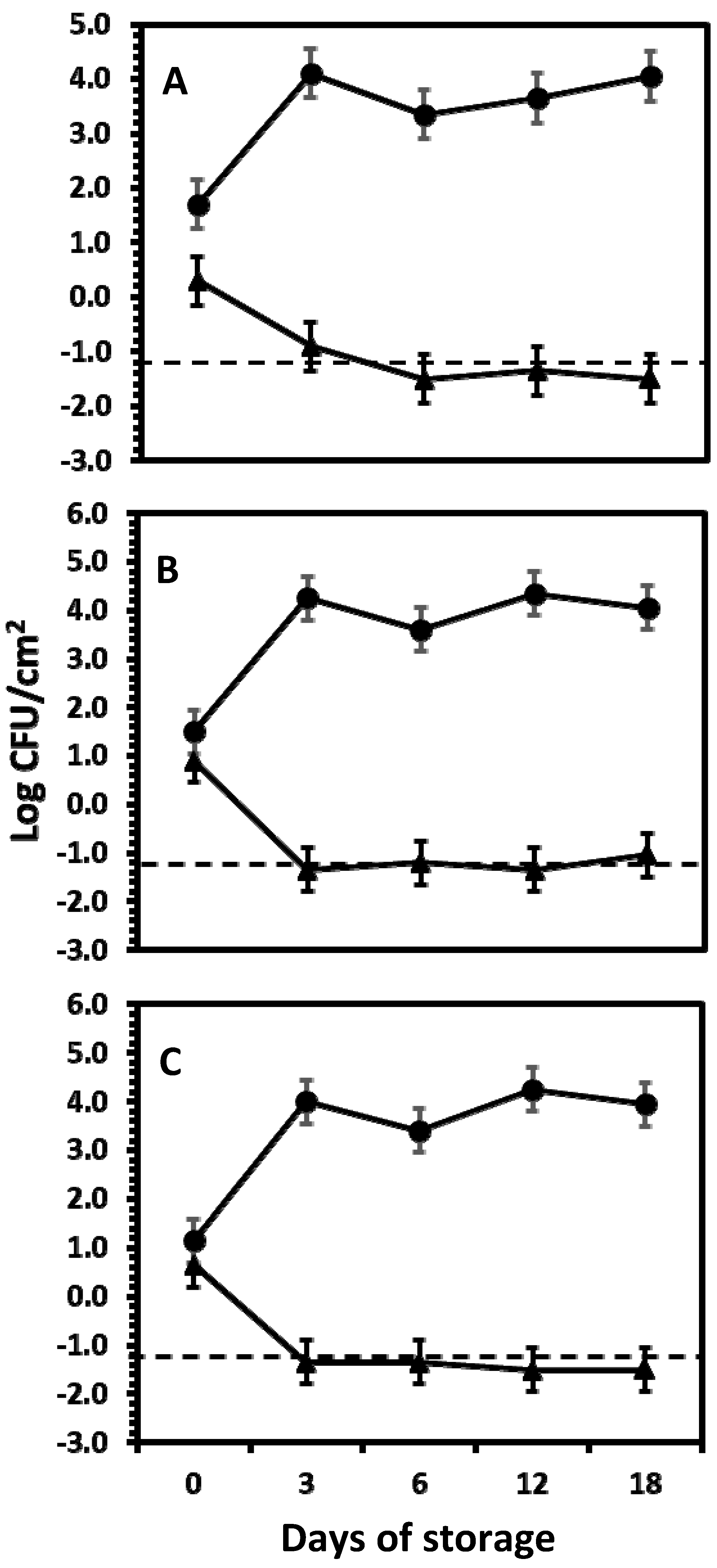
Figure 2.
Growth of Salmonella Newport cocktail on the outer papery skin layers (triangles) and in the inner layers (circles) of red (A), white (B), and yellow (C) bulb onions stored in containers and held at room temperature (25 °C). The lines crossing the chart show the limit of detection of the counting method (-1.2 log CFU/cm2). Each data point represents the mean of at least 9 tested samples and the error bars represent standard error (SE). There were no differences in counts between onion varieties (P ≥ 0.05).
Figure 2.
Growth of Salmonella Newport cocktail on the outer papery skin layers (triangles) and in the inner layers (circles) of red (A), white (B), and yellow (C) bulb onions stored in containers and held at room temperature (25 °C). The lines crossing the chart show the limit of detection of the counting method (-1.2 log CFU/cm2). Each data point represents the mean of at least 9 tested samples and the error bars represent standard error (SE). There were no differences in counts between onion varieties (P ≥ 0.05).
3.2 The fate of Salmonella serotype Newport on yellow, white, and red onion bulbs during storage at room temperature.
3.2.1 Salmonella Survival on the Outer and the Inner Onion Layers
Generally, all onion cultivars' outer papery skin layer exerted a significantly greater inhibitory effect against Salmonella Newport in the 18 days of the experiment. No colonies were detected on the lowest dilution of uninoculated onion samples; the detection limit was -0.5 log CFU/cm2, showing no evidence of inherent Salmonella in onions.
4.1.3. Effect of Salmonella Inoculum Internalization
For outer layers (triangled markers in Figure 2), in all instances, the Salmonella population was significantly (P < 0.05) reduced within the first 3 days of storage in all onion cultivars. The initial Salmonella mean populations of the outer scales of red, white, and yellow onions on day 0 between 0.3-1.5 log CFU/cm2, and experienced a detrimental growth decline within the first 3 days of storage, to -0.9 log CFU/cm2 for red onion, whereas in white and yellow onions, these counts were at or below the detection limit (< -1.2 log CFU/cm2). The mean decline in the Salmonella population from 0-3 days was 1.2, > 2.1, and > 1.9 log CFU/cm2 in red, white, and yellow onions, respectively, since all counts were reduced to levels below the limit of detection of the plate count method. No significant differences (P ≥ 0.05) were found between the 3 onion varieties tested. These results were confirmed during trials repeating the same procedure on red onions but increasing the inoculum level to ~5 log CFU/cm2. Again, the counts of Salmonella Newport inoculated on the outer papery layer were reduced to undetectable levels within the first 3 days of storage, remaining undetectable for the remaining 18 days of storage. The magnitude of reduction was > 3.7 log cycles, confirming the strong and rapid antimicrobial effect of the external layer of the onion bulb. In contrast, the internal layers inoculated by puncturing supported the growth of this organism, to a maximum increase of 1.7 log cycles at day 12 of storage (data not shown).
From these results, it can be concluded that the decline rate of Salmonella Newport on the outer papery layers of the 3 onion varieties was similar for all onion varieties, going from the initial numbers of ~1 log CFU/cm2 to not detectable within 3 days of storage. There was no further significant change (P > 0.05) in the Salmonella mean population in all onion varieties from day 6-18, which remained below detection levels during the rest of the storage period. The low numbers reported here are the result of the conversion to CFU/cm2. However, during data analysis the variances and standard errors remained unchanged with or without data conversion, as expected. The decision to present results in CFU/cm2 intended to show data in a conventional and understandable type of units, without affecting the accuracy of the conclusions drawn from the data analysis.
In contrast, for the syringing/wounding/bruising inoculation method (circles in Figure 2), Salmonella Newport underwent a significantly (P < 0.05) different pattern as compared to the outer layers; Salmonella Newport was able to grow in the inner layers of the three onion cultivars (Figure 2). In the first 3 days, S. Newport experienced an increase in population by 2.3, 2.6, and 2.6 log cycles in the inner layers of red, white, and yellow onions, respectively. Typically, in the 18-day storage time, the growth of Salmonella Newport in the inner layers of red onions followed a constant but small trend. The initial mean population of Salmonella Newport after inoculation (0 days of storage) in red, white, and yellow was 1.7, 1.5, and 1.2 log CFU/cm2, respectively. After 3 days, the counts of Salmonella Newport underwent a significantly (P < 0.05) increase to 4.1, 4.3 and 4.0 log CFU/cm2 for red, white, and yellow onions, respectively. At this time, Salmonella Newport seemed to reach the stationary phase, with a calculated maximum population increase of 2.4, 2.6 and 2.8 log cycles over 18 days of storage for red, white, and yellow onions, respectively. No differences (P > 0.05) in the growth patterns were observed between all onion varieties when inoculation was achieved by puncturing.
Due to agricultural production practices, handling, and insect and plant pathogens, the damaged plant tissues serve as entry points for human pathogens [41,42,43]. Although information about human pathogens in onions is lacking, onions are susceptible to pathogenic bacterial diseases close to harvest [44]. The concentration of biochemical components in host plants in response to such damages is not always necessarily associated with activating defensive machinery, but often compromises the normal functioning of stomata, distribution of photoassimilates, modification of cell walls, water, and ion imbalance [45], all conducive to the survival of human pathogens.
In a subsequent experiment, the survival of Salmonella Newport on outer vs. inner layers of red, white and yellow onions tested. The data in Figure 3 show significant (P < 0.05) effects of the location of the onion layer, time of storage and onion variety on the survival of Salmonella Newport over a 6-day storage period. Unlike wounding (see Figure 2), where Salmonella Newport grew rapidly, the exposure of the 3rd. scale followed by surface inoculation resulted in a reduction with various decline rates during storage, depending on the onion variety. In contrast, the outer (papery) layers did not permit the growth of this pathogen, with varying rates of decline depending on the onion variety. Red onions (Figure 3A) showed a sharp decline to below the limit of detection within one day regardless of the layer (outer or inner, P > 0.05), where Salmonella Newport was significantly (P < 0.05) reduced by >2.5 - >2.8 log cycles by day 1 (reduction to nondetectable levels), remaining unchanged until the end of the storage time. Contrarily, the outer layers of yellow and white onions experienced nearly the same Salmonella Newport survival pattern, showing a gradual decrease to below the detection limit within 4 days. The reason why there are numbers reported below the detection limit, is that some samples yielded detectable counts, but the mean counts of all repetitions and replicates were still below the limit of detection. White and yellow onions' death rates were much slower than red onions
(P < 0.05). Contrasting the previous experiment (see Figure 2), where Salmonella Newport grew inside the onions within 3 days when inoculated by wounding with a needle, exposing the inner tissue by peeling and then surface inoculating the 3rd. inner scale resulted in small but significant (P < 0.05) growth of Salmonella Newport during the first day of storage, to continue with a slow decline over 6 days of storage on white and yellow onions (Figures 3B and 3C). On the inner scales, there were no differences (P ≥ 0.05) in the Salmonella Newport populations between white vs. yellow onions during the first 4 days of storage. At 6 days the populations were significantly lower (P < 0.05) than at 0, 1 or 4 days, with a final reduction of 2.1 and 1.3 log cycles on the inner scales of white and yellow onions, respectively (data not shown). The behavior on the outer papery layers of the 3 onion varieties was consistent in the experiments shown in Figure 2 and Figure 3, which show that the outer papery layers of onions express greater antimicrobial activity than the internal tissue of the onion bulb. However, when such internal tissue was disrupted (wounding by the inoculating needle, Figure 2) Salmonella Newport grew actively, while the non-wounded surface of the internal scales allowed only minimal growth followed by a slow reduction.
The findings of this study supported earlier reports that red onions possess greater antimicrobial capacity than other onion varieties, which is attributed to the reported higher concentrations of specific polyphenols [24]. This may explain why Salmonella Newport could not grow or survive in red onions as much as they were able to do it on white and yellow onion tissues. The antimicrobial activity of red onions reported by Sharma et al. [24] is generally consistent with our results.
Regarding the greater antimicrobial effect shown by the outer papery layer of onions compared to the inner layers, not many studies were available on the influence of onion skins on the growth of Salmonella. However, it has been elucidated that onion peel contains roughly 3-5 times more isolated phenolic compounds and quercetin than the edible portion of the onion [46], supporting the assumption that the antimicrobial activity observed in this study may be attributed to the effect of these compounds. Furthermore, extracts prepared from the edible components of onions have exhibited decreased antimicrobial efficacy against these bacteria, including no growth inhibition for E. coli [24,46]. With regards to the reduction of Salmonella Newport when inoculated on the outer papery layer of onions, some reports support the findings in this study. Antimicrobial activity against S. aureus and E. coli was observed in red onion bulbs' outer layers (skin) extracted by direct maceration [47], while Kumar et al. [48] found the largest quantities of flavonoids and phenolics in onion skin when compared to edible onion flesh. The higher concentration of phenolic compounds in the outer papery layer of onions may be facilitated by the drying process that starts from the curing step. By drying, the polyphenols are expected to become more concentrated in the skin, as it collapses due to water loss. In contrast, the internal tissues would have a higher water content, which may dilute the polyphenols or accelerate their degradation.
Table 2 shows the aw of various layers of red, white and yellow onions removed from fresh onion bulbs. The aw of the outer layers significantly differed (P < 0.05) from that of the inner layers. Generally, the red variety showed lower aw, particularly in comparison to white, while yellow onions showed variations in similarities with either red or white onions. However, the most critical finding was the gradual increase in aw as the layers were more profound in the onion bulb. In all onion varieties, the deeper the layer location, the higher the aw. On the outer layer, aw values were < 0.6, which is often regarded as the aw threshold for supporting microbial growth. This explains why the outer layers consistently inhibited the growth of Salmonella. However, the expected higher concentration of phenolics in the outer layers [46] may not be sufficient to explain the reduction of Salmonella Newport (see Figure 2 and Figure 3) since the absence of moisture may also interfere with the transfer of molecules to the bacterial cells. The 1st layer after the outer papery skin also showed significant differences (P < 0.05) across the three varieties with mean values of 0.764 ± 0.023, 0.904 ± 0.042, 0.863 ± 0.027 for red, white, and yellow, respectively. The mean water activity of the red variety (0.836 ± 0.023) in the 2nd layer after the outer papery layer was significantly different (P < 0.05) than the white (0.909 ± 0.001) and yellow (0.895 ± 0.017) varieties. Similarly, in the 3rd layer, the red onion was significantly different (P < 0.05) from the yellow and white types with aw mean of 0.897 ± 0.02 (red), 0.928 ± 0.003 (white), and 0.921 ± 0.015 (yellow). There was a significant difference (P < 0.05) in the 4th layer after the outer papery layer in all onion varieties with red recording the lowest mean aw of 0.961 ± 0.011, followed by yellow with 0.972 ± 0.001 and white with 0.997 ± 0.003. Across the rows in Table 3, the aw for each variety increased with the depth of the layer. All varieties consistently increased in aw from 0.51-0.58 on the outer layer to 0.96-0.99. The white onions consistently showed aw > 0.90 since the 1st layer after the outer, whereas yellow onions showed aw values > 0.90 since the 3rd layer after the outer.

Table 2.
The water activity of red, white, and yellow onion layers at various depths at 25 °C.
| Layer | |||||
|---|---|---|---|---|---|
| Variety | Outer papery | 1st after outer | 2nd after outer | 3rd after outer | 4th after outer |
| Red | 0.509 ± 0.032 Aa | 0.764 ± 0.023 C | 0.836 ± 0.023 G | 0.897 ± 0.024 E | 0.961 ± 0.011 Fb |
| White | 0.583 ± 0.003 B | 0.904 ± 0.042 E | 0.909 ± 0.001 E | 0.928 ± 0.003 E | 0.997 ± 0.003 G |
| Yellow | 0.525 ± 0.011 A | 0.863 ± 0.027 D | 0.895 ± 0.017 E | 0.921 ± 0.015 E | 0.972 ± 0.001 F |
|
a Water activity (aw) values are means ± standard error. b Within columns and rows, means with different letters are significantly different (P < 0.05). | |||||
To the best of our knowledge, this paper is the first to study the aw of onions at various depths at room temperature, and the higher aw with an increase in scale depth across the three onion varieties could aid in explaining the growth of Salmonella in the inner layers upon wounding/syringing, especially in yellow and white varieties.
Results show that the outer layer had a significant inhibitory impact on the survival of Salmonella Newport on the 3 onion varieties. Other studies on the inoculation of onion skin have shown this effect [48,49,50], and this effect is attributed to the phenolic contents being high on the skin of the onion. In fact, onion waste is recognized as important sources of naturally occurring bioactive chemicals [10,51,52]. In this study, the inner layers of yellow, white, and red onion varieties supported the growth of Salmonella Newport in white and yellow varieties, whereas red onions showed consistent suppression of Salmonella Newport growth during storage. The literature discussed here makes it clear that red onions have higher concentration of polyphenols [24,53] and that the onion outer papery skin containing higher concentrations of polyphenols has been covered [24,46,48]. In fact, Kim and Kim [54] reported the quercetin concentration in onions gradually decreasing between the inedible papery skin and the bulb's core.
Another important observation was the rapid growth of Salmonella Newport when inoculated by creating a wound with a needle and syringe. Wounding or bruising could occur throughout the supply chain and physical damage is reported as one of the major mechanisms for infection with plant pathogens [55]. This may be extended to human pathogens that may contaminate onions at pre and postharvest stages. Factors promoting produce bruising and how physical damage favor pathogen internalization have also been described in other commodities [56,57,58,59]. It is likely that the same mechanisms for tissue damage described for tomatoes by Tokarskyy et al. [58] would operate in other produce commodities, such as onions. In onions, deep bruising may release large amounts of liquid, favoring microbial growth. This could explain why Salmonella Newport experienced a decline when onions were peeled in our study compared to when the injury was imparted by syringing.
4. Conclusions
The highlights of this study focused on the effects of various factors on the survival or growth of Salmonella in onion extracts and bulbs. Although no attempts were made to study the effect of phenolic compounds from onion, the data showing the antimicrobial activity of onion extracts and tissues against Salmonella underlines the need for further research. This is especially urgent since under some conditions, Salmonella showed ability to grow. Since the antimicrobial effect of onions is attributed to the phenolic compounds, there is a need for a mechanistic description of synergism between phenolics and possibly other compounds, as well as other biochemical or physicochemical interactions that result in the expression of antimicrobial activity in onions. The inhibition not only of Salmonella, but possibly of other biofilms associated with foodborne pathogens underlines the need for more detailed exploration of their potential to interfere with quorum sensing to control biofilm and toxin production in bacteria. Further research is needed to harness the dual role of onion phenolics as nutraceuticals and environmentally friendly antibacterial tools.
In this study, comparing the results of the trials with onion extracts with those of the trials where onion bulbs were directly inoculated, it becomes apparent that these two approaches may provide different points of view on the antimicrobial activity of onions. The challenge studies, which may represent more realistic onion consumption scenarios, revealed that outer layers consistently inhibited Salmonella growth while inner layers showed increased bacterial populations and that the more severe the tissue disruption, the higher the growth rate. In addition, the aw increased consistently with the depth of the onion scales. Although the relation between red onion variety and rapid decline of Salmonella was expected due to the known higher concentration of polyphenols in the red onions, these trials show that the ability of Salmonella to grow in and on onions may be multifactorial and not exclusively related to the presence of polyphenols with antimicrobial activity but at least, a dual effect between water activity and polyphenols. While more research should be conducted to elucidate all factors in Salmonella inhibition by onions, this research supports the importance of maintaining adequate postharvest product handling practices. Preventing bruising of onion bulbs seems to be paramount in preventing the growth or survival of Salmonella in bulb onions. We recommend that it is fundamental for onion processors and consumers to adhere to careful and/or strict handling procedures of onions given their delicate nature to avoid damage/injuries/wounding which could exacerbate the attachment and internalization process of Salmonella into the internal layers of onions resulting to eventual growth.
Author Contributions
Conceptualization, Emmanuel Kiplagat, Moazzameh Ramezani, Vijay Joshi and Alejandro Castillo; Data curation, Emmanuel Kiplagat and Alejandro Castillo; Formal analysis, Emmanuel Kiplagat and Alejandro Castillo; Funding acquisition, Vijay Joshi; Investigation, Emmanuel Kiplagat; Methodology, Emmanuel Kiplagat, Moazzameh Ramezani, Subas Malla, Luis Cisneros-Zevallos, Vijay Joshi and Alejandro Castillo; Project administration, Vijay Joshi and Alejandro Castillo; Resources, Subas Malla and Vijay Joshi; Supervision, Vijay Joshi; Validation, Alejandro Castillo; Visualization, Emmanuel Kiplagat, Subas Malla and Alejandro Castillo; Writing – original draft, Emmanuel Kiplagat and Alejandro Castillo; Writing – review & editing, Subas Malla, Luis Cisneros-Zevallos, Vijay Joshi and Alejandro Castillo.
Funding
This research was funded by the Center for Produce Safety (CPS), Texas. CPS Award Number: 2022CPS04, USDA Cooperative Agreement Number: USDA-AMS-TM-SCBGP-G-21-0003.
Data Availability Statement
The original data presented in the study are openly available in the Texas Data Repository at https://doi.org/10.18738/T8/CFAWKM.
Acknowledgments
The authors thank the Centers for Produce Safety (CPS) for funding. The contents of this article reflect the opinions of the authors and do not necessarily represent the official views of nor an endorsement by the CPS, or the U.S. Government. Thanks to Karla Solis, Haris Jebrini, Carlos Carette, Mariana Gonzalez de Cossio Cepeda, and Zahra Mohebbi for their assistance. Special thanks to Dr. Chris Kerth of Texas A&M AgriLife Research for invaluable advice during data analysis.
Conflicts of Interest
The authors declare no conflict of interest. The funders had no role in the study's design; in the collection, analyses, or interpretation of data; in the writing of the manuscript; or in the decision to publish the results.
References
- Brummell, D.A. and Toivonen, P.M. A. Postharvest Physiology of Vegetables, in Handbook of Vegetables and Vegetable Processing, 2018, pp. 223–245.
- Nile, S.H.; Nile, A.S.; Keum, Y.S.; Sharma, K. Utilization of quercetin and quercetin glycosides from onion (Allium cepa L.) solid waste as an antioxidant, urease, and xanthine oxidase inhibitors. Food Chem. 2017, 235, 119–126. [Google Scholar] [CrossRef] [PubMed]
- Majid, I.; Hussain, S.; Nanda, V. Impact of sprouting on the degradation kinetics of color and vitamin C of onion powder packaged in different packaging materials. JFPP 2018, 43, e138. [Google Scholar] [CrossRef]
- Hollman, P.C. H.; Arts, I.C. W. Flavonols, flavones and flavanols – nature, occurrence and dietary burden. J. Sci. Food Agric. 2000, 80, 1081–1093. [Google Scholar] [CrossRef]
- Islam, M.; Doyle, M.P.; Phatak, S.C.; Millner, P.; Jiang, X. Survival of Escherichia coli O157:H7 in soil and on carrots and onions grown in fields treated with contaminated manure composts or irrigation water. Food Microbiol. 2005, 63–70. [Google Scholar] [CrossRef]
- Emch, A.W.; Waite-Cusic, J.G. Conventional curing practices reduce generic Escherichia coli and Salmonella spp. on dry bulb onions produced with contaminated irrigation water. Food Microiol. 2016, 41–47. [Google Scholar] [CrossRef]
- Machado-Moreira, B.; Richards, K.; Brennan, F.; Abram, F.; Burgess, C.M. Microbial Contamination of Fresh Produce: What, Where, and How? Compr. Rev. Food Sci.Food Saf. 18, 1727–1750. [CrossRef]
- Kianian, F.; Marefati, N.; Boskabady, M.; Ghasemi, S.Z.; Boskabady, M.H. Pharmacological properties of Allium cepa, preclinical and clinical evidences; A review. Iran J. Pharm. Res. 2021, 107–134. [Google Scholar] [CrossRef]
- Prakash, D.; Singh, B.N.; Upadhyay, Antioxidant and free radical scavenging activities of phenols from onion (Allium cepa), Food Chemistry, vol. 102, no. 4, pp. 1389–1393, 2007/01/01/ 2007. [CrossRef]
- Sagar, N.A.; Pareek, S.; Gonzalez-Aguilar, G.A. Quantification of flavonoids, total phenols and antioxidant properties of onion skin: a comparative study of fifteen Indian cultivars. J. Food Sci. Technol., 2020, 57, 2423–2432.ko. [Google Scholar] [CrossRef]
- Lombard, K.; Peffley, E.; Geoffriau, E. ; Thompson, L; Herring, A. Quercetin in onion (Allium cepa L.) after heat-treatment simulating home preparation. J. Food Compos. Anal. 2005, 18, 571–581. [Google Scholar] [CrossRef]
- Jang, M.; Asnin, L.; Nile, S.H.; Keum, Y.S.; Kim, H.Y.; Park, S.W. Ultrasound-assisted extraction of quercetin from onion solid wastes. Int. J. Food Sci. Tech. 2013, 48, 246–252. [Google Scholar] [CrossRef]
- Ioku, K.; Aoyama, Y.; Tokuno, A.; Terao, J.; Nakatani, N.; Takei, Y. Various cooking methods and the flavonoid content in onion. J. Nutr. Sci. Vitaminol. 2001, 47, 78–83. [Google Scholar] [CrossRef] [PubMed]
- Islek, M.; Nilufer-Erdil, D.; Knuthsen, P. Changes in flavonoids of sliced and fried yellow onions (Allium cepa L. var. zittauer) during storage at different atmospheric, temperature, and light conditions. J. Food Proc. Preserv 2015, 39, 357–368. [Google Scholar] [CrossRef]
- Benett, S.D.; Sodha, S.V.; Ayers, T.L.; Lynch, M.F.; Gould, L.H.; Tauxe, R.V. Produce-associated foodborne disease outbreaks, USA, 1998–2013. Epidemiol. Infect. 2018, 146, 1397–1406. [Google Scholar] [CrossRef] [PubMed]
- Cueva, C.; Moreno-Arribas, M.V.; Martín-Álvarez, P.J.; Bills, G.; Vicente, M.F.; Basilio, A.; Rivas, C.L.; Requena, T.; Rodríguez, J.M.; Bartolomé, B. Antimicrobial activity of phenolic acids against commensal, probiotic and pathogenic bacteria. Res. Microbiol. 2010, 161, 372–382. [Google Scholar] [CrossRef]
- Lee, O.-H.; Lee, B.-Y. Antioxidant and antimicrobial activities of individual and combined phenolics in Olea europaea leaf extract. Bioresour. Technol. 2010, 101, 3751–3754. [Google Scholar] [CrossRef]
- Salaheen, S.; Jaiswal, E.; Joo, J.; Peng, M.; Ho, R.; Oconnor, D.; Adlerz, K.; Aranda-Espinoza, J.H.; A.; Sexton, R.; McKenna, C.; Cornell, J.; Sandoval, A.L.; Wang, H.; Bell, R.L.; Christan Stager, C.; Zamora Nava, M.C.; Lara de la Cruz, J.L.; Sánchez Córdova, L.I.; Regalado Galván, P.; Arias Ortiz, J.; Flowers, S.; Grisamone, A.; Gieraltowski , L.; Bazaco, M.; Viazis, S. Multistate outbreak of Salmonella Oranienburg infections linked to bulb onions imported from Mexico – United States, 2021. Food Cont. 2024, 160, 110325. [CrossRef]
- Sandquist, E.L. Effect of Simulated Storage and Distribution on Listeria innocua Growth in Non-traditional Salad Ingredients. M. Sc. Thesis, California Polytechnic State University, San Luis Obispo, CA, January 2021.
- McCormic, Z.D.; Patel, K.; Higa, J.; Bancroft, J.; Donovan, D.; Edwards, L.; Cheng, J.; Adcock, B.; Bond, C.; Pereira, E.; Doyle, M.; Wise, M.E.; Gieraltowski, L.; Brandenburg, J.M.; Leeper, M.; Kim, B.; Arroyo, F.; Lui, J.; Schwensohn, C.; Gollarza, L. Bi-national outbreak of Salmonella Newport infections linked to onions: the United States experience. Epidemiol. Infect. 2022, 150, 1–8. [Google Scholar] [CrossRef]
- Mitchell, M.R.; Kirchner, M.; Schneider, B.; McClure, M.; Neil, K.P.; Madad, A.; Jemaneh, T.; Tijerina, M.; Nolte, K.; Wellman, A.; Neises, D.; Pightling, A.; Angela Swinford, A.; Piontkowski, A.; Sexton, R.; McKenna, C.; Cornell, J.; Sandoval, A.L.; Wang, H.; Bell, R.L.; Christan Stager, C.; Zamora Nava, M.C.; Lara de la Cruz, J.L.; Sánchez Córdova, L.I.; Regalado Galván, P.; Arias Ortiz, J.; Flowers, S.; Grisamone, A.; Gieraltowski, L.; Bazaco, M.; Viazis, S. Multistate outbreak of Salmonella Oranienburg infections linked to bulb onions imported from Mexico – United States, 2021. Food Cont. 2024, 160, 110325. [Google Scholar] [CrossRef]
- Commichaux, S. , Rand, H., Javkar, K., Molloy, E.K., Pettengill, J.B., Pightling, A., Hoffmann, M., Pop, M., Jayeola, V., Foley, S., and Luo, Y. Assessment of plasmids for relating the 2020 Salmonella enterica serovar Newport onion outbreak to farms implicated by the outbreak investigation. BMC Genomics 2023, 24, 165. [Google Scholar] [CrossRef]
- Zhang, X.; Bian, Z.; Yuan, X. ; Chen, X, Lu, C. A review on the effects of light-emitting diode (LED) light on the nutrients of sprouts and microgreens. Trends Food Sci. Technol. 2020, 99, 203–216. [Google Scholar] [CrossRef]
- Sharma, K.; Mahato, N.; Lee, Y.R. Systematic study on active compounds as antibacterial and antibiofilm agent in aging onions. J. Food Drug Anal. 2018, 26, 518–528. [Google Scholar] [CrossRef] [PubMed]
- Brandt, A.L.; Castillo, A.; Harris, K.B.; Keeton, J.T.; Hardin, M.D.; Taylor, T.M. Inhibition of Listeria monocytogenes by food antimicrobials applied singly and in combination. J. Food Sci. 2010, 75, M557–M563. [Google Scholar] [CrossRef] [PubMed]
- Branen, J.K.; Davidson, P.M. Enhancement of nisin, lysozyme, and monolaurin antimicrobial activities by ethylenediaminetetraacetic acid and lactoferrin. Int. J. Food Microbiol. 2004, 63–74. [Google Scholar] [CrossRef] [PubMed]
- USDA Food Safety and Inspection Service. Isolation and identification of Salmonella from meat, poultry, pasteurized egg, Siluriformes (fish) products and carcass and environmental sponges. https://www.fsis.usda.gov/sites/default/files/media_file/documents/MLG-4.14.pdf (accessed on 12 March 2024).
- Trammell K., W.; Peterson, C.E. Quantitative differences in the flavonol content of yellow onion, AIIium cepa L.1. J. Amer. Soc. Hort. Sci. 1976, 101, 205–207. [Google Scholar] [CrossRef]
- Roso, R.; Nunes, U.R.; Müller, C.A.; Paranhos, J.T.; Lopes, S.J.; Dornelles, S.H. B.; Bertagnolli, C.M.; Huth, C.; Forte, C.T.; Menegaes, J.F. Light quality and dormancy overcoming in seed germination of Echium plantagineum L. (Boraginaceae). Braz. J. Biol. 2021, 81, 650–656. [Google Scholar] [CrossRef]
- Ko, E.Y.; Nile, S.H.; Sharma, K.; Li, G.H.; Park, S.W. Effect of different exposed lights on quercetin and quercetin glucoside content in onion (Allium cepa L.). Saudi J. Biol. Sci. 2015, 22, 398–403. [Google Scholar] [CrossRef]
- Kołton, A. ; Długosz-GrochowskaO.; Wojciechowska, R.; Czaja, M. Biosynthesis Regulation of Folates and Phenols in Plants. Sci. Hortic. 2022, 291, 110561. [Google Scholar] [CrossRef]
- Grace, S.C.; Logan, B.A. Energy dissipation and radical scavenging by the plant phenylpropanoid pathway. Phil. Trans. R. Soc. Lond. 2000, 355, 1499–1510. [Google Scholar] [CrossRef]
- Sagar, N.A.; Pareek, S.; Benkeblia, N.; Xiao, J. Onion (Allium cepa L.) bioactives: chemistry, pharmacotherapeutic functions, and industrial applications. Food Front. 2022, 3, 380–412. [Google Scholar] [CrossRef]
- Górniak, I. , Bartoszewski, R. & Króliczewski, J. Comprehensive review of antimicrobial activities of plant flavonoids. Phytochem. Rev. 2019, 18, 241–272. [Google Scholar] [CrossRef]
- Quecan, B.X. V.; et al. Effect of quercetin rich onion extracts on bacterial quorum sensing. Front. Microbiol. 2019, 10, 867. [Google Scholar] [CrossRef] [PubMed]
- Herrmann, K. Flavonols and flavones in food plants: a review. Int.. Food Sci. Technol. 1976, 11, 433–448. [Google Scholar] [CrossRef]
- Haytowitz, D.B.; Bhagwat, S.; Holden, J.M. Sources of variability in the flavonoid content of foods. Procedia Food Sci. 2013, 2, 46–51. [Google Scholar] [CrossRef]
- Quecan, B.X. V.; Santos, J.T. C.; Rivera, M.L. C.; Hassimotto, N.M. A.; Almeida, F.A.; Pinto, U.M. Effect of quercetin rich onion extracts on bacterial quorum sensing. Front. Microbiol. 2019, 10, 867. [Google Scholar] [CrossRef]
- Cushnie, T.P.; Lamb, A.J. Antimicrobial activity of flavonoids. Int. J. Antimicrob. Agents 2005, 26, 343–356. [Google Scholar] [CrossRef]
- Wu, D.; Kong, Y.; Han, C.; Chen, J.; Hu, L.; Jiang, H.; Xu Shen, X. d-Alanine:d-alanine ligase as a new target for the flavonoids quercetin and apigenin. Int. J. Antimicrob. Agents 2008, 32, 421–426. [Google Scholar] [CrossRef]
- Brandl, M. Plant lesions promote the rapid multiplication of Escherichia coli O157: H7 on postharvest lettuce. Appl. Environ. Microbiol. 2008, 74, 5285–5289. [Google Scholar] [CrossRef]
- Semenov, A.M.; Kuprianov, A.A.; Van Bruggen, A.H. Transfer of enteric pathogens to successive habitats as part of microbial cycles. Microb. Ecol. 2010, 60, 239–249. [Google Scholar] [CrossRef]
- Lim, J.A.; Lee, D.H.; Heu, S. The interaction of human enteric pathogens with plants. Plant Pathol. J. 2014, 30, 109–116. [Google Scholar] [CrossRef]
- Belo, T., Du Toit, L.J., and Lahue, G.T. Reducing the risk of onion bacterial diseases: A review of cultural management strategies. Agronomy Journal 2023, 115, 459–473.
- Gorshkov, V.; Tsers, I. Plant susceptible responses: the underestimated side of plant-pathogen interactions. Biol. Rev. Camb. Philos. Soc. 2022, 97, 45–66. [Google Scholar] [CrossRef] [PubMed]
- Škerget, M.; Majhenič, L.; Bezjak, M.; Knez, Ž. Antioxidant, radical scavenging and antimicrobial activities of red onion (Allium cepa L) skin and edible part extracts. CABEQ 2009, 23, 435–444. Available:https://hrcak.srce.hr/en/45385.
- Masfria, G.H.; Mierza, V. Analysis chemical compounds and antimicrobial activity of red onion (Allium cepa L. ) bulb skin extract. RASAYAN J. Chem. 2019, 12, 1002–1010. [Google Scholar] [CrossRef]
- Kumar, M.; Barbhai, M.D.; Hasan, M.; Punia, S.; Dhumal, S.; Radha; Rais, N.; Chandran, D.; Pandiselvam, R.; Kothakota, A.; Tomar, M.; Satankar, V.; Senapathy, M.; Anitha, T.; Dey, A.; Sayed, A.A. S.; Gadallah , F.M.; Amarowicz, R.; Mekhemar, M. Onion (Allium cepa L.) peels: A review on bioactive compounds and biomedical activities. Biomed. Pharmacother. 2022, 146, 112498. [CrossRef]
- Lieberman, V.M.; Zhao, I.Y.; Schaffner, D.W.; Danyluk, M.D.; Harris, L.J. Survival or growth of inoculated Escherichia coli O157:H7 and Salmonella on yellow onions (Allium cepa) under conditions simulating food service and consumer handling and storage. J. Food Prot. 2015, 78, 42–50. [Google Scholar] [CrossRef]
- Lieberman, V.M.; Harris, L.J. Fate of inoculated Listeria monocytogenes on yellow onions (Allium cepa) under conditions simulating food service and consumer handling and storage. Food Cont. 2019, 96, 375–382. [Google Scholar] [CrossRef]
- Khiari, Z.; Makris, D.P. Stability and transformation of major flavonols in onion (Allium cepa) solid wastes. J. Food Sci. Technol. 2012, 49, 489–494. [Google Scholar] [CrossRef]
- Santiago, B.; Arias Calvo, A.; Gullón, B.; Feijoo, G.; Moreira, M.T.; González-García, S. Production of flavonol quercetin and fructooligosaccharides from onion (Allium cepa L.) waste: An environmental life cycle approach. Chem. Eng. J. 2020, 392, 123772. [Google Scholar] [CrossRef]
- Mardani, N.; Jahadi, M.; Sadeghian, M.; Keighobadi, K.; Khosravi-Darani, K. Antimicrobial activities, phenolic and flavonoid contents, antioxidant and DNA protection of the internal and outer layers of Allium cepa L. from Iran." NFS Journal 2023, 31, 93–101. [Google Scholar] [CrossRef]
- Kim, S.; Kim, G.-H. Quantification of quercetin in different parts of onion and its DPPH radical scavenging and antibacterial activity. Food Sci. Biotechnol. 2006, 15, 39–43. [Google Scholar]
- Mark, G.L.; Gitaitis, R.D.; Lorbeer, J.W. Bacterial Diseases of Onion. In Allium Crop Science: Recent Advances; Rabinowitch, H.D., Currah, L., Eds.; CABI Publishing: New York, NY, USA, 2002; pp. 267–292. [Google Scholar]
- Van Linden, V.; Scheerlinck, N.; Desmet, M.; De Baerdemaeker, J. Factors that affect tomato bruise development as a result of mechanical impact. Postharvest Biol. Technol. 2006, 42, 260–270. [Google Scholar] [CrossRef]
- Aliasgarian, S.; Ghassemzadeh, S.H. R.; Moghaddam, H.R. M.; Ghaffari, H. Mechanical damage of strawberry during harvest and postharvest operations. World Appl. Sci. J. 2013, 22, 969–974. [Google Scholar] [CrossRef]
- Tokarskyy, O.; De, J.; Fatica, M.K.; Brecht, J.; Schneider, K. R. Survival of Escherichia coli O157:H7 and Salmonella on bruised and unbruised tomatoes from three ripeness stages at two temperatures. J. Food Prot. 2018, 81, 2028–2033. [Google Scholar] [CrossRef] [PubMed]
- Wells J., M.; Butterfield, J. E. Incidence of Salmonella on fresh fruits and vegetables affected by fungal rots or physical injury. Plant Dis. 1999, 83, 722–726. [Google Scholar] [CrossRef] [PubMed]
Figure 1.
Growth and inhibition of Salmonella in extracts of red (A), white (B) and yellow (C) onions made from bulbs grown under natural light (diamonds) or artificial blue (circles), red (triangles), white (squares) light under greenhouse conditions.
Figure 1.
Growth and inhibition of Salmonella in extracts of red (A), white (B) and yellow (C) onions made from bulbs grown under natural light (diamonds) or artificial blue (circles), red (triangles), white (squares) light under greenhouse conditions.
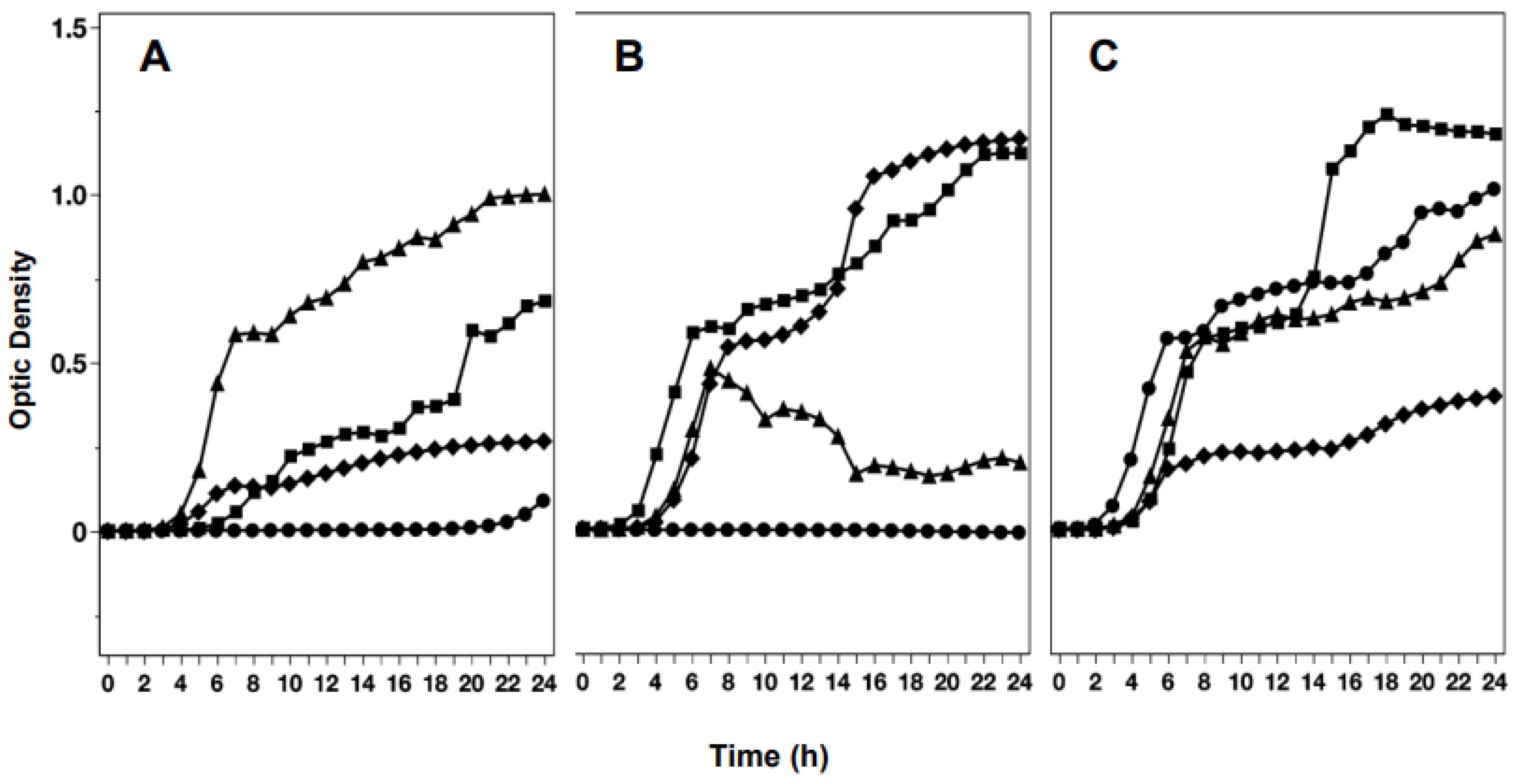
Figure 3.
Reduction of Salmonella Newport on outer (triangles) and inner (circles) layers of red (A), white (B) and yellow (C) onions during storage at room temperature. The dotted lines crossing the chart show the limit of detection of the counting method (1.1 log CFU/cm2) and the error bars represent standard error (SE). Each data point represents the mean of at least 9 tested samples.
Figure 3.
Reduction of Salmonella Newport on outer (triangles) and inner (circles) layers of red (A), white (B) and yellow (C) onions during storage at room temperature. The dotted lines crossing the chart show the limit of detection of the counting method (1.1 log CFU/cm2) and the error bars represent standard error (SE). Each data point represents the mean of at least 9 tested samples.
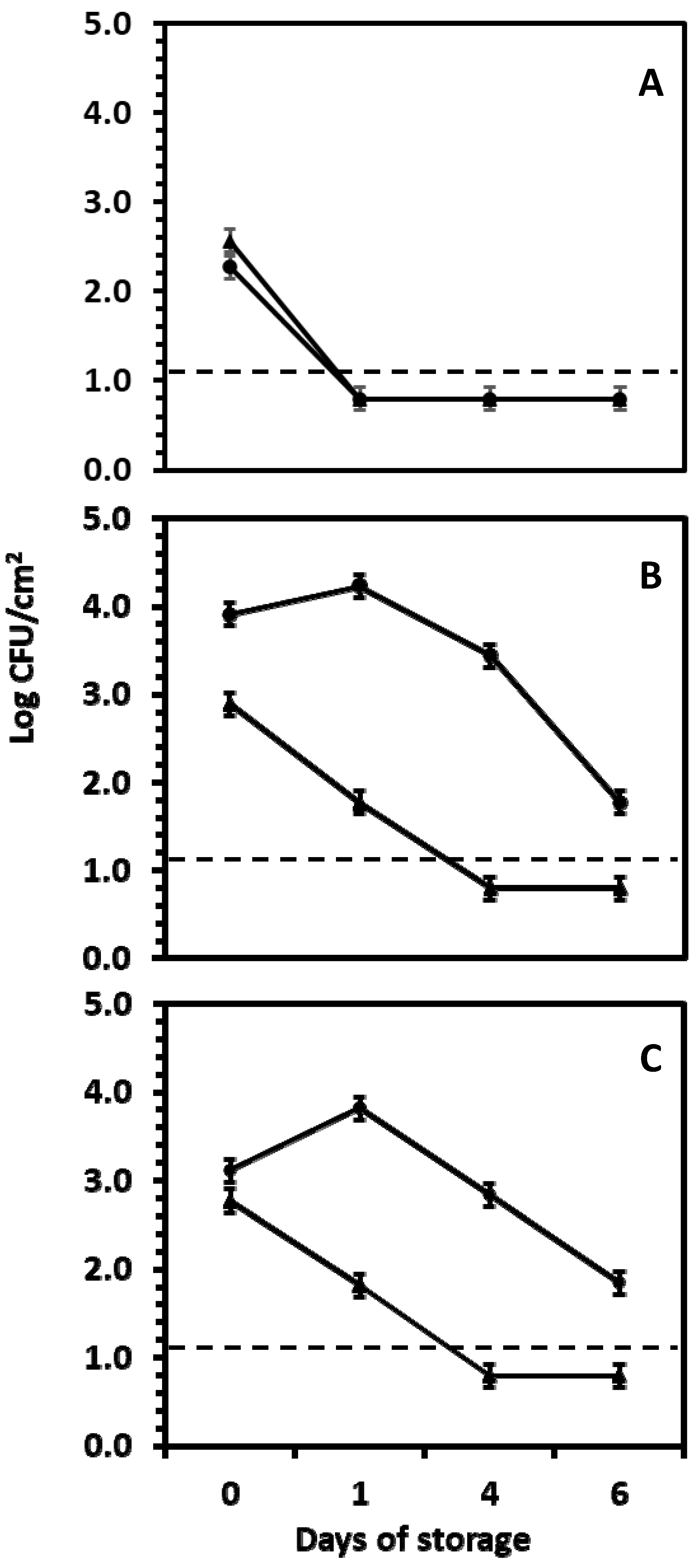
Table 1.
Growth of Salmonella in the presence of extracts of different genotypes of onion.
| Mean ∆ODa ± STDEV by location of scales used for extracts | ||
|---|---|---|
| Genotype | Outer | Inner |
| 25X | 0.62 ± 0.11 ABb | 0.97 ± 0.35 AB |
| 218Y | 0.85 ± 0.38 AB | 0.67 ± 0.02 AB |
| 231Y | 0.60 ± 0.02 AB | 0.70 ± 0.22 AB |
| 541X | 0.76 ± 0.20 AB | 0.68 ± 0.04 AB |
| 542 | 0.93 ± 0.38 AB | 0.33 ± 0.47 AB |
| 544X | 0.82 ± 0.01 AB | 0.80 ± 0.01 AB |
| 545X | 0.88 ± 0.43 A | 1.14 ± 0.03 AB |
| 1102 | 0.83 ± 0.37 AB | 1.08 ± 0.02 A |
| 1104 | -0.0025 ± 0.01 B | 0.26 ± 0.36 AB |
| 1196 | 0.64 ± 0.03 AB | 0.92 ± 0.34 AB |
| 1197 | 0.87 ± 0.35 AB | 0.58 ± 0.06 AB |
| YELLOW H6 | 0.67 ± 0.03 A | 1.17 ± 0.03 AB |
|
a ∆OD represents the change in OD reading at λ 630 for each extract and is calculated by subtracting the OD at zero time from the OD observed after 24 h incubation period. A ∆OD of ≤ 0.05 would be considered as no Salmonella growth. b Means followed by the same letter are not significantly different (P ≥ 0.05). Each mean represents the OD values obtained from 9 analytical values. | ||
Disclaimer/Publisher’s Note: The statements, opinions and data contained in all publications are solely those of the individual author(s) and contributor(s) and not of MDPI and/or the editor(s). MDPI and/or the editor(s) disclaim responsibility for any injury to people or property resulting from any ideas, methods, instructions or products referred to in the content. |
© 2024 by the authors. Licensee MDPI, Basel, Switzerland. This article is an open access article distributed under the terms and conditions of the Creative Commons Attribution (CC BY) license (http://creativecommons.org/licenses/by/4.0/).
Copyright: This open access article is published under a Creative Commons CC BY 4.0 license, which permit the free download, distribution, and reuse, provided that the author and preprint are cited in any reuse.


