1. Introduction
In the context of globalization, regional integration and economic performance are closely related [
1]. As a significant player in the global economy, China is actively responding to this trend by implementing a series of regionally coordinated development strategies. Among these, one key initiative is the construction of the Chengdu–Chongqing economic circle for transforming China’s economy from extensive to intensive, high-quality growth. By strengthening the synergistic effects between the two core cities, Chongqing and Chengdu, this initiative aims to stimulate the economic and social development of the entire western region. In October 2021, the Chinese State Council officially released the “Outline of the Chengdu–Chongqing Economic Circle Construction Plan,” which marks the upgrade of this regional cooperation model to a national strategic deployment and signifies unprecedented opportunities for cooperation between Sichuan and Chongqing in terms of policy guidance, industrial upgrading, and infrastructure connectivity.
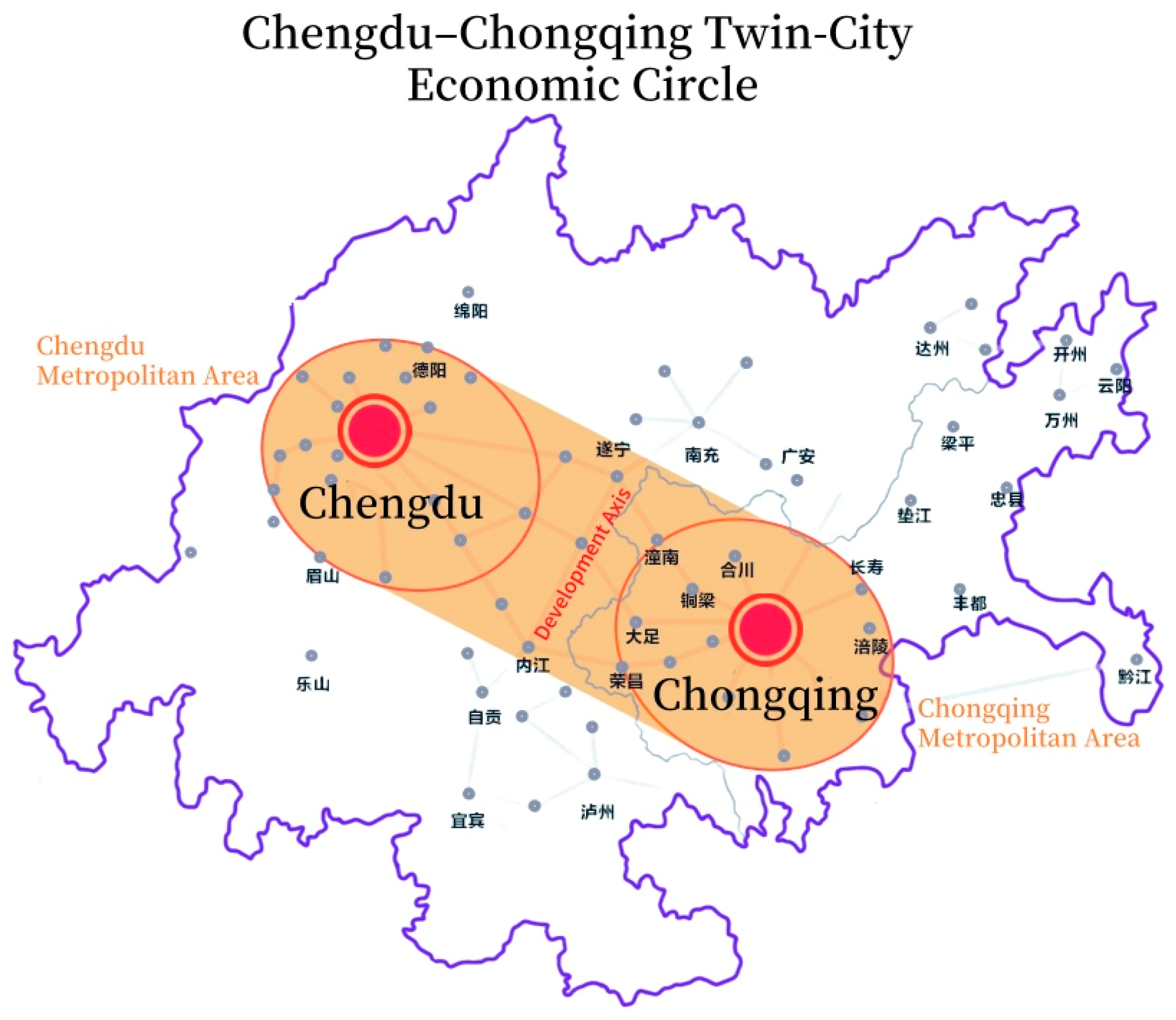
Chengdu and Chongqing, located in southwestern China, are key node cities of the “Belt and Road Initiative” and the Yangtze River Economic Belt [
2].
Figure 1 shows their geographical locations. The development of sports tourism in the Chengdu-Chongqing region is highly significant. It not only boosts domestic demand and drives economic growth but also takes advantage of the region's policy support, infrastructure, and rich natural and cultural resources. This, in turn, fosters balanced regional economic development, enhances the quality of life for local residents, and encourages the adoption of healthier lifestyles. However, to tackle challenges like regional development imbalances and issues of homogenization, it is essential to embrace innovative, coordinated, sustainable, open, and inclusive development strategies. These efforts will ensure the high-quality, integrated growth of sports tourism in the region.
The purpose of this paper was to explore the development pathways of sports tourism in the Chengdu–Chongqing Twin-City Economic Circle. This study focused on how scientific planning and policy guidance can promote differentiated development and complementary cooperation in sports tourism between the two areas, given the differing sports tourism resources and varying stages of development in Chengdu and Chongqing. This approach aimed to avoid homogenized competition [
3] and create synergistic effects.
Moreover, developing a sports tourism evaluation index system can serve as a valuable reference model for advancing sports tourism in other regions around the world. It can also enable comparative studies of sports tourism across similar regions, helping to identify strengths and weaknesses in various areas and fostering improvements and innovation. Examining the coordinated development of sports tourism in the Chengdu-Chongqing region from an international perspective can enhance the region’s ties to the global tourism market and attract more international visitors. This collaboration extends beyond the tourism sector, encompassing the hosting of sports events, resource sharing, and other initiatives, thus creating a broader network of international partnerships.
2. Theoretical Background
Sports tourism is a social, economic, and cultural phenomenon that arises from the unique interaction between activities, people, and places [
4]. As an emerging service industry, sports tourism represents the intersection and integration of sports and tourism, encompassing travel by individuals to watch, participate in, or experience various sports activities. Moreover, sports tourism has entered a period of rapid development with the rise of major international sporting events, such as the Olympics and the World Cup. These events attract audiences and participants from around the globe who, in addition to watching competitions, explore the host country’s culture and landscapes, which promotes the growth of the sports tourism market. In essence, sports tourism is a form of activity tourism [
5], characterized by its ability to satisfy tourists’ desire for leisure and recreation while achieving multiple goals, such as physical health [
6], skill enhancement, and cultural exchange. Sports tourism uses sports resources and facilities as core elements to attract tourists, providing unique experiences through carefully designed tourism products and services. Sports tourism encompasses various forms, such as active sports tourism, which involves traveling to participate in sports activities; event sports tourism, which involves traveling to watch sports events; and nostalgic sports tourism, which includes visits to sports museums, famous sports venues, and sports-themed cruises [
7]. Further subdivisions include complementary sports tourism, sports participation tourism, sports training tourism, event sports tourism, and luxury sports tourism [
4].
Research on sports tourism has focused primarily on nostalgia tourism studies, risk perception in sports tourism, the development of sports tourism events, the sustainable development of sports tourism [
8]. Additionally, sports tourism research has focused on various aspects, including integration strategies of sports tourism with the cultural heritage [
9], the impact of 5G technology on sports tourism development models [
10], the economic impact of sports events on local economies [
11], and the ecological environment protection and social responsibility of sports tourism destinations [
12]. Such studies aimed to promote the refined, distinctive, and high-quality development of the sports tourism industry on both theoretical and practical levels [
13]. Among these, the most noteworthy aspect is the role of sports tourism in promoting the local economy.
The impact of sports tourism on the economy is profound and multifaceted, influencing various sectors and contributing to overall economic growth. Sports tourism can be defined as travel that involves participating in or observing sports events, which generates significant economic benefits for host communities and regions [
14]. Such growth is particularly evident in regions that host large-scale sporting events, which can diversify tourism products and enhance local economies through increased visitor spending on accommodations, food, and entertainment [
15].
The economic benefits of sports tourism extend beyond immediate financial gains. Hosting major sporting events often leads to infrastructure improvements, such as enhanced transportation systems and upgraded facilities, which can have lasting positive effects on local economies [
16]. Additionally, the multiplier effect of tourism can stimulate job creation and increase income levels, particularly in less developed areas where economic opportunities may be limited [
17]. This is crucial as tourism-related industries often provide alternative income sources that contribute to economic sustainability [
18].
Moreover, the positive socio-economic impacts of sports tourism are supported by local communities, which often perceive these events as beneficial to their economic conditions [
19]. For example, the baseball town promotion project has had a certain socio-economic impact on Anan City by establishing new community development approaches, enhancing visibility, and increasing the number of participants in activities [
20]. In South Sumatra, sports tourism has been proven to transform and promote economic growth, generate income, reduce poverty, and expand opportunities [
21]. In regions like Machakos County in Kenya, sports tourism has been recognized as a vital link for economic growth, demonstrating the potential for local and national governments to promote sports tourism to enhance community benefits [
15].
Furthermore, the hospitality sector, training facilities, and sports supplies industries are among the subsectors that significantly benefit from sports tourism [
22]. The influx of tourists for sporting events creates demand for goods and services, which can stimulate local economies and lead to increased employment opportunities [
23]. This is particularly important in developing countries, where the economic impact of tourism can be transformative, providing much-needed jobs and income [
17,
18].
In conclusion, sports tourism serves as a catalyst for economic development, fostering infrastructure improvements, job creation, and community engagement. Its multifaceted impacts highlight the importance of strategic planning and investment in sports tourism as a means to enhance local economies and promote sustainable growth.
There is an inherent coupling between sports and tourism. Investigating the coordination of these two industries as they integrate enables a more precise understanding and analysis of their current integration status and existing issues. Furthermore, studying sports tourism activities not only contributes to the economic development of tourist destinations but also stimulates the upgrading of local sports industries and enhances the dissemination of local sports culture.
3. Research Questions
In the context of current research trends and the geographical characteristics of the Chengdu–Chongqing region, this study investigates the intersection and integration of sports and tourism based on the regional economic integration of the Chengdu–Chongqing area, and constructs a sports tourism evaluation index system. Using data from previous years, the coupling coordination degree and obstacle degree of sports tourism in the two cities are calculated, and future development strategies are proposed.
Building on the above content, this study proposes three research questions:
1. What are the characteristics of the temporal evolution of sports tourism development in the Chengdu-Chongqing region?
2. How has the coupling coordination degree of sports tourism in the Chengdu-Chongqing region changed from 2015 to 2020?
3. What are the primary obstacles impacting the development of sports tourism in the Chengdu-Chongqing region?
4. Methods
4.1. Entropy Method
The entropy method, grounded in the principles of information entropy theory, is a multi-criteria decision analysis technique that ascertains the weight of each index by quantifying the informational content encapsulated within the values of the respective indices. Data Standardization and Indicator Weight Calculation. The formula was as follows
where,
i represents the year, and
j represents the indicator. Standardization was used to process data with different meanings and units, facilitating subsequent comparative analysis.
Wj represents the Weights,
Fi represents the Comprehensive Scores.
4.2. Coupling Coordination Degree Model
Coupling is a concept in physics that referred to the energy transfer between circuits [
24]. With the development of interdisciplinary studies, coupling has gradually been applied to measure the interaction and mutual influence between two or more systems [
25], and is widely used in economics, management, and sociology research. The formula was as follows.
where n is the number of subsystems,
Ui is the comprehensive score of each subsystem, and the distribution interval is [0,1], which is the value after standardization. The interval of the coupling degree
C is also [0,1]. The larger the
C value, the smaller the degree of dispersion between subsystems and the higher the coupling degree; conversely, the lower the coupling degree between subsystems.
αi is the weight of the
i-th subsystem, generally set to equal weights, hence
αi = 0.5. D represents the Coupling Coordination Degree.
This paper adopts the coupling coordination degree evaluation standards proposed by Wang et al. [
26], as shown in
Table 1.
4.3. Obstacle Degree Model
The obstacle degree model can calculate the obstacle degree of each evaluation index in a comprehensive evaluation, identifying the key factors that restrict further development. A higher obstacle degree indicates a greater hindrance to the overall objective, while a zero obstacle degree indicates no hindrance to the overall objective. The formula was as follows.
where
F is the weight,
i represents the region and year, and
j represents the indicator.
This study is grounded in the “complexity thinking” centered on synergetics, treating sports tourism as an integrated whole, and constructing a sports tourism evaluation index system. The sports tourism index systems of Chengdu and Chongqing are viewed as two distinct systems when using panel data from 2015 to 2020. Through the calculation of the coupling coordination degree between these two systems, the study investigated the extent of coordinated development in sports tourism in the Chengdu–Chongqing region. Furthermore, the obstacle degree model was used to identify the factors hindering the coordinated development of sports tourism in this region, providing empirical evidence for decision-making.
4.4. Data Source
Due to the relative lag in sports industry statistics and the impact of the three-year pandemic leading to missing data in the tourism sector, the analysis ultimately uses relevant data from 2015 to 2020.
The relevant data sources for Chengdu are as follows:
1. 2015–2020 “Chengdu Sports Bureau Department Final Accounts Report”.
2. 2015–2020 “Chengdu Statistical Yearbook”.
3. Since the Chengdu sports lottery sales data could not be retrieved, the Sichuan sports lottery sales data were used as a substitute, sourced from the 2015–2020 “China Sports Yearbook”
The relevant data sources for Chongqing are as follows:
1. 2015–2020 “Chongqing Sports Bureau Department Final Accounts Report”.
2. 2015–2020 “Chongqing Statistical Yearbook”.
3. Chongqing Municipal Commission of Culture and Tourism Development “2010–2022 Chongqing Tourism Related Data”.
4. 2015–2020 “Chongqing Sports Industry Total Scale and Added Value Data Announcement” jointly released by the Chongqing Sports Bureau and the Chongqing Statistical Bureau.
5. Results
5.1. Construction of the Sports Tourism Evaluation Index System
Analysis of recent studies on sports tourism revealed that most studies on the coupling and coordinated development of sports tourism focused on coupling analysis between the sports industry and the tourism industry [
27], aiming to measure the dynamic relationship between these two sectors. This paper, building on such studies, views sports tourism as an integrated composite system, based on the theoretical foundation that sports tourism conceptualizes sports as a tourist attraction, thereby making a unique contribution to the tourism industry [
28]. The study selected indicators from four aspects: overall scale, market entities, development foundation, and government support, to conduct a quantitative analysis of sports tourism development. The indicators related to overall scale and market entities used content from previous studies. Development foundation indicators included the number of employees in the sports and entertainment industries, regional GDP, per capita disposable income, and the number of university students. Regional GDP and per capita disposable income were used to measure the level of regional economic development and the standard of living of the population, respectively. It is widely recognized that the practical conditions for promoting sports tourism include hosting major sports events and beautiful natural landscapes. Hosting major sports events, in particular, has been frequently mentioned in previous studies, and it has been noted that regions with weak economic strength and low quality of life are unable to host such events. In addition, university students are a primary source of volunteers for major sports events and play an important role in the successful hosting of these events [
29].
Unlike previous studies on the coordinated development of sports tourism, this paper focuses on the crucial role of government departments in the development of sports tourism. Therefore, three indicators—sports department revenue, financial allocations to sports departments, and government expenditure on sports—were used to highlight the role of the government. These indicators were aggregated to form the sports tourism coordinated development index system, as shown in
Table 2.
Table 2.
Sports Tourism Coordinated Development Index System.
Table 2.
Sports Tourism Coordinated Development Index System.
| Secondary Indicators |
Tertiary Indicators |
Unit |
Symbol |
Nature |
| Overall Scale |
Total Scale of the Sports Industry |
100 million yuan |
X1 |
+ |
| Sports Lottery Sales |
10,000 yuan |
X2 |
+ |
| Total Tourism Revenue |
100 million yuan |
X3 |
+ |
| Domestic Tourism Revenue |
100 million yuan |
X4 |
+ |
| Tourism Foreign Exchange Revenue |
10,000 US dollars |
X5 |
+ |
| Market Entities |
Number of Domestic Tourist Visits |
10,000 people |
X6 |
+ |
| Number of Inbound Overseas Tourists |
people |
X7 |
+ |
| Passenger Transport Volume |
10,000 people |
X8 |
+ |
| Development Foundation |
Number of Employees in the Sports and Entertainment Industry |
10,000 people |
X9 |
+ |
| Gross Regional Product |
100 million yuan |
X10 |
+ |
| Per Capita Disposable Income |
yuan |
X11 |
+ |
| Number of Enrolled University Students |
people |
X12 |
+ |
| Government Support |
Sports Department Revenue |
10,000 yuan |
X13 |
+ |
| Financial Allocations to Sports Departments |
10,000 yuan |
X14 |
+ |
| Government Expenditure on Sports |
10,000 yuan |
X15 |
+ |
Table 3.
Chengdu Sports Tourism Subsystem Data
Table 3.
Chengdu Sports Tourism Subsystem Data
| Symbol |
2015 |
2016 |
2017 |
2018 |
2019 |
2020 |
| X1 |
392.24 |
451.35 |
558 |
632.16 |
800 |
805.02 |
| X2 |
454416 |
476132 |
471638 |
848504 |
893138 |
737592 |
| X3 |
2040 |
2502 |
3033 |
3713 |
4664 |
3005 |
| X4 |
1987 |
2426 |
2946 |
3617 |
4551 |
3002 |
| X5 |
87264 |
124193 |
130656 |
144662 |
162327 |
4426 |
| X6 |
18904 |
19757 |
20704 |
23977 |
27642 |
20395 |
| X7 |
2305427 |
2723102 |
3013364 |
3406112 |
3814178 |
233091 |
| X8 |
55581.8 |
79359.9 |
99359.9 |
138356.9 |
164563.3 |
137414.7 |
| X9 |
6.17 |
8.61 |
8.83 |
7.85 |
9.19 |
9.31 |
| X10 |
10662.3 |
11874.1 |
13931.4 |
15698.9 |
17012.7 |
17716.7 |
| X11 |
33476 |
35902 |
38917.5 |
42127.85 |
45878.14 |
48593 |
| X12 |
755767 |
791593 |
817432 |
840297 |
879335 |
927111 |
| X13 |
30579.85 |
28218.21 |
31749.57 |
34870.1 |
52088.27 |
72009.11 |
| X14 |
21813.1 |
23821.45 |
20881.25 |
22522.63 |
38408.44 |
60681.13 |
| X15 |
17507.11 |
17432.96 |
19262.79 |
21515.23 |
38565.54 |
58820.02 |
Table 4.
Chongqing Sports Tourism Subsystem Data
Table 4.
Chongqing Sports Tourism Subsystem Data
| Symbol |
2015 |
2016 |
2017 |
2018 |
2019 |
2020 |
| X1 |
262.78 |
309.15 |
362.59 |
423.99 |
504.72 |
541.33 |
| X2 |
305770 |
350921 |
474659 |
596670 |
560006 |
407674 |
| X3 |
2251.31 |
2645.21 |
3308.04 |
4344.15 |
5739.07 |
3301.12 |
| X4 |
2149.15 |
2533.21 |
3176.55 |
4199.24 |
5564.61 |
3088.65 |
| X5 |
146857 |
168682 |
194759 |
218989 |
252483 |
10792 |
| X6 |
38885.1 |
44769.55 |
53871.86 |
59335.69 |
65296.69 |
53138.18 |
| X7 |
2825339 |
3165843 |
3583545 |
3880233 |
4113439 |
146342 |
| X8 |
64164 |
63402 |
63298 |
63634 |
63558 |
39797 |
| X9 |
6.96 |
7.61 |
8.31 |
9.12 |
9.75 |
9.89 |
| X10 |
16040.54 |
18023.4 |
20066.29 |
21588.8 |
23605.77 |
25002.79 |
| X11 |
27239 |
29610 |
32193 |
34889 |
37939 |
40006 |
| X12 |
767114 |
784631 |
805208 |
827945 |
907426 |
998650 |
| X13 |
49378.32 |
50612.61 |
45269.07 |
48505.76 |
57541.81 |
50543.39 |
| X14 |
34564.82 |
36714.4 |
32364.86 |
36576.29 |
37993.54 |
39194.28 |
| X15 |
25295.56 |
26529.77 |
25969.22 |
24665.67 |
25866.27 |
32366.39 |
5.2. Determination of Comprehensive Scores Using the Entropy Method
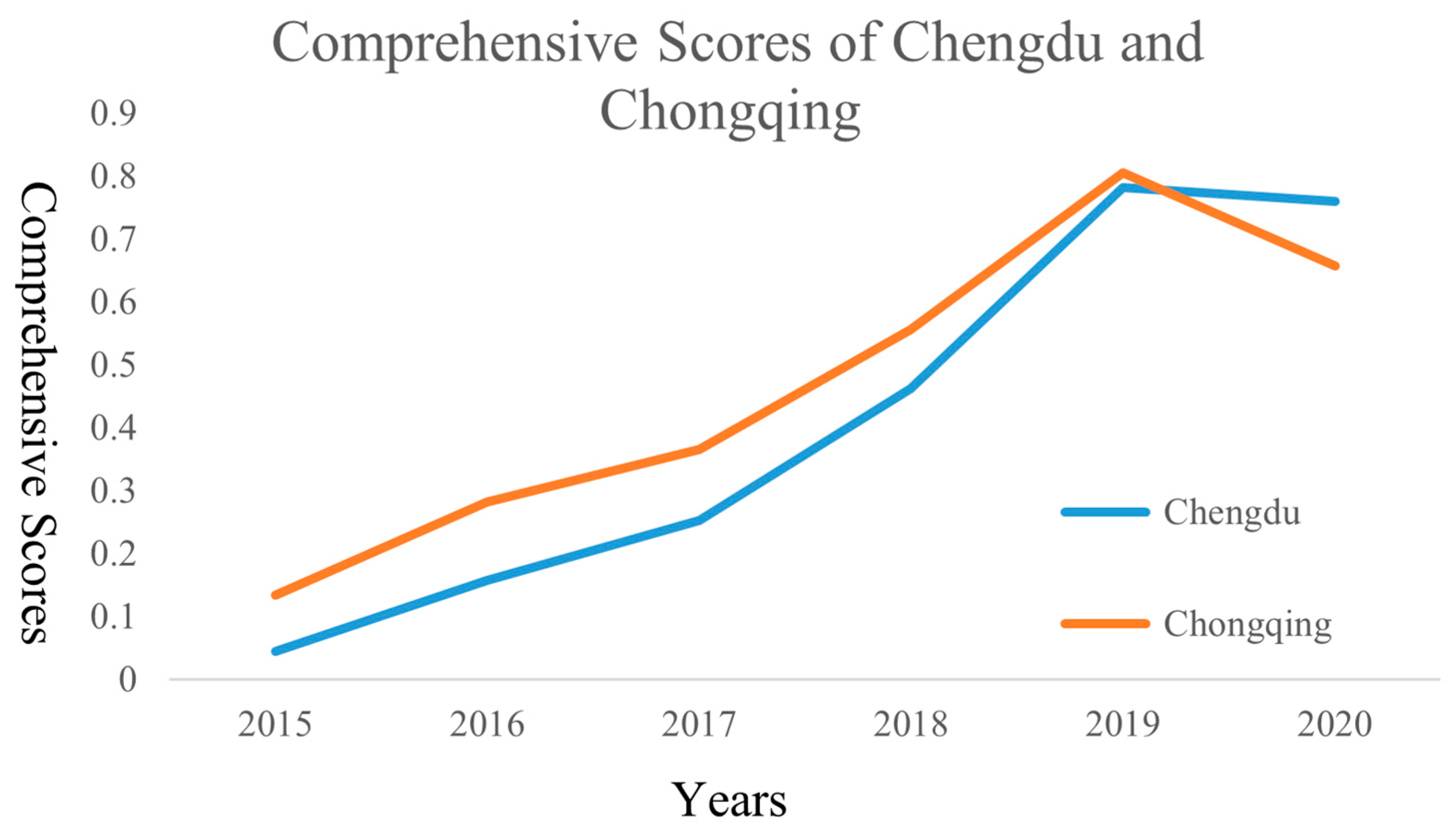
This paper employs the entropy method to calculate the indicator weights and derives the comprehensive scores for the Chengdu and Chongqing subsystems using the weight coefficients. All indicators in the sports tourism index system were positive indicators. The range method was used for data standardization. The comprehensive scores for the Chengdu and Chongqing subsystems, after calculation, are shown in
Figure 2.
As shown in
Figure 2, the overall scores for sports tourism in Chengdu and Chongqing showed a notable upward trend from 2015 to 2019, followed by a decline in 2020. This decline was more pronounced in Chongqing than in Chengdu. The strong growth of the sports tourism industry in the Chengdu-Chongqing region can be attributed to several key factors. First, political dynamics and regional cooperation have been instrumental. Chengdu, the capital of Sichuan Province, and Chongqing, a directly administered municipality, are both prominent cities in China with significant political influence, drawing considerable regional attention to the sports events hosted there [
30]. The model of cross-regional cooperation has not only facilitated resource sharing but also encouraged innovation in sports tourism products and services.
Additionally, the continuous growth in market demand has been a major driver of sports tourism development. With rising living standards and increasing health awareness, sports tourism has emerged as a popular leisure activity, attracting more and more participants. The Chengdu-Chongqing region has capitalized on this demand by organizing a wide range of sports events and activities, attracting numerous tourists and thereby fueling the steady expansion of the sports tourism market. Infrastructure development has also played a crucial role by providing the necessary support for sports tourism. Investments in outdoor sports facilities, sports parks, and other infrastructure have created an ideal environment for a variety of sports tourism activities, improving the overall experience and comfort for visitors. However, the onset of COVID-19 in 2020 had a significant impact on the global economy [
31], which in turn led to a decline in the comprehensive scores for sports tourism in the Chengdu-Chongqing region.
5.3. Measurement and Classification of Coupling Coordination Degree of Sports Tourism in the Chengdu–Chongqing Region
The coupling coordination degree model is primarily used to analyze the level of coordinated development of various phenomena, and it is generally employed to examine the degree of mutual influence and coupling between two or more systems. In this paper, the coupling coordination degree between the sports tourism sectors of Chengdu and Chongqing was calculated to analyze the coordinated development of sports tourism in the Chengdu–Chongqing region.
The calculated coupling coordination degree and coupling coordination grade for sports tourism in the Chengdu–Chongqing region are shown in
Table 5.
As shown in
Table 5, the coupling coordination degree of sports tourism in the Chengdu–Chongqing region continuously increased from 2015 to 2019, with the coordination type improving from moderate imbalance in 2015 to good coordination in 2019. The coupling coordination degree rose from 0.2779 to 0.8906. Further analysis revealed that this significant increase over five consecutive years was closely related to economic development, the increase in market entities, and strong support from local governments for sports tourism. In 2020, due to the impact of the pandemic, the tourism industry in the Chengdu–Chongqing region faced a significant setback, with a substantial decline in both sports tourism market entities and tourism industry revenue. Additionally, the complex pandemic situation in both cities hindered the smooth execution of government sports activities, leading to a 0.0502 decrease in the coupling coordination degree in 2020 compared with 2019. However, it still remained within the good coordination grade.
5.4. Obstacle Factors for the Coordinated Development of Sports Tourism in the Chengdu–Chongqing Region
As shown in
Table 6, the coordination type for the Chengdu–Chongqing region in 2019 and 2020 was classified as good coordination. To identify the obstacle factors affecting this good coordination, the original data from Chengdu and Chongqing for the years 2019–2020 were selected and analyzed.The standardized matrix and weights were calculated using the entropy method (as described above). Details are shown in
Table 6.
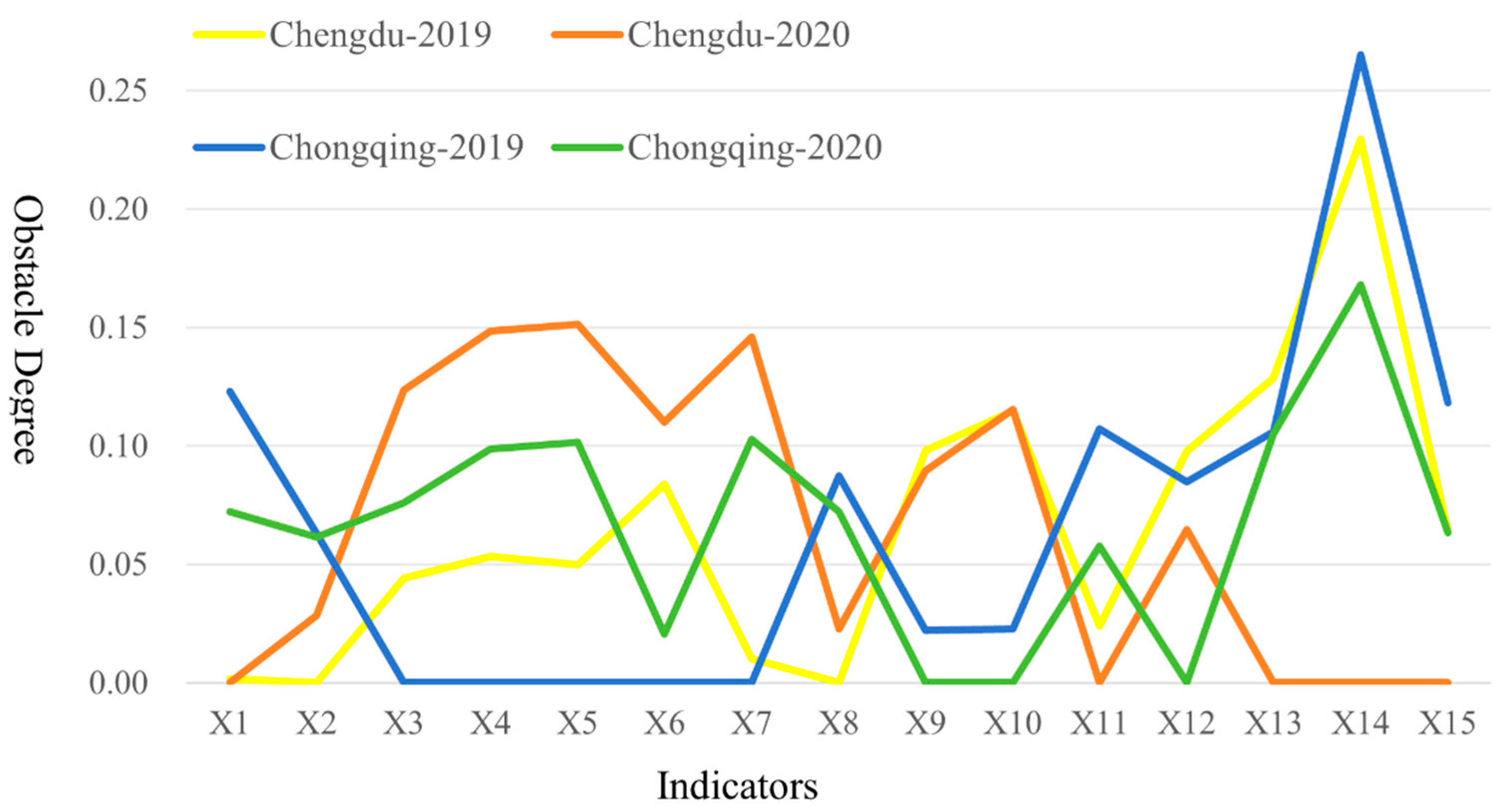
The obstacle degree for the coordinated development of sports tourism in the Chengdu–Chongqing region, as calculated, is shown in
Figure 3.
As shown in
Figure 3, the two main factors affecting the development of sports tourism in Chengdu in 2019 were financial allocations to sports departments (X14) and sports department revenue (X13). The three main factors affecting the development of sports tourism in Chengdu in 2020 were tourism foreign exchange revenue (X5), domestic tourism revenue (X4), and the number of inbound overseas tourists (X7). The two primary factors affecting the development of sports tourism in Chongqing in 2019 were financial allocations to sports departments (X14) and the total scale of the sports industry (X1). The main factor affecting the development of sports tourism in Chongqing in 2020 was financial allocations to sports departments (X14). Among these, financial allocations to sports departments were the primary obstacle factor affecting the coordinated development of sports tourism in the Chengdu–Chongqing region.
6. Discussion
6.1. Foundation for the Coordinated Development of Sports Tourism in the Chengdu–Chongqing Region
The growth of sports tourism highlights the need for critical consideration of related development issues [
28]. The Chengdu–Chongqing region’s unique geographical environment, abundant sports resources, and strong government policy support collectively form the foundation for the coordinated development of sports tourism in the area. First, the geographical environment: Chongqing and Chengdu, both important cities in China’s central and western regions, boast rich mountainous and hilly resources and unique geographical environments [
32], which provides exceptional conditions for the development of sports tourism in both cities. Chongqing’s Wulong Karst Tourist Area and Chengdu’s Xiling Snow Mountain Tourist Area, as national sports tourism demonstration bases, already have a strong reputation in the industry. Second, sports resources: Chengdu and Chongqing focus on cultivating city-specific independent brand events and are at the forefront of China in hosting international events and expanding their influence. Lastly, policy advantages: From 2007 to 2022, numerous development plans for the Chengdu–Chongqing region were formulated at both the national and local levels, providing absolute institutional guarantees for the promotion of high-quality integrated sports tourism development in the region [
33].
6.2. Recommendations for the Future Development of Sports Tourism in the Chengdu–Chongqing Region
6.2.1. Further Urban Integration
The Chengdu–Chongqing region should strengthen project cooperation, collaborated to develop distinctive resources, and create sports tourism brands with unique Chengdu–Chongqing characteristics. Additionally, the two cities should strengthen cooperation and exchange in sports events. Jointly hosting various sports events can not only increase their visibility and influence but also inject new vitality into the development of the sports tourism industry. For Chengdu and Chongqing, strengthening the coordinated improvement of urbanization levels and deepening the integration of the sports tourism industry will not only boost the urban competitiveness of both cities but also positively contribute to the promotion of economic development in the central and western regions. Optimizing urban planning and resource allocation is essential to increase urban integration. Chengdu and Chongqing should use scientific and rational urban planning to break down administrative barriers and achieve resource sharing and complementary advantages. The two cities should fully explore and use their distinctive resources while enhancing cooperation in urban infrastructure, transportation networks, and public services. Deepening urban integration, optimizing resource allocation, leveraging distinctive resources, and innovating tourism products, the Chengdu–Chongqing region can create unique sports tourism projects that attract more tourists to experience them.
6.2.2. Further Expand Open Cooperation
In response to China’s “dual circulation” development strategy, the Chengdu–Chongqing region—as a significant growth pole in the western region—should seize opportunities and view expanding open cooperation as a key measure to invigorate sports tourism. Chengdu and Chongqing should collaborate to elevate the level and depth of their openness by establishing and improving international sports exchange platforms, such as international sports forums, exhibitions, and trade fairs, to attract global attention and participation in sports tourism. The regions should also be proactive and engage with internationally renowned sports brands and events to attract more large-scale, international sports events, such as marathons, cycling races, and extreme sports challenges, to the Chengdu–Chongqing region [
34]. These events can directly boost the local tourism industry and enhance the international image and visibility of the cities effectively [
35]. The Chengdu–Chongqing region should fully maximize its cultural characteristics and natural resource advantages to develop sports tourism products with regional characteristics [
36], such as outdoor mountain adventures and water sports experiences. Through marketing and promotion overseas, the regions can attract international tourists.
6.2.3. Further Promote Industrial Agglomeration
Chengdu and Chongqing should enhance their internal structural adjustments within the industry [
37], clearly defining the distinctive positioning of sports tourism in each area. For instance, Chongqing can focus on its mountainous city characteristics to develop outdoor mountain sports, while Chengdu can focus on water sports projects due to its abundant water resources. This approach creates a complementary rather than competitive industrial pattern, which strengthens the integration of the upstream and downstream industry sectors. From organizing sports events and supplying sports equipment to providing tourism services, the construction of a closed-loop ecosystem would enhance the industrial agglomeration effect by improving the industrial chain. Additionally, efforts should be directed toward establishing sports tourism industrial parks or bases, concentrating superior resources to attract renowned domestic and international sports brands, tourism enterprises, and innovative institutions, thereby forming brand clusters. This will not only enhance regional visibility but also accelerate industrial upgrading through knowledge sharing and technological innovation within the cluster. In addition, to establish a diversified investment and financing system, the participation of social capital should be encouraged. This includes setting up sports tourism industry development funds and guiding venture capital to provide financial support for emerging projects and small innovative enterprises, thereby stimulating market vitality.
6.2.4. Further Strengthen Policy Support
To accelerate the coordinated development of sports tourism between Chongqing and Chengdu, a multi-layered, comprehensive policy system should be established to form a synergistic policy force from national to local level. At the national level, more guiding documents and preferential policies for the integration and development of sports tourism should be issued, with clear financial support measures. This includes establishing special funds to support the development of major sports tourism projects, providing tax reductions to alleviate the burden on enterprises, and encouraging social capital investment in sports tourism infrastructure construction. Talent introduction programs should attract domestic and international professionals in sports tourism management, marketing, and services should be attracted, attracting fresh blood and innovative thinking into the industry.
At the local government level, the government departments of Chongqing and Chengdu should collaborate closely to jointly research and formulate a coordinated development strategic plan that aligns with the characteristics and development needs of both regions [
38]. This plan should clearly define development goals, key tasks, and implementation pathways. The visitor experience can be enhanced by establishing a sports tourism resource-sharing mechanism, promoting joint organization of events, creating cross-regional premium sports tourism routes, and optimizing the regional transportation network. Building on the successful experiences of regions such as the Yangtze River Delta, Chongqing and Chengdu should strengthen policy innovation, which would encourage local governments to implement flexible measures based on actual conditions. For example, establishing sports tourism coordinated development demonstration zones can serve as pilot areas to experiment with and accumulate experience before gradually promoting the initiatives.
6.2.5. Further Improve the Transportation Network
Both cities currently face challenges such as outdated facilities and traffic congestion, which impact the visitor experience and willingness to return. It is therefore crucial to break through administrative barriers and coordinate infrastructure planning [
39]. The primary task is to boost investment to enhance the quality and capacity of infrastructure in well-known scenic spots, enhance reception conditions, alleviate parking difficulties, and ensure visitor satisfaction. The travel time between Chongqing and Chengdu has been reduced to one and a half hours since the Chengdu–Chongqing high-speed railway commenced operation in 2015, making the Chengdu–Chongqing “one-hour urban circle” a reality. Chongqing and Chengdu need to transcend administrative boundaries, jointly formulate relevant development policies, strengthen exchanges and cooperation, and collaboratively plan infrastructure construction [
40]. Both cities should continue their collaboration to establish a modern comprehensive transportation system, including optimizing the layout of airport clusters, enhancing the function of international aviation hubs, increasing the density of railways and highways, optimizing rail transit planning for more efficient connectivity, leveraging the advantages of Yangtze River water transport to deepen cooperation with cities along the river, and improving transport service standards to create a situation of collaborative construction and shared benefits.
7. Conclusions
The present study offers an in-depth analysis of the coordinated development of sports tourism in the Chengdu-Chongqing region of China, utilizing a sports tourism evaluation index system and coupling coordination models. The results show that the sports tourism sector in this region saw a significant increase in its coupling coordination degree from 2015 to 2019, reflecting improved integration and mutual reinforcement between sports and tourism. However, the onset of the COVID-19 pandemic in 2020 led to a notable decline, highlighting the sector's susceptibility to external disruptions. The study identifies the primary challenge to further coordination as insufficient financial resources for sports departments, indicating a need for better resource allocation and policy support.
The findings have several implications for international audiences and policymakers. First, the developed sports tourism evaluation index system provides a replicable model for assessing and comparing sports tourism development across different regions globally. This framework can guide policy decisions and strategic planning in regions aiming to leverage the economic and social benefits of sports tourism. Additionally, the use of coupling coordination theory in this study illustrates its effectiveness in examining the dynamic interaction between sports and tourism, offering valuable insights for regions worldwide seeking to strengthen synergies between these sectors.
For the Chengdu-Chongqing region, the study suggests that while substantial progress has been achieved, there is a need to further enhance urban integration, expand cooperative initiatives, foster industrial clusters, bolster policy support, and improve the transportation network. If these strategies are effectively implemented, they could help mitigate the effects of future disruptions, such as the COVID-19 pandemic, and promote the sustainable, coordinated growth of sports tourism.
In conclusion, the coordinated development of sports tourism in the Chengdu-Chongqing region presents a promising avenue for economic growth and regional integration. The region's distinctive geographical setting, abundant sports resources, and strong government backing provide a solid foundation for continued progress. By building on these strengths, the Chengdu-Chongqing region can become a model for other regions seeking to tap into the potential of sports tourism as a catalyst for economic development and international cooperation.
Author Contributions
Conceptualization, Shichuan Li; methodology, Fanxiang Zhao; software, Fanxiang Zhao; validation, Fanxiang Zhao; formal analysis, Fanxiang Zhao; investigation, Fanxiang Zhao; resources, Fanxiang Zhao; data curation, Fanxiang Zhao; writing—original draft preparation, Fanxiang Zhao; writing—review and editing, Shichuan Li; visualization, Shichuan Li; supervision, Shichuan Li.; project administration, Shichuan Li. All authors have read and agreed to the published version of the manuscript.
Funding
This research received no external funding.
Acknowledgments
We thank the editor and the reviewers for their helpful comments. In addition, we would also like to express our gratitude to all the participants who generously devoted their time to the study.
Conflicts of Interest
The authors declare no conflicts of interest.
References
- Pomerlyan, E.; and Belitski, M. Regional integration and economic performance: evidence from the Eurasian Economic Union. Eurasian Geography and Economics. 2024, 65, 627–655. [Google Scholar] [CrossRef]
- Cheshmehzangi, A.; Tang, T. Chengdu-Chongqing city cluster: From an economic zone to a major economic circle in the Western China, In China’s city cluster development in the race to carbon neutrality.; Singapore: Springer Nature Singapore, 2022; pp: 77-92. [CrossRef]
- Wang, W.; Wang, S. Q.; Li, Y. S.; Feng, C. Assessing the sustainability and competitiveness of tourism economies in China’s Chengdu-Chongqing metropolitan area. Environmental Science and Pollution Research. 2022, 29, 66960–66978. [Google Scholar] [CrossRef] [PubMed]
- Weed,M.; Bull,C. Sports Tourism Participants, Policy and Providers. London:Routledge, 2009; pp: 68-74. [CrossRef]
- Deery, M.; Jago, L.; Fredline, L. Sport tourism or event tourism: are they one and the same? Journal of Sport & Tourism. 2004, 9(3): 235–245. [CrossRef]
- Gozalova, M. , Shchikanov, A., Vernigor, A., and Bagdasarian, V. 2014. Sports tourism. Polish journal of sport and tourism. 2004, 21, 92–96. [Google Scholar] [CrossRef]
- Gibson, H. J. Sport Tourism: A Critical Analysis of Research. Sport Management Review. 1998, 1, 45–76. [Google Scholar] [CrossRef]
- Cheng, M.; Zhang, L.; Zhang, B. A literature review of sports tourism research: knowledge graph analysis based on CiteSpace visualization. Journal of Sport & Tourism. 2023, 27, 293–313. [Google Scholar] [CrossRef]
- Yuan, H.; Lu, Y.; Fang, X. Current Situation Analysis and Countermeasures of Integration between Intangible Cultural Heritage and Sports Tourism: A Case Study of Anhui Province. Journal of Chengdu Sport University. 2015, 41, 60–63. [Google Scholar]
- Liang, F.; Mu, L.; Wang, D.; Kim, B. S. A new model path for the development of smart leisure sports tourism industry based on 5G technology. IET Communications. 2022, 16, 485–496. [Google Scholar] [CrossRef]
- Gratton, C.; Shibli, S.; Coleman, R. The economics of sport tourism at major sports events. In Sport tourism destinations, London: Routledge. 2007; pp: 233-247.
- Mascarenhas, M.; Pereira, E.; Rosado, A.; Martins, R. How has science highlighted sports tourism in recent investigation on sports’environmental sustainability? A systematic review. Journal of Sport & Tourism. 2021, 25, 42–65. [Google Scholar] [CrossRef]
- Xu, K.; Huang, H.; Lian, T.; Li, G.; Ren, B. 2019. Paths and Key Issues for High-Quality Development of China's Sports Industry. Journal of Shanghai Sports University. 2019, 43, 29–37. [Google Scholar]
- Malchrowicz-Mośko, E.; Młodzik, M.; Banio, A.; Omorczyk, A. Triathlon as a form of sports consumption: motives for participation. Turyzm/Tourism. 2018, 28, 41–48. [Google Scholar] [CrossRef]
- Njoroge, J.; Atieno, L.; Nascimento, D. Sports tourism and perceived socio-economic impact in kenya: the case of machakos county. Tourism and Hospitality Management. 2017, 23, 195–217. [Google Scholar] [CrossRef]
- Kim, W.; Jun, H.; Walker, M.; Drane, D. Evaluating the perceived social impacts of hosting large-scale sport tourism events: scale development and validation. Tourism Management. 2015, 48, 21–32. [Google Scholar] [CrossRef]
- Pedauga, L.; Pardo-Fanjul, A.; Castán, J.; Izquierdo, J. Assessing the economic contribution of sports tourism events: a regional social accounting matrix analysis approach. Tourism Economics. 2020, 28, 599–620. [Google Scholar] [CrossRef]
- Joun, H.; Kim, H. Productivity evaluation of tourism and culture for sustainable economic development: analyzing south korea’s metropolitan regions. Sustainability. 2020, 12, 2912. [Google Scholar] [CrossRef]
- González-García, R.; Rico, G.; Bañuls-Lapuerta, F.; Moreno, F. Residents’ perception of the impact of sports tourism on sustainable social development. Sustainability. 2022, 14, 1232. [Google Scholar] [CrossRef]
- WADA, T. Socio-economic effects of community design through sports: A case study of sport tourism using baseball in Anan City, Tokushima. Annals of the Association of Economic Geographers. 2021, 67, 43–57. [Google Scholar] [CrossRef]
- Harahap, Z.; Kartika, T. Community development in sports tourism development as economic driver inclusive in south Sumatera. Journal of Indonesian Tourism, Hospitality and Recreation. 2020, 3(2), 197-206. [CrossRef]
- García, M.; Chico, J.; Sánchez, A.; Sánchez, J. (2020). A bibliometric analysis of sports tourism and sustainability (2002–2019). Sustainability 2840, 12, 2840. [Google Scholar] [CrossRef]
- Wortman, T.; Donaldson, R.; Westen, G. (2016). ‘they are stealing my island’: residents’ opinions on foreign investment in the residential tourism industry in tamarin, mauritius. Singapore Journal of Tropical Geography. 2016, 37, 139–157. [Google Scholar] [CrossRef]
- Ma, H. L. , Chou, N. T., and Wang, L. Dynamic Coupling Analysis of Urbanization and Water Resource Utilization Systems in China. Sustainability. 2016, 8, 1176. [Google Scholar] [CrossRef]
- Cui, M. Coupling and Coordinated Relationship between Urbanization and Ecological Environment in Central Plains Urban Agglomeration. Economic Geography. 2015, 35(07): 72-78.
- Wang, S.; Kong, W.; Ren, L.; Zhi, D.; Dai, B. Misconceptions and Corrections of Domestic Coupling Coordination Models. Journal of Natural Resources. 2021, 36, 793–810. [Google Scholar] [CrossRef]
- Cheng, M.; Zhang, L.; Li, D. Analysis of the coupled and coordinated development of sports and tourism industries and the driving factors. Scientific Reports. 2023, 13, 16725. [Google Scholar] [CrossRef] [PubMed]
- Higham, J.; Hinch, T. 2018. Sport tourism development. Bristol, Blue Ridge Summit: Channel View Publications, 2018; pp: 133-152.
- Lu, W. C.; Cheng, C. F.; Lin, S. H.; Chen, M. Y. Sport volunteering and well-being among college students. Current psychology. 2019, 38, 1215–1224. [Google Scholar] [CrossRef]
- Zheng, E.; Xue, C.; Chen, G.; Zhang, Y.; Zou, J. Unveiling urban marathon development characteristics and urban growth strategies in China: Insights from time series analysis of Baidu Search Index. PLOS ONE. 2023, 18, e0287760. [Google Scholar] [CrossRef] [PubMed]
- Naseer, S.; Khalid, S.; Parveen, S.; Abbass, K.; Song, H.; Achim, M. V. COVID-19 outbreak: Impact on global economy. Frontiers in public health. 2023, 10, 1009393. [Google Scholar] [CrossRef] [PubMed]
- Weng, G.; Li, H.; Li, Y. The temporal and spatial distribution characteristics and influencing factors of tourist attractions in Chengdu-Chongqing economic circle. Environment, Development and Sustainability. 2023, 25, 8677–8698. [Google Scholar] [CrossRef]
- Zeng, S.; Zhang, H.; Wang, M. Research on High-quality Integration of Sports Tourism in Chengdu-Chongqing Dual-city Economic Circle under the New Development Concept. Advances in Physical Sciences. 2024, 12, 242. [Google Scholar]
- Yu, Q.; Yu, Y.; Deng, C.; Wang, J. High-Quality Development of Sports Competition Performance Industry in Chengdu-Chongqing Region Based on Performance Evaluation Theory. Economics. 2024, 18, 20220063. [Google Scholar] [CrossRef]
- Kong, Q.; Lu, Z. The Multidimensional Impact of Hosting Sports Events on Urban Development. Journal of Nanjing Sport Institute: Social Sciences Edition. 2013, 27, 50–53. [Google Scholar]
- Zhou, D.; Li, P.; Luo, R. 2005. Socio-economic Value and Implementation Strategies of Sports Leisure Tourism Industry Development in the Hunan-Hubei-Chongqing-Guizhou Border Area. Journal of Wuhan Institute of Physical Education. 2005, 39, 10–13. [Google Scholar]
- Hou, L.; Cui, M. A new insight to investigate the developmental resilience of Chengdu-Chongqing twin-city economic circle based on ecological niche theory. Journal of Asian Architecture and Building Engineering. 2024, 1–13. [Google Scholar] [CrossRef]
- Cheng, H.; Wang, S. On Challenges and Countermeasures of the Sports Exchange and Cooperation in Chengdu-Chongqing Twin-City Economic Circle. Journal of Southwest China Normal University (Natural Science Edition). 2021, 46, 119–124. [Google Scholar]
- Wan, J.; Ma, C.; Jiang, T.; Phillips, A.; Wu, X.; Wang, Y. . Cao, Y. A spatial econometric investigation into road traffic accessibility and economic growth: insights from the Chengdu-Chongqing twin-city economic circle. Humanities and Social Sciences Communications. 2024, 11, 1–9. [Google Scholar] [CrossRef]
- Han, D.; Chen, L.; Wu, H.; Wang, X.; Xiao, Y.; Yang, H.; ... Chang, M. Evaluation on coupling coordinated development of population economy and eco-geological environment in the twin-city economic circle of Chengdu–Chongqing region. Scientific Reports. 2023, 13(1), 13459. [CrossRef]
|
Disclaimer/Publisher’s Note: The statements, opinions and data contained in all publications are solely those of the individual author(s) and contributor(s) and not of MDPI and/or the editor(s). MDPI and/or the editor(s) disclaim responsibility for any injury to people or property resulting from any ideas, methods, instructions or products referred to in the content. |
© 2024 by the authors. Licensee MDPI, Basel, Switzerland. This article is an open access article distributed under the terms and conditions of the Creative Commons Attribution (CC BY) license (http://creativecommons.org/licenses/by/4.0/).