

Submitted:
12 November 2024
Posted:
13 November 2024
You are already at the latest version
Abstract
This study aimed to enhance the properties and compostability of active poly(lactic acid) (PLA) films by incorporating β-cyclodextrin (β-CD) inclusion complexes with allyl isothiocyanate (AITC). Films were prepared via melt extrusion and characterized by their structural, chemical, morphological, thermal and barrier properties. These inclusion complexes improved the thermal stability and moisture absorption of films, enhancing disintegration under composting conditions. The release of AITC in the vapour phase was responsive to relative humidity, maintaining the antimicrobial functionality at low values and releasing effectively at higher humidity levels, with a maximum release at 100%. Incorporating 5% and 10% β-CD:AITC complexes accelerated disin-tegration under composting conditions, reducing the time by five days for disintegration com-pared to pure PLA, achieving up to 90% in 23 days. These results, with a general improvement in functional properties, suggest that PLA films with β-CD:AITC are promising for developing sustainable, biodegradable antimicrobial packaging solutions for food applications.
Keywords:
1. Introduction
2. Results
2.1. Characterisation of PLA Films
2.1.1. Field Emission Scanning Electronic Microscopy (FESEM)
2.1.2. X-ray Diffraction (XRD)
2.1.3. Thermal Properties
2.1.4. Colour Measurements
2.1.5. Mechanical Properties
2.1.5. Barrier Properties (Water Vapour and Oxygen Permeability)
2.2. Releasing of AITC from Active Films (Responsive Capacity)
2.3. Disintegration Under Composting Conditions
2.3.1. Macroscopic Changes and Disintegration Percentage
2.3.2. Morphological Analysis
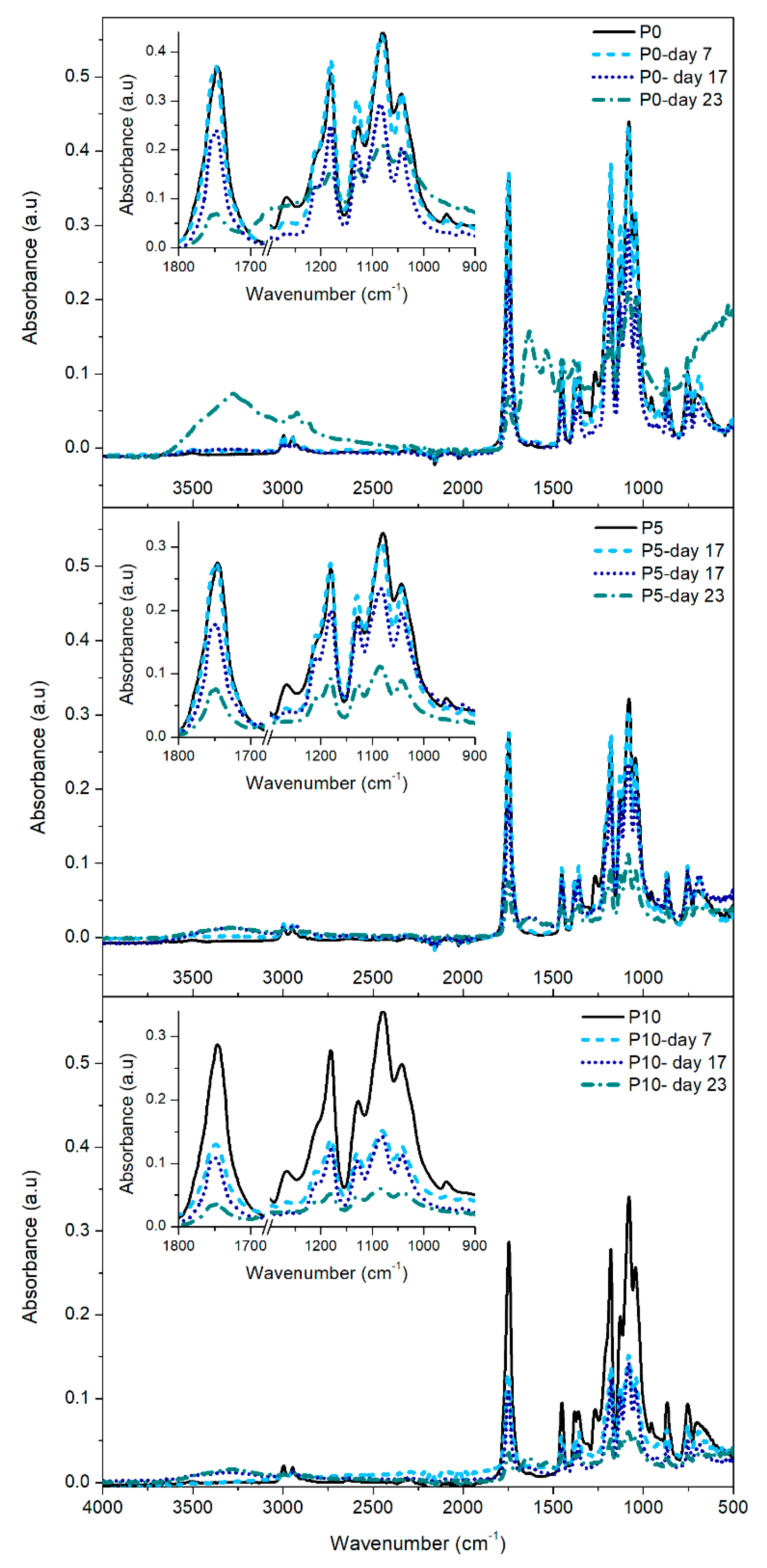
2.3.3. FTIR Analysis
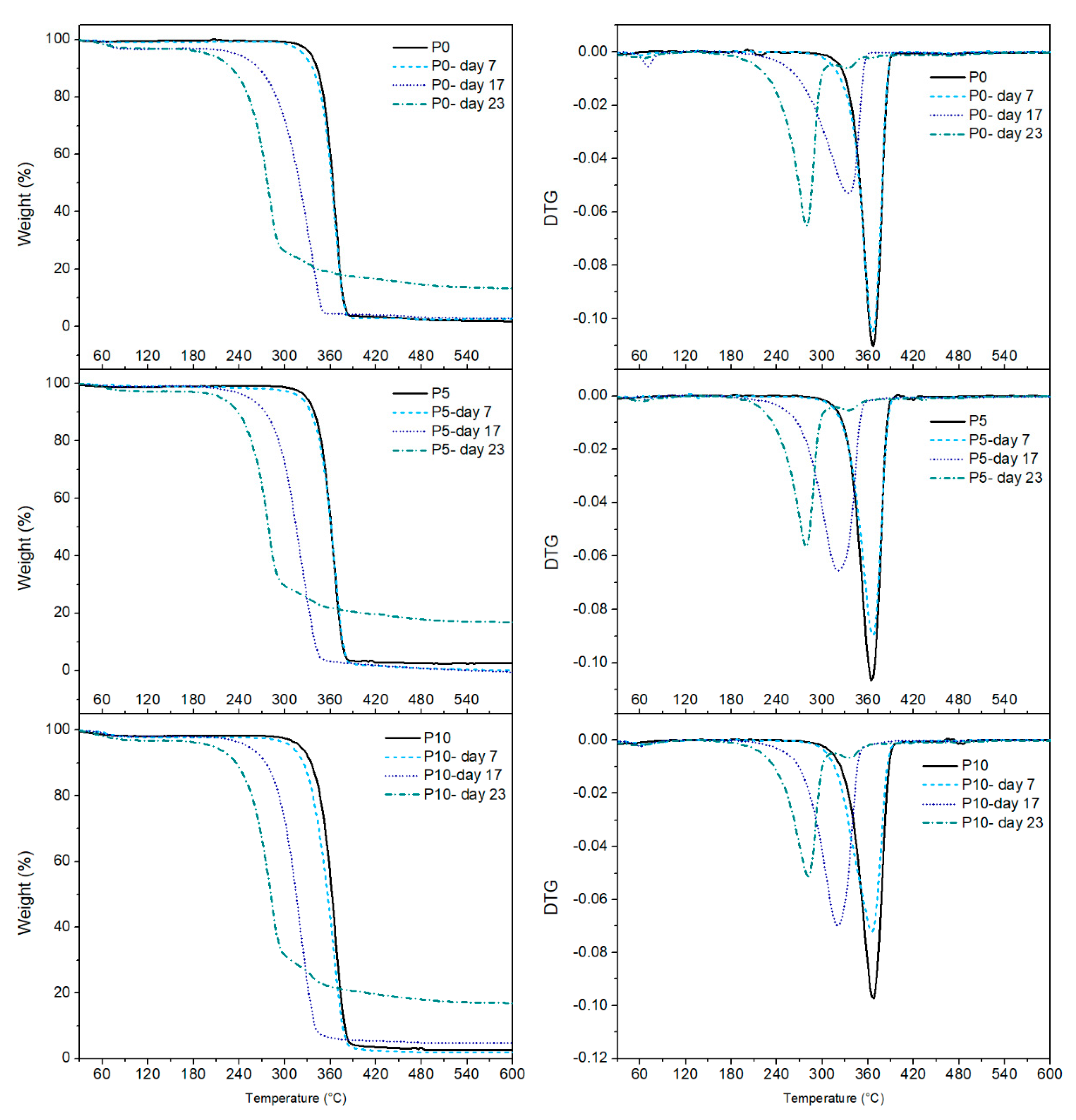
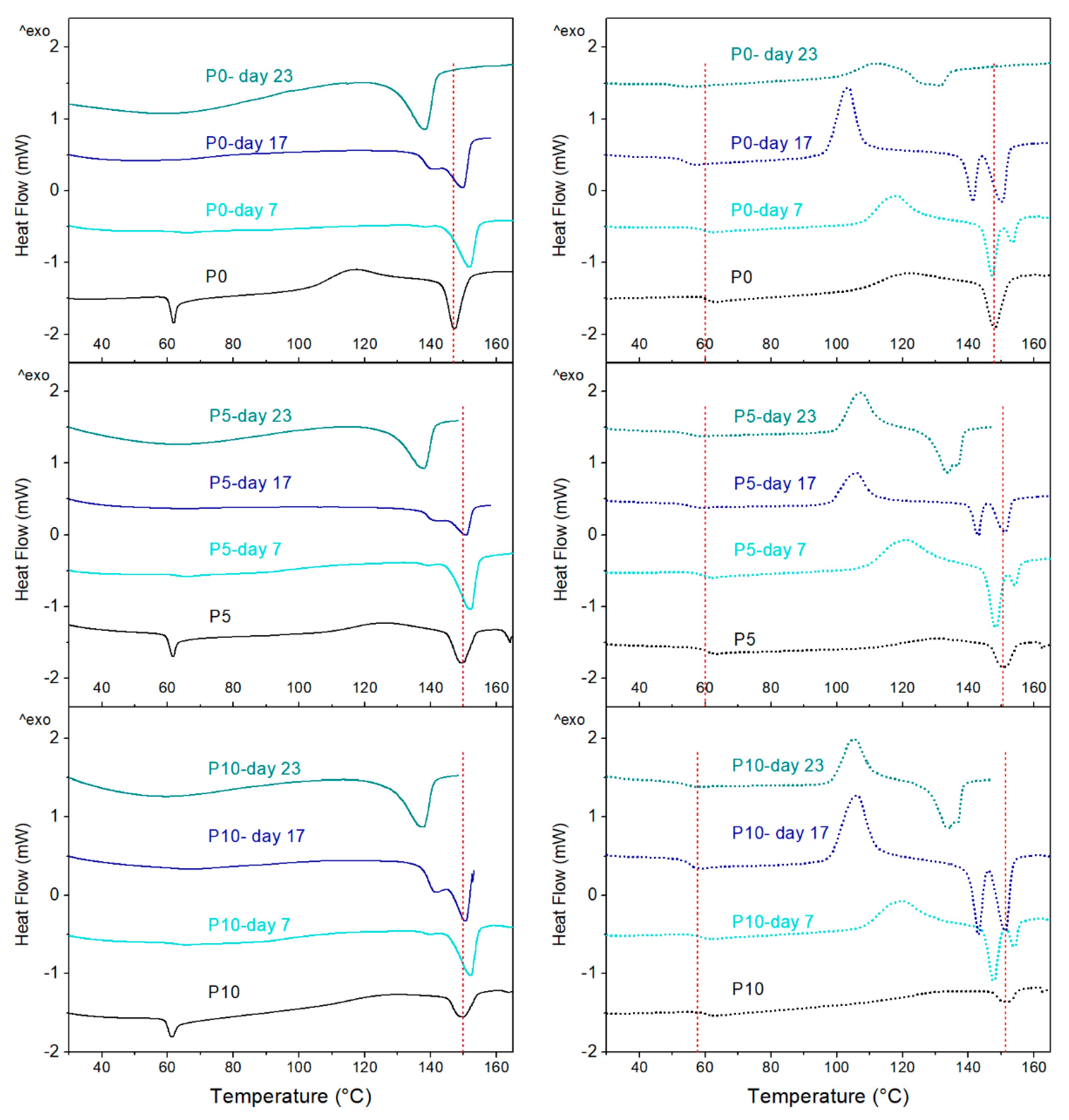
2.3.4. Thermal Analysis (TGA and DSC)
3. Materials and Methods
3.1. Materials
3.2. Films Preparation
3.3. Film Characterisation
3.3.1. Field Emission Scanning Electronic Microscopy (FESEM)
3.3.2. X-ray Diffraction (XRD)
3.3.3. Thermogravimetric Analysis (TGA)
3.3.5. Colour Measurements
3.3.6. Mechanical Properties
3.3.7. Barrier Properties
3.4. Release Vapour Phase (Responsive Capacity)
3.5. Disintegration in Compost Conditions
4. Conclusions
Supplementary Materials
Author Contributions
Funding
Institutional Review Board Statement
Informed Consent Statement
Acknowledgments
Conflicts of Interest
References
- Lombardi, A.; Fochetti, A.; Vignolini, P.; Campo, M.; Durazzo, A.; Lucarini, M.; Puglia, D.; Luzi, F.; Papalini, M.; Renzi, M.; et al. Natural Active Ingredients for Poly (Lactic Acid)-Based Materials: State of the Art and Perspectives. Antioxidants 2022, Vol. 11, Page 2074 2022, 11, 2074. [Google Scholar] [CrossRef] [PubMed]
- Siddiqui, S.A.; Singh, S.; Bahmid, N.A.; Mehany, T.; Shyu, D.J.H.; Assadpour, E.; Malekjani, N.; Castro-Muñoz, R.; Jafari, S.M. Release of Encapsulated Bioactive Compounds from Active Packaging/Coating Materials and Its Modeling: A Systematic Review. Colloids and Interfaces 2023 2023, 7, 25. [Google Scholar] [CrossRef]
- Westlake, J.R.; Tran, M.W.; Jiang, Y.; Zhang, X.; Burrows, A.D.; Xie, M. Biodegradable Biopolymers for Active Packaging: Demand, Development and Directions. Sustainable Food Technology 2023, 1, 50–72. [Google Scholar] [CrossRef]
- Westlake, J.R.; Tran, M.W.; Jiang, Y.; Zhang, X.; Burrows, A.D.; Xie, M. Biodegradable Active Packaging with Controlled Release: Principles, Progress, and Prospects. ACS Food Science and Technology 2022, 2, 1166–1183. [Google Scholar] [CrossRef]
- Muñoz-Shugulí, C.; Patiño Vidal, C.; Cantero-López, P.; Lopez-Polo, J. Encapsulation of Plant Extract Compounds Using Cyclodextrin Inclusion Complexes, Liposomes, Electrospinning and Their Combinations for Food Purposes. Trends Food Sci Technol 2021, 108, 177–186. [Google Scholar] [CrossRef]
- Yazdani, M.; Tavakoli, O.; Khoobi, M.; Wu, Y.S.; Faramarzi, M.A.; Gholibegloo, E.; Farkhondeh, S. Beta-Carotene/Cyclodextrin-Based Inclusion Complex: Improved Loading, Solubility, Stability, and Cytotoxicity. J Incl Phenom Macrocycl Chem 2022, 102, 55–64. [Google Scholar] [CrossRef]
- Benucci, I.; Mazzocchi, C.; Lombardelli, C.; Del Franco, F.; Cerreti, M.; Esti, M. Inclusion of Curcumin in B-Cyclodextrin: A Promising Prospective as Food Ingredient. Food Additives & Contaminants: Part A 2022, 39, 1942–1952. [Google Scholar] [CrossRef]
- Patiño Vidal, C.; López de Dicastillo, C.; Rodríguez-Mercado, F.; Guarda, A.; Galotto, M.J.; Muñoz-Shugulí, C. Electrospinning and Cyclodextrin Inclusion Complexes: An Emerging Technological Combination for Developing Novel Active Food Packaging Materials. Crit Rev Food Sci Nutr 2021, 62, 5495–5510. [Google Scholar] [CrossRef]
- Ravindran Maniam, M.M.; Loong, Y.H.; Samsudin, H. Understanding the Formation of β-Cyclodextrin Inclusion Complexes and Their Use in Active Packaging Systems. Starch 2022, 74, 2100304. [Google Scholar] [CrossRef]
- Li, J.; Xu, F.; Dai, Y.; Zhang, J.; Shi, Y.; Lai, D.; Sriboonvorakul, N.; Hu, J. A Review of Cyclodextrin Encapsulation and Intelligent Response for the Release of Curcumin. Polymers (Basel) 2022, 14, 5421. [Google Scholar] [CrossRef]
- Patil, P.B.; Patel, J.K. Chemopreventive Aspects, Investigational Anticancer Applications and Current Perspectives on Allyl Isothiocyanate (AITC): A Review. Mol Cell Biochem 2023, 478, 2763–2777. [Google Scholar] [CrossRef] [PubMed]
- Marques, C.S.; Dias, M.V.; Soares, N. de F.F.; Borges, S.V.; de Oliveira, I.R.N.; Pires, A.C. dos S.; Medeiros, E.A.A.; Alves, E. Ultrastructural and Antimicrobial Impacts of Allyl Isothiocyanate Incorporated in Cellulose, β-Cyclodextrin, and Carbon Nanotubes Nanocomposites. Journal of Vinyl and Additive Technology 2021, 27, 795–805. [Google Scholar] [CrossRef]
- Muñoz-Shugulí, C.; Rodríguez-Mercado, F.; Benbettaieb, N.; Guarda, A.; Galotto, M.J.; Debeaufort, F. Development and Evaluation of the Properties of Active Films for High-Fat Fruit and Vegetable Packaging. Molecules 2023, 28, 3045. [Google Scholar] [CrossRef] [PubMed]
- Abellas, E.L.; Bentain, K.B.; Mahilum, R.J.D.; Pelago, C.R.J.; Yntig, R.M.; John, M.S. Bioplastic Made from Starch as a Better Alternative to Commercially Available Plastic. Sci Educ (Dordr) 2021, 2, 257–277. [Google Scholar]
- Swetha, T.A.; Bora, A.; Mohanrasu, K.; Balaji, P.; Raja, R.; Ponnuchamy, K.; Muthusamy, G.; Arun, A. A Comprehensive Review on Polylactic Acid (PLA) – Synthesis, Processing and Application in Food Packaging. Int J Biol Macromol 2023, 234, 123715. [Google Scholar] [CrossRef]
- Dobrzyńska-Mizera, M.; Knitter, M.; Szymanowska, D.; Mallardo, S.; Santagata, G.; Di Lorenzo, M.L. Optical, Mechanical, and Antimicrobial Properties of Bio-Based Composites of Poly(L-Lactic Acid) and D-Limonene/β-Cyclodextrin Inclusion Complex. J Appl Polym Sci 2022, 139, 52177. [Google Scholar] [CrossRef]
- Rojas, A.; Velásquez, E.; Patiño, C.; Guarda, A.; Galotto, M.J.; López de Dicastillo, C. Active PLA Packaging Films: Effect of Processing and the Addition of Natural Antimicrobials and Antioxidants on Physical Properties, Release Kinetics, and Compostability. Antioxidants 2021, Vol. 10, Page 1976 2021, 10, 1976. [Google Scholar] [CrossRef]
- Izadi, F.; Pajohi-Alamoti, M.; Emamifar, A.; Nourian, A. Fabrication and Characterization of Active Poly(Lactic Acid) Films Containing Thymus Daenensis Essential Oil/Beta-Cyclodextrin Inclusion Complex and Silver Nanoparticles to Extend the Shelf Life of Ground Beef. Food Bioproc Tech 2023, 17, 1309–1320. [Google Scholar] [CrossRef]
- Shi, C.; Zhou, A.; Fang, D.; Lu, T.; Wang, J.; Song, Y.; Lyu, L.; Wu, W.; Huang, C.; Li, W. Oregano Essential Oil/β-Cyclodextrin Inclusion Compound Polylactic Acid/Polycaprolactone Electrospun Nanofibers for Active Food Packaging. Chemical Engineering Journal 2022, 445, 136746. [Google Scholar] [CrossRef]
- Wang, J.; Qiu, C.; Narsimhan, G.; Jin, Z. Preparation and Characterization of Ternary Antimicrobial Films of β-Cyclodextrin/Allyl Isothiocyanate/Polylactic Acid for the Enhancement of Long-Term Controlled Release. Materials 2017, 10, 1210. [Google Scholar] [CrossRef]
- Abarca, R.L.; Rodríguez, F.J.; Guarda, A.; Galotto, M.J.; Bruna, J.E.; Fávaro Perez, M.A.; Ramos Souza Felipe, F.; Padula, M. Application of β-Cyclodextrin/2-Nonanone Inclusion Complex as Active Agent to Design of Antimicrobial Packaging Films for Control of Botrytis Cinerea. Food Bioproc Tech 2017, 10, 1585–1594. [Google Scholar] [CrossRef]
- Ye, Y.; Zhu, M.; Miao, K.; Li, X.; Li, D.; Mu, C. Development of Antimicrobial Gelatin-Based Edible Films by Incorporation of Trans-Anethole/β-Cyclodextrin Inclusion Complex. Food Bioproc Tech 2017, 10, 1844–1853. [Google Scholar] [CrossRef]
- Li, H.; Li, K.; Zhen, W.; Luo, D.; Zhao, L. Preparation, Structure, and Performance of Poly(Lactic Acid)/Vermiculite-Poly(Lactic Acid)-β-Cyclodextrin Inclusion Complex Nanocomposites. Polym Adv Technol 2021, 32, 2218–2228. [Google Scholar] [CrossRef]
- Li, J.; Kim, S.Y.; Chen, X.; Park, H.J. Calcium-Alginate Beads Loaded with Gallic Acid: Preparation and Characterization. LWT - Food Science and Technology 2016, 68, 667–673. [Google Scholar] [CrossRef]
- Muñoz-Shugulí, C.; Rodríguez-Mercado, F.; Mascayano, C.; Herrera, A.; Bruna, J.E.; Guarda, A.; Galotto, M.J. Development of Inclusion Complexes With Relative Humidity Responsive Capacity as Novel Antifungal Agents for Active Food Packaging. Front Nutr 2022, 8, 1091. [Google Scholar] [CrossRef]
- Chaubey, A.; Aadil, K.R.; Jha, H. Synthesis and Characterization of Lignin-Poly Lactic Acid Film as Active Food Packaging Material. https://doi-org.ezproxy.usach.cl/10.1080/10667857.2020.1782060 2020, 36, 585–593. [Google Scholar] [CrossRef]
- Yu, F.; Fei, X.; He, Y.; Li, H. Poly(Lactic Acid)-Based Composite Film Reinforced with Acetylated Cellulose Nanocrystals and ZnO Nanoparticles for Active Food Packaging. Int J Biol Macromol 2021, 186, 770–779. [Google Scholar] [CrossRef]
- Velázquez-Contreras, F.; Acevedo-Parra, H.; Nuño-Donlucas, S.M.; Núñez-Delicado, E.; Gabaldón, J.A. Development and Characterization of a Biodegradable PLA Food Packaging Hold Monoterpene–Cyclodextrin Complexes against Alternaria Alternata. Polymers (Basel) 2019, 11, 1720. [Google Scholar] [CrossRef]
- Siddiqui, M.N.; Redhwi, H.H.; Tsagkalias, I.; Vouvoudi, E.C.; Achilias, D.S. Development of Bio-Composites with Enhanced Antioxidant Activity Based on Poly(Lactic Acid) with Thymol, Carvacrol, Limonene, or Cinnamaldehyde for Active Food Packaging. Polymers (Basel) 2021, 13, 3652. [Google Scholar] [CrossRef]
- YousefniaPasha, H.; Mohtasebi, S.S.; Tabatabaeekoloor, R.; Taherimehr, M.; Javadi, A.; Soltani Firouz, M. Preparation and Characterization of the Plasticized Polylactic Acid Films Produced by the Solvent-Casting Method for Food Packaging Applications. J Food Process Preserv 2021, 45, e16089. [Google Scholar] [CrossRef]
- Byun, Y.; Rodriguez, K.; Han, J.H.; Kim, Y.T. Improved Thermal Stability of Polylactic Acid (PLA) Composite Film via PLA–β-Cyclodextrin-Inclusion Complex Systems. Int J Biol Macromol 2015, 81, 591–598. [Google Scholar] [CrossRef]
- Alenyorege, E.A.; Ma, H.; Aheto, J.H.; Agyekum, A.A.; Zhou, C. Effect of Sequential Multi-Frequency Ultrasound Washing Processes on Quality Attributes and Volatile Compounds Profiling of Fresh-Cut Chinese Cabbage. LWT 2020, 117, 108666. [Google Scholar] [CrossRef]
- Fiore, A.; Park, S.; Volpe, S.; Torrieri, E.; Masi, P. Active Packaging Based on PLA and Chitosan-Caseinate Enriched Rosemary Essential Oil Coating for Fresh Minced Chicken Breast Application. Food Packag Shelf Life 2021, 29, 100708. [Google Scholar] [CrossRef]
- Zhang, L.; Huang, C.; Xu, Y.; Huang, H.; Zhao, H.; Wang, J.; Wang, S. Synthesis and Characterization of Antibacterial Polylactic Acid Film Incorporated with Cinnamaldehyde Inclusions for Fruit Packaging. Int J Biol Macromol 2020, 164, 4547–4555. [Google Scholar] [CrossRef] [PubMed]
- Auras, R.A.; Harte, B.; Selke, S.; Hernandez, R. Mechanical, Physical, and Barrier Properties of Poly(Lactide) Films: http://dx.doi.org/10.1177/8756087903039702 2016, 19, 123–135, doi:10.1177/8756087903039702. [CrossRef]
- Weligama Thuppahige, V.T.; Karim, M.A. A Comprehensive Review on the Properties and Functionalities of Biodegradable and Semibiodegradable Food Packaging Materials. Compr Rev Food Sci Food Saf 2022, 21, 689–718. [Google Scholar] [CrossRef]
- Iglesias-Montes, M.L.; Soccio, M.; Luzi, F.; Puglia, D.; Gazzano, M.; Lotti, N.; Manfredi, L.B.; Cyras, V.P. Evaluation of the Factors Affecting the Disintegration under a Composting Process of Poly(Lactic Acid)/Poly(3-Hydroxybutyrate) (PLA/PHB) Blends. Polymers 2021, Vol. 13, Page 3171 2021, 13, 3171. [Google Scholar] [CrossRef] [PubMed]
- Kalita, N.K.; Nagar, M.K.; Mudenur, C.; Kalamdhad, A.; Katiyar, V. Biodegradation of Modified Poly(Lactic Acid) Based Biocomposite Films under Thermophilic Composting Conditions. Polym Test 2019, 76, 522–536. [Google Scholar] [CrossRef]
- Arrieta, M.P.; López, J.; Rayón, E.; Jiménez, A. Disintegrability under Composting Conditions of Plasticized PLA–PHB Blends. Polym Degrad Stab 2014, 108, 307–318. [Google Scholar] [CrossRef]
- Cerro, D.; Bustos, G.; Villegas, C.; Buendia, N.; Truffa, G.; Godoy, M.P.; Rodríguez, F.; Rojas, A.; Galotto, M.J.; Constandil, L.; et al. Effect of Supercritical Incorporation of Cinnamaldehyde on Physical-Chemical Properties, Disintegration and Toxicity Studies of PLA/Lignin Nanocomposites. Int J Biol Macromol 2021, 167, 255–266. [Google Scholar] [CrossRef]
- Ramos, M.; Fortunati, E.; Peltzer, M.; Jimenez, A.; Kenny, J.M.; Garrigós, M.C. Characterization and Disintegrability under Composting Conditions of PLA-Based Nanocomposite Films with Thymol and Silver Nanoparticles. Polym Degrad Stab 2016, 132, 2–10. [Google Scholar] [CrossRef]
- Elsawy, M.A.; Kim, K.H.; Park, J.W.; Deep, A. Hydrolytic Degradation of Polylactic Acid (PLA) and Its Composites. Renewable and Sustainable Energy Reviews 2017, 79, 1346–1352. [Google Scholar] [CrossRef]
- Su, S.; Kopitzky, R.; Tolga, S.; Kabasci, S. Polylactide (PLA) and Its Blends with Poly(Butylene Succinate) (PBS): A Brief Review. Polymers 2019, Vol. 11, Page 1193 2019, 11, 1193. [Google Scholar] [CrossRef]
- Ramos, M.; Fortunati, E.; Peltzer, M.; Dominici, F.; Jiménez, A.; Garrigós, M.D.C.; Kenny, J.M. Influence of Thymol and Silver Nanoparticles on the Degradation of Poly(Lactic Acid) Based Nanocomposites: Thermal and Morphological Properties. Polym Degrad Stab 2014, 108, 158–165. [Google Scholar] [CrossRef]
- Beltrán, F.R.; Arrieta, M.P.; Elena Antón, D.; Lozano-Pérez, A.A.; Cenis, J.L.; Gaspar, G.; de la Orden, M.U.; Martínez Urreaga, J. Effect of Yerba Mate and Silk Fibroin Nanoparticles on the Migration Properties in Ethanolic Food Simulants and Composting Disintegrability of Recycled Pla Nanocomposites. Polymers (Basel) 2021, 13, 1925. [Google Scholar] [CrossRef]
- Zaaba, N.F.; Jaafar, M. A Review on Degradation Mechanisms of Polylactic Acid: Hydrolytic, Photodegradative, Microbial, and Enzymatic Degradation. Polym Eng Sci 2020, 60, 2061–2075. [Google Scholar] [CrossRef]
- Iglesias-Montes, M.L.; Luzi, F.; Dominici, F.; Torre, L.; Manfredi, L.B.; Cyras, V.P.; Puglia, D. Migration and Degradation in Composting Environment of Active Polylactic Acid Bilayer Nanocomposites Films: Combined Role of Umbelliferone, Lignin and Cellulose Nanostructures. Polymers 2021, Vol. 13, Page 282 2021, 13, 282. [Google Scholar] [CrossRef] [PubMed]
- Ramos, M.; Fortunati, E.; Beltrán, A.; Peltzer, M.; Cristofaro, F.; Visai, L.; Valente, A.J.M.; Jiménez, A.; María Kenny, J.; Carmen Garrigós, M. Controlled Release, Disintegration, Antioxidant, and Antimicrobial Properties of Poly (Lactic Acid)/Thymol/Nanoclay Composites. Polymers 2020, Vol. 12, Page 1878 2020, 12, 1878. [Google Scholar] [CrossRef] [PubMed]
- Nofar, M. Polylactide (PLA): Molecular Structure and Properties. Multiphase Polylactide Blends 2021, 97–143. [Google Scholar] [CrossRef]
- Xu, R.; Xie, J.; Lei, C. Influence of Melt-Draw Ratio on the Crystalline Behaviour of a Polylactic Acid Cast Film with a Chi Structure. RSC Adv 2017, 7, 39914–39921. [Google Scholar] [CrossRef]

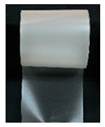
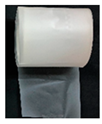
| P0 | P5 | P10 | ||
|---|---|---|---|---|
 |
 |
 |
||
| Thermal events | ||||
| Maximum degradation temperature / Tdeg (°C) | 367.0 ± 0.5a | 366.1 ± 1.0a | 366.1 ± 0.7a | |
| Glass transition temperature / Tg (°C) | 60.4 ± 0.7ª | 60.7 ± 0.1ª | 60.6 ± 0.2ª | |
| Cold crystallization temperature / Tcc (°C) | 120.9 ± 0.1b | 130.0 ± 0.5ª | 131.2 ± 0.4ª | |
| Cold crystallization enthalpy / ΔHcc (J g-1) | 16.8 ± 0.2ª | 6.6 ± 0.2b | 2.7 ± 0.2c | |
| Melting temperature / Tm (°C) | 148.0 ± 0.2b | 151.1 ± 0.1ª | 151.8 ± 0.3ª | |
| Melting enthalpy / ΔHf (J g-1) | 19.0 ± 0.5ª | 10.6 ± 0.4b | 6.0 ± 0.5c | |
| Crystallinity / Xc (%) | 2.3 ± 0.8ª | 4.3 ± 0.6ª | 3.5 ± 0.8ª | |
| Colour parameters | ||||
| L* | 98.23 ± 0.09a | 98.01 ± 0.06b | 97.25 ± 0.11c | |
| a* | -0.06 ± 0.01a | -0.09 ± 0.01b | -0.12 ± 0.01c | |
| b* | 2.28 ± 0.04c | 2.57 ± 0.02b | 2.92 ± 0.09a | |
| ΔE | - | 0.36 ± 0.05b | 1.18 ± 0.14a | |
| Mechanical properties | ||||
| Young’s modulus (MPa) | 3031.3 ± 148.3a | 2142.2 ± 196.0b | 2148.8 ± 134.0b | |
| Tensile strength (N) | 87.4 ± 2.8a | 75.1 ± 5.9b | 73.7 ± 4.1b | |
| Elongation at break (%) | 1.96 ± 0.06a | 1.82 ± 0.12ab | 1.73 ± 0.06b | |
| Barrier properties | ||||
| OP x 10-6 (cc.m/m2.d.Pa) | 50 %HR | 1.6 ± 0.1a | 1.6 ± 0.1a | 1.5 ± 0.1a |
| 80 %HR | 1.4 ± 0.1a | 1.2 ± 0.1a | 1.7 ± 0.2a | |
| WVP x 10-7 (g.m/m2.d.Pa) | 50 %HR | 9.7 ± 0.1c | 11.8 ± 0.3b | 17.3 ± 0.2a |
| 80 %HR | 9.9 ± 0.2c | 12.5 ± 0.4b | 16.8 ± 0.1a | |
| Tdeg (°C) | |||
|---|---|---|---|
| P0 | P5 | P10 | |
| Day 0 | 367.03 ± 0.50aA | 366.19 ± 1.02aA | 366.09 ± 0.66aA |
| Day 7 | 366.38 ± 0.05aA | 366.29 ± 0.07aA | 365.54 ± 0.71aA |
| Day 17 | 333.35 ± 1.24aB | 322.83 ± 2.90bB | 319.08 ± 1.38bB |
| Day 23 | 280.54 ± 1.79aC | 278.16 ± 0.51aC | 280.67 ± 0.98aC |
Disclaimer/Publisher’s Note: The statements, opinions and data contained in all publications are solely those of the individual author(s) and contributor(s) and not of MDPI and/or the editor(s). MDPI and/or the editor(s) disclaim responsibility for any injury to people or property resulting from any ideas, methods, instructions or products referred to in the content. |
© 2024 by the authors. Licensee MDPI, Basel, Switzerland. This article is an open access article distributed under the terms and conditions of the Creative Commons Attribution (CC BY) license (http://creativecommons.org/licenses/by/4.0/).


