

Submitted:
05 November 2024
Posted:
13 November 2024
You are already at the latest version
Abstract
Triboelectric separation is recently investigated as novel process for dry enrichment and separation of protein of various crops like wheat flour. The triboelectric effect allows for the separation of starch and protein particles in an electric field based on their different charging behavior despite having a similar density and size distribution. Particles are first triboelectrically charged in a charging section before they are separated in an electric field based on their polarity. The charging section plays a crucial role, however the influence of process parameters still remains largely unexplored. Thus, the influence of the charging sections’ dimensions, and the particle-gas-ratio as process key parameters were investigated experimentally. Changing the length of the charging section showed no clear correlation on protein enrichment during separation. In contrast, separation was clearly influenced by varying the diameter, indicating that the charging behavior of particles is influenced by the diameter and thus the Reynolds number. Changes in the mass flow of flour also changed the separation behavior, suggesting that the particle-gas-ratio influences the charging of the particles and the separability of protein. The results show that the electrostatic agglomeration behavior of oppositely charged particles is directly affected by alterations in machine parameters. These agglomerates are (mainly) uncharged and, therefore, cannot be separated in the electric field.
Keywords:
1. Introduction
2. Materials and Methods
2.1. Materials and Equipment
2.2. Methods
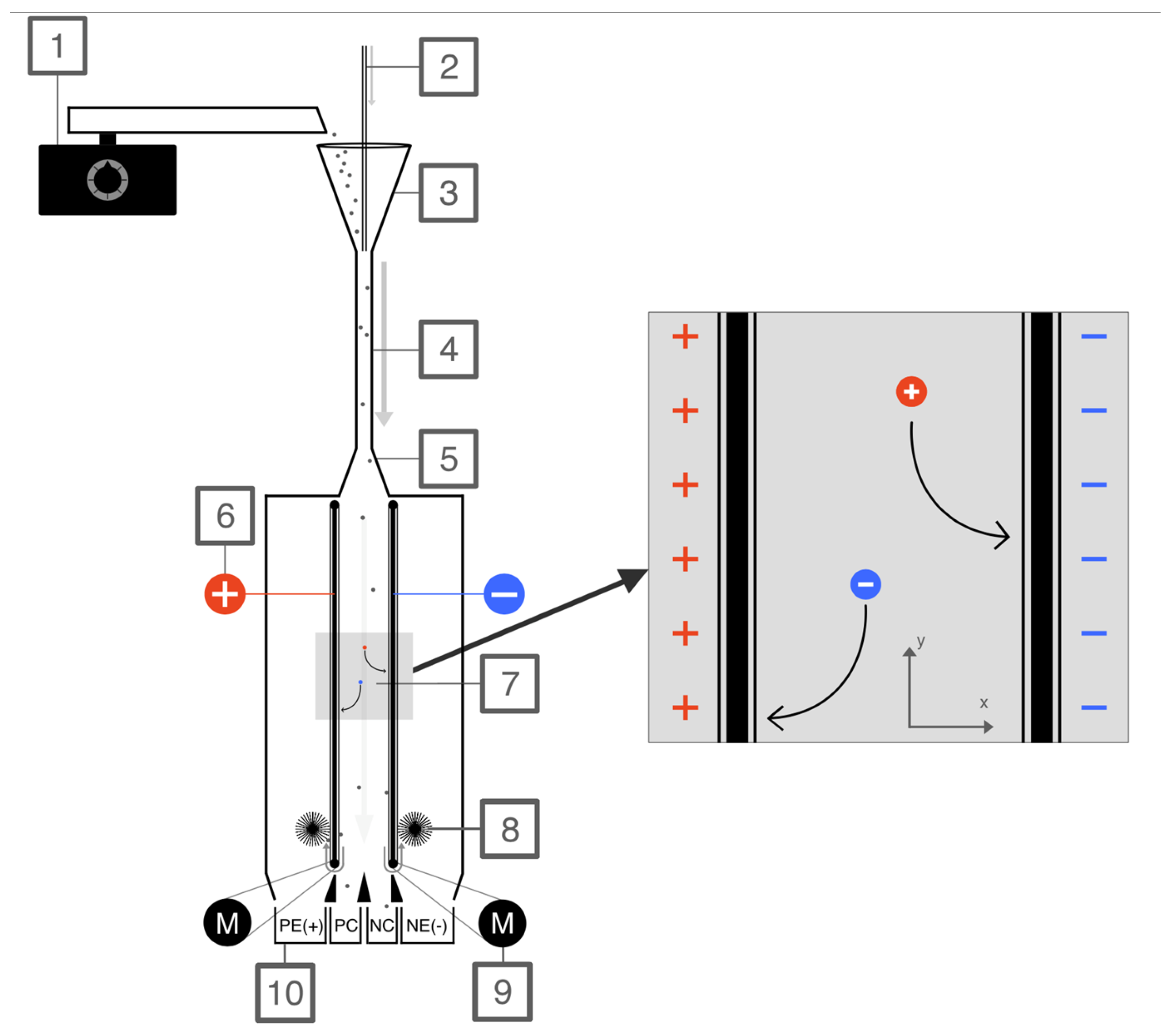
2.2.1. Structure and Function of the Separator
2.2.2. Experimental Design
2.2.3. Moisture Content Determination
2.2.4. Protein Content Determination
2.2.4. Particle Size Distribution
2.2.4. Parameters for Characterization of Separation
3. Results and Discussion
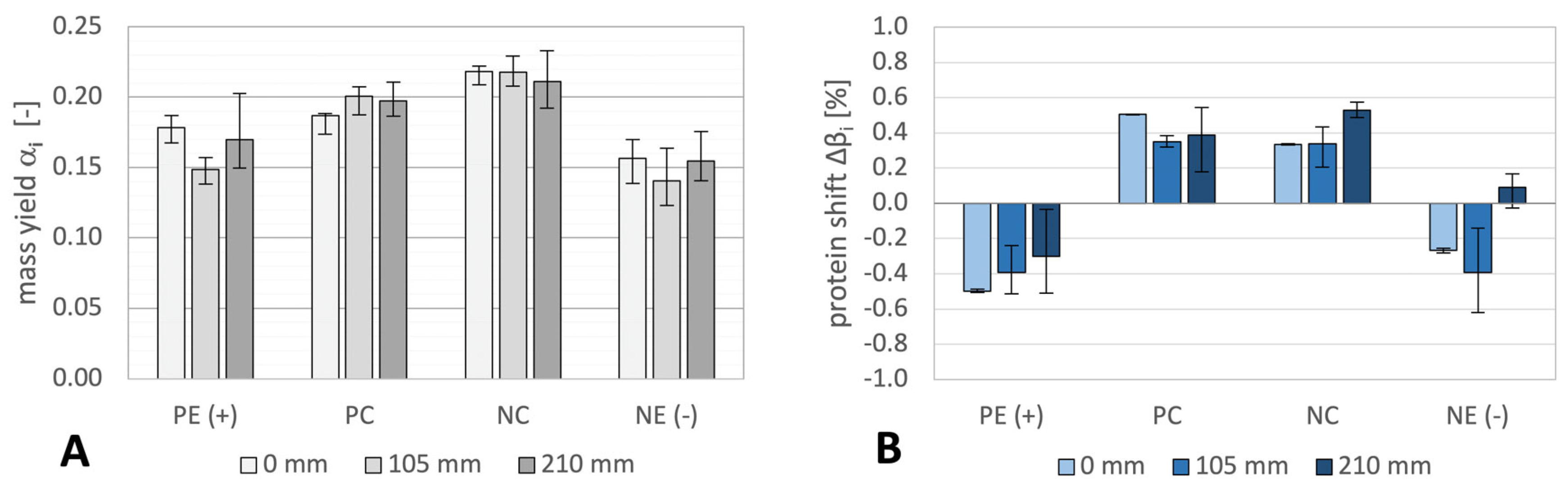
3.1. Influence of Length of Charging Section
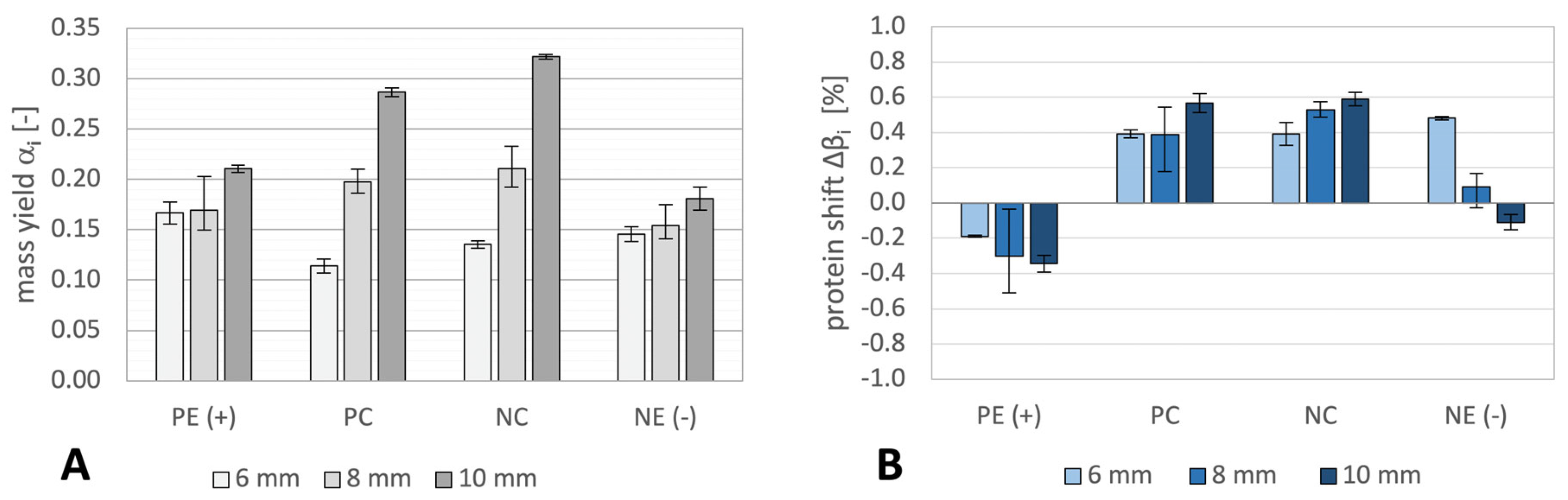
3.2. Influence of Charging Section Diameter
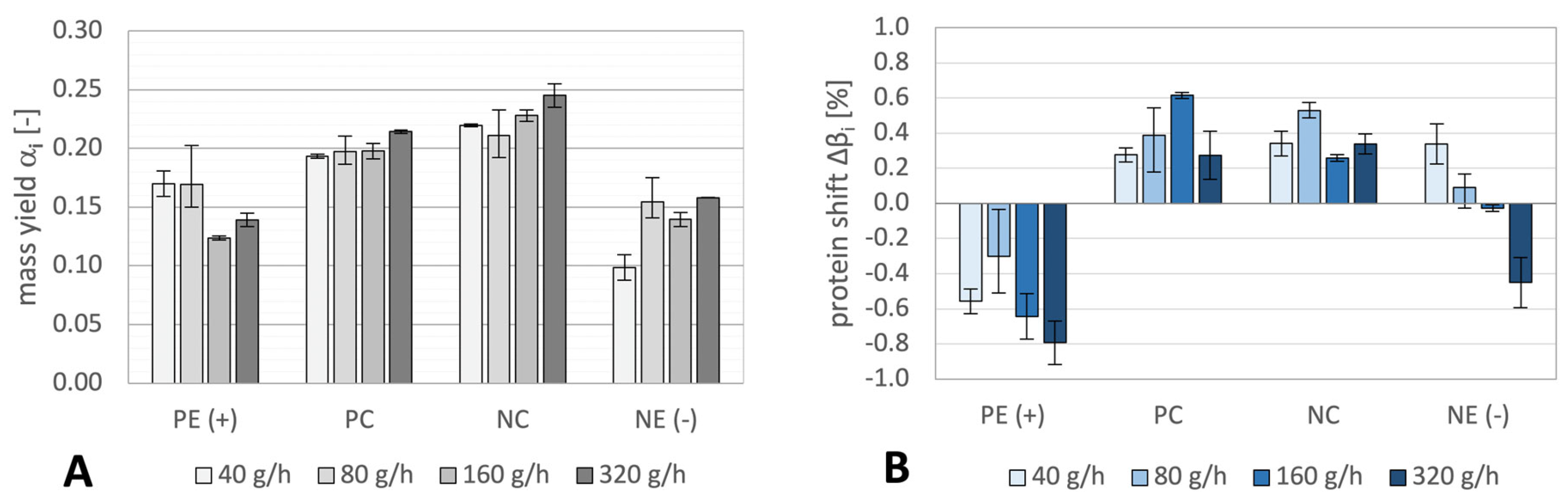
3.3. Influence of the Feed Mass Flow Rate
4. Conclusions
Author Contributions
Funding
Data Availability Statement
Conflicts of Interest
References
- USDA (United States Department of Agriculture), World Agricultural Production. Circular Series WAP 10-24, 2024.
- Shewry, P.R. and S.J. Hey, The contribution of wheat to human diet and health. Food Energy Secur., 2015. 4(3): p. 178-202. [CrossRef]
- Thanhaeuser, S.M., H. Wieser, and P. Koehler, Correlation of Quality Parameters with the Baking Performance of Wheat Flours. Cereal Chemistry, 2014. 91(4): p. 333-341. [CrossRef]
- Kuktaite, R., H. Larsson, and E. Johansson, Variation in protein composition of wheat flour and its relationship to dough mixing behaviour. Journal of Cereal Science, 2004. 40(1): p. 31-39. [CrossRef]
- Jekle, M. and T. Becker, Wheat Dough Microstructure: The Relation Between Visual Structure and Mechanical Behavior. Critical Reviews in Food Science and Nutrition, 2015. 55(3): p. 369-382. [CrossRef]
- Roberts, S., et al., The role of quality characteristics in pricing hard red winter wheat. Food Policy, 2022. 108: p. 102246. [CrossRef]
- David, O., et al., Proximate Composition and Some Functional Properties of Soft Wheat Flour. International Journal of Innovative Research in Science, Engineering and Technology, 2015. 4(2). [CrossRef]
- Xue, C., et al., Protein Composition and Baking Quality of Wheat Flour as Affected by Split Nitrogen Application. Frontiers in Plant Science, 2019. 10. [CrossRef]
- Singh, A., M. Izydorczyk, and F. Koksel, Pilot scale air classification of flours from hulled and hull-less barley for the production of protein enriched ingredients. Journal of Cereal Science, 2024. 117. [CrossRef]
- Pérez, S., P.M. Baldwin, and D.J. Gallant, Structural Features of Starch Granules I. Starch Chemistry and Technology. In Starch. Elsevier, 2009: p. 149-192.
- Roa, D.F., et al., Ball Milling of Amaranth Starch-Enriched Fraction. Changes on Particle Size, Starch Crystallinity, and Functionality as a Function of Milling Energy. Food Bioprocess Technology, 2014. 7: p. 2723–2731. [CrossRef]
- Wang, J., et al., Lupine protein enrichment by milling and electrostatic separation. Innovative Food Science and Emerging Technologies, 2016. 33: p. 596-602. [CrossRef]
- Wang, J., et al., Charging and separation behavior of gluten–starch mixtures assessed with a custom-built electrostatic separator. Separation and Purification Technology, 2015. 152: p. 164-171. [CrossRef]
- Landauer, J. and P. Foerst, Triboelectric separation of a starch-protein mixture - Impact of electric field strength and flow rate. Advanced Powder Technology 2018. 29 (1): p. S. 117–123. [CrossRef]
- Lacks, D.J. and R.M. Sankaran, Contact electrification of insulating materials. Journal of Physics D: Applied Physics, 2011. 44 453001. [CrossRef]
- Landauer, J. and P. Foerst, Influence of Particle Contact Number on Triboelectric Separation Selectivity. MDPI Processes, 2019. 7(10). [CrossRef]
- Wu, G., J. Li, and Z. Xu, Triboelectrostatic separation for granular plastic waste recycling: A review. Waste Management, 2013. 33(3): p. 585-597. [CrossRef]
- Gupta, R., D. Gidaspow, and D.T. Wasan, Electrostatic separation of powder mixtures based on the work functions of its constituents. Powder Technology, 1993. 75(1): p. 79-87. [CrossRef]
- Hemery, Y., et al., Potential of dry fractionation of wheat bran for the development of food ingredients, part II: Electrostatic separation of particles. Journal of Cereal Science, 2011. 53: p. 9-18. [CrossRef]
- Sibakov, J., et al., Electrostatic separation combined with ultra-fine grinding to produce β-glucan enriched ingredients from oat bran. Innovative Food Science & Emerging Technologies, 2014. 26: p. 445-455. [CrossRef]
- Mohanta, S.K., et al., Tribo-electrostatic separation of high ash coking coal washery rejects: Effect of moisture on separation efficiency. Powder Technology, 2016. 294: p. 292-300. [CrossRef]
- Atroune, S., et al., Comparative Experimental Study of Triboelectric Charging of Two Size Classes of Granular Plastics. Particulate Science and Technology 2015. 33: p. 652-658. [CrossRef]
- Wang, H., et al., Tribo-charging of binary mixtures composed of coarse and fine particles in gas–solid pipe flow. Particuology Elsevir, 2019. 43: p. 101-109. [CrossRef]
- Dötterl, M., et al., Electrostatic Separation. Ullmann's Encyclopedia of Industrial Chemistry Major Reference Works, 2016s, 2016. [CrossRef]
- Tabtabaei, S., et al., Solvent-free Production of Protein-enriched Fractions from Navy Bean Flour using a Triboelectification-based Approach. Journal of Food Engineering, 2015. 174: p. 21-28. [CrossRef]
- Xing, Q., et al., Protein enrichment of defatted soybean flour by fine milling and electrostatic separation. Innovative Food Science and Emerging Technologies, 2018. 50: p. 42-49. [CrossRef]
- Dumas, J.-B., Recherches de Chimie organique. Annales de chimie et de physique., 1833. 53: p. 164-181.
- ISO 16634-1:2008, Food products - Determination of the total nitrogen content by combustion according to the Dumas principle and calculation of the crude protein content. ISO, 2008. 1.
- Wang, J., et al., Analysis of electrostatic powder charging for fractionation of foods. Elsevier, Innovative Food Science & Emerging Technologies, 2014. 26: p. 360-365. [CrossRef]
- Matsusaka, S., Control of Particle Tribocharging. KONA Powder Technology Foundation, 2011. 29. [CrossRef]

| Length of charging section | Diameter of charging section | Mass flow of flour | |
| Tests length | Varied | Constant | Constant |
| Tests diameter | Constant | Varied | Constant |
| Tests mass flow | Constant | Constant | Varied |
| Length of charging section [mm] | Diameter of charging section [mm] | Mass flow of flour [g*h-1] | Residence time [ms] | Velocity [m*s-1] | Reynolds number [-] | |
| Tests length | 0 | 8 | 80 | 0 | 11.05 | 5849.77 |
| 105 | 8 | 80 | 9.5 | 11.05 | 5849.77 | |
| 210 | 8 | 80 | 19 | 11.05 | 5849.77 | |
| Tests diameter | 210 | 6 | 80 | 10.7 | 19.65 | 7799.69 |
| 210 | 8 | 80 | 19 | 11.05 | 5849.77 | |
| 210 | 10 | 80 | 29.7 | 7.07 | 4679.82 | |
| Tests mass flow | 210 | 8 | 40 | 19 | 11.05 | 5849.77 |
| 210 | 8 | 80 | 19 | 11.05 | 5849.77 | |
| 210 | 8 | 160 | 19 | 11.05 | 5849.77 | |
| 210 | 8 | 320 | 19 | 11.05 | 5849.77 |
| x50 [µm] | PE (+) | PC | NC | NE (-) |
| 6 mm | 70.74 | 100.47 | 102.69 | 67.82 |
| 8 mm | 54.54 | 84.05 | 90.23 | 62.59 |
| 10 mm | 52.1 | 84.3 | 94.61 | 57.83 |
| x50 [µm] | PE (+) | PC | NC | NE (-) |
| 40 g*h-1 | 53.28 | 82.22 | 83.89 | 75.67 |
| 80 g*h-1 | 54.54 | 84.05 | 90.23 | 62.59 |
| 160 g*h-1 | 51.08 | 86 | 83.13 | 64.44 |
| 320 g*h-1 | 52.69 | 86.77 | 77.96 | 55.79 |
Disclaimer/Publisher’s Note: The statements, opinions and data contained in all publications are solely those of the individual author(s) and contributor(s) and not of MDPI and/or the editor(s). MDPI and/or the editor(s) disclaim responsibility for any injury to people or property resulting from any ideas, methods, instructions or products referred to in the content. |
© 2024 by the authors. Licensee MDPI, Basel, Switzerland. This article is an open access article distributed under the terms and conditions of the Creative Commons Attribution (CC BY) license (http://creativecommons.org/licenses/by/4.0/).


