Preprint
Article

This version is not peer-reviewed.

An Overview of the Quantum Circuit Design Focusing on Compression and Representation

A peer-reviewed article of this preprint also exists.

Submitted:

09 November 2024

Posted:

12 November 2024

You are already at the latest version

Abstract

Quantum image computing has attracted attention due to its vast storage and faster processing of image data than classical computers. Although classical computing power has grown substantially in the last decade, its abilities have plateaued, struggling to meet the needs of huge datasets. Quantum computers, on the other hand, take advantage of unique qualities like quantum parallelism, superposition, and entanglement to provide faster solutions to complicated problems. Managing huge image data in classical systems necessitates significant memory and hardware resources, which makes quantum computing a possible alternative. Several approaches have arisen for encoding and compressing classical images in the quantum processor. However, one of the most significant limitations is the complexity of quantum state preparation, which translates pixel coordinates to corresponding quantum circuits. Current approaches for representing large-scale images require a huge number of quantum resources including qubit, and qubit connection, which presents significant hurdles. Therefore, this article aims to overview the pixel intensity and state preparation circuit that needs fewer connections, i.e., quantum gates to represent quantum image data, and then explore and design effective compression and processing methods for medium and high-resolution images. This work specializes in emerging quantum models’ potential for enhancing image representation and compression capabilities. It also conducts a comprehensive study of quantum image representation and compression techniques, categorizing existing methods by grayscale and color image types and evaluating their methods, strengths, and limitations. It focuses on crucial difficulties, such as high qubit requirements and complex state preparation, that limit scalability for huge images. This paper also assesses each model’s compression efficacy, which will help future research focus on efficient circuit designs with lower complexity for medium to high-resolution images. It is an essential reference for advancing quantum image processing research since it provides a systematic framework for evaluating quantum image compression and representation algorithms.

Keywords: 
;  ;  ;  ;  ;  ;  

1. Introduction

Moore’s law describes the computational power of classical computation in the past decade [1]. Due to the limitation of the transistor placement theory, its power has not increased further. Feynman found that quantum mechanics is the best candidate for addressing the limitation of the computing power of the classical computer. Shor has proposed a quantum algorithm to compute factorial for the integer value. The computational time of the quantum factorial algorithm is much faster than the classical approach [2]. After that, Grover also proposed a quantum algorithm for database search [3]. In terms of hardware performance, it can provide every detail simultaneously. It can also accommodate an enormous amount of information due to using an exponential formula ( 2 n ). Moreover, it’s able to create mathematical creativity automatically.
In recent years, quantum image compression and representation have gotten lots of attention in quantum image computing. Generally, it pre-processes the classical image and then uses the quantum algorithm to represent the classical information in the quantum processor mean quantum circuit. Then, the outcome from the quantum processor in the classical domain will be measured. In quantum information processing (QIP), the properties of quantum mechanics such as superposition, parallelism, and entanglement mainly deal with faster computation than classical computation [4,5,6]. In 1985, Deutch showed that the quantum computer is a physical device that is faster and capable of processing and restoring image data [4]. In our daily lives, the application of images is growing. In quantum image computing (QIC), image data are represented in the photonic circuit as a quantum circuit. Like classical image representation, quantum image representation also requires color and positional value. Then, qubit connections connect color mean image pixels and their corresponding position. When an image is represented in a quantum mechanics system, it means a multi-particle system, then it’s known as a quantum image. In quantum images, qubits replace the array of classical bits and show a better reproduction of the image than classical [7]. Three kinds of quantum images are generally considered: binary, gray-scale, and color. Each of them has its standards. The goal of quantum imaging is to produce “better” images using quantum methods with a smaller number of photons to achieve better spatial resolution, including signal-to-noise ratio.
Quantum image representation and compression use quantum computing concepts to encode and modify visual data efficiently. Quantum mechanical ideas like qubits, superposition, and entanglement are fundamental to this field since they authorize novel approaches to processing image data. Quantum techniques, as opposed to classical ones, enable the definition of images in increasingly smaller states, which reduces the need for storage and computational complexity. Knowing these fundamentals lays the groundwork for exploring how quantum algorithms can convert image representation and compression methods.
Images are represented in classical processors as matrices of numbers that characterize the color or intensity of each pixel in a Cartesian coordinate system, where each pixel’s location is related to its intensity. The classical approach, which makes use of pixel intensity associations while preserving the explicit relationship between pixel location and value, frequently uses spatial correlations. However, qubits must explicitly encode the pixel intensities and locations in quantum image processing. Since quantum picture encoding requires condensing on the "1" points in the binary representation of pixel values, this presents a new difficulty. Because of the extensive amount of data involved, traditional image processing methods frequently necessitate significant computational resources for processing and storage. Quantum image compression reduces the strain on a quantum processor’s resources. Since all operational gates add to processing complexity, the number of operational gates needed for image operations (rather than just qubits) is the primary resource in quantum computing. Boolean expression compression (BEC) is one technique employed in quantum image compression. Boolean variables are used in this technique to streamline the image representation. Each ′1′ in the binary representation is kept, and lateral variables like y represent complementary values. To compress the image, if x is a Boolean variable and its value is 1, then the literal x is used; otherwise, x ¯ is used as the literal. Therefore, a Boolean expression like:
e = x 0 x 1 x 2 ¯ ¯ + x 0 x 1 x 2
can be compressed to:
e = x 0 x 1
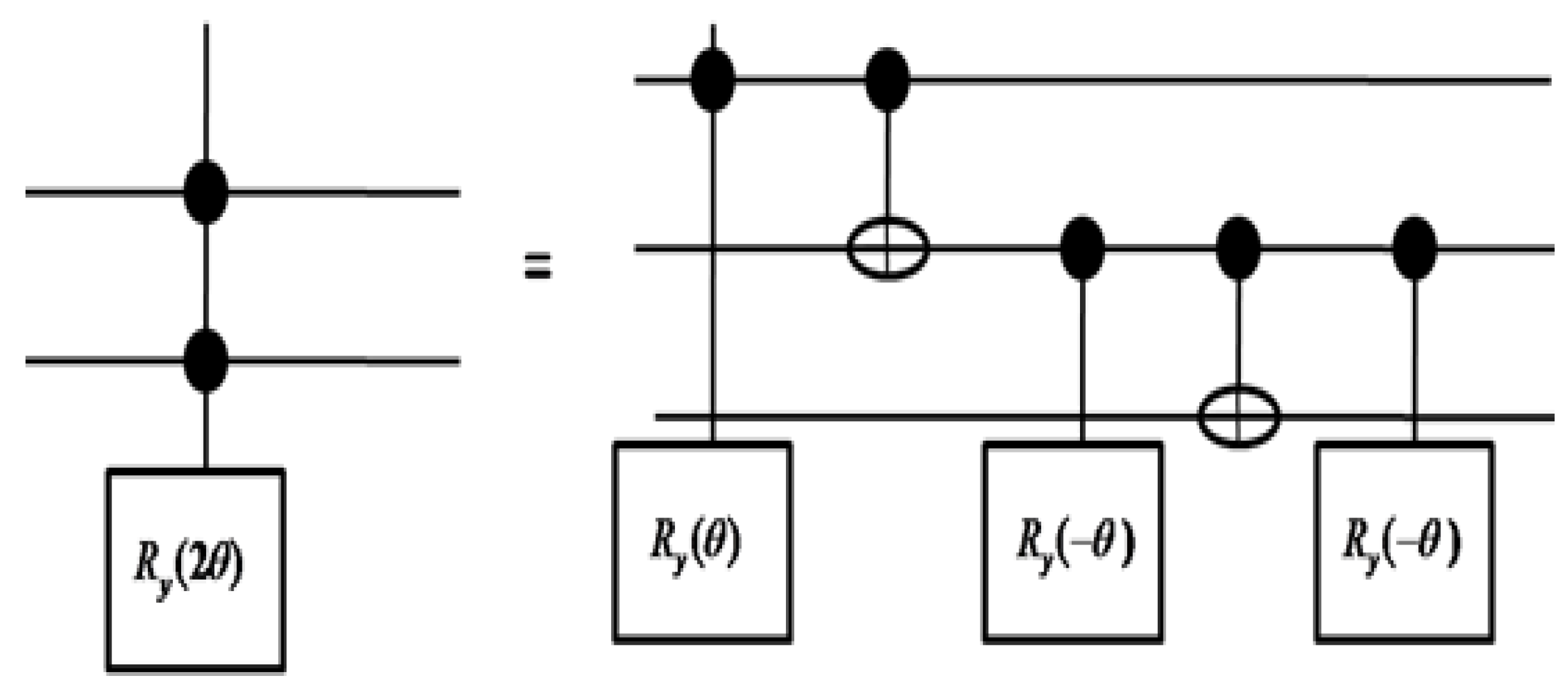
If two CNOT gates act on the same qubits (which correspond to the same color), but their control qubits are different, then two CNOT gates can be combined into one. Figure 1 shows an example.
Additionally, it can improve the compression process further by combining specific quantum gates. For instance, if two CNOT gates operate on identical qubits but with various control qubits, they can be combined into one gate. However, there are drawbacks to this process. It takes much time during the pre-processing phase to determine which CNOT gates can be joined because a pair-by-pair comparison is necessary. The complexity of this approach increases with the number of qubits. Without compression, the time complexity is O ( q · 2 4 n ) . It emphasizes the requirement for more effective methods to manage gate combinations and enhance the compression process.
In this work, we cover most of the quantum image encoding techniques, including color and its state. We have summarized ten core image compression and representation techniques. Our survey covers the pros and cons of the following compression and representation approaches.
  • Qubit Lattice (Venegas-Andraca et al. 2003)
  • Real Ket (Latore 2005)
  • Entanglement Image(Venegas-Andraca et al. 2010)
  • FRQI (Le et al. 2011)
  • MCRQI (Sun et al. 2011)
  • NEQR (Zhang et al. 2013)
  • MCQI (Sun et. al. 2013)
  • CQIR (Caraiman et al. 2013)
  • QSMC & QSNC (Li et al. 2013)
  • QUALPI (Zhang et al. 2013a)
  • NASS (Li et al. 2014)
  • SQR (Yuan et al. 2014)
  • NAQSS (Li et al. 2014a)
  • INEQR (Zhang et al. 2015)
  • QPI (Laurel et al. 2015)
  • GQIR (Zhang et al. 2015a)
  • FRQCI (Li et al. 2016)
  • NCQI (Sang et al. 2017)
  • OMCR (Abdolmaleky et al. 2017)
  • QPC (Jiang et al. 2018)
  • BRQI (Li et al. 2018)
  • QRMW (Sahin et al. 2018)
  • OCQR (Liu et al. 2018)
  • QRMMI (Zhou et al. 2018)
  • DCT-GQIR (Jiang et al. 2018a)
  • IFRQI (Khan et al. 2019)
  • QRCI (Wang et al. 2019)
  • OQIM (Xu et al. 2019)
  • GNEQR (Li et al. 2019)
  • QBIR(Liu et al. 2019)
  • FTQR (Grigoryan et al. 2020)
  • DQRI (Wang et al. 2020)
  • QHSL (Yan et al. 2021)
  • EFRQI (Nasr et al. 2021)
  • INCQI (Su et al. 2021)
  • QIRHSI (Chen et al. 2021)
  • QTRQ(Dong et al. 2022)
  • QIIR (Khan et al. 2022)

2. Existing Standards for Quantum Image Compression and Representation, and Their Limitations
Quantum computing, an interdisciplinary field combining quantum mechanics, computer science, and mathematics, can solve issues such as the impending failure of Moore’s law by increasing computational power. However, in quantum image processing, challenges still need to be solved to represent and retrieve images efficiently. A qubit, or quantum bit, is the fundamental building block of quantum information. Venegas-Andraca et al. 2003 explored Qubit lattice [7], an early quantum image representation technique in which four separate pixel values are assigned to individual qubits. It was the first quantum method to reserve and retrieve image data in a multi-particle quantum system. However, its limitations include its ability to manage only four random pixel values, making it inappropriate for real-world applications. Latorre (2005) developed the real-ket [8] method, which was limited to four-pixel values.
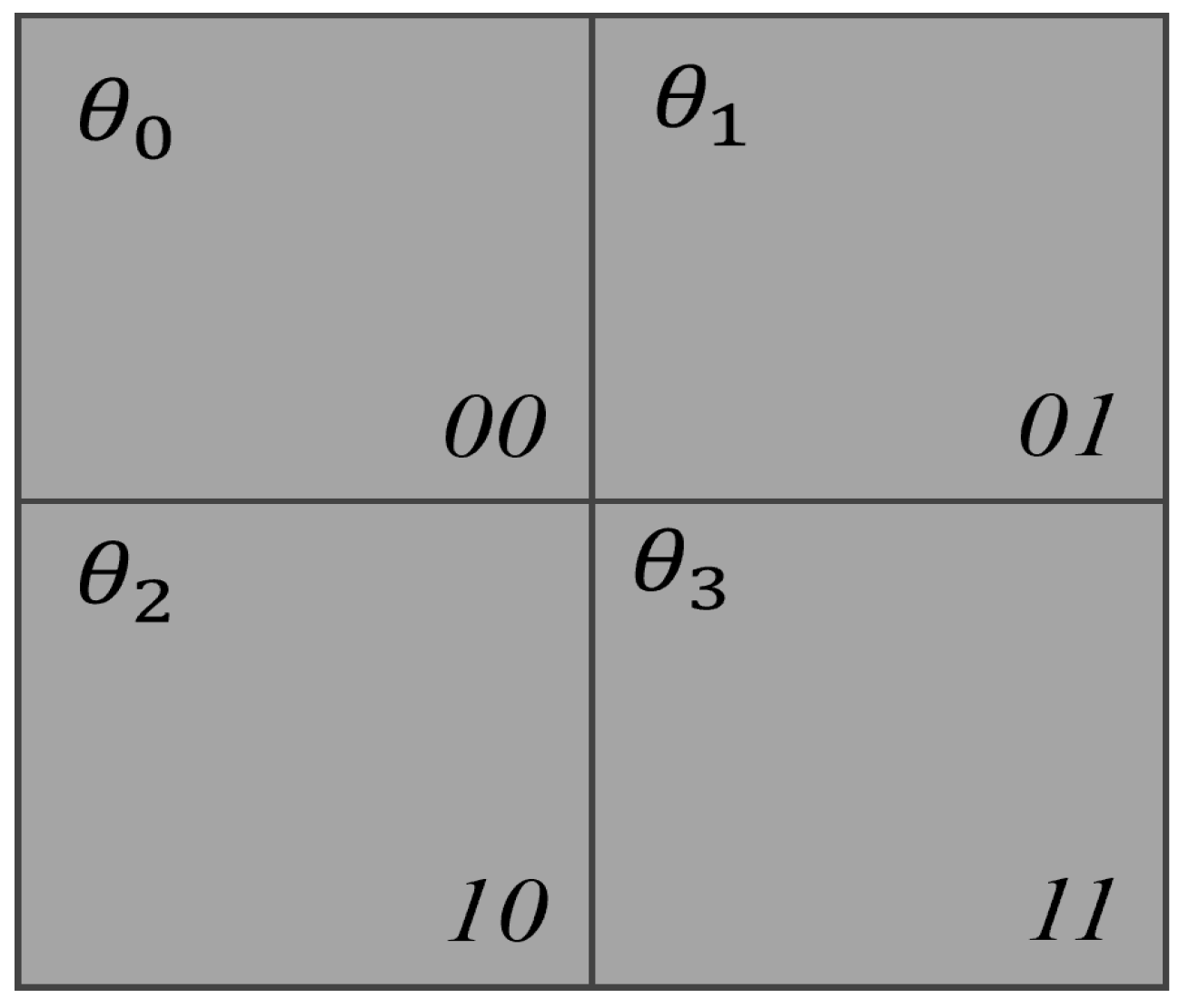
The flexible representation of quantum images (FRQI) was developed to circumvent these limitations. Inspired by pixel-wise representation, it encodes classical binary images in the quantum realm using amplitude-based probabilistic representation. Figure 3 depicts a 2 × 2 quantum and its associated quantum state. The mathematical expression for the FRQI image is given below:
| I = 1 2 ( cos θ 0 | 0 + sin θ 0 | 1 ) | 00 + ( cos θ 1 | 0 + sin θ 1 | 1 ) | 01 + ( cos θ 2 | 0 + sin θ 2 | 1 ) | 10 + ( cos θ 3 | 0 + sin θ 3 | 1 ) | 11
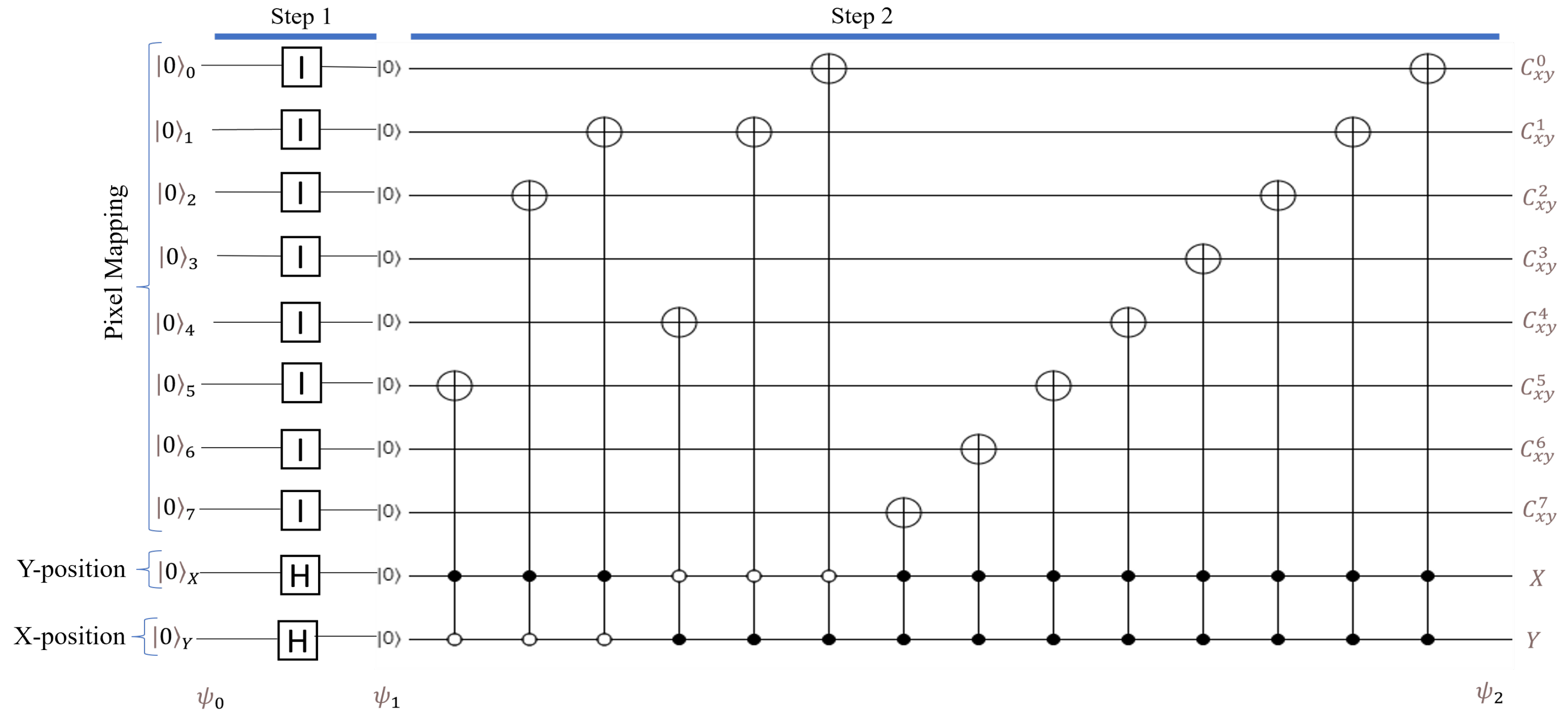
Figure 2 illustrates the FRQI circuit diagram for the quantum image | I . It uses control rotation matrices, which are supplemented by CNOT gates and standard rotational matrices, as illustrated in equation 4:
Rotation Matrix = cos θ sin θ sin θ cos θ
Despite its achievements, it is restricted in its capacity to depict pixel-wise grayscale images since it only uses a single qubit for encoding. In 2010, the entanglement image was proposed to use qubit entanglement. It is only suitable for small image sizes, such as 2 × 2 pixels. Figure 3 displays the quantum image, including its state for the 2 × 2 image size.
The novel quantum enhanced quantum representation (NEQR) [30] for digital image algorithm was developed to encode grayscale images in a quantum system to overcome these issues. Unlike FRQI, it takes a deterministic method based on pixel values. It translates the pixel values and maps them according to the frequency of ones in the binary string—pixel and state (position) qubits to their respective positions. For instance, an image with pixel values of 0 ( Y = 0 , X = 0 ) , 100 ( Y = 0 , X = 1 ) , 200 ( Y = 1 , X = 0 ) , and 255 ( Y = 1 , X = 1 ) can be represented in NEQR as follows:
| I NEQR = 1 2 | 00000000 | 00 + | 01100100 | 01 + | 11001000 | 10 + | 11111111 | 11
Figure 3. A 2 × 2 FRQI quantum image
Preprints 139042 g003
Figure 4 shows the NEQR circuit diagram for the image | I NEQR . It resolves many of the limitations of FRQI approach by using multiple qubits, allowing it to represent grayscale images with higher complexity.

3. Taxonomy of the Quantum Image Compression and Representation Approaches

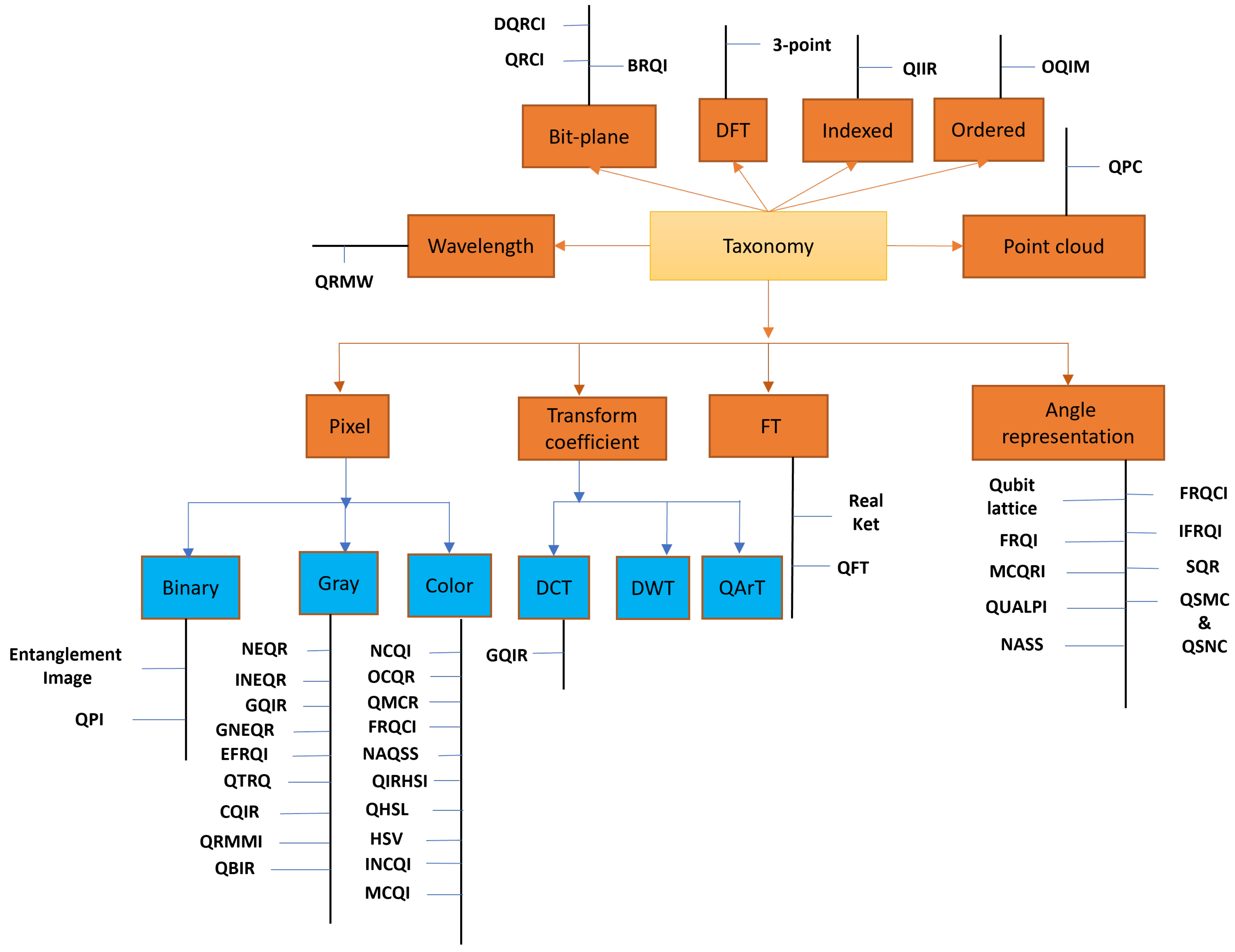
Figure 5 shows the taxonomy of the quantum image compression and representation scheme. Generally, it classifies the image representation approaches into major ten categories. Although various kinds of representation have already been developed, angles and pixel-based representation approaches have become more popular because of operational advantages and the ease of integrating complexity with other systems. Coefficient-based representation can represent images inside the quantum domain due to the mapping of coefficient values rather than pixels. The lower number of non-zero coefficients reduces the state preparation complexity.
For transfer coefficient-based quantum image representation, DWT and DCT are the two most popular transformation techniques [49]. Jiang et al. 2018 [32] proposed a DCT transfer coefficient-based GQIR approach which represents the transform version of the pixels values. It decreases the quantum preparation complexity tremendously. Moreover, it’s able to represent arbitrary shapes of images. Due to the state label mapping procedure, it needs higher redundant bits for state preparation. It compresses the image before representing it in the classical compression approach such as DCT transformation.
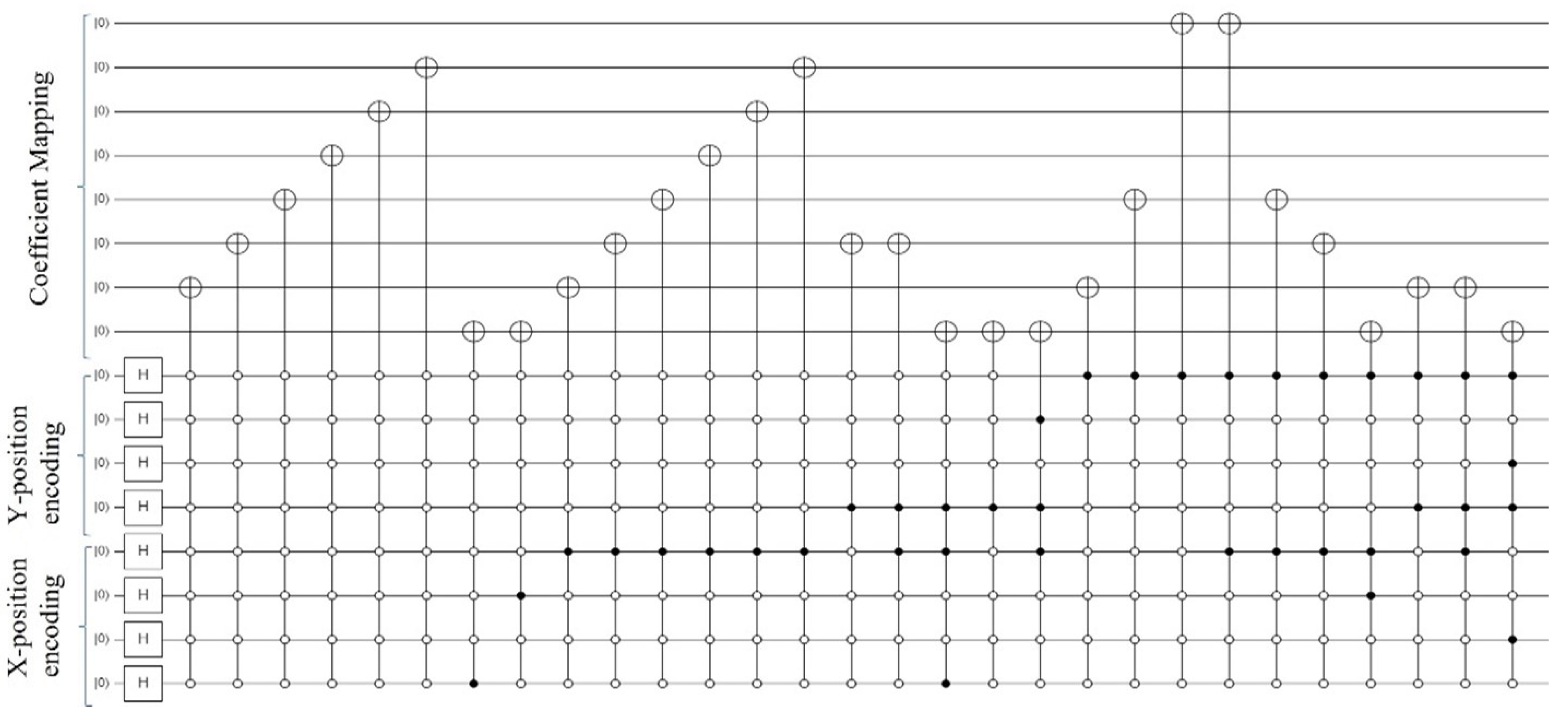
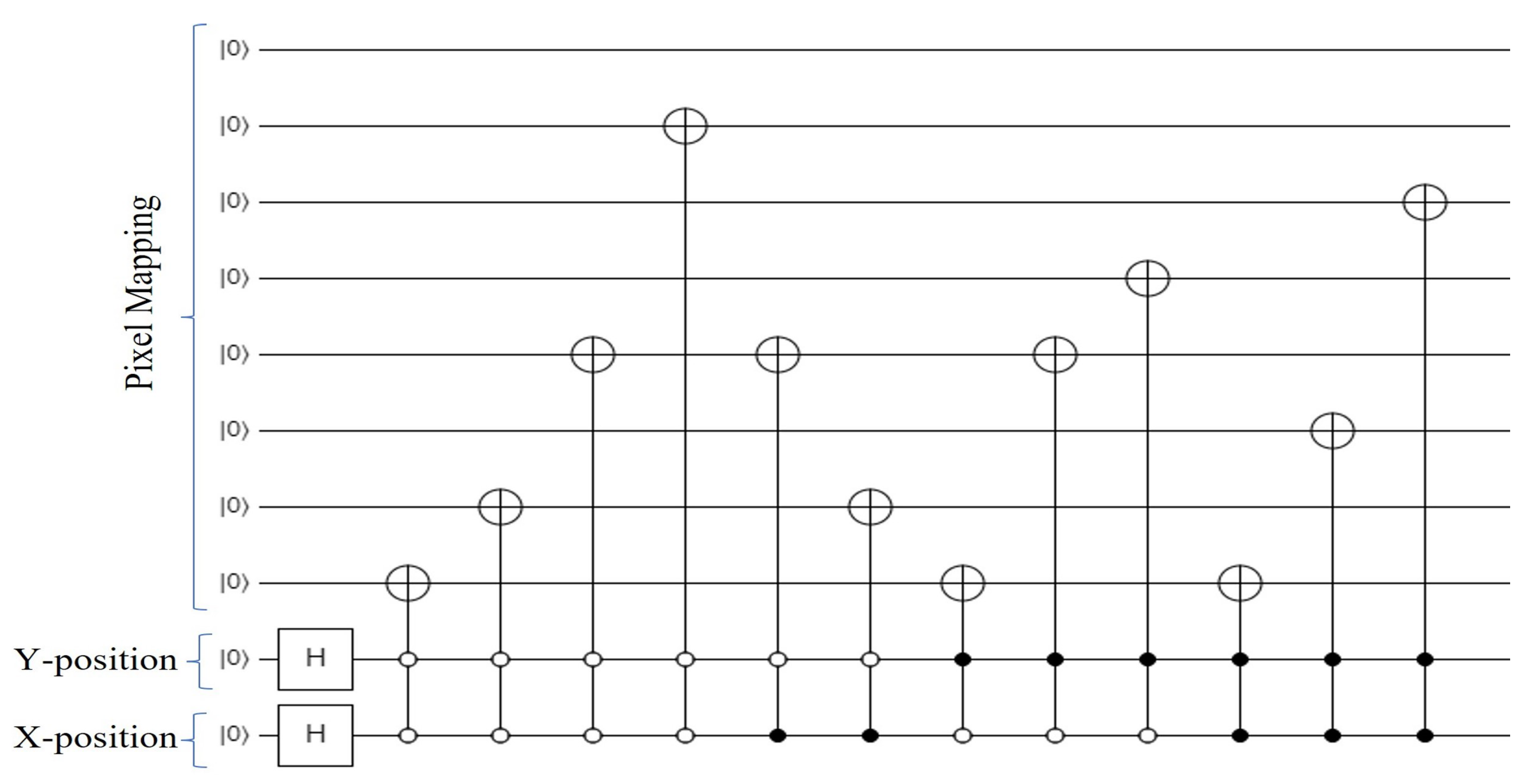
For example, for a 512 × 512 image, the required qubits for encoding Y and X positions are 9, and 9 qubits respectively. In practical application, Fig. shows a 16 × 16 image quantum circuit as an example after performing the DCT and 70 quantization factors using the Quirk simulation tool [28] whose coefficient values are 126 ( X = 1 , Y = 1 ) , 1 ( X = 1 , Y = 9 ) ,   4 ( X = 2 , Y = 1 ) , 4 ( X = 2 , Y = 9 ) , 1 ( X = 2 , Y = 10 ) ,   1 ( X = 4 , Y = 1 ) , 1 ( X = 6 , Y = 9 ) , 138 ( X = 9 , Y = 1 ) , 140 ( X = 9 , Y = 9 ) , 2 ( X = 10 , Y = 1 ) , 2 ( X = 10 , Y = 9 ) and 1 ( X = 11 , Y = 9 ) respectively. To prepare the coefficient value in the quantum domain, first, convert the coefficient of nonzero values into binary and then map the corresponding ones only using 8 numbers of qubits shown at the top of the quantum circuit in Figure 6. For state preparation, the corresponding coefficient nonzero position values are also recorded and located in the two-dimensional Y X -position using the rest 8 numbers of qubits shown at the bottom of Figure.Figure 6. After that, convert them into a binary system and count how many times one’s happened in one coefficient. The quantum circuits only deal with only ones and zeros that are governed by the qubits. The corresponding position value of each coefficient is used to prepare the quantum state. There were two kinds of bit rates; one was for the coefficient and another for its position.
On the other hand, DWT based GQIR approach has also been investigated in [49]. Due to the more frequent mapping of the state label of the transfer coefficient value, it performed poorly compared to the DCT pre-processing approach.
Latorre (2005) proposed a real ket [8] approach to represent the image using a block structure to locate the pixel in the Hilbert space to create entanglement. It also uses matrix product state to rewrite the quantum state [8]. It is limited to 2×2 pixels image. Although, it claims the compression happens, how it works is still unclear. Besides, the superposition of the qubits is another gap. Li et al. 2018 [44] represent quantum Arnold transform (QArT) images compressed through DCT and Zigzag pre-processing approaches. The compression efficiency is too low. How and where compression happened is not mentioned clearly. Quality measurement of this approach is also another gap. Pang et al.2019 [47] utilized quantum Fourier transfer for representation as well as compression purposes. In this approach, compression was done through the QFT approach which is the question of its compression ability. Because QFT represents the Fourier transform of a given signal, not compression.
Sahin et al. 2018 [24] reported QRMW approach that represents the image based on wavelength. Compared to NCQI, it increases storage capability. It uses fewer qubits compared to BRQI. It is limited to the square size of the image. Moreover, it is applicable for tiny sizes of array images such as 2 × 2 . The compression study is out of the scope of this method. Wang et al.2020 [40] explored a double quantum color images representation model (DQRCI) to represent the quantum image which uses the superposition state. It stores two digital color images simultaneously. Use only three-qubit which makes it impossible to represent medium or big size quantum image. Compression of the quantum image is not explored.
Wang et al.2019 [36] proposed a quantum representation model for color digital images. It encoded color information using the basic state of the qubit sequence. It increases the storage and processing capability of NCQI. It is limited to a square size small image. The complexity of this approach is higher compared to GQIR. Also, it does not measure the quality and accuracy. Quantum compression is not considered in this study. Li et al. 2018 [23] proposed a bit-plane-based quantum image representation approach. The use of the bit-plane approach increases the number of operations and the system becomes more complex. Also, it requires a higher number of quantum resources such as qubits, and basic gates for qubit connection than the NEQR approach. It focuses only representation approach, not compression. Jiang et al. 2017 [22] explored the quantum point cloud (QPC) approach to represent and store the 3D quantum image. Due to its architectural representation, it increases the complexity of the algorithm in terms of some operations utilizing flag and attribute information. It is applicable for 4 × 4 size of array image. Compression is not studied in this approach.
Wang et al.2022 [37] proposed a quantum image representation approach that uses an image index. It has more preparation complexity due to considering an extra matrix for encoding indexed pixels. In this approach, the quantum image compression approach is not investigated. Xu et al. 2019 [33] reported ascending order of the pixel of the image representation technique that represents the digital image in a normalized form of the state. It stores and represents the ascending order of the gray-scale image in the form of the probabilistic amplitude of the color. It also uses the different qubits to locate the position of the pixel. It does not discuss the recovery procedure at the decoder end. Also, it is limited to the 2 × 2 array size of the image. Since it works directly with image pixels the complexity of preparation is higher. Quantum image compression is not investigated in this work. Grigoryan et al. 2020 [39] demonstrated a 3-point DFT approach to the quantum image that maps the Fourier qubit data in the quantum discrete domain. It complexity of preparation increases due to considering the complex plan. Moreover, reconstructed image quality was not measured. It also represents the part of the image data in the quantum unit circle.

3.1. Angle-Based Compression and Representation Approach

In this section, the angle-based quantum image representation approaches are summarized. Table 1 overviews angle-based quantum image representation and compression methods, each with separate strategies, advantages, and restrictions. Qubit lattice approach was proposed by Venegas-Andraca et al. (2003) [7] that uses multi-particle quantum systems for pixel representation but is occupied by single-qubit scalability. FRQI (Le et al. 2011) [9] encodes pixel color and position by mapping pixels to angles, enabling binary image compression with reduced operations, though it struggles with complex grayscale representations. MCQI (Sun et al. 2011) [10] encodes RGB images into quantum forms using only three qubits, restricting its capacity to represent bigger images accurately. QUALPI (Zhang et al. 2013) [11] geometric transformations to convert classical images to quantum format but face pixel fidelity constraints, particularly with larger images. NASS (Li et al. 2014) [12] creates multidimensional color images but requires more transparency in its compression processes and is better suited for low-resolution images. An enhanced FRQI variant (Li et al. 2016) [17] presents two-phase parameters representing RGB values but has high data demands, making it unusable for big images. IFRQI (Khan et al. 2019) [25] can represent only 2 × 2 pixel arrays due to angle-based encoding, restricting scalability. QSMC QSNC (Li et al. 2013) [26] use segmented quantum states for pixel representation but are restrained to small arrays, which impacts reconstruction quality. Eventually, SQR (Yuan et al. 2014) [27] stores infrared images, but scalability and representation fidelity restrict its real-world applications. While these methods offer specific benefits, most face challenges in scaling and supporting image fidelity for more extensive or complex images, with restricted success in practical compression applications.

3.2. Overview of Pixel-Based Representation and Compression Approach

In this section, pixel-based quantum image representation as well as compression approaches are outlined. It is divided into binary, gray, and color categories. Under each section category, each method’s pros, cons, and compression opportunities have been summarized.
Venegas-Andraca et al.2010 [28] proposed a quantum binary image using the entanglement property of the quantum image. It has removed the additional resource requirements, such as pixel disposition and correlation. It is also able to create the maximum entangle between qubits. It’s limited to binary image representation mapping. Also the image size is also limited to tiny and does not provide sufficient knowledge about quantum mapping systems. It does not investigate the compression opportunity. Laurel et al. 2015 [29] proposed a quantum binary image that converts classical pixel image into quantum pixel. It applies to pure binary coding systems. Quality measurement was not performed to measure its representation performance. The drawback of this approach is that it is too complex to represent medium- or large-size images. How a medium and big size image is represented is still not clear. The quantum compression of the image is not discussed.
Table 2 overviews grayscale quantum image representation and compression techniques, describing the methods, advantages, and restrictions. NEQR (Zhang et al. 2013) [30] employs eight qubits to represent grayscale images effectively but is limited to square images, and its pixel mapping approach complicates preparation. INEQR (Zhang et al. 2015) [31] can handle unequal horizontal and vertical dimensions, though it remains to be seen how well it scales to larger images. GQIR (Zhang et al. 2015) [32] supports rectangular images of arbitrary shapes but struggles with pixel-wise fidelity for medium or large images. Figure 7 exhibits the corresponding 2 × 2 GQRI quantum circuit representation of an image whose pixel values are 79 ( X = 1 , Y = 1 ) , 10 ( X = 1 , Y = 2 ) , 25 ( X = 2 , Y = 1 ) , and 37 ( X = 2 , Y = 2 ) respectively.
It directly converts the pixel value and its position into the quantum circuit. For each pixel position connection, every time a similar number of bits is required to connect each c-not gate for preparing pixel value with its state position is the main drawback of this method. It’s developed from FRQI which represents the color and location information of the image. It maps the qubits in the vertical and horizontal coordinate system where the logarithm function is used to represent the original image, where H = l o g 2 H and W = l o g 2 W . Both color and location information are normalized in the | 0 and | 1 qubits. | X Y and q are the location information and color information. It needs ( h + w + q ) qubits to represent an H × W image with a gray range of 2q. Note that GQIR can represent not only grayscale images but also color images because the color depth q is variable. In most cases, when q = 2 , it is a binary image; when q = 8 , it is a grayscale image; and when q = 24 , it is a color image.
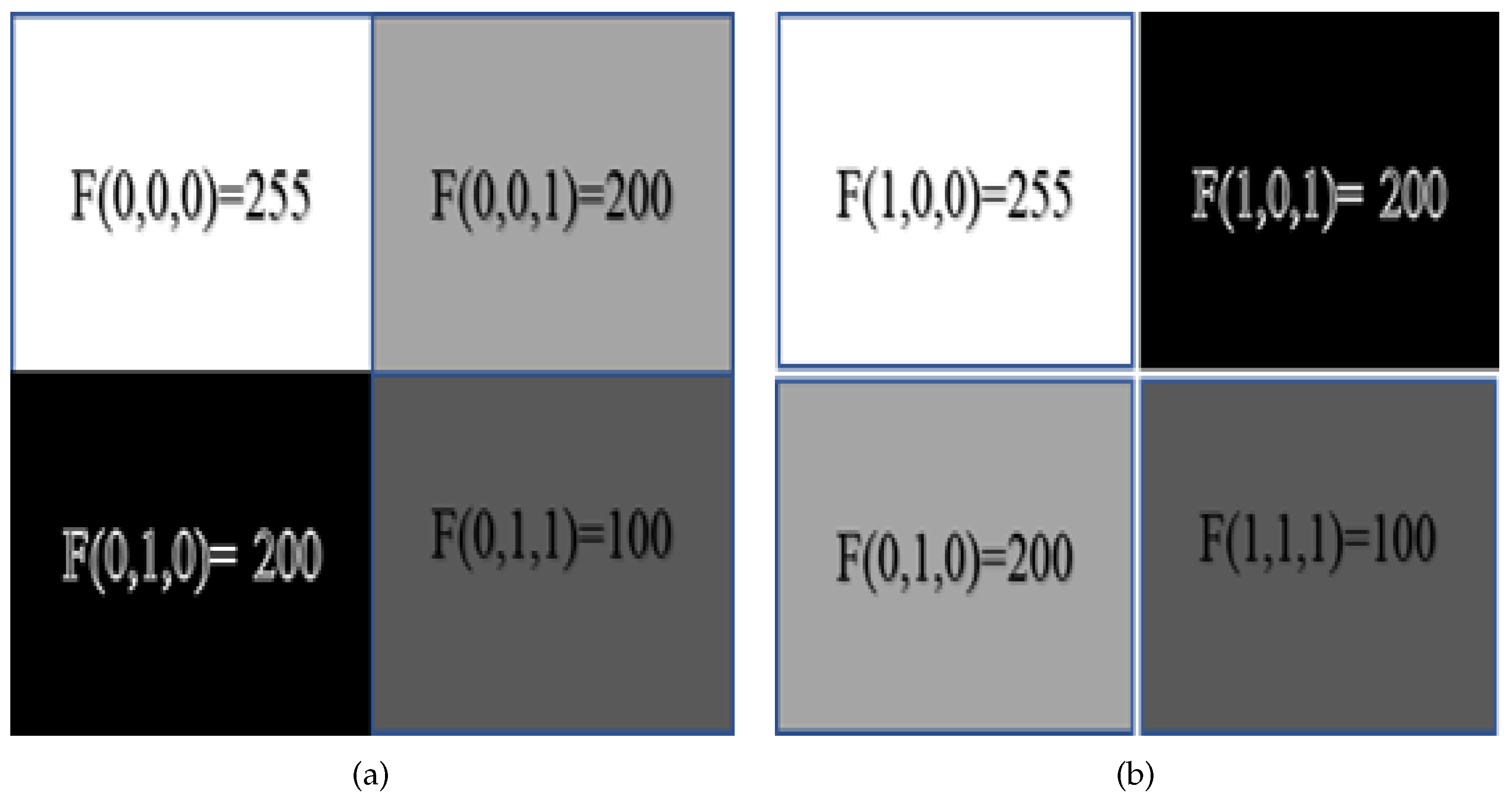
GNEQR (Li et al. 2019) [33] is suitable for real and complex values but, like NEQR, is confined to small images ( 2 × 2 pixels). FRQI (Nasr et al. 2021) [35] employs Toffoli gates to enhance state preparation, increasing complexity in larger images compared to GQIR. QTRQI (Dong et al. 2022) [35] leverages a ternary quantum system for image storage, though details on compression quality and reconstruction accuracy are limited. CQIR (Caraiman et al. 2013) [41] employs a multi-label quantum system for image storage but does not clarify mapping methods and has high preparation demands. QRMMI (Zhou et al. 2018) [42] uses a 3D Arnold transform for multiple image mapping, limited to 2 × 2 arrays, with preparation complexity akin to NEQR. The QRMMI representation of the 2 × 2 images shown in Figure 8(a) is expressed as:
| I Q R M M I = 1 2 3 [ | 200 | 010 + | 100 | 011 + | 200 | 001 + | 255 | 000 ]
The QRMMI representation of the image is shown in Figure 8(b):
r e s i z e b o x w i d t h 0.0 p t | I Q R M M I = 1 2 3 [ | 200 | 010 + | 100 | 111 + | 200 | 101 + | 255 | 101 ]
Lastly, QBIR (Liu et al. 2019) [44] encodes images block-wise but faces preparation challenges in state connectivity. These techniques provide unique approaches to quantum grayscale image representation, high preparation demands, restrictions on image size, and a lack of clarity on compression and reconstruction quality for practical applications limit many.
Table 3 summarizes quantum color image compression and representation strategies, emphasizing each strategy’s advantages and restrictions. NCQI (Sang et al. 2017) [45] represents RGB values individually to decrease time complexity but demands additional gates and more image reconstruction and PSNR measurement transparency. OCQI (Liu et al. 2018) [15] reduces time complexity compared to MCQI through channel swapping but demands more qubits, increasing operational complexity. QMCR (Abdelmaleky et al. 2017) [16] reduces preparation complexity versus NEQR but faces challenges in pixel value conversion from classical to quantum, impacting image quality. FRQCI (Li et al. 2016) [17] stores RGB values but is restricted to low-resolution images ( 2 × 2 arrays), lacking details on reconstruction methods for higher resolutions. QHSL (Yan et al. 2021) [19] maps images based on hue, saturation, and lightness but is also limited to 4 × 4 arrays, with no details on more considerable image processing. QIRHIS (Chen et al. 2021) [19] employs hue, saturation, and intensity for optimization and uses fewer qubits than NCQI, though limited to small images ( 2 × 2 arrays) and lacks a defined reconstruction strategy. MCQI (Sun et al. 2013) [20] supports multichannel color images but is confined to up to 64 × 64 arrays of square images. INCQI (Su et al. 2021) [21] uses rectangular arrays to represent color images but introduces complexity with accessory quantum bits and is suitable only for 2 × 4 arrays. NAQQS (Li et al. 2014a) [48] segments and represents color images but faces challenges with quantum circuit complexity, although it can handle compression. These methods show varying strengths in complexity reduction, time efficiency, and qubit use but are usually restricted by image size restrictions and incomplete reconstruction methods for practical applications.

4. Conclusions

This research explored recent advances in quantum image processing, with a focus on mainly image representation and compression. Quantum computing presents promising solutions for managing extensive image datasets more efficiently than classical systems constrained by memory and hardware limitations. This is because of the computation of quantum resources using quantum mechanics properties. As major companies like Google, IBM, and Microsoft pioneer developments in quantum technology, new quantum image processing techniques have emerged, each with unique strengths and limitations. This work categorizes and summarizes current methods based on their pixel intensity representation and state preparation approach. It includes models such as NEQR, FRQI, and MCQI for grayscale and color image encoding. Key strengths of these methods include reduced image storage requirements and increased processing speed. However, challenges still need to be addressed, especially regarding the complexity of state preparation and the higher qubit count needed for medium and large-scale images. For instance, NEQR can represent grey images effectively but is limited to square images, while MCQI represents multichannel color images but is constrained to specific resolutions. Color image representations, like NCQI and QIRHS, aim to optimize color storage but require further reconstruction quality and computational efficiency improvements. This review highlights the demand for efficient quantum circuits with minimized gate connections for medium and high-resolution image processing. This paper has determined areas where future research could advance quantum image compression and representation by analyzing the advantages and limitations of the existing methods, eventually improving quantum-based image processing capacities.

Author Contributions

The idea comes from co-supervisor Anwaar Ulhaq(A.U). It has been written and compiled by Ershadul Haque, and Faranak Tohidi. This project is supervised by Manoranjan Paul and co-supervised by A.U.

Funding

No funding related to this study.

Institutional Review Board Statement

The study does not include any primary data collection, and the data used are standard public data commonly used in this domain.

Informed Consent Statement

n/a, as benchmark data is publicly available. The datasets used in this paper have been extensively used in the quantum image research community. We follow the common test conditions established by the existing approach

Data Availability Statement

All data generated or analyzed during this study are included in this published article.

Conflicts of Interest

The authors declare no conflicts of interests.

References

  1. Z. Xu, M. Wang, and Y.Zhang, Review of quantum image processing. Archives of Computational Methods in Engineering 2022, 29, 737–761. [CrossRef]
  2. P.W., Shor, "Fine particles, thin films, and exchange anisotropy",n Proceedings 35th annual symposium on foundations of computer science, pp.124–134, 1994.
  3. L. K. Grover, "A fast quantum mechanical algorithm for database search", Proceedings of the twenty-eighth annual ACM symposium on Theory of computing,pp.212–219, 1996.
  4. I. S. Jacobs, Fine particles, thin films, and exchange anisotropy. Magnetism 1963, 3, 271–350.
  5. T. D. Ladd et. al., Quantum computers. nature 2010, 464, 45–53. [CrossRef] [PubMed]
  6. Mandrà, S.; Guerreschi, G.G.; Aspuru-Guzik, A. Faster than classical quantum algorithm for dense formulas of exact satisfiability and occupation problems. New J. Phys. 2016, 18, 1–12. [Google Scholar] [CrossRef]
  7. S. E. Venegas-Andraca and S. Bose, Storing, processing, and retrieving an image using quantum mechanics. Quantum information and computation 2003, 5105, 137–147.
  8. Latorre, J. I. Image compression and entanglement. arXiv 2005, arXiv:quant-ph/0510031. [Google Scholar]
  9. Le, P. Q., Dong, F., & Hirota, K. A flexible representation of quantum images for polynomial preparation, image compression, and processing operations. Quantum Information Processing 2011, 10(1), 63–84. [CrossRef]
  10. Sun B, Iliyasu AM, Le P, Dong F, Hirota K (2011) A multichannel representation for images on quantum computers using the rgbα color space. In: IEEE 7th International Symposium on Intelligent, Signal Processing, Malta, Floriana, pp 160–165.
  11. Zhang Y, Lu K, Gao Y, Xu K A novel quantum representation for log-polar images. Quant Inf Process 2013, 12, 3103–3126.15. [CrossRef]
  12. Li HS, Zhu Q, Zhou RG, Li MC, Song L, Ian H Multidimensional color image storage, retrieval, and compression based on quantum amplitudes and phases. Inf Sci 2014, 273, 212–232. [CrossRef]
  13. Li, P., Xiao, H., & Li, B. Quantum representation and watermark strategy for color images based on the controlled rotation of qubits. Quantum Information Processing 2016, 15(11), 4415–4440. [CrossRef]
  14. Jiang N, Wang J, Mu Y Quantum image scaling up based on nearest-neighbor interpolation with integer scaling ratio. Quant Inf Process 2015, 14, 4001–4026. [CrossRef]
  15. Liu K, Zhang Y, Lu K, Wang X, Wang X An optimized quantum representation for color digital images. Quant Inf Process, 2018; 57, 2938–2948.
  16. Abdolmaleky M, Naseri M, Batle J, Farouk A, Gong LH (2017), Red-green-blue multi-channel quantum representation of digital images. Opt: Int J Light Electron 128:121–132. [CrossRef]
  17. Li P, Liu X (2018a), Color image representation model and its application based on an improved FRQI. Int J Quant Inf 16(1):1850005. [CrossRef]
  18. Yan, F., Li, N., & Hirota, K. (2021). QHSL: A quantum hue, saturation, and lightness color model.Information Sciences, 577, 196-213. [CrossRef]
  19. Chen, G. L., Song, X. H., Venegas-Andraca, S. E., El-Latif, A., & Ahmed, A. (2022). QIRHSI: novel quantum image representation based on HSI color space model. Quantum Information Processing, 21(1), 1-31. [CrossRef]
  20. Sun, B., Iliyasu, A., Yan, F., Dong, F., & Hirota, K. (2013). An RGB multi-channel representation for images on quantum computers. J. Adv. Comput. Intell. Intell. Inform, 17(3). [CrossRef]
  21. Su, J.; Guo, X.; Liu, C.; Lu, S.; Li, L. An improved novel quantum image representation and its experimental test on IBM quantum experience. Sci. Rep. 2021, 11(1), 1–13. [Google Scholar] [CrossRef] [PubMed]
  22. Jiang N, Hu H, Dang Y, Zhang W Quantum point cloud and its compression. Int J Theor Phys 2017, 56, 3147–3163. [CrossRef]
  23. Li H-S, Chen X, Xia H-Y, Liang Y, Zhou Z (2018), A quantum image representation based on bitplanes. IEEE Access, 6:62396–62404. [CrossRef]
  24. Sahin E, YILMAZ I (2018), Qrmw: quantum representation of multi-wavelength images. Turk J Elect Eng Comput Sci 26(2):768–779. [CrossRef]
  25. Khan, R. A. (2019), An improved flexible representation of quantum images. Quantum Information Processing, 18(7), 1-19. [CrossRef]
  26. Li, H. S. et al. Image storage, retrieval, compression, and segmentation in a quantum system. Quantum Inf. Process. 12, 2269–2290. [CrossRef]
  27. Yuan, S. Z. et al. SQR: A simple quantum representation of infrared images. Quantum Inf. Process. 13, 1353–1379. [CrossRef]
  28. Venegas-Andraca, S.E.; Ball, J.L. Processing images in entangled quantum systems. Quantum Inf. Process. 2009, 9, 1–11. [Google Scholar] [CrossRef]
  29. Laurel, C.O.; Dong, S.-H.; Cruz-Irisson, M. Equivalence of a Bit Pixel Image to a Quantum Pixel Image. Commun. Theor. Phys. 2015, 64(5), 501–506. [Google Scholar] [CrossRef]
  30. Zhang Y, Lu K, Gao Y, Wang M Neqr: a novel enhanced quantum representation of digital images. Quant Inf Process 2013, 12, 2833–2860.
  31. Jiang N, Wang L Quantum image scaling using nearest neighbor interpolation. Quant Inf Process 2015, 14, 1559–1571. [CrossRef]
  32. Jiang, N.; Lu, X.; Hu, H.; Dang, Y.; Cai, Y. A Novel Quantum Image Compression Method Based on JPEG. Int. J. Theor. Phys. 2017, 57, 611–636. [Google Scholar] [CrossRef]
  33. Li HS, Fan P, Xia HY, Peng H, Song S Quantum implementation circuits of quantum signal representation and type conversion. IEEE Trans Circuits Syst I Regular Papers 2019, 66, 341–354. [CrossRef]
  34. Nasr, N.; Younes, A.; Elsayed, A. Efficient representations of digital images on quantum computers. Multimedia Tools Appl. 2021, 80(25), 34019–34034. [Google Scholar] [CrossRef]
  35. Dong, H.; Lu, D.; Li, C. A novel qutrit representation of quantum image. Quantum Inf. Process. 2022, 21(3), 1–29. [Google Scholar] [CrossRef]
  36. Wang, L.; Ran, Q.; Ma, J.; Yu, S.; Tan, L. QRCI: A new quantum representation model of color digital images. Opt. Commun. 2019, 438, 147–158. [Google Scholar] [CrossRef]
  37. Wang B, Hao M-Q, Li P-C, Liu Z-B Quantum representation of indexed images and its applications. Int J Theor Phys 2020, 59, 374–402. [CrossRef]
  38. Xu G, Xu X, Wang X, Wang X Order-encoded quantum image model and parallel histogram specification. Quant Inf Process 2019, 18, 1–26.
  39. Grigoryan AM, Agaian SS, New look on quantum representation of images: fourier transform representation. Quant Inf Process 19(5), 2020. [CrossRef]
  40. Wang L, Ran Q, Ma J (2020), Double quantum color images encryption scheme based on DQRCI. Multimed Tools Appl 79(9–10):6661–6687. [CrossRef]
  41. S. Caraiman and V. Manta, Image representation and processing using ternary quantum computing, in Adaptive and Natural Computing Algo- rithms, vol. 7824. Springer, Apr. 2013, pp. 366-375. [Online]. Available: https://link.springer.com/chapter/10.1007%2F978-3-642-37213-1_38. 1007.
  42. Zhou, N. R. , Yan, X. Y., Liang, H. R., Tao, X. Y. & Li, G. Y. Multi-image encryption scheme based on quantum 3D Arnold transform and scaled Zhongtang chaotic system. Quantum Inf. Process. 17, 36. [CrossRef]
  43. Pivoluska, M., & Plesch. Implementation of quantum compression on IBM quantum computers. Scientific Reports 2022, 12(1), 1–9. [Google Scholar] [CrossRef]
  44. Liu, X. B. , Xiao, D., Huang, W. & Liu, C. Quantum block image encryption based on Arnold transform and sine chaotification model. IEEE Access 7, 57188–57199. [CrossRef]
  45. Sang J, Wang S, Li Q A novel quantum representation of color digital images. Quant Inf Process 2017, 16, 42. [CrossRef]
  46. Li X-Z, Chen W-W, Wang Y-Q (2018) Quantum image compression-encryption scheme based on quantum discrete cosine transform. Int J Theor Phys 2018, 57, 2904–2919. [CrossRef]
  47. Pang CY, Zhou RG, Hu BQ, Hu WW, El-Rafei A Signal and image compression using quantum discrete cosine transform. Inf Sci 2019, 473, 121–141. [CrossRef]
  48. Li, H.-S.; Zhu, Q.; Zhou, R.-G.; Song, L.; Yang, X.-J. Multi-dimensional color image storage and retrieval for a normal arbitrary quantum superposition state, (in English). Quantum Inf. Process. 2013; 13, 991–1011. [Google Scholar] [CrossRef]
  49. Haque, E.; Paul, M.; Ulhaq, A.; Debnath, T. Advanced quantum image representation and compression using a DCT-EFRQI approach. Sci. Rep. 2023, 13, 1–15. [Google Scholar] [CrossRef]
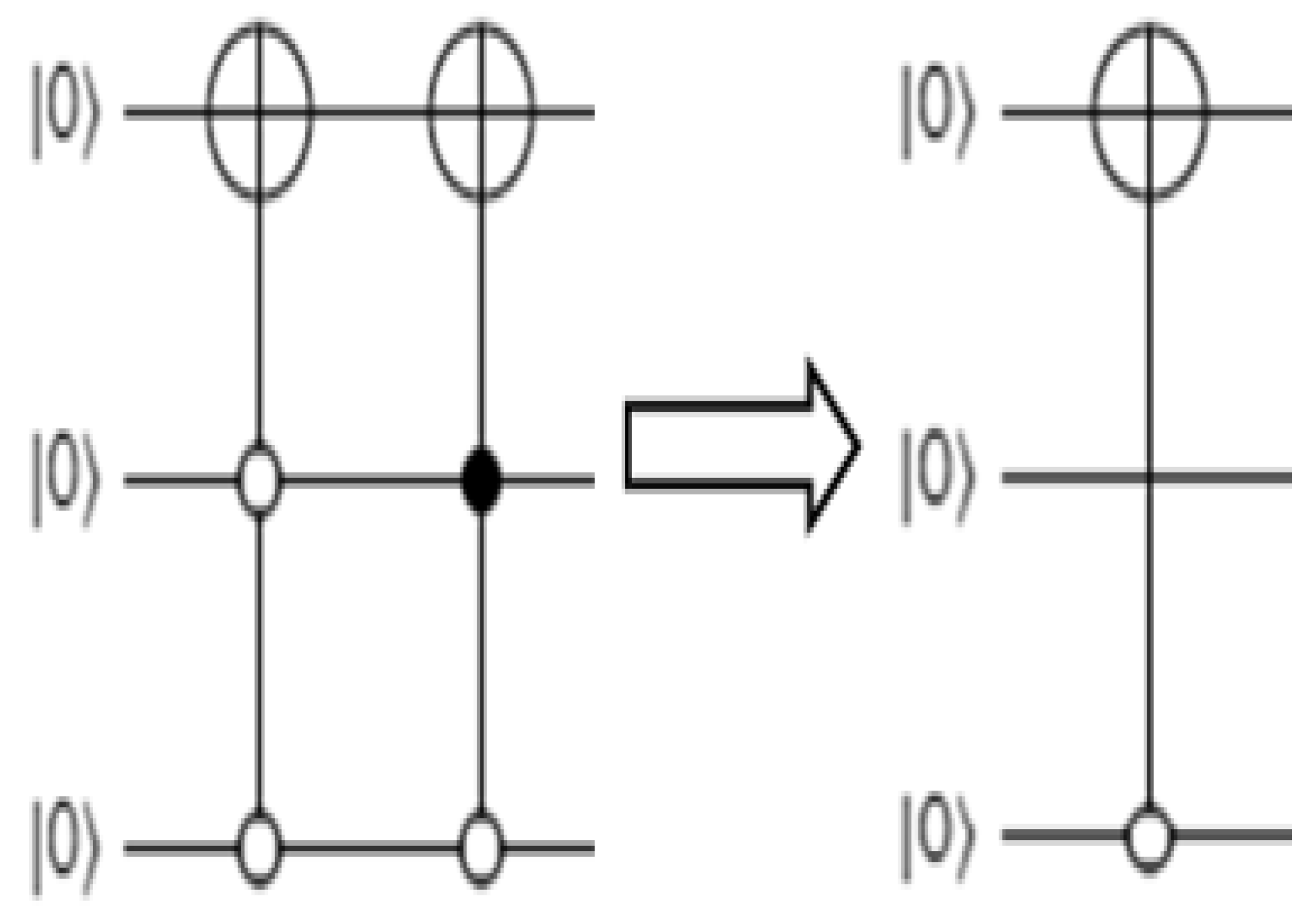
Figure 1. Quantum image compression using BEC approach
Preprints 139042 g001
Figure 2. An FRQI circuit for representing 2 × 2 quantum image
Preprints 139042 g002
Figure 4. NEQR circuit for representing image pixel
Preprints 139042 g004
Figure 5. Taxonomy of the quantum image compression and representation approaches
Preprints 139042 g005
Figure 6. A 16 × 16 DCT-GQIR quantum image including state preparation
Preprints 139042 g006
Figure 7. Quantum circuit for the GQIR representation of a 2 × 2 grayscale images
Preprints 139042 g007
Figure 8. Example of QRMMI approach for multi-image representation.
Preprints 139042 g008
Table 1. Overview of an angle-based quantum image compression and representation approach.
Reference Strategy pros cons compression
Venegas-Andraca
et al.2003 [7]
Qubit Lattice Use multi-particle quantum mechanics system.
Better reproduction of original values
compare to classical.
Use single qubit only.
Four number of pixel values are converted
randomly into quantum mechanics system.
No
Le et al.2011 [9] FRQI Capture the image pixel color and its position.
Convert the image into its normalized state.
Mapping the pixel into angle using a single qubit.
Use traditional Boolean expression compression approach.
Unable to represent pixel-wise operation.
Yes.
Sun et al.2011 [10] MCRQI Represent RGB quantum color image.
Qubits represent the color space of the image.
Insufficient qubit to represent to medium or big size images.
Map the pixel values as an angle does not give
sufficient knowledge to represent a big size image.
No.
Zhang et al. 2013 [11] QUALPI Represent the image in log-polar coordinate system.
Use geometric transformation to convert
the image.
4 × 8 array of image size was considered
Generate more redundant information for position preparation.
Nearly impossible to pixel wise representation of a
medium or big size image.
No.
Li et al. 2014 [12] NASS It represent multidimensional color image.
Create arbitrary superposition.
Pixels are directly converted into angle leading the question
of originality of reproduction.
How compression happens is not mentioned clearly.
Applicable for very low-resolution images.
Yes.
Li et al. 2016 [17] FRQCI Use two phases parameter to locate the
RGB pixel value.
Use single qubit lead the poor
quality for its representation.
Considered 4 × 4 array size of the image which can
carry a tiny amount of information for real application.
Not suitable for big-size images due to generating
huge amount of information for state preparation.
No.
Khan et al.2019 [25] IFRQI Able to represent two bits as an angle Only represent 2 × 2 array of pixel image directly.
Image reconstruction procedure is still missing.
No.
Li et al.2013  [26] QSMC
& QSNC

Represent pixel and state value.
Image is segmented based quantum method.
Use only 3 × 3 array of image.
Applicable for square size image.
Reconstruction procedure is not mentioned properly.
Yes
Yuan et al. 2014 [27] SQR
Represent and store the infrared
image using Qubit lattice approach.
Angle parameter is not mentioned clearly.
Lack of information to represent a real image.
No
Table 2. Overview of gray-scale quantum image compression and representation approaches.
Reference Strategy pros cons compression
Zhang et al. 2013  [30] NEQR Uses eight numbers of qubits to
represent the gray image.
Only applicable for square image.
Mapping the pixel values directly leading the complexity of preparation.
No.
Zhang et al. 2015 [31] INEQR Able to represent unequal horizontal
and vertical coordinate image.
Applicable for the small size of gray
image for mapping.
In what way, mapping of big size color image is still a gap?
No.
Zhang et al. 2015a  [32] GQIR Represent the rectangular image in any
arbitrary shape.
Generate more redundant information for position preparation.
Nearly impossible to pixel wise image representation of a medium or
big size image.
No.
Li et al.2019  [33] GNEQR Represent real and complex value
signal information.
Applicable for 2 × 2 square image.
Complexity of preparation is very high, like NEQR.
No.
Nasr et al. 2021 [34] EFRQI Use Toffili gate for state preparation. Its increase the number of require gate compare to GQIR.
Complexity become high when attempting to represent
every pixel of an real application image
No
Dong et al. 2022 [35] QTRQ Use ternary quantum system to store the formation. Image is reconstructed procedure is not discussed.
Exactly where and how the compression
happens is not mentioned clearly.
Nothing mentioned about quality measurement.
Yes
Caraiman et al.2013 [41] CQIR
To store and process image use multi-
label quantum system
Higher preparation complexity.
Did not mention how the image array is mapped.
No
Zhou et al.2018 [42] QRMMI
Represent multiple image using
3D Arnold transform.
Increase complexity mapping of
sequence number.
Limited to 2 × 2 array size of image
No
Liu et al.2019 [44] QBIR Represent pixel image as block-wise Complexity is similar to NEQR.
Map pixel value directly into quantum domain
create higher preparation complexity
for state connection
No
Table 3. Overview of quantum color image compression and re-presentation approaches.
Reference Strategy pros cons compression
Sang et al. 2017 [45] NCQI Represent the RGB value of
color image separately.
Decrease the time complexity
compared to MCRQI.
Although the author proposed color image representation,
but it processes gray image for measurement.
Require too many qubits to do the operation.
Reconstruction of the image was not examined.
How the required number of gates and
PSNR are calculated is not mentioned.
No.
Liu et al. 2018 [15] OCQR It require several qubits
for representation compared to MCQI.
Decrease the time complexity
compared to MCRQI.
Increase the complexity of operation
due to counting channel swapping operation.
No.
Abdolmaleky
et al. 2017 [16]
QMCR Reduce the complexity of
preparation compared to NEQR.
More qubits is required compared to MCRQI.
Quality of the reconstruction image is still issue.
Working with pixel values conversion from classical to quantum leads
the complexity of the preparation.
No.
Li et al. 2016 [17] FRQCI Store the RGB value of the color image Use probabilistic amplitude and phase against the pixels
value information.
Applicable for 2 × 2 array image.
How a higher resolution image is reconstructed still gap.
No.
Yan et al.2021 [18] QHSL Map the image using Hue,
Saturation, Lightness
Only applicable for 4 × 4 image.
How mapping a big size image is still unclear
No
Chen et al. 2021 [19] QIRHSI Represent image based on HSI
(hue, saturation, intensity) method.
Require less qubits compared to NCQI
Use traditional BEC approach for optimization.
Applicable for 2 × 2 array size of image only
Did not mention image reconstruction strategy
No
Sun et al. 2013 [20] MCQI Represent multichannel color image Only applicable for square image.
limited to 64 × 64 array size of image
No
Su et al. 2021 [21] INCQI Represent color image.
Use rectangular image
Increase complexity due to considering accessory quantum bits.
Applicable for 2 × 4 array size of image
No
Li et al.2014a [48] NAQSS Represent and segment the color image. More complexity due to considering extra qubit
for segmentation purpose.
Quality is not measured after representation
Yes
Disclaimer/Publisher’s Note: The statements, opinions and data contained in all publications are solely those of the individual author(s) and contributor(s) and not of MDPI and/or the editor(s). MDPI and/or the editor(s) disclaim responsibility for any injury to people or property resulting from any ideas, methods, instructions or products referred to in the content.
Copyright: This open access article is published under a Creative Commons CC BY 4.0 license, which permit the free download, distribution, and reuse, provided that the author and preprint are cited in any reuse.
Prerpints.org logo

Preprints.org is a free preprint server supported by MDPI in Basel, Switzerland.

Subscribe

Disclaimer

Terms of Use

Privacy Policy

Privacy Settings

© 2025 MDPI (Basel, Switzerland) unless otherwise stated