
Submitted:
06 November 2024
Posted:
08 November 2024
You are already at the latest version
Abstract
It is widely acknowledged that the majority of acute environmental issues can be attributed directly to human activity. Since the inception of human settlements, the production of waste has been a common occurrence. In addition to the production of natural waste products, the advent of the Industrial Revolution has resulted in a significant increase in the generation of artificial waste. It is therefore imperative, from an environmental standpoint, to implement effective measures to reduce these pollutants. One method of reducing the impact of organic environmental pollutants is to photochemically convert them with europium, particularly trivalent europium. As demonstrated in this proof of concept using a range of model pollutants, it is possible to break down environmentally relevant pollutants, including nitriles, carbamates and halogenated compounds, with trivalent europium salts into environmentally friendly organic compounds.
Keywords:
europium(III)
; europium
; photochemistry
; environmental pollutants
; decontamination
1. Introduction
The contemporary climate crisis can be attributed, among other contributing factors, to anthropogenic environmental pollution. It should be noted that the phenomenon of environmental pollution is not a novel issue related to features of modern society. Rather, human activities have resulted in the creation of waste since the earliest instances of human habitation in more concentrated communities. At this point, it should be noted that the type of waste has significantly changed since the beginning of mankind. However, the waste produced over a large period of time where more or less anthropogenic modified natural substances, like fragments of stone or clay. The fragments were often assembled randomly in a single location, where they started forming more substantial accumulations. In accordance with archaeological research, such accumulations like Monte Testaccio near Rome (Italy), can be found near many ancient villages. [1,2,3]. In this context it should be mentioned that the organized removal of different waste products starts in Europe with the beginning of the medieval period [4]. Where people start to collect and storage different types of waste at specific places [4]. These medieval landfills often were placed in wetlands near larger villages to form artificial land where new housing can be built. This procedure can be observed for example in parts of Prague (Czech Republic) [5]. In general, the environmental risk from these wastes can be categorized as low.
In general, little has changed in this practice. Materials that cannot be recycled still go to landfill. What has changed is the type of waste. As technology progressed, especially during the industrial revolution, the waste was increasingly artificial. However, this has meant that in the past, highly toxic substances have also been buried directly in the environment, uncontrolled. This has caused considerable environmental damage in various regions. This is particularly clear when looking at the situation in Germany over the last 100 years. In the GDR (German Democratic Republic), for example, waste from the chemical industry, such as chlorobenzene, was discharged directly into the surrounding soil, aquifers and even surface water well into the 1980s. Traces of this contamination can still be found in various regions. Under Bitterfeld, for example, there is a chlorobenzene-saturated groundwater bubble that has still not been removed despite several attempts.[6,7,8]. According to current estimations up to six million tons of toxic waste are stored in landfill built during the GDR era [6]. In contrast, in the (old, pre-1990) Federal Republic of Germany, due to strict environmental regulations imposed earlier, various environmental pollutants were usually stored in special containers at depots, often in old mines, or dumped at sea. The main environmental risk is that these containers corrode over time and start to leak, releasing the pollutants.[6,9]. To ensure that these contaminated sites do not pose a risk to future generations, efforts are often made to remove existing contamination. There are various methods of doing this, which can be categorized according to where the contaminated site is ultimately removed. A distinction is made between in situ, i.e., removal at the location of the contaminated site, and ex situ, i.e., removal at another location. The contaminants are degraded either by purely chemical processes or, increasingly, by microbiological processes, or by a combination of the two. One example of a biological in-situ process is a project in Bitterfeld in which the objective is to purify water contaminated with chlorobenzene using various microorganisms [10]. It should be noted, however, that the biological system serves only to completely break down the less toxic pollutant into carbon dioxide and water after chemical catalysis [10]. It should also be noted that not all pollutants can degrade with microorganisms because most pollutants will still be degraded using chemical processes. However, these processes often require expensive catalysts and/or extreme reaction conditions like high pressure and elevated temperatures, to break down various pollutants. Consequently, these processes are not economically practical in comparison to targeted landfilling, which is why many environmental pollutants are still landfilled. However, to ensure that these pollutants do not pose a threat to future generations, new methods must be developed to break them down effectively. One promising approach could be the photochemical degradation of various pollutants using different suitable catalysts, such as trivalent europium. Hence, the unique properties of Eu(III) shall be discussed in both a historical point of view and judging from our recent experiences which are duly reported.
First studies on the systematic studies of CT photo transitions of Europium among other REE´s (rear earth elements) which have different oxidation states dating back to 1966 [11]. Because they did the studies in HHal-saturated acetonitrile containing [REEHal6]3-, the immonium ion CH3-C(Hal)=NH2+ and HHal2 anions, they are omitting any study of possible photochemical products. In fact, these are much more likely to form using Eu oxo- or hydroxospecies, including carbonatocomplexes (same with U). Later it was noted that Eu differs from other REE’s by prevailing LMCT-transitions over ff-transitions [12]. Considering a similar behavior in Uranium, this findings could suggest that could be possible to abstract H-atoms from solvents or dissolved organic substances with Europium like it can be done with Uranium [13,14]. As far as we know the corresponding photochemistry was observed first by Stein et al. [15,16]. They observed that the excitation of the CT band in methanol-containing aqueous Eu(III) solutions leads to the formation of molecular hydrogen and Eu(II). [16]. A few years later the unique photochemistry of trivalent Europium concerning simple organic compounds like methanol, ethanol or formic acid was described in literature [17,18]. Studies until recently were done only in polar systems; thus, additional features of Eu-mediated organic photochemistry including transfer of entire functional groups like benzyl- or ester groups accruing in esters or toluene were simply missed. Some reactions and the corresponding reaction conditions are pertinent to degradation of diverse kinds and classes of potential organic environmental pollutants, as is H abstraction. While it was wrongly assumed that only very few substances could be converted with europium. Only in the last 20 years or so has there been a gradual change in thinking, with several publications suggesting that significantly more organic compounds can be oxidized with europium [17,18,19,20,21,22,23]. In combination with our own findings, we think it could be possible to photochemically degrade different environmental pollutants with trivalent Europium. In this proof-of-concept-article, we first want to describe whether this is even possible to degrade different pollutants like chlorobenzene with trivalent Europium.
2. Materials and Methods
2.1. Photochemical Degradation of Selected Pollutants with Trivalent Europium (Eu(III)-Chloride) In A Two Phase System
A comprehensive overview of the pollutants subjected to testing, along with the precise weight measurements, is presented in Table 1. The basic experimental setup is therefore described in more detail in the following section using pentanal as an illustrative example.
In order to facilitate the photochemical degradation of pentanal, the quantities weighed in Table 1 were initially dissolved in 50 mL ethylene glycol. To accelerate the dissolution process, the reaction mixture was first stirred in a closed reaction vessel at approximately 300 rpm. Subsequently, 2.5 mM europium(III)-chloride (CAS number: 10025-76-0; Sigma-Aldrich) was added to the reaction mixture, which was then stirred for approximately 15 minutes at 300 rpm after that approximately 20-30 mL toluene (CAS number: 108-88-3; Sigma-Aldrich) was add as a second phase. Subsequently, up to three samples were placed on the self-constructed photolysis unit, which consist of a commercially available LED ceiling spot with a light temperature of 7400 K, as illustrated in Figure 1, and illuminated for a minimum of 48 hours up to 168 h.
2.2. Sample Preparation for GC Analysis by Toluene Extraction
To facilitate the subsequent GC analysis, the selected pollutants generated during photochemical conversion with Eu(III)-chloride in the toluene phase were removed, and a second extraction with toluene was conducted. Consequently, 20 mL of toluene was initially added to the reaction batches. The resulting two-phase mixtures were then stirred for approximately 24 hours at 300 rpm. Thereafter, the samples were left to stand in the dark until the phase separation was complete. Upon completion of the phase separation, the toluene phase was removed and stored in the dark in sealed reaction vessels until GC analysis could be conducted.
2.3. Analysis of the Products of Photochemical Conversion of Various Selected Pollutants
Analysis was done using a GC/MS method which was described before in more detail [19,24]. Due to slightly different circumstances, the parameters of this method were adapted to the new conditions. Therefore, the oven temperature was extended to 250°C to facilitate the reliable detection of a greater number of organic compounds, including those with high boiling points. Although the injector temperature was set to 180°C to avoid Hofmann-type elimination of ammonium salts in the injector. Because of this changes the new GC/MS-method is described in detail in Tabel 2.

Table 2.
Overview of the GC/MS settings used.
| Parameter | Value |
| Injector temperature | 180 °C |
| Initial oven temperature | 80 °C |
| End oven temperature | 280 °C |
| Temperature ramp | 30 °C/min |
| Mobile phase | He |
| Flow rate | 1 ml/min |
| Split | 100/1 |
3. Results and Discussion
3.1. Results and Discussion of the Degradation Experiments Of Didodecyl Dimethyl Ammonium Bromide With Trivalent Europium
The following products have been identified as products of conversion of didodecyl dimethyl ammonium bromide by trivalent europium:
Two different tertiary amines
Dodecyl dimethyl amine
Bis-dodecyl-N-methylamine
Two Halogenated 1-C chain shortening alkanes
1-Bromoundecane
1-Chloroundecane
Various long chain alkanes
Decane
Undecane
- As well as Docosyl acetate
Upon closer examination of the products, it can be postulated that the two halogenated products are the result of the Hofmann elimination. However, this hypothesis can be refuted on two grounds. Firstly, the Hofmann elimination does not yield any chain-shortened products. Secondly, no typical Hofmann products could be identified [25,26,27]. The presence of the chain-shortened products also indicates that the quaternary ammonium salt did not undergo thermal decomposition. Consequently, the degradation is likely to be photocatalyzed by trivalent europium, as illustrated in the following Figure 2.
Figure 2 Proposed reaction scheme for the elimination of alkyl radicals, which have been shortened by one carbon atom, from quaternary ammonium salts with trivalent europium.
The resulting alkyl sidechains lost one terminal C atom, i.e., here: undecyl compounds are formed. The undecyl-radicals subsequently undergo further reactions, resulting in the formation of halogenated products. It is currently unclear whether the formation of one of the two halogenated products precedes that of the second, with the latter resulting from a substitution reaction, or whether both can arise simultaneously. The ester found (docosyl acetate) suggests that the alkyl radicals generated undergo a reaction with water, resulting in the formation of the corresponding alcohols in accordance with equation 1. To form the ester, the alcohol (docosan-1-ol) that has been formed now reacts with acetic acid, probably catalyzed by europium, to form the corresponding ester (cf. equation 2).
Nevertheless, it is still uncertain whether the separation of the methyl groups is a thermally driven process or one that is catalyzed by the presence of europium. However, internal data indicate that the reaction mixtures do not significantly heat up when illuminated, suggesting that the thermal decomposition of the quaternary ammonium salt plays a subordinate role. It can therefore be assumed that this reaction is catalyzed by bivalent europium, as proved in the following equation 3. The methyl radicals formed during this process can then react in a few ways, as illustrated in the subsequent equations (3 to 7). As previously described in the literature, this can result in the formation of methane, methanol and ethane, as well as acetic acid [17]. The findings of Matsumoto et al. suggest that the formation of alkanes may potentially be entirely degraded into CO₂ and H₂O [17]. This hypothesis is particularly applicable to short-chain alkanes, and it is also consistent with the possibility of long-chain alkanes undergoing similar degradation processes. The presence of decane may serve to substantiate this proposition.
Figure 3.
Proposed reaction scheme for the C1-Chanin reduction catalyzed by Eu(II).

It has been shown that the photocatalytic conversion of quaternary ammonium salts with europium into significantly less toxic compounds is a viable process. It is important to note, however, that the formed docosanol interacts with biological membranes in a comparable way to various quaternary ammonium salts. While the stabilization of various membrane proteins has been described, this process may also significantly impede the penetration of viruses into host cells [28,29,30]. Additionally, some degradation products could potentially pose an environmental hazard (e.g., docosanol). Further research is therefore needed to better assess this hazard potential.
3.2. Results and Discussion of the Degradation Experiments of Toluene With Trivalent Europium
The reaction of toluene did not yield any results under the conditions described here. This initially suggests that toluene may not be a practical candidate for further investigation. However, if the toluene phase is shielded in a two-phase system and thus not illuminated, the formation of 1,2-diphenylethane is a possibility. Based on previous findings, this is most likely a radical reaction after photocatalytic abstraction of a H+ ion by trivalent europium, as shown in equation 9 [19].
However, if quaternary ammonium salts are present in the reaction mixture, cyclohexanone oxazole and 1-phenyl-2-aminopropane may form. Unfortunately, it is not yet clear exactly how these compounds are formed. Further investigations are therefore necessary here. In general, however, we were able to show that toluene does not react under the reaction conditions described here and is suitable as a solvent for the second phase.
3.3. Results and Discussion of the Degradation Experiments of Pentanal with Trivalent Europium
In addition to 5-nonanone, the conversion of pentanal could yield octane as a product. As with the previous case, the empirical data and comparison with the literature data from Matsumoto et al. indicate that these reactions, as illustrated in Figure 4, proceed via at least one radical between stages [17]. This also suggests that the reaction should yield pentanoic acid as an intermediate product which we did not observe during analysis.
Figure 4.
Reaction scheme for the photocatalytic degradation of pentanal with trivalent europium .
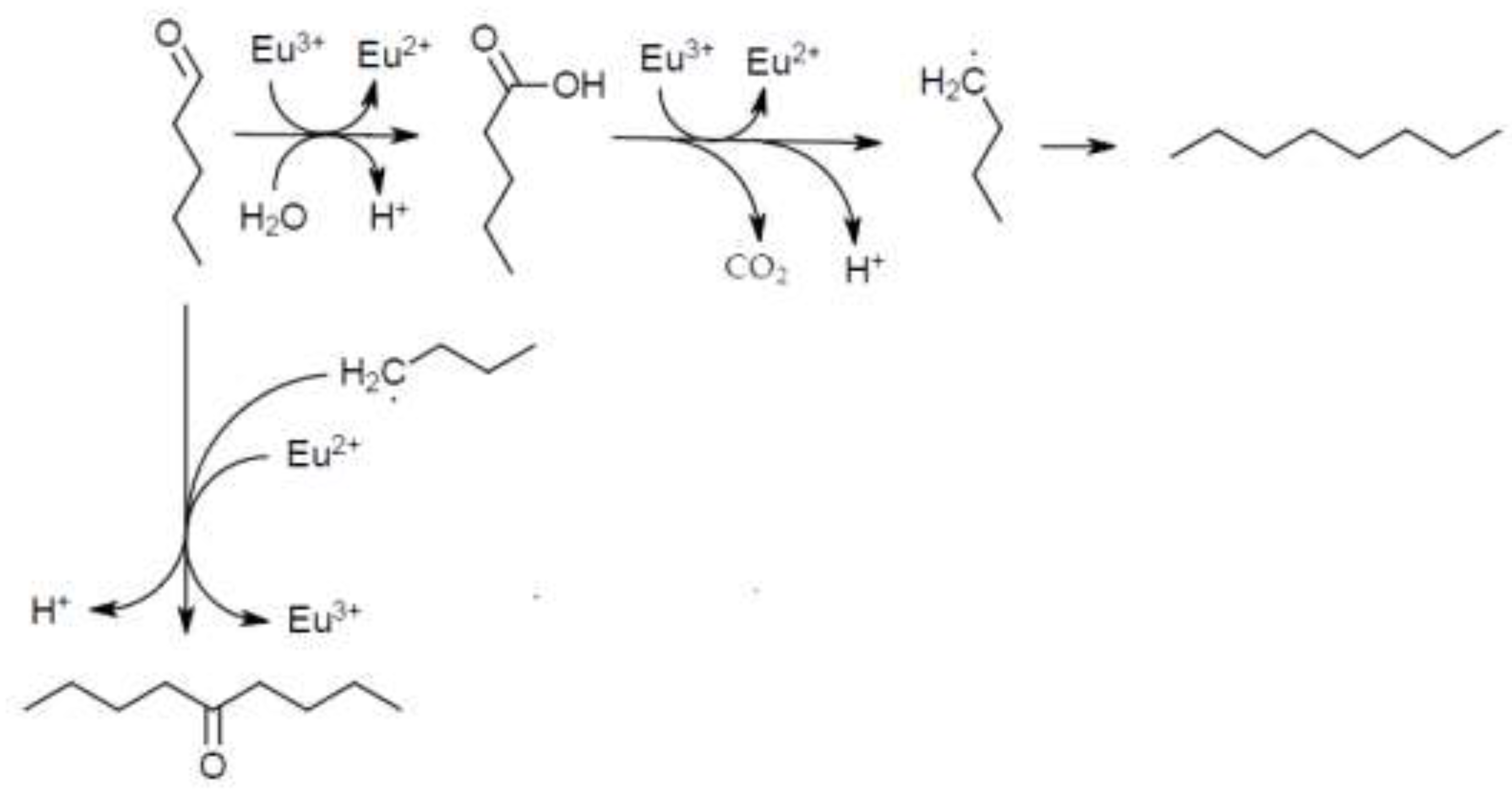
Considering the findings presented by Matsumoto et al., it can be posited that additional short-chain organic compounds, such as butanol or butanoic acid, would also be anticipated [17]. The inability to detect these compounds may suggest that the reaction observed by Matsumoto et al. and in our own experiments is highly dependent on the chain length. This results in a significant shift in the equilibrium of the reaction towards the educts with increasing chain length. This may explain why medium-chain-length compounds tend to convert preferentially into the respective alkanes or the corresponding symmetrical ketones in the case of aldehydes. This assumption is corroborated by the findings of the reaction of various quaternary ammonium salts, which revealed the absence of shorter alcohols, aldehydes, or carboxylic acids apart from long-chain alkanes. It must be acknowledged, however, that further research is required in this area to gain a deeper understanding and provide definitive conclusions. Considering the toxicity of the identified organic compounds, it can be postulated that a certain degree of detoxification may occur in the case of octane, or in the case of other aldehydes, the corresponding alkanes. The mechanism in which aldehydes in this case pentanal can be oxides by Eu(III) are shown in Figure 4. It is not possible to make a definitive statement regarding the toxicity of the ketones formed during the reaction. Studies on rats indicate that 5-nonanone is at least neurotoxic for rats [31,32,33]. Additionally, rats metabolize it into various y-diketones, including 2,5-hexanedione [31,32,33]. This has been demonstrated to be a more potent neurotoxin in animal experiments [31,32,33]. It is therefore assumed that various aldehydes are only present when long-chain alkanes are formed. If ketones are preferentially formed, this must be determined on a case-by-case basis and requires further investigation in cases where doubt exists.
3.4. Results and Discussion Of The Degradation Experiments Of Benzhydryl Amine With Trivalent Europium
Following the successful transformation of benzhydryl amine with trivalent europium, the product analysis initially revealed the following products after a reaction time of 48 hours:
- Benzophenone imine
- 2-phenylethyl-4-benzonitrile
- Diphenylmethane
Furthermore, after an additional 24 hours, 4-benzylaniline, phenyl methane imine and various methylbiphenyls could also be identified. By drawing on a range of literature sources and previously unpublished empirical data, we were able to construct the reaction scheme illustrated in Figure 5 [17,19,20,21,22,23,34].
Nevertheless, it is important to acknowledge that, thus far, a definitive explanation for the formation of 2-phenylethyl-4-benzonitrile remains elusive. At present, however, it is hypothesized that 4-benzylaniline may occur as an intermediate. At this juncture, it is also plausible that a hitherto unidentified reaction mechanism, originating from benzophenone imine and involving several radical intermediate steps, could be responsible for the observed phenomenon. Given the multitude of potential reactions that can be contemplated, further investigation is imperative. As illustrated in Figure 5, the degradation of various byproducts entailed the rearrangement of diverse functional groups within the molecule. Such rearrangements, catalyzed by europium, have been previously documented in the literature [20,21,22,23,34]. Consequently, it can be postulated that these are indeed rearrangements as depicted. Where available, the toxicological data are presented in Table 3 in the form of LD50 values. It can be observed that although a certain degree of detoxification has occurred, some less toxic compounds are still formed, which could have negative effects on the environment. Consequently, the authors wish to highlight that a detoxification of various amines may be possible, but that further investigations are necessary to more accurately assess the risk potential of the resulting products.
3.5. Results and discussion of the degradation experiments of N-1,2-diphenylethyl isopropyl carbamate with trivalent europium
The product analysis for the conversion of N-1,2-diphenylethyl isopropyl carbamate yielded the following products:
- 1-dodecyl isocyanate
- 1-phenyl-2-propanol
- diethyl bis(hydroxymethyl) malonate
- ethylbenzene
- various pyroglutamates
These allow initial conclusions to be drawn about possible reaction pathways, but the current data are insufficient to make qualified statements about them. Therefore, the possibility of detoxifying carbamates will only be briefly discussed here based on the carbamate examined. Table 4 presents the toxicological data for the identified products, where available. It is regrettable that no data for the carbamate in question has yet been published in the scientific literature.
However, given that most carbamates are insecticides, it seems reasonable to posit that the carbamate used here also has analogous properties. Carbamates usually come with warnings that “the compound is highly hazardous to aquatic organisms” which although applied for the tested carbamate in this article. Carbamates are meant to function as cholinesterase inhibitors (less dangerous to vertebrates including humans than halogenated organophosphates or – phosphonates) but conceivably interfere with chitin biosynthesis in arthropods. It can therefore be reasonably surmised that carbamates may be detoxified to a certain extent using trivalent europium. Given the lack of identification of intermediate and end products and the insufficient clarification of carbamate toxicity, further investigation is necessary. Additionally, attention should be paid to the intermediate and final products of the reaction with europium to better assess their environmental hazard potential. However, it is plausible that carbamates can be detoxified photo catalytically with trivalent europium.
3.6. Results and Discussion Of The Degradation Experiments Of Chlorobenzene With Trivalent Europium
The analysis of multiple studies on the degradation of chlorobenzene with europium consistently produced the following products:
The degradation products identified thus far include benzene, various open-chain alkanes and alkenes, and various halogenated open-chain alkanes and alkenes but not phenol which is much more toxic and itself stable towards photodecomposition mediated by Eu(III). However, the occurrence of these compounds in addition to benzene in numerous degradation experiments has hindered the ability to describe the potential degradation pathways in greater detail. In general, the open-chain products suggest that the stable aromatic ring must have undergone a process of ring opening. It remains unclear whether this process is catalyzed by europium or whether it is caused by other side reactions with various components of the reaction mixture. Given that benzene has a comparable environmental hazard profile to chlorobenzene, detoxification does not occur in the absence of dehalogenation and trivalent europium. It is noteworthy, however, that benzene exhibits considerably lower persistence. However, if ring opening and concomitant dehalogenation of the formed alkanes and alkenes occur, it can be postulated that chlorobenzene can undergo detoxification under conditions that remain to be elucidated.
4. Conclusions
As demonstrated by the model substances examined here, which represent various environmental pollutants, photocatalytic degradation of these substances is possible with trivalent europium. As proven, the organic compounds under examination were either oxidized by trivalent europium or reduced by bivalent europium, resulting in the formation of isolated radicals. However, these radicals apparently recombine to yield considerably toxic secondary products. This stands for a first partial success regarding the detoxification of various environmental pollutants. As previously said, further research into the outstanding photochemistry of trivalent europium is therefore necessary. Overall, however, it can be assumed that the spectrum of organic compounds that can be oxidized with trivalent europium is significantly broader than previously assumed in the literature. This is also consistent with previously unpublished data and initial exploratory studies by Blind as part of a master's thesis [7].
Author Contributions
Data curation, S.F.; Formal analysis, S.F.; Writing manuscript, F.B.; Supervision, S.F. All authors have read and agreed to the published version of the manuscript.
Funding
This research received no external funding
Institutional Review Board Statement
Not applicable
Acknowledgments
We like to thank Martin Kluge for his help with GC-MS-Analytic
Conflicts of Interest
The authors declare no conflicts of interest.
References
- Remesal Rodríguez, J. Monte Testaccio (Rome, Italy). In Encyclopedia of global archaeology; Springer: Cham, 2018; pp. 1–14. ISBN ISBN 978-3-319-51726-1. [Google Scholar]
- Peña, J.T. Roman pottery in the archaeological record; Cambridge University Press: Cambridge, New York, 2007; ISBN 0511285787. [Google Scholar]
- Ricerche sul Patrimonio Urbano tra Testaccio e Ostiense; CROMA Univ. Roma Tre: Roma, 2014, ISBN 9788883681301.
- Havlíček, F.; Pokorná, A.; Zálešák, J. Waste Management and Attitudes Towards Cleanliness in Medieval Central Europe. Journal of Landscape Ecology 2017, 10, 266–287. [Google Scholar] [CrossRef]
- Březinová, H.; Selmi Wallisová, M. Odpadní vrstvy a objekty jako pramen poznání stratifikace středověké společnosti – výpověď mocného smetištního souvrství z Nového Města pražského. Archaeologia historica 2016, 179–191. [Google Scholar] [CrossRef]
- Schreck, P. Environmental impact of uncontrolled waste disposal in mining and industrial areas in Central Germany. Environmental Geology 1998, 35, 66–72. [Google Scholar] [CrossRef]
- Weiß, H.; Teutsch, G.; Fritz, P.; Daus, B.; Dahmke, A.; Grathwohl, P.; Trabitzsch, R.; Feist, B.; Ruske, R.; Böhme, O.; et al. Sanierungsforschung in regional kontaminierten Aquiferen (SAFIRA) - 1. Information zum Forschungsschwerpunkt am Standort Bitterfeld. Grundwasser 2001, 6, 113–122. [Google Scholar] [CrossRef]
- Vogt, C.; Alfreider, A.; Lorbeer, H.; Hoffmann, D.; Wuensche, L.; Babel, W. Bioremediation of chlorobenzene-contaminated ground water in an in situ reactor mediated by hydrogen peroxide. Journal of Contaminant Hydrology 2004, 68, 121–141. [Google Scholar] [CrossRef]
- Beck, A.J.; van der Lee, E.M.; Eggert, A.; Stamer, B.; Gledhill, M.; Schlosser, C.; Achterberg, E.P. In Situ Measurements of Explosive Compound Dissolution Fluxes from Exposed Munition Material in the Baltic Sea. Environ. Sci. Technol. 2019, 53, 5652–5660. [Google Scholar] [CrossRef]
- Hofmann, J.; Wecks, M.; Freier, U.; Häntzschel, D. Abbau von Chlorbenzol im Grundwasser durch heterogen-katalytische Oxidation in einer Pilotanlage. Chemie Ingenieur Technik 2006, 78, 555–561. [Google Scholar] [CrossRef]
- Ryan, J.L.; Jørgensen, C.K. Absorption Spectra of Octahedral Lanthanide Hexahalides. J. Phys. Chem. 1966, 70, 2845–2857. [Google Scholar] [CrossRef]
- Horvat, O.; Horváth, O.; Stevenson, K.L. Charge transfer photochemistry of coordination compounds; VCH: New York, Weinheim, 1993; ISBN 0471188379. [Google Scholar]
- Wood, S.A.; Williams-Jones, A.E. The aqueous geochemistry of the rare-earth elements and yttrium 4. Monazite solubility and REE mobility in exhalative massive sulfide-depositing environments. Chemical Geology 1994, 115, 47–60. [Google Scholar] [CrossRef]
- Möller, P.; Wagener, K. Über die Sintergeschwindigkeit von Urandioxidpulver unter oxidierenden und reduzierenden Bedingungen und Folgerungen über die Spaltedelgasabgabe (Edelgasdiffusion in Festkörpern 16). In Über die Sintergeschwindigkeit von Urandioxidpulver unter oxidierenden und reduzierenden Bedingungen und Folgerungen über die Spaltedelgasabgabe (Edelgasdiffusion in Festkörpern 16); Möller, P., Wagener, K., Eds.; Springer Berlin Heidelberg: Berlin, Heidelberg, s.l; pp. 113–117. 1965; ISBN 978-3-662-22911-8. [Google Scholar]
- Haas, Y.; Stein, G.; Tomkiewicz, M. Fluorescence and photochemistry of the charge-transfer band in aqueous europium(III) solutions. J. Phys. Chem. 1970, 74, 2558–2562. [Google Scholar] [CrossRef]
- Haas, Y.; Stein, G.; Tenne, R. The Photochemistry of Solutions of Eu(III) and Eu(II). Israel Journal of Chemistry 1972, 10, 529–536. [Google Scholar] [CrossRef]
- Matsumoto, A.; Azuma, N. Photodecomposition of europium(III) acetate and formate in aqueous solutions. J. Phys. Chem. 1988, 92, 1830–1835. [Google Scholar] [CrossRef]
- Davis, D.D.; Stevenson, K.L.; King, G.K. Photolysis of europium(II) perchlorate in aqueous acidic solution. Inorg. Chem. 1977, 16, 670–673. [Google Scholar] [CrossRef]
- Blind, F. Orientierende Untersuchungen zur Platinmetall-freien Aktivierung von CH-Bindungen für Europium-basierte Brennstoffzellenanwendungen. Masterthesis; TU Dresden, Dresden, 06/18.
- Dai, W.-M.; Mak, W.L.; Wu, A. Eu(fod)3-catalyzed tandem regiospecific rearrangement of divinyl alkoxyacetates and Diels–Alder reaction. Tetrahedron Letters 2000, 41, 7101–7105. [Google Scholar] [CrossRef]
- Dai, W.-M.; Wu, A.; Lee, M.Y.H.; Lai, K.W. Neighboring nucleophilic group assisted rearrangement of allylic esters under Eu(fod)3 catalysis. Tetrahedron Letters 2001, 42, 4215–4218. [Google Scholar] [CrossRef]
- Dai, W.-M.; Mak, W.-L. Structural Effect on Eu(fod) 3 -Catalyzed Rearrangement of Allylic Esters. Chin. J. Chem. 2003, 21, 772–783. [Google Scholar] [CrossRef]
- Shull, B.K.; Sakai, T.; Koreeda, M. Eu(fod) 3 -Catalyzed Rearrangement of Allylic Methoxyacetates. J. Am. Chem. Soc. 1996, 118, 11690–11691. [Google Scholar] [CrossRef]
- Pulsfort, J. Biopolymere als Potenzielle Substrate der Photooxidation durch f-Block-Metalle. Master Thesis, ; TU Dresden, Zittau, 2021. [Google Scholar]
- Hofmann, A.W. Ueber die Einwirkung des Broms in alkalischer Lösung auf Amide. Ber. Dtsch. Chem. Ges. 1881, 14, 2725–2736. [Google Scholar] [CrossRef]
- Hofmann, A.W. von. Beiträge zur Kenntniss der flüchtigen organischen Basen. Justus Liebigs Ann. Chem. 1851, 78, 253–286. [Google Scholar] [CrossRef]
- Laue, T.; Plagens, A. Namen- und Schlagwort-Reaktionen der organischen Chemie, 5., durchgesehene Auflage; Vieweg + Teubner: Wiesbaden, 2006; ISBN 3-8351-0091-2. [Google Scholar]
- Sadowski, L.A.; Upadhyay, R.; Greeley, Z.W.; Margulies, B.J. Current Drugs to Treat Infections with Herpes Simplex Viruses-1 and -2. Viruses 2021, 13. [Google Scholar] [CrossRef]
- McKeough, M.B.; Spruance, S.L. Comparison of new topical treatments for herpes labialis: efficacy of penciclovir cream, acyclovir cream, and n-docosanol cream against experimental cutaneous herpes simplex virus type 1 infection. Arch. Dermatol. 2001, 137, 1153–1158. [Google Scholar] [CrossRef] [PubMed]
- Sacks, S.L.; Thisted, R.A.; Jones, T.M.; Barbarash, R.A.; Mikolich, D.J.; Ruoff, G.E.; Jorizzo, J.L.; Gunnill, L.B.; Katz, D.H.; Khalil, M.H.; et al. Clinical efficacy of topical docosanol 10% cream for herpes simplex labialis: A multicenter, randomized, placebo-controlled trial. J. Am. Acad. Dermatol. 2001, 45, 222–230. [Google Scholar] [CrossRef]
- Patty's toxicology; Bingham, E. ; Cohrssen, B.; Patty, F.A., Eds., 6. ed.; John Wiley & Sons: Hoboken, N.J, 2012; ISBN 9780470410813. [Google Scholar]
- Shifman, M.A.; Graham, D.G.; Priest, J.W.; Bouldin, T.W. The neurotoxicity of 5-nonanone: preliminary report. Toxicol. Lett. 1981, 8, 283–288. [Google Scholar] [CrossRef]
- O'Donoghue, J.L.; Krasavage, W.J.; DiVincenzo, G.D.; Ziegler, D.A. Commercial-grade methyl heptyl ketone (5-methyl-2-octanone) neurotoxicity: contribution of 5-nonanone. Toxicol. Appl. Pharmacol. 1982, 62, 307–316. [Google Scholar] [CrossRef]
- Kaiser, M.; Steinacher, M.; Lukas, F.; Gaertner, P. Carpe diene! Europium-catalyzed 3,3 and 5,5 rearrangements of aryl-pentadienyl ethers. RSC Adv. 2023, 13, 32077–32082. [Google Scholar] [CrossRef]
- Tignibidina, L.G.; Bakibaev, A.A.; Gorshkova, V.K.; Saratikov, A.S.; Krauin'sh, M.P. Synthetic anticonvulsants, antihypoxic agents, and inducers of the liver monooxygenase system. XIX. The synthesis, anticonvulsive, and antihypoxic properties of benzhydrylamine carboxylates. Pharm Chem J 1994, 28, 163–167. [Google Scholar] [CrossRef]
- Posternak, J.M.; Dufour, J.J.; Rogg, C.; Vodoz, C.A. Toxicological tests on flavouring matters. II. Pyrazines and other compounds. Food Cosmet. Toxicol. 1975, 13, 487–490. [Google Scholar] [CrossRef] [PubMed]
- BENZOPHENONE-IMINE-98-5GR.
- Barfknecht, C.F.; Smith, R.V.; Nichols, D.E.; Leseney, J.L.; Long, J.P.; Engelbrecht, J.A. Chemistry and pharmacological evaluation of 1-phenyl-2-propanols and 1-phenyl-2-propanones. J. Pharm. Sci. 1971, 60, 799–801. [Google Scholar] [CrossRef] [PubMed]
- WOLF, M.A.; ROWE, V.K.; MCCOLLISTER, D.D.; HOLLINGSWORTH, R.L.; OYEN, F. Toxicological studies of certain alkylated benzenes and benzene; experiments on laboratory animals. AMA. Arch. Ind. Health 1956, 14, 387–398. [Google Scholar]
Figure 1.
Self designed photolysis unit for photochemical experiments. The units consist of two Plexiglas tubs into which a commercially available LED ceiling spotlight (light temperature 7400 K).
Figure 1.
Self designed photolysis unit for photochemical experiments. The units consist of two Plexiglas tubs into which a commercially available LED ceiling spotlight (light temperature 7400 K).
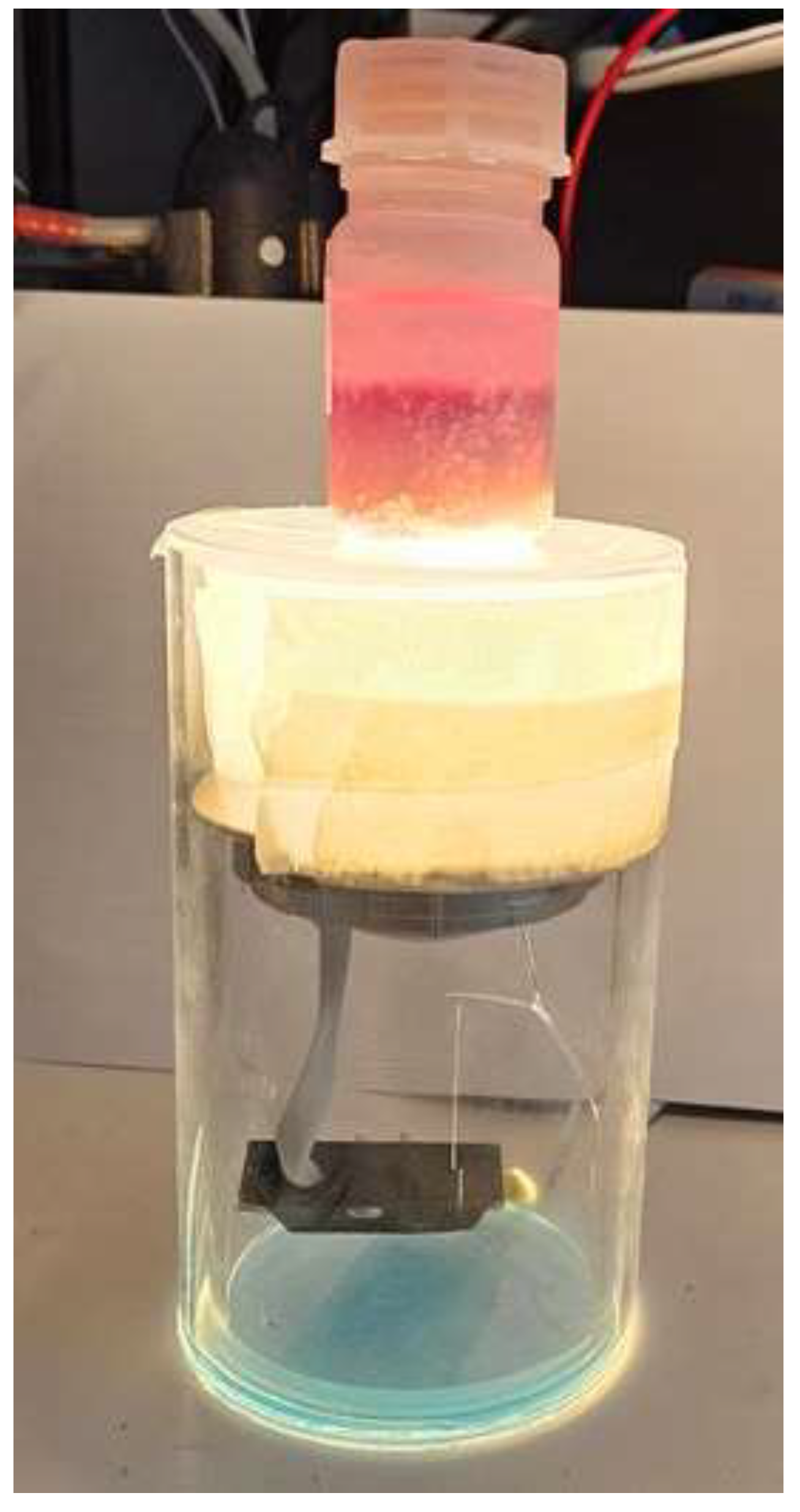
Figure 2.
Proposed reaction scheme for the elimination of alkyl radicals, which have been shortened by one carbon atom, from quaternary ammonium salts with trivalent europium.
Figure 2.
Proposed reaction scheme for the elimination of alkyl radicals, which have been shortened by one carbon atom, from quaternary ammonium salts with trivalent europium.
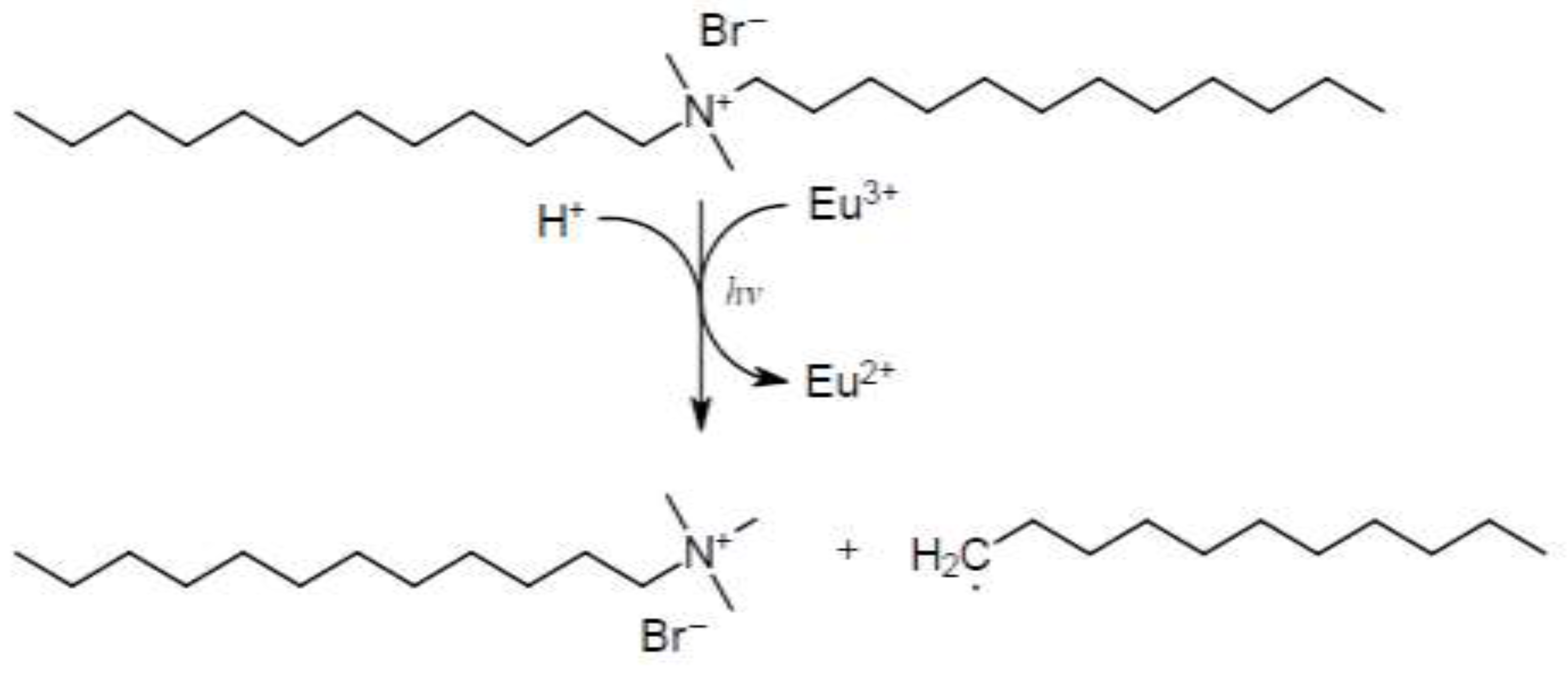
Figure 5.
Possible reaction scheme for the degradation of benzhydryl amine with trivalent europium.
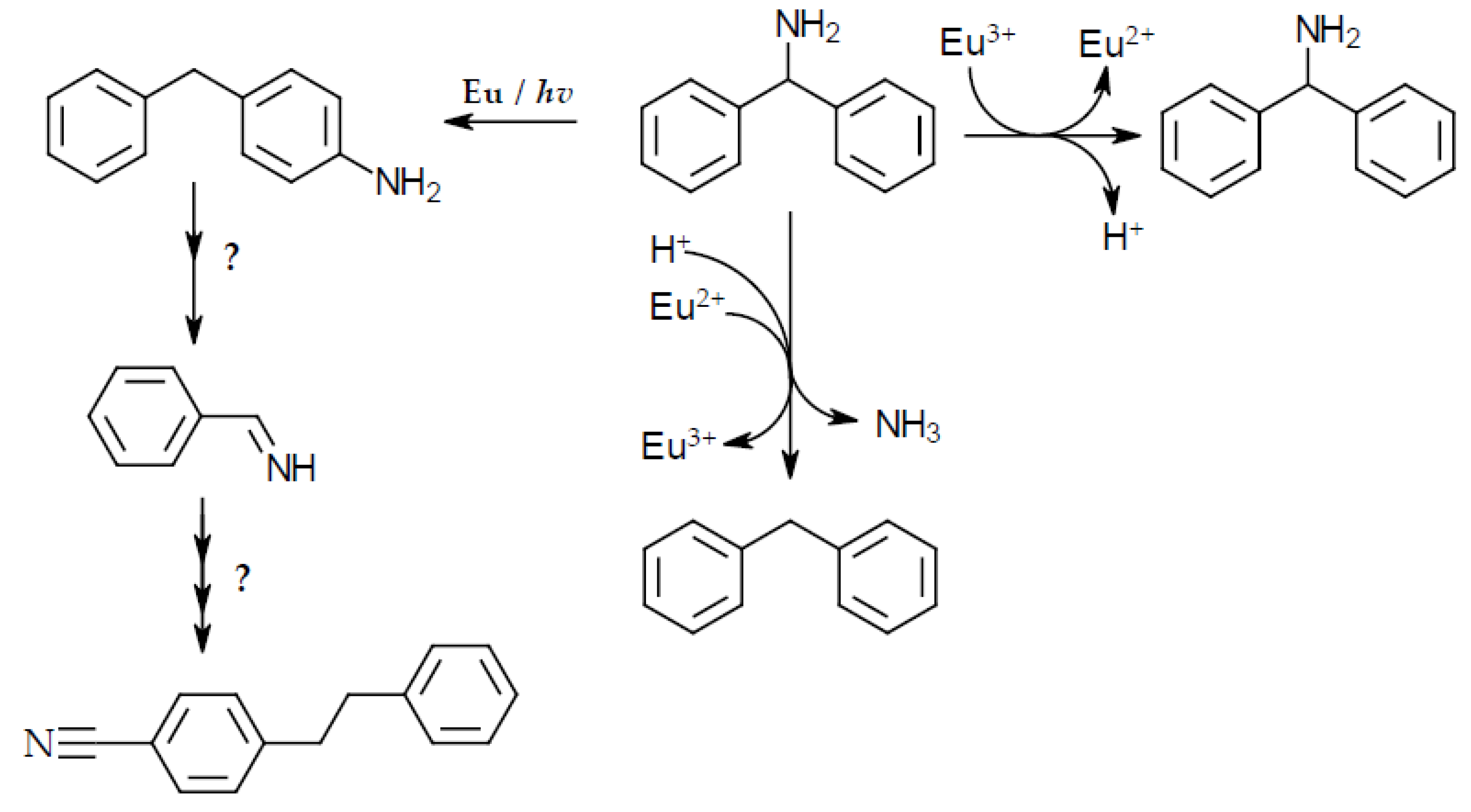
Table 1.
Overview of the environmental pollutants tested and the exact weights of the respective reaction sets
Table 1.
Overview of the environmental pollutants tested and the exact weights of the respective reaction sets
| Modell-pollutant | Concentration/amount | Solvent | Conductive salt | Eu(III)-chloride |
| Didodecyldimethylammonium1 | 0,5 g | Ethylene glycol7 | Tetraphenyl-phosphonium chloride9 (PPh4 Cl) |
2.5 mM/l |
| Toluene2 | 50 ml | Toluene2 | ||
| Pentanal3 | 2 ml | Pentanal2 | ||
| Benzhydryl amine4 | 2 ml | Ethylene glycol/ ethane-1,1,2, tricarboxylate8 | ||
| N-1,2-diphenylethyliso- propyl carbamate5 |
100 mg | Ethylene glycol | ||
| Chlorobenzene6 | 2 ml | Ethylene glycol |
1 CAS number: 3282-73-3, Sigma-Aldrich; 2 CAS number: 108-88-3, Sigma-Aldrich; 3 CAS number: 110-62-3, Sigma-Aldrich; 4 CAS number: 91-00-9, Sigma-Aldrich; 5 CAS number: 305860-10-0, Sigma-Aldrich; 6 CAS number: 108-90-7 Sigma-Aldrich; 7 CAS number: 107-21-1, Sigma-Aldrich; 8 CAS number: 922-84-9, Sigma-Aldrich; 9 CAS number: 2001-45-8, Sigma Aldrich.
Table 3.
Overview of the available toxicological data for the products resulting from the reaction of benzhydryl amines.
Table 3.
Overview of the available toxicological data for the products resulting from the reaction of benzhydryl amines.
| Substance | LD50 rat | Source |
| Benzhydryl amine | 400 mg/kg, oral | [35] |
| 4-methylbiphenyl | 2570 mg/kg, oral | [36] |
| Diphenylmethane | 2250 mg/kg, oral | [36] |
| Benzophenone imine | >2000 mg/kg, oral | [37] |
Table 4.
Table 4. Overview of the available toxicological data for the products resulting from the reaction of N-1,2-diphenylethylisopropyl carbamate
Table 4.
Table 4. Overview of the available toxicological data for the products resulting from the reaction of N-1,2-diphenylethylisopropyl carbamate
| Substance | LD50 rat | Source |
| N-1,2-diphenylethylisopropyl carbamate | No data available | |
| 1-dodecyl isocyanate | No data available | |
| 1-phenyl-2-propanol | 520 mg/kg mouse, i.p. | [38] |
| Diethyl bis(hydroxymethyl) malonate | No date available | |
| ethylbenzene | 3500 mg/kg rate, oral | [39] |
1 model substance for various carbamates that act as insecticides.
Disclaimer/Publisher’s Note: The statements, opinions and data contained in all publications are solely those of the individual author(s) and contributor(s) and not of MDPI and/or the editor(s). MDPI and/or the editor(s) disclaim responsibility for any injury to people or property resulting from any ideas, methods, instructions or products referred to in the content. |
© 2024 by the authors. Licensee MDPI, Basel, Switzerland. This article is an open access article distributed under the terms and conditions of the Creative Commons Attribution (CC BY) license (http://creativecommons.org/licenses/by/4.0/).
Copyright: This open access article is published under a Creative Commons CC BY 4.0 license, which permit the free download, distribution, and reuse, provided that the author and preprint are cited in any reuse.