

Submitted:
06 November 2024
Posted:
07 November 2024
You are already at the latest version
Abstract
Climate Change is among the greatest threats to health in the 21st century, requiring urgent scale-up of adaptation interventions. We aim to summarize adaptation interventions that were funded by the Belmont Forum and the European Union, the largest global funders of climate change and health research. A systematic search was conducted (updated February 2023) to identify articles on adaptation interventions for health within this funding network. Data extracted included study characteristics, types of interventions, and study outcomes. Results were synthesised narratively within the PRISMA-ScR guidelines. 197 articles were screened, with 37 reporting on adaptation interventions. The majority of interventions focused on the general population (n=17), with few studies examining high-risk populations such as pregnant women and children (n=4) or migrants (n=0). Targeted interventions were mostly aimed at behaviour change (n=8) and health system strengthening (n=6), while interventions with mitigation co-benefits such as nature-based solutions (n=1) or the built environment (n=0) were limited. The most studied climate change hazard was extreme heat (n=26). Several studies reported promising findings, principally on interventions to counter heat impacts in workers and pregnant women, and improving risk awareness in communities. These findings provide a platform on which to expand research and public health interventions towards safeguarding public health from the effects of climate change.
Keywords:
climate change
; adaptation interventions
; health policy
; scoping review
1. Introduction
Climate Change is increasingly recognised as the largest threat to the natural environment and human health in the 21st century. The Intergovernmental Panel on Climate Change provides incontrovertible evidence on the contribution of anthropogenic activities to climate change and provides insights into its wide-ranging effects[1]. Climate change not only contributes to incremental changes in global temperatures, and rising sea-levels, but also increases the frequency and intensity of extreme weather events, resulting in significant changes in disease patterns, and negative impacts on essential resources such as food and water.
The Lancet Countdown provides a comprehensive overview of the current and future effects of climate change on health and associated outcomes[2]. Their findings indicate an 86% increase in heat-related mortality among the elderly, since the baseline period of 1990-2000.Recent heatwaves in Europe are of particular concern; during the summer of 2022 alone, there were 61 672 heat-related deaths across Europe[3]. In addition, climate change increases the transmission risk for many infectious diseases, such as malaria, dengue, and vibriosis. The Countdown noted an increased potential for the transmission of dengue by up to 37% by 2050[2] Food security is also of profound importance, with the report noting an increase of 127 million people who experienced moderate to severe food insecurity in 2021 compared to the prior 40-year period.
Given the limited adoption of mitigation strategies, , adaptation interventions are crucial for minimizing the health impacts of climate change and enhancing resilience within communities. However, investment in adaptation measures with health benefits remains limited, with only $32 million of the Green Climate Fund used for health-related projects, and only 6% of overall adaptation financing mechanisms[4]. Understanding the effectiveness of adaptation interventions is vital for informing evidence-based policy and practice. The evidence base, however, remains limited and often fragmented, potentially contributing to a lack of investment. A recent scoping review identified only 33 articles on adaptation interventions for health, with significant gaps in climate-sensitive infectious diseases, and in the global south [5].
The Belmont Forum and European Union represent the largest global funders of climate change and health research, and have had a significant role in shaping the research agenda. Projects funded by these organisations have made great strides in understanding the impacts of climate change on health and adaptation interventions across a range of settings and topics. They have coordinated their efforts through programmes like the ENBEL project (ENhancing BELmont Research Action to support EU policy-making on climate change and health) [6].
We aim to review the literature on adaptation interventions within this funding network to establish the types of interventions implemented, target populations, measured outcomes, and the implications for policy and practice. This will serve to guide future research funding and research agendas in the climate and health nexus.
2. Materials and Methods
A literature review was conducted following the principles in the Preferred Reporting Items for Systematic Reviews extension for Scoping Reviews (PRISMA-ScR) guidelines [7]. A comprehensive search strategy was developed in conjunction with the funding bodies to identify relevant projects within the Belmont Forum, EU Horizon 2020 and ERA4CS programmes, and was updated until February 2023. Thereafter, Principal Investigators of the respective projects, were contacted to provide articles related to the project. Any missing information was requested through the same mechanism.
Two independent reviewers screened and identified articles for inclusion. Inclusion criteria encompassed articles that focused on adaptation interventions related to climate change and health and reported primary research or intervention evaluations. We included systematic and other review articles that summed the existing evidence on an intervention within an analytic framework. No language restrictions were applied.
Data were extracted from the selected articles using a standardized form (Supplementary File 1). Extracted information included study characteristics, types of interventions, and study outcomes. The study characteristics included project name, article title, location, population group, temporal focus (date or season of intervention, if relevant), research problem or main topic covered, and study objective. Intervention data extracted included a description of the intervention, evaluation methodologies, and the main results of the intervention, including any negative or unintended findings.
The extracted data were analysed thematically, focusing on the types of adaptation interventions, populations studied, outcomes assessed, and implications for policy and practice. Interventions were classified by intervention type and level of action (Figure 1).
The findings were synthesized according to the identified themes, and relevant quantitative data were summarized descriptively. As this study involved a review of published articles, no ethical approval was required.
Use of artificial intelligence: ChatGPT [8] (Large-Language Model) was used to compile an initial draft by summarising the contents of a lengthier report on which this article is based. All outputs have been reviewed and edited by the authors, for which we take full responsibility.
3. Results
The review includes articles published between October 2021 and February 2023, covering Belmont Forum (n=10), Horizon2020 (n=4) and ERAC4S (n=1) projects. A total of 194 published journal articles were identified for screening, of which 78 articles (40%) reported on adaptation interventions and were included for full text review (Figure 2). However, 41 were subsequently excluded as they did not assess health-adaptations. A total of 37 (19%) articles are included in this report. Of these, 20 articles reviewed potential interventions, and 17 articles reported directly on evidence for interventions implemented.
3.1. Timelines
The majority of articles were published between 2020 and 2021 (n=18). Between 2020 and 2023, there were approximately an equal number of papers on implemented interventions and intervention reviews. However, interestingly, reports of implemented interventions predominated from 2016 to 2019, possibly due to different focus areas of earlier funding calls.
3.2. Geographic Dstribution
Most of the studies were conducted in the Global North (Figure 3). All studies conducted in Asia and North America were on implemented interventions, compared to 60% of studies in Europe. In Africa, by contrast, the studies were primarily intervention reviews.
3.3. Methodologies
The most common study methods utilised in the reports were reviews and intervention evaluations (n=28), followed by surveys and interviews (n=8) and modelling analyses (n=6), with some studies employing mixed methodologies. One report was categorised as a cost-effectiveness study. Only 15 of 37 articles included a sub-group analysis or an inequity assessment.
3.4. Population Groups
The primary population group examined was the general population (n=17). Among the high-risk groups studied, notable attention was given to occupational settings (n=13). Other high-risk groups included urban residents, pregnant women and children, although research in these groups constituted less than 20% of the articles.
3.5. Exposure
The majority of reports focused on heat exposure (n=26), while 11 reports focused on other extreme conditions or weather events, with a similarly equal proportion of implemented and reviewed interventions.
3.6. Topic of Study
The most common topic studied was adaptation interventions to reduce the impact of heat exposure (n=15), followed by studies examining interventions to raise risk awareness (n=14). Warning systems were predominantly covered in intervention reviews (n=5). On the other hand, decision-making tools (n=2) and disaster reduction interventions (n=2) were primarily assessed in intervention studies using empirical data.
3.7. Intervention Framework
We categorised the 37 adaptation studies by the six intervention components and six levels of action described in Supplementary File 2. Some articles had multiple intervention components and levels of action. Through the thematic review, the specific intervention component breakdown was as follows: behaviour change and awareness (n=8), health systems and new health services (n=5), poverty reduction and equity (n=5), and nature-based solutions (n=1). No articles reported on an intervention component within the Built Environment.
Most interventions took place at the level of the community and workplace (n=10). Four interventions were done at the facility level, three at the individual or household level, and one at district or provincial level. No interventions were performed at the national or international level.
Figure 4 provides a visual summary of the articles' characteristics based on population group and adaptation topic. Additional figures on project name, year of publication, type of exposure, and methodology are available in Supplementary File 2.
3.8. Project Summaries
The HEAT-SHIELD project contributed the most studies (n=15), while the Micro-Poll and CCEHN projects each contributed the least to this review, with only one study each. All of the studies in the BuildERs, CCEHN, ClimAPP, Micro-Poll, and PREP presented findings of implemented interventions. However, the CHAMNHA and S&CC projects, by contrast, solely included intervention reviews or frameworks. The remaining projects had approximately an even number of reports on implemented interventions and reviews
Table 1 summarises the adaptation interventions studied, grouped by project. The BuildERS project provided evidence to support the use of novel technologies in disaster response efforts, where artificial intelligence and mobile technology showed significant benefit despite potential limitations of their use[9,10]. The CCEHN project examined the development of early warning systems and concluded that an innovative, multisectoral, local systems approach to co-production can foster long-term engagement and nurture a culture of preparedness to achieve a real reduction of risks[11]. The CHAMNHA project provided insights into adaptation interventions targeted at high-risk populations: pregnant women, newborns and children. In support of the findings of CCEHN, they emphasised the benefits of co-production and interventions suitable for the local context, where low-cost health education was at the forefront of the studied interventions[12,13,14,15]. ClimApp presents a novel heat early-warning system that provides a personalised risk profile as well as targeted interventions through a smartphone application, which was well received by testing groups[16,17]. This supports the findings of the BuildERS project on the benefit of novel technologies in adaptation interventions. The EXHAUSTION project focused on air-conditioning as an intervention in the prevention of heat and air-pollution-related disease, confirming its effectiveness in the reduction of mortality[18]. Models were also evaluated to provide real-time disaster response parameters in air pollution linked to wildfires[19] with good correlation between predicted and actual measurements. HEAT-SHIELD contributed significantly to the literature on early warning systems and occupational heat risks and interventions [20,21,22,23,24,25,26,27,28,29,30,31,32,33,34], for example, they provided an assessment of the effects of work capacity on rising heat indices, finding that Universal Thermal Climate Index(UTCI) and Wet Globe Bulb Temperature (WGBT) were best able to predict work capacity in outdoor environments, with an exponential decrease in work-capacity with rising temperatures[35]. The S&CC project assessed the effect of climate change on Schistosomiasis and found multiple effective interventions to reduce the burden of disease through a one-health approach. Interventions ranged from AI-assisted field-identification of the helminth to the modification of the host environment through invasive species reduction and introduction of biological predators, as well as community-based awareness and mass drug administration campaigns [36,37,38,39,40,41]. The PREP project found simple rest, shade and water provision interventions most effective in reducing heat exposure in sugarcane field workers—a population with a disproportionately high burden of chronic kidney disease of unknown origin with manual labour in hot conditions likely a significant contributing factor[42,43,44,45]. Importantly, this study noted increased productivity with their interventions, highlighting important co-benefits. Micro-Poll examined the importance of pollinators in food security in rural populations and emphasised the importance of ecosystem management in overall adaptation to climate change for smallholder farmers[46].
4. Discussion
The overall body of work examined in this review is substantial in its scope, although limited in its depth. This review highlights multiple promising interventions that can be implemented on national scales, across multiple different exposure-outcome pathways. However, research on adaptation interventions constituted a minority of the literature published by EU and Belmont funded projects , highlighting a gap in current research priorities within the field.
4.1. Strengths and Weaknesses of the Adaptation Interventions
Geographically, the studies cover a wide range of population groups from Asia, Africa, America, and Europe, however, the Global South remains relatively underrepresented. Cross-comparisons between different geographic and socioeconomic settings would provide valuable insights, but the included studies seldom covered multiple centres, and diverse climate hazards. However, the research sites involved in the projects in Africa, Asia, and South America may serve as platforms for future collaborative research in these underrepresented regions and reduce the bias towards the Global North [47].
The research projects reviewed drew upon a broad range of disciplines, including public health, social sciences, natural sciences, data science and computer science, with increasing representation of artificial intelligence techniques—a component proving to be increasingly important in this field. Health economics methods were applied in only one project [23] to assess the relative costs and benefits of interventions, highlighting the need for future research in this field. In most studies, mixed-methods research underscores the importance of close interdisciplinary collaboration.
The interventions focused largely on behaviour change and health-systems strengthening; mainly targeting the community or workplace. This focus neglected important interventions in nature-based solutions and adaptations to the built environment, which could be an important priority in addressing climate change through combined adaptation-mitigation interventions. Despite this, the MicroPoll and S&CC projects showed promising results in assessing a package of interventions aiming to adapt the natural environment to improve human health. In addition, the BuildERS, EXHAUSTION, and HEAT-SHIELD projects focus on increasing societal resilience by strengthening social capital, risk awareness, and preparedness of vulnerable segments of society. This highlights the importance of embracing many, diverse intervention options in the climate and health nexus. The wide range of exposures and settings across studies within this review has limited overall coherence. The lack of focused attention may hinder researchers, funding agencies, and policymakers to discern priorities. However, given the field's ongoing development, the projects will prove to be an essential step in identifying such priorities and providing a base to launch future research.
Extreme heat was the most common climate change hazard addressed by the projects, illustrating this exposure as an important priority of the field, but potentially at the detriment to other important exposures such as air pollution and other extreme weather events. Despite the focus on the general population, the findings provide a broader understanding of which sub-groups are more vulnerable to climate change impacts, such as pregnant women and children and occupational workers. This will prove helpful in designing and prioritising cost-effective interventions. Future research would benefit from addressing a broader range of climate exposures and including diverse populations, particularly vulnerable and displaced groups.
4.2. Future Opportunities
This report identifies several limitations in the existing research on climate change adaptation that has implications for future policy and practice for funders, research institutions, and policymakers. Firstly, the relatively limited number of studies evaluating adaptation interventions can be attributed to many projects primarily focusing on analysing descriptive data or performing impact assessments. Only a fraction (n=17) of the articles reported conducting primary interventional research, where interventions were designed, implemented, and evaluated. In most cases, the projects primarily assessed the impact of climate change on health outcomes, with interventional research as a minor component. Funding calls should consider prioritising primary interventional research as a core component of future projects. The field should explore combined adaptation-mitigation interventions, with a move towards large-scale intervention studies with robust methodologies.
Overlapping thematic areas between the projects show the potential for improved collaboration. For instance, despite several of the Belmont and Horizons projects including a focus on Early Warning Systems in their study aims, the ClimApp project, which had developed such an intervention, was not utilised in other projects. We did not observe cross-references to other tools or experiences across the projects. This may be due to the projects being implemented in parallel and not in sequence. Research institutions and funders should prioritise collaboration through multi-disciplinary consortiums.
The reviewed articles often did not address the pathways or mechanisms through which interventions operate. There was a stronger focus on interventions and outcomes, with less attention given to how interventions can be co-produced and implemented in collaboration with relevant stakeholders. With the urgent need to upscale climate change adaptation, understanding the most effective means to implement broad and diverse interventions can be just as important as the interventions themselves, and can be conducted through process evaluations. Although few publications reported on beneficial interactions among policymakers, researchers, and the public, several studies utilized similar social science techniques which prioritized community engagement and co-design activities, which were central to intervention design and delivery. This presents an opportunity to ensure the suitability and applicability of interventions and challenges by increasing the time to design and deliver an intervention. Optimising these trade-offs will be a priority in future studies, but the approach in the included studies provides a roadmap to achieve this. Future research efforts should explore the roles and interactions between different stakeholders and sectors, investigating strategies to facilitate action at various levels and foster cooperation across multiple societal actors in reducing the impacts of climate change on health.
4.3. Role of the Health Sector
Lastly, the results highlight the crucial role of the health sector in the net-zero transition and in enhancing overall societal resilience. The health sector can contribute to carbon-emissions reduction, support adaptation efforts, and raise public awareness about climate change mitigation and adaptation [48,49]. Focusing on the health co-benefits and trade-offs of mitigation and adaptation policies is necessary to achieve this. Many climate mitigation and adaptation interventions positively affect human health (e.g., plant-based diets, active commuting, nature-based solutions), and future research should aim to understand these interactions better. Additionally, identifying supporting policies, as well as barriers and opportunities for implementation, is essential. With more robust evidence and supportive policies, the health sector can play an increasingly significant role in the transition to net-zero societies in the years to come.
4.4. Limitations
This review only examines the work conducted within the EU and Belmont Forum. It may, therefore, be limited in its applicability to the entire field where other funding groups contribute research. Secondly, the projects reviewed were at different stages of the project lifecycle, making direct comparisons across projects challenging. Many projects were still in the final stages of data collection and analysis, and it is expected that additional publications may extend the research outputs of the projects. Delays caused by the COVID-19 pandemic further impacted the projects' timelines.
5. Conclusions
This review provides a broad understanding of the scope and scale of research on adaptation interventions for climate change and health. While this review identifies critical shortcomings, it highlights opportunities for further research in key populations across underrepresented regions. The benefits of collaboration and cross-cutting within a growing and evolving field cannot be overstated, with collaborative networks providing an important platform to coordinate research and pursue common priorities. By addressing these gaps, fostering interdisciplinary collaborations, and involving diverse stakeholders, we can develop a more comprehensive understanding of effective adaptation strategies and contribute to developing evidence-based policies and practices that equitably enhance human health resilience in the face of Climate Change.
Supplementary Materials
The following supporting information can be downloaded at the website of this paper posted on Preprints.org, Supplementary File 1: Data Extraction Tool, Supplementary File 2: Graphs illustrating project classification
Author Contributions
NB, KM, JS, SS, DL, CP—writing and editing, IMO, MFC—conceptualisation, review and editing.
Funding
This project has received funding from the European Union’s Horizon 2020 research and innovation programme under Grant Agreement No 101003966
Institutional Review Board Statement
Not applicable. This study was a review of publicly available information, and did not require review or approval by an ethics board.
Informed Consent Statement
Not Applicable
Data Availability Statement
This research was conducted on publicly available information, however full extraction tables are available on request.
Acknowledgments
The authors gratefully acknowledge the contributions of members of the ENBEL consortium in conducting this research, and assisting with the collation of the results.
Conflicts of Interest
MFC, DL, CP and NB hold investments in the fossil fuel industry through their pension funds. The University of the Witwatersrand holds investments in the fossil fuel industry through its endowments and other financial reserves.
References
- IPCC Climate Change 2023: Synthesis Report. Contribution of Working Groups I, II and III to the Sixth Assessment Report of the Intergovernmental Panel on Climate Change. Geneva, Switzerland: IPCC; 2023 2023.
- Romanello, M.; Napoli, C.D.; Drummond, P.; Green, C.; Kennard, H.; Lampard, P. , et al. The 2022 report of the Lancet Countdown on health and climate change: health at the mercy of fossil fuels. The Lancet. 2022, 400, 1619–1654. [Google Scholar] [CrossRef] [PubMed]
- Ballester, J.; Quijal-Zamorano, M.; Méndez Turrubiates, R.F.; Pegenaute, F.; Herrmann, F.R.; Robine, J.M. , et al. Heat-related mortality in Europe during the summer of 2022. Nature Medicine 2023, 29, 7. [Google Scholar] [CrossRef] [PubMed]
- Green Climate, F. Bridging the Climate-Health Gap. 2024.
- Luyten, A.; Winkler, M.S.; Ammann, P.; Dietler, D. Health impact studies of climate change adaptation and mitigation measures − A scoping review. The Journal of Climate Change and Health. 1001. [Google Scholar]
- ENBEL. ENBEL: Enhancing Belmont Research Action to support EU policy making on climate change and health 2024 [Available from: https://www.enbel-project.eu/.
- Page, M.J.; McKenzie, J.E.; Bossuyt, P.M.; Boutron, I.; Hoffmann, T.C.; Mulrow, C.D. , et al. The PRISMA 2020 statement: an updated guideline for reporting systematic reviews. BMJ.
- OpenAI ChatGPT: Optimizing Language Models for Dialogue. 2024.
- Berawi, M.A.; Leviakangas, P.; Muhammad, F.; Sari, M.; Gunawan Yatmo, Y.A. , et al. Optimizing Search and Rescue Personnel Allocation in Disaster Emergency Response using Fuzzy Logic. International Journal of Technology. 2019, 10, 1416–1426. [Google Scholar] [CrossRef]
- Latvakoski, J.; Oörni, R.; Lusikka, T.; Keränen, J. Evaluation of emerging technological opportunities for improving risk awareness and resilience of vulnerable people in disasters. International Journal of Disaster Risk Reduction. 1031. [Google Scholar]
- Peters, L.E.R.; Clark-Ginsberg, A.; McCaul, B.; Cáceres, G.; Nuñez, A.L.; Balagna, J.; et al. Informality, violence, and disaster risks: Coproducing inclusive early warning and response systems in urban informal settlements in Honduras. Frontiers in Climate. 2022. [CrossRef]
- Nakstad, B.; Filippi, V.; Lusambili, A.; Roos, N.; Scorgie, F.; Chersich, M.F.; et al. How Climate Change May Threaten Progress in Neonatal Health in the African Region. Neonatology.
- Roos, N.; Kovats, S.; Hajat, S.; Filippi, V.; Chersich, M.; Luchters, S. , et al. Maternal and newborn health risks of climate change: A call for awareness and global action. Acta Obstet Gynecol Scand.
- Chersich, M.F.; Pham, M.D.; Areal, A.; Haghighi, M.M.; Manyuchi, A.; Swift, C.P. , et al. Associations between high temperatures in pregnancy and risk of preterm birth, low birth weight, and stillbirths: systematic review and meta-analysis. BMJ. 2020;371:m3811.
- Chersich, M.F.; Scorgie, F.; Filippi, V.; Luchters, S. Increasing Global Temperatures Threaten Gains in Maternal and Newborn Health in Africa: A Review of Impacts and an Adaptation Framework. International Journal of Gynecology & Obstetrics.
- Folkerts, M.A.; Boshuizen, A.W.; Gosselink, G.; Gerrett, N.; Daanen, H.A.M.; Gao, C. , et al. Predicted and user perceived heat strain using the ClimApp mobile tool for individualized alert and advice. Climate Risk Management.
- Kingma, B.R.M.; Steenhoff, H.; Toftum, J.; Daanen, H.A.M.; Folkerts, M.A.; Gerrett, N. , et al. ClimApp—Integrating Personal Factors with Weather Forecasts for Individualised Warning and Guidance on Thermal Stress. International Journal of Environmental Research and Public Health. 1131. [Google Scholar]
- Sera, F.; Hashizume, M.; Honda, Y.; Lavigne, E.; Schwartz, J.; Zanobetti, A. , et al. Air Conditioning and Heat-related Mortality. Epidemiology. 2020, 31, 779–787. [Google Scholar] [CrossRef]
- Kukkonen, J.; Nikmo, J.; Riikonen, K.; Westerholm, I.; Ilvessalo, P.; Bergman, T. , et al. An Emergency Response Model for the Formation and Dispersion of Plumes Originating from Major Fires (BUOYANT v4.20). Geoscientific Model Development. 2022;15:4027-54.
- Morris, N.B.; Piil, J.F.; Morabito, M.; Messeri, A.; Levi, M.; Ioannou, L.G. , et al. The HEAT-SHIELD Project - Perspectives from an Inter-sectoral Approach to Occupational Heat Stress. Journal of Science and Medicine in Sport. 2021, 24, 747–755. [Google Scholar] [CrossRef]
- Piil, J.F.; Kingma, B.; Morris, N.B.; Christiansen, L.; Ioannou, L.G.; Flouris, A.D. , et al. Proposed Framework for Forecasting Heat-Effects on Motor-Cognitive Performance in the Summer Olympics. Temperature. 2021, 8, 262–283. [Google Scholar] [CrossRef]
- Morris, N.B.; Jay, O.; Flouris, A.D.; Casanueva, A.; Gao, C.; Foster, J. , et al. Sustainable Solutions to Mitigate Occupational Heat Strain: An Umbrella Review of Physiological Effects and Global Health Perspectives. Environmental Health. 2020, 19, 95. [Google Scholar] [CrossRef]
- Morabito, M.; Messeri, A.; Crisci, A.; Bao, J.; Ma, R.; Orlandini, S. , et al. Heat-related productivity loss: benefits derived by working in the shade or work-time shifting. International Journal of Productivity and Performance Management. 2020, 70, 507–525. [Google Scholar] [CrossRef]
- Gerrett, N.; Kingma, B.R.M.; Sluijter, R.; Daanen, H.A.M. Ambient Conditions Prior to Tokyo 2020 Olympic and Paralympic Games: Considerations for Acclimation or Acclimatization Strategies. Frontiers in Physiology. 2019, 10, 414. [Google Scholar] [CrossRef]
- Ioannou, L.G.; Mantzios, K.; Tsoutsoubi, L.; Nintou, E.; Vliora, M.; Gkiata, P. , et al. Occupational Heat Stress: Multi-Country Observations and Interventions. International Journal of Environmental Research and Public Health. 2021, 18, 6303. [Google Scholar] [CrossRef] [PubMed]
- Pogačar, T.; Žnidaršič,, Z. ; Kajfež Bogataj, L.; Črepinšek, Z. Steps Towards Comprehensive Heat Communication in the Frame of a Heat Health Warning System in Slovenia. International Journal of Environmental Research and Public Health. 2020, 17, 5829. [Google Scholar] [CrossRef] [PubMed]
- Casanueva, A.; Kotlarski, S.; Fischer, A.M.; Flouris, A.D.; Kjellstrom, T.; Lemke, B. , et al. Escalating Environmental Summer Heat Exposure—A Future Threat for the European Workforce. Regional Environmental Change.
- Casanueva, A.; Burgstall, A.; Kotlarski, S.; Messeri, A.; Morabito, M.; Flouris, A.D. , et al. Overview of Existing Heat-Health Warning Systems in Europe. International Journal of Environmental Research and Public Health. 2019, 16, 2657. [Google Scholar] [CrossRef] [PubMed]
- Masanotti, G.; Bartalini, M.; Fattorini, A.; Cerrano, A.; Messeri, A.; Morabito, M. , et al. Work in Harsh Hot Environment: Risk Evaluation on Thermal Stress in a Farm during Green Pruning Activity. Biomedical Journal of Scientific & Technical Research.
- Gao, C.; Kuklane, K.; Östergren, P.-O.; Kjellstrom, T. Occupational Heat Stress Assessment and Protective Strategies in the Context of Climate Change. International Journal of Biometeorology. 2018, 62, 359–371. [Google Scholar] [CrossRef]
- Andrews, O.; Le Quéré,, C. ; Kjellstrom, T.; Lemke, B.; Haines, A. Implications for Workability and Survivability in Populations Exposed to Extreme Heat Under Climate Change: A Modelling Study. The Lancet Planetary Health. 2018, 2, e540–e7. [Google Scholar] [CrossRef]
- Piil, J.F.; Lundbye-Jensen, J.; Christiansen, L.; Ioannou, L.; Tsoutsoubi, L.; Dallas, C.N. , et al. High prevalence of hypohydration in occupations with heat stress—Perspectives for performance in combined cognitive and motor tasks. PLoS ONE. 2018, 13, e0205321. [Google Scholar] [CrossRef]
- Foster, J.; Hodder, S.G.; Goodwin, J.; Havenith, G. Occupational Heat Stress and Practical Cooling Solutions for Healthcare and Industry Workers During the COVID-19 Pandemic. Annals of Work Exposures and Health. 2020, 64, 915–922. [Google Scholar] [CrossRef]
- Fojtlín, M.; Psikuta, A.; Fišer, J.; Pokorný, J.; Toma, R.; Annaheim, S. , et al. Thermal Model of an Unconditioned, Heated and Ventilated Seat to Predict Human Thermo-physiological Response and Local Thermal Sensation. Building and Environment.
- Foster, J.; Smallcombe, J.W.; Hodder, S.; Jay, O.; Flouris, A.D.; Nybo, L. , et al. Quantifying the Impact of Heat on Human Physical Work Capacity Part III: The Impact of Solar Radiation Varies with Air Temperature, Humidity, and Clothing Coverage. International Journal of Biometeorology. 2022, 66, 175–188. [Google Scholar] [CrossRef]
- Lund, A.; Sam, M.M.; Sy, A.B.; Sow, O.W.; Ali, S.; Sokolow, S.H. , et al. Unavoidable Risks: Local Perspectives on Water Contact Behavior and Implications for Schistosomiasis Control in an Agricultural Region of Northern Senegal. The American Journal of Tropical Medicine and Hygiene. 2019, 101, 1–11. [Google Scholar] [CrossRef]
- Lund, A.J.; Rehkopf, D.H.; Sokolow, S.H.; Sam, M.M.; Jouanard, N.; Schacht, A.-M. , et al. Land use impacts on parasitic infection: a cross-sectional epidemiological study on the role of irrigated agriculture in schistosome infection in a dammed landscape. Infectious Diseases of Poverty. 2021, 10, 35. [Google Scholar] [CrossRef]
- Tallam, K.; Liu, Z.Y.-C.; Chamberlin, A.J.; Jones, I.J.; Shome, P.; Riveau, G. , et al. Identification of Snails and Schistosoma of Medical Importance via Convolutional Neural Networks: A Proof-of-Concept Application for Human Schistosomiasis. Frontiers in Public Health. 6428. [Google Scholar]
- Lund, A.J.; Lopez-Carr, D.; Sokolow, S.H.; Rohr, J.R.; De Leo, G.A. Agricultural Innovations to Reduce the Health Impacts of Dams. Sustainability. 2021, 13, 1869. [Google Scholar] [CrossRef]
- Hopkins, S.R.; Lafferty, K.D.; Wood, C.L.; Olson, S.H.; Buck, J.C.; De Leo, G.A. , et al. Evidence gaps and diversity among potential win-win solutions for conservation and human infectious disease control. Lancet Planet Health. 2022, 6, e694–e705. [Google Scholar] [CrossRef] [PubMed]
- Ozretich, R.W.; Wood, C.L.; Allan, F.; Koumi, A.R.; Norman, R.; Brierley, A.S. , et al. The Potential for Aquaculture to Reduce Poverty and Control Schistosomiasis in Côte d’Ivoire (Ivory Coast) during an Era of Climate Change: A Systematic Review. Reviews in Fisheries Science & Aquaculture. 2022, 30, 467–497. [Google Scholar]
- Bodin, T.; García-Trabanino, R.; Weiss, I.; Jarquín, E.; Glaser, J.; Jakobsson, K. , et al. Intervention to reduce heat stress and improve efficiency among sugarcane workers in El Salvador: Phase 1. Occupational and Environmental Medicine. 2016, 73, 409–416. [Google Scholar] [CrossRef]
- Wegman, D.H.; Apelqvist, J.; Bottai, M.; Ekström, U.; García-Trabanino, R.; Glaser, J. , et al. Intervention to diminish dehydration and kidney damage among sugarcane workers. Scandinavian Journal of Work, Environment & Health. 2018, 44, 16–24. [Google Scholar]
- Hansson, E.; Glaser, J.; Weiss, I.; Ekström, U.; Apelqvist, J.; Hogstedt, C. , et al. Workload and cross-harvest kidney injury in a Nicaraguan sugarcane worker cohort. Occupational and Environmental Medicine. 2019, 76, 818–826. [Google Scholar] [CrossRef]
- Glaser, J.; Hansson, E.; Weiss, I.; Wesseling, C.; Jakobsson, K.; Ekström, U. , et al. Preventing kidney injury among sugarcane workers: promising evidence from enhanced workplace interventions. Occupational and Environmental Medicine. 2020, 77, 527–534. [Google Scholar] [CrossRef]
- Timberlake, T.P.; Cirtwill, A.R.; Baral, S.C.; Bhusal, D.R.; Devkota, K.; Harris-Fry, H.A. , et al. A network approach for managing ecosystem services and improving food and nutrition security on smallholder farms. People and Nature. 2022, 4, 563–575. [Google Scholar] [CrossRef]
- Bartlett, V.L.; Doernberg, H.; Mooghali, M.; Gupta, R.; Wallach, J.D.; Nyhan, K. , et al. Published research on the human health implications of climate change between 2012 and 2021: cross sectional study. BMJ Medicine. 2024, 3, e000627. [Google Scholar] [CrossRef]
- Chersich, M.F.; Wright, C.Y. Climate change adaptation in South Africa: a case study on the role of the health sector. Globalization and Health. 2019; 15. [Google Scholar]
- Or, Z.; Seppänen, A.-V. The role of the health sector in tackling climate change: A narrative review. Health Policy. 2024; 143, 105053. [Google Scholar]
Figure 1.
Framework for classifying interventions.

Figure 2.
PRISMA Flowchart.
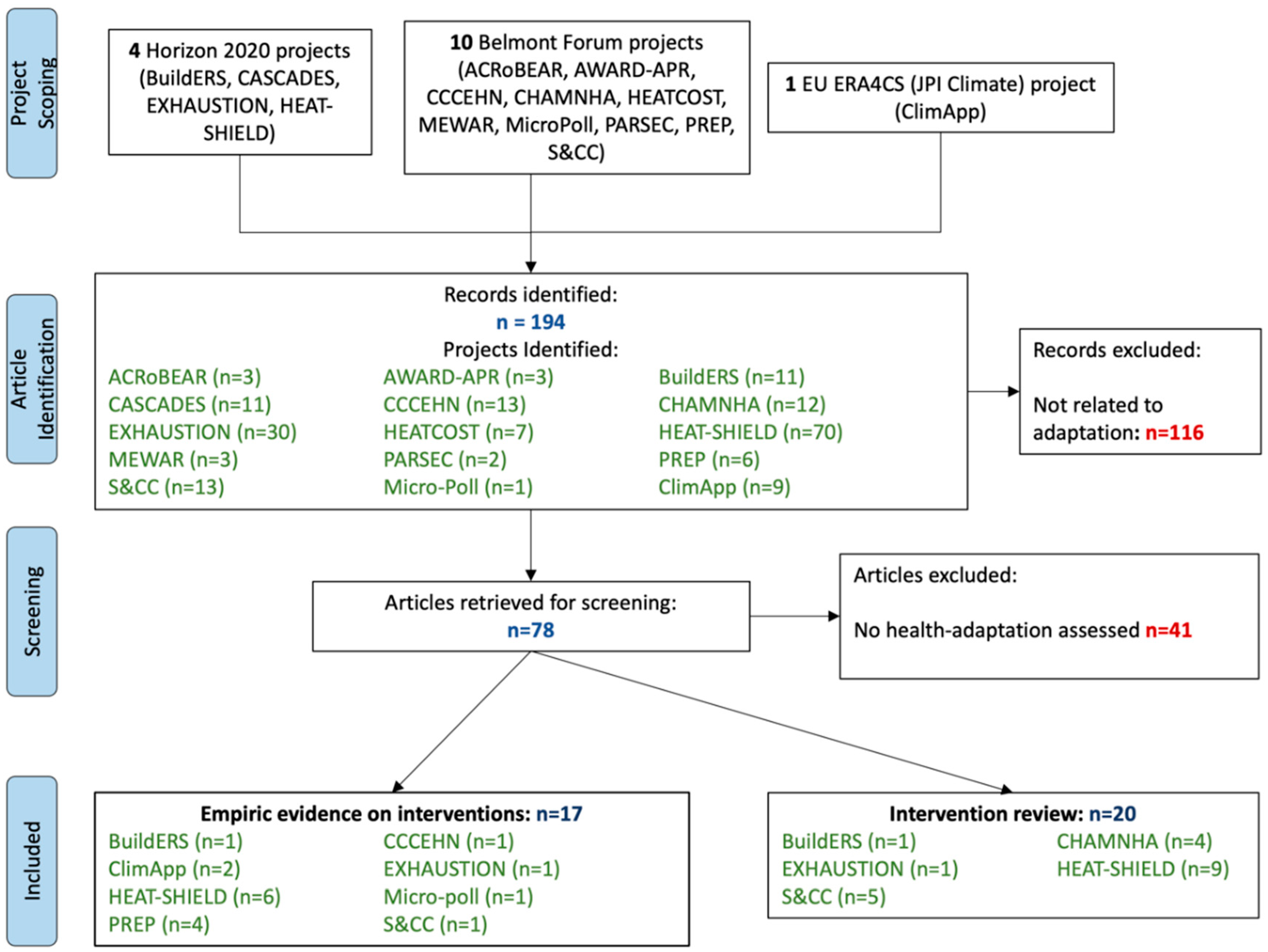
Figure 3.
Map of distribution of projects by country.
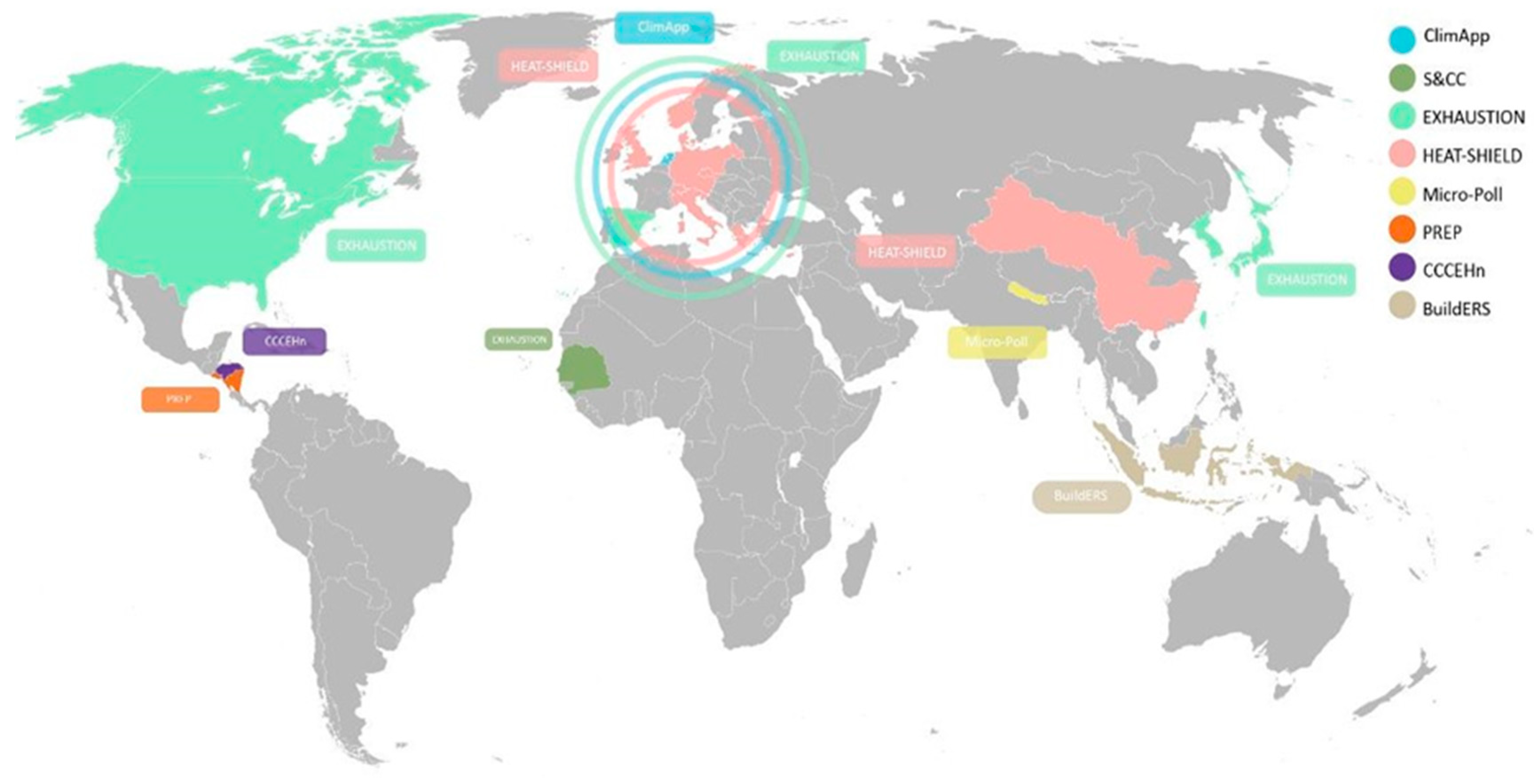
Figure 4.
Distribution of Study by Adaptation Topic and Population Group.
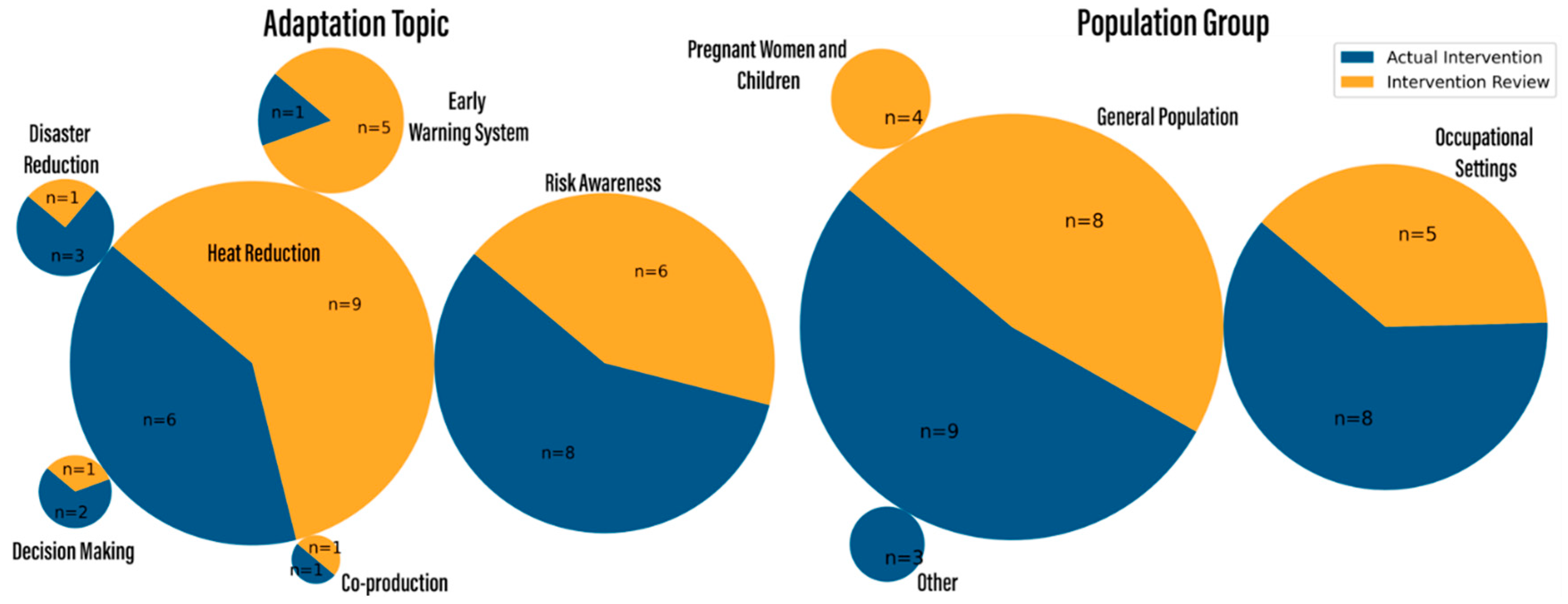

Table 1.
Summary of adaptations studied by project.
| Project Name | Aims | Adaption Studied |
|---|---|---|
| BuildERS [9,10] |
To strengthen the social capital, risk awareness, and preparedness of the vulnerable segments of societies. | Application of machine learning and data science methods, to shorten response times, optimize resource allocation, and improve risk awareness and resilience of vulnerable populations during disasters. |
| CCCEHN [11] | To identify the cascading risks of climate change in countries outside of Europe by supporting the design of a coherent European policy framework to address these risks. | Local systems developed by the community in complementing state systems and fostering long-term engagement and preparedness by risk awareness, collaborating with communities and local stakeholders, coproducing alert dissemination protocols, and developing plans to enhance existing response and contingency planning. |
| CHAMNHA [12,13,14,15] | To reduce the impacts of heat on birth and neonatal outcomes via intervention studies among pregnant women specifically aimed at reducing heat exposure in outdoor work during late pregnancy. | Information campaigns and behaviour change interventions that target pregnant women, female family members, community leaders, and other stakeholders to support self-care interventions during pregnancy. Investments in Africa in infrastructure, services, and human resources for maternal health for interventions such as Early Warning Systems. |
| ClimApp [16,17] | To combine weather forecast information with end-user data to provide heat and cold stress warnings. To facilitate the development of a decision support system to provide timely relevant guidelines to improve thermal resilience when adverse environmental conditions are expected. | The project assessed the usability of an app and conducted field validation studies, targeting specific groups such as the elderly and young children. This information can be used by individuals as guidance on how best to adapt their behaviour during periods of high temperatures to reduce any potential health risks associated with exposure. |
| EXHAUSTION [18,19] | To establish exposure-response functions for cardiopulmonary health outcomes of extreme temperatures and to assess potential interactive effects of air pollutants and project the future corresponding health burden for Europe. | Adaptation measures to reduce exposure to air pollution and heat stress, focusing on air conditioning as an effective heat adaptation strategy. The project also developed models for the formation and dispersion of plumes from major fires and evaluated approaches to monitoring heat-related deaths during heatwaves. |
| HEAT-SHIELD [20,21,22,23,24,25,26,27,28,29,30,31,32,33,34,35] | To develop correction equations to quantify outdoor work capacity and evaluate the performance implications of face mask use in hot environments. | The study quantified the impact of heat on human physical work capacity through existing heat indices and assessed the effects of prolonged face mask use in the heat on dyspnoea and motor cognitive performance. |
| Micro-Poll [46] | To quantify the nutritional value of an ecosystem and provide a framework to predict the effects of environmental change on human nutrition. | This project focused on food security and smallholder farms, assessing the nutritional value of ecosystems and the effects of environmental change on human nutrition. |
| PREP [42,43,44,45] | To assess preventive care and awareness around Chronic Kidney Disease of Undetermined Cause in outdoor workers who are highly vulnerable because of exposure to heat and dehydration. | The study reviews Adelante Initiative implementation outcomes, which comprise a package of services including water supply supplementation, rest in the shade, and improved ergonomics in work settings of sugarcane workers and evaluates their effectiveness in improving water consumption, productivity, and worker well-being. |
| S&CC [36,37,38,39,40,41] | To investigate the potential for aquaculture to reduce poverty and control Schistosomiasis in Côte d’Ivoire (Ivory Coast) during an era of climate change. | The project evaluated the control of schistosomiasis through the aquaculture of freshwater prawns, removing vegetation which aided vector distribution, using artificial intelligence techniques to identify snails and parasites, community awareness and intervention campaigns and co-benefit solutions such as altering land-use and irrigation practices. |
Disclaimer/Publisher’s Note: The statements, opinions and data contained in all publications are solely those of the individual author(s) and contributor(s) and not of MDPI and/or the editor(s). MDPI and/or the editor(s) disclaim responsibility for any injury to people or property resulting from any ideas, methods, instructions or products referred to in the content. |
© 2024 by the authors. Licensee MDPI, Basel, Switzerland. This article is an open access article distributed under the terms and conditions of the Creative Commons Attribution (CC BY) license (http://creativecommons.org/licenses/by/4.0/).
Copyright: This open access article is published under a Creative Commons CC BY 4.0 license, which permit the free download, distribution, and reuse, provided that the author and preprint are cited in any reuse.


