
Submitted:
05 November 2024
Posted:
07 November 2024
You are already at the latest version
Abstract
Several copolymer hydrogels were prepared from free radical copolymerization of 2-hydroxyethyl methacrylate (HEMA) with itaconic acid (IA). A series of Poly(2-hydroxyethyl methacrylate-co-itaconic acid) hydrogel, poly(HEMA-co-IA) were prepared at different feed monomer ratio using ammonium persulfate (APS) initiators in water at 70°C. The phytodrug 2,4-dichlorophenoxy acetic acid (2,4-D) were grafted to Poly(HEMA-co-IA) by esterification reaction. In addition, swelling behavior (Wt%) was studied at different pH. The hydrolysis of Poly(HEMA-co-IA)-2,4-D showed that the release of the bioactive compounds in aqueous phase, using Liquid-phase polymer-based retention (LPR) ultrafiltration system is dependent on the hydrophilic character as well as on pH value. The acid-hydrolysis of the herbicide from the conjugates follows a first order kinetics, showing higher kinetic constants as the pH increases. The base-catalyzed hydrolysis reaction of the herbicide follows a zero order kinetic, where the basic medium acts as a catalyst accelerating the release rate of the herbicide, showing higher kinetic constants as the pH increases. The differences in the release rates found for the hydrogel-herbicide at different pH can be correlated with the difference in their swelling capacity, where the release rate generally increases with an increase in the swelling capacity from water solution at higher pH. The study of the release process revealed that all samples in distilled water at pH 10 are representative of agricultural systems, showed first-order swelling kinetics and an absorption capacity that conforms to the parameters for hydrogels for agricultural application, which supports their potential for these purposes.
Keywords:
polymeric controlled release system
; herbicide 2
; 4 D
; ultrafiltration system
1. Introduction
Hydrogels have received increasing attention in the last decade due to their significance and applications in areas such as drug delivery, immobilization of enzymes, solute separations, baby diapers, soil for horticulture and agriculture, adsorbent pads, etc [1,2,3,4,5,6,7,8,9,10,11,12,13,14].
Accordingly, one of the most important activities in agriculture is the irrigation process, which facilitates the use of soil nutrients by plants and pest control, which helps crop growth [15,16,17]. It has been reported that cross-linked polyacrylamide hydrogels, added to soils at rates of between 5 and 10 g/kg, reduce water infiltration into soils by up to 87-94% [15].
On the other hand, irrigation processes are very expensive in areas with water scarcity, so hydrogels have become an attractive alternative to solve this problem, with even more reason for the superadsorbent hydrogels (SAP) to stand out. They reduce the cost, in addition to providing the continuous irrigation characteristic and necessary for this process [18]. It has been reported that these materials with granular structures also contribute to stabilizing the soil structure, improving aeration, permeability and soil quality, reducing soil compaction to prevent it from hardening, and providing a favorable environment for crop growth [19].
Hydrophilic functional groups such as -OH, -COOH, -CONH2, -CONR among others, attached to the main chain of the polymer, play a fundamental role in the hydration capacity and its resistance to dissolution arises by three-dimensional cross-linked polymer networks, produced from the simple reaction of one or more monomers [20,21,22]. These materials can be natural or synthetic and they show swelling or hydration capacity retaining a significant part of water or other fluid solvent in their structures, which generally do not dissolve [23].
Within the research branches, an innovative cellulose-based superabsorbent polymer (SAP) has been reported with absorption of 74 g of distilled water per g of SAP, however, when evaluating the absorption of tap water this figure was 40 g, which is within the range of typical absorption capacity of a SAP in a saline medium, which is 30-60 g water/g SAP. The system treated in that research, when subjected to extreme pHs, showed a swelling close to the upper limit in the case of basic pH, and even exceeded it in acidic medium [24]. In addition, other work has found that hydrogels swell better at neutral pHs, such that these results could be even superior in real agricultural systems [25].
Polymers supporting agricultural chemicals have recently been developed to overcome the serious environmental problems of conventional agrochemicals [26,27,28,29,30] The delivery of herbicides by controlled-release formulations offers ecological and economic advantages [31]. Degradable polymeric materials and hydrogels are of special interest because of their dual functions in this use and success of these formulations is based on a suitable choice of polymer support [32]. One of the most widely used monomers for the synthesis of hydrogel materials is 2-hydroxyethylmethacrylate (HEMA) due to its hydroxyl functional group (OH-), which interacts with water molecules through strong hydrogen bond interactions that generate swelling [33,34]. A series of crosslinked polymers containing functional groups based on acrylic acid (AA) monomers [23,35], N- vinylpyrrolidone (NVP) [20,36], and itaconic acid (IA) [37,38] have been described which possess a high hydration capacity due to their molecular structure, generating a proper hydrophilicity. On the other hand, controlled release polymeric systems have emerged whereby bioactive compounds are covalently linked to the polymer main chain to minimize the problem of environmental contamination; which accompanies the use of biologically active agents that display release via hydrolytic or enzymatic cleavage of the bond [38].
Previously, a controlled release polymeric systems was reported by our research group in which 2,4-D was bounded to poly[(1-vinyl-2-pyrrolidone)-co-(2-hydroxyethyl methacrylate)] as a bioactive carrier reagent [12] In that particular study, poly(NVP-co-HEMA)–2,4-D exhibited a high release at pH= 7 and 10. The release percentage of herbicide increased at pH=10 with release values higher than 80% after four days.
Moreover, 2,4-Dichlorophenoxyacetic acid (2,4-D) is a phenoxyherbicide (synthetic phytohormone), a product that disrupts the metabolism of plant growth hormones, and thus efficiently and selectively controls broadleaf weeds in cereal crops, not associated with legumes, as well as in corn crops, and is compatible with most pesticides used in agriculture. It has a moderately dangerous toxicity (group II) according to the Chilean standard for drinking water NCh 409/1, with a dermal LD50: ˃1400 mg/Kg and an oral LD50: ˃375 mg/Kg. Herbicides in this group (phenoxyherbicides) are generally low in toxicity when they act directly, so the less frequently they are applied, the lower the risk-[39].
In this context, the design of the controlled release polymer of the herbicide 2,4-D is proposed as a model for other phytodrugs using hydrophilic polymers. In this work, we report the synthesis, characterization and application of a superadsorbent hydrogel (SAP) as a controlled released polymer obtained using two hydrophilic monomers. Subsequently, we attached the herbicide 2,4-D to the polymer chain using a condensation reaction. It was then submitted to a chemical modification (basic hydrolysis) at different pHs for to improve its swelling properties; we then performed the study of the release of bioctive compound (2,4-D) linked to poly(HEMA-co-IA), with the purpose of adapting these materials to agricultural activities for improving soil quality, ensuring the efficient use of water in the agricultural sector with drought. The Liquid-phase polymer-based retention (LPR) technique (ultrafiltration system) was used to study the controlled release of 2,4-D from the prepared system.
2. Experimental Part
2.1. Reagents
Hydroxyethyl methacrylate (HEMA) (Merck, Stuttgart) was purified by distillation under reduced pressure. Itaconic acid (IA) (Merck, Stuttgart), herbicide: 2,4-dichlorophenoxy acetic acid, C8H6Cl2O3, m.p. 134-138°C (Chemika, Fluka) and all the other reagents and solvents were used as received. Ammonium persulfate (APS) was used as an initiator and N,N´-methylene bis-acrylamide (MBA) as a cross-linking agent. All reagents were obtained commercially from Sigma-Aldrich and no additional purification process was carried out before synthesis of copolymers.
2.2. Measurements
FT-IR and 1H-NMR spectra were recorded on a Bruker model vector 22 spectrometer respectively. The number-average molecular weight (Mn), weight-average molecular weight (Mw) and the molecular weight distribution (polydispersity, Mw/Mn) of the polymers were determined by gel permeation chromatography (GPC) under the following conditions: WATERS 600E instrument equipped with UV and RI detectors with THF as a solvent (flow rate: 1.0 mL/min). The samples were measured at 30oC with a concentration of 6 mg mL-1, and the calibration was performed using poly(methyl methacrylate) (PMMA). The UV-VIS spectra were obtained using a Perkin-Elmer, model Lambda3 spectrometer. LAB LONCO 6L equipment was used for continuous freeze dryer (lyophilization). The pH was determined with a pH-meter Hanna 211. Posteriorly, LPR technique system was employed to test the controlled release of 2,4-D bioactive agent from polymeric matrix system. Details have been previously described [40,41].
2.3 Synthesis of the Copolymers
Poly(hydroxyethyl methacrylate-co-itaconic acid), P(HEMA-co-IA) was synthesized by radical copolymerization with different feed monomer ratio in aqueous solution using 0.5 mol% of ammonium persulfate (APS) as initiator at 70°C in 15 mL of bi-distilled water keeping a total monomer concentration of 12 mM [34]. The solution was purged with N2 (g) and then the copolymer systems were put into a thermo-regulated bath at 70°C, until copolymerization reaction time of 12 h. The polymer was precipitated with heptane and dried under reduced pressure at a temperature 50°C. The yield was 85%. The schematic representation of the synthesis of the P(HEMA-co-IA) hydrogels is presented in Figure 1.
2.4. Esterification Reaction
Experimental procedure: 200 mg of the copolymer and 200 mg of 2,4-D chloride were dissolved in 5 mL of DMF. The solution was charged into a three-necked flask equipped with nitrogen inlet and outlet, dropping funnel, magnetic stirrer and thermometer. With stirring, 1 mL of pyridine was added drop wise at about 0°C. The reaction mixture was heated at 25°C for 1 h and after which the solution was poured into a large amount of HCl solution (0.5 M) to precipitate the product. The product was filtered and washed several times with cold distilled water. It was purified by precipitation using THF as solvent and cold distilled water as precipitant, then dried under reduced pressure at 50°C to constant weight. Yield was 70%.
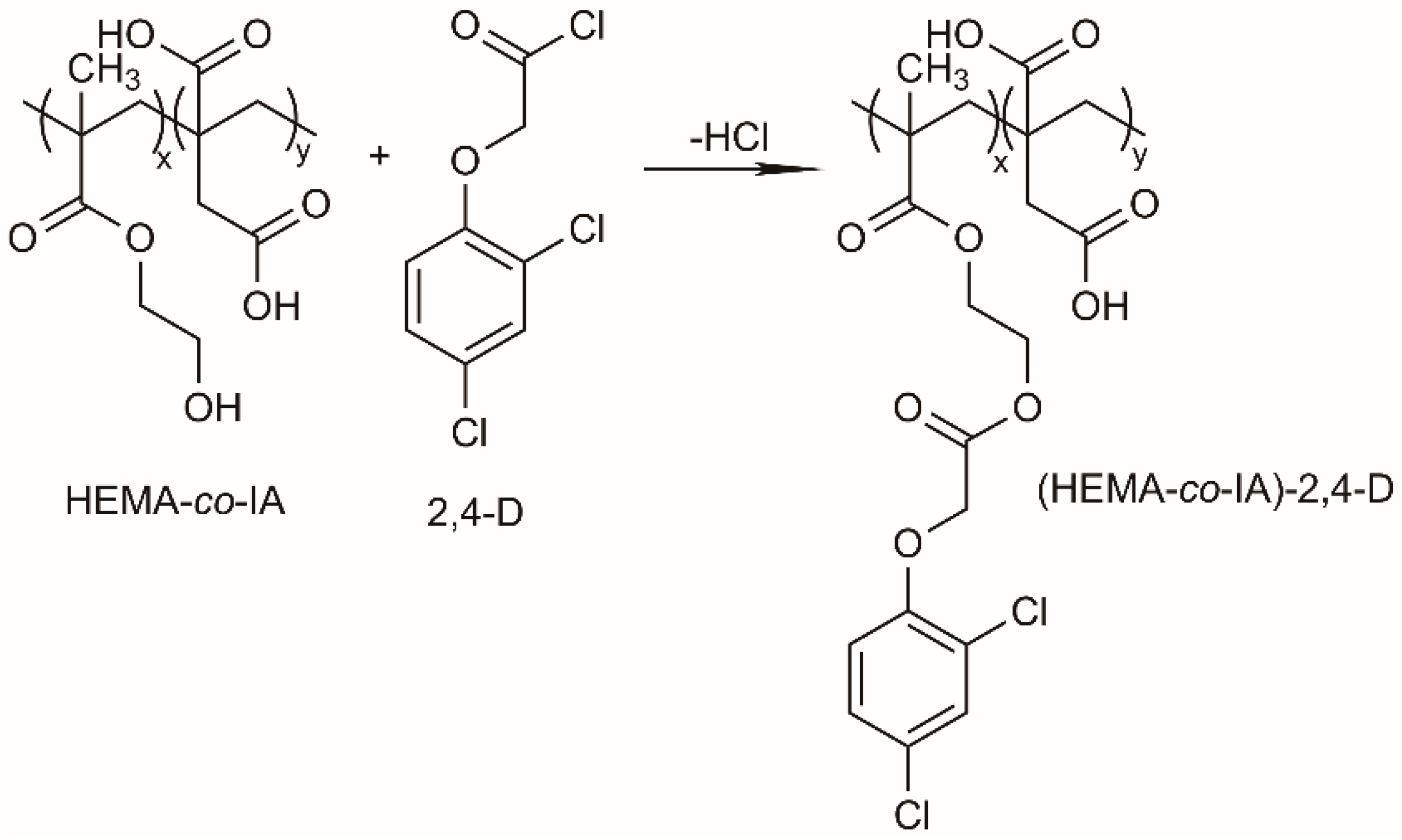
Figure 2.
Esterification reaction to obtain the Poly (HEMA-co-IA) -2,4- conjugate.
2.5. Study of Heterogeneous Hydrolysis of Poly(HEMA-co-IA)-Herbicide
The method was based on the retention of this polymer-herb by a membrane filtration cell and subsequent separation of low-molar mass species (bioactive molecule) from the copolymer matrix. Approximately 20 mg of the samples of Poly(HEMA-co-IA)-2,4D in 20 mL of water were placed into the membrane filtration cell whilst stirring. A membrane with an exclusion limit of 10.000 g mol-1 (AMICON, PM 10 or equivalent) was used. The total volume in the cell was kept constant at 20 mL. The reservoir contained water adjusted to the same pH (3,7 and 10) as that of the cell solution. The system was pressurized (300 kPa), subsequently, the cell solution was stirred for 10 min and then washed with the reservoir fluid at a flow rate of 4-6 mL min-1. The filtration fractions (Z=1) were collected every day for 30 days (Z= 20). The heterogeneous solution contained the released bioactive agent, which was quantitatively determined by UV spectroscopy at the absorption wavelength of λ= 281 nm using a calibration curve (aqueous solution of sodium hydroxide as solvent). Tests were performed for various pH values of reaction environment. The copolymer-herbicide system was lyophilized for further analytical control.
3. Results and Discusion
3.1. Synthesis and Characterization of Poly(HEMA-co-IA)
The copolymer poly(HEMA-co-IA) was synthesized by free radical polymerization in aqueous solution. Reaction conditions and copolymer compositions are shown in Table 1. The copolymer was soluble dimethylformamide, and dimethylsulfoxide. The number-average molecular weight was Mn: 18.700 weight-average molecular weight was Mw: 23.500 and the molecular weight distribution, polydispersity (Ð=Mw/Mn) was 1.32. The weight ratios of hydroxyethyl methacrylate to itaconic acid in the copolymer were calculated from 1H NMR spectroscopy. The highest yield value corresponds to the copolymer (75.5%) for a copolymer composition 76:24 mol.-% for a copolymer richest in the HEMA monomer, obtained at low conversions. The 1H-NMR spectrum of the copolymer shows the following signals (δ in ppm; DMSO-d6): from 0.2-2.0(9H, m broad, -CH3, 2x -CH2-, -CH2COOH aliphatic chain of HEMA and IA); at 2.8 [solvent DMSO-d6]; at 3.6 [-CH2 CH2OCO] from HEMA; at 3.9 (2H, s broad, -CH2OH, HEMA] and at 4.8 [–CH2CH2-OH from HEMA] and at 12.3 [was assigned to the-COOH from IA] (see Figure 3a).
3.2. Copolymer Composition by 1H-NMR
The relation of the area corresponding to aliphatic protons from HEMA and IA monomers and methylene protons from HEMA unit were used to determine the copolymer composition, where the integrals of the following functional groups were used: IMet at 3.9 [2H, s broad, -CH2OH, HEMA]; and IAlif from 2.0–0.2 [9H, m broad, -CH3, 2x -CH2-, -CH2COOH aliphatic chain of HEMA and IA], using three equations (Equation (S1)-(S3)). Applying these equations with IAlif = 6.27 e IMet = 4.0, the copolymer composition obtained and displayed in Table 1: The HEMA composition in the copolymer was 76.0%.
3.3. Poly(HEMA-co-IA) Matrix Grafted with 2,4 D-Chloride
The 1H-NMR spectrum of the copolymer-2,4 D conjugate showed the following signals (δ in ppm; DMSO-d6): at 0.2-2.0 [9H, m, 2x –CH2, 1x –CH3; –CH2COOH] from the backbone of both monomer HEMA and IA units; at 2.8 [solvent DMSO-d6]; at 4.2 [4H, m, 2x–CH2OCO– from HEMA] and at 4.8 [2H, s, –CH2OAr; at 7.1 [1H, m, Hd-Ar]; at 7.5 [1H, m, Hb–Ar]; at 8.0 [1H, m, Ha–Ar]; and at 12.3 [was assigned to 1H, s, –COOH from IA] (see Figure 3b).
3.4. Degree of Functionalization of Poly(HEMA-co-IA)-2,4-D.
The degree of functionalization was determined by 1H-NMR using signals from functional groups characteristic of each monomeric unit. For this purpose, the integrals of the following functional groups were taken from (1H, m, Hb–Ar; 1H, m, Hd–Ar); from 2.2–0.2 (9H, m ancho, –CH3, 2x–CH2–, –CH2COOH, aliphatic chain copolymer) and subsequently three equations were established (Equations (S4)–(S6)). Therefore, the functionalization was complete in the copolymer by 2,4-D is approximately 100%, since the percentage of 2,4-d coincides with that of HEMA in the copolymer.
The FT-IR spectra (KBr, cm-1) of the controlled release system showed an important change of the absorption band within the range at 3479 ν [tension O–H; –OH; HEMA] and at 3263 ν (–COOH; IA), an absorption band appears at 1736 ν [tension C–O; HEMA-2,4-D]; 1730 ν [tension C–O; >C=O, IA and HEMA]; 1650 ν [tension C-O; –COO–, IA]; 1487, 1444 and 1392 [bending C–H; –CH3, –CH2–]. The bands present in the FT-IR spectrum confirm that the tension and bending vibrations correspond to the Poly (HEMA-co-IA) -2,4-D conjugate, see Figure 4b.
3.5. Determination of Monomer Reactivity Ratios
The monomer reactivity ratio values for the HEMA and IA were determined from the monomer feed ratios and the copolymer composition obtained at high conversions. The Fineman-Ross 42, and Kelen-Tüdos 43methods were used to determine the monomer reactivity ratios. The experimental data indicated a random comonomer incorporation with a slightly (see Table S1 and S2) alternating tendency. Figure S1 shows plots according to the K-T method, from which the monomer reactivity ratios were determined for the copolymer. The variable ξ can take any possible value within 0 to 1 interval. A plot of Vs. gives a straight line, which on extrapolation to ξ= 0 and ξ= 1 gives and , respectively. The results included in Table S1, yielded reactivity ratios for HEMA and IA. The Kelen-Tudos method gave reactivity ratios for HEMA and IA of r1= 1.081 and r2 =1.098 respectively. (see Figure S1a). The experimental data indicate that the system Poly(HEMA-co-IA) can be considered as a random incorporation,
The ε vs η graph allows us to relate these variables through a linear equation and obtain the values of r1 and r2, as shown in the Equation (1) (see Figure S1):
For , where , then . For , then
The values of r1 (1.081) and r2 (1.098) are close to unity. The values of r1 (1.081) and r2 (1.098) are close to unity. Therefore, the monomers are added statistically, the monomers M1 and M2 tend towards a higher preference for the addition of a same type existing structurally at the end chain, that is, both monomers tend to incorporate statistically at random, generating small segments of the same monomer. The Fineman-Ross method (see Table S3) yielded reactivity ratios for HEMA and IA of r1 corresponds to the slope 1.1120 and r2 corresponds to the intercept 1.1470 respectively;
Where r1 x r2 = 1.2754. The graph of the initial composition (M1) vs the copolymer composition (m1) shows that both comonomers tend to incorporate statistically at random (see Table S2 and Figure S1b), which is verified by the reactivity parameters obtained using the KT method (r1 = 1.081 and r2 = 1.098) are both close to 1 (r1 and r2), agreeing with the values obtained by the FR method for copolymers at low conversions.
Where: Xo is the molar ratio of HEMA and IA in feed; Y is the molar ratio of HEMA and IA in the copolymer.
The G vs F graph (see Figure S1b) allows one to correlate these variables through a linear equation and obtain the values of r1 and r2, according to the equation of F-R:
where r1 corresponds to the slope 1.1120 and r2 corresponds to the intercept 1.1470.
The reactivity parameters can be obtained by this method for r1 = 1.1120 and r2 = 1.1470, and as results of the values obtained in the linear equation, both values are close to 1 (r1 and r2), then, indicating that monomers are added statistically, and with the same frequency for both monomer M1 and M2. The alternation is obtained due to the high reactivity that the monomers obtained when in presence of water as a solvent, obtaining a very close reactivity between both monomers and thus showing this alternating character in the copolymeric hydrogel. This applies to both the F-R and K-T methods.
3.6. Swelling Behavior of Hydrogel: Influence of pH
The swelling behavior of poly(HEMA-co-IA) hydrogel with a copolymer composition of 75:25 mol-% was investigated as a function of pH by the immersion of the gels in buffered solutions at pH = 3, 5.4, and 10 at room temperature (25°C). The Figure 5a,b show the swelling behavior of the copolymers poly(HEMA-co-IA) after different swelling times and pH. The results of the hydration of the Poly (HEMA-co-IA) hydrogel at room temperature for 10 days are presented and are expressed in percentages of hydration (Sw %) as a function of the working pH versus the days of analysis.
The dried samples of the copolymers were placed in a solution with defined pH (3, 5.4, and 10) at 25°C. Every hour, the sample was removed from the solution. After wiping-off the water on the surfaces using moist filter papers, the hydrogels were weighed and recorded as Ws . The swelling ratio (Sw) was then calculated according to Equation (3):
where Ws is the weight of the swollen hydrogel at an equilibrium state, and Wd is the weight of dried hydrogel (Xerogel). All the experiments were carried out by triplicate, and the average values were reported.
Figure 5a shows the swelling percentage of the hydrogel in acid media (pH 3.0) which reach the equilibrium condition at day fourth with swelling values of 970 % to 913%. By increasing the pH to 5.4, the equilibrium condition is reached within the first 24 hours with values ranging between 1036% to 1221%. While at pH 10.0, the maximum swelling equilibrium is reached within the first 24 h values one 10445% and 12375%, an order of magnitude higher those at lower pH (in acid medium), (see Figure 6b), thus achieving a weight gain of over 1200 times its weight at pH 10 buffers, the optimum absorption capacity for an agricultural-used hydrogel was slightly exceeded, increasing its weight approximately 100 times over.
The absorption capacity of the hydrogels increased at the pH 10, where the maximum value could be observed. This could be attributed to when the complete dissociation of the acid groups in IA takes place. Note that first and second dissociation constants of IA are pKa1 = 3.85 and pKa2 = 5.44, and herein the observed behavior [44].
The observed swelling behavior is due to the ionizable groups in the polymer, which enhance the repulsive forces between the carboxylic groups and neighboring chains. The swelling increased over time but eventually reached an equilibrium point, known as the equilibrium swelling percentage. In hydrogels with weakly ionizable groups, the dynamic absorption of the swelling medium involves the diffusion of mobile ions into the polymer, coupled with the ionization of fixed charges and diffusion of the penetrant as the polymer swells. Each monomer unit in the hydrogel holds an electrical charge, which attracts and binds water molecules. As a result, each polymer molecule can bind a significant volume of water [45].
The copolymer composition 75:25 mol.-% impacts significantly on the equilibrium swelling behavior of the poly(HEMA-co-IA) gel at pH 10 as noted in Figure 6. Moreover, the increase of carboxylic acid form IA in the hydrogels provides more hydrogen bonds. In other words, the swelling behavior of the hydrogels became more dependent on the IA content in the hydrogels and the pH.
3.7. Controlled Release Hydrogels
Poly(HEMA-co-IA) hydrogel with a copolymer composition 75:25 mol-% was modified with a chloro acetylation reaction according to the Figure 2. The esterification reaction of HEMA as co-monomer was carried out using 2,4-D chloride. For this polymer-herbicide, it is suggested that the hydrolysis of the ester functional groups at different pHs facilitates the release of the herbicide. Therefore, a series of release tests were performed at different pH. Thus, a sample of 20 mg in powder-form was added to the ultrafiltration cell (UF) system by Liquid-Phase Polymer-Based Retention (LPR) technique at pH 3, 5.4 and 10, according to the swelling studies. The filtration fractions (Z=1-10) were collected every day during 10 days, (Z=1, 1 day). The homogeneous solution contained the released 2,4-D, which was quantitatively determined by UV spectroscopy at 281 nm using calibration curves.
In the washing and enrichment methods using the LPR technique, the polymer-herbicide solution in the cell is defined as Equation (4):
were Cr is the herbicide concentration in the retentate (the cell solution, Vc, after a filtrate volume of Vf has been passed) and Co is the initial herbicide concentration in the cell. The filtration factor Z, expressed in relative units, is another convenient characteristic of the process [46,47,48,49,50,51].
The irreversible reaction describes the polymer-herbicide (PL-herbicide) dissociation, is described by:
The concentration of the herbicide which did not form part of polymer-herb, is determined through measurements before and after the filtration process.
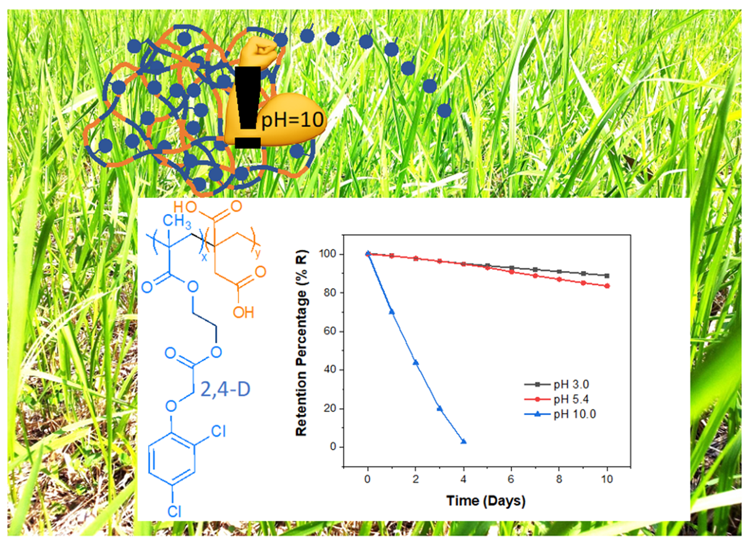
Typical release profiles are shown in Figure 7. At pH 3.0 and pH 5.4 the retention capacity of the herbicide was 83.3% and 88.7% respectively after 10 days, while at pH 10.0 on day fourth the 97% of herbicide was released. In general, the percentage of release for the copolymer-herb that takes place was increased at pH 10, a high release of the P(HEMA-co-IA)-herbicide was observed at Z = 4, (four day). For example, for Z= 1 and 2, showing release values between 79 % and 94.5%, the highest value is at Z=4. In this way, the release of the herbicide was achieved with great rate at pH 10, four days 97.3% (see Figure 6).
Therefore, the release of herbicide increases significantly corresponding to an increase of the pH. This may be due to the effective hydrolysis of the ester groups at higher pH. The groups that participate in this process are mainly the hydroxyl groups from HEMA and carboxylic acid form IA monomer units. At pH 10, the chemical equilibrium of the copolymer-herbicide conjugate shifts rapidly towards dissociation, which allows their identification. At lower pH (3 and 5) the number of protonated hydroxyl and carboxylic acid groups increases along polymer chains, thus reducing the possibility of free hydrophilic groups. This behavior at different pH favors the hydrolysis process at a higher pH, which can be attributed to a weakening of the attractive forces of intramolecular hydrogen bonds in the chains at lower pH.
3.8. Release of Bioactive Agent: Kinetic of the Reaction
The concentration of bioactive agent in the filtration fractions was quantitatively determined by UV spectroscopy at λ = 282 nm according to the UV-Vis espectrum (Figure 7a). Calibration curve for the standardization of the herbicide 2,4-D was used (Figure 7b).
In the washing method of the LPR technique, when a low molecular-weight species is filtered from the ultrafiltration system and no interaction with the ultrafiltration cell components including the ultrafiltration membrane is found, the instantaneous concentration of this species in the filtrate is governed by the following Equation (6):
where F is the filtration factor defined as . The concentration of herbicide in the filtration fractions (<cfiltrate>) is a mean value considering the instantaneous concentrations of the species in the collection process (cfiltrate), which decrease during filtration.
If the kinetics of hydrolysis of the herbicide from the copolymer-conjugates is in the of order one, there should be found an exponential decay of cbound-day with time, since Equations (7) and (8).
and then
where k is the kinetic constant.
Figure 8 depicts the profiles of dynamic release of bioactive agent from P(HEMA-co-IA)-2,4-D at various pHs at 25°C. As was observed, the higher values for herbicide release were obtained at pH 10, this suggests that the release is governed by the basic hydrolysis. The study of the release process revealed that the samples with the best swelling values at pH 10, representative of agricultural systems, showed first-order swelling kinetics and an absorption capacity that fits the parameters required for hydrogels for agricultural applications, which supports their potential for these purposes. Lower values for herbicide release were observed at pH 3 and 5.4 in accordance with the mechanism of a hydrolytic breaking of the herbicide-hydrogel bond. The differences in the release rates found for the hydrogel-conjugate at pH 3 and 5.4 can be correlated with the difference in their swelling capacity, where the release rate generally increases with an increase in the swelling from water solution. Moreover, the release is positively affected by the enhancement of conformational mobility either by extension of the lateral chain, and with a sufficient amount of –COO- groups hydrolyze completely at pH 10, in the copolymer matrix. Moreover, by extension of the lateral chain, the steric hindrance produced by HEMA moiety grafter with 2,4-D preventing the formation of inter- or intra-molecular hydrogen bonding with the content of hydrophilic co-unit from the IA segment.
The release reaction obeyed the first-order kinetic at pH 3 and 5.4. The kinetic release constants (k) found for the system at the different pH values and were extracted from the slopes of the plots in Figure 7, as can be deduced from Equation (8). These values are shown in Table 4. The exponential decay found in the release profiles confirms a first order kinetics for the acid hydrolysis of the copolymer-conjugate, when pH is change from 3.0 to 5.4 and the degradation rate of the polymer drug linkage change at pH 10. The base-catalyzed hydrolysis reaction of the herbicide follows a zero order kinetics, where the basic medium acts as a catalyst accelerating the release rate of the herbicide, showing higher kinetic constants as the pH increases.
4. Conclusions
Poly(HEMA-co-IA)-herbicide systems using the Liquid-phase polymer-based retention (LPR) technique in aqueous phase was investigated at different levels of pH. On the basis of the results of heterogeneous hydrolysis, it was found that the rate of herbicide release depends on the pH of reaction environment. The acid-hydrolysis of the herbicide from the conjugates follows a first order kinetics, showing higher kinetic constants as the pH increases. The base-catalyzed hydrolysis reaction of the herbicide follows a zero order kinetic, where the basic medium acts as a catalyst accelerating the release rate of the herbicide, showing higher kinetic constants as the pH increases. The differences in the release rates found for the hydrogel-herbicide at different pH can be correlated with the difference in their swelling capacity, where the release rate generally increases with an increase in the swelling capacity from water solution at higher pH. In this sense, the release is positively affected by the enhancement of conformational mobility either by extension of the lateral chain, and with a sufficient amount of –COO– groups hydrolyze completely at pH 10, in the copolymer matrix. Moreover, by extension of the lateral chain, the steric hindrance produced by HEMA moiety grafter with 2,4-D preventing the formation of inter- or intra-molecular hydrogen bonding with the content of hydrophilic co-unit from IA segment. The study of the release process revealed that all samples in distilled water at pH 10 are representative of agricultural systems, showed first-order swelling kinetics and an absorption capacity that conforms to the parameters for hydrogels for agricultural application, which supports their potential for these purposes.
Supplementary Materials
The following supporting information can be downloaded at the website of this paper posted on Preprints.org.
Acknowledgments
The authors gratefully acknowledge the support provided by the Project funded by the Research Continuity Project Fund, year 2021, code PY LCLI23-02, Universidad Tecnológica Metropolitana. The authors thank FONDECYT grant number 1240357.
References
- Dahan, A.; Hoffman, A. Rationalizing the Selection of Oral Lipid Based Drug Delivery Systems by an in Vitro Dynamic Lipolysis Model for Improved Oral Bioavailability of Poorly Water Soluble Drugs. Journal of Controlled Release 2008, 129(1), 1–10. [Google Scholar] [CrossRef] [PubMed]
- Mohan, Y. M.; Dickson, J. P.; Geckeler, K. E. Swelling and Diffusion Characteristics of Novel Semi-interpenetrating Network Hydrogels Composed of Poly[(Acrylamide)- Co -(Sodium Acrylate)] and Poly[(Vinylsulfonic Acid), Sodium Salt]. Polym Int 2007, 56(2), 175–185. [Google Scholar] [CrossRef]
- Mohan, Y. M.; Joseph, D. K.; Geckeler, K. E. Poly( N -isopropylacrylamide- Co -sodium Acrylate) Hydrogels: Interactions with Surfactants. J Appl Polym Sci 2007, 103(5), 3423–3430. [Google Scholar] [CrossRef]
- Kayaman, N.; Kazan, D.; Erarslan, A.; Okay, O.; Baysal, B. M. Structure and Protein Separation Efficiency of Poly(N-Isopropylacrylamide) Gels: Effect of Synthesis Conditions. J Appl Polym Sci 1998, 67(5), 805–814. [Google Scholar] [CrossRef]
- Alvarez-Lorenzo, C.; Concheiro, A. Reversible Adsorption by a PH- and Temperature-Sensitive Acrylic Hydrogel. Journal of Controlled Release 2002, 80(1–3), 247–257. [Google Scholar] [CrossRef]
- Lu, Z.-R.; Shiah, J.-G.; Sakuma, S.; Kopečková, P.; Kopeček, J. Design of Novel Bioconjugates for Targeted Drug Delivery. Journal of Controlled Release 2002, 78(1–3), 165–173. [Google Scholar] [CrossRef]
- Karadaǧ, E.; Üzüm, Ö. B.; Saraydin, D. Swelling Equilibria and Dye Adsorption Studies of Chemically Crosslinked Superabsorbent Acrylamide/Maleic Acid Hydrogels. Eur Polym J 2002, 38(11), 2133–2141. [Google Scholar] [CrossRef]
- Shantha, K. L.; Harding, D. R. K. Synthesis, Characterisation and Evaluation of Poly[Lactose Acrylate-N-Vinyl-2-Pyrrolidinone] Hydrogels for Drug Delivery. Eur Polym J 2003, 39(1), 63–68. [Google Scholar] [CrossRef]
- Peppas, N. A.; Am Ende, D. J. Controlled Release of Perfumes from Polymers. II. Incorporation and Release of Essential Oils from Glassy Polymers. J Appl Polym Sci 1997, 66(3), 509–513. [Google Scholar] [CrossRef]
- Nonaka, T.; Watanabe, T.; Kawabata, T.; Kurihara, S. Preparation of Thermosensitive and Superabsorbent Polymer Hydrogels from Trialkyl-4-Vinylbenzyl Phosphonium Chloride-N-Isopropylacrylamide-N,N?-Methylenebisacrylamide Copolymers and Their Properties. J Appl Polym Sci 2001, 79(1), 115–124. [Google Scholar] [CrossRef]
- Idziak, I.; Avoce, D.; Lessard, D.; Gravel, D.; Zhu, X. X. Thermosensitivity of Aqueous Solutions of Poly( N,N -Diethylacrylamide). Macromolecules 1999, 32(4), 1260–1263. [Google Scholar] [CrossRef]
- del C Pizarro, G.; Marambio, O. G.; Jeria-Orell, M.; Avellán, M. C.; Rivas, B. L. Synthesis, Characterization and Application of Poly[(1-vinyl-2-pyrrolidone)- Co -(2-hydroxyethyl Methacrylate)] as Controlled-release Polymeric System for 2,4-dichlorophenoxyacetic Chloride Using an Ultrafiltration Technique. Polym Int 2008, 57(7), 897–904. [Google Scholar] [CrossRef]
- Zhu, X. X.; Brizard, F.; Piché, J.; Yim, C. T.; Brown, G. R. Bile Salt Anion Sorption by Polymeric Resins: Comparison of a Functionalized Polyacrylamide Resin with Cholestyramine. J Colloid Interface Sci 2000, 232(2), 282–288. [Google Scholar] [CrossRef] [PubMed]
- Mohan, Y. M.; Geckeler, K. E. Polyampholytic Hydrogels: Poly(N-Isopropylacrylamide)-Based Stimuli-Responsive Networks with Poly(Ethyleneimine). React Funct Polym 2007, 67(2), 144–155. [Google Scholar] [CrossRef]
- Lentz, R. D. Inhibiting Water Infiltration into Soils with Cross-linked Polyacrylamide: Seepage Reduction for Irrigated Agriculture. Soil Science Society of America Journal 2007, 71(4), 1352–1362. [Google Scholar] [CrossRef]
- Tally, M.; Atassi, Y. Optimized Synthesis and Swelling Properties of a PH-Sensitive Semi-IPN Superabsorbent Polymer Based on Sodium Alginate-g-Poly(Acrylic Acid-Co-Acrylamide) and Polyvinylpyrrolidone and Obtained via Microwave Irradiation. Journal of Polymer Research 2015, 22(9), 181. [Google Scholar] [CrossRef]
- Chang, C.; Duan, B.; Cai, J.; Zhang, L. Superabsorbent Hydrogels Based on Cellulose for Smart Swelling and Controllable Delivery. Eur Polym J 2010, 46(1), 92–100. [Google Scholar] [CrossRef]
- Buchholz, F. L.; Graham, A. T. Modern Superabsorbent Polymer Technology; 1998.
- Liu, M.; Liang, R.; Zhan, F.; Liu, Z.; Niu, A. Synthesis of a Slow-release and Superabsorbent Nitrogen Fertilizer and Its Properties. Polym Adv Technol 2006, 17(6), 430–438. [Google Scholar] [CrossRef]
- Burkert, S.; Schmidt, T.; Gohs, U.; Dorschner, H.; Arndt, K.-F. Cross-Linking of Poly(N-Vinyl Pyrrolidone) Films by Electron Beam Irradiation. Radiation Physics and Chemistry 2007, 76(8–9), 1324–1328. [Google Scholar] [CrossRef]
- Ahmed, E. M.; Aggor, F. S.; Awad, A. M.; El-Aref, A. T. An Innovative Method for Preparation of Nanometal Hydroxide Superabsorbent Hydrogel. Carbohydr Polym 2013, 91(2), 693–698. [Google Scholar] [CrossRef]
- Li, Y.; Huang, G.; Zhang, X.; Li, B.; Chen, Y.; Lu, T.; Lu, T. J.; Xu, F. Magnetic Hydrogels and Their Potential Biomedical Applications. Adv Funct Mater 2013, 23(6), 660–672. [Google Scholar] [CrossRef]
- Mohammadzadeh Pakdel, P.; Peighambardoust, S. J. A Review on Acrylic Based Hydrogels and Their Applications in Wastewater Treatment. J Environ Manage 2018, 217, 123–143. [Google Scholar] [CrossRef]
- Cannazza, G.; Cataldo, A.; De Benedetto, E.; Demitri, C.; Madaghiele, M.; Sannino, A. Experimental Assessment of the Use of a Novel Superabsorbent Polymer (SAP) for the Optimization OfWater Consumption in Agricultural Irrigation Process. Water (Basel) 2014, 6(7), 2056–2069. [Google Scholar] [CrossRef]
- Hashmi, S.; Nadeem, S.; Awan, Z.; Ghani, A. A. Synthesis, Applications and Swelling Properties of Poly (Sodium Acrylate-Coacrylamide) Based Superabsorbent Hydrogels. Journal of the Chemical Society of Pakistan 2019, 41(4), 668–678. [Google Scholar] [CrossRef]
- Cardarelli, N. Controlled Release Pesticides Formulations; Zweig, G., Ed.; CRC Press, 2018. [Google Scholar] [CrossRef]
- Kydonieus, A. F. Controlled Release Technologies: Methods, Theory, and Applications; CRC Press, 1980; Vol. I.
- Das, K. G.; Patwardhan, S. A.; Collins, R. L.; Zeoli, L. T.; Kydonieus, A. F.; Wilkins, R. M.; Zweig, G.; Cardarelli, N. F.; Radick, C. M. Controlled-Release Technology: Bioengineering Aspects. (No Title).
- Baker, R. W. Controlled Release of Biologically Active Agents; Wiley, 1987. [Google Scholar]
- Schnatter, W. F. K. Functionalized Polymers and Their Applications, by A. Akelah and A. Moet, Chapman and Hall, London, 1990, 345 Pp. Price: $79.95. J Polym Sci A Polym Chem 1992, 30(11), 2473–2473. [Google Scholar] [CrossRef]
- Kenawy, E. R.; Sherrington, D. C.; Akelah, A. Controlled Release of Agrochemical Molecules Chemically Bound to Polymers. Eur Polym J 1992, 28(8), 841–862. [Google Scholar] [CrossRef]
- Akelah, A.; Kenawy, E. R.; Sherrington, D. C. Hydrolytic Release of Herbicides from Modified Polyamides of Tartrate Derivatives. Eur Polym J 1995, 31(9), 903–909. [Google Scholar] [CrossRef]
- Hernandez-Martínez, A. R.; Lujan-Montelongo, J. A.; Silva-Cuevas, C.; Mota-Morales, J. D.; Cortez-Valadez, M.; Ruíz-Baltazar, Á. de J.; Cruz, M.; Herrera-Ordonez, J. Swelling and Methylene Blue Adsorption of Poly(N,N-Dimethylacrylamide-Co-2-Hydroxyethyl Methacrylate) Hydrogel. React Funct Polym 2018, 122, 75–84. [Google Scholar] [CrossRef]
- Pizarro, G. D. C.; Marambio, O. G.; Manuel Jeria, O.; Huerta, M.; Rivas, B. L. Nonionic Water-Soluble Polymer: Preparation, Characterization, and Application of Poly(1-Vinyl-2-Pyrrolidone-Co-Hydroxyetnylmethacrylate) as a Polychelatogen. J Appl Polym Sci 2006, 100(1), 178–185. [Google Scholar] [CrossRef]
- Gharekhani, H.; Olad, A.; Mirmohseni, A.; Bybordi, A. Superabsorbent Hydrogel Made of NaAlg-g-Poly(AA-Co-AAm) and Rice Husk Ash: Synthesis, Characterization, and Swelling Kinetic Studies. Carbohydr Polym 2017, 168, 1–13. [Google Scholar] [CrossRef]
- Yetimoğlu, E. K.; Kahraman, M. V.; Ercan, Ö.; Akdemir, Z. S.; Apohan, N. K. N-Vinylpyrrolidone/Acrylic Acid/2-Acrylamido-2-Methylpropane Sulfonic Acid Based Hydrogels: Synthesis, Characterization and Their Application in the Removal of Heavy Metals. React Funct Polym 2007, 67(5), 451–460. [Google Scholar] [CrossRef]
- Taşdelen, B.; Çifçi, D. İ.; Meriç, S. Preparation of N-Isopropylacrylamide/Itaconic Acid/Pumice Highly Swollen Composite Hydrogels to Explore Their Removal Capacity of Methylene Blue. Colloids Surf A Physicochem Eng Asp 2017, 519, 245–253. [Google Scholar] [CrossRef]
- Sakthivel, M.; Franklin, D. S.; Guhanathan, S. PH-Sensitive Itaconic Acid Based Polymeric Hydrogels for Dye Removal Applications. Ecotoxicol Environ Saf 2016, 134, 427–432. [Google Scholar] [CrossRef]
- Troyer, J. R. In the Beginning: The Multiple Discovery of the First Hormone Herbicides. Weed Sci 2001, 49(2), 290–297. [Google Scholar] [CrossRef]
- Pizarro, G. del C.; Marambio, O. G.; O, M. J.; Geckeler, K. E. Synthesis and Properties of Hydrophilic Polymers, 10. Macromol Chem Phys 2003, 204(7), 922–927. [Google Scholar] [CrossRef]
- del C. Pizarro, G.; Marambio, O. G.; Jeria-Orell, M.; Huerta, M. R.; Rivas, B. L.; Habicher, W. D. Metal Ion Retention Using the Ultrafiltration Technique. Preparation, Characterization of the Water-soluble Poly(1-vinyl-2-pyrrolidone- Co -itaconic Acid) and Its Metal Complexes in Aqueous Solutions. J Appl Polym Sci 2008, 108(6), 3982–3989. [Google Scholar] [CrossRef]
- Tüdos, F.; Kelen, T.; Turcsányi, B.; Kennedy, J. P. Analysis of the Linear Methods for Determining Copolymerization Reactivity Ratios. VI. A Comprehensive Critical Reexamination of Oxonium Ion Copolymerizations. Journal of Polymer Science: Polymer Chemistry Edition 1981, 19(5), 1119–1132. [Google Scholar] [CrossRef]
- Fineman, M.; Ross, S. D. Linear Method for Determining Monomer Reactivity Ratios in Copolymerization. Journal of Polymer Science 1950, 5(2), 259–262. [Google Scholar] [CrossRef]
- Weast, R. C. Handbook of Chemistry and Physics 53rd Edition; Chemical Rubber Pub., 1972. [Google Scholar]
- Peppas, N. A.; Khare, A. R. Preparation, Structure and Diffusional Behavior of Hydrogels in Controlled Release. Adv Drug Deliv Rev 1993, 11(1–2), 1–35. [Google Scholar] [CrossRef]
- Marambio, O. G.; Sánchez, J.; del C. Pizarro, G.; Jeria-Orell, M. Rivas, B. L. Free Radical Copolymerization of Functional Water-Soluble Poly(N-Maleoylglycine-Co-Crotonic Acid): Polymer Metal Ion Retention Capacity, Electrochemical and Thermal Behavior. Polymer Bulletin 2010, 65(7), 701–717. [Google Scholar] [CrossRef]
- Moreno-Villoslada, I. Retention of Metal Ions in Ultrafiltration of Mixtures of Divalent Metal Ions and Water-Soluble Polymers at Constant Ionic Strength Based on Freundlich and Langmuir Isotherms. J Memb Sci 2003, 215(1–2), 195–202. [Google Scholar] [CrossRef]
- RIVAS, B. L.; SCHIAPPACASSE, L. N.; PEREIRAU, E.; MORENO-VILLOSLADA, I. ERROR SIMULATION IN THE DETERMINATION OF THE FORMATION CONSTANTS OF POLYMER-METAL COMPLEXES (PMC) BY THE LIQUID-PHASE POLYMER-BASED RETENTION (LPR) TECHNIQUE. Journal of the Chilean Chemical Society 2004, 49(4). [Google Scholar] [CrossRef]
- Pizarro, G. C. del; Marambio, O. G.; Rivas, B. L.; Geckeler, K. E. Interactions of the Water-Soluble Poly(N-Maleyl Glycine- Co -Acrylic Acid) as Polychelatogen with Metal Ions in Aqueous Solution. Journal of Macromolecular Science, Part A 1997, 34(8), 1483–1491. [Google Scholar] [CrossRef]
- Rivas, B. L.; Pooley, S. A.; Luna, M. Ultrafiltration of Metal Ions by Water-soluble Chelating Poly( N -acryloyl- N -methylpiperazine- Co-N -acetyl-α-aminoacrylic Acid). J Appl Polym Sci 2002, 83(12), 2556–2561. [Google Scholar] [CrossRef]
- Pizarro, G. del C.; Rivas, B. L.; Geckeler, K. E. Metal Complexing Properties of Water-Soluble Poly(N-Maleyl Glycine) Studied by the Liquid-Phase Polymer-Based Retention (LPR) Technique. Polymer Bulletin 1996, 37(4), 525–530. [Google Scholar] [CrossRef]
Figure 1.
Synthesis of the Poly (HEMA-co-IA) matrix.
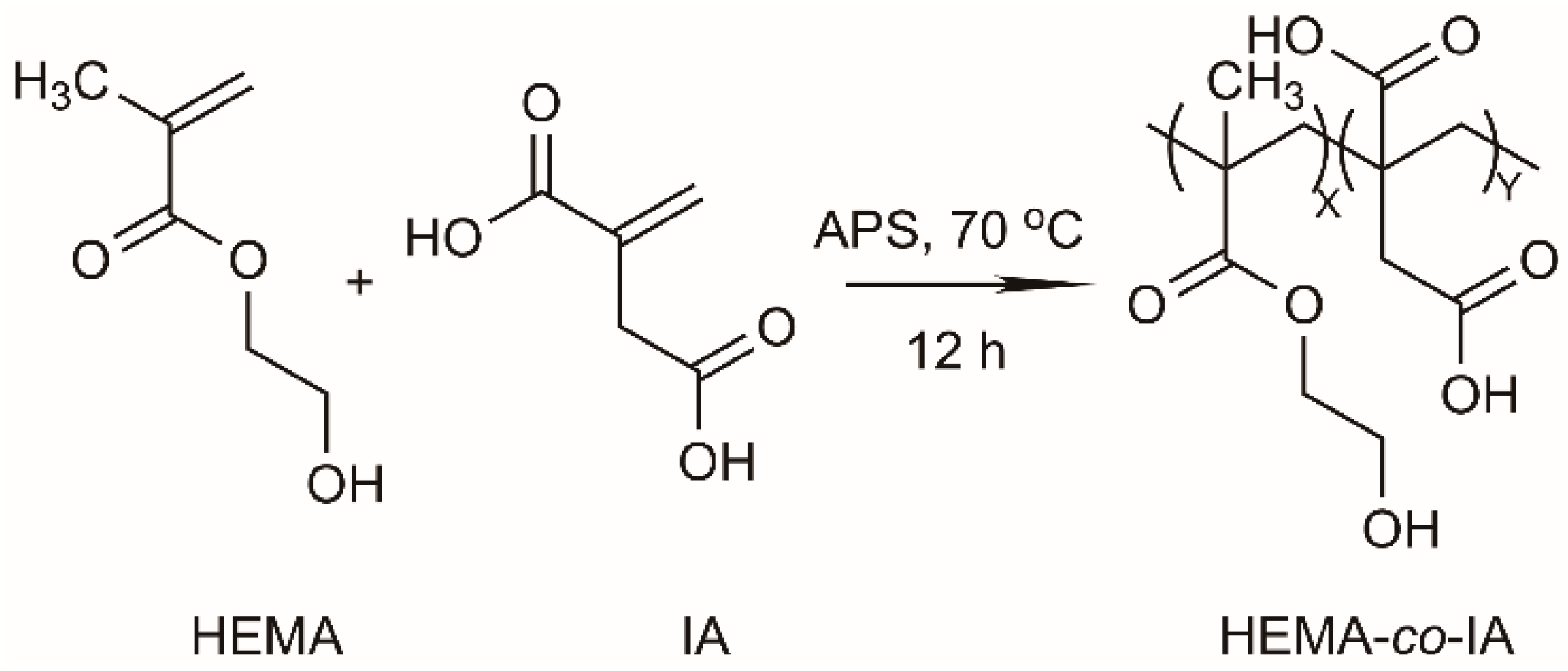
Figure 3.
a) 1H-NMR spectrum of Poly (HEMA-co-IA) matrix and b) Poly (HEMA-co-IA)-2,4D conjugate.
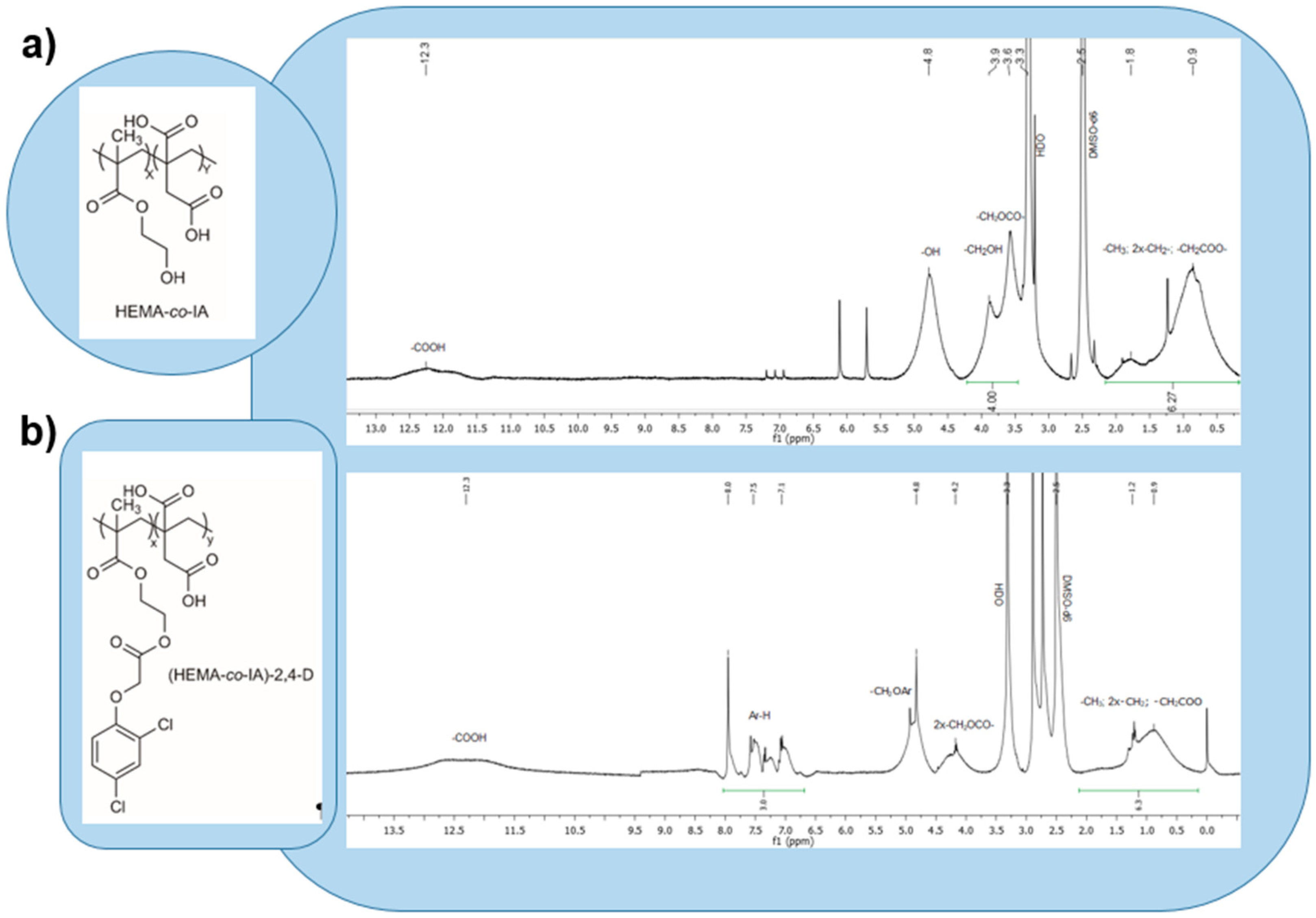
Figure 4.
Infrared spectra of P(HEMA-co-AI) matrix and P(HEMA-co-AI) grafted with 2.4-D for a copolymer composition of 3.0:1.0.
Figure 4.
Infrared spectra of P(HEMA-co-AI) matrix and P(HEMA-co-AI) grafted with 2.4-D for a copolymer composition of 3.0:1.0.
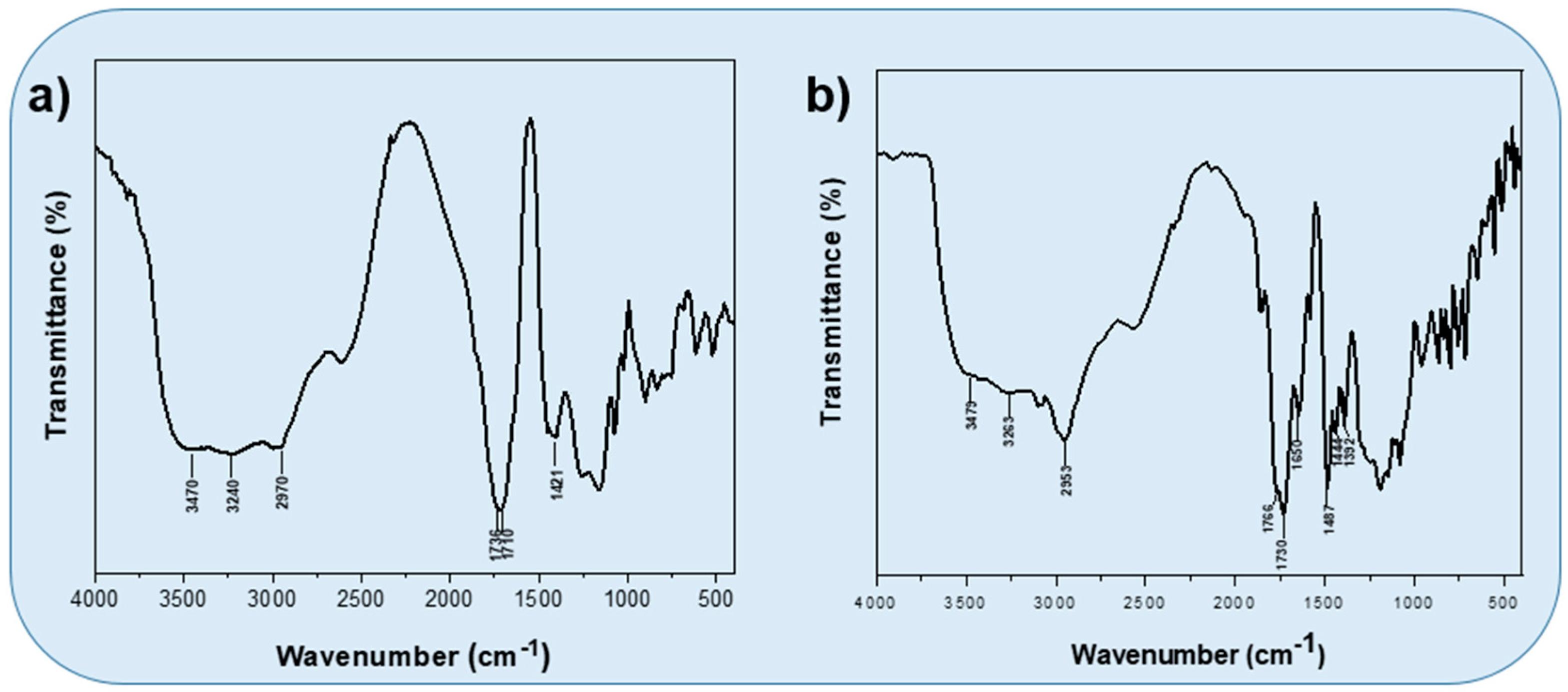
Figure 5.
The swelling behavior of poly(HEMA-co-IA) hydrogel with a copolymer composition of 75:25 mol-% as a function of pH in buffered solutions at pH = 3, 5.4, and 10 at room temperature (25°C).
Figure 5.
The swelling behavior of poly(HEMA-co-IA) hydrogel with a copolymer composition of 75:25 mol-% as a function of pH in buffered solutions at pH = 3, 5.4, and 10 at room temperature (25°C).
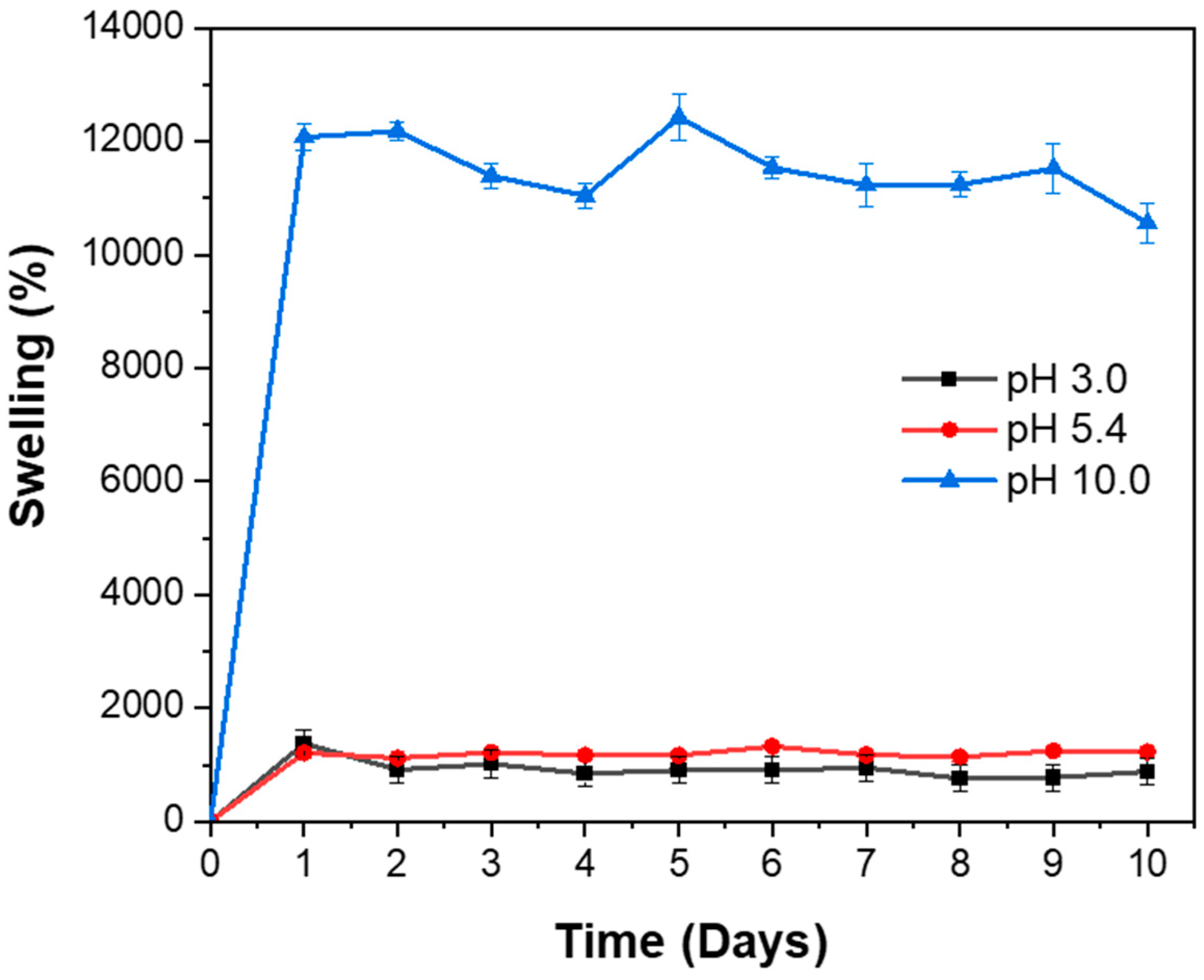
Figure 6.
Release curves of herbicide using the Poly (HEMA-co-IA)-2,4-D hydrogel at different pH.
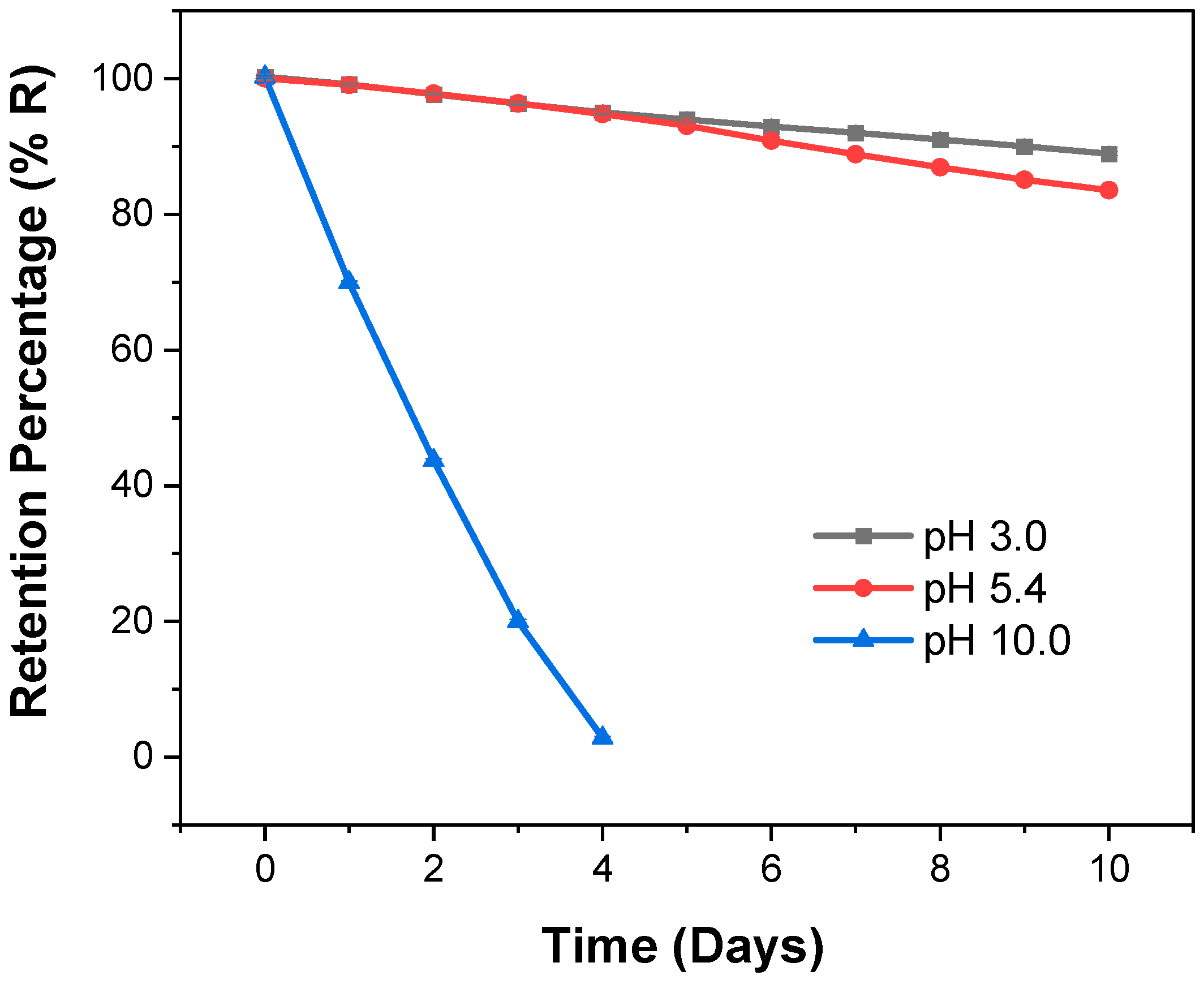
Figure 7.
a) UV-Vis spectrum of 2,4-D in CHCl3.b) Calibration curve for herbicide 2,4-D.
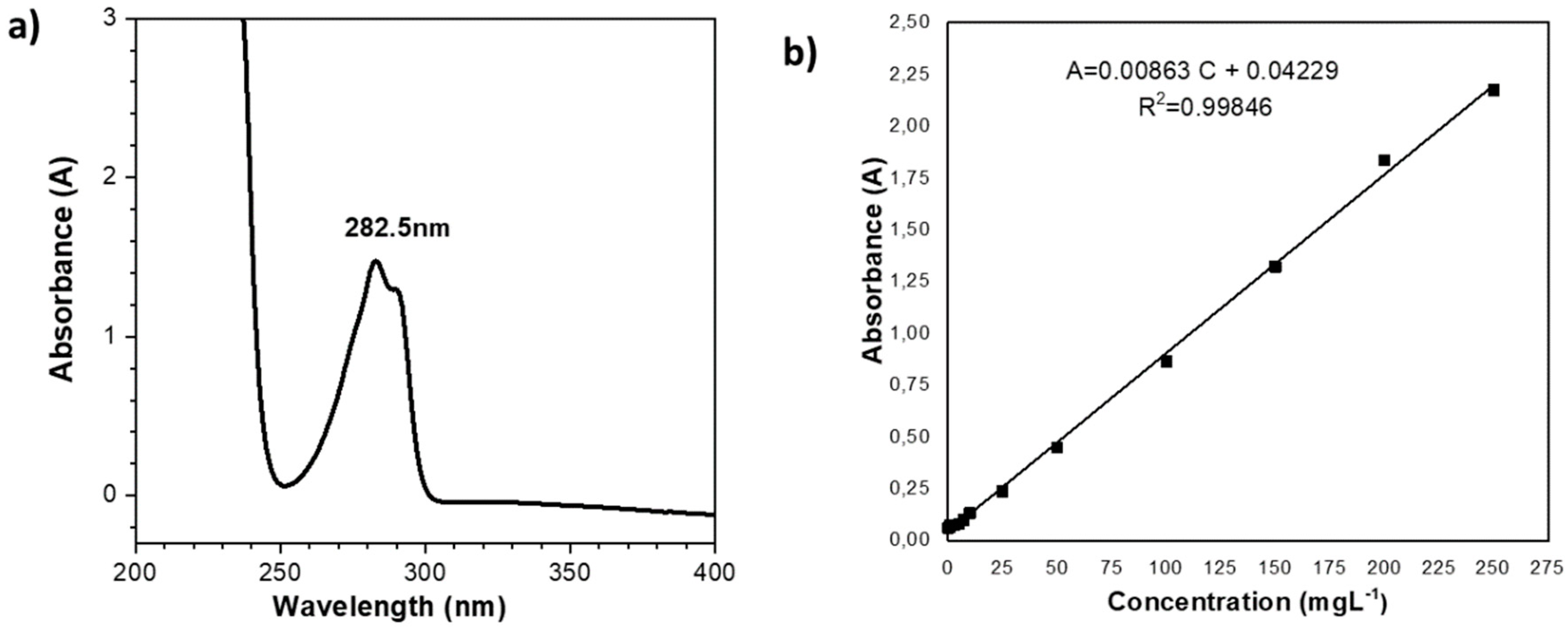

Table 1.
Experimental Conditions, yield and copolymer composition of Poly(HEMA-co-IA) hydrogels obtained using 15 mL of water at 70°C and 12 hours of reaction.
Table 1.
Experimental Conditions, yield and copolymer composition of Poly(HEMA-co-IA) hydrogels obtained using 15 mL of water at 70°C and 12 hours of reaction.
| Monomer feed ratios HEMA/IA |
HEMA mL (mmol) |
IA g (mmol) |
PSA mg (mol-%) |
Yield % |
Copolymer composition by 1H NMR |
|---|---|---|---|---|---|
| 3.0:1.0 | 4.51 (9.00) |
1.59 (3.00) |
53.6 (0.490) |
37.7 | 3.0:1.0 |
| 2.5:1.0 | 4.30 (8.60) |
1.80 (3.40) |
54.1 (0.494) |
37.3 | 2.5:1.0 |
| 2.0:1.0 | 4.01 (8.00) |
2.10 (4.00) |
54.4 (0.497) |
32.4 | 2.0:1.0 |
| 1.5:1.0 | 3.61 (7.20) |
2.53 (4.80) |
54.5 (0.498) |
27.1 | 1.5:1.0 |
| 1.0:1.0 | 3.01 (6.00) |
3.16 (6.00) |
54.5 (0.498) |
28.5 | 1.0:1.0 |
| 1.0:1.5 | 2.41 (4.80) |
3.79 (7.20) |
55.9 (0.510) |
46.5 | 1.0:1.5 |
| 1.0:2.0 | 2.01 (4.00) |
4.22 (8.00) |
56.0 (0.511) |
42.0 | 1.0:2.0 |
| 1.0:2.5 | 1.72 (3.40) |
5.51 (8.60) |
56.4 (0.515) |
38.6 | 1.0:2.5 |
| 1.0:3.0 | 1.51 (3.00) |
4.75 (9.00) |
55.4 (0.506) |
30.0 | 1.0:3.0 |
HEMA: 2-Hydroxyethylmethacrylate; IA: Itaconic Acid; APS: Ammonium Persulfate. The FT-IR spectra (KBr, cm-1) of the unmodified copolymer showed the presence of the following characteristic absorption bands: at 3470 ν[tension O–H from HEMA]; at 3240 ν[tension OH; –COOH from IA], at 2970 ν[tension C–H, –CH2-, CH3]; at 1736 ν[tension –C–O from –COO–, HEMA]; and at 1710 ν[tension –C–O; –COOH, IA]; at 1421 ν[bending C–H; –CH3, –CH2-] (see Figure 4a).
Table 2.
Rate constant (k) and half-life time (τ 1 / 2) of the Poly(HEMA-co- IA)-2,4-D.
| System |
pH 3.0 |
pH 5.4 |
pH 10.0 |
|||
|---|---|---|---|---|---|---|
|
k (n) |
τ1/2 (days) |
k (n) |
τ1/2 (days) |
k (n) |
τ1/2 (days) |
|
| Poly(HEM -co- IA)-2,4-D | 0.011 (0.988) |
63.01 | 0.019 (0.981) |
36.48 | 0.857 (0.424) |
0.81 |
K: Rate constant; n: Order kinetic release.
Disclaimer/Publisher’s Note: The statements, opinions and data contained in all publications are solely those of the individual author(s) and contributor(s) and not of MDPI and/or the editor(s). MDPI and/or the editor(s) disclaim responsibility for any injury to people or property resulting from any ideas, methods, instructions or products referred to in the content. |
© 2024 by the authors. Licensee MDPI, Basel, Switzerland. This article is an open access article distributed under the terms and conditions of the Creative Commons Attribution (CC BY) license (http://creativecommons.org/licenses/by/4.0/).
Copyright: This open access article is published under a Creative Commons CC BY 4.0 license, which permit the free download, distribution, and reuse, provided that the author and preprint are cited in any reuse.


