

Submitted:
05 November 2024
Posted:
06 November 2024
You are already at the latest version
Abstract
Chemical investigation of the Antarctic sponge Suberites sp. has previously led to the identification of new suberitane derivatives, some of which show bioactivity toward the respiratory syncytial virus (RSV). Our ongoing NMR-guided investigation of new specimens of the sponge resulted in the isolation of five new analogs (1-5), the previously reported suberitenones A-D (6-9) and oxaspirosuberitenone (10). Suberitenone K (1) was characterized as the 8-keto derivative of suberitenone A, while three new phenols, suberitandiol (2), abeosuberitandiol (3), and furanosuberitandiol (4), and the degraded sesterterpene norsuberitenone B (5) were also found. 3 displays a ring contraction while 4 has a new dihydrofuran ring. Structural characterization was achieved by a combination of NMR, HR-MS, and X-ray diffraction. Suberitenone D and the new metabolite suberitenone K showed moderate activity towards RSV, while norsuberitenone B and furanosuberitandiol were found to have mild activity.
Keywords:
Suberites sp.
; sesterterpenes
; suberitane
; porifera
; Antarctica
; RSV
1. Introduction
With an expansive range and biogeographic isolation, the waters of the Southern Ocean surrounding Antarctica host rich and diverse marine benthic invertebrate communities [1,2]. Marine sponges often act as the dominant taxa in many benthic habitats in the region, and these organisms often produce chemical defences to survive in communities structured by biotic influences like predation and competition for limited resources [2]. Sponges from Antarctica have been found to produce a wide variety of chemical compounds, including terpenes [3]. Naturally occurring terpenes have interesting chemical structures that exhibit bioactivities such as antimicrobial, anticancer, and anti-inflammatory properties that may have pharmaceutical applications in the field of drug discovery [4,5,6]. The isolation of these compounds reveals auspicious results for bioprospecting efforts in Antarctica [4].
Suberites is a genus of the family Suberitidae. These organisms can be found across various oceanic habitats including coral reefs, rocky intertidal zones, and deep sea environments [2]. Suberites spp. play an important role in the ecosystems they inhabit through their water filtration and benthic shaping qualities [2]. The genus Suberites belongs to the largest and most diverse class of sponges, Demospongiae, which leaves room for vast research to be conducted on the natural product compounds they possess. Our research group has previously studied Antarctic Suberites sp. and discovered a variety of unreported sesterterpenes, including neosuberitenone, which was characterized by a new carbon scaffold, as well as six suberitenone derivatives, an ansellane-type terpenoid, and a highly degraded sesterterpene [7]. Some of these compounds were reported with antiviral activity [7].
Herein, we report on our continuing investigation of the Antarctic sponge Suberites sp.. New specimens of the sponge were subject to 1H NMR-guided purification using reverse-phase high-performance liquid chromatography (HPLC), resulting in the isolation of five new suberitane derivatives, three being derivatives of suberiphenol [8]. Additional supplies of our previously published suberitenones were isolated together with the two major metabolites suberitenone A (6) and B (7), and the minor metabolites suberitenone C (8), D (9), and oxaspirosuberitenone (10) [7,8,9,10]. We report the structure elucidation of the previously unreported compounds and their RSV antiviral activity.
2. Results and Discussion
The molecular formula of suberitenone K (1) was determined to be C27H38O5 based on HRESIMS data ([M + Na]+ m/z 465.2622) and corroborated by the 1H and 13C NMR spectra (Table 1). The 13C NMR spectrum indicated 1 to have four olefinic carbons, including two methines and two olefinic quaternary signals, as well as three carbonyls. These account for five degrees of unsaturation, indicating 1 to have a four ring system. The remaining 20 carbons are accounted for by three quaternary carbons, three aliphatic methines, two oxygen-bearing methines, six methyl groups, and six methylene groups. The 1H NMR data (Table 1) showed two oxygen-bearing methines at δH 4.25 (H-1) and δH 5.56 (H-13), two olefinic methines at δH 6.80 (H-2) and δH 6.40 (H-22), three aliphatic methines at δH 3.35 (H-6), δH 1.96 (H-10), and δH 1.23 (H-14), and six singlet methyl groups. These NMR data indicated this compound to be structurally related to other reported compounds from Suberites sp. (Figure 1), known as the suberitane carbon skeleton [9].
The ring A partial structure could be established by a combination of COSY and HMBC correlations (Figure 2). Geminal methyl groups H3-20 and H3-25 (δH 0.94, 1.06) anchor the spin system, both displaying HMBC correlations to C-14, C-18, and C-19 (δC 57.3, 45.3, and 35.1, respectively). The methine H-14 (δH 1.23) displayed HMBC correlations to methyl groups C-20 (δC 33.3) and C-24 (δC 17.4) and the quaternary carbons C-15 (δC 38.2) and C-19. H3-24 (δH 1.34) had HMBC correlations to C-10 (δC 54.9), C-14, C-15, and methylene C-16 (δC 42.2). The COSY data further connects H2-17 (δH 1.81/1.51) to H2-16 (δH 1.69/0.98) and H2-18 (δH 1.41/1.26), resulting in ring A.
Extending the spin system, COSY correlations were observed between H-14 and oxymethine H-13 (δH 5.59), which further correlated with H2-12a/12b (δH 2.06/1.66). H2-12 had HMBC correlations to C-10, C-11 (δC 37.7), C-13 (δC 72.0), and C-14, closing the six-membered ring B with quaternary carbon C-15 between C-10 and C-14 based on the previously described HMBC correlation between H3-24 and C-10. The singlet methyl H3-23 (δH 1.29) had HMBC correlations to C-10, C-11, C-12, and the olefinic methine C-22 (δC 160.7), placing the methyl on quaternary carbon C-11. H2-9 (δH 2.52/2.50) showed HMBC correlations to carbonyl C-8 (δC 202.1), C-10, and C-11. HMBC correlations from H-22 to C-8 and the olefinic quaternary carbon C-7 (δC 134.2) connects carbonyl C-8 and olefinic methine C-22 with C-7, completing ring C.
A separate spin system comprising ring D was constructed based on COSY correlations from oxymethine H-1 (δH 4.25) to aliphatic methine H-6 (δH 3.35) and olefinic methine H-2 (δH 6.80). Further, H-2 showed HMBC correlations to C-1 (δC 65.2), C-4 (δC 202.2), C-6 (δC 38.5), and C-21 (δC 15.7). The singlet methyl group H3-21 (δH 15.7) displayed HMBC correlations to C-2 (δC 145.3), C-3 (δC 137.2), and C-4, placing it on the quaternary carbon C-3 with the olefinic methine (C-2) and ketone (C-4) on each side. The non-equivalent methylene H2-5a/5b (δH 2.75/2.15) had HMBC correlations with C-1, C-4, and C-6, closing ring D. This was supported by COSY correlations from methine H-6 to H-1 and H2-5a/5b.
The two spin systems were joined based on HMBC correlation between H-5a and H-6 with olefinic quaternary carbon C-7 (δC 134.2), establishing the suberitane backbone. The acetoxy group can be placed on oxygen-bearing C-13 based on the deshielded shift of both its carbon (δC 72.0) and proton (δH 5.59) and HMBC correlations from H-13 to C-26 (δC 172.1), completing the planar structure of suberitenone K (1).
The relative stereochemistry was determined by key NOE correlations between H3-20, H-13, and H-14 and further between H-14 and H-10. H3-23 has an NOE correlation to the acetoxy methyl, placing those on the same face of the ring. H3-25 has an NOE correlation to H3-24 placing those on the same face as the acetoxy, as H3-25 is opposite to H3-20. The relationship of H-1 and H-6 were determined to be syn to each other based on their coupling constants of J= 4.0. NOE correlations and coupling constants were used to determine 1 to share stereocenters of the same orientation as the known compound suberitenone A (6), suggesting they have the same absolute configuration of 1R,6R,10S,11S,13R,14S,15R as previously determined by Shin et al. [9] for suberitenone A using a modified Mosher’s method and CD analysis as well as our analysis of suberitenone E, which was confirmed by X-ray diffraction [7].
Suberitandiol (2) was determined to have the molecular formula C27H40O4 by the negative ion formate adduct ([M + CHOO]- 473.2908 m/z). The NMR data of 2 (Table 2) suggest ring A and B to be as found in 1. Similarly to 1, 2 has six methyl groups, one being part of the acetoxy group on C-13 (δC 70.6). The H3-23 (δH 1.43) methyl has HMBC correlations to C-10 (δC 58.9), C-11 (δC 34.8), C-12 (δC 46.7), and C-22 (δC 57.2), being placed on the quaternary carbon C-11, connecting ring B and C as shown for 1. C-22 for 1 was an olefinic methine, but for 2 was found as a non-equivalent methylene. Ring C was further verified and connected through H-22a (δH 1.57) with HMBC correlations to C-8 (δC 41.1), C-10, C-11, C-23 (δC 22.7), and quaternary carbon C-7 (δC 74.4) as shown in Figure 3. Methylene H-9a (δH 1.86) displays COSY correlations to H2-8 (δH 1.90) and H-10 (δH 1.06), establishing much of ring C. Ring C was completed between C-8 and C-9 by H-9b (δH 1.69), which demonstrated HMBC correlations to C-7, C-10, and C-11. With ring D left, three olefinic/aromatic methines, one deshielded methyl group, three quaternary carbons and two oxygens remain left to account. The three olefinic/aromatic methines and three quaternary carbons make up an aromatic ring with three substituents. The methine H-2 (δH 7.07 (d)) had COSY correlations to methine H-1 (δH 6.90), creating an olefinic bond and suggesting the loss of the oxygen-bearing methine previously observed in 1. Further, H-2 had HMBC correlations to the quaternary carbons C-4 (δC 152.6) and C-6 (δC 149.5) and the methyl C-21 (δC 15.3), as observed for 1. The third methine (H-5, δH 6.95) is a singlet with HMBC correlations to C-1 (δC 116.6) and C-3 (δC 122.0). The H3-21 methyl (δH 2.23) had HMBC correlations to C-2 (δC 130.7), C-3 (δC 122.0), and C-4, placing the methyl on the quaternary carbon C-3. The aromatic methines H-1 and H-5 both have HMBC correlations to C-7, suggesting a bridge between C-6 and C-7, connecting ring C and D. This leaves an open valence on C-4 and C-7, with two oxygens and two protons left to account for, indicating an hydroxyl group on each to complete the planar structure of 2. These assignments are supported by their deshielded shifts. The 3D structure was solved by comparing NOE and coupling constants to 1. The tertiary alcohol at C-7 was deduced by NOE correlations in DMSO-d6 from OH-7 (δH 4.38) to H3-23 (δH 1.34). The absolute configuration is proposed as 7R,10S,11S,13R,14S,15R based on similarly to the known compound suberitenone B [9].
Abeosuberitandiol (3) was found to have the formula C27H38O5 based on its 1H and 13C NMR data (Table 2) and the formate anion adduct at 487.2697 m/z. The three aromatic methines and its 2D data (Figure S27-29) indicate 3 to have the rings A, B, and D as found for 2. Figure 4 highlights the HMBC and COSY correlations to establish the differences found in ring C. H3-23 (δH 1.16) has HMBC correlations to C-10 (δC 56.4), C-12 (δC 42.6), and C-22 (δC 83.5) as shown for the other structures, however, differently from 1 and 2, H-22 (δH 4.02) has the shift of an oxygen-bearing methine. H-22 has COSY correlation to methine H-7 (δH 3.58), which further shows COSY correlations to the non-equivalent methylene H2-9a/9b (δH 2.09/1.66). H2-9a/9b has COSY correlation to H-10 (δH 1.30), completing ring C as a five-membered ring. H-9a has HMBC correlations to C-7 (δC 50.1), C-10 (δC 56.4), and the carbonyl C-8 (δC 202.1). H-22 and H-1 (δH 7.43) display HMBC correlations to C-8, as shown in Figure 4, suggesting the ketone acts as a bridge between ring C and D. The absolute configuration was deduced as earlier, showing the relative orientation of chiral centers 10R*,11R*,13R*,14S*,15R*. NOE correlations between H-7/H3-23 and H-10/H-22 places H-7 and H-22 anti to one another, suggesting the absolute configuration of 3 to be 7S,10R,11R,13R,14S,15R,22R.
Furanosuberitandiol (4) was found with the molecular formula C27H36O6, determined by the 1H and 13C NMR data (Table 2) and the (-)HRESIMS ([M + CHOO]- 501.2489 m/z). The formula suggests the structure to have ten degrees of unsaturation. The NMR data indicate 4 to have an aromatic ring, as observed for 2 and 3, and two carbonyl groups. This leaves 4 with 5 rings. Figure 5 highlights the key HMBC and COSY correlations to establish the aromatic ring, and further differences in ring C. Its NMR data (Table S4) suggests 4 to have the same A/B ring system observed for 1. Ring D differs in having two aromatic methines: C-2 (δC 112.1) and C-5 (δC 109.7). For 2 and 3, C-1 was observed as a methine; however, it is found in 4 as a quaternary carbon with a deshielded shift (δC 155.3), suggesting oxygen substitution. H3-23 (δH 1.00) had HMBC correlations to C-10 (δC 45.9) and C-22 (δC 97.4), suggesting C-22 to be oxygen-bearing, as shown in 3. H-22 (δH 4.19) displays HMBC correlations to C-1 (δC 155.3), C-7 (δC 83.3), C-8 (δC 210.8), C-10 (δC 45.9), C-11 (δC 38.3), and C-23 (δC 18.9), suggesting a bridge between C-1 and C-22 through an oxygen. The non-equivalent methylene H-9a (δH 2.48) had COSY correlation to H-10 (δH 1.88) and HMBC correlations to quaternary carbon C-7 (δC 83.3) and carbonyl C-8 (δC 210.8), establishing further connectivity of ring C. The H-9a and H-22 correlations to C-7 and C-8 suggests completion of ring C between C-7 and C-22. To complete the planar structure, a hydroxyl group is left to account for and one and two valences are open on C-6 and C-7, respectively. This suggests the hydroxy group to be placed on the oxygen-bearing C-7 and a bridge between C-6 and C-7, establishing the fifth ring system. NOE correlations and coupling constants as described earlier were used to propose the absolute configuration of 5. Key correlations between H3-23 and H-22 determined a syn relationship for these protons, while the C-7 tertiary alcohol was placed on the same face as H-22 and H3-23, as shown for 3 and suberitenone B [9]. This was corroborated by key NOE correlations in (CD3)2SO between OH-7/H-22 and a weak correlation between OH-7/H3-23 (Figure S42), giving 5 the proposed absolute configuration of 7S,10R,11R,13R,14S,15R,22R.
Norsuberitenone B (5) was isolated as a white crystal with the molecular formula C20H32O3 based on the m/z 321.2433 proton adduct of the (+)HRESIMS. Its formula indicates five degrees of unsaturation with two being carbonyl groups, suggesting a three-ring system. Its NMR data (Table S5) suggests 5 to have a similar ring system as shown for 1, but lacking ring D. HMBC correlations from the methyl groups H3-15 (δH 0.97) and H3-18 (δH 1.02) to C-9 (δC 56.5), C-13 (δC 44.0), and C-14 (δC 34.0) and from H3-17 (δH 1.23) to C-5 (δC 56.6), C-10 (δC 37.7), and C-11 (δC 42.3) suggests 5 to have a similar ring system for ring A and B as shown for previous suberitane compounds. The H3-20 (δH 2.05) and its HMBC correlation to carbonyl C-19 (δC 170.3) suggests the presence of the acetoxy group on oxygen-bearing C-8 (δH 70.0). H3-16 (δH 1.06) had HMBC correlations to C-1 (δC 59.6), C-5, C-6 (δC 37.9), and C-7 (δC 45.7), suggesting its place on the quaternary carbon C-6. The methylene H-1b (δH 2.03) and H-3b (δH 2.29) have HMBC correlations to a ketone (C-2: δC 210.9), suggesting a ketone to have replaced the tertiary alcohol bridging to ring D in 2. The stereochemistry was determined by key NOE correlations from H3-15 to H-8 (δH 5.52) and H-9 (δH 1.15) and further between H-9 and H-5 (δH 1.50). NOE correlations were observed between H3-16 and the acetyl methyl group. X-ray diffraction (Figure 6) confirmed the structure and determined the absolute configuration to be 5S,6S,8R,9S,10R.
Biosynthetically, the suberitane class differs from many other sesterterpenes due to the pendant ring D [9]. A proposed biosynthetic pathway of newly reported metabolites 1-5 is presented in Figure 7. The degraded suberitenone, norsuberitenone B (5), could be rationalized as the elimination product of ring D from suberitenone B. Compound 1 can be derived from the oxidation of a tetracyclic intermediate, as shown in Figure 7. The phenolic compounds 2-4 are perhaps derived from a protonation-catalyzed dehydration of the alcohol allylic to the α,β-unsaturated ketone.
Bracegirdle et al. reported RSV activity for the known compounds suberitenone A (6) and B (7) with IC50 values of 7.8 μM and 3.2 μM, respectively, while the compounds suberitenone F, G, and H showed moderate activity [7]. Herein, we report weak RSV activity for suberitenone D (9) (Table 3), while the others displayed no activity. A decrease in activity is shown with the degraded sesterterpene 5 relative to suberitenone B, suggesting the presence of ring D to be important for further structure-activity relationship studies. Furthermore, no activity was shown for 2 and 3, suggesting the importance of the α,β-unsaturated ketone on ring D. Suberitenone D has a decrease in activity compared to suberitenone B, with the only structural difference being the acetoxy replacing the hydroxyl group on ring D. Suberitenone C showed no activity and 1 displayed moderate activity, suggesting the Δ7(22) olefin is favourable over the Δ8 olefin, but an α,β-unsaturated ketone on ring C will decrease the activity.
3. Materials and Methods
3.1. General Experimental Procedures
Optical rotations were measured using an AutoPol IV digital polarimeter at 589 nm with a 1 dm path length cell. UV/Vis spectra were extracted from HPLC chromatograms. NMR spectra were acquired using a Bruker Neo 400 MHz broadband spectrophotometer with a cryoprobe or a Bruker Neo 600 MHz broadband spectrophotometer. The residual solvent peaks were used as an internal chemical shift reference (CDCl3: δC 77.0; δH 7.27, MeOD: δC 49.0; δH 3.31, (CD3)2SO : δC 39.5; δH 2.50). High-resolution mass spectrometry-liquid chromatography data were obtained on an Agilent 6540 LC-MS QTOF coupled to an Agilent Jet-stream electrospray ionization detector. H2O (A) and 0.1% FA in CH3CN (B) were used as mobile phases on a Phenomenex Kinetex C18 column (2.6 μm, 100 Å, 150 x 3 mm: 0.5 mL/min). Reverse-phase HPLC was performed on a Shimadzu LC20-AT system equipped with a photodiode array detector (M20A) using a preparatory Phenomenex C18 column (5 μm, 100 Å, 250 x 21.2mm: 10 mL/min) or a semi-preparatory Phenomenex C18 column (10 μm, 100 Å, 250 x 10 mm: 4 mL/min. The methanol and acetonitrile used for column chromatography were obtained from Fisher Co. and were HPLC grade (>99% purity) while the H2O was distilled and filtered. Solvents mixtures are reported as % v/v.
3.2. Biological Materials, Extraction, and Isolation
Sponge specimens were collected from Palmer Station, Antarctica in 2018. The frozen sponge (1.7 g) was freeze-dried before extracted in MeOH twice overnight. An HP20 column was prepared by washing with (CH3)2CO and pre-equilibrated in H2O. The extract was passed through the column before the eluent was diluted with equal volume of H2O and passed back through the column. The eluent was diluted a second time and passed through the column again. The column was eluted with 750 mL of 1) 30% Me2CO/H2O, 2) 75% Me2CO/H2O and 3) 100% Me2CO. A 1H NMR-guided fractionation was completed on the second fraction until pure compounds were achieved. Initial fractionation was performed using a preparative C18 HPLC with a 70-100% ACN/H2O gradient over 15 minutes, resulting in 12 fractions. 1H NMR was performed on each fraction, prioritizing fractions with a methyl around 2 ppm and an oxygen-bearing methine around 4.5 ppm. Semipreparative C18 HPLC was performed on fraction 8 using a gradient of 50-100% MeOH/H2O, resulting in norsuberitenone B (5: 4.9 mg). The same method was used to purify 1, 3, and 6 affording to suberitenone K (1: 2.0 mg), furanosuberitandiol (4: 0.9 mg), abeosuberitandiol (3: 1.2 mg), respectively. Fraction 11 was purified by semipreparative C18 HPLC using a gradient of 75-100% MeOH/H2O, resulting in suberitandiol (2: 3.2 mg) and the known compound suberitenone C (8). Fraction 10 was purified using the same method as described for fraction 11, resulting in the known compounds suberitenone D (9) and oxaspirosuberitenone (10). Fraction 9 and 12 contained the known compounds suberitenone B (7) and A (6), respectively.
3.3. Spectroscopic Data for the Suberites (1-5)
Suberitenone K (1): white film; -31.1 (c 0.14, MeOH); UV (ACN/H2O) λmax 229 nm; 1H NMR (600 MHz) and 13C NMR (150 MHz), Table S1; HRESIMS m/z 465.2616 [M + Na]+ (calcd for C27H38O5Na, 465.2622; Δ 1.38 ppm).
Suberitandiol (2): white film; -3.4 (c 0.32, MeOH); UV (ACN/H2O) λmax 274 nm; 1H NMR (400 MHz) and 13C NMR (100 MHz), Table S2; HRESIMS m/z 473.2908 [M + CHOO]- (calcd for C28H41O6, 473.2908; Δ 0.13 ppm).
Abeosuberitandiol (3): white film; +8.0 (c 0.09, MeOH); UV (ACN/H2O) λmax 261, 310 (sh) nm; 1H NMR (400 MHz) and 13C NMR (100 MHz), Table S3; HRESIMS m/z 487.2697 [M + CHOO]- (calcd for C28H38O7, 487.2701; Δ 0.88 ppm).
Furanosuberitandiol (4): white film; -8.6 (c 0.09, MeOH); UV (ACN/H2O) λmax 261 nm; 1H NMR (400 MHz) and 13C NMR (100 MHz), Table S4; HRESIMS m/z 501.2489 [M + CHOO]- (calcd for C28H37O8, 501.2494; Δ 0.98 ppm).
Norsuberitenone B (5): white film; +3.0 (c 0.24, MeOH); UV (ACN/H2O) λmax 225 nm; 1H NMR (400 MHz) and 13C NMR (100 MHz), Table S5; HRESIMS m/z 321.2433 [M + H]+ (calcd for C20H33O3, 321.2435; Δ 0.68 ppm).
3.4. RSV Antiviral Assay
The procedure was performed as previously described [7].
3.5. X-ray Diffraction
X-ray diffraction data on norsuberitenone B (5) was measured on Bruker D8 Venture PHOTON II CMOS diffractometer equipped with a Cu Kα INCOATEC ImuS micro-focus source (λ = 1.54178 Å). Indexing was performed using APEX4 (Difference Vectors method) [11]. Data integration and reduction were performed using SaintPlus [12]. Absorption correction was performed by multi-scan method implemented in SADABS [13]. Space group was determined using XPREP implemented in APEX3 [14]. Structure was solved using SHELXT and refined using SHELXL-2019/1 (full-matrix least-squares on F2) through OLEX2 interface program [15,16]. The ellipsoid plot was made with Olex2 [16]. Hydrogen atoms of -OH group and H2O molecules were freely refined.
4. Conclusions
Herein, we reported five unreported sesterterpenes during our ongoing investigation of the chemical diversity of Antarctica and the sponge Suberites sp.. Three of the metabolites displayed an isolated phenol ring (2-4) with abeosuberitandiol showing a ring contraction and furanosuberitandiol displayed a new dihydrofuran ring. The biological activity of the unreported metabolites were tested together with the known compounds suberitenone A-D and oxaspirosuberitenone. Suberitenone A, B, and D has displayed interesting activity against respiratory syncytial virus (RSV). This research highlights the importance of marine organisms and their potential in drug discovery and supports further investigation of the relatively unexplored polar habitats.
Supplementary Materials
1H, 13C, COSY, HSQC, HMBC and NOESY NMR spectra, and HR-MS of 1-5 are available free of charge at Preprints.org.
Author Contributions
Conceptualization, B.J.B., C.D.A., J.B.M. and M.N.T.; resources, B.J.B, C.D.A., J.B.M. and M.N.T.; formal analysis, S.S.H.O., M.N.T., K.C.T. and B.J.B.; methodology, S.S.H.O, M.N.T., K.C.T. and B.J.B.; investigation, S.S.H.O., S.K.M, J.L.S., K.C.T. and B.J.B; data curation, S.S.H.O, K.C.T. and B.J.B.; writing—original draft preparation, S.S.H.O.; writing—review and editing, all authors; supervision, B.J.B. and M.N.T.; funding acquisition, B.J.B., C.D.A., J.B.M. and M.N.T.; project administration, B.J.B. All authors have read and agreed to the published version of the manuscript.
Funding
The research in Antarctica was funded by the National Science Foundation awards PLR-1341333 (CDA and JBM) and PLR-1341339 (BJB). ESKAPE pathogen screening was supported by NIH grant AI154922 and Candida screening by NIH grant AT010939.
Data Availability Statement
The NMR data for the following compounds has been deposited in the Natural Products Magnetic Resonance Database (NP-MRD; www.np-mrd.org) and can be found under entries NP0341897 (suberitenone K), NP0341898 (suberitandiol), NP0341899 (abeosuberitandiol), NP0341900 (furanosuberitandiol), NP0341901 (norsuberitenone B). X-ray metadata was deposited at the Cambridge Crystallographic Data Centre, deposition number 2377382. Other data not found in the Supporting Information will be available upon request to the corresponding author.
Acknowledgments
The authors wish to thank the USF core facility staff, including the Directors of the Chemical Purification, Analysis, and Screening, the Interdisciplinary NMR Facility and the X-ray Diffraction and Solid State Characterization core facilities. The ASC support staff at Palmer Station, Antarctica, are acknowledged for the outstanding logistical services they provide to facilitate our field work. We would also like to thank Sarah Kennedy and Les Shaw for running the ESKAPE assay and Sarah Dietrick for her contributions to the Candida assay. JBM wishes to acknowledge support from an endowed Professorship in Polar and Marine Biology from the University of Alabama at Birmingham.
Conflicts of Interest
The authors declare no conflicts of interest.
References
- Amsler, C.D.; Moeller, C.B.; McClintock, J.B.; Iken, K.B.; Baker, B.J. Chemical defenses against diatom fouling in Antarctic marine sponges. Biofouling 2000, 16, 29–45. [Google Scholar] [CrossRef]
- McClintock, J.B.; Amsler, C.D.; Baker, B.J.; Van Soest, R.W. Ecology of Antarctic marine sponges: an overview. Integr. Comp. Biol. 2005, 45, 359–368. [Google Scholar] [CrossRef] [PubMed]
- Jiménez, C. Marine natural products in medicinal chemistry. Med. Chem. Lett. 2018, 9, 959–961. [Google Scholar] [CrossRef] [PubMed]
- Blunt, J.W.; Carroll, A.R.; Copp, B.R.; Davis, R.A.; Keyzers, R.A.; Prinsep, M.R. Marine natural products. Nat. Prod. Rep. 2018, 35, 8–53. [Google Scholar] [CrossRef] [PubMed]
- Wilson, K.; de Rond, T.; Burkhardt, I.; Steele, T.S.; Schäfer, R.J.; Podell, S.; Allen, E.E.; Moore, B.S. Terpene biosynthesis in marine sponge animals. Proc. Natl. Acad. Sci. 2023, 120, e2220934120. [Google Scholar] [CrossRef] [PubMed]
- Núñez-Pons, L.; Shilling, A.; Verde, C.; Baker, B.J.; Giordano, D. Marine terpenoids from polar latitudes and their potential applications in biotechnology. Mar. Drugs 2020, 18, 401. [Google Scholar] [CrossRef] [PubMed]
- Bracegirdle, J.; Olsen, S.S.; Teng, M.N.; Tran, K.C.; Amsler, C.D.; McClintock, J.B.; Baker, B.J. Neosuberitenone, a New Sesterterpenoid Carbon Skeleton; New Suberitenones; and Bioactivity against Respiratory Syncytial Virus, from the Antarctic Sponge Suberites sp. Mar. Drugs 2023, 21, 107. [Google Scholar] [CrossRef] [PubMed]
- Lee, H.-S.; Ahn, J.-W.; Lee, Y.-H.; Rho, J.-R.; Shin, J. New sesterterpenes from the antarctic sponge Suberites sp. J. Nat. Prod. 2004, 67, 672–674. [Google Scholar] [CrossRef] [PubMed]
- Shin, J.; Seo, Y.; Rho, J.-R.; Baek, E.; Kwon, B.-M.; Jeong, T.-S.; Bok, S.-H. Suberitenones A and B: Sesterterpenoids of an unprecedented skeletal class from the Antarctic sponge Suberites sp. J. Org. Chem. 1995, 60, 7582–7588. [Google Scholar] [CrossRef]
- Dı́az-Marrero, A.R.; Brito, I.; Cueto, M.; San-Martı́n, A.; Darias, J. Suberitane network, a taxonomical marker for Antarctic sponges of the genus Suberites? Novel sesterterpenes from Suberites caminatus. Tetrahedron Lett. 2004, 45, 4707–4710. [Google Scholar] [CrossRef]
- Bruker APEX4, 2015.9; Bruker AXS Inc.: Madison, WI, USA, 2022.
- Bruker SAINT, 8.35A; Bruker AXS Inc.: Madison, WI, USA, 2016.
- Krause, L.; Herbst-Irmer, R.; Sheldrick, G.M.; Stalke, D. Comparison of silver and molybdenum microfocus X-ray sources for single-crystal structure determination. J. Appl. Crystallogr. 2015, 48, 3–10. [Google Scholar] [CrossRef] [PubMed]
- Sheldrick, G. SHELXT - Integrated space-group and crystal-structure determination. Acta Crystallogr. Sec. A 2015, 71, 3–8. [Google Scholar] [CrossRef] [PubMed]
- Sheldrick, G., M. Crystal structure refinement with SHELXL. Acta Crystallographica Section C 2015, 71, 3–8. [Google Scholar] [CrossRef]
- Dolomanov, O.V.; Bourhis, L.J.; Gildea, R.J.; Howard, J.A.K.; Puschmann, H. OLEX2: A complete structure solution, refinement and analysis program. J. Appl. Crystallogr. 2009, 42, 339–341. [Google Scholar] [CrossRef]
Figure 1.
Sesterterpenes isolated from the Antarctic sponge Suberites sp.
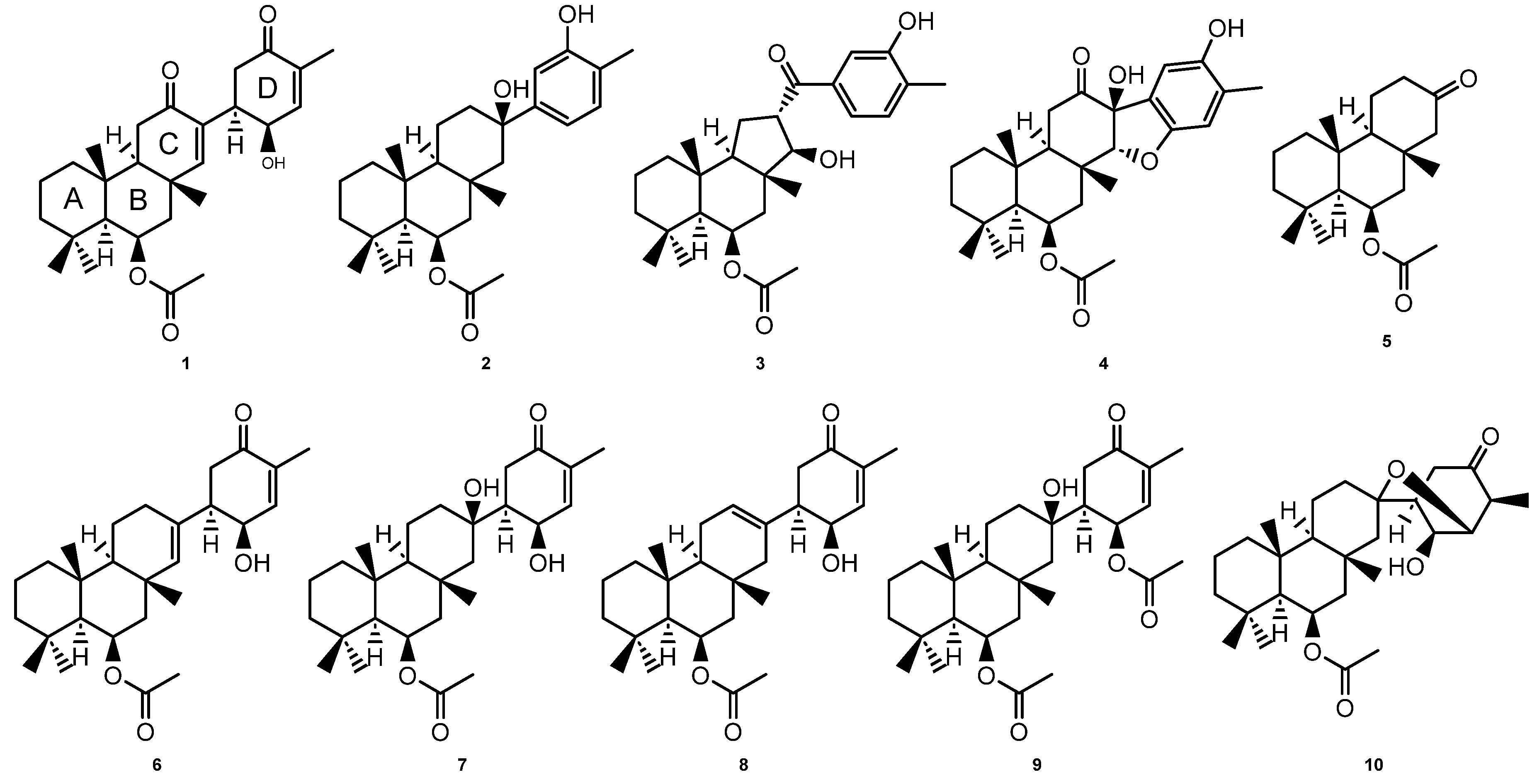
Figure 2.
Key COSY (bold) and HMBC (arrow) correlations of suberitenone K (1).
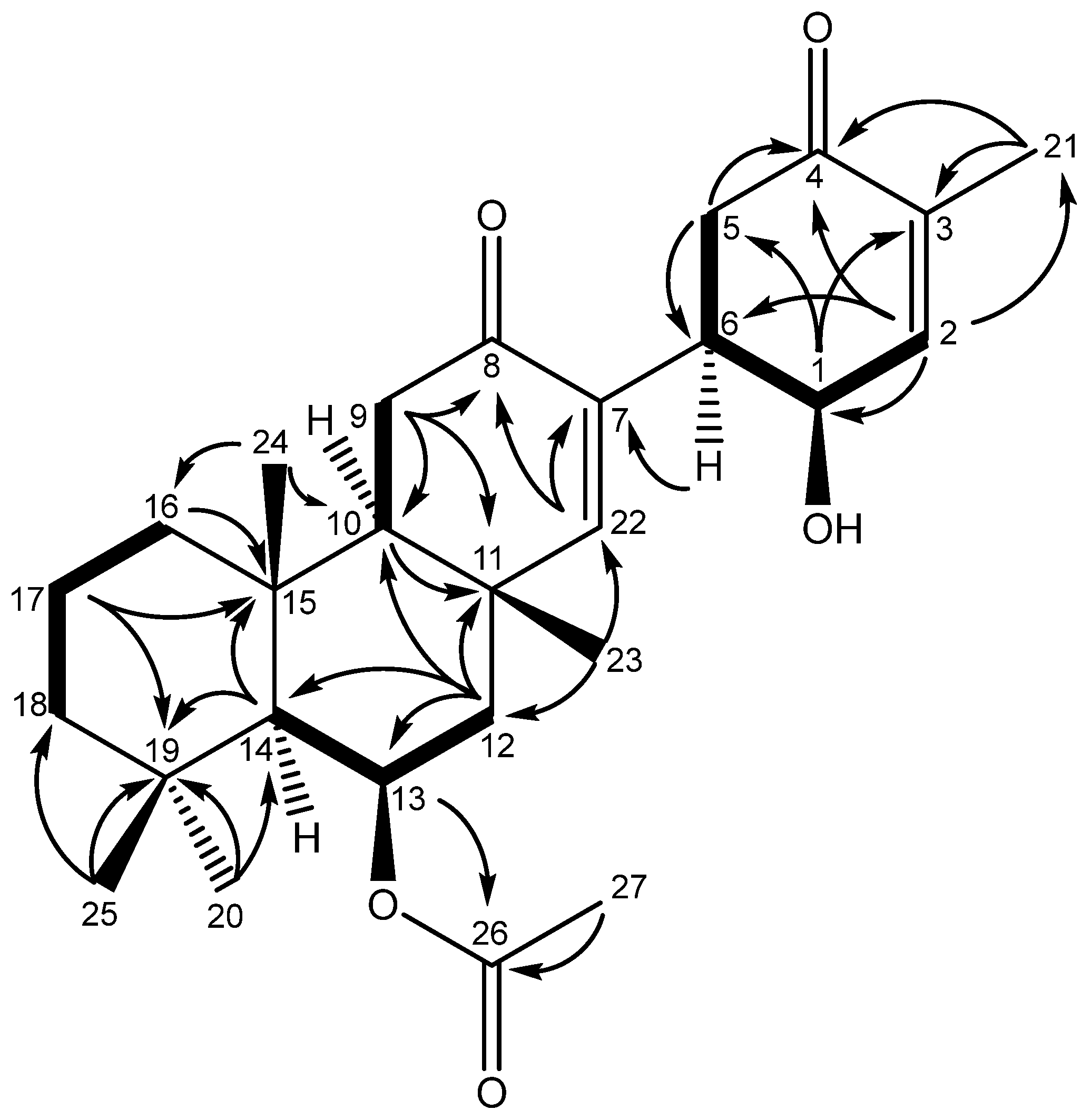
Figure 3.
Key COSY (bold) and HMBC (arrows) correlations of suberitandiol (2), highlighting changes in ring C.
Figure 3.
Key COSY (bold) and HMBC (arrows) correlations of suberitandiol (2), highlighting changes in ring C.
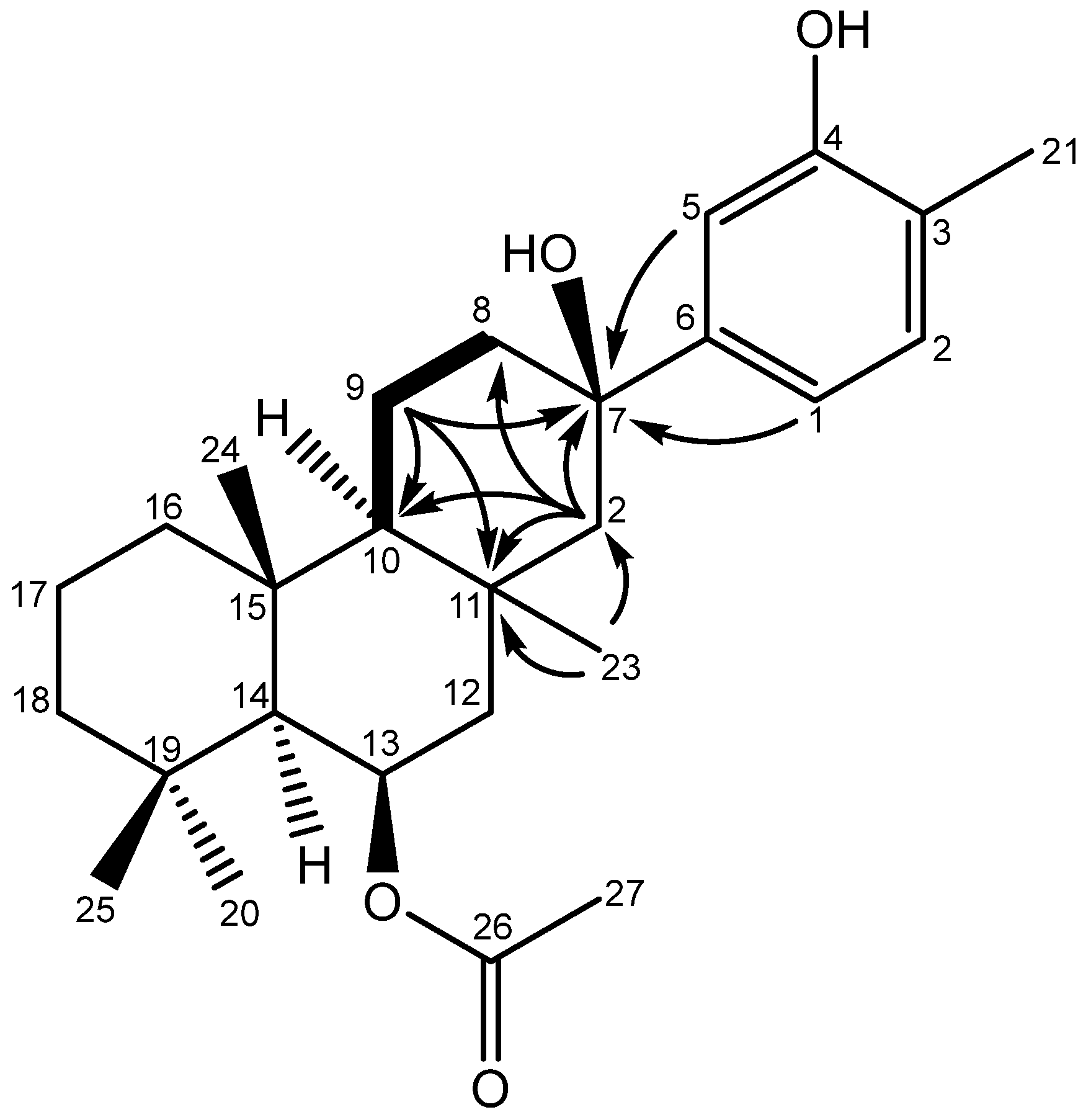
Figure 4.
Key COSY (bold) and HMBC (arrow) correlations of abeosuberitandiol (3) , highlighting changes in ring.
Figure 4.
Key COSY (bold) and HMBC (arrow) correlations of abeosuberitandiol (3) , highlighting changes in ring.
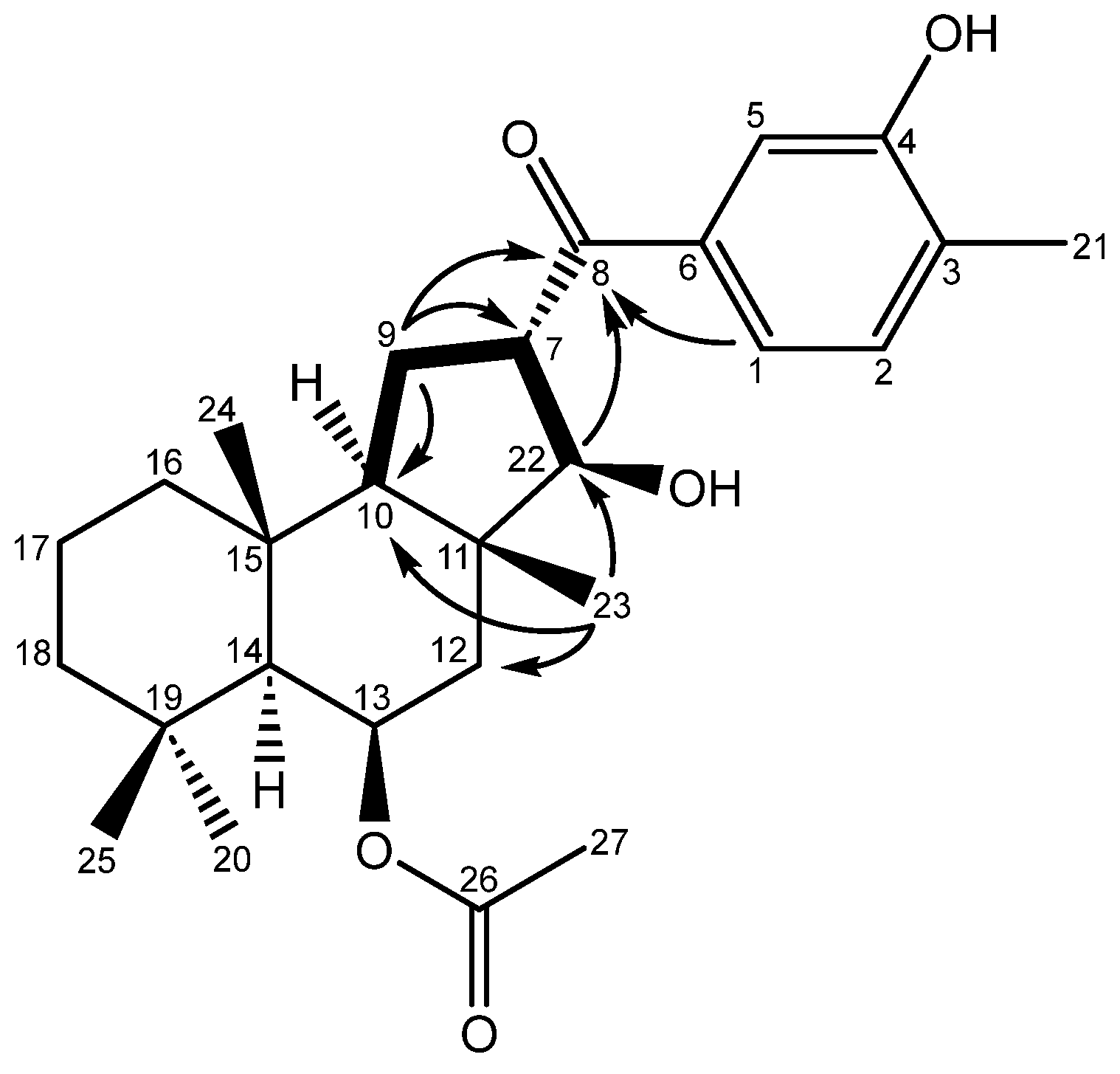
Figure 5.
Key COSY (bold) and HMBC (arrow) correlations of furanosuberitandiol (4), highlighting changes in ring C and D.
Figure 5.
Key COSY (bold) and HMBC (arrow) correlations of furanosuberitandiol (4), highlighting changes in ring C and D.
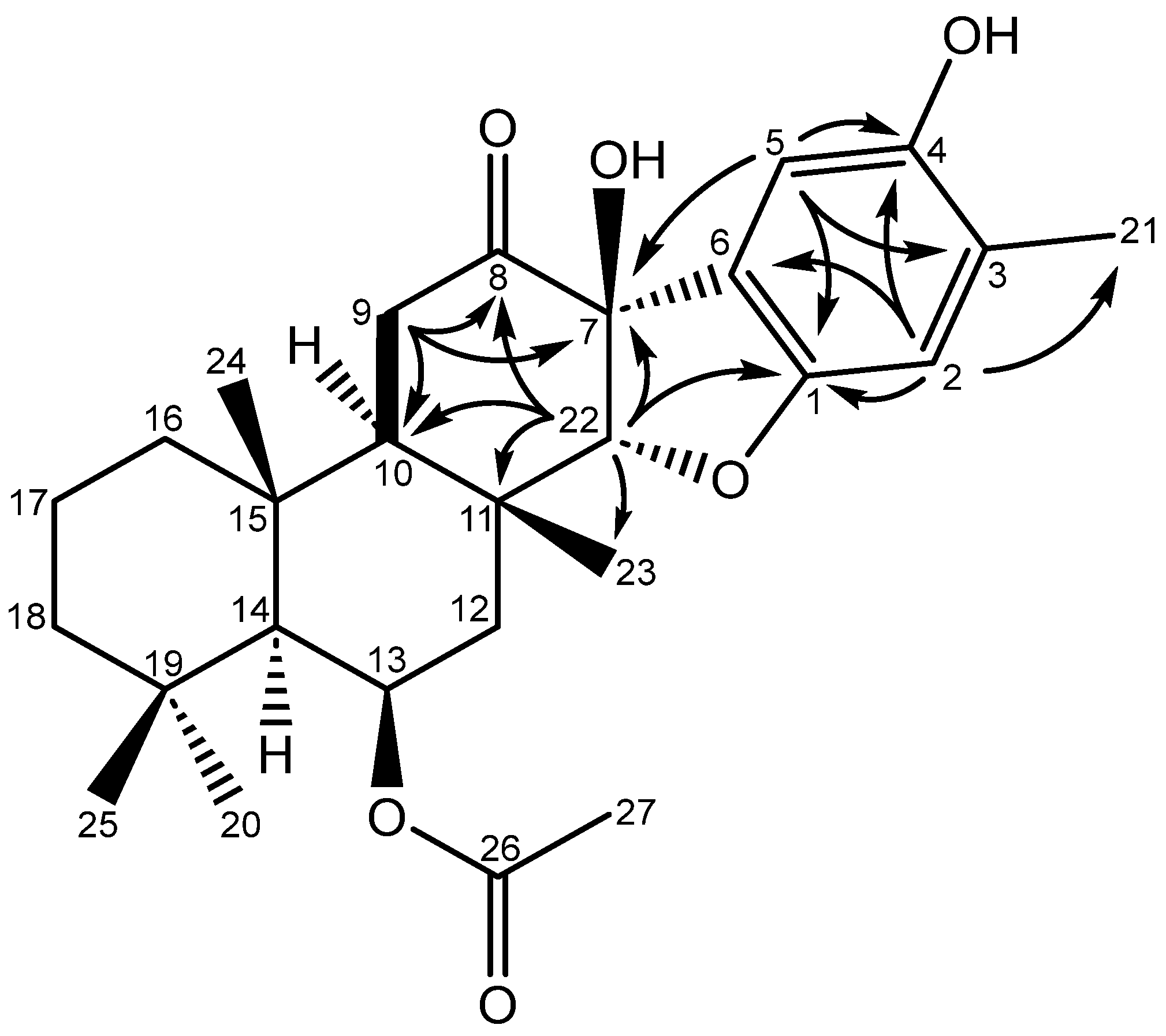
Figure 2.
(a) Key COSY (bold) and HMBC (arrow) correlations of 5; (b) XRD of 5.
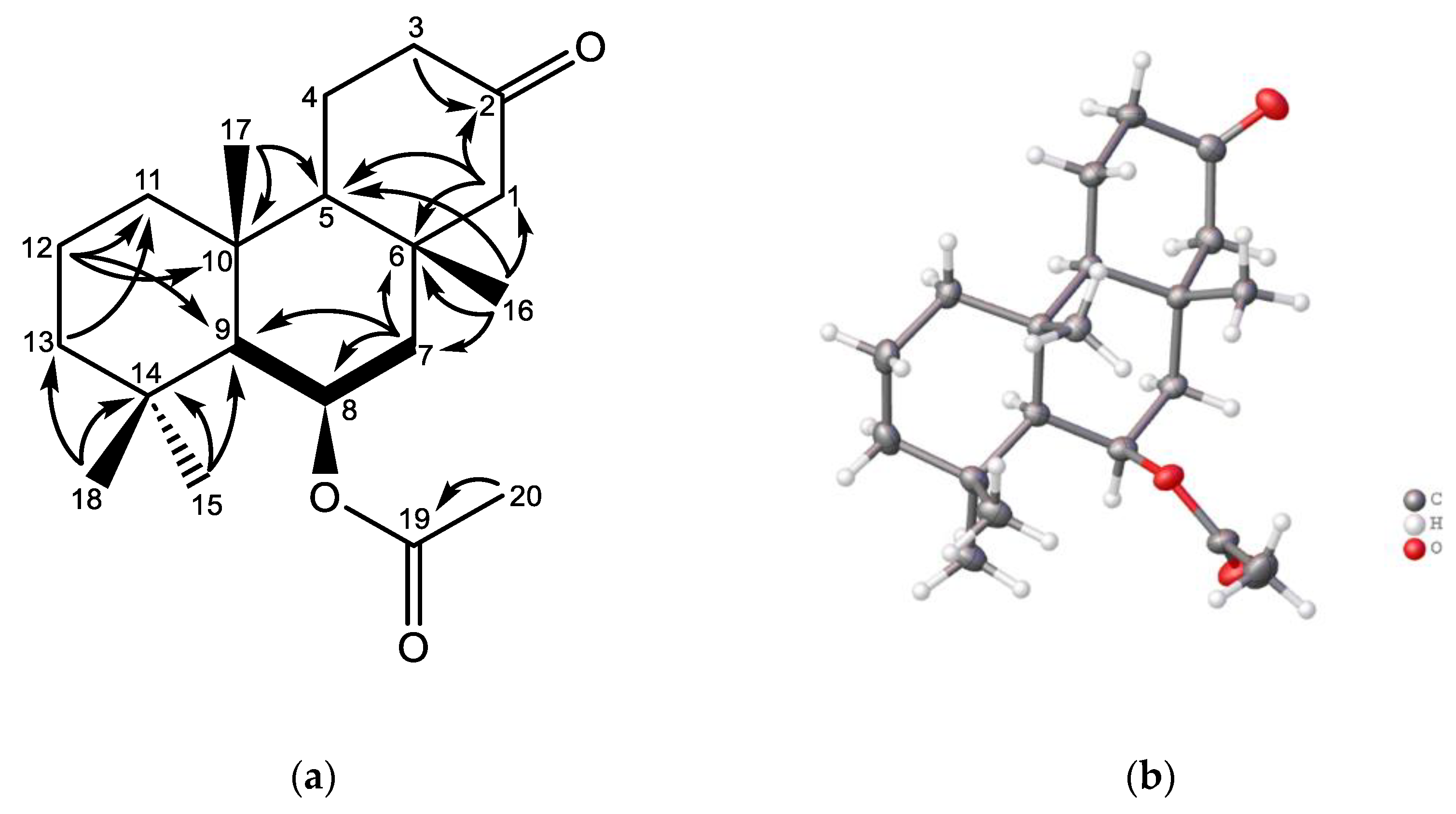
Figure 7.
Proposed biogenesis of compounds 1-5.
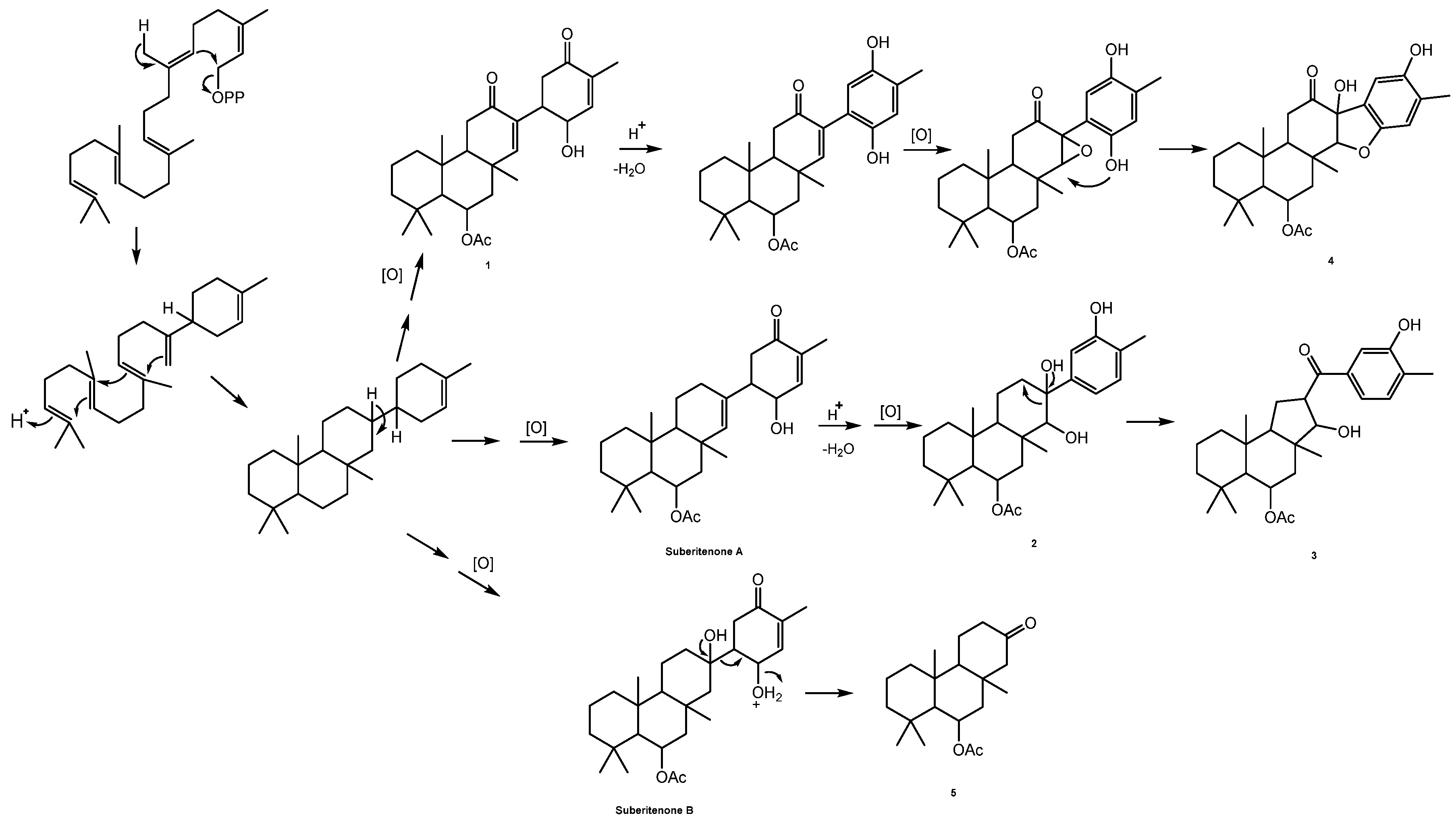

Table 1.
NMR Data for Suberitenone K (1) (600 (1H) and 150 (13C) MHz, MeOD).
| Position | δC, type | δH (mult., (J)) | gCOSY | gHMBC |
|---|---|---|---|---|
| 1 | 65.2, CH | 4.25, dd (4.5, 5.0) | 2, 6 | 2, 3, 5 |
| 2 | 145.3, CH | 6.80, dq (1.3, 5.6) | 1, 21 | 1, 4, 6, 21 |
| 3 | 137.2, C | |||
| 4 | 202.2*, C | |||
| 5a | 37.6, C | 2.75, dd (13.5, 16.1) | 5b, 6 | 1, 4, 6, 7 |
| 5b | 2.15, dd (3.5, 16.1) | 5a, 6 | 1, 3, 4, 6, 7 | |
| 6 | 38.5, CH | 3.35, o/l* | 1, 5a, 5b | 1, 5, 7, 22 |
| 7 | 134.2, C | |||
| 8 | 202.1*, C | |||
| 9a | 35.6, CH2 | 2.52, d (12.6) | 9b, 10 | 8, 10, 11 |
| 9b | 2.50, d (4.9) | 9a, 10 | ||
| 10 | 54.9, CH | 1.96, dd (5.4, 12.5) | 9a, 9b | 8, 9, 11, 22, 23, 24 |
| 11 | 37.7, C | |||
| 12a | 43.9, CH2 | 2.06, o/l* | 12b, 13 | 10, 11, 13, 14, 22, 23 |
| 12b | 1.66, o/l* | 12a, 13 | 11, 22, 23 | |
| 13 | 72.0, CH | 5.59, ddd (2.6, 2.8, 2.9) | 12a, 12b, 14 | 12, 14, 26 |
| 14 | 57.3, CH | 1.23, o/l* | 13 | 15, 19, 20, 24 |
| 15 | 38.2, C | |||
| 16a | 42.2, CH2 | 1.69, o/l* | 16b, 17a, 17b | 15 |
| 16b | 0.98, o/l* | 16a, 17a, 17b | ||
| 17a | 19.5, CH2 | 1.81, o/l* | 16a, 16b, 17b, 18a, 18b | |
| 17b | 1.51, qd (3.1, 14.3) | 16a, 16b, 17a, 18a, 18b | 15, 19 | |
| 18a | 45.3, CH2 | 1.41, ddd (3.5, 4.0, 12.9) | 17a, 17b, 18b | 16 |
| 18b | 1.26, o/l* | 17a, 17b, 18a | ||
| 19 | 35.1, C | |||
| 20 | 33.3, CH3 | 0.94, s | 14, 18, 19, 25 | |
| 21 | 15.7, CH3 | 1.79, s | 2, 3, 4 | |
| 22 | 160.7, C | 6.40, s | 6, 7, 8, 10, 12, 23 | |
| 23 | 20.9, CH3 | 1.29, s | 10, 11, 12, 22 | |
| 24 | 17.4, CH3 | 1.34, s | 10, 14, 15, 16 | |
| 25 | 23.7, CH3 | 1.06, s | 14, 18, 19, 20 | |
| 26 | 172.1, C | |||
| 27 | 21.9, CH3 | 2.07, s | 26 |
* Overlapping 1H and 13C NMR signals, 2D assignments based on proximity likelihood.
Table 2.
1H and 13C NMR Data for 2-4 (400 (1H) and 100 (13C) MHz, CDCl3).
| Position | 2 | 3 | 4 | |||
|---|---|---|---|---|---|---|
| δC, type | δH (mult., (J)) | δC, type | δH (mult., (J)) | δC, type | δH (mult., (J)) | |
| 1 | 116.6, CH | 6.90, d (7.8) | 121.4, CH | 7.43, dd (1.0, 7.9) | 155.3, C | |
| 2 | 130.7, CH | 7.07, d (7.9) | 131.0, CH | 7.19, d (7.8) | 112.1, CH | 6.70, s |
| 3 | 122.0, C | 130.6, C | 128.4, C | |||
| 4 | 153.6, C | 154.2, C | 148.4, C | |||
| 5 | 111.4, CH | 6.94, s | 114.5, CH | 7.41, d (1.0) | 109.7, CH | 6.42, s |
| 6 | 149.5, C | 136.0, C | 124.2, C | |||
| 7 | 74.4, C | 50.1, CH | 3.58, ddd (4.0, 7.9, 11.9) | 83.3, C | ||
| 8 | 41.1, CH2 | 1.90, o/l* | 202.1, C | 210.8, C | ||
| 9a | 17.5, CH2 | 1.86, o/l* | 26.2, CH2 | 2.09, o/l* | 33.9, CH2 | 2.48, dd (10.6, 19.0) |
| 9b | 1.69, o/l* | 1.66, ddd (3.0, 3.5, 12.8) | 2.33, dd (19.1, 9.0) | |||
| 10 | 58.9, CH | 1.06, o/l* | 56.4, CH | 1.30, dd (7.1, 12.9) | 45.9, CH | 1.88, t (9.6) |
| 11 | 34.8, C | 43.1, C | 38.3, C | |||
| 12a | 46.7, CH2 | 1.92, o/l* | 42.6, CH2 | 2.18, dd (2.1, 14.5) | 38.9, CH2 | 2.29, dd (4.2, 15.1) |
| 12b | 1.27, o/l* | 1.39, o/l* | 1.82, dd (2.4, 15.0) | |||
| 13 | 70.6, CH | 5.49, dt (2.5, 3.1) | 70.7, CH | 5.51, br dt (2.4, 2.5) | 69.8, CH | 5.64, td (2.1, 3.7) |
| 14 | 56.8, CH | 1.08, d (2.1) | 57.5, CH | 1.01, o/l* | 55.2, CH | 1.04, d (1.6) |
| 15 | 37.2, C | 36.9, C | 37.4, C | |||
| 16a | 41.9, CH2 | 1.82, o/l* | 41.5, CH2 | 1.40, o/l* | 41.8, CH2 | 1.37, o/l* |
| 16b | 0.92, o/l* | 0.94, o/l* | 0.76, dt (2.8, 12.2) | |||
| 17a | 18.6, CH2 | 1.75, o/l* | 18.1, CH2 | 1.70, o/l* | 18.1, CH2 | 1.62, m |
| 17b | 1.50, o/l* | 1.41, o/l* | 1.37, o/l* | |||
| 18a | 44.3, CH2 | 1.39, o/l* | 44.3, CH2 | 1.39, o/l* | 43.6, CH2 | 1.36, o/l* |
| 18b | 1.20, o/l* | 1.20, o/l* | 1.17, dd (2.5, 13.7) | |||
| 19 | 34.1, C | 33.7, C | 33.8, C | |||
| 20 | 32.9, CH3 | 0.94, s | 33.0, CH3 | 0.92, s | 33.1, CH3 | 0.98, s |
| 21 | 15.3, CH3 | 2.23, s | 16.1, CH3 | 2.30, s | 16.6, CH3 | 2.23, s |
| 22a | 57.2, CH2 | 1.59, d (14.3) | 83.5, CH | 4.02, d (7.8) | 97.4, CH | 4.19, s |
| 22b | 1.51, o/l* | |||||
| 23 | 22.7, CH3 | 1.43, s | 14.2, CH3 | 1.16, s | 18.9, CH3 | 1.00, s |
| 24 | 17.3, CH3 | 1.25, s | 16.7, CH3 | 1.26, s | 16.3, CH3 | 1.26, s |
| 25 | 23.0, CH3 | 1.03, s | 22.9, CH3 | 1.02, s | 23.2, CH3 | 1.00, s |
| 26 | 170.6, C | 170.4, C | 170.2, C | |||
| 27 | 21.9, CH3 | 2.07, s | 21.8, CH3 | 2.08, s | 21.8, CH3 | 2.06, s |
* Overlapping 1H NMR signals, 2D assignments based on proximity likelihood.
Table 3.
RSV antiviral activity (IC50).
| Compound | IC50 (μM) |
|---|---|
| 1 | 41.8 |
| 2 | >50 |
| 3 | >50 |
| 4 | >50 |
| 5 | >50 |
| 9 | 15.1 |
Disclaimer/Publisher’s Note: The statements, opinions and data contained in all publications are solely those of the individual author(s) and contributor(s) and not of MDPI and/or the editor(s). MDPI and/or the editor(s) disclaim responsibility for any injury to people or property resulting from any ideas, methods, instructions or products referred to in the content. |
© 2024 by the authors. Licensee MDPI, Basel, Switzerland. This article is an open access article distributed under the terms and conditions of the Creative Commons Attribution (CC BY) license (http://creativecommons.org/licenses/by/4.0/).
Copyright: This open access article is published under a Creative Commons CC BY 4.0 license, which permit the free download, distribution, and reuse, provided that the author and preprint are cited in any reuse.


