
Submitted:
05 November 2024
Posted:
05 November 2024
You are already at the latest version
Abstract
The title compound, trans-11-(3,4-dimethoxyphenyl)-2,3,8,9-tetramethoxy-6-oxo-11,12-dihydro-6H-dibenzo[c,h]chromene-12-carboxylic acid (4), was synthesized for the first time via a two-step protocol from 3,4-dimethoxyhomophthalic anhydride (1) and 3,4-dimethoxybenzaldehyde (DMBA). In the first step, 1 reacts with DMBA to give trans-3-(3,4-dimethoxyphenyl)-6,7-dimethoxy-1-oxo-3,4-dihydro-1H-2-benzopyran-4-carboxylic acid (2), which further reacts with additional two equivalents of 1 to give 4. Compound 4 was characterized by means of spectral methods - 1H-, 13C-, DEPT-135-NMR, and HRMS.
Keywords:
6H-dibenzo[c
; h]chromenes
; domino reaction
; anhydride
; methoxy groups
1. Introduction
Homophthalic anhydride (HA) possesses both nucleophilic and electrophilic properties, allowing it to react specifically with various reagents [1,2,3]. Previous research on tandem reactions utilizing HA as a building block has shown that most proceed through detectable and stable intermediates [4,5]; consequently, exploring their reactivity allows for studying the scope and limitations of these domino reactions and the synthesis of novel complex compounds in a controlled manner. A previous article showed that a domino reaction between unsubstituted HA with aromatic aldehydes results in tetracyclic, steroid-like compounds containing dibenzo[c,h]chromene moiety [6]. Such compounds have been shown to possess important bactericidal properties [7,8,9,10] and potential antiestrogen activity [11].
The methoxy group is frequently presented as a fragment in various natural products, and medicinal chemists have increasingly incorporated this functional group into synthetic pharmaceuticals, acknowledging its benefits concerning ligand-target binding, physicochemical characteristics, and essential ADME (Absorption, Distribution, Metabolism, and Excretion) properties [12]. Attempting to find novel compounds with antiestrogenic activity, herein we present for the first time the synthesis of highly methoxy-substituted trans-11-(3,4-dimethoxyphenyl)-2,3,8,9-tetramethoxy-6-oxo-11,12-dihydro-6H-dibenzo[c,h]chromene-12-carboxylic acid (4).
2. Results and Discussion
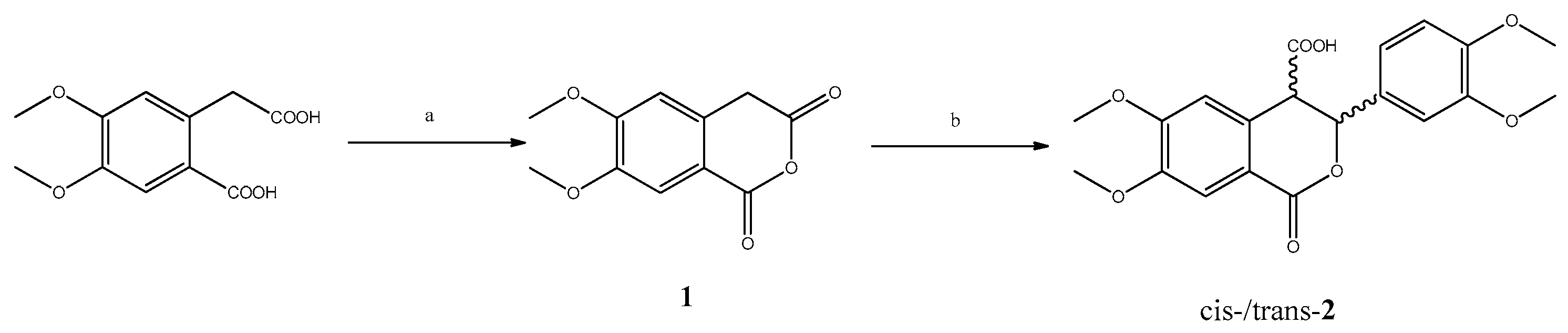
The synthesis of 4 was accomplished via a two-step synthetic procedure, as depicted in Scheme 1 and Scheme 2. In the first step (Scheme 1), we obtained trans-3-(3,4-dimethoxyphenyl)-6,7-dimethoxy-1-oxo-3,4-dihydro-1H-2-benzopyran-4-carboxylic acid (2) by reacting 6,7-dimethoxyhomophtalic anhydride (1) with 3,4-dimethoxybenzaldehyde in the presence of 4-N,N-dimethylaminopyridine (DMAP) [13]. This step proceeds smoothly, giving a diastereomeric mixture of cis- and trans-2 in a ratio of 1:4 in favor of trans-2.
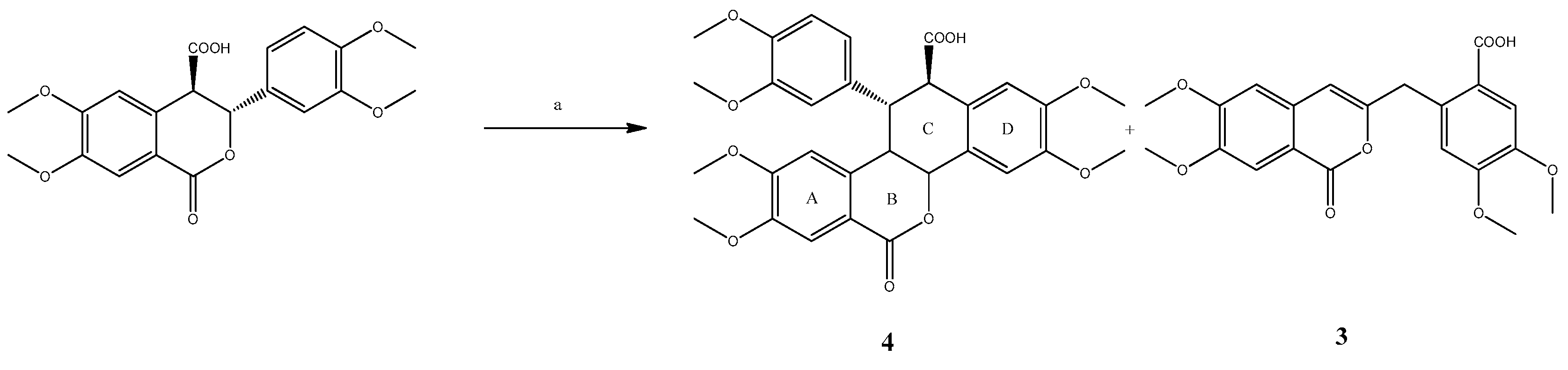
After separating from its cis isomer, we reacted trans-2 with two additional equiv. of 1 (Scheme 2). The initial investigation of this reaction showed that 1 reacts preferably with itself, giving the dimeric compound 3 [1,14]. However, the portion-wise addition of 1 (0.33 equiv. every 20 min) minimizes, to some extent, the self-dimerization reaction, thus allowing the formation of the target compound 4. Notably, the somewhat harsh reaction conditions (100 °C, pyridine) lead to partial demethylation, resulting in a 3-8% compound loss. This phenomenon can be partially elucidated through existing literature [15]. As a result, the yield of compound 4 is additionally reduced; however, it was successfully isolated in pure crystalline form following column chromatography, and its structure was unequivocally confirmed using various NMR techniques (1H-, 13C-, DEPT-135), and mass spectrometry (HRMS), available as Supplementary materials. The trans configuration of compound 4 was validated by the singlet signals for the methyne protons (ring C) observed in the 1H-NMR spectrum. According to the Karplus equation [16], this observation suggests a torsion angle between the protons of approximately 80-90°, indicating an antiperiplanar (diaxial) conformation for the bulky substituents (aryl and carboxylate groups). This finding aligns with previously reported data [6].
To summarize, a steroid-like compound with a high degree of methoxy substitution—suggesting improved biological activity—was synthesized from readily available and inexpensive starting materials through a two-step protocol that involved two domino reactions. This research demonstrates the usefulness of homophthalic anhydride in constructing complex molecules with potential medicinal applications, particularly due to the advantageous methoxy group. Further studies on the biological activity of compound 4, especially its potential as an antiestrogen, are currently underway.
3. Materials and Methods
General: All NMR spectra were recorded in DMSO-d6 on a Bruker Avance III HD 500 operating at 500.13 MHz for 1H and 125.76 MHz for 13C. Chemical shifts are reported in ppm. Reactions were monitored by thin-layer chromatography (TLC) on silica gel aluminum sheets ALUGRAM SIL G/UV254 using an Ethyl Acetate/Petroleum Ether (3:2 v/v) eluent. Column chromatography was carried out with a 1:1 Ethyl Acetate/n-heptane mobile phase on silica gel (0.04 – 0.063 Kieselgel 60) as a stationary phase. High-Resolution Mass Spectra (HRMS) were obtained on a Shimadzu LCMS-9050. All chemicals used in this study were purchased from Sigma-Aldrich (FOT, Sofia, Bulgaria). The organic solvents were of analytical grade. 6,7-Dimethoxy-4H-isochromene-1,3-dione (1) and trans-3-(3,4-dimethoxyphenyl)-6,7-dimethoxy-1-oxoisochroman-4-carboxylic acid (trans-2) were obtained as shown on Scheme 1.
3.1. trans-11-(3,4-dimethoxyphenyl)-2,3,8,9-tetramethoxy-6-oxo-11,12-dihydro-6H-dibenzo[c,h]chromene-12-carboxylic acid (4):
0.640 g (1.648 mmol) of trans-3-(3,4-dimethoxyphenyl)-6,7-dimethoxy-1-oxoisochroman-4-carboxylic acid (trans-2) were dissolved in 10 mL of pyridine and the reaction mixture was heated up to 100° C. 0.732 g (3.296 mmol) of 6,7-dimethoxy-4H-isochromene-1,3-dione (1) were then added portion-wise within 2 h (0.33 equiv. per 20 min) and the reaction mixture was left overnight. After cooling, the mixture was diluted with ethyl acetate and washed consecutively with 10% HCl, water, and 5% NaHCO3. The bicarbonate layer was then acidified (10% HCl) and extracted with ethyl acetate. The organic layer was washed with water to pH ~7, dried over Na2SO4, and then subjected to column chromatography to yield 110 mg (14%) of trans-4. White solid, 1H-NMR (500.13 MHz, DMSO) δ 3.61-3.62 (3H, s, OMe), 3.66-3.67 (3H, s, OMe), 3.75 (3H, s, OMe), 3.83-3.84 (3H, s, OMe), 3.87-3.88 (3H, s, OMe), 3.89-3.90 (3H, s, OMe), 3.92 (1H, s, 12-H), 4.97 (1H, s, 11-H), 6.47-6.50(1H, dd, ArH), 6.97 (1H, s, ArH) , 7.05 (1H, s, ArH), 7.07-7.08(1H, d, ArH), 7.31 (1H, s, ArH), 7,57 (1H, s, ArH), 12.52-12.71 (1H, s, COOH); 13C-NMR: δ 173.7, 161.04, 155.6, 150.05, 149.55, 149.15, 148.85, 148.23, 147.21, 133.55, 132.8, 125.55, 121.03, 119.25, 114.60, 113.40, 112.21, 112.05, 110.17, 110.10, 105.45, 104.63, 56.54, 56.33, 56.11, 56.09, 55.89, 55.74, 51.26 m.p.: 135-137 °C; HRMS (ESI) m/z calculated for [M+H]+ C30H29O10+: 549.1760, found ; [M+H]+ 549.17722.
Supplementary Materials
Figure S1 1H-NMR: Spectrum of Compound 4 in DMSO-d6, Figure S1a: 1H-NMR Spectrum of Compound 4 in DMSO-d6; Figure S2 13C-NMR Spectrum of Compound 4 in DMSO-d6; Figure S3 DEPT-135-NMR Spectrum of Compound 4 in DMSO-d6; Figure S4 HRMS ESI Spectrum of Compound 4;
Author Contributions
Conceptualization, M.B. and V.A.; methodology, М.B.; validation, V.A. and S.S.; investigation, V.A.; data curation, S.S.; writing—original draft preparation, V.A.; writing—review and editing, V.A., S.S. and M.B.; visualization, V.A.; supervision, S.S.; resources, M.B.; funding acquisition, M.B. All authors have read and agreed to the published version of the manuscript.
Funding
This research received no external funding.
Data Availability Statement
The data presented in this study are available in this article and supporting Supplementary Materials.
Conflicts of Interest
The authors declare no conflicts of interest.
References
- González-López, M., & Shaw, J. T. (2009). Cyclic Anhydrides in Formal Cycloadditions and Multicomponent Reactions. In Chemical Reviews (Vol. 109, Issue 1, pp. 164–189). American Chemical Society (ACS). [CrossRef]
- Moshnenko, N., Kazantsev, A., Bakulina, O., Dar’in, D., & Krasavin, M. (2022). The Use of Aryl-Substituted Homophthalic Anhydrides in the Castagnoli–Cushman Reaction Provides Access to Novel Tetrahydroisoquinolone Carboxylic Acid Bearing an All-Carbon Quaternary Stereogenic Center. In Molecules (Vol. 27, Issue 23, p. 8462). MDPI AG. [CrossRef]
- Liu, J., Wang, Z., Levin, A., Emge, T. J., Rablen, P. R., Floyd, D. M., & Knapp, S. (2014). N-Methylimidazole Promotes the Reaction of Homophthalic Anhydride with Imines. In The Journal of Organic Chemistry (Vol. 79, Issue 16, pp. 7593–7599). American Chemical Society (ACS). [CrossRef]
- Tietze, L. F., Brasche, G., & Gericke, K. M. (2006). Domino Reactions in Organic Synthesis. Wiley. [CrossRef]
- Beck, D. E., Agama, K., Marchand, C., Chergui, A., Pommier, Y., & Cushman, M. (2014). Synthesis and Biological Evaluation of New Carbohydrate-Substituted Indenoisoquinoline Topoisomerase I Inhibitors and Improved Syntheses of the Experimental Anticancer Agents Indotecan (LMP400) and Indimitecan (LMP776). In Journal of Medicinal Chemistry (Vol. 57, Issue 4, pp. 1495–1512). American Chemical Society (ACS). [CrossRef]
- Bogdanov, M. G., Mitrev, Y., & Tiritiris, I. (2010). New Highly Diastereoselective Perkin/Michael Addition Domino Reaction between Homophthalic Anhydride and Aromatic Aldehydes: A Facile Approach to Blue-Fluorescent Diben-zo[c,h]chromenones. In European Journal of Organic Chemistry (Vol. 2011, Issue 2, pp. 377–384). Wiley. [CrossRef]
- Pramanik, S., Jash, M., Mondal, D., & Chowdhury, C. (2019). Palladium-Catalyzed Synthesis of 6H-Dibenzo[c,h]chromenes and 5,6-Dihydrobenzo[c]phenanthridines: Application to the Synthesis of Dibenzo[c,h]chromene-6-ones, Benzo[c]phenanthridines, and Arnottin I. In Advanced Synthesis & Catalysis (Vol. 361, Issue 22, pp. 5223–5238). and studies cited within. [CrossRef]
- Misra, R., Tritch, H. R., & Pandey, R. C. (1985). Defucogilvocarcin V, a new antibiotic from Streptomyces arenae 2064: Isolation, characterization, partial synthesis and biological activity. In The Journal of Antibiotics (Vol. 38, Issue 9, pp. 1280–1283). Japan Antibiotics Research Association. [CrossRef]
- Oyola, R., Arce, R., Alegria, A. E., & Garcia, C. (1997). Photophysical Properties of Gilvocarcins V and M and Their Binding Constant to Calf Thymus DNA. In Photochemistry and Photobiology (Vol. 65, Issue 5, pp. 802–810). Wiley. [CrossRef]
- Sehgal, S. N., Czerkawski, H., Kudelski, A., Pandev, K., Saucier, R., & Vézina, C. (1983). Ravidomycin (AY-25,545),a new antitumor antibiotic. In The Journal of Antibiotics (Vol. 36, Issue 4, pp. 355–361). Japan Antibiotics Research Association. [CrossRef]
- Albert, L. M., Mewshaw, R. E., Edsall, R. J., Cohn, S. T., Harris, H. A., & Keith, J. C. (2002). Substituted 6h-dibenzo[c,h]chromenes as estrogenic agents EP1453820B1.
- Chiodi, D., & Ishihara, Y. (2024). The role of the methoxy group in approved drugs. In European Journal of Medicinal Chemistry (Vol. 273, p. 116364). Elsevier BV. [CrossRef]
- Bogdanov, M. G., & Palamareva, M. D. (2004). cis/trans-Isochromanones. DMAP induced cycloaddition of homophthalic anhydride and aldehydes. In Tetrahedron (Vol. 60, Issue 11, pp. 2525–2530). Elsevier BV. [CrossRef]
- Karnik, M.; Usgaonkar, R.N. (1974). Indian Journal of Chemistry (Vol. 12, p.573).
- Schmid, C. R., Beck, C. A., Cronin, J. S., & Staszak, M. A. (2004). Demethylation of 4-Methoxyphenylbutyric Acid Using Molten Pyridinium Hydrochloride on Multikilogram Scale. In Organic Process Research & Development (Vol. 8, Issue 4, pp. 670–673). American Chemical Society (ACS). [CrossRef]
- Karplus, M. (1959). Contact Electron-Spin Coupling of Nuclear Magnetic Moments. In The Journal of Chemical Physics (Vol. 30, Issue 1, pp. 11–15). AIP Publishing. [CrossRef]
Scheme 1.
Preparation of cis-/trans-2. a) AcCl, reflux, 2.5h; b) 3,4-dimethoxybenzaldehyde (DMBA), DMAP, CHCl3, r.t., 10 min [6,13];.
Scheme 2.
Synthesis of 4 and dimeric compound 3. a) 2 eq. 1, Pyridine, 100° C.
Disclaimer/Publisher’s Note: The statements, opinions and data contained in all publications are solely those of the individual author(s) and contributor(s) and not of MDPI and/or the editor(s). MDPI and/or the editor(s) disclaim responsibility for any injury to people or property resulting from any ideas, methods, instructions or products referred to in the content. |
© 2024 by the authors. Licensee MDPI, Basel, Switzerland. This article is an open access article distributed under the terms and conditions of the Creative Commons Attribution (CC BY) license (http://creativecommons.org/licenses/by/4.0/).
Copyright: This open access article is published under a Creative Commons CC BY 4.0 license, which permit the free download, distribution, and reuse, provided that the author and preprint are cited in any reuse.


