

Submitted:
31 October 2024
Posted:
01 November 2024
You are already at the latest version
Abstract
Our findings illustrate that CS should be employed as a means of popularizing scientific output, facilitating the promotion of political decision-making processes, and acting as a knowledge broker to reverse consumer behavior towards more environmentally friendly and conducive to SUP usage.
Keywords:
Citizen Science
; Single-Use Plastics
; Circular Economy
; Consumer Behavior
; Stakeholders
; Waste Management
1. Introduction
1.1. Plastic Threat to the Environment and Public Health
The global increase in the use of single-use plastic (SUP) products over the past few decades has resulted in a wide variety of environmental and public health costs [1,2]. The consequences of SUP related consumption and disposal are manifold and pervasive, especially when fragmented to a size of less than approximately 5 mm in diameter. Microplastic particulates infiltrate the atmosphere [3], contaminate water bodies [4,5], and deteriorate flora and fauna in terrestrial and aquatic ecosystems [6,7] eventually become human consumables by entering our food systems [8,9,10].
The release of plastic waste is primarily attributable to improper waste management [11], with multiple sources including tire abrasion [12], textiles [13], cosmetics, paint and many others. Consequently, as microplastics, they may gain access to human bodies by inhalation, ingestion and/or dermal contact, where they may interact with physiological fluids and tissues. Despite the detection of microplastics throughout the human body, including in blood [14], placental tissues [15], breast milk [16], and penile tissues [17], the effect of these particles on human health remains incompletely understood. Nevertheless, there is an emerging body of evidence indicating that the effects of plastic compounds on the human body may not be entirely benign. In fact, the majority of studies have reported negative effects on human health when these compounds come into contact with the body [18].
1.2. Plastic in the Consumption Perspective
In contrast to the prevailing linear production processes associated with the "take-make-waste" paradigm, the circular economy model espouses a holistic approach that encompasses the entire life cycle of a product, in this case plastic, from the initial stage of raw material extraction, through the subsequent phases of design, production, and distribution, to the ultimate stage of recycling and waste management [19,20]. Nevertheless, consumers play a pivotal role in the functioning of a circular economy. They may facilitate the transition to a circular economy by consuming in a sustainable manner and by extending the lifespan of products. Accordingly, the growing preference for conscious product consumption (including plastic) in the European Union is designed to extend the lifespan of products and significantly reduce waste. This is achieved by influencing consumers and establishing specific obligations for producers and traders [21,22]. In contrast, the United States does not have a federal prohibition on SUP. Nevertheless, a multitude of initiatives have been implemented at the city (271 local governments) and state level (e.g., Connecticut, California, Delaware, Hawaii, Maine, New York, Oregon, and Vermont) [23]. However, these ordinances only extend to 9.7% of the country's population [24]. Canada has recently enacted legislation, designated as the "SUP Prohibition Regulations," with the objective of achieving its zero-plastic-waste target by 2030 [25]. The implementation of this regulation is occurring in a phased manner; consequently, the items under examination remain available for purchase and use by consumers at the time of analysis.
1.3. Citizen Plastic & Plastic Threat
The objective of the citizen science (CS) approach is to incorporate the general public outside the scientific community into the research process. This is achieved by enlisting the assistance of citizen volunteers, who contribute information, observations, sample collection, analysis and interpretation of data in a diverse range of studies [26,27]. Over the past three decades, multiple CS initiatives have been established with the majority of these projects focusing on biology, conservation, and ecology (where CS is used as a methodology for data collection), geographic information systems (where public-collected geographic data is used) [28,29], and research related to the social sciences and epidemiology (strengthening public participation in relation to environmental issues and health). A notable recent development is the increasing prevalence of digital platforms for CS, which can effectively increase the quantity of data gathered in a logistically cost-effective way, provided that appropriate protocols, methodology and training are implemented to ensure the quality and reliability of the data [30,31,32,33].
A CS approach to environmental issues has been demonstrated to be an effective method for increasing consumer awareness, understanding, and knowledge of environmental issues [34,35,36,37]. In the context of the COVID-19 health crisis, the appeal of plastic, and SUP in particular, is evident. This is evidenced by a notable decline in research output in 2022 compared to previous years [38]. The pandemic also influenced the perception of SUP as a safer, health-conscious alternative among consumers, which led to a notable surge in its consumption [39,40,41]. Furthermore, the ongoing conflict between Russia and Ukraine has highlighted the utility of plastic as a reliable and secure material in the context of humanitarian assistance, particularly in the context of internationally coordinated aid operations [42]. Consequently, the assumption that plastic is the most convenient and irreplaceable packaging material among consumers is somewhat misguided. Despite an awareness of the detrimental effects of plastic usage on human health and well-being, consumers tend to engage in environmentally unsustainable behaviors when immediate threats to life and health are present.
In spite of the recommendation that scientists engage in public communication to enhance public awareness, researchers themselves are not frequently present in public discourse. Given their other professional and personal commitments, and the lack of support from their home institutions and governments, researchers are understandably reluctant to leave their secure positions to engage in public communication [43]. In the context of the growing threat of plastic pollution, there is a growing concern among consumers. However, they are largely left to their own to educate themselves, with the internet offering information, many of which are inaccurate [44,45]. In light of these circumstances, it is imperative that potential solutions be identified and implemented expeditiously, given the possibility that plastic contamination could double by 2040, resulting in significant adverse consequences. Here, we propose that the configuration of scientific citizenship represents a promising avenue for enhancing awareness of environmental and public health issues, including the threat posed by SUP.
In this study, we evaluate the extent to which SUP issues are addressed by CS initiatives. To this end, we conducted an extensive inventory of plastic related CS projects worldwide, as well as, a self-designed CS project, entitled "Plastic Detectives". Hence, our study aims at: a) collating and analyzing a database of CS projects related to SUP, 2) collecting SUP related behaviors via CS, and 3) assessing whether participation in a specific CS project affects SUP-related attitudes.
2. Methods
2.1. Citizen Science Projects Inventory
The CS inventory collected past and ongoing CS projects relating to plastics via a Google internet search in September 2022, using the predefined keywords "citizen science," "participatory science," “community science,” and combinations of the term "single-use plastic" with one of the previous terms. From that search, the following CS project platforms were identified and utilized: eu-citizen.science (https://eu-citizen.science/), SciStarter (https://scistarter.org/), AnecData (https://www.anecdata.org/), Zooniverse (https://www.zooniverse.org/), and the European Commission's “Citizen Science - Citizens' Data” collection (https://data.jrc.ec.europa.eu/). Only projects with a primary focus on plastic, that provided a sufficient and clear description of their methodology and objective, and that were advertised and presented in English were selected. Projects with little or vague information were excluded. In total, 74 plastic-related CS projects (49 active and 25 completed) were identified (Appendix A) and categorized by location of interest, organizing and funding, focus, data collection method, and scope and distribution.
2.2. The Plastic Detectives Project
The objective of the "Plastic Detectives" project was to gain insight into the consumption of SUP by citizens. To this end, volunteers who demonstrated a commitment to environmental stewardship and a willingness to engage in the project were recruited. Calls to action were posted on a range of CS platforms, including SciStarter, Anecdata and eu-citizen.science, as well as shared on dedicated Facebook and Twitter groups. The groups were identified through the use of keywords, including "sustainable," "plastic-free," "zero-waste," and "plastic," among others. Furthermore, the use of snowball sampling [46] proved an effective method for identifying relevant Twitter accounts with large followings, which were then contacted directly and requested to advertise the project.
Volunteering individuals, hereafter referred to as "Plastic Detectives," were tasked with monitoring the usage of SUP items by individuals in their respective communities. Consequently, they were requested to select individuals (i.e. from their family, a colleague, a partner, or a friend) to observe and categorize the plastic consumed on a daily basis. Data was collected via an online survey conducted using the ArcGIS CS tool, "Survey123," which was available for 140 days, from December 2, 2022, through April 21, 2023. Of particular interest were the quantities and types of SUP (e.g. the use of PET bottles and plastic shopping bags), as well as the specific instances of observed usage. In general, Plastic Detectives could observe as many individuals as they are willing to. No sensitive data was gathered.
The items selected for analysis were chosen due to their high availability and frequency of use, coverage by the EU Directive 2019/904 on the reduction of the impact of certain plastic products on the environment, and their support by previous studies conducted on SUP item consumption. These items include, for example, bags [47], The items included in the study were bottles [48,49,50], straws [51], cups [52], cutlery and containers [53,54,55]. Sanitary items, including gloves, protective masks and shaving razors, as well as bottles, were also included in the survey despite not being affected by the aforementioned directive.
The Plastic Detectives survey was comprised of three sections: (i) the pre-participation survey, (ii) the CS questionnaire, and (iii) the post-participation survey (see Appendix B). The pre- and post-participation surveys required approximately five minutes each to complete, while the CS survey required 10 minutes on average.
The pre- and post-participation surveys comprised three demographic questions (age, country of residence, gender), a request to rank SUP stakeholders by importance (producers, politicians, consumers, scientists, recyclers and journalists), and a question regarding the feasibility of living without SUPs, presented as a Likert item and an open-ended question.
The CS questionnaire could be filled in multiple times. It first asked some demographic details about the observed person (age, country of residence, gender, and household size). No sensitive data was gathered. The procedure guaranteed that the observed individuals could not be identified at any point of the study. Then, 12 closed questions regarding the use of the specific SUP item, or its alternatives or behaviours. An 'Other' option was provided to allow participants to share additional thoughts or observatons. In sum, the questionnaire was designed to analyse four categories of SUP related behaviour, which were as follows: 1) use of SUP items, 2) use of single-use non-plastic items, 3) use of multiple-use items, and 4) a lack of use of the item (alternative behavior pattern).
3. Data Analysis
A Wilcoxon signed-rank test for paired samples was employed to ascertain the discrepancy between the pre- and post-participation survey questions. The order of the stakeholders in the answers to the ranking question (PQ2 from Appendix B) was assigned a value between six and one. The higher rank is associated with a higher value, thus creating an index. The difference per stakeholder was then analyzed using the median of the values assigned. In the case of the CS data, each item was subjected to independent analysis on the basis of the number of respondents per question. Furthermore, the mean value for each target was analyzed using the demographic information as defining factors in the model. Answers that fell under four possible ordinal categories were assigned a SUP consumption score on a scale of 1 to 4. A score of 1 indicated that the item under observation was not used by the target, while a score of 4 indicated that the target used a SUP item. Items falling into the other two ordinal categories were assigned scores of 2 and 3, respectively. A lower score indicated a greater distance from the use of SUP items and a closer proximity to behavior conducive to a circular economy (i.e. lower consumption levels). To analyze by age and gender, a Kruskal-Wallis test was employed. All analyses and the generation of figures were conducted using the statistical software package SPSS.
4. Results
4.1. Citizen Science Projects Inventory
Of the CS projects identified in the inventory (N = 74; 66% active, 34% completed), the majority (81%) relate to the pollution or littering from SUPs in or near water bodies, with 70% of these projects focusing on oceans and 11% on ocean shorelines, rivers, and lakes. The remaining projects are not directly associated with water bodies and can be divided into two categories. The first category comprises projects relating to plastic use or litter within a specific location, such as the home, school, or shop. This category accounts for 12% of the total number of projects. The second category comprises projects regarding the whole community or city. This category accounts for 7% of the total number of projects.
A significant proportion of the projects (27%) had a global scope, thereby making them accessible to any citizen scientist, regardless of their geographical location. Seven projects had a regional scope, with three being open to all countries in Europe, two to some countries in Europe, one to many countries in Asia, and one to countries in Africa. Of the projects that were not of global scope, the distribution of these projects across the continents is as follows: Twenty-four percent of the projects were conducted in Europe, 26% in North America, of which three were carried out in the Caribbean, 14% in Asia, 5% in Australia, 3% in South America, and 1% in Africa. Approximately 80% of these projects were executed in the Global North, while of those carried out in the Global South, the highest number were located in Asia.
In general, CS projects pertaining to plastic are spearheaded by a multitude of entities, including non-profit organizations, academic institutions, government bodies, private enterprises, and a combination of these entities. A total of 49% of the analyzed projects were conducted by non-profit organizations, including charities, museums, foundations and funds. A total of 18% of the projects were conducted or funded by academic institutions, while 14% were conducted or funded by government entities. Private companies were involved in 7% of all projects. The joint efforts were undertaken through a variety of grouping arrangements, with the most common being academia and non-profit NGOs (6%). The remaining combinations, which constituted ≤1% of all projects, were also observed: academia and government entities; government entities and private companies; academia, government entities, and non-profit NGOs; academia, non-profit NGOs, and private companies; government entities and non-profit NGOs; and finally, government entities, non-profit NGOs, and private companies.
Almost half (47%) of the projects employed an internal form of data/sample collection, accessible to the public with registration, in the form of a paper questionnaire/survey, Google Forms, or Microsoft Forms. Nevertheless, the most prevalent method of open data collection was through a mobile application exclusively (19%), followed by projects utilising forms provided by a previously referenced CS project platform (15%). Additionally, 12% of projects established a dedicated webpage to facilitate data collection, while 6% of projects provided both a mobile app and a webpage. The most distinctive approach to data and sample collection was through the postal service for a single project (1%).
The majority of the investigated projects (66%) focused on the quantity, distribution and composition of plastic litter. The methodology employed by the majority of these projects was based on the concept of beach clean-up, with a similar structure being applied in each case. Citizens were asked to collect the polluting plastic, record details of what was collected (location, type of plastic, images), share the collected information and dispose of the collected plastic appropriately. The objective was to clean up the litter while simultaneously raising public awareness of the scale of the plastic problem. The second most prevalent area of focus was on microplastics (20%), which were largely structured in a similar manner to the aforementioned group and concentrated on the collection and documentation of data pertaining to the quantity and distribution of microplastics. A total of 9% of the projects were concerned with the consumption of SUPs, with the overarching objective of enhancing awareness of the quantity of plastic used, whether at home or in educational establishments. Two projects (3%) concentrated on animal interactions, with the objective of recording the observed interactions of wild animals with plastics, predominantly in marine environments. Ultimately, one project (1%) requested that citizen scientists document instances of plastic packaging in a retail establishment to ascertain the source of the introduction of plastic packaging into the supply chain of the sold products.
4.2. The Plastic Detectives Project
The website for the "The Plastic Detectives" project received 260 visits, with 177 respondents completing a survey, representing a 68% response rate. The valid entries for the CS project were collected from the following countries: the USA (93 entries), Poland (59 entries), Italy (17 entries), Germany (12 entries), France (11 entries), Canada (10 entries), the Netherlands (2 entries), Belgium (1 entry), and Spain (1 entry). The gender distribution of the targeted individuals is skewed towards women, with 57.6% of the targets being women, 41% men, 0.5% non-binary, and 1% of the individuals did not disclose their gender. The age group with the highest representation was that of 25–34 year olds (29.5%), followed by 18–24 year olds (24.8%), 44–54 year olds (18.1%), 35–44 year olds (11.0%), 55–64 year olds (10.0%), 65–74 year olds (5.2%), and those aged 75 and above (1.4%). With regard to the categories of waste segregation that have been employed, it is observed that plastic is the most frequently segregated category (N = 147 instances), followed by paper (N = 132), glass (N = 121), metals (N = 91) and finally organic matter (N = 88).
The participants in the "Plastic Detectives" project were asked to evaluate their perceptions of the feasibility of living without SUP before and after engaging in the project. No statistically significant difference was identified across all participants (p = 0.087; Figure 1). Only those participants who completed both the pre- and post-participation surveys were included in the analysis (N = 64).
Subsequently, participants were requested to provide a rationale for their score in relation to the feasibility of living without SUPs. In the pre-participation survey (Table 1), the most frequently cited reasons for selecting either response 1 or 2 were the wide availability, convenience and low cost of SUPs. For those who selected the third option, the hygienic qualities of SUPs in the medical and food industries were emphasized, as were their extensive availability, the fact that they are inescapable in certain contexts, and the difficulty of changing consumer behavior. For those who answered 4 or 5, the fact that there are readily available reusable alternatives as well as the necessity for consumer behavior to change were identified as significant factors. Additionally, the historical absence of plastic and the potential for a pre-plastic lifestyle to be re-established were highlighted.
The rationale behind the responses to the question "To what extent is it feasible to live without SUPs?" as presented in the post-survey are outlined in Table 2. Those who selected the first or second option indicated that the extensive accessibility, ease of use, and affordability of SUPs, along with the prevailing societal inclination towards consumerism, influenced their decision. For those who selected the third option, the most frequently cited reason is the level of difficulty involved in transitioning from single-use to reusable items. For those who answered 4 or 5, the fact that there are readily available reusable alternatives, the necessity for consumer behavior to change and the increase in awareness of the problems associated with SUP use were identified as significant factors.
The respondents were requested to assign a ranking to the following groups in order to ascertain their perceived importance in the fight against SUP. In the pre-participation survey, respondents identified producers as the most important group, followed by politicians, consumers, scientists, recyclers, and journalists. This same order is maintained in the post-participation survey (see Table 3 and Figure 2). A comparison of the pre- and post-participation survey responses revealed no statistically significant differences across all stakeholder groups (producers: p = 0.493, scientists: p = 0.116, consumers: p = 0.291, recyclers: p = 0.136, journalists: p = 0.568, politicians: p = 0.814).
5. Discussion
5.1. How CS Reacts to the Plastic Threat?
NGOs are significantly involved in CS projects due to their activist nature and their role in facilitating the interaction between academia and government [56]. It is similarly recognised that governments may employ CS as a conduit for disseminating knowledge, thereby influencing policy decisions [57,58]. The pervasiveness of plastic pollution is evident across all ecosystems, including marine, freshwater, and terrestrial environments, with an unequal distribution of the accumulated plastic burden [59]. This is consistent with the majority of data collection taking place in marine and coastal environments. The contamination of marine ecosystems by plastic debris has its origins on land, with rivers acting as vectors for the transfer of this material from terrestrial to marine environments. Estimates suggest that between 0.41 x 10⁶ and 4 x 10⁶ tons of debris are transported from land to ocean annually [60,61], underscoring the value of CS projects that collect data from water bodies other than oceans and beaches. The accumulation of plastic debris of any size commences inland, particularly in regions exhibiting a pronounced anthropogenic impact [62], underscoring the significance of data collection at the household and community levels [63]. This is particularly pertinent in the context of the advent of the COVID pandemic and the subsequent escalation in the production, consumption and disposal of SUPs [40,64,65].
One of the principal advantages of CS based research methodologies is that they facilitate access to previously inaccessible information. In consequence, a considerable number of the CS projects examined in this study are of a considerable scale, encompassing global, regional and national levels of investigation, and capitalizing on the cost-effective nature of the tool [66]. Europe and the United States are at the vanguard of CS, as evidenced by the findings of Figueiredo et al. [57] and Gura [32]. Notably, the US also has the highest number of identified plastic-related CS projects. While there are Asian countries in which plastic CS projects are based, there is a higher number of CS projects that gather data from Asian countries that would mirror the official statement of the ASEAN (Association of Southeast Asian Nations), which states that its member states are among the world's biggest sources of plastic pollution [67].
The majority of CS projects in our inventory focused on distribution and composition, which is consistent with the findings of previous studies that have utilized CS-gathered data [68,69]. This was followed by microplastics, which have been identified as a threat to aquatic and terrestrial ecosystems [62,70,71]. Nevertheless, research on consumer behavior with regard to plastics remains relatively unexplored. The study of consumer behavior is of great importance in order to gain insight into consumer choices [72]. However, the collection of primary data from consumers (for example, through surveys) is open to question with regard to its validity, due to concerns about the veracity of the information provided [73]. It is therefore valuable to employ the services of citizen scientists as objective data collectors, rather than direct respondents.
5.2. Can a Single CS Project Change the Consumers’ Behavior?
The findings of the "Plastic Detectives" project, which examined the use of plastic grocery bags, indicated that social pressure is a significant factor influencing the transition from plastic to reusable cloth grocery bags [74]. The study posited that individuals are more likely to adopt cloth bags if they observe others in their social circle using them. Furthermore, the implementation of legislative measures, such as the imposition of charges on plastic bags, has been shown to result in an increase in the utilisation of reusable bags [75,76]. This finding could conceivably be extrapolated to other traditionally SUP items that are used publicly, such as straws [51], take-out containers, cutlery [77], and cups [52]. This would support the effectiveness and importance of legislative action to reduce the use of SUP items. A lack of utilisation of an item, as evidenced in the "Plastic Detectives" survey, will result in a reduction in the consumption score. This could explain the lower values for items like straws, which have become a prominent traditionally SUP item that some researchers have proposed as an item that is relatively easy to stop using or to boycott [51,78]. However, if a participant does not directly observe the use of an item, it can be perceived as the target not using it (non-response bias). Consequently, the consumption score calculated for the item and target may not accurately reflect the actual use frequency.
The influence and importance of legislation limiting access to SUP items is supported throughout the literature [75,76,78,79,80], and is a widely accepted measure in society [51,81,82]. Despite the EU SUP Directive's emphasis on banning or limiting SUPs through the introduction of single-use alternatives (e.g., eco-containers made of paper), it does not explicitly endorse the use of reusable items. Nevertheless, the objective of a circular economy approach is to concentrate on the design of products and the prevention of waste. In contrast, Harris et al. [83] did not find a significant reduction in packaging debris on shorelines after the introduction of an extended producer responsibility policy which indirectly reduces access to SUP by shifting the responsibility of a product's waste management to the producers. This policy incentivises a reduction in waste generation, for example through improved product design. However, the most segregated category of recycling is plastics, which suggests the possibility of these SUPs being reincorporated into the economy.
The findings of the "Plastic Detectives" project are based on the observations of citizen scientists, whose accuracy and rigor in data collection are generally comparable to that of professional academics [84,85]. However, in cases that require a high degree of scientific rigour or technical expertise, the quality of the results may be compromised [86,87]. The limitations of the "Plastic Detectives" project are due to the small number of observations, which can be attributed to a low response rate to our interventions to join the project. It is therefore evident that the results are not fully representative of the activities of citizen scientists in relation to plastic, nor are they representative of the demographic and behavioural characteristics of each region. Nevertheless, the findings of this study can be regarded as a preliminary observational inventory, providing insights into the threat of plastic and laying the foundation for future collaborations between academics and citizen scientists. Without the active involvement of the general public in addressing environmental risks, such as those posed by climate change and plastic pollution, it is unlikely that these issues can be resolved effectively [88,89]. To facilitate this process, further research is recommended, employing a larger and more representative sample size, and utilising an improved structure and method of dissemination.
The perception of participants regarding the feasibility of living without SUPs remained consistent between the pre- and post-participation surveys within the project. Although CS has been demonstrated to enhance the knowledge, awareness and understanding of participants [34,35,36,37], it has also been demonstrated to have a negligible impact on behavioral changes [35]. It may therefore be the case that the quantification and realization of the degree of SUP use by those around them was insufficient to effect a change in their perceptions. However, this may also be attributed to their already high environmental awareness, given that their participation in the CS project indicates a preexisting interest in the subject matter. This may also be attributed to the participants' desire to demonstrate that their perceptions have remained unchanged and that they remain firmly committed to their positions (i.e., response shift bias) [90,91,92].
In both the pre- and post-participation surveys, the most frequently cited reasons for why it is realistic to live without SUP are the availability of reusable alternatives and the support of the literature [93,94,95,96]. This concept is further elaborated upon by Heidbreder et al. [51], who found that ethical consumers will not only refuse to purchase products or brands that they do not deem fit but will also engage in what is known as a "buycott" (i.e., they will praise, or promote, alternative products or brands). The notion that consumer behavior change is a key factor in the feasibility of living without SUP places the onus of transitioning to a circular economy on the consumer. This is corroborated by Cowan et al. [81], who determined that consumer behavior and purchasing patterns of SUPs were the primary contributors to plastic pollution. Furthermore, respondents identified this as a rationale for why a SUP-free lifestyle is not a realistic option. The majority of responses to this question indicated that it is a challenging transition. The convenience and low cost of SUP items were identified as the primary reasons for the perceived difficulty of transitioning to reusable items, even when such an option is available. This finding is consistent with the results of Jahani et al. [54], who identified situational influences as a barrier to reducing the use of SUP items. Sanitary properties are a frequently cited reason for the middle-ground rating that respondents provided in response to this problem. In the wake of the global pandemic caused by the SARS-CoV-2 virus, the health benefits of the sterile conditions that SUPs allow have been emphasized by several researchers [97,98,99].
In response to the question of which stakeholders bear responsibility for combating SUPs, the participants identified producers as the most culpable party. This may be attributed to the fact that the life cycle of a SUP item commences at the point of production. It is the responsibility of politicians, or those who create policy, to regulate the availability of SUP items and alternatives. The implementation of bans on SUP items would result in the cessation of production, thereby removing SUP items from the market and preventing consumers from purchasing them. The consumer is regarded as the third most important group in the fight against plastic, which may be due to the fact that regular consumers are more likely to purchase products that are available to them. Nevertheless, research indicates that consumers are aware of their role in addressing plastic pollution [52]. The scientific community, recycling industry, and members of the press are regarded as the least influential stakeholders in this issue. This may be due to their less direct involvement with SUPs compared to the previously mentioned stakeholders, who are regarded as primary groups of interest. This is corroborated by the findings that consumers underscored the significance of consumer behaviour and the necessity for policy, whereas industry stakeholders accorded greater importance to the scientific community [81,100].
6. Conclusions
The present study employs the use of CS to ascertain consumer behaviour with regard to SUP items. This is with a view to measuring the transition from a linear economy to a circular economy in each region. The results demonstrate that the majority of completed and ongoing CS projects concerning plastics have been beach clean-up initiatives, with reporting incorporated with the objective of identifying the distribution and composition of plastic litter. This emphasizes the significance of the interplay between the public, politics and science, as well as its influence on consumer behavior, which can be employed to inform environmental policy and strategy. The collaboration between researchers and the general public offers significant potential for scientific innovation and can facilitate the collection of a more extensive and scientifically validated data set. Furthermore, insights and influences from society can be integrated into research as knowledge brokerage, which can prompt the formulation of new inquiries. Accordingly, if CS is conceived as autonomous involvement in scientific activities, there is the possibility of pioneering avenues for the involvement and impact of social actors in scientific procedures. Moreover, CS has the potential to facilitate the development of novel approaches to science communication, which is crucial for the effective implementation of CS projects and initiatives.
For those engaged in policymaking, CS can constitute an important element in the national discourse aimed at developing solutions to urgent social issues. In this context, it seems essential that representatives from the scientific, political and civil society sectors work together in an efficient and sustainable manner. It is imperative that the involvement of citizens be facilitated from the outset and throughout the entirety of the decision-making process. Consequently, CS provides a valuable opportunity to foster and strengthen the connections between society, politics, and science. In this manner, the objective of promoting sustainable transformation in society can be achieved.
Funding
The publication has been supported by a grant from the National Science Centre, Poland 2020/39/B/HS4/00264.
Appendix A: Table of Projects
| No. | Name of Project | Organizer |
| 1 | Dive Against Debris | PADI Aware |
| 2 | River Survey | The Ocean Clean Up |
| 3 | Ocean Survey | The Ocean Clean Up |
| 4 | Marine Debris Tracker | Morgan Stanley, National Geographic Society and the University of Georgia |
| 5 | International Coastal Cleanup | Ocean Conservancy |
| 6 | Litterati | Litterati |
| 7 | Plastic Pirates - Go Europe | European Union |
| 8 | 2 minute beach clean / 2 minute litter pick up | The 2 Minute Foundation |
| 9 | CoastWatch Micro Litter Survey | European Commission |
| 10 | International Pellet Watch | Laboratory of Organic Geochemistry - University of Agriculture and Technology |
| 11 | Marine LitterWatch | European Environment Agency |
| 12 | The Great Nurdle Hunt | Fidra |
| 13 | The RIMMEL project | European Commission |
| 14 | The Plastic Tide | Zooniverse by The Citizen Science Association |
| 15 | Plastic Origins | Surfrider Foundation Europe |
| 16 | Ocean Initiatives | Surfrider Foundation Europe |
| 17 | Plastic Citizen | University of Hull |
| 18 | No Home for Plastic | VOICE |
| 19 | Stay at Home - Household Waste Audit | S.C.R.A.P. Gallery |
| 20 | #ECOSQUADGOALS | De La Salle University |
| 21 | #OpenLitterMap | GeoTech Innovations |
| 22 | Clean Sea LIFE | Parco Nazionale dell'Asinara |
| 23 | Plastexperiment | Vetenskap & Allmänhet (VA – Public & Science) and University of Gothenburg |
| 24 | Plastic Spotter | Leiden University - Citizen Science Lab |
| 25 | OSPARITO | Surfrider Foundation Europe |
| 26 | Surfing for Science | Universitat de Barcelona, Surfrider Foundation and EarthWatch |
| 27 | Pescadores de Plastico | BETA Technological Center (University of Vic-Central University of Catalonia) |
| 28 | ePollution | eOceans |
| 29 | Tangled in Trash: A Reporting Tool for Wildlife | National Marine Sanctuary Foundation |
| 30 | Shorelines Cleanup | San Antonio Bay Partnership |
| 31 | Nurdle Pratrol | Mission-Aransas National Estuarine Research Reserve |
| 32 | BeachWatch - Plastics Brazil | UFABC |
| 33 | TIDES - Trash Information and Data for Education and solutions | Ocean Conservancy |
| 34 | The Big Microplastic Survey | Just One Ocean & University of Portsmouth |
| 35 | AMDI - Australian Marine Debris Initiative | Tangaroa Blue Foundation |
| 36 | MDMAP - Marine Debris Monitoring and Assessment Project | NOAA |
| 37 | Florida Microplastic Awareness Project | University of Florida and IFAS Extension |
| 38 | Litter-free Digital Journal | South Carolina Aquarium |
| 39 | Plastic Litter Project: Coastal Litter Mapping | University of the Aegean |
| 40 | Microplastics Pollution Monitoring Program | Ocean First Institute |
| 41 | Programa de Monitoreo de Desperdicios Sólidos | LabCom (Reserva Natural Ciénaga Las Cucharillas run by Caras con Causas) |
| 42 | Explosive Shock Tube Data Collection | Center for Coastal Studies |
| 43 | Kinh Tế Sinh Thái Việt Nam | Key-Log Economics |
| 44 | Maine Microplastic Monitoring | Community Environmental Health Lab - MDI Biological Laboratory |
| 45 | Plastic Pollution: Impacts on Wildlife | Cape Eleuthera Institute |
| 46 | OIB Beach Garbage Pickup | Ocean Isle Beach Sea Turtle Protection Organization |
| 47 | Testing Our Waters | Anthropocene.Design |
| 48 | Freshwater Microplastics in Maine | Lakes Environmental Association |
| 49 | Airborne Microplastics | INBRE - Northwest College |
| 50 | Exploring the Marine Microbiome | MDI Biological Laboratory |
| 51 | Eco-Schools Bahamas: Shopping Bag Challenge | Bahamas Reef Environment Educational Foundation (BREEF) |
| 52 | Surfers Against Sewage | Surfers Against Sewage |
| 53 | Beat the Microbead | Plastic Soup Foundation & UNEP |
| 54 | Strengthening and Improving Marine Litter Response in Indonesia | Korean Ministry of Oceans and Fisheries, Korea Marine Environment Management Corporation, Our Sea of East Asia Network (OSEAN), and the Indonesian Waste Platform (IWP) |
| 55 | Mesoplastic on the Polish coast | Institute of Oceanology of the Polish Academy of Sciences and Experiment Science Centre in Gdynia |
| 56 | Break Free From Plastic | Greenpeace |
| 57 | Quantity and type of coastal debris pollution in Taiwan | IndigoWaters Institute and Institute of Marine Affairs and Resources Management |
| 58 | Preventing Plastic Pollution | Interreg France (Channel) England Programme and 18 other orgs |
| 59 | Fish Feed Bag | Plastic Free Seas |
| 60 | Produce Packaging Project | Plastic Free Seas |
| 61 | Citizen Science project in Chile | Carla Wichmann and team |
| 62 | CounterMEASURE | UNEP |
| 63 | Mapping Portsmouth's Plastic | University of Portsmouth |
| 64 | MarineQuest | Univeristy of North Carolina Wilmington and 2TC |
| 65 | Community's Awareness on the Use and Address of Municipal Plastic Waste | The Research Center for Gender, Family, and Environment in Development |
| 66 | Microplastic Detective | Ecological Observation and Wetlands Conservation |
| 67 | Investigation of Plastic Types in Households and Waste Banks | Nexus Foundation for Environmental Health and Development |
| 68 | National Marine Debris | CSIRO |
| 69 | Clean Up Australia's Citizen Science Project | Clean Up Australia |
| 70 | COLLECT – Citizen Observation of Local Litter in Coastal ECosysTems | Partnership for Observation of the Global Ocean |
| 71 | Australian Microplastic Assessment Project | Total Environment Centre |
| 72 | Citizen science on the Waddenzee | The Ocean Movement |
| 73 | Picking Up the Pieces | Environment Climate Change Canada, Ocean Diagnostics |
| 74 | Mass Experiment | Danish National Center for Science Education and Roskilde University |
Appendix B: Surveys & Questionnaire
Pre and Post survey
- PD1.
- Country of residence
- 1.
- France
- 2.
- Germany
- 3.
- Italy
- 4.
- Poland
- 5.
- Other: __________
- PD2.
- Gender
- 1.
- Female
- 2.
- Male
- 3.
- Non-binary
- 4.
- Prefer to not say
- PD3.
- Age
- 1.
- Under 18
- 2.
- 18-24
- 3.
- 25-34
- 4.
- 35-44
- 5.
- 45-54
- 6.
- 55-64
- 7.
- 65-74
- 8.
- 75 and older
- PQ1.
- ‘Please rank the following groups by importance in the fight against single-use plastics’
- a.
- Plastic producers
- b.
- Journalists
- c.
- Consumers
- d.
- Scientists
- e.
- Politicians
- f.
- Recyclers
- PQ2.
- ‘How realistic is it to live without single-use plastics?’ (five-point Likert scale from 1— ‘not realistic at all’ to 5— ‘extremely realistic’)
- PQ3.
- ‘Why do you think so?’ (OQ)
Citizen Science ‘Plastic Detectives’ Questionnaire
- D1.
- ‘Please indicate the city in which you are conducting this investigation’ (GPS location selection)
- D2.
- Gender of the person
- 1.
- Female
- 2.
- Male
- 3.
- Non-binary
- 4.
- Prefer not to say
- D3.
- My relationship to the person
- 1.
- Spouse/Partner
- 2.
- Sibling
- 3.
- Child
- 4.
- Parent
- 5.
- Grandparent
- 6.
- Room-/Flat mate
- 7.
- Friend
- 8.
- Other: __________
- D4.
- Age of the person
- 1.
- Under 18
- 2.
- 18-24
- 3.
- 25-34
- 4.
- 35-44
- 5.
- 45-54
- 6.
- 55-64
- 7.
- 65-74
- 8.
- 75 and older
- D5.
- How many people are living in the same household?
- 1.
- Only this person
- 2.
- 2
- 3.
- 3
- 4.
- 4
- 5.
- 5
- 6.
- more than 5
- Q1.
- ‘Have you seen this person ever use bottles when drinking water?’
- 1.
- Yes
- 2.
- No (Go to Q2)
- Q1.1
- ‘Which bottles are used most often for drinking water?’
- 1.
- single-use plastic bottle
- 2.
- single-use glass bottles
- 3.
- reusable plastic bottles
- 4.
- reusable glass bottles
- 5.
- reusable metal bottles
- 6.
- Others: __________
- Q2.
- ‘Have you seen this person grocery shopping?’
- 1.
- Yes
- 2.
- No (Go to Q3)
- Q2.1.
- ‘How does this person transport groceries most often?’
- 1.
- single-use plastic bags
- 2.
- single-use paper bags
- 3.
- single-use biodegradable bags
- 4.
- reusable plastic bags
- 5.
- reusable textile bags
- 6.
- reusable baskets
- 7.
- Other: __________
- Q2.2.
- ‘What does this person use to transport loose produce most often? (e.g., fruits, vegetables, nuts)’
- 1.
- single-use plastic bags
- 2.
- single-use paper bags
- 3.
- single-use biodegradable bags
- 4.
- reusable plastic bags
- 5.
- reusable textile bags
- 6.
- reusable baskets
- 7.
- Other: __________
- Q3.
- ‘Have you seen this person order take-away food or drinks?’
- 1.
- Yes
- 2.
- No (Go to Q4)
- Q3.1.
- ‘How does this person take away food most often?’
- 1.
- Take-out food boxes and cutlery
- 2.
- own reusable food boxes
- 3.
- Other: __________
- Q3.2.
- ‘How does this person take away beverages most often?’
- 1.
- single-use paper cup
- 2.
- single-use Styrofoam cup
- 3.
- single-use plastic cup
- 4.
- reusable glass/mug/cup
- 5.
- Other: __________
- Q4.
- ‘Have you seen this person use straws?’
- 1.
- Yes
- 2.
- No (Go to Q5)
- Q4.1.
- ‘What kind of straw is used most often?’
- 1.
- single-use plastic straws
- 2.
- single-use paper straws
- 3.
- single-use bran straws
- 4.
- reusable wood straws
- 5.
- reusable metal straws
- 6.
- reusable glass straws
- 7.
- Other: __________
- Q5.
- ‘Have you seen this person use gloves for cleaning or any other reason?’
- 1.
- Yes
- 2.
- No (Go to Q6)
- Q5.1.
- ‘What kind of gloves are used most often?’
- 1.
- single-use latex gloves
- 2.
- single-use nitrile gloves
- 3.
- reusable silicone gloves
- 4.
- Other: __________
- Q6.
- ‘Have you seen this person use razors?’
- 1.
- Yes
- 2.
- No (Go to Q7)
- Q6.1.
- ‘What kind of razor is used most often?’
- 1.
- single-use plastic razor/razor head
- 2.
- biodegradable razor/razor head
- 3.
- stainless steel razor
- 4.
- electric razor
- 5.
- Other: __________
- Q7.
- ‘Have you seen this person use cotton buds?’
- 1.
- Yes
- 2.
- No (Go to Q8)
- Q7.1.
- ‘Out of which material is the cotton bud stick made of?’
- 1.
- cotton buds with plastic sticks
- 2.
- cotton buds with biodegradable sticks
- 3.
- cotton buds with wooden/bamboo sticks
- 4.
- cotton buds with paper sticks
- 5.
- reusable rubber buds
- 6.
- Other: __________
- Q8.
- ‘Have you seen this person use masks for protection against COVID-19?’
- 1.
- Yes
- 2.
- No (Go to Q9)
- Q8.1.
- ‘What kind of protection is used against COVID-19 most often?’
- 1.
- single-use surgical mask
- 2.
- single-use textile mask
- 3.
- reusable N-95 mask
- 4.
- reusable textile mask
- 5.
- Other: __________
- Q9.
- ‘Have you seen this person use garbage bags?’
- 1.
- Yes
- 2.
- No (Go to Q10)
- Q9.1.
- ‘What kind of garbage bags are used most often?’
- 1.
- single-use plastic bags
- 2.
- single-use paper bags
- 3.
- single-use biodegradable bags
- 4.
- Other: __________
- Q10.
- ‘Have you seen this person segregate waste?’
- 1.
- Yes
- 2.
- No (Survey ends here)
- Q10.1.
- ‘Please select the categories of waste that are segregated apart from general waste’ (MR)
- 1.
- Plastic
- 2.
- Paper
- 3.
- Glass
- 4.
- Metals
- 5.
- organic matter
- 6.
- Other: __________
References
- Marine Anthropogenic Litter; Bergmann, M., Gutow, L., Klages, M., Eds.; Springer International Publishing: Cham, 2015; ISBN 978-3-319-16509-7.
- Galgani, F.; Brien, A.S.; Weis, J.; Ioakeimidis, C.; Schuyler, Q.; Makarenko, I.; Griffiths, H.; Bondareff, J.; Vethaak, D.; Deidun, A.; et al. Are Litter, Plastic and Microplastic Quantities Increasing in the Ocean? Microplastics Nanoplastics 2021, 1, 2. [Google Scholar] [CrossRef]
- Shen, M.; Huang, W.; Chen, M.; Song, B.; Zeng, G.; Zhang, Y. (Micro)Plastic Crisis: Un-Ignorable Contribution to Global Greenhouse Gas Emissions and Climate Change. J. Clean. Prod. 2020, 254, 120138. [Google Scholar] [CrossRef]
- Boucher, J.; Billard, G. The Challenges of Measuring Plastic Pollution. Field Actions Sci. Rep. J. Field Actions 2019, 68–75. [Google Scholar]
- Pathak, G. ‘Plastic Pollution’ and Plastics as Pollution in Mumbai, India. Ethnos 2023, 88, 167–186. [Google Scholar] [CrossRef]
- Chen, Y.; Awasthi, A.K.; Wei, F.; Tan, Q.; Li, J. Single-Use Plastics: Production, Usage, Disposal, and Adverse Impacts. Sci. Total Environ. 2021, 752, 141772. [Google Scholar] [CrossRef]
- Cuvillier-Hot, V.; Salin, K.; Devers, S.; Tasiemski, A.; Schaffner, P.; Boulay, R.; Billiard, S.; Lenoir, A. Impact of Ecological Doses of the Most Widespread Phthalate on a Terrestrial Species, the Ant Lasius Niger. Environ. Res. 2014, 131, 104–110. [Google Scholar] [CrossRef]
- Jiang, B.; Kauffman, A.E.; Li, L.; McFee, W.; Cai, B.; Weinstein, J.; Lead, J.R.; Chatterjee, S.; Scott, G.I.; Xiao, S. Health Impacts of Environmental Contamination of Micro- and Nanoplastics: A Review. Environ. Health Prev. Med. 2020, 25, 29. [Google Scholar] [CrossRef]
- Plastic Pollution. Available online: https://iucn.org/resources/issues-brief/plastic-pollution (accessed on 11 April 2024).
- Yee, M.S.-L.; Hii, L.-W.; Looi, C.K.; Lim, W.-M.; Wong, S.-F.; Kok, Y.-Y.; Tan, B.-K.; Wong, C.-Y.; Leong, C.-O. Impact of Microplastics and Nanoplastics on Human Health. Nanomaterials 2021, 11, 496. [Google Scholar] [CrossRef]
- Xue, B.; Zhang, L.; Li, R.; Wang, Y.; Guo, J.; Yu, K.; Wang, S. Underestimated Microplastic Pollution Derived from Fishery Activities and “Hidden” in Deep Sediment. Environ. Sci. Technol. 2020, 54, 2210–2217. [Google Scholar] [CrossRef]
- Kole, P.J.; Löhr, A.J.; Van Belleghem, F.; Ragas, A. Wear and Tear of Tyres: A Stealthy Source of Microplastics in the Environment. Int. J. Environ. Res. Public. Health 2017, 14, 1265. [Google Scholar] [CrossRef]
- Bermúdez, J.R.; Swarzenski, P.W. A Microplastic Size Classification Scheme Aligned with Universal Plankton Survey Methods. MethodsX 2021, 8, 101516. [Google Scholar] [CrossRef] [PubMed]
- Leslie, H.A.; Van Velzen, M.J.M.; Brandsma, S.H.; Vethaak, A.D.; Garcia-Vallejo, J.J.; Lamoree, M.H. Discovery and Quantification of Plastic Particle Pollution in Human Blood. Environ. Int. 2022, 163, 107199. [Google Scholar] [CrossRef] [PubMed]
- Ragusa, A.; Svelato, A.; Santacroce, C.; Catalano, P.; Notarstefano, V.; Carnevali, O.; Papa, F.; Rongioletti, M.C.A.; Baiocco, F.; Draghi, S.; et al. Plasticenta: First Evidence of Microplastics in Human Placenta. Environ. Int. 2021, 146, 106274. [Google Scholar] [CrossRef] [PubMed]
- Ragusa, A.; Notarstefano, V.; Svelato, A.; Belloni, A.; Gioacchini, G.; Blondeel, C.; Zucchelli, E.; De Luca, C.; D’Avino, S.; Gulotta, A.; et al. Raman Microspectroscopy Detection and Characterisation of Microplastics in Human Breastmilk. Polymers 2022, 14, 2700. [Google Scholar] [CrossRef]
- Codrington, J.; Varnum, A.A.; Hildebrandt, L.; Pröfrock, D.; Bidhan, J.; Khodamoradi, K.; Höhme, A.-L.; Held, M.; Evans, A.; Velasquez, D.; et al. Detection of Microplastics in the Human Penis. Int. J. Impot. Res. 2024. [Google Scholar] [CrossRef]
- Campanale, C.; Massarelli, C.; Savino, I.; Locaputo, V.; Uricchio, V.F. A Detailed Review Study on Potential Effects of Microplastics and Additives of Concern on Human Health. Int. J. Environ. Res. Public. Health 2020, 17, 1212. [Google Scholar] [CrossRef]
- Schandl, H.; King, S.; Walton, A.; Kaksonen, A.; Tapsuwan, S.; Baynes, T. Circular Economy Roadmap for Plastics, Glass, Paper and Tyres; Commonwealth Scientific and Industrial Research Organisation, 2021.
- Urbinati, A.; Chiaroni, D.; Chiesa, V. Towards a New Taxonomy of Circular Economy Business Models. J. Clean. Prod. 2017, 168, 487–498. [Google Scholar] [CrossRef]
- Directive (EU) 2019/904 of the European Parliament and of the Council of 5 June 2019 on the Reduction of the Impact of Certain Plastic Products on the Environment (Text with EEA Relevance); 2019; Vol. 155.
- Directorate-General for Environment Circular Economy Action Plan. Available online: https://environment.ec.europa.eu/strategy/circular-economy-action-plan_en (accessed on 8 May 2023).
- Richard, J. The U.S. Progress with Single-Use Plastic Bans. Available online: https://www.seasidesustainability.org/post/the-u-s-progress-with-single-use-plastic-bans (accessed on 27 April 2023).
- Wagner, T.P. Reducing Single-Use Plastic Shopping Bags in the USA. Waste Manag. 2017, 70, 3–12. [Google Scholar] [CrossRef]
- Canada, E. and C.C. Single-Use Plastics Prohibition Regulations: Overview. Available online: https://www.canada.ca/en/environment-climate-change/services/managing-reducing-waste/reduce-plastic-waste/single-use-plastic-overview.html (accessed on 1 May 2023).
- Hidalgo-Ruz, V.; Thiel, M. The Contribution of Citizen Scientists to the Monitoring of Marine Litter. In Marine Anthropogenic Litter; Bergmann, M., Gutow, L., Klages, M., Eds.; Springer International Publishing: Cham, 2015; pp. 429–447; ISBN 978-3-319-16509-7. [Google Scholar]
- Rambonnet, L.; Vink, S.C.; Land-Zandstra, A.M.; Bosker, T. Making Citizen Science Count: Best Practices and Challenges of Citizen Science Projects on Plastics in Aquatic Environments. Mar. Pollut. Bull. 2019, 145, 271–277. [Google Scholar] [CrossRef]
- Walker, J.; Taylor, P.D. Using eBird Data to Model Population Change of Migratory Bird Species. Avian Conserv. Ecol. 2017, 12, art4. [Google Scholar] [CrossRef]
- Kyba, C.C.M.; Altıntaş, Y.Ö.; Walker, C.E.; Newhouse, M. Citizen Scientists Report Global Rapid Reductions in the Visibility of Stars from 2011 to 2022. Science 2023, 379, 265–268. [Google Scholar] [CrossRef] [PubMed]
- Ammendolia, J.; Walker, T.R. Citizen Science: A Way Forward in Tackling the Plastic Pollution Crisis during and beyond the COVID-19 Pandemic. Sci. Total Environ. 2022, 805, 149957. [Google Scholar] [CrossRef] [PubMed]
- Grodzińska-Jurczak, M. Nauka obywatelska – zmiana paradygmatu nauki czy jedynie pomocnicza procedura badawcza? Kwart. Trzeci Sekt. 2019, 47, 14–27. [Google Scholar] [CrossRef]
- Gura, T. Citizen Science: Amateur Experts. Nature 2013, 496, 259–261. [Google Scholar] [CrossRef]
- Van Der Velde, T.; Milton, D.A.; Lawson, T.J.; Wilcox, C.; Lansdell, M.; Davis, G.; Perkins, G.; Hardesty, B.D. Comparison of Marine Debris Data Collected by Researchers and Citizen Scientists: Is Citizen Science Data Worth the Effort? Biol. Conserv. 2017, 208, 127–138. [Google Scholar] [CrossRef]
- Bonney, R.; Phillips, T.B.; Ballard, H.L.; Enck, J.W. Can Citizen Science Enhance Public Understanding of Science? Public Underst. Sci. 2016, 25, 2–16. [Google Scholar] [CrossRef]
- Jordan, R.C.; Gray, S.A.; Howe, D.V.; Brooks, W.R.; Ehrenfeld, J.G. Knowledge Gain and Behavioral Change in Citizen-Science Programs: Citizen-Scientist Knowledge Gain. Conserv. Biol. 2011, 25, 1148–1154. [Google Scholar] [CrossRef]
- Locritani, M.; Merlino, S.; Abbate, M. Assessing the Citizen Science Approach as Tool to Increase Awareness on the Marine Litter Problem. Mar. Pollut. Bull. 2019, 140, 320–329. [Google Scholar] [CrossRef]
- Toomey, A.H.; Domroese, M.C. Can Citizen Science Lead to Positive Conservation Attitudes and Behaviors? Hum. Ecol. Rev. 2013, 20, 50–62. [Google Scholar]
- Lewis, D. The COVID Pandemic Has Harmed Researcher Productivity – and Mental Health. Nature 2021, d41586-021-03045-w. [CrossRef]
- Filho, W.L.; Voronova, V.; Kloga, M.; Paço, A.; Minhas, A.; Salvia, A.L.; Ferreira, C.D.; Sivapalan, S. COVID-19 and Waste Production in Households: A Trend Analysis. Sci. Total Environ. 2021, 777, 145997. [Google Scholar] [CrossRef]
- Patrício Silva, A.L.; Prata, J.C.; Walker, T.R.; Duarte, A.C.; Ouyang, W.; Barcelò, D.; Rocha-Santos, T. Increased Plastic Pollution Due to COVID-19 Pandemic: Challenges and Recommendations. Chem. Eng. J. 2021, 405, 126683. [Google Scholar] [CrossRef] [PubMed]
- Prata, J.C.; Silva, A.L.P.; Walker, T.R.; Duarte, A.C.; Rocha-Santos, T. COVID-19 Pandemic Repercussions on the Use and Management of Plastics. Environ. Sci. Technol. 2020, 54, 7760–7765. [Google Scholar] [CrossRef] [PubMed]
- Bułkowska, M.; Bazhenova, H. DIRECT AND INDIRECT CONSEQUENCES OF THE WAR IN UKRAINE FOR POLISH TRADE IN AGRI-FOOD PRODUCTS. Zagadnienia Ekon. Rolnej Probl. Agric. Econ. 2023, 376, 66–90. [Google Scholar] [CrossRef]
- Krawczyk, A.; Jaguszewska, N.; Ziółkiewicz, W.; Grodzińska-Jurczak, M. The Ivory Tower of Academia in the Era of Climate Change: European Scientists’ Engagement in Science Popularization Related to Single-Use Plastics. Environ. Sci. Policy 2023, 146, 185–202. [Google Scholar] [CrossRef]
- Guenther, L.; Joubert, M. Science Communication as a Field of Research: Identifying Trends, Challenges and Gaps by Analysing Research Papers. J. Sci. Commun. 2017, 16, A02. [Google Scholar] [CrossRef]
- Scheufele, D.A.; Krause, N.M. Science Audiences, Misinformation, and Fake News. Proc. Natl. Acad. Sci. 2019, 116, 7662–7669. [Google Scholar] [CrossRef]
- Leighton, K.; Kardong-Edgren, S.; Schneidereith, T.; Foisy-Doll, C. Using Social Media and Snowball Sampling as an Alternative Recruitment Strategy for Research. Clin. Simul. Nurs. 2021, 55, 37–42. [Google Scholar] [CrossRef]
- Afroz, R.; Rahman, A.; Masud, M.M.; Akhtar, R. The Knowledge, Awareness, Attitude and Motivational Analysis of Plastic Waste and Household Perspective in Malaysia. Environ. Sci. Pollut. Res. 2017, 24, 2304–2315. [Google Scholar] [CrossRef]
- Bruchmann, K.; Chue, S.M.; Dillon, K.; Lucas, J.K.; Neumann, K.; Parque, C. Social Comparison Information Influences Intentions to Reduce Single-Use Plastic Water Bottle Consumption. Front. Psychol. 2021, 12, 612662. [Google Scholar] [CrossRef]
- Heidbreder, L.M.; Steinhorst, J.; Schmitt, M. Plastic-Free July: An Experimental Study of Limiting and Promoting Factors in Encouraging a Reduction of Single-Use Plastic Consumption. Sustainability 2020, 12, 4698. [Google Scholar] [CrossRef]
- Van Rensburg, M.L.; Nkomo, S.L.; Dube, T. The ‘Plastic Waste Era’; Social Perceptions towards Single-Use Plastic Consumption and Impacts on the Marine Environment in Durban, South Africa. Appl. Geogr. 2020, 114, 102132. [Google Scholar] [CrossRef]
- Heidbreder, L.M.; Lange, M.; Reese, G. #PlasticFreeJuly – Analyzing a Worldwide Campaign to Reduce Single-Use Plastic Consumption with Twitter. Environ. Commun. 2021, 15, 937–953. [Google Scholar] [CrossRef]
- Nguyen, X.C.; Dao, D.C.; Nguyen, T.T.; Tran, Q.B.; Huyen Nguyen, T.T.; Tuan, T.A.; Phuong Nguyen, K.L.; Nguyen, V.-T.; Nadda, A.K.; Thanh-Nho, N.; et al. Generation Patterns and Consumer Behavior of Single-Use Plastic towards Plastic-Free University Campuses. Chemosphere 2022, 291, 133059. [Google Scholar] [CrossRef]
- Cavaliere, A.; Pigliafreddo, S.; De Marchi, E.; Banterle, A. Do Consumers Really Want to Reduce Plastic Usage? Exploring the Determinants of Plastic Avoidance in Food-Related Consumption Decisions. Sustainability 2020, 12, 9627. [Google Scholar] [CrossRef]
- Jahani, A.; Dehdari, T.; Farzadkia, M.; Mansourian, M. Iranian Experiences in Terms of Consumption of Disposable Single- Use Plastics: Introduction to Theoretical Variables for Developing Environmental Health Promotion Efforts. Environ. Toxicol. Pharmacol. 2019, 65, 18–22. [Google Scholar] [CrossRef]
- Nguyen, H.V.; Le, M.T.T.; Do, L.T. Intrinsic Motivation for Reducing Single-Use Plastics: The Compensation Effects of Basic Psychological Needs. Resour. Conserv. Recycl. 2022, 185, 106482. [Google Scholar] [CrossRef]
- Jasanoff, S. NGOs and the Environment: From Knowledge to Action. Third World Q. 1997, 18, 579–594. [Google Scholar] [CrossRef]
- Figueiredo, D.N.S.; Rubio-Iglesias, J.M.; Owen, R.; Schade, S.; Shanley, L. Citizen Science for Policy Formulation and Implementation. Available online: https://publications.jrc.ec.europa.eu/repository/handle/JRC103892 (accessed on 17 May 2023).
- Oliver, T.H.; Benini, L.; Borja, A.; Dupont, C.; Doherty, B.; Grodzińska-Jurczak, M.; Iglesias, A.; Jordan, A.; Kass, G.; Lung, T.; et al. Knowledge Architecture for the Wise Governance of Sustainability Transitions. Environ. Sci. Policy 2021, 126, 152–163. [Google Scholar] [CrossRef]
- MacLeod, M.; Arp, H.P.H.; Tekman, M.B.; Jahnke, A. The Global Threat from Plastic Pollution. Science 2021, 373, 61–65. [Google Scholar] [CrossRef]
- Liro, M.; Zielonka, A.; Van Emmerik, T.H.M.; Grodzińska-Jurczak, M.; Liro, J.; Kiss, T.; Mihai, F.-C. Mountains of Plastic: Mismanaged Plastic Waste along the Carpathian Watercourses. Sci. Total Environ. 2023, 888, 164058. [Google Scholar] [CrossRef]
- Schmidt, C.; Krauth, T.; Wagner, S. Export of Plastic Debris by Rivers into the Sea. Environ. Sci. Technol. 2017, 51, 12246–12253. [Google Scholar] [CrossRef] [PubMed]
- Horton, A.A.; Walton, A.; Spurgeon, D.J.; Lahive, E.; Svendsen, C. Microplastics in Freshwater and Terrestrial Environments: Evaluating the Current Understanding to Identify the Knowledge Gaps and Future Research Priorities. Sci. Total Environ. 2017, 586, 127–141. [Google Scholar] [CrossRef]
- Thushari, G.G.N.; Senevirathna, J.D.M. Plastic Pollution in the Marine Environment. Heliyon 2020, 6, e04709. [Google Scholar] [CrossRef] [PubMed]
- Ammendolia, J.; Saturno, J.; Brooks, A.L.; Jacobs, S.; Jambeck, J.R. An Emerging Source of Plastic Pollution: Environmental Presence of Plastic Personal Protective Equipment (PPE) Debris Related to COVID-19 in a Metropolitan City. Environ. Pollut. 2021, 269, 116160. [Google Scholar] [CrossRef] [PubMed]
- Peng, Y.; Wu, P.; Schartup, A.T.; Zhang, Y. Plastic Waste Release Caused by COVID-19 and Its Fate in the Global Ocean. Proc. Natl. Acad. Sci. 2021, 118, e2111530118. [Google Scholar] [CrossRef] [PubMed]
- Oturai, N.G.; Bille Nielsen, M.; Clausen, L.P.W.; Hansen, S.F.; Syberg, K. Strength in Numbers: How Citizen Science Can Upscale Assessment of Human Exposure to Plastic Pollution. Curr. Opin. Toxicol. 2021, 27, 54–59. [Google Scholar] [CrossRef]
- Wood, J. Asia’s Plastic Problem Is Choking the World’s Oceans. Here’s How to Fix It. Available online: https://www.weforum.org/agenda/2018/09/asia-s-plastic-problem-is-choking-the-world-s-oceans-here-s-how-to-fix-it/ (accessed on 6 December 2022).
- Nelms, S.E.; Easman, E.; Anderson, N.; Berg, M.; Coates, S.; Crosby, A.; Eisfeld-Pierantonio, S.; Eyles, L.; Flux, T.; Gilford, E.; et al. The Role of Citizen Science in Addressing Plastic Pollution: Challenges and Opportunities. Environ. Sci. Policy 2022, 128, 14–23. [Google Scholar] [CrossRef]
- Zettler, E.R.; Takada, H.; Monteleone, B.; Mallos, N.; Eriksen, M.; Amaral-Zettler, L.A. Incorporating Citizen Science to Study Plastics in the Environment. Anal. Methods 2017, 9, 1392–1403. [Google Scholar] [CrossRef]
- Alimi, O.S.; Farner Budarz, J.; Hernandez, L.M.; Tufenkji, N. Microplastics and Nanoplastics in Aquatic Environments: Aggregation, Deposition, and Enhanced Contaminant Transport. Environ. Sci. Technol. 2018, 52, 1704–1724. [Google Scholar] [CrossRef]
- De Souza Machado, A.A.; Kloas, W.; Zarfl, C.; Hempel, S.; Rillig, M.C. Microplastics as an Emerging Threat to Terrestrial Ecosystems. Glob. Change Biol. 2018, 24, 1405–1416. [Google Scholar] [CrossRef]
- Chrysochou, P. Consumer Behavior Research Methods. In Consumer Perception of Product Risks and Benefits; Emilien, G., Weitkunat, R., Lüdicke, F., Eds.; Springer International Publishing: Cham, 2017; pp. 409–428; ISBN 978-3-319-50528-2. [Google Scholar]
- Hyman, H. Do They Tell the Truth? Public Opin. Q. 1944, 8, 557. [Google Scholar] [CrossRef]
- Arı, E.; Yılmaz, V. Consumer Attitudes on the Use of Plastic and Cloth Bags. Environ. Dev. Sustain. 2017, 19, 1219–1234. [Google Scholar] [CrossRef]
- Thomas, G.O.; Sautkina, E.; Poortinga, W.; Wolstenholme, E.; Whitmarsh, L. The English Plastic Bag Charge Changed Behavior and Increased Support for Other Charges to Reduce Plastic Waste. Front. Psychol. 2019, 10, 266. [Google Scholar] [CrossRef] [PubMed]
- Wang, B.; Zhao, Y.; Li, Y. How Do Tougher Plastics Ban Policies Modify People’s Usage of Plastic Bags? A Case Study in China. Int. J. Environ. Res. Public. Health 2021, 18, 10718. [Google Scholar] [CrossRef]
- Molloy, S.; Varkey, P.; Walker, T.R. Opportunities for Single-Use Plastic Reduction in the Food Service Sector during COVID-19. Sustain. Prod. Consum. 2022, 30, 1082–1094. [Google Scholar] [CrossRef]
- Wagner, T.P.; Toews, P. ASSESSING THE USE OF DEFAULT CHOICE MODIFICATION TO REDUCE CONSUMPTION OF PLASTIC STRAWS. Detritus 2018, In Press, 1. [Google Scholar] [CrossRef]
- Fischbach, S.; Yauney, B. Social Cognitive Theory and Reciprocal Relationship: A Guide to Single-Use Plastic Education for Policymakers, Business Leaders and Consumers. Sustainability 2023, 15, 3946. [Google Scholar] [CrossRef]
- Li, Y.; Wang, B. Go Green and Recycle: Analyzing the Usage of Plastic Bags for Shopping in China. Int. J. Environ. Res. Public. Health 2021, 18, 12537. [Google Scholar] [CrossRef]
- Cowan, E.; Booth, A.M.; Misund, A.; Klun, K.; Rotter, A.; Tiller, R. Single-Use Plastic Bans: Exploring Stakeholder Perspectives on Best Practices for Reducing Plastic Pollution. Environments 2021, 8, 81. [Google Scholar] [CrossRef]
- Kochanska, E.; Wozniak, K.; Nowaczyk, A.; Piedade, P.J.; De Almeida Lavorato, M.L.; Almeida, A.M.; Morais, A.R.C.; Lukasik, R.M. Global Ban on Plastic and What Next? Are Consumers Ready to Replace Plastic with the Second-Generation Bioplastic? Results of the Snowball Sample Consumer Research in China, Western and Eastern Europe, North America and Brazil. Int. J. Environ. Res. Public. Health 2022, 19, 13970. [Google Scholar] [CrossRef]
- Harris, L.; Liboiron, M.; Charron, L.; Mather, C. Using Citizen Science to Evaluate Extended Producer Responsibility Policy to Reduce Marine Plastic Debris Shows No Reduction in Pollution Levels. Mar. Policy 2021, 123, 104319. [Google Scholar] [CrossRef]
- Kosmala, M.; Wiggins, A.; Swanson, A.; Simmons, B. Assessing Data Quality in Citizen Science. Front. Ecol. Environ. 2016, 14, 551–560. [Google Scholar] [CrossRef]
- Lewandowski, E.; Specht, H. Influence of Volunteer and Project Characteristics on Data Quality of Biological Surveys: Data Quality of Volunteer Surveys. Conserv. Biol. 2015, 29, 713–723. [Google Scholar] [CrossRef] [PubMed]
- Gardiner, M.M.; Allee, L.L.; Brown, P.M.; Losey, J.E.; Roy, H.E.; Smyth, R.R. Lessons from Lady Beetles: Accuracy of Monitoring Data from US and UK Citizen-science Programs. Front. Ecol. Environ. 2012, 10, 471–476. [Google Scholar] [CrossRef]
- Kremen, C.; Ullman, K.S.; Thorp, R.W. Evaluating the Quality of Citizen-Scientist Data on Pollinator Communities: Citizen-Scientist Pollinator Monitoring. Conserv. Biol. 2011, 25, 607–617. [Google Scholar] [CrossRef]
- Fernandes-Jesus, M.; Carvalho, A.; Fernandes, L.; Bento, S. Community Engagement in the Transition Movement: Views and Practices in Portuguese Initiatives. Local Environ. 2017, 22, 1546–1562. [Google Scholar] [CrossRef]
- Sheppard, S.R.J.; Shaw, A.; Flanders, D.; Burch, S.; Wiek, A.; Carmichael, J.; Robinson, J.; Cohen, S. Future Visioning of Local Climate Change: A Framework for Community Engagement and Planning with Scenarios and Visualisation. Futures 2011, 43, 400–412. [Google Scholar] [CrossRef]
- Drennan, J.; Hyde, A. Controlling Response Shift Bias: The Use of the Retrospective Pre-test Design in the Evaluation of a Master’s Programme. Assess. Eval. High. Educ. 2008, 33, 699–709. [Google Scholar] [CrossRef]
- Howard, G.S. Response-Shift Bias: A Problem in Evaluating Interventions with Pre/Post Self-Reports. Eval. Rev. 1980, 4, 93–106. [Google Scholar] [CrossRef]
- Howard, G.S.; Dailey, P.R. Response-Shift Bias: A Source of Contamination of Self-Report Measures. J. Appl. Psychol. 1979, 64, 144–150. [Google Scholar] [CrossRef]
- Poortinga, W.; Whitaker, L. Promoting the Use of Reusable Coffee Cups through Environmental Messaging, the Provision of Alternatives and Financial Incentives. Sustainability 2018, 10, 873. [Google Scholar] [CrossRef]
- Santos, J.M.; Van Der Linden, S. Environmental Reviews and Case Studies: Changing Norms by Changing Behavior: The Princeton Drink Local Program. Environ. Pract. 2016, 18, 116–122. [Google Scholar] [CrossRef]
- Uehara, T.; Ynacay-Nye, A. How Water Bottle Refill Stations Contribute to Campus Sustainability: A Case Study in Japan. Sustainability 2018, 10, 3074. [Google Scholar] [CrossRef]
- Walker, T.R.; McGuinty, E.; Charlebois, S.; Music, J. Single-Use Plastic Packaging in the Canadian Food Industry: Consumer Behavior and Perceptions. Humanit. Soc. Sci. Commun. 2021, 8, 80. [Google Scholar] [CrossRef]
- Bansal, M.; Sharma, J.G. Plastic Pollution by COVID-19 Pandemic: An Urge for Sustainable Approaches to Protect the Environment. J. Pure Appl. Microbiol. 2021, 15, 1083–1093. [Google Scholar] [CrossRef]
- Grodzińska-Jurczak, M.; Krawczyk, A.; Jurczak, A.; Strzelecka, M.; Rechciński, M.; Boćkowski, M. ENVIRONMENTAL CHOICES VS. COVID-19 PANDEMIC FEAR – PLASTIC GOVERNANCE RE-ASSESSMENT. Soc. Regist. 2020, 4, 49–66. [Google Scholar] [CrossRef]
- Parashar, N.; Hait, S. Plastics in the Time of COVID-19 Pandemic: Protector or Polluter? Sci. Total Environ. 2021, 759, 144274. [Google Scholar] [CrossRef]
- Grodzińska-Jurczak, M.; Krawczyk, A.; Akhshik, A.; Dedyk, Z.; Strzelecka, M. Contradictory or Complementary? Stakeholders’ Perceptions of a Circular Economy for Single-Use Plastics. Waste Manag. 2022, 142, 1–8. [Google Scholar] [CrossRef]
Figure 1.
Distribution of participants' responses to the question “How realistic is it to live without single-use plastics?” in the pre and post survey from all of the regions. The y-axis values are the possible responses from a 5-point Likert scale from 1 (not realistic at all) to 5 (extremely realistic).
Figure 1.
Distribution of participants' responses to the question “How realistic is it to live without single-use plastics?” in the pre and post survey from all of the regions. The y-axis values are the possible responses from a 5-point Likert scale from 1 (not realistic at all) to 5 (extremely realistic).

Figure 2.
Distribution of participants' responses to the question, “Please rank the following groups by importance in the fight against single-use plastics.” in the pre-participation (green) and post-participation (blue) survey. The y-axis values are provided from the ranking of stakeholders by importance from 1 (least important) to 6 (most important).
Figure 2.
Distribution of participants' responses to the question, “Please rank the following groups by importance in the fight against single-use plastics.” in the pre-participation (green) and post-participation (blue) survey. The y-axis values are provided from the ranking of stakeholders by importance from 1 (least important) to 6 (most important).
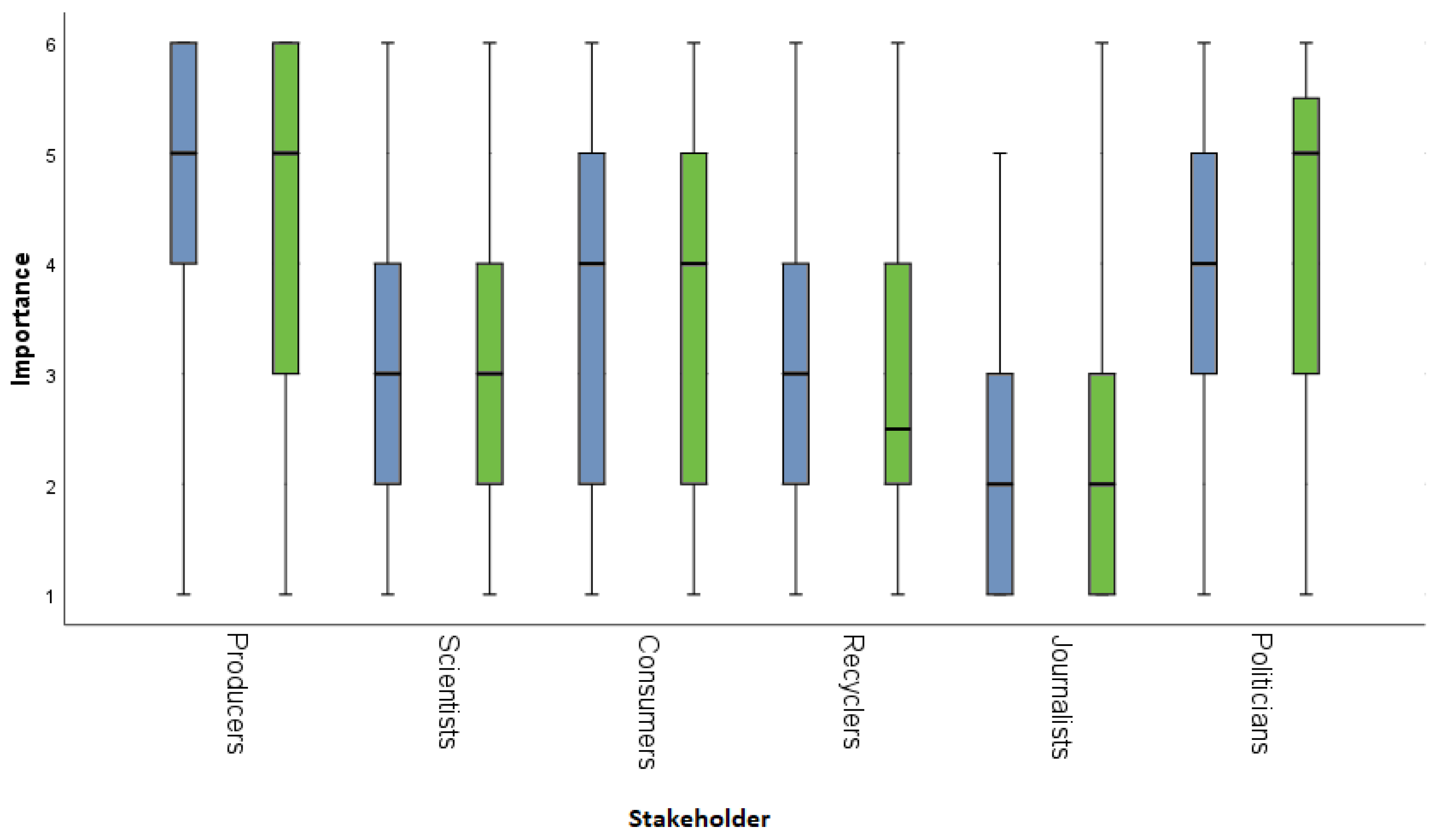

Table 1.
Frequency of pre-participation survey answers regarding the reasoning behind the answer to the question “How realistic is it to live without single-use plastics?” where 1 is not realistic at all and 5 is very realistic.
Table 1.
Frequency of pre-participation survey answers regarding the reasoning behind the answer to the question “How realistic is it to live without single-use plastics?” where 1 is not realistic at all and 5 is very realistic.
| Category | 1 | 2 | 3 | 4 | 5 | Total |
| Available reusable alternatives | 0 | 1 | 6 | 13 | 12 | 32 |
| Sanitary properties | 2 | 1 | 9 | 8 | 0 | 20 |
| Wide availability | 4 | 6 | 8 | 1 | 0 | 19 |
| Convenience | 4 | 6 | 3 | 4 | 0 | 17 |
| Difficult change | 0 | 2 | 7 | 3 | 0 | 12 |
| Low cost | 1 | 4 | 6 | 1 | 0 | 12 |
| Consumer behavior change | 0 | 0 | 0 | 2 | 7 | 9 |
| Ineffective alternatives | 2 | 2 | 3 | 1 | 0 | 8 |
| Pre plastic lifestyle | 0 | 0 | 1 | 0 | 6 | 7 |
| Lack of industry interest | 1 | 0 | 4 | 0 | 1 | 6 |
| Lack of reusable alternatives | 2 | 0 | 4 | 0 | 0 | 6 |
| Lack of legislation | 0 | 1 | 4 | 0 | 0 | 5 |
| Environmentalism | 0 | 0 | 1 | 2 | 2 | 5 |
| Lack of awareness | 0 | 1 | 2 | 0 | 0 | 3 |
| Political hurdles | 0 | 0 | 2 | 0 | 1 | 3 |
| Increasing awareness | 0 | 0 | 0 | 2 | 0 | 2 |
| Existing legislation | 0 | 0 | 0 | 2 | 0 | 2 |
| Ineffective recycling measures | 0 | 0 | 0 | 1 | 0 | 1 |
| Ineffective reduction measures | 0 | 0 | 1 | 0 | 0 | 1 |
| Consumerism | 0 | 1 | 0 | 0 | 0 | 1 |
Table 2.
Frequency of post-participation survey answers regarding the reasoning behind the answer to the question “How realistic is it to live without single-use plastics?” where 1 is not realistic at all and 5 is very realistic.
Table 2.
Frequency of post-participation survey answers regarding the reasoning behind the answer to the question “How realistic is it to live without single-use plastics?” where 1 is not realistic at all and 5 is very realistic.
| Category | 1 | 2 | 3 | 4 | 5 | Total |
| Available reusable alternatives | 0 | 1 | 2 | 4 | 4 | 11 |
| Consumer behavior change | 0 | 0 | 1 | 3 | 4 | 8 |
| Increasing awareness | 0 | 0 | 2 | 4 | 0 | 6 |
| Difficult change | 1 | 0 | 3 | 0 | 0 | 4 |
| Convenience | 1 | 0 | 0 | 2 | 1 | 4 |
| Low cost | 0 | 1 | 2 | 0 | 0 | 3 |
| Sanitary properties | 0 | 1 | 2 | 0 | 0 | 3 |
| Wide availability | 0 | 1 | 2 | 0 | 0 | 3 |
| Environmentalism | 0 | 0 | 0 | 3 | 0 | 3 |
| Ineffective alternatives | 0 | 0 | 2 | 0 | 0 | 2 |
| Consumerism | 0 | 1 | 0 | 1 | 0 | 2 |
| Lack of legislation | 0 | 0 | 0 | 0 | 2 | 2 |
| Pre plastic lifestyle | 0 | 0 | 0 | 0 | 1 | 1 |
| Lack of necessity | 0 | 0 | 0 | 0 | 1 | 1 |
| Lack of industry interest | 0 | 0 | 1 | 0 | 0 | 1 |
| Existing legislation | 0 | 0 | 0 | 1 | 0 | 1 |
Table 3.
Mean value and significance according to stakeholder and survey group (pre- or post-participation survey) difference.
Table 3.
Mean value and significance according to stakeholder and survey group (pre- or post-participation survey) difference.
| Stakeholder | Negative ranks | Positive ranks | Ties | Z | p | ||||
| N | MR | SR | N | MR | SR | ||||
| Producers | 14 | 11.43 | 160.0 | 9 | 12.89 | 116.0 | 37 | -0.685a | 0.493 |
| Scientists | 15 | 13.87 | 208.0 | 19 | 20.37 | 387.0 | 26 | -1.571b | 0.116 |
| Consumers | 10 | 9.55 | 95.5 | 12 | 13.13 | 157.5 | 38 | -1.056b | 0.291 |
| Recyclers | 17 | 14.71 | 250.0 | 10 | 12.80 | 128.0 | 33 | 1.493a | 0.136 |
| Journalists | 9 | 13.33 | 120.0 | 14 | 11.14 | 156.0 | 37 | -0.571b | 0.568 |
| Politicians | 10 | 15.80 | 158.0 | 14 | 10.14 | 142.0 | 26 | -0.236a | 0.814 |
Note: MR = Mean ranks; SR = Sum of ranks; Z = Wilcoxon signed-rank statistic; p denotes statistical significance. a. based on positive ranks; b. based on negative ranks.
Disclaimer/Publisher’s Note: The statements, opinions and data contained in all publications are solely those of the individual author(s) and contributor(s) and not of MDPI and/or the editor(s). MDPI and/or the editor(s) disclaim responsibility for any injury to people or property resulting from any ideas, methods, instructions or products referred to in the content. |
© 2024 by the authors. Licensee MDPI, Basel, Switzerland. This article is an open access article distributed under the terms and conditions of the Creative Commons Attribution (CC BY) license (http://creativecommons.org/licenses/by/4.0/).
Copyright: This open access article is published under a Creative Commons CC BY 4.0 license, which permit the free download, distribution, and reuse, provided that the author and preprint are cited in any reuse.


