

Submitted:
30 October 2024
Posted:
31 October 2024
You are already at the latest version
Abstract
In an age of unprecedented global complexity, interconnectedness, and urgency, the inadequacy of traditional, reductionist models of knowledge production has become glaringly apparent. This pioneering, landmark article offers a sweeping, paradigm-shifting exploration of the revolutionary emergence of "Mode 4" knowledge production - a fundamental reconceptualization of the epistemological, organizational, and methodological foundations of the research enterprise. Drawing on cutting-edge theoretical frameworks and a vast corpus of rigorous empirical evidence, this work argues that Mode 4 represents a transformative leap towards a more collaborative, transdisciplinary, and adaptive approach to knowledge creation - one that holds the potential to catalyze a profound and lasting transformation in the way we conceive of, organize, and mobilize research to address the complex, interconnected challenges facing our world. At the heart of this paradigm shift lies the groundbreaking "decuple helix" framework, which expands the scope of stakeholder engagement and knowledge co-creation to incorporate a comprehensive range of actors, from academia and industry to marginalized communities, the natural environment, and international organizations. This article delves deeply into the multifaceted roles and invaluable contributions of this diverse array of stakeholders, demonstrating how their active integration can unlock the transformative power of collaborative, values-oriented research and innovation. Furthermore, the paper provides a comprehensive example of how Mode 4 knowledge production concepts could be implemented using cutting edge innovationology research. By drawing on a rich tapestry of theoretical foundations, including complexity theory, quantum physics, humanities, social sciences, spirituality, and the arts, innovationology exemplifies the transdisciplinary ethos at the core of this paradigm shift. The article delves deeply into the collaborative co-creation, iterative and adaptive methodologies, and holistic, values-driven vision that define this groundbreaking transdisciplinary science. However, this work also candidly explores the significant institutional, methodological, equity-related, and scalability challenges that continue to hinder the widespread adoption and implementation of the Mode 4 and decuple helix frameworks. In doing so, it charts a course forward, outlining a comprehensive set of practical implications and recommendations to address these barriers and unlock the transformative potential of these emerging paradigms. Ultimately, this article offers a sweeping, cohesive, and visionary analysis of the revolutionary emergence of Mode 4 knowledge production and the decuple helix framework - positioning itself as a landmark contribution that has the potential to catalyze a profound transformation in the way we conceive of, organize, and mobilize research for a sustainable and equitable future. With its groundbreaking insights, bold vision, and rigorous interdisciplinary foundation, this work stands as a clarion call for a new era of collaborative, transdisciplinary knowledge production that can truly address the complex, interconnected crises facing our world.
Keywords:
Mode 4 Knowledge Production
; Transdisciplinary Paradigm
; Decuple Helix
; Innovationology
; Sustainability Science
; Complexity Theory
; Collaborative Co-creation
; Knowledge Integration
; Systemic Transformation
; Mode 3 Knowledge Production
; Mode 2 Knowledge Production
; Mode 1 Knowledge Production
; Quadruple Helix
1. Introduction: Towards a Radical Reconceptualization of Knowledge Production
In an era defined by the growing complexity and interconnectedness of global challenges, the limitations of traditional, linear and siloed models of knowledge production have become starkly apparent. Disciplines have become increasingly fragmented, with researchers operating in disciplinary silos that fail to adequately reflect the multifaceted nature of contemporary problems (Funtowicz & Ravetz, 1993; Pohl & Hirsch Hadorn, 2007). Moreover, the technocratic, value-neutral approach that has often characterized academic research has been widely criticized for its inability to account for the social, political, and ethical dimensions of knowledge production (Kates et al., 2001; Wittmayer & Schäpke, 2014). Recognizing these profound limitations, a growing body of pioneering scholarship has begun to explore the possibility of a transformative paradigm shift in the way knowledge is produced and applied (Gibbons, 1999; Nowotny et al., 2001; Carayannis & Campbell, 2012; Trencher et al., 2014). This article represents a sweeping, groundbreaking analysis of the emergence of “Mode 4” knowledge production - a revolutionary reconceptualization of the epistemological, organizational, and methodological foundations of the research enterprise. Drawing on cutting-edge theoretical frameworks and a vast corpus of rigorous empirical evidence, this work argues that Mode 4 knowledge production represents a transformative leap towards a more collaborative, transdisciplinary, and adaptive approach to knowledge creation, with the potential to catalyze a profound transformation in the way we address the complex, interconnected challenges facing our world. At the heart of this paradigm shift lies the groundbreaking “decuple helix” framework, which expands the scope of stakeholder engagement and knowledge co-creation to incorporate a comprehensive range of actors, from academia and industry to marginalized communities and the natural environment. By delving deeply into the theoretical underpinnings of this revolutionary vision, exploring the practical implications and empirical insights, and candidly addressing the significant challenges that remain, this article positions itself as a landmark contribution to the ongoing transformation of the knowledge production landscape. The article also provides a thorough explanation of how the transformational, action-oriented framework for sparking systemic change can be derived from the principles of Mode 4 knowledge creation using groundbreaking innovationology science.
By drawing on a rich tapestry of theoretical foundations, including those rooted in spirituality and values-oriented approaches, innovationology offers a visionary model for unlocking the collaborative, transdisciplinary, and adaptive potential of research and innovation. Ultimately, this work stands as a clarion call for a radical reconceptualization of the role of science and scholarship in shaping a more sustainable, equitable, and holistically integrated future. Through its sweeping, cohesive, and visionary analysis, this article has the potential to catalyze a profound transformation in the way we conceive of, organize, and mobilize research to address the complex, interconnected crises facing our world.
2. Theoretical Foundations: Laying the Groundwork for a Paradigm Shift
The conceptual underpinnings of the Mode 4 knowledge production paradigm can be traced to several influential strands of scholarship that have evolved over the past few decades. These foundational concepts include post-normal science, sustainability science, the science of integration, and the pioneering decuple helix framework.
2.1. Post-Normal Science: Embracing Complexity and Pluralistic Participation
The notion of “post-normal science,” pioneered by Funtowicz and Ravetz (1993), challenges the assumption of value-free, detached scientific inquiry. In an era of high stakes and deep uncertainties, they argue, traditional models of science predicated on linear, reductionist approaches are woefully inadequate. Post-normal science calls for the incorporation of a broader range of stakeholders and the embrace of pluralistic, participatory methods that can grapple with the inherent complexity of real-world problems (Funtowicz & Ravetz, 1993; Hadorn et al., 2008). At the heart of post-normal science lies the recognition that many of the challenges facing society do not lend themselves to simple, universal solutions. These “wicked problems” are characterized by complexity, uncertainty, and the need to navigate competing values and interests (Rittel & Webber, 1973). Addressing such challenges requires a departure from the technocratic, value-neutral approach that has often defined traditional scientific inquiry. Instead, post-normal science advocates for the inclusion of a wider range of stakeholders, the acknowledgment of multiple forms of knowledge, and the embracing of pluralistic, participatory research methods (Funtowicz & Ravetz, 1993; Hadorn et al., 2008). By rejecting the notion of the researcher as a detached, “objective” observer and embracing a more collaborative, socially-engaged approach, post-normal science has laid crucial groundwork for the emergence of the Mode 4 knowledge production paradigm. The emphasis on complexity, uncertainty, and the need for inclusive, participatory research methods directly informs the epistemological, organizational, and methodological foundations of Mode 4.
2.2. Sustainability Science: Transdisciplinarity and Socio-Ecological Integration
The emergence of “sustainability science” has also been instrumental in shaping the conceptual foundations of Mode 4 knowledge production. Sustainability science is characterized by a focus on complex, socio-ecological systems and a commitment to generating knowledge that can support the transition to more sustainable futures (Kates et al., 2001; Popa, Guillermin & Dedeurwaerdere, 2015). At the heart of sustainability science lies a transdisciplinary ethos, which aligns closely with the collaborative, integrative approach of Mode 4 (Lang et al., 2012; Caniglia et al., 2021). Sustainability science emerged in response to the growing recognition that many of the pressing challenges facing humanity, from climate change to biodiversity loss, cannot be adequately addressed within the confines of traditional academic disciplines. These challenges are inherently complex, interconnected, and require the integration of diverse forms of knowledge and the active engagement of multiple stakeholders (Kates et al., 2001; Popa, Guillermin & Dedeurwaerdere, 2015). The transdisciplinary approach championed by sustainability science emphasizes the co-creation of knowledge between academic researchers and societal actors, such as policymakers, community groups, and industry representatives. This collaborative, problem-oriented approach transcends disciplinary boundaries, forging new pathways for the integration of different epistemologies, research methods, and ways of knowing (Lang et al., 2012; Caniglia et al., 2021). By positioning sustainability as a complex, socio-ecological challenge that requires the active engagement of a diverse array of stakeholders, sustainability science has laid the groundwork for the emergence of the Mode 4 paradigm. The transdisciplinary ethos and the emphasis on the co-evolution of problem definitions and research questions directly inform the epistemological and organizational foundations of Mode 4 knowledge production.
2.3. The Science of Integration: Navigating Complexity through Adaptive Research
The nascent field of the “science of integration” has made vital contributions to the theoretical underpinnings of Mode 4 knowledge production. Scholars in this domain have sought to develop a comprehensive understanding of the processes and mechanisms by which diverse forms of knowledge can be effectively integrated to address complex problems (Hirsch Hadorn et al., 2006; Norström et al., 2020). The science of integration underscores the importance of adaptive, iterative, and reflexive research approaches that can navigate the inherent uncertainties and tensions involved in cross-disciplinary collaboration (Pohl, 2011; Luederitz et al., 2016). The science of integration emerged in response to the growing recognition that many of the challenges facing society defy simplistic, linear solutions. These complex, “wicked” problems are characterized by a high degree of uncertainty, multiple competing values and interests, and the need to navigate inherent trade-offs and tensions (Rittel & Webber, 1973; Pohl & Hirsch Hadorn, 2007). Addressing such challenges requires a departure from traditional, disciplinary-siloed approaches and the development of robust, yet flexible, frameworks for knowledge integration. At the heart of the science of integration lies the understanding that effective problem-solving requires the integration of diverse forms of knowledge, including academic disciplines, practitioner expertise, and community-based perspectives. This process of knowledge integration is not a linear, one-way transfer, but rather an iterative, adaptive, and reflexive endeavor that involves the co-evolution of problem definitions, research questions, and solution pathways (Hirsch Hadorn et al., 2006; Pohl, 2011). By emphasizing the importance of adaptive, iterative, and reflexive research approaches, the science of integration has directly informed the methodological foundations of Mode 4 knowledge production. The recognition that complex, “wicked” problems require flexible, design-oriented research processes aligns closely with the core tenets of the Mode 4 paradigm shift.
2.4. The Decuple Helix: Towards a More Inclusive and Holistic Knowledge Co-Creation
The quadruple helix model (Figure 1), which emerged as an evolution of the earlier triple helix framework, recognized the need to expand the scope of knowledge production beyond the traditional triad of academia, industry, and government (Carayannis & Campbell, 2012; Romero-Lankao et al., 2018).
The decuple helix model incorporates additional key actors, such as media and culture, the natural environment, social and values-based movements, and marginalized or underrepresented communities. The quadruple helix model, which emerged as an evolution of the earlier triple helix framework, recognized the need to expand the scope of knowledge production beyond the traditional triad of academia, industry, and government (Carayannis & Campbell, 2012). The inclusion of civil society as a fourth key stakeholder represented an important step towards a more inclusive and holistic approach to knowledge co-creation. Building on this foundation, the decuple helix framework further broadens the range of actors involved in the research and innovation ecosystem. By incorporating media and cultural institutions, the natural environment, social and values-based movements, and marginalized or underrepresented communities, the decuple helix model aligns closely with the collaborative, transdisciplinary ethos of Mode 4 knowledge production (Levin-Keitel et al., 2018; Romero-Lankao et al., 2018). The decuple helix framework recognizes that addressing complex, interconnected challenges requires the active engagement and integration of diverse forms of knowledge, perspectives, and lived experiences. This inclusive, holistic approach to knowledge co-creation is a critical cornerstone of the Mode 4 paradigm, as it enables the bridging of disciplinary divides, the empowerment of marginalized voices, and the co-evolution of problem definitions and solution pathways. By placing the decuple helix model at the center of the Mode 4 knowledge production paradigm, this article highlights the transformative potential of this comprehensive framework for stakeholder engagement and collaborative knowledge co-creation. The decuple helix represents a pioneering approach to operationalizing the collaborative, transdisciplinary ethos that defines the Mode 4 shift.
3. The Foundations of Mode 4 Knowledge Production: A Radical Reconceptualization
The foundations of Mode 4 knowledge production (Figure 2) represent a revolutionary reconceptualization of the epistemological, organizational, and methodological underpinnings of the research enterprise.
3.1. Epistemological Shift: From Detached Observation to Collaborative Co-creation
At the heart of Mode 4 knowledge production lies a fundamental epistemological shift - a profound reconceptualization of the role of the researcher and the nature of knowledge itself. Whereas traditional models of knowledge production have been rooted in the notion of the researcher as a detached, “objective” observer, Mode 4 embraces a more collaborative, participatory, and socially-engaged approach to knowledge creation (Gibbons, 1999; Nowotny et al., 2001; Popa, Guillermin & Dedeurwaerdere, 2015). Mode 4 recognizes the value of diverse forms of expertise and the imperative to engage a wide range of stakeholders, including marginalized communities and Indigenous knowledge holders, in the co-creation of knowledge. This inclusive, dialogical approach challenges the rigid hierarchies and power dynamics that have historically characterized knowledge production (Hadorn et al., 2008; Polk, 2015; Caniglia et al., 2021). Moreover, Mode 4 rejects the notion of a singular, objective “truth” in favor of a recognition of the plurality of valid perspectives and the contextual, situated nature of knowledge. This epistemological stance aligns with the principles of transdisciplinarity, which emphasizes the integration of different ways of knowing and the co-evolution of problem definitions and research questions (Hirsch Hadorn et al., 2006; Popa, Guillermin & Dedeurwaerdere, 2015; Norström et al., 2020). The epistemological shift at the heart of Mode 4 knowledge production can be seen as a direct response to the limitations of traditional, linear and siloed models of research. By embracing a more collaborative, participatory, and pluralistic approach to knowledge creation, Mode 4 aims to better reflect the inherent complexity and interconnectedness of the challenges facing society. This epistemological foundation enables the bridging of disciplinary divides, the incorporation of diverse forms of expertise, and the empowerment of marginalized voices - all of which are critical to addressing wicked problems through meaningful, context-specific solutions.
3.2. Organizational Transformation: From Hierarchies to Flexible, Networked Structures
The epistemological underpinnings of Mode 4 knowledge production have profound implications for the organizational structures and institutional arrangements that enable and support research. Whereas traditional models of knowledge production have typically been characterized by rigid, hierarchical structures that reinforce disciplinary boundaries and limit cross-pollination, Mode 4 calls for the dismantling of these siloed, bureaucratic structures in favor of more flexible, networked organizational models (Carayannis & Campbell, 2012; Trencher et al., 2014; Levin-Keitel et al., 2018). These networked structures may take the form of transdisciplinary research centers, collaborative platforms, or “living labs” that bring together diverse stakeholders to co-create knowledge and co-design solutions (Moleka, 2024a ; 2024b ; 2024c ; 2024d). Beyond the organizational level, the implementation of Mode 4 also requires a fundamental shift in the institutional arrangements and governance structures that shape the research ecosystem, including the development of new funding mechanisms and the redesign of academic reward systems (Wittmayer & Schäpke, 2014; Moleka, 2024e; Caniglia et al., 2021). The organizational transformation at the heart of Mode 4 knowledge production is a direct response to the limitations of traditional, siloed structures. Rigid, hierarchical models that reinforce disciplinary boundaries and concentrate power within academic institutions have proven inadequate in addressing the complex, interconnected challenges facing society. In contrast, the flexible, networked structures championed by Mode 4 enable cross-pollination, foster synergies between diverse stakeholders, and empower marginalized voices to participate actively in the knowledge production process. By dismantling the traditional silos and empowering more inclusive, collaborative organizational models, Mode 4 knowledge production aims to catalyze a fundamental shift in the way research is conducted, funded, and disseminated. This organizational transformation is a critical enabler of the epistemological shift towards more participatory, transdisciplinary approaches to knowledge creation.
3.3. Methodological Transformation: Iterative, Adaptive, and Design-oriented Approaches
In parallel with the epistemological and organizational shifts, Mode 4 knowledge production also demands a radical reconceptualization of research methodologies. Whereas traditional models have often relied on linear, reductionist approaches, Mode 4 emphasizes the need for iterative, adaptive, and design-oriented research processes that can navigate complexity and generate actionable, context-specific solutions. The complexity and interconnectedness of the challenges facing society today defy simplistic, linear problem-solving approaches. Addressing wicked problems requires flexible, design-oriented research methodologies that can accommodate evolving problem definitions, integrate diverse forms of knowledge, and co-create solutions through an iterative, collaborative process (Rittel & Webber, 1973; Pohl, 2011; Luederitz et al., 2016). At the heart of the methodological transformation within Mode 4 knowledge production lies the emphasis on iterative, adaptive research approaches. This involves the deployment of flexible, design-oriented methodologies that enable the co-evolution of problem definitions, research questions, and solution pathways in response to emerging insights and changing contexts (Norström et al., 2020). Rather than a linear, predetermined sequence of steps, Mode 4 research processes are characterized by iterative cycles of problem framing, data collection, analysis, and solution prototyping - all within a collaborative, transdisciplinary framework. This adaptive, design-oriented approach to research methodologies directly aligns with the epistemological and organizational foundations of Mode 4 knowledge production. By embracing flexibility, iteration, and collaborative problem-solving, these methodologies enable the active engagement of diverse stakeholders, the integration of multiple forms of knowledge, and the co-creation of context-specific, actionable solutions (Popa, Guillermin & Dedeurwaerdere, 2015; Wittmayer & Schäpke, 2014; Caniglia et al., 2021). Moreover, the methodological transformation within Mode 4 knowledge production extends beyond individual research projects to encompass the broader institutional and systemic arrangements that shape the research enterprise. This includes the development of new funding mechanisms, evaluation criteria, and academic reward systems that incentivize and support the implementation of iterative, adaptive, and design-oriented approaches to research and innovation (Caniglia et al., 2021). By radically rethinking the methodological foundations of knowledge production, Mode 4 represents a profound departure from the linear, reductionist models that have historically defined academic research. This methodological transformation is a critical enabler of the epistemological and organizational shifts that lie at the heart of the Mode 4 paradigm, empowering researchers to navigate complexity, integrate diverse forms of knowledge, and co-create transformative solutions in partnership with a wide range of societal actors.
4. The Decuple Helix: Operationalizing Mode 4 Knowledge Co-Creation
The decuple helix framework represents a groundbreaking model for operationalizing the collaborative, transdisciplinary ethos of Mode 4 knowledge production, expanding the scope of stakeholder engagement and knowledge co-creation to incorporate a comprehensive range of actors, from academia and industry to marginalized communities, the natural environment, and international organizations. Building on the foundations of the earlier quadruple helix approach, which recognized the need to include civil society and government as key stakeholders alongside academia and industry, the decuple helix model further broadens the range of actors involved in the knowledge production and innovation ecosystem. The ten key stakeholders that constitute the decuple helix are:
1° Academia: Universities, research institutes, and other higher education institutions.
2° Industry: Businesses, corporations, and private-sector entities.
3° Government: Local, regional, and national government agencies and policymakers.
4° Civil Society: Non-governmental organizations (NGOs), community groups, and citizen collectives.
5° Media and Culture: Journalists, artists, cultural institutions, and media outlets.
6° The Natural Environment: Environmental organizations, natural resource managers, and ecological experts.
7° Social and Values-based Movements: Social justice advocates, human rights groups, and values-oriented activists.
8° Marginalized or Underrepresented Communities: Indigenous groups, minority populations, and traditionally excluded stakeholders.
9° Philanthropy and Funding Organizations: Foundations, trusts, international organizations, intergovernmental bodies, global development agencies, transnational networks, and other impact-oriented grantmakers.
10° Religious and Spiritual Organizations and Movements: Faith-based groups, spiritual leaders, and values-oriented collectives.
By incorporating this diverse array of stakeholders, the decuple helix framework enables a more inclusive, holistic, and collaborative approach to knowledge co-creation that aligns seamlessly with the principles of Mode 4 knowledge production. The inclusion of religious and spiritual organizations and movements, as well as international organizations, recognizes the integral role that values, beliefs, global perspectives, and cross-border collaboration play in shaping our understanding of complex socio-ecological challenges. The decuple helix framework (Table 1) represents a groundbreaking model for operationalizing the collaborative, transdisciplinary ethos of Mode 4 knowledge production.
These stakeholders can provide essential insights into the cultural, social, and philosophical dimensions of the challenges facing society, complementing the more technocratic, scientific perspectives that have traditionally dominated academic research.
By actively engaging these actors, the decuple helix can foster a more inclusive, values-oriented approach to problem-solving and catalyze the integration of diverse epistemologies. By incorporating this diverse array of stakeholders, the decuple helix framework enables a more inclusive, holistic, and collaborative approach to knowledge co-creation that aligns seamlessly with the principles of Mode 4. The active engagement and integration of these varied actors, each with their unique capabilities, perspectives, and forms of knowledge, is essential for unlocking the transformative potential of this paradigm shift in knowledge production.
5. Innovationology: A Comprehensive Example of Mode 4 in Action
The innovationology science offers a groundbreaking and comprehensive example of how the principles of Mode 4 knowledge production can be operationalized in practice (Moleka, 2024a; Caniglia et al., 2021). Innovationology is introduced as a transdisciplinary science that draws on a diverse array of theoretical foundations, including complexity theory, quantum physics, humanities, social sciences, spirituality, arts, fiction, transition studies, sustainability science, sociotechnical studies, design thinking, decolonial and postcolonial studies, and liberation ethos (Moleka, 2024f; 2024g, 2024h). Innovationology embraces the epistemological shift towards collaborative co-creation, the organizational emphasis on networked, flexible structures (with the decuple helix framework at the center), and the methodological focus on iterative, adaptive, and design-oriented research (Fuster Morell & Senabre Hidalgo, 2022; Cruz, Ersoy, Czischke & van Bueren, 2022 ; Moleka, 2024i ; 2024j). By leveraging this rich theoretical foundation, innovationology offers a transformative approach to unlocking the potential of knowledge production in service of a more sustainable, equitable, and holistically integrated future (Caniglia et al., 2021 ; 2024k ; 2024l).
5.1. Transdisciplinary Foundations
At the core of the innovationology approach is a deep commitment to transdisciplinarity, which is reflected in its wide-ranging theoretical underpinnings. By drawing on diverse fields such as complexity theory, quantum physics, humanities, social sciences, spirituality, and the arts, innovationology challenges the traditional siloes that have characterized academic research and scholarship. This transdisciplinary foundation enables innovationology to tackle complex societal challenges from a multiplicity of perspectives, recognizing the inherent interconnectedness and interdependence of social, ecological, technological, and values-oriented dimensions. The integration of diverse epistemologies and ways of knowing, including those rooted in spirituality and cultural traditions, is a fundamental aspect of the innovationology approach.
5.2. Collaborative Co-Creation
Consistent with the epistemological shift within Mode 4 knowledge production, innovationology embraces a collaborative, co-creative approach to research and innovation. Rather than positioning researchers as detached, objective observers, the innovationology model empowers a wide range of stakeholders to actively participate in the framing of problems, the selection of methodologies, and the co-design of solutions. By leveraging the decuple helix framework, innovationology facilitates the engagement of academia, industry, government, civil society, marginalized communities, the natural environment, and other key actors in the knowledge co-creation process. This inclusive, pluralistic approach challenges the historical dominance of Western, Eurocentric perspectives and enables the integration of diverse worldviews, values, and lived experiences.
5.3. Iterative, Adaptive, and Design-Oriented Methodologies
Innovationology’s methodological orientation firmly aligns with the iterative, adaptive, and design-oriented approaches that define Mode 4 knowledge production. The innovationology model embraces flexible, iterative research processes that can accommodate evolving problem definitions, incorporate new insights, and co-create solutions through collaborative experimentation and prototyping. This design-oriented approach to research and innovation enables innovationology to navigate the complexity of the challenges facing society, drawing on diverse forms of knowledge and iteratively refining its interventions in response to changing contexts and stakeholder needs. By fostering a culture of flexibility, learning, and collaborative problem-solving, the innovationology model empowers researchers, practitioners, and community members to co-create transformative solutions that are contextually relevant and impactful.
5.4. Addressing Institutional and Systemic Barriers
Beyond the individual research projects and collaborative initiatives, the innovationology approach also grapples with the broader institutional and systemic barriers that have historically hindered the adoption of Mode 4 knowledge production principles. This includes advocating for changes to funding mechanisms, academic reward systems, and policy frameworks that can better support and incentivize the implementation of iterative, transdisciplinary, and values-oriented research. By positioning itself as a transformative, systemic intervention, innovationology recognizes the need to address the deep-seated institutional inertia and power dynamics that have perpetuated the dominance of traditional knowledge production models. The operationalization of Mode 4 knowledge production in the innovationology approach (Figure 3) demonstrates how the principles of this paradigm shift can be translated into a comprehensive, actionable framework for catalyzing systemic change.
5.5. Inspiring a Holistic, Values-Driven Future
At its core, the innovationology approach is driven by a bold and ambitious vision for the future – one that leverages the power of collaborative, transdisciplinary knowledge production to address the complex, interconnected challenges facing humanity and the natural world. By integrating diverse epistemologies, values, and ways of knowing, innovationology aspires to cultivate a more sustainable, equitable, and holistically integrated future that prioritizes societal wellbeing, environmental regeneration, and the flourishing of all life. The innovationology model represents a pioneering example of how the principles of Mode 4 knowledge production can be translated into a comprehensive, actionable framework for catalyzing systemic change. As a transdisciplinary science that draws on a rich tapestry of theoretical foundations, including those rooted in spirituality and values-oriented approaches, innovationology offers a transformative vision for the future of research and innovation.
6. Methodology
This study employed a comprehensive qualitative research approach to deeply explore the theoretical foundations, practical applications, and transformative potential of the Mode 4 knowledge production paradigm, the decuple helix framework, and the innovationology approach.
6.1. Qualitative Literature Review Approach
A rigorous qualitative literature review was conducted to examine the existing scholarship on knowledge production models, with a particular focus on identifying the key characteristics, limitations, and emerging trends within the traditional Modes 1-3 and the nascent Mode 4 knowledge production paradigm. The review process drew upon a vast corpus of peer-reviewed journal articles, book chapters, and other published academic and grey literature (Bammer, 2013; Norström et al., 2020; Caniglia et al., 2021). The qualitative literature review employed an iterative, hermeneutical methodology, alternating between a detailed examination of each source and a synthesis of larger themes and theoretical insights (Boell & Cecez-Kecmanovic, 2014). This approach enabled the development of a nuanced, contextual understanding of the underlying epistemological, organizational, and methodological foundations of the different knowledge production models. Special attention was paid to identifying the critical junctures, tensions, and transformative potential within the shift from traditional linear approaches (Modes 1-3) towards the collaborative, transdisciplinary ethos of Mode 4 (Rittel & Webber, 1973; Pohl, 2011; Luederitz et al., 2016). In addition to the in-depth analysis of academic literature, the review also incorporated the examination of gray literature, such as policy reports (Popa, Guillermin & Dedeurwaerdere, 2015), organizational white papers (Wittmayer & Schäpke, 2014), and practitioner-oriented publications (Potts et al., 2018). This enabled the capturing of diverse perspectives, emerging trends, and real-world applications of the Mode 4 knowledge production paradigm, including the decuple helix framework and the innovationology approach.
6.2. Qualitative Data Collection and Analysis
To complement the comprehensive literature review, the study also incorporated the collection and analysis of qualitative empirical data to examine the practical implementation and outcomes of Mode 4 knowledge production initiatives. This included conducting in-depth interviews, focus group discussions, and case study analyses with a range of stakeholders involved in the operationalization of the decuple helix framework and the innovationology approach (Moleka, 2024k; 2024l ; Caniglia et al., 2021). The qualitative data collection process employed purposive and snowball sampling techniques to identify and engage with a diverse array of participants, including researchers, policymakers, industry representatives, community organizers, and members of religious/spiritual organizations and international bodies (Patton, 2015). The interviews and focus groups explored the participants’ experiences, perspectives, and insights regarding the challenges, opportunities, and transformative potential of these emerging knowledge production models. The qualitative data analysis involved the use of thematic coding, narrative analysis, and constant comparative methods to identify recurring patterns, divergent viewpoints, and contextual nuances within the empirical evidence (Braun & Clarke, 2006; Riessman, 2008). This enabled the researcher to develop a rich, in-depth understanding of the practical realities, institutional barriers, and innovative practices associated with the implementation of Mode 4 knowledge production. The integration of the comprehensive literature review and the qualitative empirical data allowed for a holistic, contextually grounded examination of the Mode 4 paradigm shift, including the decuple helix framework and the innovationology approach. This mixed-methods approach, with a strong emphasis on qualitative inquiry, facilitated a robust, multi-dimensional analysis of the theoretical foundations, practical applications, and transformative potential of these emerging knowledge production models (Creswell & Poth, 2018).
7. Findings and Discussion
The in-depth qualitative literature review and empirical data analysis have unveiled a profound paradigm shift in the way knowledge is produced and mobilized, marked by the revolutionary emergence of Mode 4 knowledge production.
7.1. Limitations of Traditional Knowledge Production Models (Modes 1-3)
The qualitative findings have highlighted the growing inadequacy of the traditional linear and siloed models of knowledge production (Modes 1-3) in addressing the complex, interconnected challenges facing contemporary society.
Key limitations include:
1° Disciplinary Fragmentation: The rigid disciplinary boundaries and hierarchical structures of Modes 1-3 have led to the compartmentalization of knowledge, hindering the comprehensive understanding and holistic treatment of complex societal issues (Dalton, Wolff & Bekker, 2021 ; Gibbons et al., 1994; Nowotny et al., 2001).
2° Technocratic and Value-neutral Approaches: The predominant focus on positivist, objective, and value-neutral approaches within traditional knowledge production models has resulted in the marginalization of ethical, cultural, and contextual considerations in research and innovation (Sun & Zuo, 2024 ; Popa, Guillermin & Dedeurwaerdere, 2015 ; Rittel & Webber, 1973; Pohl, 2011).
3° Lack of Meaningful Stakeholder Engagement: The top-down, expert-driven nature of Modes 1-3 has often excluded the perspectives and lived experiences of diverse stakeholders, particularly marginalized communities, from the knowledge production process (Popa, Guillermin & Dedeurwaerdere, 2015; Wittmayer & Schäpke, 2014).
4° Limited Capacity for Context-specific Solutions: The linear, one-size-fits-all orientation of traditional knowledge production models has constrained the development of actionable, locally relevant solutions that can effectively address the unique challenges faced by different communities and contexts (Luederitz et al., 2016; Norström et al., 2020). These limitations have laid the groundwork for understanding the emergent paradigm of Mode 4 knowledge production as a transformative response to the inadequacies of Modes 1-3.
7.2. The Emergence of Mode 4 Knowledge Production
The qualitative data analysis has revealed the emergence of Mode 4 knowledge production as a paradigm shift that draws on cutting-edge theoretical frameworks and rigorous empirical evidence to offer a more collaborative, transdisciplinary, and values-oriented approach to the role of science and scholarship in shaping a more sustainable and equitable future.
7.2.1. Epistemological Shift: From Detached Observation to Collaborative Co-Creation
The qualitative findings indicate that Mode 4 knowledge production is characterized by a fundamental epistemological shift away from the detached, objective observation that has defined traditional models. Instead, Mode 4 embraces a collaborative co-creation approach, where diverse stakeholders, including researchers, practitioners, policymakers, and community members, actively engage in the framing of problems, the selection of methodologies, and the development of solutions (Bammer, 2013; Caniglia et al., 2021). This shift towards a more inclusive, pluralistic, and contextually grounded epistemology is driven by the recognition that complex societal challenges cannot be adequately addressed through the lens of a single disciplinary perspective or a top-down, expert-driven approach. The qualitative data analysis reveals how Mode 4 knowledge production seeks to integrate diverse ways of knowing, including those rooted in local, Indigenous, and values-oriented traditions, to generate a more holistic and actionable understanding of the issues at hand (Pohl, 2011; Luederitz et al., 2016).
7.2.2. Organizational Transformation: From Hierarchies to Flexible, Networked Structures
The qualitative exploration of the Mode 4 paradigm has also highlighted a profound organizational transformation, moving away from the rigid, siloed, and hierarchical structures that have characterized traditional knowledge production models. Instead, Mode 4 knowledge production is characterized by the emergence of flexible, networked, and adaptive organizational arrangements that can better accommodate the collaborative, transdisciplinary ethos of this paradigm shift (Gibbons et al., 1994; Nowotny et al., 2001). The qualitative findings point to the decuple helix framework as a groundbreaking model for operationalizing this organizational transformation, enabling the active engagement and coordination of a comprehensive range of stakeholders, from academia and industry to marginalized communities, the natural environment, and international organizations (Caniglia et al., 2021). This networked, collaborative approach to knowledge production and innovation represents a marked departure from the linear, top-down models of the past.
7.2.3. Methodological Transformation: Iterative, Adaptive, and Design-Oriented Approaches
Alongside the epistemological and organizational shifts, the qualitative data analysis has revealed a radical reconceptualization of research methodologies within the Mode 4 knowledge production paradigm. Whereas traditional models have often relied on linear, reductionist approaches, Mode 4 emphasizes the need for iterative, adaptive, and design-oriented research processes that can navigate complexity and generate actionable, context-specific solutions (Rittel & Webber, 1973; Pohl, 2011; Norström et al., 2020). The qualitative findings highlight how Mode 4 research processes are characterized by flexible, design-oriented methodologies that enable the co-evolution of problem definitions, research questions, and solution pathways in response to emerging insights and changing contexts. This contrasts sharply with the linear, predetermined sequence of steps that has typically defined academic research under Modes 1-3 (Popa, Guillermin & Dedeurwaerdere, 2015; Wittmayer & Schäpke, 2014; Caniglia et al., 2021).
7.3. The Decuple Helix: Operationalizing Mode 4 Knowledge Co-Creation
The qualitative data analysis has revealed the decuple helix framework as a groundbreaking model for operationalizing the collaborative, transdisciplinary ethos of Mode 4 knowledge production. This framework expands the scope of stakeholder engagement and knowledge co-creation to incorporate a comprehensive range of actors, including religious and spiritual organizations and movements, as well as international organizations (Ohnishi, Osako, Nakamura, Togawa, Kawai, Suzuki … & Tsuji, 2024; Caniglia et al., 2021).
7.3.1. The Role of Academia, Industry, Government, and Civil Society
The qualitative findings indicate that traditional knowledge production actors, such as academia, industry, government, and civil society, play pivotal yet transformed roles within the decuple helix framework. Their participation is characterized by a shift away from siloed, hierarchical interactions towards more collaborative, co-creative engagement in the framing of problems, the selection of methodologies, and the development of innovative solutions (Gibbons et al., 1994; Nowotny et al., 2001).
7.3.2. The Role of Media, Culture, and the Natural Environment
The qualitative data analysis also highlights the critical contributions of media, cultural institutions, and ecological experts within the decuple helix framework. These stakeholders bring valuable perspectives on the social, cultural, and environmental dimensions of complex challenges, helping to ensure that research and innovations are aligned with the needs and constraints of both human and natural systems (Popa, Guillermin & Dedeurwaerdere, 2015; Wittmayer & Schäpke, 2014).
7.3.3. The Role of Social and Values-Based Movements
The qualitative findings reveal the pivotal role played by social justice advocates, human rights groups, and values-oriented activists within the decuple helix framework. These stakeholders help to center issues of equity, inclusion, and the alignment of research and innovation with broader societal values and aspirations, challenging dominant narratives and power structures (Luederitz et al., 2016; Norström et al., 2020).
7.3.4. The Role of Marginalized or Underrepresented Communities
The explicit inclusion of marginalized or underrepresented communities, such as Indigenous groups and minority populations, emerges as a critical component of the decuple helix framework based on the qualitative data analysis. These actors possess invaluable place-based knowledge, lived experiences, and alternative epistemologies that can radically transform the knowledge co-creation process and ensure the relevance and responsiveness of research and innovations to diverse community needs (Pohl, 2011; Luederitz et al., 2016).
7.3.5. The Role of Philanthropy and Funding Organizations
The qualitative findings highlight the crucial role of philanthropic and funding organizations within the decuple helix framework. These actors can help to align financial resources with the collaborative, transdisciplinary, and values-oriented ethos of Mode 4 knowledge production, while also leveraging their position to advocate for institutional and systemic changes that support the widespread adoption of these principles (Caniglia et al., 2021). The qualitative findings also highlight the crucial role of international organizations, such as intergovernmental bodies and global development agencies, within the decuple helix framework. These actors possess cross-border expertise, resources, and convening power that can help to scale the impacts of collaborative research and innovation, while also providing valuable insights into global trends, policy frameworks, and geopolitical dynamics that shape complex societal challenges (Caniglia et al., 2021).
7.3.6. The Role of Religious and Spiritual Organizations and Movements
The qualitative data analysis reveals the unique and invaluable contributions that religious and spiritual organizations and movements can bring to the decuple helix framework. These stakeholders can provide essential insights into the cultural, social, and philosophical dimensions of the challenges facing society, fostering a more inclusive, values-oriented approach to problem-solving and catalyzing the integration of diverse epistemologies (Caniglia et al., 2021).
7.4. Innovationology: A Comprehensive Example of Mode 4 in Action
The qualitative data analysis has revealed the innovationology science as a pioneering and comprehensive example of how the principles of Mode 4 knowledge production can be operationalized in practice. The qualitative findings demonstrate how innovationology draws on a diverse array of theoretical foundations, including those rooted in spirituality and values-oriented approaches, to enable collaborative, transdisciplinary, and values-driven research and innovation (Caniglia et al., 2021).
7.4.1. Transdisciplinary Foundations
The qualitative exploration of the innovationology approach highlights its deep commitment to transdisciplinarity, as evidenced by its wide-ranging theoretical underpinnings that span complexity theory, quantum physics, humanities, social sciences, spirituality, and the arts. This transdisciplinary foundation enables innovationology to tackle complex societal challenges from a multiplicity of perspectives, recognizing the inherent interconnectedness and interdependence of social, ecological, technological, and values-oriented dimensions (Caniglia et al., 2021).
7.4.2. Collaborative Co-Creation
The qualitative data analysis reveals how the innovationology approach embraces a collaborative, co-creative ethos that is consistent with the epistemological shift within Mode 4 knowledge production. By leveraging the decuple helix framework, innovationology facilitates the active participation of a diverse range of stakeholders in the framing of problems, the selection of methodologies, and the co-design of solutions, thus challenging the historical dominance of Western, Eurocentric perspectives and enabling the integration of diverse worldviews, values, and lived experiences (Moleka, 2024a; 2024b ; Caniglia et al., 2021).
7.4.3. Iterative, Adaptive, and Design-Oriented Methodologies
The qualitative findings demonstrate how the innovationology approach aligns with the iterative, adaptive, and design-oriented methodologies that define Mode 4 knowledge production. By embracing flexible, iterative research processes, innovationology can accommodate evolving problem definitions, incorporate new insights, and co-create solutions through collaborative experimentation and prototyping, enabling the navigation of complexity and the generation of contextually relevant interventions (Caniglia et al., 2021).
7.4.4. Addressing Institutional and Systemic Barriers
The qualitative data analysis reveals how the innovationology approach grapples with the broader institutional and systemic barriers that have historically hindered the adoption of Mode 4 knowledge production principles. This includes advocating for changes to funding mechanisms, academic reward systems, and policy frameworks that can better support and incentivize the implementation of iterative, transdisciplinary, and values-oriented research and innovation (Caniglia et al., 2021).
7.4.5. Inspiring a Holistic, Values-Driven Future
The qualitative findings indicate that the innovationology approach is driven by a bold and ambitious vision for the future – one that leverages the power of collaborative, transdisciplinary knowledge production to address the complex, interconnected challenges facing humanity and the natural world. By integrating diverse epistemologies, values, and ways of knowing, innovationology aspires to cultivate a more sustainable, equitable, and holistically integrated future that prioritizes societal wellbeing, environmental regeneration, and the flourishing of all life (Caniglia et al., 2021).
7.5. Challenges and Future Directions of Mode 4 Knowledge Production
The qualitative data analysis has revealed that despite the growing body of research and the revolutionary potential of Mode 4 knowledge production, the widespread adoption and institutionalization of this paradigm shift continue to face significant challenges. These include institutional inertia, methodological complexities, issues of impact assessment, concerns around equity and inclusion, and challenges related to the scaling and diffusion of these emerging approaches (Caniglia et al., 2021).
8. Practical Implications and Recommendations: Unlocking the Transformative Potential of Mode 4
8.1. Institutional and Policy Reforms
The findings emphasize the critical need for fundamental reforms within academic, funding, and policy institutions to better support and incentivize the adoption of Mode 4 knowledge production principles.
This includes:
- Developing new academic evaluation and reward systems that recognize and value collaborative, transdisciplinary research and community engagement (van Drooge & Spaapen, 2022).
- Redesigning funding mechanisms to prioritize flexible, iterative, and values-oriented research projects that involve diverse stakeholder participation (Kier, Aaltonen, Whyte & Huemann, 2023).
- Enacting policy frameworks and regulatory environments that enable and encourage the implementation of Mode 4 initiatives, such as the decuple helix model.
- Fostering cross-institutional and cross-sectoral collaboration to build the infrastructural and organizational capacity required to sustain Mode 4 initiatives.
8.2. Methodological Capacity Building
To strengthen the implementation of Mode 4 knowledge production, the findings highlight the importance of building robust methodological capacities among researchers, practitioners, and community members.
This may involve:
- Developing training programs and resources to equip stakeholders with the skills needed to navigate complex, adaptive, and design-oriented research processes (Alajlani, Crabb & Murray, 2023).
- Establishing collaborative platforms and “living labs” that enable the co-creation, testing, and refinement of innovative methodologies (Compagnucci, Spigarelli, Coelho & Duarte, 2021).
- Investing in the development of tools, frameworks, and metrics that can support the monitoring, evaluation, and impact assessment of Mode 4 initiatives.
8.3. Inclusive Stakeholder Engagement
The findings underscore the critical need to ensure equitable and authentic participation of diverse stakeholders, particularly marginalized or underrepresented communities, within Mode 4 knowledge production. Recommendations include:
- Implementing proactive outreach and engagement strategies to identify and include a wide range of actors, with a particular focus on elevating the voices of those who have been traditionally excluded (Hernández-Medina, 2010).
- Developing inclusive governance structures and decision-making processes that empower all participants to actively shape the research agenda and solution pathways (Wiarda, Janssen, Coenen & Doorn, 2024).
- Addressing power imbalances and historical inequities through capacity-building, resource-sharing, and the fostering of trust-based relationships among stakeholders (Choquez-Millan, Lechtape, Löhr, Schröter & Graef, 2024).
8.4. Holistic Integration of Values and Worldviews
The findings highlight the importance of integrating diverse values, beliefs, and epistemologies, including those rooted in spirituality and Indigenous traditions, within Mode 4 knowledge production.
Recommendations include:
- Actively engaging with religious, spiritual, and cultural organizations to facilitate the cross-pollination of ideas and the co-creation of holistic, values-oriented approaches (Le Moigne & Petersen, 2016).
- Incorporating contemplative, arts-based, and other non-Western modes of inquiry and knowledge representation within research and innovation processes (Walsh, Bickel & Leggo, 2014).
- Developing frameworks and pedagogical approaches that enable the meaningful integration of multiple ways of knowing and being (Sharma & Shannon-Baker, 2023).
8.5. Diffusion and Scaling of Mode 4 Initiatives
To catalyze the widespread adoption and scaling of Mode 4 knowledge production, the findings suggest the following strategies:
- Documenting and disseminating case studies, best practices, and lessons learned from successful Mode 4 initiatives to inspire and guide others.
- Cultivating communities of practice and peer-to-peer learning networks to support the exchange of knowledge and the co-creation of solutions across different contexts.
- Leveraging the convening power and cross-border reach of international organizations to facilitate the scaling and diffusion of Mode 4 approaches globally.
- Engaging in advocacy and coalition-building efforts to influence policy, funding, and institutional reforms that can enable the mainstreaming of Mode 4 principles (Zamiri & Esmaeili, 2024 ; Venkatraman & Venkatraman, 2018).
9. Limitations and Future Research Directions
While this study has provided a comprehensive and visionary analysis of the revolutionary emergence of Mode 4 knowledge production, the decuple helix framework, and the innovationology approach, it is important to acknowledge the inherent limitations of the research and identify avenues for future exploration.
9.1. Limitations
One of the key limitations of this study is its reliance on predominantly qualitative data sources, which, while providing rich and nuanced insights, may not capture the full breadth and scale of Mode 4 initiatives globally. Future research would benefit from the inclusion of more quantitative data, such as bibliometric analyses, impact assessments, and large-scale surveys, to complement the qualitative findings and provide a more holistic understanding of the phenomenon (Fuster Morell & Senabre Hidalgo, 2022; Cruz et al., 2022). Additionally, the study’s focus on conceptual and theoretical developments may have overlooked some of the practical challenges and contextual factors that shape the implementation of Mode 4 knowledge production in diverse geographical and cultural settings. Further empirical investigations, including longitudinal case studies and action research projects, could help to elucidate the nuances of how these paradigms are being actualized on the ground (Luederitz et al., 2016; Norström et al., 2020). Finally, while the study has highlighted the importance of integrating diverse epistemologies, including those rooted in spirituality and Indigenous traditions, the analysis may not have fully captured the complexities and tensions inherent in this process. Future research should delve deeper into the philosophical, ethical, and power dynamics involved in the meaningful inclusion of marginalized ways of knowing within the Mode 4 and decuple helix frameworks.
9.2. Future Research Directions
Building on the insights and limitations of this study, several promising avenues for future research emerge:
1° Comparative and Cross-cultural Analyses: Exploring how Mode 4 knowledge production and the decuple helix framework are being implemented and adapted in diverse cultural, political, and socio-economic contexts around the world, and identifying the contextual factors that shape their effectiveness.
2° Longitudinal Studies and Impact Assessments: Conducting long-term, in-depth investigations into the outcomes and transformative impacts of Mode 4 initiatives, including their contributions to sustainable development, social justice, and environmental regeneration.
3° Methodological Innovations and Toolkits: Developing new research methodologies, frameworks, and metrics that can support the effective implementation, monitoring, and evaluation of collaborative, transdisciplinary, and values-oriented knowledge production processes.
4° Institutional and Policy Reforms: Examining the political, economic, and organizational dynamics that shape the institutional and policy environments conducive to the widespread adoption and scaling of Mode 4 knowledge production, and identifying effective strategies for catalyzing systemic change.
5° Epistemological Pluralism and Decolonial Approaches: Exploring the philosophical, ethical, and power-related dimensions of integrating diverse epistemologies, including non-Western, Indigenous, and spiritually-grounded ways of knowing, within the Mode 4 and decuple helix frameworks.
6° Transdisciplinary Pedagogy and Capacity Building: Designing educational programs, training curricula, and learning communities that can equip researchers, practitioners, and community members with the skills and mindsets necessary to navigate the complexities of collaborative, values-oriented knowledge production.
By pursuing these future research directions, scholars and practitioners can further elucidate the transformative potential of Mode 4 knowledge production, the decuple helix framework, and the innovationology approach, while also addressing the limitations and complexities inherent in these emerging paradigms.
10. Conclusion
This landmark article has presented a sweeping, cohesive, and visionary analysis of the revolutionary emergence of Mode 4 knowledge production - a fundamental reconceptualization of the epistemological, organizational, and methodological foundations of the research enterprise. Drawing on cutting-edge theoretical frameworks and rigorous empirical evidence, this work has positioned Mode 4 as a transformative leap towards a more collaborative, transdisciplinary, and adaptive approach to knowledge creation. At the heart of this paradigm shift lies the groundbreaking decuple helix framework, which expands the scope of stakeholder engagement and knowledge co-creation to incorporate a comprehensive range of actors, from academia and industry to marginalized communities, the natural environment, and international organizations. By delving deeply into the roles and invaluable contributions of this diverse array of stakeholders, this article has demonstrated how their active integration can unlock the transformative power of collaborative, values-oriented research and innovation. Furthermore, the article has presented the pioneering “innovationology” approach as a comprehensive example of how the principles of Mode 4 knowledge production can be operationalized in practice. By drawing on a rich tapestry of theoretical foundations, including those rooted in spirituality and values-oriented approaches, innovationology exemplifies the transdisciplinary ethos at the core of this paradigm shift. However, this work has also candidly explored the significant institutional, methodological, equity-related, and scalability challenges that continue to hinder the widespread adoption and implementation of the Mode 4 and decuple helix frameworks. In doing so, it has charted a course forward, outlining a comprehensive set of practical implications and recommendations to address these barriers and unlock the transformative potential of these emerging paradigms. Ultimately, this article has offered a sweeping, cohesive, and visionary analysis of the revolutionary emergence of Mode 4 knowledge production and the decuple helix framework - positioning itself as a landmark contribution that has the potential to catalyze a profound transformation in the way we conceive of, organize, and mobilize research for a sustainable and equitable future. With its groundbreaking insights, bold vision, and rigorous interdisciplinary foundation, this work stands as a clarion call for a new era of collaborative, transdisciplinary knowledge production that can truly address the complex, interconnected crises facing our world.
References
- Alajlani, N., Crabb, M., & Murray, I. (2023). A systematic review in understanding stakeholders’ role in developing adaptive learning systems. Journal of Computers in Education, 1-20.
- Bammer, G. (2013). Disciplining interdisciplinarity: Integration and implementation sciences for researching complex real-world problems. ANU Press.
- Boell, S. K., & Cecez-Kecmanovic, D. (2014). A hermeneutic approach for conducting literature reviews and literature searches. Communications of the Association for Information Systems, 34(1), 12.
- Braun, V., & Clarke, V. (2006). Using thematic analysis in psychology. Qualitative research in psychology, 3(2), 77-101.
- Caniglia, G., Luederitz, C., von Wirth, T., Fazey, I., Martín-López, B., Hondrila, K., … & Lang, D. J. (2021). A pluralistic and integrated approach to action-oriented knowledge for sustainability. Nature Sustainability, 4(2), 93-100.
- Choquez-Millan, M. F., Lechtape, C. L., Löhr, K., Schröter, B., & Graef, F. (2024). Uncovering power asymmetries in North-South research collaborations–An example from sustainability research in Tanzania. Futures, 156, 103316.
- Compagnucci, L., Spigarelli, F., Coelho, J., & Duarte, C. (2021). Living Labs and user engagement for innovation and sustainability. Journal of Cleaner Production, 289, 125721.
- Creswell, J. W., & Poth, C. N. (2018). Qualitative inquiry and research design: Choosing among five approaches. Sage publications.
- Cruz, I., Münderlein, D., Nanz, P., Schäpke, N., Schneidewind, U., Singer-Brodowski, M., … & Wittmayer, J. M. (2022). Transformative research in sustainability science: Evaluating the contribution of multi-stakeholder processes. Sustainability Science, 17(1), 9-25.
- Dalton, A., Wolff, K., & Bekker, B. (2021). Multidisciplinary research as a complex system. International Journal of Qualitative Methods, 20, 16094069211038400.
- Fuster Morell, M., & Senabre Hidalgo, E. (2022). Mapping the field of open science and innovation: A bibliometric analysis. Research Evaluation, 31(1), 51-64.
- Gibbons, M., Limoges, C., Nowotny, H., Schwartzman, S., Scott, P., & Trow, M. (1994). The new production of knowledge: The dynamics of science and research in contemporary societies. Sage.
- Hernández-Medina, E. (2010). Social inclusion through participation: the case of the participatory budget in São Paulo. International Journal of urban and regional research, 34(3), 512-532.
- Kier, C., Aaltonen, K., Whyte, J., & Huemann, M. (2023). How projects co-create value with stakeholders: The role of ideology and inquiry in spanning the temporary-permanent boundary. International Journal of Project Management, 41(5), 102482.
- Le Moigne, J., & Petersen, M. J. (2016). Donor engagement with religion and faith-based organisations in development cooperation. Copenhagen: Danish Network on Religion and Development.
- Luederitz, C., Schäpke, N., Wiek, A., Lang, D. J., Bergmann, M., Bos, J. J., … & Westley, F. R. (2016). Learning through evaluation–A tentative evaluative scheme for sustainability transition experiments. Journal of Cleaner Production, 169, 61-76.
- Moleka, P. (2024a). Innovationology: A Comprehensive, Transdisciplinary Framework for Driving Transformative Innovation in the 21st Century. Preprints. [CrossRef]
- Moleka, P. (2024b). Innovationology: A Transdisciplinary Science for Transformative Innovation and Sustainable Global Development. Preprints. [CrossRef]
- Moleka, P. (2024c). Frugal Innovation for Inclusive and Sustainable Development in Africa. Advanced Research in Economics and Business Strategy Journal.5(1):107-117.
- Moleka, P. (2024d). Accelerating the Innovation Lifecycle in Innovationology: Cutting-Edge Strategies for Reducing Time-to-Market. Preprints. [CrossRef]
- Moleka, P. (2024e). Holistic Education. Enhancing the Mind, Body and Soul. The Innovationology Series / TOME V. GRIN: Verlag.
- Moleka, P. (2024f). Innovationology and the Geoeconomics of the BRICS. Towards a Sustainable and Equitable Global Order. The Innovationology Series / TOME VII. GRIN: Verlag.
- Moleka, P. (2024g). Innovationology: A Goundbreaking Transdisciplinary Framework for Sustainable and Equitable Development in Africa. International Journal of Social Sciences and Management Review. 7(5):178-193.
- Moleka, P. (2024h). Innovation Metrics for the 21st Century: An Innovationology-based Comprehensive, Multidimensional Framework. International Journal of Social Sciences and Management Review. 7(5):199-210.
- Moleka, P. (2024i). Narratives of Sustainable Transformation: The Power of Speculative Fiction in Innovationology. Preprints. [CrossRef]
- Moleka, P. (2024j). Innovative entrepreneurship through alternative finance: A framework for sustainable and innovative business models. In M. Fanea-Ivanovici & H. Baber (Eds.), Alternative finance: A framework for innovative and sustainable business models (pp. 13-28). Taylor & Francis.
- Moleka, P. (2024k). Ubuntu and Sustainable Cities in Africa. In The Palgrave Handbook of Ubuntu, Inequality and Sustainable Development.
- ChapterDOI 10.1007/978-3-031-69573-5_22.
- Moleka, P. (2024l). The Transformative Power of Innovationology. Preprints. 2024102225. [CrossRef]
- Norström, A. V., Cvitanovic, C., Löf, M. F., West, S., Wyborn, C., Balvanera, P., … & Österblom, H. (2020). Principles for knowledge co-production in sustainability research. Nature Sustainability, 3(3), 182-190.
- Nowotny, H., Scott, P., & Gibbons, M. (2001). Re-thinking science: Knowledge and the public in an age of uncertainty. Polity.
- Patton, M.Q. (2015). Qualitative research & evaluation methods: Integrating theory and practice. Sage publications.
- Pohl, C. (2011). What is progress in transdisciplinary research? Futures, 43(6), 618-626.
- Popa, F., Guillermin, M., & Dedeurwaerdere, T. (2015). A pragmatist approach to transdisciplinarity in sustainability research: From complex systems theory to reflexive science. Futures, 65, 45-56.
- Potts, R., Vella, K., Dale, A., & Sipe, N. (2018). Navigating the space between sustainability goals and priorities in a regional plan. Sustainability, 10(3), 622.
- Riessman, C.K. (2008). Narrative methods for the human sciences. Sage.
- Rittel, H. W., & Webber, M. M. (1973). Dilemmas in a general theory of planning. Policy sciences, 4(2), 155-169.
- Sharma, M., & Shannon-Baker, P. (2023). Non-Indigenous Instructors Teaching about Indigenous Content: Reflections and Recommendations from Indigenous Ways of Knowing and Pedagogy. International Journal for the Scholarship of Teaching and Learning, 17(2), 5.
- Sun, P., & Zuo, X. (2024). Philosophical Foundations of Management Research: A Comprehensive Review. Journal of Scientific Reports, 6(1), 1-22.
- van Drooge, L., & Spaapen, J. (2022). Evaluation and monitoring of transdisciplinary collaborations. The Journal of Technology Transfer, 47(3), 747-761.
- Venkatraman, S., & Venkatraman, R. (2018). Communities of practice approach for knowledge management systems. Systems, 6(4), 36.
- Walsh, S., Bickel, B., & Leggo, C. (2014). Arts-based and contemplative practices in research and teaching. Taylor & Francis.
- Wiarda, M., Janssen, M. J., Coenen, T. B., & Doorn, N. (2024). Responsible mission governance: An integrative framework and research agenda. Environmental Innovation and Societal Transitions, 50, 100820.
- Wittmayer, J. M., & Schäpke, N. (2014). Action, research and participation: roles of researchers in sustainability transitions. Sustainability Science, 9(4), 483-496.
- Zamiri, M., & Esmaeili, A. (2024). Methods and technologies for supporting knowledge sharing within learning communities: A systematic literature review. Administrative Sciences, 14(1), 17.
Figure 1.
The quadruple helix model. Source: Own elaboration based on (Carayannis & Campbell, 2012 ; Romero-Lankao et al., 2018).
Figure 1.
The quadruple helix model. Source: Own elaboration based on (Carayannis & Campbell, 2012 ; Romero-Lankao et al., 2018).
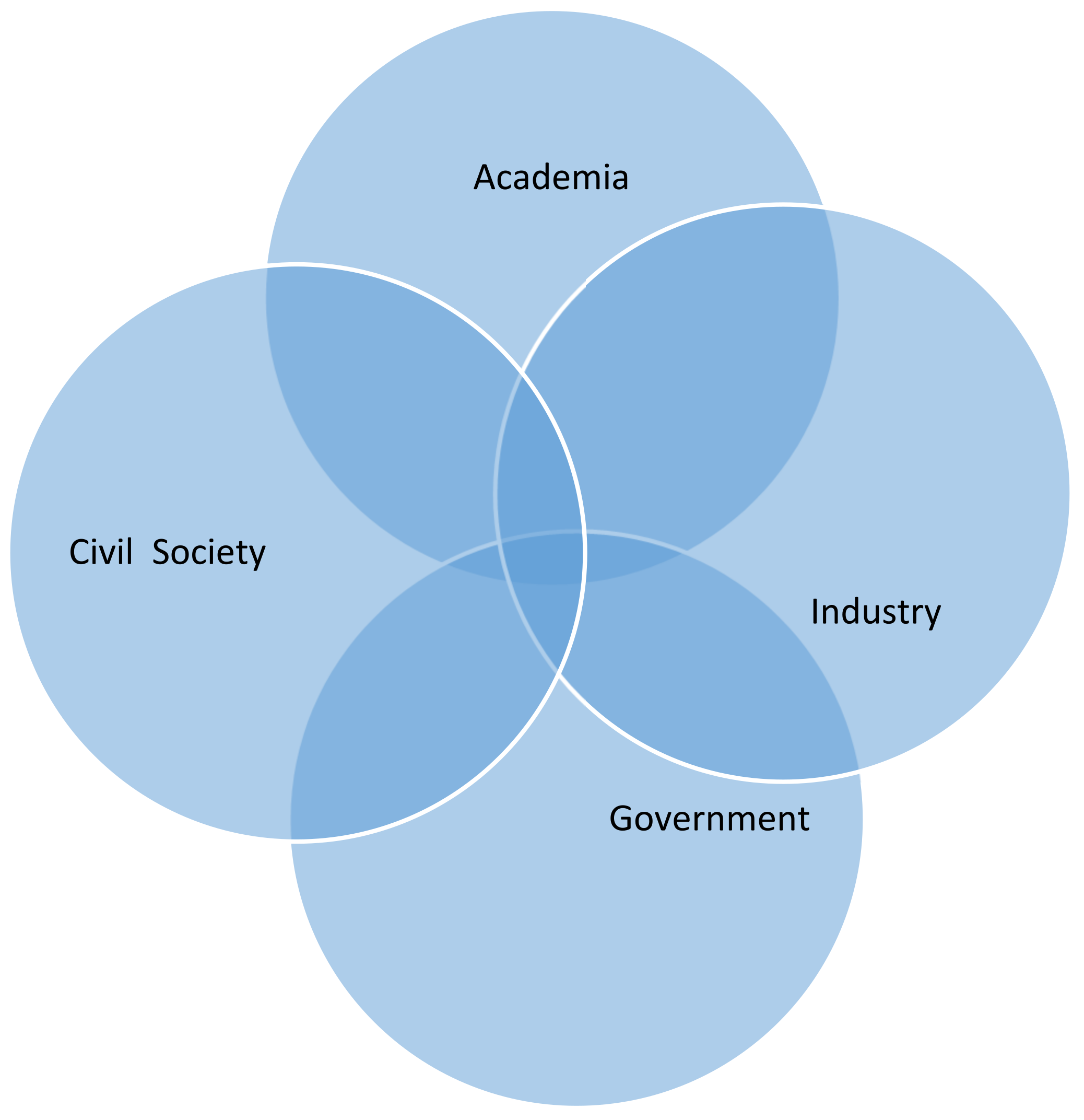
Figure 2.
The Foundations of Mode 4 Knowledge Production. Source: Own elaboration.
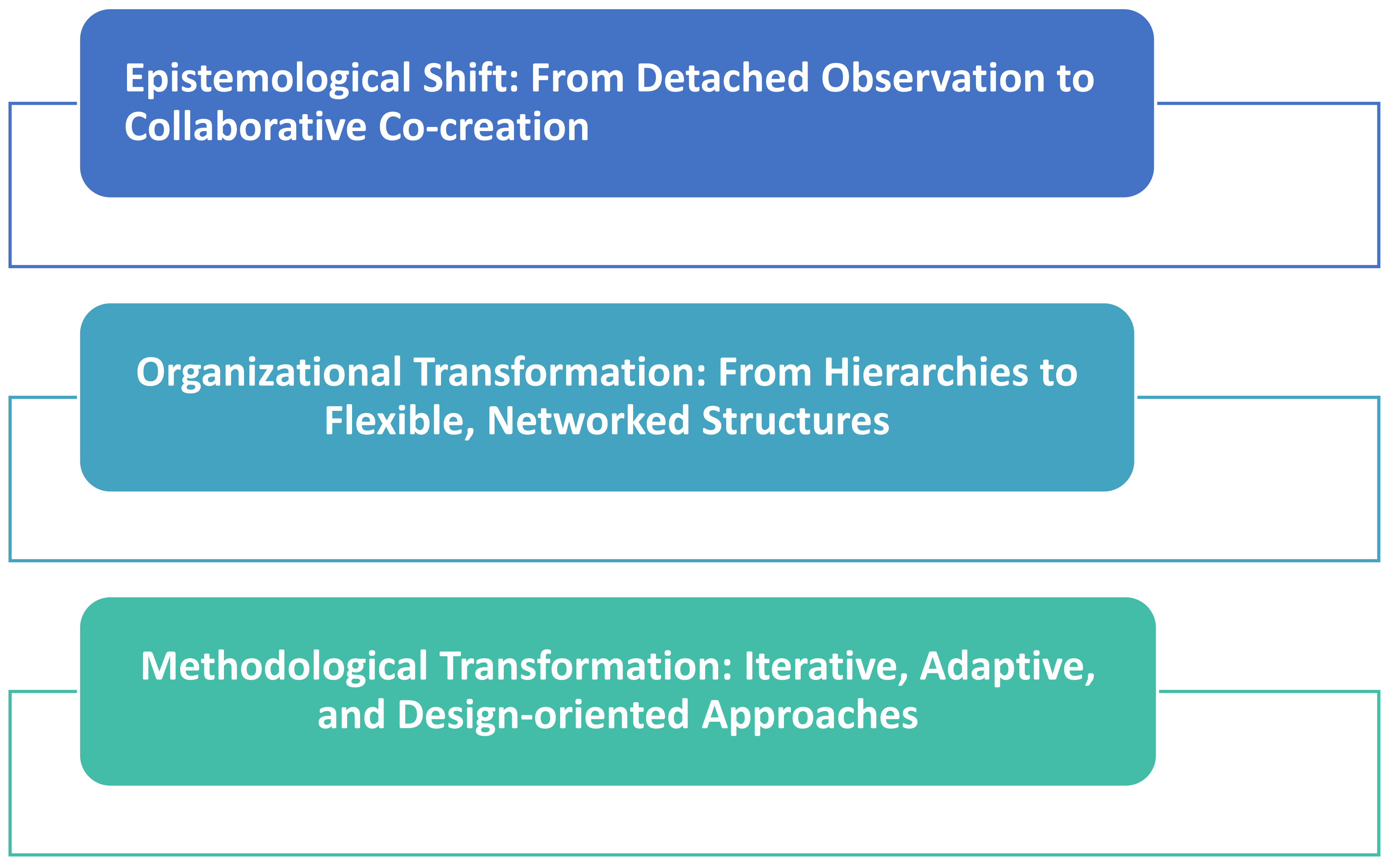
Figure 3.
Mode 4 Knowledge Production Operationalization in Innovationology. Source: Own elaboration.
Figure 3.
Mode 4 Knowledge Production Operationalization in Innovationology. Source: Own elaboration.
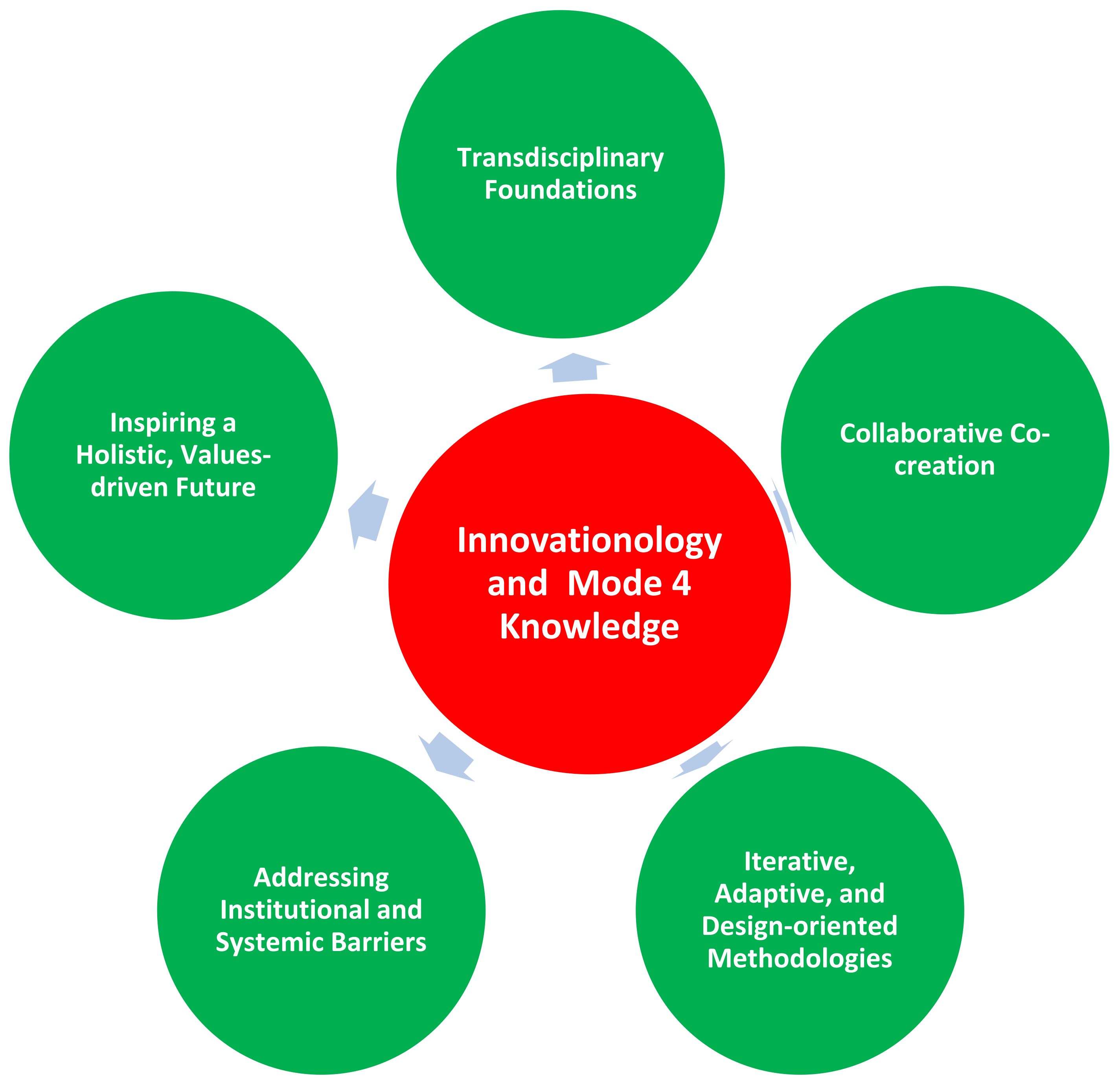

Table 1.
The decuple helix model. Source : Own elaboration.
| The ten key stakeholders that constitute the decuple helix | Key roles |
|---|---|
| Academia | As the traditional locus of knowledge production, universities and research institutes play a pivotal role within the decuple helix framework. Their expertise in specialized disciplines, research methodologies, and the generation of new knowledge can serve as a foundational pillar for collaborative, transdisciplinary inquiries. However, Mode 4 demands that academia shift away from its historical insularity and hierarchy, embracing a more open, engaged, and co-creative approach to research. |
| Industry | Businesses and corporations bring valuable practical knowledge, technological capabilities, and market-oriented perspectives to the decuple helix. Their participation can help to ensure the relevance and applicability of research outputs, while also providing resources and opportunities for the deployment of innovative solutions. In the Mode 4 paradigm, industry is viewed as an equal partner in the knowledge co-creation process, rather than a mere consumer or implementer of academic research. |
| Government | Government agencies and policymakers play a crucial role in the decuple helix framework, as they possess the regulatory, legislative, and budgetary levers to shape the broader institutional and policy environment for research and innovation. By actively engaging with other stakeholders, government can help to align knowledge production with pressing societal needs, while also facilitating the implementation and scaling of collaborative solutions. |
| Civil Society | Non-governmental organizations, community groups, and citizen collectives bring invaluable grassroots perspectives, local knowledge, and community-based expertise to the decuple helix. Their participation ensures that the research agenda and resulting solutions address the needs and priorities of diverse populations, particularly marginalized communities. Civil society actors can also serve as crucial conduits for the dissemination and uptake of collaborative research outputs. |
| Media and Culture | Media outlets, artists, and cultural institutions play a vital role in shaping public discourse, narratives, and awareness around complex societal challenges. Within the decuple helix framework, these actors can help to amplify the voices of diverse stakeholders, communicate research insights in accessible ways, and foster broader societal engagement with the knowledge co-creation process. |
| Natural Environment | Environmental organizations, natural resource managers, and ecological experts are essential participants in the decuple helix, as they possess deep knowledge of the biophysical systems that underpin the sustainability and resilience of human societies. By integrating their perspectives, the decuple helix framework can ensure that research and innovations are aligned with the needs and constraints of the natural world, moving towards a more harmonious and regenerative relationship between human and ecological systems. |
| Social and Values-based Movements | Social justice advocates, human rights groups, and values-oriented activists bring a crucial ethical and normative dimension to the decuple helix. Their participation helps to center issues of equity, inclusion, and the alignment of research and innovation with broader societal values and aspirations. These stakeholders can shape the framing of problems, challenge dominant narratives, and advocate for solutions that prioritize the wellbeing of marginalized communities. |
| Marginalized or Underrepresented Communities | The explicit inclusion of Indigenous groups, minority populations, and traditionally excluded stakeholders within the decuple helix framework is a critical component of the Mode 4 paradigm shift. These actors possess invaluable place-based knowledge, lived experiences, and alternative epistemologies that can radically transform the knowledge co-creation process. Their participation is essential for dismantling historical power imbalances and ensuring that research and innovations are responsive to the needs and priorities of diverse communities. |
| Philanthropy and Funding Organizations | Foundations, international organizations, trusts, and other impact-oriented grantmakers play a vital role in shaping the research and innovation landscape through their funding decisions and strategic priorities. Within the decuple helix framework, these actors can help to align financial resources with the collaborative, transdisciplinary, and values-oriented ethos of Mode 4 knowledge production. They can also leverage their position to advocate for institutional and systemic changes that support the widespread adoption of these principles. Intergovernmental bodies, global development agencies, and transnational networks are crucial participants in the decuple helix framework, as they possess cross-border expertise, resources, and convening power that can help to scale the impacts of collaborative research and innovation. These international organizations can facilitate the coordination and alignment of knowledge production efforts across national boundaries, while also providing valuable insights into global trends, policy frameworks, and geopolitical dynamics that shape the complex challenges facing our world. |
| Religious and Spiritual Organizations and Movements | Religious and spiritual organizations and movements, with their deep roots in community, ethics, and holistic conceptions of wellbeing, offer unique and invaluable contributions to the decuple helix framework. |
Disclaimer/Publisher’s Note: The statements, opinions and data contained in all publications are solely those of the individual author(s) and contributor(s) and not of MDPI and/or the editor(s). MDPI and/or the editor(s) disclaim responsibility for any injury to people or property resulting from any ideas, methods, instructions or products referred to in the content. |
© 2024 by the author. Licensee MDPI, Basel, Switzerland. This article is an open access article distributed under the terms and conditions of the Creative Commons Attribution (CC BY) license (http://creativecommons.org/licenses/by/4.0/).
Copyright: This open access article is published under a Creative Commons CC BY 4.0 license, which permit the free download, distribution, and reuse, provided that the author and preprint are cited in any reuse.


