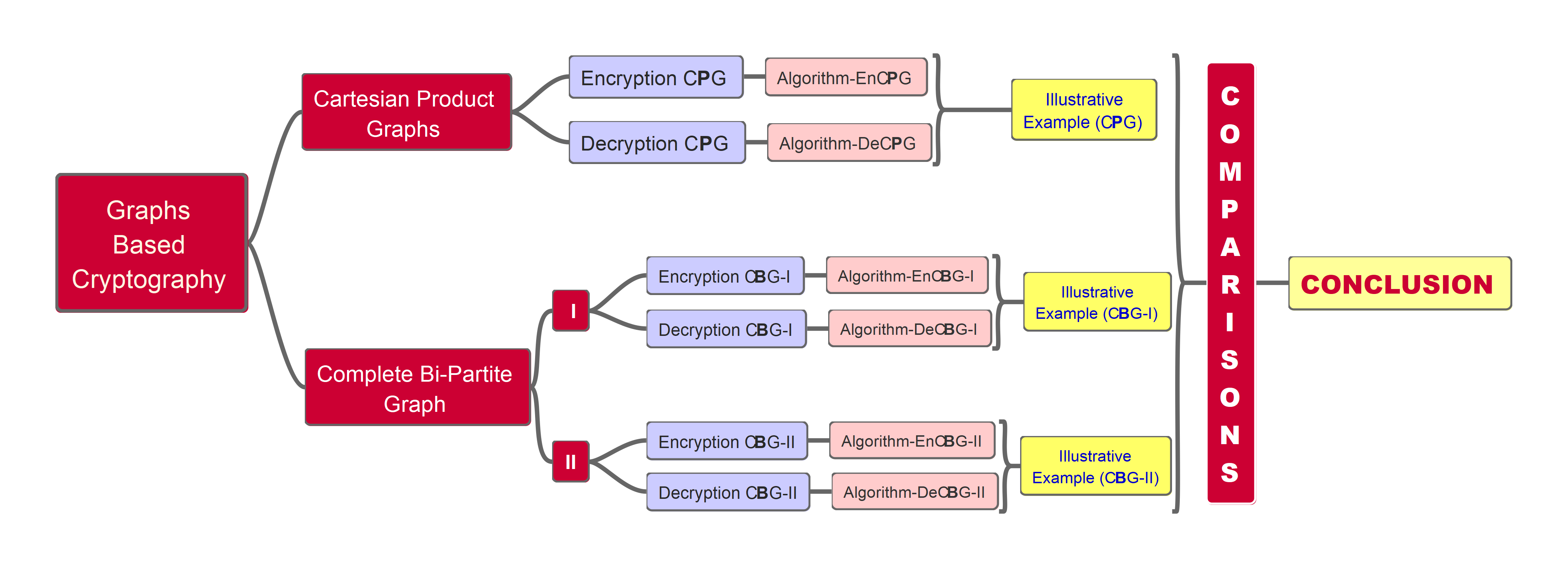
1. Introduction
Mathematical cryptography forms a crucial aspect of modern information security, employing advanced techniques to protect data against unauthorized access. The complexity and sophistication of cyber threats demand the development of robust cryptographic algorithms. This paper presents four innovative encryption schemes, each utilizing distinct mathematical transformations and methodologies to enhance data security.
The first scheme employs matrix manipulations and partitioning of numerical values derived from plain text characters, constructing a cipher through matrix additions. The second scheme builds on this foundation, introducing division operations and additional layers of transformation to further obscure the encrypted data. The third scheme incorporates tridiagonal matrices, creating a structured and secure encryption process. The fourth scheme refines this approach, using quotient-remainder operations and symmetric keys to construct a tridiagonal matrix cipher.
Each scheme is detailed, with step-by-step algorithms provided for both encryption and decryption processes. Examples illustrate the practical application of these methods, and a comprehensive discussion highlights the strengths and potential vulnerabilities of each approach. This paper aims to contribute to the field of mathematical cryptography by presenting these novel schemes, offering enhanced security for digital communication.
2. Related Work
Cryptography’s applications have garnered significant research attention. Lalitha and Vasu proposed a Python-based method for encoding and decoding text [
1]. Amudha, Sagayaraj, and Sheela [
2], along with Chowdhury, Ghosh, and Jana [
3], explored techniques for securing communications.
Kumari introduced a modified affine cipher algorithm for securing network communications, using matrices for data encryption and converting it into images [
4]. Meenakshi et al. highlighted efficient domination and total magic labeling techniques for encryption and decryption [
5]. Perera and Wijesiri discussed using matrices as secret keys in symmetric cryptography, enhancing data protection by converting plaintext into ciphertext [
6].
The rise of edge computing has significantly transformed network management, facilitating the dispersal of services throughout the entire network rather than centralizing them within the cloud [
7]. Tanguy Godquin et al. proposed a novel approach for deploying security services within IoT networks, considering the capabilities of individual devices [
8]. By applying this approach to a smart city scenario, specifically employing IPsec services, the authors observed enhanced network security with minimal disruption to information flow and minimized deployment costs.
Privacy preservation in multi-agent systems (MASs) is paramount, particularly in the context of data exchange. Zewei Yang et al. tackled this issue by investigating privacy-preserving bipartite consensus control for discrete-time nonlinear MASs [
9]. Employing the Paillier encryption scheme and event-triggered schemes, they ensured data confidentiality while maintaining communication efficiency. Theoretical analyses, supported by numerical examples, validated the effectiveness of their approach, offering insights into achieving bounded bipartite consensus in MASs.
The advent of quantum computing poses challenges to traditional cryptographic algorithms. Xiaohui Zhang et al. proposed leveraging topological graphic passwords for enhanced security against AI-equipped attacks and quantum threats [
10]. Their study introduced new techniques utilizing graph colorings and labelings, offering insights into the design of secure encryption systems resilient to emerging technological threats.
Recognizing encrypted traffic poses challenges, particularly in the absence of prior label information. Ruipeng Yang et al. proposed a subspace clustering via graph auto-encoder network (SCGAE) to address this issue [
11]. Their approach integrated graph encoder-decoder structures with self-supervised learning, yielding superior performance in identifying unknown encrypted traffic compared to benchmark models.
In conclusion, these studies collectively contribute to advancing the understanding and implementation of security measures, optimization techniques, and cryptographic systems in diverse network environments, addressing the evolving challenges posed by emerging technologies and dynamic network landscapes.
3. Main Work
In this section, the data is secured using the standard encoding (
Table 1). From the set of values, matrices are constructed by using basic modular arithmetic. It is important to note that the elements of sets constructed in these algorithms can repeat and are ordered. We begin with the preliminaries first:
3.1. Preliminaries
Cryptography is the art of transforming original messages into an incomprehensible form, ensuring that only authorized parties can access the information. This transformation is achieved through mathematical techniques and algorithms designed to encrypt (encode) data securely. The entire process of secure communication is facilitated by a framework known as a cryptosystem, which comprises five essential components: the key, the encryption algorithm, the decryption algorithm, the cipher-text, and the plain-text.
The plain text is the original message sent by the sender, while the cipher text is the secret message or the encrypted version of the plain text. The encryption process involves converting the plain text into cipher text using a cryptographic algorithm and a key. Conversely, decryption is the process of converting the cipher text back into plain text using a key. The cryptographic algorithm is a mathematical algorithm employed to perform both encryption and decryption. A key, which is a secret value used by cryptographic algorithms, is crucial for encrypting and decrypting data. To ensure the security of the encrypted information, keys must be kept confidential.
Cryptographic techniques can be broadly classified into two categories based on key distribution: symmetric key cryptography and asymmetric key cryptography.
Symmetric key cryptography, also known as secret key cryptography, employs the same key for both encryption and decryption. This method involves using a single encryption key for electronic communication, making use of a secret key and numerical computation to secure the data. In symmetric key cryptography, both participants use the same key K to encrypt and decrypt data, thereby protecting it from unauthorized access.
On the other hand, asymmetric key cryptography, also known as public key cryptography, utilizes a pair of keys: a public key and a private key. In this method, the public key is used for encryption, while the private key is used for decryption. These keys are essentially large, non-distinguishable numbers that have been generated to work together. This form of cryptography allows for more secure and flexible communication, as the public key can be freely distributed while the private key remains confidential.
By combining the strengths of symmetric and asymmetric key cryptography, modern cryptographic systems can provide robust security for a wide range of applications, ensuring the confidentiality, integrity, and authenticity of the information being transmitted.
3.1.1. Encoding Tables
There are two types of encoding table used in this work to encrypt/decrypt the given data. One is the standard encoding table and the other is the Pythagorean encoding table.
Table 1.
Standard Encoding Table
Table 1.
Standard Encoding Table
| A |
B |
C |
D |
E |
F |
G |
H |
I |
J |
K |
L |
M |
| 1 |
2 |
3 |
4 |
5 |
6 |
7 |
8 |
9 |
10 |
11 |
12 |
13 |
| N |
O |
P |
Q |
R |
S |
T |
U |
V |
W |
X |
Y |
Z |
| 14 |
15 |
16 |
17 |
18 |
19 |
20 |
21 |
22 |
23 |
24 |
25 |
26 |
Table 2 displays the Pythagorean numbers corresponding to the alphabets and
Table 3 illustrates how the numbers are connected to the alphabets in order to allow for uniqueness in vertex labeling of a graph.
The details of the encryption and decryption algorithm are listed below.
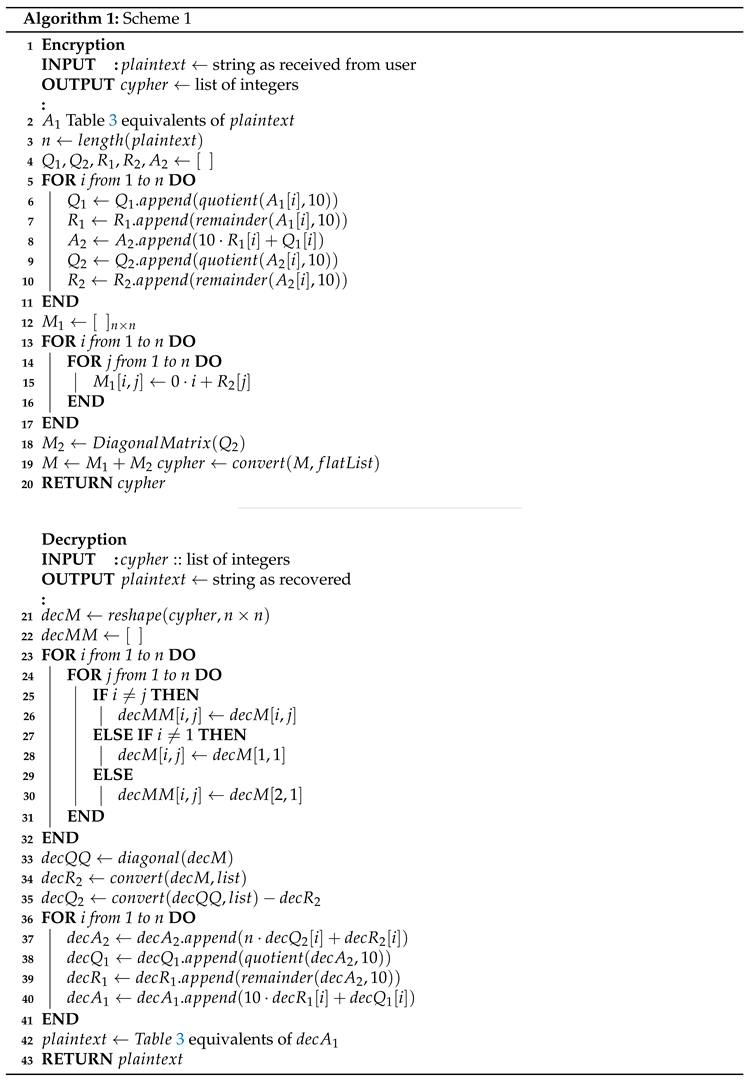
3.2. Scheme 1: Novel Cryptographic Protocol Using Matrix Conversions and Partitioned Values for Enhanced Security
Following algorithm initiates with the plain text, partitioning and interchanging values to form distinct sets. These sets are then ingeniously transformed into matrices, which through specific mathematical manipulations, yield the final cipher text. The decryption process mirrors this complexity, systematically reversing the operations to retrieve the original message. Each step, grounded in mathematical precision, contributes to a resilient cryptographic protocol capable of withstanding potential security breaches.
| Scheme 1 : Description |
Encryption
Let P be the plain text of length n. Let be the set of values corresponding to the alphabets. Partition into two sets such that is the set of values in that are at ten’s place and is the set of values in that are at unit’s place. It is important to note that all the numbers in have two digits. Construct a new set from the set by interchanging the values. Similarly, partition in two parts such that is the set of values in that are at ten’s place and is the set of values in that are at unit’s place. Construct a matrix of order n with each row . Construct a diagonal matrix of order n with diagonal entries from the set . Adding matrices and to obtain the matrix M. Construct a list according to each column of the matrix M. This list of element is our cipher.
|
Decryption
A list of numbers is received by the receiver. Count the element of the cipher and by taking the square root of the obtained number. The length of the original plain text is decrypted. Construct the matrix from the cipher according to each column. Arrange the diagonal entry in an array and denote it by . Construct an array by taking 1st element from 21 entry of the matrix and the remaining elements are the entries of first row of starting from 2nd position to the position. Subtract from to obtained the . Multiplying by 10 and adding to the corresponding element of . We obtained the set . Divide each element of by 10 to obtained the sets and which are respectively the set of quotients and the set of remainders. Multiply each element of by 10 and adding to the corresponding element of to obtained the set . Find the corresponding alphabets from the Table 3. The original message is decrypted.
|
Example 1. Encryption
Let the plain text be MATRIX of length 6. Then we have and thus
Construct a matrix of order n with each row , and another diagonal matrix of order n with diagonal entries from the set . Adding and yields our matrix M as shown below:
The ordered list of 36 elements
is our cipher.
Decryption Chopping the received cipher list into chunks of size each and stacking to get the matrix
Extract diagonal of and recover , respectively as . Subtract from to get . Multiplying by 10 and adding to the corresponding element of to gives . Divide each element of by 10 to get and . Multiplying each element of by 10 and adding to the corresponding element of to obtain and using Table 3 original text is decrypted as MATRIX.
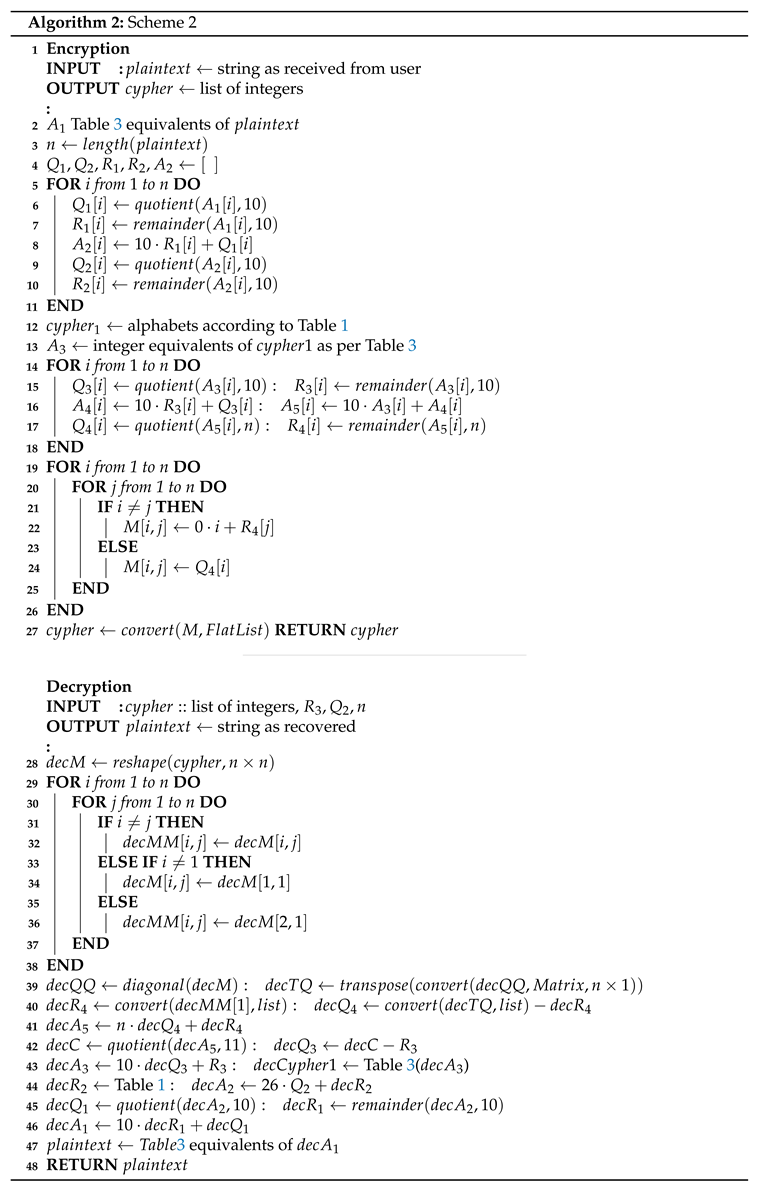
3.3. Scheme 2: Two-Layer Cryptographic Scheme Using Symmetric Key Transformation and Encoding
In this scheme (Scheme 2), the encryption algorithm initiates similarly to Scheme 1 but introduces a more elaborate series of steps involving additional partitions and transformations. This scheme enhances security by employing multiple layers of encoding and manipulation, which are further reinforced by the use of symmetric keys. The decryption algorithm, though more complex, effectively reverses these intricate steps to retrieve the original plain text, ensuring both security and accuracy in the encryption process.
| Scheme 2 : Description |
Encryption
Do 5 steps of scheme 1. Divide each element of by 26 to get the sets and that are the sets of quotient and the remainders, respectively. Find the alphabets from the Table 1 corresponding to each element of the . Let the plain text be . From Table 3, find the values corresponding to each alphabets of and let be the ordered set containing all the values. Divide each element of by 10 and let and are the sets of quotient and remainder, respectively. Multiplying by 10 and then add to the corresponding component of . The resulting values will be stored in an ordered set . Add the corresponding element of and and denote the resulting set by . Divide each element of by n and let and are the respective sets of quotients and remainders, respectively. Back to scheme 1
|
Decryption
Let the receiver has received the message as a string of numbers together with two sets of symmetric keys and . Count the element of the cipher and by taking the square root of the obtained number. The length of the original plain text is decrypted. Construct the matrix from the cipher according to each column. Arrange the diagonal entry in an array form and denote by . Construct an array by taking 1st element of the matrix from the entry 21 and the remaining elements of the matrix from row starting from 2nd position to the position. Subtract from to obtained the . Multiplying by n and adding to the corresponding element of . We obtained the set . Divide by 11 to obtained the set decC that are the set of quotient. And then subtract it from the symmetric key to obtained the set . Multiplying each element of by 10 and add it to the corresponding element of the symmetric key . Let us denote the resulting set as . Find the alphabet corresponding to each value of from the Table 3. Find the values corresponding to each alphabet from the Table 1 to get . Multiply each component of the symmetric key by 26 and add in the previous set which is and then subtract 1 from each element to decrypt . Divide each element of by 10 to decrypt the sets and which are the sets of quotients and remainders, respectively. Multiply each element of by 10 and then add them to the corresponding element of to decrypt . Find the alphabet corresponding to each element of from Table 3. The message is decrypted.
|
Example 2.
Encryption Let be the plain-text of length 6. Then we have . Constructing a new set from the set by interchanging the values and computing its quotients and remainders after dividing by 26 gives: . Finding the alphabets from the Table 1 corresponding to each element of the set produces . Using Table 3, for gives . Multiplying by 10 and then adding to the corresponding component of yields . Add the set and we have and consequently division of by 6 yields and as follows: . Matrix M is obtained as follows:
List the element of the matrix as follows: . This list of 36 elements is our cipher. For decryption, on receiving the 36 element list , and , construct the matrix
and extract its diagonal . Next, construct an array by taking 1st element of the matrix from the entry 21 and the remaining elements of the matrix from row starting from 2nd position to the position. Subtract from and multiplying by 6 and adding to the corresponding element of one gets: and
Divide by 10 to obtain the and then subtract it from the symmetric key to obtain the set . Now get by multiplying each element of by 10 and add it to the corresponding element of the symmetric key . Using Table 3 over gives . Further use of Table 1 yields .
Multiplying each component of the symmetric key by 26 and adding in and then subtract 1 from each element to obtain . Divide each element of by 10 to decrypt the sets as and . Next, multiply each element of by 10 and then add them to the corresponding element of to get the set which by use of Table 3 yields the final decrypted message as .
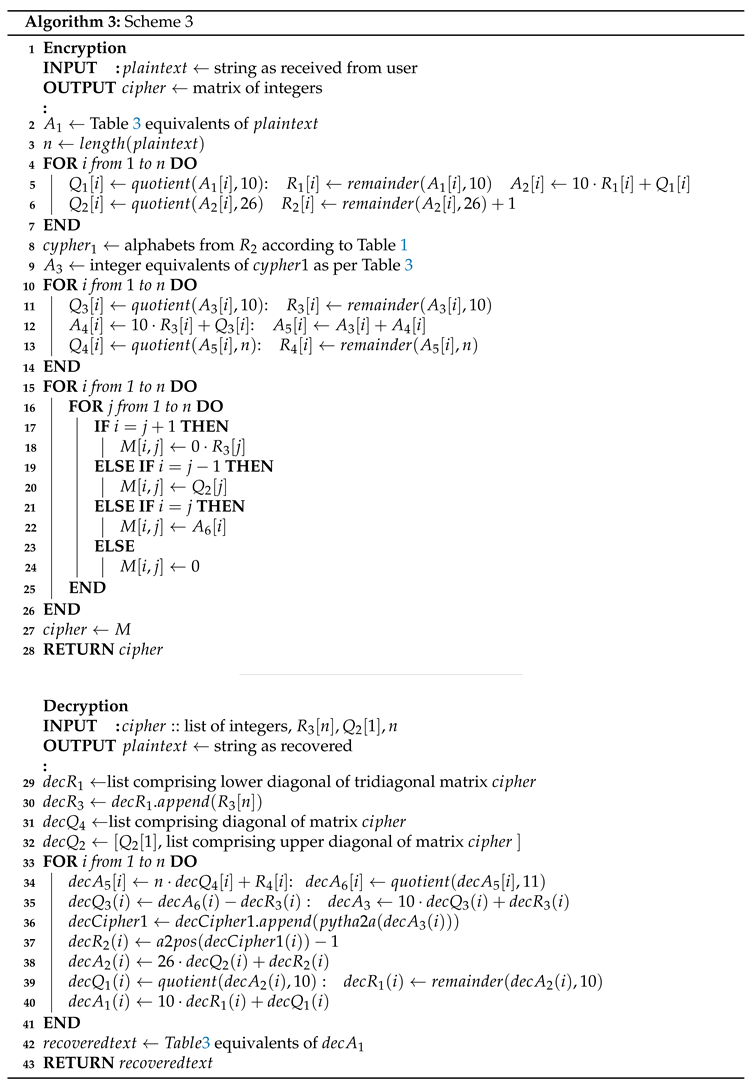
3.4. Scheme 3: Enhanced Cipher-Text Length Optimisation and Compact Keys for Two-Layer Cryptography Scheme
The algorithm of Scheme 3 integrates advanced mathematical operations to create a cipher from the plain text. The detailed process involves partitioning values, interchanging digits, and constructing tridiagonal matrices. These steps are designed to transform the plain text into an encrypted form that is challenging to decipher without the correct keys. Furthermore, the decryption algorithm ensures that the original message can be accurately reconstructed, maintaining the integrity of the data. The systematic approach of Scheme 3, combined with its use of tridiagonal matrices and symmetric keys, marks a significant improvement over previous schemes, offering enhanced security and complexity.
| Scheme 3 : Description |
Encryption
Let P be the plain text of length n. Let be the set of values corresponding to the alphabets. Partition the values of in two parts such that is the set of values in that are at ten’s place and is the set of values in that are at unit’s place. Construct a new set from the set by interchanging the values. Divide each element of by 26 to get the sets and that are the sets of quotients and the remainders, respectively. Find the alphabets from the Table 1 corresponding to each element of the set . Let the plain text be . From Table 3, find the values corresponding to each alphabets of and let be the ordered set containing all the values. Divide each element of by 10 and let and are the sets of quotient and remainder, respectively. Multiplying by 10 and then add to the corresponding component of . The resulting values will be stored in an ordered set . Add the corresponding element of and and denote the resulting set by . Divide each element of by n and let and are the respective sets of quotients and remainders, respectively. -
Construct the cipher as follows:
Construct the cipher as tridiagonal matrix with main diagonal set . The lower sub-diagonal set as entries from the first elements of the set . The entries of the upper sub-diagonal are the last elements of the set .
The cipher text is obtained.
|
Decryption
Let the receiver has received the message as a matrix of order together with set of symmetric keys and and 1st entries of and respectively. Arrange the diagonal entry in a set to decrypt . Arrange the lower sub-diagonal entry of matrix received as first elements and the key of entry of as last n element in a set to decrypt . Arrange the upper sub-diagonal entry of matrix received as last elements and the key of 1st entry of as first element in a set to decrypt . Multiplying each element of by 10 and add it to the corresponding element of the symmetric key . Let us denote the resulting set as . Find the alphabet corresponding to each value of from the Table 3. Find the values corresponding to each alphabet from the Table 1 to get . Multiply each component of the symmetric key by 26 and add in the previous set which is and then subtract 1 from each element to decrypt . Divide each element of by 10 to decrypt the sets and which are the sets of quotients and remainders, respectively. Multiply each element of by 10 and then add them to the corresponding element of to decrypt . Find the alphabet corresponding to each element of from Table 3. The message is decrypted.
|
Example 3.
Plain text gives and . Construct a new set from the set by interchanging the values and the corresponding sets and by dividing by 26. Using Table 1 on gives . Using Table 3, on obtain and . multiplying by 10 and then adding to the corresponding component of yields . and thus make the cipher as:
For decryption, receive the cipher M together with symmetric keys and and 1st element of and respectively. , 6th element of is 2 and 1st element of is 0. Here .
Arrange the diagonal entry in a list to decrypt . Arrange the lower sub-diagonal entry of matrix M as first 5 elements and the key of 6th entry of which is 2 as 6 element in a set to decrypt . Arrange the upper sub-diagonal entry of matrix M as last 5 elements and the key of 1st entry of which is 0 as 6 element in a list to decrypt . and Multiplying the symmetric key by 10 and adding to the corresponding element of to decrypt the .Which on using Table 3 gives and in turn use of Table 1 yields . Multiply each element of by 26 and add in the previous set which is and then subtract 1 from each element to obtain the set and then divide each element of by 10 to and . Multiply each element of by 10 and then add them to the corresponding element of to get the . Find the alphabets corresponding to each element of from the Table 3.
, and the original message is decrypted.
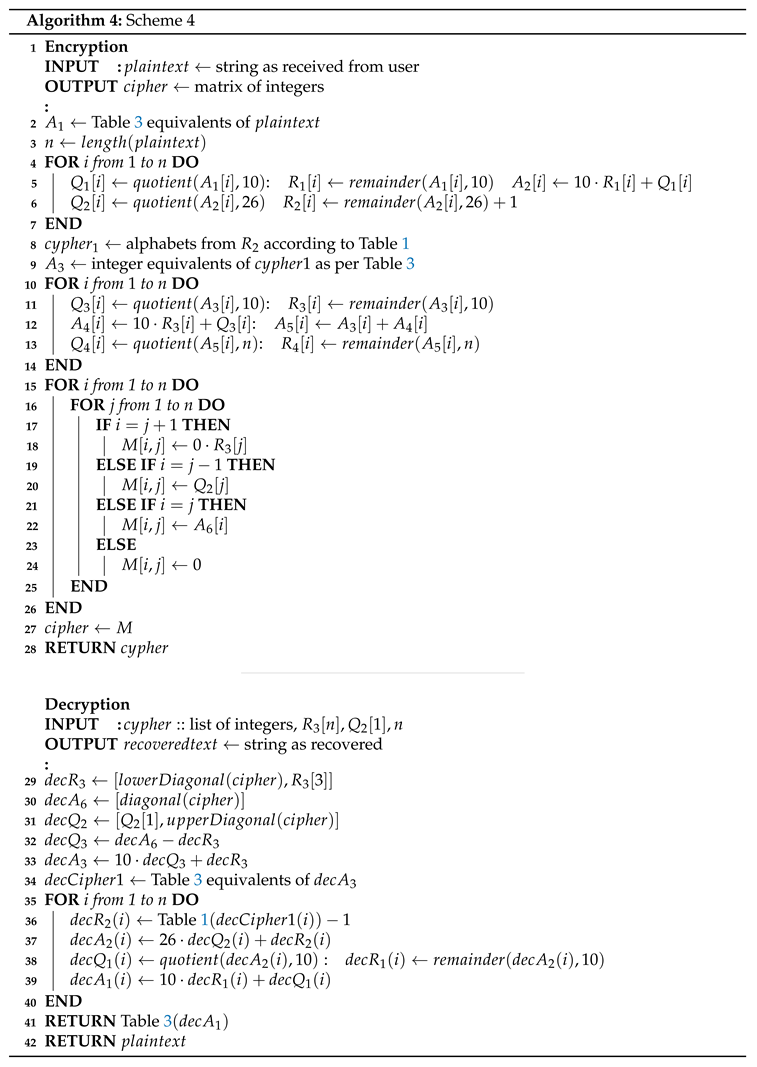
3.5. Scheme 4: Encryption and Decryption Using Tridiagonal Matrices and Disguised Key
The encryption algorithm of Scheme 4 begins by mapping plain text characters to their corresponding numerical values. These values are partitioned, transformed, and rearranged through multiple steps involving division by constants, multiplication, and addition operations. The resulting values are used to construct a tridiagonal matrix, which serves as the cipher text. Decryption, on the other hand, involves reversing these operations to accurately reconstruct the original message. The use of tridiagonal matrices and symmetric keys not only enhances the encryption process but also ensures that decryption is precise and reliable. This scheme stands out for its methodological rigor and the robust security it provides.
| Scheme 4: Description |
Encryption
Let P be the plain text of length n. Let be the set of values corresponding to the alphabets. Partition the values of in two parts such that is the set of values in that are at ten’s place and is the set of values in that are at unit’s place. Construct a new set from the set by interchanging the values. Divide each element of by 26 to get the sets and that are the sets of quotient and the remainders respectively. Find the alphabets from the Table 1 corresponding to each element of the set . Let the plain text be . From Table 3, find the values corresponding to each alphabets of and let be the ordered set containing all the values. Divide each element of by 10 and let and are the sets of quotient and remainder, respectively. Multiplying by 10 and then add to the corresponding component of . The resulting values will be stored in an ordered set . Add the corresponding element of and and denote the resulting set by . Divide each element of by 11 to get the set that is the set of quotient. -
Construct the cipher as follows:
- (a)
The main diagonal will be the set . - (b)
The lower sub-diagonal set as entries from the first elements of the set . - (c)
The entries of the upper sub-diagonal are the last elements of the set .
We obtained the cipher.
|
Decryption
Let the receiver has received the message as a matrix of order together with two symmetric keys of and 1st entries of and , respectively. Arrange the diagonal entry in a set to decrypt . Arrange the lower sub-diagonal entry of matrix received as first elements and the key of entry of as last n element in a set to decrypt . Arrange the upper sub-diagonal entry of matrix received as last elements and the key of 1st entry of as first element in a set to decrypt . Subtract each element of from the corresponding elements of and the resulting set will be denoted by . Find by multiplying each element of by 10 and then add it to the corresponding element of . Find the alphabets corresponding to each value of from the Table 3. Find the values corresponding to each alphabet from the Table 1 to get . Multiply each element of by 26 and add in the previous set to decrypt . Divide each element of by 10 to decrypt the sets and which are the sets of quotients and remainders, respectively. Multiply each element of by 10 and then add them to the corresponding elements of to decrypt . Find the alphabets corresponding to each element of from Table 3. Original plain text is decrypted.
|
Example 4.
Plaintext gives and . Interchanging the values of gives , and also by dividing 26 we have . Using Table 1 on gives . Table 3, on yields and . Multiplying by 10 and then add to the corresponding element of to obtain. Next divided by 11, . This allows construction of cipher as
For decryption, on receiving the cipher together with symmetric keys: 6th and 1st element of and , respectively. Using 6th element of is 2 and 1st element of is 0. Here, . Arrange the diagonal entry in a set to decrypt . Arrange the upper sub-diagonal entry of matrix M as last 5 elements and the key of 1st entry of which is 0 as 6 element in a set to decrypt . We now have and . Subtracting from , . Multiplying by 10 and adding to the corresponding element of , gives and use of Table 3. Encoding this with Table 1 produces . Now multiply each element of by 26 and add in the previous set which is to obtained the set and . Multiply each element of by 10 and then add them to the corresponding element of to get the set . Table 3 gives , and the message is decrypted.
Table 4.
Complexity Analysis: Encryption in is of linear order, while all others due to involvement of square matrices have square order complexities.
Table 4.
Complexity Analysis: Encryption in is of linear order, while all others due to involvement of square matrices have square order complexities.
| |
Time |
Space |
| |
Encryption |
Decryption |
Encryption |
Decryption |
|
|
|
|
|
|
n |
|
|
|
|
|
|
|
|
|
|
|
|
|
3.6. Complexity Analysis
We only give details of time-complexity and space-complexity for Scheme 1.
Encryption: Assigning the length
n to the plaintext
P and drawing the encryption table both take
time. Extracting the set
, partitioning
into
and
, constructing
, partitioning
into
and
, and constructing the diagonal matrix
all involve
operations. Constructing the matrix
, adding
and
, and constructing the final cipher list require
time. Hence the total time complexity for the encryption process is:
Decryption: Receiving the list takes
time, while counting the elements in the cipher, taking the square root, and constructing the matrix
each require
. Arranging diagonal entries into an array, constructing
, subtracting arrays to obtain
, multiplying and adding elements to form
, dividing to get
and
, reconstructing
, and finding corresponding alphabets all involve
operations. Therefore the total time complexity for the decryption process is:
Hence, the overall time complexity of Scheme 1 is:
All other Schemes may be analysed in a similar fashion. Complete data, thus obtained is shown in
Table 4.
4. Conclusion
We have created four schemes. The first encrypts data using a string of numbers. numbers make up a cipher, where n is the length of the plain-text. The encryption/decryption algorithm does not have a key and does not provide an attacker with a pattern to access the original message. The length of the plain text can be predicted by the attacker from the cypher-text, which is the only disadvantage.
An additional layer has been utilised in Scheme 2. Two keys are required in order to decrypt the information. Before being transformed into a list of numbers, plain-text is first disguised as another plain-text of the same length. Furthermore, in order to decrypt the original data, two keys, each made up of n numbers, are required. We’ll improve our data security with this plan. A word of length n can only be decrypted by the receiver if he had numbers, which is the only drawback.
Scheme three has two layers, just as Scheme 2. In this scheme, the cipher consists of an ordered set of numbers and three keys, each of size n. We make it difficult for attackers to predict the length of the plain-text by implementing this scheme. We also shortened the length of the keys and the cipher-text. In scheme 4, we have not only shrunk the key’s size but also changed its ordering, making it harder for an attacker to find the original text.
References
- M. Lalitha.; S. Vasu. A Study On Graph Theory In Cryptography Using Python. Journal of Engineering Technologies and Innovative Research 2023, 10.
- Amudha, P.; Sagayaraj, A.C.C.; Sheela, A.C.S. An Application of Graph Theory in Cryptography. International Journal of Pure and Applied Mathematics 2018, 119, 375–383.
- Chowdhury, S.; Ghosh, P.; Jana, M. An Approach of Graph Theory for Solving Cryptographic Problem. BKGC Scholars 2020, 1, 64–68.
- Kumari, M.; Kirubanad, V. Data Encryption And Decryption Using Graph Plotting. International Journal of Civil Engineering and Technology 2018, 9, 36–46.
- Meenakshi, A.; Kannan, A.; Cep, R.; Elangovan, M. Efficient Graph Network Using Total Magic Labeling and Its Applications. Mathematics 2023, 11, 4132. doi:. [CrossRef]
- G. S . Wijesiri, P.A.S.D.P. Encryption and Decryption Algorithms in Symmetric Key Cryptography Using Graph Theory. Psychology and Education Journal 2021, 58, 3420–3427. [CrossRef]
- Mahboob, A.; Asif, M.; Nadeem, M.; Saleem, A.; Eldin, S.M.; Siddique, I. A Cryptographic Scheme for Construction of Substitution Boxes Using Quantic Fractional Transformation. IEEE Access 2022, 10, 132908–132916. [CrossRef]
- Godquin, T.; Barbier, M.; Gaber, C.; Grimault, J.L.; Le Bars, J.M. Applied graph theory to security: A qualitative placement of security solutions within IoT networks. Journal of Information Security and Applications 2020, 55, 102640. [CrossRef]
- Yang, R.; Yu, A.; Cai, L.; Meng, D. Subspace clustering via graph auto-encoder network for unknown encrypted traffic recognition. Cybersecurity 2022, 5, 29. [CrossRef]
- Zhang, X.; Zhang, S.; Ye, C.; Yao, B. Graphic lattices made by graph felicitous-type labelings and colorings of topological coding. Discrete Applied Mathematics 2023, 336, 37–46. [CrossRef]
- Yang, Z.; Yu, L.; Liu, Y.; Alotaibi, N.D.; Alsaadi, F.E. Event-triggered privacy-preserving bipartite consensus for multi-agent systems based on encryption. Neurocomputing 2022, 503, 162–172. [CrossRef]
Table 2.
Pythagorean numbers corresponding to each alphabet.
Table 2.
Pythagorean numbers corresponding to each alphabet.
| |
1 |
2 |
3 |
4 |
5 |
6 |
7 |
8 |
9 |
| 1 |
A |
B |
C |
D |
E |
F |
G |
H |
I |
| 2 |
J |
K |
L |
M |
N |
O |
P |
Q |
R |
| 3 |
S |
T |
U |
V |
W |
X |
Y |
Z |
|
Table 3.
Adjusted table used in encryption/decryption scheme
Table 3.
Adjusted table used in encryption/decryption scheme
| A |
B |
C |
D |
E |
F |
G |
H |
I |
J |
K |
L |
M |
| 11 |
21 |
31 |
41 |
51 |
61 |
71 |
81 |
91 |
12 |
22 |
32 |
42 |
| N |
O |
P |
Q |
R |
S |
T |
U |
V |
W |
X |
Y |
Z |
| 52 |
62 |
72 |
82 |
92 |
13 |
23 |
33 |
43 |
53 |
63 |
73 |
83 |
|
Disclaimer/Publisher’s Note: The statements, opinions and data contained in all publications are solely those of the individual author(s) and contributor(s) and not of MDPI and/or the editor(s). MDPI and/or the editor(s) disclaim responsibility for any injury to people or property resulting from any ideas, methods, instructions or products referred to in the content. |
© 2024 by the authors. Licensee MDPI, Basel, Switzerland. This article is an open access article distributed under the terms and conditions of the Creative Commons Attribution (CC BY) license (http://creativecommons.org/licenses/by/4.0/).