

Submitted:
24 October 2024
Posted:
25 October 2024
You are already at the latest version
Abstract
The present paper investigates the intricacies of the Chinese English slang world with a focus on the use of the term "vibe." The goal here is to provide a look at how terms change and what their metonymic uses are in the approaches of translanguaging. Through the use of a corpus approach to this issue, the goal is to bring out the meanings and their cultural dimensions expressed in this slang word. Against this backdrop, this paper uses the rich linguistic resource from a translanguaging perspective to explore how users navigate the complexities implicated in online self-presentation with the use of such slang. Therefore, the paper scrutinizes the concept of metonymy in Chinese English slang in an attempt to unearth the symbolic meanings or connotations that have been buried in the meaning of the term "vibe." The result of this analysis is a contribution toward understanding the changing landscape of language and communication in this digital era using linguistic data from the Chinese English slang ecosystem.
Keywords:
vibe
; Chinese English Slang
; Translanguaging
; Metonymy
; Corpus Linguistics
Introduction
1.1. Background
Social network communication in later decades has quickly created over the world. The virtual world, comprised of different sorts of online communication, is presently an indistinguishable portion in numerous people's lives. As a result, distinctive sorts of Social network communication have developed, such as social-networking app(e.g. Instagram), micro-blogging (e.g. X), online dialog forum(e.g. Reddit). These virtual spaces offer different communicative affordances, counting online chatting, long posts, and brief blogging posts (Zhang, 2022).
Similar to Twitter, Weibo provides micro blogging services to users and is the most popular microblogging site in China(Data Weibo, March,2024). Weibo is a space where online users can express their thoughts and interact through social networks, allowing them to practice their creative online literacy.
Many young people use 'Internet English' a lot on social media. Using English words and phrases in Chinese social media sites is a popular way for people in China to communicate with each other(Zhang, 2012). Young people often make up new words or ways of using language when they're online. This is because teenagers are known for changing the way we speak and write, and are seen as the main reason language keeps changing(Palacios Martínez, 2018: 363).Young people often make up new words or ways of using language when they're online. This is because teenagers are known for changing the way we speak and write, and are seen as the main reason language keeps changing.
The growing interest in Chinese-English slang research just brings closer the study of how different linguistic resources and socio-cultural influences interact in the process of configuring current practices of communication. Employing the tools of corpus linguistics, this paper teases apart the nuanced strata upon which meaning may be constructed for the word 'vibe' and its sociolinguistic implications for cross-cultural interaction and identity online. Numerous semantic scholars have managed with the components of the advancement of word implications in past decades(Kachru, 1983; Qin & Guo, 2020; Tan, 2009; Yang, 2005). More and more proof shows that implications and utilizations of words are variable and composite, and may turn out in an unexpected way depending on how words are utilized in settings.
1.2. Research Questions
This study aims to find out how Chinese people use the English word "vibe" by focusing upon how they mix languages and use one word to represent a larger idea. The research questions which were answered from this research were:
1. How do people use their translanguaging strategies in the context of Internet slang, with particular focus on the use of "vibe" within this framework?
2. How is metonymy involved in configuring and construing the meaning of "vibe" in Chinese-English slang?
3. How do translanguaging and metonymy shape the meaning and use of the term "vibe" in cyber communication?
4.What patterns and trends are manifested in the use of translanguaging and metonymy in the term "vibe," as seen in a corpus linguistic approach?
5. How do cultural nuances and linguistic intricacies inform the use and meaning of "vibe" in Chinese English slang?
2. Literature Review
2.1. What’s the Vibe
The word, "vibe," is a noun used to describe the mood or atmosphere in regard to a person's feeling. It is an informal way of capturing the mood or feeling which something or some place gives off. For instance, a person could say that a certain place gives off a "good vibe" if the same is welcoming and positive or, contrarily, a place could be said to give off a "bad vibe" if the feeling is one of hostility and negativity. As a verb, "vibe" can mean to enjoy oneself by listening to or dancing to popular music, or to be in harmony with someone or something(Oxford University Press, n.d.).
The word "vibe" originated in the 1940s as a short form for "vibraphone," the musical instrument. By the 1960s, it was in use as an abbreviation for "vibration" in the sense of an instinctive feeling about a person or thing(Online Etymology Dictionary, n.d.).
It comes from the Latin "vibratio", meaning "a shaking, a brandishing"; from the past participle stem of "vibrare," meaning "to set in tremulous motion." The intuitive signal of a person or thing, vis-à-vis the concept of "vibe", became popular in the late 60s, though one finds etymological origin for both senses as far back as 1899(Online Etymology Dictionary, n.d.). In general, the evolution of a word reflects changes in culture and the adaptation of language to express totally new ideas and emotions. That is to say, "vibe" is widely used today to describe either the atmosphere or the emotional tone of a situation, place, or person—more typically in informal contexts and among young generations. Among young people in China, the term "vibe" has also been embraced and innovatively used to communicate with each other. It also signals a wider trend in which English expressions and slang are becoming part of everyday speech (Online Etymology Dictionary, n.d; Merriam-Webster, n.d.)
Chinese people have a tendency to introduce new meanings of such words and use them actually to catch some unique traits of their culture and identity. There comes Chinese English slang, also known as Chinglish which is a specific linguistic phenomenon that has won popularity in online communication platforms such as Douyin (Chinese TikTok), Weibo, and Wechat. Chinese English slang is a way of hybrid language: it uses the materials from both Chinese and English in creating a new syncretic style of linguistic lexical formation that represents the creativity and adaptability of subjects using the Internet within the Chinese paradigm (Li&Wang,2024). Examples of other translanguaging strategies, apart from Pinyin initialism, abound in new Chinglish, including other hybrid words with Chinese, English, and Arabic numerals. Another prevalent one is that of other translanguaging strategies, which serve as indicators of more creative ways in which people blend their linguistic resources for self-identification purposes and online self-presentation (Li&Wang,2024).
Chinese English slang finds its sources associated closely with modern globalization, while society's gradual increased "informatization" leads to the communication and exchange of information in mass social networking sites (Qiao,2024). In the background of this is that communication with such mass social networking sites presents itself as a beehive of activities with people from all sorts of cultural backgrounds; hence, it uses internet slang as an important device for the expression of ideas, vibetions, and identities in a rapidly transforming digital scape (Qiao,2024).
From a sociolinguistic point of view, Chinese English slang is not only a tool for communication but also a reflection of the value orientation and norms of society creating and using it (Qiao,2024). This research on Internet terms with their corresponding translation strategies depicts how language has been changing in order to adapt toward technological development and changes in culture and towards reflecting the dynamics of any linguistic expression in the digital era.
For example, the atmosphere of a new café or general mood during a social event would be caught with the usage of the word "vibe". It is a way of expressing, in present-day terms, a complicated variety of feelings or the character of a place. When such a word as "vibe" is used, alongside so many other English slang words, it represents a more vibrant and dynamic form of bilingual communication that is most popular on social media platforms and in informal conversation. Its linguistic creativity is not trapped in the use of this word, but extend to an even wider array of metalinguistic choices. It's a testament to how changes in a globalized, digitized world enable youth to fall back on adaptability and inventiveness.
2.2. Translanguaging and Metonymy
Originally derived from Welsh ('trawsieithu'), translanguaging was presented as a language teaching approach to alternation of language for pupils in class, (Williams,1994,1996). Indeed it is a term that has been much investigated and debated by researchers and theorists, ( Blackledge & Creese, 2010; Canagarajah, 2011; Garcia & Li, 2014; García, 2009) as the terms such as code-mixing and code-switching cannot fully capture the bilingual/multilingual speaker's online/offline social interaction in the increasingly globalized flows of communication.
The media, people, goods, and services have contributed toward the increasing diversity in the linguistic landscape of individuals repertoires (Hafner et al., 2015, p. 445). Canagarajah (2011) describes translanguaging as how multilingual speakers shuttle between languages, which are regarded as an integrated system. Garcia and Li (2014) further argue that translanguaging extends the monolithic view of code-switching which continues to treat language as separate entities and excludes other semiotic resources.
Therefore, translanguaging stress on the manner through which the users of language seem to make use of not only different languages and language varieties but also with different multiliteracies resources within a transformative, resemiotisation process.
Translanguaging is a complex, multifaceted phenomenon in which different languages and their resources are put together in communication. Much insight from the existing literature on the theoretical underpinning and practical application of translanguaging has been taken up nowadays across a variety of linguistic contexts. This is attributed to be a dynamic and fluid nature while focusing on promoting language learning and further communication in multilingual contexts(Li, 2017).
All this is happening in processes that are supposed to be very central to translanguaging. This helps in meaning construction and identity negotiations in translanguaging practices (Li, 2017). Hence, an exploration of the use of metonymy in translanguaging practices may reveal more of how these resources are drawn upon by users of language in service of their communicative goals.
Besides this, the translanguaging resources available in English, for instance, the Chinese English slang "vibe," all point us to how creative, adaptive, mutable, and dynamic in nature the use of language can get while communicating online. The analysis of translanguaging resources mobilized in performance of internet slang offers a way towards unpacking complex ways in which individuals draw from diverse linguistic and semiotic resources relevant to how they shape their identities in self-presentation online.
In non-cognitive approaches to language, metonymy has been traditionally viewed as a rhetorical figure in which the name of a referent is used to point to another that it replaces and with which it has a relation of contiguity in the real world. Kövecses and Radden (1998: 39) have offered one of the most widely accepted definitions of metonymy as a cognitive process in which one entity offers mental access to another inside the same domain: A cognitive process in which one conceptual entity, the vehicle, provides mental access to another conceptual entity, the target, within the same domain (Kövecses and Radden 1998: 39). This definition of metonymy is not free from certain problems. A fundamental concept in which metonymy and metaphor differ is in CL the paradigmatic reality that metonymy is a shift within one of the only differences whereas metaphor is a shift between domains.
In its broad sense, metonymy is a fundamental concept for any word or phrase substitution according to the conceptual relation between them. The manipulation of Chinese English slang "vibe" may imply certain meanings and associations within the construal.
The existing metonymy literature focuses on its cognitive and linguistic mechanisms that shed light on how the language users exploit this phenomenon to optimize communication. Metonymy is not a device in linguistics but a cognitive process taking place in the backgrounds of our perception and understanding of a language (Li,2024). In other words, checking the role of metonymy in coming to an understanding of a slang item, for example "vibe," helps researchers understand more intricate webbing of associations and meanings situated therein.
In addition, metonymy has been brought into close relation with translanguaging: flexible use between languages and semiotic resources (Li,2024). In the case of Chinese English slang, the relationship between metonymy and translanguaging provides insight into well-structured and often complicated ideas and conceptions that guide language users across linguistic boundaries.
Researching point of confluence between metonymy and translanguaging in the use of "vibe" in Chinese English slang stands to discover a subtle connection between meaning and the identities appropriated by language users on the Internet. This section will attempt to introduce some literature, focusing mainly on metonymy and its importance for the application and understanding of different contexts of social and cultural linguistics.
When we come back to “vibe”, there is an example of cline from evident lexical to clearly word-formational diction, all referring to metonymic patterns:
Figure 1.
A cline of derivative patterns of “vibe”.
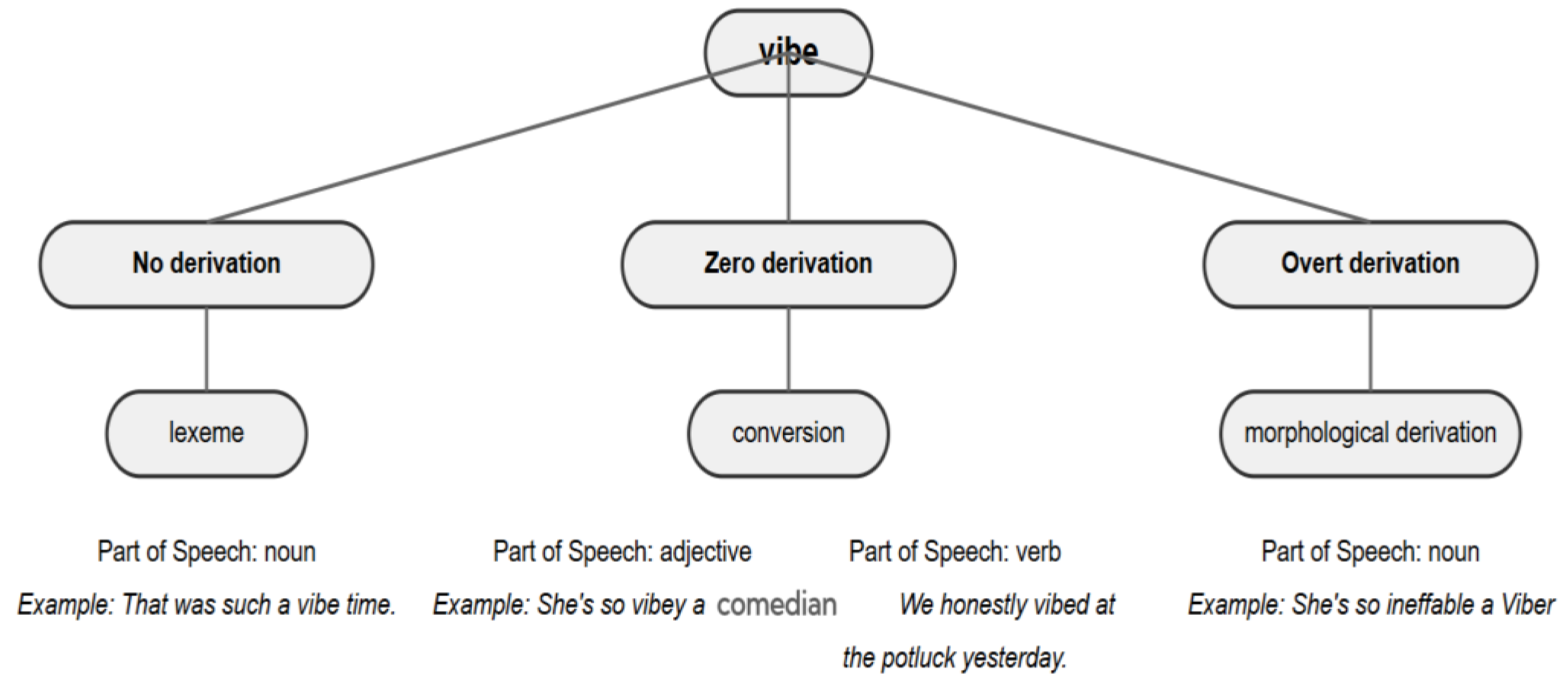

Table 1.
A cline of derivative patterns of “vibe”.
| no derivation | vibe | lexeme | (n.) | That was such a vibe time. |
| zero derivation (conversion) |
vibe |
conversion | (adj.)&(v.) | She's so vibey a comedian We honestly vibed at the potluck yesterday. |
| overt derivation | viber | morphological derivation |
(n.) | She's so ineffable a Viber |
3. Methodology
Corpus-based research is put into figurative language of "vibe". Moreover, if a large-scale study is carried out with data that are all carefully selected from corpora, finally we can even achieve results generalizable to a certain population or genre. The corpus methods turn out to be more effective than the traditional use of examples drawn from dictionaries for the study of figurative language unavoidably present the researcher with a skewed picture of what actually goes on in language(Adel,2016).The recruitment period for data collection from Weibo posts started on 14/03/2024 and ended on 02/05/2024, spanning a total of 49 days.
Ethics Statement
The studies involving human participants were reviewed and approved by the Institutional Review Board (IRB) of Jeonbuk National University. The IRB confirms that authors have thoroughly reviewed and adhered to Weibo's Terms of Use for social media research, ensuring compliance with all relevant policies, including the privacy and anonymity of users. All personally identifiable information such as user avatars and profiles has been excluded to maintain user confidentiality. All personal information and privacy related to users in Weibo posts have been anonymized, and all data comply with Weibo's Terms of Use.
3.1. Data Collection
There are 511million active users on Weibo, according to the site's official statistics, for March 2020. This platform has spontaneity of social events, news, and celebrity activities. Weibo users are exposed to multimodal input system by means of which they can type through different languages, emojis, and graphics, Meme. With the available technological affordances, the publicity and huge number of user base, Weibo is an appropriate research site even for beginner digital literacy practices.
We collected data from the posting of the Weibo users. By searching "vibe" inside the text in the page "Hot Weibo," we browsed through micro-blogs. The collection period was five-day week, and in every day, the latest microblogs with 'vibe' were sampled for the first five pages. The entire data collection process went on for almost 2 months from March 14th to May 2nd, 2024, resulting in a total of 2,220 Weibo postings. Within the collected Weibo postings, the total number of sample “vibe” has reached 2,220 in all.
This is an intensive approach to data collection in the sense that it has been collected at rigid and systematic intervals, and at the same time offered a certain degree of randomness. The size of posting data is rich for the purpose of the research into literacy practices on Weibo containing 'vibe'. Importantly, all the sensitive and identifiable information, such as user avatar, personal profile have all been sifted and dropped to protect users' privacy and anonymity.
The process of building the corpus for Chinese English slang "vibe" was very careful to meet varied translanguaging strategies and metonymic expressions. The data selection criterion with regards to the corpus was the frequency of the language items in use, relevance to the research topic, and the diversity of what is termed in these corpora. Another reason for the corpus size is that it was based on an in-depth inquiry into the patterns of translanguaging and metonymic features found in the Chinglish slang "vibe." The compilation of such a corpus was conducted prudently to capture subtleties and intricacies involved in how one manipulates translanguaging resources and metonymy within this mode of online self-presentation, which will illuminate the creative and adaptive character of the Chinese netizens in realizing their digital presentation (Li,2024).
3.2. Data Analysis
These collected expressions and variations of 'vibe' have been analyzed in a linguistic and communicative functions in the corresponding Weibo posts. Each original post was semantically coded for what the user wanted to say in Mandarin Chinese. This task called for Mandarin Chinese literacy and computer literacy to decode the meaning of 'vibe' in multiple texts and contexts. The original posting was followed by a literal translation and the interpretation was followed by a figurative translation. (Table 2) In the example below, ‘vibed’ was used as a replacement of ‘enjoy themselves’ due to similar meaning. In this way, vibe(verb)stems from vibe(n.). which is the zero derivation of the metonymic pattern. The analytic approach was conducted consistently through the data analysis. The following section will illustrate and discuss the detailed findings from the 2,220 Weibo postings.
4. Finding
Versatility of ‘vibe’
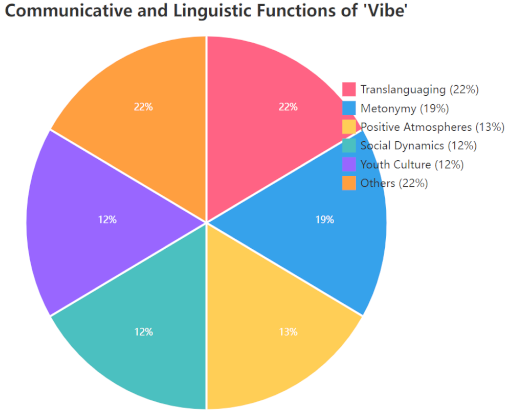
The analytical result renders eight form of literacy practices with ‘vibe’ based on the translanguaging. Table 3 displays the linguistic functions of ‘vibe’. In that the literal meaning of the word ‘vibe’ in pop songs, which imitates ‘vigor’, people who use Weibo have given new meanings and even novel attributes of the word for Chinese social network. Aside from that, other linguistic and communicative functions in translanguaging, such as affective emoji and intensification, have been utilized by Weibo users.
Chart 2.
Communicative and linguistic functions of ‘vibe’ in decreasing order.
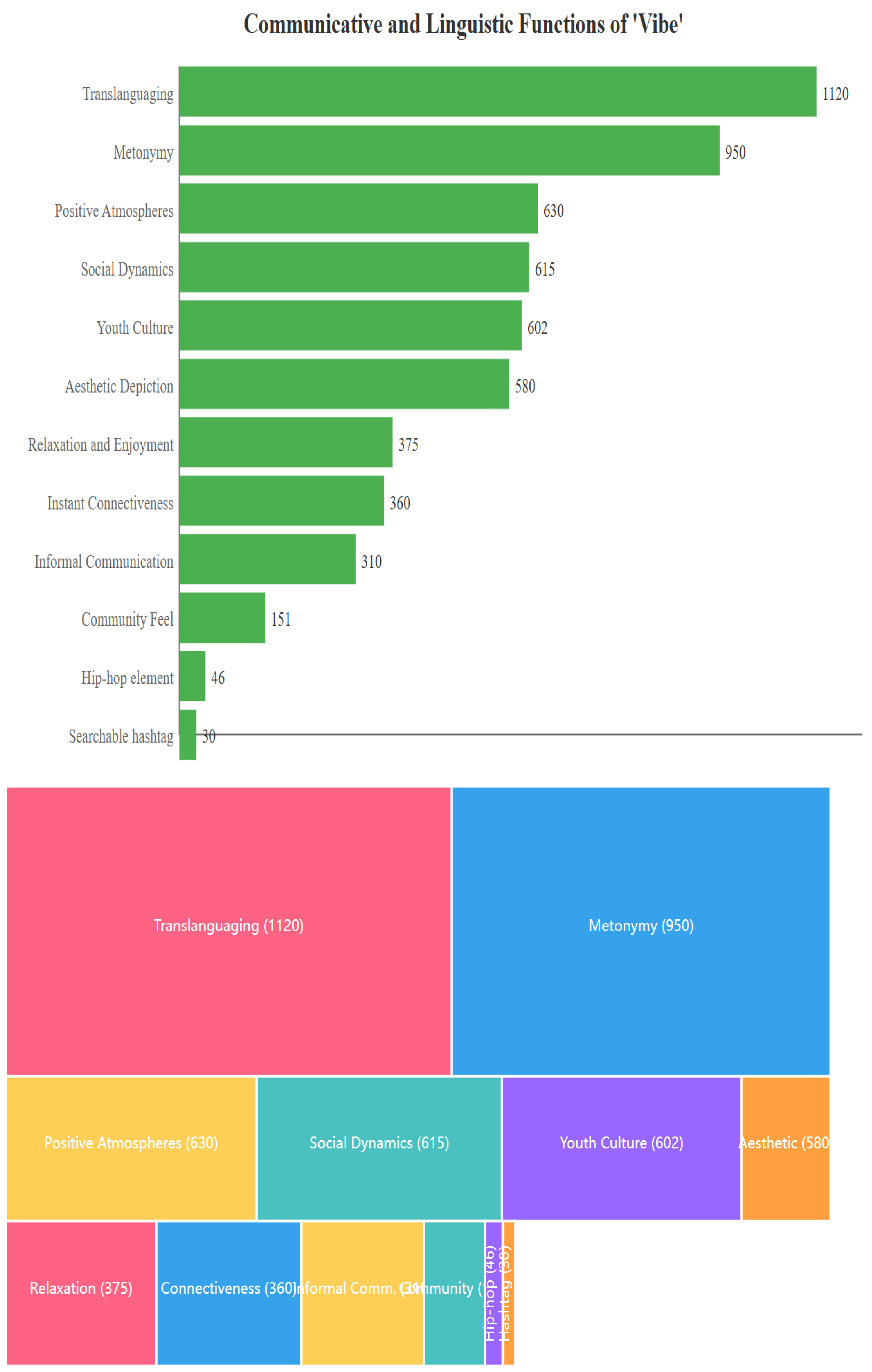
Table 3.
Communicative and linguistic functions of ‘vibe’ in decreasing order.
| Type | Frequency |
|---|---|
| 1. Translanguaging: Mixing Languages | 1120 |
| 2. Metonymy: Conveying | 950 |
| 3. Describing Positive Atmospheres | 630 |
| 4. Social Dynamics | 615 |
| 5. Nuances on Youth Culture | 602 |
| 6. Enhancing Aesthetic Depiction | 580 |
| 7. Encouraging Relaxation and Enjoyment | 375 |
| 8. Enabling Instant Connectiveness | 360 |
| 9. Informal and Relatable Communication | 310 |
| 10. Creating a 'Community' Feel 11. Hip-hop element 12. Searchable hashtag |
151 46 30 |
4.1. Translanguaging: Mixing Languages
Vibe is a term that has risen through the Chinese and English online community, in yet another resource infusion manner of borrowing. This section will discuss corpus linguistics based translanguaging in the coining of this term, thus deconstructing how new meaning is made through the coining process by taking elements from both Chinese and English.
One can linguistically decode a very interesting interaction of Chinese and English language resources in the mechanisms of the term "vibe." The users of the very term take to quite a number of different strategies of translanguaging in their recourse, ordering away the unintended nuances of vibetion shored up with cultural references. For example, there is the use of Chinglish forms, Pinyin initialisms, the hybrid word wherein various Chinese characters are blended with English words and numerals in Arabic to develop a new form (Li,2024).
Therefore, metonymy in translanguaging might even become another stratum of the meaning for "vibe". Metonymy attaches any piece of words or expressions to the more general concepts or vibetions; this makes the term deeper and more complicated. The use of metonymic expression enables one to make culture meanings together with the resonances of vibetion which are not language-specific (Qiao, 2024).
This implies that, from a corpus linguistics viewpoint, one would obtain usage patterns of translanguaging and metonymy related to the signifier "vibe". In a big corpus of written online interactions and textual exchanges, one could draw linguistic strategies reoccurring in relation to this sign. The present study takes an empirical approach regarding how language users creatively blend Chinese and English resources to the vibetions for meaning (Li,2024).
Apart from the fact that it is easy to substitute "vibe" on the Chinese sentence, there are also English letters or words seen in Chinese context that give rise to a peculiar mixture of languages. Such tendencies indicate the characteristics of the modern dynamic communication environment and the growth of the global culture, which is often bound together. Tying both English and Chinese, the result is endless patterns of expression.
Table 4, Table 5, Table 6, Table 7, Table 8, Table 9, Table 10, Table 11, Table 12, Table 13, Table 14 and Table 15 below illustrate the different parts of a social media posts from Weibo contains “vibe”, and show how English words were assimilated into Chinese sentence structure to form a hybrid language style. The table has a nonduplicable column. Original Posting is the untouched text of the Weibo post in Chinese, but it contains an English word – "vibe." This illustrates how there is a concept of vibe built into Chinese idioms. The translation column gives the whole original post in English, which expresses the core point of a Chinese sentence to its Table. This renders the content intelligible for those who do not speak Chinese. What I mean is, the intended meaning reveals what is meant by the original post More often than not, translating is limiting and does not exactly represent how messages are conveyed; for this reason, this column will go over what a specific post actually means in wording terms and emotional or contextual implications. Example cited by the author further explains how “vibe” can be interpreted in a different context. Shows that 'vibe' is subjective and used across different contexts, including the unreleased one in her thread. Description can be taken as an analysis or commentary, about how the word ‘vibe’ fits into Chinese sentences and creates a mixed language form This gives readers a more organic understanding of the language at work. These categories work to break down how ‘vibe’ is mobilized in Chinese linguistic usage together, displaying the mechanism of language hybridization and translation of English words into a different cultural context. A typical case is exemplified below (Table 4):
4.2. Metonymy: Conveying
This linguistic device of metonymy will be considered in the use of the term "vibe" so as to ascertain the underlying connotations and representations that pertain to the term. It is a figure of speech in which a part is used to represent the whole, or vice versa. In terms of Chinese-English slang, metonymy plays a very big role when used with the word "vibe" in conveying nuanced meanings and culture-related references.A semiotic understanding of the term "vibe" reveals many nuances of language and how it is used to evoke certain vibetions, attitudes, and connotations of a culture(Li, 2024). We extract the meanings attached to the term itself by explicating how certain elements or characteristics of the term symbolize broader concepts and ideas. It is because of this that a corpus linguistics approach can help to explore such instances of metonymy in the usage of "vibe" within Chinese English slangs. Towards strict corpus collection spanning sources like Douyin and other online communication platforms, one is able to develop patterns and trends in how really metonymy is used through this word(Qiao, 2024).
In addition, even the study of translanguaging strategies in interpreting and transferring the "vibe" can be informative about further ways cultural indirection and concrete linguistic strategies mold the sense and use of the term. In that regard, because of how it influences the use of metonymy in cross-cultural communication and expression, translanguaging can be seen as a dynamic, fluid language processing (Li, 2024).
Apart from the atmosphere or mood mentioned above, "vibe" can also have the metonymic use in Chinese to represent certain aspects of culture or society; used to refer to the general aura or ambiance related to a given event, location, or individuals. This use mashes many-sided ideas into one word for easy and clear communication. A typical case is exemplified below (Table 5):
4.3. Describing Positive Atmospheres
Although there is some straying from the original connotation of pleasant or stylish environments, "vibe" can still pretty often be used to describe not only very enjoyable and sophisticated environments but also invigorating social interactions in vivid community spaces. Thus, "vibe" is quite a flexible tool for different kinds of positive phenomena in contemporary use in the Chinese language. An example is shown below (Table 6):
4.4. Social Dynamics
The word vibe has expanded from describing not a place or space but actually the social dynamics of that space. This can probably compare to a verbal encapsulation of the mood or the energy an array of people gives off and often times it becomes very critical in the discussions of social interactions and group cohesion. It therefore suffices to be most applicable in the current digital age where much interaction is characterized by virtual communities and virtual interactions on the web. "Vibe" may well be the most important factor of an online space that helps to determine styles of communication and community engagement. An example is shown below (Table 7):
4.5. Nuances on Youth Culture
The term "vibe" is particularly resonant with youth culture in China. It usually describes popular experiences, settings, or trends with which the young people in question interact. In this sense, this usage captures the feeling of the current cultural landscape, it makes the past relevant and relatable for the youth always looking for fresh expressions and ways of association with their equals. Not only this, but "vibe" is a concept that goes much further than the mere physical and refers to the digital grounding as well, as when one speaks of one forum or social-media site having the "vibe" of another. An example is shown below (Table 8):
4.6. Enhancing Aesthetic depiction
"Vibe" is so overused for fashion, design, and lifestyle when something's setting off a vibe of stylishness or attractiveness. It's in this way that the word came to be well loved by influencers and trendsetters alike when explaining a certain type of appeal to some looks or experiences. Whether describing the ambience of a posh café or capturing the scent of an avant-garde fashion show, "vibe" permeates aesthetic descriptions with undercurrents of feeling that extend far beyond the ocular and into how they resonate with feeling and understanding the style and design more holistically across cultures and continents. Below is provided an example: (Table 9):
4.7. Encouraging Relaxation and Enjoyment
Sayings such as this one remind humankind to take a moment, to pause and relax, to enjoy what is around them—this really puts the experiential weight back into the meaning of "vibe." The call here is for a being to steer clear of the schedules distractingly experienced through life, to look about and take pleasure in some of the mundane moments of life. This type of attitude can alleviate the stress that is part of our environment and can bring about well-being. An example is shown below (Table 10):
4.8. Enabling Instant Connectiveness
Phrases such as "get the vibe" mean that there is an immediate understanding or connection with the atmosphere or energy of a place or event. This also helps in easy sharing of the same experience or mutual understanding, fostering friendship and rapport among people who have just met each other. The feeling allows one to communicate very fast without explaining much bit by bit because an immediate bond is established based on the same feelings or perceptions. An example is shown below (Table 11):
4.9. Informal and Relatable Communication
"Vibe" has, to this point, found its way into common slang and speech in such a way that communication loses some of its formality and feels much warmer; it brings an air of the known spirit to every dialogue, especially when found in the ever-brief status updates in online social media. The use of familiar language that resonates with one's daily experience puts the speaker or writer in a more receptive position to their audience and therefore demolishes the barriers that formal settings put up. An example is shown below (Table 12):
4.10. Create a 'Community' Feel
This goes a long way to add more to the feeling of community amongst users, who might share a similar taste or experience. If one identifies with that "vibe," he can really feel part of a bigger group with the same mindset and, hence, brings belonging and acceptance in an online or offline social circle.
This helps people bond with each other much better and, at the same time, bring in a sense of relaxation, entertainment, informality, and inclusivity among communities. An example is shown below (Table 13):
4.11. Other functions of ‘Vibe’
There are another 2 types of functions in the use of 'vibe' namely the Hip-hop element and the Searchable hashtag. Compared with the other types mentioned before, these 2 compose only a small portion of the data; however, it is worthy of notice since these functions reflect the online technological affordances of micro-blogging as well as users' adaptations to popular culture like hip-pop and the indexical meanings embedded in 'vibe'. (Table 13&14)
5. Discussion
5.1. Translanguaging Strategies in "Vibe"
Note that the term "vibe" was among the most frequent in lots of translanguaging strategies by netizens speaking Chinese. The main strategy is mixing English with Chinese, placing "vibe" in Chinese sentences, which gives rise to the hybrid language form. This lays credence to the growing trend of incorporating English words and expressions into Chinese online discourse: hanyingcizu (Zhang & Ren, 2022; Zhang, 2017).
The use of the word "vibe" further underpins just how creative and adaptive in nature language users are in constructing meanings during processes of translanguaging. In this fusion of linguistic resources from different languages, netizens can articulate ideas, emotions, and identities hard to fully encapsulate through single language use alone (Canagarajah, 2011; García & Li, 2014).
5.2. Metonymic Representations of "Vibe"
This is also brought out in the analysis that metonymy plays a key role in influencing meaning and use in the Chinese English slang "vibe". Very often, the word "vibe" is used metonymically to refer to something more general with respect to atmosphere, mood, or social dynamics. This metonymic extension is one through which speakers can convey elaborate ideas and associations in an economy-of-means manner that facilitates communication: convincingly, one where there is shared knowledge within an online community (Kövecses & Radden 1998; Janda 2014).
And secondly, this metonymic realization of "vibe" in the Chinese context is constitutive of moral nuance and linguistic subtlety. Language users may then take advantage of the metonymic associations to navigate the enhanced complexities through self-presentation and bargaining for identity in the online spaces by adopting the abundant riches that culture may afford to them (Kachru, 1983; Qin & Guo, 2020).
5.3. Cultural and Languages Implications
The multiplicity of uses of the Chin English slang "vibe" is a very valuable insight into the contemporary Chinese social and language life. This term resonates for the youth culture, giving a medium through which youths are able to express shared experiences, trends, and aesthetics in an informal and relatable way (Palacios Martínez, 2018; Zhang, 2012).
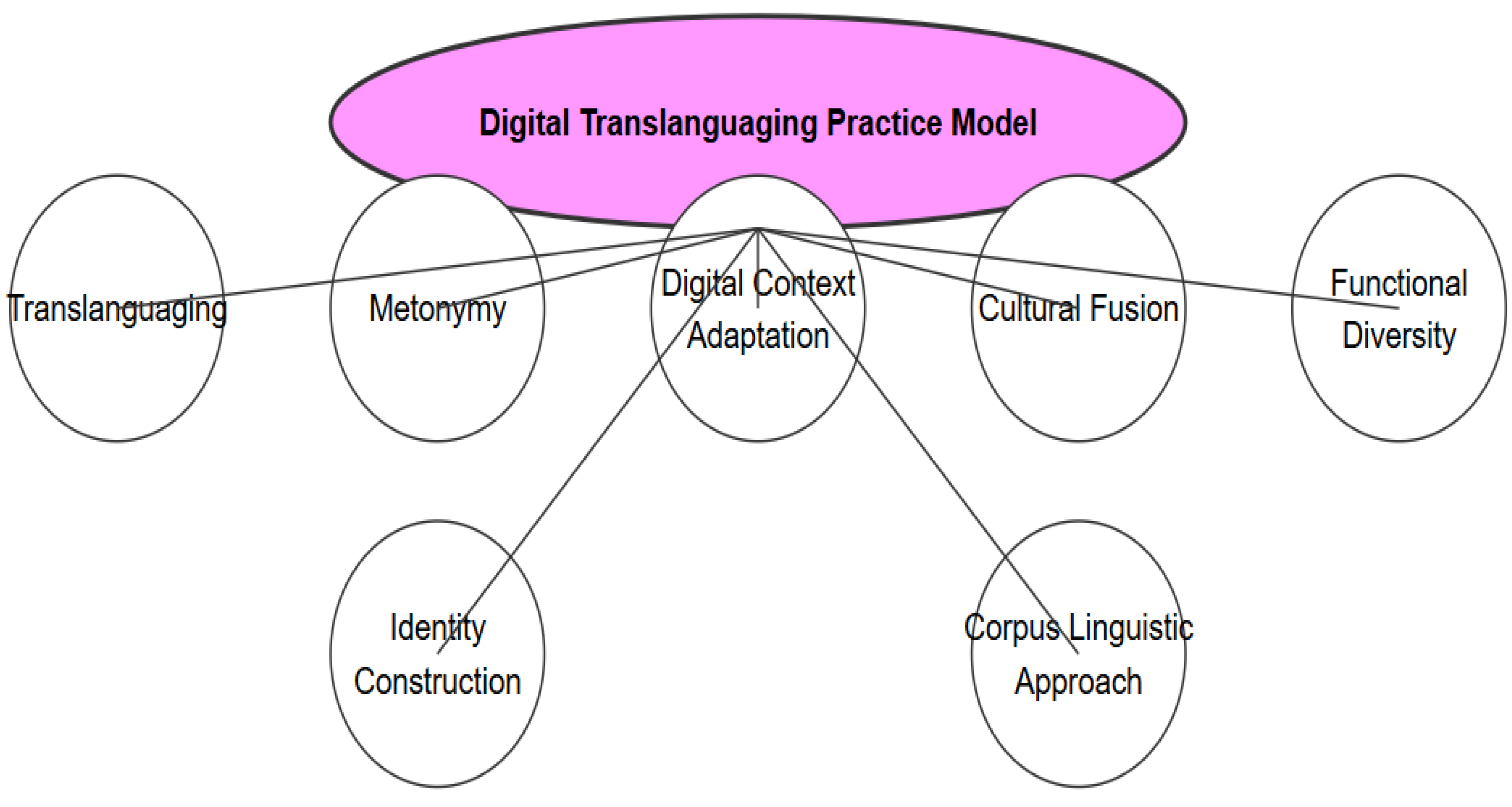
In addition to base functions, 'vibe' through forming a community of common tastes and experiences contributes to social bonding and belongingness. This is because languages that play a role in the construction of cultural identity and in the promotion of social interaction in virtual spaces are likely to (Li & Wang, 2024; Qiao, 2024). Through examining the "vibe" in Chinese social media as a phenomenon of linguistic innovation and cultural adaptation, a theoretical analysis thus takes us to a proposal for a theoretical framework---the Digital Translanguaging Practice Model (DTPM). The findings regarding translanguaging practices, metonymic usage and digital context adaptation, cultural fusion and identity construction are integrated using a model. The DTPM also provides a broad and holistic view of how borrowing words manifest in convergence patterns within digital platforms related to the evolution of languages. It shows how a single lexical item when taken out of one linguistic and cultural milieu, often in online spaces, may come to perform multiple functions and have a multitude of meanings. This model explains not only what happened with "vibe" in Chinese social media, but provides six features for future studies on other cases of category extension to consider.
Figure 2.
Digital Translanguaging Practice Model (DTPM).
6. Future Research
This research could contribute to the knowledge of the strategies used in translanguaging, metonymic representation, as well as cultural implications of 'vibe' within Chinese-English slang, but further research must be done to deepen knowledge of the phenomenon. Future studies should delve into 'vibe' and other lexical items that manifest in Chinese across various social media through regions and demographic groups. This would enable making a more complete analysis regarding the diversity and change in language practices on the internet.
Furthermore, longitudinal studies could be put into place to trace effectively the dynamic nature of language change over time: how meanings and usages of slang terms like "vibe" have changed in response to cultural shifts and technological advancements. This will increase understanding of the complex relationship between language, culture, and identity in the digital age. Other future engagements could find a focus on multi-interdisciplinary research, where insights would be drawn not only from sociolinguistics but also from the fields of anthropology and cultural studies to understand in more depth the socio-cultural variables that influence language practices and presentation of self in the Internet. In conclusion, Chinese English slang and all the nuances of translanguaging and metonymy are very interrelated and can give way to numerous new grounds for research, and in that light, valuable insight is given into dynamic and adaptive languages in globalization and digital communication.
7. Conclusions
This paper examines the complex interplay of translanguaging strategies, metonymic representations, and cultural nuances inherent in using the Chinese-English slang term "vibe" on the popular microblogging platform Weibo. This research, therefore, emphasizes the creative nature of adaptive language users when negotiating the intricacies of online self-presentation and identity through corpus linguistics analysis (Zhang & Ren, 2022; Canagarajah, 2011).“Vibe” has been put to more general use in all manner of translanguaging strategies, usually through a combination of Chinese and English, which represents a current tendency within the hybridity of languages online and further metonymically, such that Lang-8 users should be able to draw on the term to convey far more voluminous concepts and implications regarding the ambiance, tone, and social phenomena in a shorthand way, enabling it to be a valuable aspect of quick and subtle communication within an online community(Kövecses & Radden, 1998; Janda, 2014).
Besides, a plurality of functions of "vibe" in Chinese English slang speaks to resonances with youth culture that demand community and belonging for people with similar experiences and aesthetics for users of this language (Palacios Martínez, 2018; Li & Wang, 2024). The above accents the pivotal role which language can actually play today in fostering various cultural identities, enabling social links among individuals(Qiao, 2024).
Appendix A
Other 125 Typical Examples
| Data from Document (original text) | Theme |
| “舞台碎片新朋友和老朋友#vibe#” | Social Dynamics |
| “some Gallagher vibe🏃🏻♀️➡️” | Hip-hop element |
| “cozy vibe~~~” | Describing Positive Atmospheres |
| “陷入大自然的vibe” | Enhancing Aesthetic Depiction |
| “East Village vibe 2美国·East Village New York” | Cultural Nuances |
| “同学说了句好羡慕你们new yorker的vibe啊” | Creating a 'Community' Feel |
| “郑钧私奔那张专辑封面上的照片整体vibe还挺拿我的,一生喜欢摇滚男的宿命” | Hip-hop element |
| “Autumn vibe!!!” | Enhancing Aesthetic Depiction |
| “what a vibe” | Informal and Relatable Communication |
| “同学说了句好羡慕你们new yorker的vibe啊” | Social Dynamics |
| “vacation vibe🏖️和所有work说拜拜” | Encouraging Relaxation and Enjoyment |
| “summer vibe~” | Encouraging Relaxation and Enjoyment |
| “West Village vibe” | Creating a 'Community' Feel |
| “I love you for my life past 我爱你,爱了整整一个曾经,一起欣赏张泽禹的《VIBE》” | Describing Positive Atmospheres |
| “假期vibe” | Encouraging Relaxation and Enjoyment |
| “chill vibe心心念念的脆球没有吃到 真的很好奇它的味道and第一次去live house这种(我真是个老年人)” | Informal and Relatable Communication |
| “现在回望对男的的心路历程都觉得可笑,无论是好坏话都不想说了,其实我们拉扯都算不上,只是互欣赏彼此vibe的陌生人” | Social Dynamics |
| “Autumn vibe” | Enhancing Aesthetic Depiction |
| “我从火车到站刚上出租车的那一刻就爱上布哈拉了!热情洋溢、风情万种,我想把大家对我的形容词套到这座城,难怪布哈拉的vibe让我全身舒畅” | Creating a 'Community' Feel |
| “陷入大自然的vibe·四姑娘山漂流好好玩!” | Encouraging Relaxation and Enjoyment |
| “你很有vibe @种地吧李昊” | Informal and Relatable Communication |
| “姐看着真的很高,感觉起码有175,然后查了一下姐居然只有165!!感觉这个点很关键的就在于,姐一下子从偶尔流露出的八尺夫人的vibe里彻彻底底变成了” | Informal and Relatable Communication |
| “现在回望对男的的心路历程都觉得可笑,无论是好坏话都不想说了,其实我们拉扯都算不上,只是互欣赏彼此vibe的陌生人” | Social Dynamics |
| “vacation vibe🏖️和所有work说拜拜👋🏻 2越南·岘港凯悦休闲度假村(Hyatt Regency Danang Resort and Spa)” | Encouraging Relaxation and Enjoyment |
| “姐说他原本是学当音乐剧老师的...合理起来了!我之前就觉得他有一种当老师的vibe” | Creating a 'Community' Feel |
| “B2B Ibiza afters was such a vibe!!” | Describing Positive Atmospheres |
| “假期vibe” | Encouraging Relaxation and Enjoyment |
| “西雅图day 2 🍁☕️小方去上班 我独自开朗的一天幸福早餐!路边的枫叶好漂亮 我忍不住一直citywalk还在星巴克坐下来看了会儿书” | Enhancing Aesthetic Depiction |
| “Weekly vibe#plog日记##周plog#” | Informal and Relatable Communication |
| “感受纯正的川渝vibe” | Hip-hop element |
| “姐看着真的很高,感觉起码有175,然后查了一下姐居然只有165!!感觉这个点很关键的就在于,姐一下子从偶尔流露出的八尺夫人的vibe” | Describing Positive Atmospheres |
| “感觉幸福 发自内心的幸福🪁#倪在干嘛##mylife##vibe#” | Describing Positive Atmospheres |
| “Autumn vibe .2” | Enhancing Aesthetic Depiction |
| “再看沙发我就看吐了什么奶油沙发云朵沙发 感觉沙发真的很重要,又要好看又要舒服还要稳整个家的色调但我就想要ins风网红风精致女生独居vlog里那种vibe” | Enhancing Aesthetic Depiction |
| “SH vibe” | Creating a 'Community' Feel |
| “姐这种vibe真的不常见 2樟树” | Social Dynamics |
| “感受纯正的川渝vibe,正宗的《川渝trap》!嫩口-何文翔” | Hip-hop element |
| “秋天vibe🍂 2上海” | Enhancing Aesthetic Depiction |
| “姐说他原本是学当音乐剧老师的啊啊啊啊 合理起来了!我之前就觉得他有一种当老师的vibe” | Creating a 'Community' Feel |
| “姐这种vibe真的不常见” | Social Dynamics |
| “假期vibe🎃” | Encouraging Relaxation and Enjoyment |
| “chill vibe心心念念的脆球没有吃到 真的很好奇它的味道and第一次去live house这种(我真是个老年人)” | Informal and Relatable Communication |
| “看今天的live 一点没有新巡演的vibe” | Describing Positive Atmospheres |
| “Catch our live show on your device.Feel the vibe.” | Informal and Relatable Communication |
| “姐说他原本是学当音乐剧老师的 合理起来了!我之前就觉得他有一种当老师的vibe哪怕对德国人刻板印象” | Social Dynamics |
| “姐看着真的很高,感觉起码有175,然后查了一下姐居然只有165!!感觉这个点很关键的就在于,姐一下子从偶尔流露出的八尺夫人的vibe里彻彻底底变成了” | Describing Positive Atmospheres |
| “姐这种vibe真的不常见” | Social Dynamics |
| “哇…宋银硕…这怎么记得的啊🧋:외치는 순간 是哪里的啊?🪨:외치는 순간 Feel the vibe~甚至不是自己的part…!” | Creating a 'Community' Feel |
| “姐说他原本是学当音乐剧老师的 啊啊啊啊 合理起来了!我之前就觉得他有一种当老师的vibe” | Creating a 'Community' Feel |
| “silva给我一种双枪的vibe” | Describing Positive Atmospheres |
| “姐姐这种八尺夫人的vibe一下变成my pookie” | Informal and Relatable Communication |
| “Catch this vibe…🌅” | Describing Positive Atmospheres |
| “今天也太咚化vibe了” | Describing Positive Atmospheres |
| “姐说他原本是学当音乐剧老师的,合理起来了!我之前就觉得他有一种当老师的vibe” | Creating a 'Community' Feel |
| 『Ride the Vibe (Japanese Ver.) / Keep on Moving』发售纪念,感谢不远万里来到关东会场的各位!我们真的感到特别开心🤍 从今往后也请多多关照🤝✨ | Enabling Instant Connectiveness |
| "Kbet u wanna去年这首给我和喷3英雄模式一首bgm一种vibe,但我想不起来到底是哪首,,听了一圈也没找到" | Metonymy: Conveying broader concepts |
| "已经对粤语越来越熟悉了,再读黎子的po突然能get到那种vibe" | Nuances on Youth Culture |
| "磕奶爱不仅是磕cp,而是一场人生的修行。在这场修行中,你将收获超绝的耐心、强大的洞察力、辩证思维能力..." | Social Dynamics |
| "我今天听马思唯呢 我是个说唱歌手但具有rnb vibe" | Hip-hop element |
| "来看一场地中海的日落吧! vibe 超棒的beach club" | Encouraging Relaxation and Enjoyment |
| "姜:啊 真的 很劲道 可能这就是加拿大vibe吧" | Creating a 'Community' Feel |
| "我笑死了,采访问kathryn pick up four other ppl as her coven,姐回答:Adele(lmao她俩vibe超级像),beyonce..." | Informal and Relatable Communication |
| "Amsterdam vibe 自由又浪漫" | Describing Positive Atmospheres |
| "vacation vibe🏖️ 和所有work说拜拜" | Encouraging Relaxation and Enjoyment |
| "姐看着真的很高,感觉起码有175,然后查了一下姐居然只有165!姐这种八尺夫人的vibe彻底变成了pookie" | Enhancing Aesthetic Depiction |
| "本人看悲第一次看到黑人芳汀,而且是一个很像赞达亚vibe的姐,效果是愤大于悲,从没见过这种充满怒气充满力量甚至充满攻击性的版本" | Metonymy: Conveying broader concepts |
| "陷入大自然的vibe· 四姑娘山漂流好好玩!" | Describing Positive Atmospheres |
| "chill vibe 心心念念的脆球没有吃到 真的很好奇它的味道" | Informal and Relatable Communication |
| "p5好像几年前也有张这种vibe的" | Searchable hashtag |
| "vibe的图还是这么摄人心魂" | Enhancing Aesthetic Depiction |
| "姐看着真的很高,感觉起码有175,然后查了一下姐居然只有165!!姐这种八尺夫人的vibe一下彻彻底底变成了pookie" | Social Dynamics |
| "Recording a mini concert, evening vibe" | Describing Positive Atmospheres |
| "她这种vibe真的不常见" | Social Dynamics |
| "感觉生活也不过如此嘛,我就这样一下子又想通了,然后在之后的某一个时间又想不通了" | Nuances on Youth Culture |
| "LISA《Moonlit Floor》日榜,VIBE日榜:not in" | Searchable hashtag |
| "鸭儿这两步走的 感觉vibe是下班后和同事在小酒馆喝到微醺 拎着酒瓶一个人走在回家的路上哼点小曲" | Enhancing Aesthetic Depiction |
| "餐厅太暗 vibe 太好" | Describing Positive Atmospheres |
| "vibe🏄🏻♀️" | Encouraging Relaxation and Enjoyment |
| "我喜欢的人也惺惺相惜 P1是说他想加入的五人组(Mark和ten都是尼尔自己提的)P2-3是在夸Mark(Canada vibe~)" | Creating a 'Community' Feel |
| "赌定你是我的vibe" | Informal and Relatable Communication |
| "vibe日榜:DAY6-HAPPY日冠×6👑" | Searchable hashtag |
| "今天跟外教上课还在聊,他觉得我重视跟家人在一起,我跟他说学习和挣钱到最后也是为了追求自己喜欢的事情以及更好的陪伴家人" | Creating a 'Community' Feel |
| "gossip girl外面天很冷他们在屋子里暖暖的喝hot chocolate 就羡慕这种cozy vibe" | Describing Positive Atmospheres |
| "每次看moonrock都有新的震撼啊到底是怎么拍出这么男同vibe的东西的" | Metonymy: Conveying broader concepts |
| "姐说他原本是学当音乐剧老师的...有一种当老师的vibe" | Social Dynamics |
| "潮汕 vibe 和吹凉风的阳台" | Describing Positive Atmospheres |
| "总觉得广东是个和我巨合的地方,酒vibe、帅哥、lifestyle(全靠互联网感觉)踩中我的点" | Nuances on Youth Culture |
| "维也纳的九区真特么跟巴黎的Quartier Latin有相似的vibe啊" | Metonymy: Conveying broader concepts |
| "Feel the Vibe (Dub Mix)" | Searchable hashtag |
| "奈良と神戸,阴天有阴天的vibe" | Describing Positive Atmospheres |
| "感觉nct127老是在出些自以为很有vibe很艺术的专辑" | Enhancing Aesthetic Depiction |
| "幸福早餐!路边的枫叶好漂亮 我忍不住一直citywalk" | Enhancing Aesthetic Depiction |
| "西雅图...真的很爱西雅图的vibe,温度好,人们也很友善" | Describing Positive Atmospheres |
| "summer vibe" | Encouraging Relaxation and Enjoyment |
| "贵上海rave vibe be like:一个手指朝天的衬衣男对所有女的搭讪" | Social Dynamics |
| "Catch our live show on your device. Feel the vibe." | Enabling Instant Connectiveness |
| "微醺的酒馆vibe🍷" | Describing Positive Atmospheres |
| "天呐,超爱岛上的 vibe,破旧的美感,人不多,走走停停,闲情逸致" | Describing Positive Atmospheres |
| "Kaohsiung Vibe🛤️" | Creating a 'Community' Feel |
| "Love this vibe🥳" | Describing Positive Atmospheres |
| "很有二世子趁着爹妈不在跑自己家汉普顿的别墅里度假来了的vibe" | Informal and Relatable Communication |
| "Reading cozy spooky fall vibe" | Nuances on Youth Culture |
| "泡泡岛合肥站现场超有vibe" | Hip-hop element |
| "米卡好帅...合肥的天气成功让大帅哥误判" | Informal and Relatable Communication |
| "独一份的vibe" | Creating a 'Community' Feel |
| "宝宝flow很丝滑,编曲很有vibe" | Enhancing Aesthetic Depiction |
| "宝宝强大的自我剖析能力,直视血淋淋社会现实的勇气,真的很喜欢这种带着思考和挣扎的歌词,编曲很有vibe" | Hip-hop element |
| "Busan vibe" | Describing Positive Atmospheres |
| "Cozy vibe 💙🩵🤍" | Encouraging Relaxation and Enjoyment |
| "The Holiday vibe of Beijing" | Describing Positive Atmospheres |
| "舍不得我的海景房...讨厌鬼don’t kill my vibe" | Informal and Relatable Communication |
| "巴黎vibe" | Enhancing Aesthetic Depiction |
| "独一份的vibe" | Creating a 'Community' Feel |
| "警队来招人,每个警员都有一种FBI vibe" | Social Dynamics |
| "哇这个舞室的 vibe 好棒" | Describing Positive Atmospheres |
| "LISA《Moonlit Floor》日榜,VIBE日榜:not in" | Searchable hashtag |
| "鸭儿这两步走的 感觉vibe是下班后和同事在小酒馆喝到微醺 拎着酒瓶一个人走在回家的路上哼点小曲" | Enhancing Aesthetic Depiction |
| "餐厅太暗 vibe 太好" | Describing Positive Atmospheres |
| "vibe🏄🏻♀️" | Encouraging Relaxation and Enjoyment |
| "我喜欢的人也惺惺相惜 P1是说他想加入的五人组(Mark和ten都是尼尔自己提的)P2-3是在夸Mark(Canada vibe~)" | Creating a 'Community' Feel |
| "赌定你是我的vibe" | Informal and Relatable Communication |
| "vibe日榜:DAY6-HAPPY日冠×6👑" | Searchable hashtag |
| "今天跟外教上课还在聊,他觉得我重视跟家人在一起,我跟他说学习和挣钱到最后也是为了追求自己喜欢的事情以及更好的陪伴家人" | Creating a 'Community' Feel |
| "gossip girl外面天很冷他们在屋子里暖暖的喝hot chocolate 就羡慕这种cozy vibe" | Describing Positive Atmospheres |
References
- Ädel, A. (2016). " Not one word of it made any sense": Hyperbolic Synecdoche in the British National Corpus. Nordic Journal of English Studies, 15(4), 1-23.
- Blackledge, A., & Creese, A. (2010). Multilingualism: A critical perspective. Bloomsbury Publishing.
- Canagarajah, S. (2011). Translanguaging in the classroom: Emerging issues for research and pedagogy. Applied Linguistics Review, 2(1), 1–28. [CrossRef]
- García, O. (2009). Bilingual education in the 21st century: A global perspective. Wiley-Blackwell.
- Garcia, O., & Li, W. (2014). Translanguaging: Language, bilingualism and education. Palgrave Macmillan.
- Hafner, C. A., Li, D. C. S., & Miller, L. (2015). Language choice among peers in project-based learning: A Hong Kong case study of English language learners’ plurilingual practices in out-of-class computer-mediated communication. Canadian Modern Language Review, 71(4), 441–470. [CrossRef]
- Janda, L. A. (2014). Metonymy and word-formation revisited. Cognitive Linguistics, 25(2). [CrossRef]
- Kachru, B. B. (1983). The Indianization of English: The English Language in India. Delhi, Oxford: Oxford University Press.
- Kövecses, Z. & Radden, G. (1998). Metonymy: Developing a Cognitive Linguistics View. Cognitive Linguistics Vol. 9. No. 1. 37–77.
- Li, Z., & Wang, L. (2024). Investigating translanguaging strategies and online self-presentation through internet slang on Douyin (Chinese TikTok). Applied Linguistics Review.
- Merriam-Webster. (n.d.). Vibe. In Merriam-Webster.com dictionary. Retrieved May 25, 2024, from https://www.merriam-webster.com/dictionary/vibe.
- Oxford University Press. (n.d.). In Oxford Languages. Retrieved from https://languages.oup.com.
- Online Etymology Dictionary. (n.d.). Vibe. Retrieved from https://www.etymonline.com/word/vibe.
- Palacios Martínez, I. M. (2018). Lexical innovation in the language of teenagers: A cross-linguistic Perspective. In A. Ziegler (Ed.), Jugendsprachen/Youth languages: Aktuelle Perspektiven Internationaler Forschung/Current Perspectives of International Research (pp. 363-390). De Gruyter. [CrossRef]
- Qiao, X. (2024). A Study on the Main Characteristics of English Internet Terms and Chinese Translation Strategies. Communications in Humanities Research.
- Qin, M., & Guo, H. (2020). Word formation of Chinese English words: Evidence from the Chinese English dictionary. World Englishes, 41(2), 151-168. [CrossRef]
- Tan, S. I.(2009). ‘Lexical borrowing from Chinese languages in Malaysian English.’ World Englishes, 28, 451–484. [CrossRef]
- Williams, C. (1994). Arfarniad o Ddulliau Dysgu ac Addysgu yng Nghyd-destun Addysg Uwchradd Ddwyieithog [An evaluation of teaching and learning methods in the context of bilingual secondary education]. Unpublished Doctoral Thesis (University of Wales, Bangor).
- Williams, C. (1996). Secondary education: Teaching in the bilingual situation. In C. Williams, G. Lewis, & C. Baker (Eds.), The language Policy: Taking stock (pp. 39–78). CAI.
- Wei, Li (2017). Translanguaging as a Practical Theory of Language. Applied Linguistics, (), –. [CrossRef]
- 21. Xinhui Qiao. (2024). A Study on the Main Characteristics of English Internet Terms and Chinese Translation Strategies.
- Yang, J.(2005). ‘Lexical innovations in China English.’ World Englishes, 24 (4), 425–436. [CrossRef]
- Zhang, W. (2012). 'Chinese-English code-mixing among China's netizens: Chinese-English mixed-code communication is gaining popularity on the Internet.' English Today, 28(3), 40-52.
- Zhang, Y. (2017). The semiotic multi functionality of Arabic numerals in Chinese online discourse. Language@Internet, 14(2). http://www.languageatinternet.org/articles/2017/zhang.
- Zhang, Y., & Ren, W. (2022). 'This is so skrrrrr'--creative translanguaging by Chinese micro-blogging users. International Journal of Multilingualism, 19(3), 289-304.
- Ziqi Li, Li Wang.(2024). Investigating translanguaging strategies and online self-presentation through internet slang on Douyin (Chinese TikTok).
Table 2.
Sample Weibo posting with ‘vibe’.
| Original posting | 昨天的聚会/我们一个班的人/一起vibe了整个晚上,太开心了! At the party/ yesterday/our class / vibed all night. It was so fun! |
| Intended meaning | Our class enjoyed themselves badly overnight. It was so fun! |
Table 4.
Sample Weibo posting with ‘vibe’.
| Original posting | 剪了长发尾/睡不醒/就立刻变成敏感/难搞/男高 vibe |
|---|---|
| Translation | If you cut your hair long / and can't wake up / you'll immediately become a sensitive / and stubborn / man with a haughty vibe. |
| Intended meaning | If you cut your hair long and can't wake up, you become a sensitive, stubborn and arrogant man. |
| Example cited by the author | “这个青年酒店的vibe真的很棒棒!” (The vibe of this hostel is really good!) |
| Description | The use of "vibe" seamlessly in Chinese sentences, often creates a hybrid language form. |
Table 5.
Sample Weibo posting with ‘vibe’.
| Original posting | 这次活动vibe极其牛叉。 |
|---|---|
| Translation | The vibe of this event is extremely good. |
| Intended meaning | The atmosphere of this event was particularly good. |
| Example | “这次招待的vibe特别好。” (The vibe of this reception is particularly good.) |
| Description | "Vibe" represents broader concepts like ambiance, emotional tone, or social atmosphere. |
Table 6.
Sample Weibo posting with ‘vibe’.
| Original posting | 那个可以上网的咖啡馆的vibe超级棒。 |
|---|---|
| Translation | The vibe of that cybercafé is super cool. |
| Intended meaning | The atmosphere of that café is so pleasant. |
| Example | “那个咖啡馆的vibe太妙了。” (The vibe of that café is that awesome.) |
| Description | Describes admirable or stylish environments, such as cafes, parties, or events. |
Table 7.
Sample Weibo posting with ‘vibe’.
| Original posting | 昨天家庭聚会的vibe好极了,大家happy的不得了。 |
|---|---|
| Translation | The vibe at yesterday’s family party was so ineffable, everyone had a good time. |
| Intended meaning | The collective mood and energy at yesterday's party were very positive, and everyone enjoyed themselves. |
| Example | “昨天聚会的vibe特别好,每个人玩得很开心。” (The vibe at yesterday’s party was good, everyone in the family had a lot of fun.) |
| Description | Describes the collective mood or energy of a group. |
Table 8.
Sample Weibo posting with ‘vibe’.
| Original posting | 这个火车站是新的网红打卡地,它的vibe超符合年轻人尤其是小孩的口味。 |
|---|---|
| Translation | The vibe of that new popular spot from the net which is a railway station is very attractive to young people, especially children. |
| Intended meaning | The atmosphere and environment of that new famous spot attract young people. |
| Example | “这个景点的vibe超符合年轻人的口味。” (The vibe of this tourist spot is appealing to young people.) |
| Description | Resonates especially with youth culture, capturing popular experiences, settings, or trends. |
Table 9.
Sample Weibo posting with ‘vibe’.
| Original posting | 她妈妈今天的穿搭vibe很优雅经典。 |
|---|---|
| Translation | Her mom’s outfit today has a very vintage vibe. |
| Intended meaning | Her mom’s outfit today looks very graceful. |
| Example | “她今天的穿搭vibe很高级。” (Her dress has a very classy vibe today.) |
| Description | Used in fashion, design, and lifestyle to display a stylish and aesthetically desirable atmosphere. |
Table 10.
Sample Weibo posting with ‘vibe’.
| Original posting | 周末我们去海边度假区vibe一下。 |
|---|---|
| Translation | Let's go vibe at the beach of a tourist spot this weekend. |
| Intended meaning | Let's relax and enjoy the atmosphere at the beach of a tourist spot this weekend. |
| Example | “周末我们去景点vibe一下。” (Let's go vibe at the tourist spot this weekend.) |
| Description | Phrases like "vibe一下" promote taking time to relax and enjoy the atmosphere. |
Table 11.
Sample Weibo posting with ‘vibe’.
| Original posting | 我刚进门就get到那个地方的vibe了。 |
|---|---|
| Translation | I got the vibe of that place when I walked in. |
| Intended meaning | I instantly sensed and felt the atmosphere of that place when I entered into. |
| Example | “刚刚进门就get到这个地方的vibe了。” (I got the vibe of this place as soon as I walked into.) |
| Description | Expressions like "get the vibe" denote instant understanding or connection. |
Table 12.
Sample Weibo posting with ‘vibe’.
| Original posting | 今天的讨论真是vibe。 |
|---|---|
| Translation | Our discussion today was vibing. |
| Intended meaning | Our discussion today was very enjoyable and relaxing. |
| Example | “我们今天的讨论真是vibe。” (Our discussion today was vibing.) |
| Description | "Vibe" in everyday slang makes conversations more informal and relatable. |
Table 13.
Sample Weibo posting with ‘vibe’.
| Original posting | dig这种vibe的人都可以加入我们的微信群。 |
|---|---|
| Translation | People who like this vibe can all join our community of wechat. |
| Intended meaning | People who appreciate this sort of atmosphere can become part of our wechat community. |
| Example | “喜爱这种vibe的人都可以加入我们的社群。” (People who like this vibe can all participate in our community.) |
| Description | Fosters a sense of community among users who have similar tastes or experiences in common. |
Table 14.
Sample Weibo posting with ‘vibe’.
| Original posting | 吴青峰音乐vibe很强,有种新生代Hip-hop的感觉。 |
|---|---|
| Translation | Qingfeng Wu’s music has a strong vibe, with a novel Hip-hop feel. |
| Intended meaning | His music strongly conveys the mood and style of a new Hip-hop. |
| Example | “她的音乐vibe很强,有种k-pop的感觉。” (Her music has a strong vibe, with a k-pop feel.) |
| Description | Used to describe the feel or mood of music, performance, or style within hip-hop culture. |
Table 15.
Sample Weibo posting with ‘vibe’.
| Original posting | 在海边 #vibe, 鸟随鸾凤飞腾远,人伴贤良品格高 |
|---|---|
| Translation | At the beach today #vibe(Exclaim With Chinese poem) |
| Intended meaning | At the beach today, experiencing a relaxing atmosphere and expressing his mood through poem |
| Example | “今天在海边 #vibe” (At the beach today #vibe) |
| Description | Frequently used as a hashtag to categorize posts related to mood, atmosphere, mind, and style. |
Disclaimer/Publisher’s Note: The statements, opinions and data contained in all publications are solely those of the individual author(s) and contributor(s) and not of MDPI and/or the editor(s). MDPI and/or the editor(s) disclaim responsibility for any injury to people or property resulting from any ideas, methods, instructions or products referred to in the content. |
© 2024 by the authors. Licensee MDPI, Basel, Switzerland. This article is an open access article distributed under the terms and conditions of the Creative Commons Attribution (CC BY) license (http://creativecommons.org/licenses/by/4.0/).
Copyright: This open access article is published under a Creative Commons CC BY 4.0 license, which permit the free download, distribution, and reuse, provided that the author and preprint are cited in any reuse.


