

Submitted:
24 October 2024
Posted:
25 October 2024
Read the latest preprint version here
Abstract
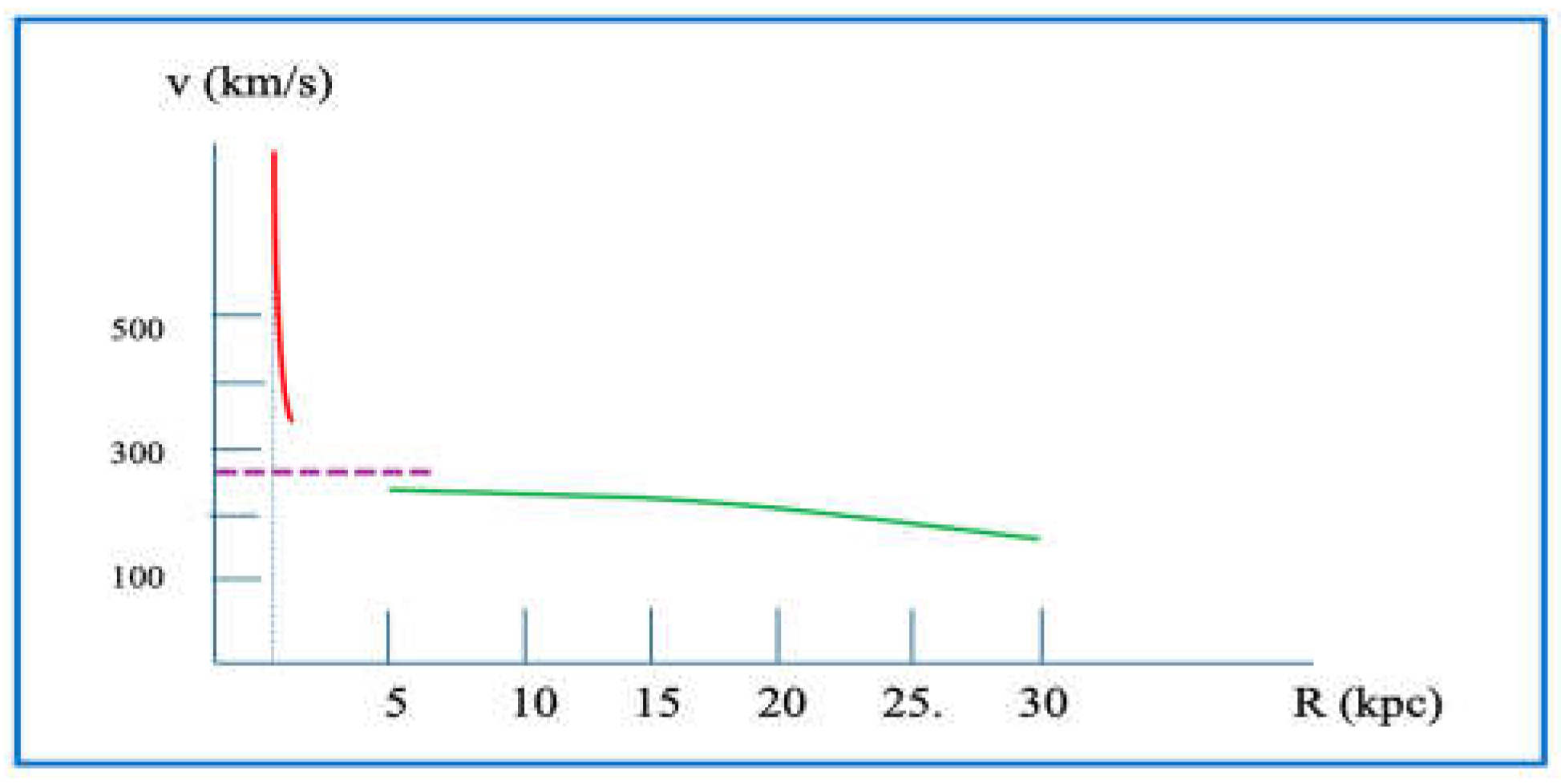
Galactic rotation curve was formulated before the Sgr A* had been confirmed. The action of the Sgr A* on the rotation curve has not been considered. Now, it was observed that the fastest stars in the Milky Way is in the distance less than 0.5pc from the Sgr A*. It is contradicted with the current galactic rotation curve in which the orbital velocity near the center of the galaxy is the smallest. And, because of the advance of technology, it was observed that the circular velocity curve of the Milky Way from 5 to 30 kpc is with a significantly faster decline (Keplerian decline) compared to the inner parts. It is contradicted with the current curve in which the out parts could be larger or no decline. And, it was observed that the fast galaxy bar continue challenge the standard cosmology. For the reasons, we present an improved galactic rotation curve.
Keywords:
1. Introduction
2. New Observations and Improved Galactic Rotation Curve
3. Discussions
3.1. The Rotation Curve in the Galactic Disc
3.2. The Rotation Curve and the Bar
3.3. The Rotation Curve Near the Sgr A*
4. Conclusion
- (1)
- In the current galactic rotation curve, the orbital velocity in the center of the Milky Way is the smallest; while, in the improved one that is the largest. It is clear, after the Sgr A* was discovered, it is easy to know that the orbital velocity near the Sgr A* is the largest.
- (2)
- (3)
References
- Babcock, H.W. The rotation of the Andromeda Nebula. Lick Observatory Bulletins 1939, 498, 41–51. [Google Scholar] [CrossRef]
- Oort, J.H.; Kerr, F.J. & Westerhout, G. The galactic system as a spiral nebula (Council Note). MNRAS 1958, 118, 379. [Google Scholar]
- Rubin, V.C.; Ford, W.K.; Thonnard, N. Rotational properties of 21 SC galaxies with a large range of luminosities and radii, from NGC 4605 (R=4kpc) to UGC 2885 (R=122kpc). ApJ 1980, 238, 471. [Google Scholar] [CrossRef]
- Genzel, R.; Eisenhauer, F. and Gillessen, S.; 2010, The Galactic Center Massive Black Hole and Nuclear Star Cluster, Reviews of Modern Physics, 82.4, 3121-3195.
- Ghez, A.M.; et al. Stellar orbits around the Galactic Center black hole. Astrophys. J. 2005, 620, 744–757. [Google Scholar] [CrossRef]
- Peißker, F.; Eckart, A. and Parsa, M. On a 9.9 yr Orbit around SgrA*. ApJ, 2020, 889, 61.
- Peißker, F.; Eckart, A.; Zajaček, M. and Britzen, S. Observation of S4716- A star with a 4 year orbit around Sgr A*. ApJ 2022, 933, 49. [Google Scholar] [CrossRef]
- Peißker, F.; Eckart, A.; Zajaček, M.; Britzen, S.; Ali, B. and Parsa, M. S62 and S4711: Indications of a Population of Faint Fast-moving Stars inside the S2 Orbit—S4711 on a 7.6yr Orbit around Sgr A*. ApJ 2020, 899, 50. [Google Scholar] [CrossRef]
- Peißker, F.; Eckart, A. and Ali, B. Observation of the Apoapsis of S62 in 2019 with NIRC2 and SINFONI. APJ 2021, 918, 25. [Google Scholar] [CrossRef]
- GRAVITY Collaboration, et al. Deep images of the Galactic center with GRAVITY, A&A 2022, 657, A82.
- GRAVITY Collaboration, et al. Mass distribution in the Galactic Center based on interferometric astrometry of multiple stellar orbits, A&A 2022, 657, L12.
- Sofue, Y.; Rubin, V. Rotation Curves of Spiral Galaxies. Annu. Rev. Astron. Astrophys. 2001, 39, 137. [Google Scholar] [CrossRef]
- Feng, J.Q. and Gallo, C.F. Modeling the Newtonian dynamics for rotation curve analysis of thin-disk galaxies, Research in Astron. Astrophys 2011, 11, 1429–1448. [Google Scholar]
- Feng, J.Q. Rotating Disk Galaxies without Dark Matter Based on Scientific Reasoning. Galaxies 2020, 8, 9. [Google Scholar] [CrossRef]
- Hofmeister, A.M.; Criss, R.E. Debated Models for Galactic Rotation Curves: A Review and Mathematical Assessment, Galaxies 2020, 8, 47. 8.
- Krełowski, J.; et al. The Milky Way Rotation Curve Revisited, PASP 2018, 130, 114302. 130.
- Russeil, D.; Annie Zavagno, P. Mege, Y. Poulin, S. Molinari, et al., The Milky Way rotation curve revisited. A&A 2017, 601, L5. [Google Scholar]
- Eilers, A.; Hogg, D.W.; Rixand, H.; Ness, M.K. The Circular Velocity Curve of the Milky Way from 5 to 25 kpc. ApJ.
- Mróz, P.; Udalski, A.; Skowron, D.M.; Skowron, J.; et al. Rotation Curve of the Milky Way from Classical Cepheids. ApJL 2019, 870, L10. [Google Scholar] [CrossRef]
- Wang, H.; Chrobáková Ž. , López-Corredoira, M. and Labini, F.S. Mapping the Milky Way Disk with Gaia DR3: 3D Extended Kinematic Maps and Rotation Curve to ≈30 kpc. ApJ 2023, 942, 12. [Google Scholar] [CrossRef]
- Zhou, Y.; et al. The Circular Velocity Curve of the Milky Way from 5–25 kpc Using Luminous Red Giant Branch Stars. ApJ 2023, 946, 73. [Google Scholar] [CrossRef]
- Jiao, Y.; Hammer, F.; Wang, H.; Wang, J.; et al. Detection of the Keplerian decline in the Milky Way rotation curve. A&A 2023, 678, A208. [Google Scholar]
- Ou, X.; Eilers, A.; Necib, L. and Frebel, A. The dark matter profile of the Milky Way inferred from its circular velocity curve, MNRAS 2024, 528, 693–710. [Google Scholar]
- Roshan, M.; Ghafourian, N.; Kashfi, T.; Banik, I.; Haslbauer, M.; et al. Fast galaxy bars continue to challenge standard cosmology, Monthly Notices of the Royal Astronomical Society 2021, 508(1) 926–939.
- Fragkoudi1, F.; Grand, R.J. J.; Pakmor, R.; Springel, V.; et al. Revisiting the tension between fast bars and the CDM paradigm. A&A 2021, 650, L16. [Google Scholar]
- Corsini, E.M.; Aguerri, J.A. L.; Debattista, V.P.; Pizzella, A.; Barazza, F.D. and Jerjen, H.; 2007, The Bar Pattern Speed of Dwarf Galaxy NGC 4431, ApJ, 659, L121.
- Aguerri, J.A. L.; Méndez-Abreu, J.; Falcón-Barroso, J.; Amorin, A.; et al. Bar pattern speeds in CALIFA galaxies I. Fast bars across the Hubble sequence. A&A 2015, 576, A102. [Google Scholar]
- Zhu, Y. ; Interaction of Gravitational Field and Orbit in Sun-planet-moon system [v1] |. [CrossRef]
- Häberle, M.; Neumayer, N.; Seth, A.; et al. Fast-moving stars around an intermediate-mass black hole in ω Centauri. Nature 2024, 631, 285–288. [Google Scholar] [CrossRef] [PubMed]
- Howard, D.; et al. The Bulge Radial Velocity Assay (BRAVA). I. Sample Selection and a Rotation Curve. 2008. [Google Scholar]
- Kunder, A.; et al. The bulge radial velocity assay (BRAVA). II. Complete sample and data release. AJ.
- Skokos, Ch. , Patsis, P. A.; Athanassoula, E. Orbital dynamics of three-dimensional bars—I. The backbone of three-dimensional bars. A fiducial case, Monthly Notices of the Royal Astronomical Society 2002, 333, 847. [Google Scholar]
- Mattia, M.C.; Gerhard, O.; Portail, M.; Vasiliev, E.; Clarke, J. The stellar mass distribution of the Milky Way’s bar: an analytical model. Monthly Notices of the Royal Astronomical Society. Letters 2022, 514, L1–L5. [Google Scholar]
- McWilliam, A. & Zoccali, M. Two Red Clumps and the X-shaped Milky Way Bulge. ApJ 2010, 724, 149. [Google Scholar]
- Nishiyama, S.; et al. A Distinct Structure inside the Galactic Bar. ApJ 2005, 621, L105. [Google Scholar] [CrossRef]
- Zhu, Y. A Conjecture on the Possible Another Supermassive Black Hole in the Bar of Our Milky Way. 2024. [CrossRef]
Disclaimer/Publisher’s Note: The statements, opinions and data contained in all publications are solely those of the individual author(s) and contributor(s) and not of MDPI and/or the editor(s). MDPI and/or the editor(s) disclaim responsibility for any injury to people or property resulting from any ideas, methods, instructions or products referred to in the content. |
© 2024 by the authors. Licensee MDPI, Basel, Switzerland. This article is an open access article distributed under the terms and conditions of the Creative Commons Attribution (CC BY) license (http://creativecommons.org/licenses/by/4.0/).