1. Introduction
Specialist palliative care is more then end of life care. Palliative Care (PC) is an approach that improves the quality of life of patients (adults or children) and their families who are facing problems associated with life-threatening illness. It prevents and relieves suffering through the early identification, correct assessment and treatment of pain and other problems, whether they are physical, psychosocial or spiritual [
1].
Palliative care must be available and accessible to all, wherever and whenever they need it. In healthcare, most researchers and clinicians agree that quality of life (QOL) is related to symptoms, functioning, psychological and social wellbeing, and probably to a lesser extent to meaning and fulfilment. This multidimensional health-oriented concept has been named health-related quality of life (HRQOL). However, during end-of-life care spirituality and existential issues become more prominent, as well as family members’ perception of quality of care [
2].
Older adults are heterogenous in the aging process and thus using a physician specialist in geriatrics and Palliative care is needed to perform comprehensive assessments. This can help to tailor the palliative care of the older adult with cancer or other chronic illnesses, providing for better predictions of the success of the proposed treatment. The overarching goal is to maintain the individual's quality of life and independence [
3].
Early integration of palliative care has been shown to provide improved outcomes in patients with advanced cancer [
4].
So, why not apply this principle also in management of liver cirrhosis or other chronic diseases? This article reviews the ways in which palliative care and medical teams can collaborate to provide high-quality care to end-stage-liver patients and their families.
We try to provide practical tips for hospitalists who wish to initiate primary palliative care for their chronic patients. Prior to referral to a specialized interdisciplinary palliative care team, teams managing these patients may start advance-care planning discussions, provide basic pain and non-pain symptom relief and utilize several assessment tools. If a specialized palliative care team is not available, the hospital team can also address additional aspects of palliative care, with assistance from social work departments and other resources in the community.
2. Palliative Care Needs in Liver Cirrhosis Patients
End-stage liver disease (ESLD) is the culmination of progression of chronic liver disease to cirrhosis, decompensation, and chronic liver failure, featuring portal hypertension or hepatocellular failure-related complications.
In this context, palliative care offers best possible quality of life and is not limited to end-of-life care. It also encompasses achievable goals such as symptom control and avoidance of aggressive disease-modifying treatments or interventions that beneficially alter the natural course of the disease to offer curative intend.
Improving patients quality of live is the cornerstone of PC medicine and the main need expressed by these patients. It is known that improvement of hepatic encephalopathy management, ascites control and malnutrition treatment have the greatest impact on patients day by day live and prognosis. Patients usually tend to avoid hospital admissions, so educating and empowering patients and their carers to optimize symptom management themselves may help support this. In chronic diseases the successful palliation techniques involve effective symptoms but also relief of unnecessary burdens such as polypharmacy/iatrogeny.
Palliative care offers a wide range of benefits, from controlling muscle cramps, performed timely paracentesis for recidivating ascites, prophylaxis/treatment of hepatic encephalopathy, controlling pain with safe dosages without side effects, avoiding malnutrition to controlling care by involving also the family psysician (GP), discussion about the financial needs, about place of death or considering the caregiver burden.
Symptom care in palliation of end stage liver disease (only medication available in Romania): after Philips, C. A., & Kedarisetty, C. K. (2023) [
5].
Muscle cramps – taurine, zinc sulphate, L-carnitine, quinidine sulphate, BCAA
Pain- Acetaminophen (under 2g/day), NSAIDS, gabapentin, pregabalin, lidocaine, tramadol, morphine
Itching: UDCA (Ursodeoxycholic acid) 10-15mg/kg, naltrexone, sertraline
Fatigue- testosterone replacement, gabapentin, sertraline, venlafaxine (unless Child C, hyponatremia)
Sleep disorders- lactulose (for encephalopathy), zolpidem, melatonin, avoid duloxetine
Malnutrition- bed time snack, early dietitian referral
Refractory ascites: Long-term abdominal drains, day case paracentesis, alfapump®
Hospital treatments aimed for cirrhotic patients:
3. When Is Palliative Care Needed in Cirrhosis and Who Can Deliver It?
Some indication for PC could be:
- -
uncontrolled physical symptoms
- -
patient/family/caregiver emotional or spiritual distress or conflicts about goals of care
- -
accelerating/frequent need for medical care or repeated hospitalisation
- -
curative treatment not available or not possible for the case
Recent indication found in literature identify several triggers for palliation in advanced liver disease: MELD score over 29 or increase in MELD more than 5 points in the last 30 days, ACLF grade 2-3 after 1 week of treatment, sarcopenia or recurrent sepsis [
5].
Since resources are limited, in palliation we consider the surprise question (SQ) to be one of standards by witch the patients will benefit most from PC services. The surprise question — “Would I be surprised if this patient died in the next 12 months?” — has been used to identify patients at high risk of death who might benefit from palliative care services. Several studies suggest that the surprise question performs poorly to modestly as a predictive tool for death, with worse performance in noncancer illness. The SQ was developed more than a decade ago and has been suggested as a simple test to identify patients who might benefit from hospice and palliative care. It was thought that the SQ would correct some physician’s tendency to overestimate prognosis by asking the physician to consider whether death in the coming year is possible rather than probable. The surprise question has been widely promoted and adopted into frameworks for assessing hospice and palliative care needs [
6].
The study called COMPASS: A Pilot Trial of an Early Palliative Care Intervention for Patients With End-Stage Liver Disease was a randomized controlled trial of patients with end-stage liver disease admitted to the hepatology service at a tertiary referral center whose attending hepatologist indicated they would not be surprised if the patient died in the following year on a standardized questionnaire. The control group patients received usual care, while the intervention group patients received inpatient specialist palliative care consultation and outpatient follow-up by a palliative care nurse by phone. The primary outcome was time until first readmission. Secondary outcomes included days alive outside the hospital, referral to hospice care, death, readmissions, patient quality of life, depression, anxiety, and quality of end-of-life care over 6 months. The was stopped early because of difficulties in finding patients, since of 293 eligible patients, only 63 patients were enrolled, 31 in the intervention group and 32 in the control group. Even with this bias, the intervention group patients had a lower hazard of readmission (hazard ratio: 0.36, 95% confidence interval: 0.16-0.83, P = 0.017) and greater odds of having more days alive outside the hospital than control group patients (odds ratio: 3.97, 95% confidence interval: 1.14-13.84, P = 0.030), with no other statistically significant differences observed. This study proves preemptive palliative care intervention resulted in increased time to first readmission and more days lived outside the hospital in the six months following study entry.[
7]
In an a retrospective, single-center study published in 20121 from a metropolitan tertiary referral hospital from Australia the research aimed to determine palliative care referral rates and patterns for patients admitted with decompensated cirrhosis and to identify the factors associated with referral. Only a fifth of eligible patients (25/116) were referred to palliative care. Despite benefits from timely referral, less than one quarter of palliative care eligible patients was referred and the study concludes that referral was reserved for those facing imminent death-surviving just under 3 weeks post-referral, although the mortality in non-referred patients remained high (148-day median). Low rates and late referral are a missed opportunity to improve the end of life care for patients with end-stage liver disease [
8].
In most of the studies published for this topic, liver disease is strongly associated with significant social, psychological and financial hardships for patients or carers and strategies that involve the wider multidisciplinary team at an early stage in the disease trajectory help ensure proactive management of such issues. PC introduced at an early stage in the trajectory of advanced chronic disease has been shown to improve quality of life (QOL) and symptom management, often in conjunction with ongoing active and potentially curative therapy.
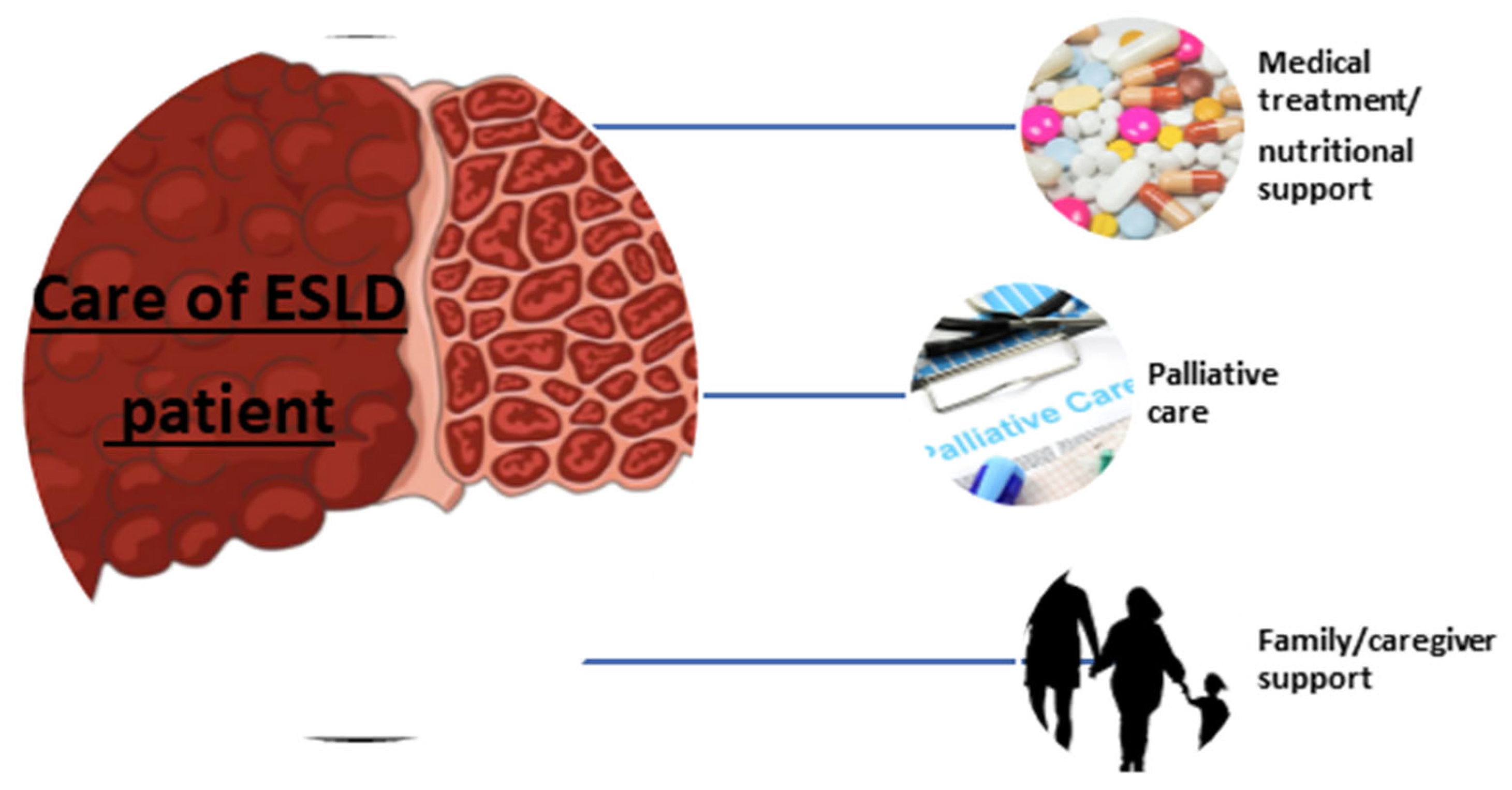
Core palliative care is best delivered by the hepatology team in parallel with active disease management. This include ensuring that discussions about disease trajectory and advanced planning occur alongside active management of disease complications. Liver disease is strongly associated with significant social, psychological and financial hardships for patients and their families so we must create strategies that involve a multidisciplinary team- physician (family doctor, internist, hepatologist), medical nurse, social worker, priest.
Figure 1.
Holistic approach to End of Stage Liver Disease patients.
Figure 1.
Holistic approach to End of Stage Liver Disease patients.
4. Barriers to PC
For patients, not understanding of illness trajectory and role of PC can lead to unrealistic expectations and unwillingness to engage early with PC discussions.
The onset of hepatic encephalopathy (HE) can also leave patients lacking capacity and unable to participate in ACP discussions. Many patients and doctors also still consider PC initialisation to be similar with end of live discussions and this is surely an overstatement. The perception that PC initialisation excludes disease modifying treatments and/or transplantation has been recognised as an important barrier in the timely initiation of core PC measures. Unfortunately in Romania the liver transplant services are very limited so many patients will not finally benefit of them. Improving QOL for all of these patients by including PC in their care is an important factor in delivering high-quality medical services.
Potential barriers to discussing PC and to chronic liver diseases referral include patient, physician and health system-related factors.
Table 1 present some of these problems that should be assessed by the health system and local medical authorities.
5. What to Do Next?
Many hospitals acknowledge the complex needs of this patients and plan to implement novel models of care to address them or establish new PC wards in their onsets. We need to increase awareness of this subject, to find and stimulate adequate resources and implement PC establisments that will provide services for oncological and non-oncological patients.
A key element of these approaches is recognition that conversations about prognosis and advance care planning (ACP) take time and adequate resources need to be allocated in order to make these services effective. Inclusion of metrics that recognise the importance of high-quality coordinated care, early ACP discussions in Gastroenterology or Internal medicine wards and PC input in these settings will enable impact evaluation.
For departments with constrained resources, an advanced liver disease medical multidisciplinary team is an achievable goal, but in romanian settings this is possible only in some University hospitals or tertiar Gastroenterology clinics. Liver disease is a ‘multi-dimensional’ burden, affecting people for many diffrent perspectives: socially, psychologically, financially and also physically. Medical teams can guide future conversations with patients and ensure good, consistent communication with plans that can be shared with the amily doctor in order to improve continuity of care.
6. Conclusions
Palliative care practice offers several scales and models of symptom control and evaluation techniques that can be adopted in caring non-oncology patients. [
10]. Promoting PC among all healthcare workers is vital, and dispelling the myth that PC is synonymous with final period of live is vital. PC should be viewed as a mean of optimizing QOL for patients and carers in parallel with an active management of chronic liver diseases.
Gastroenterology and Internal medicine trainees residents as well as ward nurses need to gain awareness and practical training in the principles of PC to help achieve this goal. Proper evaluation, symptom control and advance care plan discussions could ease the burden of the disease and increase quality of care in these patients, even in a country like Romania, struggling with limited resources and lacks in health system organisation.
References
- www.who.int/news-room/fact-sheets/detail/palliative-care.
- Kaasa S, Loge JH. Quality of life in palliative care: principles and practice. Palliative Medicine 2003, 17, 11–20. [Google Scholar] [CrossRef] [PubMed]
- Binns-Emerick, L. , Patel, P., Deol, B. B., & Kang, M. Multidisciplinary palliative care of the older adult: a narrative review. Annals of palliative medicine 2024, 13, 1002–1011. [Google Scholar] [CrossRef] [PubMed]
- Swami, M. , & Case, A. A. Effective Palliative Care: What Is Involved? Oncology (Williston Park, N.Y.), 2018, 32, 180–184. [Google Scholar] [PubMed]
- Philips, C. A. , & Kedarisetty, C. K. Palliative Care for Patients with End-Stage Liver Disease. Journal of clinical and experimental hepatology 2023, 13, 319–328. [Google Scholar] [CrossRef] [PubMed]
- Downar, J. , Goldman, R., Pinto, R., Englesakis, M., & Adhikari, N. K. The "surprise question" for predicting death in seriously ill patients: a systematic review and meta-analysis. CMAJ: Canadian Medical Association journal = journal de l'Association medicale canadienne 2017, 189, E484–E493. [Google Scholar] [CrossRef] [PubMed]
- Shinall, M. C. , Jr, Karlekar, M., Martin, S., Gatto, C. L., Misra, S., Chung, C. Y., Porayko, M. K., Scanga, A. E., Schneider, N. J., Ely, E. W., Pulley, J. M., Jerome, R. N., Dear, M. L., Conway, D., Buie, R., Liu, D., Lindsell, C. J., & Bernard, G. R. COMPASS: A Pilot Trial of an Early Palliative Care Intervention for Patients With End-Stage Liver Disease. Journal of pain and symptom management 2019, 58, 614–622. [Google Scholar] [CrossRef] [PubMed]
- Chen, H. , Johnston, A., Palmer, A., Mickenbecker, M., O'Sullivan, T., & Clark, P. Too little, too late: Palliation and end-stage liver disease. Journal of gastroenterology and hepatology 2021, 36, 2303–2306. [Google Scholar] [CrossRef] [PubMed]
- Woodland, H. , Hudson, B., Forbes, K., McCune, A., Wright, M., & British Association for the Study of the Liver (BASL) End of Life Special Interest Group Palliative care in liver disease: what does good look like? Frontline gastroenterology 2019, 11, 218–227. [Google Scholar] [CrossRef] [PubMed]
- https://www.ncbi.nlm.nih.gov/books/NBK447766/#_appi_s2_.
|
Disclaimer/Publisher’s Note: The statements, opinions and data contained in all publications are solely those of the individual author(s) and contributor(s) and not of MDPI and/or the editor(s). MDPI and/or the editor(s) disclaim responsibility for any injury to people or property resulting from any ideas, methods, instructions or products referred to in the content. |
© 2024 by the authors. Licensee MDPI, Basel, Switzerland. This article is an open access article distributed under the terms and conditions of the Creative Commons Attribution (CC BY) license (http://creativecommons.org/licenses/by/4.0/).