

Submitted:
14 October 2024
Posted:
16 October 2024
You are already at the latest version
Abstract
Ice cream is popular but contains high amounts of saturated fats and few health-promoting ingredients. In the presence of xanthan gum (0.25%), the blueberry peel particles prepared through ball-milling treatment (BMP) were used to prepare ice cream containing camellia oil as a fat replacer. BMP possessed smaller particle sizes, larger contact angles, and higher contents of anthocyanin aglycone, as compared with commonly-milled blueberry peel particles. BMP with the smallest D[4,3] value (about 10 μm) and the largest contact angle (66.30°) were obtained by ball-milling the blueberry peel at 15 Hz for 6 h (BMP15 Hz 6 h). The ice cream mixes were depicted as linear viscoelastic gel-like solids, and their apparent viscosity, G′ and G′ increased with the increase in BMP15 Hz 6 h concentrations. Ice cream with strong antioxidant activity and good freeze-thaw stability was acceptable and desirable in the presence of less than 0.5% BMP15 Hz 6 h.
Keywords:
Blueberry peels
; Ball milling
; Ice cream
; Pickering emulsion
1. Introduction
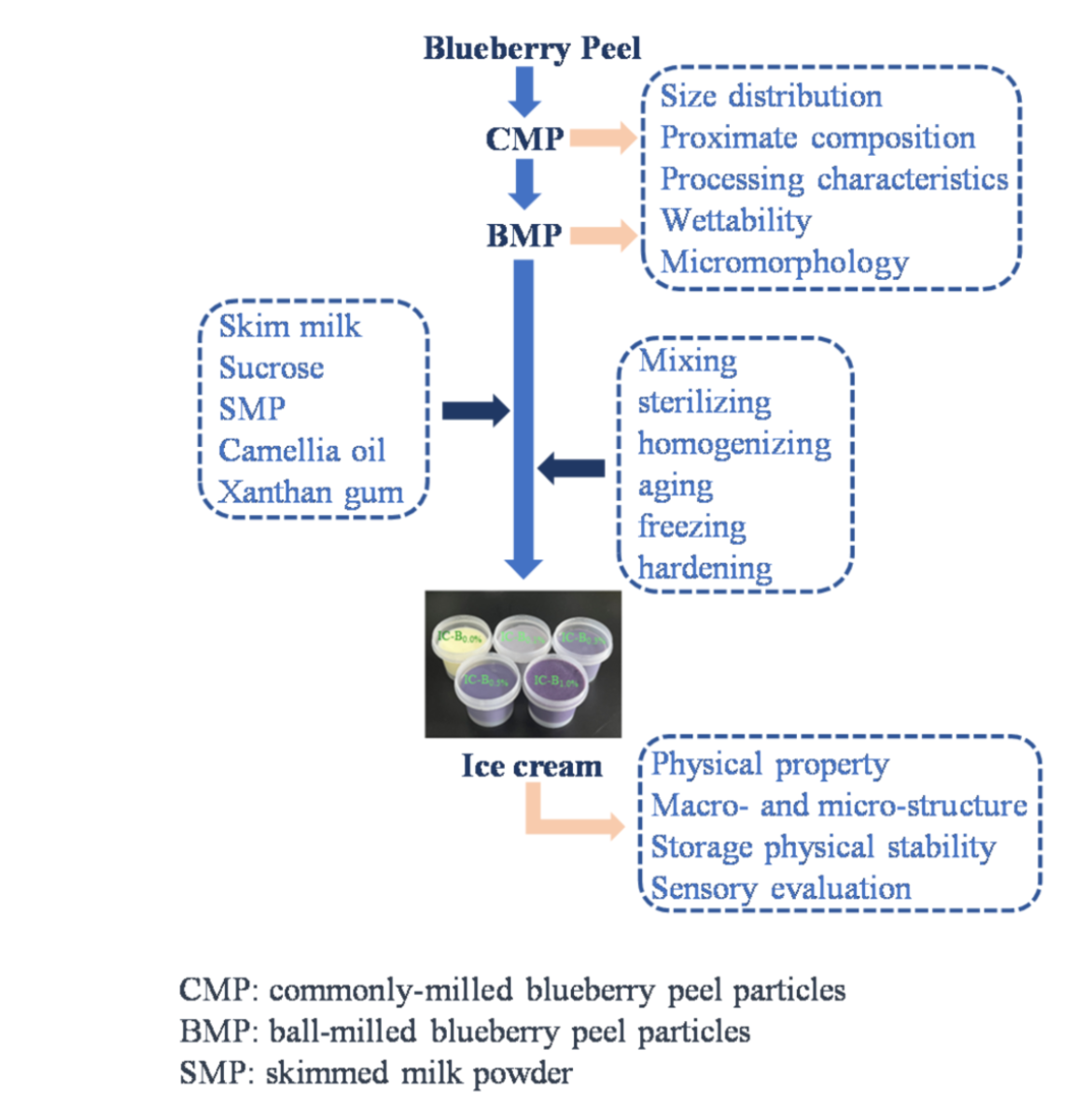
Ice cream is a popular dessert which is made of milk products, fat, sweeteners, emulsifiers, stabilizers and condiments, and has undergone many processing steps including mixing, sterilizing and homogenizing of all the components (namely preparing of ice cream mix), and subsequent aging, freezing, and hardening (Ewert, Schlierenkamp, Fischer, & Stressle, 2019). The ice cream mix exhibits an oil-in-water emulsion, where proteins, fat globules, ice crystals, air bubbles, and particle stabilizers are dispersed in the continuous phase containing milk proteins, sugars, salts, emulsifiers and hydrocolloids, and is responsible for the stability and texture of ice cream (Ewert, Schlierenkamp, Fischer, & Stressler, 2019). However, the ice cream mix contains a pretty amount of saturated fatty acids, so high consumption of ice cream will increase the risk of obesity and cardiovascular disease, and other health problems (Genovese, Balivo, Salvati, & Sacchi, 2022). Therefore, industry and consumers are continuously seeking alternative ingredients to meet the demand of new and healthier ice cream.
To reduce the amount of saturated fat in ice cream, the liquid oil with high contents of natural unsaturated fat, such as sunflower oil (Moriano & Alamprese, 2017), rapeseed oil (Monié, et al., 2023) and peanut oil (Zaaboul, Tian, Borah, & Bari, 2024), has been incorporated into the ice cream mix after they have been structured into oleogels in the presence of Pickering gelators and/or hydrocolloids, which make the rheological behavior of the liquid oil be similar to that of a solid crystalline fat. In addition, the by-products peel powder from pitaya (Utpott et al., 2020), pomegranate (Ismail, Hameed, Refaeym, Sayqal, & Aly, 2020) and persimmon (Yoseffyan, Mahdian, Kordjazi, & Hesarinejad, 2024) has also been added into the ice cream mix to produce the functional ice cream with dietary fibers, polyphenols, and/or antioxidants.
Blueberry, considered as “super fruit”, possess the capacities of scavenging free radicals and preventing the cardiovascular disease, neurological decline and type 2 diabetes mellitus, which predominantly attributes to their abundant phytochemicals, especially to their rich anthocyanin pigments (Wang, Camp, & Ehlenfeldt, 2012). However, blueberry anthocyanins are mainly located in the peel, which reach up to 90% anthocyanins of the whole fruit, and they are not easy to be extracted owing to the binding of cell walls (Li, Deng, Pan, Luo, & Zheng, 2023). In addition, blueberry peel which accounts for nearly 30% dry weight of the whole blueberries is usually discarded due to its low solubility and immiscibility. Therefore, it is of importance to find an efficient method to utilize the blueberry peel for the development of blueberry planting and processing enterprises.
Ball milling technology has been used for the production of ultrafine powder and foods, wherein the medium balls colliding in the ball mill tank would result in the materials be modified by creating shear force and stress (Zhao, Zhu, Zhang, & Tang. 2015; Wang, Zhang, Devahastin, & Liu, 2020; Cao et al., 2021). The particles with nanometer/submicron scale from fruit peel, such as yam (Chiang, Chen, & Yeh, 2012) and onion peel (Jiang, Ramachandraiah, Wu, Li, & Eun, 2020), have been obtained using a ball milling grinder. Excitingly, the whole red rice materials were media-milled into nano/submicrometer particles that can used as stabilizers for Pickering emulsions with intrinsic antioxidant properties (Lu & Huang, 2019). Therefore, the ball milling technology may be an efficient method to modify the solubility and immiscibility of blueberry peel as to realize their full utilization and to enlarge their scopes of applications.
Camellia oil from tea seeds (Camellia oleifera Abel.) is a unique edible vegetable oil with high contents of oleic acid and tea polyphenols, and can reduce blood lipid levels and prevent coronary heart disease (Luo et al., 2019a). In our previous work, camellia oil-based oleogels have been structured in the presence of xanthan gum (Luo et al., 2019a) and been used as fat replacers to prepare functional cookies (Luo et al., 2019b; Pan, Wu, Luo, He, & Luo, 2020) and soft candies (Pan et al., 2022). The aims of this study are to (1) prepare blueberry peel particles using ball milling treatment at low temperature, (2) evaluate physicochemical characteristics of the ball-milled blueberry peel particles, and (3) investigate the possibility of the preparation of ice cream using camellia oil instead of solid fats, and using blueberry peel particles as stabilizers in the presence of xanthan gum.
2. Materials and methods
2.1. Materials and chemicals
Fresh blueberry (Britewell) fruits were provided by Anhui Huiwang Food Co., Ltd. (Hefei, China). Nile red, 3',6'-dihydroxy-5-isothiocyanato-3H-spiro[isobenzofuran-1,9'-xanthen]-3-one (FITC), 6-hydroxy-2,5,7,8-tetramethylchroman-2-carboxylic acid (Trolox), gallic acid (GA), and cyanidin-3-O-glucoside (CGE), were obtained from Solarbio Science & Technology Co., Ltd. (Beijing, China). All other chemicals used were analytical-grade and bought from Sinopharm Chemical Reagent Co., Ltd. (Shanghai, China).
2.2. Preparation of blueberry peel particles
Blueberry peel was obtained according to our previous work (Li, Deng, Pan, Luo, & Zheng 2023). The dried blueberry peel was ground with a QSB-200 crusher (Yongkang Industry & Trade Co., Ltd., Yongkang, China) for 3 min and passed through a 60-mesh sieve to give the commonly-milled blueberry peel particles (CMP). CMP (4g) was mixed with ZrO2 at a mass ratio of 1:4, placed into a BM500 cryogenic mill (Anton-paar, Shanghai, China), and ball-milled at 15 Hz or 25 Hz for 1.5 h, 3 h and 6 h, respectively, to give the ball-milled blueberry peel particles (BMP) (Jiang, Ramachandraiah, Wu, Li, & Eun, 2020), denoted as BMP15 Hz 1.5h, BMP15 Hz 3h, BMP15 Hz 6h, BMP25 Hz 1.5h, BMP25 Hz 3h, and BMP25 Hz 6h. The blueberry peel particles CMP and BMP, were separately stored at - 18 °C in double Ziploc bags for further use.
2.3. Property analysis of blueberry peel particles
2.3.1. Size distribution
The particle size distribution was determined with a MS 200 laser particle size analyzer (Malvern Instruments Limited, Britain) at room temperature using the wet technique. D10, D50, D90, D[4,3], D[3,2], Span, Φ (cell wall breakage ratio), and specific surface area (SSA) were recorded, wherein, Span = (D90 – D10)/D50, Φ = 1 – (1 – 10/D50) (if D50 ≤ 10 μm, then Φ = 1) (Xiao, Zhang, Fan, & Han. 2017).
2.3.2. Wettability
The wettability was assessed through monitoring the contact angle with an SCA20 contact angle measuring instrument (DataPhysics Instruments GmbH, Stuttgart, Germany) following our previous work (Luo et al., 2018). The contact angle (θo/w) was determined according to the captured images of the contact sheet surface.
2.3.3. Micromorphology
The microstructure was observed with a high-resolution field emission scanning electron microscope Regulus 8230 (Hitachi Co, Japan). Blueberry peel particles were carefully placed onto the conductive adhesive carbon tape affixed to the sample plate, and then the micromorphology was examined after gold was sprayed on the sample.
2.3.4. Anthocyanin composition
The anthocyanin composition of blueberry peel particles was analyzed with a UPLCOrbitrap-MS system (Thermo Fisher Scientific Instruments Co., Ltd., Shanghai, China) connected with a Waters Accuracy UPLC HSS T3 column (2.1 mm × 100 mm; Thermo Fisher Scientific Instruments Co., Ltd., Shanghai, China), according to our previous work (Li, Deng, Pan, Luo, & Zheng, 2023).
2.4. Preparation of ice cream
The ice cream was prepared according to the method of Samakradhamrongthai et al. (2021) with slight modifications. The ingredients used in the ice cream formula (IC-B) consisted of skim milk, sucrose, skimmed milk powder, camellia oil, xanthan gum and BMP15 Hz 6h (Table 1). Skim milk and camellia oil were placed into a pan and heated to 50 °C in a water bath. Sucrose, skimmed milk powder, xanthan gum and BMP15 Hz 6h were completely premixed, and then were added and continuously stirred for 10 min to form a homogeneous ice cream mix. The ice cream mix was pasteurized at 85 ± 1 °C for 2 min, then homogenized with an FA25 high shear emulsifying machine (Fluko Co, Germany) for 2 min firstly at 60 °C and 10000 rpm, sequentially homogenized at 16000 rpm for 2 min, and then quickly chilled to 4 °C and aged at 4 °C for 24 h to ensure thorough hydration of all ingredients. The aged ice cream mixes were frozen in an ice cream maker (Hubei Dongbei Electromechanical Co. Ltd., Huangshi, China) for 6 min to 4 °C, further whipped for 7 min, and then hardened at -30 °C for 24h to obtain ice cream samples. The ice cream samples were stored at -18 °C for further use. The ice cream added with 0, 0.1%, 0.3%, 0.5% and 1.0% BMP was designated as IC-B0.0%, IC-B0.1%, IC-B0.3%, IC-B0.5% and IC-B1.0%, respectively.
2.5. Rheological behavior analysis of ice cream mix
The rheological behavior of the ice cream mix was measured with a DHR-3 rheometer (TA Instruments, Leatherhead, UK) (Pan et al., 2022). The ice cream mix of 2 ml was tiled on the test platform of the rheometer. The gap between the test platform and the fixture with a diameter of 40 mm was set at 1000 μm. The frequency sweep test was measured at a strain of 0.5% and a frequency range of 0.1–10 Hz. The flow measurement was performed at a shear rate of 0.001 - 100 s-1. All procedures were carried out at 25 ◦C.
2.6. Characteristic assessment of ice cream
2.6.1. Overrun, first dripping time, melting rate and firmness
The overrun, first dripping time, melting rate and firmness of the ice cream samples, were measured according to the method of Liu, Wang, Liu, Wu, & Zhang (2018). A 200-mL container was weighed and the overrun percentage was determined as following: overrun% = (weight of ice cream mixes - weight of frozen ice cream) ÷ weight of frozen ice cream × 100%. The first dripping time was defined as the required time (min) for the dripping of the first melted drop of the ice cream. The melting rate (%/min) was calculated as the slope of the linear curve interval of the dripped portion as function of the time. The firmness was gauged with a physical property tester (Stable micro system Co, Britain) at the test speed of 2.00 mm/s and depth of 20 mm, and the firmness value was obtained through Texture Expert software (version 1.20, Stable Micro Systems, UK).
2.6.2. Macro- and micro-structure observation
The air bubbles scattered in the ice cream were observed through a microscope with a digital camera (Nikon Co, Japan) in a bright area. The distribution of the protein and fat granules in the ice cream was observed through an FV1000 confocal laser scanning microscope (Olympus Co, Japan) the help of fluorescent dyes FITC and Nile red, respectively, at the excitation wavelengths of 633 nm and 488 nm (Cheng, Ma, Li, Yan, & Cui. 2015).
2.6.3. Storage physical stability
The changes in the particle size and creaming index (CI) of ice cream samples kept in a 10-mL transparent centrifuge tube with a lid and stored at 4 ± 1 °C, were monitored on the 7th, 14th, 21st and 28th day of storage. The Z-ave of the ice cream droplet was gauged with a Mastersizer 2000 (Malvern Instruments Ltd., Malvern, UK), wherein the dispersant of water, particle refractive index of 1.520, particle absorption rate of 0.1 and dispersant refractive index of 1.330 were set. The CI value was calculated as following: CI% = (Hs/He) × 100, where Hs stands for the height of the serum layer, and He for the height of the entire ice cream (Luo et al., 2018).
2.6.4. Sensory evaluation
Sensory properties were evaluated according to the method of Liu, Wang, Liu, Wu, & Zhang (2018) with some modifications. On the first and last day of 28-day storage, sensory evaluation was conducted by 30 pre-trained panelists (18 females and 12 males, ages between 20 and 55) from School of Food and Biological Engineering, using a 5-point hedonic scale for five attributes (appearance, texture, taste, flavor, and overall acceptability), where 1 meant “dislike extremely” and 5 meant “like extremely”.
2.7. Statistical analysis
All tests were performed in triplicate. The results were expressed as mean values ± standard error. Statistical analysis and multiple comparisons between the means were analyzed by one way analysis of variance and LSD test at 5% level of significance using SPSS 17.0 software.
3. Results and discussion
3.1. Effects of ball-milling on physical properties of blueberry peel particles
3.1.1. Particle size distribution
The particle size has important impacts on the wettability and other characteristics of particles. The particle size of BMP was reduced by approximately 10 times due to the low-temperature ball milling treatment, as compared with that of CMP, and it decreased with the increasing ball milling time (Table 2). When the ball milling time increased from 1.5 h to 6.0 h, the D10 value of blueberry peel particles decreased from 30 µm to 3.5 - 5.5 µm, D50 value from 210 µm to 15.0 - 24.0 µm, and D90 value from 550 µm to 40 - 60 µm, D[4,3] value from 260 µm to 12 - 44 µm, and D[3,2] value from 56.5 µm to 8.5 - 11.5 µm, respectively. Similar results of reduced particle sizes were also found by Jiang, Ramachandraiah, Wu, Li, and Eun (2020) for onion peel, and by Xiao, Yang, Zhao, Wang, & Ge (2022) for pomelo peel. With the increase in the ball milling frequency, the particle size increased and then decreased as a whole. As the ball milling time was extended to 6 h, the particle size of blueberry peel particles obtained at 15 Hz (BMP15 Hz 6.0 h) was smaller than that obtained at 25 Hz (BMP25 Hz 6.0 h). BMP15 Hz 6.0h possessed the lowest difference between D90 and D50, the highest ratio of D[4,3]/D[3,2], and the largest span value and Φ value, suggesting that BMP15 Hz 6.0h had more uniform particle size distribution and better homogeneity than other blueberry peel particles (Huang, Dou, Li, & Wang, 2018). Especially, BMP15 Hz 6h achieved 100% of Φ and 1.01 m2/g of SSA, which indicated that they would be high-quality powdery additives due to a strong digestion possibility of nutrient components (Wang, Zhang, Devahastin, & Liu, 2020).
3.1.2. Surface properties
Generally, the greater the θo/w value of the test samples, the higher their surface hydrophobicity is. CMP had a θo/w of 37.43°, which is much lower than that (51.10 - 66.30°) of BMP (Figure 1A), which might be ascribed to the smaller particle size and the presence of higher contents of fiber in BMP. Similar results were also described by Yang & Tang (2021) who reported that the contact angles of okara holocellulose were obviously increased and their surface hydrophobicity were largely improved after ball milling treatment. BMP15 Hz 6h with an θo/w of 66.30°, are preferentially wetted by water, but they can also be wetted by oil, so they can stabilize the emulsions through a Pickering mechanism (Chen et al., 2018).
3.1.3. Microstructure
CMP showed an irregular flaky structure and uneven surface, while BMP exhibited an irregular spherical form (Figure 1B), which suggested that ball milling treatment greatly altered the microstructure of blueberry peel particles. BMP tended to gather in clusters and exhibited a highly agglomerated morphology, which may be due to the small size, large SSA and uniform particles. Wang, Zhang, Devahastin, & Liu (2020) also found that the ball-milled horseradish powder exhibited better morphological properties than other milled samples. Greater modifications in the size and shape of the BMP caused by ball-milling treatment, may bring significant effects on the physicochemical and functional properties of the particles (Table 2 & Table 3).
3.2. Effects of ball-milling on anthocyanin composition of blueberry peel particles
The low-temperature ball milling treatment changed the percentage of individual anthocyanin, while did not change the anthocyanin composition of blueberry peel particles (Table 3). The same 35 anthocyanins in the form of aglycone or glycoside were identified from both CMP and BMP15 Hz 1.5 h, however, BMP15 Hz 1.5h had higher percentage of anthocyanin aglycone and lower percentage of anthocyanin glycoside than CMP. This may be due to the decrease in the particle size and the increase in the surface area of BMP15 Hz 1.5 h, which led to the more extensive hydrolysis of the anthocyanin glycoside by endogenous enzyme of blueberry peel, resulting in the more release of anthocyanin aglycone. Wang, Zhang, Devahastin, & Liu (2020) also reported that low-temperature ball milling treatment accelerated the hydrolysis of substrates (i.e., glucosinolates) and increased the contents of bioactive compounds (i.e., isothiocyanates).
3.3. Effects of BMP on rheological behavior of ice cream mix
With increasing levels of BMP15 Hz 1.5 h, the values of elastic modulus, G′, and viscosity modulus, G′′, of the ice cream mix increased at a fixed frequency (Figure 2A). Additionally, G′ and G′′ values did not change obviously in the range of the measured oscillation frequency, suggesting that the internal network structure of the ice cream mix was stable and would not be easily changed by the external environment. The G′ value of the ice cream mix was higher than the G′′ value over the tested frequency range (Figure 2A & Table 4), indicating that the ice cream mix showed mechanical elasticity. In the ice cream mix, particles, such as fats, are adsorbed on the interface, air bubble and small droplets interact to form a gel-like emulsions (Dogan, Kayacier, Toker, Yilmaz, & Karaman, 2013). Meanwhile, when BMP15 Hz 1.5 h were added into the mix system, they intertwine with other polymers to form a solid-like three-dimensional gel structure, which increased the rheological properties of the mix emulsion. The amelioration of the rheological properties of the ice cream mix emulsion will contribute to the improvement of the viscoelastic structure of ice cream samples (Dogan, Kayacier, Toker, Yilmaz, & Karaman, 2013).
The apparent viscosity of the ice cream mix emulsions decreased with increasing shear rate (Figure 2B). The ice cream mix system showed high apparent viscosity at low shear and low viscosity at high shear owing to the breakdown of the internal network and the arrangement of ice crystal s and macromolecules in the shear direction, as well as due to the specific rheological properties of xanthan gum showing the pseudoplastic behavior (shear thinning) (Dogan, Kayacier, Toker, Yilmaz, & Karaman, 2013). The viscosity of the ice cream mixes dramatically increased as the added levels of BMP15 Hz 6 h increased in ice cream formula (Table 4). This may be due to the introduction of BMP Pickering stabilizers and the increase in the fiber and hydrophilic compound contents of BMP15 Hz 6 h in the mixture, causing an increase in the apparent viscosity (Soukoulis, Lebesi, & Tzia, 2009). Reducing fat would also lead to an increase of viscosity of ice cream, causing less creamy and harder ice cream (Yu, Zeng, Wang, & Regenstein, 2021). Additionally, the abundant anthocyanins in BMP15 Hz 6 h might interact with the components of ice cream, such as proteins, unsaturated fatty acid and xanthan gum, finally forming the more stable gel networks, and effectively increasing the viscosity of ice cream (Trigueros, Wojdylo, & Sendra, 2014).
3.4. Effects of BMP on physico-chemical properties of ice cream
3.4.1. Overrun and firmness
The addition of BMP15 Hz 6 h significantly changed the overrun and firmness of IC-B samples (Table 5). As the added levels of BMP15 Hz 6 h increased, the overrun value of the IC-B firstly increased, reaching the highest value of 45.13% (at 0.5 % BMP15 Hz 6 h addition), then decreased to 38.22% (at 1.0 % BMP15 Hz 6 h addition) which is still higher than that of the control sample IC-B0.0% with an overrun value of 32.99%. The overrun values of blueberry pulp-added ice cream were reported as 36.21 - 39.66% (Sayar, Şengül, & Ürkek, 2022), which is lower than that of IC-B0.5%. According to the results of Şentürk, Akın, Göktepe, & Denktaş (2024), the addition of 1% - 3% blueberry puree into the probiotic ice cream caused no significant effects on overrun values of samples (p > 0.05). Similar to our results, the addition of peanut oil bodies as a fat replacer into ice cream (Zaaboul, Tian, Borah, & Bari, 2024) had a higher overrun value. It has been considered that the overrun value is affected by the contents of fat globule, protein, emulsifier in the ice cream mix, and the viscosity in the production system (Tsevdou et al., 2019). The increased overrun value of BMP15 Hz 6 h-added ice cream could be ascribed to the reduced fat, and the Pickering emulsifier attribute of BMP, as well as the interaction of the abundant anthocyanin in BMP15 Hz 6 h with proteins and camellia oil.
Oppositely, the firmness of IC-B samples firstly decreased, obtaining the lowest value of 19.03N (at 0.5 % BMP15 Hz 6 h addition), and then increased to 24.41N (at 1.0 % BMP15 Hz 6 h addition) which is still lower than that of the control sample IC-B0.0% with the highest firmness of 33.15N. The IC-B samples in the present work had lower firmness than the camel milk ice cream with blueberry fruits (137 - 203 N, Sayar, Şengül, & Ürkek, 2022) and the probiotic ice cream with blueberry puree (5000 - 8000 N, Şentürk, Akın, Göktepe, & Denktaş, 2024), but showed similar hardness to the ice cream with persimmon peel (Yoseffyan, Mahdian, Kordjazi, & Hesarinejad, 2024). The firmness of ice cream is a function of the composition in ice cream formulation (protein, fat, sweetener, hydrocolloids, etc.), ice crystal sizes, ice crystal phase volume, system viscosity, air state, and the fat instability (Muse & Hartel, 2004). The compounds that create the network improve the air state (Figure 2), and decrease the ice crystal size (Javidi, Razavi, Behrouzian, & Alghooneh, 2016), therefore reduced the firmness of IC-B samples. Additionally, the firmness of ice creams may ascribe to the overrun. It has been reported that the higher overrun value of ice cream, the less hardness, because the presence of more air in the network of ice cream makes it easy to the penetration of the probe of the texture analyzer (Yoseffyan, Mahdian, Kordjazi, & Hesarinejad, 2024).
3.4.2. Melting behavior
The addition of BMP15 Hz 6 h significantly improved the melting resistance of ice cream (Table 5). As the added levels of BMP15 Hz 6 h increased, the first dripping time quickly prolonged, reaching the maximum value of 20.18 min (at 0.5 % BMP15 Hz 6 h addition), then slightly shortened to 18.00 min (at 1.0 % BMP15 Hz 6 h addition) which is still longer than 14.16 min of IC-B0.0% sample without BMP15 Hz 6 h. Also, the melting rate of the BMP-added IC-B samples decreased from 3.13 %/min to 2.71 %/min.
Too quick melting loses its edible attribute and is susceptible to thermal shock, while too slow melting is considered as an inferior ice cream product. The meltdown rate reflects both fat stabilization and rheological properties of ice cream, the more stable the fat and the greater the viscosity, the lower the melting rate (Parvar & Goff, 2013; Tsevdou et al., 2019). In the present work, the high viscosity created by xanthan gum and BMP15 Hz 6 h is responsible for the reduced meltdown rate and the prolonged first dripping time. Similar to our results, the addition of pomegranate peel (Ismail, Hameed, Refaeym, Sayqal, & Aly, 2020) and persimmon peel (Yoseffyan, Mahdian, Kordjazi, & Hesarinejad, 2024) resulted in a significant increase in the melting resistance of ice cream. The first dripping time of camel milk ice cream containing blueberry fruits (26 min - 29 min) were also longer than that of the control without blueberry fruits (23.1 min) (Sayar, Şengül, & Ürkek, 2022).
3.4.3. Antioxidant activities
The addition of BMP15 Hz 6 h into ice cream formula significantly improved DPPH and ABTS radicals scavenging activities (Figure 3A) of IC-B samples (P < 0.05). The IC50 values of DPPH and ABTS decreased from 195.13 mg TE/100 g to 8.47 mg TE/100 g, and from 125.22 mg TE/100 g to 5.35 mg TE/100 g, respectively, as the added levels of BMP15 Hz 6 h increased from 0.1% to 1.0%. Blueberry peel has strong antioxidant activities due to its rich phenolics, anthocyanins and other bioactive substants, and the total phenolics content of which is reported as about 55 mg GAE/g dry weight (Li, Deng, Pan, Luo, & Zheng, 2023). Meanwhile, the contents of anthocyanin aglycons in BMP were further enhanced by ball milling (Table 3). Therefore, the strong free radicals scavenging activities of IC-B samples are attributed to the presence of BMP15 Hz 6 h that have rich anthocyanins, as well as the antioxidants in camellia oil. The DPPH values of probiotic ice cream with blueberry puree (Şentürk, Akın, Göktepe, & Denktaş, 2024) and camel milk ice cream with blueberry fruits (Sayar, Şengül, & Ürkek, 2022) were reported in the range of 8.91% - 9.20% and 213 - 125 µg/ml (IC50), respectively.
3.5. Effects of BMP on storage stabilities of ice cream
3.5.1. Storage physical stability
The storage physical stabilities were determined by Z-ave and CI (Figure 3B). As the added levels of BMP15 Hz 6 h increased, the Z-ave and CI values of IC-B samples decreased firstly during storage, reaching the lowest values at 0.5 % BMP15 Hz 6 h addition, and then increased at 1.0 % BMP15 Hz 6 h addition. The Z-ave and CI values of all IC-B samples increased with the extension of the storage time, but the increment was lower for IC-B samples with BMP15 Hz 6 h. Also, after 7 days of storage, there was no significant difference in Z-Ave and CI values for all of IC-B samples with BMP15 Hz 6 h, nevertheless, with the extension of the storage time, IC-B0.5% showed the lowest values of Z-Ave and CI values. The results suggested that a suitable level of BMP15 Hz 6 h added was required for the preparation of ice cream with high storage stability, which is in line with the results of Velasquezz-cock et al. (2018), and that IC-B0.5% showed the highest storage physical stability.
3.5.2. Sensory attributes
IC-B0.0% and IC-B0.5% scored the highest appearance (P > 0.05), which showed tempting creamy yellow and blueberry purple, respectively. No significant differences in the taste scores were observed among the samples, except for IC-B1.0%. Compared with IC-B0.0%, the texture scores of IC-B0.1%, IC-B0.3%, IC-B0.5% and IC-B1.0% increased by 5.80%, 18.21%, 31.13% and 12.14%, respectively. The variation trend of the flavor and overall acceptability scores was similar to that of the texture score. Similar to our results, ice cream incorporated with appropriate amount of blueberry puree (Sayar, Şengül, & Ürkek, 2022; Şentürk, Akın, Göktepe, & Denktaş, 2024) or fruit peel (Ismail, Hameed, Refaeym, Sayqal, & Aly, 2020; Yoseffyan, Mahdian, Kordjazi, & Hesarinejad, 2024) could be desirable to consumers.
During storage, as the added levels of BMP15 Hz 6 h increased, the overall score value of IC-B samples increased firstly, reaching the highest value of 24.55 (at 0.5 % BMP15 Hz 6 h addition), and then decreased to 21.69 (at 1.0 % BMP15 Hz 6 h addition), which is similar to that of IC-B0.0% (Figure 3B). On the last day of storage, the overall score of all samples decreased, while IC-B0.5% had the highest overall score, followed by IC-B0.3% IC-B0.1%, IC-B0.0% and IC-B1.0% (Figure 3D), which agrees with the results of Z-ave and CI (Figure 3B) and suggested that the addition of 0.5% BMP15 Hz 6 h in ice cream mix may be a threshold level that is appealing for consumers. This may be because 0.5% BMP15 Hz 6 h not only give the ice cream an intense color and various functional compositions (Table 3 & Figure 4), but also improved the texture due to its Pickering particles attribute which helped the air bubbles, protein and fat globules distributed evenly (Figure 4).
3.6. Effects of BMP on macro-and micro-structure of ice cream
The color of IC-B samples changed from milky yellow to deep purple red as the added level of BMP15 Hz 6 h increased from 0 to 1.0% (Figure 4A), wherein purple (at 0.5 % BMP15 Hz 6 h addition) is the enjoyable color. The air bubbles in the IC-B0.0% sample were big and sparse, which occurred probably due to the high fat content (10%) of camellia oil; nevertheless, more and smaller air bubbles were observed as the addition amount of BMP15 Hz 6 h increased to 0.5%, but the air bubbles became too big as the added level of BMP15 Hz 6 h was 1.0% (Figure 4B). Many red big fat globules in the IC-B0.0% sample could be seen in the visual field, but the fat globules gradually diminished and evenly distributed as the added level of BMP15 Hz 6 h was increased up to 0.5%, however, the size of the fat globules became big again (Figure 4C). Similar results were found by Bilbao-Sainz, Sinrod, Chiou, & McHugh (2019) who added strawberry powder into the ice cream mix and found that an appropriate addition level was necessary for the uniform distribution of air bubbles and fat globules in ice cream and delectability of products. BMP15 Hz 6 h ameliorated the distribution of air bubbles and fat globules in ice cream through the following ways: (1) BMP15 Hz 6 h might serve as Pickering emulsifiers for enhancing the interfacial properties of ice cream, (2) abundant dietary fiber with colloidal properties could stabilize oil in water, (3) abundant phenolics and anthocyanins acted with protein further increase the viscosity, and (4) the pectin BMP and xanthan gumin have the power to reinforce the gel structure, preventing bubble collapse in the process.
4. Conclusions
The blueberry peel particles with Pickering attributes were obtained by low-temperature ball-milling treatment at 15 Hz for 6 h, and were used for the preparation of ice cream containing camellia oil. BMP15 Hz 6 h with a D[4,3] of 12.39 ± 0.13 μm and a D[3,2] of 7.91 ± 0.28 μm possessed an θo/w of 66.30° and high contents of anthocyanin aglycone. The ice cream mixes with different levels of BMP15 Hz 6 h added showed the linear viscoelastic solids exhibiting pseudoplastic flow, and behaved as a strong gel-like dispersion with G′ much greater than G″. As the addition of BMP15 Hz 6 h in the ice cream formula was increased from 0% to 1.0%, the overrun value of ice cream changed from 32.99% to 36.51 - 45.13%, onset time from 14.16 min to 17.43 - 20.18 min, melting rate from 3.13 %/min to 2.71 - 2.84 %/min, and firmness from 33.15 N to 19.03 - 25.97 N, and their antioxidant activity, freeze-thaw stability and storage stabilities were improved. The ice cream added with no more than 0.5% of BMP15 Hz 6 h was acceptable and desirable.
Acknowledgments
This research was gratefully supported by the National Key Research and Development Project [grant No. 2023YFD2100400], and Anhui Province scientific and technological research project [grant No. 202423110050025].
Conflicts of Interest
The authors declare no conflict of interest.
References
- Bilbao-Sainz, C., Sinrod, A. J. G., Chiou, B. S., and McHugh, T. Functionality of strawberry powder on frozen dairy desserts. Journal of Texture Studies, 50: 556 - 563(2019). [CrossRef]
- Cao, Y. W., Zhao, J. W., Tian, Y. Q., Jin, Z. Y., Xu, X. M., Zhou, X and Wang, J. P. Physicochemical properties of rice bran after ball milling. Journal of Food Process Preservation, 45: e15785(2021). [CrossRef]
- Chen, X., Mcclements, D., Wang, J., Zou, L., Deng, S., Liu, W., Yan, C., Zhu, Y. Q., Cheng, C., and Liu, C., M. Coencapsulation of (-) -epigallocatechin-3-gallate and quercetin in particle-stabilized w/o/w emulsion gels: controlled release and bioaccessibility. Journal of Agricultural and Food, 66(14): 3691 - 3699 (2018). [CrossRef]
- Cheng, J., Ma, Y., Li, X., Yan, T., and Cui, J. Effects of milk protein-polysaccharide interactions on the stability of ice cream mix model systems. Food Hydrocolloids, 45: 327 - 336 (2015). [CrossRef]
- Chiang, L., Chen, S., and Yeh, A. Preparation of nano/submicrometer yam and its benefits on collagen secretion from skin fibroblast cells. Journal of agricultural and food chemistry, 60(50): 12332 - 12340(2012). [CrossRef]
- Dogan M, Kayacier A, Toker Ö S, Yilmaz M T, & Karaman S. (2013) Steady, dynamic, creep, and recovery analysis of ice cream mixes added with different concentrations of xanthan gum. Food Bioprocess Technol, 6:1420-1433. [CrossRef]
- Ewert, J., Schlierenkamp, F., Fischer, L., and Stressler, T. Application of a technofunctional caseinate hydrolysate to replace surfactants in ice cream. Chemie Ingenieur Technik, 91(7): 1024 - 1031(2019). [CrossRef]
- Genovese A, Balivo A, Salvati A, Sacchi R. Functional ice cream health benefits and sensory implications. Food Research International 161 (2022) 111858. [CrossRef]
- Huang, X., Dou, J. Y., Li, D., and Wang, L. J. Effects of superfine grinding on properties of sugar beet pulp powder. LWT-Food Science and Technology, 87: 203 - 209(2018). [CrossRef]
- 10 Ismail, H. A., Hameed, A. M., Refaeym, M. M., Sayqal, A., and Aly, A. A. Rheological, physio-chemical and organoleptic characteristics of ice cream enriched with Doum syrup and pomegranate peel. Arabian Journal of Chemistry, 13, 7346 - 7356(2020). [CrossRef]
- Javidi, F., Razavi, S. M. A., Behrouzian, F., and Alghooneh, A. The influence of basil seed gum, guar gum and their blend on the rheological, physical and sensory properties of low fat ice cream. Food Hydrocolloids, 52: 625 - 633(2016). [CrossRef]
- Jiang, G. H., Ramachandraiah, K., Wu, Z. G., Li, S.J., and Eun, J.B. Impact of ball-milling time on the physical properties, bioactive compounds, and structural characteristics of onion peel powder. Food Bioscience, 36: 100630(2020). [CrossRef]
- Li, M. J., Deng, Y. Y., Pan, L. H., Luo, S. Z., & Zheng, Z. (2023). Comparisons in phytochemical components and in vitro digestion properties of corresponding peels, flesh and seeds separated from two blueberry cultivars. Food Science and Biotechnology, online. [CrossRef]
- Liu, R., Wang, L., Liu, Y., Wu, T., and Zhang, M. Fabricating soy protein hydrolysate/xanthan gum as fat replacer in ice cream by combined enzymatic and heat-shearing treatment. Food Hydrocolloids, 81: 39 - 47(2018). [CrossRef]
- Lu, X., and Huang, Q. Nano/submicrometer milled red rice particles-stabilized pickering emulsions and their antioxidative properties. Journal of agricultural and food chemistry, 68: 292 - 300(2019). [CrossRef]
- Luo, S. Z., Hu, X. F., Pan, L. H., Zheng, Z., Zhao, Y. Y., and Cao, L. L. Preparation of camellia oil-based W/O emulsions stabilized by tea polyphenol palmitate: Structuring camellia oil as a potential solid fat replacer. Food Chemistry, 276: 209 - 21(2019a). [CrossRef]
- Luo, S. Z., Hu, X. F., Jia, J. Y., Pan, L. H., Zheng, Z., Zhao, Y. Y. Mu D. D., Zhong, X. Y., and Jiang, S, T. Camellia oil-based oleogels structuring with tea polyphenol-palmitate particles and citrus pectin by emulsion-templated method: Preparation, characterization and potential application. Food Hydrocolloids, 95: 76 - 87(2019b). [CrossRef]
- Monié, A., Habersetzer, T., Sureau, L., David, A., Clemens, K., Malet-Martino, M., Perez, E., Franceschi, S., Balayssac, S., and Delample, M. Modulation of the crystallization of rapeseed oil using lipases and the impact on ice cream properties. Food Research International, 165, 112473(2023). [CrossRef]
- Moriano, M. E., and Alamprese, C. Organogels as novel ingredients for low saturated fat ice creams. LWT - Food Science and Technology, 86371e376(2017). [CrossRef]
- Muse, M. R., and Hartel, R. W. Ice cream structural elements that affect melting rate and hardness. Journal of Dairy Science, 87(1): 1 - 10(2004). [CrossRef]
- Pan, L., Wu, C., Luo, S., Luo, J., Zheng, Z., Jiang, S., Zhao, Y., and Zhong, X. Preparation and characteristics of sucrose-resistant emulsions and their application in soft candies with low sugar and high lutein contents and strong antioxidant activity. Food Hydrocolloids, 129, 107619(2022). [CrossRef]
- Pan, L. H., Wu, X. L., Luo, S. Z., He, Y. H., and Luo, J. P. Effects of tea polyphenol ester with different fatty acid chain length on camellia oil-based oleogels preparation and its effects on cookies properties. Journal of Food Science, 85(8): 2461 - 2469(2020). [CrossRef]
- Parvar, M. B., and Goff, H. D. Basil seed gum as a novel stabilizer for structure formation and reduction of ice recrystallization in ice cream. Dairy Sci. and Technol, 93: 273 - 285(2013).
- Samakradhamrongthai, R. S., Jannu, T., Supawan, T., Khawsud, A., Aumpa, P., and Renaldi, G. Inulin application on the optimization of reduced-fat ice cream using response surface methodology-sciencedirect. Food Hydrocolloids, 119: 106873(2021).
- Sayar, E., Şengül, M., and Ürkek, B. Antioxidant capacity and rheological, textural properties of ice cream produced from camel's milk with blueberry. Journal of Food Processing and Preservation, 64(3): e16346(2022).
- Şentürk, G., Akın, N., Göktepe, Ç. K., and Denktaş, B. The effects of blueberry (Vaccinium corymbosum L.) and jujube fruit (Ziziphus jujube) on physicochemical, functional, and sensorial properties, and probiotic (Lactobacillus acidophilus DSM 20079) viability of probiotic ice cream. Food Science and Nutrion, 1 - 13(2024).
- Soukoulis, C., Lebesi, D., and Tzia, C. Enrichment of ice cream with dietary fibre: Effects on rheological properties, ice crystallisation and glass transition phenomena. Food Chemistry, 115, 665 - 671(2009). [CrossRef]
- Trigueros, L., Wojdylo, A., and Sendra, E. Antioxidant activity and protein-polyphenol interactions in a pomegranate (Punka granatum l.) yogurt. Journal of Agricultural and Food Chemistry. 62 , 6417 - 6425(2014).
- Tsevdou, M., Aprea, E., Betta, E., Khomenko, I., Molitor, D., Gaiani, C., Hoffmann, L., Taoukis, P.S., and Soukoulis, C. Rheological, textural, physicochemical and sensory profiling of a novel functional ice cream enriched with muscat de hamburg (Vitis vinifera L.) grape pulp and skins. Food and Bioprocess Technology, 12: 665 - 680(2019). [CrossRef]
- Utpott, M., Ramos de Araujo, R., Galarza Vargas, C., Nunes Paiva, A.R., Tischer, B., de Oliveira Rios, A., and Hickmann Flôres, S. Characterization and application of red pitaya (Hylocereus polyrhizus) peel powder as a fat replacer in ice cream. Journal of Food Processing and Preservation, 44: e14420(2020). [CrossRef]
- Velásquez-Cock, J., Serpa, A., Vélez, L., Gañán, P., Gómez Hoyos, C., Castro, C., Duizer, L.M., Goff, H.D., and Zuluaga, R. Influence of cellulose nanofibrils on the structural elements of ice cream. Food Hydrocolloids, 87: 204 - 213(2019).
- Wang, J., Zhang, M., Devahastin, S., and Liu, Y. P. Influence of low-temperature ball milling time on physicochemical properties, flavor, bioactive compounds contents and antioxidant activity of horseradish powder. Advanced Powder Technology, 31: 914 - 921(2020).
- Wang, S. Y., Camp, M. J., and Ehlenfeldt, M. K. Antioxidant capacity and alpha-glucosidase inhibitory activity in peel and flesh of blueberry (Vaccinium spp.) cultivars. Food Chemistry, 132(4): 1759 - 1768(2012).
- Xiao, W., Zhang, Y., Fan, C., and Han, L. A method for producing superfine black tea powder with enhanced infusion and dispersion property. Food Chemistry, 214: 242 - 247(2017). [CrossRef]
- Xiao, Z. Q., Yang, X. Y., Zhao, W. W., Wang, Z. Z., and Ge, Q. Physicochemical properties of insoluble dietary fiber from pomelo (Citrus grandis) peel modified by ball milling. Journal of Food and Process Preservation, 46: e16242(2022). [CrossRef]
- Yang, T., and Tang, C. H. Holocellulose nanofibers from insoluble polysaccharides of okara by mild alkali planetary ball milling: Structural characteristics and emulsifying properties. Food Hydrocolloids, 115: 106625(2021). [CrossRef]
- Yoseffyan, M., Mahdian, E., Kordjazi, A., and Hesarinejad, M. A. Freeze-dried persimmon peel: A potential ingredient for functional ice cream. Heliyon 10, e25488(2024). [CrossRef]
- Yu, B., Zeng, X., Wang, L. F., and Regenstein, J. M. Preparation of nanofibrillated cellulose from grapefruit peel and its application as fat substitute in ice cream. Carbohydrate Polymers, 254117415(2021). [CrossRef]
- Zaaboul, F., Tian, T., Borah, P. K., and Bari. V. D. Thermally treated peanut oil bodies as a fat replacer for ice cream: Physicochemical and rheological properties. Food Chemistry, 436, 137630(2024). [CrossRef]
- Zhao, X., Zhu, H., Zhang, G., and Tang, W. Effect of superfine grinding on the physicochemical properties and antioxidant activity of red grape pomace powders. Powder Technology, 286: 838 - 844(2015). [CrossRef]
Figure 1.
Effects of ball-milling frequency and ball-milling time on contact angle (A) and microstructure (B) of blueberry peel particles.
Figure 1.
Effects of ball-milling frequency and ball-milling time on contact angle (A) and microstructure (B) of blueberry peel particles.
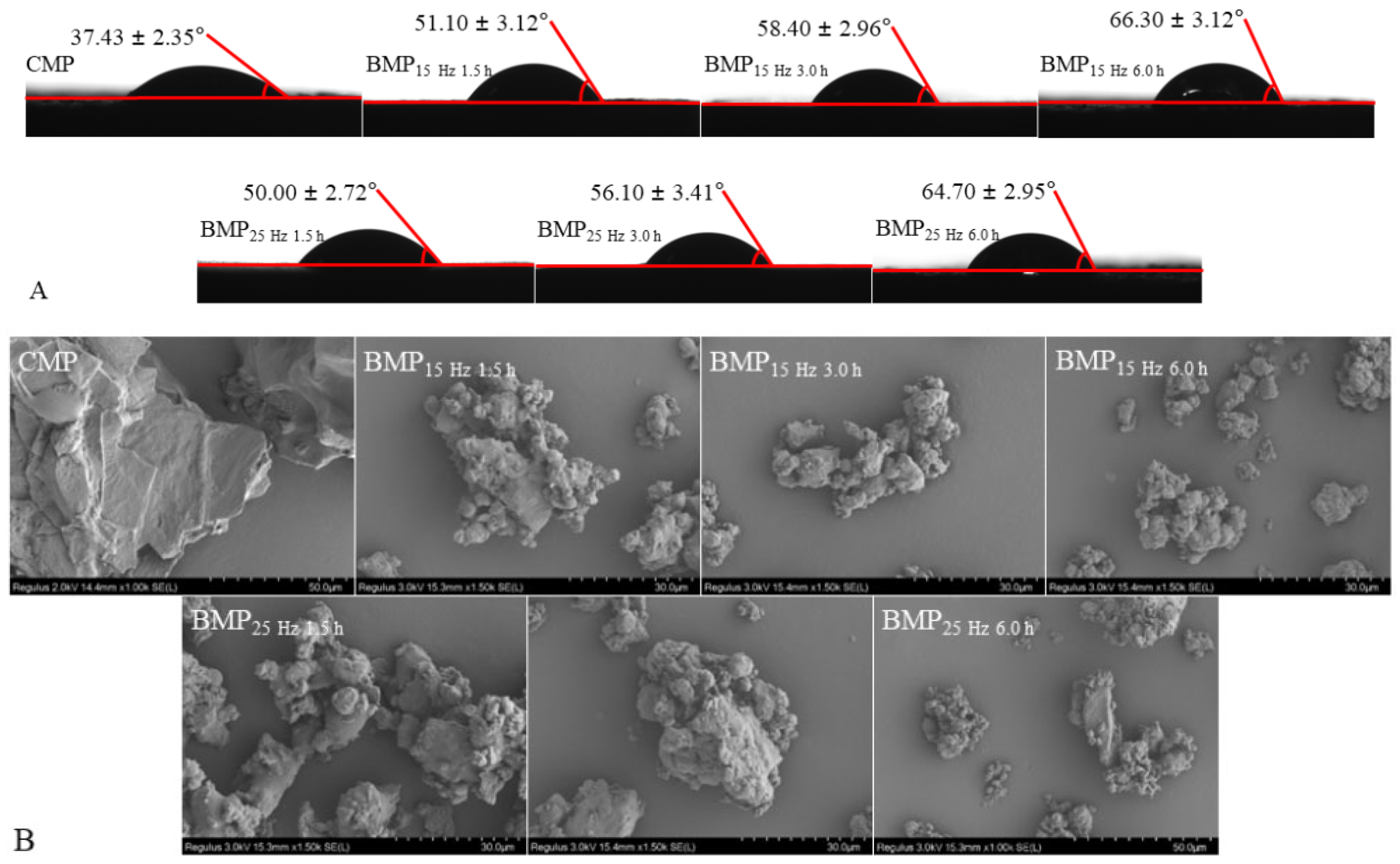
Figure 2.
Rheological properties of ice cream mixes with different levels of BMP15 Hz 1.5h added.
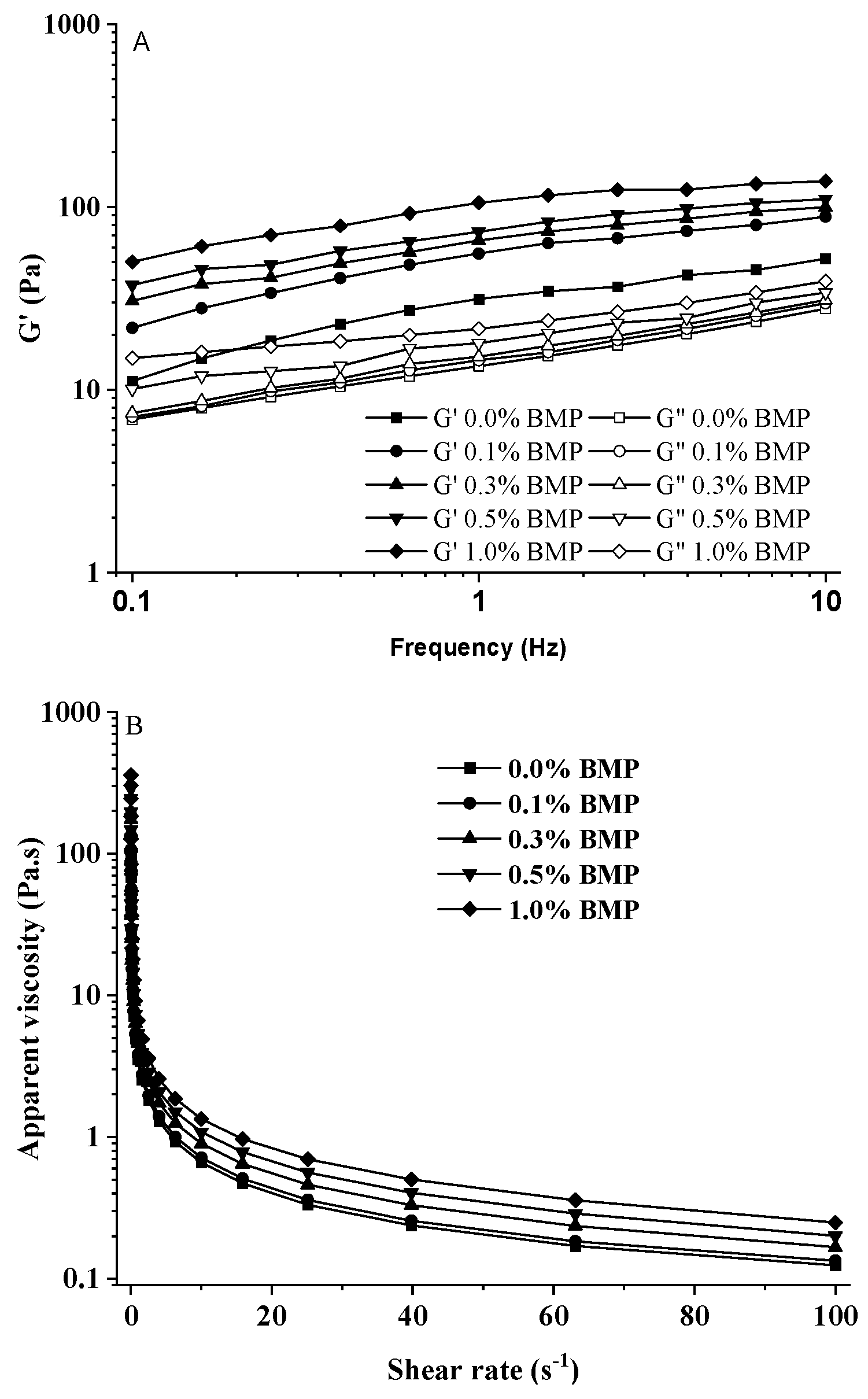
Figure 3.
Antioxidant activities, storage physical stability (B) and sensory scores (C & D) of ice cream prepared with different levels of BMP15 Hz 1.5h.
Figure 3.
Antioxidant activities, storage physical stability (B) and sensory scores (C & D) of ice cream prepared with different levels of BMP15 Hz 1.5h.
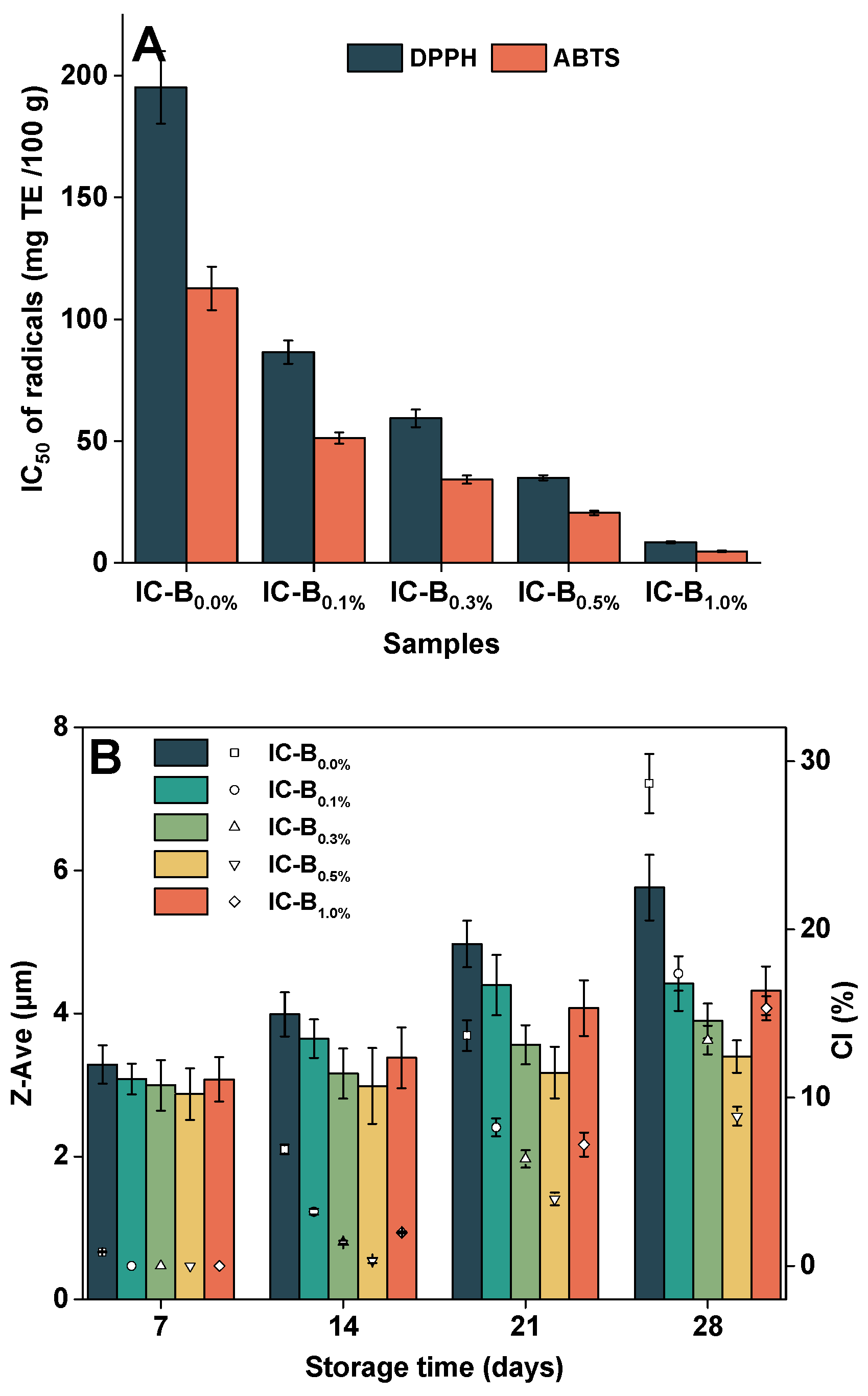
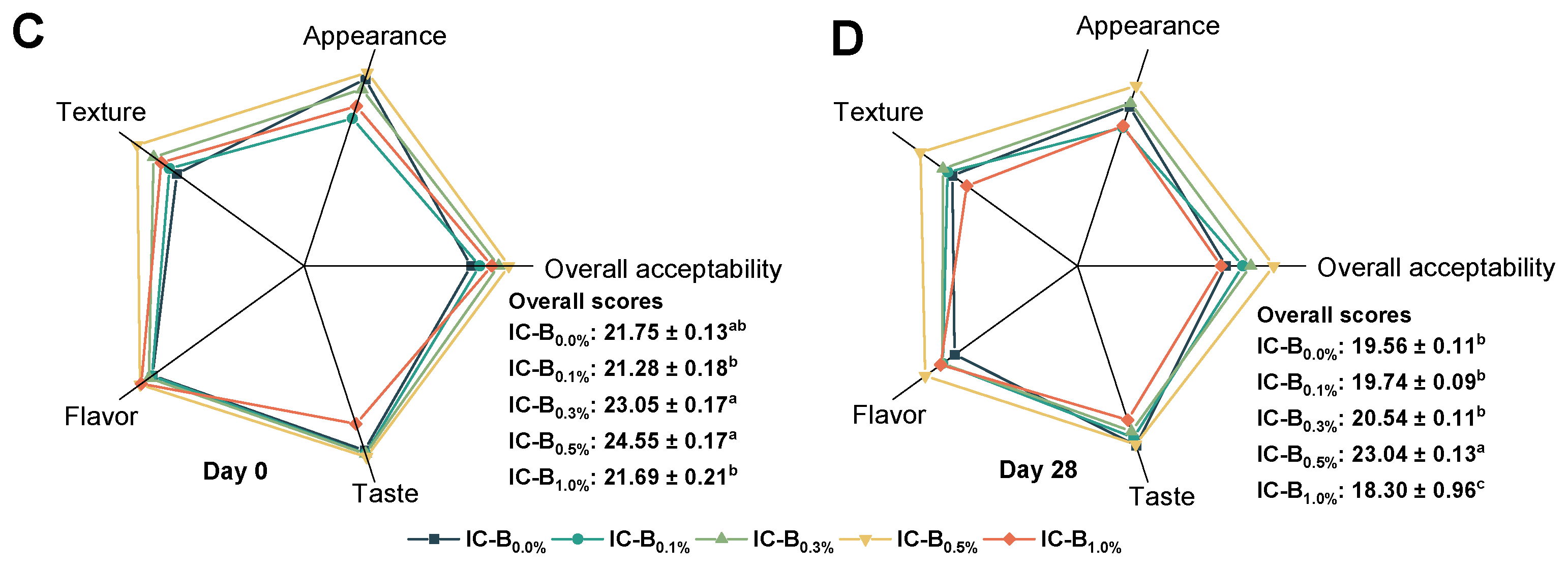
Figure 4.
Visuals (A), optical microscopy images (B) and confocal micrographs (C) of ice cream prepared with different levels of BMP15 Hz 1.5h.
Figure 4.
Visuals (A), optical microscopy images (B) and confocal micrographs (C) of ice cream prepared with different levels of BMP15 Hz 1.5h.
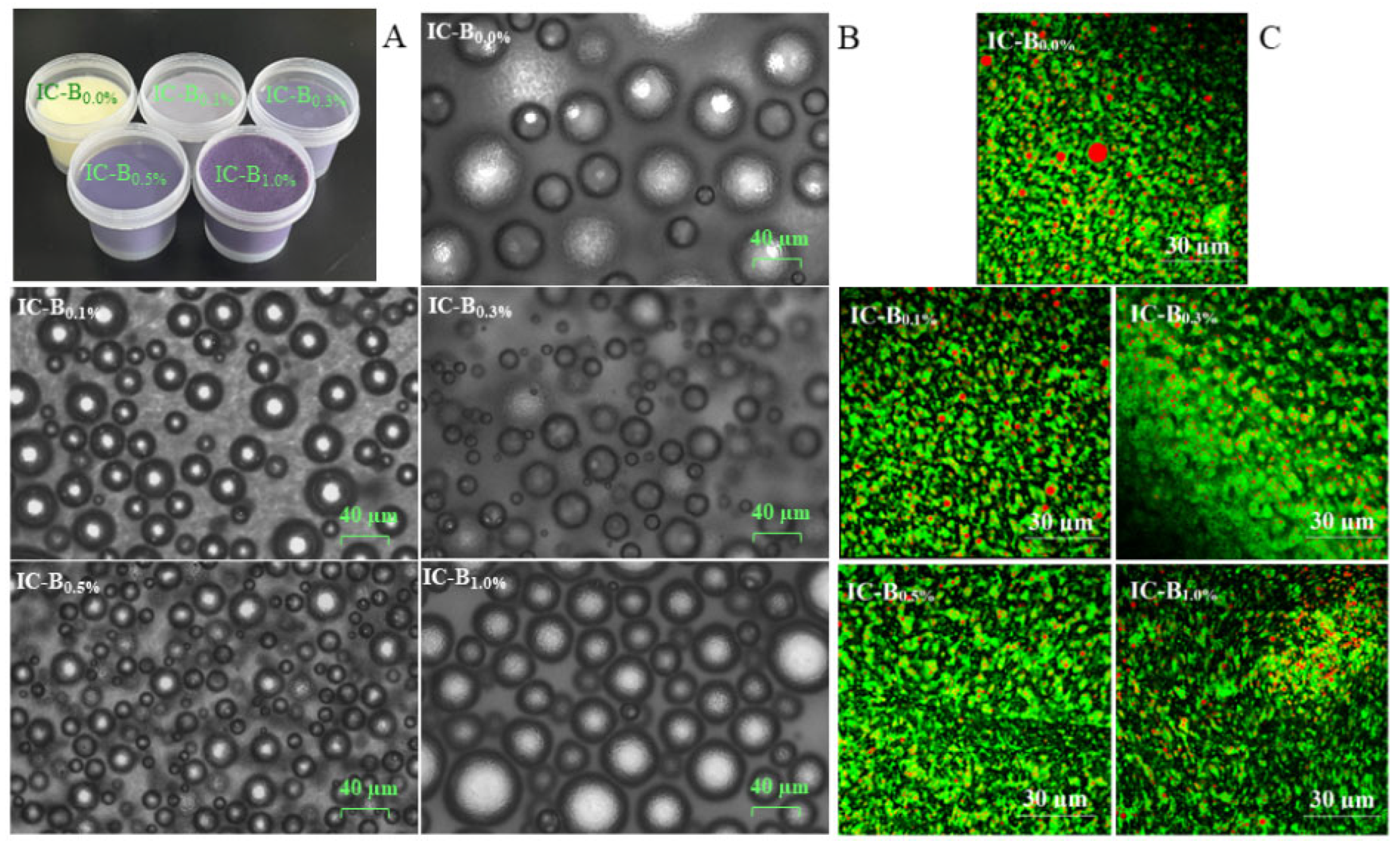

Table 1.
Formulations of ice cream.
| Ingredients (g/100 g) | IC-B0.0% | IC-B0.1% | IC-B0.3% | IC-B0.5% | IC-B1.0% |
|---|---|---|---|---|---|
| Skim milk | 64.75 | 64.65 | 64.45 | 64.25 | 63.75 |
| Sucrose | 14 | 14 | 14 | 14 | 14 |
| Skimmed milk powder | 11 | 11 | 11 | 11 | 11 |
| Camellia oil | 10 | 10 | 10 | 10 | 10 |
| Xanthan gum | 0.25 | 0.25 | 0.25 | 0.25 | 0.25 |
| BMP15 Hz 1.5h | 0 | 0.1 | 0.3 | 0.5 | 1.0 |
IC-B, the ice cream prepared with different levels of BMP15 Hz 1.5h added, the subscripts behind which expressing the added level of BMP15 Hz 1.5h in the ice cream mix.
Table 2.
Effects of ball-milling frequency and ball-milling time on size properties of blueberry peel particles.
Table 2.
Effects of ball-milling frequency and ball-milling time on size properties of blueberry peel particles.
| Samples | D10 (μm) | D50 (μm) | D90 (μm) | D[4,3] (μm) | D[3,2] (μm) | Span | Φ (%) | SSA (m2/g) |
|---|---|---|---|---|---|---|---|---|
| CMP | 29.83 ± 3.37a | 210.28 ± 2.55a | 547.68 ± 31.34a | 256.90 ± 8.43a | 56.21 ± 0.51a | 2.46 ± 0.02c | 13.60 ± 0.00d | 0.11 ± 0.00e |
| BMP15 Hz 1.5h | 5.43 ± 0.06b | 23.12 ± 0.31b | 60.95 ± 1.44c | 29.25 ± 1.02d | 11.46 ± 0.13b | 3.04 ± 0.01b c | 81.73 ± 0.03c | 0.52 ± 0.01d |
| BMP15 Hz 3.0h | 4.01 ± 0.01c | 17.36 ± 0.05c | 50.95 ± 0.26d | 23.94 ± 0.31e | 8.90 ± 0.00c | 2.70 ± 0.02c | 92.38 ± 0.02ab | 0.67 ± 0.00b |
| BMP15 Hz 6.0h | 2.62 ± 0.16e | 15.00 ± 0.14e | 36.00 ± 0.88f | 12.39 ± 0.13g | 7.91 ± 0.28e | 2.40 ± 0.03 | 100.00 ± 0.01a | 1.01 ± 0.05a |
| BMP25 Hz 1.5h | 3.85 ± 0.25c | 17.64 ± 3.44c | 75.36 ± 6.12b | 80.60 ± 4.21b | 9.47 ± 0.76c | 4.05 ± 0.01a | 91.88 ± 0.02b | 0.63 ± 0.03bc |
| BMP25 Hz 3.0h | 3.70 ± 0.12cd | 16.18 ± 1.22cd | 48.75 ± 8.31d | 43.69 ± 0.97c | 8.84 ± 0.53cd | 2.78 ± 0.02bc | 94.43 ± 0.01a | 0.68 ± 0.04b |
| BMP25 Hz 6.0h | 3.54 ± 0.01d | 15.12 ± 0.11de | 39.92 ± 0.31e | 18.90 ± 0.38f | 8.49 ± 0.05d | 2.41 ± 0.02c | 96.12 ± 0.01a | 0.71 ± 0.00b |
CMP, commonly-milled particles of blueberry peel; BMP, ball-milled particles of blueberry peel, the subscripts behind which expressing the ball-milling frequency and ball-milling time, respectively; Span = (D90 – D10)/D50; Φ = 1 – (1 – 10/D50), if D50 ≤ 10 μm, then Φ = 1; SSA, specific surface area. D10, D50 and D90, calculated by the software using the Rayleigh theory, represent 10 %, 50 % and 90 % of total volume at particle distribution, supposing a spherical shape. Means in the same column with different superscript letters are significantly different at p < 0.05.
Table 3.
compositions of blueberry peel particles.
| No | Anthocyanins | Retention time (min) | [M-H]-(m/z) | Fragment masses | Percentage (%) | ||
|---|---|---|---|---|---|---|---|
| CMP | BMP15 Hz 1.5h | CMP | BMP15 Hz 1.5h | ||||
| 1 | Cy | 16.83 | 16.84 | 287.05 | 449.11, 287.06 | 0.002b | 0.006a |
| 2 | Cy-3,5-O-dig | 1.99 | 1.99 | 611.16 | 463.12, 625.18, 301.07 | 0.005 | 0.006 |
| 3 | Cy-3-O-gal/glu | 5.57 | 5.61 | 449.11 | 287.06 | 8.101 | 8.102 |
| 4 | Cy-3-O-ara | 6.57 | 6.59 | 419.10 | 287.06 | 2.245 | 2.245 |
| 5 | Cy-3-O-sop | 11.75 | 11.74 | 611.16 | 317.07 | 0.099 | 0.096 |
| 6 | Cy-3-O-rut | 13.05 | 13.07 | 595.17 | 287.06 | 0.015 | 0.014 |
| Total percentage | 10.467 | 10.469 | |||||
| 7 | Dp | 13.22 | 13.22 | 303.05 | 317.07 | 0.752 | 0.764 |
| 8 | Dp-3-O-(6''-p-coumaryl)-glu | 16.42 | 16.42 | 611.14 | 303.05 | 0.070 | 0.065 |
| 9 | Dp-3-O-(6-O-acetyl)-glu | 14.51 | 14.53 | 507.11 | 303.05 | 0.373 | 0.366 |
| 10 | Dp-3-O-ara | 13.22 | 13.21 | 435.09 | 303.05 | 0.397 | 0.396 |
| 11 | Dp-3-O-gal/glu | 12.23 | 12.21 | 465.10 | 303.05 | 1.869 | 1.872 |
| 12 | Dp-3-O-rha | 5.57 | 5.58 | 449.11 | 317.07 | 8.064 | 8.061 |
| 13 | Dp-3-O-rut | 1.99 | 1.99 | 611.16 | 317.07 | 0.005 | 0.005 |
| Total percentage | 11.530 | 11.529 | |||||
| 14 | Mv-3-O-(6''-acetyl)-gal/glu | 10.65 | 9.92 | 535.14 | 331.08, 493.13 | 1.883 | 1.885 |
| 15 | Mv-3-O-(6''-malonyl)-glu | 9.51 | 9.51 | 579.13 | 331.08, 493.13 | 0.138 | 0.135 |
| 16 | Mv-3-O-(6-O-p-coumaryl)-O-glu | 12.37 | 12.38 | 639.17 | 331.08 | 0.094 | 0.092 |
| 17 | Mv-3-O-ara | 8.15 | 8.16 | 463.12 | 331.08 | 15.248 | 15.248 |
| 18 | Mv-3-O-gal/glu | 7.42 | 7.43 | 493.13 | 331.08 | 24.630 | 24.633 |
| 19 | Mv-3,5-O-dig | 13.09 | 13.10 | 655.19 | 287.06 | 0.004 | 0.004 |
| Total percentage | 41.997 | 41.997 | |||||
| 20 | Pg | 9.07 | 9.06 | 271.06 | 301.07 | 0.001b | 0.003a |
| 21 | Pg-3,5-O-dig | 13.05 | 13.05 | 595.17 | 303.05 | 0.015 | 0.013 |
| 22 | Pg-3-O-gal/glu | 7.84 | 7.85 | 433.11 | 493.13, 331.08 | 1.297 | 1.296 |
| Total percentage | 1.313 | 1.312 | |||||
| 23 | Pn | 15.76 | 15.76 | 301.07 | 303.05 | 0.002b | 0.005a |
| 24 | Pn-3-O-(6''-acetyl)-gal/glu | 10.49 | 10.44 | 505.13 | 331.08 | 0.265 | 0.262 |
| 25 | Pn-3-O-ara | 7.84 | 7.85 | 433.11 | 301.07, 463.12 | 1.297 | 1.297 |
| 26 | Pn-3-O-gal/glu | 8.15 | 8.16 | 463.12 | 433.11, 271.06 | 15.248 | 15.249 |
| 27 | Pn-3-O-sop-5-O-glu | 8.89 | 8.88 | 787.23 | 271.06 | 0.002 | 0.001 |
| Total percentage | 16.814 | 16.814 | |||||
| 28 | Pt | 16.84 | 16.85 | 317.06 | 303.05 | 0.018b | 0.025a |
| 29 | Pt-3-O-rut-5-O-glu | 8.89 | 8.88 | 787.23 | 317.07, 479.12, 625.18 | 0.002 | 0.001 |
| 30 | Pt-3-O-(6''-acetyl) gal/glu | 9.26 | 9.27 | 521.13 | 301.07 | 0.887 | 0.883 |
| 31 | Pt-3-O-(6''-malonyl)-glu | 14.86 | 14.88 | 565.12 | 317.07, 479.12 | 0.063 | 0.060 |
| 32 | Pt-3-O-gal/glu | 6.30 | 6.29 | 479.12 | 317.07, 479.12 | 8.581 | 8.585 |
| 33 | Pt-3-O-rut | 13.00 | 12.99 | 625.18 | 317.07, 479.12 | 0.212 | 0.212 |
| 34 | Pt-3-O-p-coumaroyl-O-glu | 16.65 | 16.66 | 625.15 | 317.07, 479.12 | 0.010a | 0.005b |
| 35 | Pt-3-O-ara | 5.57 | 5.59 | 449.11 | 301.07 | 8.101 | 8.101 |
| Total percentage | 17.874 | 17.872 | |||||
m/z, mass-to-charge ratio; Cy, cyanidin; dig, diglucoside; gal, galactoside; glu, glucoside; ara, arabinoside; sop, sophoroside; rut, rutinoside; Pt, petunidin; Dp, delphinidin; rha, rhamnoside; Mv, malvidin; Pn, peonidin; Pg, pelargonidin. For other abbreviations see Table 2. Means in the same line with different superscript are significantly different at p < 0.05.
Table 4.
viscoelasticity of ice cream mixes with different levels of BMP15 Hz 1.5h added.
| Mixes | G′ (Pa s) | G′′ (Pa s) | Tanα | G* (Pa s) | η* (Pa s) |
|---|---|---|---|---|---|
| IC-B0.0% | 31.42 ± 1.77e | 13.47 ± 0.78cd | 0.43 ± 0.02a | 34.19 ± 2.03c | 3.52 ± 0.21d |
| IC-B0.1% | 55.65 ± 3.12d | 14.53 ± 0.85c | 0.26 ± 0.01b | 27.52 ± 1.65c | 3.80 ± 0.23cd |
| IC-B0.3% | 65.79 ± 3.27bc | 15.19 ± 0.85c | 0.23 ± 0.01bc | 67.52 ± 4.13b | 4.59 ± 0.26c |
| IC-B0.5% | 73.33 ± 4.91b | 18.02 ± 1.13b | 0.25 ± 0.02b | 75.51 ± 4.64b | 5.38 ± 0.35b |
| IC-B1.0% | 105.53 ± 6.05a | 21.56 ± 1.26a | 0.20 ± 0.01c | 107.71 ± 6.51a | 6.68 ± 0.37a |
G′, storage modulus; G′′, loss modulus; tanα, loss tangent; G*, complex modulus; η*, complex viscosity. Abbreviations see Table 1. Data are expressed as mean ± SD. Means in the same row with different superscript are significantly different at p < 0.05.
Table 5.
Physical properties of ice cream prepared with different levels of BMP15 Hz 1.5h.
| Samples | Overrun (%) | Firmness (N) | First dripping time (min) | Melting rate (%/min) |
|---|---|---|---|---|
| IC-B0.0% | 32.99 ± 0.85c | 33.15 ± 2.16a | 14.16 ± 0.93c | 3.13 ± 0.82a |
| IC-B0.1% | 36.51 ± 2.01c | 25.97 ± 1.79b | 17.43 ± 0.89b | 2.84 ± 0.03b |
| IC-B0.3% | 38.75 ± 2.34b | 19.31 ± 1.44c | 18.54 ± 1.01a | 2.83 ± 0.08b |
| IC-B0.5% | 45.13 ± 3.06a | 19.03 ± 1.18c | 20.18 ± 1.07a | 2.71 ± 0.02b |
| IC-B1.0% | 38.22 ± 2.92ab | 24.41 ± 1.42b | 18.00 ± 1.10ab | 2.77 ± 0.11ab |
Abbreviations see Table 1. Means in the same row with different superscript are significantly different at p < 0.05.
Disclaimer/Publisher’s Note: The statements, opinions and data contained in all publications are solely those of the individual author(s) and contributor(s) and not of MDPI and/or the editor(s). MDPI and/or the editor(s) disclaim responsibility for any injury to people or property resulting from any ideas, methods, instructions or products referred to in the content. |
© 2024 by the authors. Licensee MDPI, Basel, Switzerland. This article is an open access article distributed under the terms and conditions of the Creative Commons Attribution (CC BY) license (https://creativecommons.org/licenses/by/4.0/).
Copyright: This open access article is published under a Creative Commons CC BY 4.0 license, which permit the free download, distribution, and reuse, provided that the author and preprint are cited in any reuse.


