
Submitted:
15 October 2024
Posted:
16 October 2024
You are already at the latest version
Abstract
A new maritime order is emerging – the blue economy – characterised by a plethora of non-traditional security threats. Using the case of the Western Indian Ocean I demonstrate how the creation of spaces of risk in response to traditional security threats by world powers has led to a new, regionally-led governance regime in response to the new maritime order. International efforts to protect shipping lanes from the threat of piracy off the coast of Somalia have evolved into wider environmental and human security measures. I analyse these changes through the lens of governmentality and argue that this case represents an example of a global governmentality in which states are responsibilised to act collaboratively by the international community through discourses of risk. Regional States have turned this to their advantage, acting together to construct and secure a new development frontier - a shared blue economy space in an extensive and difficult-to-govern territory.
Keywords:
maritime security
; blue economy
; governmentality
; spaces of risk
; panoptic surveillance
Introduction
In this paper I explore the securitisation1 of the Western Indian Ocean (WIO)2 using Foucault’s concept of ‘governmentality’ to examine the particular knowledges, technologies and practices through which power is exercised as a contribution to the understanding of power relations in the emerging blue economy (BE). Thus, I note how the emergent discourse in response to piracy incidents in the region creates ‘spaces of risk’ i.e. codified zones in which global powers seek to influence the behaviours of actors. I then describe a shift in discourse as a response to a decline in incidents of piracy and the growing awareness of the ocean as a development opportunity for small island and least developed coastal states. This led to coordinated regional action against non-traditional security threats to secure a ‘blue economy space’ for development. I argue that this ‘Blue Economy shift’ represents a new maritime order, effected through particular governmental practices instigated first by the international community and then by regional states.
Insights gained from such analysis are globally relevant, contributing to understandings of how the BE can be implemented effectively to meet economic needs by the creation of a secure ocean space for development. For example, the Caribbean Maritime Security Strategy and Implementation Plan (UN Office on Drugs and Crime, 2023) frames security as an essential enabler of the blue economy. Singh (2019) recounts the changing emphasis of maritime security in India to that of enabling ‘regenerative and restorative’ activities in support of blue economy development. Duarte (2015) links national changes in maritime security policy in Brazil to the development potential of offshore energy and other resources and the role of peace and security in the South Atlantic for their exploitation. Voyer et al (2019) describe the co-evolution and co-dependence of maritime security and blue economy agendas in the wider Indian Ocean Region and elsewhere.
Blue Economy and Maritime Security
The emergence of the blue economy as a development paradigm in the decade since Rio+20 in 2012 has changed the way many states view the oceans. For small island developing states and least developed countries, in particular, the oceans have been reframed through the UN sustainable development goals as a source of future wealth, jobs and economic growth – SDG143 providing a strong stimulus for policy development and action. The Africa Blue Economy Strategy (AU-IBAR, 2019) highlights the continent’s “vast ocean territories” (p iii), and the benefits of blue economy development for food and livelihood security in the context of a continent expecting a doubling of its population by 2050. The need for a safe and secure maritime domain in order to benefit from the BE is recognised in the Africa Integrated Maritime Strategy (‘AIM 2020’. AU, 2012), and the Lomé Charter (AU, 2016) both of which explicitly link Africa’s BE to maritime security. In the WIO region the blue economy is seen as a development paradigm that can deliver sustainable, resilient development and prosperity for the whole region, whose countries „all share one ocean, ……increasingly seen as a new frontier for development as a basis for economic growth and to lift lower-income countries out of poverty,” (Didier Dogley, then Minister of Environment, Energy and Climate Change, Government of Seychelles. In Obura et al., 2017). The WIO therefore represents a valuable case study of the emerging practice of BE development and what governmental tools and technologies are being deployed, particularly in the context of security.
Traditional maritime security encompasses the political imperative to secure empires and spheres of influence, and the economic imperative to safeguard freedom of navigation and so facilitate trade (Otto, 2020). However, in the last decade or so it has become important in relation to BE development, leading to a broader understanding of the concept and greater complexity in its practice.
Maritime security has been defined in a negative sense, by the absence of any of a variety of threats prevalent in the maritime domain, or in a positive sense by the preservation of order at sea (Beuger, 2015). As about 90% of the world’s international trade is transported on the world’s oceans, and since UNCLOS provided for the extension of territorial rights over marine resources through the mechanism of Exclusive Economic Zones (EEZ’s)4, the security of the oceans has become increasingly important politically and economically, calling for an increased and more diverse role for maritime security (Voyer et al 2018b). It is also being recognised as increasingly complex: Bueger and Edmunds (2017, summarised in Otto, 2020) describe four characteristics of the maritime security agenda:
- the interconnected nature of maritime security challenges;
- the liminality of maritime security – that is, that most maritime security problems cannot be understood nor addressed without a consideration of their linkages to challenges on land;
- the transnational nature of maritime security given that the sovereignty of the high seas is shared, with jurisdiction there being international in theory, but also varying depending on the given circumstances pertaining to a threat or incident; and
- that, by extension, the maritime domain is essentially cross-jurisdictional.
Thus, whilst many threats and risks in the maritime domain are known to maritime States, the challenge of developing and implementing effective solutions is considerably greater. That is, “maritime affairs involve cooperation to a degree that does not fit in easily with the staunchly defended concepts of sovereignty and jurisdiction. However, issues of maritime governance transcend national, geographical and political boundaries.” (Wambua, 2009, p45). Sustainable long-term solutions may require pooling of sovereignty, adopting consensus decision-making, and delegating some decision-making power to supranational groups (Walker, 2020).
In recent years the understanding of maritime security has developed beyond traditional issues of peace and security to encompass a range of ‘non-traditional’ security threats. Caballero-Anthony (2016) highlights the more significant consequences of this shift:
- While not rejecting the state as a security referent, it argues for the inclusion of other referents, most notably, individuals and communities.
- It recognizes that threats such as climate change, pandemics and financial crises are transnational in nature and require non-military responses.
- Given that threats have transborder implications, international multilateral cooperation is critical.
- Non-state actors and international institutions are seen as having important roles in the global governance of emerging threats.
As a pertinent example, the AIM 2020 Strategy (AU, 2012) takes a broad approach to defining maritime security threats. Not only does it include more conventional security threats such as transnational organised crime, illegal unreported and unregulated (IUU) fishing and environmental crimes but also natural disasters, cyber-security, poor navigational aids and safety information, and vulnerable legal frameworks. Few non-traditional security threats are existential to the State itself. Rather they are of concern to the general health and wellbeing of their populations and the economy upon which that depends. Thus, threats to livelihoods and jobs, through IUU fishing for example, or marine pollution, become important security concerns. This perspective is apparent in the Africa Blue Economy Strategy (AU, 2019), in which livelihood and food security feature prominently alongside sustainable natural resource management. By contrast, human insecurity becomes a driving factor in the emergence of criminal activities such as piracy or trafficking illegal goods (drugs, timber, arms etc) (Beuger, 2015).
These differing conceptions of security are evident in the case of Somalia, which is fundamental to this paper, in which the collapse of the Somali State in 1991 led to a complex array of security issues and responses linked to both human insecurity and global security concerns. For coastal communities, widespread poverty, lack of employment and loss of resources through illegal fishing (Glaser et al, 2019) and dumping of toxic wastes stimulated local responses that quickly evolved into the capture of vessels for ransom (Kellerman, 2011). This piracy proved very profitable and the practice expanded, supported by criminal and terrorist organisations, becoming a major component of local economies. For western nations on the other hand, Somalia was seen as a potential centre for the proliferation of terrorist activities (Elliot and Holzer, 2009) and so attracted attention in the ‘war on terror’ declared by the US and allies in the aftermath of the 9/11 terrorist attacks. This in turn led to the establishment of a western naval presence in the Gulf of Aden, the US-led Combined Maritime Forces, which later provided capacity to address the problem of piracy as it became a global security concern.
The historian Michel Foucault took considerable interest in security in his analyses of the evolution of government in Western Europe. His insights have been drawn upon to reveal knowledge and power dynamics across many aspects of governance, including security. I draw upon Foucault’s ouvre in this study and so introduce his work in the next section.
Governmentality, ‘the International’, and Risk
In this section I set out the foundations for my argument drawing upon existing scholarship. I reference the concept of governmentality and the role of tactics in deploying power to govern populations. I introduce more recent thinking on the operation of governance at the international level and how it can be seen to operate on and through States and so ‘guide’ their conduct towards international norms. I recount how the discourse of risk has been used to obligate subjects, including States, to act in certain ways, in particular to foster the health, wealth and wellbeing of their own populations as a mechanism to mitigate risks to human security. I demonstrate how management of risk is connected with territorial and human security and outline the role of surveillance. Thus, I set the stage for my main argument.
I open this account with an introduction to the thinking of Michel Foucault, a C20th historian and philosopher whose body of work has been used extensively to support analysis and explanation of forms of governance in western capitalist society.
‘‘In contrast to sovereignty, government has as its purpose not the act of government itself, but the welfare of the population, the improvement of its conditions, the increase of its wealth, longevity, health etc.’’Foucault ([1978] 1991:100)
In this way Foucault captures the essence of his genealogy of government in which he traces, from the middle ages to the present in Europe, the evolution of ways in which power is exerted in order to control populations (see Hindess, 2005; Lemke, 2019). He identifies three stages in this journey, which he terms sovereignty, discipline, and advanced liberal government (the latter encompassing neo-liberal government, prominent since the 1980s, as a particular variety). Foucault recognised that at various stages on this journey differing rationalities of thought were applied to the problem of government which were related to how power was deployed. In sovereign government, sovereignty and law were inseparable, power was effected through the rule of law. The object of government was territory. As populations in Europe grew and the State became more concerned with their wellbeing through the maintenance of order, such as controlling outbreaks of infectious disease for example, then the State developed ways to govern at a distance. That is, to shape and guide the conduct of individuals to conform to the priorities of the State through the deployment of tactics, techniques, laws and so on. Thus, populations became the object of governance and the practice of government became the ‘conduct of conduct’. In the C19th and C20th the emergence of ‘advanced liberal government’ became concerned with the role of the State itself as an institution of government, and to counter concerns that the State was governing too much a move developed to transfer [some of] the practice of government to other institutions - to non-state agencies, to individuals and to markets. Liberalism as freedom came to be seen as a tactic of government, in which individuals and other non-state entities are enabled to exert a freedom of choice, but a freedom with a responsibility to choose wisely. Thus, government is promulgated through the cultivation of responsible self-regulatory behaviours amongst subjects.
Foucault’s great insight from this genealogy was to recognise that power operated not through institutions per see but through the tactics deployed to control populations:
“ ‘Discipline’ may be identified neither with an institution nor with an apparatus; it is a type of power, a modality for its exercise, comprising a whole set of instruments, techniques, procedures, levels of application, targets, it is a ‘physics’ or an ‘anatomy’ of power, a technology.” .Foucault 1977: p215
Foucault coins the term ‘governmentality’ to refer to these different rationalities of government and the ‘anatomies of power’ to which they give rise. Subsequent scholars have applied the concept of governmentality in many contexts, beyond that of Foucault’s genealogy, and developed various analytics of government on the basis of Foucault’s lectures, interviews and writings.
Of particular interest to this paper are the analyses of ‘the international’ as a site of government. Neumann and Sending (2007), rather than focus on the international order as a point of analysis, consider the rationality by which power is applied through specific forms of governmental practices. Thus, they conceptualise the international as ‘a socially embedded realm’ – a structure defined by relations of power - generating different and changing practices of political rule through its governmental rationality as it changes through time. A key question in relation to governmentality as an analytical tool of the international is the question of at what or whom is power directed? In considering the question of how States can be the subject of governmentality, Joseph (2009) contends that we should consider governmentality as working through States on populations, rather than States themselves being the subject of a governmentality (as governmentality is only concerned with the governance of populations). Nevertheless, this rationality can be used to regulate States. Löwenheim (2008), for example, demonstrates the power of statistical metrics, benchmarks, indicators, indexes and so on to regulate States. These techniques are increasingly used to rank States by transparency and quality of governance, by economic performance, by human rights and many more, and are used, for example, to make decisions regarding development aid, development finance loans etc. Through such rankings States become the object of a power which tends to normalise the dominant international regimes of governance, which follow the form of an advanced liberal character. Forms of international governance of this nature have been termed examples of ‘global governmentality’ (Larner and Walters, 2004; Methmann, 2013).
The role of risk is an interesting element in this evolution of international governmentality. Jaeger (2010: 65) draws attention to the debates and reforms within the UN system concerning human security and collective security, and the calculation of risk:
“By objectifying interdependent threats as risks, collective security can operate as an insurance regime; it can invert the meaning of threats, transforming them from obstacles into opportunities for regulation. Conceptualizing threats as risks means that threats no longer constitute discrete, absolute, and existential dangers emanating from an external enemy; rather, they represent serial, graduated, and calculated hazards stemming from the interconnected collective security ‘system’ itself.”
This perspective of risk as calculated hazard renders otherwise existential threats governable by regulation and individual self-restraint. This in turn places responsibility on States to foster the health, wealth and wellbeing of their own populations as a mechanism to mitigate risk (of famine, crime, terrorism etc), and to engage in the international system to contribute to a global collective security. For least developed States this implies a responsibility to not only take action to mitigate risks and so protect their ‘vulnerable‘ populations, but also to engage with the international community in doing so (for example to be willing receivers of international support and assistance) (see Jaeger, 2010). In relation to governmentality, a central question is what knowledges (e.g. facts, discourses, perspectives) are used to classify and to calculate risks, who produced those knowledges, and who sets the benchmarks or targets by which risk mitigation is measured? We see here a globalisation of security, expressed as human security comprising a collection of fundamental rights of populations and individuals, and as a collective security as a ‘responsibility to protect’ which legitimises States collective intervention (Caballero-Anthony, 2016) in regional conflict, in the suppression of terrorism and transnational crime, or in response to natural or human disasters. ‘Good’ and ‘bad’ security as framed by the international community is normalised in the form of specific goals and targets, such as the Sustainable Development Goals.
Regimes based on the calculation and mitigation of risk can be understood as a “set of technologies, rationalities and subjectifications, or, in other words, as apparatuses of security” (Bohle, 2018, p131). As a set of knowledge-power structures, they influence which risk perceptions are enabled and which are restricted and so alter the nature of behaviours and practices. Risk, therefore, becomes a technique for controlling conduct through self-governance, based on a ‘calculative rationality’ (Castel 1991; Mythen and Walklate, 2006), and which is encouraged through tactics that shift responsibility for behaviour to the subject. In rewarding certain types of behaviour over others, these tactics incentivise individuals, States, or other agents to assume responsibility for their own compliance (i.e. they are ‘responsibilised’) with behavioural norms that are informed by a liberal rationality of governance (Neumann and Sending, 2010; Innes and Steele, 2012). The emergence of statistical descriptors of populations plays a significant role in Foucault’s genealogy of government, as techniques with which to make populations and their various characteristics visible and therefore governable.
Mapping, classification, and zoning play a similar role, creating what I collectively term ‘spaces of risk’. Salter (2008 – cited in Innes and Steele, 2012) identifies aviation as an ‘imagined space of risk’ for air travellers, made real by statistics on safety and security. Air travellers are responsibilised by means of these statistical techniques to comply, through self-governance, with security measures. Spatial dimensions of risk can be represented as cartographic maps, such as coastal hazard risk maps for example which represent complex calculations pertaining to topography, predicted sea level rise and degrees of storminess etc. Müller-mahn and Everts (2012) introduce the concept of ‘risk-scapes’ bringing together relational and cartographic ‘mapping’ of risk, including perceptual and institutional elements, with a land or sea scape of natural factors and their spatial location. I further develop this concept of spaces of risk in later sections in the context of maritime security.
Foucault considered that the essential challenge of security was that of managing circulation (of people, of goods, etc), security being effected through biopolitical practices of “organising circulation, eliminating its dangers, making a division between good and bad circulation, and maximizing the good circulation by eliminating the bad” (Foucault 2007: 18). In this vein, Glück (2015) views maritime security from a Marxist perspective and sees the production of ‘security space’ as a capitalist project to ensure the efficient circulation of goods, piracy being a constraining factor which must be controlled. The management of circulation requires surveillance – the ability to make circulation visible and observe its patterns. Inspired by social reformer Jeremy Bentham’s design for an ideal prison, which was designed to allow constant, covert observation of prisoners, Foucault developed particular insights regarding surveillance that provide a valuable analytic lens for studies of governance and security. The Panopticon was not a design for an ideal prison in Foucault’s eyes but a system of surveillance in which subjects are conditioned into good behaviour, being constantly under observation. Foucault’s ‘inverted panopticon’ (Bentham: watching; Foucault: being watched) represents “a landscape that could at any time impart in an individual a likelihood of surveillance” (Elmer, 2012, p24). Panoptic surveillance then, is an important component of governmentality – the constant likelihood of surveillance acting on subjects to condition their behaviours to adhere to prevailing societal norms.
These concepts of governmental tactics, responsibilisation through discourses of risk, and surveillance practices form the pillars of my argument regarding the securitisation of the blue economy in the WIO region, and I will return to them after the next section in which I outline my methodology.
Method
Foucault considered discourse to be a technology of power and knowledge (Foucault, 1998). He argued that discourse shapes or produces reality by framing problems of government and by favouring certain solutions over others. Those solutions give rise to practices and knowledges that themselves exert power over subjects. Discourse analysis has particular strengths for environmental policy analysis, including an awareness of the role of language and knowledge in constituting policies, polities and politics and as exerting power effects, and how practices of government are constitutive of power relations and knowledge systems (Feindt & Oels, 2005).
Dean (1999) applied Foucault’s thinking to develop an analytics of government, proposing (in its simplest form) a three point framework. That is, to understand how the need for government is problematised (or framed), what utopias or visions are consequently used to garner support from the population, and what regimes of practices (that is, assemblages of laws, policies, procedures etc) are deployed to operationalise government (Russell and Frame, 2013). This analytical framework was combined in this study with a spatial framework based on Malpas (2012) to provide a spatially sensitive analysis of the WIO blue economy discourse and practice (see Midlen, 2021 for details).
In a practical sense, discourse analysis involves the categorisation of texts, by coding, to identify common themes, issues, contradictions, etc. from which insights may be gained and conclusions drawn. ‘Texts’ can include documents, speech, video, photographs, art, actions etc. Relevant policy documents, reports and web-based resources were identified amongst the regional States, international and intergovernmental organisations, and NGOs active in the WIO, analysed, and key informants (mostly connected to the policy documents, either as an author or an organisational representative) interviewed (semi-structured interviews, online) between April and June 2021.
These texts were coded in NVivo 12, using the spatial / governmentality framework to cluster segments of text into related themes. This enabled the identification of human, environmental, economic, and traditional security concerns across a range of organisations and sectors. The value of the framework was in the focus it enabled on spatiality and governance within the texts.
Having identified security as a prominent component of the BE discourse in the WIO Region, further research and analysis was undertaken to gain a greater depth of understanding of the issue, including the identification of additional key informants for interview (Table 3) and policy instruments for analysis (referenced in the text).

Table 1.
Documents subject to discourse analysis.
| Title | Spatial remit | Focus | Publisher/date |
|---|---|---|---|
| Blue economy flagship. A briefing note for partnership. | African Continent | Prepared for Blue Economy Conference in Nairobi, Kenya, 26-28 November 2018. | African Development Bank Group, 2018 |
| 2050 Africa’s Integrated Maritime strategy (2050 aim strategy). | African Continent | Maritime strategy | African Union (2012) |
| Conference Report. African Ministerial Conference on the Environment. Seventeenth session | African Continent | Marine environment | AMCEN (2019). |
| Africa Blue Economy Strategy. Nairobi, Kenya. Strategy report and Annex’s 1-5 | African Continent | Blue Economy development | AU-IBAR, 2019. |
| Development of the AUDA-NEPAD Blue Economy Programme. Messages from Stakeholders | African Continent | Blue Economy development | AUDA-NEPAD 2019. |
| Introducing the sustainable blue economy finance principles | Global | Blue Economy finance | European Commission (2017). |
| Declaration of the sustainable blue economy finance principles. | Global | Blue Economy finance | European Commission (2018) |
| Sector plan for blue economy. State Department for Fisheries, Aquaculture and the Blue Economy, Ministry of Agriculture, Livestock, Fisheries and Irrigation. | Kenya | Blue Economy development | Government of Kenya (2018). |
| High Level Panel For A Sustainable Ocean Economy, Western Indian Ocean (WIO) Regional Meeting. 2 – 3 December 2019, Mombasa, Kenya. Meeting Report | WIO Region | Blue Economy development | HLP, 2019. |
| A regional strategy for conserving marine ecosystems and fisheries of the Western Indian Ocean Islands Marine Ecoregion (WIOMER). | WIO Region | Marine environment | Indian Ocean Commission (IOC). 2010. |
| Building the Blue Economy in the Western Indian Ocean. 8th Conference of Parties Meeting for the Nairobi Convention, 22-24 June 2015 Mahé, Seychelles. Blue Economy and Oceans Governance Workshop | WIO Region | Blue Economy development | Kelleher, K. (2015). |
| Ministerial segment, Durban, South Africa, 14 and 15 November 2019. Advancing the blue/ocean economy in Africa | African Continent | Blue Economy development | AMCEN (2019) |
| Seychelles Blue Economy: Strategic Policy Framework and Roadmap. Charting the future (2018–2030). | Seychelles EEZ | Blue Economy development | Republic of Seychelles (2019). |
| Report On The Global Sustainable Blue Economy Conference. 26th – 28th November 2018, Nairobi, Kenya | Global / Africa | Blue Economy development | SBEC (2018) |
| The Nairobi Statement of Intent on Advancing the Global Sustainable Blue Economy. Sustainable Blue Economy Conference, Nairobi, Kenya | Global / Africa | Blue Economy development | SBEC (2018). |
| Unlocking the full potential of the blue economy: Are African Small Island Developing States ready to embrace the opportunities? Addis Ababa, Ethiopia | African continental islands | Blue Economy development | UNECA (2014) |
| Africa’s Blue Economy: A policy handbook. Addis Ababa, Ethiopia | African Continent | Blue Economy development | UNECA (2016a) |
| The Blue Economy. Report. Addis Ababa, Ethiopia | African Continent | Blue Economy development | UNECA (2016b) |
| Blue Economy, Inclusive Industrialization and Economic Development in Southern Africa. The 24th Session of the Inter-Governmental Committee of Experts (ICE) (Senior Government Officials) of Southern Africa. 18 – 21 September 2018, Balaclava, Mauritius. United Nations Economic Commission for Africa Addis Ababa, Ethiopia | Southern Africa | Blue Economy development | UNECA (2020) |
| AFRICA’S BLUE ECONOMY: Opportunities and challenges to bolster sustainable development and socioeconomic transformation. Issue Paper produced for the Sustainable Blue Economy Conference. 26th – 28th November 2018, Nairobi, Kenya | African Continent | Blue Economy development | UNECA (2018) |
| Transformative Growth in Eastern Africa: Catalysts and Constraints. ECA-EA/ICE/21 | Eastern Africa | Regional Economic Development | UNECA (2017) |
| Green Economy in a blue world. Nairobi, Kenya | Global | Sustainable ocean development | UNEP (2012) |
| Report of the eighth conference of parties to the convention for the protection, management and development of the marine and coastal environment of the Western Indian Ocean (Nairobi Convention). Mahé, Seychelles. 22-24 June, 2015. | WIO Region | Marine environment | UNEP (2015) |
| Marine Spatial Planning of the Western Indian Ocean Blue Economy. UNEP/NC/FP/2017/4/Doc/13 | WIO Region | Spatial planning | UNEP (2017) |
| The Potential of the Blue Economy: Increasing Long-term Benefits of the Sustainable Use of Marine Resources for Small Island Developing States and Coastal Least Developed Countries. World Bank, Washington DC. | Global | Blue Economy development | World Bank (2017a) |
| The Ocean Economy in Mauritius: Making it happen, making it last. Washington DC, USA | Mauritius | Blue Economy development | World Bank Group (2017b) |
| Principles For a Sustainable Blue Economy. | Global | Blue Economy development | WWF (2017a) |
| Reviving The Western Indian Ocean Economy. Gland, Switzerland | WIO Region | Blue Economy development | WWF (2017) |
Table 2.
Key informants interviewed for initial discourse analysis.
| Organisation | Expertise | Date of interview |
|---|---|---|
| International BE informants | ||
| 1. Association for Coastal Ecosystem Services (ACES) | Administering community accreditation and carbon credit sales | 05.11.2021 |
| 2. AU-IBAR* | Intergovernmental Agency | 03.05.21 Online |
| 3. AUDA-NEPAD | Blue Economy policy | 12.04.2021 Online |
| 4. Contact Group**** | Maritime security | 22.04.21 Online |
| 5. CORDIO East Africa | International ocean governance | 20.04.21 Online |
| 6. IGAD** | Regional Economic Community | 27.04.21 Online |
| 7. Independent Expert | International ocean governance | 08.04.21 Online |
| 8. Independent Expert | International ocean governance | 18.05.21 Online |
| 9. Indian Ocean Commission | Regional collaboration for ocean governance | 15.05.2021 Online |
| 10. Indian Ocean Commission (IOC) | International environmental policy coordination | 15.05.21 Online |
| 11. IOTC (Indian Ocean Tuna Commission) | International Fisheries Policy Coordination | 17.05.21 Online01.03.22 In person |
| 12. Nairobi Convention | International environmental policy coordination | 22.06.21 Online |
| 13. Plan Vivo | Accreditation body for carbon credits | 01.12.2021 |
| 14. RMIFC | Maritime crime and surveillance coordination | 27.05.2021 Online |
| 15. UNEPFI Sustainable Blue Economy Finance Initiative | Sustainable finance | 04.05.2021 Online |
| 16. WIOMSA (Western Indian Ocean Marine Science Association) | Marine science and evidence-based policy | 04.05.2021 Online |
| 17. WWF | Sustainable finance | 18.05.2021 Online |
| Kenya cases | ||
| 18. Beach Management Unit | Community based fishery management | 18.12.2021 |
| 19. County Adminstration | Coastal fishery management in Lamu County | 4.11.21 and 20.12.21 |
| 20. Crab Shack | Community-led environmental cons4ervation and eco-tourism | 31.10.21 and 28.01.22 |
| 21. Debaso Creek Conservation Association (Prawn Shack) | Community-led environmental cons4ervation and eco-tourism | 30.10.21 |
| 22. EU Delegation, Kenya | GoBlue project and inter-County cooperation in Kenya | 08.12.21 |
| 23. Gazi Community Forest Association | Community-based resource management | 27.10.21 In person |
| 24. Go Blue project | Coastal blue economy development programme | |
| 25. Government of Kenya | Blue Economy policy | 17.11.21 In person |
| 26. Government of Kenya | Blue Economy policy | 16.03.22 In person |
| 27. Jumuiya ya Kaunti za Pwani | Policy coordination for coastal Counties in Kenya | 03.11.21 and 25.01.21 |
| 28. Kenya Wildlife Service, Watamu Marine National Park and Reserve | Wildlife governance and community engagement | 29.01.22 |
| 29. Kibuyuni Seaweed Cooperative | Seaweed farmers | 05.12.21 |
| 30. Kumbatia Seafood | Fish marketing start-up | 08.12.21 (in person), 16.12.21 (online), 27.01.22 |
| 31. Lamu County Government | Spatial Planning | 03.12.21 |
| 32. Lamu Environment Foundation | Community environmental conservation | 23.11.21 |
| 33. Lamu Marine Conservation Trust | Local marine conservation, eco-tourism and plastic waste management | 03.12.21 |
| 34. LAPSSET CDA | Port Development -spatial planning | 19.10.21 In person |
| 35. LAPSSET CDA | Port Development - community liaison | 16.03.22 In person |
| 36. LAPSSET CDA | Port Development – construction management | 02.12.21 In person |
| 37. Lobster fishers, Lamu | Artisanal fishing | Various, Oct/Nov 2021 |
| 38. Paté Marine Community Conservancy | Octopus fishers, Paté Island | 22.12.21 |
| 39. Paté Marine Community Conservancy | Community Conservancy leaders, Paté Island | 22.12.21 |
| 40. Paté Marine Community Conservancy | Marine Conservancy security staff, Paté Island | 22.12.21 |
| 41. Save Lamu | Community Action Group | 15.11.21, 25.11.21, and 24.12.21 |
| 42. Taka Taka Heroes | Community plastic waste collection and recycling | 23.12.21 |
| 43. Technical University of Mombasa | Blue economy innovation | 09.03.21 |
| 44. TNC (The Nature Conservancy), Kenya | Coastal resource conservation | 10.11.21 and 5.1.22online |
| 45. UNEP, Kenya programmes | Lamu port development | 21.10.21 |
| 46. WWF Kenya | Conservation management in Lamu County, Kenya | 29.10.21 |
| Seychelles cases | ||
| 47. Development Bank of Seychelles | Administration of Blue Bond finance | 21.02.22 |
| 48. Enterprise Seychelles Agency | Entrepreneurship and innovation ecosystem | 01.03.22 |
| 49. Entrepreneur | Fishing post-harvest sector | 22.02.22 |
| 50. Fishing Boat Owners Association | Fishing sector | 24.2.22 In person |
| 51. Government of Seychelles | National fishery policy (SWIOFISH programme) | 17.02.22 Online |
| 52. Government of Seychelles | National fisheries operational administration | 24.02.22 |
| 53. Government of Seychelles | National BE Policy (group interview) | 14.04.21 Online23.02.22 In person |
| 54. Government of Seychelles | National policy development | 25.02.22 |
| 55. Government of Seychelles | Blue Economy Policy | 03.03.22 In person |
| 56. Government of Seychelles | Mascarene Joint Management Area coordination | 16.04.21 |
| 57. Government of Seychelles | Fisheries policy | 01.03.22 |
| 58. Government of Seychelles (NC representation) | International environmental policy coordination | 28.04.21 Online |
| 59. Government of Seychelles JMA*** | International environmental policy coordination | 16.04.21 Online |
| 60. Government of Seychelles, Department of Environment | Marine spatial planning and its implementation framework | 03.03.22 |
| 61. Government of Seychelles, Ministry of Internal Affairs | Maritime transnational organised crime | 29.04.2021 Online |
| 62. Independent Expert | Carbon accounting | 21.02.22 In person |
| 63. Independent expert | Seychelles fisheries management and aquaculture development | 03.03.22 |
| 64. Petroseychelles | State owned petrochemicals development agency | 25.02.22 |
| 65. SeyCCAT (Seychelles Conservation and Climate Adaptation Trust) | Community-led BE innovation | 16.03.22 |
| 66. SeyCCAT | Seagrass conservation and blue carbon | 17.03.22 |
| 67. SeyCCAT | Multistakeholder workshop regarding seagrass conservation and blue carbon | 23.02.22 |
| 68. Seychelles entrepreneurs | Meetings with BE entrepreneurs funded by SeyCCAT grants programme. | Feb/March 2022 |
| 69. The Guy Morel Institute | Entrepreneurship and innovation ecosystem | 03.03.22 |
| 70. TNC (Seychelles) | Marine spatial planning | 16.03.22 |
| 71. TNC, Seychelles | Coastal resource conservation / Marine Spatial Planning | 16.02.22 In person |
Table 3.
Key informants interviewed regarding maritime security, including coding used to refer to them in the text.
Table 3.
Key informants interviewed regarding maritime security, including coding used to refer to them in the text.
| Organisation | Expertise | Code | Date of interview |
|---|---|---|---|
| Government of Seychelles, Ministry of Internal Affairs | Maritime transnational organised crime | GoS | 29.04.2021 |
| Indian Ocean Commission | Regional collaboration for ocean governance | IOC | 15.05.2021 |
| AUDA-NEPAD | Blue Economy policy | AUDA | 12.04.2021 |
| RMIFC | Maritime crime and surveillance coordination | RMIFC | 27.05.2021 |
Findings
Evolution of Maritime Security in the WIO
The Western Indian Ocean, and more specifically waters off the coast of Somalia, came to international prominence in 2007 after a rapid increase in piracy incidents in which merchant vessels were captured and, along with their crew, held to ransom. These incidents continued to increase in frequency through to 2011, when a peak of 237 incidents was recorded, after which they quite rapidly declined. At times dozens of ships and hundreds of crew were being held by pirates. These events were the result of a complex array of factors: the collapse of the Somali State in 1991, resulting in internal conflict, economic collapse, unemployment and poverty; the illegal fishing over many years by foreign vessels of Somali waters due to the inability of the State to secure the fishing grounds within the EEZ, so depriving Somali fishers of resources and income; the alleged illegal dumping of toxic wastes in Somali waters, again in response to the absence of protection and enforcement capabilities (see: UNEP, 2005; UN & World Bank, 2007; Sorenson, 2008; World Bank, 2013; Glaser et al. 2015; Environmental Justice Atlas, 2021). At the same time, the waters off the horn of Africa had become an object of international concern following the 9/11 terrorist attacks. Subsequent moves by the US and its allies to secure important shipping lanes and to counter the rise of international terrorism led to the establishment in 2002 of a Combined Maritime Force in the region. A UN Security Council Resolution in 2008 triggered a range of responses from the international community which emerged, I contend, in two, overlapping, phases: Phase I ‘Rapid response’; Phase II ‘Long-term response’.
Phase I (see Appendix I) commenced with a Security Council resolution (#1851) in 2008 calling for the establishment of an international cooperation mechanism with regard to anti-piracy measures, including for information on piracy. Further, States were urged to develop avoidance, evasion and defensive best practices for shipping in the region. This triggered a number of voluntary actions in response: the US, EU and UK established Naval task forces; States agreed to cooperation in arrest, seizure and rescue operations and to build capacities (through training etc) through the Djibouti Code of Conduct (DCoC) (2009); an international ‘Contact Group’ was established, involving a wide range of stakeholders, to act as a forum for discussion and alignment of actions and resulting in Transfer Agreements and Best Management Practices to be applied to a delimited High Risk Area. SHADE (Shared Awareness and Deconfliction Mechanism) was established as a wider forum for coordination of anti-piracy action, making use of a common information sharing platform, Mercury, to disseminate incident reports and other data (Beuger, 2017). The Insurance industry established its own risk area, the Listed Area for war risk. The Phase II response (Appendix I) represented a shift from piracy alone to wider security concerns: the Jeddah Amendment to the DCoC redefined security as applying to any ‘illicit maritime activity’; the EU funded the implementation of a Regional Plan of Action which had been first developed in 2010, leading to the establishment of a ‘Maritime Security Architecture’ comprising two centres: a Regional Maritime Information Fusion Centre5 (RMIFC) in Madagascar and a Regional Coordination Operations Centre (RCOC) in Seychelles, staffed by the seven States which are party to the agreement.
Spaces of Risk
In determining how to respond to piracy in the WIO region, in my analysis, the issue has been ‘problematised’ by key actors as the emergence of spaces of risk which need to be securitised so as to maintain order at sea. Thus, practices arising from the risk discourse have conformed to a governmentality effected through spatialised codes designed to enrol independent actors (e.g. vessel operators). Further, the ‘order’ to be maintained has evolved from a traditional maritime order (the ‘International Rules Based Order’ prioritising peace, and security for trade and mariners) to what I term a ‘blue economy order’ in which ocean spaces have been reterritorialized as economic spaces which need to be secured against an array of criminal and environmental threats in order to minimise risks to economic growth.
The initial international response to the threat of piracy marks ‘Phase I’ of the securitisation of the WIO, characterised by the construction of multiple distinct but interconnected spaces of risk (Voluntary Reporting Area, High Risk Area, and Listed Area) amounting to a ‘territorialisation’ of the ocean, which are documented in detail in Table 2. Each space is the product of specific regimes of practices directed at shipping, comprising monitoring, surveillance and classification (reporting, risk assessment, requirements to take measures), and technologies (practice guides, private armed security teams, online platforms, coordination centres) for reporting, sharing information and taking action to manage risk. These spaces of risk transcend sovereign territory (EEZs) and are ‘voluntary’ in nature (i.e. none are effected through any legal agreement). Authorisations (e.g. S/RES/1851) and Agreements (eg Djibouti Code of Conduct) make provision for joint or transnational operations against piracy. The spaces and their relations are inscribed and codified in maritime security charts (eg UKHO Q6099. See Figure 1), an essential navigational tool for shipping which communicate information to merchant and fishing vessels in a familiar form and to which vessel Masters are trained to respond. These charts inscribe the zones, and codify the conducts expected of vessel owners and Masters to register their movements and to report incidents to naval forces. Risks are classified by zone (present/absent), nature of threat (suspicious activity, attack / piracy, terrorism, conflict-related), and by frequency and season (monsoon etc). Risk assessments are made by Maritime Coordination Centre – Horn of Africa (MSCHOA, part of EU NAVFOR) and Combined Maritime Forces (CMF) and released as ‘Industry Releasable Threat Assessments’ (IRTAs), to aid general risk management, and ‘Industry Releasable Threat Bulletins’ (IRTBs), which cover specific events. For example,
“The threat to merchant and large fishing vessels transiting the Red Sea, BAM, GOA and the Western Indian Ocean :
- From piracy is LOW (an attack is unlikely).
- From conflict-related activity is MODERATE for KSA- and SLC-flagged vessels (an attack is possible but unlikely) and LOW for the others. The threat against vessels of any flag operating from or to ports operated by actors in the Yemen Conflict is considered MODERATE.
- From terrorism is LOW (an attack is unlikely)6”
Table 2.
Spaces of risk. Sources: BMP5; IMO7.
Table 2.
Spaces of risk. Sources: BMP5; IMO7.
| Area | Regime/Technlogy | Responsibilities |
| Voluntary Reporting Area (VRA). The VRA represents the beginnings of a shift from Sovereign surveillance - naval powers patrolling the seas (CTF151) - to a system in which subjects (Merchant Vessels) start to discipline their own behaviours, by reporting on their movements, on perceived threats, and undertaking to respond to piracy risk reports and alerts. This space is created by naval powers in response to a widely dispersed threat of piracy, in which the subjects themselves are enrolled to contribute to the regime by gathering and sharing knowledge. | ● UKMTO Reporting regime – daily transit position, incidents and suspicious activity ● MSCHoA Registration scheme (itinerary and vulnerability related information) and issuance of risk assessment reports (combined intelligence from CMF, UKMTO and EU NAVFOR) by means of online platform ● Operationalised Maritime Security Transit Corridor (MSTC) through which vessel movements are coordinated by MSCHoA. Includes the Internationally Recommended Transit Corridor (IRTC) through which group transits and national convoys may be offered ● CMF CTF151 Maritime Security Transit Corridor surveillance and protection ● UKHO Maritime Security Chart Q6099 |
● Combined Maritime Force (CMF) – security operations ● UK Maritime Trade Operations (UKMTO) – vessel monitoring and risk assessment ● Maritime Security Centre Horn of Africa (MSCHoA) – vessel monitoring and risk assessment (part of EU NAVFOR) ● Vessel owners / Masters – applying best management practices including reporting and on-board security measures |
| BMP High Risk Area8. In contrast to the VRA, this is an industry- (i.e. subject-) led initiative (its development led by IMO) with the clear aim to promote self-discipline amongst merchant vessels in such a way as to mitigate risks arising from piracy in line with strategy of Maritime Powers to combat the piracy risk and related threats to the global shipping industry. This space is constructed by the subjects, at the request of maritime powers (through UN Security Council resolution S/RES/1851 and Contact Group on Piracy off the Coast of Somalia, CGPCS). It responds to the specific threats of vessel capture and ransom, to crew safety, and of economic losses incurred in mitigating these risks. | The High Risk Area (HRA) is an industry defined area within the VRA where it is considered that a higher risk of attack exists, and additional security requirements may be necessaryBest Management Practices (to deter Piracy and Enhance Maritime Security in the Red Sea, Gulf of Aden, Indian Ocean and Arabian Sea) should be applied by vessel owners and Masters, including: threat and risk assessment, planning, ship protection measures, reporting.Lists ‘common understandings’ (definitions) for use in reporting attacks and suspicious activity | Vessel owners / Masters – applying best management practices including reporting and on-board security measures |
| Joint War Committee Listed Area. This risk space is created by the insurance industry. It requires merchant vessels to notify insurance underwriters of intent to transit the specified area, which is similar but not exactly congruent with the HRA. The aim is to enable the insurers to mitigate their own underwriting risks in relation to piracy (theft, damage, ransom, harm to passengers and crew, operational losses) by imposing conditions upon the insured subject, either high premiums to reflect higher risk, or the implementation of mitigation measures, or some combination of the two. | The Listed Area is an area of perceived enhanced risk on behalf of insurance underwriters. Ships entering the area are required to notify their insurers. Mitigation measures apply on a case by case basis. | Vessel owners – notification of insurance underwriters and application of required mitigation actions |
The assessment report goes on to reinforce the importance of the regime of practices to which it ascribes success:
“It is assessed that Piracy is currently DETERRED / SUPPRESSED (but not eradicated) due to:
- Widespread implementation of Best Management Practice (BMP).
- The embarkation of PAST [private armed security teams on vessels].
- The continued presence and monitoring of CMF, EU NAVFOR, other warships and maritime patrol aircrafts in the region.
- The prospect of a prison sentence for pirates.
- The adoption by former pirates of lower risk, yet profitable, criminal activities such as smuggling.
- Improvements in the capabilities and competence of Somali maritime security forces, such as the Somaliland Coast Guard.”
Nevertheless, the continued presence of risk is reiterated in the report, reinforcing the need for continued observance of the recommended practices: “the causal factors of piracy still endure in Somalia and include but are not limited to: poverty, unemployment, the lack of effective governance, corruption, conflict, illegal fishing and over-fishing.” Criminal networks still retain the capability to mount attacks, and “it is possible that piracy could re-emerge if some or all the following conditions are met:
- The shipping industry ceases to fully implement BMP or embark PAST following an owner’s vessel risk assessment.
- There is a significant decrease in the presence of warships and local maritime security forces in the area.
- The decline in economic and political situation persists, further exacerbating poverty and instability in Somalia and the wider region due to COVID-19, famine, the ripple effects of flooding and locust infestation.”
Figure 1.
Maritime security chart UKHO Q6099, which inscribes certain practices in relation to the respective areas of risk it defines. (With permission UK Hydrographic Office).
Figure 1.
Maritime security chart UKHO Q6099, which inscribes certain practices in relation to the respective areas of risk it defines. (With permission UK Hydrographic Office).
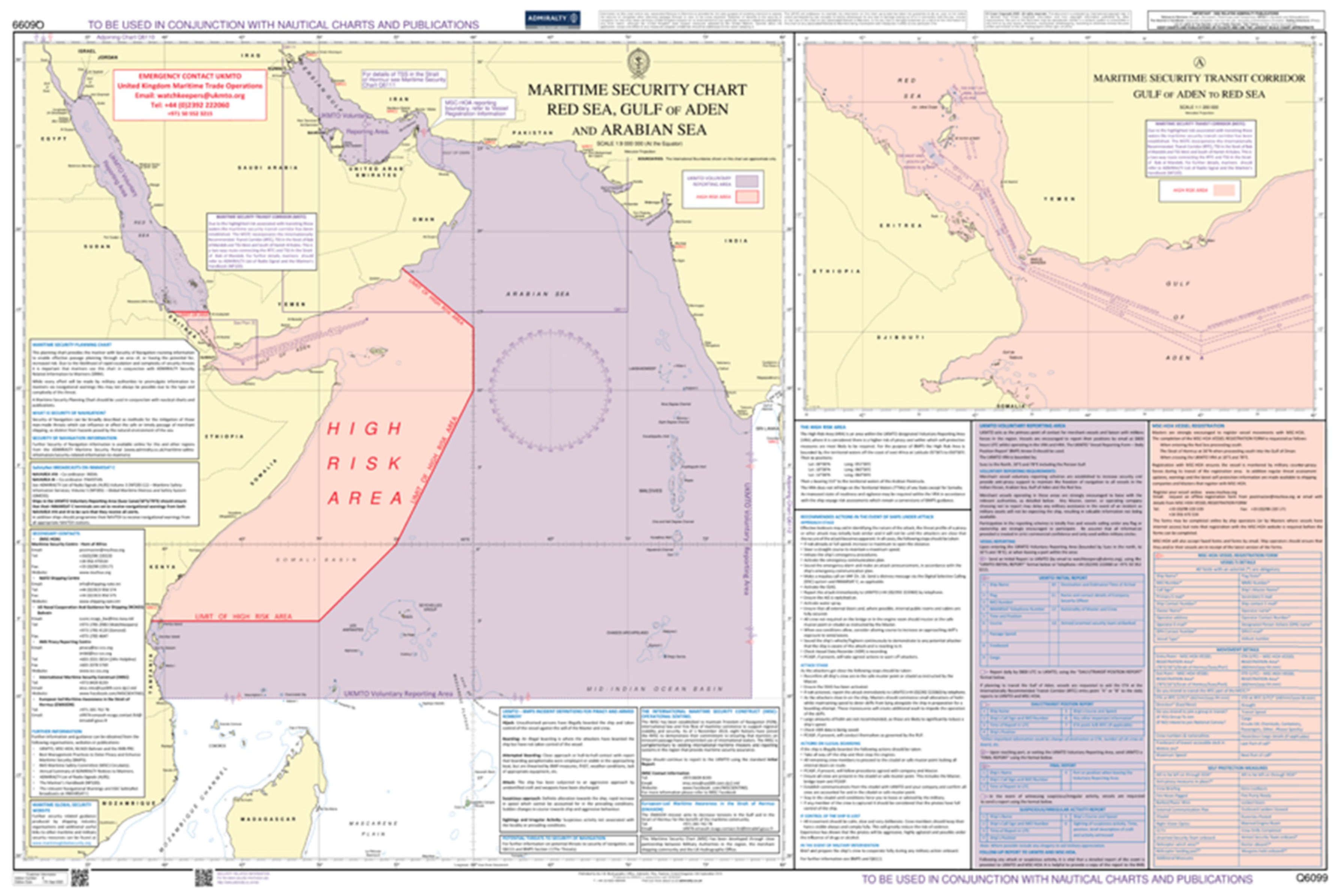
Phase II of the securitisation of the WIO is marked by a more regionally-led response and a broadening of focus to an array of transnational and environmental threats. The reduction of piracy incidents came at the expense of an increase in other forms of criminality, as pirates used their now powerful criminal networks to exploit less risky forms of transnational criminality (trafficking drugs, arms, people. Mohabeer and Sullivan de Estrada 2019; IOC, 2021). This was in response to new factors outside the region, as well as anti-piracy measures. For example, the emergence of Afgan opium trade routes through Pakistan fed an East African coastal trafficking route (GoS, 2021). This had ramifications at the State level: “in 2013 when piracy started declining we invested our efforts in [tackling] other … transnational organised crime, namely drug trafficking, human trafficking, human smuggling, small arms trafficking, and also in the domain over charcoal trafficking between Somalia, Kenya and towards Europe. So we’ve grown our mandate from purely anti-piracy to other transnational organised crime (GoS, 2021).
In the second phase of securitisation, the regional States become the subjects of a security governmentality, being ‘responsibilised’ to take action to secure their territories and the resources within them against a variety of criminal acts and other incidents. A first step in responsibilisation was the agreement by two regional States (Kenya and Seychelles) to receive prisoners from international forces (legitimised through Transfer Agreements) for prosecution, to overcome difficulties that countries from outside the region faced when they apprehended pirates: “the developed countries couldn’t do anything about it [prosecuting pirates] .... even if you take prisoners, they [western States] can’t do anything so they put lots of pressure on the countries in this region to prosecute those Pirates” (IOC, 2021).
A Blue Economy Shift….
A second and much more significant step, I argue, was the negotiation of the EU funded MASE (Maritime Security) programme, in which the object of securitisation was broadened from piracy to a wide range of transnational crime and environmental threats across a more extensive ocean space. The rationale for this strategy was explained as follows: “what other things politically can motivate [States in the region to collaborate on security]? First, ... the blue economy - you have to guarantee maritime security to attract investors” (IOC, 2021). That is, there are important social and economic issues that need attention, such as drug trafficking, risks to tourism and fishing, illegal charcoal trade, terrorism (financed through such activities), etc to enable blue economy development. A programme of measures was developed by regional States, through the IOC, and responsibility for implementation taken by regional organisations (the Regional Economic Communities and IOC) with support from the international community, thus reversing leadership roles from Phase I. The wider perspective on the Continent was changing, “it was an opportune time to drive the momentum towards blue economy..... to link it [safety and security] to development opportunities” (AUDA, 2021), providing impetus to this shift.
Thus, an Eastern and Southern Africa and Indian Ocean (ESA-IO) Ministerial conference in October 20109 marks the start of the second phase of securitisation of the WIO region. A three-point strategy (the Regional Strategy and Regional Plan of Action) was agreed which provided for a regional framework to prevent and combat piracy and promote maritime security (comprising: Somalia Inland Action Plan; prosecution of pirates by regional States; strengthened capacities of regional States to secure their maritime zones). This strategy was to be implemented jointly by the member States in the region and by the Regional Economic Communities (the RECs). Support was requested from international partners, leading to the strategy being translated into a 5-point programme agreed in 2016, which addressed land based factors contributing to transnational crime including poverty and conflict, legal frameworks for prosecution of criminals and their financiers which included harmonisation of laws and efforts to prevent money laundering, and information sharing and coordination of operational activities.
At the same time the new BE concept was focussing attention on economic exploitation of the oceans and the need for a safe and secure environment to do so, being explicitly recognised in the Africa Integrated Maritime Strategy (2050 AIM Strategy) of 2012, the Lomé Charter (2016) and the DCoC Jeddah Amendment. The 2050 AIM Strategy introduces the notion of a combined maritime space, the African Maritime Domain or AMD. The strategy assigns a range of threats to this space (e.g. transnational organised crime; IUU fishing; vulnerable legal framework), and highlights consequent risks, ascribing the potential for : “mass casualties and ... catastrophic economic harm to African States” and asserting that “As the actors threatening Africa’s maritime domain continue to grow in number and capability, there must be a corresponding African endeavour to address these at the national, regional and continental levels” (2050 AIM Strategy, p10-11).
Like the 2050 AIM Strategy, the Lomé Charter and DCoC Jeddah Amendment explicitly link maritime safety and security with blue economy, the latter representing a policy to reduce crime and terrorism through improving livelihoods of coastal communities by protecting marine resources from illegal and over-exploitation, and developing them to create jobs and improve livelihoods.
New Maritime Security Architecture
The new maritime security architecture involved the establishment of two new centres, coordinated by the IOC, to enable collaborative management between States of a new, extended space of risk, the ‘RMIFC General Area of Interest’, extending from the Cape of Good Hope north to the red sea and straits of Hormuz and west to the southern-most tip of India. The Regional Maritime Information Fusion Centre (RMIFC) located in Madagascar, and the Regional Centre for Operations Coordination (RCOC), located in Seychelles, are each backed up by national centres run by the seven regional States currently party to the MASE Regional Agreements. These new centres did not replace existing surveillance infrastructures such as MSCHoA, UKMTO, and the Mercury platform, but provided a mechanism ‘owned’ by regional States, further building their commitments to maritime securitisation. The importance of national capacity building was not overlooked – national capabilities limit the efficacy of the regional institutions so “we are getting the countries to reform the way they are addressing their capacity to manage the oceans in the EEZ” (IOC, 2021).
The two regional centres coordinate surveillance, information collation (or fusion) and analysis, and control and enforcement operations respectively. Each is staffed with International Liaison Officers (ILO’s) from each of the seven signatory States to enable efficient information exchange and validation. Each ILO is connected to their respective national maritime surveillance centre. The RMIFC comprises a ‘watchfloor’ on which ILO’s surveil shipping activity and analyse information, using a suite of digital tools (e.g. web-based maritime coordination and information-sharing tools; AI-powered behaviour-at-sea analysis) with the objective of producing actionable intelligence. Control and enforcement activity reinforces the discourse of universal surveillance amongst subjects. The watchfloor is staffed 24/7 by ILOs tracking vessels from journey start to finish, on a bank of monitors. Any unexpected stoppages, route deviations, or liaisons between vessels are investigated, first attempting to establish contact with the ship, “In case the ship does not answer and now we find another ship coming close to her… it becomes a direct suspect….. something wrong is going on.” The relevant State is informed and requested to take action (RMIFC, 2021). Officers have access to international databases and vessel tracking systems providing a summary of the vessel’s name, Flag state, registration numbers, cargo, ports of origin and destination etc. enabling background checks to be made. If further information is needed the Centre can request real time satellite images, for example. “So in this process we get whatever is required in case we are able to intervene to arrest, bring to port, and make a legal case, and follow up for court procedures” (RMIFC, 2021).
Discussion
I argue that the evolution of maritime securitisation in the WIO through two, overlapping, phases represents a case of global governmentality in which regional States are responsibilised to take action to mitigate security and economic risks. However, I also argue that from the initial securitisation a global ‘blue economy’ governmentality comes into play, in Phase II, as States work together to meet their wider strategic goals through the securitisation of the ocean as a shared economic space in support of a blue economy (see Midlen, 2023). This represents a paradigm shift from peace and security based order to what I term a ‘blue economy order’. The transnational collaboration derived from this global governmentality enables the regional States to overcome capacity constraints and so more effectively create a shared blue economy space and collectively manage risks to its security.
A crucial technology in this shift was the development of a system of panoptic surveillance. Initial, more or less ad hoc, responses to the threat of piracy off the coast of Somalia constructed multiple spaces of risk, each characterised by specific technologies and practices which performed a disciplining function on merchant and fishing vessels operating in the region. In developing a global governmentality of collaboration regional States reterritorialized the WIO through the creation of a regional centre of control (the combined RMIFC and RCOC) encompassing previous spaces of risk within a greatly expanded purview. This panoptic centre is made possible by and relies upon digital technologies of surveillance and communication to overcome the challenges of monitoring and control over a vast and almost empty ocean space but one with complex institutional relations (sovereign territory, free navigation, international maritime powers, transnational organised crime).
Spaces of Risk and Discipline Governmentality
Applying Dean’s (1999) analytical framework, the new maritime security architecture problematises the blue economy as a space of risk as well as of economic opportunity, risks arising from the threats posed by multinational crime, terrorism, IUU fishing, maritime incidents (e.g. oil spill) and extreme natural events. The ‘utopian vision’ for responding to these solutions is a collaborative effort between States to securitise the ocean as an economic space, so enabling development of a blue economy. The new maritime security architecture represents a regime of practices that responds to these threats through a collaborative approach to overcome State’s individual capacity challenges regarding knowledge (intelligence) and enforcement.
New ocean spaces were constructed through a discourse of risk – risk of high and continued insecurity (e.g. UNODC, 2010) due to the complex political factors in Somalia fuelling the rise of piracy. Data on the frequency and location of pirate attacks and reports from naval forces, the insurance industry, and vessel owners describing incidents of boarding, hostage taking, and ransom demands made the threat of piracy visible and the consequent risks calculable. Given economic losses by companies and damage to regional economies, pressure built for action. Reports to and debates at the UN Security Council solidified the risk discourse:
“Continuing to be gravely concerned by the dramatic increase in the incidents of piracy and armed robbery at sea off the coast of Somalia in the last six months, and by the threat that piracy and armed robbery at sea against vessels pose to the prompt, safe and effective delivery of humanitarian aid to Somalia, and noting that pirate attacks off the coast of Somalia have become more sophisticated and daring and have expanded in their geographic scope, notably evidenced by the hijacking of the M/V Sirius Star 500 nautical miles off the coast of Kenya and subsequent unsuccessful attempts well east of Tanzania,”(S/RES/1851, 2008)
Similar discourses were presented by the IMO, for example in November 2007 (Resolution A.1002(25), IMO 2007). Such discourses led directly to the establishment of the many ad hoc (but not uncoordinated) international initiatives in late 2008 and early 2009 which resulted in the creation of specific spaces of risk, the VRA, HRA, and Listed Area and their associated technologies and practices of control.
The practical effect of these regimes was to inculcate a risk-awareness amongst vessel owners and Masters’ leading them to take action to mitigate risk, and so lessen the international impact of piracy on security and trade. From the governmentality perspective we can see the production of risk-aware subjects through statistics (e.g. on frequency of attacks), technologies (e.g. registration systems and communication channels for risk alerts) and practices (e.g. application of Best Management Practices, which include risk assessments). Thus, subjects calculate risk and adopt mitigating behaviours, without these being forced upon them by sovereign powers - merchant and fishing vessel owners and Masters’ are being ‘responsibilised’ to take action to reduce their vulnerability to pirate attack. For the naval forces attempting to counter the threat of piracy over a very large ocean space, these practices and resultant behaviours enable them to ‘govern at a distance’ and provide more effective security. These factors are all evident in the following statement produced by the CMF10:
“Operating in these waters requires thorough planning and the use of all available information. The maritime threat environment is dynamic; the risks will not remain constant for subsequent visits. It is essential therefore, that Masters, Ship Security Officers and Company Security Officers carry out detailed Risk Assessments for each voyage to the region and for each activity within the region.
All vessels transiting the Gulf of Aden and Bab Al Mandeb should follow the guidance of BMP5 to the maximum extent possible and consider the use of embarked armed security. Recent piracy attacks in 2017 serve to emphasise the importance of robustly following this guidance.
Further, registration to transit the VRA enrols subjects in surveillance of the risk spaces, and reporting of incidents and suspicious behaviours that assist the naval forces to police the region efficiently.
Global Governmentality
A global governmentality can be seen at work in the securitisation of the WIO, with traditional maritime powers first responding to the threat posed by piracy to global shipping and trade, then responsibilising regional States to design and implement a new maritime security architecture and assume responsibility for its operation. This move required a shift in the problematisation of the need for government in the WIO, from peace and security in relation to shipping to a wider concern regarding the securitisation of the ocean as a shared economic space to enable the development of the blue economy. We see this rationality in statements from key players in the region, the EU and the IOC:
“The EU understands that the oceans, and in particular the Indian Ocean, are not only a shared space but also a shared responsibility.…. Sustaining the progress made so far means that we need to support our partners in the Indian Ocean in building their own capacities.” Statement by M. Neven Mimica, EU Commissioner for International Cooperation and Development(IOC. 2019: 11)13
“The recent events [with three acts of piracy off the Somali coasts after five years of calm], reminded us that maritime insecurity remains a major challenge in the Western Indian Ocean. That is why we must not slacken our efforts.” In addressing a broad range of threats “The added value of the EU-financed MASE Programme lies in the fact that it is covering all aspects of maritime security and safety”. Statement by Hamada Madi, Indian Ocean Commission’s General-Secretary. April 201714
Piracy, especially after the frequency of attacks had subsided, was a more marginal concern to the WIO States. However, the blue economy had become a significant priority, enshrined in international development activities since the 2012 UN Conference on Environment and Development, and for some States threats to it were seen as existential risks. For Seychelles, for example, tourism and fishing are the main pillars of the economy. Such threats to the emerging blue economy of the region are more salient, I argue, to regional States current social, economic and environmental concerns than the more remote and now infrequent piracy attacks in the north of the WIO. Wider social, environmental and security concerns are also important and whilst not necessarily recognised as blue economy sectors, certain criminal activities perpetrated at sea are also of sufficient concern as to mobilise action by regional States. Pragmatic moves to gain agreement of regional States to receive and prosecute apprehended pirates, also have the effect of responsibilising regional States to engage with the international counter piracy effort. Actions funded by MASE and other programmes that strengthen national legal capacities (sharing of knowledge and experience; harmonising national legislation with international law) to respond to piracy threats are operationalised through bilateral Agreements (Transfer Agreements).
This global governmentality features a collaborative element, rooted in a recognition that the sea is a shared space (notwithstanding territorial enclosures - the objects of security and governance in this instance are largely unconstrained by these artificial boundaries) and that its governance must be a shared endeavour. Considering the ocean as a shared space is to recognise the material connections inherent in the ocean environment and through the action of ecosystem processes, and as a space of free navigation and trade. In a collaborative global governmentality subjects act together independently of a higher authority, driven by a shared interest, be it at State, International or some other level. However, this apparent decentring of power is not to diffuse or lessen it. On the contrary, collaboration allows, in this case, WIO States to project power over the maritime domain more effectively than their individual capacities would allow, and over a considerably larger area than their sovereign powers over their individual territories would permit: “the scarcity of resources, both humans and physical assets, is cause for us to collaborate amongst each other so that we can better deliver on the different objectives of what the country really needs” (GoS, 2021).
The new ‘General Area of Interest’ for RMIFC reterritorialized the WIO, reshaping the WIO region as a space of surveillance and calculation in which a higher than before level of observation, knowledge sharing and analysis enables more effective tackling of transnational crime through joint operations amongst regional States. It is becoming a governable space with threats against the blue economy, rather than piracy alone, being the object of securitisation. The motivation for regional States is clear:
“you cannot push for developing the blue economy if the maritime security is not at a certain level…….so that is the main reason for the countries to join [the RMIFC]”.(IOC, 2021)
Panoptic Surveillance
I argue in this paper that the new maritime Security Architecture of the WIO represents a panoptic surveillance system comprising material practices and technologies of surveillance, calculative practices, and digital surveillance tools.
At its simplest level panoptic surveillance aims to achieve discipline amongst a population of subjects. Living under the possibility of 24hr surveillance, subjects’ moderate behaviour to conform to expected norms and minimise risk of censure through infraction of those norms:
“if we monitor .... then the vessels know that they are being monitored … so that will drastically reduce [illegal activity]...... all the challenges that we have in the oceans now [are included]”.(IOC, 2021)
In contrast to Bentham’s panoptic design, which relied upon clear sightlines between the observer and the subject, the essential challenge of maritime security is in overcoming the practicalities of observation over vast areas of almost empty sea. Digital technologies are fundamental to the ability to surveil such large areas and they make possible the maintenance of an order at sea, both in EEZs and on the high seas. In the WIO new maritime security architecture a number of specific technologies are used. SAT-AIS tracks shipping movements and overcomes the shortcomings of land-based radar systems that cannot see over the horizon. Satellite photography and remote sensing render every part of the ocean space observable. Various web-based platforms enable information sharing, analysis, visual presentation, and coordination of control and enforcement activities. Trend analysis makes threats visible, enabling them to be categorised as risks and quantified (probabilities of threats becoming reality) and in turn justifying securitisation. The maritime panopticon then is a fusion of sea power (naval, coastguard), digital surveillance technologies, and legal mechanisms (Transfer Agreements etc) to monitor and control security threats, to mitigate security risks, minimise security incidents, and so securitise the blue economy.
Territorialisation of the Oceans
Ocean governance is closely aligned with the process of territorialisation – the creation of areas or jurisdictions subject to a specific set of rules. Spaces of risk, as described in this article, are one such example. This analysis shows that territories can be dynamic over space and time, to a much greater extent than, for example, the sovereign territory boundaries recognised in international law. They are the result of fluid and temporal relations (social, spatial, material) in constant flux. In this sense these findings are supported by previous studies. For example, Lambach (2022) reflects on past territorialisations of the sea, and notes the influence of political and technological change on its episodic nature. Beuger (2018) reflects on global ocean governance and the emergence and decline of governance arrangements and the authority of actors promoting them. Aalberts and Gammeltoft-Hansen (2014) describe the subjectification of States by particular discourses of sovereignty, territoriality, and governmentality, but note the ability of actors to shape governmentalities to their own benefit highlighting their fluid nature.
Conclusion
Analysis of maritime security through the lens of governmentality reveals the important role of tactics and technologies for maritime governance and the exertion of maritime power by small States to secure blue economy potentials. Hampered by capacity constraints, small maritime States in the WIO have employed a combination of digital surveillance technologies and [mainly small scale] sea power to monitor and control a vast ocean space. This collaborative global governmentality has enabled small maritime powers in the WIO region to exert control, to project power over an extensive collective territory, and to secure their shared ocean space more effectively than would have been possible if each worked alone.
Threats from piracy initiated the production of spaces of risk through processes of inscription (delimitation of risk areas on maps) and codification (specifying expected behaviours) that acted on subjects (vessel owners and Masters) to inculcate a risk-awareness and to adopt behaviours to mitigate risks from piracy. Discourses of risk were deployed as disciplining tactics by world powers to responsibilise regional States in the WIO to take more responsibility for anti-piracy measures. This global governmentality morphed into a more collaborative form as small maritime States re-problematised and re-territorialised the risk space of the WIO to encompass wider concerns with stronger political salience. Thus, maritime securitisation became a mechanism to enable development of the ocean as an economic space, following a new blue economy order encompassing a wider range of risks: transnational organised crime, terrorism, IUU fishing, environmental harms, and maritime incidents. Knowledges acquired through surveillance, data fusion, and analysis make threats visible and governable. The WIO becomes a governable space and open to economic exploitation. This territorialisation may yet be short-lived, or may pre-sage a new age of ocean development effected through blue economy spaces. Emergent from a global governmentality comprising a dynamic and complex assemblage of practices, actors, power relations, spatialities and materialities the future of these new spaces must remain uncertain.
Further research on emerging blue economy power relations should consider the new institutions being created in tandem with blue economy policies - marine spatial planning, transboundary and highly migratory fish stock recovery plans, management of Areas Beyond National Jurisdiction, and so on – to understand their role in producing ocean space and their implications for the exercise of maritime power.
Disclosure statement
The author has no conflicts of interest to declare.
Acknowledgements
This research was undertaken with financial support from Templeton Education and Charity Trust (Green Templeton College, University of Oxford, UK), School of Geography and Environment, University of Oxford, and Cornwall Oxford Alumni Society. The author is grateful for ongoing advice and guidance of his doctoral supervisor, Dr Ariell Ahearn, and also gratefully acknowledges the anonymous referees for their valuable remarks and suggestions that contributed to improve the quality of this paper.
References
- Aalberts, T. E, and Gammeltoft-Hansen, T. (2014). Sovereignty at Sea: The Law and Politics of Saving Lives in Mare Liberum. Journal of International Relations and Development 17(4): 439–68.
- AU (2012). Africa Integrated Maritime Strategy. African Union.
- AU (2016) African Charter on Maritime Security and Safety and Development in Africa (Lomé Charter).
- AU (2019) Africa Blue Economy Strategy.
- AU-IBAR (2019). Africa Blue Economy Strategy. Nairobi, Kenya.
- Barbesgaard, M. (2018). Blue growth: savior or ocean grabbing? Journal of Peasant Studies, 45(1), 130–149. [CrossRef]
- Bohle, J. (2018). Hurricane-riskscapes and governmentality. Erdkunde, 2(June), 91–102.
- Bueger, C. (2015). What is maritime security? Marine Policy, 53, 159–164. [CrossRef]
- Beuger, C (2017). “Ocean Shield” Achieved its Mission. The Maritime Executive. https://www.maritime-executive.com/blog/ocean-shield-achieved-its-mission.
- Bueger, C. (2018). Territory, Authority, Expertise: Global Governance and the Counter-Piracy Assemblage, European Journal of International Relations 24(3): 614-637.
- Bueger, C., & Edmunds, T. (2017). Beyond seablindness: A new agenda for maritime security studies. International Affairs, 93(6), 1293–1311. [CrossRef]
- Caballero-Anthony, M. (2016). Understanding Non-traditional Security. In An Introduction to Non-Traditional Security Studies: A Transnational Approach (pp. 1–14). Sage Publications, London. [CrossRef]
- Castel, R. (1991), ‘From Dangerousness to Risk’, in G. Burchell, C. Gordon and P. Miller, eds, The Foucault Effect: Studies in Governmentality. London: Harvester Wheatsheaf.
- Choi, Y. R. (2017). The Blue Economy as governmentality and the making of new spatial rationalities. Dialogues in Human Geography, 7(1), 37–41. [CrossRef]
- Dean, M (1999). Governmentality: Power and Rule in Modern Society. Sage.
- Elliot, A., & Holzer, G. S. (2009). The invention of ‘terrorism’ in Somalia: Paradigms and policy in US foreign relations. South African Journal of International Affairs, 16(2), 215–244. [CrossRef]
- Elmer, G (2012). Panopticon—discipline—control. In: Ball, K., Haggerty, K., & Lyon, D. (2012). Routledge Handbook of Surveillance Studies. [CrossRef]
- Environmental Justice Atlas. Toxic waste dumping, Somalia. Accessed July 2021 https://ejatlas.org/conflict/somalia-toxic-waste-dumping-somalia;
- Feindt, P. H., & Oels, A. (2005). Does discourse matter? Discourse analysis in environmental policy making. Journal of Environmental Policy and Planning, 7(3), 161–173. [CrossRef]
- Foucault, Michel. (1977). Discipline and Punish: The Birth of the Prison, translated by A. Sheridan. Penguin.
- Foucault, M. ([1978] 1991) Governmentality. In: The Foucault Effect: Studies in Governmentality, edited by Graham Burchell, Colin Gordon and Peter Miller. Chicago: Chicago University Press.
- Foucault, M. (1998) The Will to Knowledge: the history of sexuality volume 1 (London: Penguin Books), French original 1976.
- Foucault, M. (2007) Security, Territory, Population. Palmgrave Macmillan, UK. (Translated by Graham Burchell, Edited by Michel Senellart.
- Glaser SM, Roberts PM, Mazurek RH, Hurlburt KJ, and Kane-Hartnett L (2015) Securing Somali Fisheries. Denver, CO: One Earth Future Foundation. [CrossRef]
- Glaser SM, Roberts PM and Hurlburt KJ (2019) Foreign Illegal, Unreported, and Unregulated Fishing in Somali Waters Perpetuates Conflict. Front. Mar. Sci. 6:704. [CrossRef]
- Glück, Z. (2015). Piracy and the Production of Security Space. Environment and Planning D: Society and Space 33(4):642-659.
- Guilfoyle, D. (2013). Prosecuting Pirates: The Contact Group on Piracy off the Coast of Somalia, Governance and International Law. Global Policy. 4 (1): 73-79.
- Hindess, B. (2005). Politics as Government : Michel Foucault’s Analysis of Political Reason. Alternatives, 30(4), 389–413.
- IMO (2009). The Code of Conduct concerning the Repression of Piracy and Armed Robbery against Ships in the Western Indian Ocean and the Gulf of Aden (Djibouti Code of Conduct).
- IMO (2017). Jeddah Amendment to the Djibouti Code of Conduct 2017.
- IOC (2019). Maritime Security: Building the Future Together. Indian Ocean Commission.
- Innes, A. J., & Steele, B. J. (2012). Governmentality in Global Governance. The Oxford Handbook of Governance, (November), 1–15. [CrossRef]
- Jaeger, H. (2010). UN reform, biopolitics, and global governmentality. International Theory (2010), 2, 50–86. [CrossRef]
- Joseph, J. (2009). Governmentality of what? populations, states and international organisations. Global Society, 23(4), 413–427. [CrossRef]
- Kellerman, M. G. (2011). Somali Piracy: Causes and Consequences. Inquiries Journal / Student Pulse, 3. http://www.inquiriesjournal.com/a?id=579.
- Lambach, D. (2022). The Territorialization of the Global Commons : Evidence from Ocean Governance. Politics and Governance 10(3): 41–50.
- Larner, W., & Walters, W. (2004). Globalization as governmentality. Alternatives, 29, 495–514.
- Larsson, O. L. (2019). The governmentality of network governance: Collaboration as a new facet of the liberal art of governing. Constellations, 27(1), 111–126. [CrossRef]
- Lemke, T. (2019). Foucault’s Analysis of Modern Governmentality: A Critique of Political Reason. Verso Books. London, NY.
- Löwenheim, O. (2008). Examining the State: A Foucauldian perspective on international “governance indicators.” Third World Quarterly, 29(2), 255–274. [CrossRef]
- Malpas, J. (2012). Putting space in place: Philosophical topography and relational geography. Environment and Planning D: Society and Space, 30(2), 226–242. [CrossRef]
- Methmann, C. (2013). The sky is the limit: Global warming as global governmentality. European Journal of International Relations, 19(1), 69–91. [CrossRef]
- Midlen, A. (2021). What is the Blue Economy? A spatialised governmentality perspective. Maritime Studies, 20(4), 423–448. [CrossRef]
- Midlen, A. (2023). Enacting the blue economy in the Western Indian Ocean : A ‘ collaborative blue economy governmentality .’ Environment and Planning E: Nature and Space, 1–27. [CrossRef]
- Mohabeer, R. and Sullivan de Estrada, K. (2019). Strengthening Maritime Security in the Western Indian Ocean. Ebene, Mauritius: IOC.
- Müller-Mahn, D. asnd Everts, J (2013). Riskscapes: the spatial dimensions of risk. In The Spatial Dimension of Risk. Routledge.
- Mythen, G., & Walklate, S. (2006). Criminology and terrorism: Which thesis? Risk society or governmentality? British Journal of Criminology, 46(3), 379–398. [CrossRef]
- Neumann, I. B., & Sending, O. J. (2007). “The international” as governmentality. Millennium: Journal of International Studies, 35(3), 677–701. [CrossRef]
- Neumann, I. B. and Sending, O. J. (2010). Governing the Global Polity: Practice, Mentality, Rationality. Ann Arbor, MI: University of Michigan Press.
- Obura, D. et al. (2017). Reviving the Western Indian Ocean Economy: Actions for a Sustainable Future. WWF International, Gland, Switzerland. 64 pp.
- Otto, L. (2020). Introducing Maritime Security: The Sea as a Geostrategic Space. In: Otto, L. (ed). (2020). Global challenges in maritime security: an introduction. Springer Nature, Switzerland.
- Russell, S., & Frame, B. (2013). Technologies for sustainability: A governmentality perspective. International Journal of Sustainable Development, 16(1–2), 91–106. [CrossRef]
- Silver, J. J., Gray, N. J., Campbell, L. M., Fairbanks, L. W., & Gruby, R. L. (2015). Blue Economy and Competing Discourses in International Oceans Governance. Journal of Environment and Development, 24(2), 135–160. [CrossRef]
- Sorenson, K. (2008). State Failure on the High Seas: Reviewing the Somali Piracy. FOI, Swedish Defence Research Agency.
- Tardy (ed.) (2014). Fighting piracy off the coast of Somalia: Lessons learned from the Contact Group. EU Institute for Security Studies, Report 20.
- https://www.iss.europa.eu/sites/default/files/EUISSFiles/Report_20_Piracy_off_the_coast_of_Somalia.pdf.
- UNEP (2005). The State of the Environment in Somalia A Desk Study. United Nations Environment Programme, Nairobi.
- UN and World Bank (2007). Somali joint needs assessment : productive sectors and environment cluster report (Vol. 2) (English).
- UNODC (2010). The Globalization Of Crime: a transnational organized crime threat assessment. United Nations Office On Drugs And Crime. Vienna.
- Voyer, M., Quirk, G., McIlgorm, A., & Azmi, K. (2018a). Shades of blue: what do competing interpretations of the Blue Economy mean for oceans governance? 20(5), 595–616. [CrossRef]
- Voyer, M., Schofield, C., Azmi, K., Warner, R., McIlgorm, A., & Quirk, G. (2018b). Maritime security and the Blue Economy: intersections and interdependencies in the Indian Ocean. Journal of the Indian Ocean Region, 14(1), 28–48. [CrossRef]
- Voyer, M., & van Leeuwen, J. (2019). `Social license to operate’ in the Blue Economy. RESOURCES POLICY, 62(February), 102–113. [CrossRef]
- Wambua, P. M. (2009). Enhancing regional maritime cooperation in Africa: The planned end state. African Security Review, 18(3), 45–59. [CrossRef]
- Walker, T (2020). The Successes and Struggles of Multilateralism: African Maritime Security and Strategy. In: Otto, L. (ed). (2020). Global challenges in maritime security: an introduction. Springer Nature, Switzerland.
- World Bank (2013). The Pirates of Somalia: Ending the Threat, Rebuilding a Nation. Washington.
| 1 | Securitisation refers to a process by which security is defined by political and cultural discourses, which may encompass any of a wide array of threats from traditional military, to crime, environment, famine etc. |
| 2 | Comprising signatories to the Nairobi Convention, one of a UNEP family of regional sea conventions established initially to collaborate on conservation of marine and coastal environments: Somalia, Kenya, Tanzania, Mozambique, South Africa, Madagascar, Seychelles, France (Réunion and Mayotte), Comoros, Mauritius. |
| 3 | UN Sustainable Development Goal 14, ‘Life below water’. |
| 4 | An exclusive economic zone (EEZ) is an area of the ocean where a country has exclusive rights to the use and exploration of marine resources. The United Nations Convention on the Law of the Sea established the concept of an EEZ in 1982. It stretches from the outer limit of the territorial sea (22.224 kilometres or 12 nautical miles from the baseline) out 370.4 kilometres (or 200 nautical miles) from the coast of the state in question, except where boundaries intersect. |
| 5 |
https://www.ifc.org.sg/ifc2web/app_pages/User/commonv2/commonIndexv7.cshtml Accessed August 2023. |
| 6 | Extract from IRTA 1st December 2020, issued by CMF and EU NAVFOR. |
| 7 | Interim Guidance on Maritime Security in the Southern Red Sea and Bab al-Mandeb https://wwwcdn.imo.org/localresources/en/OurWork/Security/Documents/Maritime%20Security%20in%20The%20Southern%20Red%20Sea%20and%20Bab%20al-Mandeb.pdf. |
| 8 | Best Management Practices 5 https://www.ics-shipping.org/publication/bmp5-hi-res-needs-further-compression-not-clear-on-date-only-one-available-is-for-a-related-file/ Accessed June 2023. |
| 9 | |
| 10 |
https://combinedmaritimeforces.com/maritime-security-transit-corridor-mstc/ Accessed August 2023. |
| 11 | Internationally Recommended Transit Corridor. |
| 12 | Maritime Security Transit Corridor. |
| 13 | |
| 14 |
https://igad.int/mase-programme-a-regional-response-to-maritime-insecurity/ Accessed August 2023. |
Disclaimer/Publisher’s Note: The statements, opinions and data contained in all publications are solely those of the individual author(s) and contributor(s) and not of MDPI and/or the editor(s). MDPI and/or the editor(s) disclaim responsibility for any injury to people or property resulting from any ideas, methods, instructions or products referred to in the content. |
© 2024 by the authors. Licensee MDPI, Basel, Switzerland. This article is an open access article distributed under the terms and conditions of the Creative Commons Attribution (CC BY) license (http://creativecommons.org/licenses/by/4.0/).
Copyright: This open access article is published under a Creative Commons CC BY 4.0 license, which permit the free download, distribution, and reuse, provided that the author and preprint are cited in any reuse.


