

Submitted:
14 October 2024
Posted:
16 October 2024
Read the latest preprint version here
Abstract
The tryptophan-kynurenine (KYN) pathway has long been recognized for its essential role in gen-erating metabolites that influence various physiological processes. Traditionally, these metabolites have been categorized into distinct, often opposing groups, such as pro-oxidant versus antioxidant, excitotoxic versus neuroprotective, or neurotoxic versus neuroprotective. This dichotomous framework has shaped much of the research on conditions like neurodegenerative and neuropsy-chiatric disorders, as well as cancer, where metabolic imbalances are a key feature. The effects are significantly influenced by various factors, including the concentration of metabolites and the par-ticular cellular milieu in which they are generated. A molecule that acts as neuroprotective at low concentrations may exhibit neurotoxic effects at elevated levels. The oxidative equilibrium of the surrounding environment can alter the function of KYN from an antioxidant to a pro-oxidant. This narrative review offers a comprehensive examination and analysis of the contemporary under-standing of KYN metabolites, emphasizing their multifaceted biological functions and their rele-vance in numerous physiological and pathological processes. This underscores the pressing ne-cessity for a paradigm shift in the comprehension of KYN metabolism. Understanding the intricate, context-dependent functions of these metabolites is crucial for establishing novel therapeutic tar-gets, especially in conditions such as neurodegeneration, immunological disorders, and cancer, where metabolic dysregulation serves as a primary catalyst of pathogenesis.
Keywords:
tryptophan
; kynurenine pathway
; neurodegenerative diseases
; oxidative stress
; immune response
; neuroprotection
; pro-oxidants
; antioxidants
; neuroinflammation
1. Introduction
A variety of diseases, including neurodegenerative disorders, autoimmune conditions, cancer, and psychiatric illnesses such as depression and schizophrenia, demonstrate abnormal metabolism in the tryptophan (Trp)-kynurenine (KYN) metabolic pathway [1,2,3,4]. Although this pathway is well acknowledged to be involved in these diseases, it is still unclear whether the observed dysmetabolism is a causal element that contributes to the onset of the disease or just a result of the progressive development of the disease. Clarifying the roles of significant Trp-KYN pathway byproducts and enzymes, such as KYN, quinolinic acid (QUIN), and indoleamine 2,3-dioxygenases (IDOs), has gained increasing attention [5,6,7]. The compounds are under investigation for their possible functions as risk factors for the initiation of diseases, as biomarkers for early detection, or as targets for tentative interventions to slow down the progression of diseases [1,8,9,10,11,12]. Investigators are especially intrigued by the impact of these metabolic products on immune responses, neuroinflammation, and cellular energy regulation [2,13,14,15,16,17]. The objective of scientists is to acquire more profound understanding of the contributions of the Trp-KYN pathway to different diseases by elucidating its fundamental mechanisms. This understanding may eventually lead to novel strategies for disease prevention, diagnosis, and treatment, paving the way for more effective interventions in managing complex, multifactorial diseases.
In the realm of biochemistry, the discovery of key metabolic intermediates often unfolds in unexpected sequences. Notably, KYN, a metabolite derived from Trp, was identified as early as 1853 by Justus von Liebig, nearly five decades prior to the isolation of Trp itself [18]. It was British chemist Frederick Hopkins who, in 1901, successfully identified Trp as an essential amino acid integral to protein structure, a breakthrough for which he later received the Nobel Prize [19]. This historical progression underscores the intricate and gradual understanding of metabolic pathways and their fundamental role in human physiology. Notwithstanding these initial findings, the exact biological importance of these compounds, particularly their involvement in metabolic pathways, remained unknown for a considerable period of time. In 1925, Matsuoka and Yoshimatsu identified KYN as a metabolite of Trp in the urine of rabbits that had been fed a diet rich in Trp. This was the first discovery in the KYN pathway [20]. Further investigation in the mid-20th century revealed that Trp could be enzymatically degraded via the KYN pathway, producing several biologically significant compounds such as KYNA and QUIN.
Nevertheless, the precise biological roles of these metabolites remained uncertain, and they were mostly considered secondary products of regular metabolic processes. Gradually, scientists have started to acknowledge the participation of these metabolites in diverse biological processes, such as the control of the immune system, inflammation of the brain, and cellular energy production [17,21,22,23]. Although there is increasing knowledge, there are still profound uncertainties regarding the role of disturbances in the Trp-KYN pathway in disease processes. Despite being recognized for more than a century, the intricate functions of these molecules in health and disease are still being vigorously studied, providing potentially novel understandings for the management of diseases such as neurodegenerative disorders, cancer, and psychiatric disorders [24,25,26].
Early studies on KYNs have yielded a split interpretation regarding the biological activities of Trp metabolites. Specifically, KYNA is thought to have antioxidant and neuroprotective properties, whereas 3-hydroxykynurenine (3-HK) and QUIN act as prooxidants and neurotoxins [27,28,29,30,31,32,33,34]. Furthermore, this divergence has led to the concept of neuroprotective and neurotoxic sub-pathways within KYN metabolism [5,35,36]. Emerging evidence suggests that most of KYNs exhibit a Janus-like duality, with opposing biological effects depending on their concentration and the cellular environment in which they operate [37,38,39]. The objective of this narrative review is to recapitulate the historical understanding, which is still prevalent in the research community, while also facilitating a paradigm shift by highlighting the cutting-edge knowledge regarding the biological properties of KYNs. Additionally, this review underscores the necessity of comprehending the molecular actions of KYNs at multiple levels to appreciate their holistic biological roles. Understanding this intricate balance may provide crucial insights into developing therapeutic strategies aimed at modulating KYN pathways for neuroprotection.
2. Traditional Paradigm
For many years, researchers have investigated the biological functions of Trp and its metabolites, especially those generated through the KYN pathway. Trp is essential for protein synthesis and serves as a precursor to bioactive compounds such as serotonin, melatonin, and nicotinamide adenine dinucleotide (NAD) which are crucial for sustaining physiological functions [40,41,42,43,44,45]. These compounds are essential for maintaining physiological processes. Historically, research has focused primarily on the serotonin pathway due to its importance in regulating mood, sleep, and cognitive functions, particularly in relation to mental health disorders such as depression and anxiety [46,47,48,49,50]. Recent research has concentrated on the KYN pathway, which metabolizes over 90% of Trp not utilized in protein synthesis [5,8,51]. This pathway produces various bioactive molecules that are crucial in immune responses, inflammation, oxidative stress, and neurodegeneration [24,52,53,54]. KYNs, metabolites of the KYN pathway, are associated with Alzheimer’s disease (AD), Parkinson’s disease (PD), and other neurodegenerative disorders [1,54,55,56,57,58] (Figure 1). Their dual functions—some neuroprotective, some neurotoxic—make the KYN pathway an important area of research for understanding and potentially treating these diseases.
2.1. Pro-Oxidants and Antioxidants
KYN metabolites, particularly 3-HK and QUIN are well-documented for their pro-oxidant activities, contributing significantly to oxidative stress [59,60,61]. Historical research has uncovered their ability to generate reactive oxygen species (ROS), implicating them in the progression of neurodegenerative diseases through oxidative damage rather than excitotoxicity [61,62,63] (Table 1).
In 1989, Eastman and Guilarte were among the first to highlight the pro-oxidant properties of 3-HK [64]. Their findings demonstrated that 3-HK, a metabolite of the KYN pathway, could generate ROS such as superoxide and hydrogen peroxide, which directly contribute to oxidative damage of cellular components like lipids, proteins, and DNA [65,66,67,68]. This discovery established 3-HK as a key player in the oxidative processes linked to neurodegenerative diseases like AD and PD [62,66,69,70]. Similarly, the pro-oxidant properties of QUIN were identified in 1997 [71,72]. Researchers found that QUIN could increase oxidative stress by promoting the formation of free radicals, particularly in the context of inflammation [73,74,75]. This oxidative activity leads to the damage of mitochondria and other cellular structures, further implicating QUIN in the progression of disorders such as Huntington’s disease (HD) [76,77,78]. Studies from the late 1990s and 2000s confirmed that elevated levels of QUIN correlated with increased oxidative damage in neurodegenerative conditions.
KYN metabolites are not only involved in pro-oxidant activities but also exhibit significant antioxidant properties, which play crucial roles in counterbalancing oxidative stress [8,62,79,80,81]. Kynurenic acid (KYNA), anthranilic acid (AA), and picolinic acid (PA), among others, have been identified for their neuroprotective effects through antioxidant mechanisms, and historical research has gradually uncovered their contributions to protecting the brain from oxidative damage [28,82,83,84].
KYNA was first chemically identified by German chemist Richard Willstätter in 1904. In 1951, Albert S. Gordon and colleagues published a study detailing the metabolic pathways involving KYNA. The antioxidant properties of KYNA were explored in the early 1990s, with a notable study by Christen and colleagues [85]. Further studies opened new avenues for understanding the therapeutic potential of KYN pathway metabolites. Later, Gilles and colleagues demonstrated that KYNA could scavenge free radicals and protect neurons from oxidative stress in vitro [86]. The broad recognition of KYNA as an antioxidant compound likely solidified in scientific literature around 2005-2010 as more studies began to explore its multifaceted neuroprotective and anti-inflammatory roles [87,88,89,90]. KYNA is particularly noted for its ability to neutralize ROS and reduce lipid peroxidation, which is critical in preventing oxidative damage to cell membranes [27,79,91,92,93]. Studies in the 2000s further confirmed KYNA’s role as an antioxidant, showing that it can mitigate oxidative stress in conditions such as neuroinflammation and neurodegeneration [27,28,94].
AA was first chemically identified in the mid-19th century by German chemist August Wilhelm von Hofmann in 1855. Its significance as a metabolite in the KYN pathway was later elucidated through studies on Trp metabolism. In 1948, Harold N. Rydon and colleagues published a pivotal paper detailing the Trp metabolic pathways involving AA [95]. The antioxidant properties of AA were explored in the early 1990s, with a notable study by Misaela Francisco-Marquez and colleagues highlighting its ability to scavenge free radicals through metal chelation [96].
German chemist Hermann Kolbe discovered PA, a metabolite of the KYN pathway, for the first time in 1845. Its metabolic significance was further detailed in a 1951 study by Albert S. Gordon and colleagues. PA’s antioxidant properties became a focus of research in the early 1990s, with a 1993 study by Grant et al. demonstrating its ability to scavenge free radicals, protecting cells from oxidative stress. This highlighted PA’s potential therapeutic role. Additionally, PA’s capacity to chelate metal ions such as iron and zinc, reducing harmful ROS via the Fenton reaction, was explored in the 1980s. Research by Beninger and others showed PA’s neuroprotective effect through iron chelation, which prevents ROS formation. Further studies in the 2000s confirmed PA’s role in maintaining mitochondrial function and cellular redox balance, establishing its importance in neuroprotection.
Other KYN metabolites, such as xanthurenic acid (XA) and cinnabarinic acid (CA), have also been found to possess antioxidant properties. These discoveries have opened new avenues for understanding the therapeutic potential of KYN pathway metabolites. In short, these historical findings highlight the diverse antioxidant roles of KYN pathway metabolites. Their ability to scavenge ROS, chelate metal ions, and regulate oxidative processes underscores their significance in protecting the brain from oxidative stress, providing a potential therapeutic avenue for neurodegenerative diseases where oxidative damage is a central pathological feature.
2.2. Excitotoxicity and Neuroprotection
The KYN pathway is crucial in Trp metabolism, generating metabolites that play key roles in both the central nervous and immune systems [97,98,99,100]. It contributes to excitotoxicity, a process where excessive activation of receptors leads to neuronal damage, often seen in neurodegenerative diseases like AD and HD [101,102,103]. However, the pathway also has neuroprotective functions, helping to regulate excitatory neurotransmission and prevent harmful cellular stress [104,105,106] (Table 1). In addition to its effects on brain health, the KYN pathway influences immune modulation by interacting with receptors that regulate inflammation and immune responses [98,107,108,109,110]. These multiple roles in excitotoxicity, neuroprotection, and immune regulation make the KYN pathway a critical focus for research into therapies for neurodegenerative and immune-related disorders, as its balance between toxicity and protection can significantly impact disease progression. Understanding how the KP functions in different environments is key to harnessing its potential for therapeutic interventions.
2.2.1. Excitotoxicity
The excitotoxic properties of KYN pathway metabolites, especially QUIN, have been widely investigated for their critical involvement in neurodegenerative diseases [111,112]. QUIN and other metabolites are produced during the degradation of Trp via the KYN pathway, a process active in both peripheral tissues and the central nervous system (CNS) [61,113,114,115]. Among these metabolites, QUIN stands out as a potent neurotoxin. It exerts its toxic effects primarily through the overactivation of N-methyl-D-aspartate (NMDA) receptors, leading to an excessive influx of calcium ions into neurons [72,73,116,117]. This cascade of events disrupts cellular homeostasis, triggering oxidative stress and the production of free radicals, which further damage cellular components like proteins, lipids, and DNA [72,74,117,118] . Over time, this oxidative damage contributes to the dysfunction and death of neurons, a hallmark of neurodegenerative conditions such as AD, HD, and multiple sclerosis (MS) [119,120,121]. Understanding the precise mechanisms of KP-mediated neurotoxicity is critical for developing strategies to mitigate its contribution to neuronal degeneration and excitotoxicity.
QUIN, a metabolite of the KYN pathway, was first identified in the 1970s as a potent neurotoxin due to its excitotoxic properties [122,123,124]. Further research uncovered QUIN ‘s ability to overactivate NMDA receptors, a subtype of glutamate receptor that plays a critical role in synaptic plasticity and memory formation [125,126,127]. By the late 1980s, researchers began exploring QUIN’s broader impact on brain cells beyond neurons, particularly its effects on glial cells like astrocytes and microglia [128,129,130]. Glial cells, which are essential for maintaining neuronal function and homeostasis, were found to be susceptible to QUIN -induced toxicity as well. This discovery expanded QUIN ‘s role from a purely excitotoxic agent to a molecule contributing to neuroinflammation and broader brain degeneration. In addition to overactivating NMDA receptors, QUIN was shown to interfere with mitochondrial function, impairing the cell’s energy production mechanisms and amplifying the generation of ROS [76,131,132]. This oxidative stress exacerbates cellular damage, affecting both neurons and glial cells. Moreover, the inflammatory response triggered by QUIN in the glial cells further perpetuates neurodegeneration [63,133,134]. These findings spurred increased interest in QUIN’s role in neurodegenerative disorders, leading to more targeted investigations into its potential as a therapeutic target for diseases like PD, amyotrophic lateral sclerosis (ALS), and even certain forms of epilepsy [135,136,137].
By the early 2000s, KYN pathway metabolites like 3-HK had gained attention for their important role in neurotoxicity, which is linked to a variety of neurodegenerative diseases [138,139,140]. 3-HK, an intermediate metabolite in the breakdown of Trp, is particularly neurotoxic because it produces ROS during oxidation [66,141]. This ROS production amplifies oxidative stress in neurons, resulting in cellular damage and mitochondrial dysfunction [142,143,144]. The oxidative damage caused by 3-HK is particularly harmful in the context of neurodegenerative disorders such as AD and PD, where increased oxidative stress is a major contributor to disease progression. In these situations, 3-HK’s ability to generate free radicals disrupts cellular homeostasis, exacerbating neuronal degeneration and hastening the breakdown of critical brain regions involved in memory, motor control, and cognitive function. Research has demonstrated that, at even nanomolar concentrations, 3-HK can induce significant oxidative damage, underscoring its toxic potential in the brain. As a result, the role of 3-HK in promoting neurodegeneration has become the focal point of studies investigating the KYN pathway as a therapeutic target for mitigating oxidative damage in neurodegenerative diseases.
2.2.2. Neuroprotection
KYN metabolites have garnered significant attention in neurobiological particularly through their modulation of NMDA receptors. Among the KYN pathway metabolites, KYNA stands out due to its potent antioxidant properties and non-competitive antagonism of NMDA receptors. The KYN pathway, responsible for the metabolism of Trp into several neuroactive compounds, plays a dual role in neuroprotection and neurotoxicity, with KYNA contributing to the preservation of neuronal health (Table 1). By the late 1980s, KYNA functioned as a natural antagonist of the NMDA receptor [145]. This finding was particularly significant because NMDA receptors play a key role in synaptic plasticity and cognitive functions [126,146,147]. The discovery opened new research avenues focused on enhancing KYNA’s therapeutic potential, either by modulating its levels or developing synthetic analogs for use in clinical interventions.
Research in the early 1990s, researchers further emphasized the neuroprotective effects of KYNA. Expanding on their previous work, they demonstrated that KYNA’s inhibition of NMDA receptors was instrumental in preventing neurological damage in various experimental models of brain disorders, such as AD and HD [148,149,150,151,152]. At the same time, comparisons between KYNA and QUIN, another KYN pathway metabolite, began to surface. While KYNA functioned as an NMDA receptor antagonist, offering protection against neurological damage, QUIN acted in the opposite manner as an NMDA receptor agonist, promoting harmful processes. This duality between KYNA and QUIN highlighted the complexity of the KYN pathway and its significant influence on brain health. KYNA’s protective role contrasted sharply with QUIN’s neurodegenerative effects, underscoring how modulation of these metabolites could have profound implications for brain function and the progression of neurological diseases. These discoveries paved the way for further exploration of the KYN pathway as a therapeutic target, inspiring research into how manipulating KYNA and QUIN levels could be used to mitigate the effects of neurological disorders.
The development of the concept that the KYN pathway divides into neurotoxic and neuroprotective branches arose from early studies on the duality between KYN metabolites: KYNA as neuroprotective, while 3-HK and QUIN as neurotoxic [153,154,155]. Researchers emphasized that these two contrasting properties of KYN metablite had opposing effects on NMDA receptors, with KYNA functioning as an antagonist and QUIN as an agonist. This finding led to the idea that the KYN pathway could have both protective and damaging roles in the brain, depending on which metabolite predominated. KYNA, by blocking NMDA receptors, was shown to protect neurons, while QUIN’s receptor activation was associated with processes that contribute to neurodegeneration [156,157,158,159,160]. This dual action of the KYN metabolites not only helped explain its complex role in neurological diseases but also provided a framework for understanding how imbalances in these metabolites could drive brain disorders. For example, elevated levels of QUIN and reduced levels of KYNA have been linked to conditions like AD and HD, where excitatory signaling contributes to pathology. This understanding of the pathway’s dual nature has since driven research aimed at developing therapeutic strategies to shift the balance toward neuroprotection by modulating KYNA and QUIN levels.
3. Emerging Evidence
Emerging evidence challenges the longstanding binary categorizations of KYN metabolites, presenting new perspectives on their multifaceted roles. Recent studies reveal that these metabolites, such as KYN and KYNA, do not operate strictly as pro-oxidants or antioxidants but exhibit dual properties depending on factors like concentration and cellular environment. Additionally, neuroimaging studies, such as those utilizing voxel-based morphometry, have advanced our understanding of structural brain alterations in various disorders, highlighting the importance of examining gray matter volume and concentration in conditions like autism spectrum disorder [161]. This complexity underscores the need to reconsider traditional views on how these compounds influence neuroprotection, excitotoxicity, and immune regulation. The evolving understanding highlights a dynamic and context-dependent behavior of KYN pathway metabolites, which could revolutionize therapeutic approaches [162]. Researchers are now focusing on concentration gradients and metabolic environments to explore novel applications for disease management, particularly in neurodegenerative and immune-mediated disorders [100,163,164,165,166]. These developments mark a significant shift in the conceptual framework governing KYN metabolism [167].
3.1. Pro-Oxidants or Antioxidants?
The KYN pathway produces several metabolites that exhibit dual properties—acting as either pro-oxidants or antioxidants depending on their concentration and the specific cellular environment. These contrasting roles have been highlighted in numerous studies conducted after 2000, revealing that the oxidative or reductive effects of KYN metabolites can vary dramatically based on factors such as cell type, redox state, and the presence of other signaling molecules. Understanding these dual properties is critical for appreciating how KYN pathway dysregulation contributes to neurodegenerative diseases, inflammation, and immune responses [168].
KYN itself exhibits dual behavior as a pro-oxidant or antioxidant, largely depending on its concentration and the cellular environment [79,169]. At physiological levels, KYN can act as an antioxidant, protecting neurons from oxidative stress by scavenging free radicals. However, at higher concentrations, KYN can shift towards a pro-oxidant role, contributing to oxidative damage in neurons and glial cells. This dual role is especially important in neurodegenerative diseases, where elevated KYN levels are linked to increased oxidative stress and neuronal death.
KYNA has been widely studied for its neuroprotective antioxidant properties, but recent research indicates it can also act as a pro-oxidant under certain conditions. At low concentrations, KYNA effectively reduced oxidative stress in cultured neurons by neutralizing ROS [27]. This antioxidant function is beneficial in protecting neurons from damage in conditions such as AD. However, at high concentrations, KYNA can paradoxically enhance oxidative stress by disrupting mitochondrial function and promoting the production of free radicals [170,171]. This concentration-dependent duality is influenced by the local cellular redox environment, particularly in tissues already undergoing oxidative stress.
XA, another metabolite of the KYN pathway, has demonstrated both pro-oxidant and antioxidant properties depending on its concentration and cellular conditions. A study showed that XA at low concentrations can act as an antioxidant, supporting mitochondrial function by reducing oxidative damage and maintaining ATP production in neurons [172,173,174]. However, when XA accumulates at higher levels, it shifts towards a pro-oxidant role, potentially disrupting mitochondrial respiration and leading to increased production of ROS [59,171,175]. The delicate balance that determines whether XA will protect or damage cells, with implications for metabolic disorders and neurodegenerative diseases.
3-HK has been identified as one of the most potent pro-oxidants within the KYN pathway. Studies after 2000 showed that at elevated concentrations, 3-HK acts as a strong pro-oxidant, promoting lipid peroxidation and oxidative stress, particularly in neurons [37,59,144,176]. This effect is exacerbated in neurodegenerative diseases like PD, where increased 3-HK levels contribute to oxidative damage and cell death. However, at very low concentrations, 3-HK can exhibit mild antioxidant properties by modulating redox signaling pathways [144,177,178].
CA is a less-studied metabolite, but recent research has begun to uncover its dual redox properties. A study found that CA can act as an antioxidant in specific controlled environments, particularly in immune cells, where it reduces oxidative stress and supports cellular redox balance [179,180,181]. However, under conditions of chronic inflammation or when present at high concentrations, CA can shift towards a pro-oxidant role, promoting oxidative damage [59,182,183]. This dual behavior suggests that CA’s redox properties are highly context-dependent, influenced by the immune status and overall redox environment of the tissue.
The dual pro-oxidant and antioxidant properties of KYN pathway metabolites such as KYN, KYNA, XA, 3-HK, and CA highlight the complexity of their roles in cellular processes. Recent findings emphasize the importance of concentration and cellular environment in determining whether these metabolites protect against or contribute to oxidative stress. These insights have significant implications for understanding the role of the KYN pathway in diseases such as neurodegeneration, cancer, and inflammation, where the balance between antioxidant and pro-oxidant effects can influence disease progression.
3.2. Receptor Agonists or Antagonists?
The KYN pathway metabolites have emerged as critical regulators of cellular processes, exhibiting dual properties as receptor agonists or antagonists depending on their concentration and the cellular environment. These metabolites, such as KYN, KYNA, XA, and 3-HK, can modulate signaling pathways through their interactions with receptors like NMDA, alpha-amino-3-hydroxy-5-methyl-4-isoxazolepropionic acid (AMPA), metabotropic glutamate receptors (mGluRs), and AhR. Notably, research conducted after 2000 has further illuminated these dual roles.
KYN itself plays a significant role in modulating receptor activity in the brain, influencing both excitatory and immune pathways. KYN is an agonist for the AhR, a transcription factor involved in immune regulation and neuroinflammation. By binding to AhR, KYN can modulate gene expression related to inflammatory responses, linking it to immune-related processes in the central nervous system [184,185,186]. These interactions highlight KYN’s role in balancing excitatory neurotransmission and immune responses, contributing to its involvement in both neuroprotective and neuroinflammatory processes.
KYNA acts as a significant modulator in the brain, primarily through its antagonist activities at several key receptors. It is a potent antagonist at NMDA receptors, particularly at the glycine co-agonist site, reducing excitotoxicity linked to excessive glutamate signaling, which is implicated in neurodegenerative diseases [187,188,189]. It was reported, however, at low concentrations, KYNA acts as an agonist at NMDA receptors [38]. KYNA also antagonizes AMPA receptors, further damping excitatory neurotransmission [190]. However, KYNA’s dual actions was also reported regarding AMPA receptors [191]. Additionally, KYNA has inhibitory effects on mGluRs, particularly the mGlu2 and mGlu3 subtypes, which are involved in regulating synaptic plasticity and neurotransmitter release [192,193,194]. Through these interactions, KYNA plays a neuroprotective role by limiting overactive excitatory signaling. Beyond its effects on glutamate receptors, KYNA is an endogenous AhR agonist [195]. Activation of AhR by KYNA links it to anti-inflammatory processes, contributing to its broader neuroprotective properties [196,197,198].
XA is an intriguing metabolite in the KYN pathway, known for its interactions with several key receptors. XA has also been shown to interact with mGluRs, particularly mGlu2 and mGlu3, where it may act as a modulator of synaptic transmission and plasticity [199,200,201]. Through these interactions, XA can regulate glutamate-related excitatory signaling and contribute to neuroprotective effects. XA is also linked to AhR, where it may act as an agonist, influencing immune and inflammatory pathways in the brain [202,203,204]. These combined receptor interactions make XA an important regulator of both neural and immune functions. 3-HK has been identified as an agonist at AhR, which is involved in the regulation of gene expression and immune responses [205,206,207]. These interactions highlight the complex role of 3-HK in neurophysiological processes and its potential impact on neurological health. CA interacts with mGluRs. Specifically, it acts as an agonist at mGlu4 receptors [208]. This interaction can modulate neurotransmission and has potential implications for neuroprotective strategies. CA acts as an agonist at AhR, which plays a role in regulating immune responses and gene expression [209].
The versatile properties of KYN pathway metabolites as receptor agonists or antagonists, depending on concentration and cellular context, reflect their intricate roles in modulating neurochemical and immune signaling. Emerging studies have significantly contributed to our understanding of how metabolites like KYN, KYNA, XA, and 3-HK interact with receptors such as NMDA, AMPA, mGluRs, and AhR. These findings emphasize the importance of concentration-dependent effects in determining whether these metabolites act protectively or contribute to pathology. Further research into these dynamics offers exciting potential for therapeutic strategies that manipulate receptor activity to address conditions such as neurodegeneration, inflammation, and immune dysfunction.
3.3. Immunomodulators
The KYN pathway has emerged as a critical metabolic route for Trp degradation, producing metabolites with significant effects on immune regulation. Over the decades, it became clear that certain KYN metabolites, such as KYN, KYNA, XA, and CA, function as ligands for the aryl hydrocarbon receptor (AhR), a key transcription factor involved in immune regulation [210,211,212]. The discovery of their interaction with AhR marked a turning point in understanding the broad physiological roles of the KYN pathway, offering new insights into immune system modulation.
Duarte and colleagues reported that KYN acts as a potent ligand for AhR, influencing immune regulation through its effects on T cell differentiation [213]. By activating AhR, KYN promotes the development of regulatory T cells (Tregs) and dampens the activity of pro-inflammatory Th17 cells, a process that helps maintain immune tolerance. This balance is crucial in preventing excessive immune responses, which can lead to autoimmune disorders. Elevated KYN levels have been associated with various diseases, including cancer, where it contributes to an immunosuppressive microenvironment that allows tumor cells to evade immune detection.
This research highlighted the importance of KYN-AhR interactions in both physiological and pathological immune processes. KYNA, first identified as an AhR ligand in the 1980s by researchers like Schwarcz and others, also plays a role in immune modulation. KYNA’s ability to bind AhR influences immune responses by reducing the production of inflammatory cytokines and regulating dendritic cell and macrophage activity. By promoting a tolerogenic environment, KYNA can help control inflammation and immune activation. This discovery helped shift the view of KYNA beyond its neuroactive properties to include its role in immune regulation. KYNA’s interaction with AhR continues to be an area of interest, particularly in chronic inflammatory diseases and conditions requiring immune suppression.
XA, a lesser-studied KYN pathway metabolite, was first identified in the 1940s. More recently, its role as an AhR ligand has garnered attention. Early research into its immune-modulating properties suggested that XA may influence cytokine production and immune cell function, contributing to the regulation of immune responses. Although the detailed mechanisms are still under investigation, XA’s potential to interact with AhR positions it as a promising target for further research into immune modulation, particularly in autoimmune and inflammatory conditions. CA, identified as a KYN pathway metabolite in the 1980s, has been shown to serve as a unique ligand for AhR. Researchers like Pierluigi Nicotera have highlighted CA’s ability to modulate immune tolerance by promoting the differentiation of Tregs and limiting pro-inflammatory immune responses. This interaction with AhR suggests its potential use in therapeutic strategies for autoimmune diseases such as MS and rheumatoid arthritis. By fostering immune tolerance, CA may help suppress pathological immune activation, making it a valuable target for future immune therapies.
Beyond the primary metabolites like KYN and KYNA, other derivatives of the kynurenine pathway also interact with AhR to influence immune functions. For example, 3-HK and 3-HAA have been investigated since the 1960s for their roles in immune regulation. These metabolites participate in a complex regulatory network, influencing both pro-inflammatory and anti-inflammatory responses, depending on the immune context. This further underscores the importance of the KYN-AhR axis in maintaining immune balance and preventing diseases marked by immune dysregulation, such as chronic inflammation and autoimmune disorders. The discovery of KYN pathway metabolites as ligands for the AhR in the late 20th century significantly broadened our understanding of their roles in immune modulation. Researchers like Robert Schwarcz and Pierluigi Nicotera have been instrumental in uncovering how metabolites like KYN, KYNA, and CA influence immune responses, promoting either immune tolerance or regulation of inflammation. This KYN-AhR axis offers exciting therapeutic possibilities, particularly for immune-related diseases such as autoimmunity and chronic inflammation, making it a promising area for future research into immune modulation therapies.
3.4. The Body-Brain Axes
In recent years, the KYN pathway, the primary route for Trp metabolism, has been recognized as a crucial mediator of several body-brain axes, including the gut microbiome-brain axis, the muscle-brain axis, and other systemic connections. These axes are essential for understanding how peripheral metabolic and immune processes influence brain function. The gut microbiome-brain axis, in particular, has received significant attention, as studies such as those by Eran Elinav in 2016 demonstrated that gut microbes can regulate the production of KYN and its metabolites, influencing neuroinflammation and mood disorders like depression. Meanwhile, the muscle-brain axis highlights the role of physical activity in modulating KYN levels. In 2014, Jorge Ruas discovered that exercise-induced upregulation of enzymes in skeletal muscle, such as kynurenine aminotransferases (KATs), converts neurotoxic KYN into KYNA, a neuroprotective metabolite, thereby reducing stress-induced depression. Other important axes include the liver-brain and immune-brain axes, where peripheral inflammation and hepatic metabolism influence the KYN pathway, modulating neuroinflammation and cognitive function. Collectively, these body-brain axes underline the KYN pathway’s role as a key integrative link between peripheral systems and the CNS, offering insights into the development of neurodegenerative diseases, mental health disorders, and potential therapeutic interventions (Table 3).
3.4.1. The Gut-Brain Axis
The gut microbiome-brain axis, a bidirectional communication network between the gut microbiota and the CNS, has emerged as a key regulator of brain function and behavior [214,215,216]. In recent years, researchers have uncovered the critical role of the KYN pathway in mediating this axis, particularly in the context of mental health and neuroinflammation [217,218,219]. Gut microbiota can influence Trp metabolism, diverting it through the KYN pathway and producing metabolites that affect brain processes. This connection between the gut and brain opens new avenues for understanding psychiatric and neurodegenerative diseases, highlighting how gut health impacts mental and neurological well-being. Key findings after 2000 have deepened our understanding of this pathway, with significant contributions from researchers like John Cryan and Eran Elinav [220,221].
A breakthrough in understanding the microbiome’s role in Trp metabolism came in 2016, when Eran Elinav and his team demonstrated that the gut microbiota directly influences the KYN pathway by modulating the availability of Trp, the pathway’s precursor [222,223]. Elinav’s research showed that gut bacteria can either increase or decrease the flow of Trp into the KYN pathway, depending on the composition of the microbiota. For example, a diverse and healthy microbiome can prevent the excessive diversion of Trp into neurotoxic KYN metabolites, while dysbiosis (an imbalanced gut microbiota) can increase KYN production, leading to heightened neuroinflammation [2,224,225]. This modulation of Trp metabolism by gut bacteria highlights how changes in the microbiome can directly influence brain health, especially in conditions like depression, anxiety, and neurodegenerative diseases [226,227,228].
John Cryan’s 2019 research demonstrated that gut microbiota influences mental health by regulating KYN metabolism. Elevated levels of KYN and its neurotoxic metabolite, QUIN, were linked to depression, while gut bacteria that convert KYN into KYNA showed antidepressant effects [229,230]. These findings suggest therapeutic potential in targeting gut microbiota to balance KYN metabolites and treat psychiatric disorders. Further supporting the importance of the gut microbiome in neurological health, Nathalie Delzenne’s research explored the role of dysbiosis, or gut microbial imbalance, in metabolic diseases [231]. Delzenne demonstrated that gut dysbiosis can lead to increased production of KYN and QUIN, metabolites known to contribute to neuronal damage and neuroinflammation [232]. Her findings suggest that this imbalance may exacerbate conditions like AD and PD. Moreover, studies like Premysl Bercik’s investigation have explored probiotics as a way to positively modulate the gut-brain axis and KYN metabolism [233].
This review highlights the therapeutic potential of probiotics in treating mental and neurological disorders through microbiota-targeted interventions. In the gut microbial indole pyruvate pathway, L-Trp metabolism occurs via four distinct pathways: the indoxyl sulfate pathway, the indole-3-acetamide (IAM) pathway, the tryptamine pathway, and the indole-3-propionic acid (IPA) pathway [218,234,235,236,237] (Figure 1). Each pathway produces metabolites with unique biological activities. For instance, in the indoxyl sulfate pathway, tryptophanase (TNA) converts Trp to indole, which is further metabolized into indoxyl sulfate (INS) in the liver. INS acts as a pro-oxidant, contributing to oxidative stress and inflammation [238,239,240]. Conversely, metabolites like indole-3-propionic acid (IPA) and indole-3-lactic acid (ILA) exhibit antioxidant properties, protecting cells from oxidative damage [241,242,243] (Figure 1).
The IAM pathway involves the conversion of Trp to indole-3-acetic acid (IAA) via indole-3-acetamide hydrolase. IAA can be further metabolized into indole-3-aldehyde (IAld) or 3-methylindole (skatole) [244,245,246]. In the tryptamine pathway, tryptophan decarboxylase (TrD) converts Trp to tryptamine, which is then metabolized into indole-3-acetaldehyde (IAld) [247,248]. IAld can be converted into IAA or indole-3-ethanol (tryptophol) [234]. Several indole derivatives, including IAld, can activate the AhR, influencing immune responses and maintaining gut homeostasis [249,250,251]. AhR activation by these metabolites plays a crucial role in regulating intestinal barrier function and immune modulation. Finally, the IPA pathway involves the conversion of Trp to indole-3-pyruvic acid (IPyA) by aromatic amino acid aminotransferase (ArAT) [252,253,254]. IPyA can yield tryptamine, ILA, indole acrylic acid (IA), and eventually IPA [218,253,255]. These metabolites collectively highlight the complex interplay between gut microbiota and host physiology, emphasizing their importance in health and disease (Table 2).
The gut microbiome-brain axis plays a crucial role in regulating KYN pathway activity, influencing neuroinflammation, mental health, and neurodegeneration. Findings from researchers have shown that the composition of the gut microbiota can dramatically alter the balance of KYN metabolites, with profound effects on brain function. These discoveries highlight the potential for microbiota-targeted therapies, such as probiotics, to modulate the KYN pathway and offer new treatments for psychiatric and neurodegenerative disorders. Understanding this axis opens new avenues for exploring how gut health directly impacts the brain, positioning the microbiome as a key player in mental and neurological well-being.
3.4.2. The Muscle-Brain Axis
The muscle-brain axis has emerged as a significant area of research, highlighting how skeletal muscles influence brain function, particularly through the modulation of the KYN pathway [256,257,258]. Physical activity has been shown to regulate the production and metabolism of KYN, altering the balance between neurotoxic and neuroprotective metabolites [259,260,261]. This connection offers important insights into how exercise impacts mental health, neuroinflammation, and neurodegenerative diseases [257]. Research after 2000, including key studies by Jorge Ruas and others, has revealed the molecular mechanisms linking muscle activity to brain health, emphasizing the role of muscle-derived enzymes in shaping KYN metabolism and reducing the harmful effects of stress and neurotoxicity [16,262,263,264] (Table 3).
Jorge Ruas and colleagues found that physical exercise KATs in skeletal muscle, reducing neurotoxic KYN levels in the brain, which protects against stress-induced behavioral changes and depression [16,262,263]. This highlights the muscle-brain axis as a key pathway for exercise’s antidepressant effects. By detoxifying KYN, exercise promotes mental health and stress resilience. Ludovic Z. Agudelo’s research focuses on how physical exercise alters KYN metabolism via the muscle-brain axis. His studies reveal that skeletal muscle increases the expression of KATs [265]. This prevents KYN from crossing the blood-brain barrier (BBB) and causing neuroinflammation. Agudelo’s work highlights the protective role of exercise in mental health, showing how muscle-driven changes in KYN metabolism reduce stress-induced depression and offer potential therapeutic strategies for neuropsychiatric conditions
The muscle-brain axis plays a critical role in regulating brain health through the modulation of KYN metabolism. Research by Jorge Ruas, Ludovic Z. Agudelo, and others has highlighted how physical activity can influence KYN metabolism, reducing stress, neuroinflammation, and the risk of neurodegenerative diseases. These findings underscore the importance of exercise in maintaining mental and neurological health, with the muscle-brain axis serving as a key pathway linking physical activity to brain protection. As the understanding of this axis deepens, it offers promising therapeutic strategies for treating mental health disorders and neurodegenerative diseases through targeted modulation of the KYN pathway.
3.4.3. Other Axes
Beyond the gut microbiome-brain and muscle-brain axes, several other systemic connections influence brain function. These include the immune-brain axis, liver-brain axis, and, where disruptions in the KYN pathway can lead to altered neuroinflammatory responses and neurodegeneration [266,267,268,269]. Since 2000, research has increasingly focused on how these peripheral systems affect the KYN pathway’s metabolite balance. Understanding these systemic pathways sheds light on how conditions such as immune dysfunction, liver disease, and cardiovascular disorders contribute to brain health and disease through the KYN pathway (Table 3).
In 2018, Jochen Kindler and colleagues published a pivotal paper on the role of the KYN pathway in neuroinflammation and neurodegenerative diseases, highlighting its impact on the immune-brain axis [270] (Table 3). Mohammad Sheibani and colleagues study explored the immunomodulatory properties of KYN metabolites in psychiatric disorders [271]. Razieh Mohammad Jafari and colleagues focused on the pathway’s influence on inflammatory diseases and its potential therapeutic targets [272]. Rowan Kearns examined the connection between gut permeability, inflammation, and neuroinflammation through the KYN pathway [94]. These studies collectively advance our understanding of KYN metabolism in the immune-brain axis.
The liver-brain axis is another critical pathway that regulates KYN metabolism, with liver dysfunction profoundly impacting brain health (Table 3). Lucía Hipólito’s 2015 study explored how liver diseases, including hepatic encephalopathy and cirrhosis, affect KYN pathway activity. Zhang and colleagues found that Bisphenol F (BPF) exposure triggered depression-like behaviors in mice through tests like the sucrose preference and forced swim test. Mechanistically, BPF disturbed the KYN metabolic pathway along the liver-brain axis, significantly increasing neurotoxic metabolites such as KYN 3-HK in the brain. These changes were linked to elevated hepatic enzymes, IDO1 and tryptophan 2,3-dioxygenase (TDO) 2 and the upregulation of LAT1, facilitating the transport of KYN across the BBB [267]. The findings suggest targeting LAT1 or liver-derived KYN may be a potential therapeutic approach for BPF-induced depression. These findings show that impaired liver function disrupts this balance, leading to pysychiatric outcomes, including cognitive decline and increased susceptibility to depression.
The cardiovascular-brain axis, particularly through the BBB, plays a vital role in regulating the transfer of KYN metabolites between the periphery and the CNS (Table 3). This axis plays a crucial role in various physiological processes, including nutrient delivery, oxygenation, and waste removal. Berislav Zlokovic discussed how cardiovascular diseases such as hypertension and atherosclerosis disrupt BBB integrity [273]. Reduced BBB function facilitates the influx of inflammatory cytokines and neurotoxic metabolites from the blood, increasing neuroinflammation and cognitive impairment. This research also indicated that cardiovascular health is crucial for maintaining KYN pathway homeostasis, suggesting that therapeutic strategies to improve vascular integrity could help control the neurotoxic effects of KYN metabolism in neurological diseases.
Chronic kidney disease (CKD) significantly alters systemic KYN metabolism, which can negatively impact brain function [274,275,276,277] (Table 3). Pawlak and colleagues investigated the accumulation of toxic degradation products of KYN in hemodialyzed patients [278]. The patients undergoing hemodialysis exhibited elevated levels of KYN pathway metabolites, which are associated with oxidative stress and inflammation. This accumulation may contribute to the pathophysiology of cardiovascular and neurological complications commonly observed in these patients. This study underscores the critical role of KYN metabolism in linking renal and neurological health.
The endocrine-brain axis, particularly through the regulation of stress hormones and insulin, affects KYN metabolism and brain function [279,280] (Table 3). Müller and Schwarz investigated the KYN pathway in depression, demonstrating that immune activation, particularly via cytokines, causes an increase in KYN and QUIN production, which influences serotonin and glutamate neurotransmission. This immune activation is linked to the pathophysiology of major depression. Parrott and colleagues investigated the lipopolysaccharide (LPS)-induced activation of the KYN pathway, specifically how immune system activation affects KYN metabolism in the brain [281]. Their research, conducted in mice after LPS administration, provided valuable insights into how immune responses can influence neurochemical processes in brain regions that regulate mood. This work highlights the potential connection between inflammation and psychiatric disorders, such as depression, by demonstrating how immune-induced changes in neurochemistry may contribute to mood dysregulation. These studies suggest that targeting the endocrine regulation of the KYN pathway could help alleviate the neurotoxic effects of chronic stress and metabolic dysfunction on the brain.
The systemic connections between the immune, liver, cardiovascular, renal, and endocrine systems and the brain play crucial roles in regulating KYN metabolism, influencing neuroinflammation, cognitive function, and neurodegeneration. Research on the body-brain axis has shed light on how disruptions in these peripheral systems lead to altered KYN pathway activity, contributing to various neurodegenerative and neuroinflammatory conditions. These findings highlight the importance of maintaining systemic health to regulate the KYN pathway and prevent its neurotoxic effects, offering potential therapeutic approaches for neurodegenerative diseases and cognitive disorders.
4. Paradigm Shift
To apply the concepts of first-order, second-order, third-order, and higher-order responses to understand the levels of interaction in biological systems, a clear framework is essential [282,283,284]. Molecule-molecule interactions, such as enzyme-substrate binding, often follow first-order kinetics, where the rate is directly proportional to the concentration of molecules involved [285,286,287]. In neural transmission, more complex second-order responses occur, involving neurotransmitter-receptor interactions that affect downstream signaling pathways [288,289,290]. The immune system showcases higher-order interactions, where cytokines and immune cells create feedback loops, modulating immune responses [291,292,293]. These varying orders of interaction form the basis of systems biology, which seeks to map how molecules, cells, and tissues work together to maintain homeostasis or trigger responses to stimuli [294,295,296]. Furthermore, the concept of zero-order responses, particularly in metabolic resilience, highlights how biological systems can maintain stability despite external perturbations, providing insights into disease mechanisms and potential therapeutic targets [297,298,299,300].
4.1. Molecule-Molecule Interactions
Molecule-molecule interactions play a fundamental role in biological systems, governing processes such as enzyme activity, signal transduction, and gene expression. The study of these interactions dates back to the early 20th century, with key contributions from scientists like Emil Fischer, who introduced the “lock and key” model of enzyme specificity in 1894 [301,302]. This concept has since evolved, with modern techniques allowing us to explore more complex molecular interactions, such as allosteric regulation and cooperative binding [303,304,305] . Understanding these interactions is essential for probing the metabolic pathways involved in disease pathogenesis, particularly in disorders linked to Trp-KYN metabolism, which is associated with immune regulation and neurodegeneration.
First-order molecular interactions are characterized by a direct, proportional relationship between interacting molecules. In biological systems, receptor-ligand binding at low concentrations follows first-order kinetics, where the binding rate depends linearly on ligand concentration [306,307,308]. For example, drug binding to a cellular receptor often follows this model at initial stages [309]. Similarly, enzyme-substrate interactions, when substrate concentration is low, can be modeled as first-order processes [310]. In the context of Trp metabolism, first-order interactions are important when analyzing early steps of the KYN pathway, where enzymes like TDO catalyze the conversion of Trp to KYN. Studying these dynamics helps identify points of intervention for potential therapeutic targets in immune-related diseases.
More complex molecular interactions often follow second-order dynamics, where multiple molecules influence each other’s behavior. Cooperative binding, such as the oxygen binding to hemoglobin, exemplifies second-order kinetics, as the binding of one oxygen molecule increases the affinity for subsequent molecules [311,312,313]. In the Trp-KYN pathway, second-order dynamics can be observed in inhibition and allosteric regulation. For example, KYN and its metabolites can act as inhibitors, modulating the activity of key enzymes involved in immune responses. The regulatory effect of such molecules on enzymes like IDO suggests new avenues for modulating this pathway in conditions such as cancer and neuroinflammation.
As molecular interactions become increasingly complex, third-order or higher-order behavior arises. Signal transduction cascades, where a ligand binds to a receptor and activates a series of downstream molecules, provide a prime example of third-order systems. In the KYN pathway, complex interactions between multiple enzymes and signaling molecules influence immune and neurological responses. Protein complexes involved in feedback loops, such as those regulating the balance of KYN and its downstream neuroactive products, exhibit non-linear dynamics. Understanding these interactions is critical for unraveling the multifaceted role of the KYN pathway in pathogenesis, especially in disorders like major depressive disorder and neurodegeneration.
Systems biology offers a holistic approach to studying molecule-molecule interactions, integrating network models and quantitative analyses [314,315,316]. In the context of Trp-KYN metabolism, systems biology can map the complex regulatory networks and feedback loops between enzymes and metabolites. Network models of the KYN pathway can reveal how perturbations at one node, such as elevated levels of KYN, affect downstream processes like neurotoxicity or immunomodulation. Quantitative modeling of enzyme kinetics, receptor-ligand interactions, and feedback mechanisms provides insights into how therapeutic interventions could modulate these pathways, offering new targets for treating conditions such as autoimmune disorders and neurodegenerative diseases [317,318,319,320].
4.2. Molecule-Neural Transmission Interactions
Molecule-neural transmission interactions have been a focus of scientific research for over a century. Early work by Sir Charles Sherrington in the late 19th century laid the foundation for understanding how neurons communicate through synapses [321,322,323]. The discovery of neurotransmitters like acetylcholine by Otto Loewi in 1921 further illuminated how chemical signals transmit across neural junctions [324,325,326]. Today, this knowledge is critical for exploring complex metabolic pathways, such as the Trp-KYN pathway, which plays a significant role in immune and neurological functions. Understanding the molecular interactions in this pathway could provide insights into the pathogenesis of neurodegenerative diseases and identify therapeutic targets.
In simple neural transmission scenarios, neurotransmitter release and receptor binding can be modeled as first-order interactions, especially when neurotransmitter concentration is low [327,328]. For instance, when a neurotransmitter like glutamate is released from the presynaptic neuron, it binds directly to postsynaptic receptors, following first-order kinetics [329,330]. This is crucial for understanding early events in Trp metabolism, where low concentrations of KYN may interact with neural receptors in a direct manner. Investigating these first-order interactions can help in identifying how early-stage disruptions in the KYN pathway might lead to altered neural communication and disease development.
As molecular interactions become more complex, second-order dynamics emerge. Neuromodulation, where neurotransmitters such as dopamine or serotonin activate receptors that modulate ion channels or enzymes, follows second-order kinetics [331,332,333]. Similarly, synaptic plasticity—long-term potentiation or long-term depression—involves second-order interactions where repeated stimulation changes synapse strength [334,335,336]. These processes are important in the KYN pathway, where the accumulation of metabolites like QUIN can modulate receptor function and impact synaptic plasticity. Understanding these second-order processes is key to exploring how the KYN pathway contributes to neuroinflammation and neurodegeneration.
Third-order interactions involve complex neural networks where signals propagate through multiple neurons and feedback loops [337,338]. For instance, neurotransmitter cascades triggered by dopamine involve G-protein-coupled receptors, second messengers (e.g., cAMP), and the activation of kinases or transcription factors that regulate gene expression [339,340]. In the Trp-KYN pathway, complex feedback between metabolites and neurotransmitters could influence multiple neural circuits, contributing to memory formation, decision-making, and potentially neurotoxic outcomes. Understanding these interactions helps elucidate how metabolic dysregulation in the KYN pathway might lead to cognitive impairment or neuropsychiatric conditions.
Systems biology offers a framework to model the complexity of neural transmission interactions [341,342]. Mathematical models, such as the Hodgkin-Huxley equations, simulate how neural signals propagate in response to various inputs [343,344,345]. In the context of Trp-KYN metabolism, systems biology approaches can model how disruptions in KYN levels affect broader neural circuits. Functional connectivity analyses and neural network models allow researchers to predict how KYN pathway alterations could lead to neurological diseases like AD or PD. By simulating these interactions, researchers can explore potential therapeutic targets to modulate the pathway and mitigate disease progression.
4.3. Molecule-Immune System Interactions
The study of molecular interactions within the immune system has evolved significantly over the last century. The discovery of the antigen-antibody reaction by Emil von Behring in the 1890s laid the foundation for understanding immune defense mechanisms [346,347,348]. This knowledge expanded with advancements in molecular immunology, which identified key pathways like cytokine signaling and T-cell activation [349,350,351] . Today, the immune system’s molecular interactions are being investigated to understand how metabolic pathways, such as the Trp-KYN pathway, contribute to immune regulation and disease pathogenesis. These insights can help identify therapeutic targets for conditions like autoimmune disorders, cancer, and neurodegenerative diseases.
Simple immune responses, such as the binding between an antigen and its corresponding antibody, often follow first-order kinetics [352,353,354]. In these cases, the rate of response is directly proportional to the concentration of the antigen, as seen in early stages of immune recognition [355]. The binding of antibodies to microbial antigens is a classic example of first-order interaction, playing a crucial role in neutralizing pathogens [356,357]. In the context of Trp-KYN metabolism, first-order kinetics might help explain how early immune responses influence downstream effects, such as the production of KYN metabolites that modulate immune activity and inflammation.
Immune signaling pathways often involve second-order interactions, where multiple components interact to trigger a response [358,359]. Cytokines, such as IL-2 or TNF-α, bind to receptors on immune cells, initiating signaling cascades that lead to cellular activation. This ligand-receptor interaction is second-order because it involves two interacting molecules [260]. Similarly, T-cell activation, where antigen-presenting cells engage with T-cell receptors through multiple co-stimulatory signals, follows second-order dynamics [360,361,362]. In Trp metabolism, cytokines can influence the activity of enzymes like IDO, thus linking immune activation with metabolic regulation, particularly in cancer and chronic inflammation.
Complex immune processes, such as inflammatory responses, are examples of third-order or higher interactions [363,364,365]. In cytokine storms, a cascade of immune signals involves multiple cell types and feedback mechanisms, creating a highly regulated and amplified response [366,367,368]. This third-order dynamic is critical in understanding immune regulation and pathologies like sepsis or autoimmune flare-ups. Similarly, immune memory and tolerance involve higher-order processes where feedback loops adjust the immune system’s response over time [369,370]. In the KYN pathway, such complex regulation may determine the balance between immune activation and suppression, making it a potential target for therapeutic intervention in immune-mediated diseases.
Systems biology provides a framework for modeling the complex interactions in the immune system. Using computational models, scientists can simulate how molecules such as cytokines, antibodies, and immune cells interact within feedback loops [371,372,373]. This approach is valuable for understanding conditions like autoimmune diseases, where dysregulation in molecular signaling leads to aberrant immune responses. In Trp-KYN metabolism, agent-based models can simulate how immune cells, influenced by KYN metabolites, respond to inflammatory cues. These models help predict disease progression and identify potential targets for therapeutic intervention in conditions such as neuroinflammation and cancer.
4.4. Connecting to Systems Biology
Systems biology is a multidisciplinary approach that integrates molecular, cellular, and physiological interactions into comprehensive models to predict biological behaviors at the organismal level [295,374]. Pioneered by researchers like Hiroaki Kitano in the early 2000s, systems biology has revolutionized how we study complex systems by utilizing computational tools and mathematical modeling [375,376]. In the context of Trp-KYN metabolism, systems biology can provide insights into how metabolites like KYN influence immune responses, neuroinflammation, and neurodegeneration. By modeling interactions between neurons, immune cells, and metabolites, systems biology can help identify key regulatory nodes, potentially revealing new therapeutic targets for diseases like AD and cancer.
Mathematical modeling is central to systems biology [377,378,379]. First-order interactions, such as enzyme-substrate reactions, can be modeled using simple linear differential equations [380]. For more complex interactions, like those involving cytokines or neurotransmitters, non-linear models are required to capture the dynamics of second- and third-order responses [381,382,383]. In the Trp-KYN pathway, modeling can be used to simulate how different enzyme activities, like IDO, affect KYN production and downstream immune modulation. These models help predict how alterations in the pathway might contribute to pathogenesis and immune escape in diseases like cancer.
Pathway analysis allows researchers to map complex signaling networks, such as the MAPK or JAK-STAT pathways, which often involve multiple orders of molecular interactions [384]. By studying how perturbations, such as drug treatments or mutations, affect these pathways, systems biologists can simulate potential therapeutic outcomes [385,386,387]. In Trp-KYN metabolism, this approach can be used to explore how metabolites interact with immune cells, influencing signaling cascades involved in inflammation and immune suppression. This analysis helps in identifying potential intervention points to modulate the pathway in diseases such as chronic inflammation and autoimmune disorders.
Biological systems are regulated by feedback loops, which can be either negative or positive [295,388,389]. In higher-order interactions, these loops ensure system stability or drive processes like immune regulation and homeostasis [390,391,392]. Systems biology applies control theory to understand how feedback mechanisms influence biological responses [393,394,395]. For instance, in the KYN pathway, feedback loops between KYN metabolites and immune cells can either amplify or dampen immune activity, depending on the context. Understanding these dynamics is essential for identifying therapeutic targets, as manipulating feedback loops could restore balance in conditions like neuroinflammation.
One of the most powerful aspects of systems biology is its ability to integrate multi-omics data, including genomics, proteomics, and metabolomics [396,397,398]. This data-driven approach allows scientists to connect molecular interactions across different scales, from genes to metabolites, and see how they contribute to whole-body physiological responses. In the case of Trp-KYN metabolism, integrating omics data can help uncover how genetic mutations or altered protein expression influence the production of KYN metabolites and their role in pathogenesis. This holistic view is critical for identifying novel drug targets and personalizing therapeutic strategies.
4.5. Zero-Order Responses, Resilience Measurement, and Intolerance, Among Others
Zero-order kinetics was first classically applied in pharmacokinetics in the mid-20th century to describe drug metabolism under conditions of enzyme saturation [399,400,401]. Zero-order kinetics occurs when the rate of response remains constant, irrespective of changes in the concentration of the stimulus. This saturation happens when all available receptors or enzymes are fully occupied, and the system can no longer increase its response. Even as the concentration of a drug or stimulus rises, the response stays constant. This concept was first identified in pharmacokinetics to describe drug metabolism behavior. Historically, zero-order kinetics has been essential in explaining how certain drugs are metabolized, offering insights into systems that maintain a stable output despite varying external conditions.
A classical example of zero-order kinetics is seen in alcohol metabolism by the liver [402]. When alcohol is consumed, the liver metabolizes it at a constant rate, regardless of the amount consumed, due to the saturation of alcohol dehydrogenase enzymes. Similarly, enzyme reactions exhibit zero-order kinetics when enzyme activity reaches its maximum velocity (Vmax). In such cases, increasing the substrate concentration does not accelerate the reaction. This is particularly relevant in metabolic pathways like the Trp-KYN metabolism, where enzyme saturation may occur, leading to stable output levels even under varied conditions, such as during immune responses or inflammation.
Zero-order responses are critical for measuring metabolic system resilience, particularly in maintaining stability despite external fluctuations [403,404]. In the Trp-KYN pathway, enzymes like IDO can operate under zero-order kinetics when substrate concentrations are high. This allows the system to maintain a steady output of KYN and related metabolites, even under conditions of nutrient depletion or oxygen variability. Such resilience is vital for understanding how this pathway remains functional during immune challenges or stress, offering promising targets for therapeutic interventions in diseases like cancer and neurodegenerative disorders, where metabolic regulation plays a crucial role in pathogenesis.
5. Discussion
In recent years, research into the Trp-KYN pathway has expanded our understanding of its critical role in various biological processes [4,23,405]. This metabolic route, which handles over 90% of dietary Trp not used for protein synthesis, produces bioactive metabolites that have significant implications in immune responses, inflammation, oxidative stress, and neurodegeneration [6,406,407]. Historically, the focus was on serotonin production due to its impact on mood and cognitive function, but attention has shifted towards the KYN pathway due to its association with conditions like AD and PD [408,409,410]. KYN metabolites exhibit dual behavior: some, like KYNA, are neuroprotective and act as antioxidants, while others, such as 3-HK and QUIN, promote oxidative stress and neurotoxicity [27,32,411]. The recent paradigm shift has opened up new therapeutic avenues beyond focusing on the balance of pro-oxidant and antioxidant actions of KYN metabolites. Fine-tuning the Trp-KYN pathway may provide novel treatments for neurodegenerative and immune-related diseases, potentially changing our clinical approach to these conditions [8,33,412].
Emerging evidence has significantly broadened the scope of research into Trp-KYN metabolism, shifting traditional views on its metabolites. Historically viewed with distinct pro-oxidant or antioxidant roles, KYN metabolites are now recognized for their dual, context-dependent behaviors [29,79,413]. These behaviors depend largely on concentration gradients and cellular environments [38,93,191]. For instance, KYN and KYNA can act as antioxidants at physiological concentrations, protecting neurons from oxidative stress. However, at elevated levels, these same metabolites can switch to pro-oxidant roles, contributing to oxidative damage, particularly in neurodegenerative diseases like PD and AD. This complexity in KYN metabolism challenges prior binary categorizations and highlights the need for a more nuanced understanding of how these metabolites influence neuroprotection, immune regulation, and oxidative stress. By exploring the concentration-dependent effects of these metabolites, researchers are uncovering new opportunities for therapeutic intervention, particularly for conditions driven by inflammation and oxidative stress. This evolving perspective on KYN metabolism emphasizes its dynamic role in both disease progression and potential treatment avenues.
The paradigm shift in Trp-KYN metabolism underscores a transformative understanding of its metabolites. Once viewed through the rigid lens of pro-oxidant versus antioxidant properties, emerging research highlights the dynamic and context-dependent behavior of KYN metabolites. Those metabolites, previously recognized primarily for their protective roles in neurodegeneration, now reveal dual functions. At physiological levels, these metabolites act as antioxidants, safeguarding neurons from oxidative stress. However, at elevated concentrations, such as in conditions of chronic inflammation or neurodegenerative diseases, KYN metabolites switch roles, exacerbating oxidative damage. This redefinition challenges the traditional binary framework, emphasizing the need for deeper exploration of concentration gradients and cellular environments in understanding KYN metabolism. This shift also opens new therapeutic possibilities by modulating KYN metabolites, offering innovative interventions for diseases where oxidative stress and inflammation are key drivers. Ultimately, this evolving perspective not only reshapes our understanding of neuroprotection and neurotoxicity but also sets the stage for novel clinical applications targeting metabolic imbalances.
Future research into Trp-KYN metabolism should prioritize bridging the gap between in vitro and in vivo preclinical studies by adopting more integrative and dynamic models [414,415,416,417]. Advanced in vivo technologies, such as brain-on-a-chip systems, offer promising tools to replicate the complex metabolic and neural interactions under physiologically relevant conditions [418,419,420]. These platforms will enhance our understanding of how KYN metabolites like 3-HK influence neuroinflammation and oxidative stress within neural circuits. Moreover, refining animal studies by incorporating biomarker-driven stratification, akin to clinical trials, will improve the reliability and translatability of findings to human therapies [421,422,423]. This approach will also enable more targeted interventions, where treatments are personalized based on metabolic profiles. Focusing on conditions like AD and PD, where Trp-KYN dysregulation plays a critical role, future studies can identify predictive biomarkers, facilitating the development of personalized therapeutic strategies aimed at mitigating oxidative damage and neurotoxicity for improved clinical outcomes.
The ultimate goal of this line of research is to bridge the gap between understanding Trp-KYN metabolism and applying this knowledge to clinical interventions for neurodegenerative and immune-related diseases. The main challenge lies in reconciling discrepancies between in vitro and in vivo studies, particularly due to the complex interplay of metabolic and neural processes that are difficult to replicate outside a living organism [36,424,425]. To address this, advanced knowledge in systems biology and cutting-edge technologies such as brain-on-a-chip models will be essential. This field has made significant strides, but further research is necessary to clarify the precise roles of KYN metabolites. This review builds on previous work by refining methodologies and introducing new perspectives on receptor interactions and oxidative stress. Its implications for future research are vast, particularly in identifying biomarkers and therapeutic targets. While the review highlights key advancements, it also acknowledges limitations in current experimental models, with promising potential for clinical applications in neurodegenerative and psychiatric disorders.
6. Conclusions
This review provides an in-depth exploration of the complex interactions within the Trp-KYN pathway and highlights the importance of revising traditional views on its metabolites. The authors emphasize the necessity of moving beyond the binary categorization of KYN metabolites, such as pro-oxidant/antioxidant or neuroprotective/neurotoxic. They argue for a paradigm shift that recognizes the nuanced, context-dependent roles of these metabolites in various physiological and pathological processes. This perspective has profound theoretical implications, especially in understanding neurodegenerative diseases and immune dysregulation. The review also identifies potential areas for future research, such as examining the concentration-dependent effects of metabolites and how these interactions could be leveraged for therapeutic interventions. Methodologically, further development is needed to explore the interplay between KYN metabolites and other molecular systems in disease contexts. Expanding this understanding will provide new opportunities for disease intervention, particularly in conditions where metabolic dysregulation is central to pathophysiology.
Author Contributions
Conceptualization, M.T. and L.V.; methodology, N/A; software, N/A; validation, N/A; formal analysis, N/A; investigation, N/A; resources, N/A; data curation, N/A; writing—original draft preparation, M.T.; writing—review and editing, M.T. and L.V.; visualization, Á.S.; supervision, M.T. and L.V.; project administration, M.T. and L.V.; funding acquisition, L.V. All authors have read and agreed to the published version of the manuscript.
Funding
This work was supported by the National Research, Development, and Innovation Office—NKFIH K138125, SZTE SZAOK-KKA No: 2022/5S729, and the HUN-REN Hungarian Research Network.
Institutional Review Board Statement
Not applicable.
Informed Consent Statement
Not applicable.
Data Availability Statement
Data sharing is not applicable to this article.
Conflicts of Interest
The authors declare no conflicts of interest.
Abbreviations
| AA | anthranilic acid |
| AD | Alzheimer’s disease |
| AhR | aryl hydrocarbon receptor |
| AMPA | alpha-amino-3-hydroxy-5-methyl-4-isoxazolepropionic acid |
| ALS | amyotrophic lateral sclerosis |
| BBB | blood-brain barrier |
| BPF | Bisphenol F |
| CA | cinnabarinic acid |
| CKD | Chronic kidney disease |
| CNS | central nervous system |
| GPR35 | G-protein-coupled receptor 35 |
| 3-HAA | 3-hydroxyanthranilic acid |
| HD | Huntington’s disease |
| 3-HK | 3-hydroxykynurenine |
| IAA | indole-3-acetic acid |
| IAld | indole-3-aldehyde |
| IAM | indole-3-acetamide |
| IDO | indoleamine 2,3-dioxygenase |
| ILA | indole-3-lactic acid |
| INS | indoxyl sulfate |
| IPA | indole-3-propionic acid |
| IPyA | indole-3-pyruvic acid |
| KATs | kynurenine aminotransferases |
| KYN | kynurenine |
| KYNA | kynurenic acid |
| LPS | lipopolysaccharide |
| mGluRs | metabotropic glutamate receptors |
| MS | multiple sclerosis |
| NMDA | N-methyl-D-aspartate |
| PA | picolinic acid |
| PD | Parkinson’s disease |
| QUIN | quinolinic acid |
| ROS | reactive oxygen species |
| TDO | tryptophan 2,3-dioxygenase |
| Tregs | regulatory T cells |
| Trp | tryptophan |
| XA | xanthurenic acid |
References
- Török, N.; Tanaka, M.; Vécsei, L. Searching for peripheral biomarkers in neurodegenerative diseases: the tryptophan-kynurenine metabolic pathway. International journal of molecular sciences 2020, 21, 9338. [Google Scholar] [CrossRef]
- Tsuji, A.; Ikeda, Y.; Yoshikawa, S.; Taniguchi, K.; Sawamura, H.; Morikawa, S.; Nakashima, M.; Asai, T.; Matsuda, S. The tryptophan and kynurenine pathway involved in the development of immune-related diseases. International Journal of Molecular Sciences 2023, 24, 5742. [Google Scholar] [CrossRef]
- Badawy, A.A.-B. Tryptophan metabolism and disposition in cancer biology and immunotherapy. Bioscience Reports 2022, 42, BSR20221682. [Google Scholar] [CrossRef]
- Gong, X.; Chang, R.; Zou, J.; Tan, S.; Huang, Z. The role and mechanism of tryptophan–kynurenine metabolic pathway in depression. Reviews in the Neurosciences 2023, 34, 313–324. [Google Scholar] [CrossRef]
- Tutakhail, A.; Boulet, L.; Khabil, S.; Nazari, Q.A.; Hamid, H.; Coudoré, F. Neuropathology of kynurenine pathway of tryptophan metabolism. Current pharmacology reports 2020, 6, 8–23. [Google Scholar] [CrossRef]
- Hestad, K.; Alexander, J.; Rootwelt, H.; Aaseth, J.O. The role of tryptophan dysmetabolism and quinolinic acid in depressive and neurodegenerative diseases. Biomolecules 2022, 12, 998. [Google Scholar] [CrossRef]
- Dolšak, A.; Gobec, S.; Sova, M. Indoleamine and tryptophan 2, 3-dioxygenases as important future therapeutic targets. Pharmacology & Therapeutics 2021, 221, 107746. [Google Scholar]
- Tanaka, M.; Tóth, F.; Polyák, H.; Szabó, Á.; Mándi, Y.; Vécsei, L. Immune influencers in action: metabolites and enzymes of the tryptophan-kynurenine metabolic pathway. Biomedicines 2021, 9, 734. [Google Scholar] [CrossRef]
- Gáspár, R.; Halmi, D.; Demján, V.; Berkecz, R.; Pipicz, M.; Csont, T. Kynurenine pathway metabolites as potential clinical biomarkers in coronary artery disease. Frontiers in Immunology 2022, 12, 768560. [Google Scholar] [CrossRef]
- Rebnord, E.W.; Strand, E.; Midttun, Ø.; Svingen, G.F.; Christensen, M.H.; Ueland, P.M.; Mellgren, G.; Njølstad, P.R.; Tell, G.S.; Nygård, O.K. The kynurenine: tryptophan ratio as a predictor of incident type 2 diabetes mellitus in individuals with coronary artery disease. Diabetologia 2017, 60, 1712–1721. [Google Scholar] [CrossRef]
- Liu, J.-J.; Ching, J.; Wee, H.N.; Liu, S.; Gurung, R.L.; Lee, J.; Zheng, H.; Lee, L.S.; Ang, K.; Shao, Y.M. Plasma tryptophan-kynurenine pathway metabolites and risk for progression to end-stage kidney disease in patients with type 2 diabetes. Diabetes care 2023, 46, 2223–2231. [Google Scholar] [CrossRef]
- Basson, C.; Serem, J.C.; Hlophe, Y.N.; Bipath, P. The tryptophan–kynurenine pathway in immunomodulation and cancer metastasis. Cancer Medicine 2023, 12, 18691–18701. [Google Scholar] [CrossRef]
- Fiore, A.; Murray, P.J. Tryptophan and indole metabolism in immune regulation. Current opinion in immunology 2021, 70, 7–14. [Google Scholar] [CrossRef]
- Yan, J.; Kuzhiumparambil, U.; Bandodkar, A.; Bandodkar, S.; Dale, R.C.; Fu, S. Cerebrospinal fluid metabolites in tryptophan-kynurenine and nitric oxide pathways: biomarkers for acute neuroinflammation. Developmental Medicine & Child Neurology 2021, 63, 552–559. [Google Scholar]
- Mithaiwala, M.N.; Santana-Coelho, D.; Porter, G.A.; O’connor, J.C. Neuroinflammation and the kynurenine pathway in CNS disease: molecular mechanisms and therapeutic implications. Cells 2021, 10, 1548. [Google Scholar] [CrossRef]
- Martin, K.S.; Azzolini, M.; Ruas, J.L. The kynurenine connection: How exercise shifts muscle tryptophan metabolism and affects energy homeostasis, the immune system, and the brain. American Journal of Physiology-Cell Physiology 2020. [Google Scholar] [CrossRef]
- Castro-Portuguez, R.; Sutphin, G.L. Kynurenine pathway, NAD+ synthesis, and mitochondrial function: Targeting tryptophan metabolism to promote longevity and healthspan. Experimental gerontology 2020, 132, 110841. [Google Scholar] [CrossRef]
- Liebig, J. Über Kynurensäure, Justus Liebig’s Ann. Chem 1853, 86, 125–126. [Google Scholar]
- Hopkins, F.G.; Cole, S.W. A contribution to the chemistry of proteids: Part I. A preliminary study of a hitherto undescribed product of tryptic digestion. The Journal of physiology 1901, 27, 418. [Google Scholar] [CrossRef]
- Matsuoka, Z.; Yoshimatsu, N. Über eine neue Substanz, die aus Tryptophan im Tierkörper gebildet wird. 1925. [Google Scholar] [CrossRef]
- Krupa, A.; Kowalska, I. The kynurenine pathway—new linkage between innate and adaptive immunity in autoimmune endocrinopathies. International Journal of Molecular Sciences 2021, 22, 9879. [Google Scholar] [CrossRef]
- Schwarcz, R.; Stone, T.W. The kynurenine pathway and the brain: Challenges, controversies and promises. Neuropharmacology 2017, 112, 237–247. [Google Scholar] [CrossRef]
- Savitz, J. The kynurenine pathway: a finger in every pie. Molecular psychiatry 2020, 25, 131–147. [Google Scholar] [CrossRef]
- Mor, A.; Tankiewicz-Kwedlo, A.; Krupa, A.; Pawlak, D. Role of kynurenine pathway in oxidative stress during neurodegenerative disorders. Cells 2021, 10, 1603. [Google Scholar] [CrossRef]
- Ala, M. The footprint of kynurenine pathway in every cancer: a new target for chemotherapy. European Journal of Pharmacology 2021, 896, 173921. [Google Scholar] [CrossRef]
- Marx, W.; McGuinness, A.J.; Rocks, T.; Ruusunen, A.; Cleminson, J.; Walker, A.J.; Gomes-da-Costa, S.; Lane, M.; Sanches, M.; Diaz, A.P. The kynurenine pathway in major depressive disorder, bipolar disorder, and schizophrenia: a meta-analysis of 101 studies. Molecular psychiatry 2021, 26, 4158–4178. [Google Scholar] [CrossRef]
- Lugo-Huitrón, R.; Blanco-Ayala, T.; Ugalde-Muñiz, P.; Carrillo-Mora, P.; Pedraza-Chaverrí, J.; Silva-Adaya, D.; Maldonado, P.; Torres, I.; Pinzón, E.; Ortiz-Islas, E. On the antioxidant properties of kynurenic acid: free radical scavenging activity and inhibition of oxidative stress. Neurotoxicology and teratology 2011, 33, 538–547. [Google Scholar] [CrossRef]
- Ostapiuk, A.; Urbanska, E.M. Kynurenic acid in neurodegenerative disorders—Unique neuroprotection or double-edged sword? CNS neuroscience & therapeutics 2022, 28, 19–35. [Google Scholar]
- Leipnitz, G.; Schumacher, C.; Dalcin, K.B.; Scussiato, K.; Solano, A.; Funchal, C.; Dutra-Filho, C.S.; Wyse, A.T.; Wannmacher, C.M.; Latini, A. In vitro evidence for an antioxidant role of 3-hydroxykynurenine and 3-hydroxyanthranilic acid in the brain. Neurochemistry international 2007, 50, 83–94. [Google Scholar] [CrossRef]
- Okuda, S.; Nishiyama, N.; Saito, H.; Katsuki, H. Hydrogen peroxide-mediated neuronal cell death induced by an endogenous neurotoxin, 3-hydroxykynurenine. Proceedings of the National Academy of Sciences 1996, 93, 12553–12558. [Google Scholar] [CrossRef]
- Leipnitz, G.; Schumacher, C.; Scussiato, K.; Dalcin, K.B.; Wannmacher, C.M.; Wyse, A.T.; Dutra-Filho, C.S.; Wajner, M.; Latini, A. Quinolinic acid reduces the antioxidant defenses in cerebral cortex of young rats. International Journal of Developmental Neuroscience 2005, 23, 695–701. [Google Scholar] [CrossRef]
- La Cruz, V.P.-D.; Carrillo-Mora, P.; Santamaría, A. Quinolinic acid, an endogenous molecule combining excitotoxicity, oxidative stress and other toxic mechanisms. International Journal of Tryptophan Research 2012, 5, IJTR–S8158. [Google Scholar] [CrossRef]
- Tanaka, M.; Bohár, Z.; Vécsei, L. Are kynurenines accomplices or principal villains in dementia? Maintenance of kynurenine metabolism. Molecules 2020, 25, 564. [Google Scholar] [CrossRef]
- Tanaka, M.; Vécsei, L. Monitoring the redox status in multiple sclerosis. Biomedicines 2020, 8, 406. [Google Scholar] [CrossRef]
- Birner, A.; Platzer, M.; Bengesser, S.A.; Dalkner, N.; Fellendorf, F.T.; Queissner, R.; Pilz, R.; Rauch, P.; Maget, A.; Hamm, C. Increased breakdown of kynurenine towards its neurotoxic branch in bipolar disorder. PloS one 2017, 12, e0172699. [Google Scholar] [CrossRef]
- Stone, T.W.; Darlington, L.G.; Badawy, A.A.-B.; Williams, R.O. The Complex World of Kynurenic Acid: Reflections on Biological Issues and Therapeutic Strategy. International Journal of Molecular Sciences 2024, 25. [Google Scholar] [CrossRef]
- Colín-González, A.L.; Maldonado, P.D.; Santamaría, A. 3-Hydroxykynurenine: an intriguing molecule exerting dual actions in the central nervous system. Neurotoxicology 2013, 34, 189–204. [Google Scholar] [CrossRef]
- Rózsa, E.; Robotka, H.; Vécsei, L.; Toldi, J. The Janus-face kynurenic acid. Journal of neural transmission 2008, 115, 1087–1091. [Google Scholar] [CrossRef]
- Pérez-González, A.; Alvarez-Idaboy, J.R.; Galano, A. Dual antioxidant/pro-oxidant behavior of the tryptophan metabolite 3-hydroxyanthranilic acid: A theoretical investigation of reaction mechanisms and kinetics. New Journal of Chemistry 2017, 41, 3829–3845. [Google Scholar] [CrossRef]
- Hopkins, F.G. Feeding experiments illustrating the importance of accessory factors in normal dietaries. J Physiol 1912, 44, 425–460. [Google Scholar] [CrossRef]
- Klaessens, S.; Stroobant, V.; De Plaen, E.; Van den Eynde, B.J. Systemic tryptophan homeostasis. Frontiers in molecular biosciences 2022, 9, 897929. [Google Scholar] [CrossRef]
- Leathwood, P.D. Tryptophan availability and serotonin synthesis. Proceedings of the Nutrition Society 1987, 46, 143–156. [Google Scholar] [CrossRef]
- Majewska, M.; Zajac, K.; Zemelka, M.; Szczepanik, M. Influence of melatonin and its precursor L-tryptophan on Th1 dependent contact hypersensitivity. J. Physiol. Pharmacol 2007, 58, 125–132. [Google Scholar]
- Oxenkrug, G. Insulin resistance and dysregulation of tryptophan–kynurenine and kynurenine–nicotinamide adenine dinucleotide metabolic pathways. Molecular neurobiology 2013, 48, 294–301. [Google Scholar] [CrossRef]
- Rodriguez Cetina Biefer, H.; Vasudevan, A.; Elkhal, A. Aspects of tryptophan and nicotinamide adenine dinucleotide in immunity: A new twist in an old tale. International Journal of Tryptophan Research 2017, 10, 1178646917713491. [Google Scholar] [CrossRef]
- Mondanelli, G.; Volpi, C. The double life of serotonin metabolites: in the mood for joining neuronal and immune systems. Current Opinion in Immunology 2021, 70, 1–6. [Google Scholar] [CrossRef]
- Vaseghi, S.; Arjmandi-Rad, S.; Nasehi, M.; Zarrindast, M.-R. Cannabinoids and sleep-wake cycle: the potential role of serotonin. Behavioural Brain Research 2021, 412, 113440. [Google Scholar] [CrossRef]
- Bacqué-Cazenave, J.; Bharatiya, R.; Barrière, G.; Delbecque, J.-P.; Bouguiyoud, N.; Di Giovanni, G.; Cattaert, D.; De Deurwaerdère, P. Serotonin in animal cognition and behavior. International journal of molecular sciences 2020, 21, 1649. [Google Scholar] [CrossRef]
- De Deurwaerdère, P.; Di Giovanni, G. Serotonin in health and disease. 2020, 21, 3500. [Google Scholar] [CrossRef]
- Lin, J.; Liu, W.; Guan, J.; Cui, J.; Shi, R.; Wang, L.; Chen, D.; Liu, Y. Latest updates on the serotonergic system in depression and anxiety. Frontiers in Synaptic Neuroscience 2023, 15, 1124112. [Google Scholar] [CrossRef]
- Xue, C.; Li, G.; Zheng, Q.; Gu, X.; Shi, Q.; Su, Y.; Chu, Q.; Yuan, X.; Bao, Z.; Lu, J. Tryptophan metabolism in health and disease. Cell Metabolism 2023, 35, 1304–1326. [Google Scholar] [CrossRef]
- Strasser, B.; Becker, K.; Fuchs, D.; Gostner, J.M. Kynurenine pathway metabolism and immune activation: Peripheral measurements in psychiatric and co-morbid conditions. Neuropharmacology 2017, 112, 286–296. [Google Scholar] [CrossRef]
- Haroon, E.; Welle, J.R.; Woolwine, B.J.; Goldsmith, D.R.; Baer, W.; Patel, T.; Felger, J.C.; Miller, A.H. Associations among peripheral and central kynurenine pathway metabolites and inflammation in depression. Neuropsychopharmacology 2020, 45, 998–1007. [Google Scholar] [CrossRef]
- Pathak, S.; Nadar, R.; Kim, S.; Liu, K.; Govindarajulu, M.; Cook, P.; Watts Alexander, C.S.; Dhanasekaran, M.; Moore, T. The influence of kynurenine metabolites on neurodegenerative pathologies. International Journal of Molecular Sciences 2024, 25, 853. [Google Scholar] [CrossRef]
- Giil, L.M.; Midttun, Ø.; Refsum, H.; Ulvik, A.; Advani, R.; Smith, A.D.; Ueland, P.M. Kynurenine pathway metabolites in Alzheimer’s disease. Journal of Alzheimer’s Disease 2017, 60, 495–504. [Google Scholar] [CrossRef]
- Fathi, M.; Vakili, K.; Yaghoobpoor, S.; Tavasol, A.; Jazi, K.; Hajibeygi, R.; Shool, S.; Sodeifian, F.; Klegeris, A.; McElhinney, A. Dynamic changes in metabolites of the kynurenine pathway in Alzheimer’s disease, Parkinson’s disease, and Huntington’s disease: A systematic Review and meta-analysis. Frontiers in Immunology 2022, 13, 997240. [Google Scholar] [CrossRef]
- Chang, K.H.; Cheng, M.L.; Tang, H.Y.; Huang, C.Y.; Wu, Y.R.; Chen, C.M. Alternations of Metabolic Profile and Kynurenine Metabolism in the Plasma of Parkinson’s Disease. Mol Neurobiol 2018, 55, 6319–6328. [Google Scholar] [CrossRef]
- Heilman, P.L.; Wang, E.W.; Lewis, M.M.; Krzyzanowski, S.; Capan, C.D.; Burmeister, A.R.; Du, G.; Escobar Galvis, M.L.; Brundin, P.; Huang, X.; et al. Tryptophan Metabolites Are Associated With Symptoms and Nigral Pathology in Parkinson’s Disease. Mov Disord 2020, 35, 2028–2037. [Google Scholar] [CrossRef]
- Hajsl, M.; Hlavackova, A.; Broulikova, K.; Sramek, M.; Maly, M.; Dyr, J.E.; Suttnar, J. Tryptophan Metabolism, Inflammation, and Oxidative Stress in Patients with Neurovascular Disease. Metabolites 2020, 10. [Google Scholar] [CrossRef]
- Hestad, K.; Alexander, J.; Rootwelt, H.; Aaseth, J.O. The Role of Tryptophan Dysmetabolism and Quinolinic Acid in Depressive and Neurodegenerative Diseases. Biomolecules 2022, 12. [Google Scholar] [CrossRef]
- Huang, Y.; Zhao, M.; Chen, X.; Zhang, R.; Le, A.; Hong, M.; Zhang, Y.; Jia, L.; Zang, W.; Jiang, C.; et al. Tryptophan Metabolism in Central Nervous System Diseases: Pathophysiology and Potential Therapeutic Strategies. Aging Dis 2023, 14, 858–878. [Google Scholar] [CrossRef]
- Mor, A.; Tankiewicz-Kwedlo, A.; Krupa, A.; Pawlak, D. Role of Kynurenine Pathway in Oxidative Stress during Neurodegenerative Disorders. Cells 2021, 10. [Google Scholar] [CrossRef]
- Tanaka, M.; Toldi, J.; Vécsei, L. Exploring the Etiological Links behind Neurodegenerative Diseases: Inflammatory Cytokines and Bioactive Kynurenines. Int J Mol Sci 2020, 21. [Google Scholar] [CrossRef]
- Eastman, C.L.; Guilarte, T.R. Cytotoxicity of 3-hydroxykynurenine in a neuronal hybrid cell line. Brain Res 1989, 495, 225–231. [Google Scholar] [CrossRef]
- Okuda, S.; Nishiyama, N.; Saito, H.; Katsuki, H. Hydrogen peroxide-mediated neuronal cell death induced by an endogenous neurotoxin, 3-hydroxykynurenine. Proc Natl Acad Sci U S A 1996, 93, 12553–12558. [Google Scholar] [CrossRef]
- Okuda, S.; Nishiyama, N.; Saito, H.; Katsuki, H. 3-Hydroxykynurenine, an endogenous oxidative stress generator, causes neuronal cell death with apoptotic features and region selectivity. J Neurochem 1998, 70, 299–307. [Google Scholar] [CrossRef]
- Thomas, S.R.; Stocker, R. Redox reactions related to indoleamine 2,3-dioxygenase and tryptophan metabolism along the kynurenine pathway. Redox Rep 1999, 4, 199–220. [Google Scholar] [CrossRef]
- Barbalho, S.M.; Sloan, L.A.; Araujo, A.C.; Laurindo, L.F.; Sloan, K.P. Vitamin D and Its Role on Inflammation, Oxidative Stress and Cardiovascular Disease. In Lipophilic Vitamins in Health and Disease; Springer, 2024; pp. 291–311. [Google Scholar]
- Ogawa, T.; Matson, W.R.; Beal, M.F.; Myers, R.H.; Bird, E.D.; Milbury, P.; Saso, S. Kynurenine pathway abnormalities in Parkinson’s disease. Neurology 1992, 42, 1702–1706. [Google Scholar] [CrossRef]
- Capucciati, A.; Galliano, M.; Bubacco, L.; Zecca, L.; Casella, L.; Monzani, E.; Nicolis, S. Neuronal Proteins as Targets of 3-Hydroxykynurenine: Implications in Neurodegenerative Diseases. ACS Chem Neurosci 2019, 10, 3731–3739. [Google Scholar] [CrossRef]
- Stípek, S.; Stastný, F.; Pláteník, J.; Crkovská, J.; Zima, T. The effect of quinolinate on rat brain lipid peroxidation is dependent on iron. Neurochem Int 1997, 30, 233–237. [Google Scholar] [CrossRef]
- Lugo-Huitrón, R.; Ugalde Muñiz, P.; Pineda, B.; Pedraza-Chaverrí, J.; Ríos, C.; Pérez-de la Cruz, V. Quinolinic acid: an endogenous neurotoxin with multiple targets. Oxid Med Cell Longev 2013, 2013, 104024. [Google Scholar] [CrossRef]
- Behan, W.M.; McDonald, M.; Darlington, L.G.; Stone, T.W. Oxidative stress as a mechanism for quinolinic acid-induced hippocampal damage: protection by melatonin and deprenyl. Br J Pharmacol 1999, 128, 1754–1760. [Google Scholar] [CrossRef]
- Pérez-De La Cruz, V.; Carrillo-Mora, P.; Santamaría, A. Quinolinic Acid, an endogenous molecule combining excitotoxicity, oxidative stress and other toxic mechanisms. Int J Tryptophan Res 2012, 5, 1–8. [Google Scholar] [CrossRef]
- Guillemin, G.J. Quinolinic acid, the inescapable neurotoxin. Febs j 2012, 279, 1356–1365. [Google Scholar] [CrossRef]
- Mishra, J.; Kumar, A. Improvement of mitochondrial function by paliperidone attenuates quinolinic acid-induced behavioural and neurochemical alterations in rats: implications in Huntington’s disease. Neurotox Res 2014, 26, 363–381. [Google Scholar] [CrossRef]
- Fão, L.; Rego, A.C. Mitochondrial and Redox-Based Therapeutic Strategies in Huntington’s Disease. Antioxid Redox Signal 2021, 34, 650–673. [Google Scholar] [CrossRef]
- D’Egidio, F.; Castelli, V.; Cimini, A.; d’Angelo, M. Cell Rearrangement and Oxidant/Antioxidant Imbalance in Huntington’s Disease. Antioxidants (Basel) 2023, 12. [Google Scholar] [CrossRef]
- Ramírez Ortega, D.; Ugalde Muñiz, P.E.; Blanco Ayala, T.; Vázquez Cervantes, G.I.; Lugo Huitrón, R.; Pineda, B.; González Esquivel, D.F.; Pérez de la Cruz, G.; Pedraza Chaverrí, J.; Sánchez Chapul, L. On the antioxidant properties of L-kynurenine: An efficient ROS scavenger and enhancer of rat brain antioxidant defense. Antioxidants 2021, 11, 31. [Google Scholar] [CrossRef]
- Sharma, V.K.; Singh, T.G.; Prabhakar, N.K.; Mannan, A. Kynurenine metabolism and alzheimer’s disease: the potential targets and approaches. Neurochemical Research 2022, 47, 1459–1476. [Google Scholar] [CrossRef]
- Kubicova, L.; Chobot, V. Potential of kynurenine metabolites in drug development against neurodegenerative diseases. Neural Regeneration Research 2021, 16, 308–309. [Google Scholar]
- Shaw, C.; Hess, M.; Weimer, B.C. Microbial-derived tryptophan metabolites and their role in neurological disease: anthranilic acid and anthranilic acid derivatives. Microorganisms 2023, 11, 1825. [Google Scholar] [CrossRef]
- Tóth, F.; Cseh, E.K.; Vécsei, L. Natural molecules and neuroprotection: kynurenic acid, pantethine and α-lipoic acid. International journal of molecular sciences 2021, 22, 403. [Google Scholar] [CrossRef]
- Nunes, Y.C.; Mendes, N.M.; Pereira de Lima, E.; Chehadi, A.C.; Lamas, C.B.; Haber, J.F.; dos Santos Bueno, M.; Araújo, A.C.; Catharin, V.C.S.; Detregiachi, C.R.P. Curcumin: A Golden Approach to Healthy Aging: A Systematic Review of the Evidence. Nutrients 2024, 16, 2721. [Google Scholar] [CrossRef]
- Christen, S.; Peterhans, E.; Stocker, R. Antioxidant activities of some tryptophan metabolites: possible implication for inflammatory diseases. Proceedings of the National Academy of Sciences 1990, 87, 2506–2510. [Google Scholar] [CrossRef]
- Giles, G.I.; Collins, C.A.; Stone, T.W.; Jacob, C. Electrochemical and in vitro evaluation of the redox-properties of kynurenine species. Biochemical and Biophysical Research Communications 2003, 300, 719–724. [Google Scholar] [CrossRef]
- Németh, H.; Robotka, H.; Toldi, J.; Vécsei, L. Kynurenines in the central nervous system: recent developments. Central Nervous System Agents in Medicinal Chemistry (Formerly Current Medicinal Chemistry-Central Nervous System Agents) 2007, 7, 45–56. [Google Scholar] [CrossRef]
- Pérez-De La Cruz, V.; Königsberg, M.; Santamaría, A. Kynurenine pathway and disease: an overview. CNS Neurol Disord Drug Targets 2007, 6, 398–410. [Google Scholar]
- Stone, T.; Forrest, C.; Mackay, G.; Stoy, N.; Darlington, L. Tryptophan, adenosine, neurodegeneration and neuroprotection. Metabolic brain disease 2007, 22, 337–352. [Google Scholar] [CrossRef]
- Chen, Y.; Guillemin, G.J. Kynurenine pathway metabolites in humans: disease and healthy states. International journal of tryptophan research 2009, 2, IJTR–S2097. [Google Scholar] [CrossRef]
- Gao, Y.; Guo, X.; Zhou, Y.; Du, J.; Lu, C.; Zhang, L.; Sun, S.; Wang, S.; Li, Y. Kynurenic acid inhibits macrophage pyroptosis by suppressing ROS production via activation of the NRF2 pathway. Molecular Medicine Reports 2023, 28, 1–11. [Google Scholar] [CrossRef]
- Ferreira, F.S.; Schmitz, F.; Marques, E.P.; Siebert, C.; Wyse, A.T. Intrastriatal quinolinic acid administration impairs redox homeostasis and induces inflammatory changes: prevention by kynurenic acid. Neurotoxicity Research 2020, 38, 50–58. [Google Scholar] [CrossRef]
- Martos, D.; Lőrinczi, B.; Szatmári, I.; Vécsei, L.; Tanaka, M. The Impact of C-3 Side Chain Modifications on Kynurenic Acid: A Behavioral Analysis of Its Analogs in the Motor Domain. International journal of molecular sciences 2024, 25, 3394. [Google Scholar] [CrossRef]
- Kearns, R. The Kynurenine Pathway in Gut Permeability and Inflammation. Inflammation 2024, 1–15. [Google Scholar] [CrossRef]
- Rydon, H. Anthranilic acid as an intermediate in the biosynthesis of tryptophan by Bact. typhosum. British Journal of Experimental Pathology 1948, 29, 48. [Google Scholar]
- Francisco-Marquez, M.; Fernández, M.A.; Galano, A. Anthranilic acid as a secondary antioxidant. Computational and Theoretical Chemistry 2015. [Google Scholar]
- Nemeth, H.; Toldi, J.; Vecsei, L. Role of kynurenines in the central and peripherial nervous systems. Current neurovascular research 2005, 2, 249–260. [Google Scholar] [CrossRef]
- Mándi, Y.; Vécsei, L. The kynurenine system and immunoregulation. J Neural Transm (Vienna) 2012, 119, 197–209. [Google Scholar] [CrossRef]
- Rajda, C.; Majláth, Z.; Pukoli, D.; Vécsei, L. Kynurenines and Multiple Sclerosis: The Dialogue between the Immune System and the Central Nervous System. Int J Mol Sci 2015, 16, 18270–18282. [Google Scholar] [CrossRef]
- Tanaka, M.; Tuka, B.; Vécsei, L. Navigating the Neurobiology of Migraine: from pathways to potential therapies. 2024, 13, 1098. [Google Scholar] [CrossRef]
- Barone, P. The ‘Yin’ and the ‘Yang’ of the kynurenine pathway: excitotoxicity and neuroprotection imbalance in stress-induced disorders. Behav Pharmacol 2019, 30, 163–186. [Google Scholar] [CrossRef]
- Kincses, Z.T.; Toldi, J.; Vécsei, L. Kynurenines, neurodegeneration and Alzheimer’s disease. J Cell Mol Med 2010, 14, 2045–2054. [Google Scholar] [CrossRef]
- Zádori, D.; Klivényi, P.; Szalárdy, L.; Fülöp, F.; Toldi, J.; Vécsei, L. Mitochondrial disturbances, excitotoxicity, neuroinflammation and kynurenines: novel therapeutic strategies for neurodegenerative disorders. J Neurol Sci 2012, 322, 187–191. [Google Scholar] [CrossRef]
- Vamos, E.; Pardutz, A.; Klivenyi, P.; Toldi, J.; Vecsei, L. The role of kynurenines in disorders of the central nervous system: possibilities for neuroprotection. J Neurol Sci 2009, 283, 21–27. [Google Scholar] [CrossRef]
- Tan, L.; Yu, J.T.; Tan, L. The kynurenine pathway in neurodegenerative diseases: mechanistic and therapeutic considerations. J Neurol Sci 2012, 323, 1–8. [Google Scholar] [CrossRef]
- Sas, K.; Szabó, E.; Vécsei, L. Mitochondria, Oxidative Stress and the Kynurenine System, with a Focus on Ageing and Neuroprotection. Molecules 2018, 23. [Google Scholar] [CrossRef]
- Baumgartner, R.; Forteza, M.J.; Ketelhuth, D.F.J. The interplay between cytokines and the Kynurenine pathway in inflammation and atherosclerosis. Cytokine 2019, 122, 154148. [Google Scholar] [CrossRef]
- Gutiérrez-Vázquez, C.; Quintana, F.J. Regulation of the Immune Response by the Aryl Hydrocarbon Receptor. Immunity 2018, 48, 19–33. [Google Scholar] [CrossRef]
- Wang, Q.; Liu, D.; Song, P.; Zou, M.H. Tryptophan-kynurenine pathway is dysregulated in inflammation, and immune activation. Front Biosci (Landmark Ed) 2015, 20, 1116–1143. [Google Scholar] [CrossRef]
- Jászberényi, M.; Thurzó, B.; Bagosi, Z.; Vécsei, L.; Tanaka, M. The Orexin/Hypocretin System, the Peptidergic Regulator of Vigilance, Orchestrates Adaptation to Stress. Biomedicines 2024, 12, 448. [Google Scholar] [CrossRef]
- Guillemin, G.J.; Meininger, V.; Brew, B.J. Implications for the kynurenine pathway and quinolinic acid in amyotrophic lateral sclerosis. Neurodegener Dis 2005, 2, 166–176. [Google Scholar] [CrossRef]
- Maddison, D.C.; Giorgini, F. The kynurenine pathway and neurodegenerative disease. Semin Cell Dev Biol 2015, 40, 134–141. [Google Scholar] [CrossRef]
- Badawy, A.A. Hypothesis kynurenic and quinolinic acids: The main players of the kynurenine pathway and opponents in inflammatory disease. Med Hypotheses 2018, 118, 129–138. [Google Scholar] [CrossRef]
- Kita, T.; Morrison, P.F.; Heyes, M.P.; Markey, S.P. Effects of systemic and central nervous system localized inflammation on the contributions of metabolic precursors to the L-kynurenine and quinolinic acid pools in brain. J Neurochem 2002, 82, 258–268. [Google Scholar] [CrossRef]
- Skorobogatov, K.; De Picker, L.; Verkerk, R.; Coppens, V.; Leboyer, M.; Müller, N.; Morrens, M. Brain Versus Blood: A Systematic Review on the Concordance Between Peripheral and Central Kynurenine Pathway Measures in Psychiatric Disorders. Front Immunol 2021, 12, 716980. [Google Scholar] [CrossRef]
- Li, D.; Yu, S.; Long, Y.; Shi, A.; Deng, J.; Ma, Y.; Wen, J.; Li, X.; Liu, S.; Zhang, Y.; et al. Tryptophan metabolism: Mechanism-oriented therapy for neurological and psychiatric disorders. Front Immunol 2022, 13, 985378. [Google Scholar] [CrossRef]
- Bertollo, A.G.; Mingoti, M.E.D.; Ignácio, Z.M. Neurobiological mechanisms in the kynurenine pathway and major depressive disorder. Rev Neurosci 2024. [Google Scholar] [CrossRef]
- Stone, T.W.; Darlington, L.G.; Badawy, A.A.; Williams, R.O. The Complex World of Kynurenic Acid: Reflections on Biological Issues and Therapeutic Strategy. Int J Mol Sci 2024, 25. [Google Scholar] [CrossRef]
- Olivares, D.; Deshpande, V.K.; Shi, Y.; Lahiri, D.K.; Greig, N.H.; Rogers, J.T.; Huang, X. N-methyl D-aspartate (NMDA) receptor antagonists and memantine treatment for Alzheimer’s disease, vascular dementia and Parkinson’s disease. Curr Alzheimer Res 2012, 9, 746–758. [Google Scholar] [CrossRef]
- Bano, D.; Zanetti, F.; Mende, Y.; Nicotera, P. Neurodegenerative processes in Huntington’s disease. Cell Death Dis 2011, 2, e228. [Google Scholar] [CrossRef]
- Gonsette, R.E. Neurodegeneration in multiple sclerosis: the role of oxidative stress and excitotoxicity. J Neurol Sci 2008, 274, 48–53. [Google Scholar] [CrossRef]
- Beltramino, C.A.; de Olmos, J.S.; Gallyas, F.; Heimer, L.; Záborszky, L. Silver staining as a tool for neurotoxic assessment. NIDA Res Monogr 1993, 136, 101–126. [Google Scholar] [CrossRef]
- Foster, A.C.; Collins, J.F.; Schwarcz, R. On the excitotoxic properties of quinolinic acid, 2,3-piperidine dicarboxylic acids and structurally related compounds. Neuropharmacology 1983, 22, 1331–1342. [Google Scholar] [CrossRef]
- Moroni, F.; Lombardi, G.; Carlà, V.; Moneti, G. The excitotoxin quinolinic acid is present and unevenly distributed in the rat brain. Brain Res 1984, 295, 352–355. [Google Scholar] [CrossRef]
- Bruyn, R.P.; Stoof, J.C. The quinolinic acid hypothesis in Huntington’s chorea. J Neurol Sci 1990, 95, 29–38. [Google Scholar] [CrossRef]
- Hunt, D.L.; Castillo, P.E. Synaptic plasticity of NMDA receptors: mechanisms and functional implications. Curr Opin Neurobiol 2012, 22, 496–508. [Google Scholar] [CrossRef]
- Li, F.; Tsien, J.Z. Memory and the NMDA receptors. N Engl J Med 2009, 361, 302–303. [Google Scholar] [CrossRef]
- Heyes, M.P.; Rubinow, D.; Lane, C.; Markey, S.P. Cerebrospinal fluid quinolinic acid concentrations are increased in acquired immune deficiency syndrome. Ann Neurol 1989, 26, 275–277. [Google Scholar] [CrossRef]
- Ogawa, M.; Araki, M.; Nagatsu, I.; Yoshida, M. Astroglial cell alteration caused by neurotoxins: immunohistochemical observations with antibodies to glial fibrillary acidic protein, laminin, and tyrosine hydroxylase. Exp Neurol 1989, 106, 187–196. [Google Scholar] [CrossRef]
- Eriksdotter-Nilsson, M.; Jonsson, G.; Dahl, D.; Björklund, H. Astroglial development in microencephalic rat brain after fetal methylazoxymethanol treatment. Int J Dev Neurosci 1986, 4, 353–362. [Google Scholar] [CrossRef]
- Bordelon, Y.M.; Chesselet, M.F.; Nelson, D.; Welsh, F.; Erecińska, M. Energetic dysfunction in quinolinic acid-lesioned rat striatum. J Neurochem 1997, 69, 1629–1639. [Google Scholar] [CrossRef]
- Ribeiro, C.A.; Grando, V.; Dutra Filho, C.S.; Wannmacher, C.M.; Wajner, M. Evidence that quinolinic acid severely impairs energy metabolism through activation of NMDA receptors in striatum from developing rats. J Neurochem 2006, 99, 1531–1542. [Google Scholar] [CrossRef]
- Tan, L.S.Y.; Francis, H.M.; Lim, C.K. Exploring the roles of tryptophan metabolism in MS beyond neuroinflammation and neurodegeneration: A paradigm shift to neuropsychiatric symptoms. Brain Behav Immun Health 2021, 12, 100201. [Google Scholar] [CrossRef]
- Reynolds, A.; Laurie, C.; Mosley, R.L.; Gendelman, H.E. Oxidative stress and the pathogenesis of neurodegenerative disorders. Int Rev Neurobiol 2007, 82, 297–325. [Google Scholar] [CrossRef]
- Qin, W.; Shi, Y.; Chen, W.; Jia, X.; Asakawa, T. Can kynurenine pathway be considered as a next-generation therapeutic target for Parkinson’s disease? An update information. Biosci Trends 2022, 16, 249–256. [Google Scholar] [CrossRef]
- Lee, J.M.; Tan, V.; Lovejoy, D.; Braidy, N.; Rowe, D.B.; Brew, B.J.; Guillemin, G.J. Involvement of quinolinic acid in the neuropathogenesis of amyotrophic lateral sclerosis. Neuropharmacology 2017, 112, 346–364. [Google Scholar] [CrossRef]
- Ghosh, C.; Marchi, N.; Hossain, M.; Rasmussen, P.; Alexopoulos, A.V.; Gonzalez-Martinez, J.; Yang, H.; Janigro, D. A pro-convulsive carbamazepine metabolite: quinolinic acid in drug resistant epileptic human brain. Neurobiol Dis 2012, 46, 692–700. [Google Scholar] [CrossRef]
- Guidetti, P.; Schwarcz, R. 3-Hydroxykynurenine and quinolinate: pathogenic synergism in early grade Huntington’s disease? Adv Exp Med Biol 2003, 527, 137–145. [Google Scholar] [CrossRef]
- Stone, T.W. Endogenous neurotoxins from tryptophan. Toxicon 2001, 39, 61–73. [Google Scholar] [CrossRef]
- Cerstiaens, A.; Huybrechts, J.; Kotanen, S.; Lebeau, I.; Meylaers, K.; De Loof, A.; Schoofs, L. Neurotoxic and neurobehavioral effects of kynurenines in adult insects. Biochem Biophys Res Commun 2003, 312, 1171–1177. [Google Scholar] [CrossRef]
- Forrest, C.M.; Mackay, G.M.; Stoy, N.; Egerton, M.; Christofides, J.; Stone, T.W.; Darlington, L.G. Tryptophan loading induces oxidative stress. Free Radic Res 2004, 38, 1167–1171. [Google Scholar] [CrossRef]
- Reyes-Ocampo, J.; Ramírez-Ortega, D.; Cervantes, G.I.; Pineda, B.; Balderas, P.M.; González-Esquivel, D.; Sánchez-Chapul, L.; Lugo-Huitrón, R.; Silva-Adaya, D.; Ríos, C.; et al. Mitochondrial dysfunction related to cell damage induced by 3-hydroxykynurenine and 3-hydroxyanthranilic acid: Non-dependent-effect of early reactive oxygen species production. Neurotoxicology 2015, 50, 81–91. [Google Scholar] [CrossRef]
- Tanaka, M.; Szabó, Á.; Spekker, E.; Polyák, H.; Tóth, F.; Vécsei, L. Mitochondrial Impairment: A Common Motif in Neuropsychiatric Presentation? The Link to the Tryptophan-Kynurenine Metabolic System. Cells 2022, 11. [Google Scholar] [CrossRef]
- Fathi, M.; Vakili, K.; Yaghoobpoor, S.; Tavasol, A.; Jazi, K.; Hajibeygi, R.; Shool, S.; Sodeifian, F.; Klegeris, A.; McElhinney, A.; et al. Dynamic changes in metabolites of the kynurenine pathway in Alzheimer’s disease, Parkinson’s disease, and Huntington’s disease: A systematic Review and meta-analysis. Front Immunol 2022, 13, 997240. [Google Scholar] [CrossRef]
- Birch, P.J.; Grossman, C.J.; Hayes, A.G. Kynurenic acid antagonises responses to NMDA via an action at the strychnine-insensitive glycine receptor. Eur J Pharmacol 1988, 154, 85–87. [Google Scholar] [CrossRef]
- Kumar, A. NMDA Receptor Function During Senescence: Implication on Cognitive Performance. Front Neurosci 2015, 9, 473. [Google Scholar] [CrossRef]
- Chen, Q.Y.; Li, X.H.; Zhuo, M. NMDA receptors and synaptic plasticity in the anterior cingulate cortex. Neuropharmacology 2021, 197, 108749. [Google Scholar] [CrossRef]
- Miranda, A.F.; Boegman, R.J.; Beninger, R.J.; Jhamandas, K. Protection against quinolinic acid-mediated excitotoxicity in nigrostriatal dopaminergic neurons by endogenous kynurenic acid. Neuroscience 1997, 78, 967–975. [Google Scholar] [CrossRef]
- Wu, H.Q.; Salituro, F.G.; Schwarcz, R. Enzyme-catalyzed production of the neuroprotective NMDA receptor antagonist 7-chlorokynurenic acid in the rat brain in vivo. Eur J Pharmacol 1997, 319, 13–20. [Google Scholar] [CrossRef]
- Russi, P.; Alesiani, M.; Lombardi, G.; Davolio, P.; Pellicciari, R.; Moroni, F. Nicotinylalanine increases the formation of kynurenic acid in the brain and antagonizes convulsions. J Neurochem 1992, 59, 2076–2080. [Google Scholar] [CrossRef]
- Vécsei, L.; Beal, M.F. Comparative behavioral and pharmacological studies with centrally administered kynurenine and kynurenic acid in rats. Eur J Pharmacol 1991, 196, 239–246. [Google Scholar] [CrossRef]
- Beal, M.F.; Matson, W.R.; Swartz, K.J.; Gamache, P.H.; Bird, E.D. Kynurenine pathway measurements in Huntington’s disease striatum: evidence for reduced formation of kynurenic acid. J Neurochem 1990, 55, 1327–1339. [Google Scholar] [CrossRef]
- Moroni, F. Tryptophan metabolism and brain function: focus on kynurenine and other indole metabolites. Eur J Pharmacol 1999, 375, 87–100. [Google Scholar] [CrossRef]
- Boegman, R.J.; Jhamandas, K.; Beninger, R.J. Neurotoxicity of tryptophan metabolites. Ann N Y Acad Sci 1990, 585, 261–273. [Google Scholar] [CrossRef]
- Schwarcz, R. Metabolism and function of brain kynurenines. Biochem Soc Trans 1993, 21, 77–82. [Google Scholar] [CrossRef]
- Wu, H.Q.; Guidetti, P.; Goodman, J.H.; Varasi, M.; Ceresoli-Borroni, G.; Speciale, C.; Scharfman, H.E.; Schwarcz, R. Kynurenergic manipulations influence excitatory synaptic function and excitotoxic vulnerability in the rat hippocampus in vivo. Neuroscience 2000, 97, 243–251. [Google Scholar] [CrossRef]
- Guillemin, G.J.; Kerr, S.J.; Smythe, G.A.; Smith, D.G.; Kapoor, V.; Armati, P.J.; Croitoru, J.; Brew, B.J. Kynurenine pathway metabolism in human astrocytes: a paradox for neuronal protection. J Neurochem 2001, 78, 842–853. [Google Scholar] [CrossRef]
- Thevandavakkam, M.A.; Schwarcz, R.; Muchowski, P.J.; Giorgini, F. Targeting kynurenine 3-monooxygenase (KMO): implications for therapy in Huntington’s disease. CNS Neurol Disord Drug Targets 2010, 9, 791–800. [Google Scholar] [CrossRef]
- Kocki, T.; Wnuk, S.; Kloc, R.; Kocki, J.; Owe-Larsson, B.; Urbanska, E.M. New insight into the antidepressants action: modulation of kynurenine pathway by increasing the kynurenic acid/3-hydroxykynurenine ratio. J Neural Transm (Vienna) 2012, 119, 235–243. [Google Scholar] [CrossRef]
- Ye, Z.; Yang, S.; Lu, L.; Zong, M.; Fan, L.; Kang, C. Unlocking the potential of the 3-hydroxykynurenine/kynurenic acid ratio: a promising biomarker in adolescent major depressive disorder. Eur Arch Psychiatry Clin Neurosci 2024. [Google Scholar] [CrossRef]
- Liloia, D.; Zamfira, D.A.; Tanaka, M.; Manuello, J.; Crocetta, A.; Keller, R.; Cozzolino, M.; Duca, S.; Cauda, F.; Costa, T. Disentangling the role of gray matter volume and concentration in autism spectrum disorder: A meta-analytic investigation of 25 years of voxel-based morphometry research. Neuroscience & Biobehavioral Reviews 2024, 105791. [Google Scholar]
- Battaglia, S.; Avenanti, A.; Vécsei, L.; Tanaka, M. Neural correlates and molecular mechanisms of memory and learning. 2024, 25, 2724. [Google Scholar] [CrossRef]
- Tanaka, M.; Vécsei, L. A Decade of Dedication: Pioneering Perspectives on Neurological Diseases and Mental Illnesses. 2024, 12, 1083. [Google Scholar] [CrossRef]
- Valotto Neto, L.J.; Reverete de Araujo, M.; Moretti Junior, R.C.; Mendes Machado, N.; Joshi, R.K.; dos Santos Buglio, D.; Barbalho Lamas, C.; Direito, R.; Fornari Laurindo, L.; Tanaka, M. Investigating the Neuroprotective and Cognitive-Enhancing Effects of Bacopa monnieri: A Systematic Review Focused on Inflammation, Oxidative Stress, Mitochondrial Dysfunction, and Apoptosis. Antioxidants 2024, 13, 393. [Google Scholar] [CrossRef]
- Battaglia, S.; Avenanti, A.; Vécsei, L.; Tanaka, M. Neurodegeneration in cognitive impairment and mood disorders for experimental, clinical and translational neuropsychiatry. 2024, 12, 574. [Google Scholar]
- Balogh, L.; Tanaka, M.; Török, N.; Vécsei, L.; Taguchi, S. Crosstalk between existential phenomenological psychotherapy and neurological sciences in mood and anxiety disorders. Biomedicines 2021, 9, 340. [Google Scholar] [CrossRef]
- Tanaka, M.; Battaglia, S.; Giménez-Llort, L.; Chen, C.; Hepsomali, P.; Avenanti, A.; Vécsei, L. Innovation at the intersection: emerging translational research in neurology and psychiatry. 2024, 13, 790. [Google Scholar] [CrossRef]
- Juhász, L.; Szolnoki, B.Z.; Nászai, A.; Szabó, Á.; Rutai, A.; Tallósy, S.P.; Toldi, J.; Tanaka, M.; Ono, E.; Vécsei, L. Electron transport disturbances in kynurenine aminotransferase knockout mice. Biochimica et Biophysica Acta (BBA)-Bioenergetics 2024, 1865, 149389. [Google Scholar] [CrossRef]
- Parker, N.R.; Jamie, J.F.; Davies, M.J.; Truscott, R.J. Protein-bound kynurenine is a photosensitizer of oxidative damage. Free Radical Biology and Medicine 2004, 37, 1479–1489. [Google Scholar] [CrossRef]
- Bratek-Gerej, E.; Ziembowicz, A.; Godlewski, J.; Salinska, E. The mechanism of the neuroprotective effect of kynurenic acid in the experimental model of neonatal hypoxia–ischemia: The link to oxidative stress. Antioxidants 2021, 10, 1775. [Google Scholar] [CrossRef] [PubMed]
- Murakami, K.; Haneda, M.; Yoshino, M. Prooxidant action of xanthurenic acid and quinoline compounds: role of transition metals in the generation of reactive oxygen species and enhanced formation of 8-hydroxy-2’-deoxyguanosine in DNA. Biometals 2006, 19, 429–435. [Google Scholar] [CrossRef]
- Murakami, K.; Ito, M.; Yoshino, M. Xanthurenic acid inhibits metal ion-induced lipid peroxidation and protects NADP-isocitrate dehydrogenase from oxidative inactivation. J Nutr Sci Vitaminol (Tokyo) 2001, 47, 306–310. [Google Scholar] [CrossRef]
- Malina, H.Z.; Hess, O.M. Xanthurenic acid translocates proapoptotic Bcl-2 family proteins into mitochondria and impairs mitochondrial function. BMC Cell Biol 2004, 5, 14. [Google Scholar] [CrossRef]
- Lai, Q.; Wu, L.; Dong, S.; Zhu, X.; Fan, Z.; Kou, J.; Liu, F.; Yu, B.; Li, F. Inhibition of KMO Ameliorates Myocardial Ischemia Injury via Maintaining Mitochondrial Fusion and Fission Balance. Int J Biol Sci 2023, 19, 3077–3098. [Google Scholar] [CrossRef]
- González Esquivel, D.; Ramírez-Ortega, D.; Pineda, B.; Castro, N.; Ríos, C.; Pérez de la Cruz, V. Kynurenine pathway metabolites and enzymes involved in redox reactions. Neuropharmacology 2017, 112, 331–345. [Google Scholar] [CrossRef]
- Korlimbinis, A.; Hains, P.G.; Truscott, R.J.; Aquilina, J.A. 3-Hydroxykynurenine oxidizes alpha-crystallin: potential role in cataractogenesis. Biochemistry 2006, 45, 1852–1860. [Google Scholar] [CrossRef]
- Leipnitz, G.; Schumacher, C.; Dalcin, K.B.; Scussiato, K.; Solano, A.; Funchal, C.; Dutra-Filho, C.S.; Wyse, A.T.; Wannmacher, C.M.; Latini, A.; et al. In vitro evidence for an antioxidant role of 3-hydroxykynurenine and 3-hydroxyanthranilic acid in the brain. Neurochem Int 2007, 50, 83–94. [Google Scholar] [CrossRef]
- Eryavuz Onmaz, D.; Tezcan, D.; Abusoglu, S.; Sak, F.; Humeyra Yerlikaya, F.; Yilmaz, S.; Abusoglu, G.; Kazim Korez, M.; Unlu, A. Impaired kynurenine metabolism in patients with primary Sjögren’s syndrome. Clin Biochem 2023, 114, 1–10. [Google Scholar] [CrossRef]
- Hu, S.; Hu, C.; Luo, L.; Zhang, H.; Zhao, S.; Liu, Z.; Zeng, L. Pu-erh tea increases the metabolite Cinnabarinic acid to improve circadian rhythm disorder-induced obesity. Food Chem 2022, 394, 133500. [Google Scholar] [CrossRef]
- Zollner, H. Effects of cinnabarinic acid on mitochondrial respiration. Biochem Pharmacol 1976, 25, 643–648. [Google Scholar] [CrossRef]
- Nagamura, Y.; Uesugi, K.; Naito, J.; Ishiguro, I. Cinnabarinic acid was formed in damaged mitochondria and its effect on mitochondrial respiration. Adv Exp Med Biol 1999, 467, 419–423. [Google Scholar] [CrossRef]
- Hiramatsu, R.; Hara, T.; Akimoto, H.; Takikawa, O.; Kawabe, T.; Isobe, K.; Nagase, F. Cinnabarinic acid generated from 3-hydroxyanthranilic acid strongly induces apoptosis in thymocytes through the generation of reactive oxygen species and the induction of caspase. J Cell Biochem 2008, 103, 42–53. [Google Scholar] [CrossRef]
- Jovanovic, F.; Candido, K.D.; Knezevic, N.N. The Role of the Kynurenine Signaling Pathway in Different Chronic Pain Conditions and Potential Use of Therapeutic Agents. Int J Mol Sci 2020, 21. [Google Scholar] [CrossRef]
- Mezrich, J.D.; Fechner, J.H.; Zhang, X.; Johnson, B.P.; Burlingham, W.J.; Bradfield, C.A. An interaction between kynurenine and the aryl hydrocarbon receptor can generate regulatory T cells. J Immunol 2010, 185, 3190–3198. [Google Scholar] [CrossRef]
- Kawasaki, H.; Chang, H.W.; Tseng, H.C.; Hsu, S.C.; Yang, S.J.; Hung, C.H.; Zhou, Y.; Huang, S.K. A tryptophan metabolite, kynurenine, promotes mast cell activation through aryl hydrocarbon receptor. Allergy 2014, 69, 445–452. [Google Scholar] [CrossRef]
- Kaiser, H.; Parker, E.; Hamrick, M.W. Kynurenine signaling through the aryl hydrocarbon receptor: Implications for aging and healthspan. Exp Gerontol 2020, 130, 110797. [Google Scholar] [CrossRef]
- Stone, T.W. Kynurenic acid antagonists and kynurenine pathway inhibitors. Expert Opin Investig Drugs 2001, 10, 633–645. [Google Scholar] [CrossRef]
- Tuboly, G.; Tar, L.; Bohar, Z.; Safrany-Fark, A.; Petrovszki, Z.; Kekesi, G.; Vecsei, L.; Pardutz, A.; Horvath, G. The inimitable kynurenic acid: the roles of different ionotropic receptors in the action of kynurenic acid at a spinal level. Brain Res Bull 2015, 112, 52–60. [Google Scholar] [CrossRef]
- Stone, T.W. Does kynurenic acid act on nicotinic receptors? An assessment of the evidence. J Neurochem 2020, 152, 627–649. [Google Scholar] [CrossRef]
- Weber, M.; Dietrich, D.; Gräsel, I.; Reuter, G.; Seifert, G.; Steinhäuser, C. 6-Hydroxykynurenic acid and kynurenic acid differently antagonise AMPA and NMDA receptors in hippocampal neurones. J Neurochem 2001, 77, 1108–1115. [Google Scholar] [CrossRef]
- Prescott, C.; Weeks, A.M.; Staley, K.J.; Partin, K.M. Kynurenic acid has a dual action on AMPA receptor responses. Neurosci Lett 2006, 402, 108–112. [Google Scholar] [CrossRef]
- Foley, C.M.; Moffitt, J.A.; Hay, M.; Hasser, E.M. Glutamate in the nucleus of the solitary tract activates both ionotropic and metabotropic glutamate receptors. Am J Physiol 1998, 275, R1858–1866. [Google Scholar] [CrossRef]
- Deora, G.S.; Kantham, S.; Chan, S.; Dighe, S.N.; Veliyath, S.K.; McColl, G.; Parat, M.O.; McGeary, R.P.; Ross, B.P. Multifunctional Analogs of Kynurenic Acid for the Treatment of Alzheimer’s Disease: Synthesis, Pharmacology, and Molecular Modeling Studies. ACS Chem Neurosci 2017, 8, 2667–2675. [Google Scholar] [CrossRef]
- Wang, Y.T.; Wang, X.L.; Feng, S.T.; Chen, N.H.; Wang, Z.Z.; Zhang, Y. Novel rapid-acting glutamatergic modulators: Targeting the synaptic plasticity in depression. Pharmacol Res 2021, 171, 105761. [Google Scholar] [CrossRef]
- DiNatale, B.C.; Murray, I.A.; Schroeder, J.C.; Flaveny, C.A.; Lahoti, T.S.; Laurenzana, E.M.; Omiecinski, C.J.; Perdew, G.H. Kynurenic acid is a potent endogenous aryl hydrocarbon receptor ligand that synergistically induces interleukin-6 in the presence of inflammatory signaling. Toxicol Sci 2010, 115, 89–97. [Google Scholar] [CrossRef]
- Moroni, F.; Cozzi, A.; Sili, M.; Mannaioni, G. Kynurenic acid: a metabolite with multiple actions and multiple targets in brain and periphery. J Neural Transm (Vienna) 2012, 119, 133–139. [Google Scholar] [CrossRef]
- García-Lara, L.; Pérez-Severiano, F.; González-Esquivel, D.; Elizondo, G.; Segovia, J. Absence of aryl hydrocarbon receptors increases endogenous kynurenic acid levels and protects mouse brain against excitotoxic insult and oxidative stress. J Neurosci Res 2015, 93, 1423–1433. [Google Scholar] [CrossRef]
- Cortés Malagón, E.M.; López Ornelas, A.; Olvera Gómez, I.; Bonilla Delgado, J. The Kynurenine Pathway, Aryl Hydrocarbon Receptor, and Alzheimer’s Disease. Brain Sci 2024, 14. [Google Scholar] [CrossRef]
- Neale, S.A.; Copeland, C.S.; Uebele, V.N.; Thomson, F.J.; Salt, T.E. Modulation of hippocampal synaptic transmission by the kynurenine pathway member xanthurenic acid and other VGLUT inhibitors. Neuropsychopharmacology 2013, 38, 1060–1067. [Google Scholar] [CrossRef]
- Copeland, C.S.; Neale, S.A.; Salt, T.E. Actions of Xanthurenic acid, a putative endogenous Group II metabotropic glutamate receptor agonist, on sensory transmission in the thalamus. Neuropharmacology 2013, 66, 133–142. [Google Scholar] [CrossRef]
- Chakraborty, P.; Dey, A.; Gopalakrishnan, A.V.; Swati, K.; Ojha, S.; Prakash, A.; Kumar, D.; Ambasta, R.K.; Jha, N.K.; Jha, S.K.; et al. Glutamatergic neurotransmission: A potential pharmacotherapeutic target for the treatment of cognitive disorders. Ageing Res Rev 2023, 85, 101838. [Google Scholar] [CrossRef]
- Fazio, F.; Lionetto, L.; Curto, M.; Iacovelli, L.; Copeland, C.S.; Neale, S.A.; Bruno, V.; Battaglia, G.; Salt, T.E.; Nicoletti, F. Cinnabarinic acid and xanthurenic acid: Two kynurenine metabolites that interact with metabotropic glutamate receptors. Neuropharmacology 2017, 112, 365–372. [Google Scholar] [CrossRef]
- Sun, M.; Ma, N.; He, T.; Johnston, L.J.; Ma, X. Tryptophan (Trp) modulates gut homeostasis via aryl hydrocarbon receptor (AhR). Crit Rev Food Sci Nutr 2020, 60, 1760–1768. [Google Scholar] [CrossRef]
- Lin, J.; Sun-Waterhouse, D.; Cui, C. The therapeutic potential of diet on immune-related diseases: based on the regulation on tryptophan metabolism. Crit Rev Food Sci Nutr 2022, 62, 8793–8811. [Google Scholar] [CrossRef]
- Ambrosio, L.F.; Insfran, C.; Volpini, X.; Acosta Rodriguez, E.; Serra, H.M.; Quintana, F.J.; Cervi, L.; Motrán, C.C. Role of Aryl Hydrocarbon Receptor (AhR) in the Regulation of Immunity and Immunopathology During Trypanosoma cruzi Infection. Front Immunol 2019, 10, 631. [Google Scholar] [CrossRef]
- Seo, S.K.; Kwon, B. Immune regulation through tryptophan metabolism. Exp Mol Med 2023, 55, 1371–1379. [Google Scholar] [CrossRef]
- Dong, F.; Perdew, G.H. The aryl hydrocarbon receptor as a mediator of host-microbiota interplay. Gut Microbes 2020, 12, 1859812. [Google Scholar] [CrossRef]
- Fazio, F.; Lionetto, L.; Molinaro, G.; Bertrand, H.O.; Acher, F.; Ngomba, R.T.; Notartomaso, S.; Curini, M.; Rosati, O.; Scarselli, P.; et al. Cinnabarinic acid, an endogenous metabolite of the kynurenine pathway, activates type 4 metabotropic glutamate receptors. Mol Pharmacol 2012, 81, 643–656. [Google Scholar] [CrossRef]
- Lowe, M.M.; Mold, J.E.; Kanwar, B.; Huang, Y.; Louie, A.; Pollastri, M.P.; Wang, C.; Patel, G.; Franks, D.G.; Schlezinger, J.; et al. Identification of cinnabarinic acid as a novel endogenous aryl hydrocarbon receptor ligand that drives IL-22 production. PLoS One 2014, 9, e87877. [Google Scholar] [CrossRef]
- Seok, S.-H.; Ma, Z.-X.; Feltenberger, J.B.; Chen, H.; Chen, H.; Scarlett, C.; Lin, Z.; Satyshur, K.A.; Cortopassi, M.; Jefcoate, C.R. Trace derivatives of kynurenine potently activate the aryl hydrocarbon receptor (AHR). Journal of Biological Chemistry 2018, 293, 1994–2005. [Google Scholar] [CrossRef]
- Mezrich, J.D.; Fechner, J.H.; Zhang, X.; Johnson, B.P.; Burlingham, W.J.; Bradfield, C.A. An interaction between kynurenine and the aryl hydrocarbon receptor can generate regulatory T cells. The Journal of Immunology 2010, 185, 3190–3198. [Google Scholar] [CrossRef]
- Rojas, I.Y.; Moyer, B.J.; Ringelberg, C.S.; Wilkins, O.M.; Pooler, D.B.; Ness, D.B.; Coker, S.; Tosteson, T.D.; Lewis, L.D.; Chamberlin, M.D. Kynurenine-Induced Aryl Hydrocarbon Receptor Signaling in Mice Causes Body Mass Gain, Liver Steatosis, and Hyperglycemia. Obesity 2021, 29, 337–349. [Google Scholar] [CrossRef]
- Duarte, J.H.; Di Meglio, P.; Hirota, K.; Ahlfors, H.; Stockinger, B. Differential influences of the aryl hydrocarbon receptor on Th17 mediated responses in vitro and in vivo. PloS one 2013, 8, e79819. [Google Scholar] [CrossRef]
- Osadchiy, V.; Martin, C.R.; Mayer, E.A. The gut–brain axis and the microbiome: mechanisms and clinical implications. Clinical Gastroenterology and Hepatology 2019, 17, 322–332. [Google Scholar] [CrossRef]
- Martin, C.R.; Mayer, E.A. Gut-brain axis and behavior. Intestinal microbiome: functional aspects in health and disease 2017, 88, 45–54. [Google Scholar]
- Gershon, M.D.; Margolis, K.G. The gut, its microbiome, and the brain: connections and communications. The Journal of clinical investigation 2021, 131. [Google Scholar] [CrossRef]
- Verma, A.; Inslicht, S.S.; Bhargava, A. Gut-Brain Axis: Role of Microbiome, Metabolomics, Hormones, and Stress in Mental Health Disorders. Cells 2024, 13, 1436. [Google Scholar] [CrossRef]
- Undieh, U.A.U. Dysfunction of the Gut Microbiome-Brain Axis in Neurodegenerative Disease: Role of Indole and Its Metabolites; Drexel University: 2023.
- Młynarska, E.; Gadzinowska, J.; Tokarek, J.; Forycka, J.; Szuman, A.; Franczyk, B.; Rysz, J. The role of the microbiome-brain-gut axis in the pathogenesis of depressive disorder. Nutrients 2022, 14, 1921. [Google Scholar] [CrossRef]
- Margolis, K.G.; Cryan, J.F.; Mayer, E.A. The microbiota-gut-brain axis: from motility to mood. Gastroenterology 2021, 160, 1486–1501. [Google Scholar] [CrossRef]
- Kern, L.; Mastandrea, I.; Melekhova, A.; Elinav, E. Mechanisms by which microbiome-derived metabolites exert their impacts on neurodegeneration. Cell Chemical Biology 2024. [Google Scholar] [CrossRef]
- Spivak, I.; Fluhr, L.; Elinav, E. Local and systemic effects of microbiome-derived metabolites. EMBO reports 2022, 23, e55664. [Google Scholar] [CrossRef]
- Shapiro, H.; Thaiss, C.A.; Levy, M.; Elinav, E. The cross talk between microbiota and the immune system: metabolites take center stage. Current opinion in immunology 2014, 30, 54–62. [Google Scholar] [CrossRef]
- Yusufu, I.; Ding, K.; Smith, K.; Wankhade, U.D.; Sahay, B.; Patterson, G.T.; Pacholczyk, R.; Adusumilli, S.; Hamrick, M.W.; Hill, W.D. A tryptophan-deficient diet induces gut microbiota dysbiosis and increases systemic inflammation in aged mice. International journal of molecular sciences 2021, 22, 5005. [Google Scholar] [CrossRef]
- Lin, P.; Li, D.; Shi, Y.; Li, Q.; Guo, X.; Dong, K.; Chen, Q.; Lou, X.; Li, Z.; Li, P. Dysbiosis of the gut microbiota and kynurenine (Kyn) pathway activity as potential biomarkers in patients with major depressive disorder. Nutrients 2023, 15, 1752. [Google Scholar] [CrossRef]
- Capuco, A.; Urits, I.; Hasoon, J.; Chun, R.; Gerald, B.; Wang, J.K.; Kassem, H.; Ngo, A.L.; Abd-Elsayed, A.; Simopoulos, T. Current perspectives on gut microbiome dysbiosis and depression. Advances in therapy 2020, 37, 1328–1346. [Google Scholar] [CrossRef]
- Tao, Y.; Zhou, H.; Li, Z.; Wu, H.; Wu, F.; Miao, Z.; Shi, H.; Huang, F.; Wu, X. TGR5 deficiency-induced anxiety and depression-like behaviors: The role of gut microbiota dysbiosis. Journal of Affective Disorders 2024, 344, 219–232. [Google Scholar] [CrossRef]
- Intili, G.; Paladino, L.; Rappa, F.; Alberti, G.; Plicato, A.; Calabrò, F.; Fucarino, A.; Cappello, F.; Bucchieri, F.; Tomasello, G. From Dysbiosis to neurodegenerative diseases through different communication pathways: An overview. Biology 2023, 12, 195. [Google Scholar] [CrossRef]
- Kennedy, P.J.; Cryan, J.F.; Dinan, T.G.; Clarke, G. Kynurenine pathway metabolism and the microbiota-gut-brain axis. Neuropharmacology 2017, 112, 399–412. [Google Scholar] [CrossRef]
- O’Mahony, S.M.; Clarke, G.; Borre, Y.; Dinan, T.G.; Cryan, J. Serotonin, tryptophan metabolism and the brain-gut-microbiome axis. Behavioural brain research 2015, 277, 32–48. [Google Scholar] [CrossRef]
- Delzenne, N.M.; Cani, P.D.; Everard, A.; Neyrinck, A.M.; Bindels, L.B. Gut microorganisms as promising targets for the management of type 2 diabetes. Diabetologia 2015, 58, 2206–2217. [Google Scholar] [CrossRef]
- Leclercq, S.; Schwarz, M.; Delzenne, N.M.; Stärkel, P.; de Timary, P. Alterations of kynurenine pathway in alcohol use disorder and abstinence: a link with gut microbiota, peripheral inflammation and psychological symptoms. Translational Psychiatry 2021, 11, 503. [Google Scholar] [CrossRef]
- Bercik, P.; Collins, S.M. The effects of inflammation, infection and antibiotics on the microbiota-gut-brain axis. microbial endocrinology: the microbiota-gut-brain axis in health and disease 2014, 279–289. [Google Scholar]
- Gao, J.; Xu, K.; Liu, H.; Liu, G.; Bai, M.; Peng, C.; Li, T.; Yin, Y. Impact of the gut microbiota on intestinal immunity mediated by tryptophan metabolism. Frontiers in cellular and infection microbiology 2018, 8, 13. [Google Scholar] [CrossRef] [PubMed]
- Hubková, B.; Valko-Rokytovská, M.; Čižmárová, B.; Zábavníková, M.; Mareková, M.; Birková, A. Tryptophan: Its metabolism along the kynurenine, serotonin, and indole pathway in malignant melanoma. International Journal of Molecular Sciences 2022, 23, 9160. [Google Scholar] [CrossRef] [PubMed]
- Herderich, M.; Gutsche, B. Tryptophan-derived bioactive compounds in food. Food Reviews International 1997, 13, 103–135. [Google Scholar] [CrossRef]
- Badawy, A.A.-B. Tryptophan metabolism in alcoholism. Nutrition research reviews 2002, 15, 123–152. [Google Scholar] [CrossRef] [PubMed]
- Miyamoto, Y.; Watanabe, H.; Otagiri, M.; Maruyama, T. New Insight Into the Redox Properties of Uremic Solute Indoxyl Sulfate as a Pro-and Anti-Oxidant. Therapeutic Apheresis and Dialysis 2011, 15, 129–131. [Google Scholar] [CrossRef]
- Rapa, S.F.; Prisco, F.; Popolo, A.; Iovane, V.; Autore, G.; Di Iorio, B.R.; Dal Piaz, F.; Paciello, O.; Nishijima, F.; Marzocco, S. Pro-Inflammatory Effects of Indoxyl Sulfate in Mice: Impairment of Intestinal Homeostasis and Immune Response. International Journal of Molecular Sciences 2021, 22, 1135. [Google Scholar] [CrossRef]
- Tan, Y.-Q.; Wang, Y.-N.; Feng, H.-Y.; Guo, Z.-Y.; Li, X.; Nie, X.-L.; Zhao, Y.-Y. Host/microbiota interactions-derived tryptophan metabolites modulate oxidative stress and inflammation via aryl hydrocarbon receptor signaling. Free Radical Biology and Medicine 2022, 184, 30–41. [Google Scholar] [CrossRef]
- Iwan, P.; Stepniak, J.; Karbownik-Lewinska, M. Cumulative protective effect of melatonin and indole-3-propionic acid against KIO3—induced lipid peroxidation in porcine thyroid. Toxics 2021, 9, 89. [Google Scholar] [CrossRef]
- Zhang, F.-L.; Chen, X.-W.; Wang, Y.-F.; Hu, Z.; Zhang, W.-J.; Zhou, B.-W.; Ci, P.-F.; Liu, K.-X. Microbiota-derived tryptophan metabolites indole-3-lactic acid is associated with intestinal ischemia/reperfusion injury via positive regulation of YAP and Nrf2. Journal of Translational Medicine 2023, 21, 264. [Google Scholar] [CrossRef]
- Lin, J.; Sun-Waterhouse, D.; Cui, C. The therapeutic potential of diet on immune-related diseases: based on the regulation on tryptophan metabolism. Critical Reviews in Food Science and Nutrition 2022, 62, 8793–8811. [Google Scholar] [CrossRef] [PubMed]
- Kumar, P.; Lee, J.H.; Lee, J. Diverse roles of microbial indole compounds in eukaryotic systems. Biological Reviews 2021, 96, 2522–2545. [Google Scholar] [CrossRef] [PubMed]
- Zgarbová, E.; Vrzal, R. Skatole: A thin red line between its benefits and toxicity. Biochimie 2023, 208, 1–12. [Google Scholar] [CrossRef] [PubMed]
- Tennoune, N.; Andriamihaja, M.; Blachier, F. Production of indole and indole-related compounds by the intestinal microbiota and consequences for the host: the good, the bad, and the ugly. Microorganisms 2022, 10, 930. [Google Scholar] [CrossRef] [PubMed]
- Tang, J.; Li, Y.; Zhang, L.; Mu, J.; Jiang, Y.; Fu, H.; Zhang, Y.; Cui, H.; Yu, X.; Ye, Z. Biosynthetic pathways and functions of indole-3-acetic acid in microorganisms. Microorganisms 2023, 11, 2077. [Google Scholar] [CrossRef]
- Shatova, O.; Shestopalov, A. Tryptophan Metabolism: A New Look at the Role of Tryptophan Derivatives in the Human Body. Biology Bulletin Reviews 2023, 13, 81–91. [Google Scholar] [CrossRef]
- Zhuang, H.; Li, B.; Xie, T.; Xu, C.; Ren, X.; Jiang, F.; Lei, T.; Zhou, P. Indole-3-aldehyde alleviates chondrocytes inflammation through the AhR-NF-κB signalling pathway. International Immunopharmacology 2022, 113, 109314. [Google Scholar] [CrossRef]
- Zelante, T.; Puccetti, M.; Giovagnoli, S.; Romani, L. Regulation of host physiology and immunity by microbial indole-3-aldehyde. Current Opinion in Immunology 2021, 70, 27–32. [Google Scholar] [CrossRef]
- Zhang, J.; Zhang, R.; Chen, Y.; Guo, X.; Ren, Y.; Wang, M.; Li, X.; Huang, Z.; Zhu, W.; Yu, K. Indole-3-aldehyde Alleviates High-Fat Diet-Induced Gut Barrier Disruption by Increasing Intestinal Stem Cell Expansion. Journal of Agricultural and Food Chemistry 2024, 72, 18930–18941. [Google Scholar] [CrossRef]
- Kumavath, R.N.; Barh, D.; Azevedo, V.; Kumar, A.P. Potential pharmacological applications of enzymes associated with bacterial metabolism of aromatic compounds. Journal of Microbiology and Antimicrobials 2017, 9, 1–13. [Google Scholar]
- Pan, T.; Pei, Z.; Fang, Z.; Wang, H.; Zhu, J.; Zhang, H.; Zhao, J.; Chen, W.; Lu, W. Uncovering the specificity and predictability of tryptophan metabolism in lactic acid bacteria with genomics and metabolomics. Frontiers in Cellular and Infection Microbiology 2023, 13, 1154346. [Google Scholar] [CrossRef] [PubMed]
- Konopelski, P.; Mogilnicka, I. Biological effects of indole-3-propionic acid, a gut microbiota-derived metabolite, and its precursor tryptophan in mammals’ health and disease. International journal of molecular sciences 2022, 23, 1222. [Google Scholar] [CrossRef] [PubMed]
- Hendrikx, T.; Schnabl, B. Indoles: metabolites produced by intestinal bacteria capable of controlling liver disease manifestation. Journal of Internal Medicine 2019, 286, 32–40. [Google Scholar] [CrossRef] [PubMed]
- Arosio, B.; Calvani, R.; Ferri, E.; Coelho-Junior, H.J.; Carandina, A.; Campanelli, F.; Ghiglieri, V.; Marzetti, E.; Picca, A. Sarcopenia and Cognitive decline in older adults: targeting the muscle–brain Axis. Nutrients 2023, 15, 1853. [Google Scholar] [CrossRef]
- de Lima, E.P.; Tanaka, M.; Lamas, C.B.; Quesada, K.; Detregiachi, C.R.P.; Araújo, A.C.; Guiguer, E.L.; Catharin, V.M.C.S.; de Castro, M.V.M.; Junior, E.B. Vascular Impairment, Muscle Atrophy, and Cognitive Decline: Critical Age-Related Conditions. Biomedicines 2024, 12, 2096. [Google Scholar] [CrossRef]
- Pedersen, B.K. Physical activity and muscle–brain crosstalk. Nature Reviews Endocrinology 2019, 15, 383–392. [Google Scholar] [CrossRef]
- Saran, T.; Turska, M.; Kocki, T.; Zawadka, M.; Zieliński, G.; Turski, W.A.; Gawda, P. Effect of 4-week physical exercises on tryptophan, kynurenine and kynurenic acid content in human sweat. Scientific reports 2021, 11, 11092. [Google Scholar] [CrossRef]
- Dugué, P.-A.; Li, S.; Marinis, S.; Hodge, A. Combined association of diet and physical activity with plasma concentrations of markers of the kynurenine pathway. Proceedings of the Nutrition Society 2023, 82, E201. [Google Scholar] [CrossRef]
- Lim, A.; Harijanto, C.; Vogrin, S.; Guillemin, G.; Duque, G. Does exercise influence kynurenine/tryptophan metabolism and psychological outcomes in persons with age-related diseases? A systematic review. International Journal of Tryptophan Research 2021, 14, 1178646921991119. [Google Scholar] [CrossRef]
- Cervenka, I.; Agudelo, L.Z.; Ruas, J.L. Kynurenines: Tryptophan’s metabolites in exercise, inflammation, and mental health. Science 2017, 357, eaaf9794. [Google Scholar] [CrossRef]
- Valente-Silva, P.; Ruas, J.L. Tryptophan-kynurenine metabolites in exercise and mental health. Hormones, metabolism and the benefits of exercise 2017, 83–91. [Google Scholar]
- Valente-Silva, P.; Cervenka, I.; Ferreira, D.M.; Correia, J.C.; Edman, S.; Horwath, O.; Heng, B.; Chow, S.; Jacobs, K.R.; Guillemin, G.J. Effects of tryptophan supplementation and exercise on the fate of kynurenine metabolites in mice and humans. Metabolites 2021, 11, 508. [Google Scholar] [CrossRef] [PubMed]
- Agudelo, L.Z.; Femenía, T.; Orhan, F.; Porsmyr-Palmertz, M.; Goiny, M.; Martinez-Redondo, V.; Correia, J.C.; Izadi, M.; Bhat, M.; Schuppe-Koistinen, I. Skeletal muscle PGC-1α1 modulates kynurenine metabolism and mediates resilience to stress-induced depression. Cell 2014, 159, 33–45. [Google Scholar] [CrossRef] [PubMed]
- Holzer, P.; Farzi, A.; Hassan, A.M.; Zenz, G.; Jačan, A.; Reichmann, F. Visceral inflammation and immune activation stress the brain. Frontiers in immunology 2017, 8, 1613. [Google Scholar] [CrossRef]
- Yu, Z.; Lin, Y.; Wu, L.; Wang, L.; Fan, Y.; Xu, L.; Zhang, L.; Wu, W.; Tao, J.; Huan, F. Bisphenol F exposure induces depression-like changes: Roles of the kynurenine metabolic pathway along the “liver-brain” axis. Environmental Pollution 2024, 346, 123356. [Google Scholar] [CrossRef]
- Lucchetti, J.; Fumagalli, F.; Olivari, D.; Affatato, R.; Fracasso, C.; De Giorgio, D.; Perego, C.; Motta, F.; Passoni, A.; Staszewsky, L. Brain kynurenine pathway and functional outcome of rats resuscitated from cardiac arrest. Journal of the American Heart Association 2021, 10, e021071. [Google Scholar] [CrossRef]
- Moon, H.Y.; van Praag, H. On the run for hippocampal plasticity. Cold Spring Harbor perspectives in medicine 2018, 8, a029736. [Google Scholar]
- Kindler, J.; Lim, C.K.; Weickert, C.S.; Boerrigter, D.; Galletly, C.; Liu, D.; Jacobs, K.R.; Balzan, R.; Bruggemann, J.; O’Donnell, M. Dysregulation of kynurenine metabolism is related to proinflammatory cytokines, attention, and prefrontal cortex volume in schizophrenia. Molecular psychiatry 2020, 25, 2860–2872. [Google Scholar] [CrossRef]
- Sheibani, M.; Shayan, M.; Khalilzadeh, M.; Soltani, Z.E.; Jafari-Sabet, M.; Ghasemi, M.; Dehpour, A.R. Kynurenine pathway and its role in neurologic, psychiatric, and inflammatory bowel diseases. Molecular Biology Reports 2023, 50, 10409–10425. [Google Scholar] [CrossRef]
- Jafari, R.M.; Shayesteh, S.; Ala, M.; Yousefi-Manesh, H.; Rashidian, A.; Hashemian, S.M.; Sorouri, M.; Dehpour, A.R. Dapsone ameliorates colitis through TLR4/NF-kB pathway in TNBS induced colitis model in rat. Archives of medical research 2021, 52, 595–602. [Google Scholar] [CrossRef]
- Zlokovic, B.V. Neurovascular pathways to neurodegeneration in Alzheimer’s disease and other disorders. Nature Reviews Neuroscience 2011, 12, 723–738. [Google Scholar] [CrossRef] [PubMed]
- Mor, A.; Kalaska, B.; Pawlak, D. Kynurenine pathway in chronic kidney disease: what’s old, what’s new, and what’s next? International Journal of Tryptophan Research 2020, 13, 1178646920954882. [Google Scholar] [CrossRef] [PubMed]
- Wee, H.N.; Liu, J.-J.; Ching, J.; Kovalik, J.-P.; Lim, S.C. The kynurenine pathway in acute kidney injury and chronic kidney disease. American Journal of Nephrology 2021, 52, 771–787. [Google Scholar] [CrossRef] [PubMed]
- Tankiewicz, A.; Pawlak, D.; Topczewska-Bruns, J.; Buczko, W. Kidney and liver kynurenine pathway enzymes in chronic renal failure. In Developments in Tryptophan and Serotonin Metabolism; Springer: 2003; pp. 409-414.
- Gorji, H.; Yang, J.W.; Hannan, M.; He, J.; Miller, L.M.; Mathew, A.V.; Seliger, S.L.; Tamura, M.; Mehta, R.; Kotanko, P. Kynurenine Metabolism and Neurocognition in CKD: CRIC Study: TH-PO1066. Journal of the American Society of Nephrology 2023, 34, 390–391. [Google Scholar] [CrossRef]
- Pawlak, D.; Pawlak, K.; Malyszko, J.; Mysliwiec, M.; Buczko, W. Accumulation of toxic products degradation of kynurenine in hemodialyzed patients. International Urology and Nephrology 2001, 33, 399–404. [Google Scholar] [CrossRef]
- Banks, W.A. The blood–brain barrier as an endocrine tissue. Nature Reviews Endocrinology 2019, 15, 444–455. [Google Scholar] [CrossRef]
- Yousefi, B.; Babaeizad, A.; Banihashemian, S.Z.; Feyzabadi, Z.K.; Dadashpour, M.; Pahlevan, D.; Ghaffari, H.; Eslami, M. Gastrointestinal tract, microbiota and multiple sclerosis (MS) and the link between gut microbiota and CNS. Current microbiology 2023, 80, 38. [Google Scholar] [CrossRef]
- Parrott, J.M.; Redus, L.; O’Connor, J.C. Kynurenine metabolic balance is disrupted in the hippocampus following peripheral lipopolysaccharide challenge. Journal of Neuroinflammation 2016, 13, 1–15. [Google Scholar] [CrossRef]
- Alcocer-Cuarón, C.; Rivera, A.L.; Castaño, V.M. Hierarchical structure of biological systems: a bioengineering approach. Bioengineered 2014, 5, 73–79. [Google Scholar] [CrossRef]
- Bick, C.; Gross, E.; Harrington, H.A.; Schaub, M.T. What are higher-order networks? SIAM Review 2023, 65, 686–731. [Google Scholar] [CrossRef]
- Xia, C.; Wang, J.; Perc, M.; Wang, Z. Reputation and reciprocity. Physics of life reviews 2023, 46, 8–45. [Google Scholar] [CrossRef] [PubMed]
- Neurock, M.; Stark, S.M.; Klein, M.T. Molecular simulation of kinetic interactions in complex mixtures. In Computer-aided design of catalysts; CRC Press: 2020; pp. 55-88.
- Sánchez, W.N.; Robeson, L.; Carrasco, V.; Figueroa, N.L.; Burgos-Bravo, F.; Wilson, C.A.; Casanova-Morales, N. Determination of protein–protein interactions at the single-molecule level using optical tweezers. Quarterly Reviews of Biophysics 2022, 55, e8. [Google Scholar] [CrossRef] [PubMed]
- Wang, Y.; Zhang, L.; Liao, W.; Tong, Z.; Yuan, F.; Mao, L.; Liu, J.; Gao, Y. The concentration-, pH-and temperature-responsive self-assembly of undenatured type II collagen: Kinetics, thermodynamics, nanostructure and molecular mechanism. Food Hydrocolloids 2023, 137, 108424. [Google Scholar] [CrossRef]
- Ohi, Y.; Kimura, S.; Haji, A. Modulation of glutamatergic transmission by presynaptic N-methyl-D-aspartate mechanisms in second-order neurons of the rat nucleus tractus solitarius. Neuroscience Letters 2015, 587, 62–67. [Google Scholar] [CrossRef] [PubMed]
- Todd, A.J. An historical perspective: the second order neuron in the pain pathway. Frontiers in Pain Research 2022, 3, 845211. [Google Scholar] [CrossRef]
- Yamada, D.; Bushey, D.; Li, F.; Hibbard, K.L.; Sammons, M.; Funke, J.; Litwin-Kumar, A.; Hige, T.; Aso, Y. Hierarchical architecture of dopaminergic circuits enables second-order conditioning in Drosophila. Elife 2023, 12, e79042. [Google Scholar] [CrossRef]
- Subramanian, N.; Torabi-Parizi, P.; Gottschalk, R.A.; Germain, R.N.; Dutta, B. Network representations of immune system complexity. Wiley Interdisciplinary Reviews: Systems Biology and Medicine 2015, 7, 13–38. [Google Scholar] [CrossRef]
- You, X.; Zhang, M.; Ma, Y.; Tan, J.; Liu, Z. Impact of higher-order interactions and individual emotional heterogeneity on information-disease coupled dynamics in multiplex networks. Chaos, Solitons & Fractals 2023, 177, 114186. [Google Scholar]
- Treur, J. On Structure, Dynamics, and Adaptivity for Biological and Mental Processes: a Higher-Order Adaptive Dynamical System Modeling Perspective. In Proceedings of the Proceedings of the Annual Meeting of the Cognitive Science Society, 2024.
- Nijhout, H.F.; Best, J.A.; Reed, M.C. Systems biology of robustness and homeostatic mechanisms. Wiley Interdisciplinary Reviews: Systems Biology and Medicine 2019, 11, e1440. [Google Scholar] [CrossRef]
- Cohen, A.A.; Ferrucci, L.; Fülöp, T.; Gravel, D.; Hao, N.; Kriete, A.; Levine, M.E.; Lipsitz, L.A.; Olde Rikkert, M.G.; Rutenberg, A. A complex systems approach to aging biology. Nature Aging 2022, 2, 580–591. [Google Scholar] [CrossRef]
- Bi, D.; Almpanis, A.; Noel, A.; Deng, Y.; Schober, R. A survey of molecular communication in cell biology: Establishing a new hierarchy for interdisciplinary applications. IEEE Communications Surveys & Tutorials 2021, 23, 1494–1545. [Google Scholar]
- Karafyllis, I.; Krstic, M. Nonlinear stabilization under sampled and delayed measurements, and with inputs subject to delay and zero-order hold. IEEE Transactions on Automatic Control 2011, 57, 1141–1154. [Google Scholar] [CrossRef]
- Laracuente, M.-L.; Marina, H.Y.; McHugh, K.J. Zero-order drug delivery: State of the art and future prospects. Journal of Controlled Release 2020, 327, 834–856. [Google Scholar] [CrossRef] [PubMed]
- Domínguez-Hüttinger, E.; Christodoulides, P.; Miyauchi, K.; Irvine, A.D.; Okada-Hatakeyama, M.; Kubo, M.; Tanaka, R.J. Mathematical modeling of atopic dermatitis reveals “double-switch” mechanisms underlying 4 common disease phenotypes. Journal of Allergy and Clinical Immunology 2017, 139, 1861–1872. [Google Scholar] [CrossRef] [PubMed]
- Chakraborty, A.; Vijayasree, V.; Das, S.; Sivamani, Y.; Elayaperumal, S. Overview of drugs and drug targets. In Biochemical and Molecular Pharmacology in Drug Discovery; Elsevier: 2024; pp. 45-69.
- Fischer, E. Einfluss der Configuration auf die Wirkung der Enzyme. Berichte der deutschen chemischen Gesellschaft 1894, 27, 2985–2993. [Google Scholar] [CrossRef]
- Cramer, F. Emil Fischer’s Lock-and-Key Hypothesis after 100 years-Towards a Supracellular Chemistry’. Perspectives in supramolecular chemistry: The lock-and-key principle 1994, 1, 1–23. [Google Scholar]
- Brunori, M. Allostery turns 50: Is the vintage yet attractive? Protein Science: a Publication of the Protein Society 2011, 20, 1097. [Google Scholar] [CrossRef]
- Hill, A.V. The possible effects of the aggregation of the molecules of hemoglobin on its dissociation curves. j. physiol. 1910, 40, iv. [Google Scholar]
- Cattoni, D.I.; Chara, O.; Kaufman, S.B.; González Flecha, F.L. Cooperativity in binding processes: New insights from phenomenological modeling. PloS one 2015, 10, e0146043. [Google Scholar] [CrossRef]
- Sykes, D.A.; Stoddart, L.A.; Kilpatrick, L.E.; Hill, S.J. Binding kinetics of ligands acting at GPCRs. Molecular and cellular endocrinology 2019, 485, 9–19. [Google Scholar] [CrossRef]
- Tummino, P.J.; Copeland, R.A. Residence time of receptor− ligand complexes and its effect on biological function. Biochemistry 2008, 47, 5481–5492. [Google Scholar] [CrossRef] [PubMed]
- Peletier, L.A. An Extended Model Including Target Turnover, Ligand–Target Complex Kinetics, and Binding Properties to Describe Drug–Receptor Interactions. Computational Methods for Estimating the Kinetic Parameters of Biological Systems 2021, 19–46. [Google Scholar]
- Borisov, D.; Veselovsky, A. Ligand–receptor binding kinetics in drug design. Biochemistry (Moscow), Supplement Series B: Biomedical Chemistry 2020, 14, 228–240. [Google Scholar] [CrossRef]
- Srinivasan, B. A guide to enzyme kinetics in early drug discovery. The FEBS Journal 2023, 290, 2292–2305. [Google Scholar] [CrossRef]
- Gibson, Q.H. The reaction of oxygen with hemoglobin and the kinetic basis of the effect of salt on binding of oxygen. Journal of Biological Chemistry 1970, 245, 3285–3288. [Google Scholar] [CrossRef]
- Gibson, Q.H. Kinetics of oxygen binding to hemoglobin A. Biochemistry 1999, 38, 5191–5199. [Google Scholar] [CrossRef]
- Berger, R.L.; Antonini, E.; Brunori, M.; Wyman, J.; Rossi-Fanelli, A. Observations on the kinetics of the reaction of hemoglobin with oxygen. Journal of Biological Chemistry 1967, 242, 4841–4843. [Google Scholar] [CrossRef]
- Zomaya, A.Y.; Pan, Y. Biomolecular networks: methods and applications in systems biology; John Wiley & Sons: 2009.
- Lü, J.; Wang, P. Modeling and analysis of bio-molecular networks; Springer: 2020.
- Hampel, H.; Nisticò, R.; Seyfried, N.T.; Levey, A.I.; Modeste, E.; Lemercier, P.; Baldacci, F.; Toschi, N.; Garaci, F.; Perry, G. Omics sciences for systems biology in Alzheimer’s disease: State-of-the-art of the evidence. Ageing Research Reviews 2021, 69, 101346. [Google Scholar] [CrossRef]
- Azer, K.; Kaddi, C.D.; Barrett, J.S.; Bai, J.P.; McQuade, S.T.; Merrill, N.J.; Piccoli, B.; Neves-Zaph, S.; Marchetti, L.; Lombardo, R. History and future perspectives on the discipline of quantitative systems pharmacology modeling and its applications. Frontiers in physiology 2021, 12, 637999. [Google Scholar] [CrossRef]
- Li, L.; Ji, J.; Song, F.; Hu, J. Intercellular receptor-ligand binding: effect of protein-membrane interaction. Journal of Molecular Biology 2023, 435, 167787. [Google Scholar] [CrossRef]
- Markin, C.; Mokhtari, D.; Sunden, F.; Appel, M.; Akiva, E.; Longwell, S.; Sabatti, C.; Herschlag, D.; Fordyce, P. Revealing enzyme functional architecture via high-throughput microfluidic enzyme kinetics. Science 2021, 373, eabf8761. [Google Scholar] [CrossRef]
- Loisios-Konstantinidis, I.; Mavroudis, P.D.; Macheras, P. Dynamical aspects of pharmacokinetic/pharmacodynamic & quantitative systems pharmacology models. Approaching Complex Diseases: Network-Based Pharmacology and Systems Approach in Bio-Medicine 2020, 35–61. [Google Scholar]
- Foster, M. A textbook of physiology, book three: The central nervous system and its instruments. 1897.
- Bennett, M.R. The early history of the synapse: from Plato to Sherrington. Brain research bulletin 1999, 50, 95–118. [Google Scholar] [CrossRef] [PubMed]
- Shepherd, G.M.; Erulkar, S.D. Centenary of the synapse: from Sherrington to the molecular biology of the synapse and beyond. Trends in neurosciences 1997, 20, 385–392. [Google Scholar] [CrossRef] [PubMed]
- Loewi, O. Über humorale übertragbarkeit der Herznervenwirkung. Pflügers Archiv European Journal of Physiology 1921, 189, 239–242. [Google Scholar] [CrossRef]
- Borges, R.; García, A.G. One hundred years from Otto Loewi experiment, a dream that revolutionized our view of neurotransmission. Pflügers Archiv-European Journal of Physiology 2021, 473, 977–981. [Google Scholar] [CrossRef] [PubMed]
- Tudor, K.I.; Matovinovic, M.; Tudor, D.M.; Bosnic, A. ON THE OCCASION OF THE CELEBRATION OF THE CENTENNIAL ANNIVERSARY OF THE DISCOVERY OF THE FIRST NEURO-TRANSMITTER, ACETYLCHOLINE (ALIAS “VAGUSSTOFF”) BY OTTO LOEWI.
- Ince, R.A.; Montani, F.; Arabzadeh, E.; Diamond, M.E.; Panzeri, S. On the presence of high-order interactions among somatosensory neurons and their effect on information transmission. In Proceedings of the Journal of Physics: Conference Series; 2009; p. 012013. [Google Scholar]
- Wang, B.; Dudko, O.K. A theory of synaptic transmission. Elife 2021, 10, e73585. [Google Scholar] [CrossRef]
- Destexhe, A.; Mainen, Z.; Sejnowski, T. An E cient Method for Computing Synaptic Conductances Based on a Kinetic Model of Receptor Binding. Neural computation 1994, 6, 14–18. [Google Scholar] [CrossRef]
- Norman, C.A.; Krishnakumar, S.S.; Timofeeva, Y.; Volynski, K.E. The release of inhibition model reproduces kinetics and plasticity of neurotransmitter release in central synapses. Communications Biology 2023, 6, 1091. [Google Scholar] [CrossRef]
- Levine, M.S.; Li, S.; Cepeda, C.; Cromwell, H.C.; Altemus, K.L. Neuromodulatory actions of dopamine on synaptically-evoked neostriatal responses in slices. Synapse 1996, 24, 65–78. [Google Scholar] [CrossRef]
- Trevathan, J.K.; Yousefi, A.; Park, H.O.; Bartoletta, J.J.; Ludwig, K.A.; Lee, K.H.; Lujan, J.L. Computational modeling of neurotransmitter release evoked by electrical stimulation: nonlinear approaches to predicting stimulation-evoked dopamine release. ACS chemical neuroscience 2017, 8, 394–410. [Google Scholar] [CrossRef] [PubMed]
- Seeholzer, A.; Deger, M.; Gerstner, W. Stability of working memory in continuous attractor networks under the control of short-term plasticity. PLoS computational biology 2019, 15, e1006928. [Google Scholar] [CrossRef] [PubMed]
- Tompa, P.; Töth-Boconádi, R.; Friedrich, P. Frequency decoding of fast calcium oscillations by calpain. Cell Calcium 2001, 29, 161–170. [Google Scholar] [CrossRef] [PubMed]
- Schild, J.; Clark, J.; Canavier, C.; Kunze, D.; Andresen, M. Afferent synaptic drive of rat medial nucleus tractus solitarius neurons: dynamic simulation of graded vesicular mobilization, release, and non-NMDA receptor kinetics. Journal of neurophysiology 1995, 74, 1529–1548. [Google Scholar] [CrossRef] [PubMed]
- FallahBagheri, N.; Akan, O.B. A Molecular Communication Perspective of Alzheimer’s Disease: Impact of Amyloid Beta Oligomers on Glutamate Diffusion in the Synaptic Cleft. arXiv preprint arXiv:2409.03396, 2024; arXiv:2409.03396 2024. [Google Scholar]
- Bosl, W.J. Systems biology by the rules: hybrid intelligent systems for pathway modeling and discovery. BMC systems biology 2007, 1, 1–25. [Google Scholar] [CrossRef]
- Singel, D.J.; Stamler, J.S. Chemical physiology of blood flow regulation by red blood cells: the role of nitric oxide and S-nitrosohemoglobin. Annu. Rev. Physiol. 2005, 67, 99–145. [Google Scholar] [CrossRef]
- Araki, T.; Tanji, H.; Kato, H.; Mizugaki, M.; Itoyama, Y. Alterations of second messenger systems in the rat brain after 6-hydroxydopamine lesions of the medial forebrain bundle. European journal of pharmaceutical sciences 1999, 8, 261–267. [Google Scholar] [CrossRef]
- Frade, J.G.L.d.O. Real-time change of nitric oxide in rat hippocampal slices and astrocytic glutathione release via glutamate-dependent pathways. 2008.
- Gosak, M.; Markovič, R.; Dolenšek, J.; Rupnik, M.S.; Marhl, M.; Stožer, A.; Perc, M. Network science of biological systems at different scales: A review. Physics of life reviews 2018, 24, 118–135. [Google Scholar] [CrossRef]
- De Luca, C.; Colangelo, A.M.; Virtuoso, A.; Alberghina, L.; Papa, M. Neurons, glia, extracellular matrix and neurovascular unit: a systems biology approach to the complexity of synaptic plasticity in health and disease. International journal of molecular sciences 2020, 21, 1539. [Google Scholar] [CrossRef]
- Hodgkin, A.L.; Huxley, A.F. A quantitative description of membrane current and its application to conduction and excitation in nerve. The Journal of physiology 1952, 117, 500. [Google Scholar] [CrossRef]
- Hodgkin, A.L.; Huxley, A.F. A quantitative description of membrane current and its application to conduction and excitation in nerve. Bulletin of mathematical biology 1990, 52, 25–71. [Google Scholar] [CrossRef] [PubMed]
- Bickle, J. Hodgkin’s and Huxley’s own assessments of their “quantitative description” of nerve membrane current. History and Philosophy of the Life Sciences 2023, 45, 25. [Google Scholar] [CrossRef] [PubMed]
- Behring, E.v. Ueber das zustandekommen der diphtherie-immunität und der tetanus-immunität bei thieren. Drucke 19. Jh. 1890. [Google Scholar]
- Winau, F.; Winau, R. Emil von Behring and serum therapy. Microbes and infection 2002, 4, 185–188. [Google Scholar] [CrossRef] [PubMed]
- Lahaie, Y.M.; Watier, H. From the Gorgon’s blood to Behring’s Blutserumtherapie: A long path towards serum therapy. Immunological Reviews 2024. [Google Scholar] [CrossRef]
- Jiang, P.; Zhang, Y.; Ru, B.; Yang, Y.; Vu, T.; Paul, R.; Mirza, A.; Altan-Bonnet, G.; Liu, L.; Ruppin, E. Systematic investigation of cytokine signaling activity at the tissue and single-cell levels. Nature methods 2021, 18, 1181–1191. [Google Scholar] [CrossRef]
- Hwang, J.-R.; Byeon, Y.; Kim, D.; Park, S.-G. Recent insights of T cell receptor-mediated signaling pathways for T cell activation and development. Experimental & molecular medicine 2020, 52, 750–761. [Google Scholar]
- Wu, L.; Wei, Q.; Brzostek, J.; Gascoigne, N.R. Signaling from T cell receptors (TCRs) and chimeric antigen receptors (CARs) on T cells. Cellular & Molecular Immunology 2020, 17, 600–612. [Google Scholar]
- Toraño, A.; Moreno, I.; Infantes, J.A.; Domínguez, M. An Overview of ELISA-Based Initial Velocity Methods to Measure the Immunoreactive Fraction, Association Rate, And Equilibrium Constants of Monoclonal Antibodies. Asian Journal of Complementary and Alternative Medicine 2022, 148. [Google Scholar] [CrossRef]
- Witt, S.N.; McConnell, H.M. A first-order reaction controls the binding of antigenic peptides to major histocompatibility complex class II molecules. Proceedings of the National Academy of Sciences 1991, 88, 8164–8168. [Google Scholar] [CrossRef]
- Šimánek, V.; Pecen, L.; Řezáčková, H.; Topolčan, O.; Fajfrlík, K.; Sedláček, D.; Šín, R.; Bludovská, M.; Pazdiora, P.; Slouka, D. Long-Term Monitoring of the Antibody Response to a SARS-CoV-2 Infection. Diagnostics 2021, 11, 1915. [Google Scholar] [CrossRef] [PubMed]
- Leslie, R. Macrophage handling of soluble immune complexes. immunology today 1980, 1, 78–84. [Google Scholar] [CrossRef] [PubMed]
- Klasse, P. Neutralization of virus infectivity by antibodies: old problems in new perspectives. Advances in biology 2014, 2014, 157895. [Google Scholar] [CrossRef] [PubMed]
- Elveborg, S.; Monteil, V.M.; Mirazimi, A. Methods of inactivation of highly pathogenic viruses for molecular, serology or vaccine development purposes. Pathogens 2022, 11, 271. [Google Scholar] [CrossRef] [PubMed]
- Zheng, Y.; Balakrishnan, V.; Buzzard, G.; Geahlen, R.; Harrison, M.; Rundell, A. Modeling and analysis of early events in T-lymphocyte antigen-activated intracellular-signaling pathways. Journal of computational and applied mathematics 2005, 184, 320–341. [Google Scholar] [CrossRef]
- Kennedy, R.H.; Silver, R. Neuroimmune signaling: cytokines and the central nervous system. In Neuroscience in the 21st century: from basic to clinical; Springer: 2022; pp. 883-922.
- Carreño, L.J.; Bueno, S.M.; Bull, P.; Nathenson, S.G.; Kalergis, A.M. The half-life of the T-cell receptor/peptide–major histocompatibility complex interaction can modulate T-cell activation in response to bacterial challenge. Immunology 2007, 121, 227–237. [Google Scholar] [CrossRef]
- Perley, J.P.; Mikolajczak, J.; Buzzard, G.T.; Harrison, M.L.; Rundell, A.E. Resolving early signaling events in T-cell activation leading to IL-2 and FOXP3 transcription. Processes 2014, 2, 867–900. [Google Scholar] [CrossRef]
- Slansky, J.E.; Nakayama, M. Peptide mimotopes alter T cell function in cancer and autoimmunity. In Proceedings of the Seminars in immunology; 2020; p. 101395. [Google Scholar]
- Glover, R.E.; Koshkin, V.; Dunford, H.B.; Mason, R.P. The reaction rates of NO with horseradish peroxidase compounds I and II. Nitric Oxide 1999, 3, 439–444. [Google Scholar] [CrossRef]
- Cai, C.; Fordsmann, J.C.; Jensen, S.H.; Gesslein, B.; Lønstrup, M.; Hald, B.O.; Zambach, S.A.; Brodin, B.; Lauritzen, M.J. Stimulation-induced increases in cerebral blood flow and local capillary vasoconstriction depend on conducted vascular responses. Proceedings of the National Academy of Sciences 2018, 115, E5796–E5804. [Google Scholar] [CrossRef]
- He, C.; Li, D.; Li, Y.; Yang, P.; Zhang, Q.; Zhong, W.; Shan, H.; Dai, H.; Chen, L. Identifying function modules from protein–protein interaction networks based on Szemerédi’s Regularity Lemma. International Journal of Biomathematics 2024, 2350104. [Google Scholar] [CrossRef]
- Yuan, S.; Jiang, S.-C.; Zhang, Z.-W.; Fu, Y.-F.; Hu, J.; Li, Z.-L. Quantification of cytokine storms during virus infections. Frontiers in Immunology 2021, 12, 659419. [Google Scholar] [CrossRef] [PubMed]
- Bocquet-Garçon, A. Impact of the SARS-CoV-2 Spike Protein on the Innate Immune System: A Review. Cureus 2024, 16. [Google Scholar] [CrossRef] [PubMed]
- Kang, S.; Kishimoto, T. Interplay between interleukin-6 signaling and the vascular endothelium in cytokine storms. Experimental & molecular medicine 2021, 53, 1116–1123. [Google Scholar]
- Kwong, A.C.; Ordovas-Montanes, J. Deconstructing inflammatory memory across tissue setpoints using cell circuit motifs. Journal of Allergy and Clinical Immunology 2024. [Google Scholar] [CrossRef] [PubMed]
- Reddy, N. Synthetic Biology Approaches to Understand and Engineer Immune Cells; University of California, San Francisco: 2023.
- Bocharov, G. Understanding complex regulatory systems: integrating molecular biology and systems analysis. Transfusion Medicine and Hemotherapy 2005, 32, 304–321. [Google Scholar] [CrossRef]
- Jaitly, T.; Gupta, S.K.; Wolkenhauer, O.; Schuler, G.; Vera, J. Envisioning the Application of Systems Biology in Cancer Immunology. Cancer Immunology: A Translational Medicine Context 2020, 599–624. [Google Scholar]
- Zhou, L.; Fu, F.; Wang, Y.; Yang, L. Interlocked feedback loops balance the adaptive immune response. Mathematical Biosciences and Engineering 2022, 19, 4084–4100. [Google Scholar] [CrossRef]
- Madhavan, M.; Mustafa, S. Systems biology–the transformative approach to integrate sciences across disciplines: Systems Biology: Integrating Biological Sciences. Physical Sciences Reviews 2023, 8, 2523–2545. [Google Scholar] [CrossRef]
- Kitano, H. Looking beyond the details: a rise in system-oriented approaches in genetics and molecular biology. Current genetics 2002, 41, 1–10. [Google Scholar] [CrossRef]
- Kitano, H. Nobel Turing Challenge: creating the engine for scientific discovery. NPJ systems biology and applications 2021, 7, 29. [Google Scholar] [CrossRef]
- Stelling, J. Mathematical models in microbial systems biology. Current opinion in microbiology 2004, 7, 513–518. [Google Scholar] [CrossRef] [PubMed]
- Ingalls, B.P. Mathematical modeling in systems biology: an introduction; MIT press: 2013.
- Banerjee, S. Mathematical modeling: models, analysis and applications; Chapman and Hall/CRC: 2021.
- Ricardo, H.J. A modern introduction to differential equations; Academic Press: 2020.
- Nakada, T.; Mager, D.E. Systems model identifies baseline cytokine concentrations as potential predictors of rheumatoid arthritis inflammatory response to biologics. British Journal of Pharmacology 2022, 179, 4063–4077. [Google Scholar] [CrossRef] [PubMed]
- Wang, F.; Sohail, A.; Nutini, A.; Arif, R.; Tavares, J.M.R. Computational model to explore the endocrine response to trastuzumab action in HER-2/neu positive breast cancer. Saudi Journal of Biological Sciences 2022, 29, 123–131. [Google Scholar] [CrossRef] [PubMed]
- Ernst, A.; Schütte, C.; Sigrist, S.J.; Winkelmann, S. Variance of filtered signals: Characterization for linear reaction networks and application to neurotransmission dynamics. Mathematical Biosciences 2022, 343, 108760. [Google Scholar] [CrossRef] [PubMed]
- Wang, M.; Xie, Y.; Liu, J.; Li, A.; Chen, L.; Stromberg, A.; Arnold, S.M.; Liu, C.; Wang, C. A Probabilistic Approach to Estimate the Temporal Order of Pathway Mutations Accounting for Intra-Tumor Heterogeneity. Cancers 2024, 16, 2488. [Google Scholar] [CrossRef]
- Simoni, G.; Reali, F.; Priami, C.; Marchetti, L. Stochastic simulation algorithms for computational systems biology: Exact, approximate, and hybrid methods. Wiley Interdisciplinary Reviews: Systems Biology and Medicine 2019, 11, e1459. [Google Scholar] [CrossRef]
- Ayers, D.; Day, P.J. Systems medicine: the application of systems biology approaches for modern medical research and drug development. Molecular Biology International 2015, 2015, 698169. [Google Scholar] [CrossRef]
- Soyer, O.S.; O’Malley, M.A. Evolutionary systems biology: what it is and why it matters. BioEssays 2013, 35, 696–705. [Google Scholar] [CrossRef]
- El-Samad, H. Biological feedback control—Respect the loops. Cell Systems 2021, 12, 477–487. [Google Scholar] [CrossRef]
- Cinquin, O.; Demongeot, J. Roles of positive and negative feedback in biological systems. Comptes rendus. Biologies 2002, 325, 1085–1095. [Google Scholar] [CrossRef]
- Paludan, S.R.; Pradeu, T.; Masters, S.L.; Mogensen, T.H. Constitutive immune mechanisms: mediators of host defence and immune regulation. Nature Reviews Immunology 2021, 21, 137–150. [Google Scholar] [CrossRef] [PubMed]
- Ranganath, V.A.; Maity, I. Artificial Homeostasis Systems Based on Feedback Reaction Networks: Design Principles and Future Promises. Angewandte Chemie International Edition 2024, 63, e202318134. [Google Scholar] [CrossRef] [PubMed]
- Ferraz de Arruda, G.; Aleta, A.; Moreno, Y. Contagion dynamics on higher-order networks. Nature Reviews Physics 2024, 6, 468–482. [Google Scholar] [CrossRef]
- Khammash, M.H. Perfect adaptation in biology. Cell Systems 2021, 12, 509–521. [Google Scholar] [CrossRef] [PubMed]
- Angarita-Rodríguez, A.; González-Giraldo, Y.; Rubio-Mesa, J.J.; Aristizábal, A.F.; Pinzón, A.; González, J. Control Theory and Systems Biology: Potential Applications in Neurodegeneration and Search for Therapeutic Targets. International Journal of Molecular Sciences 2023, 25, 365. [Google Scholar] [CrossRef] [PubMed]
- Filo, M.; Chang, C.-H.; Khammash, M. Biomolecular feedback controllers: from theory to applications. Current Opinion in Biotechnology 2023, 79, 102882. [Google Scholar] [CrossRef]
- Graw, S.; Chappell, K.; Washam, C.L.; Gies, A.; Bird, J.; Robeson, M.S.; Byrum, S.D. Multi-omics data integration considerations and study design for biological systems and disease. Molecular omics 2021, 17, 170–185. [Google Scholar] [CrossRef]
- Jung, G.T.; Kim, K.-P.; Kim, K. How to interpret and integrate multi-omics data at systems level. Animal cells and systems 2020, 24, 1–7. [Google Scholar] [CrossRef]
- Jendoubi, T. Approaches to integrating metabolomics and multi-omics data: a primer. Metabolites 2021, 11, 184. [Google Scholar] [CrossRef]
- Gehlen, W. Wirkungsstärke intravenös verabreichter Arzneimittel als Zeitfunktion: Ein Beitrag zur mathematischen Behandlung pharmakologischer Probleme. Naunyn-Schmiedebergs Archiv für experimentelle Pathologie und Pharmakologie 1933, 171, 541–554. [Google Scholar] [CrossRef]
- Gladtke, E. History of pharmacokinetics. In Pharmacokinetics: Mathematical and Statistical Approaches to Metabolism and Distribution of Chemicals and Drugs; Springer: 1988; pp. 1-9.
- Talevi, A.; Ruiz, M.E. Zero-Order Drug Release. In The ADME Encyclopedia: A Comprehensive Guide on Biopharmacy and Pharmacokinetics; Springer: 2021; pp. 1-6.
- Widmark, E. The theoretical basis and practical application of medical-legal determination of alcohol. Berlin: Urban und Schwarzenberg 1932, 1–140. [Google Scholar]
- Himeoka, Y.; Furusawa, C. Perturbation-response analysis of in silico metabolic dynamics in nonlinear regime: Hard-coded responsiveness in the cofactors and network sparsity. eLife 2024, 13. [Google Scholar]
- Filo, M.; Kumar, S.; Khammash, M. A hierarchy of biomolecular proportional-integral-derivative feedback controllers for robust perfect adaptation and dynamic performance. Nature communications 2022, 13, 2119. [Google Scholar] [CrossRef] [PubMed]
- Wang, Q.; Liu, D.; Song, P.; Zou, M.-H. Tryptophan-kynurenine pathway is dysregulated in inflammation, and immune activation. Front Biosci (Landmark Ed) 2015, 20, 1116–1143. [Google Scholar] [PubMed]
- Hajsl, M.; Hlavackova, A.; Broulikova, K.; Sramek, M.; Maly, M.; Dyr, J.E.; Suttnar, J. Tryptophan metabolism, inflammation, and oxidative stress in patients with neurovascular disease. Metabolites 2020, 10, 208. [Google Scholar] [CrossRef]
- Morris, G.; F Carvalho, A.; Anderson, G.; Galecki, P.; Maes, M. The many neuroprogressive actions of tryptophan catabolites (TRYCATs) that may be associated with the pathophysiology of neuro-immune disorders. Current pharmaceutical design 2016, 22, 963–977. [Google Scholar] [CrossRef]
- Riedel, W.J.; Klaassen, T.; Schmitt, J.A. Tryptophan, mood, and cognitive function. Brain, behavior, and immunity 2002, 16, 581–589. [Google Scholar] [CrossRef]
- Almulla, A.F.; Supasitthumrong, T.; Amrapala, A.; Tunvirachaisakul, C.; Jaleel, A.-K.K.A.; Oxenkrug, G.; Al-Hakeim, H.K.; Maes, M. The tryptophan catabolite or kynurenine pathway in Alzheimer’s disease: a systematic review and meta-analysis. Journal of Alzheimer’s Disease 2022, 88, 1325–1339. [Google Scholar] [CrossRef]
- Venkatesan, D.; Iyer, M.; Narayanasamy, A.; Siva, K.; Vellingiri, B. Kynurenine pathway in Parkinson’s disease—An update. Eneurologicalsci 2020, 21, 100270. [Google Scholar] [CrossRef]
- Tan, L.; Yu, J.-T.; Tan, L. The kynurenine pathway in neurodegenerative diseases: mechanistic and therapeutic considerations. Journal of the neurological sciences 2012, 323, 1–8. [Google Scholar] [CrossRef]
- Bohár, Z.; Toldi, J.; Fülöp, F.; Vécsei, L. Changing the face of kynurenines and neurotoxicity: therapeutic considerations. International journal of molecular sciences 2015, 16, 9772–9793. [Google Scholar] [CrossRef] [PubMed]
- Zhuravlev, A.V.; Zakharov, G.A.; Shchegolev, B.F.; Savvateeva-Popova, E.V. Antioxidant properties of kynurenines: density functional theory calculations. PLOS Computational Biology 2016, 12, e1005213. [Google Scholar] [CrossRef] [PubMed]
- Tanaka, M.; Vécsei, L. From Lab to Life: Exploring Cutting-Edge Models for Neurological and Psychiatric Disorders. Biomedicines 2024, 12, 613. [Google Scholar] [CrossRef] [PubMed]
- Tanaka, M.; Szabó, Á.; Vécsei, L.; Giménez-Llort, L. Emerging translational research in neurological and psychiatric diseases: From in vitro to in vivo models. 2023, 24, 15739. [Google Scholar]
- Tanaka, M.; Szabó, Á.; Körtési, T.; Szok, D.; Tajti, J.; Vécsei, L. From CGRP to PACAP, VIP, and beyond: unraveling the next chapters in migraine treatment. Cells 2023, 12, 2649. [Google Scholar] [CrossRef]
- Tanaka, M.; Chen, C. Towards a mechanistic understanding of depression, anxiety, and their comorbidity: Perspectives from cognitive neuroscience. 2023, 17, 1268156. [Google Scholar] [CrossRef]
- Maoz, B.M. Brain-on-a-Chip: Characterizing the next generation of advanced in vitro platforms for modeling the central nervous system. APL bioengineering 2021, 5. [Google Scholar] [CrossRef]
- Mofazzal Jahromi, M.A.; Abdoli, A.; Rahmanian, M.; Bardania, H.; Bayandori, M.; Moosavi Basri, S.M.; Kalbasi, A.; Aref, A.R.; Karimi, M.; Hamblin, M.R. Microfluidic brain-on-a-chip: perspectives for mimicking neural system disorders. Molecular neurobiology 2019, 56, 8489–8512. [Google Scholar] [CrossRef]
- Brofiga, M.; Massobrio, P. Brain-on-a-chip: Dream or reality? Frontiers in Neuroscience 2022, 16, 837623. [Google Scholar] [CrossRef]
- Subramanyam, M.; Goyal, J. Translational biomarkers: from discovery and development to clinical practice. Drug Discovery Today: Technologies 2016, 21, 3–10. [Google Scholar] [CrossRef]
- Cook, N.; Jodrell, D.I.; Tuveson, D.A. Predictive in vivo animal models and translation to clinical trials. Drug discovery today 2012, 17, 253–260. [Google Scholar] [CrossRef] [PubMed]
- Serelli-Lee, V.; Ito, K.; Koibuchi, A.; Tanigawa, T.; Ueno, T.; Matsushima, N.; Imai, Y. A State-of-the-Art Roadmap for Biomarker-Driven Drug Development in the Era of Personalized Therapies. Journal of Personalized Medicine 2022, 12, 669. [Google Scholar] [CrossRef] [PubMed]
- Stone, T.W. Does kynurenic acid act on nicotinic receptors? An assessment of the evidence. Journal of neurochemistry 2020, 152, 627–649. [Google Scholar] [CrossRef] [PubMed]
- Huang, Y.-S.; Ogbechi, J.; Clanchy, F.I.; Williams, R.O.; Stone, T.W. IDO and kynurenine metabolites in peripheral and CNS disorders. Frontiers in Immunology 2020, 11, 388. [Google Scholar] [CrossRef]
Figure 1.
The tryptophan metabolic pathways. Tryptophan (Trp) is catabolized via the serotonin (5-HT) pathway (over 2% of L-Trp), the kynurenine (KYN) pathway (more than 90% of L-Trp), and the gut microbial indole pyruvate pathway (over 5% of L-Trp). a) In the KYN pathway, L-Trp is converted into several key metabolites, including N-formyl-L-kynurenine, kynurenine, kynurenic acid, anthranilic acid, 3-hydroxykynurenine, xanthurenic acid, 3-hydroxyanthranilic acid, quinolinic acid, picolinic acid, and nicotinamide adenine dinucleotide (NAD+). These conversions occur via the action of various enzymes: tryptophan 2,3-dioxygenase (TDO), indoleamine 2,3-dioxygenases (IDOs), kynurenine formamidase (KFA), kynurenine 3-monooxygenase (KMO), kynurenine aminotransferases (KATs), kynureninase (KYNU), 3-hydroxyanthranilate oxidase (3-HAO), quinolinate phosphoribosyl transferase (QPRT), nicotinamide mononucleotide adenylyltransferase (NMNAT), NAD synthetase, amino-β-carboxymuconate-semialdehyde-decarboxylase (ACMSD), and 2-aminomuconic-6-semialdehyde dehydrogenase (AMSD). KYNA is also further metabolized by the gut microbiome, resulting in quinaldic acid and 8-hydroxyquinaldic acid, which may be dehydroxylated from xanthurenic acid. b) In the gut microbial indole pyruvate pathway, L-Trp metabolism occurs via four distinct pathways: the indoxyl sulfate pathway, the indole-3-acetamide (IAM) pathway, the tryptamine pathway, and the indole-3-propionic acid (IPA) pathway. In the indoxyl sulfate pathway, the rate-limiting enzyme is tryptophanase (TNA), which requires pyridoxal phosphate. It converts Trp to indole, which passes through the gut lining before being hydroxylated into 3-hydroxyindole (indoxyl), which is then converted to indoxyl sulfate (INS) in the liver by p450 cytochrome and sulfonation. The IAM pathway starts with tryptophan-2-monooxygenase (TMO), which converts Trp to IAM, which is then converted to indole-3-acetic acid by indole-3-acetamide hydrolase. IAA can then be metabolized into in-dole-3-aldehyde (IAld) or decarboxylated into 3-methylindole (skatole). In the tryptamine pathway, tryptophan decarboxylase (TrD) converts Trp to tryptamine via amino acid decarboxylase (AAD), which is then converted into indole-3-acetaldehyde. IAAld can be converted into IAA or reversibly into indole-3-ethanol (tryptophol). Finally, in the IPA pathway, aromatic amino acid aminotransferase (ArAT) converts Trp to indole-3-pyruvic acid (IPyA), which yields tryptamine, indole-3-lactic acid (ILA), indole acrylic acid (IA), and, eventually, IPA. Black arrows: the host pathways, Yellow arrows: the gut microbiome pathways. ?: unknown.
Figure 1.
The tryptophan metabolic pathways. Tryptophan (Trp) is catabolized via the serotonin (5-HT) pathway (over 2% of L-Trp), the kynurenine (KYN) pathway (more than 90% of L-Trp), and the gut microbial indole pyruvate pathway (over 5% of L-Trp). a) In the KYN pathway, L-Trp is converted into several key metabolites, including N-formyl-L-kynurenine, kynurenine, kynurenic acid, anthranilic acid, 3-hydroxykynurenine, xanthurenic acid, 3-hydroxyanthranilic acid, quinolinic acid, picolinic acid, and nicotinamide adenine dinucleotide (NAD+). These conversions occur via the action of various enzymes: tryptophan 2,3-dioxygenase (TDO), indoleamine 2,3-dioxygenases (IDOs), kynurenine formamidase (KFA), kynurenine 3-monooxygenase (KMO), kynurenine aminotransferases (KATs), kynureninase (KYNU), 3-hydroxyanthranilate oxidase (3-HAO), quinolinate phosphoribosyl transferase (QPRT), nicotinamide mononucleotide adenylyltransferase (NMNAT), NAD synthetase, amino-β-carboxymuconate-semialdehyde-decarboxylase (ACMSD), and 2-aminomuconic-6-semialdehyde dehydrogenase (AMSD). KYNA is also further metabolized by the gut microbiome, resulting in quinaldic acid and 8-hydroxyquinaldic acid, which may be dehydroxylated from xanthurenic acid. b) In the gut microbial indole pyruvate pathway, L-Trp metabolism occurs via four distinct pathways: the indoxyl sulfate pathway, the indole-3-acetamide (IAM) pathway, the tryptamine pathway, and the indole-3-propionic acid (IPA) pathway. In the indoxyl sulfate pathway, the rate-limiting enzyme is tryptophanase (TNA), which requires pyridoxal phosphate. It converts Trp to indole, which passes through the gut lining before being hydroxylated into 3-hydroxyindole (indoxyl), which is then converted to indoxyl sulfate (INS) in the liver by p450 cytochrome and sulfonation. The IAM pathway starts with tryptophan-2-monooxygenase (TMO), which converts Trp to IAM, which is then converted to indole-3-acetic acid by indole-3-acetamide hydrolase. IAA can then be metabolized into in-dole-3-aldehyde (IAld) or decarboxylated into 3-methylindole (skatole). In the tryptamine pathway, tryptophan decarboxylase (TrD) converts Trp to tryptamine via amino acid decarboxylase (AAD), which is then converted into indole-3-acetaldehyde. IAAld can be converted into IAA or reversibly into indole-3-ethanol (tryptophol). Finally, in the IPA pathway, aromatic amino acid aminotransferase (ArAT) converts Trp to indole-3-pyruvic acid (IPyA), which yields tryptamine, indole-3-lactic acid (ILA), indole acrylic acid (IA), and, eventually, IPA. Black arrows: the host pathways, Yellow arrows: the gut microbiome pathways. ?: unknown.
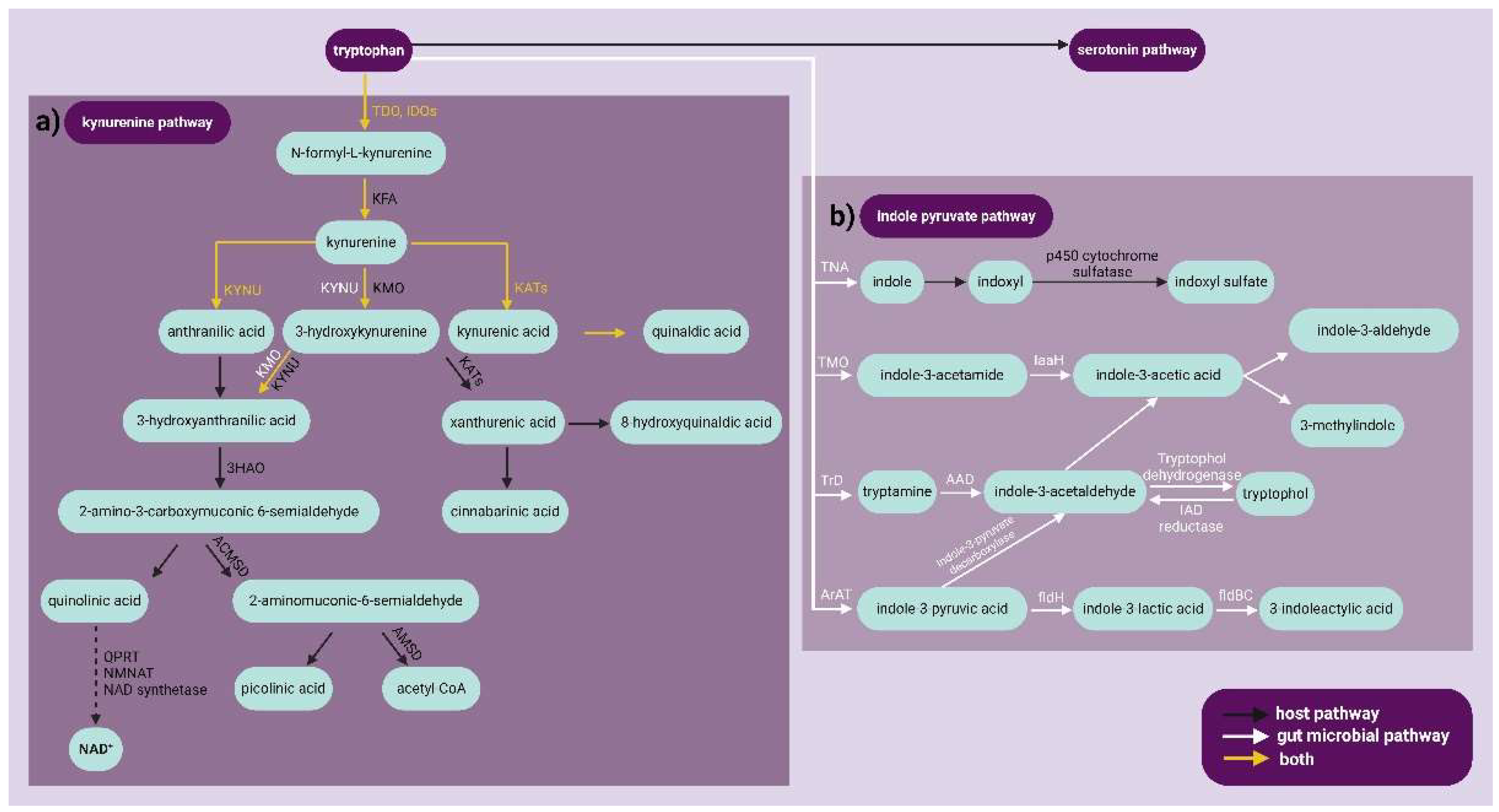

Table 1.
Traditional view on tryptophan-kynurenine metabolites.
| Metabolites | Pro-oxidant | Antioxidant | NMDA receptor | |
|---|---|---|---|---|
| Agonist | Antagonist | |||
| Kynurenine | - | - | - | - |
| Kynurenic acid | - | + | - | + |
| Anthranilic acid | - | + | - | - |
| 3-Hydroxykynurenine | + | - | - | - |
| Xanthurenic acid | - | - | - | - |
| 3-Hydroxyanthranilic acid | + | + | - | - |
| Quinolinic acid | + | - | + | - |
| Picolinic acid | - | + | - | - |
NMDA: N-methyl-D-aspartate, +: positive effect, -: unknown.
Table 2.
Emerging evidence of tryptophan-kynurenine metabolites.
| Metabolites | Pro-oxidant | Antioxidant | NMDA receptor | AhR agonist | |
|---|---|---|---|---|---|
| Agonist | Antagonist | ||||
| Kynurenine | + | + | - | - | + |
| Kynurenic acid | - | + | + | + | + |
| Anthranilic acid | - | + | - | - | + |
| 3-Hydroxykynurenine | + | + | - | - | + |
| Xanthurenic acid | + | + | - | - | + |
| Cinnabarinic acid | - | - | + | ||
| 3-Hydroxyanthranilic acid | + | + | - | - | - |
| Quinolinic acid | + | - | + | - | - |
| Picolinic acid | - | + | - | - | - |
| Indoxyl sulfate | + | - | - | - | - |
| Indole-3-propionic acid | - | + | - | - | - |
| Indole-3-lactic acid | - | + | - | - | - |
| Indole-3-acetaldehyde | - | - | - | - | + |
NMDA: N-methyl-D-aspartate, AhR: Aryl hydrocarbon receptor +: positive effect, -: unknown, emerging findings in bold.
Disclaimer/Publisher’s Note: The statements, opinions and data contained in all publications are solely those of the individual author(s) and contributor(s) and not of MDPI and/or the editor(s). MDPI and/or the editor(s) disclaim responsibility for any injury to people or property resulting from any ideas, methods, instructions or products referred to in the content. |
© 2024 by the authors. Licensee MDPI, Basel, Switzerland. This article is an open access article distributed under the terms and conditions of the Creative Commons Attribution (CC BY) license (http://creativecommons.org/licenses/by/4.0/).
Copyright: This open access article is published under a Creative Commons CC BY 4.0 license, which permit the free download, distribution, and reuse, provided that the author and preprint are cited in any reuse.


