

Submitted:
14 October 2024
Posted:
15 October 2024
You are already at the latest version
Abstract
In the textile industry, cotton plays a significant role as the primary raw material. However, cotton farming often faces challenges from various diseases, resulting in reduced productivity and financial losses for farmers. To address this issue, this study proposes a new method for predicting cotton diseases in Internet of Things (IoT)-based applications. The proposed solution combines meta-heuristic techniques with deep learning (DL). The aim of the proposed method leverages IoT, deep learning, and meta-heuristic techniques to detect and classify cotton plant diseases, providing an accurate and efficient solution for farmers and the textile industry. The process begins with capturing high-resolution images of cotton leaves in agricultural fields using a camera. These images are then processed using IoT to identify potential diseases. Noise removal and quality enhancement are performed using a Probabilistic Hybrid Wiener Filter (PHWF). Next, the Modified Dilated U-Net (MDU-Net) model segments significant disease regions from the images. Effective features are extracted from these segments using Improved Local Binary Pattern (ILBP), Gray Level Co-Occurrence Matrix (GLCM), and Gray Level Run Length Matrix (GLRM). Feature dimensionality is reduced by selecting optimal features through a Binary Guided Whale-Dipper Throated Optimizer (BGW-DTO). Classification is carried out using a stacking ensemble model, which combines EfficientNet-B7, ResNet50, VGG19, DenseNet121, and InceptionV3 models. To optimize the ensemble, a Harris whale optimization algorithm determines optimal weight coefficients for each classifier. The optimized ensemble model classifies various diseases, including Army Worms, Powdery Mildew, Bacterial Blight, Aphids, and Target Spots. Using our dataset of cotton plant leaf images, the proposed technique achieves a high accuracy of 99.66%. By integrating IoT sensor data and DL, early detection of cotton plant leaf diseases is enabled.
Keywords:
Cotton disease prediction
; IoT
; Deep Learning
; Meta-heuristic
; Ensemble model
; Harris whale optimization algorithm
Introduction
The most important cash crop in India is cotton, which has a wide range of economic effects [4,10,11,12]. Much more people are dependent on the production of cotton [4]. In the modern world, several pests will impact the crops because of unpredictably changing weather patterns and other environmental problems. These problems may also have an impact on soil nutrition [1]. Many diseases may afflict the crops as a result of this nutritional shortage. Yet, the spread of several crop diseases may hinder the development of agriculture. The farmers either recognise the illness via experience or seek assistance from other professionals. In this case, the symptoms of these illnesses are typically assessed with just the naked eye. As a result, there are higher chances for diseases to be misdiagnosed because they share symptoms with one another. This could lead to errors in overuse of pesticides and incorrect illness diagnosis control [4]. Thus, it is essential to adopt a unique approach to illness control and early diagnosis [13,14,15]. Several diseases in cotton crops are a major warning sign that has an impact on both financial and commercial influence. If the disease is accurately diagnosed and discovered early, additional steps can be taken to save the crop.
Technology is advancing because there are so many intelligent systems (IS) and smart sensors around us that are connected to one another via the internet and cloud platforms. Cotton is among of the most significant crops produced in the state of Maharashtra. Many illnesses hinder plant growth in fields, potentially drastically lowering the quality of the end produce. Early fall off of leaves or diseased leaves cause damage to cotton crops. Plant illnesses are typically brought on by a variety of climatic factors, such as scorching temperatures in the crop fields or the need for pesticides soon after. There are various
methods for classifying and identifying various diseases, such as Bacterial Blight, Alternaria, and many others, in the soil for the purpose of detecting and controlling their spread on cotton leaves. Using a variety of machine learning algorithms and an IoT-based system, the farmers are then presented with information on the disease and potential treatments. Many and varied characteristics present in agricultural data must be gathered and analysed for the development of production techniques in order to address issues like environmental sustainability, undesired reduction, and topsoil optimization.
Scientists have recently focused on the agricultural industry to identify crop diseases through automated methods. Two examples of modern technologies that enable the automated identification of agricultural illnesses without human intervention are deep learning and computer vision. For the purpose of diagnosing plant disease, a computerised method would be quicker, less expensive, and more accurate. Plant diseases have a significant financial impact on the global agriculture sector. Management of crop diseases is crucial for ensuring the quantity and quality of food. Plant illnesses must be detected early in order to limit disease transmission and enhance effective treatment methods. Effective crop management depends on evaluating plant disease status, which involves predicting methods and models for treatment implementation.
The agronomist is helped by the computational approach to identifying and diagnosing plant diseases. The diagnosis of the condition might still be done subjectively using outdated methods. On the other hand, modern technologies offer a way that can be used to determine plant diseases objectively. Automated technologies, like Deep Learning, enable the precise and dependable identification of agricultural diseases while also reducing costs and time.
Literature Review
In this we present complete review on computational methods on cotton plant disease detection. Extensive literature survey of Cotton plant diseases detection methods was carried out, and more focus on what types of diseases occurred on cotton plant and what are the deep learning methods to detect cotton plant diseases. We studied, in the cotton plant, the occurrence of disease is reflected mainly through the symptoms on its leaves [10].
Some of the diseases identified in the cotton leaf spots are categorized and shown in below Table 1 as:[44]
Going through reviews and categories different research papers in terms of methods and features, dataset used, challenges etc. Below Table 2 shows overview of Literature in terms of Methods and Features is as shown below,
Proposed System
The Layers include convolutional, ReLU, fully connected, pooling, and activation layers are part of the supervised CNN technique. CNNs can use tens or hundreds of hidden layers to learn how to identify different features in an image. With every layer that is buried, the learnt visual aspects get increasingly complex. Depending on the geometry of the object that we want to detect, the final hidden layer may learn to recognize more complex forms, while that initial hidden layer may tend to recognize edges. The supervised CNN technique consists of pooling layers, activation layers, fully connected layers, ReLU layers, and convolutional layers.
In first phase the CNN model build using Keras framework, as shown in Figure 1.This implied work uses the real field image dataset and examined multiple parameters like learning rate, batch size, and number of epochs to preserve the functionality of model. There are 1956 images belonging to 4 classes such as diseased cotton leaf, diseased cotton plant, fresh cotton leaf, fresh cotton plant storing in separate folders. Pre-Processing the images through modifications of images using data augmentation for training. To avoid overfitting on the proposed training model, more data were generated by flipping the data vertically and horizontally, rotating it at four different angles, and creating their transformations and responses. This allowed for the acquisition of more images from the original cotton leaf class from the real field dataset. 10% was used for validation, 10% for testing, and 80% of the dataset was used for training. Next, a CNN architecture model along the hyper parameter suggested for training stages is suggested.
All of the experiments in this work were conducted with Google Colaboratory, a tool that comes with built-in GPU support from Google. The structure of the CNN model used to detect cotton plant leaf disease is shown in Figure 1 below,
Data availability
Dataset created from actual images from real cotton field through camera.
Data Augmentation
The process of creating new data points from preexisting data to train the model is known as "data augmentation," which increases the amount of data artificially. Rescale to 255, rotation range 450, width shift range 20 %, height shift range 20%, shear range 20%, zoom range 20 %.
Role of IoT (Internet of Things) for Cotton Plant Diseases Detection
The Proposed System Architecture is as shown in above Figure 2. To obtain greater development and productivity, cotton is the crop that needs to be watched over and managed. As a result, the IoT, which is a global trend today, has greatly penetrated the agriculture industry. IoT can help farmers overcome a variety of challenges in cotton production. The necessary secondary data were used as the foundation for the study. For the cotton crop, variables including temperature, humidity, soil moisture, soil temperature, etc., were also examined.
Extensive survey on IoT based methods to collect Environmental data from Cotton farm field, and more focus on what types of diseases occurred on cotton plant and what
are the symptoms and which environmental factors affecting cotton plant diseases.
We studied in the cotton plant, the occurrence of disease is reflected mainly through the symptoms on its leaves [10]. Implementing an IoT Based Live Environmental Parameters Monitoring System Using Node MCU ESP8266 on cotton crop field. Using several sensors, an IoT-based system will gather information about the soil and environment. In order to connect the NodeMCU ESP8266-12E Wi-fi Module with following components,
Components Details:
1. NodeMCU- ESP8266-12E Board,
2. BMP 180 Sensor- BMP 180 Barometric Pressure Sensor,
3. DHT11 Sensor- Humidity Temperature sensor,
4. FC-37 Sensor- Rain Sensor module
The below Figure 3 represents IoT Based Live Environmental Parameters Monitoring System Using Node MCU ESP8266 as,
We'll record the temperature, humidity, barometric pressure, and rainfall and upload the information to the cloud. So that we create “Krishimitra” Channel on ThingSpeak, to Monitor field sensor data and act on it immediately. Analyze, Process and store data from different environmental sensors on ThingSpeak Cloud. The below Figure 4 shows IoT Based Circuit for collection of cotton field sensor parameters as,
The Internet of Things (IoT) is a network of physical objects or objects with embedded software, sensors, or other technology. Sharing data and information through a connection or gadget on the internet is beneficial. The agricultural sector is attempting to adopt the technology for its application due to the rapid growth in IoT usage. IoT have the potential to boost and improve agriculture by looking at many farming-related parameters.
The following are the main obstacles to cotton farming:
- climatic circumstances;
- improper use of fertilizers and insecticides;
- pest and disease attacks;
- Minimal revenue for small-scale farmers
- Low cost because of problems with quality
- Increased labor costs
- Depletion of soil
IoT Plays Major role for Cotton Farming
1: To research the important function that IoT plays in cotton cultivation:
IoT is utilized in agriculture for a variety of tasks, including planting, harvesting, processing, and consumer delivery. The use of IoT in agriculture should be viewed as the best option for monitoring and controlling. An agriculturalist's ability to make decisions is aided by the analysis of remote data.
2: To explore how different parameters affect growth of cotton: [44]
Rainfall: Expect a modest amount, between 50 and 75 cm. Early growth of the cotton plant requires sufficient moisture, but after flowering it needs a bright, dry climate. Rainfall is not necessary during the early stages of germination, but it may reduce output if it occurs later. Rainfall can seriously harm crops, especially during the harvest season. Sowing at the appropriate period is therefore advised. In India, it is sown between April and May, and harvested between December and January, just before winter, because the latter can harm the crops.
pH of soil: For best development, In general, cotton requires a deep, productive sandy loam soil with adequate drainage. Problems arise when seeds germinate in sandy or clayey soil. Neither, According to their pH value, soils can be categorized as neutral (6.5 to 7.5), alkaline (above 7.5), acidic (less than 6.5), or extremely acidic (5.5 or below). It is advised to cultivate cotton in soil with a pH of 6.0 to 8.0. The pH of the soil has a significant impact on cotton yield when it rises over 8.5 or falls below 5.5.
Moisture of the Soil: Cotton has a wide range of soil moisture requirements because it is a drought-tolerant crop. Because of this, the amount of water needed varies depending on the conditions, from 400 to 800 mm. A high soil moisture content increases fruit shedding because the earth's oxygen content is reduced. Moreover, a decrease in soil moisture causes the leaves to mature and shed more leaves. The Table 3 shows soil type and their moisture level as below,
Temperature of the Soil: The germination of seeds is greatly influenced by soil temperature. Early germination can be achieved with a higher soil temperature, but cotton's growth stages are ruined. Similar to that, if the soil temperature is kept low, it may take longer for the plant to emerge. As a result, the soil temperature must be kept above 64°F (18°C) during the germination period. The ideal temperature range for cotton is between 21°C and 30°C. Cotton balls ripen and burst more quickly in the sunshine when the daytime temperature in October is over 26 degrees Celsius. The plant must also grow for at least 200 frost-free days in order to develop. 21°C to 37°C is the ideal soil temperature for cotton.
Air Humidity: Cotton's color and quality are mostly impacted by humidity. As is well known, bacteria thrive in humid environments, which can cause cotton fiber to deteriorate and becoming discolored. Moreover, it may intensify pest and disease attacks. Thus, the air's relative humidity must be lower than 70%.
Light Intensity: High light intensity is necessary for cotton to grow well at all stages, according to research on light intensity. Sugars are produced by high levels of sunshine and aid in the growth of foliage and bolls. Low light levels, on the other hand, may retard the growth of bolls and ultimately produce low-quality fruit.
The below Table 4 summarizes cotton plant diseases with different environmental parameters as,
Classification using the Ensemble Learning Model
The proposed Stacking ensemble Learning Model for categorizing diseases in cotton plant leaves utilizes several components, including Popular Pre-train model such as Inception V3, ResNet50, and VGG16. Each of these models has a unique design that captures various aspects of the input data, providing a diverse range of predictions. When an image is input into each model, they generate predictions regarding the probabilities of the image belonging to different classes in our task. These predictions reflect the confidence of each model in the image's classification.
Result And Performance Analysis
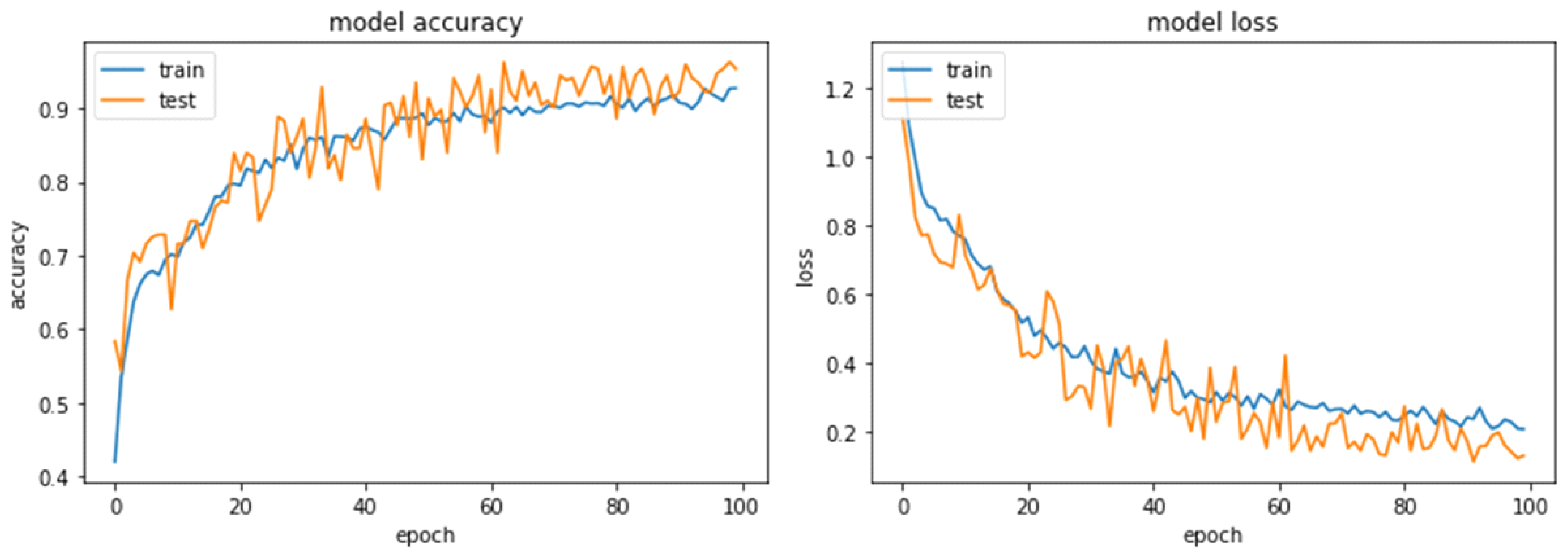
The CNN model's performance on a dataset encompassing 100 epochs, along with the accuracy and loss analysis conducted for the proposed CNN model, yielded the findings depicted in below Table 5 and overall classification performance in Table 6 shows the proposed ensemble model and existing model.
Figure 6.
Result of Own CNN Model in terms of Accuracy and loss.
Conclusion
It is crucial for cotton growers to be aware of the illnesses that affect the crop, the organisms that cause them, when the diseases are most likely to strike, and how to combat them using integrated disease management strategies that include cultural, biological, and environmental approaches. Convolutional neural network and IoT based detection techniques have been developed in our proposed model and have been utilized extensively in cotton crop production loss reduction efforts in recent years due to crop disease outbreaks. CNN is the most dependable tool for diagnosing and forecasting cotton plant diseases. For a number of diseases, we use field-based images that must be assessed in order to identify the contaminated area and identify the type of disease present in the target area. A Stacking Ensemble model is introduced for cotton plant leaf disease classification, our focus should be on showcasing the various automated systems that have the potential to transform our daily lives, since technology is advancing at an exponential rate and reducing the need for human labor through the use of automated devices to execute certain tasks. Cotton illness is predicted by our suggested method with a good degree of accuracy. Our next task is creating an intuitive application that offers solutions for the farmers. Enhancing the capabilities of the robot or automated car that is used to diagnose plants. This research proposes a novel method that combines IoT, deep learning, Hybrid Meta Model for Cotton disease detection Using IoT based platform and Ensemble learning Approach.
Availability of data and materials: Real time dataset data collection from cotton field.
References
- Sharma, P. , et al. KrishiMitr (Farmer’s Friend): Using Machine Learning to Identify Diseases in Plants. Proceedings of the 2018 IEEE International Conference on Internet of Things and Intelligence System (IoTaIS); 2018.
- Adhao, A.S.; Pawar, V.R. Automatic Cotton Leaf Disease Diagnosis and Controlling Using Raspberry Pi and IoT. Intelligent Communication and Computational; 2019.
- Prashar, K.; Talwar, R.; Kant, C. CNN based on Overlapping Pooling Method and Multi-layered Learning with SVM & KNN for American Cotton Leaf Disease Recognition. Proceedings of IEEE; 2019.
- Alves, A.N.; Souza, W.S.R.; Borges, D.L. Cotton pest’s classification in field-based images using deep residual networks. Comput. Electron. Agric. 2020, 174, 105488. [Google Scholar] [CrossRef]
- Afroze, A.S.; Beham, M.P.; Tamilselvi, R.; Maraikkayar, S.M.A.; Rajakumar, K. Cotton Leaf Disease Detection Using Texture and Gradient Features. Int. J. Eng. Adv. Technol. 2019, 9, 700–703. [Google Scholar] [CrossRef]
- Nerkar, B.; Talbar, S. Improving Leaf Disease Detection and Localization Accuracy Using Bio-Inspired Machine Learning. Applied Computer Vision and Image Processing. 2020.
- Patki, S.S.; Sable, G.S. Cotton Leaf Disease Detection & Classification using Multi SVM. Int. J. Adv. Res. Comput. Commun. Eng. 2017, 5, 165–168. [Google Scholar]
- Bhong, V.S.; Pawar, B.V. Study and Analysis of Cotton Leaf Disease Detection Using Image Processing. Int. J. Adv. Res. Sci. Eng. Technol. 2017, 3, 1447–1454. [Google Scholar]
- Dubey, Y.K.; Mushrif, M.M.; Tiple, S. Superpixel based roughness measure for cotton leaf diseases detection and classification. Proceedings of the 2018 4th International Conference on Recent Advances in Information Technology (RAIT); Dhanbad, India; 2018.
- Bodhe, K.D.; Taiwade, H.V.; Yadav, V.P.; Aote, N.V. Implementation of Prototype for Detection & Diagnosis of Cotton Leaf Diseases using Rule Based System for Farmers. Proceedings of the 2018 3rd International Conference on Communication and Electronics Systems (ICCES); Coimbatore, India; 2018.
- Jenifa, R.; Ramalakshmi, R.; Ramachandran, V. Cotton Leaf Disease Classification using Deep Convolution Neural Network for Sustainable Cotton Production. Proceedings of the IEEE International Conference on Clean Energy and Energy Efficient Electronics Circuit for Sustainable Development (INCCES); Krishnankoil, India; 2019.
- Jenifa, R.; Ramalakshmi, R.; Ramachandran, V. Classification of Cotton Leaf Disease Using Multi-Support Vector Machine. Proceedings of the 2019 IEEE International Conference on Intelligent Techniques in Control, Optimization and Signal Processing (INCOS); Tamilnadu, India; 2019.
- Prashar, K.; Talwar, R.; Kant, C. CNN based on Overlapping Pooling Method and Multi-layered Learning with SVM & KNN for American Cotton Leaf Disease Recognition. Proceedings of the International Conference on Automation, Computational and Technology Management (ICACTM); London, UK; 2019.
- Kumari, U.; Prasad, S.J.; Mounika, G. Leaf Disease Detection: Feature Extraction with K-means clustering and Classification with ANN. Proceedings of the 2019 3rd International Conference on Computing Methodologies and Communication (ICCMC); Erode, India; 2019.
- Plant Disease Handbook: Cotton. Texas A&M AgriLife Extension Service. Available from:https://plantdiseasehandbook.tamu.edu/industry-specialty/fiber-oil-specialty/cotton/.
- Sarangdhar, A.; Pawar, V.R. Machine learning regression technique for cotton leaf disease detection and controlling using IoT. Proceedings of the 2017 International Conference on Electronics, Communication and Aerospace Technology (ICECA); Coimbatore, India; 2017.
- Dubey, Y.K.; Mushrif, M.M.; Tiple, S. Superpixel based roughness measure for cotton leaf diseases detection and classification. Proceedings of the 2018 4th International Conference on Recent Advances in Information Technology (RAIT); Dhanbad, India; 2018.
- Bodhe, K.D.; Taiwade, H.V.; Yadav, V.P.; Aote, N.V. Implementation of Prototype for Detection & Diagnosis of Cotton Leaf Diseases using Rule Based System for Farmers. Proceedings of the 2018 3rd International Conference on Communication and Electronics Systems (ICCES); Coimbatore, India; 2018.
- Bhimte, N.R.; Thool, V.R. Diseases Detection of Cotton Leaf Spot Using Image Processing and SVM Classifier. Proceedings of the 2018 Second International Conference on Intelligent Computing and Control Systems (ICICCS); Madurai, India; 2018.
- Shah, N.; Jain, S. Detection of Disease in Cotton Leaf using Artificial Neural Network. Proceedings of the 2019 Amity International Conference on Artificial Intelligence (AICAI); Dubai, UAE; 2019.
- Ahmed, N.; Amin, I.; Mansoor, S. Cotton Leaf Curl Disease (Geminiviridae). Encyclopedia of Virology (Fourth Edition). 2021.
- Mushtaq, R.; Shahzad, K.; Bashir, A. Isolation of biotic stress resistance genes from cotton (Gossypium arboreum) and their analysis in model plant tobacco (Nicotiana tabacum) for resistance against cotton leaf curl disease complex. J. Virol. Methods 2019, 276, 113760. [Google Scholar] [CrossRef] [PubMed]
- Shafiq, M.; Iqbal, Z.; Amin, I. Real-time quantitative PCR assay for the quantification of virus and satellites causing leaf curl disease in cotton in Pakistan. J. Virol. Methods 2017, 248, 54–60. [Google Scholar] [CrossRef]
- Akmal, M.; Baig, M.S.; Khan, J.A. Suppression of cotton leaf curl disease symptoms in Gossypium hirsutum through over expression of host-encoded miRNAs. J. Biotechnol. 2017, 263, 21–29. [Google Scholar] [CrossRef]
- Briddon, R.W.; Akbar, F.; Mansoor, S. Effects of genetic changes to the begomovirus/betasatellite complex causing cotton leaf curl disease in South Asia post-resistance breaking. Virus Res. 2015, 186, 114–119. [Google Scholar] [CrossRef] [PubMed]
- Siddiqui, K.; Mansoor, S.; Amin, I. Diversity of alphasatellites associated with cotton leaf curl disease in Pakistan. Virol. Rep. 2016, 6, 41–52. [Google Scholar] [CrossRef]
- Zhang, J.H.; Kong, F.; Zhai, Z.F. Automatic image segmentation method for cotton leaves with disease under natural environment. J. Integr. Agric. 2018, 17, 1800–1814. [Google Scholar] [CrossRef]
- Khattab, A.; Habib, S.E.; Ismail, H.; Zayan, S.; Fahmy, Y.; Khairy, M.M. An IoT-based cognitive monitoring system for early plant disease forecast. Comput. Electron. Agric. 2019, 166, 105028. [Google Scholar] [CrossRef]
- He, D.F.; Zhao, X.; Zhang, R. Genetic variation in LBL1 contributes to depth of leaf blades lobes between cotton subspecies, Gossypium barbadense and Gossypium hirsutum. J. Integr. Agric. 2018, 17, 2394–2404. [Google Scholar] [CrossRef]
- Sarwar, M.W.; Riaz, A.; Mubin, M. Homology modeling and docking analysis of ßC1 protein encoded by Cotton leaf curl Multan betasatellite with different plant flavonoids. Heliyon 2019, 5, e01303. [Google Scholar] [CrossRef] [PubMed]
- Silva, J.C.; Suassuna, N.D.; Bettiol, W. Management of Ramularia leaf spot on cotton using integrated control with genotypes, a fungicide and Trichoderma asperellum. Crop. Prot. 2017, 94, 28–32. [Google Scholar] [CrossRef]
- Ashry, N.A.; Ghonaim, M.M.; Mogazy, A.M. Physiological and molecular genetic studies on two elicitors for improving the tolerance of six Egyptian soybean cultivars to cotton leaf worm. Plant Physiol. Biochem. 2018, 130, 224–234. [Google Scholar] [CrossRef]
- Celik, Y.; Ulker, E. An Improved Marriage in Honey Bees Optimization Algorithm for Single Objective Unconstrained Optimization. Sci. World J. 2013, 2013, 370172. [Google Scholar] [CrossRef]
- Mareli, M.; Twala, B. An adaptive Cuckoo search algorithm for optimisation. Appl. Comput. Inform. 2018, 14, 107–115. [Google Scholar] [CrossRef]
- Chuang, K.S.; Tzeng, H.L.; Chen, S.; Wu, J.; Chen, T.J. Fuzzy c-means clustering with spatial information for image segmentation. Comput. Med. Imaging Graph. 2006, 30, 9–15. [Google Scholar] [CrossRef]
- Ershad, S.F. Texture Classification Approach Based on Combination of Edge & Co-occurrence and Local Binary Pattern. Proceedings of the Int'l Conf. IP, Comput Vision, and Pattern Recognition; 2011.
- ChandraPrabha, K.; Bharathi, C. Texture Analysis using GLCM & GLRLM Feature Extraction Methods. Int. J. Res. Appl. Sci. Eng. Technol. 2019, 7, 2059–2064. [Google Scholar]
- Wang, J.H.; Liu, T.W.; Luo, X.; Wang, L. An LSTM Approach to Short Text Sentiment Classification with Word Embeddings. Proceedings of the 2018 Conference on Computational Linguistics and Speech Processing; 2018.
- Singh, V.; Misra, A.K. Detection of plant leaf diseases using image segmentation and soft computing techniques. Inf. Process. Agric. 2017, 4, 41–49. [Google Scholar] [CrossRef]
- Ramcharan, A.; Baranowski, K.; McCloskey, P.; Ahmed, B.; Legg, J.; Hughes, D.P. Deep learning for image-based cassava disease detection. Front. Plant Sci. 2017, 8, 1852. [Google Scholar] [CrossRef] [PubMed]
- Nachtigall, L.G.; Araujo, R.M.; Nachtigall, G.R. Classification of apple tree disorders using convolutional neural networks. Proceedings of the 2016 IEEE 28th International Conference on Tools with Artificial Intelligence (ICTAI); 2016. p. 472-6.
- Ferentinos, K.P. Deep learning models for plant disease detection and diagnosis. Comput. Electron. Agric. 2018, 145, 311–318. [Google Scholar] [CrossRef]
- Cotton Disease Management. Government of India. Available from: https://farmer.gov.in/imagedefault/ipm/cotton.pdf.
- Ahmed, S. , et al. Cotton Production and Bacterial Blight Management in Pakistan: A Review. Pak. J. Phytopathol. 2017, 29, 251–270. [Google Scholar]
- Mohanty, S.P.; Hughes, D.P.; Salathé, M. Using deep learning for image-based plant disease detection. Front. Plant Sci. 2016, 7, 1419. [Google Scholar] [CrossRef] [PubMed]
- Sladojevic, S.; Arsenovic, M.; Anderla, A.; Culibrk, D.; Stefanovic, D. Deep neural networks based recognition of plant diseases by leaf image classification. Comput. Intell. Neurosci. 2016, 2016, 3289801. [Google Scholar] [CrossRef]
- Prajapati, B.S.; Shah, J.; Dabhi, V.K. A survey on detection and classification of cotton leaf diseases. In: 2016 IEEE International Conference on Electrical, Electronics, and Optimization Techniques (ICEEOT). 2016.
- Revathi, P.; Hemlata, M. Advance computing enrichment evaluation of cotton leaf spot disease detection using image edge detection. In: 2012 IEEE International Conference on Computing, Communication and Networking Technologies (ICCCNT). 2012.
- Rothe, P.R.; Kshirsagar, P.R. Cotton leaf disease identification using pattern recognition techniques. In: 2015 International Conference on Pervasive Computing (ICPC). 2015.
- Shakeel, W.; Rehman, A.; Razaque, A. , et al. Early detection of Cercospora cotton plant disease by using machine learning technique. In: 2020 IEEE 30th International Conference on Computer Theory and Applications (ICCTA). Alexandria, Egypt; 2020:12-14.
- Warne, P.; Ganorkar, S. Detection of diseases on cotton leaves using K-mean clustering method. Int. Res. J. Eng. Technol. 2015, 2, 425–431. [Google Scholar]
- Rothe, P.R.; Kshirsagar, P.R. SVM-based classifier system for recognition of cotton leaf diseases. Int. J. Emerg. Technol. Comput. Appl. Sci. 2014, 8, 427–432. [Google Scholar]
- Rothe, P.R.; Kshirsagar, P.R. A study and implementation of active contour model for feature extraction: With diseased cotton leaf as example. Int. J. Curr. Eng. Technol. 2014, 4, 812–816. [Google Scholar]
- Patil, S.; Zambre, R. Classification of cotton leaf spot disease using support vector machine. Int. J. Eng. Res. 2014, 3, 1511–1514. [Google Scholar]
- Chaudhari, V.; Patil, C.Y. Disease detection of cotton leaves using advanced image processing. Int. J. Adv. Comput. Res. 2014, 4, 653. [Google Scholar]
- Revathi, P.; Hemalatha, M. Classification of cotton leaf spot diseases using image processing edge detection techniques. In: Emerging Trends in Science, Engineering and Technology (INCOSET), 2012 International Conference. 2012:169-173.
- Adsule, B.; Bhattad, J. Leaves classification using SVM and NN for disease detection. Int. J. Innov. Res. Comput. Commun. Eng. 2015, 3, 5488–5495. [Google Scholar]
- Abhang, D.; Autade, P.; Bhokare, S.; Dawange, P. A survey on, analysis and detection of disease on cotton leaves. Int. J. Adv. Res. Innov. Ideas Educ. 2015, 4, 236–243. [Google Scholar]
- Arjunagi, S. , et al. A survey on detection and computing the amount of plant diseases using image processing. IAETSD J. Adv. Res. Appl. Sci. 2017, 4, 344–354. [Google Scholar]
- Sartin, M.; Da Silva, A.; Kappas, C. Image segmentation with artificial neural network for nutrient deficiency in cotton crop. J. Comput. Sci. 2014, 10, 1084–1093. [Google Scholar] [CrossRef]
- Kamilaris, A.; Prenafeta-Boldú, F.X. A review of the use of convolutional neural networks in agriculture. J. Agric. Sci. 2018, 156, 312–322. [Google Scholar] [CrossRef]
- Gawas, M.; Patil, H.; Govekar, S.S. An integrative approach for secure data sharing in vehicular edge computing using blockchain. Peer-to-Peer Netw. Appl. 2021, 14, 2840–2857. [Google Scholar] [CrossRef]
- Hebbar, N.; Patil, H.Y.; Agarwal, K. Web powered CT scan diagnosis for brain hemorrhage using deep learning. In: 2020 IEEE 4th Conference on Information & Communication Technology (CICT). 2020:1-5. [CrossRef]
- Patil, P.; Patil, H. X-ray imaging based pneumonia classification using deep learning and adaptive clip limit based CLAHE algorithm. In: 2020 IEEE 4th Conference on Information & Communication Technology (CICT). 2020:1-4. [CrossRef]
- Barua, S.; Patil, H.; Desai, P.D.; Arun, M. Deep learning-based smart colored fabric defect detection system. In Applied Computer Vision and Image Processing. Advances in Intelligent Systems and Computing; Iyer, B., Rajurkar, A., Gudivada, V., Eds.; Springer: Berlin/Heidelberg, Germany, 2020; Volume 1155, pp. 333–342. [Google Scholar] [CrossRef]
- Patil, P.; Ranganathan, M.; Patil, H. Ship image classification using deep learning method. In Applied Computer Vision and Image Processing. Advances in Intelligent Systems and Computing; Iyer, B., Rajurkar, A., Gudivada, V., Eds.; Springer: Berlin/Heidelberg, Germany, 2020; Volume 1155, pp. 343–351. [Google Scholar] [CrossRef]
- Patil, B.V.; Patil, P.S. Computational method for cotton plant disease detection of crop management using deep learning and internet of things platforms. In: Evolutionary Computing and Mobile Sustainable Networks: Proceedings of ICECMSN 2020. Springer; 2021.
- Patil, H.Y.; Chandra, A. Deep learning based kinship verification on KinFaceW-I dataset. In: TENCON 2019 - 2019 IEEE Region 10 Conference (TENCON). 2019:2529-2532. [CrossRef]
- iKisan. Cotton disease management. Available from: https://www.ikisan.com/ap-cotton-disease-management.htm. Accessed June 21, 2024.
Figure 1.
Structure of Own CNN Model Employed for Cotton Plant Leaf Disease Detection.
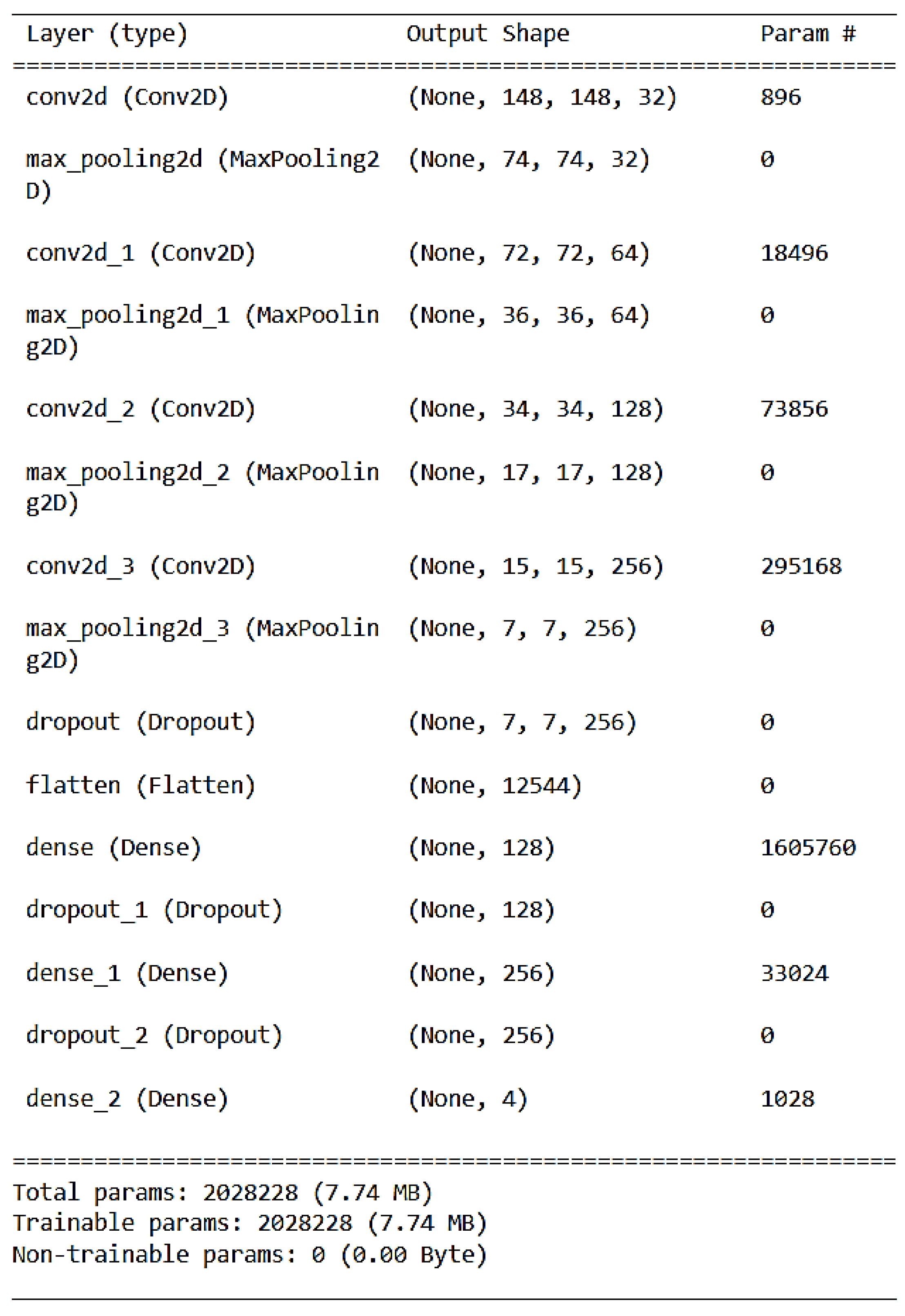
Figure 2.
Proposed System Architecture.
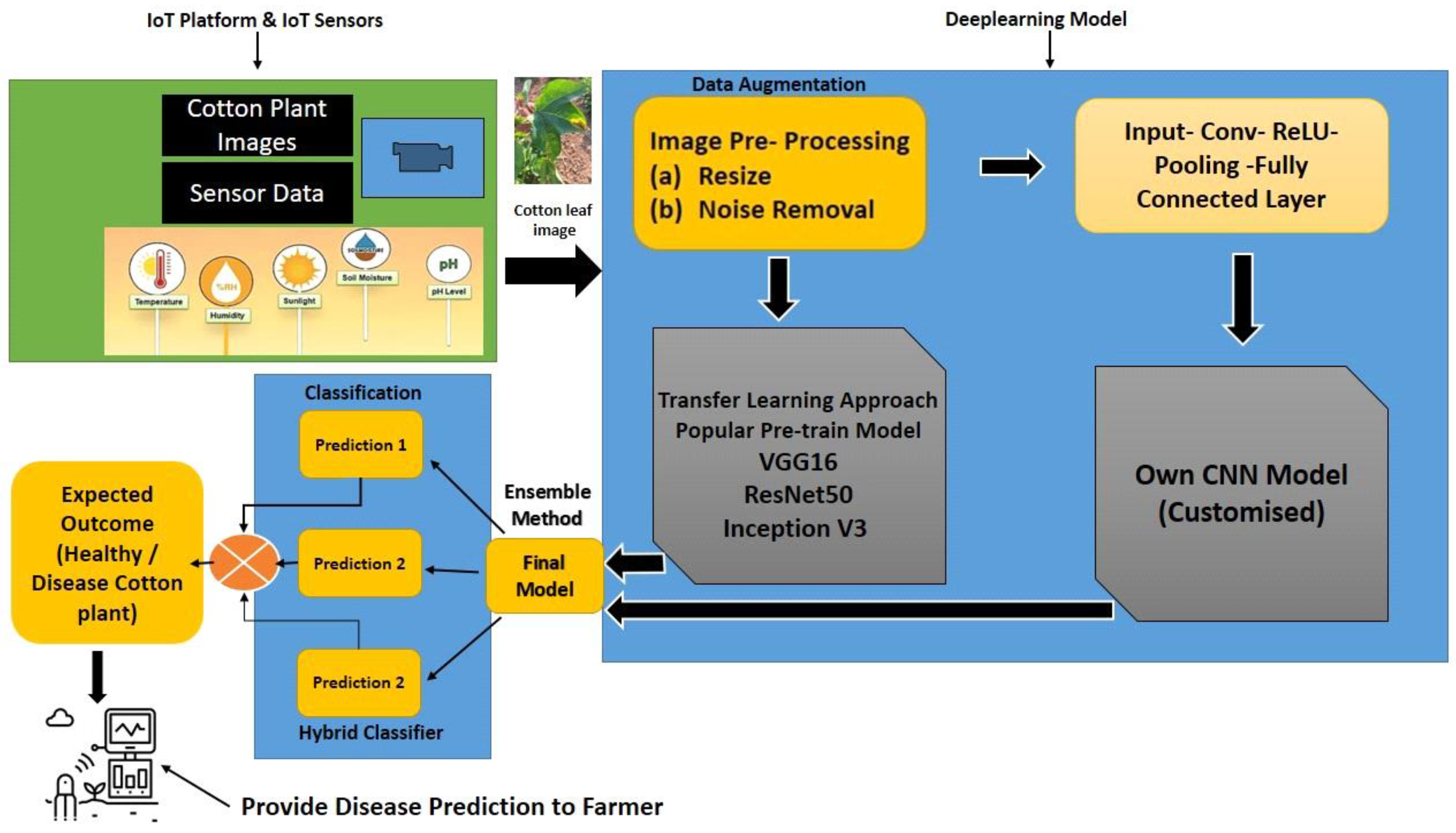
Figure 3.
IoT Based Live Environmental Parameters Monitoring System Using Node MCU ESP8266.
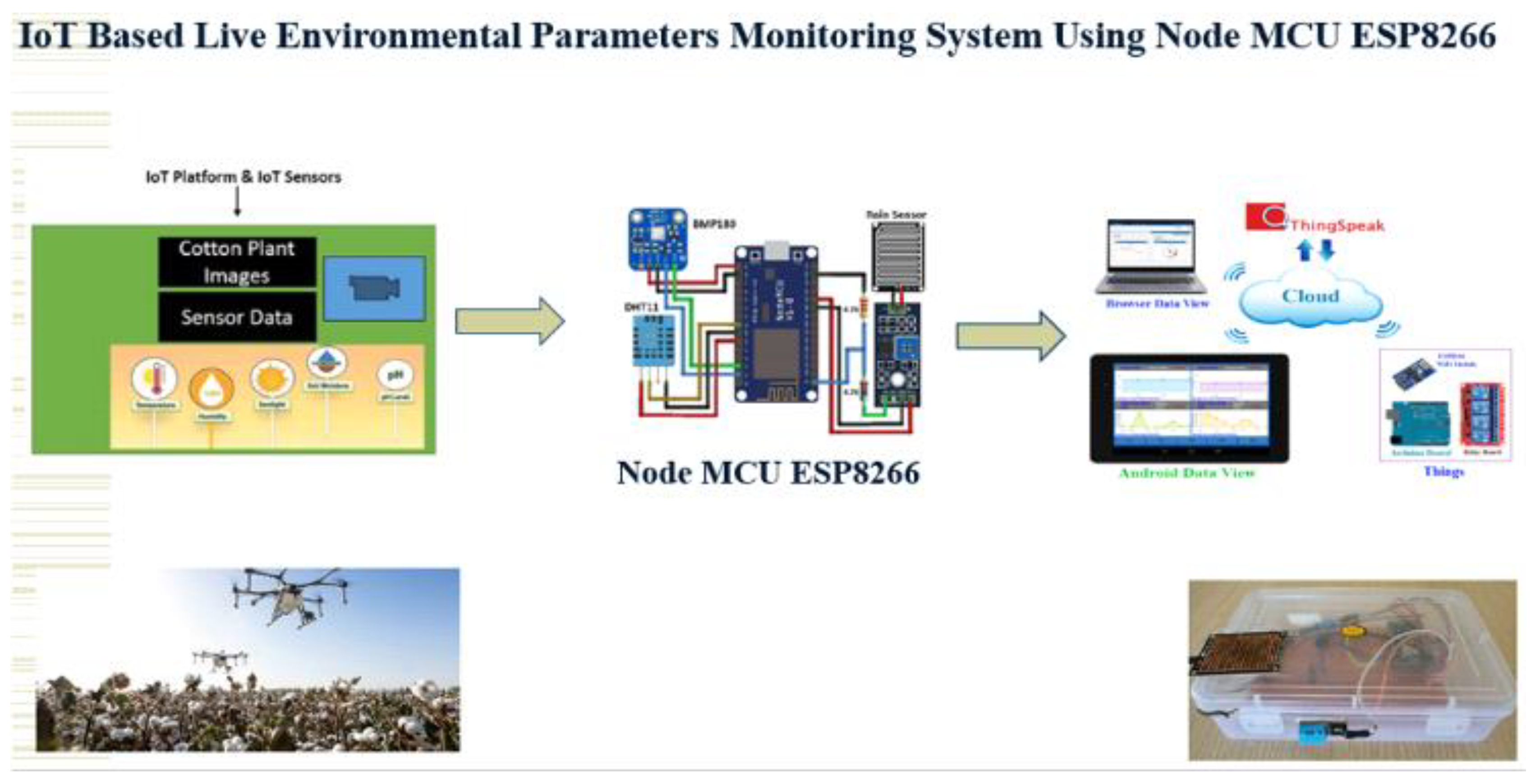
Figure 4.
IoT Based Circuit for collection of cotton field sensor parameters.

Figure 5.
Krishi Mitra Channel on ThinkSpeak Open Access Cloud.

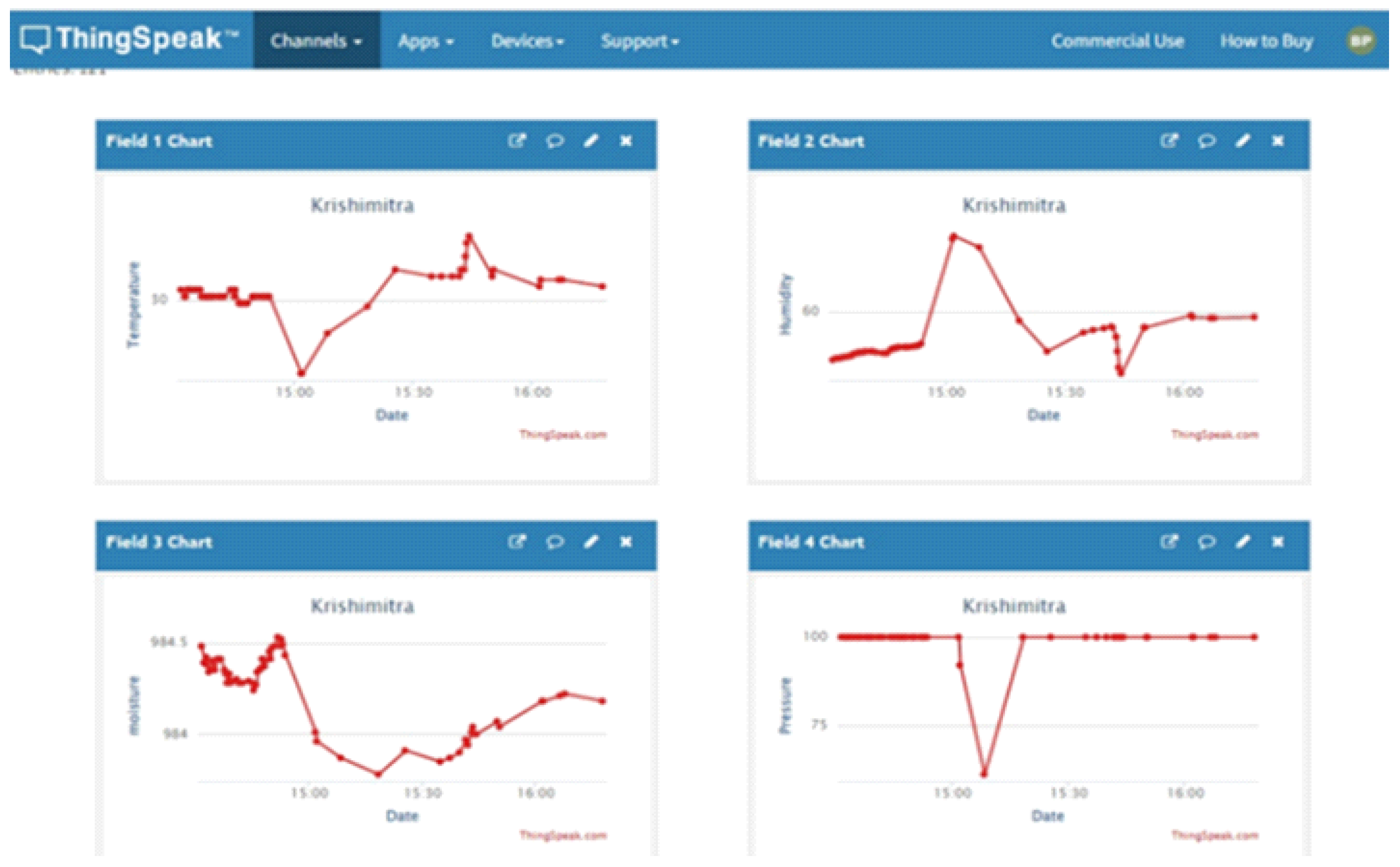

Table 1.
Categories of Diseases.
| Sr. No. | Category of Diseases | Examples |
|---|---|---|
| 1 | Bacterial diseases | Bacterial Blight Crown Gall |
| 2 | Fungal diseases | Anthracnose Leaf Spot Alternaria |
| 3 | Viral diseases | Leaf Curl Leaf Crumple Leaf Roll |
| 4 | Diseases(Due to insects) | White flies Leaf insects |
Table 2.
Overview of Literature in terms of Methods and Features overview of Literature in terms of Methods and Features.
Table 2.
Overview of Literature in terms of Methods and Features overview of Literature in terms of Methods and Features.
| Sr. No. | Author [Citation] | Dataset Used | Adopted Methodology | Features | Challenges |
|---|---|---|---|---|---|
| 1 | Parul Sharma et al. [1] | PlantVillage database, field-based dataset, Internet image |
Convolutional neural network (CNN) | High accuracy (>93%) was obtained with very noisy images | Required more disease coverage |
| 2 | Adhao and Pawar [2] | Images are Captured using digital camera | Support Vector Machine (SVM) | Cost-effective and independent | Lower overall accuracy for disease detection (83.26%) Highly prone to noise |
| 3 | Prashar et al. [3] | 40 infected images capture through digital camera. | KNN and SVM | Accurately localize the disease region | Higher time complexity |
| 4 | Alves et al. [4] | Live field-based images & Internet image. | deep residual networks | Achieved the highest accuracy higher F1-Score |
Lower learning rate |
| 5 | Afroze et al. [5] | Images of normal and diseased leaves are gathered from the Internet and used in the field. | Local Binary Pattern (LBP) is used to extract the gradient feature and texture of the K-Nearest neighbor classifier. | Reduced computing time and increased classification accuracy | Reduced specificity and sensitivity |
| 6 | Nerkar and Talbar [6] | Images are Captured using digital camera | bio-inspired ML-based classification algorithm | Improved classification accuracy Increases the performance of system based on disease localization. |
Higher computational complexity in terms of cost and time |
| 7 | Patki et al. [7] | 103 infected images capture through digital camera | Multi SVM (Multi Support Vector Machine) classifier | Higher detection accuracy | Higher average recognition time |
| 8 | Bhong et al. [8] | images capture through digital camera | K-means technique for clustering | straightforward and precise | The identification procedure has a slower recognition rate. |
| 9 | Dubey et al. [9] | images capture through digital camera | Support Vector Machine (SVM) | Higher classification accuracy | Higher testing time |
| 10 | Bodhe et al. [10] |
images capture through digital camera | Rule Based System | Higher detection and diagnosis Higher accuracy in classification |
Very time-consuming and expensive |
| 11 | Jenifa et al. [11] | 600 images capture through digital camera | Deep Convolution Neural Network | Improved classification rate | Highly prone to noise Higher misclassification |
| 12 | Jenifa et al. [12] | Real time images capture by camera | Multi-Support Vector Machine | less prone to over fits | suffers from multiple local minima |
| 13 | Dong et al. [13] | Own database formed for 5 diseases. | CBR and fuzzy logic | get a high success percentage for diagnostics | Inadequate database size and manual selection reduce the effectiveness of the diagnosis. |
| 14 | Kumari et al. [14] | plant village data base | K-means clustering and ANN | Improved average classification accuracy (92.5 %.) |
Samples are misclassified |
| 15 | Sarangdhar and Pawar [15] | Images capture through Nikon digital camera | Support Vector Machine | Higher overall classification accuracy | Highly prone to noise |
Table 3.
Moisture Level.
| Soil Type | Soil Moisture Level |
|---|---|
| Fine (Clay) | Below 60% |
| Medium (Black & loamy) | Below 70% |
| Coarse (Sandy) | Below 80% |
Table 4.
Cotton plant Diseases with different environmental Parameter [69].
| Temperature | Humidity | Soil Moisture | Rail fall | Symptoms | Disease type |
|---|---|---|---|---|---|
| 240-280 C | High | 80-90% | YES | Yellow to brown colored cotyledon leaves turn brown and drop off | Fussarium wilt |
| 350-430 C | High | 50-60% | YES | Sudden and complete wilting of the plant | Root rot |
| 290-330 C | High | 80-90% | YES | Small reddish-colored spots and cotyledons. Water soaked small | Boll spotting |
| 250-300 C | Very high | 60-70% | 25.4 to 76.2 mm | Angular leaf spots on leaf on steam and leaf- lesions on young leaves | Angular leaf spots |
| Temperature | Humidity | Soil Moisture | Rail fall | Symptoms | Disease type |
| 100-300 C | Very high | 80-90% | YES | Brown rounded or irregular spots on leaf cracked centres cause canker on steam | Alternaria leaf spot |
| 250-300 C | Very high | 60-70% | YES | Irregular translucent spots on leaf- leaves become yellowish brown and finally fall off | Bacterial blight |
| 350-430 C | High | 50-60% | NO | Purple dark brown or blakish borders and white centers | Cercospora |
Table 5.
Result and Performance of Own CNN Model.
| Parameters | Proposed Own CNN model |
|---|---|
| Training Accuracy | 0.92 |
| Training Loss | 0.209 |
| Testing Accuracy | 0.95 |
| Testing Loss | 0.132 |
| Training Time | 29s 466ms/step |
| Testing Time | 29s 467ms/step |
| Epoch | 100 |
Table 6.
Overall classification performance in the proposed ensemble model and existing model.
| Performance (%) |
VGG 16 |
ResNet 50 |
Inception V3 |
Proposed (Stack ensemble) |
|---|---|---|---|---|
| Accuracy | 0.9844 | 0.9881 | 0.9930 | 0.9966 |
| Precision | 0.9380 | 0.9525 | 0.9728 | 0.9866 |
| F1-score | 0.9382 | 0.9527 | 0.9726 | 0.9869 |
| MCC | 0.9290 | 0.9457 | 0.9683 | 0.9849 |
| Specificity | 0.9911 | 0.9932 | 0.9960 | 0.99811 |
| Sensitivity | 0.9380 | 0.9529 | 0.9723 | 0.9871 |
| RMSE | 0.0704 | 0.060 | 0.0453 | 0.0346 |
| MSE | 0.0049 | 0.0036 | 0.0020 | 0.0422 |
| MAE | 0.1889 | 0.1373 | 0.0766 | 0.0422 |
| PPV | 0.9380 | 0.9525 | 0.9728 | 0.98662 |
| NPV | 0.9911 | 0.9932 | 0.9960 | 0.99810 |
| FPR | 0.0088 | 0.0067 | 0.0039 | 0.99818 |
| FNR | 0.0614 | 0.0470 | 0.0276 | 0.01280 |
Disclaimer/Publisher’s Note: The statements, opinions and data contained in all publications are solely those of the individual author(s) and contributor(s) and not of MDPI and/or the editor(s). MDPI and/or the editor(s) disclaim responsibility for any injury to people or property resulting from any ideas, methods, instructions or products referred to in the content. |
© 2024 by the authors. Licensee MDPI, Basel, Switzerland. This article is an open access article distributed under the terms and conditions of the Creative Commons Attribution (CC BY) license (http://creativecommons.org/licenses/by/4.0/).
Copyright: This open access article is published under a Creative Commons CC BY 4.0 license, which permit the free download, distribution, and reuse, provided that the author and preprint are cited in any reuse.


