

Submitted:
14 October 2024
Posted:
14 October 2024
You are already at the latest version
Abstract
Molecular cages are preorganized molecules with a central cavity, typically formed through the self-assembly of their building blocks. This requires in most cases forming and breaking reversible bonds during the self-assembly reaction pathway for error correction to drive the reaction to the cage product. In this work, we focus on both Pd–ligand and hydrazone bonds implemented in the structure of a Pd2L4 hydrazone molecular cage. As the cage contains two different types of reversible bonds, we envisaged a cage formation comparative study by performing the self-assembly of the cage through 3 different reaction pathways involving the formation of Pd–ligand bonds, hydrazone bonds, or a combination of both. The 3 reaction pathways produce the self-assembly of the cage with yields ranging from 73% to 79%. Despite the complexity of the reaction the cage is formed in a very high yield, even for the reaction pathway that involves the formation of 16 bonds. This research paves the way for more sophisticated cage self-assembly designs.

Keywords:
molecular cages
; supramolecular chemistry
; metal-organic cages
; self-assembly
1. Introduction
Molecular cages are preorganized hosts with a central cavity that provides enhanced host–guest properties compared to less preorganized systems such as macrocycles [1,2], aiming to mimic the sophisticated cavity and functions of enzymes [3,4,5,6]. Chemists have developed synthetic methods to prepare both metal-organic cages and purely organic cages resulting in a wide range of structures with size- and shape-dependent host–guest properties [7,8,9]. Encapsulation in the cavity of cages results in different effects on the guest molecule, ranging from activation for catalytic reactions to protection from the surrounding media. These effects yielded multiple applications of molecular cages, including catalysis [10,11,12,13,14,15], sensing of chemicals [16,17,18,19,20,21,22,23], stabilization of chemical species [24,25], separation process [26,27,28], removal of pollutants from water [29,30,31,32] and biological applications [33,34,35,36,37,38,39,40,41,42,43] among many others [7,8,44,45].
The self-assembly of molecular cages from the constituent building block involves in most cases numerous reversible steps. Reversibility is key for error correction of improperly self-assembled by-products produced during the self-assembly process to give the final cage product [46,47,48]. For this, cage building blocks must have a specific shape and geometry that provides an appropriate preorganization in a similar fashion to macrocycles [7,49]. Besides the geometric requirements of the building blocks, both thermodynamic and kinetic are key in order to set up the appropriate reaction conditions, including concentration of reagents, reaction time, and temperature [46,47,48,50]. In this regard, computational modelling has been extensively used to design cages with specific geometries and properties such as predicting host-guest affinity [51,52,53,54,55,56,57].
Typically, metal-organic cages are prepared by the self-assembly reaction of ligands with metals forming metal–ligand bonds [8,58,59], and purely organic cages are prepared by the self-assembly reaction of ligands with complementary reactivity through reversible reactions such as imine and hydrazone bond formation [7,60,61]. There are examples of cages containing both metal–ligand bonds and reversible organic bonds, allowing their assembly via either type of bond, even both bonds simultaneously [8,62,63,64] Focusing in Pd(II) containing cages, the formation of Pd2L4 cages involves the self-assembly of two Pd(II) ions and four ditopic ligands, typically containing pyridine moieties [65,66,67,68], though Pd–pyridine coordination bonds [69]. Regarding hydrazone containing cages, hydrazone bonds are both reversible and robust [70], allowing the preparation of cages through the condensation reaction between hydrazide and aldehyde-containing building blocks [34,71,72,73,74,75,76,77,78,79]. Combining both strategies, Crowley and his team showed the feasibility of using simultaneously in the cage self-assembly both Pd–pyridine coordination bonds and hydrazone bonds [63], and we proved that it is possible to self-assemble cages that contain Pd–pyridine bonds through hydrazone bond formation [34]. These results open the way to explore multiple cage self-assembly reaction pathways involving both Pd–pyridine and hydrazone bonds. For this, we propose studying the self-assembly of a Pd2L4 cage through various reaction pathways involving the formation of Pd–ligand bonds, hydrazone bonds, or a combination of both.
In this work, we present a comparative study of the self-assembly of a Pd2L4 cage containing Pd–pyridine and hydrazone links [34]. The reversible nature of both bond types enables the self-assembly of the cage through the formation of Pd–ligand bonds or hydrazone bonds, utilizing three distinct reaction pathways (Figure 1). As far as we know, this is the first cage formation comparative study involving Pd–ligand and organic bond formation reactions. In particular, we focused on a Pd2L4 cage containing four dihydrazone units with a bended geometry and two [PdPy4]2+ units with a C4 symmetric geometry that serve to cap the cage [34].
2. Results and Discussion
2.1. Self-Assembly Process of the PD2L4 Cage
The self-assembly of a Pd2L4 cage containing Pd–pyridine and hydrazone bonds can be performed through multiple ways. In this regard, we proposed 3 possible reactions to prepare the Pd2L4 cage C1 (Figure 2). The reaction pathway 1 involves the reaction of dihydrazide ligand 1 and the square planar tetrapyridyl Pd2+ motif 2 by hydrazone bond formation [34]; the reaction pathway 2 comprises the reaction of dipyridine ligand 3 with Pd2+ by Pd–pyridine bond formation; and the reaction pathway 3 involves the reaction between dihydrazide ligand 1, 3-pyridinecarboxaldehyde, and Pd2+ involving simultaneously Pd–pyridine and hydrazone bond formation. In all cases, the self-assembly of cage C1 was performed in deuterated DMSO at 25 oC and formation was monitored by 1H NMR spectroscopy. The solvent DMSO was chosen as it enables the complete solution of the reagents, cage, and reaction intermediates. Quantification of the concentration of the species in solution was performed by integration of the corresponding proton signals considering the concentration of the internal standard 1,4-dimethoxybenzene.
Initially we performed the self-assembly reaction of cage C1 through reaction pathway 1. For this, we placed hydrazide 1 and tetrapyridyl–Pd2+ 2 in an NMR tube and monitored the evolution of the reaction by acquiring 1H NMR spectra at different time intervals for a total of 55 hours (Figure 3). The signals corresponding to the starting materials disappeared rapidly with the simultaneous formation of the signals of the Pd2L4 cage. In contrast, few signals of the reaction intermediates could be observed in the reaction mixture, probably due to a combination of the formation of a large number of reaction intermediates in fast exchange with unsymmetrical structures containing chemically inequivalent NMR signals, as often observed in cage self-assembly reactions [46,80].
Then we performed the self-assembly reaction of cage C1 through reaction pathway 2. We reacted hydrazide ligand 3 with Pd(NO3)2·to form the cage through Pd–pyridine bond formation. The reaction proceeds smoothly with the formation of cage C1, that is the only product observed in the 1H NMR spectra (Figure 4). In contrast to reaction pathway 1, after 6 minutes, nearly all signals corresponding to the starting materials are absent, and the predominant signals in the spectra correspond to the cage. This highlights the rapid formation of the Pd–pyridine bonds, resulting in quick cage assembly.
Finally, we performed the self-assembly reaction of cage C1 through reaction pathway 3. This reaction is more complex, as it involves the simultaneous formation of 16 bonds, comprising 8 Pd–pyridine bonds and 8 hydrazone bonds. Indeed, this reaction pathway involves more difficulty, for example, the nitrogen atom of hydrazine 1 may result in competition with pyridine for Pd2+ coordination that may disturb the cage self-assembly pathway. However, despite this complexity, the reaction yields the expected C1 cage in a clean self-assembly reaction (Figure 5). This self-assembly experiment highlights the feasibility of the simultaneous formation of Pd–pyridine and hydrazone bonds in a cage self-assembly reaction.
After performing the self-assembly reactions, we carried out a quantitative analysis of the integrals of the 1H NMR signals for the three reaction pathways to evaluate the kinetics of cage formation. For this, the integral of the internal standard 1,4-dimethoxybenzene was taken into account (Figure 6). We observed that the fastest cage formation is for reaction pathway 2, which gives a 65% yield in 6 minutes. In contrast, reaction pathways 1 and 3, only give a 16% and 17% yield in 6 minutes, respectively. These results highlight that the formation of Pd–pyridine bond has a greater rate than the formation of hydrazone bond (reaction pathway 2 vs. reaction pathway 1). A key observation in reaction pathway 3, which involves the formation of 16 bonds through the self-assembly of 12 building blocks and 2 Pd(II) atoms, is that it exhibits similar reaction kinetics to pathway 1, which only requires the formation of 8 bonds from the self-assembly of 6 building blocks. This observation shows that hydrazone bond formation is the rate limiting step of the cage self-assembly process, in contrast to the fast Pd–pyridine bond formation. Focusing on the final cage formation yield at 55 hours of reaction, both reaction pathways 1 and 3 have similar yields in the range 78–79%, whereas reaction pathway 2 has a 73% yield. Despite all that, reaction pathway 2 is the fastest, the final yield is the lowest, highlighting that the final yield does not depend exclusively on the initial reaction rate. As the cage self-assembly yields are less than 100% for the three reaction pathways, in all three cases by-products are formed.
In order to determine if the by-products formed in the three reaction pathways are visible by 1H NMR, a close examination of the obtained spectra at the end of the reaction was performed. While reaction pathways 1 and 2 produce clean 1H NMR spectra showing only the signals of cage C1, reaction pathway 3 displays a small set of additional peaks (Figure 7). This is probably due to the formation of asymmetric oligomeric structures possessing a number of chemically distinct NMR signals that are individually at too low a concentration to be observed by 1H NMR.
To understand the successful cage self-assembly observed in the three different reaction pathways, we additionally carried out molecular mechanics calculations. We performed a conformational search of the building blocks to obtain the most stable conformations. We observed that all conformations of ligands 1 and 3 have a bent configuration (Figure 8c,d), with good complementarity of ligand 1 to the geometry of metal complex 3 (Figure 8e) and ligand 3 to the square planar geometry of Pd(II). Specifically, the rigidity of the core Ph–O–Ph fragment of ligands 1 and 3 provides a key structural element with an average bent angle of 121 o (Figure 8c) and 118 o (Figure 8d), respectively. These angles match nicely the 130 oC average angle the ligand has in the crystal structure of the cage C1·NO3 (Figure 8a) and the theoretical angle of 120o of the chemical representation of cage C1 (Figure 8b). This analysis suggests that the successful self-assembly of the ligands into the cage structure is linked to a favorable preorganization of the building blocks, whose geometry aligns well with the cage structure.
3. Materials and Methods
Materials. All chemicals and solvents were obtained from commercial sources and used without further purification unless specified.
NMR Experiments. 1H spectra were recorded on a Bruker FT-NMR Avance 400 (Ettlingen, Germany) spectrometer at 300K. Chemical shifts (δ) are reported in parts per million (ppm) and referenced to residual solvent peak.
Molecular Modelling. The structure of ligands was modelled with the Spartan’ 20 software, using the built-in conformational search algorithm using the MMFF force field [81].
3.1. Synthesis of Ligands and Cages
Compounds 1, 2, 3, and C1 were prepared as described by our research group as reported in the literature [34].
3.2. Cage Formation Kinetic Experiments
All 1H NMR kinetic experiments were performed using the following general procedure. To an NMR tube was introduced 1 (2.6 mg, 9.2 µmol) and 2 (3.0 mg, 4.6 µmol) for reaction pathway 1; 3 (4.3 mg, 9.2 µmol) and Pd(NO3)2·2H2O (1.2 mg, 4.6 µmol) for reaction pathway 2; or 1 (2.6 mg, 9.2 µmol), and Pd(NO3)2·2H2O (1.2 mg, 4.6 µmol) for reaction pathway 3. Then a stock solution of 1,4-dimethoxybenzene as internal standard in DMSO-d6 (600 µL of a 10 mM stock solution) was added for reaction pathways 1 and 2. For reaction pathway 3 a solution of 1,4-dimethoxybenzene as internal standard (600 µL of a 10 mM stock solution) containing 3-pyridinecarboxaldehyde (1.8 µL, 18.4 mmol). The reaction was shaken to get a clear solution of all the components and the crude reaction mixture was monitored by 1H NMR for 55 hours at 25 ºC. The concentration of all chemical species was determined for each reaction time by the analysis of integrals of the 1H NMR signals of the cage and the internal standard, reporting the yield as the average. All reactions were performed at least twice, and a representative example is reported in the manuscript.
5. Conclusions
We have performed a study of the self-assembly of a Pd2L4 hydrazone molecular cage C1 through 3 different reaction pathways involving formation of Pd–ligand bonds, hydrazone bonds, or a combination of both. Our results show that it is possible to self-assemble the cage structure C1 through 3 different reaction pathways, obtaining yields ranging from 73 to 79%, with the lowest yield observed for pathway 2 (73%) and similar yields for pathways 1 and 3 (78% and 79%, respectively). The fastest initial reaction rate is observed for reaction pathway 2, compared to reaction pathways 1 and 3, that have similar initial reaction rates, indicating that Pd-pyridine bonds are formed faster than hydrazone bonds. In overall, the self-assembly reaction pathway influences the initial reaction kinetics and the final cage yield. We also proved that despite the complexity of the reaction pathway 3, that involves the formation of 16 bonds in contrast to reaction pathways 1 and 2 that only involve the formation of 8 bonds, the cage is formed in a 79% yield. Molecular modelling shows that the ligands have a favorable reorganization, whose geometry matches well with the cage structure. We anticipate that these results will open the way for more complex cage self-assembly designs involving the simultaneous formation of both Pd–ligand and hydrazone bonds.
Supplementary Materials
The following supporting information can be downloaded at the website of this paper posted on Preprints.org.
Author Contributions
Conceptualization, V.M-C.; methodology, G.M.-G.; experiments, G.M.-G.; writing—original draft preparation, G.M.-G., V.M-C. and R.M-.M.; writing—review and editing, G.M.-G., V.M-C. and R.M-.M.; supervision, V.M-C. and R.M-.M.; project administration, V.M-C. and R.M-.M.; funding acquisition, V.M-C. and R.M-.M. All authors have read and agreed to the published version of the manuscript.
Funding
V. M.-C. acknowledges the financial support from project CIDEGENT/2020/031 funded by the Generalitat Valenciana, project PID2020-113256RA-I00 funded by MICIU/AEI/10.13039/501100011033, and project CNS2023-144879 funded by MICIU/AEI/10.13039/501100011033 and European Union NextGenerationEU/PRTR. R. M.-M. acknowledges the financial support from project PROMETEO CIPROM/2021/007 from the Generalitat Valenciana and project PID2021-126304OB-C41 funded by MICIU/AEI/10.13039/501100011033 and FEDER A way to make Europe.
Data Availability Statement
The original contributions presented in the study are included in the article/supplementary material, further inquiries can be directed to the corresponding author/s.
Acknowledgments
U26 facility of ICTS “NANBIOSIS” is acknowledged for support in the NMR characterization of compounds. This research was supported by CIBER (CB06/01/2012), Instituto de Salud Carlos III, Ministerio de Ciencia e Innovación.
Conflicts of Interest
The authors declare no conflicts of interest.
References
- Martí-Centelles, V.; Duarte, F.; Lusby, P. J. Host-Guest Chemistry of Self-Assembled Hemi-Cage Systems: The Dramatic Effect of Lost Pre-Organization. Isr. J. Chem. 2019, 59, 257–266. [Google Scholar] [CrossRef]
- Rondelli, M.; Daranas, A. H.; Martín, T. Importance of Precursor Adaptability in the Assembly of Molecular Organic Cages. J. Org. Chem. 2023, 88, 2113–2121. [Google Scholar] [CrossRef] [PubMed]
- Lewis, J. E. M. Developing Sophisticated Microenvironments in Metal-organic Cages. Trends Chem. 2023, 5, 717–719. [Google Scholar] [CrossRef]
- Barber, B. E.; Jamieson, E. M. G.; White, L. E. M.; McTernan, C. T. Metal-Peptidic Cages—Helical Oligoprolines Generate Highly Anisotropic Nanospaces with Emergent Isomer Control. Chem 2024, 10, 2792–2806. [Google Scholar] [CrossRef]
- Yuan, J.; Guan, Z.; Lin, H.; Yan, B.; Liu, K.; Zhou, H.; Fang, Y. Modeling the Enzyme Specificity by Molecular Cages Through Regulating Reactive Oxygen Species Evolution. Angew. Chem. Int. Ed. 2023, 62, e202303896. [Google Scholar] [CrossRef] [PubMed]
- Bhattacharyya, S.; Ali, S. R.; Venkateswarulu, M.; Howlader, P.; Zangrando, E.; De, M.; Mukherjee, P. S. Self-Assembled Pd12 Coordination Cage as Photoregulated Oxidase-Like Nanozyme. J. Am. Chem. Soc. 2020, 142, 18981–18989. [Google Scholar] [CrossRef]
- Montà-González, G.; Sancenón, F.; Martínez-Máñez, R.; Martí-Centelles, V. Purely Covalent Molecular Cages and Containers for Guest Encapsulation. Chem. Rev. 2022, 122, 13636–13708. [Google Scholar] [CrossRef]
- Percástegui, E. G.; Ronson, T. K.; Nitschke, J. R. Design and Applications of Water-soluble Coordination Cages. Chem. Rev. 2020, 120, 13480–13544. [Google Scholar] [CrossRef]
- Cox, C. J. T.; Hale, J.; Molinska, P.; Lewis, J. E. M. Supramolecular and Molecular Capsules, Cages, and Containers. Chem. Soc. Rev. 2024, ASAP. [Google Scholar] [CrossRef]
- Martí-Centelles, V.; Lawrence, A. L.; Lusby, P. J. High Activity and Efficient Turnover by a Simple, Self-Assembled Artificial "Diels-Alderase". J. Am. Chem. Soc. 2018, 140, 2862–2868. [Google Scholar] [CrossRef]
- Yu, Y.; Yang, J. M.; Rebek, J. Molecules in Confined Spaces: Reactivities and Possibilities in Cavitands. Chem. 2020, 6, 1265–1274. [Google Scholar] [CrossRef]
- Pappalardo, A.; Puglisi, R.; Trusso Sfrazzetto, G. Catalysis inside Supramolecular Capsules: Recent Developments. Catalysts 2019, 9, 630. [Google Scholar] [CrossRef]
- Chen, S.; Chen, L.-J. Metal–organic Cages: Applications in Organic Reactions. Chemistry 2022, 4, 494–519. [Google Scholar] [CrossRef]
- Piskorz, T. K.; Martí-Centelles, V.; Spicer, R. L.; Duarte, F.; Lusby, P. J. Picking the Lock of Coordination Cage Catalysis. Chem. Sci. 2023, 14, 11300–11331. [Google Scholar] [CrossRef] [PubMed]
- Chen, S.; Chen, L.-J. Metal–Organic Cages: Applications in Organic Reactions. Chemistry 2022, 4, 494–519. [Google Scholar] [CrossRef]
- Luo, K.; Liu, Y.; Li, A.; Lai, Z.; Long, Z.; He, Q. A Tetraphenylethylene-Based Superphane for Selective Detection and Adsorption of Trace Picric Acid in Aqueous Media. Supramol. Chem. 2024, 1–10. [Google Scholar] [CrossRef]
- La Cognata, S.; Amendola, V. Recent Applications of Organic Cages in Sensing and Separation Processes in Solution. Chem. Commun. 2023, 59, 13668–13678. [Google Scholar] [CrossRef]
- Merli, D.; La Cognata, S.; Balduzzi, F.; Miljkovic, A.; Toma, L.; Amendola, V. A Smart Supramolecular Device for the Detection of t,t-Muconic Acid in Urine. New J. Chem. 2018, 42, 15460–15465. [Google Scholar] [CrossRef]
- Ludden, M. D.; Taylor, C. G. P.; Ward, M. D. Orthogonal Binding and Displacement of Different Guest Types Using a Coordination Cage Host with Cavity-Based and Surface-Based Binding Sites. Chem. Sci. 2021, 12, 12640–12650. [Google Scholar] [CrossRef]
- Lu, Y.; Wang, S.-M.; He, S.-S.; Huang, Q.; Zhao, C.-D.; Yu, S.; Jiang, W.; Yao, H.; Wang, L.-L.; Yang, L.-P. An Endo-functionalized Molecular Cage for Selective Potentiometric Determination of Creatinine. Chem. Sci. 2024, 14, 14791–14797. [Google Scholar] [CrossRef]
- Luo, K.; Liu, Y.; Li, A.; Lai, Z.; Long, Z.; He, Q. A Tetraphenylethylene-Based Superphane for Selective Detection and Adsorption of Trace Picric Acid in Aqueous Media. Supramol. Chem. 2024, 1–10. [Google Scholar] [CrossRef]
- Lu, Y.; Wang, S.-M.; He, S.-S.; Huang, Q.; Zhao, C.-D.; Yu, S.; Jiang, W.; Yao, H.; Wang, L.-L.; Yang, L.-P. An Endo-functionalized Molecular Cage for Selective Potentiometric Determination of Creatinine. Chem. Sci. 2024, 15, 14791–14797. [Google Scholar] [CrossRef] [PubMed]
- Maitra, P. K.; Bhattacharyya, S.; Purba, P. C.; Mukherjee, P. S. Coordination-induced Emissive Poly-nhc-derived Metallacage for Pesticide Detection. Inorg. Chem. 2024, 63, 2569–2576. [Google Scholar] [CrossRef] [PubMed]
- Mal, P.; Breiner, B.; Rissanen, K.; Nitschke, J. R. White Phosphorus is Air-Stable within a Self-Assembled Tetrahedral Capsule. Science 2009, 324, 1697–1699. [Google Scholar] [CrossRef] [PubMed]
- Galan, A.; Ballester, P. Stabilization of Reactive Species by Supramolecular Encapsulation. Chem. Soc. Rev. 2016, 45, 1720–1737. [Google Scholar] [CrossRef]
- Zhang, D.; Ronson, T. K.; Zou, Y.-Q.; Nitschke, J. R. Metal–organic Cages for Molecular Separations. Nat. Rev. Chem. 2021, 5, 168–182. [Google Scholar] [CrossRef]
- Little, M. A.; Cooper, A. I. The Chemistry of Porous Organic Molecular Materials. Adv. Funct. Mater. 2020, 30, 1909842. [Google Scholar] [CrossRef]
- Zhang, J.; Xie, S.; Zi, M.; Yuan, L. Recent Advances of Application of Porous Molecular Cages for Enantioselective Recognition and Separation. J. Sep. Sci. 2020, 43, 134–149. [Google Scholar] [CrossRef]
- Pérez-Ferreiro, M.; Gallagher, Q. M.; León, A. B.; Webb, M. A.; Criado, A.; Mosquera, J. Engineering a Surfactant Trap via Postassembly Modification of an Imine Cage. Chem. Mater. 2024, 36, 8920–8928. [Google Scholar] [CrossRef]
- Wang, Z.; Pacheco-Fernández, I.; Carpenter, J. E.; Aoyama, T.; Huang, G.; Pournaghshband Isfahani, A.; Ghalei, B.; Sivaniah, E.; Urayama, K.; Colón, Y. J.; Furukawa, S. Pore-networked Membrane Using Linked Metal-organic Polyhedra for Trace-level Pollutant Removal and Detection in Environmental Water. Commun. Mater. 2024, 5, 161. [Google Scholar] [CrossRef]
- Samanta, J.; Tang, M.; Zhang, M.; Hughes, R. P.; Staples, R. J.; Ke, C. Tripodal Organic Cages with Unconventional CH···O Interactions for Perchlorate Remediation in Water. J. Am. Chem. Soc. 2023, 145, 21723–21728. [Google Scholar] [CrossRef] [PubMed]
- Liu, X.; Zhang, Z.; Shui, F.; Zhang, S.; Li, L.; Wang, J.; Yi, M.; You, Z.; Yang, S.; Yang, R.; Wang, S.; Liu, Y.; Zhao, Q.; Li, B.; Bu, X.; Ma, S. Porous Organic Cage as an Efficient Platform for Industrial Radioactive Iodine Capture. Angew. Chem. Int. Ed. 2024, e202411342. [Google Scholar] [CrossRef]
- Montà-González, G.; Ortiz-Gómez, E.; López-Lima, R.; Fiorini, G.; Martínez-Máñez, R.; Martí-Centelles, V. Water-Soluble Molecular Cages for Biological Applications. Molecules 2024, 29, 1621. [Google Scholar] [CrossRef]
- Montà-González, G.; Bastante-Rodríguez, D.; García-Fernández, A.; Lusby, P. J.; Martínez-Máñez, R.; Martí-Centelles, V. Comparing organic and metallo-organic hydrazone molecular cages as potential carriers for doxorubicin delivery. Chem. Sci. 2024, 15, 10010–10017. [Google Scholar] [CrossRef]
- Casini, A.; Woods, B.; Wenzel, M. The Promise of Self-Assembled 3D Supramolecular Coordination Complexes for Biomedical Applications. Inorg. Chem. 2017, 56, 14715–14729. [Google Scholar] [CrossRef]
- Zhu, C.-Y.; Pan, M.; Su, C.-Y. Metal-Organic Cages for Biomedical Applications. Isr. J. Chem. 2018, 59, (3–4). [Google Scholar] [CrossRef]
- Dou, W.-T.; Yang, C.-Y.; Hu, L.-R.; Song, B.; Jin, T.; Jia, P.-P.; Ji, X.; Zheng, F.; Yang, H.-B.; Xu, L. Metallacages and Covalent Cages for Biological Imaging and Therapeutics. ACS Mater. Lett. 2023, 5, 1061–1082. [Google Scholar] [CrossRef]
- Ahmad, N.; Younus, H. A.; Chughtai, A. H.; Verpoort, F. Metal–organic Molecular Cages: Applications of Biochemical Implications. Chem. Soc. Rev. 2015, 44, 9–25. [Google Scholar] [CrossRef] [PubMed]
- Sun, D.; Feng, X.; Zhu, X.; Wang, Y.; Yang, J. Anticancer Agents Based on Metal Organic Cages. Coord. Chem. Rev. 2024, 500, 215546. [Google Scholar] [CrossRef]
- Cruz-Nava, S.; De Jesús Valencia-Loza, S.; Percástegui, E. G. Protection and Transformation of Natural Products Within Aqueous Metal-organic Cages. Eur. J. Org. Chem. 2022, 2022, e202200844. [Google Scholar] [CrossRef]
- Tapia, L.; Alfonso, I.; Solà, J. Molecular Cages for Biological Applications. Org. Biomol. Chem. 2021, 19, 9527–9540. [Google Scholar] [CrossRef] [PubMed]
- Tapia, L.; Pérez, Y.; Carreira-Barral, I.; Bujons, J.; Bolte, M.; Bedia, C.; Solà, J.; Quesada, R.; Alfonso, I. Tuning pH-dependent Cytotoxicity in Cancer Cells by Peripheral Fluorine Substitution on Pseudopeptidic Cages. Cell Rep. Phys. Sci. 2024, 102152. [Google Scholar] [CrossRef]
- Montà-González, G.; Martínez-Máñez, R.; Martí-Centelles, V. Requirements of Constrictive Binding and Dynamic Systems on Molecular Cages for Drug Delivery. Preprints 2024, 2024100823. [Google Scholar] [CrossRef]
- Zhang, G.; Mastalerz, M. Organic Cage Compounds-from Shape-Persistency to Function. Chem. Soc. Rev. 2014, 43, 1934–1947. [Google Scholar] [CrossRef]
- Liu, W.; Stoddart, J. F. Emergent Behavior in Nanoconfined Molecular Containers. Chem. 2021, 7, 919–947. [Google Scholar] [CrossRef]
- Kai, S.; Martí-Centelles, V.; Sakuma, Y.; Mashiko, T.; Kojima, T.; Nagashima, U.; Tachikawa, M.; Lusby, P. J.; Hiraoka, S. Quantitative Analysis of Self-Assembly Process of a Pd₂L₄ Cage Consisting of Rigid Ditopic Ligands. Chem. Eur. J. 2018, 24, 663–671. [Google Scholar] [CrossRef]
- Abe, T.; Sanada, N.; Takeuchi, K.; Okazawa, A.; Hiraoka, S. Assembly of Six Types of Heteroleptic Pd2L4 Cages Under Kinetic Control. J. Am. Chem. Soc. 2023, 145, 28061–28074. [Google Scholar] [CrossRef]
- Foianesi-Takeshige, L. H.; Takahashi, S.; Tateishi, T.; Sekine, R.; Okazawa, A.; Zhu, W.; Kojima, T.; Harano, K.; Nakamura, E.; Sato, H.; Hiraoka, S. Bifurcation of Self-assembly Pathways to Sheet or Cage Controlled by Kinetic Template Effect. Commun. Chem. 2019, 2. [Google Scholar] [CrossRef]
- Martí-Centelles, V.; Pandey, M. D.; Burguete, M. I.; Luis, S. V. Macrocyclization Reactions: The Importance of Conformational, Configurational, and Template-Induced Preorganization. Chem. Rev. 2015, 115, 8736–8834. [Google Scholar] [CrossRef]
- Martí-Centelles, V. Kinetic and thermodynamic concepts as synthetic tools in supramolecular chemistry for preparing macrocycles and molecular cages. Tetrahedron Lett. 2022, 93, 153676. [Google Scholar] [CrossRef]
- Martí-Centelles, V.; Piskorz, T. K.; Duarte, F. CageCavityCalc (C3): A Computational Tool for Calculating and Visualizing Cavities in Molecular Cages. J. Chem. Inf. Model. 2024, 64, 5604–5616. [Google Scholar] [CrossRef] [PubMed]
- Piskorz, T. K.; Martí-Centelles, V.; Young, T. A.; Lusby, P. J.; Duarte, F. Computational Modeling of Supramolecular Metallo-organic Cages-Challenges and Opportunities. ACS Catal. 2022, 12, 5806–5826. [Google Scholar] [CrossRef] [PubMed]
- Tarzia, A.; Wolpert, E. H.; Jelfs, K. E.; Pavan, G. M. Systematic Exploration of Accessible Topologies of Cage Molecules via Minimalistic Models. Chem. Sci. 2023, 14, 12506–12517. [Google Scholar] [CrossRef] [PubMed]
- Young, T. A.; Gheorghe, R.; Duarte, F. cgbind: A Python Module and Web App for Automated Metallocage Construction and Host–Guest Characterization. J. Chem. Inf. Model. 2020, 60, 3546–3557. [Google Scholar] [CrossRef]
- Turcani, L.; Tarzia, A.; Szczypiński, F. T.; Jelfs, K. E. stk: An Extendable Python Framework for Automated Molecular and Supramolecular Structure Assembly and Discovery. J. Chem. Phys. 2021, 154, 214102. [Google Scholar] [CrossRef]
- Santolini, V.; Miklitz, M.; Berardo, E.; Jelfs, K. E. Topological Landscapes of Porous Organic Cages. Nanoscale 2017, 9, 5280–5298. [Google Scholar] [CrossRef]
- Greenaway, R. L.; Jelfs, K. E. High-throughput Approaches for the Discovery of Supramolecular Organic Cages. ChemPlusChem 2020, 85, 1813–1823. [Google Scholar] [CrossRef]
- Mcconnell, A. J. Metallosupramolecular Cages: From Design Principles and Characterisation Techniques to Applications. Chem. Soc. Rev. 2022, 51, 2957–2971. [Google Scholar] [CrossRef]
- Cook, T. R.; Stang, P. J. Recent Developments in the Preparation and Chemistry of Metallacycles and Metallacages via Coordination. Chem. Rev. 2015, 115, 7001–7045. [Google Scholar] [CrossRef]
- Xu, Z.; Ye, Y.; Liu, Y.; Liu, H.; Jiang, S. Design and Assembly of Porous Organic Cages. Chem. Commun. 2024, 60, 2261–2282. [Google Scholar] [CrossRef]
- Yang, X.; Ullah, Z.; Stoddart, J. F.; Yavuz, C. T. Porous Organic Cages. Chem. Rev. 2023, 123, 4602–4634. [Google Scholar] [CrossRef] [PubMed]
- Van Hilst, Q. V. C.; Pearcy, A. C.; Preston, D.; Wright, L. J.; Hartinger, C. G.; Brooks, H. J. L.; Crowley, J. D. A Dynamic Covalent Approach to [PtnL2n]2n+ Cages. Chem. Commun. 2024, 60, 4302–4305. [Google Scholar] [CrossRef] [PubMed]
- Lisboa, L. S.; Riisom, M.; Dunne, H. J.; Preston, D.; Jamieson, S. M. F.; Wright, L. J.; Hartinger, C. G.; Crowley, J. D. Hydrazone- and Imine-containing [PdPtL4]4+ Cages: A Comparative Study of the Stability and Host–guest Chemistry. Dalton Trans. 2022, 51, 18438–18445. [Google Scholar] [CrossRef]
- Pradhan, S.; John, R. P. Self-assembled Pd6l4 Cage and Pd4l4 Square Using Hydrazide Based Ligands: Synthesis, Characterization and Catalytic Activity in Suzuki–Miyaura Coupling Reactions. RSC Adv. 2016, 6, 12453–12460. [Google Scholar] [CrossRef]
- Han, M.; Engelhard, D. M.; Clever, G. H. Self-assembled Coordination Cages Based on Banana-shaped Ligands. Chem. Soc. Rev. 2014, 43, 1848–1860. [Google Scholar] [CrossRef]
- Pullen, S.; Tessarolo, J.; Clever, G. H. Increasing Structural and Functional Complexity in Self-assembled Coordination Cages. Chem. Sci. 2021, 12, 7269–7293. [Google Scholar] [CrossRef]
- Moree, L. K.; Faulkner, L. A. V.; Crowley, J. D. Heterometallic Cages: Synthesis and Applications. Chem. Soc. Rev. 2024, 53, 25–46. [Google Scholar] [CrossRef]
- Schmidt, A.; Casini, A.; Kühn, F. E. Self-Assembled M2L4 Coordination Cages: Synthesis and Potential Applications. Coord. Chem. Rev. 2014, 275, 19–36. [Google Scholar] [CrossRef]
- Kurpik, G.; Walczak, A.; Gołdyn, M.; Harrowfield, J.; Stefankiewicz, A. R. Pd(II) Complexes with Pyridine Ligands: Substituent Effects on the NMR Data, Crystal Structures, and Catalytic Activity. Inorg. Chem. 2022, 61, 14019–14029. [Google Scholar] [CrossRef]
- Nguyen, R.; Huc, I. Optimizing the Reversibility of Hydrazone Formation for Dynamic Combinatorial Chemistry. Chem. Commun. 2003, 942–943. [Google Scholar] [CrossRef]
- Lin, Z.; Emge, T. J.; Warmuth, R. Multicomponent Assembly of Cavitand-based Polyacylhydrazone Nanocapsules. Chem. Eur. J. 2011, 17, 9395–9405. [Google Scholar] [CrossRef] [PubMed]
- Wierzbicki, M.; Głowacka, A. A.; Szymański, M. P.; Szumna, A. A Chiral Member of the Family of Organic Hexameric Cages. Chem. Commun. 2017, 53, 5200–5203. [Google Scholar] [CrossRef] [PubMed]
- Yang, M.; Qiu, F.; M. El-Sayed, E.-S.; Wang, W.; Du, S.; Su, K.; Yuan, D. Water-stable Hydrazone-linked Porous Organic Cages. Chem. Sci. 2021, 12, 13307–13315. [Google Scholar] [CrossRef] [PubMed]
- Foyle, E.; Mason, T.; Coote, M.; Izgorodina, E.; White, N. Robust Organic Cages Prepared Using Hydrazone Condensation Display Sulfate/hydrogenphosphate Selectivity in Water. ChemRxiv 2024. [Google Scholar] [CrossRef]
- Zheng, X.; Zhang, Y.; Wu, G.; Liu, J.-R.; Cao, N.; Wang, L.; Wang, Y.; Li, X.; Hong, X.; Yang, C.; Li, H. Temperature-dependent Self-assembly of a Purely Organic Cage in Water. Chem. Commun. 2018, 54, 3138–3141. [Google Scholar] [CrossRef]
- Xu, Y.-Y.; Liu, H.-K.; Wang, Z.-K.; Song, B.; Zhang, D.-W.; Wang, H.; Li, Z.; Li, X.; Li, Z.-T. Olive-shaped Organic Cages: Synthesis and Remarkable Promotion of Hydrazone Condensation Through Encapsulation in Water. J. Org. Chem. 2021, 86, 3943–3951. [Google Scholar] [CrossRef]
- Vestrheim, O.; Schenkelberg, M. E.; Dai, Q.; Schneebeli, S. T. Efficient Multigram Procedure for the Synthesis of Large Hydrazone-linked Molecular Cages. Org. Chem. Front. 2023, 10, 3965–3974. [Google Scholar] [CrossRef]
- Foyle, É. M.; Goodwin, R. J.; Cox, C. J. T.; Smith, B. R.; Colebatch, A. L.; White, N. G. Expedient Decagram-Scale Synthesis of Robust Organic Cages That Bind Sulfate Strongly and Selectively in Water. J. Am. Chem. Soc. 2024, 146, 27127–27137. [Google Scholar] [CrossRef]
- Cortón, P.; Wang, H.; Neira, I.; Blanco-Gómez, A.; Pazos, E.; Peinador, C.; Li, H.; García, M. D. “The Red Cage”: Implementation of Ph-responsiveness Within a Macrobicyclic Pyridinium-based Molecular Host. Org. Chem. Front. 2022, 9, 81–87. [Google Scholar] [CrossRef]
- Hiraoka, S. Self-Assembly Processes of Pd(II)- and Pt(II)-Linked Discrete Self-Assemblies Revealed by QASAP. Isr. J. Chem. 2019, 59, 151–165. [Google Scholar] [CrossRef]
- Deppmeier, B. J.; Driessen, A. J.; Hehre, T. S.; Hehre, W. J.; Johnson, J. A.; Klunzinger, P. E.; Leonard, J. M.; Pham, I. N.; Pietro, W. J.; Jianguo, Y. Spartan ‘20, version 1.0.0 (Mar 8th 2021),Wavefunction Inc., 2011.
Figure 1.
Schematic representation of the three reaction pathways for the self-assembly of a Pd2L4 cage containing hydrazone and Pd–pyridine bonds.
Figure 1.
Schematic representation of the three reaction pathways for the self-assembly of a Pd2L4 cage containing hydrazone and Pd–pyridine bonds.
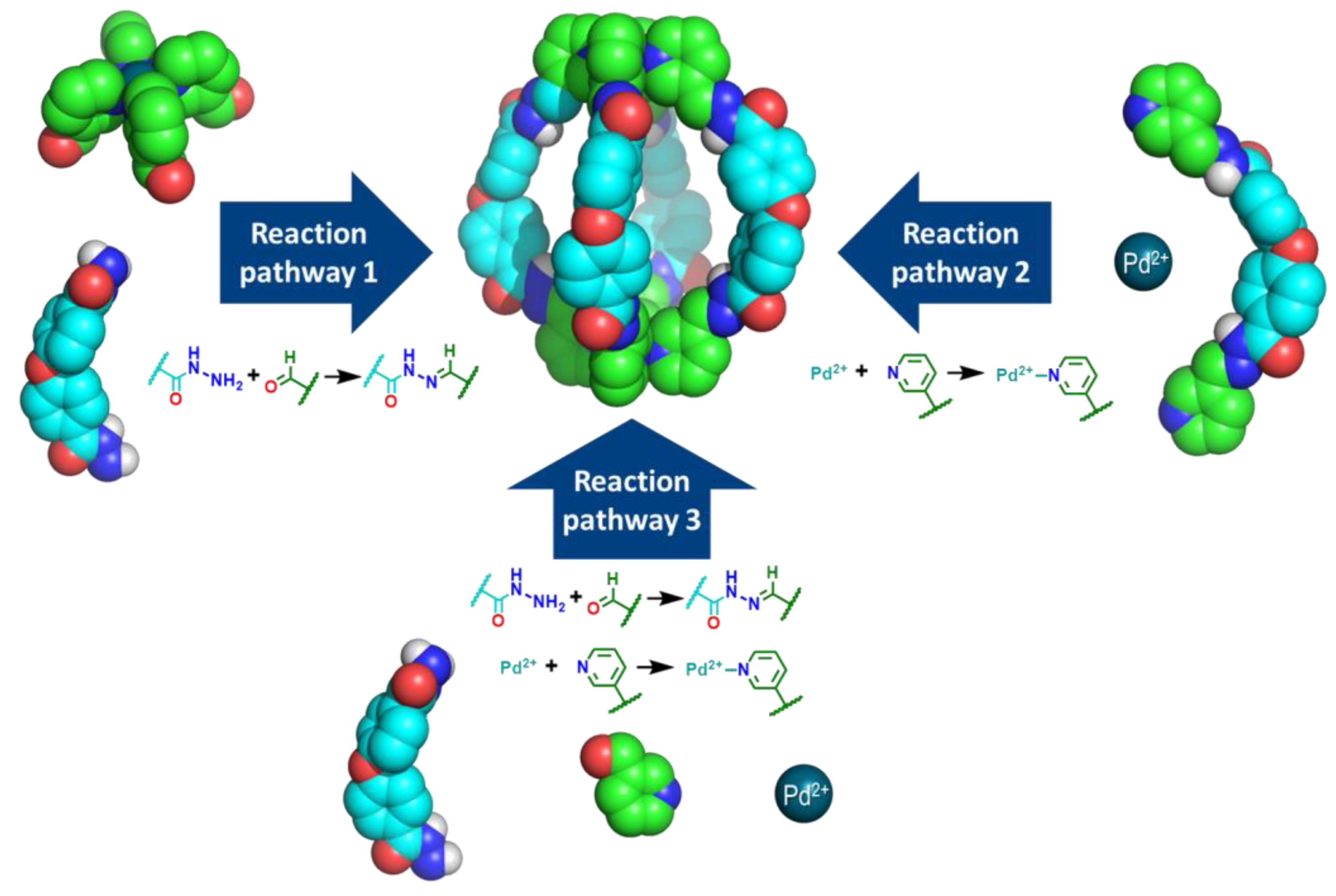
Figure 2.
The three possible reaction pathways for the self-assembly of cage C1 by Pd–pyridine and hydrazone bond formation. The lettering corresponds to the assignment of the 1H NMR signals.
Figure 2.
The three possible reaction pathways for the self-assembly of cage C1 by Pd–pyridine and hydrazone bond formation. The lettering corresponds to the assignment of the 1H NMR signals.
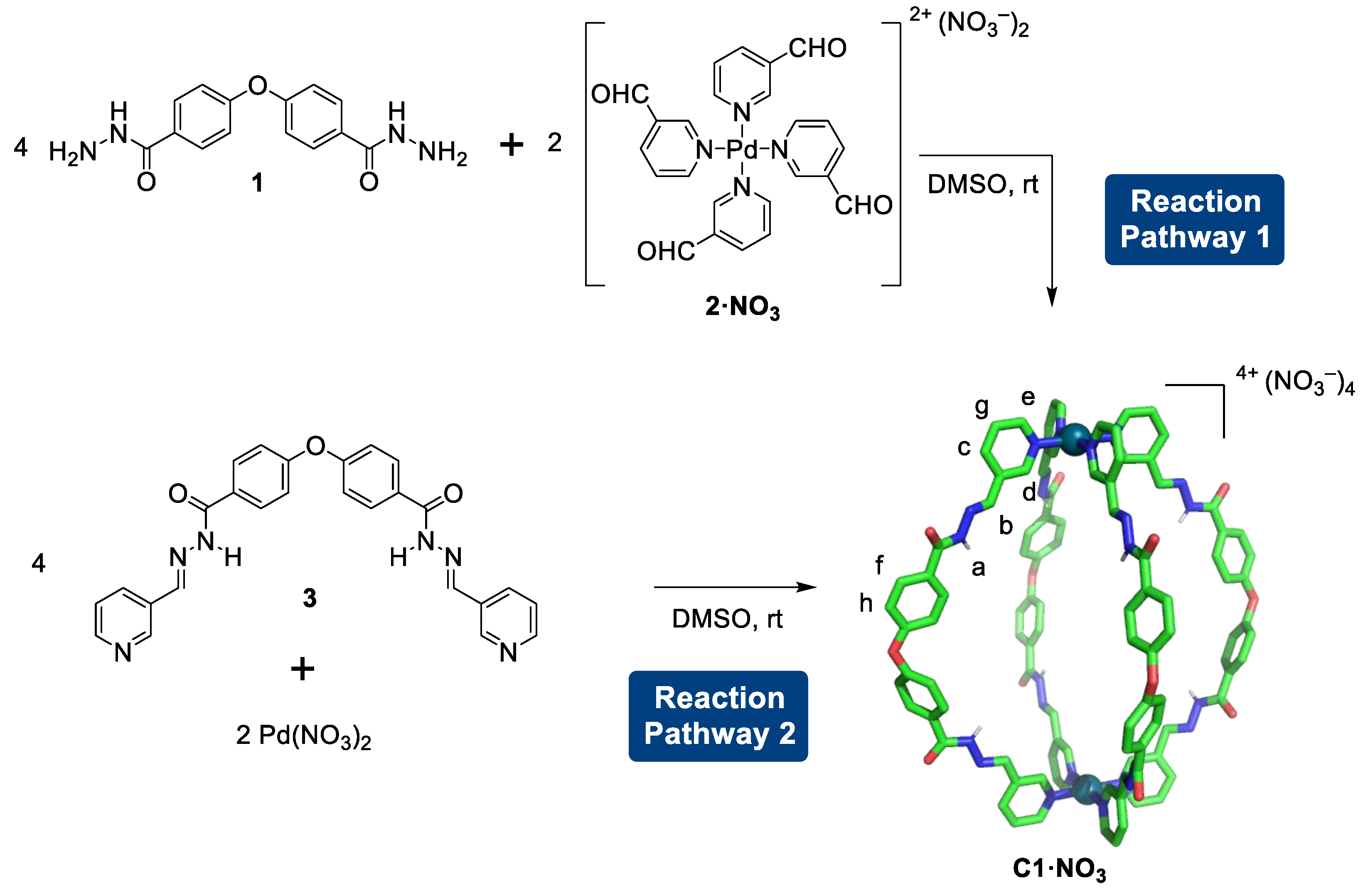
Figure 3.
Evolution of the 1H NMR (400 MHz, DMSO-d6) of the self-assembly reaction of cage C1 through reaction pathway 1 from 1 and 2. The signal at 6.86 ppm corresponds to 1,4-dimethoxybenzene used as an internal standard. The assignment of cage signals is shown in Figure 2.
Figure 3.
Evolution of the 1H NMR (400 MHz, DMSO-d6) of the self-assembly reaction of cage C1 through reaction pathway 1 from 1 and 2. The signal at 6.86 ppm corresponds to 1,4-dimethoxybenzene used as an internal standard. The assignment of cage signals is shown in Figure 2.
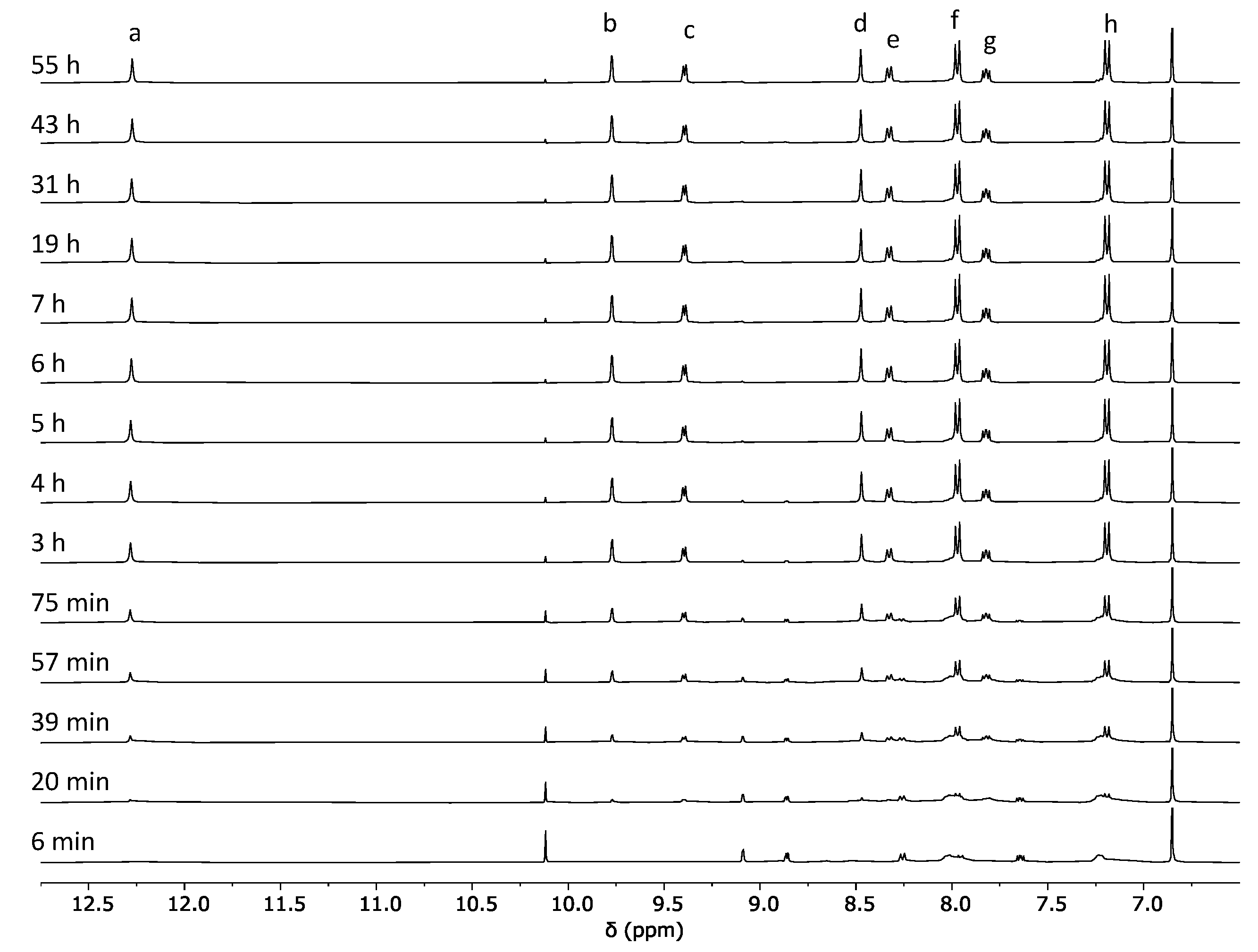
Figure 4.
Evolution of the 1H NMR (400 MHz, DMSO-d6) of the self-assembly reaction of cage C1 through reaction pathway 2 from 3 and Pd(NO3)2. The signal at 6.86 ppm corresponds to 1,4-dimethoxybenzene used as an internal standard. The assignment of cage signals is shown in Figure 2.
Figure 4.
Evolution of the 1H NMR (400 MHz, DMSO-d6) of the self-assembly reaction of cage C1 through reaction pathway 2 from 3 and Pd(NO3)2. The signal at 6.86 ppm corresponds to 1,4-dimethoxybenzene used as an internal standard. The assignment of cage signals is shown in Figure 2.
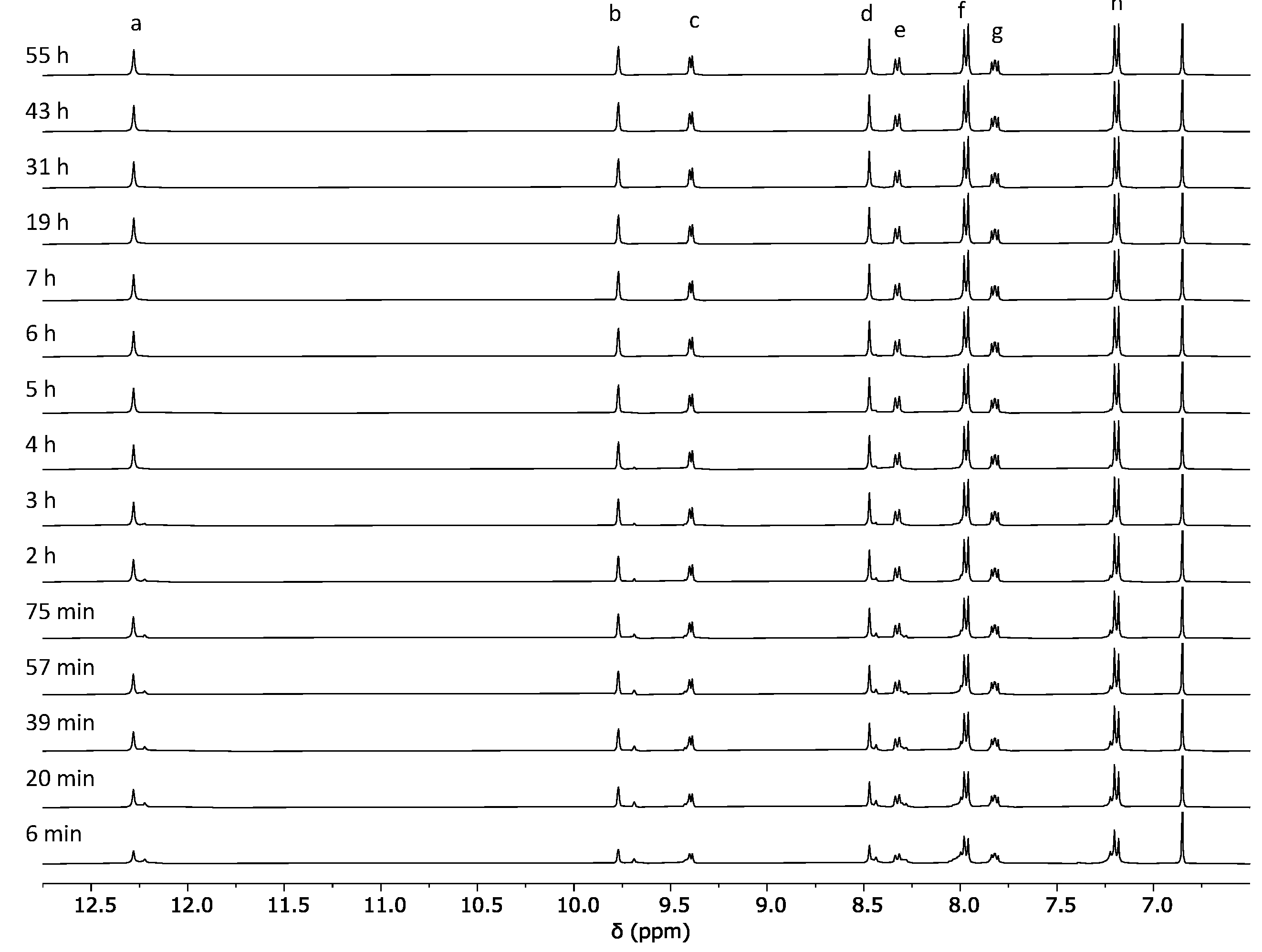
Figure 5.
Evolution of the 1H NMR (400 MHz, DMSO-d6) of the self-assembly reaction of cage C1 through reaction pathway 3 from 1, Pd(NO3)2, and 3-pyridinecarboxaldehyde. The signal at 6.86 ppm corresponds to 1,4-dimethoxybenzene used as an internal standard. The assignment of cage signals is shown in Figure 2.
Figure 5.
Evolution of the 1H NMR (400 MHz, DMSO-d6) of the self-assembly reaction of cage C1 through reaction pathway 3 from 1, Pd(NO3)2, and 3-pyridinecarboxaldehyde. The signal at 6.86 ppm corresponds to 1,4-dimethoxybenzene used as an internal standard. The assignment of cage signals is shown in Figure 2.
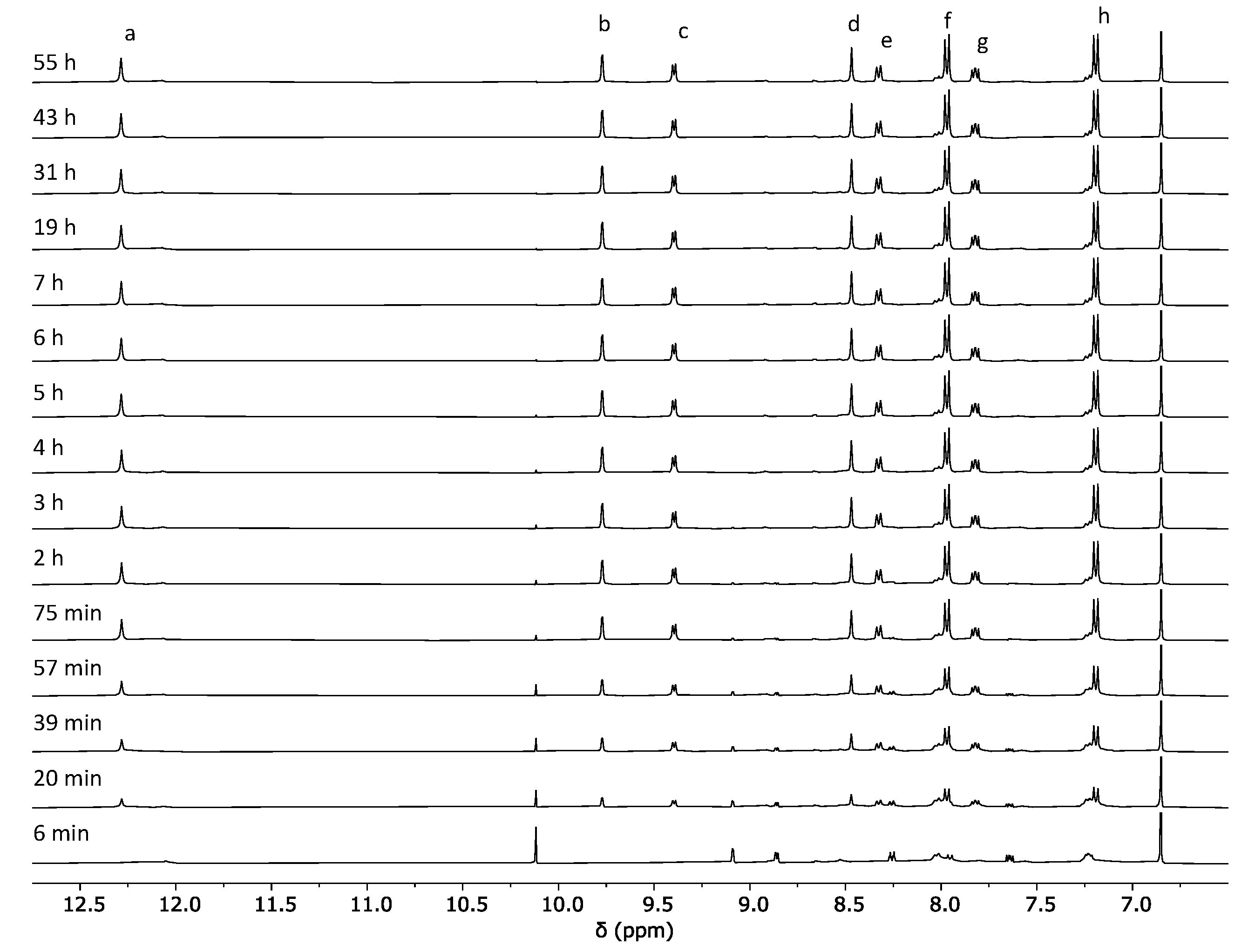
Figure 6.
Evolution of the cage C1 formation for the self-assembly reaction through reaction pathways 1 (green), 2 (orange), and 3 (blue). Cage formation yields have been determined by 1H NMR using the integrals of the signals of the cage and 1,4-dimethoxybenzene which has been used as an internal standard.
Figure 6.
Evolution of the cage C1 formation for the self-assembly reaction through reaction pathways 1 (green), 2 (orange), and 3 (blue). Cage formation yields have been determined by 1H NMR using the integrals of the signals of the cage and 1,4-dimethoxybenzene which has been used as an internal standard.
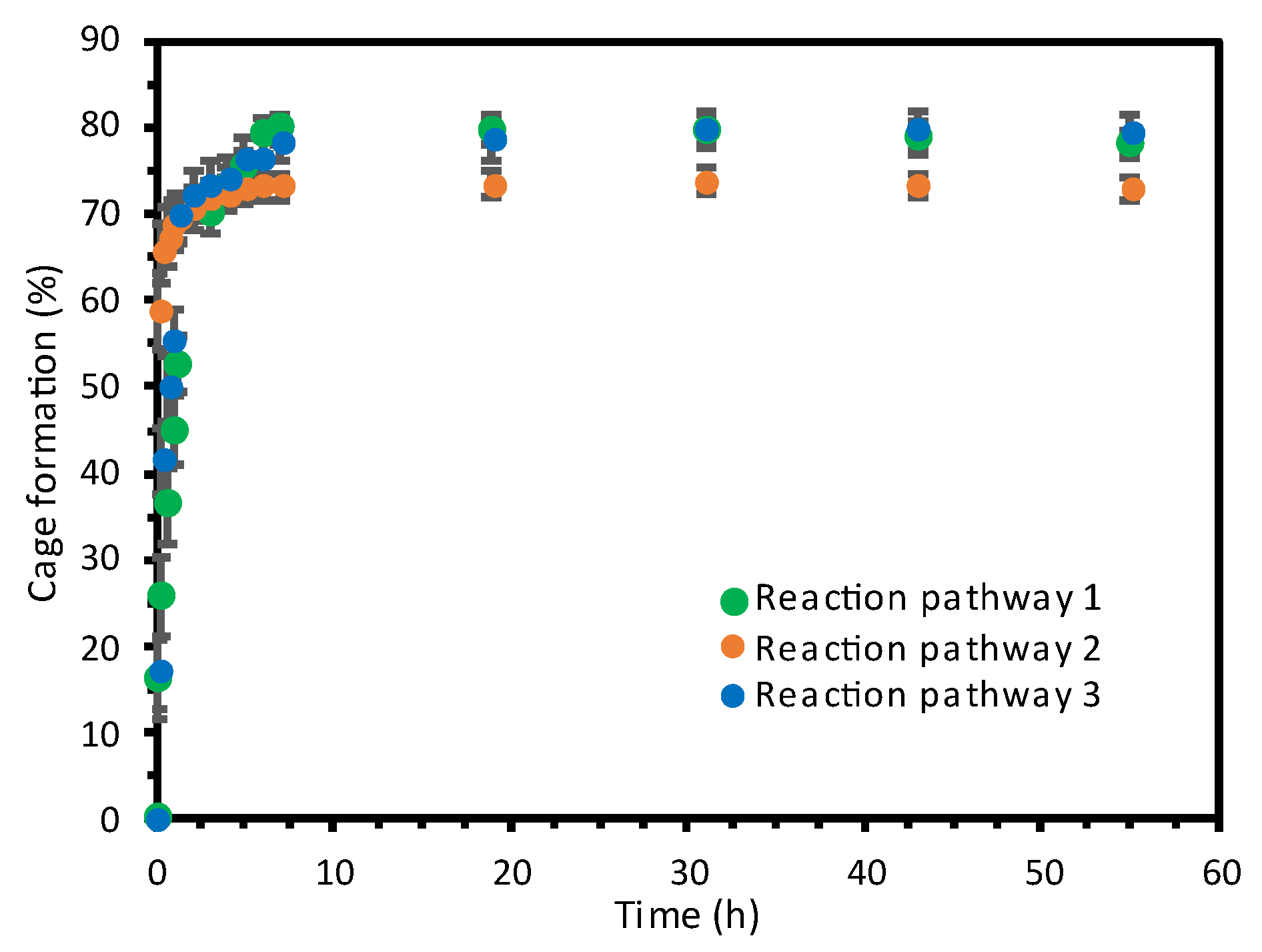
Figure 7.
Comparison of the 1H NMR obtained at 55 hours for the self-assembly reaction of cage C1 through reaction pathways 1, 2, and 3. The signal at 6.86 ppm corresponds to 1,4-dimethoxybenzene used as an internal standard.
Figure 7.
Comparison of the 1H NMR obtained at 55 hours for the self-assembly reaction of cage C1 through reaction pathways 1, 2, and 3. The signal at 6.86 ppm corresponds to 1,4-dimethoxybenzene used as an internal standard.
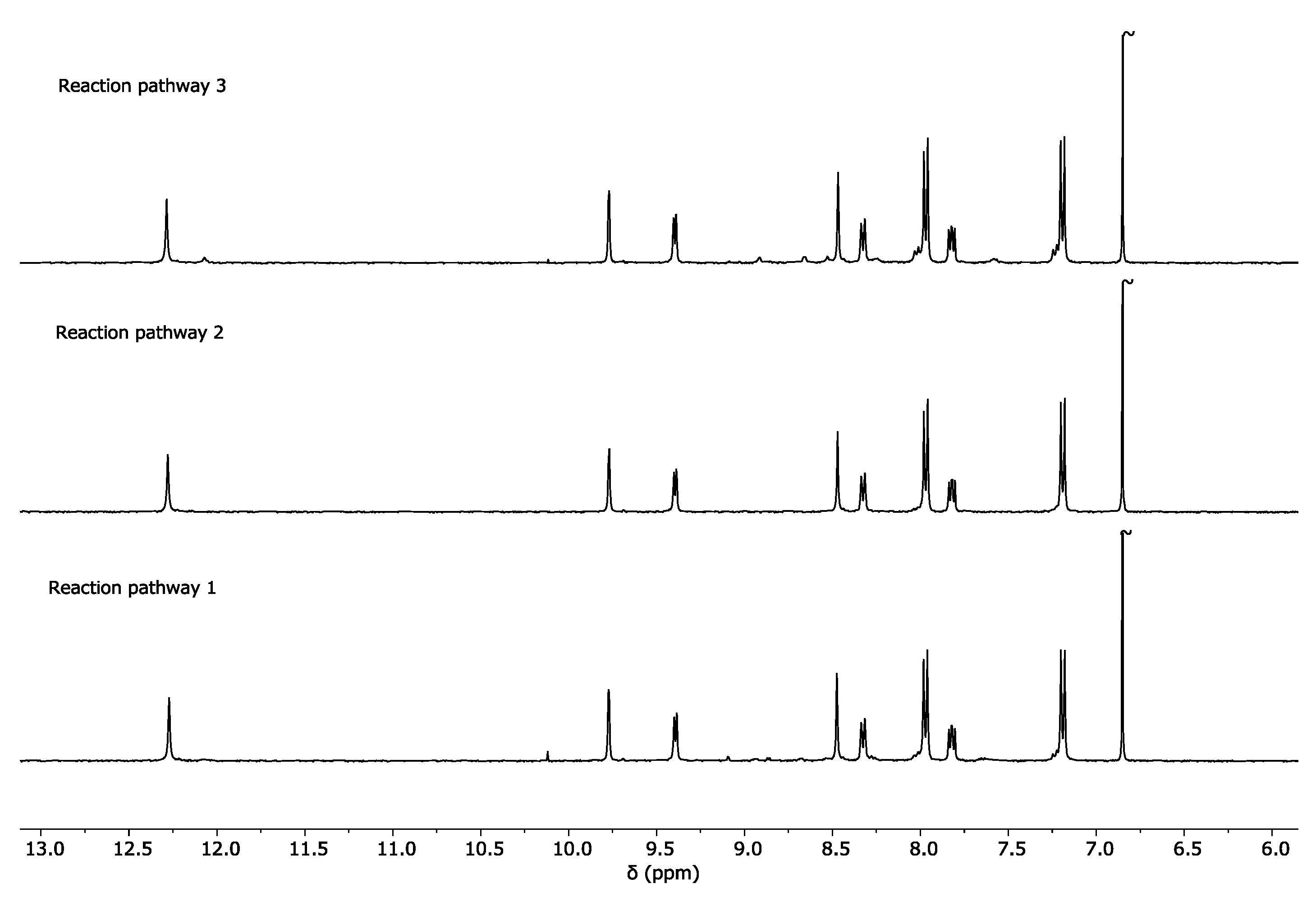
Figure 8.
(a) Crystal structure of cage C1·NO3 (CCDC 2295536).34 (b) Chemical representation of the structure of cage C1 highlighting the ideal 120 º angle of the ligand. (c–e) A conformational search performed at MMFF level of theory using the software Wavefunction Spartan 20 (overlay of the found conformers in a 2 kcal/mol energy window).
Figure 8.
(a) Crystal structure of cage C1·NO3 (CCDC 2295536).34 (b) Chemical representation of the structure of cage C1 highlighting the ideal 120 º angle of the ligand. (c–e) A conformational search performed at MMFF level of theory using the software Wavefunction Spartan 20 (overlay of the found conformers in a 2 kcal/mol energy window).

Disclaimer/Publisher’s Note: The statements, opinions and data contained in all publications are solely those of the individual author(s) and contributor(s) and not of MDPI and/or the editor(s). MDPI and/or the editor(s) disclaim responsibility for any injury to people or property resulting from any ideas, methods, instructions or products referred to in the content. |
© 2024 by the authors. Licensee MDPI, Basel, Switzerland. This article is an open access article distributed under the terms and conditions of the Creative Commons Attribution (CC BY) license (http://creativecommons.org/licenses/by/4.0/).
Copyright: This open access article is published under a Creative Commons CC BY 4.0 license, which permit the free download, distribution, and reuse, provided that the author and preprint are cited in any reuse.


