

Submitted:
22 November 2024
Posted:
25 November 2024
You are already at the latest version
Abstract
A game problem of structural design is defined as a problem of playing against external circumstances. There are two classes of players, the “ordinal” and “cardinal” players. The ordinal players, designated as the "operator" and "nature," endeavor to respectively minimize or maximize the payoff function, operating within the constraints of limited resources. The fundamental premise of this study is that action of player “nature” is a priori unknown. Statistical decision theory addresses decision-making scenarios where these probabilities, whether or not they are known, must be considered. The solution to the substratum game is expressed as a value of the game “against nature”. The structural optimization extension of the game considers the value of game “against nature” as the function of the certain parameters. Thus, value of the game is contingent upon the design parameters. The cardinal players, "designers", make choice of the design parameters. There are two formulations of the optimization. For the se single cardinal player, the pursuit of the maximum and minimum values of the game reduces to the problem of optimal design. In the second formulation, there are multiple cardinal players with conflicting objectives. Accordingly, the superstratum game emerges, which addresses the interests of the superstratum players. Finally, the optimal design problems for games with closed forms are presented. The game formulations could be applied for optimal design with uncertain loading, considering “nature” as the source for uncertainty.
Keywords:
1. Introduction
- The fundamental premise of this study is that the probability distribution governing nature's "choice" of states remains unknown. Statistical decision theory addresses decision-making scenarios where these probabilities, whether objective or subjective, are pertinent factors.
- In classical structural optimization, the "cardinal" players are responsible for assuming the role of “design parameters” or "control functions". If the number of design freedoms is finite, one speaks about “design parameters”. For the continuous design freedom, the "control functions" are involved according to Pontryagin's maximum principle (Geering, 2007). In actual context, the "cardinal" players modify the governing equations and payoff functions in the game formulations (Eschenauer, Koski, & J., 1990). In structural optimization, the "cardinal" players are responsible for determining the coefficients of the governing equations. In essence, their function is to establish the rules of engagement, which may result in conflict between certain players. In the context of the stratified game approach, the "cardinal" players form the "superstratum", or the upper level of the game. The "cardinal payers" are designated as "designers" due to their capacity to alter, for instance, the coefficients of matrices in matrix games with the objective of attaining a superior value for the game.
- Furthermore, other participants act in accordance with the governing equations, which are determined by the "cardinal" players. In the context of the stratified game approach, the "ordinal" players represent the "substratum." "Ordinal" players are permitted to make decisions within their respective stratum, but they are unable to impact the governing equations. The “ordinal” payers could be referred to as “nature” or “operators”. Certain "ordinal" participants represent the external forces. These external factors are typically referred to as "nature." For the sake of clarity, it may be more appropriate to refer to Nature's strategies as "states" rather than strategies. Such games are therefore classified as "games against nature." (Szép & Forgó, Games against nature., 1985) . The remaining "ordinal" participants aim to offset the impact of "nature" in order to mitigate potential risks or to achieve the most favorable outcome. (Kobelev, On a game approach to optimal structural design., 1993) For the sake of clarity, these participants will henceforth be referred to as "operators" and “nature”. In the case of antagonistic matrix game, the payout matrix is only relevant for “operators”. The role of “cardinal players” is inherited from the common optimization formulations.
- The conflict between the two "ordinal" players, namely "nature" and "operators" is studied for the linearly summed resources using the common principles of game theory (Tadelis, 2013). This case is typical for interdependent decision making in operational research and social games.
- The application of game formulations for problems of engineering and natural sciences assumes the quadratically summed resources of the ordinal players. The solution of matrix and bi-matrix games with the quadratically summed resources is essential for application of game-theoretical approach to the engineering and physical tasks.
- In the matrix game, there is a single payoff matrix. From the perspective of optimization theory, there is a single objective function. In consequence, the optimization problem is of a scalar nature. This value represents the goal function of the matrix game. At the low-level (substratum level), the win of “nature” is the loss of the “operator” This game is antagonistic, with a single goal function. Theory of quadratically constrained matrix and bi-matrix games is presented in Section 2 and Section 3.
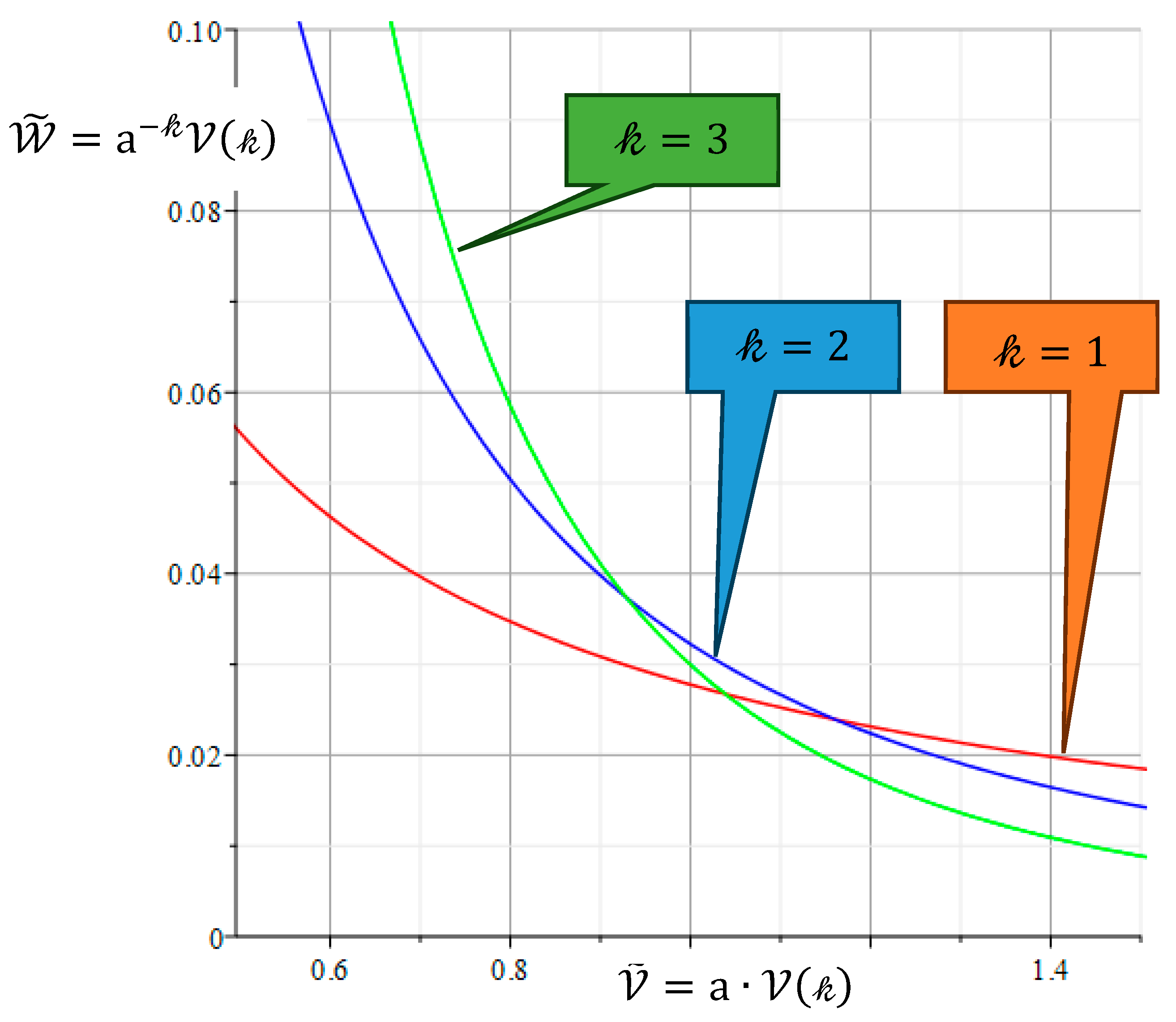
- The solution of the stratified matrix game is presented in Section 2. In a bi-matrix game, payoff matrices are employed. From the perspective of optimization theory, there are two distinct goal functions. The optimization problem is of vector type. These goal functions are derived from the solution of a bi-matrix game. The equilibrium between the interests of "nature" and "operator" results in a solution to the game at the lower level. The designer determines the optimal value for the goal function in accordance with the methods of vector optimization. The solution of the stratified bi-matrix game is presented in Section 3.
- In Section 4 the results of the aforementioned sections are generalized for self-adjoint positive definite differential operators. The optimization of elastic energy was selected as an example of optimization task with closed form of solution. Action of “Nature” is the external load. The load that results in the greatest structural response among all permissible loads, represents the strategy of “nature” in low-level task. The upper value of the game could be determined in all cases. The third player, “designer” acts on the upper-level. “Designer” determines the optimal value for the aforementioned goal function, manipulating the “design variables”. Designer optimizes the upper value, creating the stiffer structural element for the most dangerous action of “nature”. The corresponding examples are given in Sections 4 to 7.
- For special type of game with the stored energy, the value of the game is shown to be equal to the eigenvalue of structural matrix. The optimal strategies of the "operator" and "nature" are uniquely determined. In the simplest formulation, the resources of “operator” are limited to zero. In this case, there is no opposite reaction to all possible actions of “nature” on the lower level. In this case, the role of the opposite player takes the cardinal player, “designer”. The "designer" modifies the coefficients of the payoff matrix, while "nature" alters both the left and right vectors of the payoff function
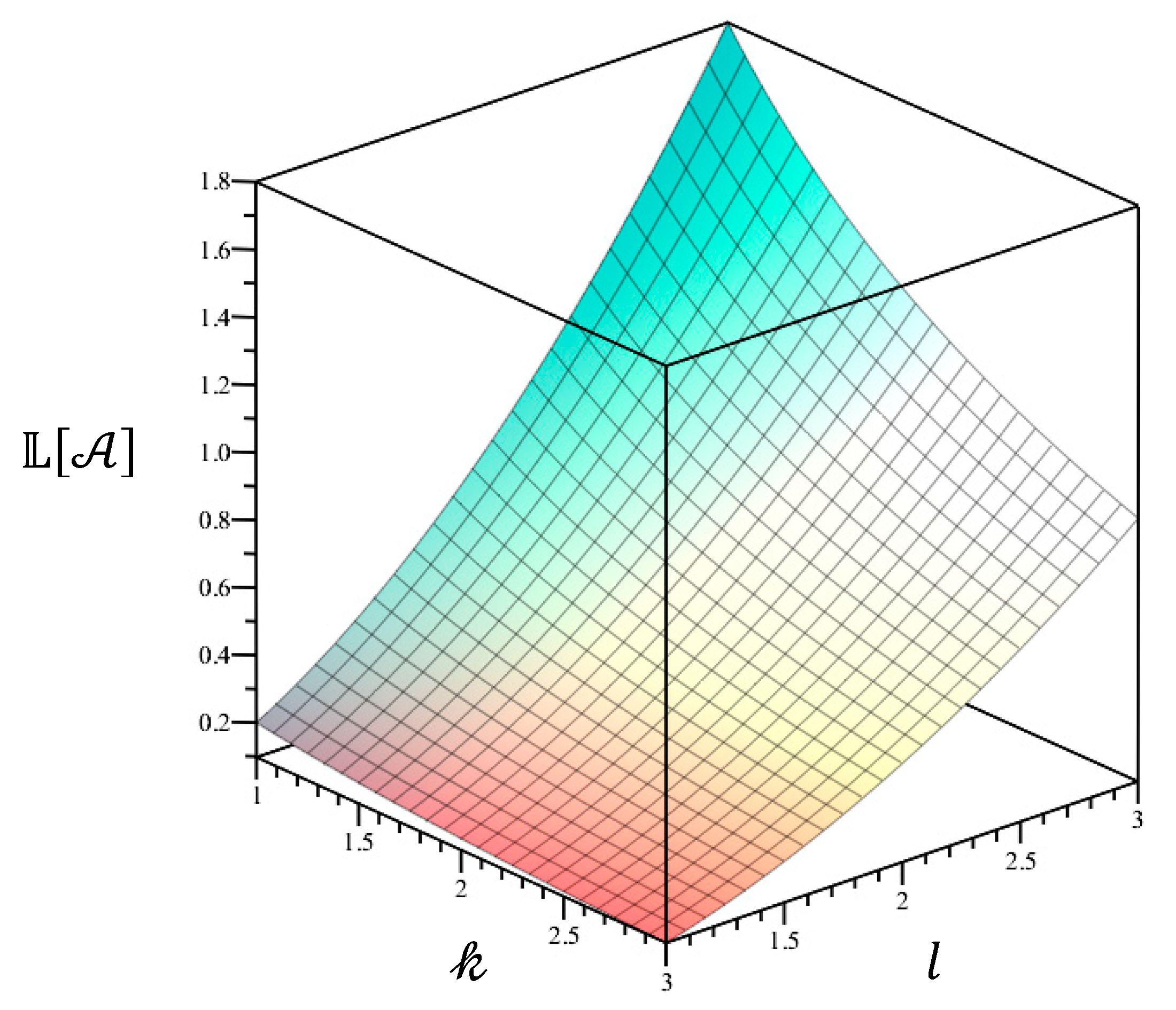
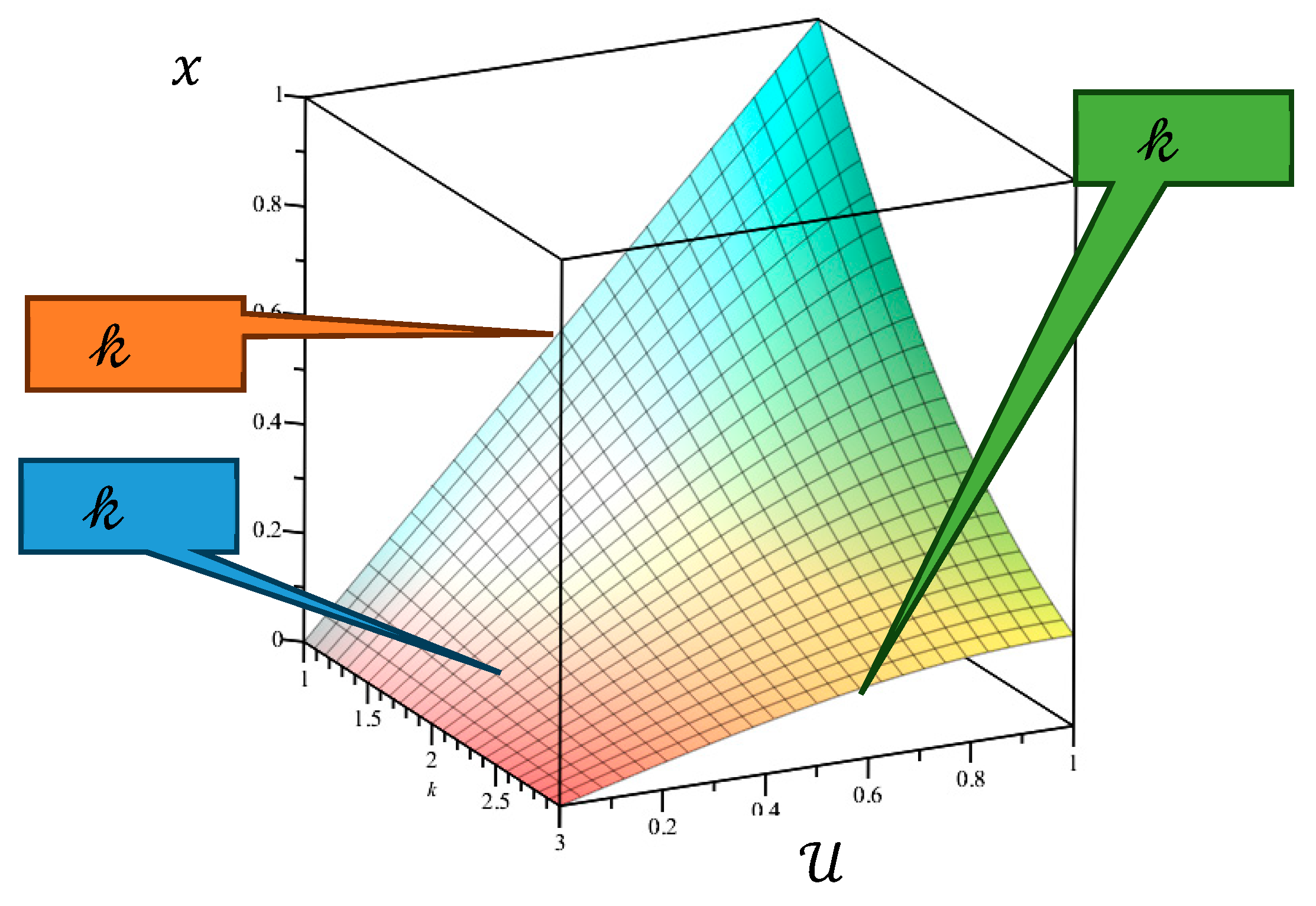
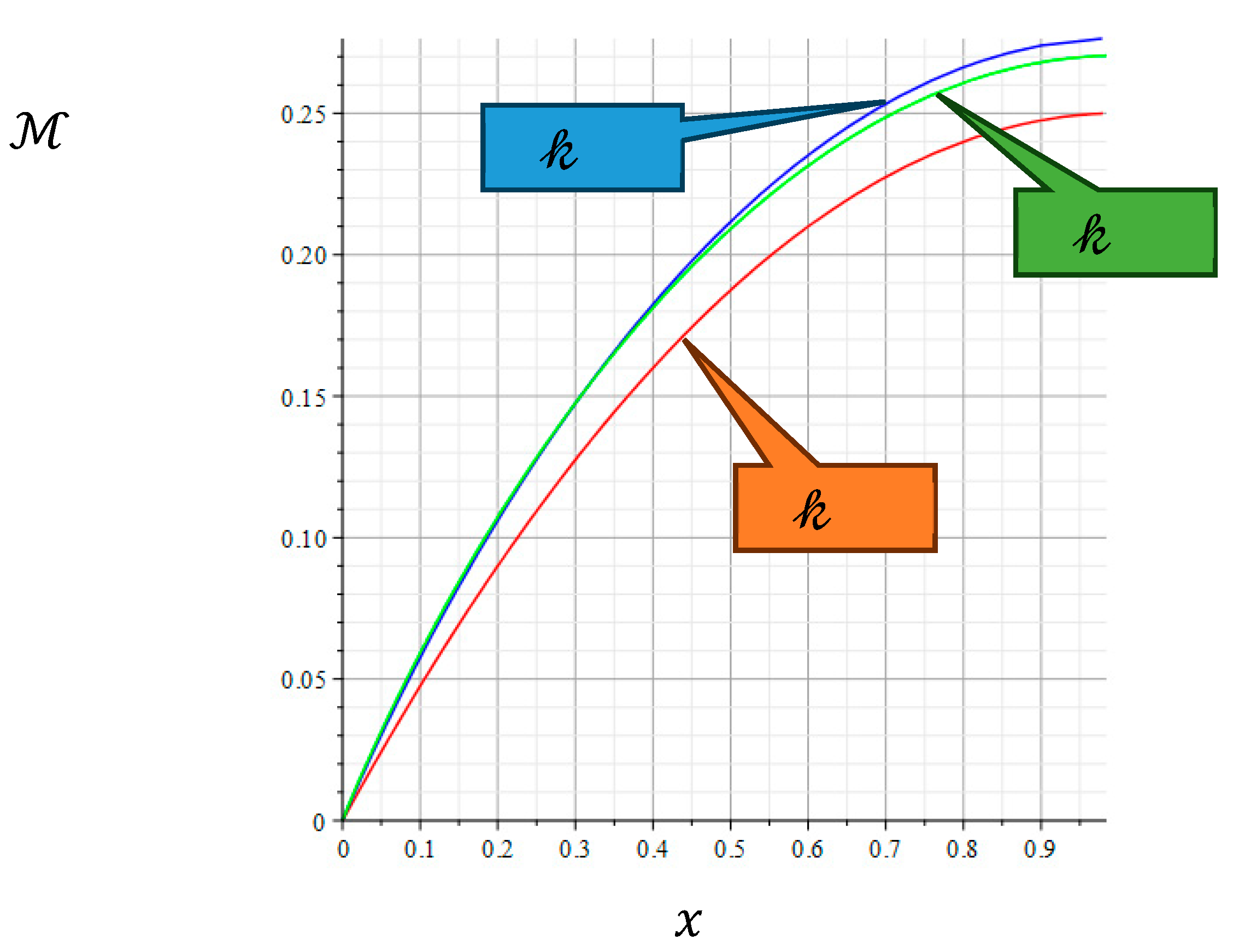
- The application of the aforementioned considerations to structural optimization problems will be discussed in the following sections. The Section 5 and Section 6 demonstrate the applications of the developed technique for the structural optimization problems with the continuous control functions. In Section 5, the beam is subjected to arbitrary bending efforts, and the designer determines the optimal beam shape for resisting these forces. In Section 6, the rod is subjected to arbitrary twist moments, and the designer determines the optimal design of the twisted bar, ensuring the greatest stiffness.
2. Antagonistic Matrix Stratified Games
3. Bi-Matrix Stratified Games
4. Optimization Games with one “Cardinal Player”
5. Game Formulation for the Beam Subjected to Arbitrary Bending Moments

| 1 | |
| 2 |
| 1 | |||
| 2 | |||
| 3 |
6. Game Formulation for the Rod Subjected to Arbitrary Torque
| 1 | 1 | |
| 2 | ||
| 3 |
7. Nash and Pareto fronts
8. Conclusions
Funding
Conflicts of Interest
Replication of results
References
- Banichuk, N. V. (1973). On the game theory approach to problems of optimization of elastic bodies. Journal of Applied Mathematics and Mechanics, Volume 37, Issue 6, p. 1042-1052. [CrossRef]
- Banichuk, N. V. (1990). Introduction to Optimization of Structures. New York: Springer-Verlag.
- Battoo, R. (1999). An introductory guide to literature in aeroelasticity. . Aeronautical J., 103(1029):511-518. [CrossRef]
- Biezeno, C. B., & Grammel, R. (1956). Engineering Dynamics. London: Blackie.
- Borm, P., Tijs, S., & van den Aarssen, J. (1988). Pareto equilibria in multiobjective games. Tilburg : Tilburg University, School of Economics and Management. https://research.tilburguniversity.edu/en/publications/pareto-equilibria-in-multiobjective-games.
- Courant, R., & Hilbert, D. (2004). Methods of Mathematical Physics. https://doi/10.1002/9783527617210 : WILEY-VCH Verlag GmbH & Co. KGaA,.
- Cox, S. J., & Overton, M. L. (1992). On the Optimal Design of Columns Against Buckling. SIAM Journal on Mathematical Analysis, Vol. 23, Iss. 2. [CrossRef]
- Denardo, E. (2011). A Bi-Matrix Game. Chapter 15,. In Linear Programming and Generalizations, International Series, Ser. Operations Research & Management Science 149, (pp. Springer Science+Business Media: Berlin. [CrossRef]
- Ehrgott, M. (2005). Multicriteria Optimization. Berlin Heidelberg, Springer-Verlag. [CrossRef]
- Eschenauer, H., Koski, J., & J., O. (1990). Multicriteria Design Optimization: Procedures and Applications. Berlin, Heidelberg: Springer-Verlag.
- Fernandez, F. R., Monroy, L., & Puerto, J. (1988). Multicriteria Goal Games. Journal of Optimization Theory and Applications, Vol. 99, No. 2, pp. 403-421, https://link.springer.com/article/10.1023/A:1021726311384 .
- Geering, H. P. (2007). Optimal Control with Engineering Applications. NY, ISBN 978-3-540-69437-3: Springer.
- Greiner, D., Periaux, J., Emperador, J. M., Galván, B., & Winter, G. (2017). Game Theory Based Evolutionary Algorithms: A Review with Nash Applications in Structural Engineering Optimization Problems. Archives of Computational Methods in Engineering,, Volume 24, Number 4, Page 703. [CrossRef]
- Henrot, A. (2006). Extremum Problems for Eigenvalues of Elliptic Operators. In Frontiers in Mathematics (pp. https://doi.org/10.1007/3-7643-7706-2). Basel: Birkhäuser. [CrossRef]
- Holmberg, E., Thore, C., & Klarbring, A. (2017). Game theory approach to robust topology optimization with uncertain loading. Struct Multidisc Optim, 55, 1383–1397. [CrossRef]
- Kesavan, S. (2022). Nonlinear Functional Analysis: A First Course. Singapore: Springer.
- Kobelev, V. (1993). On a game approach to optimal structural design. Struct Multidisc Optimization, 6, 194-199. [CrossRef]
- Kobelev, V. (2014). Comment to the Article “Several Examples of Application of Nash and Pareto Approaches to Multiobjective Structural Optimization with Uncertainties” of N. V. Banichuk, F. Ragnedda, M. Serra. Mechanics Based Design of Structures and Machines, 42:1, 130-133. [CrossRef]
- Kobelev, V. (2023). Optimization of Compressed Rods with Sturm Boundary Conditions. In V. Kobelev, Fundamentals of Structural Optimization. Mathematical Engineering. (pp. https://doi.org/10.1007/978-3-031-34632-3_5). Cham: Springer.
- Kobelev, V. (2023). Stability Optimization of Twisted Rods. In V. Kobelev, Fundamentals of Structural Optimization (pp. https://doi.org/10.1007/978-3-031-34632-3_7 ). Cham: Springer.
- Lemke, C. E., & Howson, J. T. (1964). Equilibrium Points of Bi-Matrix Games. SIAM Journal, V. 12, pp. 413-423,.
- Lewis, A., & Overton, M. (1996). Eigenvalue optimization. Acta Numerica, 5:149-190. [CrossRef]
- McIntosh, S. C., Weisshaar, T. A., & Ashley, H. (1969). Progress in Aeroelastic Optimization - Analytical Versus Numerical Approaches. AIAA Structural Dynamics and Aeroelasticity Specialist Conference, SUDAAR NO. 383. New Orleans: AIAA .
- Monfared, M. S., Monabbati, S. E., & A Kafshgar, R. (2021). Pareto-optimal equilibrium points in non-cooperative multi-objective optimization problems . Expert Systems with Applications , 114995. [CrossRef]
- Nash, J. (1951). Non-cooperative games. Annals of Mathematics. 2nd Ser., 54 (2): 286–295. JSTOR 1969529. [CrossRef]
- Parlett, B. N. (1998). The symmetric eigenvalue problem. Classics in Applied Mathematics, 20.
- Reddy, J. N. (2002). Energy Principles and Variational Methods in Applied Mechanics. Wiley.
- Szép, J., & Forgó, F. (1985). Bimatrix games. In J. Szép, & F. Forgó, Introduction to the Theory of Games. Mathematics and Its Applications, Vol 17 (pp.). Dordrecht: Springer. [CrossRef]
- Szép, J., & Forgó, F. (1985). Games against nature. In J. Szép, & F. Forgó, Introduction to the Theory of Games. Mathematics and Its Applications, vol 17. (pp.). Dordrecht: Springer. [CrossRef]
- Szép, J., & Forgó, F. (1985). Games played over the unit square. In J. Szép, & F. Forgó, Introduction to the Theory of Games. Mathematics and Its Applications, vol 17 (pp.). Dordrecht: Springer. [CrossRef]
- Tadelis, S. (2013). Game Theory. An Introduction. Princeton and Oxford: Princeton University Press.
- Thore, C., Holmberg, E., & Klarbring, A. (2017). A general framework for robust topology optimization under load-uncertainty including stress constraints. Computer Methods in Applied Mechanics and Engineering,, Volume 319. [CrossRef]
- Thore, C.-J., Alm Grundström, H., & Klarbring, A. (2020). Game formulations for structural optimization under uncertainty. Int J Numer Methods Eng., 121: 165–185. [CrossRef]
- von Neumann, J. (1928). Zur Theorie der Gesellschaftsspiele. Math. Ann. , https://link.springer.com/content/pdf/10.1007/BF01448847.pdf .
- von Neumann, J., & Morgenstern, O. (2004). Theory of Games and Economic Behavior. Princeton: Princeton University Press. [CrossRef]
- Werner, D. (2018). Normierte Räume. In D. Werner, Funktionalanalysis. Springer-Lehrbuch. . Berlin, Heidelberg: Springer Spektrum. [CrossRef]
- Wilkinson, J. H. (1965). The algebraic eigenvalue problem, Volume 662. Oxford: Clarendon .
- Zettl, A. (2005). Sturm–Liouville Theory. Providence: American Mathematical Society.
- Zhang, F. (2011). Matrix Theory, Basic Results and Techniques. New York: Springer. [CrossRef]
| Solid or (filled) cross section | equilateral triangle | regular hexagon | square | circular area |
| side length of | radius | |||
| area | ||||
| area moment of inertia | ||||
| shape factor | ||||
Disclaimer/Publisher’s Note: The statements, opinions and data contained in all publications are solely those of the individual author(s) and contributor(s) and not of MDPI and/or the editor(s). MDPI and/or the editor(s) disclaim responsibility for any injury to people or property resulting from any ideas, methods, instructions or products referred to in the content. |
© 2024 by the authors. Licensee MDPI, Basel, Switzerland. This article is an open access article distributed under the terms and conditions of the Creative Commons Attribution (CC BY) license (http://creativecommons.org/licenses/by/4.0/).