Preprint
Article

This version is not peer-reviewed.

Some Approximation Properties of Two Dimensional Chlodovsky-Bernstein Operators Based on (P, Q) Integer

A peer-reviewed article of this preprint also exists.

Submitted:

12 October 2024

Posted:

15 October 2024

You are already at the latest version

Abstract
In the present study, we introduce the two dimensional Chlodovsky type Bernstein operators based on (p,q)−integer. We examine approximation properties of our new operator by the help of Korovkin-type theorem. Further, we present the local approximation properties and establish the rates of convergence by means of the modulus of continuity and the Lipschitz type maximal function. Also, we give a Voronovskaja type theorem for this operators. And, we investigate weighted approximation properties of these operators and estimate rate of convergence in the same space. Finally, with the help of Maple, illustrative graphics show the rate of convergence of these operators to certain functions . The optimization of approximation speeds by operators during system control provides significant improvements in stability and performance. As a result, the control and modeling of dynamic systems become more efficient and effective through innovative methods. These advancements in the fields of modeling fractional differential equations and control theory offer substantial benefits to both modeling and optimization processes, expanding the range of applications in these areas.
Keywords: 
;  ;  ;  ;  ;  

1. Introduction

Approximation theory is fast becoming a key instrument not only in classical approximation theory but also in other fields of mathematics such as differential equations, orthogonal polynomials and geometric design. Since Korovkin’s famous theorem was first published in 1950, the issue of approximation by linear positive operators has became increasingly important area as part of approximation theory. A considerable amount of literature has been published on that [1,2,10,12,14,15,23,24].
In the past two decades, the applications of q calculus in approximation theory have been studied extensively. Firstly, the Bernstein polynomials based on q integers was done by Lupaş [6]. As approximation of q Bernstein polynomials studied by Lupaş is better than classical one under convenient choice of q, many authors introduced q-generalization of many operators and examined several approximation properties. Several studies have revealed that [3,7,8,13].
In recent years, Mursaleen et al. have focused on ( p , q ) -calculus in approximate by linear positive operator and proposed ( p , q ) analogue of Bernstein operators [20,21]. They computed uniform convergence of the operators and rate of convergence. For some recent study directed to ( p , q ) -operators, we can refer the readers to [17,18,19,26,27].
The main motivation in this paper, to the best of authors knowledge, no study about approximate two variable operator has been found so far using ( p , q ) calculus. In the present study, we define the two dimensional Chlodovsky type Bernstein operators based on ( p , q ) integer. We examine approximation properties of our new operator by the help of Korovkin-type theorem. In addition, we present the local approximation properties and establish the rates of convergence by means of the modulus of continuity and the Lipschitz type maximal function. Also, we give a Voronovskaja type theorem for this operators. Another important aim of this study is to examine weighted approximation properties of these our operators on R + 2 = [ 0 , ) × [ 0 , ) . In order to get these results, we will apply the weighted Korovkin type theorem.
Let us recall some definitions and notations regarding the concept of ( p , q ) calculus. The ( p , q ) integer of the number n is defined by
n p , q : = p n q n p q , n = 1 , 2 , 3 , 0 < q < p 1 .
The ( p , q ) factorial n p , q ! and the ( p , q ) binomial coefficients are defined as :
n p , q ! : = n p , q n 1 p , q 1 p , q , n N 1 , n = 0 .
and
n k p , q = n p , q ! k p , q ! n k p , q ! , 0 k n .
Further, the ( p , q ) binomial expansions are given as
( a x + b y ) p , q n = k = 0 n p n k 2 q k 2 a n k b k x n k y k .
and
( x y ) p , q n = ( x y ) ( p x q y ) ( p 2 x q 2 y ) ( p n 1 x q n 1 y ) .
Further information related to ( p , q ) calculus can be found in [25,28].

2. Construction of the Operators

Recently, Ansari and Karaisa [16] have defined and studied ( p , q ) analogue of Chlodovsky operators as follows:
C n , p , q f ; x = 1 p n ( n 1 ) / 2 k = 0 n n k p , q p k ( k 1 ) / 2 x b n k 1 x b n p , q n k 1 f k p , q n p , q p k n b n ,
where
1 x b n p , q n k 1 = s = 0 n k 1 p s q s x b n .
For 0 < q 1 , q 2 < p 1 , p 2 1 , we define Chlodovsky type two dimensional Bernstein operator based on ( p , q ) integers as follows:
C n , m ( p 1 , q 1 ) , ( p 1 , q 1 ) f ; x , y = k = 0 n j = 0 m Φ n , k ( p 1 , q 1 ; x ) Φ m , j ( p 2 , q 2 ; y ) f k p 1 , q 1 n p 1 , q 1 p 1 k n α n , j p 2 , q 2 m p 2 , q 2 p 2 j m β m ,
for all n , m N , f C ( I α n β m ) with I α n β m = { ( x , y ) : 0 α n x , 0 β m y } and C ( I α n β m ) = { f : I α n β m R is continuous } . Here ( α n ) and ( β m ) be increasing unbounded sequences of positive real numbers such that
lim n α n [ n ] p 1 , q 1 = 0 ,
lim m β m [ m ] p 2 , q 2 = 0 .
Also, the basis elements are
Φ n , k ( p 1 , q 1 ; x ) = p 1 k ( k 1 ) n ( n 1 ) 2 n k p 1 , q 1 x α n k s = 0 n k 1 p 1 s q 1 s x α n , Φ m , j ( p 2 , q 2 ; y ) = p 2 j ( j 1 ) m ( m 1 ) 2 m j p 2 , q 2 y β m j s = 0 m j 1 p 2 s q 2 s y β m .
Now, we need following lemmas for proving our main results.
Lemma 1. [16] 
C n , p , q 1 ; x = 1 , C n , p , q e 1 ; x = x , C n , p , q e 2 ; x = p n 1 b n [ n ] p , q x + q [ n 1 ] p , q [ n ] p , q x 2 C n , p , q e 3 ; x = b n 2 x [ n ] p , q 2 p 2 n 2 + ( 2 p + q ) q [ n 1 ] p , q x 2 b n [ n ] p , q 2 p n 1 + q 3 [ n 1 ] p , q [ n 2 ] p , q x 3 [ n ] p , q 2 , C n , p , q e 4 ; x = b n 3 x [ n ] p , q 3 p 3 n 3 + q ( 3 p 2 + 3 q p + q 3 ) [ n 1 ] p , q b n 2 x 2 [ n ] p , q 3 p 2 n 4 + q 3 ( 3 p 2 + 2 p q + q 2 ) [ n 1 ] p , q [ n 2 ] p , q b n x 3 [ n ] p , q 3 p n 3 + q 6 [ n 1 ] p , q [ n 2 ] p , q [ n 3 ] p , q x 4 [ n ] p , q 3 .
From Lemma 1, we have following:
Lemma 2. 
C n , m ( p 1 , q 1 ) , ( p 2 , q 2 ) 1 ; x , y = 1 , C n , m ( p 1 , q 1 ) , ( p 2 , q 2 ) s ; x , y = x , C n , m ( p 1 , q 1 ) , ( p 2 , q 2 ) t ; x , y = y , C n , m ( p 1 , q 1 ) , ( p 2 , q 2 ) s t ; x , y = x y , C n , m ( p 1 , q 1 ) , ( p 2 , q 2 ) s 2 ; x , y = p 1 n 1 α n [ n ] p 1 , q 1 x + q 1 [ n 1 ] p 1 , q 1 [ n ] p 1 , q 1 x 2 , C n , m ( p 1 , q 1 ) , ( p 2 , q 2 ) t 2 ; x , y = p 2 m 1 β m [ m ] p 2 , q 2 y + q 2 [ m 1 ] p 2 , q 2 [ m ] p 2 , q 2 y 2 .
Using Lemma 2 and by linearity of C n , m ( p 1 , q 1 ) , ( p 2 , q 2 ) , we have
Remark 1. 
C n , m ( p 1 , q 1 ) , ( p 2 , q 2 ) ( t x ) 2 ; x , y = p 1 n 1 x 2 [ n ] p 1 , q 1 + x p 1 n 1 α n [ n ] p 1 , q 1 ,
C n , m ( p 1 , q 1 ) , ( p 2 , q 2 ) ( s y ) 2 ; x , y = p 2 m 1 y 2 [ m ] p 2 , q 2 + y p 2 m 1 β m [ m ] p 2 , q 2 .
Theorem 1. 
Let q 1 : = ( q 1 , n ) , p 1 : = ( p 1 , n ) , q 2 : = ( q 2 , m ) , p 2 : = ( p 2 , m ) such that 0 < q 1 , n , q 2 , m < p 1 , n , p 2 , m 1 . If
lim n p 1 , n = 1 , lim n q 1 , n = 1 , lim m p 2 , m = 1 , lim m q 2 , m = 1 , lim n p 1 , n n = a 1 and lim m p 1 , m m = a 2 ,
the sequence C n , m ( p 1 , q 1 ) , ( p 2 , q 2 ) f ; x , y convergence uniformly to f ( x , y ) , on [ 0 , a ] × [ 0 , b ] = I a b for each f C I a b , where a , b be reel numbers such that a α n , b β m and C ( I a b ) be the space of all real valued continuous function on I a b with the norm
f C ( I a b ) = sup ( x , y ) I a b f ( x , y ) .
Proof. 
Assume that the equities (7),(3) and (4) are holds. Then, we have
p 1 , n n 1 α n n p 1 , n , q 1 , n 0 , p 2 , m m 1 β m m p 2 , m , q 2 , m 0 , q 1 , n n p 1 , n , q 1 , n n p 1 , n , q 1 , n 1 and q 2 , m m 1 p 2 , m , q 2 , m m p 2 , m , q 2 , m 1 .
as n , m . From Lemma 2, we obtain lim n , m C n , m ( p 1 , q 1 ) , ( p 2 , q 2 ) e i j ; x , y = e i j ( x , y ) uniformly on I a b , where e i j ( x , y ) = x i y j , 0 i + j 2 are the test functions. By Korovkin’s theorem for functions of two variables was presented by Volkov [29], it follows that lim n , m C n , m ( p 1 , q 1 ) , ( p 2 , q 2 ) f ; x , y = f ( x , y ) , uniformly on I a b , for each f C ( I a b ) . □

3. Rate of Convergence

In this section, we compute the rates of convergence of operators C n , m ( p 1 , q 1 ) , ( p 2 , q 2 ) to f ( x , y ) by means of the modulus of continuity. Proceeding further, we provide a summary of the notations and definitions of the modulus of continuity and the Peetre’s K functional for bivariate real valued functions.
For f C ( I a b ) , the complete modulus of continuity for a bivariate case is defined as follows:
ω ( f , δ ) = sup | f ( t , s ) f ( x , y ) | : ( t x ) 2 + ( s y ) 2 δ .
for every ( t , s ) , ( x , y ) I a b . Further, partial moduli of continuity with respect to x and y are defined as
ω 1 ( f , δ ) = sup | f ( x 1 , y ) f ( x 2 , y ) | : y [ 0 , b ] and | x 1 x 2 | δ ω 2 ( f , δ ) = sup | f ( x , y 1 ) f ( x , y 2 ) | : x [ 0 , a ] and | y 1 y 2 | δ ,
It is obvious that they satisfy the properties of the usual modulus of continuity [11].
For δ > 0 , the Peetre-K functional [22] is given by
K ( f , δ ) = inf g C 2 ( I a b ) f g C ( I a b ) + δ g C 2 ( I a b ) ,
where C 2 ( I a b ) is the space of functions of f such that f, j f x j and j f y j ( j = 1 , 2 ) in C ( I a b ) . The norm . on the space C 2 ( I a b ) is defined by
f C 2 I a b = f C ( I a b ) + j = 1 2 j f y j C ( I a b ) + j f y j C ( I a b ) .
Now, we give an estimate of the rate of convergence of operators C n , m ( p 1 , q 1 ) , ( p 2 , q 2 ) .
Theorem 2. 
Let f C I a b . For all x I a b , we have
C n , m ( p 1 , q 1 ) , ( p 2 , q 2 ) f x , y 2 ω f ; δ n , m ,
where
δ n , m 2 = a α n p 1 n 1 [ n ] p 1 , q 1 + b β m p 2 m 1 [ m ] p 2 , q 2 .
Proof. 
By definition the complete modulus of continuity of f ( x , y ) and linearity and positivity our operator, we can write
| C n , m ( p 1 , q 1 ) , ( p 2 , q 2 ) f ; x , y f ( x , y ) | C n , m ( p 1 , q 1 ) , ( p 2 , q 2 ) | f ( t , s ) f ( x , y ) | ; x , y C n , m ( p 1 , q 1 ) , ( p 2 , q 2 ) ω f ; ( t x ) 2 + ( s y ) 2 ; x , y ω ( f , δ n , m ) 1 δ n , m C n , m ( p 1 , q 1 ) , ( p 2 , q 2 ) ( t x ) 2 + ( s y ) 2 ; x , y .
Using Cauchy-Scwartz inequality, from (5) and (6), one can write following
| C n , m ( p 1 , q 1 ) , ( p 2 , q 2 ) f ; x , y f ( x , y ) | ω ( f , δ n , m ) 1 + 1 δ n , m C n , m ( p 1 , q 1 ) , ( p 2 , q 2 ) ( t x ) 2 + ( s y ) 2 ; x , y 1 / 2 = ω ( f , δ n , m ) 1 + 1 δ n , m C n , m ( p 1 , q 1 ) , ( p 2 , q 2 ) ( t x ) 2 ; x , y + C n , m ( p 1 , q 1 ) , ( p 2 , q 2 ) ( s y ) 2 ; x , y 1 / 2 ω ( f , δ n , m ) 1 + 1 δ n , m a α n p 1 n 1 [ n ] p 1 , q 1 + b β m p 2 m 1 [ m ] p 2 , q 2 1 / 2 .
Choosing δ n , m = a α n p 1 n 1 [ n ] p 1 , q 1 + b β m p 2 m 1 [ m ] p 2 , q 2 1 / 2 , for all ( x , y ) I a b , we get desired the result.
Theorem 3. 
Let f C I a b , then the following inequalities satisfy
C n , m ( p 1 , q 1 ) , ( p 2 , q 2 ) f x , y ω 1 f ; δ n + ω 2 f ; δ m ,
where
δ n 2 = a α n p 1 n 1 [ n ] p 1 , q 1 ,
δ m 2 = b β m p 2 m 1 [ m ] p 2 , q 2 .
Proof. 
By definition partial moduli of continuity of f ( x , y ) and applying Cauchy-Scwartz inequality, we have
| C n , m ( p 1 , q 1 ) , ( p 2 , q 2 ) f ; x , y f ( x , y ) | C n , m ( p 1 , q 1 ) , ( p 2 , q 2 ) | f ( t , s ) f ( x , y ) | ; x , y C n , m ( p 1 , q 1 ) , ( p 2 , q 2 ) | f ( t , s ) f ( x , s ) | ; x , y + C n , m ( p 1 , q 1 ) , ( p 2 , q 2 ) | f ( x , s ) f ( x , y ) | ; x , y C n , m ( p 1 , q 1 ) , ( p 2 , q 2 ) | ω 1 ( f ; | t x | ) | ; x , y + C n , m ( p 1 , q 1 ) , ( p 2 , q 2 ) | ω 2 ( f ; | s y | ) | ; x , y ω 1 ( f , δ n ) 1 + 1 δ n C n , m ( p 1 , q 1 ) , ( p 2 , q 2 ) | t x | ; x , y + ω 2 ( f , δ m ) 1 + 1 δ m C n , m ( p 1 , q 1 ) , ( p 2 , q 2 ) | s y | ; x , y ω 1 ( f , δ n ) 1 + 1 δ n C n , m ( p 1 , q 1 ) , ( p 2 , q 2 ) ( t x ) 2 ; x , y 1 / 2 + ω 2 ( f , δ m ) 1 + 1 δ m C n , m ( p 1 , q 1 ) , ( p 2 , q 2 ) ( s y ) 2 ; x , y 1 / 2 .
Consider (5), (6) and choosing
δ n 2 = a α n p 1 n 1 [ n ] p 1 , q 1 , δ m 2 = b β m p 2 m 1 [ m ] p 2 , q 2 .
we reach the result. □
For α ^ 1 , α ^ 2 ( 0 , 1 ] and ( s , t ) , ( x , y ) I a b , we define the Lipschitz class L i p M ( α ^ 1 , α ^ 2 ) for the bivariate case as follows:
f ( s , t ) f ( x , y ) M s x α ^ 1 t y α ^ 2 .
Theorem 4. 
Let f L i p M ( α ^ 1 , α ^ 2 ) . Then, for all ( x , y ) I a b , we have
| C n , m ( p 1 , q 1 ) , ( p 2 , q 2 ) f ; x , y f ( x , y ) | M δ n α ^ 1 / 2 δ m α ^ 2 / 2 ,
where δ n and δ m defined in (8) and (9), respectively.
Proof. 
As f L i p M ( α ^ 1 , α ^ 2 ) , it follows
| C n , m ( p 1 , q 1 ) , ( p 2 , q 2 ) f ; x , y f ( x , y ) | C n , m ( p 1 , q 1 ) , ( p 2 , q 2 ) ( | f ( t , s ) f ( x , y ) | , q n ; x , y ) M C n , m ( p 1 , q 1 ) , ( p 2 , q 2 ) ( | t x | α ^ 1 | s y | α ^ 2 ; x , y ) = M C n , m ( p 1 , q 1 ) , ( p 2 , q 2 ) ( | t x | α ^ 1 | ; x ) C n , m ( p 1 , q 1 ) , ( p 2 , q 2 ) ( | s y | α ^ 2 ; y ) .
For p ^ = 1 α ^ 1 , q ^ = α ^ 1 2 α ^ 1 and p ^ = 1 α ^ 2 , q ^ = α ^ 2 2 α ^ 2 applying the Hölder’s inequality, we get
| C n , m ( p 1 , q 1 ) , ( p 2 , q 2 ) f ; x , y f ( x , y ) | M { C n , m ( p 1 , q 1 ) , ( p 2 , q 2 ) ( | t x | 2 ; x ) } α ^ 1 / 2 { C n , m ( p 1 , q 1 ) , ( p 2 , q 2 ) ( 1 ; x ) } α ^ 1 / 2 × { C n , m ( p 1 , q 1 ) , ( p 2 , q 2 ) ( | s y | 2 ; y ) } α ^ 12 / 2 { C n , m ( p 1 , q 1 ) , ( p 2 , q 2 ) ( 1 ; y ) } α ^ 2 / 2 = M δ n α ^ 1 / 2 δ m α ^ 2 / 2 .
Hence, we get desired the result. □
Theorem 5. 
Let f C 1 ( I a b ) and 0 < q 1 , n , q 2 , m < p 1 , n , p 2 , m 1 . Then, we have
| C n , m ( p 1 , q 1 ) , ( p 2 , q 2 ) f ; x , y f ( x , y ) | f x C ( I a b ) δ n + f y C ( I a b ) δ m .
Proof. 
For ( t , s ) I a b , we obtain
f ( t ) f ( s ) = x t f u ( u , s ) d u + y s f v ( x , v ) d u
Applying our operator on both sides above equation, we deduce
| C n , m ( p 1 , q 1 ) , ( p 2 , q 2 ) f ; x , y f ( x , y ) | C n , m ( p 1 , q 1 ) , ( p 2 , q 2 ) x t f u ( u , s ) d u ; x , y + C n , m ( p 1 , q 1 ) , ( p 2 , q 2 ) y s f v ( x , v ) d u ; x , y .
As
x t f u ( u , s ) d u f x C ( I a b ) | t x | and y s f v ( x , v ) d u f y C ( I a b ) | s y | ,
we have
| C n , m ( p 1 , q 1 ) , ( p 2 , q 2 ) f ; x , y f ( x , y ) | f x C ( I a b ) C n , m ( p 1 , q 1 ) , ( p 2 , q 2 ) | t x | ; x , y + f y C ( I a b ) C n , m ( p 1 , q 1 ) , ( p 2 , q 2 ) | s y | ; x , y .
Using the Cauchy-Schwarz inequality, we can write following
| C n , m ( p 1 , q 1 ) , ( p 2 , q 2 ) f ; x , y f ( x , y ) | f x C ( I a b ) { C n , m ( p 1 , q 1 ) , ( p 2 , q 2 ) ( t x ) 2 ; x , y } 1 / 2 { C n , m ( p 1 , q 1 ) , ( p 2 , q 2 ) 1 ; x , y } 1 / 2 + f y C ( I a b ) { C n , m ( p 1 , q 1 ) , ( p 2 , q 2 ) ( s y ) 2 ; x , y } 1 / 2 { C n , m ( p 1 , q 1 ) , ( p 2 , q 2 ) 1 ; x , y } 1 / 2 .
Form (5) and (6), we get desired the result. □
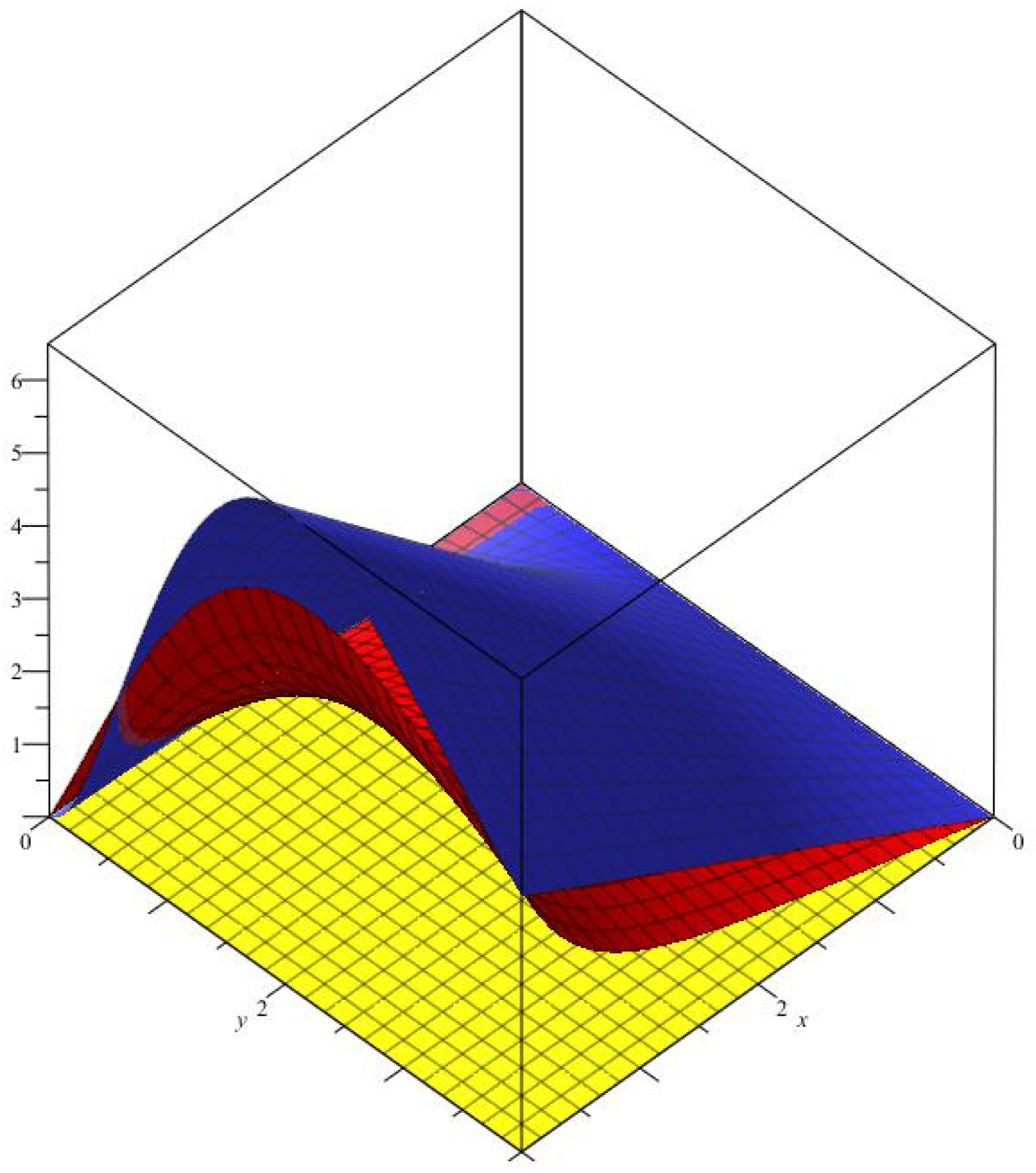
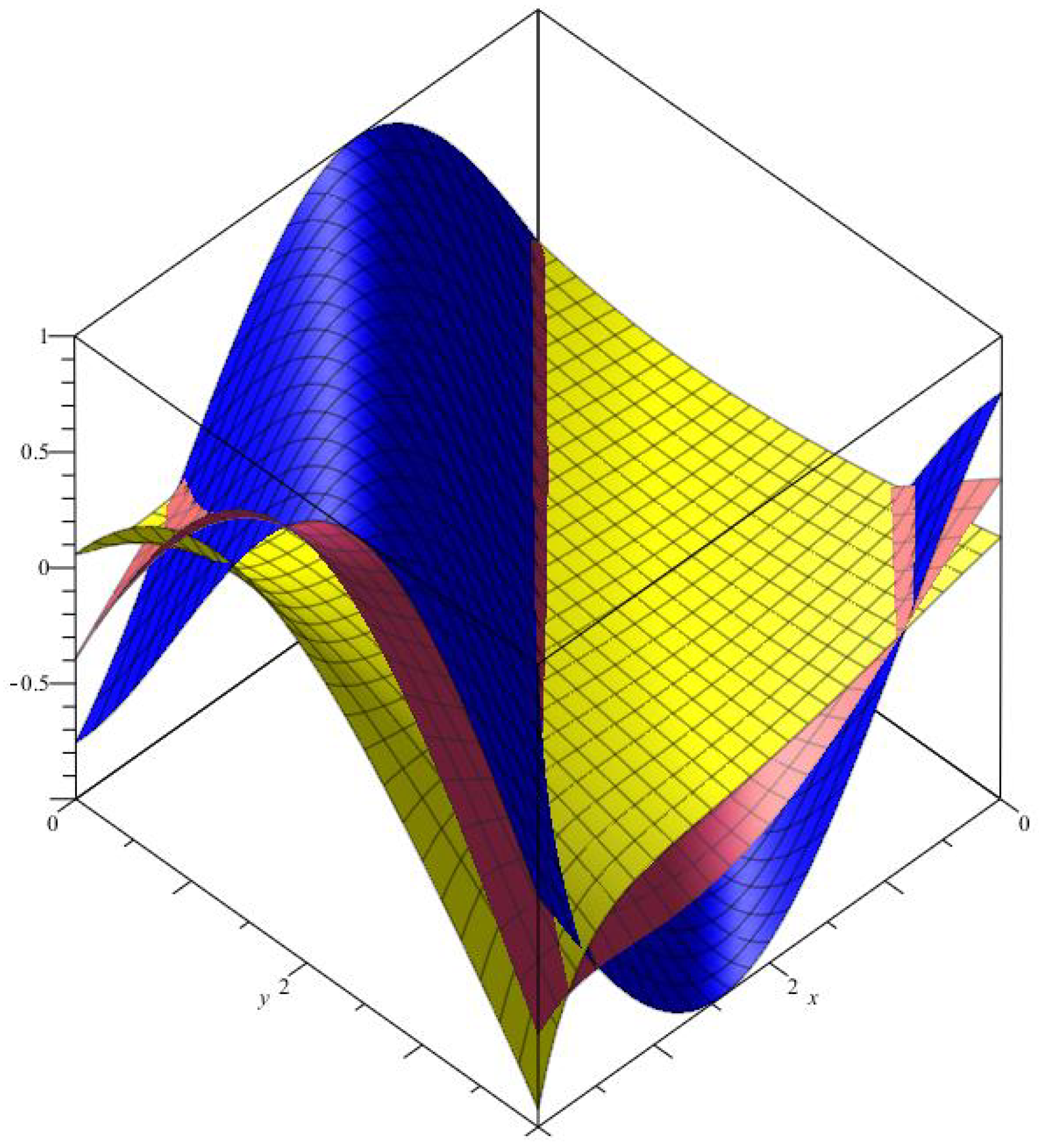
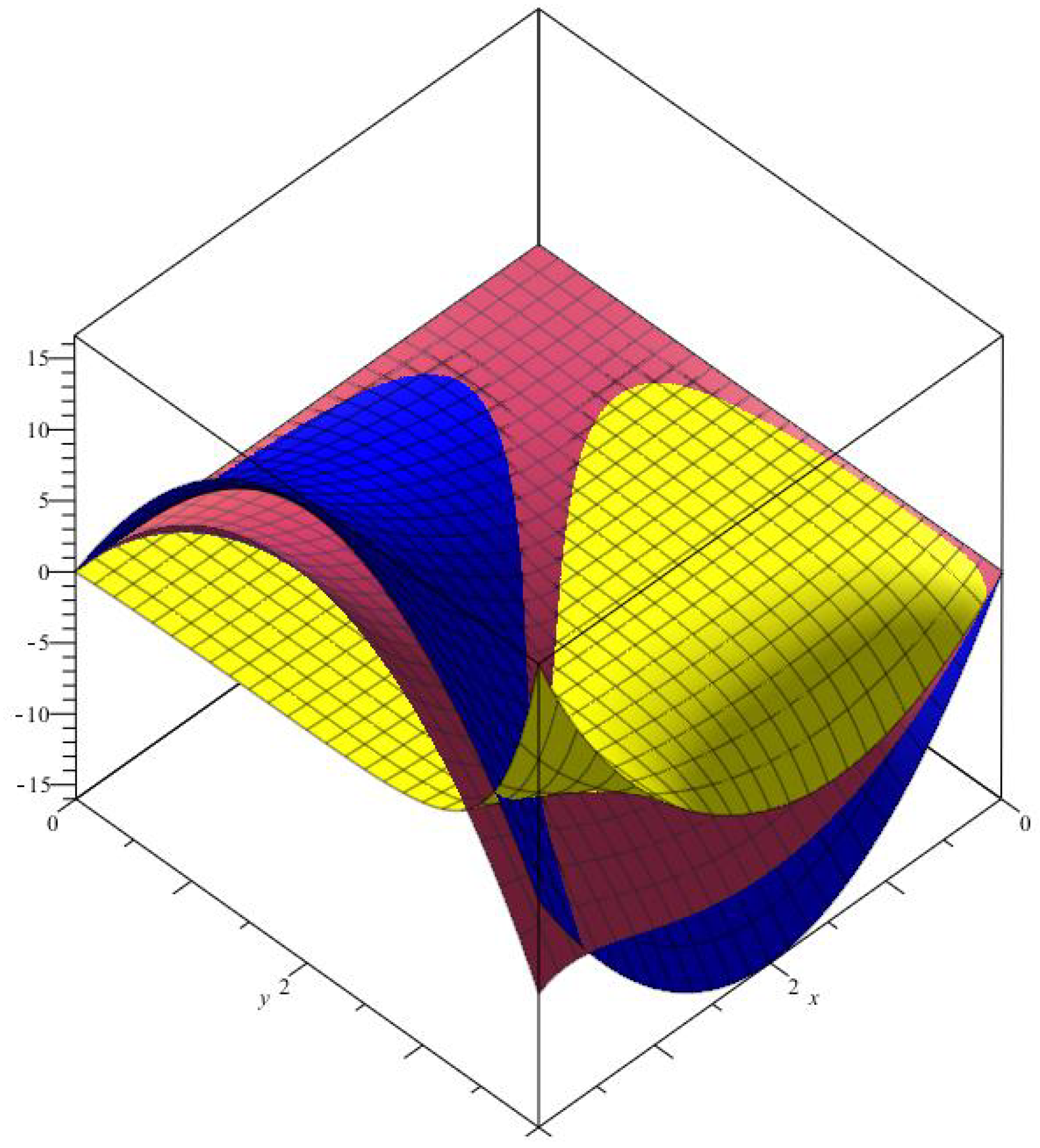
By means of Maple, illustrative graphics show the rate of convergence of C n , m ( p 1 , q 1 ) , ( p 2 , q 2 ) operators to certain functions:
Figure 1. The comparison convergence of C 20 , 20 ( 0.999 , 0.9 ) , ( 0.999 , 0.9 ) ( f ; x , y ) (red), C 20 , 20 ( 0.90 , 0.86 ) , ( 0.996 , 0.89 ) ( f ; x , y ) (yellow) with α n = ln ( n ) , β m = m and f ( x , y ) = 3 x y 2 e y (blue)
Preprints 121040 g001
Figure 2. The comparison convergence of C 20 , 20 ( 0.999 , 0.9 ) , ( 0.99 , 0.9 ) ( f ; x , y ) (red), C 20 , 20 ( 0.990 , 0.86 ) , ( 0.996 , 0.89 ) ( f ; x , y ) (yellow) with α n = ln ( n ) , β m = m and f ( x , y ) = sin ( x y ) (blue).
Preprints 121040 g002
Figure 3. The comparison convergence of C 20 , 20 ( 0.99 , 0.9 ) , ( 0.999 , 0.96 ) ( f ; x , y ) (red), C 20 , 20 ( 0.99 , 0.9 ) , ( 0.990 , 0.90 ) ( f ; x , y ) (yellow) with α n = ln ( n ) , β m = ln ( m ) and f ( x , y ) = x 2 y x y 2 ) (blue).
Preprints 121040 g003
Theorem 6. 
Let f C I a b , then we have
C n , m ( p 1 , q 1 ) , ( p 2 , q 2 ) f ; x , y f ( x , y ) C I a b 2 M f ; δ n , m ( x , y ) / 2 ,
where
δ n , m ( x , y ) = 1 2 max a α n p 1 n 1 [ n ] p 1 , q 1 , b β m p 2 m 1 [ m ] p 2 , q 2 .
Proof. 
Let g C 2 ( I a b ) . By the Taylor’s formula, we get
g ( s 1 , s 2 ) g ( x , y ) = g ( s 1 , y ) g ( x , y ) + g ( s 1 , s 2 ) g ( s 1 , y ) = g ( x , y ) x ( s 1 x ) + x s 1 ( s 1 u ) 2 g ( u , y ) u 2 d u + g ( x , y ) x ( s 2 y ) + y s 2 ( s 2 v ) 2 g ( x , v ) v 2 d v = g ( x , y ) x ( s 1 x ) + 0 s 1 x ( s 1 x u ) 2 g ( u , y ) u 2 d u + g ( x , y ) x ( s 2 y ) + 0 s 2 y ( s 2 y v ) 2 g ( x , v ) v 2 d v
Applying C n , m ( p 1 , q 1 ) , ( p 2 , q 2 ) to the both sides of the above equation, we obtain
C n , m ( p 1 , q 1 ) , ( p 2 , q 2 ) g ; x , y g ( x , y ) g ( x , y ) x C n , m ( p 1 , q 1 ) , ( p 2 , q 2 ) ( s 1 x ) ; x , y + C n , m ( p 1 , q 1 ) , ( p 2 , q 2 ) 0 s 1 x ( s 1 x u ) 2 g ( u , y ) u 2 d u ; x , y + g ( x , y ) y C n , m ( p 1 , q 1 ) , ( p 2 , q 2 ) ( s 2 y ) ; x , y + C n , m ( p 1 , q 1 ) , ( p 2 , q 2 ) 0 s 2 y ( s 2 y v ) 2 g ( v , x ) v 2 d v ; x , y
As C n , m ( p 1 , q 1 ) , ( p 2 , q 2 ) ( s 1 x ) ; x , y = 0 and C n , m ( p 1 , q 1 ) , ( p 2 , q 2 ) ( s 2 y ) ; x , y = 0 , one can write following
C n , m ( p 1 , q 1 ) , ( p 2 , q 2 ) f ; x , y f ( x , y ) C I a b 1 2 g ( x , y ) x C I a b C n , m ( p 1 , q 1 ) , ( p 2 , q 2 ) ( s 1 x ) 2 ; x , y + 1 2 g ( x , y ) y C I a b C n , m ( p 1 , q 1 ) , ( p 2 , q 2 ) ( s 2 y ) 2 ; x , y .
By (5), (6), we deduce,
C n , m ( p 1 , q 1 ) , ( p 2 , q 2 ) f ; x , y f ( x , y ) C I a b 1 2 max p 1 n 1 x 2 [ n ] p 1 , q 1 + x p 1 n 1 α n [ n ] p 1 , q 1 , p 2 m 1 y 2 [ m ] p 2 , q 2 + y p 2 m 1 β m [ m ] p 2 , q 2 × g ( x , y ) x C I a b + g ( x , y ) x C I a b g C I a b δ n , m .
By the linearity C n , m ( p 1 , q 1 ) , ( p 2 , q 2 ) , we obtain
C n , m ( p 1 , q 1 ) , ( p 2 , q 2 ) f ; x , y f ( x , y ) C I a b C n , m ( p 1 , q 1 ) , ( p 2 , q 2 ) f C n , m ( p 1 , q 1 ) , ( p 2 , q 2 ) g C I a b + C n , m ( p 1 , q 1 ) , ( p 2 , q 2 ) g g C I a b + f g C I a b .
By (10) and (11), one can see that
C n , m ( p 1 , q 1 ) , ( p 2 , q 2 ) f ; x , y f ( x , y ) C I a b 2 M f ; δ n , m ( x , y ) / 2 .
This step completes the proof. □
First, we need the auxiliary result contained in the following lemma.
Lemma 3. 
Let 0 < q n < p n 1 be sequences such that p n , q n 1 and p n n a 1 as n . Then, we have the following limits:
(i)
lim n [ n ] p n , q n α n C n , n ( p n , q n ) ( ( t x ) 2 ; x ) = a 1 x
(ii)
lim n [ n ] p n , q n 2 α n 2 C n , n ( p n , q n ) ( ( t x ) 4 ; x ) = 3 a 1 x 2 .
Proof. (i) Using Lemma 1, we have
C n , n ( p n , q n ) ( ( t x ) 2 ; x ) = p n n 1 x 2 [ n ] p n , q n + x p n n 1 α n [ n ] p n , q n
Then, we get
[ n ] p n , q n α n C n , n ( p n , q n ) ( ( t x ) 2 ; x ) = p n n 1 x 2 α n + x p n n 1 .
Let us take the limit of both sides of the above equality as n , then we can write
lim n [ n ] p n , q n α n C n , n ( p n , q n ) ( ( t x ) 2 , x ) = lim n p n n 1 x 2 α n + x p n n 1 = a 1 x .
(ii) By Lemma 1 and by the linearity of the operators C n , n ( p n , q n ) , we have
C n , n ( p n , q n ) ( ( t x ) 4 ; x ) = A 1 , n x 4 + A 2 , n x 3 + A 3 , n x 2 + A 4 , n x
where
A 1 , n = p n n 3 [ n ] p n , q n 2 ( p n 2 + 2 p n q n q n 2 ) + p n n 5 [ n ] p n , q n ( p n 3 + 3 p n q n 2 + q n 3 ) p n 3 n 6 ( p n 2 + p n 3 + 2 p n q n 2 + q n 3 ) [ n ] p n , q n 3 A 2 , n = p n n 3 [ n ] p n , q n 2 ( p n 2 2 p n q n + q n 2 ) [ n ] p n , q n 3 α n + p 2 n 5 [ n ] p n , q n ( q n 3 4 p n q n 2 3 p n 2 q n + 2 p n 3 ) p n 3 n 6 ( 3 p n 3 + 3 p n q n 2 + 5 p n 2 q n + q n 3 ) [ n ] p n , q n 3 α n A 3 , n = p n 2 n 4 [ n ] p n , q n ( p n 2 + 3 p n q n + q n 2 ) p n 3 n 5 ( 3 p n 2 + q n 2 + 3 p n q n ) [ n ] p n , q n 3 α n 2 A 4 , n = p 3 n 3 α n 3 [ n ] p n , q n 3 ,
It is clear that
lim n [ n ] p n , q n 2 α n 2 { A 4 , n x } = 0 .
Taking the limit of both sides of A 1 , n , we get
lim n [ n ] p n , q n 2 α n 2 { A 1 , n } = lim n p n n 3 [ n ] p n , q n ( p n q n ) 2 α n 2 + p n n 5 ( p n 3 + 3 p n q n 2 + q n 3 ) α n 2 p n 3 n 6 ( p n 2 + p n 3 + 2 p n q n 2 + q n 3 ) [ n ] p n , q n α n 2 = lim n p n n 3 ( p n n q n n ) ( p n q n ) α n 2 + p n 5 ( p n 3 + 3 p n q n 2 + q n 3 ) α n 2 p n 3 n 6 ( p n 2 + p n 3 + 2 p n q n 2 + q n 3 ) [ n ] p n , q n α n 2 = 0 .
Similarly, we can show that;
lim n [ n ] p n , q n 2 α n 2 { A 2 , n } = 0 and lim n [ n ] p n , q n 2 α n 2 { A 3 , n } = 3 a 1 x 2
By combining (14)-(16), we reach the desired the result. □
Now, we ready present a Voronovskaja type theorem for C n , n ( p n , q n ) ( f ; x , y ) .
Theorem 7. 
Let f C 2 ( I a b ) . Then, we have
lim n [ n ] p n , q n C n , n ( p n , q n ) ( f ; x , y ) f ( x , y ) ) = a 1 x f x 2 ( x , y ) 2 + a 1 y f y 2 ( x , y ) 2 .
Proof. 
Let ( x , y ) I a b . Then, write Taylor’s formula of f as follows:
f ( s , t ) = f ( x , y ) + f x ( s x ) + f y ( t y ) + 1 2 f x ( t x ) 2 + 2 f x y ( s x ) ( t y ) + f y ( t y ) 2 + ε ( s , t ) ( s x ) 2 + ( t y ) 2
where ( s , t ) I a b and ε ( s , t ) 0 as ( s , t ) ( x , y ) .
If we apply the operator C n , n ( p n , q n ) ( f ; . ) on (17), we obtain
C n , n ( p n , q n ) ( f ; s , t ) f ( x , y ) = f x ( x , y ) C n , n ( p n , q n ) ( ( s x ) ; x , y ) + f y ( x , y ) C n , n ( p n , q n ) ( ( t y ) ; x , y ) + 1 2 { f x 2 C n , n ( p n , q n ) ( ( t x 0 ) 2 ; x , y ) + 2 f x y C n , n ( p n , q n ) ( ( s x ) ( t y ) ; x , y ) + f y 2 C n , n ( p n , q n ) ( ( t y ) 2 ; x , y ) } + C n , n ( p n , q n ) ε ( s , t ) ( s x ) 2 + ( t y ) 2 ; x , y .
Applying the limit of both sides of the above equality, we get n , □
lim n [ n ] p n , q n C n , n ( p n , q n ) ( f ; s , t ) f ( x , y ) ) = lim n [ n ] p n , q n 1 2 { f x 2 C n , n ( p n , q n ) ( ( t x ) 2 ; x , y ) + 2 f x y C n , n ( p n , q n ) ( ( s x ) ( t y ) ; x , y ) + f y 2 C n , n ( p n , q n ) ( ( t y ) 2 ; x , y ) } + lim n [ n ] p n , q n C n , n ( p n , q n ) ε ( s , t ) ( s x ) 2 + ( t y ) 2 ; x , y .
By Cauchy-Schwartz inequality, we can write the following
C n , n ( p n , q n ) ε ( s , t ) ( s x ) 2 + ( t y ) 2 ; x , y lim n C n , n ( p n , q n ) ε 2 ( s , t ) ; x , y × 2 lim n [ n ] p n , q n 2 C n , n ( p n , q n ) ε ( s , t ) ( s x ) 4 + ( t y ) 4 ; x , y .
As lim n C n , n ( p n , q n ) ε 2 ( s , t ) ; x , y = ε 2 ( x , y ) = 0 and from Lemma 3(ii)
lim n [ n ] p n , q n 2 C n , n ( p n , q n ) ( s x ) 4 + ( t y ) 4 ) ; x , y is finite, then we have
lim n [ n ] p n , q n 2 C n , n ( p n , q n ) ε ( s , t ) ( s x ) 4 + ( t y ) 4 ; x , y = 0 .
Hence, we deduce
lim n [ n ] p n , q n C n , n ( p n , q n ) ( f ; x , y ) f ( x , y ) ) = a 1 x f x 2 ( x , y ) 2 + a 1 y f y 2 ( x , y ) 2 .
This step completes the proof.

4. Weighted Approximation Properties of Two Variable Function

In this section, the convergence of the sequence of linear positive operator C n , m ( p 1 , q 1 ) , ( p 2 , q 2 ) to a functions of two variables which defined on weighted space and compute rate of convergence via weighted modulus continuity.
Let ρ ( x , y ) = x 2 + y 2 + 1 and B ρ be the space of all functions f defined on the real axis provide with | f ( x , y ) | M f ρ ( x , y ) , where M f is a positive constant depending only on f. Let C ρ be the subspace of B ρ of all continuous functions with the norm:
f ρ = sup x , y R + 2 | f ( x , y ) | ρ x , y .
Let C ρ 0 denote the subspace of all functions f C ρ such that lim x f ( x , y ) ρ x , y exists finitely. For all f C ρ 0 , the weighted modulus of continuity is defined by
Ω f ( f ; δ 1 , δ 2 ) = sup x , y R + 2 sup h 1 δ 1 , h 2 δ 2 f ( x + h 1 , y + h 2 ) f ( x , y ) ρ ( x , y ) ρ ( h 1 , h 2 ) .
Lemma 4. 
The operators C n , m ( p 1 , q 1 ) , ( p 2 , q 2 ) defined (2) act from C ρ ( R + 2 ) to B ρ ( R + 2 ) if and only if the inequality
C n , m ( p 1 , q 1 ) , ( p 2 , q 2 ) ( ρ ; x , y ) x 2 c .
holds for some positive constant c.
Theorem 8. 
Let C n , m ( p 1 , q 1 ) , ( p 2 , q 2 ) be sequence of linear positive operators defined (2), then for each f C ρ 0 and for all ( x ; y ) I α n β m , we have
lim n C n , m ( p 1 , q 1 ) , ( p 2 , q 2 ) ( f ; x , y ) f ( x , y ) ρ = 0 .
Proof. 
From Lemma 2, we obtain
C n , m ( p 1 , q 1 ) , ( p 2 , q 2 ) 1 ; x , y 1 ρ = 0 , C n , m ( p 1 , q 1 ) , ( p 2 , q 2 ) s ; x , y x ρ = 0 C n , m ( p 1 , q 1 ) , ( p 2 , q 2 ) t ; x , y y ρ = 0 .
Again by Lemma 2, we can write following
C n , m ( p 1 , q 1 ) , ( p 2 , q 2 ) ( s 2 + t 2 ; x , y ) ( x 2 + y 2 ) ρ = sup ( x , y ) R + 2 p 1 n 1 α n x [ n ] p 1 , q 1 ( x 2 + y 2 + 1 ) + p 1 n 1 x 2 [ n ] p 1 , q 1 ( x 2 + y 2 + 1 ) + p 2 m 1 β m y [ m ] p 2 , q 2 ( x 2 + y 2 + 1 ) + p 2 m 1 y 2 [ m ] p 2 , q 2 ( x 2 + y 2 + 1 ) p 1 n 1 α n [ n ] p 1 , q 1 + p 1 n 1 [ n ] p 1 , q 1 + p 2 m 1 β m [ m ] p 2 , q 2 + p 2 m 1 [ m ] p 2 , q 2
Taking the limit of both sides of above inequality as n , m with by (3) and (4), we get
lim m , n C n , m ( p 1 , q 1 ) , ( p 2 , q 2 ) ( s 2 + t 2 ; x , y ) ( x 2 + y 2 ) ρ = 0 .
Applying weighted Korovkin theorem for two variable which presented by Gadzhiev [4,5], we get desired the results. □
For estimate rate of convergence we need the following lemma.
Lemma 5. 
For all ( x ; y ) I α n β m , by (5), (6) and (13), one can write the following
C n , m ( p 1 , q 1 ) , ( p 2 , q 2 ) t x 2 ; x , y = O α n p 1 n 1 [ n ] p 1 , q 1 x 2 + x ,
C n , m ( p 1 , q 1 ) , ( p 2 , q 2 ) t x 4 ; x , y = O α n p 1 n 1 [ n ] p 1 , q 1 x 4 + x 3 + x 2 + x
and
C n , m ( p 1 , q 1 ) , ( p 2 , q 2 ) s y 2 ; x , y = O β m p 2 m 1 [ m ] p 2 , q 2 y 2 + y + 1 ,
C n , m ( p 1 , q 1 ) , ( p 2 , q 2 ) s y 4 ; x , y = O β m p 2 m 1 [ m ] p 2 , q 2 y 4 + y 3 + y 2 + y + 1 .
Now, compute rate of convergence the operator C n , m ( p 1 , q 1 ) , ( p 2 , q 2 ) in weighted spaces .
Theorem 9. 
If f C ρ 0 , then we have
sup x , y R + 2 C n , m ( p 1 , q 1 ) , ( p 2 , q 2 ) ( f ; x , y ) f ( x , y ) ρ x , y 3 C 2 ω ρ ( f ; δ n , δ m )
, where C 2 is a constant independent of n , m and δ n = p 1 n 1 α n [ n ] p 1 , q 1 , δ n = p 2 m 1 β m [ m ] p 2 , q 2 .
Proof. 
Taking into account the following inequality given in [9], we deduce
f t , s f x , y 8 1 + x 2 + y 2 ω ρ ( f ; δ n , δ m )
× 1 + t x δ n 1 + s y δ m 1 + t x 2 1 + s y 2 .
Applying C n , m ( p 1 , q 1 ) , ( p 2 , q 2 ) both side above inequality and using Cauchy-Schwarz inequality, one can write following
C n , m ( p 1 , q 1 ) , ( p 2 , q 2 ) ( f ; x , y ) f ( x , y ) 8 1 + x 2 + y 2 ω ρ ( f ; δ n , δ m )
× 1 + C n , m ( p 1 , q 1 ) , ( p 2 , q 2 ) t x 2 ; x , y + 1 δ n C n , m ( p 1 , q 1 ) , ( p 2 , q 2 ) t x 2 ; x , y
1 δ n C n , m ( p 1 , q 1 ) , ( p 2 , q 2 ) t x 2 ; x , y C n , m ( p 1 , q 1 ) , ( p 2 , q 2 ) t x 4 ; x , y
× 1 + C n , m ( p 1 , q 1 ) , ( p 2 , q 2 ) s y 2 ; x , y , a + 1 δ m C n , m ( p 1 , q 1 ) , ( p 2 , q 2 ) s y 2 ; x , y
× 1 δ m C n , m ( p 1 , q 1 ) , ( p 2 , q 2 ) s y 2 ; x , y C n , m ( p 1 , q 1 ) , ( p 2 , q 2 ) s y 4 ; x , y .
By (19)-(22), we obtain
C n , m ( p 1 , q 1 ) , ( p 2 , q 2 ) ( f ; x , y ) f ( x , y ) 8 1 + x 2 + y 2 ω ρ ( f ; δ n , δ m )
× 1 + O p 1 n 1 α n [ n ] p 1 , q 1 x 2 + x + 1 δ n O p 1 n 1 α n [ n ] p 1 , q 1 x 2 + x
+ 1 δ n O p 1 n 1 α n [ n ] p 1 , q 1 x 2 + x x 4 + x 3 + x 2 + x
× 1 + p 2 m 1 β m [ m ] p 2 , q 2 y 2 + y + p 2 m 1 β m [ m ] p 2 , q 2 p 2 m 1 β m [ m ] p 2 , q 2
+ 1 δ m p 2 m 1 β m [ m ] p 2 , q 2 y 2 + y p 2 m 1 β m [ m ] p 2 , q 2 y 4 + y 3 + y 2 + y .
Taking δ n = p 1 n 1 α n [ n ] p 1 , q 1 1 / 2 , δ m = p 2 m 1 β m [ m ] p 2 , q 2 1 / 2 , one write the following:
C n , m ( p 1 , q 1 ) , ( p 2 , q 2 ) ( f ; x , y ) f ( x , y ) C 2 1 + x 2 + y 2 ω ρ ( f ; δ n , δ m )
× 1 + δ n 2 x 2 + x + x 2 + x + x 2 + x x 4 + x 3 + x 2 + x
× 1 + δ m 2 y 2 + y + y 2 + y + y 2 + y y 4 + y 3 + y 2 + y ,
where C 2 is a constant independent of n , m . Since δ n 2 < 1 , δ m 2 < 1 , for sufficiently large n , m , we get
sup x , y R + 2 C n , m ( p 1 , q 1 ) , ( p 2 , q 2 ) ( f ; x , y ) f ( x , y ) 1 + x 2 + y 2 3 C 2 ω ρ f ; p 1 n 1 α n [ n ] p 1 , q 1 , p 2 m 1 β m [ m ] p 2 , q 2 .
This step completes the proof. □

Author Contributions

Conceptualization, Ü.K.; validation, A.K.; formal analysis, A.K.; and writing, A.A. All authors have read and agreed to the published version of the manuscript.

Funding

This research received no external funding.

Data Availability Statement

Data are contained within the article.

Acknowledgments

We thank the referees for their careful reading of the original manuscript and for the valuable comments.

Conflicts of Interest

The authors declare no conflict of interest.

Abbreviations

The following abbreviations are used in this manuscript:
MDPI Multidisciplinary Digital Publishing Institute
DOAJ Directory of open access journals
TLA Three letter acronym
LD Linear dichroism

References

  1. A. Karaisa, Approximation by Durrmeyer type Jakimoski–Leviatan operators, Math Methods Appl Sci In Press(2015), 1–12. [CrossRef]
  2. Karaisa and F.Karakoc, Stancu type generalization of Dunkl analogue of Szàsz operators, Adv Appl, 1–14. [CrossRef]
  3. A. Karaisa, DT. Tollu and Y. Asar, Stancu type generalization of q-Favard-Szàsz operators, Appl Math Comput.(2015), 264: 249–257. [CrossRef]
  4. A D. Gadjiev, Linear positive operators in weighted space of functions of several variables, Izvestiya Acad of Sciences of Azerbaijan(1980), 1: 32-37.
  5. AD. Gadjiev, H. Hacýsalihoglu, On convergence of the sequences of linear positive operators, Ph. D. thesis, Ankara University, 1995, in Turkish.
  6. A. Lupaş, q-analogue of the Bernstein operator, Seminar on Numerical and Statistical Calculus, University of Cluj-Napoca(1987), 9: 85-92.
  7. AM. Acu and CV. Muraru, Approximation Properties of bivariate extension of q- Bernstein-Schurer-Kantorovich operators, Result Math.(2015), 67: 265–279. [CrossRef]
  8. A. Aral, V. Gupta and RP. Agarwal, Applications of q- calculus in operator theory, Berlin: Springer, 2013. [CrossRef]
  9. C. Atakut and N. Ispir, Approximation by modified Szász-Mirakjan operators on weighted spaces, Proc Indian Acad Sci Math.(2002), 112: 571-578. [CrossRef]
  10. D. Barbosu, Some Generalized Bivariate Bernstein Operators, Mathematical Notes Miskolc.(2000), 1: 3–10. [CrossRef]
  11. GA. Anastassiou and SG. Gal, Approximation theory: moduli of continuity and global smoothness preservation, Birkha¨user: Boston, 2000.
  12. H. Karsli, A Voronovskaya type theory for the second derivative of the Bernstein-Chlodovsky polynomials, Proc Est Acad Sci.(2012),61: 9–19. [CrossRef]
  13. I. Büyükyazıcı, On the approximation properties of two-dimensional q-Bernstein-Chlodowsky polynomials, Math Commun.(2009), 14: 255–269.
  14. I. Büyükyazıcı and H. Sharma Approximation properties of two-dimensional q-Bernstein–Chlodowsky–Durrmeyer operators, Numer Funct Anal Optim.(2012), 33:1351–1371. [CrossRef]
  15. I. Büyükyazıcı, Approximation by Stancu–Chlodowsky polynomials, Comput Math Appl., 2010; 59: 274–282. [CrossRef]
  16. KJ. Ansari and A. Karaisa, Chlodovsky type generalization of Bernstein operators based on (p,q) integer, under the cominication.
  17. M. Mursaleen, MD. Nasiuzzaman and A. Nurgali, Some approximation results on Bernstein–Schurer operators defined by (p,q)-integers, Jour Ineq Appl.(2015),249: 1–15. [CrossRef]
  18. M. Mursaleen, KJ. Ansari and A. Khan, Some approximation results by (p,q)-analogue of Bernstein–Stancu operators, Appl Math Comput.(2015),64: 392–402. [CrossRef]
  19. M. Mursaleen, MD. Nasiruzzaman, A. Khan and KJ. Ansari, Some approximation results on Bleimann-Butzer–Hahn operators defined by (p,q)-integers, 2015. [CrossRef]
  20. M. Mursaleen, KJ. Ansari and A. Khan, On (p,q)-analogue of Bernstein operators, Appl Math Comput.(2015). [CrossRef]
  21. M. Mursaleen, KJ. Ansari and A. Khan, Erratum to on (p,q)- analogue of Bernstein Operators, [Appl. Math. Comput. 266 (2015) 874-882] Appl. Math. Comput.(2016); 278: 70-71. [CrossRef]
  22. PL. Butzer and H. Berens, Semi-groups of operators and approximation, Springer, New York, 1967.
  23. PL. Butzer and H.Karsli, Voronovskaya-type theorems for derivatives of the Bernstein-Chlodovsky polynomials and the Szá sz–Mirakyan operator, Comment Math.(2009), 49: 33–58.
  24. PN. Agrawal and N. Ispir, Degree of Approximation for Bivariate Chlodowsky–Szász-Charlier Type Operator, Results Math.(2015). [CrossRef]
  25. Sadjang, On the fundamental theorem of (p,q)-calculus and some (p,q)-Taylor formulas, 2015; [math.QA]. [CrossRef]
  26. T. Acar, A. Aral and SA. Mohiuddine, Approximation by bivariate (p,q)-Bernstein–Kantorovich operator(2016), [math.CA]. [CrossRef]
  27. V. Gupta, (p,q)-Szàsz-Mirakyan-Baskakov operators, Complex Anal Oper Theory(2015), 1–9. [CrossRef]
  28. V. Sahai and S. Yadav Representations of two parameter quantum algebras and p,q-special functions, J Math Anal Appl.(2007), 335: 268-279. [CrossRef]
  29. VJ. Volkov, On the convergence of linear positive operators in the space of continuous functions of two variables, (Russian). Doklakad Nauk SSSR, (1957)115: 17-19.
Disclaimer/Publisher’s Note: The statements, opinions and data contained in all publications are solely those of the individual author(s) and contributor(s) and not of MDPI and/or the editor(s). MDPI and/or the editor(s) disclaim responsibility for any injury to people or property resulting from any ideas, methods, instructions or products referred to in the content.
Copyright: This open access article is published under a Creative Commons CC BY 4.0 license, which permit the free download, distribution, and reuse, provided that the author and preprint are cited in any reuse.
Prerpints.org logo

Preprints.org is a free preprint server supported by MDPI in Basel, Switzerland.

Subscribe

Disclaimer

Terms of Use

Privacy Policy

Privacy Settings

© 2025 MDPI (Basel, Switzerland) unless otherwise stated