
Submitted:
10 October 2024
Posted:
11 October 2024
You are already at the latest version
Abstract
This article discourses on how the inheritance and innovation in paper-cutting art have taken place through its integration with modern design language. Xuzhou paper-cut is regarded as representative of China's traditional folk art, carrying a rich cultural heritage, but it faces both challenges and opportunities that come with modern society. In the course of reviewing the development history of Xuzhou paper-cutting, the value of Xuzhou paper-cut as intangible cultural heritage was discussed. This paper will seek to find out the possibility of application for Xuzhou paper-cutting in modern design with both qualitative and quantitative methods, including questionnaires and interviews. Successful examples are used in this research to look for evidence that effectively proves traditional paper-cutting combines well with the principles of modern design in developing concepts, artistic expressions, and cultural symbolism. It shows that Xuzhou paper-cutting has a great potential to apply in modern design, and education, exhibitions, and community activities will be also necessary to revive it. On the other hand, traditional craft could adapt to current social needs only when the design language has been innovated. The research brought in new input with regard to integrating traditional culture with modern design from a theoretical and practical point of view, thus serving as an informant for the direction of further research in heritage and design integration.
Keywords:
Xuzhou paper-cutting art
; dynamic transmission
; contemporary design language
; cultural symbolism
; intangible cultural heritage
1. Introduction
1.1. Background and Significance
Xuzhou paper-cutting art is an important part of China's intangible cultural heritage, with rich cultural symbols and historic narratives contained therein. It is a folk art that not only esthetically pleases but has embodied social life, folk culture, and local identity. However, in fast-developing modern society, Xuzhou paper-cutting art faces severe survival challenges. The younger generation does not show much interest in folk arts, which may deprive this rich cultural heritage of being forgotten.
The purpose of the study is to explore the possibility of dynamic transmission of Xuzhou paper-cutting art, with the main focus on how to engage in active dialogue with modern design language in order to create innovative and rejuvenated cultural expression. This study will analyze the historical evolution and current status of Xuzhou paper-cutting, highlighting its unique value and application potential in modern design. Unlike traditional research methods, this study adopts an interdisciplinary perspective, merging theories from art, design, sociology, and anthropology, thereby providing new insights for the modern transformation of traditional art. 1
Novelty consists in the fact that the research will present the case of Xuzhou paper-cutting art in a redefinition and innovative application in contemporary society from the point of view of "dynamic transmission." This study has emphasized not only the preservation and transmission of traditional skills but also how modern design can re-create these skills to become part of today's life. If Xuzhou paper-cutting can integrate modern design language, then it can become an artistic development that is in step with the current needs of society and thus younger participation and appreciation.
1.2. Research Questions and Objectives
What is the level of public awareness of Xuzhou paper-cutting art, and how receptive are different demographic groups to its integration into contemporary design? By collecting data through surveys and interviews, this research aims to identify effective strategies for enhancing public engagement and understanding.
1.2.1. Public Recognition for Xuzhou Paper-Cutting Art
How does the use of elements of Xuzhou paper-cutting find effective applications in modern design to form new expression modes? Specific case analysis is conducted in this research to find out how the combination of traditional cultural symbols and modern design ideas can result in works that are full of cultural depth and visual shock.2
1.2.2. Integrating Classic Arts into Contemporary Design
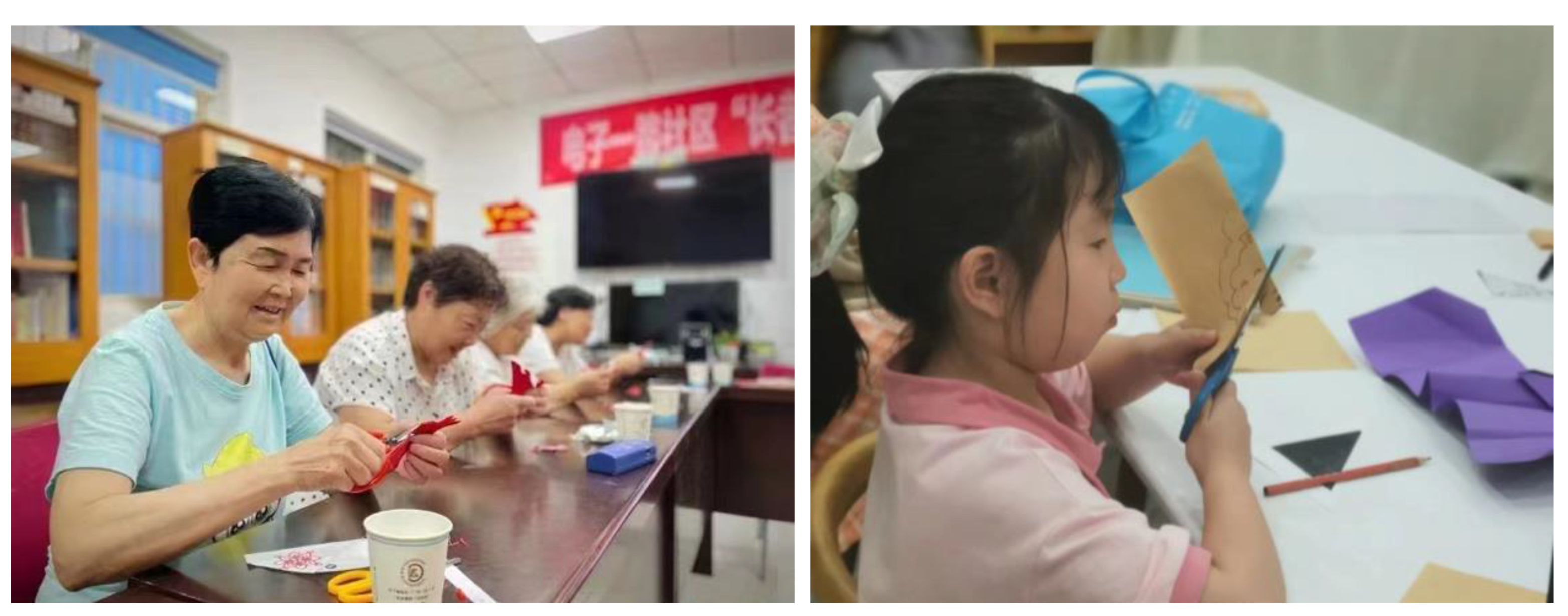
What are the roles of education and community activities within the vibrant Xuzhou paper-cut transmission? In this paper, in-depth attention will be paid to the ways in which various institutions of education, art groups, and initiatives by the community contribute to the creation of greater awareness and appreciation through workshops, exhibitions, and other related events. 3
Figure 1.
The scene of the community event.
1.3. Research Innovation
1.3.1. Dynamic Transmission View
This paper takes the dynamic transmission perspective and explores Xuzhou paper-cutting art revival and transformation in the context of modern design language. The living transmission of traditional art should not rely exclusively on the transmission of techniques but also needs to take into consideration the changes of social and cultural contexts at different historical moments. In this respect, the study points out how Xuzhou paper-cutting art is invested with a new lease on life within the framework of modern design and the sensitive issue of striking a balance between inheritance and innovation. This paper argues, through the underlining of concrete examples of cultural revival, for dynamic transmission in a way that will not only preserve traditional craftsmanship but also make such work more adaptable to contemporary society. 4
1.3.2. Integration of Modern Design Language
The authors further discuss how the symbols of traditional paper-cutting art could integrate with modern design language in coming up with new forms of design expression. This innovation is realized through the incorporation of an interdisciplinary approach that marries the translation of cultural symbols with contemporary visual communication theories. Specific design cases are analyzed to illustrate the application of Xuzhou paper-cutting art in product design, graphic design, and architectural design, so as to highlight the unique value embodied by the paper-cutting art in modern design contexts.5 It not only provides designers with new creative inspiration but also empirical support for the modernization of traditional culture.
1.3.3. Empirical Research Approach
In this study, an empirical research approach will be taken; both qualitative and quantitative methods will be used, with data gathered systematically from questionnaires and interviews. The respondents will include inheritors of the paper-cutting arts, designers, and cultural experts. The goal is to understand fully the cognition of public awareness about Xuzhou paper-cutting art and its application in modern design. This paper critically assesses, through empirical data, the creative outcome of the integration of traditional art with modern design, and therefore can be referred to in related areas of research.
1.4. Structure of the Study
The contents, in this research, shall be explained in a systematized manner through successive chapters on background, theoretical framework, methodologies, and findings. Specifically, the structure is as follows:
Chapter 1 introduces the research background and significance, clarifies research questions and objectives, and highlights the paper's innovations and contributions.
Chapter 2 embodies the literature review concerning the theoretical underpinning of design language and integration of cultural heritage with contemporary design, indicating research gaps and issues.
Chapter 3 constructs the theoretical framework in explaining the dynamic transmission theory and elaborates on relevant concepts for the integration of design language.
Chapter 4 describes the research methodology, including research subjects, sampling, data collection, and analysis methods.
Chapter 5 considers the analysis of the current situation and problems in the dynamic transmission of Xuzhou paper-cutting art, with an innovative strategy proposed.
Chapter 6 explores the usage of paper-cutting symbols within modern design language and its translation processes.
Chapter 7: The Application of Integrating Traditional Art into Modern Design Regarding Specific Practices
Chapter 8 summarizes the main findings obtained in the research work, discusses contributions to theory and practice, and describes further areas of the research.
2. Literature Review
2.1. Theoretical Basis of Design Language
As a multidimensional concept, design language underlines the importance of symbols and visual communication in the process of cultural identity. The presented research is particularly interested in the role of design language in integrating traditional art with modern design and in finding new approaches by which Xuzhou paper-cutting art can act as cultural heritage to enrich the expressiveness and richness of modern design language. Christopher Alexander also emphasized, in his work A Pattern Language, that design should meet human needs and reflect the depth of the cultural context. Such contexts are Xuzhou paper-cutting art and its special forms and symbolic meanings, which may serve as rich materials and inspire modern designs.
This section will focus on the essentials of the design language: how shape, color, material, and symbols can merge with cultural context through visual communication. Semiotics, in that respect, is helpful to reveal deeper meanings in relation to cultural contexts about the use of these elements so that designers can reframe the meanings projected onto traditional art in the creation process. From the semiotic perspective, the value of Xuzhou paper-cutting can have both the observation of the traditional aesthetic features and the paths through which such features can be mixed with the innovations of modern design in evocative design works. For example, the alive animal imagery in the paper-cut art bears heavy cultural meaning; designers need to think about how to continue this meaning of cultural signs when reworking them, thus making a successful conversation between tradition and modernity possible.
The introduction of the theory of dynamic transmission into the discourse on design language immediately gives us deeper insights into traditional art in contemporary society. This theory is about the adaptability and innovativeness of traditional arts in modern design, providing a frame in which the designer should explore their use in the modern context without putting them out of their historical contexts. 6 Such cultural integration is reflected not only in product design but also in brand narratives and user experience construction, providing robust theoretical support for this research.
2.2. Cultural Heritage and Contemporary Design
Cultural heritage within a contemporary design framework remains an important issue in design practice. Not only does cultural heritage carry any burden of history and values, but it also conveys identity and has become one of the richest sources of inspiration for designers today. According to the exploratory theory of John H. Falk and Lynn D. Dierking, for example, the existence of cultural heritage can boost an individual's identity and provide a feeling of belonging, acting as the very basis for sustainable development. In the case of Xuzhou paper-cutting, this traditional craft is representative not only of a form of handicraft but also of a major medium for delivering cultural narratives and societal values.
This paper seeks to highlight the role that has been played by the revival of Xuzhou paper-cutting in the protection and transmission of local culture and its unparalleled value in the contemporary world. Indeed, it constitutes a source of identification more urgently needed with globalization pressures and cultural homogenization threats. 7 Designers should make use of this advantage to reflect the particularity of local culture in their design work and enhance more cultural connotation and emotional appeal in design. The application of cutting can be combined with product design, adding cultural value to products and attracting more consumers who are fond of traditional culture.
In short, this literature review identifies and underlines the theoretical basis of design language and cultural heritage's role in contemporary design. Only bringing these two elements together can give this research its innovative potential regarding the art of Xuzhou paper-cutting, showing how traditional culture can meet modern design concepts. This dual focus not only gives a much-needed weight to the discourse on cultural heritage in design, but it also underpins the paper with a degree of theoretical reliability, its sound academic grounding offering new light on the dynamic interaction between tradition and modernity. Such a study should inspire further design practices and further academic inquiry into novel ways in which traditional art is being deployed in contemporary society.
However, existing literature on the integration of cultural heritage and design often lacks empirical research demonstrating the concrete outcomes of these practices. This study addresses this gap by analyzing multiple successful cases, specifically investigating the successful application of Xuzhou paper-cutting in contemporary design contexts. For instance, incorporating paper-cutting elements in product design not only enhances the cultural value of products but also attracts consumers interested in traditional culture.
In a nutshell, the review of literature accentuates the theoretical basis of design language and cultural heritage in current design. Integrating these two aspects into the research, it illustrates Xuzhou's paper-cutting art innovative potential by blending traditional culture with contemporary design concepts. While both focuses elevate the discourse on the aspect of cultural heritage in design, the theoretical reliability of the paper is further enhanced by providing new perspectives on the dynamic interaction between tradition and modernity through a solid academic grounding. We thus hope that this research will encourage future design practices and academic inquiries in the innovative application of traditional art within contemporary society.
2.3. Research Gaps and Issues
Despite the growing desire to combine elements of traditional culture and contemporary design practice, much work remains to be done. The current literature fails to satisfactorily indicate how traditional art forms, such as Xuzhou paper-cutting, can be taken into the structure of contemporary design. Although theoretical discussions argue for the importance of cultural heritage in design, they often fall short of probing the dynamic mechanisms of transmission and adaptation of these very traditions in a contemporary context.
Besides, little is known about the investigation of how public perception influences the acceptance of traditional elements in the modern concept of design. Establishing a relationship here can help people develop more appreciation and be more interactive with cultural symbols. In addition, there is an inadequate approach in current research on methodologies for the application of theoretical frameworks in practical applications, leading to limited case studies where successful integrations of traditional art have been explained within design.
The current research study has aimed to fill in these gaps by investigating the concrete ways in which Xuzhou paper-cutting art can be transmitted dynamically into modern design contexts. In a mixed-methods approach that undertakes both qualitative and quantitative analyses, this research aims to provide sound empirical evidence to support the use of traditional cultural practices within a contemporary design framework. 8
3. Theoretical Framework
The dynamic transmission theory provides the theoretical basis for this study, acting as a critical lens in understanding how Xuzhou paper-cutting art is integrated into contemporary design. The theory places cultural artifacts as never being static; rather, they are in continuous transformation and reevaluation whenever they come across different social contexts. This view allows for an in-depth appreciation of how traditional forms of art can be transformed and still flourish in a modern environment.
3.1. Dynamic Transmission Theory
3.1.1. Cultural Revival
Cultural revival involves the rediscovery process and revitalization of traditional practices in response to contemporary demands and challenges of society. In this respect, such a revival is of paramount importance for Xuzhou paper-cutting in terms of retaining its cultural identity and relevance within a rapidly evolving landscape. Exploring the underlying mechanisms of cultural revival further underlines how traditional art forms can inspire innovative creative practices while retaining their intrinsic cultural significance. This dynamic process enables the artist to tap into and build upon the rich heritage of the Paper Cutting Art to facilitate new forms of expression relevant to today's audience. 9
3.1.2. Intergenerational Transmission
Intergenerational transmission refers to the process of knowledge, skills, and cultural values related to traditional practices being transmitted from one generation to another. This aspect is crucial in securing the continuity of Xuzhou paper-cutting art since the techniques and their meanings will be preserved. 10 By examining the roles of educators, practitioners, and community leaders in facilitating this transmission, the study highlights the importance of mentorship and community engagement in fostering renewed appreciation for traditional art forms. This intergenerational dialogue enriches the understanding of cultural heritage and empowers emerging designers to reinterpret and innovate upon these traditions.
3.1.3. Social Adaptation
Social adaptation refers to the way cultural practices vary and evolve to meet changing social, economic, and technological circumstances. This research pinpoints, while analyzing the social adaptation of Xuzhou paper-cutting, how traditional art can still keep its relevance and appeal for a contemporary society. This section looks at the implications of modern design trends and consumer expectations for changing notions of paper-cutting art, showing how artists can creatively respond to such dynamics. With this framing, the study shows that traditional art forms may not only survive but grow in strength to breach the gap between historical legacy and contemporary relevance. 11
3.2. Design Language Integration Framework
The integration framework of design language developed herein presents a structured way of understanding how cultural symbols, derived from Xuzhou paper-cutting art, can be effectively translated and applied within modern design practice. This will be a pivotal tool for designers seeking to work with tradition yet make sure their products would be relevant for the present audience.
3.2.1. Cultural Symbol Translation
Translation of the cultural symbols means re-interpretation of the traditional motifs, color, and forms into a contemporary perspective. Therefore, it is crucial in allowing Xuzhou paper-cutting art to be more presentable and relevant toward the modern design perception. By examining individual symbols occurring in paper-cutting artworks and delving deep into their cultural meaning, designers are able to create works that will not only be respectful of their heritage but also understandable by today's consumers. 12 This section sets out case studies of successfully executed translation of cultural symbols, providing real-life examples of how traditional elements can be imaginatively reinvented.
3.2.2. Visual Communication
Design decisions about the visual display play an important role in communicating the narrative of culture. This part of the framework dwells on the aesthetic decisions of color, composition, and material that render a design emotionally appealing and hence truly representative of the Xuzhou paper-cutting art. 13 By using the visual language of paper-cutting, designers are able to construct effective storytelling that captures people's attention and allows them to connect with their cultural heritage more profoundly. Besides, this section deals with the psychological dimensions of visual communication, considering how design choices may appeal to emotions and memories linked to traditional practices.
3.2.3. Cross-Cultural Design
Cross-cultural design discusses the interaction of various cultural factors in determining the practice of contemporary design. Regarding Xuzhou paper-cutting, this section will explain how combining traditional Chinese elements with global design trends can make a product unique, with full cultural flavor, and appreciated by the greater public. This model will support not only cultural exchange but also innovation because designers would be inspired to create from various cultural sources. By analyzing successful cross-cultural design projects, the research elucidates theadvantages of collaboration and the sharing of ideas in enriching the design landscape. 14
In brief, the theoretical framework presented in this study forms an all-around basis for understanding Xuzhou paper-cutting art in its dynamic transmission to modern design contexts. The framework discusses the possible development and flowering of traditional art forms within contemporary society through the exploration of cultural revival, intergenerational transmission, and social adaptation. Moreover, the framework for integrating design language has practical implications for designers who want to integrate cultural symbols into their work, making the traditions not only preserved but also reinterpreted in innovative and meaningful ways. This rigorous academic exploration greatly contributes to the discussion on how traditional culture can be integrated with contemporary design by drawing out pathways for further research in heritage and design integration.
4. Methodology
4.1. Research Methods and Rationale
The methodology adopted in this study is designed to ensure that the present research acquires a far-reaching and multi-faceted understanding of the dynamic transmission of Xuzhou paper-cutting art and its integration into the language of contemporary design. This research framework adopts a mixed-methods approach, combining qualitative and quantitative data collection and analysis. This has the purpose of capturing not just the empirical realities of cultural transmission but also ensuring applicability and appropriateness in the modern field of design findings. 15
4.1.1. Field Research
Field research in Xuzhou paper-cutting is indispensable in getting to understand the traditional and evolving practices. This involves direct contact with the environment where the paper-cutting takes place, such as workshops, exhibitions, and other community events. The observation of an art form, such as Xuzhou paper-cutting, in its native cultural and social surroundings is very helpful for an in-depth analysis of how it is practiced, taught, and experienced. Data of this nature is crucial in understanding how traditional techniques are maintained or adapted to fit into contemporary settings. Field research also aids in understanding the key transmission channels that include local schools, cultural centers, and museums, which give a contextual basis to the theoretical framework leading to this study on dynamic transmission.
4.1.2. Case Studies
Case studies form part of the cornerstones in this research, serving as real examples to illustrate how Xuzhou paper-cutting can be integrated into modern design applications. Three selected cases are representative on the basis of their innovative use of traditional paper-cutting elements within contemporary design settings: product design, fashion, and digital media. Each case study is comprehensively presented with an analysis of the creative procedure, design philosophy, and results necessary to specify the successful incorporation of traditional cultural symbols within the realms of modern designs. This research could be used to shed light on the possible ways in which Xuzhou paper-cutting art could adapt different design forms without being compromised regarding its cultural value, using actual examples.
4.1.3. Interviews with Stakeholders
It included interviews with different stakeholders, including paper-cutting art inheritors, contemporary designers, cultural experts, and community members. Through interviews, rich information can be obtained regarding both the preservation of traditional paper-cutting technique elements and problems in their integration into modern design. Interviews were conducted to understand how the inheritors of Xuzhou paper-cutting art teach and transmit this folk craft. On the other hand, designers and cultural experts were called upon to have an overview of how artistically and commercially feasible it was to use paper-cutting motifs in modern contexts. This secures the research of both cultural and practical dimensions regarding design innovation.
4.1.4. Visual Analysis
Visual analysis was carried out to analyze the aesthetic aspects of Xuzhou paper-cutting: form, color, and composition. This approach will allow us to study the recurring motifs, patterns, and symbols in traditional paper-cutting works and how they are effectively reinterpreted in modern design. The visual analysis will serve as a link between the theoretical research of the translation of cultural symbols and the practical use of these signs within modern design. The methodology, in turn, will be empirically more rigorous and provide an assurance that the integration of Xuzhou paper-cutting into modern design will be both visually coherent and culturally respectful.
4.2. Research Subjects and Sampling
The selection of subjects and samples was done with considerations for the need to get wide perspectives and experiences on the dynamic transmission of Xuzhou paper-cutting art. The targeted sampling was done from both traditional practitioners and modern innovators to ensure dual purposes: balance and comprehensiveness.
4.2.1. Inheritors of Paper-Cutting Art
Inheritors of Xuzhou paper-cutting art were selected as primary subjects because of the responsibility to safeguard the traditional techniques. Such subjects will be well informed about the traditional and cultural values of this art and would then pass those on to future generations. By engaging with these practitioners, the study gains insight into how traditional practices may be preserved and adapted in an increasingly dynamic social and cultural environment. Their perspectives are crucial in understanding how artists face the challenge of balancing authenticity and innovation. 16
4.2.2. Designers and Cultural Experts
In this regard, the research work also included interviews with professional designers and cultural experts who have experience in integrating heritage elements into modern design, further probing the interaction between traditional culture and contemporary design. The subjects provided essential feedback on the feasibility, marketability, and aesthetic impact a use such as this of Xuzhou paper-cutting would have in product design, graphic design, and architecture. 17 Their insights partly bridge the gap between traditional cultural symbols and the demands of modern design practice that form part of this study in exploring cross-cultural and cross-disciplinary collaboration.
4.2.3. Representative Case Selection
Three representative cases were chosen to illustrate the practical application of Xuzhou paper-cutting in modern design based on the criteria of originality of the design concept, proper use of paper-cutting elements, and the influence on how the project affects the perception of the public about cultural heritage in design. These are selected case studies from different design disciplines: product design, fashion, and digital media, in order to test the versatility and adaptability of Xuzhou's paper-cutting art. Each of these case studies gives a detailed scrutiny of how traditional cultural elements can be reinterpreted in modern applications regarding symbolic value. 18
4.3. Data Collection and Analysis
This section describes the data collection methods and the analysis strategies employed in this study to ensure objectivity and validity in the research findings. 19
4.3.1. Data Collection Techniques
In this respect, the research methods applied in the present study included interviews, field observations, and visual analysis, as it was necessary to comprehensively reflect the dynamic transmission of Xuzhou paper-cutting art and its integration with modern design language. Such methods were chosen based on the nature of the researched subject and diversified research questions.
Interviews
In-depth interviews with inheritors of paper-cutting art, designers, and cultural experts provided firsthand information related to the cultural background, craftsmanship transmission, and modern applications of paper-cutting art. The interviews covered historical evolution, modern challenges, and innovative applications in contemporary design.
Field Observations
Field observations were taken in the paper-cutting workshops, art exhibitions, and cultural events in Xuzhou. A clear understanding of the dynamic development of paper-cutting in actual creation and transmission was necessary. The present study documented the creative process and public display of the art to analyze in detail the vitality of this traditional craft in contemporary society and its transmission pathways.
Visual Data
It also provides visual information on both the traditional and modern application of the same, analyzed through methods of appropriate visual analysis. These images provided substantial concrete visual evidence in support of the analysis of how cultural symbols were transformed and innovatively applied in modern design.
4.3.2. Analytical Approaches
In this paper, multidiscipline analytical methods were used to ensure scientific rigor in the data, interpret the data from multiple perspectives, and provide reliable support for research conclusions.
Qualitative Analysis
Qualitative analysis categorized and coded data from interviews and field observations, which revealed the channels of Xuzhou paper-cutting art transmission in various design and cultural contexts. This would help highlight in a modern-day context the value of the craft concerning sociocultural adaptability and its acceptance across several social groups.
Case Study Analysis
The case studies focused on certain design examples obtained by field research and interviews; they also explore how to apply Xuzhou paper-cutting successfully in product design, fashion, and digital media. In this project, through the case analysis, it shows how traditional cultural symbols are combined creatively into modern design, especially in the integration of design concept and cultural expression.
Quantitative Analysis
Although quantitative analysis was not the main approach of this research, some parts of the interview were complemented by questionnaire surveys to allow a quantitative assessment of public awareness about Xuzhou paper-cutting and its acceptance in modern design. The statistical analysis of the data enabled an objective look at the reception of this kind of art in contemporary society and at probable development.
5. Dynamic Transmission of Xuzhou Paper-Cutting Art
It focuses on the current status, challenges, and dynamic transmission model of Xuzhou paper-cutting art, with a particular emphasis on the role of education and the effectiveness of transmission channels.
5.1. Current Status and Challenges
Xuzhou paper-cutting is one of the major items of China's intangible cultural heritage, having a profound cultural tradition, yet it also faces many problems in modern society. 20 With accelerated globalization, the younger generation has less interest in traditional culture, bringing about problems in the continuation of paper-cutting skills. Second, traditional crafts have fallen out of favor with the revolution in modern lifestyles, especially within a consumerist society where the market value of paper-cutting has yet to be thoroughly explored. Finally, though attempts have been made to employ paper-cut art in modern design, no guiding theory or pathways have yet been proposed to stir up innovative use of paper-cut symbols.
5.2. Dynamic Transmission Model
To address these challenges, this study proposes a dynamic transmission model, emphasizing the use of diverse methods to sustain and disseminate paper-cutting art, ensuring its vitality in contemporary society. 21
5.2.1. Role of Education
The role that education plays in cultural heritage transmission, especially in the concern of passing traditional crafts on to new generations, is more than important. The transference will be able to take place through generations via formal education, community-level training, and informal learning. For example, within the local school system, courses or workshops concerning paper-cutting can be included in their curriculum. The collaborations with design institutions may look forward to the use of papercutting in modern design so that the craft may not be preserved just as a traditional art but can also be a source of inspiration for modern design language.
5.2.2. Effective Transmission Channels
Besides education, the other major platforms that are important for spreading paper-cutting art include cultural places such as museums, exhibitions of art, and cultural festivals. Such a platform allows more extensive public involvement with the art form, increasing its visibility and cultural influence. For instance, museums could serve more as activity spaces than exhibition areas by offering interactive experiences, such as workshops and lectures, among others, to inform and involve more individuals in creating paper-cutting art. Also, modern digital media creates new perspectives for spreading paper-cutting art, first and foremost social media, virtual exhibitions, and digital art forms allowing the exposure of this side of cultural heritage worldwide.
5.3. Innovative Strategies
The innovative strategies for the dynamic transmission of Xuzhou paper-cutting focus on reimagining the traditional art form within modern design contexts. These strategies aim to preserve its cultural essence while ensuring relevance in contemporary design fields such as product design, fashion, graphic design, and digital media. 22
5.3.1. Innovation in Design Areas
Product Design
Designers can implement paper-cutting motifs in packaging and home décor that is in lotus flower shapes, marrying the tradition with the requirements of modern consumers. This will add cultural and commercial value to the craft.
Fashion Design
The intricate pattern in paper-cutting inspires contemporary textiles and accessories, integrating traditional techniques with a modern look to produce fashion pieces celebrating one's cultural heritage.
Digital Media
New 3D modeling technologies and augmented reality allow paper-cutting to transcend its physical limitations and provide immersive digital experiences appealing to younger generations and international audiences alike.
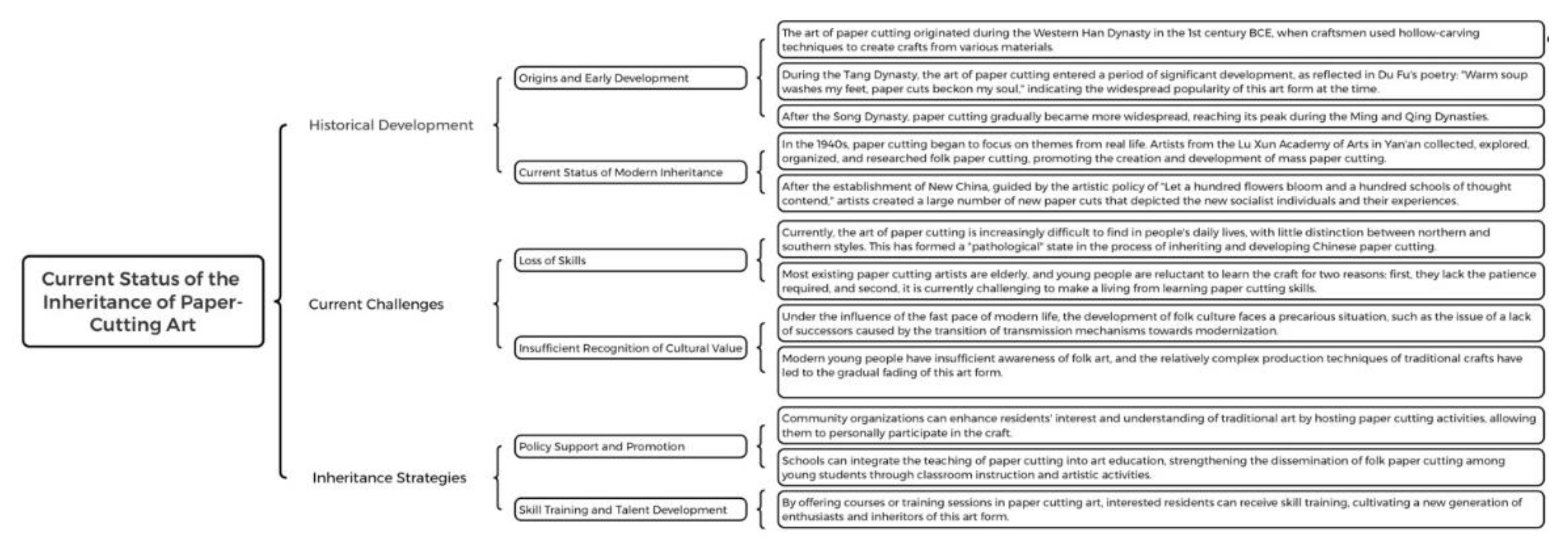
Figure 2.
The shape and transformation of paper-cutting.
5.3.2. Interdisciplinary Collaboration
Collaborating with artisans, designers, and technologists is crucial for the sustainable innovation of paper-cutting. Joint efforts between traditional craftsmen and modern designers ensure cultural authenticity while allowing for creative reinterpretation, while partnerships with academic and technological institutions help integrate the craft into the digital and globalized world.
5.3.3. Adaptation to Modern Socioeconomic Contexts
Xuzhou paper-cutting should be aligned to meet the requests of modern markets and global trends: ethical commercialization, satisfaction of the consumer's demand for culturally relevant products, and international exhibitions enhancing the recognition of paper-cutting on a global scale. In such a way, the craft will not lose its historical value but will be adequately positioned in the contemporary cultural and economic context.
These strategies provide a way for Xuzhou paper-cutting to achieve dynamic transmission in the 21st century through design integration, cross-disciplinary collaboration, and adaption to modern contexts. This approach means that the craft is able to evolve with its roots in its cultural significance, ensuring its continued relevance and influence both in heritage preservation and modern design.
6. Integration of Paper-Cutting Symbols in Contemporary Design
One of the major innovatory areas in this research involves the integration of Xuzhou paper-cutting symbols into modern design. This not only maintains the original beauty of the traditional paper-cutting art but also makes it more adaptable to modern uses, thereby placing it within a constantly developing design context. Translated cultural symbols and integrated into various modern design applications, the traditional craftsmanship is revitalized and given new life.
6.1. Characteristics of Paper-Cutting Art
To effectively apply paper-cutting symbols in contemporary design, it is essential to understand the core characteristics that define this traditional art form. 23
6.1.1. Form
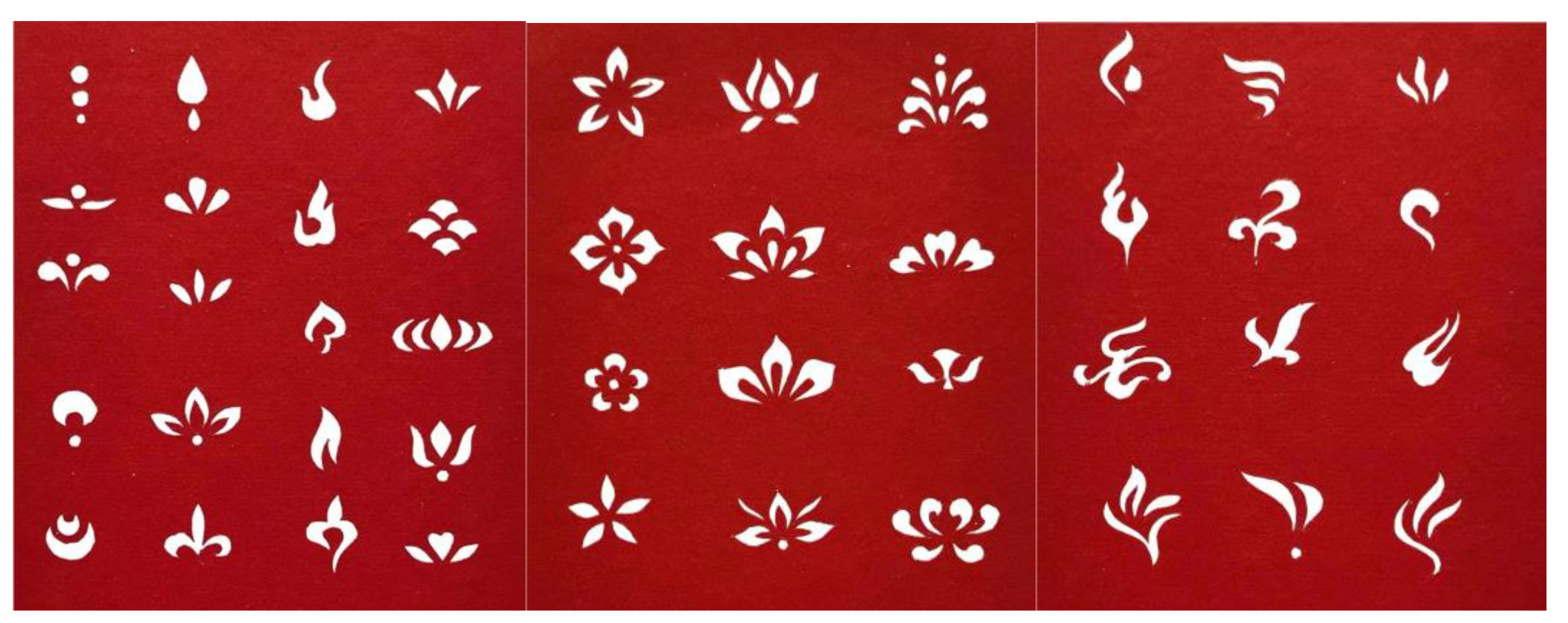
The forms in Xuzhou paper-cutting are very stylized, often representing flowers, animals, and landscapes. These forms are simplified into geometrical shapes and lines, so easily grasped in the modern minimalist design trend. Furthermore, the strong emphasis on symmetry and balance in paper-cutting designs encourages their application in contemporary aesthetic practices in design.
Figure 3.
Common patterns of Chinese paper-cutting.
6.1.2. Colour
Traditionally, Xuzhou paper-cutting involves bright and high-contrast color schemes, such as red, to symbolize happiness and prosperity in Chinese culture. These could be updated into a modern design by reinterpreting them into modern color palettes that incorporate traditional meaning with modern trends, such as pastel shades or other monochromatic color schemes that appeal to current market tastes.
6.1.3. Composition
Compositionally speaking, Xuzhou paper-cutting depends on negative space for the development of depth and meaning. This might be employed in modern graphic and product design to enhance communication while retaining integrity within the culture. Positive and negative spaces are in a visual dialogue in paper-cutting; this aspect is pretty flexible when it comes to contemporary design applications, such as designing a logo or packaging of any product.
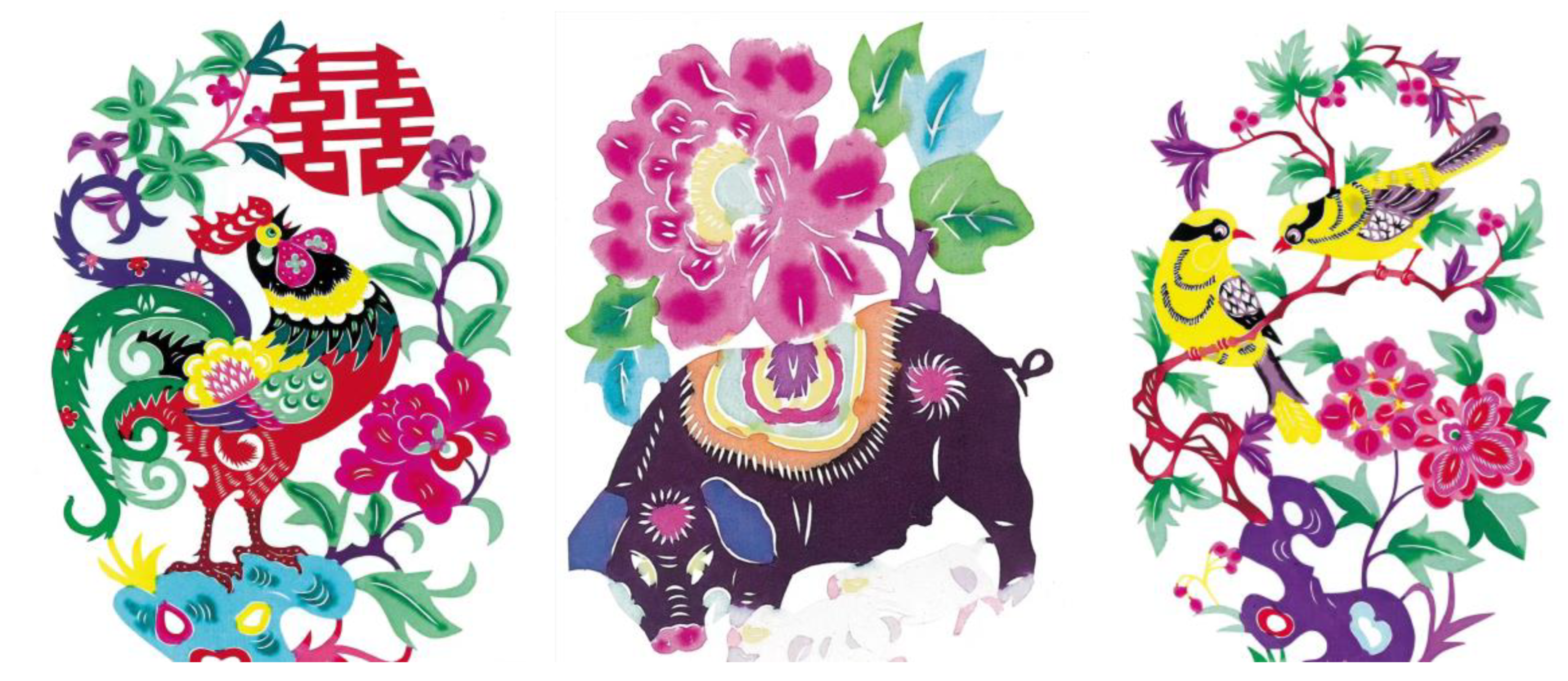
Figure 4.
Traditional Chinese art dyeing and paper-cutting.
6.2. Use of Paper-Cut in Modern Design
The diverse applications of Xuzhou paper-cutting symbols range from a lot of design spheres, each enriched with the cultural depth and aesthetic appeal that this traditional art form provides.
6.2.1. Product Design
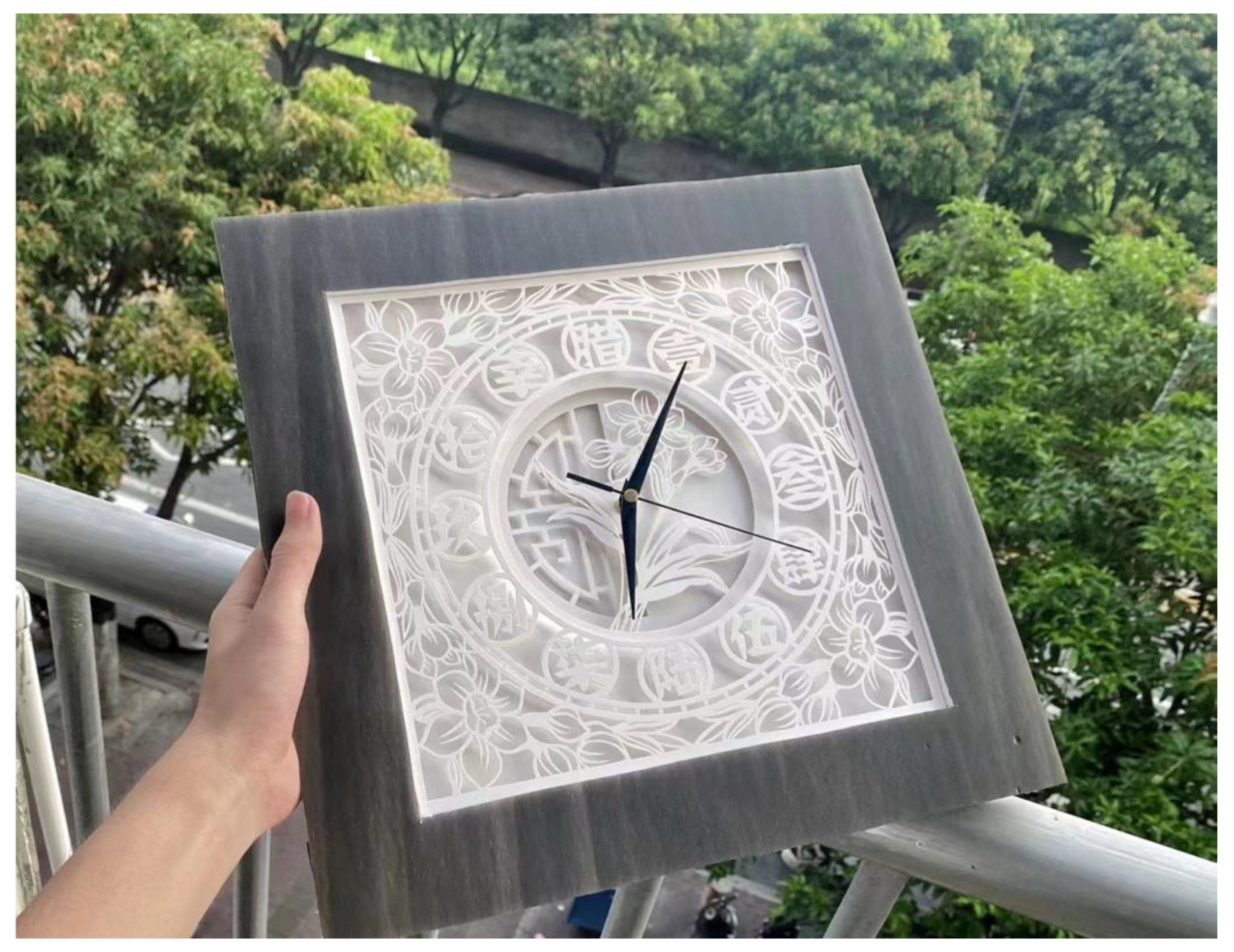
Paper-cutting models can be used in product design on consumer goods ranging from home decoration to packaging. The complicated paper-cutting designs create value and give a particular identity to products due to their culture, which enables them to penetrate into the most competitive markets. These patterns can be integrated into ceramics, textiles, and even electronic gadgets with a design that fuses both the traditional and modern looks. This approach appeals to consumers who are looking for products that have cultural significance, giving depth to the identity of the product. Another example is integration with clock design, where the form of the clock has been innovatively enhanced by the paper-cut motifs. 24
From the cultural perspective, the application of paper-cutting patterns draws from intangible cultural heritage in China, embedding traditional values into modern product design. For instance, the handcrafting of paper sculpture clocks involves many processes where no two can be exactly the same, thus maintaining their artisanal quality. The final design is good for home aesthetics, melding into an elegant domestic environment. Its use of simple, eco-friendly materials is not only highly recyclable but adds to a very modern and stylish appearance. Such products merge art and functionality, encouraging users to value both aesthetics and practicality, bringing cultural heritage into daily life while remaining relevant in contemporary design.
Figure 5.
Application of paper carving technology in clocks.
6.2.2. Graphic Design
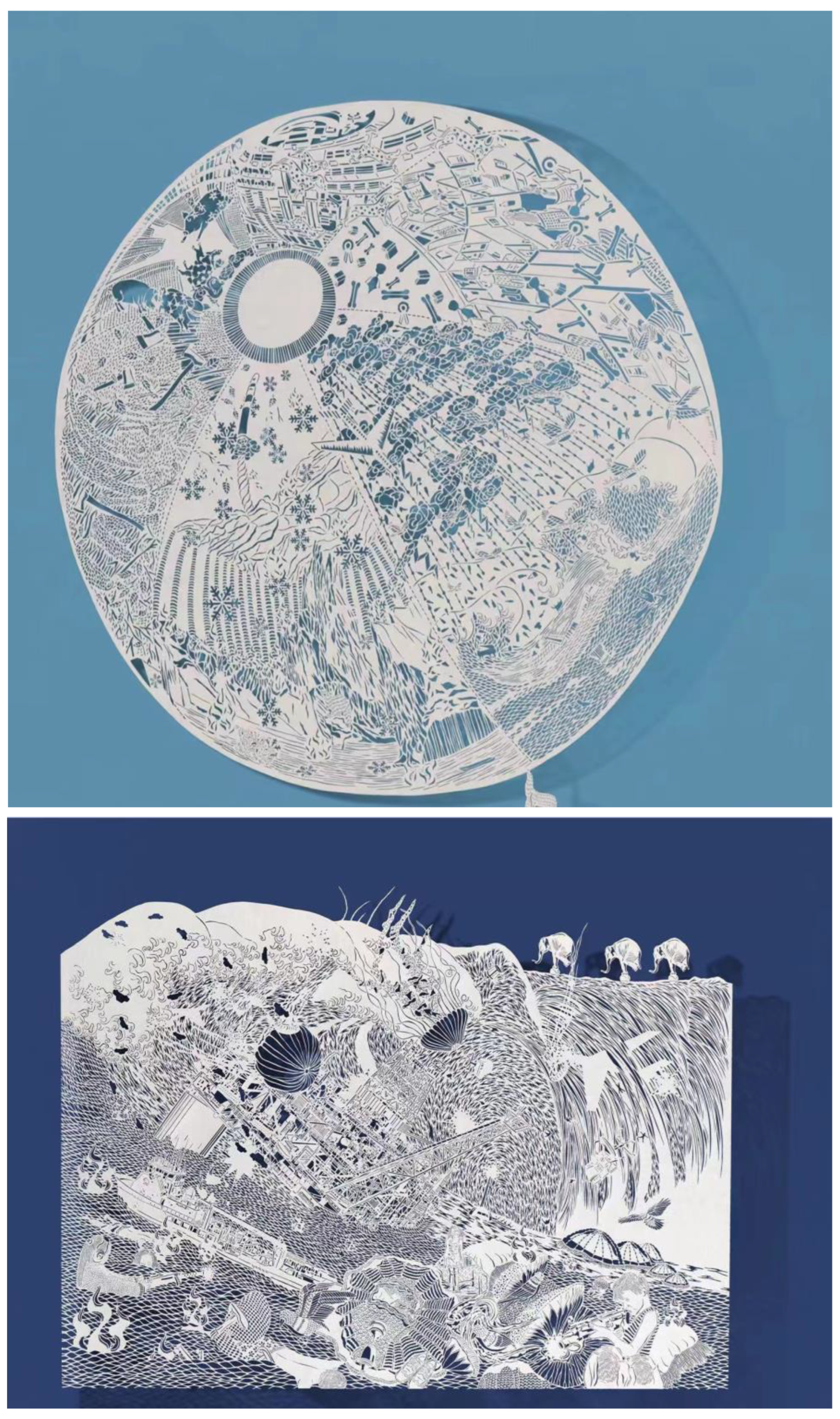
Lee Bovey is known for intricate paper-cutting and installation pieces that describe the dynamic relationship between humans and nature, within greater contexts of migration. Historically, paper-cutting was a generations-old pastime for Chinese women, often anonymous and confined to depictions of rural life. Bovey raises this craft to the level of a contemporary art form, using her singular, concept-driven works to tell personal social and political messages.
Bovey also points out that among the important roles of paper-cut motifs in graphic design are their flexibility within logos, advertisements, and digital illustrations. Paper-cut designs lend bold shapes and vivid colors to visual identity, while being smoothly blended into various media platforms, revealing the enormous possibilities these traditional symbols have in modern design contexts.
Figure 6.
Lee Bovey's creative cut-out design.
6.2.3. Architectural Design
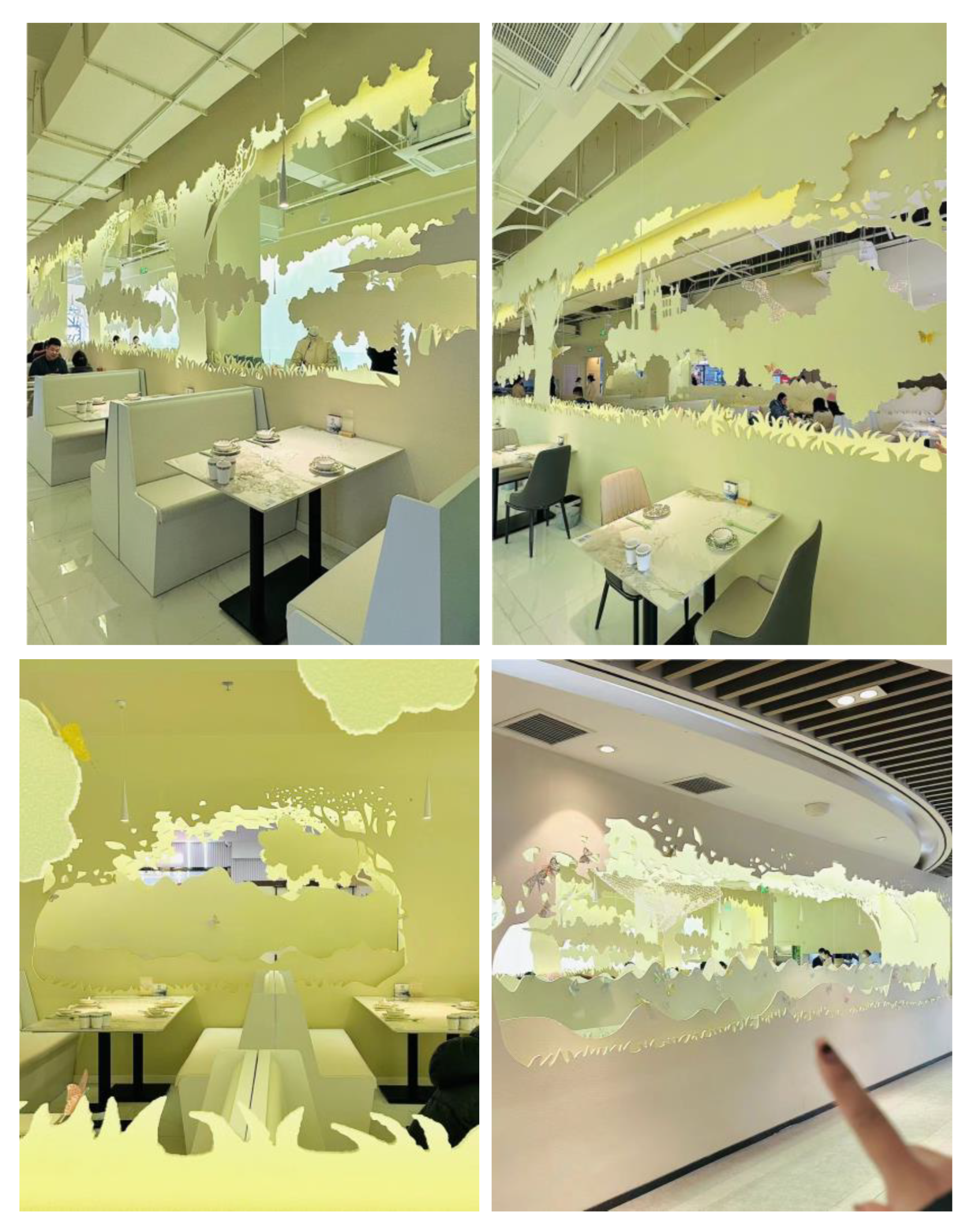
Paper Cutting Restaurant in Nanjing, China: Interplays of overlapping paper cuts and reflections in shadows create a romantic atmosphere. On sunny days, sunlight filters through the windows to make beautiful patterns with great detail-the blue sky outside also reflected inside. Such design not only increases the aesthetic value of the area but can make dining culturally enriching. The geometrical shapes and patterns followed in paper-cutting act as an unparalleled source of inspiration for modern architectural elements; one can thus manage to blend traditional art with contemporary design.
In this case, referencing paper-cutting in architectural detailing, designers come up with visually appealing and culturally relevant spaces. For instance, the perforated metal panel or etched glass used in the building can often successfully mirror the complex cut patterns typical of traditional paper-cutting. Therefore, the balance of light, shadow, and form together comes to create harmony. This sets up an enriched spatial experience that points to a variety of ways in which paper-cutting art can be applied to modern architecture.
6.3. Symbol Translation and Innovation
Symbol translation involves changing cultural symbols to fit into new contexts without losing their meanings. In the case of Xuzhou paper-cutting, for example, translation could be about finding the symbol of the lotus flower standing for purity or the dragon standing for strength and power into modern design elements that retain cultural meaning. This application of semiotic theory-whereby all symbols shall be taken both literally and metaphorically-is essential. In order to apply semiotic logic, designers can ensure that cultural depth related to paper-cutting symbols is preserved even when they have transformed into new forms.
6.3.1. Visual Communication and Emotional Resonance
Their translation into commercially successful art is also dependent on how well they achieve an emotional echo with today's audience. Careful handling of form, color, and composition can allow designers to render eye-catching works representative of the spirit of tradition, yet give resonance to the modern consumer. This aspect of the integration process is very critical in ensuring that commercial success for products and designs incorporating paper-cutting symbols is culturally meaningful and aesthetically appealing.
Figure 7.
Nanjing paper-cut style restaurant.
6.3.2. Cross-Cultural Design
Today, cross-cultural design is an important concept in the perspective of globalization. The paper-cutting activity at the center of Chinese culture, therefore, forms a wide basis for cross-cultural collaboration both in design research and practice. Translation of paper-cutting symbols to forms that are universally appreciated can help designers to inspire a greater bond and appreciation to the Chinese culture from different parts of the world. This cross-cultural approach also opens up new markets for products and designs that incorporate paper-cutting, enhancing their appeal to international audiences.25
6.4. Conclusions
The integration of Xuzhou paper-cutting symbols into modern design involves dynamic processes of cultural translation and innovation. These could be made possible through careful adaptation of traditional forms, colors, and composition to create an artistic work that is culturally rooted and avant-garde. Significantly, these innovative strategies discussed in this chapter have shown that paper-cutting is capable not only of survival but also of thriving within a modern context-a worthy case study in which heritage and contemporary aesthetics are fused.
7. Case Studies
The following section chose some case studies to explain in what ways this paper-cutting symbol of Xuzhou was integrated into contemporary design practice. These cases also explained how traditional cultural elements are digested and applied in the modern creative industries of product design, fashion, and digital media art.
7.1. Representative Cases
Three case representative works are analyzed to illustrate the diverse applications of Xuzhou paper-cutting in modern design:
7.1.1. Layla May Arthur's Paper Art Lighting Works
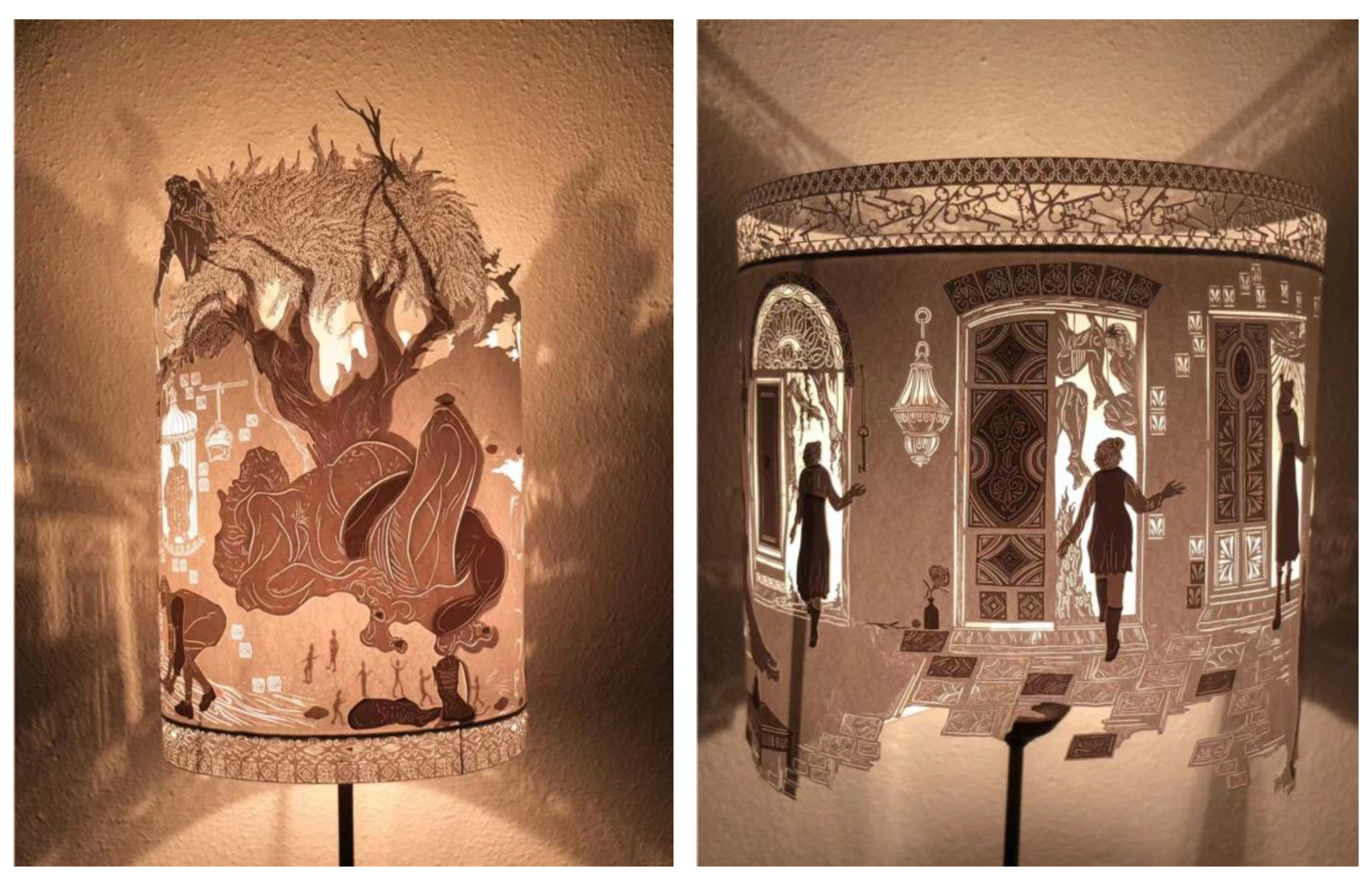
The following example of an innovative approach in lighting design is by Layla May Arthur, who transformed paper into a medium of telling stories. She cuts out intricate patterns and sculpts the paper to create a complex world with light interacting inside, thereby generating dynamic shadows. Every carefully cut angle or pattern of the white paper would be dramatized through spotlighting or internal lighting. Arthur uses basic scenographic principles, emphasizing light and shadow relationships across her work, largely treated for its storytelling potential in context like window displays and exhibitions in galleries. From personalized staircase sculptures to large-scale immersive installations, her work instills a sense of audience participation in the interactions of characters within each scene. 26
The present case shows how reinterpretations of traditional paper-cutting patterns in lighting design have poignantly brought out the symbolic and aesthetic use of light and shade. These designs boast complex compositions within the lamp fittings and have been translated into modern materials, thus producing products with a touch of cultural heritage yet suitable for contemporary living environments. Arthur's innovative applications of paper-cutting usages, showing how cultural expressions can inform and improve contemporary design practices.
Figure 8.
Layla May's creative paper sculpture lamp design.
7.1.2. Fashion Collection
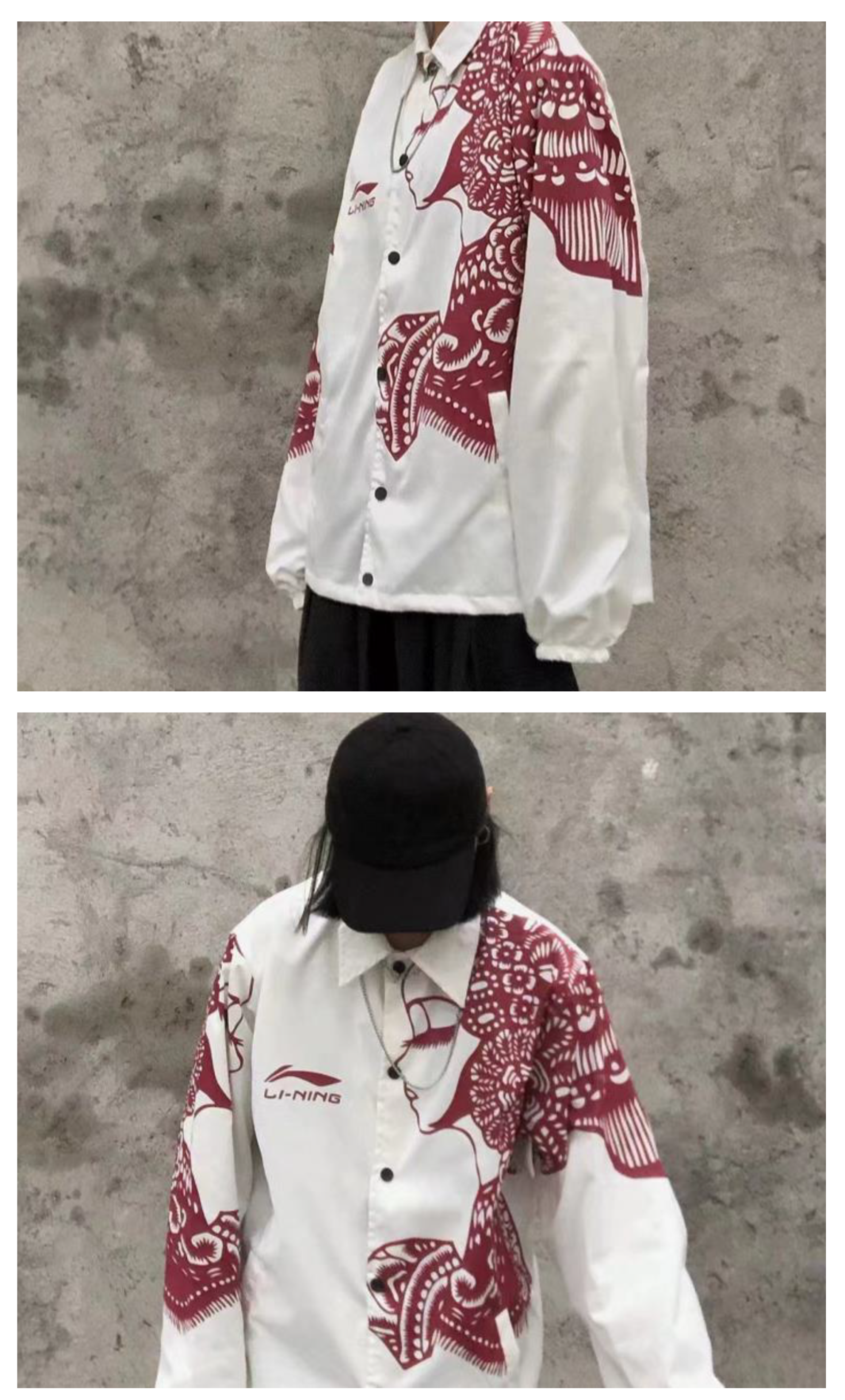
Recently, Li-Ning, the Chinese fashion brand, launched new series garments enriched with cultural touches. The new series of coach jackets is inspired by paper-cutting art. It has integrated traditional motifs, such as plum blossoms and bamboo, into designs on fabric with embroidery and printing and merged with cuts in modern apparel. This not only enriches the cultural narrative of Li-Ning but also turns the head in the fashion industry, proving how traditional art relates to and can be applied to modern fashion design.
In this case, Xuzhou paper-cutting patterns are combined with modern fashion through the method of laser cutting. These motives are used to decorate textiles and therefore present traditional paper-cutting craft in minute detail as wearable art for modern consumers. This collection treads the careful balance between tradition and innovation, reflecting the concept of "wearable heritage." 27
7.1.3. Digital Media Art
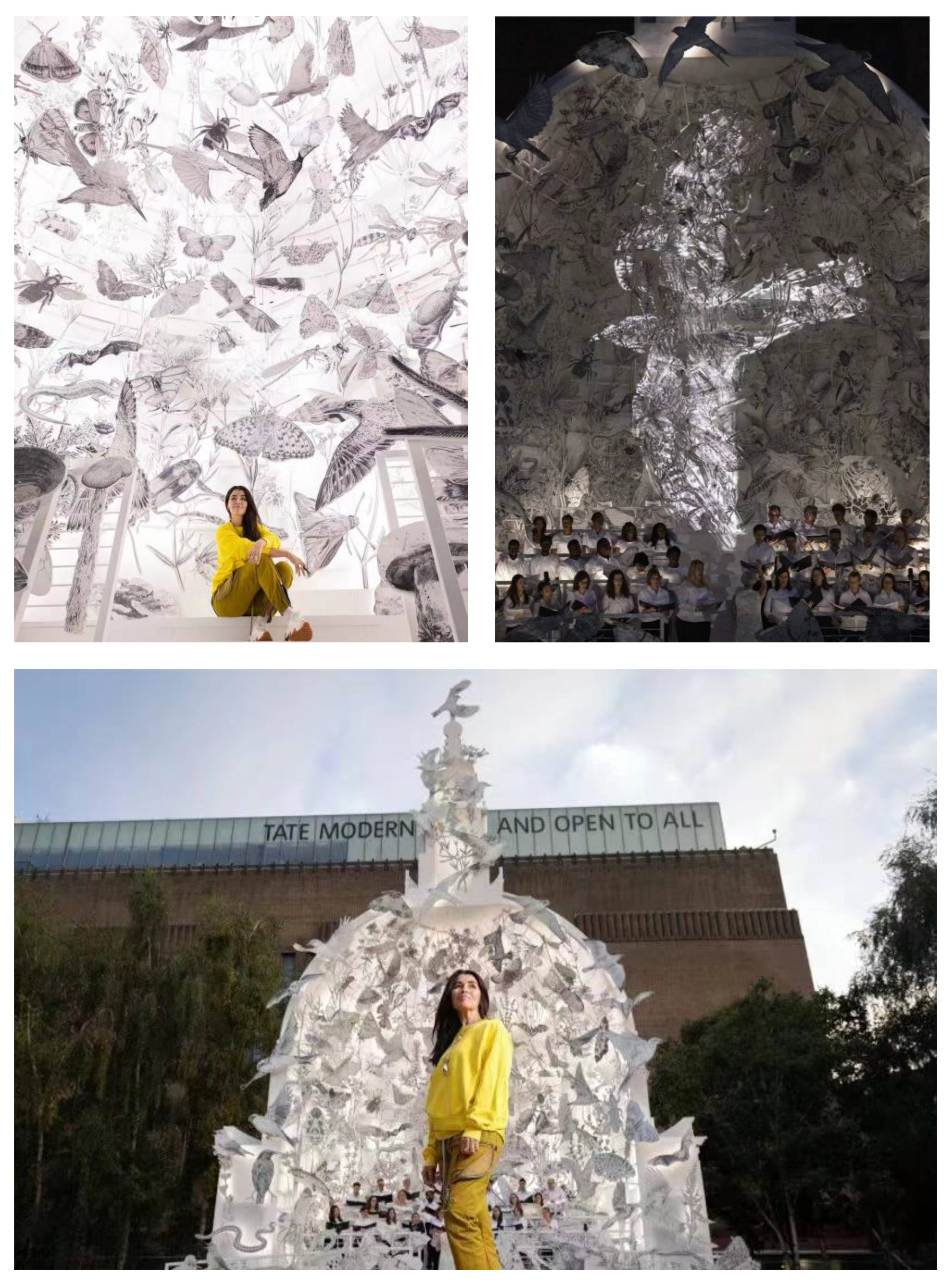
Es Devlin has developed light, music, and language-based, large-scale public art installations, and stage sculptures. One of her pieces entitled Come Home Again has taken its inspiration from the neoclassical dome of St. Paul's Cathedral, which symbolizes sanctuary from what is coming from the outside world. This theme was inspired by 92-year-old climate activist Joanna Macy. The cut-out motifs of the hanging paper were personally drawn by Devlin herself and contained 243 of the species listed as a priority conservation target by the City of London. These were then translated into very intricate paper-cut designs, interacting with the illuminated environment to tell a visually compelling story. Projects by Devlin include designing concert stages for high-profile performers like Beyoncé, The Weeknd, Kanye West, and U2, to name a few. Devlin has designed award ceremonies for the London and Rio Olympics.
Figure 9.
"Li Ning" brand paper-cut style design.
The case study looks at the digital adaptation of the traditional act of paper-cutting; more precisely, how static designs are transformed to assume dynamic, animated visuals. A cross-section of the dome structure has been cut open for Come Home Again, embellished with light effects that illustrate various species: moths, birds, beetles, wild flowers, and fish. Visitors get to interact with the 243 species pinpointed by London Biodiversity Action Plan whose populations are in decline and need conservation. This project acts as an example of how traditional paper-cut symbols can be creatively combined with digital media into interactive, engrossing content that appeals to younger, technology-savvy audiences while traditional cultural content is preserved in the paper-cutting art form.28
Figure 10.
Es Devlin's "Coming Home Again.".
7.2. Case Analysis
This section selects several case studies on how Xuzhou paper-cutting art is used in today's design, including lamp design, fashion, and digital media. These examples explain how traditional symbols and forms could be reshaped for modern aesthetic expression but retain their essence in cultural representation.
These case studies are important because they apply the theoretical material discussed above and concern the dynamic transmission of intangible cultural heritage. The analysis of these cases shows how successful strategies were found and what problems arose in the design process that eventually succeeded in incorporating traditional art into modern creative activity.
7.2.1. Creative Process
Each case study here has its creative processes vital in bringing traditional paper-cutting elements into contemporary design effectively. In Paper-Cut Lamp Design, the traditional motif undergoes deconstruction at the hands of the designer, with intricate patterns translated into functional elements such as perforated metal surfaces copying the delicate cuts of paper, thus letting light create the shadows that evoke the traditional forms.
In the Fashion Collection, the designer uses laser-cutting techniques to reproduce paper-cutting designs on textiles. While doing this, he has struck a balance between retaining craftsmanship and making clothes wearable. Such complicated work required knowledge in both traditional techniques and modern fashion trends.
The Digital Media Art project innovatively translated these two-dimensional paper-cut forms into digital animation. Using software to simulate the texture and depth of hand-cut paper, he reimagines the static designs as dynamic visuals that captivate an even larger audience while preserving the cultural essence of the craft.
7.2.2. Design Philosophy
These projects are joined by design philosophies of cultural continuity and innovation where traditional art forms such as the Xuzhou paper-cutting are dynamic assets that can be marshaled in service to contemporary life.
The Paper-Cut Lamp Design is the concept of "light as a medium of cultural expression", which translates into keeping the heritage alive in modern times. Light and shadow have been combined to relate the traditional culture to a contemporary way of living.
The Fashion Collection endorses "wearable heritage," which suggests that traditional culture should be applied in daily life through fashion and made available to the modern consumer.
The Digital Media Art project emphasizes the "digital rebirth" of traditional art forms, using new technologies to captivate audiences and further expand the possibilities of cultural storytelling.
These philosophies demonstrate the flexibility required to integrate traditional art into modern contexts while preserving core cultural values. They underscore the innovative potential of Xuzhou paper-cutting in contemporary design, highlighting its relevance in today's creative landscape.29
7.3. Practical Issues and Solutions
While all components blended well, several practical issues turned up. In the case of the Paper-Cut Lamp, there was a limitation from the material perspective: normal paper would not be sufficient to meet the contemporary durability requirements. So, the alternatives used were acrylic and metal; these retained not only the beauty attributes of paper-cutting but also made it more functional. In the Fashion Collection, a compromise was needed between traditional designs and the requirements for scalability in mass production. By using laser-cutting techniques, the designer managed to preserve accuracy while outperforming previous productions of this constraint.
In the field of Digital Media Art, it was an effort to search for a method to represent the tactile nature of paper-cutting in a digital environment. One possible way could be creating digital textures that emulate the look of hand-cut paper, which would allow audiences and users to experience this medium in new ways using new media.
The challenges faced and their respective solutions mirror the complexity involving the integration of traditional craftsmanship into modern design contexts. Each case was unique and required innovative strategies to preserve the cultural essence of Xuzhou paper-cutting while paving the way for its commercial success in contemporary contexts. Thus, this section underlines the crucial flexibility and problem-solving within heritage-oriented design and assures the continued development and contemporarity of traditional crafts. 30
8. Conclusions
8.1. Summary of Findings
This study explored the innovative revival of Xuzhou paper-cutting art and its integration into contemporary design, indicating how traditional cultural practices can be reinterpreted for modern applications. 31 Case studies in lamp design, fashion, and digital media showcased creative processes and design philosophies that bridge heritage and modern aesthetics. Key findings include the successful adaptation of traditional motifs into functional designs, the importance of maintaining cultural integrity, and the role of technology in expanding the reach of traditional art forms.
8.2. Contributions to Theory and Practice
This study contributes to both theory and practice on a multiplicity of levels. First, at the theoretical level, it deepens the concept of dynamic transmission of intangible cultural heritage, bringing forward an issue of real actuality-the traditional art forms of Xuzhou paper-cutting in the contemporary design. It reflects the interplay between tradition and modernity, the balance between cultural continuity and innovation. This theoretical framework provides new perspectives for understanding how traditional art can be reinterpreted in modern contexts.
The second part of this study, through the presentation of cases, demonstrates the applications of Xuzhou paper-cutting art to modern design; for example, lamp design, fashion, and digital media art. These cases, besides demonstrating how traditional art can be merged with modern design concepts, reveal creative challenges and solutions during the design process that form an empirical basis for design practice.32 To be specific, this study emphasizes:
8.2.1. Contemporary Translation of Cultural Symbols
The study reveals that designers may produce products not only corresponding to the modern aesthetic but also maintaining the cultural essence through re-interpretation of the traditional pattern of paper cutting. This process protects the value of traditional art and meets the demand for personalization and innovation from contemporary consumers.
8.2.2. Interdisciplinary Design Philosophy
This study indicates that the integration of traditional art and modern design should be interdisciplinary in nature. The designers have to consider the technical, material, and cultural contexts while developing the designs to ensure their feasibility and depth regarding culture. The insights from a multidisciplinary approach provide a direction for future design education and practice.
8.2.3. Sustainable Cultural Practices
It also embraces the research about how to realize cultural sustainability in the process of design. As a result, through the use of innovative production techniques and material traditional art can find its vitality in modern society, while increasing public recognition and involvement with traditional culture.
In a word, this research provides new perspectives and frames for theoretical research and effective strategy and guidance for designers and cultural workers, thus contributing to the revival and development of traditional art in contemporary society.
8.3. Future Research Directions
Future research should look into the long-term impacts of integrating traditional arts into various design fields, specifically the sustainability of such practices and the cultural relevance in light of a rapidly changing cultural scenario. This implies discussing how traditional crafts can be merged with emerging design trends and technologies without any degradation of their inherent cultural values.
Furthermore, it is important to look into strategies in education to instill appreciation in younger generations for traditional arts. For instance, investigation into curriculum courses that successfully bridge traditional craftsmanship with modern design principles could provide the necessary insights into fostering future artisans and designers.
Further research is encouraged in the potential that digital platforms have toward improving engagement with traditional art forms. This could be related to the way virtual spaces can support the promotion and access of traditional arts through social media and interactive applications to make them more relevant and accessible to today's audiences.
By broadening the scope of inquiry in such areas, scholars can gain a more nuanced understanding of the evolving relationship between traditional crafts and contemporary design practices that ultimately contribute to the sustainable revival of cultural heritage within modern society. 33
Acknowledgments
Delete for peer review.
References
- Kayyali, M. Design Thinking and Creativity in Entrepreneurial Innovation. In Applying Business Intelligence and Innovation to Entrepreneurship; IGI Global: Hershey, PA, USA, 2024; pp. 155–170. [Google Scholar] [CrossRef]
- Tyrväinen, P.; Silvennoinen, M.; Talvitie-Lamberg, K.; Ala-Kitula, A.; Kuoremäki, R. Opportunities of AI Applications in Healthcare Identifying — Renewing the National Healthcare and Social Services. Proceedings of the 2018 IEEE 6th International Conference on Serious Games and Applications for Health (SeGAH); IEEE: Piscataway, NJ, USA, 2018; pp. 1–7. [Google Scholar] [CrossRef]
- Daniel, A.D. Fostering an Entrepreneurial Mindset by Using a Design Thinking Approach in Entrepreneurship Education. Industry and Higher Education 2016, 30, 215–223. [Google Scholar] [CrossRef]
- O'Driscoll, K. The Agile Data Modelling & Design Thinking Approach to Information System Requirements Analysis. Journal of Decision Systems 2016, 25, 632–638. [Google Scholar] [CrossRef]
- Melles, G.; Anderson, N.; Barrett, T.; Thompson-Whiteside, S. Problem Finding Through Design Thinking in Education. In Inquiry-Based Learning for Multidisciplinary Programs: A Conceptual and Practical Resource for Educators; Emerald Group Publishing: Bingley, UK, 2015; pp. 191–209. [Google Scholar] [CrossRef]
- Holland, R.; Lam, B. Strategic Design. In Managing Strategic Design; Palgrave Macmillan: London, UK, 2014; pp. 3–31. [Google Scholar] [CrossRef]
- Von Kortzfleisch, H.F.O.; Zerwas, D.; Mokanis, I. Potentials of Entrepreneurial Design Thinking® for Entrepreneurship Education. Procedia - Social and Behavioral Sciences 2013, 106, 2080–2092. [Google Scholar] [CrossRef]
- Stigliani, I.; Ravasi, D. Organizing Thoughts and Connecting Brains: Material Practices and the Transition from Individual to Group-Level Prospective Sensemaking. Academy of Management Journal 2012, 55, 1232–1259. [Google Scholar] [CrossRef]
- Redante, R.C.; de Medeiros, J.F.; Vidor, G.; da Cruz, C.M.L.; Ribeiro, J.L.D. Creative Approaches and Green Product Development: Applying Design Thinking to Stakeholder's Engagement. Sustainable Production and Consumption 2019, 19, 247–256. [Google Scholar] [CrossRef]
- Reorienting our health system towards its users thanks to design thinking. Experience in Healthcare Innovation; Wiley: Hoboken, NJ, USA, 2024; pp. 131–148. [Google Scholar] [CrossRef]
- Clark, K. Engaging and Adaptive: Going Beyond Ease of Use. In Human Centered Design; Springer: Berlin, Germany, 2009; pp. 46–54. [Google Scholar] [CrossRef]
- Eusebi, N. ; Barcelona Design Centre (BDC). € Design—Measuring Design Value: Guidelines for Collecting and Interpreting Design Data; 2014; 1–40. Available at: http://www.measuringdesignvalue.eu/index.php.
- Dobrigkeit, F.; Pajak, P.; De Paula, D.; Uflacker, M. DT@IT Toolbox: Design Thinking Tools to Support Everyday Software Development. In Design Thinking Research; Springer: Cham, Switzerland, 2019; pp. 201–227. [Google Scholar] [CrossRef]
- Lim, S.; Kim, M.; Sawng, Y.W. Design Thinking for Public R&D: Focus on R&D Performance at Public Research Institutes. Sustainability 2022, 14, 7765. [Google Scholar] [CrossRef]
- Magistretti, S.; Bellini, E.; Cautela, C.; Dell'Era, C.; Gastaldi, L.; Lessanibahri, S. The Perceived Relevance of Design Thinking in Achieving Innovation Goals: The Individual Microfoundations Perspective. Creativity and Innovation Management 2022, 31, 740–754. [Google Scholar] [CrossRef]
- Micheli, P.; Wilner, S.J.S.; Bhatti, S.H.; Mura, M.; Beverland, M.B. Doing Design Thinking: Conceptual Review, Synthesis, and Research Agenda. Journal of Product Innovation Management 2018, 36, 124–148. [Google Scholar] [CrossRef]
- De Paula, D.; Marx, C.; Wolf, E.; Dremel, C.; Cormican, K.; Uebernickel, F. A Managerial Mental Model to Drive Innovation in the Context of Digital Transformation. Industry and Innovation 2022, 30, 42–66. [Google Scholar] [CrossRef]
- Wilson, G.A.; Dobni, C.B. What Innovative Methodologies and Technologies Enhance Firm Performance? A Global Study of SMEs. Research-Technology Management 2022, 65, 50–60. [Google Scholar] [CrossRef]
- Dobni, C.B.; Wilson, G.A.; Klassen, M. Business Practices of Highly Innovative Japanese Firms. Asia Pacific Management Review 2022, 27, 155–162. [Google Scholar] [CrossRef]
- Huang, Y.; Hands, D. Evolution of the Relationship between Design and Business Activities. In Design Thinking for New Business Contexts; Springer: Cham, Switzerland, 2022; pp. 9–26. [Google Scholar] [CrossRef]
- Caban-Piaskowska, K. Business Model of a Creative Company and Design Management. Problemy Zarzadzania 2019, 82, 155–169. [Google Scholar] [CrossRef]
- Anonymous. Design as Interface: As Professionals See It. Design Management Journal (Former Series) 2002, 13(1), 56–61. [CrossRef]
- Bettiol, M.; Micelli, S. The Hidden Side of Design: The Relevance of Artisanship. Design Issues 2014, 30(1), 7–18. [Google Scholar] [CrossRef]
- Borja de Mozota, B. The Four Powers of Design: A Value Model in Design Management. Design Management Review 2010, 17(2), 44–53. [Google Scholar] [CrossRef]
- Cautela, C.; Deserti, A.; Rizzo, F.; Zurlo, F. Design and Innovation: How Many Ways? Design Issues 2014, 30(1), 3–6. [Google Scholar] [CrossRef]
- Chen, C. Design for the Environment: A Quality-Based Model for Green Product Development. Management Science 2001, 47(2), 250–263. [Google Scholar] [CrossRef]
- Choi, Y.; Cooper, R.; Lim, S.; Evans, M. National Support for Design: Developing Propositional Models. Design Management Review 2010, 21(4), 60–69. [Google Scholar] [CrossRef]
- Churchman, M.; Marzano, T. How to Make Sure a Brand Behaves Itself. Design Management Review 2008, 19(3), 74–79. [Google Scholar] [CrossRef]
| 1 | Chen, C. Design for the Environment: A Quality-Based Model for Green Product Development. Management Science2001, 47(2), 250–263. https://doi.org/10.1287/mnsc.47.2.250.9841. |
| 2 | Tyrvainen, P.; Silvennoinen, M.; Talvitie-Lamberg, K.; Ala-Kitula, A.; Kuoremaki, R. Identifying Opportunities for AI Applications in Healthcare — Renewing the National Healthcare and Social Services. In Proceedings of the 2018 IEEE 6th International Conference on Serious Games and Applications for Health (SeGAH); IEEE: Piscataway, NJ, USA, 2018; pp. 1–7. https://doi.org/10.1109/SeGAH.2018.8401381. |
| 3 | Huang, Y.; Hands, D. Evolution of the Relationship Between Design and Business Activities. In Design Thinking for New Business Contexts; Springer: Cham, Switzerland, 2022; pp. 9–26. https://doi.org/10.1007/978-3-030-94206-9_2. |
| 4 | Melles, G.; Anderson, N.; Barrett, T.; Thompson-Whiteside, S. Problem Finding Through Design Thinking in Education. In Inquiry-Based Learning for Multidisciplinary Programs: A Conceptual and Practical Resource for Educators; Emerald Group Publishing: Bingley, UK, 2015; pp. 191–209. https://doi.org/10.1108/S2055-364120150000003027. |
| 5 | Micheli, P.; Wilner, S.J.S.; Bhatti, S.H.; Mura, M.; Beverland, M.B. Doing Design Thinking: Conceptual Review, Synthesis, and Research Agenda. Journal of Product Innovation Management 2018, 36, 124–148. https://doi.org/10.1111/jpim.12466. |
| 6 | Stigliani, I.; Ravasi, D. Organizing Thoughts and Connecting Brains: Material Practices and the Transition from Individual to Group-Level Prospective Sensemaking. Academy of Management Journal 2012, 55, 1232–1259. https://doi.org/10.5465/amj.2010.0890. |
| 7 | Borja de Mozota, B. The Four Powers of Design: A Value Model in Design Management. Design Management Review2010, 17(2), 44–53. https://doi.org/10.1111/j.1948-7169.2006.tb00038.x. |
| 8 | Wilson, G.A.; Dobni, C.B. Which Innovative Methodologies and Technologies Help Improve Firm Performance? A Global Study of SMEs. Research-Technology Management 2022, 65, 50–60. https://doi.org/10.1080/08956308.2022.2032973. |
| 9 | Von Kortzfleisch, H.F.O.; Zerwas, D.; Mokanis, I. Potentials of Entrepreneurial Design Thinking® for Entrepreneurship Education. Procedia - Social and Behavioral Sciences 2013, 106, 2080–2092. https://doi.org/10.1016/j.sbspro.2013.12.237. |
| 10 | O’Driscoll, K. The Agile Data Modelling & Design Thinking Approach to Information System Requirements Analysis. Journal of Decision Systems 2016, 25, 632–638. https://doi.org/10.1080/12460125.2016.1189643. |
| 11 | Dobni, C.B.; Wilson, G.A.; Klassen, M. Business Practices of Highly Innovative Japanese Firms. Asia Pacific Management Review 2022, 27, 155–162. https://doi.org/10.1016/j.apmrv.2021.06.005. |
| 12 | Cautela, C.; Deserti, A.; Rizzo, F.; Zurlo, F. Design and Innovation: How Many Ways? Design Issues 2014, 30(1), 3–6. https://doi.org/10.1162/DESI_a_00244. |
| 13 | Clark, K. Engaging and Adaptive: Going Beyond Ease of Use. In Human Centered Design; Springer: Berlin, Germany, 2009; pp. 46–54. https://doi.org/10.1007/978-3-642-02806-9_7. |
| 14 | Choi, Y.; Cooper, R.; Lim, S.; Evans, M. National Support for Design: Developing Propositional Models. Design Management Review 2010, 21(4), 60–69. https://doi.org/10.1111/j.1948-7169.2010.00096.x. |
| 15 | Redante, R.C.; Medeiros, J.F.; Vidor, G.; Cruz, C.M.L.; Ribeiro, J.L.D. Creative Approaches and Green Product Development: Using Design Thinking to Promote Stakeholders’ Engagement. Sustainable Production and Consumption2019, 19, 247–256. https://doi.org/10.1016/j.spc.2019.04.006. |
| 16 | De Paula, D.; Marx, C.; Wolf, E.; Dremel, C.; Cormican, K.; Uebernickel, F. A Managerial Mental Model to Drive Innovation in the Context of Digital Transformation. Industry and Innovation 2022, 30, 42–66. https://doi.org/10.1080/13662716.2022.2072711. |
| 17 | De Paula, D.; Marx, C.; Wolf, E.; Dremel, C.; Cormican, K.; Uebernickel, F. A Managerial Mental Model to Drive Innovation in the Context of Digital Transformation. Industry and Innovation 2022, 30, 42–66. https://doi.org/10.1080/13662716.2022.2072711. |
| 18 | Lim, S.; Kim, M.; Sawng, Y.W. Design Thinking for Public R&D: Focus on R&D Performance at Public Research Institutes. Sustainability 2022, 14, 7765. https://doi.org/10.3390/su14137765. |
| 19 | Lim, S.; Kim, M.; Sawng, Y.W. Design Thinking for Public R&D: Focus on R&D Performance at Public Research Institutes. Sustainability 2022, 14, 7765. https://doi.org/10.3390/su14137765. |
| 20 | Holland, R.; Lam, B. Strategic Design. In Managing Strategic Design; Palgrave Macmillan: London, UK, 2014; pp. 3–31. https://doi.org/10.1007/978-1-137-32595-2_1. |
| 21 | Micheli, P.; Wilner, S.J.S.; Bhatti, S.H.; Mura, M.; Beverland, M.B. Doing Design Thinking: Conceptual Review, Synthesis, and Research Agenda. Journal of Product Innovation Management 2018, 36, 124–148. https://doi.org/10.1111/jpim.12466. |
| 22 | Huang, Y.; Hands, D. Evolution of the Relationship Between Design and Business Activities. In Design Thinking for New Business Contexts; Springer: Cham, Switzerland, 2022; pp. 9–26. https://doi.org/10.1007/978-3-030-94206-9_2. |
| 23 | Bettiol, M.; Micelli, S. The Hidden Side of Design: The Relevance of Artisanship. Design Issues 2014, 30(1), 7–18. https://doi.org/10.1162/DESI_a_00245. |
| 24 | Caban-Piaskowska, K. Business Model of a Creative Company and Design Management. Problemy Zarzadzania 2019, 82, 155–169. https://doi.org/10.7172/1644-9584.82.8. |
| 25 | Chen, C. Design for the Environment: A Quality-Based Model for Green Product Development. Management Science2001, 47(2), 250–263. https://doi.org/10.1287/mnsc.47.2.250.9841. |
| 26 | Reorienting Our Health System Towards Its Users Thanks to Design Thinking. In Experience in Healthcare Innovation; Wiley: Hoboken, NJ, USA, 2024; pp. 131–148. https://doi.org/10.1002/9781394300723.ch7. |
| 27 | Daniel, A.D. Fostering an Entrepreneurial Mindset by Using a Design Thinking Approach in Entrepreneurship Education. Industry and Higher Education 2016, 30, 215–223. https://doi.org/10.1177/0950422216653195. |
| 28 | Tyrvainen, P.; Silvennoinen, M.; Talvitie-Lamberg, K.; Ala-Kitula, A.; Kuoremaki, R. Identifying Opportunities for AI Applications in Healthcare — Renewing the National Healthcare and Social Services. In Proceedings of the 2018 IEEE 6th International Conference on Serious Games and Applications for Health (SeGAH); IEEE: Piscataway, NJ, USA, 2018; pp. 1–7. https://doi.org/10.1109/SeGAH.2018.8401381. |
| 29 | Melles, G.; Anderson, N.; Barrett, T.; Thompson-Whiteside, S. Problem Finding Through Design Thinking in Education. In Inquiry-Based Learning for Multidisciplinary Programs: A Conceptual and Practical Resource for Educators; Emerald Group Publishing: Bingley, UK, 2015; pp. 191–209. https://doi.org/10.1108/S2055-364120150000003027. |
| 30 | Stigliani, I.; Ravasi, D. Organizing Thoughts and Connecting Brains: Material Practices and the Transition from Individual to Group-Level Prospective Sensemaking. Academy of Management Journal 2012, 55, 1232–1259. https://doi.org/10.5465/amj.2010.0890. |
| 31 | Stigliani, I.; Ravasi, D. Organizing Thoughts and Connecting Brains: Material Practices and the Transition from Individual to Group-Level Prospective Sensemaking. Academy of Management Journal 2012, 55, 1232–1259. https://doi.org/10.5465/amj.2010.0890. |
| 32 | Wilson, G.A.; Dobni, C.B. Which Innovative Methodologies and Technologies Help Improve Firm Performance? A Global Study of SMEs. Research-Technology Management 2022, 65, 50–60. https://doi.org/10.1080/08956308.2022.2032973. |
| 33 | Holland, R.; Lam, B. Strategic Design. In Managing Strategic Design; Palgrave Macmillan: London, UK, 2014; pp. 3–31. https://doi.org/10.1007/978-1-137-32595-2_1. |
Disclaimer/Publisher’s Note: The statements, opinions and data contained in all publications are solely those of the individual author(s) and contributor(s) and not of MDPI and/or the editor(s). MDPI and/or the editor(s) disclaim responsibility for any injury to people or property resulting from any ideas, methods, instructions or products referred to in the content. |
© 2024 by the authors. Licensee MDPI, Basel, Switzerland. This article is an open access article distributed under the terms and conditions of the Creative Commons Attribution (CC BY) license (http://creativecommons.org/licenses/by/4.0/).
Copyright: This open access article is published under a Creative Commons CC BY 4.0 license, which permit the free download, distribution, and reuse, provided that the author and preprint are cited in any reuse.


