

Submitted:
09 October 2024
Posted:
10 October 2024
You are already at the latest version
Abstract
Construction projects' unsatisfactory performance has been linked to factors influencing individuals' well-being and mental alertness on projects. Drowsiness is a significant indicator of sleep deprivation and fatigue, being able to identify the cognitive and physical preparedness of workers on site to engage in construction tasks. As a consequence of the strenuous nature of the work involved in construction, long work hours, and environmental conditions, drowsiness is commonplace and has received less attention despite being a leading cause of accidents occurring on-site. Detecting drowsiness is essential for determining the safety and well-being of site workers. This study presents a vision-based approach using an improved version of the You Only Look Once (YOLOv8) algorithm for real-time drowsiness exposure among construction workers. The proposed method leverages computer vision techniques to analyse facial and eye features, enabling early detection of drowsiness signs, effectively preventing accidents, and enhancing on-site safety. The model showed significant precision and efficiency in detecting drowsiness from the given dataset, accomplishing a drowsiness class with a mean average precision (mAP) of 92%. However, it also exhibited difficulties handling imbalanced classes, particularly the underrepresented 'Awake with PPE' class, which was detected with high precision but comparatively lower recall and mAP. This highlighted the necessity of balanced datasets for optimal deep learning performance. The YOLOv8 model's average mAP of 78% in drowsiness detection compared favourably with other studies employing different methodologies. The vision-based drowsiness detection system has broad applications in the construction industry. It can be integrated into existing safety protocols, enabling real-time alerts to supervisors or workers when drowsiness is detected. The system improves productivity and reduces costs by preventing accidents and enhancing worker safety. However, limitations, such as sensitivity to lighting conditions and occlusions, must be addressed in future iterations.
Keywords:
1. Introduction
2. Construction Workers Well Being
2.1. Unsafe Behavior in the Construction Sector
2.2. Fatigue amongst Construction Workers
2.3. Drowsiness by Workers in the Construction Industry
2.4. Computer Vision Techniques and Deep Learning in Construction
3. Methodology
3.1. Dataset Extraction
3.2. Computation Specifications
3.3. Evaluation Metrics
3.4. YOLOV8 Model
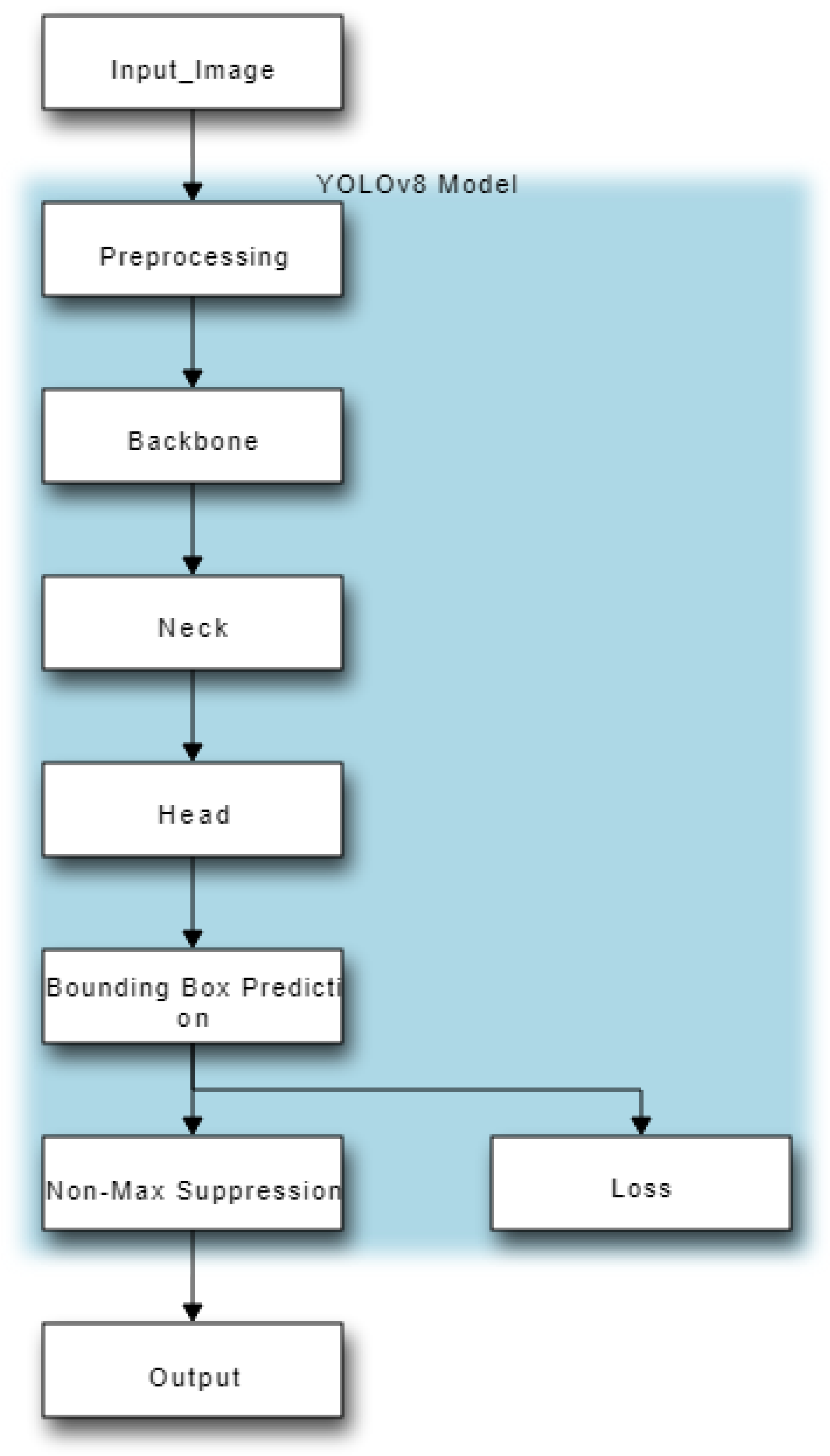
3.5. Dataset Labeling
4. Results

| Parameter | Value | Remarks |
|---|---|---|
| Optimizer | Stochastic Gradient Descent (SGD). | |
| Seed | 0 | reproducibility |
| Verbose | True | Enabling the printing of detailed information during training |
| Amp | True | Enabling automatic mixed precision for faster training |
| Fraction | 1.0 | Indicating the image fraction to process during training |
| Overlap_mask | True | Enabling the overlapping mask for mosaic augmentation |
| Mask_ratio | 4 | The ‘dropout’ is set to 0.0, indicating no dropout during training |
| learning rate | 0.01 | The final learning rate (lrf) is also 0.01 |
| Momentum | 0.937 | The is set to |
| weight decay | 0.0005 | |
| Warmup Epochs | 3.0 | With a warmup momentum of 0.8 and a warmup bias learning rate of 0.1 |
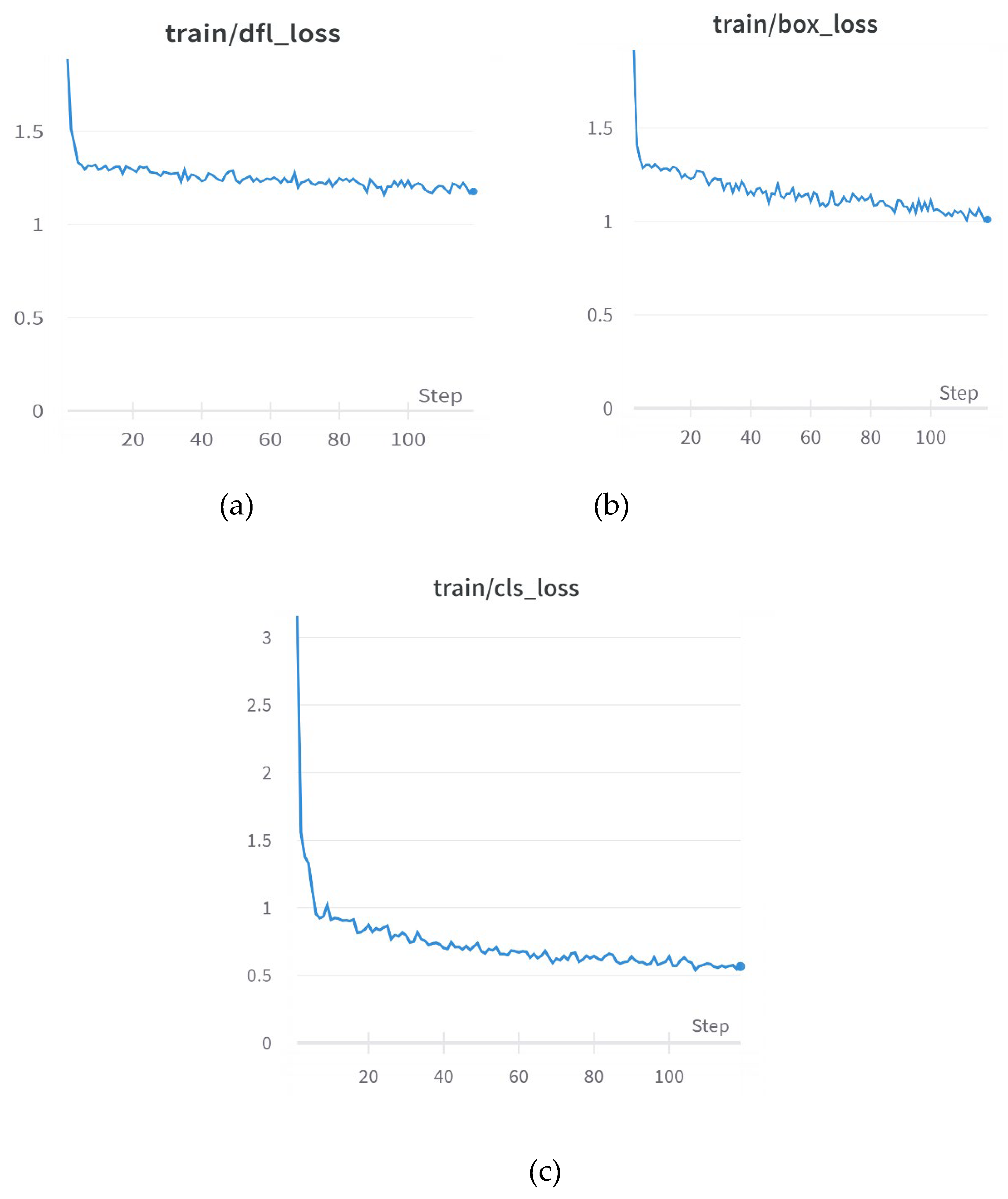
4.1. Performance of the Yolov8
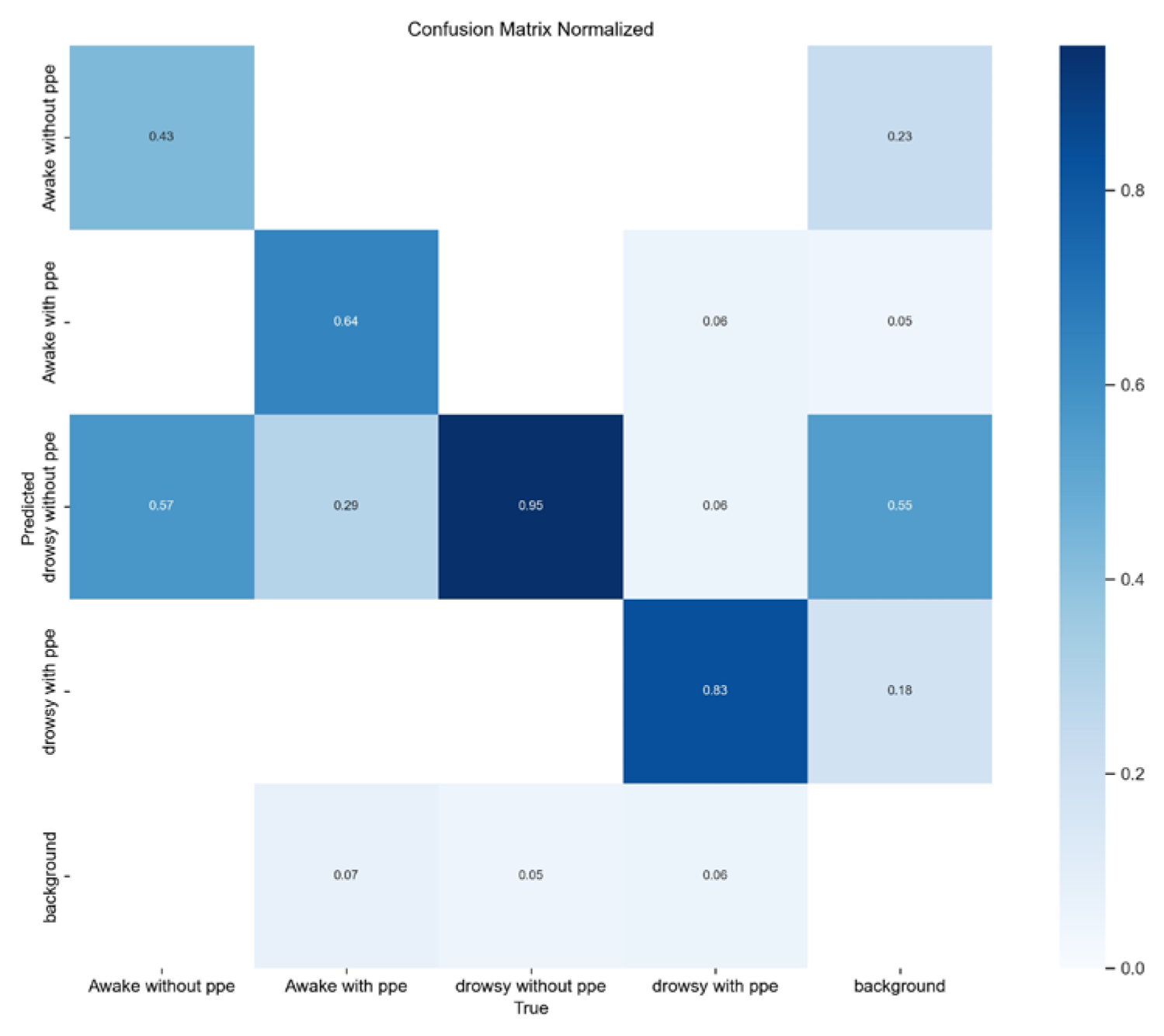
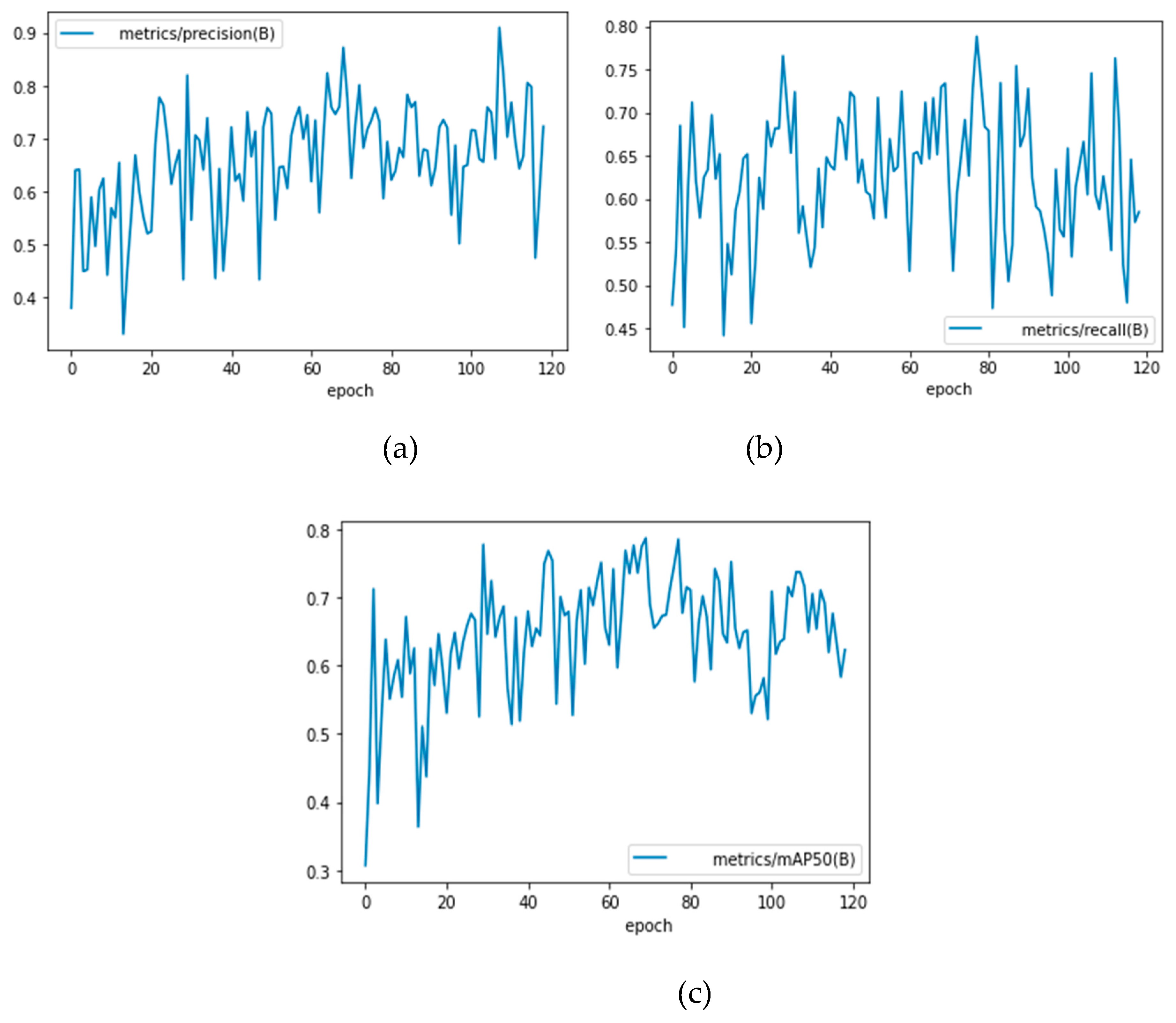
| Metrics | |||
|---|---|---|---|
| Class | Precision | Recall | mAP@50 |
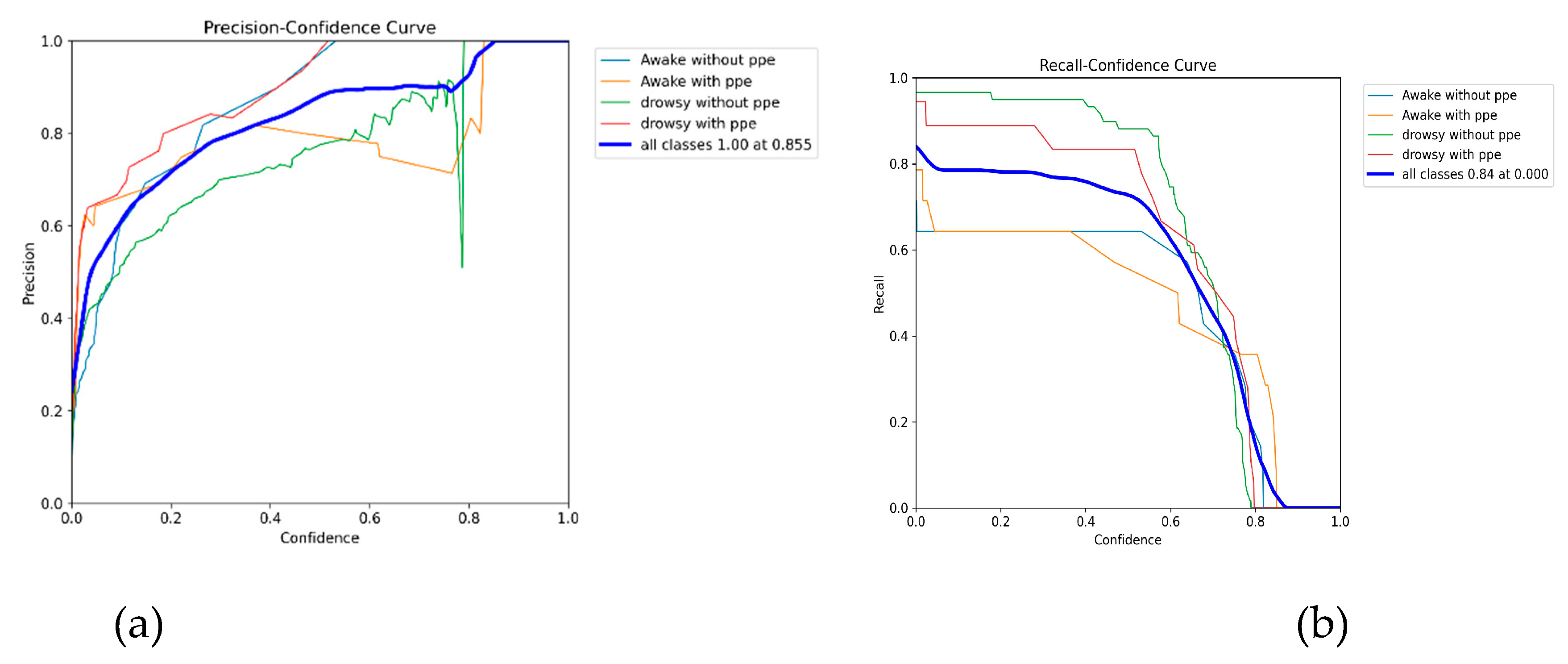
| All | 0.87 | 0.73 | 0.78 |
| Awake without PPE | 0.96 | 0.64 | 0.67 |
| Awake with PPE | 0.80 | 0.57 | 0.68 |
| Drowsy without PPE | 0.77 | 0.88 | 0.84 |
| Drowsy with PPE | 0.96 | 0.83 | 0.92 |
4.2. Discussion
| Reference | Domain | Methodology | mAP (%) |
|---|---|---|---|
| Proposed | Drowsiness | Yolo-v8 | 78 |
| Lee et al. (2023) | Worker | YOLOACT | 64.3 |
| Lee et al. (2023) | Hardhat | YOLOACT | 77.2 |
| Lee et al. (2023) | Safety vest | YOLOACT | 62.3 |
Implications of the Study
Drowsiness as an Indicator of Fatigue
Enhanced Construction Health, Safety and Well-Being
5. Conclusions and Future Directions
Author Contributions
Funding
Data Availability Statement
Acknowledgments
Conflicts of Interest
References
- Luo, H.; Wang, M.; Wong, P. K. Y.; Tang, J.; Cheng, J. C. P. Vision-Based Pose Forecasting of Construction Equipment for Monitoring Construction Site Safety. Lect. Notes Civ. Eng. 2021, 98 (September 2020), 1127–1138. [CrossRef]
- Onososen, A. O.; Musonda, I.; Onatayo, D.; Tjebane, M. M.; Saka, A. B.; Fagbenro, R. K. Impediments to Construction Site Digitalisation Using Unmanned Aerial Vehicles (UAVs). Drones 2023, 7 (1), 45. [CrossRef]
- Powell, R.; Copping, A. Sleep Deprivation and Its Consequences in Construction Workers. J. Constr. Eng. Manag. 2010, 136 (10), 1086–1092. [CrossRef]
- Ansaripour, A.; Heydariaan, M.; Kim, K.; Gnawali, O.; Oyediran, H. Applied Sciences ViPER + : Vehicle Pose Estimation Using Ultra-Wideband Radios for Automated Construction Safety Monitoring. Appl. Sci. 2023, 13 (1581).
- NCS. Fatigue in Safety Critical Industries — Impacts, Risks & Recommendations https://www.nsc.org/in-the-newsroom/69-percent-of-employees-many-in-safety-critical-jobs-are-tired-at-work-says-nsc-report (accessed 2023 -06 -25).
- Sedighi Maman, Z.; Alamdar Yazdi, M. A.; Cavuoto, L. A.; Megahed, F. M. A Data-Driven Approach to Modeling Physical Fatigue in the Workplace Using Wearable Sensors. Appl. Ergon. 2017, 65, 515–529. [CrossRef]
- Zhang, K.; Li, X. Human-Robot Team Coordination That Considers Human Team Fatigue. Int. J. Adv. Robot. Syst. 2014, 11 (9), 1–9. [CrossRef]
- Yu, Y.; Guo, H.; Ding, Q.; Li, H.; Skitmore, M. An Experimental Study of Real-Time Identification of Construction Workers’ Unsafe Behaviors. Autom. Constr. 2017, 82 (July), 193–206. [CrossRef]
- Ray, S. J.; Teizer, J. Real-Time Construction Worker Posture Analysis for Ergonomics Training. Adv. Eng. Informatics 2012, 26 (2), 439–455. [CrossRef]
- Wójcik, B.; Żarski, M.; Książek, K.; Miszczak, J. A.; Skibniewski, M. J. Hard Hat Wearing Detection Based on Head Keypoint Localization. 2021.
- Mariam, A. T.; Olalusi, O. B.; Haupt, T. C. A Scientometric Review and Meta- Analysis of the Health and Safety of Women in Construction : Structure and Research Trends. J. Eng. Des. Technol. 2021, 19 (2), 446–466. [CrossRef]
- Fang, Q.; Li, H.; Luo, X.; Ding, L.; Luo, H.; Li, C. Computer Vision Aided Inspection on Falling Prevention Measures for Steeplejacks in an Aerial Environment. Autom. Constr. 2018, 93 (May), 148–164. [CrossRef]
- Gheisari, M.; Rashidi, A.; Esmaeili, B. Using Unmanned Aerial Systems for Automated Fall Hazard Monitoring. Constr. Res. Congr. 2018 Saf. Disaster Manag. - Sel. Pap. from Constr. Res. Congr. 2018 2018, 2018-April (June), 62–72. [CrossRef]
- Kim, D.; Lee, S.; Kamat, V. R. Proximity Prediction of Mobile Objects to Prevent Contact-Driven Accidents in Co-Robotic Construction. J. Comput. Civ. Eng. 2020, 34 (4), 04020022. [CrossRef]
- Srinivas Aditya, U. S. P.; Singh, R.; Singh, P. K.; Kalla, A. A Survey on Blockchain in Robotics: Issues, Opportunities, Challenges and Future Directions. J. Netw. Comput. Appl. 2021, 196 (March 2021), 103245. [CrossRef]
- Tjebane, M. M.; Musonda, I.; Okoro, C. Organisational Factors of Artificial Intelligence Adoption in the South African Construction Industry. Front. Built Environ. 2022, 8 (March). [CrossRef]
- Bowen, P.; Peihua Zhang, R.; Edwards, P. An Investigation of Work-Related Strain Effects and Coping Mechanisms among South African Construction Professionals. Constr. Manag. Econ. 2021, 39 (4), 298–322. [CrossRef]
- Seo, J.; Han, S.; Lee, S.; Kim, H. Computer Vision Techniques for Construction Safety and Health Monitoring. Adv. Eng. Informatics 2015, 29 (2), 239–251. [CrossRef]
- Luo, H.; Wang, M.; Wong, P. K. Y.; Tang, J.; Cheng, J. C. P. Construction Machine Pose Prediction Considering Historical Motions and Activity Attributes Using Gated Recurrent Unit (GRU). Autom. Constr. 2021, 121 (October 2020), 103444. [CrossRef]
- Souto Maior, C. B.; Santana, J. M.; Nascimento, L. M.; Macedo, J. B.; Moura, M. C.; Isis, D. L.; Droguett, E. L. Personal Protective Equipment Detection in Industrial Facilities Using Camera Video Streaming. Saf. Reliab. - Safe Soc. a Chang. World - Proc. 28th Int. Eur. Saf. Reliab. Conf. ESREL 2018 2018, No. October 2019, 2863–2868. [CrossRef]
- Liang, C. J.; Kamat, V. R.; Menassa, C. C. Teaching Robots to Perform Construction Tasks via Learning from Demonstration. In Proceedings of the 36th International Symposium on Automation and Robotics in Construction, ISARC 2019; 2019; pp 1305–1311. [CrossRef]
- Akinosho, T. D.; Oyedele, L. O.; Bilal, M.; Ajayi, A. O.; Delgado, M. D.; Akinade, O. O.; Ahmed, A. A. Deep Learning in the Construction Industry: A Review of Present Status and Future Innovations. J. Build. Eng. 2020, 32, 101827. [CrossRef]
- Ibrahim, A.; Nnaji, C.; Namian, M.; Koh, A.; Techera, U. Investigating the Impact of Physical Fatigue on Construction Workers ’ Situational Awareness. Saf. Sci. 2023, 163 (January), 106103. [CrossRef]
- Malomane, R.; Musonda, I. The Opportunities and Challenges Associated with the Implementation of Fourth Industrial Revolution Technologies to Manage Health and Safety. 2022.
- FinancialTimes. Qatari World Cup Chief Says 400 Workers Killed during Construction. ft.com. 2022.
- Onososen, A. O.; Musonda, I.; Ramabodu, M.; Tjebane, M. M. Resilience in Construction Robotics and Human-Robot Teams for Industrialised Construction. In The Twelfth International Conference on Construction in the 21st Century (CITC-12 Amman, Jordan | May 16-19, 2022; 2022; pp 537–546.
- Nath, N. D.; Behzadan, A. H.; Paal, S. G. Deep Learning for Site Safety: Real-Time Detection of Personal Protective Equipment. Autom. Constr. 2020, 112 (January), 103085. [CrossRef]
- Anwer, S., Li, H.; Antwi-Afari, M. F.; Umer, W.; Mehmood, I.; Al-Hussein, M.; Wong, A. Y. Test-Retest Reliability, Validity, and Responsiveness of a Textile-Based Wearable Sensor for Real-Time Assessment of Physical Fatigue in Construction Barbenders. J. Build. Eningeering 2021, 44 (1). [CrossRef]
- Namian, M.; Albert, A.; Feng, J. Effect of Distraction on Hazard Recognition and Safety Risk Perception. J. Constr. Eng. Manag. 2018, 144 (4). [CrossRef]
- Soltani, M. M.; Zhu, Z.; Hammad, A. Skeleton Estimation of Excavator by Detecting Its Parts. Autom. Constr. 2017, 82. [CrossRef]
- Cha, Y.-J.; Choi, W.; Büyüköztürk, O. Deep Learning-Based Crack Damage Detection Using Convolutional Neural Networks. Comput. Civ. Infrastruct. Eng. 2017, 32, 361–378. [CrossRef]
- Yokoyama, S.; Matsumoto, T. Development of an Automatic Detector of Cracks in Concrete Using Machine Learning. Procedia Eng. 2017, 171, 1250–1255. [CrossRef]
- Nepal, U.; Eslamiat, H. Comparing YOLOv3, YOLOv4 and YOLOv5 for Autonomous Landing Spot Detection in Faulty UAVs. Sensors 2022, 22 (2). [CrossRef]
- Lee, Y.-R.; Jung, S.-H.; Kang, K.-S.; Ryu, H.-C.; Ryu, H.-G. Deep Learning-Based Framework for Monitoring Wearing Personal Protective Equipment on Construction Sites. J. Comput. Des. Eng 2023, 10, 905–917. [CrossRef]
- Onatayo, D. A.; Srinivasan, R. S.; Shah, B. Ultraviolet Radiation Transmission in Building’s Fenestration: Part II, Exploring Digital Imaging, UV Photography, Image Processing, and Computer Vision Techniques. 2023.
- Karlsson, J.; Strand, F.; Bigun, J.; Alonso-Fernandez, F.; Hernandez-Diaz, K.; Nilsson, F. Visual Detection of Personal Protective Equipment and Safety Gear on Industry Workers. 2023, 395–402. [CrossRef]
- Aich, S.; Joo, M. il; Kim, H. C.; Park, J. Improvisation of Classification Performance Based on Feature Optimization for Differentiation of Parkinson’s Disease from Other Neurological Diseases Using Gait Characteristics. Int. J. Electr. Comput. Eng. 2019, 9 (6), 5176–5184. [CrossRef]
- Karystianis, G.; Adily, A.; Schofield, P.; Knight, L.; Galdon, C.; Greenberg, D.; Jorm, L.; Nenadic, G.; Butler, T. Automatic Identification of Mental Health Disorders from Domestic Violence Police Narratives. J. Med. Internet Res 2018, 20. [CrossRef]
- Aich, S.; Joo, M.; Kim, H.-C.; Park, J. Improvisation of Classification Performance Based on Feature Optimization for Differentiation of Parkinson’s Disease from Other Neurological Diseases Using Gait Characteristics. Int. J. Electr. Comput. Eng 2019, 9, 5176–5184. [CrossRef]
- Cromsjö, M.; Hallonqvist, L. Detection of Safety Equipment in The Manufacturing Industry Using Image Recognition. 2021.
- Onatayo, D. A.; Srinivasan, R. S.; Shah, B. Ultraviolet Radiation Transmission in Buildings’ Fenestration: Part I, Detection Methods and Approaches Using Spectrophotometer and Radiometer. Buildings 2023, 13 (7), 1670. [CrossRef]
- Aboah, A.; Wang, B.; Bagci, U.; Adu-Gyamfi, Y. Real-Time Multi-Class Helmet Violation Detection Using Few-Shot Data Sampling Technique and YOLOv8. 2023, 5349–5357.
- Wang, M.; Wong, P. K.-Y.; Luo, H.; Kumar, S.; Delhi, V.-S. .; Cheng, J. C.-P. Predicting Safety Hazards Among Construction Workers and Equipment Using Computer Vision and Deep Learning Techniques. In Presented at the 36th International Symposium on Automation and Robotics in Construction, Banff, AB, Canada; 2019. [CrossRef]
- Aboah, A.; Wang, B.; Bagci, U.; Adu-Gyamfi, Y. Real-Time Multi-Class Helmet Violation Detection Using Few-Shot Data Sampling Technique and YOLOv8. 2023.
- Wang, C.-Y.; Bochkovskiy, A.; Liao, H.-Y. M. YOLOv7: Trainable Bag-of-Freebies Sets New State-of-the-Art for Real-Time Object Detectors. 2022, No. July. [CrossRef]
| Class | Numbers included |
|---|---|
| Awake with PPE | 98 |
| Awake without PPE | 121 |
| Drowsy with PPE | 159 |
| Drowsy without PPE | 227 |
Disclaimer/Publisher’s Note: The statements, opinions and data contained in all publications are solely those of the individual author(s) and contributor(s) and not of MDPI and/or the editor(s). MDPI and/or the editor(s) disclaim responsibility for any injury to people or property resulting from any ideas, methods, instructions or products referred to in the content. |
© 2024 by the authors. Licensee MDPI, Basel, Switzerland. This article is an open access article distributed under the terms and conditions of the Creative Commons Attribution (CC BY) license (http://creativecommons.org/licenses/by/4.0/).


