

Submitted:
08 October 2024
Posted:
09 October 2024
You are already at the latest version
Abstract
The increasing volume of Municipal Solid Waste (MSW), including biodegradable plant residues such as pruning, leaves, and kitchen waste, presents a substantial environmental challenge due to the limited availability of landfill space and the resulting environmental contamination. Sustainable waste management practices, encompassing recycling and waste-to-energy conversion through biological or thermochemical processes, are imperative. In the Municipality of Athens, Greece, significant quantities of green waste generated from public and private gardening activities provide a valuable opportunity for energy recovery and landfill waste reduction. In accordance with Directive 2008/98/EC, Athens emphasizes waste prevention, reuse, recycling, and recovery. This study examines alternative bio-waste and green waste management systems, with examples from Europe, focusing on the Athens Directorate of Urban Green Spaces and Urban Wildlife. It discusses methods for assessing the energy value of pruning residues, providing a definitive disposal framework. Additionally, it presents a technoeconomic study of one of the Municipal Swimming Pools in the Municipality of Athens, investigating the production and distribution of thermal energy to meet the heating needs of the pool facilities. This research identifies key constraints and their impact on decision-making, highlighting the potential for alternative green waste management. It advocates modern recycling techniques in line with national and Community legislation, demonstrating significant environmental and economic benefits.
Keywords:
Green waste management
; Municipal Solid Waste (MSW)
; Pruning residues
; Sustainable development
; Circular economy
; Waste valorization
; Waste-to-energy conversion
; Biomass boiler
1. Introduction
Throughout history, humans have always used biomass from leaves, wood, and everyday waste as a source of energy. During the Industrial Revolution, fossil fuels were preferred and replaced biomass in urban areas. However, in modern times, biomass is becoming an attractive choice once again. Urban biomass can be classified into three major categories based on its composition within the urban context: Municipal Solid Waste (MSW) with a thermal value between 7.10-19.90 MJ/kg, urban sewage with a thermal value between 8.73-19.10 MJ/kg, and urban wood biomass with a thermal value between 16.96-21.59 MJ/kg. The characteristics of urban biomass between developed and developing countries differ significantly. The potential reasons for these differences are the varied resources, customs, and cultures [1].
Biofuels production represents an alternative utilization of plant residues in Greece (Appendix A: Ministerial Decision 198/2013, Government Gazette B 2499/4-10-2013). Specifically, solid biofuels are derived from biomass that must be free from foreign substances and originate directly or indirectly from: a. Forestry and agricultural products, b. Residues from forestry and agriculture, c. Wood residues, excluding those containing heavy metals or halogenated organic compounds, d. By-products from the processing industry of agricultural products.
Legislative frameworks governing biomass management, energy recovery, and waste reduction are critical for advancing sustainability within European and national contexts. These regulations delineate essential strategies for effective waste management and biomass utilization. A comprehensive overview of these frameworks is provided in Appendix A.
The Promotion of Recycling Bill (Appendix A) integrates Directives 2018/851 and 2018/852 into Greek law, updating the “Integrated Framework for Waste Management.” It includes a landfill fee starting from January 1, 2021, at €20 per tonne, increasing by €5 annually until reaching €35 per tonne. This fee applies to all waste streams, such as residues from waste processing, biowaste, industrial waste, hazardous waste, and others. The policy aims to reduce the landfill rate to less than 10% of the total annual waste generated by 2030.
The utilization of biomass as a renewable energy source has garnered significant attention in recent legislative frameworks, highlighting its potential in reducing greenhouse gas emissions and promoting sustainable development (Appendix A: Law 5037/2023, Greek Government Gazette 78/A/28.03.2023). Specifically, for solid biomass fuels, the installations must have a total nominal thermal capacity of at least twenty megawatts (20 MW), while for gaseous biomass fuels, the required capacity is at least two megawatts (2 MW). These regulations underscore the critical role of biomass in large-scale energy production, aligning with broader European Union (EU) directives aimed at fostering renewable energy sources and reducing dependency on fossil fuels [2]. By ensuring that biomass fuels are utilized in high-capacity installations, the legislation aims to maximize the environmental benefits of biomass, thereby contributing to the overarching goals of energy sustainability and climate change mitigation [1,3].
The processing of MSW (Table 1) involves biological, thermal, physical, and chemical processes aimed at reducing their volume and hazard, improving their handling, and ultimately recovering them. There is no optimal process; however, its effectiveness depends on the quantitative and qualitative composition of biowaste and consequently plant residues. Key parameters include social acceptance, environmental effectiveness, and economic feasibility.
The sustainable management of Municipal Solid Waste (MSW) is increasingly crucial for urban areas, particularly in light of rising waste volumes that include significant quantities of biodegradable plant residues like pruning, leaves, and kitchen waste. These materials pose substantial environmental challenges due to limited landfill space and the potential for contamination. Adopting sustainable waste management practices is essential to address these issues. These practices include recycling and converting waste into energy through biological or thermochemical processes, offering a path to mitigate the environmental impact of urban waste [3].
The European Commission’s “Clean Planet for All” strategy [5], initiated in 2018, aims to achieve net-zero greenhouse gas emissions by 2050. This vision includes the complete elimination of coal use and significant reductions in oil and gas consumption. These changes raise important questions regarding both the technological advancements required and the costs associated with transitioning from conventional energy sources in the heating systems of EU countries. In 2018, fossil fuels, with natural gas as the predominant fuel, supplied over 80% of the energy demand in the heating sector. Biomass boilers have emerged as a key alternative, capable of providing heating for both residential and commercial buildings, as well as for service and production sectors. Typically, the choice of heating method is driven by cost considerations [5].
Biomass boilers, which utilize organic materials such as wood chips, pellets, and green waste to produce heat, represent a particularly effective solution for managing green waste. These systems provide a dual benefit: they help reduce the volume of waste sent to landfills while also producing renewable energy. The Municipality of Athens, Greece, faces significant quantities of green waste generated from public and private gardening activities, presenting a valuable opportunity for energy recovery through biomass boilers. Directive 2008/98/EC of the European Union mandates that member states prioritize waste prevention, reuse, recycling, and recovery, aligning with Athens’s waste management strategies [2].
Studying existing models and practices of biomass boiler implementations in other European cities is crucial for developing effective green waste management systems in Athens. Cities like Salzburg, Umeå, Ljubljana, Bristol, Graz, Amindeo and Trikala have successfully integrated biomass boilers into their waste management and energy production strategies. These cities provide valuable examples of how to utilize biomass boilers to enhance sustainability, reduce greenhouse gas emissions, and improve energy efficiency [6,7,8,9,10,11].
The adoption of biomass boilers is expanding across sectors in France and Portugal, enhancing energy efficiency and sustainability. In Champetieres, France, a clinic for people with special needs replaced gas boilers with a PelleTech Idro 200kW biomass system using woodchips for heating and production of hot water. Hospital Eygurande in France also transitioned from oil to a PelleTech Idro 500 kW biomass boiler powered by woodchips. Additionally, a hospital in Portugal installed a woodchip-fueled PelleTech Idro 300 kW to cover its heating needs. An automotive facility in France which provides district heating to a nearby village from the foundry’s cooling system, installed two PelleTech Idro 500 kW woodchip biomass boilers to meet the additional thermal demands of the district heating system [12].
Municipal District Heating Company of Amindeo (DHCA), Greece, has installed a PelleTech Idro 300 kW boiler to heat a primary school in the village of Lehovo (Figure 1). The fuel supplied to the school is sourced from Amindeo’s central district heating system, which has significantly reduced heating costs compared to the previous oil-fired boiler [11].
Local biomass forest residues have also been utilized in Trikala, Greece. PelleTech installed two fully automated biomass heating systems, each with a capacity of 300 kW, to supply heat to the Holy Monastery of Saint Vissarion in Dousiko and the Monastery of Holy Mary in Korbovou. These systems replaced the monasteries’ outdated woodlog boilers with PelleTech Idro 300 models, which feature advanced moving step grate technology. Locally sourced wood logs, derived from forest residues, are shredded by a contractor and delivered to on-site silos—40 m³ for Saint Vissarion Monastery and 35 m³ for Holy Mary Monastery (Figure 2) [14].
A key component of this study involves a technoeconomic analysis of biomass boiler installations for energy recovery from green waste in Athens. This analysis focuses on one of the municipal swimming pools in the city, investigating the feasibility of using biomass boilers to meet the heating needs of the pool facilities. In particular, the study assesses the economic and operational viability of transitioning from a natural gas heating system to a biomass boiler system for a public swimming pool facility. The comparison includes the calculation of biomass fuel requirements, operational expenditures (OPEX), capital investment, and financial metrics such as Net Present Value (NPV), Internal Rate of Return (IRR), and Payback Period. By evaluating the energy value of pruning residues and other green waste, this research aims to propose a comprehensive disposal and energy recovery framework tailored to Athens’s needs. Identifying key constraints and assessing their impact on decision-making will be essential to developing a successful green waste management strategy [15]. Therefore, this study aims to conduct a comparative analysis of heating costs using biomass-fired boilers, providing a comprehensive assessment of the economic feasibility of biomass as a sustainable heating solution in line with the EU’s long-term environmental goals.
2. Materials and Methods
2.1. Case Study
The Municipality of Athens (36°06’N, 23°47’W, elevation: 236m (774ft)) is the capital of Greece and the largest municipality in the country. Its population is 643,452 residents, and the area it occupies amounts to 38.96 km2 (Government Gazette B’ Issue 2802/2023). The area of the Municipality of Athens has a mild Mediterranean climate throughout the year, characterized as subtropical. The climatic conditions are similar to the entire Attica region. The average maximum temperature during the winter months is quite high, reaching 13.4oC, while during the summer months, it reaches 32.6oC. The average annual temperature fluctuates around 17.7oC. Summers are particularly hot, with temperatures sometimes exceeding 40oC. The highest temperature ever recorded in Europe was in Athens on July 10, 1977, reaching 48oC. The average annual precipitation reaches 450.6mm. Winters are mild, with rare snowfall, which may occur after November [16].
The offices of the Municipality of Athens, including the Tree Nursery, are located at 5, Panagioti Kanellopoulou Avenue, an area formerly known as Katechaki Avenue, covering an area of approximately 9 hectares. The Greenery and Urban Fauna Directorate is responsible for the management of an estimated 6,000 to 7,000 tonnes of pruned branches and other plant residues generated annually by various municipal activities. This directorate oversees the collection and processing of garden waste and communal greenery generated throughout the municipality. This includes the products of vegetation control and care of urban greenery (tree and shrub branches, mowing grass, pruning waste, etc.) from gardens, islands, parks, hills, groves, squares, sidewalks, schools, sports centers, and playgrounds, as well as the green waste from residents’ gardens within the Municipality of Athens. The communal greenery encompasses approximately 97,000 trees, 460,000 shrubs, about 60 hectares of lawns, and around 200 hectares of hills, groves, green school areas, sports centers and playgrounds (Greenery and Urban Fauna Directorate, personal communication).
From the study National Technical University of Athens (NTUA) and Municipality of Athens (2017) [17], it was found that the physicochemical characteristics of the examined plant residues (Table 2) from the nursery have a high content of total organic carbon and, therefore, organic matter. The total nitrogen content was found to be relatively low, resulting in a high carbon-to-nitrogen ratio (TOC/TN). The density of the dry material is, on average, 100-120 kg/m3. The moisture content and density were calculated to be lower than that of food waste. These results lead to the possibility of forming a mixture of organic waste from preselected green and food waste, enhancing the process of aerobic biodegradation of organic matter, which occurs at the EMAK (Integrated Waste Management Facility of Attica) [17].
Regarding the management of garden green waste and communal green areas, the Municipality directly collects the trimmings after pruning and transports them to the Municipality’s nursery in the Goudi area of Athens. Approximately 60% of the total quantity is generated during the period from November to April. From there, a specific portion of the plant residues is transported to the Mechanical Recycling and Composting Plants (EMAK) facility in the area of Ano Liosia to improve composting conditions as an additional material to enhance the conditions of the composting process. Specifically, they are mixed with food residues in suitable proportions to regulate key parameters of their physicochemical properties for composting purposes [18].
The total municipal solid waste for the Municipality in the year 2020 was 310,660 tonnes. The quantities of waste that ended up at EMAK include various mixed municipal solid waste (122,901 tonnes), green waste (895.5 tonnes), and organic waste from households and markets (2,018.9 tonnes). The quantity of green waste from the period 2015-2020 was as follows: 763.1 tonnes (2015), 383.6 tonnes (2016), 1,801.2 tonnes (2017), 1,508.8 tonnes (2018), 1,215.7 tonnes (2019), and 895.5 tonnes (2020). However, the plant residues resulting from the Green Department of the Municipality of Athens on an annual basis, from pruning, amount to approximately 5,500-7,000 tonnes, depending on the year. In cases of severe weather phenomena, such as the storm ELPIS in 2022, the quantity may be higher [19].
Green spaces require maintenance throughout the year, while the recovered biomass exhibits pronounced seasonal variation. Plant residues produced for aesthetic reasons must be promptly removed from the work areas. Access to green spaces within urban areas is typically facilitated by small-sized trucks, resulting in the need for multiple trips for their collection [20,21]. For the collection of green waste and to facilitate the manual loading of branches, the Directorate of Greenery & Urban Fauna currently uses small-capacity trucks (10-12 m3 and 14-16 m3) with one driver and two laborers. Typically, each vehicle, after completing its route (approximately 20 kilometers) for collecting branches from various production points, heads to the Ano Liosia area for unloading at the EMAK facility, covering a total average round-trip distance of 80 kilometers (30km + 30km + 20km). The duration of a complete route for collection and transportation to EMAK, depending on the season and time of day, is approximately 3.5 hours, including preparation time, break time, instructions reception, etc. It is observed that executing more than one route during working hours is not feasible due to the work hours (6.5 hours for unskilled laborers and the driver) as per the relevant Collective Labor Agreement. Due to the large volume of plant residues, they undergo shredding using a Pezzolato S 9000 branch shredder within the nursery, capable of producing 30-40 m3/hour, equivalent to shredding 5 to 7 tonnes of branches per hour (Greenery and Urban Fauna Directorate, personal communication).Aρχή φόρμας
The process described above, the distance covered, and the low specific weight of the branches (100 kg/m3) result in, on the one hand, intensive and costly transportation for the collection and removal of unshredded branches to the EMAK facility in Ano Liosia. On the other hand, it leads to the underutilization of the potential for on-site utilization of part of the generated green waste for the benefit of the residents (Greenery and Urban Fauna Directorate, personal communication).
This transport is particularly costly both in terms of time, as the round-trip distance is estimated at 80 kilometers, and economically, as covering this distance requires fuel consumption, taking into account potential wear and tear, personnel costs, and tolls due to passing through the Attiki Odos highway. According to the census data of the Municipality of Athens, the cost is around €30 per tonne of plant residues. Based on the Directorate’s estimates, the annual production of plant residues is between 6,000 and 7,000 tonnes. The majority of this is generated between November and April. Therefore, the transportation cost to EMAK is estimated to be between €180,000 and €210,000 per year (Greenery and Urban Fauna Directorate, personal communication).
2.2. Methodological Approach to Biomass Boiler Unit Assessment in the Goudi Municipal Swimming Pool Area
The purpose of the project is the production and distribution of thermal energy to cover the heating needs of the facilities of the Municipal Swimming Pool of the Municipality of Athens (Goudi) (N 37° 59.037180 E 23° 46.832040). The municipal Swimming Pool of Athens is an Olympic size outdoor pool with 50 meters length, 25 meters width and 2.4 meters depth. For energy production, locally sourced biomass from tree prunings (within the municipality) will be used. The proposal is based on communication with Camino Design G. Samoukatsidis Bros, which provided the necessary information for PelleTech’s offer regarding the sale of thermal energy for the public swimming pool. The biomass will be burned in boilers with new technology, aiming to reduce heating costs by a percentage that could reach up to 45% compared to the installed system of natural gas boilers. Simultaneously, the use of biomass for heating achieves a significant reduction in CO2 emissions annually.
To achieve this, the installation of two new-generation biomass boilers - Pelletech IDRO 500 is proposed. The choice of installing two boilers is due to the exceptional efficiency rate (94.6%) of Pelletech IDRO 500, which exceeds the efficiency of the already installed, outdated technology system. If there is a need to increase the amount of thermal energy, the installation of a third Pelletech IDRO 500 boiler is possible. The following is a detailed description of the equipment along with illustrative examples [22].
2.2.1. Technical Information Equipment Description
For the thermal energy production needs, the following systems will be installed by the Provider:
- 2 × Containerized Pelletech IDRO 500 (Figure 3)
- Fuel supply system for wood chips boiler with back burn return protection diaphragm
- Automatic ash extraction system
- Automatic ignition with hot air blower
- WiFi modem + 4heat up App
- Automatic exchanger cleaning system
- Spring core agitator fuel feeding system
- Inertia tank
- Circulation Pump, Valves and pipes for boiler-inertia tank connection
- Flue gas duct
- Containerized woodchip fuel silo of 37.5 m3 fuel capacity
- Integrated Electrostatic Precipitator
2.2.2. Technical Information: Equipment Specifications for the Pelletech IDRO 500 Biomass Boiler
The Pelletech IDRO 500 boiler integrates advanced technology to optimize biomass combustion and energy efficiency. The following technical features outline its design and performance capabilities:
- Combines the advantages of a revolutionary multi-level reciprocating grate system that allows the combustion of biomass even with increased humidity up to 40%.
- Very high efficiency rate of up to 94.6% thanks to the triple flue gas path, integrated impellers, and fully controlled combustion conditions with independent dual air supply (primary and secondary).
- Fully automated operation with automatic ignition, cleaning cycles, and ash removal.
- Variable power according to the conditions of the space and the ability to memorize and select combustion parameters according to the type of fuel.
- Excellent combustion and proper fuel utilization without losses achieved through the use of a lambda sensor.
- Combustion chamber made of heavy-duty steel lined with refractory concrete for long life.
- Extremely low pollutant emissions, as shown in Table 3.
2.3. Methodological Approach to Biomass Boiler Unit Assessment in the Goudi Municipal Swimming Pool Area
As detailed in Table 4, the operating costs include labor expenses and replacement parts for two heating units, based on PelleTech’s life cycle analysis for this model (data provided directly by the manufacturer Camino Design G. Samoukatsidis Bros). These cost components are critical for assessing the long-term economic viability of the system.
According to the officially conducted emission measurements the PelleTech Idro 500 boiler comply with the European standard EN 303-5:2021 and Commission Regulation EU No. 2015/1189 [23,24].
These results indicate that the emissions of carbon monoxide (CO), organic gaseous compounds (OGC), and dust are well below the specified requirements EN303-5:2021 [24]), while the emission of nitrogen oxides (NOx) is provided without a specific requirement. The rated output and efficiency also meet or exceed the specified standards.
Energy Production and Biomass Economic Considerations
The production of thermal energy will come from burning pieces of shredded wood (woodchips) from the Green Department headquarters. Mulberry and Sοphora Japonica represent the main volume of the plant residues collected to EMAK facility (see Appendix B). The woodchips are sourced from:
-
Pieces wood from prunings of urban trees:
- Pieces originating from the tree trunk.
- Entire tree - pieces from all aboveground parts of the biomass of a tree
- Pieces of residues: From branches, bark, etc.
- Pieces of twigs
- Pieces from non-processed wood residues, recycled wood, and from the remains of pruning
- Pieces from cutting residues, from the leftovers of sawmills
- Thinnings from periodic forest thinning/cycle pruning of forest pieces from the respective energy crops.
The supplied woodchip fuel to the boiler will consist of chipped Mulberry trees (50%) and of chipped Sophora Japonica trees (50%).
The low specific density of prunings presents a challenge for efficient storage and transportation of biomass. To address this, prunings will undergo a drying process to reduce their moisture content, significantly enhancing their energy efficiency as a fuel source. Specifically, the woodchip fuel will be stored under sheds near the Green Department headquarters, where it will be dried in open-air conditions for at least 35 days. This drying process aims to lower the moisture content of the biomass to 10% (W10), optimizing the fuel for combustion. The reduction in moisture content not only increases the calorific value of the biomass but also reduces transportation weight and storage requirements, making it a more efficient and sustainable energy source for the municipality’s heating needs. This approach aligns with best practices in biomass management, where proper drying is crucial to maximize the fuel’s performance and minimize emissions during combustion [25].
The average Gross Calorific Values (GCV) of Mulberry and Sophora Japonica branches with 10% humidity content are 17,127.62 kJ kg -1 and 17,970.49 kJ kg -1 respectively (Table 5) [26].
The total cost of the woodchip fuel is a sum of the transportation cost of the green residues to EMAK facilities, the shredding costs and the refueling process of biomass equipment. The transportation costs of green residues to EMAK facility has been calculated between 25.7€ per tonne to 30€ per tonne in Services of General Economic Interest (SGEI) Compliance Documentation Report for Biowaste Management Actions [27]. Τhe shredding cost has been calculated to 45€/t based on the tender for the management, collection of pruning products of the Department of Greenery and Urban Fauna of the Municipality of Athens.The refueling costs have been calculated to 1.37€/t of delivered fuel. The existing truck of the municipality with 10m3 capacity will deliver fuel up to 4 times a day to fill the fuel silo of 37.5m3. Following the specific weight of the pruning which is 100 kg/m3, the truck will deliver to the silo 1,000 kg of woodchips each time. The distance of the fuel storage area to the biomass consumption point is 900 meters (Figure 4). The truck will cover 1,800 meters for a complete delivery consuming 0.9 liters of diesel based on the average fuel consumption of 0.5L/km (Greenery and Urban Fauna Directorate, personal communication). The price for diesel fuel is 1.527€ per liter resulting a delivery fuel cost of 1.3743€ per delivery or 1.37 €/t [28].
Since labor costs are not included in the biomass supply costs, as municipal employees are used for this process, the calculation of the woodchip fuel cost is derived accordingly in Table 6.
2.4. Methodology for Energy Consumption
The energy requirements of the swimming pool were calculated based on the annual billing data for 2021 (Table 7), 2022 (Table 8), and 2023 (Table 9), provided by the Directorate of Technical Services of the Organization of Culture, Sports, and Youth of the Municipality of Athens (OPANDA). Notably, the costs in Table 8 were lower due to the impact of the COVID-19 pandemic, during which OPANDA facilities operated at reduced capacity. Nevertheless, thermal energy consumption (kWhth) remained consistent across all three years.
Based on the average annual thermal energy requirements, derived from Table 8, Table 9, and Table 10, which amount to 3,328,952.60 kWhth (equivalent to 3,328,952.60 × 3.6 × 10⁶ J, given that 1 kWh = 3.6 × 10⁶ J), the installation of two boilers, each with a nominal output of 500 kW, has been proposed for the swimming pool (as shown in Table 10).
2.4.1. Biomass Fuel Mass Requirements Calculation
The biomass fuel requirements were calculated based on the swimming pool’s annual thermal energy demand (Table 10). The biomass boiler operates with a seasonal efficiency of 81% (Table 3). The energy demand and woodchip fuel gross calorific value (GCV) of the woodchip fuel were provided, and the equations used for these calculations are detailed below.
Energy Required from Biomass
The required energy from the woodchips is calculated by adjusting for the efficiency of the biomass boiler. The equation used is [29,30] :
Where:
Ewood = Energy required from the biomass fuel (J),
Ethermal= Thermal energy required to heat the swimming pool (kWhth),
Biomass Fuel Mass Calculation
The mass of the biomass (woodchips) fuel required for average annual thermal energy consumption is calculated using the energy demand and the gross calorific value (GCV) [31]:
Where:
mwood = Mass of the required for average annual biomass fuel (kg),
GCVthermal = Gross calorific value of the woodchip fuel (J/kg).
Operational Expenditure (OPEX) Calculation for the Biomass System
The Operational Expenditure (OPEX) refers to the ongoing costs associated with the daily operation of a business or system. In the context of energy systems like a biomass boiler, OPEX consists primarily of the costs for fuel, maintenance and other support services. OPEX is a critical consideration when evaluating the total lifecycle cost of an energy system, as it affects the long-term financial sustainability of the project.
The operational expenditure (OPEX) for the biomass system includes the cost of woodchip fuel and annual maintenance. The equation used for calculating the fuel cost is [29]:
Where:
Cwood = Annual woodchip fuel cost (€),
mwood= Mass of the biomass fuel (kg),
Pwood= Price per tonne of woodchip fuel (€)
Operational Expenditure (OPEX) Calculation for the Natural Gas System
In the present study auxiliary energy costs such as electricity for the boiler operation is not calculated since the electrical energy consumption of the biomass installation is similar to the existing heating system of natural gas (Source: Directorate of Technical Services of the Organization of Culture, Sports, and Youth of the Municipality of Athens (OPANDA) Personal communication). The ash disposal costs are not included in the calculation since can be reused in road construction or cement production by the technical department of roadworks, sewage, and public spaces of the municipality. In the event that the amount of ash produced is not consumed by the municipality’s technical service, an ash disposal cost of 70€ per tonne should be calculated according to the literature [32].
The OPEX for the natural gas system is calculated by multiplying the annual energy demand by the price of natural gas [29]:
Where:
CNG = Annual cost of natural gas (€),
ENG= Annual energy demand in kWhth,
PNG= Price per kWh of natural gas
Financial Metrics: NPV, IRR, and Payback Period
-
Net Present Value (NPV) is calculated by discounting future savings to the present value [29,33]:Where:St = Annual savings in year t,r = Discount rateI0 = Initial investmentN = Service life of the biomass system
The annual savings must be adjusted for the Consumer Price Index (CPI) over the lifetime of the project. The equation for CPI is [29]:
Where:
S0 = First-year savings = Annual Operating Cost of Natural Gas System−Annual Operating Cost of Biomass System
CPI = Inflation rate
-
Payback Period is the time required to recover the initial investment through annual savings [29]:Where:I0 = Initial capital investment,S0 = First-year savings = Annual Operating Cost of Natural Gas System−Annual Operating Cost of Biomass System
4. Results
All costs for the above-described installations are reported in Table 4.
All the above-listed costs and benefits are reported in Table 5, Table 6, Table 7, Table 8, Table 9 and Table 10 are useful in order to calculate the main financial parameters.
4.1. Biomass Fuel Mass Requirements
The annual thermal energy demand for the swimming pool is 3,328,952.60 kWhth (Table 10), which translates to:
Using Equation 1 to calculate the energy required from the woodchips:
Next, using Equation 2, the mass of biomass fuel required is:
Therefore, 843 tonnes of woodchip fuel are needed for average annual thermal energy consumption to meet the heating demands of the swimming pool.
4.2. Operational Expenditure (OPEX)
The OPEX was calculated for both the biomass and natural gas systems.
4.2.1. Operational Expenditure (OPEX) for the Biomass System
For the biomass system, the calculation included the cost of woodchip fuel (Table 6). Using Equation 3, the annual fuel cost for the biomass system is:
Adding the annual maintenance costs of €7,700 (Table 4), the total OPEX for the biomass system is:
4.2.2. Operational Expenditure (OPEX) for the Natural Gas System
The natural gas system’s OPEX was based on both average historical prices (2021-2023) (Table 10) and the current natural gas price (April 2024) [35]. For the natural gas system, using Equation 4, the OPEX is calculated as:
In the case where the annual maintenance cost of the boiler has been determined through market research, the operational expenditure (OPEX) for the natural gas heating system can be calculated using the average natural gas price for the period 2021–2023 (Table 11) and the natural gas price as of April 2024 (Table 12). The €1,500 maintenance cost is based on typical industry standards for boilers of this capacity (Market research, personal communication). The inclusion of maintenance costs ensures a comprehensive comparison of operational costs between the biomass and natural gas systems.
4.2.3. Comparison of Operational Expenditures
OPEX for Biomass System: 46,789.91 € (Eq. 13)
Total OPEX for natural gas heating system and natural gas price of April 2024: 204,832.42€
Total OPEX for natural gas heating system and average natural gas price of period 2021-2023: 348,061.30€
Switching to biomass results in a significant cost reduction, S0 value for Equations 6 and 8 will be:
4.3. Financial Metrics Calculation
To evaluate the financial feasibility, the NPV, IRR, and Payback Period were calculated based on the assumptions for the economic analysis provided in Table 13.
The capital investment for the biomass system included the cost of two 500 kW biomass boilers, auxiliary systems, and installation. This capital investment was entirely equity-financed, with a system service life of 15 years.
From Equation 6 the annual savings must be adjusted for the Consumer Price Index (CPI) over the lifetime of the project. Assuming that annual savings will increase at an inflation rate (CPI) of 3% [37], the savings in 15 years are given in Table 14.
The NPV, IRR, and Payback Period was calculated by discounting the future annual savings of the two systems to their present value, using a discount rate of 3.65% [36]. By applying Equations 5, 6, 7, 8, 17, and 18, the results are summarized in Table 14.
The comparison in Table 14 highlights the operational costs and financial performance of both the existing natural gas heating system and the proposed biomass system. The analysis includes two configurations for the natural gas system: one based on the average natural gas prices from 2021–2023, and the other using the prices from April 2024. The biomass system is then evaluated in relation to both configurations. Key financial metrics such as annual cost reduction, percentage of cost savings, net present value (NPV), internal rate of return (IRR), and payback period are used to assess the financial feasibility of each system.
The analysis demonstrates that the operational expenditure for the biomass heating system is significantly lower than that of the natural gas system. This underscores the financial viability of biomass boilers for heating applications, particularly in cases of high thermal energy demands, such as municipal swimming pools.
5. Discussion
The economic indicators examined in this study reveal that transitioning to a biomass heating system for the outdoor swimming pool is highly advantageous. The annual heating costs of the pool using biomass fuel from wood residues are reduced by 86.55% comparing to the average natural gas heating costs of period 2021-2023.In the event that the natural gas prices stabilize to the April 2024 level, the biomass heating system is still preferable, reducing the operating costs by 77.15%.
In addition to the reduced operational costs of biomass utilization, a significant cost-saving arises from the elimination of transportation expenses to the EMAK facility. Previously, the green residues were transported to EMAK for processing, with transportation costs ranging from 25.7 € to 30 € per tonne. By utilizing the biomass within the municipality, this cost is entirely avoided, resulting in annual savings that range from approximately 21,665.10 € (based on 843 tonnes × 25.7 €/tonne) to 25,290 € (based on 843 tonnes × 30 €/tonne), depending on the total biomass generated. This reduction in transportation costs not only decreases the operational expenses (OPEX) but also contributes to a more sustainable and locally integrated waste management system, enhancing the economic and environmental benefits of the project.
The biomass heating solution demonstrates a short payback period of 1.10 years and 2.09 years respectively in both cases. The internal rate of return (IRR) for the first scenario, based on the higher natural gas prices of the 2021-2023 period, is 94.29%, which is significantly higher compared to the IRR of 50.73% in the second scenario, which reflects the lower natural gas prices of April 2024.The NPV index in both cases indicates that the biomass system is profitable over its 15 years old life. Specifically for the first scenario, the NPV value is calculated at 3,843,646.60 € while the NPV value for the second scenario is positive at 1,859,433.20 € despite the low natural gas prices of April 2024 (Table 14).
The local production of biomass, which comes from pruning within the Municipality of Athens, has significant advantages, as it reduces the cost of the raw material and transport costs. However, challenges include the high cost and labor-intensive nature of transporting unshredded branches over significant distances to the EMAK facility, coupled with the missed opportunity to locally utilize a portion of the produced green waste to benefit the local community. The proximity of biomass supply also helps to reduce carbon emissions from material transport, enhancing sustainable development [38].
Notably, the availability of prunings and plant residues in the municipality of Athens is quite high. Based on estimates from the Directorate of Greenery and Urban Fauna, the annual production of plant residues ranges between 6,000 and 7,000 tonnes. This abundant supply of biomass not only covers the heating needs of the swimming pool, which requires approximately 843 tonnes of woodchip fuel per year (as calculated in Eq. 11), but also leaves a considerable surplus. This excess biomass could be utilized to produce additional heat for other municipal facilities, such as administrative buildings and the offices of the Department of Greenery and Urban Fauna. The fact that a large quantity of plant residues remains unused after meeting the pool’s energy requirements ensures a stable and reliable source of thermal energy. The increased availability of raw materials enhances the security of the energy supply, reducing dependence on fossil fuels, and making biomass a dependable and sustainable option for broader public applications. Furthermore, the consistent generation of biomass from municipal pruning activities ensures that this energy source remains viable in the long term. This makes biomass not only an environmentally friendly solution but also a practical and economically advantageous choice for large-scale municipal facilities with high heating demands. As the results show, the financial viability of the biomass system, with its short payback periods and high internal rates of return, reinforces its potential as a key component of sustainable urban energy strategies [1].
By utilizing plant residues, the Municipality of Athens complies with European legislation on waste management, thereby promoting the circular economy. According to Directive 2018/851/EU, member states are encouraged to advance the management of bio-waste to reduce landfill disposal and promote circular economy practices [5,39]. Furthermore, by diverting green waste from landfills, the municipality reduces the fees associated with waste disposal. These fees, which are expected to increase in the coming years, are now avoided, contributing to long-term financial sustainability and further reducing the operational expenses (OPEX) of the waste management system. The transition to biomass also contributes to a reduction in carbon emissions, aligning with the municipality’s environmental goals. This shift could potentially generate carbon credits or similar incentives, further adding to the economic benefits of the project.
Another significant advantage of using biomass is that heating costs are not dependent on geopolitical factors. The production of thermal energy through biomass provides energy independence from international fossil fuel prices, which are influenced by geopolitical tensions and fluctuations in supply. This is particularly important during crises, as it offers stability in energy prices and reduces dependence on imported fuels [40].
Additionally, there is the potential for collaboration with neighboring municipalities, which could contribute additional biomass, thereby enhancing the fuel stock. Such collaboration could create regional biomass management networks, improving efficiency and reducing overall energy production costs [41].
The production of thermal energy close to consumption areas can significantly improve system efficiency by reducing energy losses associated with long-distance heat transfer. The use of small-scale heating systems, such as mobile boilers mounted in containers, offers flexibility and efficiency, allowing for heat production to be adapted to local needs. These mobile systems can be easily transported and installed near the areas requiring heating, thus minimizing energy losses and enabling quicker response to changing demands. Research shows that the use of such systems not only enhances efficiency but also contributes to reducing the environmental impacts associated with heat transport [42,43].
6. Conclusions
In conclusion, biomass boilers offer a promising solution for the sustainable management of green waste in urban settings. By adopting modern recycling techniques and waste-to-energy processes in line with national and Community legislation, cities like Athens can achieve significant environmental and economic benefits. The financial analysis conducted in this study demonstrates that biomass boilers significantly reduce operating costs, with potential savings of up to 86.55% compared to natural gas systems. Additionally, the short payback periods and high internal rates of return further reinforce the economic viability of this approach. This study aims to contribute to the development of effective waste management strategies by emphasizing the potential of biomass boilers to transform green waste into a valuable resource, while simultaneously promoting sustainability and economic efficiency.
Author Contributions
Conceptualization, M.D. and G.B.; methodology, M.D. and G.B.; software, M.D. and G.B.; validation, M.D., G.B., P.K., D.Z., D.K. and E.P.; formal analysis, M.D., G.B.; investigation, M.D., G.B., D.K. and E.P.; resources, M.D., D.K. and E.P.; data curation, M.D., D.K. and E.P.; writing—original draft preparation, M.D.; writing—review and editing, M.D., G.B.,D.Z., P.K.; visualization, M.D.; supervision, M.D., P.K., D.Z.; project administration, M.D., D.K. and E.P. All authors have read and agreed to the published version of the manuscript.
Funding
This research received no external funding.
Data Availability Statement
The authors confirm that the data supporting the findings of this study are available within the article.
Acknowledgments
The support of the Directorate of Technical Services of the Organization of Culture, Sports, and Youth of the Municipality of Athens (OPANDA) for this work is appreciated.
Conflicts of Interest
The authors declare no conflicts of interest.
Appendix A: Legislative Frameworks and Waste Management Regulations
- Council Directive 1999/31/EC: Defines biodegradable waste as waste capable of undergoing aerobic or anaerobic decomposition, including garden and food waste, cardboard, and paper.
- Directive 2018/851 of the European Parliament and Council (May 30, 2018): Amends Directive 2008/98/EC on waste. It emphasizes waste management practices that enhance environmental protection, human health, and the sustainable use of resources, promoting the circular economy’s principles.
- Directive 2008/98/EC on Waste: Outlines a hierarchical approach to waste management, focusing on prevention, minimization, reuse, recycling, recovery, and disposal.
- Greek Government Gazette 2706/B΄/2015: Provides guidance for the creation of Operational Plans for Municipal Solid Waste (MSW) management, in alignment with Council Directive 1999/31/EC. These plans are integrated into the Regional Waste Management Plans.
- National Waste Management Plan (NWMP): Formulated under Articles 22 and 35 of Law 4042/2012, its main goal is the high-level protection of health and the environment. The plan was ratified by the Greek Government under Decision 49/15.12.2015 (Government Gazette 174A). The New National Waste Management Plan (ESDA 2020-2030) sets targets for source-separation of Green/Garden Waste, aiming for 50% by 2025 and 60% by 2030.
- European Waste Catalogue (EWC): As described in the Annex of Decision 2000/532/EC, amended by several decisions (2001/118/EC, 2001/119/EC, and 2001/573/EC), the EWC systematically classifies waste using specific codes for better management and compliance with European regulations.

| Classification of Plant Residues According to the European Waste Catalogue (EWC) | |
|---|---|
| EWC Code | Description and Origin of Waste |
| 02 01 07 | Waste from forestry |
| 20 01 38 | Wood waste other than those containing hazardous substances, falling under category 20 01 37 |
| 20 02 01 | Biodegradable waste from green areas, public parks, and private gardens |
| 20 02 02 | Soil and stones |
| 20 03 03 | Street-cleaning residues |
- 7.
- Ministerial Decision 198/2013: Published in the Greek Government Gazette B 2499/4-10-2013, this decision specifies the requirements for solid biomass fuels for non-industrial use, which must comply with ELOT standards EN 14961 and EN 15234.
- 8.
- Promotion of Recycling Bill: Incorporates Directives 2018/851 and 2018/852, modernizing landfill fees effective from January 1, 2021, with incremental increases per tonne of waste to discourage landfilling and achieve a landfill rate of less than 10% by 2030.
- 9.
- Law 5037/2023 (Article 79): Establishes sustainability criteria for biomass fuels used in energy production installations, requiring a nominal thermal capacity of at least 20 MW for solid biomass fuels and 2 MW for gaseous biomass fuels to meet environmental goals.
These legislative frameworks play a crucial role in shaping biomass management and energy recovery strategies in line with European Union and national goals for sustainability and waste reduction.
Appendix B: Total Number of Each Tree Species in the Municipality of Athens
Total number of each tree species in the Municipality of Athens, obtained through communication with the Greenery and Urban Fauna Directorate, which provided the requested data.
| Municipal community | ||||||||
|---|---|---|---|---|---|---|---|---|
| Species name | 1 | 2 | 3 | 4 | 5 | 6 | 7 | Total |
| Ailanthus altissima | 103 | 151 | 634 | 587 | 94 | 96 | 155 | 1820 |
| Agave americana | 4 | 4 | ||||||
| Acacia spp. | 39 | 39 | 12 | 66 | 14 | 9 | 52 | 231 |
| Albizia julibrissin | 10 | 23 | 82 | 13 | 4 | 3 | 23 | 158 |
| Vitis vinifera | 3 | 4 | 11 | 1 | 19 | |||
| Prunus dulcis | 1 | 4 | 5 | |||||
| Quercus ilex | 25 | 67 | 6 | 1 | 99 | |||
| Araucaria Araucana | 2 | 1 | 2 | 1 | 3 | 9 | ||
| Quercus spp. | 1 | 1 | ||||||
| Brachychiton acerifolius | 443 | 138 | 747 | 170 | 200 | 64 | 386 | 2148 |
| Broussonetia papyrifera | 2 | 1 | 6 | 9 | ||||
| Acacia farnesiana | 3 | 2 | 2 | 1 | 8 | |||
| Jacaranda sp. | 173 | 80 | 23 | 9 | 19 | 54 | 21 | 379 |
| Yucca spp. | 24 | 25 | 73 | 14 | 9 | 15 | 30 | 190 |
| Gleditschia tricanthos | 1 | 1 | 4 | 9 | 1 | 16 | ||
| Grevillea robusta | 8 | 2 | 39 | 2 | 6 | 57 | ||
| Laurus nobilis | 117 | 14 | 70 | 25 | 8 | 39 | 19 | 292 |
| Olea europaea | 352 | 1627 | 783 | 406 | 1087 | 321 | 1590 | 6166 |
| Eucalyptus sp. | 20 | 28 | 47 | 45 | 59 | 15 | 22 | 236 |
| Euonymus spp. | 7 | 7 | ||||||
| Hibiscus syriacus | 649 | 942 | 316 | 103 | 279 | 69 | 312 | 2670 |
| Aesculus hippocastanum | 1 | 1 | 1 | 3 | ||||
| Casuarina spp. | 134 | 2 | 39 | 64 | 16 | 45 | 300 | |
| Camellia spp. | 5 | 1 | 1 | 7 | ||||
| Juglans regia | 2 | 2 | ||||||
| Cedrus spp. | 5 | 5 | ||||||
| Koelreuteria paniculata | 235 | 54 | 33 | 390 | 121 | 60 | 157 | 1050 |
| Pinus pinea | 35 | 11 | 4 | 50 | ||||
| Cercis siliquastrum | 268 | 140 | 291 | 138 | 123 | 113 | 523 | 1596 |
| Cotoneaster spp. | 1 | 1 | ||||||
| Cupressus sp. | 27 | 132 | 131 | 34 | 43 | 33 | 109 | 509 |
| Populus spp. | 94 | 59 | 21 | 57 | 71 | 71 | 159 | 532 |
| Populus alba | 39 | 5 | 7 | 4 | 6 | 3 | 29 | 93 |
| Populus nigra | 1 | 2 | 5 | 4 | 12 | |||
| Populus x canadensis | 1 | 3 | 14 | 18 | ||||
| Ligustrum sp. | 878 | 391 | 270 | 400 | 761 | 996 | 390 | 4086 |
| Vitex agnus-castus | 1 | 1 | 2 | 4 | ||||
| Magnolia spp. | 5 | 10 | 4 | 4 | 23 | |||
| Melia azedarach | 3 | 3 | 3 | 1 | 10 | |||
| Morus sp. | 2788 | 2407 | 1042 | 1316 | 3743 | 1808 | 3808 | 16912 |
| Eriobotrya japonica | 11 | 7 | 27 | 5 | 8 | 8 | 66 | |
| Bougainvillea spp. | 1 | 1 | ||||||
| Citrus aurantium | 3027 | 3081 | 2317 | 2126 | 3001 | 1876 | 4338 | 19766 |
| Washigtonia filifera | 4 | 32 | 86 | 10 | 3 | 9 | 7 | 151 |
| Parkinsonia aculeata | 1 | 1 | ||||||
| Syringa vulgaris | 1 | 1 | ||||||
| Pinus spp. | 47 | 64 | 27 | 65 | 808 | 9 | 165 | 1185 |
| Pinus sylvestris | 18 | 36 | 4 | 19 | 77 | |||
| Pinus nigra | 1 | 1 | ||||||
| Pinus halepensis | 5 | 26 | 32 | 1 | 30 | 31 | 125 | |
| Nerium oleander | 242 | 323 | 325 | 152 | 328 | 303 | 319 | 1992 |
| Platanus spp. | 61 | 95 | 53 | 9 | 11 | 100 | 329 | |
| Platanus orientalis | 100 | 129 | 1 | 3 | 1 | 33 | 267 | |
| Platanus occidentalis | 8 | 10 | 4 | 1 | 15 | 38 | ||
| Prunus cerasifera | 63 | 16 | 48 | 6 | 19 | 22 | 103 | 277 |
| Buxus spp. | 1 | 1 | 2 | 4 | ||||
| Pyracantha spp. | 8 | 35 | 2 | 2 | 19 | 66 | ||
| Rhamnus spp. | 3 | 3 | ||||||
| Pseudoacacia robinia | 252 | 360 | 117 | 366 | 110 | 161 | 140 | 1506 |
| Punica granatum | 4 | 20 | 2 | 7 | 33 | |||
| Sophora japonica | 3091 | 2632 | 1270 | 1384 | 2118 | 3234 | 2094 | 15823 |
| Ficus carica | 8 | 6 | 19 | 14 | 6 | 13 | 17 | 83 |
| Acer negundo | 264 | 370 | 172 | 124 | 283 | 153 | 13 | 1379 |
| Pistacia lentiscus | 2 | 2 | ||||||
| Ficus spp. | 11 | 14 | 31 | 3 | 7 | 4 | 5 | 75 |
| Phoenix spp. | 8 | 14 | 47 | 17 | 3 | 2 | 7 | 98 |
| Opuntia ficus-indica | 1 | 1 | ||||||
| Ulmus sp. | 1 | 1 | 1 | 3 | 23 | 29 | ||
| Photinia spp. | 2 | 11 | 2 | 15 | ||||
| Chamaerops humilis | 9 | 2 | 1 | 12 | ||||
| Ceratonia siliqua | 31 | 75 | 39 | 50 | 25 | 161 | 77 | 458 |
| Ptaeroxylon obliquum | 8 | 55 | 43 | 18 | 29 | 40 | 39 | 232 |
| Schinus molle | 37 | 44 | 38 | 4 | 15 | 3 | 141 | |
References
- Y. Li, L. W. Zhou, and R. Z. Wang, “Urban biomass and methods of estimating municipal biomass resources,” 2017, Elsevier Ltd. [CrossRef]
- European Commission, Directive 2008/98/EC on waste (Waste Framework Directive). 2008. Available online: https://eur-lex.europa.eu/eli/dir/2008/98/oj (accessed on 19 September 2024).
- S. Kumar, J. K. Bhattacharyya, A. N. Vaidya, T. Chakrabarti, S. Devotta, and A. B. Akolkar, “Assessment of the status of municipal solid waste management in metro cities, state capitals, class I cities, and class II towns in India: An insight,” Waste Management, vol. 29, no. 2, pp. 883–895, Feb. 2009. [CrossRef]
- G. Tchobanoglous, “Handbook of Solid Waste Management,” Springer eBooks, Jan. 2020. [CrossRef]
- European Union, Directive (EU) 2018/851 on Waste Management. 2018.
- R. Day, G. Walker, and N. Simcock, “Conceptualising energy use and energy poverty using a capabilities framework,” Energy Policy, vol. 93, pp. 255–264, Jun. 2016. [CrossRef]
- Banja M, Monforti-Ferrario F, Bódis K, Jäger-Waldau A, and Taylor N, “Renewable energy deployment in the European Union,” 2017. [CrossRef]
- Jäger-Waldau, “Snapshot of photovoltaics-March 2017,” Sustainability (Switzerland), vol. 9, no. 5, 2017. [CrossRef]
- J. Sjödin and D. Henning, “Calculating the marginal costs of a district-heating utility,” Appl Energy, vol. 78, no. 1, pp. 1–18, 2004. [CrossRef]
- M. M. Pedersen, “Task 32 Biomass Combustion Final Task Report,” 2019.
- Municipal District Heating Company of Amindeo (D.H.C.A.) – ΔΕΤΕΠA. Available online: https://detepa.gr/dhca/ (accessed on 20 September 2024).
- Pelletech, “Small scale remote heating,” 2023.
- “Biomass boiler in a primary school, Lehovo Greece.”. Available online: https://detepa.gr/2016/12/08/%CE%B5%CE%BA%CE%BA%CE%AF%CE%BD%CE%B7%CF%83%CE%B7-%CE%BB%CE%B5%CE%B9%CF%84%CE%BF%CF%85%CF%81%CE%B3%CE%AF%CE%B1%CF%82-%CE%BC%CE%BF%CE%BD%CE%AC%CE%B4%CE%B1%CF%82-%CE%BA%CE%B1%CF%8D%CF%83%CE%B5%CF%89/ (accessed on 20 September 2024).
- Samoukatsidis Bros. G.P. and Camino Design, “Biomass boilers - energy fireplaces - foundries,” 2021. Available online: www.pelletech.gr.
- K. G. Aravossis, A. Mitsikas, and K. Aravossis, A techno economic assessment of waste management scenarios in Attica-Greece. 2017. Available online: https://www.researchgate.net/publication/326958310.
- Climatic Data by City - METEOGRAMS, Hellenic National Meteorological Service (HNMS). Available online: http://www.emy.gr/emy/el/climatology/climatology_city (accessed on 19 September 2024).
- National Technical University of Athens (NTUA) and Municipality of Athens, “Investigation of the optimal integrated biowaste management system in the Municipality of Athens with the aim of their utilization,” Jul. 2017.
- ΕΜAΚ. Available online: https://www.fisikolipasma.gr/emak (accessed on 20 September 2024).
- Municipality of Athens, “Part I of the Climate Action Plan,” 2022.
- F. Meisel and N. Thiele, “Where to dispose of urban green waste? Transportation planning for the maintenance of public green spaces,” Transp Res Part A Policy Pract, vol. 64, pp. 147–162, 2014. [CrossRef]
- Y. Shi, Y. Ge, J. Chang, H. Shao, and Y. Tang, “Garden waste biomass for renewable and sustainable energy production in China: Potential, challenges and development,” 2013, Elsevier Ltd. [CrossRef]
- Pelletech. Available online: https://newsite.pelletech.gr/product/ecd63403b5c3dtnjwoib/Biomass/Woodchips%20integrated%20hot%20water%20production%20system%20IDRO%20150-500/eca9wj00/eca6ajrq# (accessed on 20 September 2024).
- COMMISSION REGULATION (EU) 2015/ 1189 - of 28 April 2015 - implementing Directive 2009/ 125/ EC of the European Parliament and of the Council with regard to ecodesign requirements for solid fuel boilers. 2015.
- BS EN 303-5:2021+A1:2022 | 30 Nov 2023 | BSI Knowledge. Available online: https://knowledge.bsigroup.com/products/heating-boilers-heating-boilers-for-solid-fuels-manually-and-automatically-stoked-nominal-heat-output-of-up-to-500-kw-terminology-requirements-testing-and-marking-2?version=standard (accessed on 20 September 2024).
- R. Saidur, E. A. Abdelaziz, A. Demirbas, M. S. Hossain, and S. Mekhilef, “A review on biomass as a fuel for boilers,” Jun. 2011. [CrossRef]
- B. Velázquez-Martí, M. Sajdak, I. López-Cortés, and A. J. Callejón-Ferre, “Wood characterization for energy application proceeding from pruning Morus alba L., Platanus hispanica Münchh. and Sophora japonica L. in urban areas,” Renew Energy, vol. 62, pp. 478–483, Feb. 2014. [CrossRef]
- Development of a biowaste collection and management network in the Municipality of Athens, MIS 5053881, OPS Call 3658. Available online: https://www.ymeperaa.gr/erga/perivallon/entakseis-ypodomes/aksonas-14/diaxeirisi-evd-ep-ymeperaa/1139-anaptyksi-diktyou-syllogis-kai-diaxeirisis-vioapovliton-sto-dimo-athinaion-mis-5053881-ops-prosklisis-3658 (accessed on 20 September 2024).
- Ministry of Development | Central website of the Ministry of Development. Available online: https://www.mindev.gov.gr/ (accessed on 20 September 2024).
- R. A. Brealey, S. C. Myers, Franklin. Allen, and Alex. Edmans, Principles of corporate finance, 14th Ediition. McGraw Hill, 2023.
- S. Van Loo and J. Koppejan, The Handbook of Biomass Combustion and Cofiring. London: earthscan, 2008. Available online: https://www.researchgate.net/publication/237079687.
- T. Gregory. Hicks, Standard handbook of engineering calculations. Tyler G. Hicks, editor. New York: McGraw-Hill, 1972.
- K. Braimakis, A. Charalampidis, and S. Karellas, “Techno-economic assessment of a small-scale biomass ORC-CHP for district heating,” Energy Convers Manag, vol. 247, Nov. 2021. [CrossRef]
- S. A. . Ross, Randolph. Westerfield, J. F. . Jaffe, B. D. . Jordan, and Kelly. Shue, Corporate finance, 13thEdition ed. McGraw Hill LLC, 2022.
- E. F. Brigham and M. C. Ehrhardt, Financial Management: Theory and Practice. Thomson South-Western, 2021.
- Natural Gas Greek energy company. Available online: https://www.fysikoaerioellados.gr/commodity/ti-einai-to-fysiko-aerio/#section-4 (accessed on 21 September 2024).
- ECB interest rates. Available online: https://www.bankofgreece.gr/en/statistics/financial-markets-and-interest-rates/ecb-interest-rates (accessed on 29 September 2024).
- HELLENIC REPUBLIC HELLENIC STATISTICAL AUTHORITY, “CONSUMER PRICE INDEX: August, annual inflation 3.0%,” Sep. 2024.
- M. Hiloidhari, M. A. Sharno, D. C. Baruah, and A. N. Bezbaruah, “Green and sustainable biomass supply chain for environmental, social and economic benefits,” Biomass Bioenergy, vol. 175, Aug. 2023. [CrossRef]
- European Commission, The European Green Deal. COM(2019) 640 final. 2020. Available online: https://eur-lex.europa.eu/legal-content/EN/TXT/?uri=COM%3A2019%3A640%3AFIN (accessed on 19 September 2024).
- R. Figueiredo, M. Soliman, A. N. Al-Alawi, and M. J. Sousa, “The Impacts of Geopolitical Risks on the Energy Sector: Micro-Level Operative Analysis in the European Union,” Economies, vol. 10, no. 12, Dec. 202. [CrossRef]
- Z. Vazifeh, F. Mafakheri, and C. An, “Biomass supply chain coordination for remote communities: A game-theoretic modeling and analysis approach,” Sustain Cities Soc, vol. 69, Jun. 2021. [CrossRef]
- K. Du, J. Calautit, P. Eames, and Y. Wu, “A state-of-the-art review of the application of phase change materials (PCM) in Mobilized-Thermal Energy Storage (M-TES) for recovering low-temperature industrial waste heat (IWH) for distributed heat supply,” May 01, 2021, Elsevier Ltd. [CrossRef]
- S. Guo et al., “Mobilized thermal energy storage: Materials, containers and economic evaluation,” Dec. 01, 2018, Elsevier Ltd. [CrossRef]
Figure 1.
(a) PelleTech Biomass boiler; (b) with agitator feeding system installation in a primary school, Lehovo Greece [13].
Figure 1.
(a) PelleTech Biomass boiler; (b) with agitator feeding system installation in a primary school, Lehovo Greece [13].

Figure 2.
(a) PelleTech Biomass boiler; (b) agitator feeding system installation in Saint Vissarion Monastery, Trikala Greece [14].
Figure 2.
(a) PelleTech Biomass boiler; (b) agitator feeding system installation in Saint Vissarion Monastery, Trikala Greece [14].

Figure 3.
(a) The installation proposal of PelleTech boiler inside containers; (b) The sectional view of the container reveals the functional layout and equipment (Source: The proposal is based on communication with Camino Design G. Samoukatsidis Bros, which supplied the required information [22]).
Figure 3.
(a) The installation proposal of PelleTech boiler inside containers; (b) The sectional view of the container reveals the functional layout and equipment (Source: The proposal is based on communication with Camino Design G. Samoukatsidis Bros, which supplied the required information [22]).
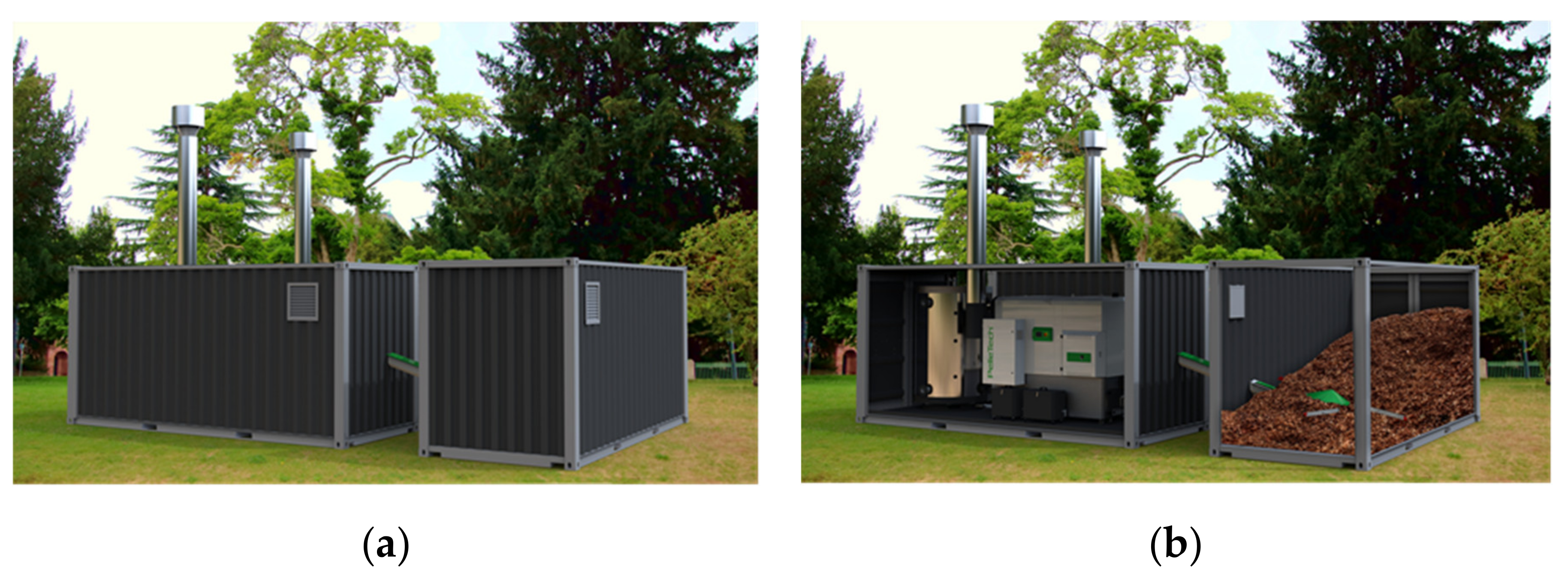
Figure 4.
Total distance between the pruning shredding/storage point and the swimming pool which is the delivery point is 900 meters (Source: Edited from Google Maps Map data @ 2024 Google).
Figure 4.
Total distance between the pruning shredding/storage point and the swimming pool which is the delivery point is 900 meters (Source: Edited from Google Maps Map data @ 2024 Google).
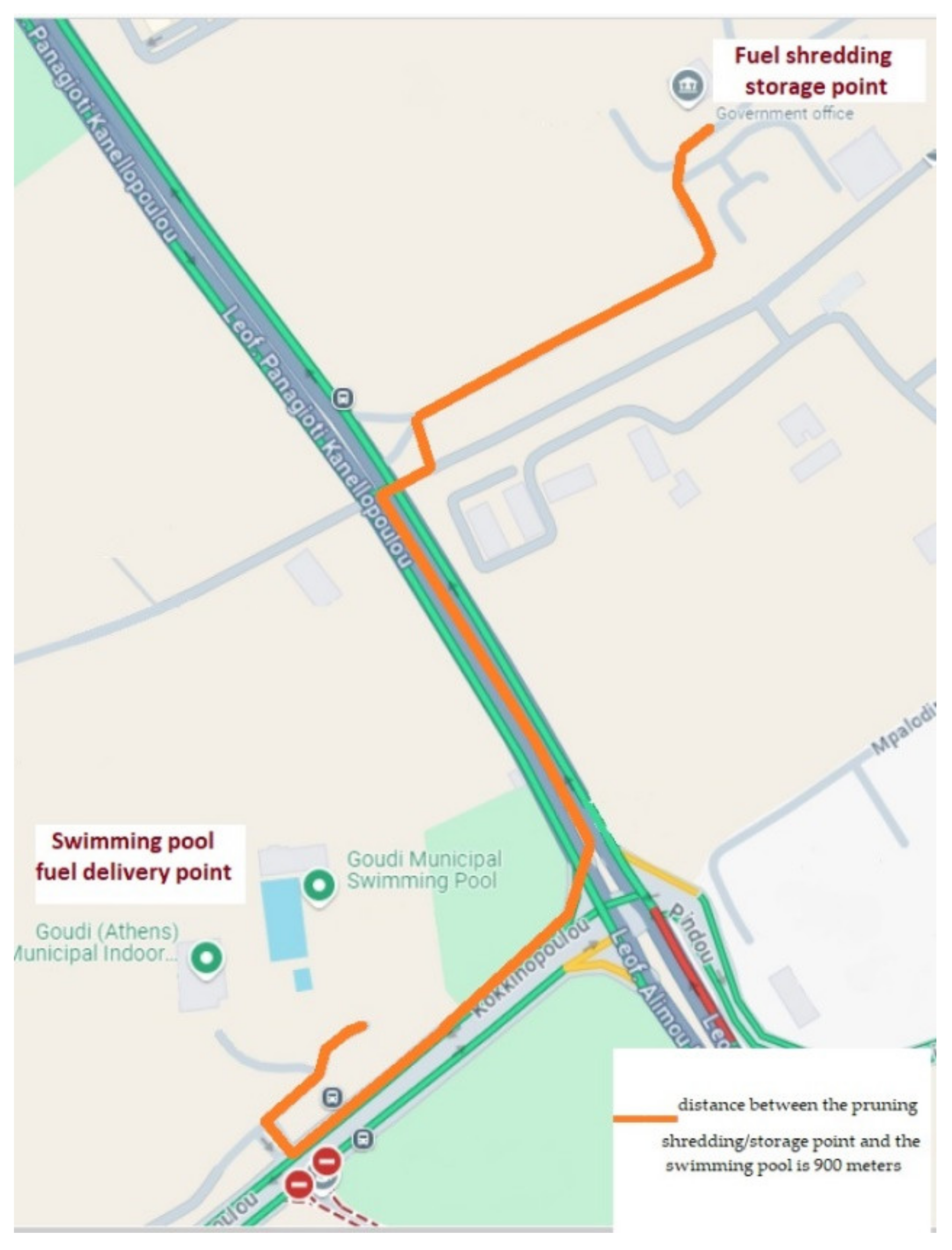
Table 1.
Basic Systems for the Management of Biowaste and Plant Residues (Source: Adapted from [4]).
Table 1.
Basic Systems for the Management of Biowaste and Plant Residues (Source: Adapted from [4]).
| Systems for the Management of Biowaste and Plant Residues | ||
| System | Description | Characteristics |
| Landfill Sites (ΧΥΤA) | Disposal of waste in designated sites, either legally or illegally | Possibility of biogas recovery |
| Aerobic Biological Treatment - Composting | Composting systems, which can be centralized, open, or closed type | Includes household composting |
| Anaerobic Digestion | Biological process for the pre-treatment and post-treatment of organic load | Anaerobic biological treatment |
| Aerobic Biodrying | Process to remove moisture from plant residues, reducing volume and generating bio-thermal energy | Moisture removal, volume reduction, bio-thermal energy development |
| Gasification | Thermal process for the treatment of garden waste | Thermal processing primarily for garden waste |
| Incineration | Process that involves burning waste | Effectiveness depends on thermal or energy recovery |
Table 2.
Physicochemical characteristics of plant residues of the Municipality of Athens (Source: processed from [17] in communication with Greenery and Urban Fauna Directorate).
Table 2.
Physicochemical characteristics of plant residues of the Municipality of Athens (Source: processed from [17] in communication with Greenery and Urban Fauna Directorate).
| Parameter | Value | Unit |
|---|---|---|
| Conductivity | 1.97±1.25 | mS cm⁻¹ |
| Total Solids (TS) | 63.59±6.25 | % w.w. |
| Volatile Solids (VS) | 78.62±9.52 | % TS |
| pH | 6.20±0.36 | - |
| Moisture | 36.51±6.25 | % w.w. |
| Total Organic Carbon (TOC) | 48.33±5.36 | % TS |
| Total Nitrogen (TN) | 1.01±0.22 | % TS |
| Density | 0.19±0.05 | gr cm⁻³ w.w. |
| Organic Nitrogen (Norg) | 0.94±0.24 | % TS |
| Nitrate Nitrogen (NO₃-N) | 0.00±0.00 | % TS |
| Ammoniacal Nitrogen (NH₄-N) | 0.02±0.03 | % TS |
| Carbon-to-Nitrogen Ratio (TOC/TN) | 52.48±18.03 | - |
Table 3.
PelleTech Idro 500 emission and efficiency values. (Source: technical data provided directly by the manufacturer Camino Design G. Samoukatsidis Bros (Test report 39-16083/T)).
Table 3.
PelleTech Idro 500 emission and efficiency values. (Source: technical data provided directly by the manufacturer Camino Design G. Samoukatsidis Bros (Test report 39-16083/T)).
| PelleTech Idro 500 emission and efficiency test report | ||
|---|---|---|
| Parameters | Values | Directive Requirements |
| Rated nominal output | 499 kW | |
| Partial load output (30%) | 149 kW | |
| CO at 10% O2 | 33 mg/Nm3 | 500 mg/Nm3 |
| OGC at 10% O2 | <1 mg/Nm3 | |
| Dust at 10% O2 | 11 mg/Nm3 | 40 mg/Nm3 |
| NOx at 10% O2 | 162 mg/Nm3 | 200 mg/Nm3 |
| Efficiency (NCV) | 94.6 % | 88% |
| Partial load Efficiency | 92.5 % | |
| Useful Efficiency (CGV) | 84.7 % | |
| Seasonal space heating energy efficiency | 81% | |
Table 4.
Table of costs for biomass boiler equipment. The operating costs include labor cost and replacement parts for 2 heating units, according to PelleTech life cycle analysis for the model PelleTech Idro 500 (The results are derived from consultations with Camino Design G. Samoukatsidis Bros).
Table 4.
Table of costs for biomass boiler equipment. The operating costs include labor cost and replacement parts for 2 heating units, according to PelleTech life cycle analysis for the model PelleTech Idro 500 (The results are derived from consultations with Camino Design G. Samoukatsidis Bros).
| PelleTech Idro 500 equipment, installation and annual maintenance costs | |||
|---|---|---|---|
| References | Components | Costs € | Operating maintenance costs € |
| PelleTech offer | Containerized biomass boilers PelleTech Idro 500 | 330,000.00 | 7,700.00 |
Table 5.
Calculation of Average GCV value for woodchip fuel (Source: [26]).
Table 5.
Calculation of Average GCV value for woodchip fuel (Source: [26]).
| Mulberry and Sophora Japonica) | |
|---|---|
| Parameters | Values |
| Mulberry | 17,127.62 kJ kg -1 |
| Sophora Japonica | 17,970.49 kJ kg -1 |
| Average woodchip fuel GCV | 17,549.05 kJ kg -1 |
Table 6.
Calculation of Woodchip fuel cost.
| Calculation of woodchip fuel cost | |
|---|---|
| Parameters | Values |
| Shredding process | 45€/t |
| Boiler refueling costs | 1.37€/t |
| Total | 46.37€/t |
Table 7.
Annual Thermal energy requirements and costs of the facilities of the Municipal Swimming Pool of the Municipality of Athens for 2021 (Source the Directorate of Technical Services of the Organization of Culture, Sports, and Youth of the Municipality of Athens (OPANDA).
Table 7.
Annual Thermal energy requirements and costs of the facilities of the Municipal Swimming Pool of the Municipality of Athens for 2021 (Source the Directorate of Technical Services of the Organization of Culture, Sports, and Youth of the Municipality of Athens (OPANDA).
| Swimming pool annual thermal energy consumption and cost for year 2021 | ||||
|---|---|---|---|---|
| Date | Thermal Energy consumption kWhth | Thermal Energy consumption MWhth | Natural Gas Monthly Cost € |
Natural Gas Price per Mwh [€/MWh] |
| Jan 2021 | 476,247.36 | 476.25 | 23,619.17 | 49.59 |
| Feb 2021 | 376,690.63 | 376.69 | 20,133.72 | 53.45 |
| Mar 2021 | 386,073.18 | 386.07 | 19,421.85 | 50.31 |
| Apr 2021 | 239,453.34 | 239.45 | 12,240.57 | 51.12 |
| May 2021 | 61,183.21 | 61.18 | 3,309.81 | 54.10 |
| Jun 2021 | 23,428.71 | 23.43 | 1,453.08 | 62.02 |
| Jul 2021 | 21,177.80 | 21.18 | 1,435.79 | 67.80 |
| Aug 2021 | 17,792.28 | 17.79 | 1,354.93 | 76.15 |
| Sep 2021 | 121,807.12 | 121.81 | 9,678.34 | 79.46 |
| Oct 2021 | 333,984.64 | 333.98 | 34,345.31 | 102.83 |
| Nov 2021 | 401,502.10 | 401.50 | 51,787.05 | 128.98 |
| Dec 2021 | 548,280.43 | 548.28 | 67,707.24 | 123.49 |
| Total | 3,007,620.28 | 3,000.62 | 246,486.86 | |
Table 8.
Annual Thermal energy requirements and costs of the facilities of the Municipal Swimming Pool of the Municipality of Athens for 2022 (Source the Directorate of Technical Services of the Organization of Culture, Sports, and Youth of the Municipality of Athens (OPANDA).
Table 8.
Annual Thermal energy requirements and costs of the facilities of the Municipal Swimming Pool of the Municipality of Athens for 2022 (Source the Directorate of Technical Services of the Organization of Culture, Sports, and Youth of the Municipality of Athens (OPANDA).
| Swimming pool annual thermal energy consumption and cost for year 2022 | ||||
|---|---|---|---|---|
| Date | Thermal Energy consumption kWhth | Thermal Energy consumption MWhth | Natural Gas Monthly Cost € |
Natural Gas Price per Mwh [€/MWh] |
| Jan 2022 | 561,024.61 | 561.02 | 68,108.43 | 121.40 |
| Feb 2022 | 551,020.31 | 551.02 | 65,108.43 | 118.16 |
| Mar 2022 | 523,784.70 | 523.78 | 49,994.83 | 95.45 |
| Apr 2022 | 264,574.71 | 264.57 | 33,982.36 | 128.44 |
| May 2022 | 139,380.15 | 139.38 | 16,640.34 | 119.39 |
| Jun 2022 | 38,136.85 | 38.13 | 4,258.61 | 111.67 |
| Jul 2022 | 37,604.16 | 37.60 | 4,466.42 | 118.77 |
| Aug 2022 | 32,031.55 | 32.03 | 5,746.04 | 179.39 |
| Sep 2022 | 75,198.83 | 75.19 | 18,047.82 | 240.00 |
| Oct 2022 | 313,913.34 | 313.91 | 53,475.48 | 170.35 |
| Nov 2022 | 427,320.82 | 427.32 | 60,525.57 | 141.64 |
| Dec 2022 | 475,751.41 | 475.75 | 69,608.74 | 146.31 |
| Total | 3,439,741.44 | 3,439.74 | 449,963.07 | |
Table 9.
Annual Thermal energy requirements and costs of the facilities of the Municipal Swimming Pool of the Municipality of Athens for 2023 (Source the Directorate of Technical Services of the Organization of Culture, Sports, and Youth of the Municipality of Athens (OPANDA).
Table 9.
Annual Thermal energy requirements and costs of the facilities of the Municipal Swimming Pool of the Municipality of Athens for 2023 (Source the Directorate of Technical Services of the Organization of Culture, Sports, and Youth of the Municipality of Athens (OPANDA).
| Swimming pool annual thermal energy consumption and cost for year 2023 | ||||
|---|---|---|---|---|
| Date | Thermal Energy consumption kWhth | Thermal Energy consumption MWhth | Natural Gas Monthly Cost € |
Natural Gas Price per Mwh [€/MWh] |
| Jan 2023 | 561,854.05 | 561.85 | 87,441.81 | 155.63 |
| Feb 2023 | 540,608.22 | 540.60 | 56,742.86 | 104.96 |
| Mar 2023 | 462,621.16 | 462.62 | 43,812.04 | 94.70 |
| Apr 2023 | 401,036.06 | 401.03 | 33,803.11 | 84.29 |
| May 2023 | 286,359.61 | 286.35 | 23,007.55 | 80.34 |
| Jun 2023 | 86,367.32 | 86.36 | 6,054.39 | 70.10 |
| Jul 2023 | 34,798.03 | 34.79 | 2,437.07 | 70.30 |
| Aug 2023 | 45,111.18 | 45.11 | 3,052.57 | 67.67 |
| Sep 2023 | 131,398.66 | 131.39 | 6,568.17 | 49.99 |
| Oct 2023 | 207,614.35 | 207.61 | 15,322.32 | 73.80 |
| Nov 2023 | 301,976.88 | 301.97 | 25,048.82 | 82.95 |
| Dec 2023 | 479,750.05 | 479.75 | 39,943.26 | 83.26 |
| Total | 3,539,495.57 | 3,539.49 | 343,233.97 | |
Table 10.
Average Thermal Energy Requirements and Costs for the Facilities of the Municipal Swimming Pool of the Municipality of Athens for the Period 2021–2023.
Table 10.
Average Thermal Energy Requirements and Costs for the Facilities of the Municipal Swimming Pool of the Municipality of Athens for the Period 2021–2023.
| Swimming pool average annual thermal energy consumption for 2021 – 2023 period | |||
|---|---|---|---|
| Year | Thermal Energy consumption kWhth | Thermal Energy consumption MWhth | Annual Cost of Natural Gas € |
| 2021 | 3,007,620.28 | 3,000.62 | 246,486.86 |
| 2022 | 3,439,741.44 | 3,439.74 | 449,963.07 |
| 2023 | 3,539,495.57 | 3,539.49 | 343,233.97 |
| Average | 3,328,952.60 | 3,328.95 | 346,561.30 |
Table 11.
Operational expenditure for natural gas heating system.
| Operational expenditure for natural gas heating system and average natural gas price of period 2021-2023 | |
|---|---|
| Parameters | Value € |
| Annual natural gas Fuel cost (Table 10) | 346,561.30 |
| Boiler Annual Maintenance Costs (market research) | 1,500.00 |
| Total | 348,061.30 |
Table 12.
Operational expenditure for natural gas heating system.
| Operational expenditure for natural gas heating system and natural gas price of April 2024 | |
|---|---|
| Parameters | Value € |
| Annual natural gas Fuel cost (Eq. 14) | 203,332.42 |
| Boiler Annual Maintenance Costs (market research) | 1,500.00 |
| Total | 204,832.42 |
Table 13.
Assumptions for economic analysis.
| Woodchip fuel cost for the production of the average annual thermal energy requirements | |||
|---|---|---|---|
| Parameter | Unit | Value | |
| Capital investment | € | 330.000,00 | [Table 4] |
| Equity financing of Biomass project | % | 100 | |
| Equipment service life (Ν) | years | 15 | |
| Discount rate (r) | % | 3,65 | [36] |
| Consumer price index (CPI) | €/t | 3.0 | [37] |
Table 14.
Comparative Economic Analysis of Natural Gas and Biomass Heating Systems: Operational Expenditures, NPV, IRR, and Payback Period.
Table 14.
Comparative Economic Analysis of Natural Gas and Biomass Heating Systems: Operational Expenditures, NPV, IRR, and Payback Period.
| Description | Total investment cost (€) |
Operation Expenditure (OPEX) (€) |
Annual operating cost reduction (€) |
Percentage of operating cost reduction (%) |
Net present value (NPV) (€) |
Internal rate of return (IRR) (%) | Payback period (years) |
|---|---|---|---|---|---|---|---|
| Existing system average natural gas prices 2021-2023 |
– | 348,061.30 | – | – | – | – | – |
| Existing system Current natural gas prices (April 2024) |
– | 204,832.42 | 143,228.88 | 41.15 | – | – | – |
| Biomass System compared to average natural gas prices 2021-2023 | 330,000.00 | 46,789.91 | 301,271.39 | 86.55 | 3,843,646.60 | 94.29 | 1.10 |
| Biomass System compared to April 2024 natural gas prices | 330,000.00 | 46,789.91 | 158,042.51 | 77.15 | 1,859,433.20 | 50.73 | 2.09 |
Disclaimer/Publisher’s Note: The statements, opinions and data contained in all publications are solely those of the individual author(s) and contributor(s) and not of MDPI and/or the editor(s). MDPI and/or the editor(s) disclaim responsibility for any injury to people or property resulting from any ideas, methods, instructions or products referred to in the content. |
© 2024 by the authors. Licensee MDPI, Basel, Switzerland. This article is an open access article distributed under the terms and conditions of the Creative Commons Attribution (CC BY) license (http://creativecommons.org/licenses/by/4.0/).
Copyright: This open access article is published under a Creative Commons CC BY 4.0 license, which permit the free download, distribution, and reuse, provided that the author and preprint are cited in any reuse.


