

Submitted:
07 October 2024
Posted:
08 October 2024
You are already at the latest version
Abstract
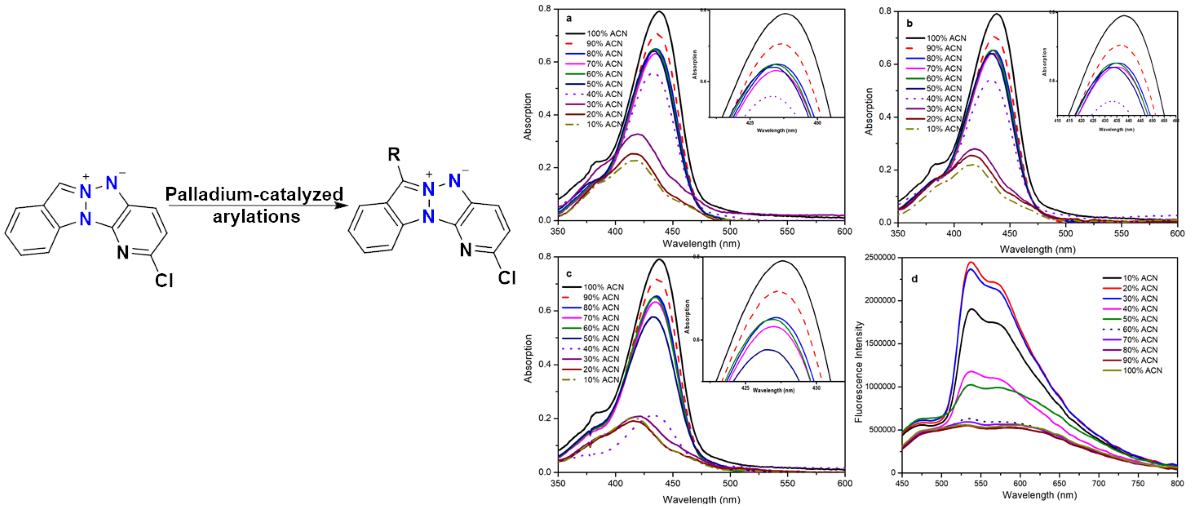
A pyridine-fused triazapentalene shows weak fluorescence in solution, and is readily accessible via nitrene-mediated cyclization. In this research, a modified Cadogan reaction was used to synthesize HetATAP1. Palladium-catalyzed reactions have been demonstrated as post-functionalization methods. Interestingly, Suzuki cross-coupling with various boronic acids resulted in poor to moderate yields of the products HetATAP2-5 arylated on the azole moiety. Direct CH arylation of HetATAP1 gave the products with the same regiochemistry in satisfactory yields. The structures of HetATAP2-5 were confirmed using NMR analysis. In addition, the fluorescence properties of HetATAP2-5 were studied in the solid-state and solution at room temperature, and the photophysical properties of HetATAP3 and 4 in the aggregated state were both measured in ACN/water and THF/water mixtures, respectively.
Keywords:
triazapentalene
; pyridine-fused triazapentalene
; Suzuki cross-coupling
; CH arylation
; fluorescent properties
; solid-state
; aggregated state
1. Introduction
Heteroaryl-fused triazapentalenes (HetATAPs), more specifically N-heteroaryl triazapentalenes (N-HetATAPs), show fluorescent properties that are of interest for potential future applications [1,2,3,4,5,6,7]. Currently, only two mainly synthetic pathways toward HetATAPs have been reported [2,3,8,9,10,11], as shown in Scheme 1. The first published procedure mostly focus on the deoxygenation of 1-(o-nitro(hetero)aryl)pyrazoles and the thermolysis or photolysis of 1-(o-azido(hetero)aryl)pyrazoles [10,11]. In particular, HetATAP has been studied by the Bettinetti group, forming in unreactive media starting from 2-azido-1-(3,5-dimethylpyrazol-1-yl)phenazine 1. The triazapentalene 2 was produced by intramolecular trapping of the formed nitrene. On the other hand, the synthetic methodology of Guillaumet et al. involves a deoxygenation reaction using nitro(pyrazolyl)pyridines 3, which leads to pyridine-fused triazapentalenes 4 [3]. Although the deoxygenation reaction was only slightly influenced by the substituents of the pyrazole core, the modification of nitropyridine had a considerable impact on the reaction result. Later in 2009, the same group reported a library of pyrazine-fused triazapentalenes 6 by the thermolysis of 2-azido-3-(pyrazol-1-yl)pyrazines 5, starting from nitropyrazoles and 2-azido-3-chloropyrazine [2]. The second reported pathway toward compound 8 begins with coupling reactions or nucleophilic aromatic substitutions with halogenated heterocyclic amines and pyrazole derivatives, followed by oxidative cyclization (Scheme 1, Suzenet et al.) [6,12]. Complementary to the radical reaction, under basic conditions in the presence of hypervalent iodine, the direct formation of intramolecular N-N bond takes place to form the desired HetATAP derivatives. Unfortunately, in function of the substitutions on the fused ring and the position of the amine, the reaction yields were variable.
Applying the oxidative intramolecular N-N bond formation, Suzenet et al. studied the photophysical properties of HetATAP derivatives [6]. However, most of them exhibit modest to poor fluorescence quantum yields in solution. The variable quantum yields can be attributed to either the charge of the nitrogen atoms in the heteroaryl moiety or substituents on the azole moiety. Introducing two nitrogen atoms in the fused ring and/or an electron-withdrawing group on the azole ring in the case of R3 position can improve the quantum yields of the resulting dyes in solution [6,7].
In 2001, Tang et al. reported that the aggregation of silole molecules induced light emission, which was opposite to the well-known aggregation-caused quenching (ACQ) [13]. Aggregation-induced emission enhancement (AIEE) has sparked considerable interest in its broad potential applications in physics[14], chemistry [15], biology [16,17,18,19], and material science [20,21,22,23] However, as the formation of delocalized excitons or excimers may lead to enhanced non-radiative inactivation of the excited state, most organic molecules show fluorescence ACQ in their aggregated or solid state. The reported organic fluorescence dyes exhibit the AIEE characteristics, such as siloles [13,24,25,26], tetraphenylethylene (TPE) [27,28], 1-cyano-trans1,2-bis(4′-methylbiphenyl)ethylene (CN-MBE) [29,30], 1,4-di[(E)-2-phenyl-1-propenyl]benzene (PPB) [31,32], and salicylaldehyde azine derivatives [33,34].
To date, the photophysical properties of HetATAP derivatives have only been reported in solution. The successful applications of HetATAPs are limited by their use as fluorescent probes in living cells and fluorescent dyes inserted into LDH host structures and polymers [1,5,7,35]. Because of the growing interest in HetATAP fluorophores, the initial goal of the present work was to expand the variety of substitution patterns on the heteroaryl moiety of triazapentalenes via post-functionalization strategies and study the photophysical properties of HetATAP in solids. For this purpose, the readily available Cadogan reaction was chosen as the synthetic pathway to obtain HetATAP1, and the feasibility of the palladium-catalyzed cross-coupling reactions was demonstrated. Herein, we describe the synthesis of HetATAP derivatives and their interesting solid-state fluorescent properties. To the best of our knowledge, the photophysical properties of solid-state HetATAPs have not been reported until now.[1]
2. Results and Discussion
2.1. Synthesis
To start our investigation, the desired HetATAP1 was obtained using a modified Cadogan reaction (see SI Scheme S1) [3]. In an attempt to arylate heteroaryl-fused triazapentalene, procedures previously reported for the arylation of 1,3a,6a-triazapentalene with palladium catalysis were applied to HetATAP1 [36]. The reported procedure with a Suzuki cross-coupling reaction was first carried out taking advantage of the presence of a chlorine atom on the pyridine moiety, and was performed with one equivalent of phenylboronic acid in the presence of CuI in DMF at 60 °C for 12 h. Surprisingly, a CH arylation occurred instead of the excepted coupling reaction (Scheme 2a). The unexpected compound HetATAP2 was formed and confirmed via NMR analysis. In addition, we have sequentially attempted Stille coupling reaction with PhSnBu3 and direct palladium-catalyzed CH arylation with bromobenzene using toluene as solvent, which provided the same product (Scheme 2b and 2c). Similar reaction yields were obtained for HetATAP2 from the Suzuki reaction and the direct CH arylation, but only 13% from the Stille coupling reaction. Hence, to extend the substituents, the Suzuki reaction and the direct CH arylation were carried out with different boronic acids and bromoarenes, respectively (Table 1). The reaction yields of the direct CH arylation were quite satisfying, and consequently higher than those of Suzuki reactions. In 2008, Gorelsky et al. reported the mechanism of the direct CH bond cleavage in the presence of Pd(OAc)2 and potassium carbonate for the (electron-rich) heteroarenes [37]. As mentioned above, the direct palladium-catalyzed CH arylation conditions were adopted for the arylation of 1,3a,6a-triazapentalene, where arylation may occur via a concerted metalation-deprotonation in the presence of carbonate. For this process, the same reaction pathway is considered to have happened.
2.2. Photophysical Measurements
2.2.1. Fluorescence in the Solid-State
The absorption and emission spectra were taken for HetATAP1 and its postmodified products HETATAP2–5 in solid-state at room temperature. The color of these compounds under the naked eye and a UV lamp are collected in Figure 1a, and the emission spectra for HetATAP1-5 are shown in Figure 1b. The photophysical parameters are listed in Table 2. The color of all the compounds is slightly different. Observing the brightness of all compounds under UV light, HetATAP2 and 5 are less intense compared to HetATAP1, while HetATAP3 and 4 are slightly more intense, suggesting the difference of quantum yields of fluorescence (ΦF). Compared to the precursor HetATAP1, the absorption spectra of HetATAP 2-4 are redshifted and the emission spectra are slightly blueshifted, except for HetATAP5. The presence of additional functional groups which could disturb the molecular planarity of HetATAP1 might be responsible. In HetATAP 2-5, the Stokes shift is smaller than that of HetATAP1, suggesting more coplanarity. Since HetATAP3 and 4 have good fluorescent properties, it is of utmost interest to study them further.
2.2.2. Fluorescence in Solution
For the HetATAPs 2-5 dyes in DCM at room temperature, absorption spectra show the bathochromically shifted spectra compared to HetATAP1. The phenyl and 4-methoxyphenyl substituents in HetATAPs 2 and 3 gave an approximately 30 nm bathochromic shift, whereas the 4-ethoxycarbonylphenyl and 4-dimethylaminophenyl substituents showed a shift of around 43 nm (Figure 2). As mentioned earlier, these dyes show very weak emission properties in solution, suggesting the substituents at R3 are not helpful for their fluorescence quantum yields, which is the same as the reports for pyrazine-fused triazapentalenes [6,7].
The different solvent effect on the photophysical parameters of HetATAP3 and 4 in solution at room temperature were investigated (Figure 3, Table 3). The maximum absorption wavelength (λabs, max) of these compounds were barely affected by the polarity of the solvent, indicating that in the ground state and excited state, their dipole moments are almost equal (Figure 3a, 3b). However, the effect of solvent polarity on the molar absorption coefficients (ε) was more apparent (Table 3). The ε values of HetATAP3 and 4 in DCM and THF were much higher than that in other solvents, respectively. In addition, the molar absorption coefficients of HetATAP3 and 4 underwent only a small change in other solvents, except that HetATAP3 gave a higher ε value in ACN. Notably, the solubility of HetATAP4 in ACN is too poor to check the ε value. The fluorescence quantum yields (ΦF) of HetATAP1 and 2-5 are less than 0.01 in organic solvents, so these compounds show almost no fluorescence in solution.
2.3. Fluorescence in the Aggregated State
The AIEE properties of compounds HetATAP3 and HetATAP4 were investigated in a mixture of ACN/THF and water (Figure 4). In organic solvents, HetATAP3 and HetATAP4 are well dispersed and show absorption and weak emission spectra. However, the situation was reversed when they were placed in a solvent-poor system under the same conditions. The weak absorption and strong fluorescence emission indicate that they formed aggregated states and the aggregation-induced fluorescence emission. In addition, in the solvent-poor system, the maximum absorption wavelengths of HetATAP3 and HetATAP4 showed a significant blue shift of 20 nm and 30 nm, respectively.
To further investigate the AIEE properties of HetATAP3 and HetATAP4, UV-Vis absorption and fluorescence emission spectra were measured in different volume fractions of ACN/THF and water mixtures (Figure 5 and 6). Compared to the UV-Vis absorption spectra of compounds HetATAP3 and HetATAP4 at different test times (10 min, 3.0 h, 24 h), the maximum absorption wavelengths remained almost unchanged when the organic fraction was between 40% and 100% (Figure 5a-c and 6a-c). However, there was a gradual decrease in the intensity of absorption, especially for compound HetATAP3. When the organic fraction was reduced from 40% to 30%, the intensity of absorption decreased rapidly and there was a significant blue shift in the maximum absorption wavelength. When the duration of the test was increased from 3 to 24 hours, the absorption intensity decreased sharply when the system contained 40% organic solvent. The Mie scattering caused by nanoparticles may be responsible for the decreased intensity [38,39,40].
The HetATAP3 and HetATAP4 derivatives (Figure 5d and Figure 6d) showed very weak fluorescence emission in dilute organic solvent over 24 hours. Reducing the organic solvent content in the solution containing the compound HetATAP4 to 60% (v/v), or even to 50%, the fluorescence properties were barely changed as the compound could be well dissolved into the solvent system. However, as the organic solvent content in the solution system dropped from 50% to 0, the fluorescence emission intensity gradually increased (Figure 5d and Figure 6d), while the absorption intensity decreased sharply (Figure 5c and Figure 6c). Furthermore, the maximum emission wavelength of HetATAP3 and HetATAP4 started to split into two clear peaks with a significant blue shift of 80 nm and 30 nm, respectively. Due to the poor solubility of the compounds in water, they may have aggregated in the solvent systems with lower organic solvent contents (40%-10%, v/v). Therefore, HetATAP3 and HetATAP4 are AIEE active. The effect of the volume fraction of water on the AIEE phenomenon and the color changed was observed under a UV lamp (365 nm) (Figure 7).
To further investigate the AIEE phenomenon, the fluorescence intensities of compounds HetATAP3 and HetATAP4 were studied for different durations in ACN/water and THF/water mixtures with an organic solvent content of 10% v/v, respectively (Figure 8). The fluorescence intensities were measured immediately after shaking the freshly prepared solutions by hand. The results showed the fluorescence of compounds HetATAP3 and HetATAP4 increased and almost reached its maximum value within 30 and 10 min, respectively. It was assumed that the initial shaking increases the chances of some of the dye molecules gathering together to form tiny particles, and then the remaining molecules gradually associate to the particles formed (see SI Figure S12). After a certain amount of time, the compounds precipitated completely from the solution, and the enhancement of fluorescence intensity ceased.
3. Materials and Methods
3.1. Chemical and Materials
All chemicals were purchased from Acros Organics, Merck, J&K Scientific, Fluorochem and TCI Europe and used as received. Solvents were dried prior to use. For column chromatography, 70–230 mesh silica gel 60 (Acros) was used as the stationary phase.
3.2. Instrumentation
1H and 13C NMR spectra were recorded on a Bruker Avance 300, Bruker Avance III HD 400 or a Bruker Avance II+ 600 spectrometer. Chemical shifts (δ) are reported in parts per million (ppm) referenced to tetramethylsilane (0.00 ppm) as an internal standard for samples in CDCl3, or to the respective solvent for samples in DMSO-d6 (2.50 ppm). 13C NMR spectra were referenced to the respective solvent signals (CDCl3, 77.16 ppm). High-resolution mass spectra were acquired on a quadrupole orthogonal acceleration time-of-flight mass spectrometer (Synapt G2 HDMS, Waters, Milford, MA). Melting points (not corrected) were determined using a Reichert Thermovar apparatus.
UV-Vis absorption spectra were recorded on a PerkinElmer Lambda 950 spectrophotometer using blank correction. Fluorescence spectra and excitation spectra were recorded on a HORIBA Jobin Yvon Fluorolog FL3-22 fluorimeter and corrections for the excitation beam intensity, the wavelength dependent sensitivity of the detector and the optical path were applied.
3.3. Synthesis
3.3.1. General Procedure for Suzuki Cross-Coupling Reaction
To an oven-dried reaction tube equipped with a magnetic stirring bar were added HetATAPs (0.2 mmol, 1 equiv), boronic acids (0.24 mmol, 1.2 equiv), Pd(OAc)2 (27 mg, 0.12 mmol, 0.6 equiv), CuI (15.2 mg, 0.08 mmol, 0.4 equiv), SPhos (10 mg, 0.023, 0.12 equiv) and DMF (2 mL). The mixture was left and stirred for 12 hours at 60 °C in an aluminum heating block. The crude reaction mixture was dissolved in ethyl acetate (20 mL) and washed with water (2 × 20 mL) and brine (1 × 20 mL). The organic layer was subsequently dried over magnesium sulfate and concentrated under reduced pressure. Further purification by column chromatography, using a PE-DCM gradient as the eluent, afforded the solid compounds.
3.3.2. Stille Coupling Reaction of Compound HetATAP1
HetATAP1 (24.3 mg, 0.1 mmol, 1 equiv), PhSnBu3 (44.2 mg, 0.12 mmol, 1.2 equiv) and Pd2dba3 (5 mg, 0.005, 0.05 equiv) were added to an oven-dried reaction tube equipped with a magnetic stirring bar and dissolved in toluene (1 mL) under a nitrogen atmosphere. The reaction mixture was left and stirred at 70°C for 24 hours. The reaction mixture was diluted with EtOAc (20 mL) and washed with water (2 × 20 mL) and brine (1 × 20 mL). The organic layer was subsequently dried over magnesium sulfate and concentrated under reduced pressure. Further purification by column chromatography, using a PE-DCM ((1:1–0:1)) gradient as the eluent, afforded a yellow solid HetATAP2 (4 mg, 13%).
3.3.3. General Procedure for Palladium-Catalyzed CH Arylation
To an oven-dried reaction tube equipped with a magnetic stirring bar were added HetATAP1 (0.2 mmol, 1 equiv), bromoarene reagents (0.2 mmol, 1.0 equiv), Pd(OAc)2 (2.4 mg, 0.01 mmol, 0.05 equiv), Cy3HBF4 (7.8 mg, 0.02 mmol, 0.1 equiv), pivalic acid (6.6 mg, 0.03, 0.3 equiv), K2CO3 (88 mg, 0.6 mmol, 3.0 equiv) and dry toluene (4 mL). The mixture was left and stirred for 24 hours at 110 °C in an aluminum heating block. The reaction mixture was dissolved in ethyl acetate (20 mL) and washed with water (2 × 20 mL) and brine (1 × 20 mL). The organic layer was subsequently dried over magnesium sulfate and concentrated under reduced pressure. Further purification by column chromatography, using a PE-DCM gradient as the eluent, afforded the solid compounds.
3.3.4. Experimental Details and Characterization Data
HetATAP1: Yellow solid. Yield 89.5 mg, 74%. Mp 192–195°C. 1H NMR (400 MHz, CDCl3) δ 8.35 (d, J = 5.5 Hz, 1H), 7.98 (s, 1H), 7.80–7.73 (m, 1H), 7.67 (d, J = 8.5 Hz, 1H), 7.48 (d, J = 7.0 Hz, 2H), 7.33 (d, J = 8.5 Hz, 1H). 13C NMR (101 MHz, CDCl3) δ 138.77, 138.40, 135.91, 125.03, 124.57, 123.66, 123.55, 121.16, 120.60, 118.70, 111.37, 98.33. HRMS (ESI-Q-TOF): m/z [M+H]+ calcd for C12H7Cl1N4: 243.0432, found: 243.0431.
HetATAP2: (1) Prepared following the general procedure for Suzuki cross-coupling reaction: HetATAPs (0.2 mmol, 1 equiv), phenylboronic acid (0.24 mmol, 1.2 equiv), Pd(OAc)2 (27 mg, 0.12 mmol, 0.6 equiv), CuI (15.2 mg, 0.08 mmol, 0.4 equiv), SPhos (10 mg, 0.023, 0.12 equiv) and DMF (2 mL), 12 h. Purification by column chromatography, using a PE-DCM gradient (1:1–0:1) as the eluent, afforded HetATAP2 (38 mg, 53%) as a yellow solid. (2). Prepared following the procedure for Stille coupling reaction: HetATAP1 (24.3 mg, 0.1 mmol, 1 equiv), PhSnBu3 (44.2 mg, 0.12 mmol, 1.2 equiv), Pd2dba3 (5 mg, 0.005, 0.05 equiv), 24 h. Purification by column chromatography, using a PE-DCM gradient (1:1–0:1) as the eluent afforded HetATAP2 (4 mg, 13%). (3). Prepared following the general procedure for palladium-catalyzed CH arylations: HetATAP1 (0.2 mmol, 1 equiv), bromobenzene (0.2 mmol, 1.0 equiv), Pd(OAc)2 (2.4 mg, 0.01 mmol, 0.05 equiv), Cy3HBF4 (7.8 mg, 0.02 mmol, 0.1 equiv), pivalic acid (6.6 mg, 0.03, 0.3 equiv), K2CO3 (88 mg, 0.6 mmol, 3.0 equiv) and dry toluene (4 mL), 24 h. Purification by column chromatography, using a PE-DCM (1:1–0:1) gradient as the eluent, afforded the solid compounds HetATAP2 (42 mg, 66%) as a yellow solid. Mp 192–194 °C. 1H NMR (400 MHz, CDCl3) δ 8.52–8.40 (m, 1H), 8.35 (dd, J = 8.5, 1.2 Hz, 2H), 8.22–8.09 (m, 1H), 7.75 (d, J = 8.5 Hz, 1H), 7.67–7.59 (m, 2H), 7.61–7.52 (m, 2H), 7.48–7.38 (m, 1H), 7.35 (d, J = 8.5 Hz, 1H). 13C NMR (101 MHz, CDCl3) δ 138.90, 138.71, 129.12, 128.14, 127.88, 126.57, 125.28, 124.00, 123.90, 123.02, 121.22, 120.83, 119.15, 111.53. HRMS (ESI-Q-TOF): m/z [M+H]+ calcd for C18H11ClN4:319.0744, found:319.0741.
HetATAP3: (1). Prepared following the general procedure for Suzuki cross-coupling reaction: HetATAP1 (0.2 mmol, 1 equiv), 4-methoxyphenylboronic acid (0.24 mmol, 1.2 equiv), Pd(OAc)2 (27 mg, 0.12 mmol, 0.6 equiv), CuI (15.2 mg, 0.08 mmol, 0.4 equiv), SPhos (10 mg, 0.023, 0.12 equiv) and DMF (2 mL), 12 h. Purification by column chromatography, using a PE-DCM gradient (1:1–0:1) as the eluent, afforded HetATAP3 (32.9 mg, 47%) as a yellow solid. (2). Prepared following the general procedure for palladium-catalyzed CH arylations: HetATAP1 (0.2 mmol, 1 equiv), 4-bromoanisole (0.2 mmol, 1.0 equiv), Pd(OAc)2 (2.4 mg, 0.01 mmol, 0.05 equiv), Cy3HBF4 (7.8 mg, 0.02 mmol, 0.1 equiv), pivalic acid (6.6 mg, 0.03, 0.3 equiv), K2CO3 (88 mg, 0.6 mmol, 3.0 equiv) and dry toluene (4 mL), 24 h. Purification by column chromatography, using a PE-DCM (1:1–0:1) gradient as the eluent, afforded the solid compounds HetATAP3 (43.4 mg, 62%) as a yellow solid. Mp 248–250°C. 1H NMR (400 MHz, CDCl3) δ 8.45–8.35 (m, 1H), 8.26 (d, J = 8.9 Hz, 1H), 8.11–8.06 (m, 1H), 7.69 (d, J = 8.5 Hz, 1H), 7.57–7.48 (m, 1H), 7.31 (d, J = 8.5 Hz, 1H), 7.15 (d, J = 8.9 Hz, 1H). 13C NMR (101 MHz, CDCl3) δ 159.28, 138.93, 138.37, 136.12, 129.97, 128.19, 125.05, 123.93, 122.88, 121.04, 120.61, 120.33, 119.11, 114.65, 111.49, 110.98, 55.45. HRMS (ESI-Q-TOF): m/z [M] calcd for C19H13ClN4O:348.0778, found:348.0778.
HetATAP4: (1). Prepared following the general procedure for Suzuki cross-coupling reaction: HetATAP1 (0.2 mmol, 1 equiv), 4-ethoxycarbonylphenylboronic acid (0.24 mmol, 1.2 equiv), Pd(OAc)2 (27 mg, 0.12 mmol, 0.6 equiv), CuI (15.2 mg, 0.08 mmol, 0.4 equiv), SPhos (10 mg, 0.023, 0.12 equiv) and DMF (2 mL), 12 h. Purification by column chromatography, using a PE-DCM gradient (1:1–0:1) as the eluent, afforded HetATAP4 (27.3 mg, 35%) as a yellow solid. (2). Prepared following the general procedure for palladium-catalyzed CH arylations: HetATAP1 (0.2 mmol, 1 equiv), ethyl 4-bromobenzoate (0.2 mmol, 1.0 equiv), Pd(OAc)2 (2.4 mg, 0.01 mmol, 0.05 equiv), Cy3HBF4 (7.8 mg, 0.02 mmol, 0.1 equiv), pivalic acid (6.6 mg, 0.03, 0.3 equiv), K2CO3 (88 mg, 0.6 mmol, 3.0 equiv) and dry toluene (4 mL), 24 h. Purification by column chromatography, using a PE-DCM (1:1–0:1) gradient as the eluent, afforded the solid compounds HetATAP4 (39.8 mg, 51%) as a yellow solid. Mp 249–251°C. 1H NMR (400 MHz, CDCl3) δ 8.53–8.48 (m, 2H), 8.48–8.43 (m, 1H), 8.29–8.24 (m, 3H), 8.24–8.15 (m, 1H), 7.88 (dd, J = 8.2, 1.3 Hz, 1H), 7.64–7.48 (m, 2H), 7.39 (dd, J = 8.2, 4.8 Hz, 1H), 4.44 (q, J = 7.1 Hz, 2H), 1.45 (t, J = 7.1 Hz, 3H). 13C NMR (101 MHz, CDCl3) δ 166.23, 139.56, 139.37, 137.33, 132.86, 130.24, 128.54, 125.55, 125.39, 124.20, 123.92, 123.09, 121.26, 119.58, 119.00, 111.41, 109.35, 61.04, 14.41. HRMS (ESI-Q-TOF): m/z [M+H]+ calcd for C21H15ClN4O2: 391.0956, found: 391.0954.
HetATAP5: (1). Prepared following the general procedure for Suzuki cross-coupling reaction: HetATAP1 (0.2 mmol, 1 equiv), 4-(dimethylamino)phenylboronic acid (0.24 mmol, 1.2 equiv), Pd(OAc)2 (27 mg, 0.12 mmol, 0.6 equiv), CuI (15.2 mg, 0.08 mmol, 0.4 equiv), SPhos (10 mg, 0.023, 0.12 equiv) and DMF (2 mL), 12 h. Purification by column chromatography, using a PE-DCM gradient (1:1–0:1) as the eluent, afforded HetATAP5 (22.1 mg, 30%) as a yellow solid. (2). Prepared following the general procedure for palladium-catalyzed CH arylations: HetATAP1 (0.2 mmol, 1 equiv), 1-bromo-4-(dimethylamino)benzene (0.2 mmol, 1.0 equiv), Pd(OAc)2 (2.4 mg, 0.01 mmol, 0.05 equiv), Cy3HBF4 (7.8 mg, 0.02 mmol, 0.1 equiv), pivalic acid (6.6 mg, 0.03, 0.3 equiv), K2CO3 (88 mg, 0.6 mmol, 3.0 equiv) and dry toluene (4 mL), 24 h. Purification by column chromatography, using a PE-DCM (1:1–0:1) gradient as the eluent, afforded the solid compounds HetATAP5 (53.8 mg, 73%) as an orange-yellow solid. Mp 115–117 °C. 1H NMR (300 MHz, CDCl3) δ 8.49–8.26 (m, 1H), 8.19 (d, J = 8.5 Hz, 2H), 8.17–7.98 (m, 1H), 7.64 (d, J = 8.5 Hz, 1H), 7.58–7.45 (m, 2H), 7.28 (d, J = 8.0 Hz, 1H), 6.93 (d, J = 8.5 Hz, 2H), 3.06 (s, 6H). 13C NMR (101 MHz, CDCl3) δ 149.99, 136.30, 127.88, 124.75, 124.01, 123.88, 122.85, 120.84, 119.79, 119.51, 115.65, 112.52, 111.44, 40.41. HRMS (ESI-Q-TOF): m/z [M] calcd for C20H16ClN5: 361.1094, found: 361.1090.
4. Conclusions
In summary, novel heteroaryl-fused triazapentalene derivatives were developed by Suzuki cross-coupling and palladium-catalyzed arylation reactions. The yields of Suzuki cross-coupling reactions were not satisfactory, while the direct CH arylation reaction was justified to be an effective strategy. In terms of photophysical properties, HetATAP1-5 are virtually non-luminescent in the solution state, but exhibit luminescent behavior in the solid-state and possess AIEE properties upon aggregation. Furthermore, substituents with electronic groups do not affect the fluorescence properties in solution, whereas they are slightly affected in the solid-state. In particular, compounds HetATAP3 and HetATAP4 were studied for their AIEE properties in ACN/water and THF/water (10:0 to 1:9), respectively. It was also observed that in these mixtures, solvent system and duration affect the AIEE photoluminescence of HetATAP3 and HetATAP4. In particular, the AIEE fluorescence color of these HetATAPs can be tuned by introducing different substituents on the indazole ring.
Supplementary Materials
The following supporting information can be downloaded at the website of this paper posted on Preprints.org.
Author Contributions
Conceptualization, Y.W. and W.D.; methodology, Y.W.; validation, Y.W. and J.W.; investigation, Y.W.; writing—original draft preparation, Y.W. and J. W; writing—review and editing, Y.W. and W.D.; supervision, W.D.; funding acquisition, W.D. All authors have read and agreed to the published version of the manuscript.
Funding
This research was funded by the Research Council of KU Leuven through projects C14/19/78 and C14/19/079 (FUEPONA). Y.W. received a doctoral fellowship from the China Scholarship Council (201706920044) and the research fellowship from Henan University of Urban Construction (990/K-Q2024015). Mass spectrometry was made possible by the support of the Hercules Foundation of the Flemish Government (20100225-7) and NMR spectroscopy by Hercules grants I002720N and G0D6221N. The purchase of the diffractometer was supported by the Hercules Foundation through project AKUL/09/0035.
Data Availability Statement
The original contributions presented in the study are included in the article/Supplementary Material; further inquiries can be directed to the corresponding authors.
Acknowledgments
The authors acknowledge Bart Van Huffel for technical assistance with the NMR spectrometers, and Jef Rozenski for the HRMS measurements.
Conflicts of Interest
The authors declare no conflicts of interest.
References
- Wang Y, Opsomer T, Dehaen W. Developments in the chemistry of 1,3a,6a-triazapentalenes and their fused analogs [Internet]. 1st ed. Vol. 137, Advances in Heterocyclic Chemistry. Elsevier Inc.; 2022. 25–70 p. [CrossRef]
- Nyffenegger C, Pasquinet E, Suzenet F, Poullain D, Guillaumet G. Synthesis of nitro-functionalized polynitrogen tricycles bearing a central 1,2,3-triazolium ylide. Synlett. 2009;3(8):1318–20.
- Nyffenegger C, Pasquinet E, Suzenet F, Poullain D, Jarry C, Léger JM, et al. An efficient route to polynitrogen-fused tricycles via a nitrene-mediated N-N bond formation under microwave irradiation. Tetrahedron. 2008;64(40):9567–73.
- González J, Santamaría J, Suárez-Sobrino ÁL, Ballesteros A. One-Pot and Regioselective Gold-Catalyzed Synthesis of 2-Imidazolyl-1-pyrazolylbenzenes from 1-Propargyl-1H-benzotriazoles, Alkynes and Nitriles through α-Imino Gold(I) Carbene Complexes. Adv Synth Catal. 2016;358(9):1398–403.
- Legentil P, Chadeyron G, Therias S, Chopin N, Sirbu D, Suzenet F, et al. Luminescent N-heterocycles based molecular backbone interleaved within LDH host structure and dispersed into polymer. Appl Clay Sci [Internet]. 2020;189(March):105561. [CrossRef]
- Daniel M, Hiebel MA, Guillaumet G, Pasquinet E, Suzenet F. Intramolecular Metal-Free N−N Bond Formation with Heteroaromatic Amines: Mild Access to Fused-Triazapentalene Derivatives. Chem - A Eur J. 2020;26(7):1525–9.
- Sirbu D, Diharce J, Martinić I, Chopin N, Eliseeva S V., Guillaumet G, et al. An original class of small sized molecules as versatile fluorescent probes for cellular imaging. Chem Commun. 2019;55(54):7776–9.
- Katritzky AR, Hür D, Kirichenko K, Ji Y, Steel PJ. Synthesis of 2, 4-disubstituted furans and 4, 6-diaryl-substituted 2, 3-benzo-1, 3a, 6a-triazapentalenes. Arkivoc. 2004;2:109–21.
- VOl N, Lynch BM, Hung YY. Pyrazolo [ 1,2-a] benzotriazole and Related Compounds (1). J Heterocycl Chem. 1965;2(1):218–9.
- Albini A, Bettinetti G, Minoli G. The effect of the p-nitro group on the chemistry of phenylnitrene. A study via intramolecular trapping. J Chem Soc Perkin Trans 2. 1999;(12):2803–7.
- Albini BA, Bettinetti GF, Minoli G, Pietra S. Singlet Oxygen Photo-oxidation of some Triazapentalenes By. J Chem Soc Perkin Trans 1. 1980;0(2904):2–6.
- Sirbu D, Diharce J, Martinić I, Chopin N, Eliseeva S V, Guillaumet G, et al. An original class of small sized molecules as versatile fluorescent probes for cellular imaging. Chem Commun [Internet]. 2019;55(54):7776–9. [CrossRef]
- Luo J, Xie Z, Xie Z, Lam JWY, Cheng L, Chen H, et al. Aggregation-induced emission of 1-methyl-1,2,3,4,5-pentaphenylsilole. Chem Commun. 2001;18:1740–1.
- Lian X, Sun J, Zhan Y. Dibenzthiophene and carbazole modified dicyanoethylene derivative exhibiting aggregation-induced emission enhancement and mechanochromic luminescence. J Lumin. 2023;263:120023.
- Zhuang Q, Zeng C, Mu Y, Zhang T, Yi G, Wang Y. Lead (II)-triggered aggregation-induced emission enhancement of adenosine-stabilized gold nanoclusters for enhancing photoluminescence detection of nabam—disodium ethylenebis (dithiocarbamate). Chem Eng J. 2023;470:144113.
- Liu D, Guo X, Wu H, Chen X. Aggregation-induced emission enhancement of gold nanoclusters triggered by sodium heparin and its application in the detection of sodium heparin and alkaline amino acids. Spectrochim Acta Part A Mol Biomol Spectrosc. 2024;304:123255.
- An Y, Li B, Yu Y, Zhou Y, Yi J, Li L, et al. A rapid and specific fluorescent probe based on aggregation-induced emission enhancement for mercury ion detection in living systems. J Hazard Mater. 2024;465:133331.
- Nelson M, Santhalingam G, Ashokkumar B, Ayyanar S, Selvaraj M. Aggregation induced emission enhancement (AIEE) receptor for the rapid detection of Cu2+ ions with in vivo studies in A549 and AGS gastric cancer cells. Microchem J. 2023;194:109294.
- Nurnabi M, Gurusamy S, Wu JY, Lee CC, Sathiyendiran M, Huang SM, et al. Aggregation-induced emission enhancement (AIEE) of tetrarhenium (I) metallacycles and their application as luminescent sensors for nitroaromatics and antibiotics. Dalt Trans. 2023;52(7):1939–49.
- Chen G, Wang J, Chen W, Gong Y, Zhuang N, Liang H, et al. Triphenylamine-functionalized multiple-resonance TADF emitters with accelerated reverse intersystem crossing and aggregation-induced emission enhancement for narrowband OLEDs. Adv Funct Mater. 2023;33(12):2211893.
- Arshad M, AT JR, Joseph V, Joseph A. Selective detection of picric acid in aqueous medium using a novel naphthaldehyde-based aggregation induced emission enhancement (AIEE) active “turn-off” fluorescent sensor. J Lumin. 2023;258:119818.
- Turelli M, Ciofini I, Wang Q, Ottochian A, Labat F, Adamo C. Organic compounds for solid state luminescence enhancement/aggregation induced emission: a theoretical perspective. Phys Chem Chem Phys. 2023;25(27):17769–86.
- Li S, Zhang H, Huang Z, Jia Q. Fluorometric and colorimetric dual-mode sensing of α-glucosidase based on aggregation-induced emission enhancement of AuNCs. J Mater Chem B. 2024;12(6):1550–7.
- Yin S, Peng Q, Shuai Z, Fang W, Wang Y hua, Luo Y. Aggregation-enhanced luminescence and vibronic coupling of silole molecules from first principles. Phys Rev B [Internet]. 2006;73:205409. Available from: https://api.semanticscholar.org/CorpusID:121544093.
- Liu J, Lam JWY, Tang BZ. Aggregation-induced Emission of Silole Molecules and Polymers: Fundamental and Applications. J Inorg Organomet Polym Mater [Internet]. 2009;19(3):249–85. [CrossRef]
- Zhao Z, He B, Tang BZ. Aggregation-induced emission of siloles. Chem Sci. 2015;6(10):5347–65.
- Wang Z, Gu Y, Liu J, Cheng X, Sun JZ, Qin A, et al. A novel pyridinium modified tetraphenylethene: AIE-activity, mechanochromism, DNA detection and mitochondrial imaging. J Mater Chem B. 2018;6(8):1279–85.
- Dong Y, Lam JWY, Qin A, Liu J, Li Z, Tang BZ, et al. Aggregation-induced emissions of tetraphenylethene derivatives and their utilities as chemical vapor sensors and in organic light-emitting diodes. Appl Phys Lett. 2007;91(1).
- Ito F, Fujimori J ichi, Oka N, Sliwa M, Ruckebusch C, Ito S, et al. AIE phenomena of a cyanostilbene derivative as a probe of molecular assembly processes. Faraday Discuss. 2017;196:231–43.
- Ito F, Fujimori J ichi, Oka N, Sliwa M, Ruckebusch C, Ito S, et al. AIE phenomena of a cyanostilbene derivative as a probe of molecular assembly processes. Faraday Discuss. 2016 Nov 30;196.
- Bhongale CJ, Chang CW, Lee CS, Diau EWG, Hsu CS. Relaxation dynamics and structural characterization of organic nanoparticles with enhanced emission. J Phys Chem B. 2005;109(28):13472–82.
- Itami K, Ohashi Y, Yoshida JI. Triarylethene-based extended π-systems: Programmable synthesis and photophysical properties. J Org Chem. 2005;70(7):2778–92.
- Ziółek M, Filipczak K, Maciejewski A. Spectroscopic and photophysical properties of salicylaldehyde azine (SAA) as a photochromic Schiff base suitable for heterogeneous studies. Chem Phys Lett. 2008;464(4–6):181–6.
- Arcovito G, Bonamico M, Domenicano A, Vaciago A. Crystal and molecular structure of salicylaldehyde azine. J Chem Soc B Phys Org. 1969;733–41.
- Sirbu D, Chopin N, Martinić I, Ndiaye M, Eliseeva S V., Hiebel MA, et al. Pyridazino-1,3a,6a-triazapentalenes as versatile fluorescent probes: Impact of their post-functionalization and application for cellular imaging. Int J Mol Sci. 2021;22(12):1–10.
- Wang Y, Opsomer T, de Jong F, Verhaeghe D, Mulier M, Van Meervelt L, et al. Palladium-Catalyzed Arylations towards 3,6-Diaryl-1,3a,6a-triazapentalenes and Evaluation of Their Fluorescence Properties. Molecules. 2024;29(10).
- Gorelsky SI, Lapointe D, Fagnou K. Analysis of the concerted metalation-deprotonation mechanism in palladium-catalyzed direct arylation across a broad range of aromatic substrates. J Am Chem Soc. 2008;130(33):10848–9.
- Zheng J, Huang F, Li Y, Xu T, Xu H, Jia J, et al. The aggregation-induced emission enhancement properties of BF2 complex isatin-phenylhydrazone: Synthesis and fluorescence characteristics. Dye Pigment. 2015;113:502–9.
- Turchini GM, Ng WK, Tocher DR. Fish oil replacement and alternative lipid sources in aquaculture feeds. CRC Press; 2010.
- Zhang Y, Qi X, Cui X, Shi F, Deng Y. Palladium catalyzed N-alkylation of amines with alcohols. Tetrahedron Lett. 2011;52(12):1334–8.
Scheme 1.
Synthetic pathways toward heteroaryl-fused triazapentalenes (HetATAPs) and the numbering of the triazapentalene core.
Scheme 1.
Synthetic pathways toward heteroaryl-fused triazapentalenes (HetATAPs) and the numbering of the triazapentalene core.
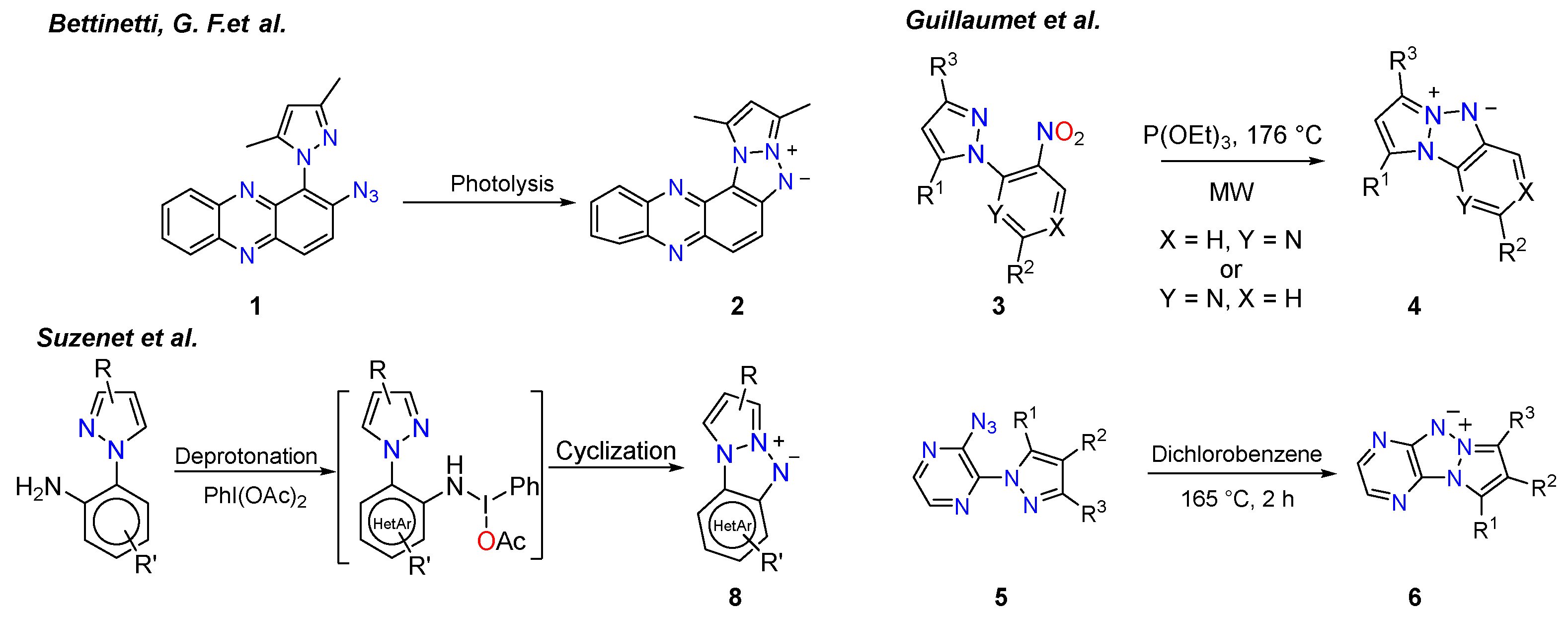
Scheme 2.
The synthetic pathways towards HetATAPs 2–5. (a). Suzuki cross-coupling reaction, (b). Stille coupling reaction, (c) Direct palladium-catalysed CH arylation.
Scheme 2.
The synthetic pathways towards HetATAPs 2–5. (a). Suzuki cross-coupling reaction, (b). Stille coupling reaction, (c) Direct palladium-catalysed CH arylation.
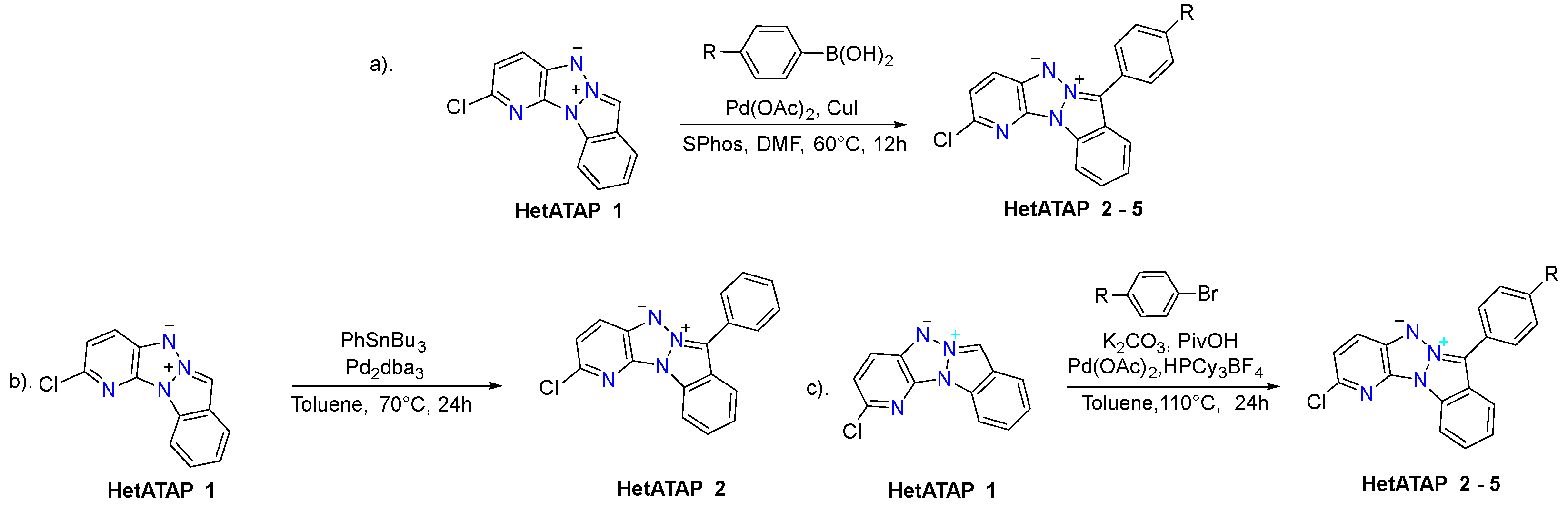
Figure 1.
The color of compounds under naked eyes and UV lamp (a) (365 nm) and normalized, fluorescence emission spectra of HetATAPs 1-5 in the solid-state (b).
Figure 1.
The color of compounds under naked eyes and UV lamp (a) (365 nm) and normalized, fluorescence emission spectra of HetATAPs 1-5 in the solid-state (b).
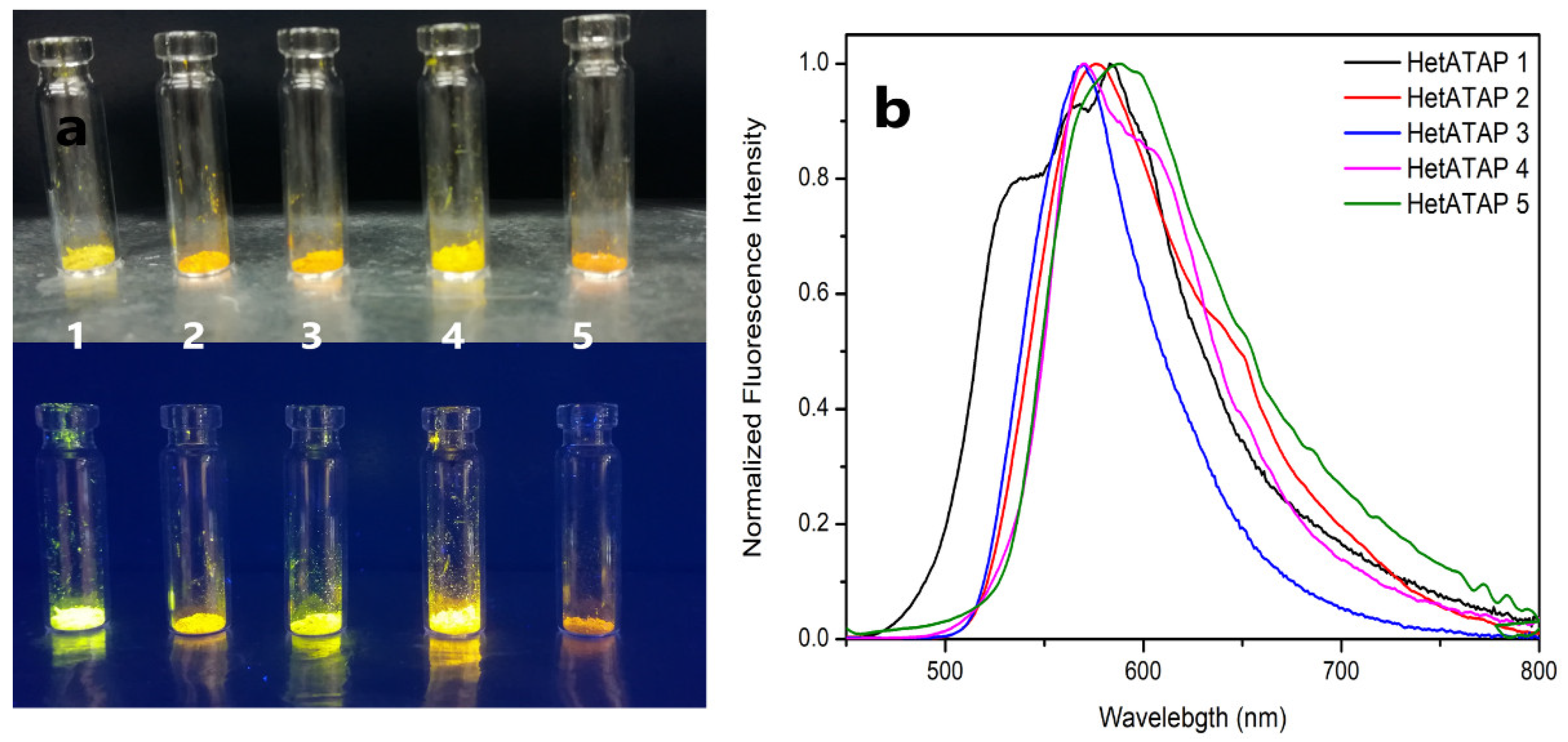
Figure 2.
Normalized, absorption spectra of HetATAPs 1 and 2–5 in the DCM.
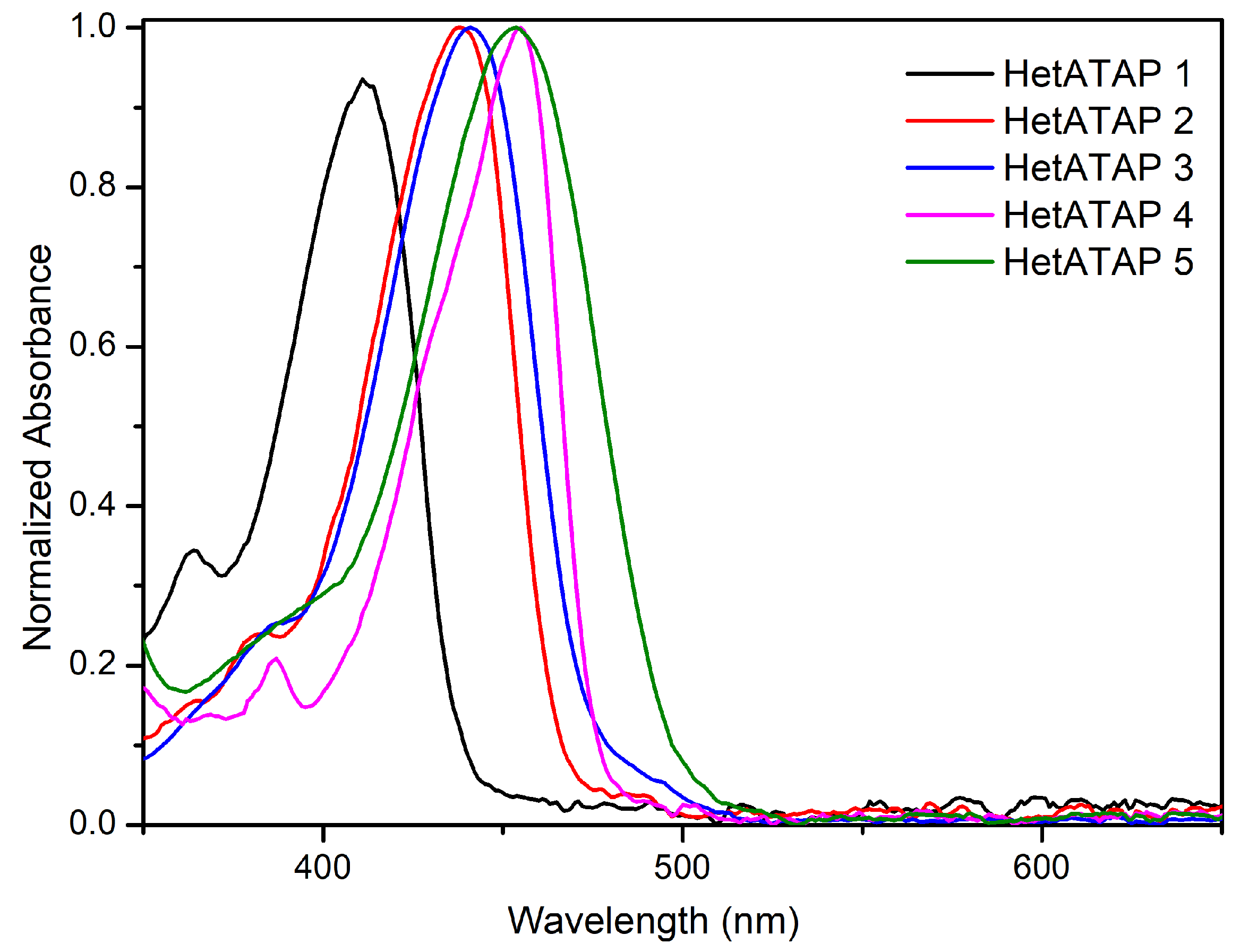
Figure 3.
Absorption spectra of compounds HetATAP3 (a) and 4 (b) in different solution (200 µM).
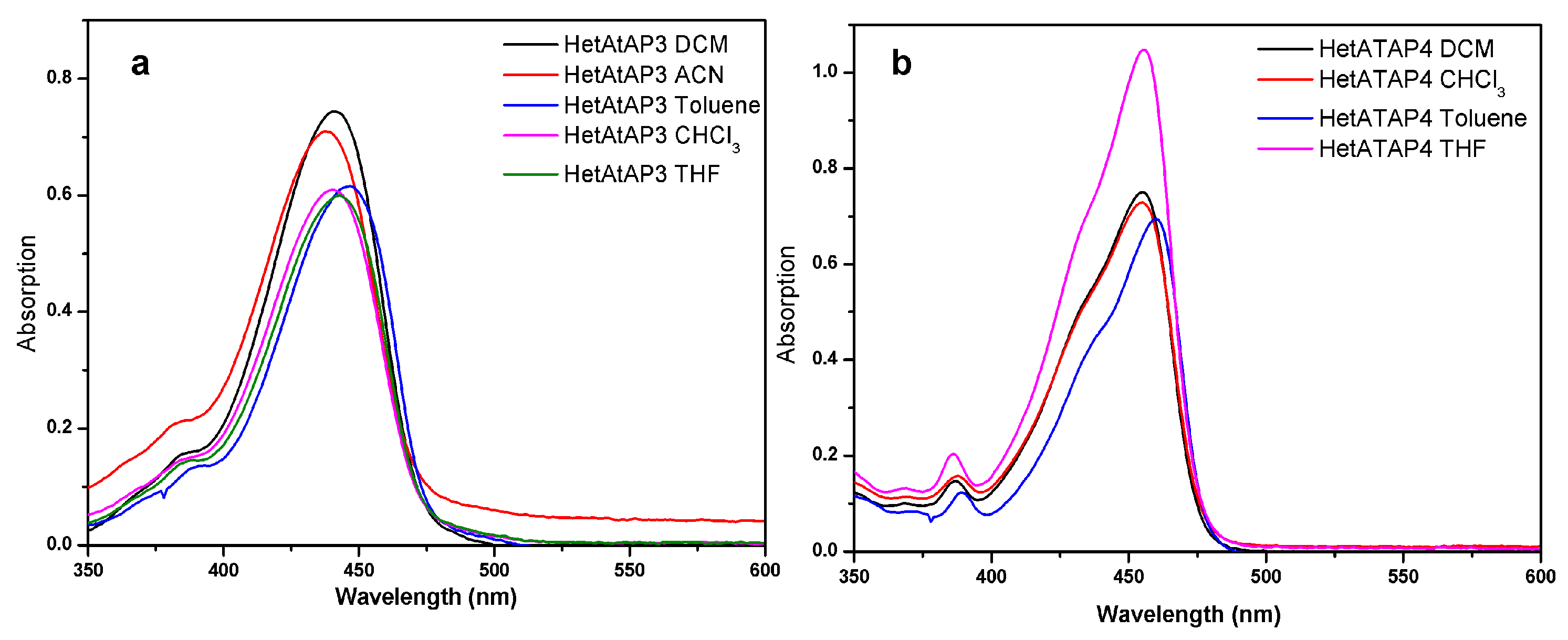
Figure 4.
Absorption (a) and fluorescence emission spectra (c) of HetATAP3 (λex = 438 nm) (200 µM) in ACN solution and “aggregate” (ACN/water, 1:9, v/v); absorption (b) and fluorescence emission spectra (d) of HetATAP 4 (λex = 450 nm) (200 µM) in THF solution and “aggregate” (THF/water, 1:9, v/v).
Figure 4.
Absorption (a) and fluorescence emission spectra (c) of HetATAP3 (λex = 438 nm) (200 µM) in ACN solution and “aggregate” (ACN/water, 1:9, v/v); absorption (b) and fluorescence emission spectra (d) of HetATAP 4 (λex = 450 nm) (200 µM) in THF solution and “aggregate” (THF/water, 1:9, v/v).
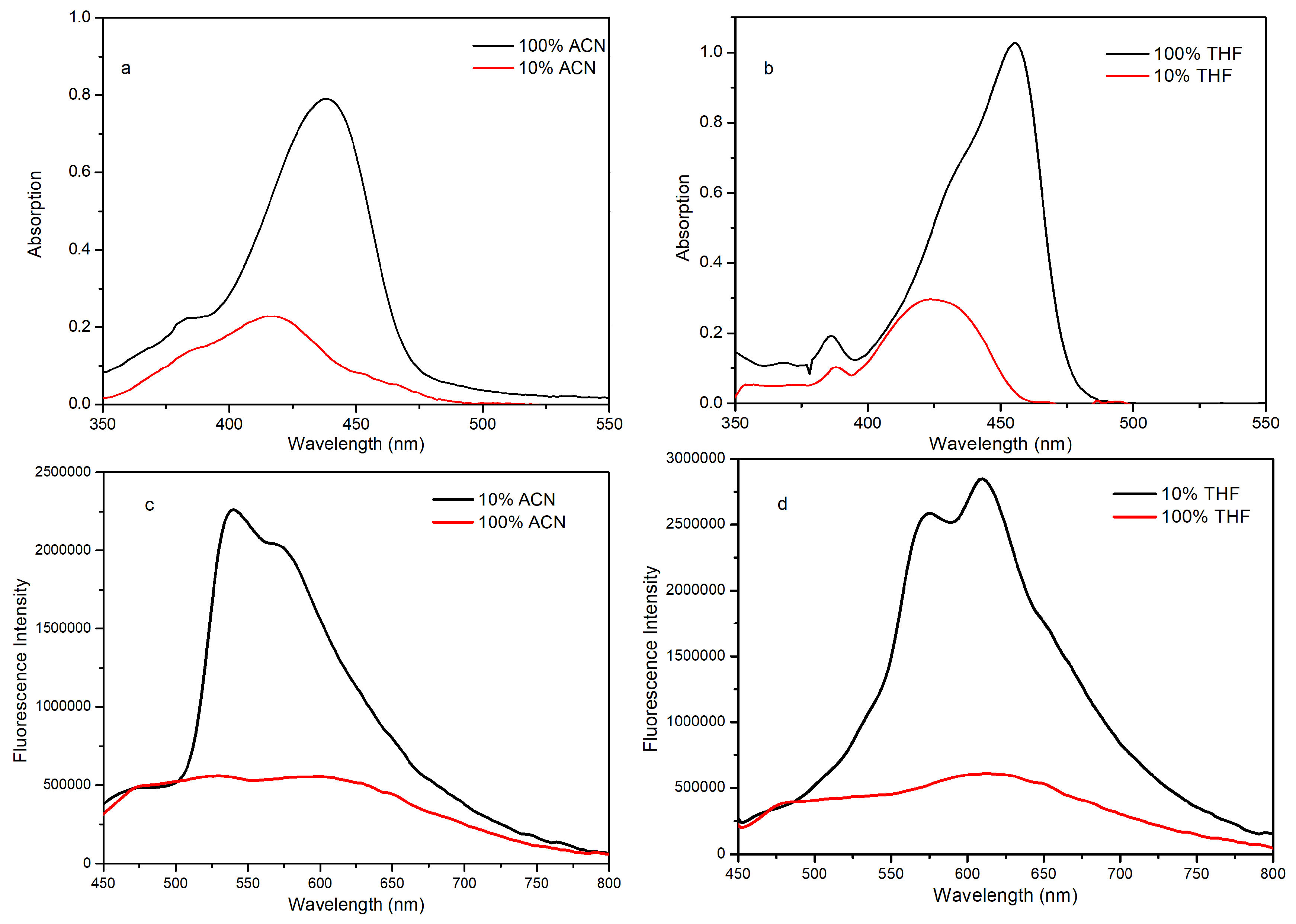
Figure 5.
Absorption (a, b, c) of compound HetATAP3 (200 µM) with different duration for (10 min, 3 h, 24 h) and fluorescence spectra (d) with duration over 24 hours in ACN/water mixtures with different ACN contents.
Figure 5.
Absorption (a, b, c) of compound HetATAP3 (200 µM) with different duration for (10 min, 3 h, 24 h) and fluorescence spectra (d) with duration over 24 hours in ACN/water mixtures with different ACN contents.
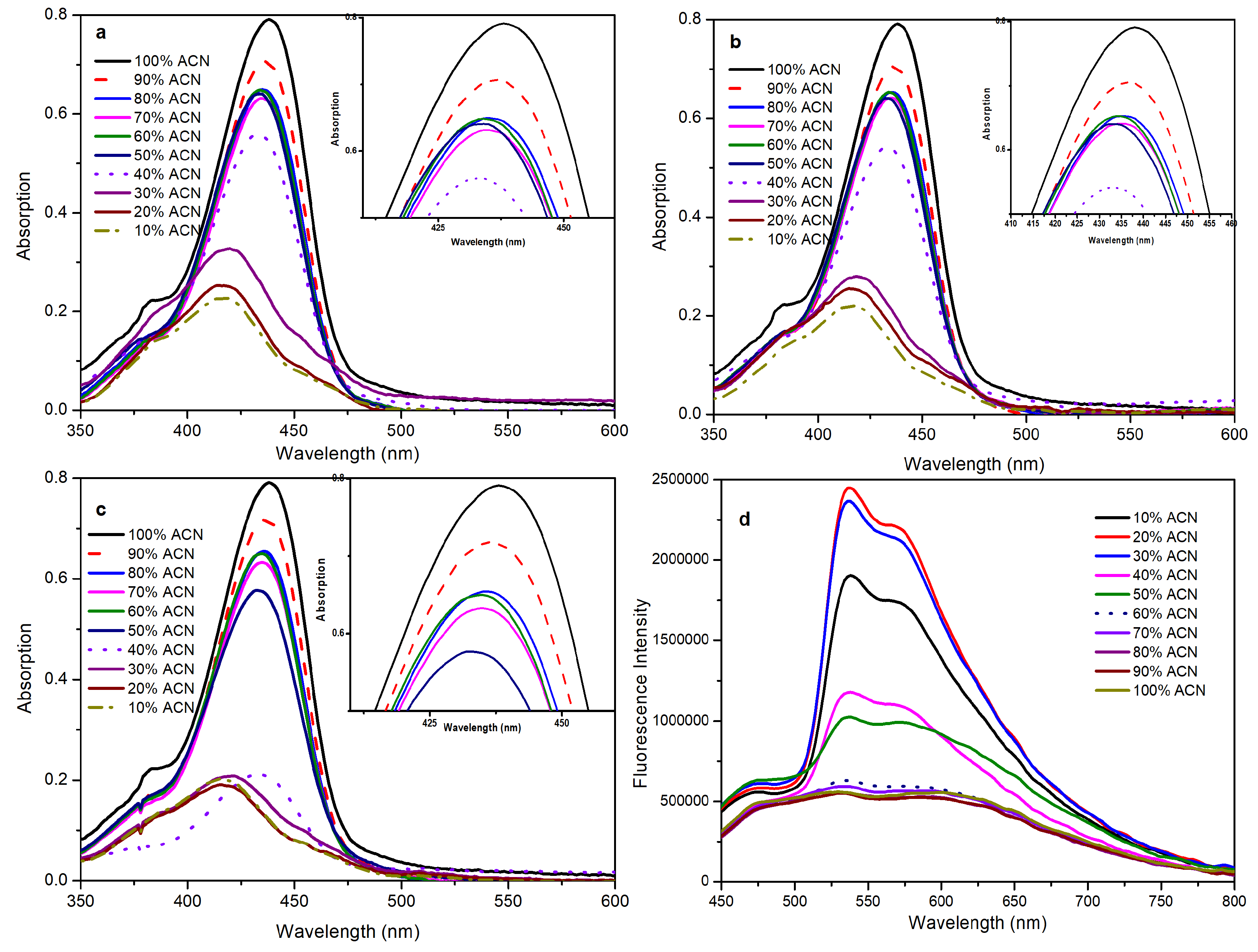
Figure 6.
Absorption (a, b, c) of compound HetATAP4 (200 µM) with different duration for (10 minutes, 3.0 h, 24 h) and fluorescence spectra (d) with duration over 24 hours in THF/water mixtures with different THF contents.
Figure 6.
Absorption (a, b, c) of compound HetATAP4 (200 µM) with different duration for (10 minutes, 3.0 h, 24 h) and fluorescence spectra (d) with duration over 24 hours in THF/water mixtures with different THF contents.
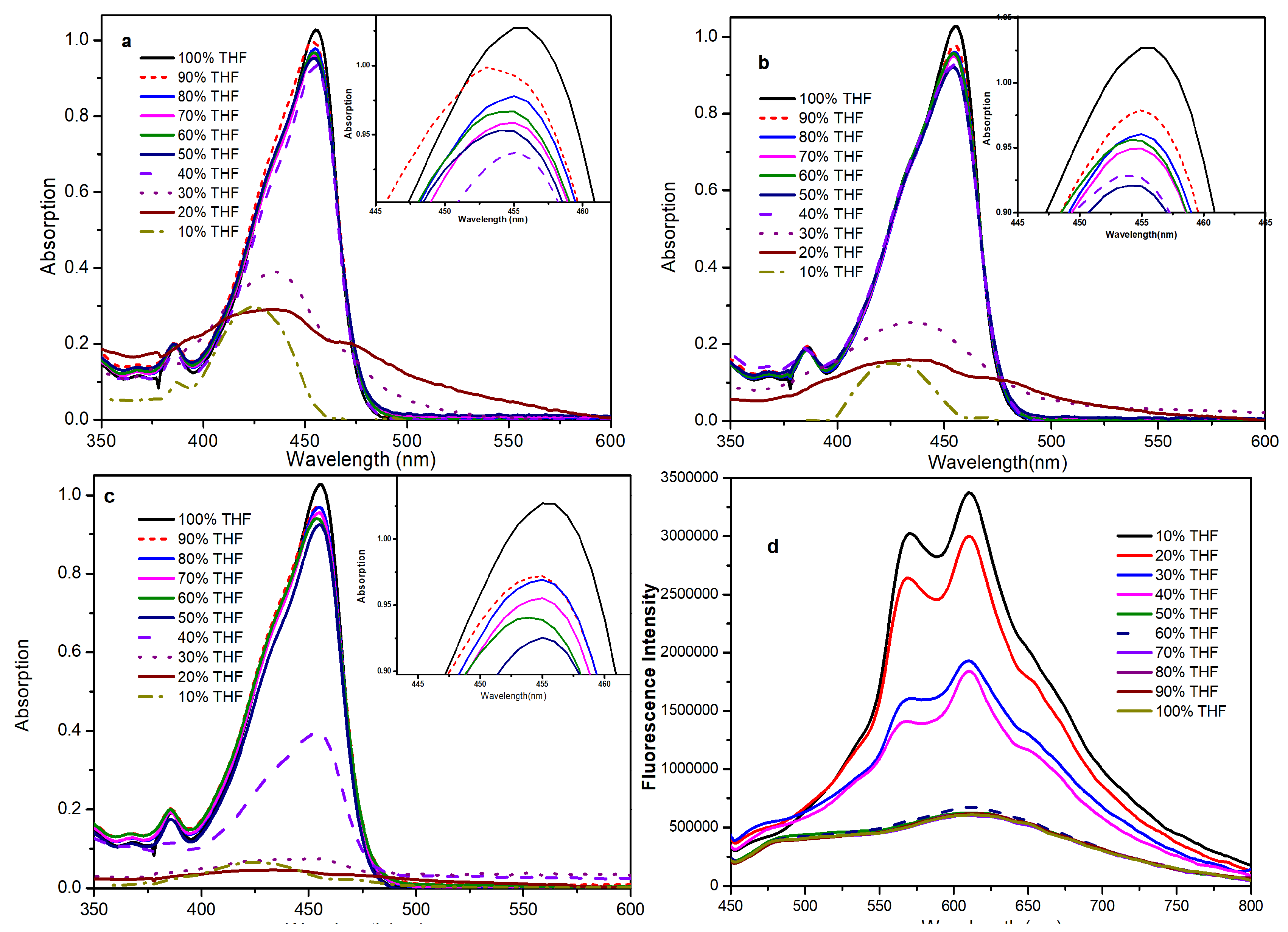
Figure 7.
The color of compound HetATAP3 in ACN/water with different ACN contents under the naked eye (a) and under the UV lamp (365 nm) (b). The color of compound HetATAP4 in THF/water with different THF contents under naked eye (c) and under the UV lamp (365 nm) (d).
Figure 7.
The color of compound HetATAP3 in ACN/water with different ACN contents under the naked eye (a) and under the UV lamp (365 nm) (b). The color of compound HetATAP4 in THF/water with different THF contents under naked eye (c) and under the UV lamp (365 nm) (d).
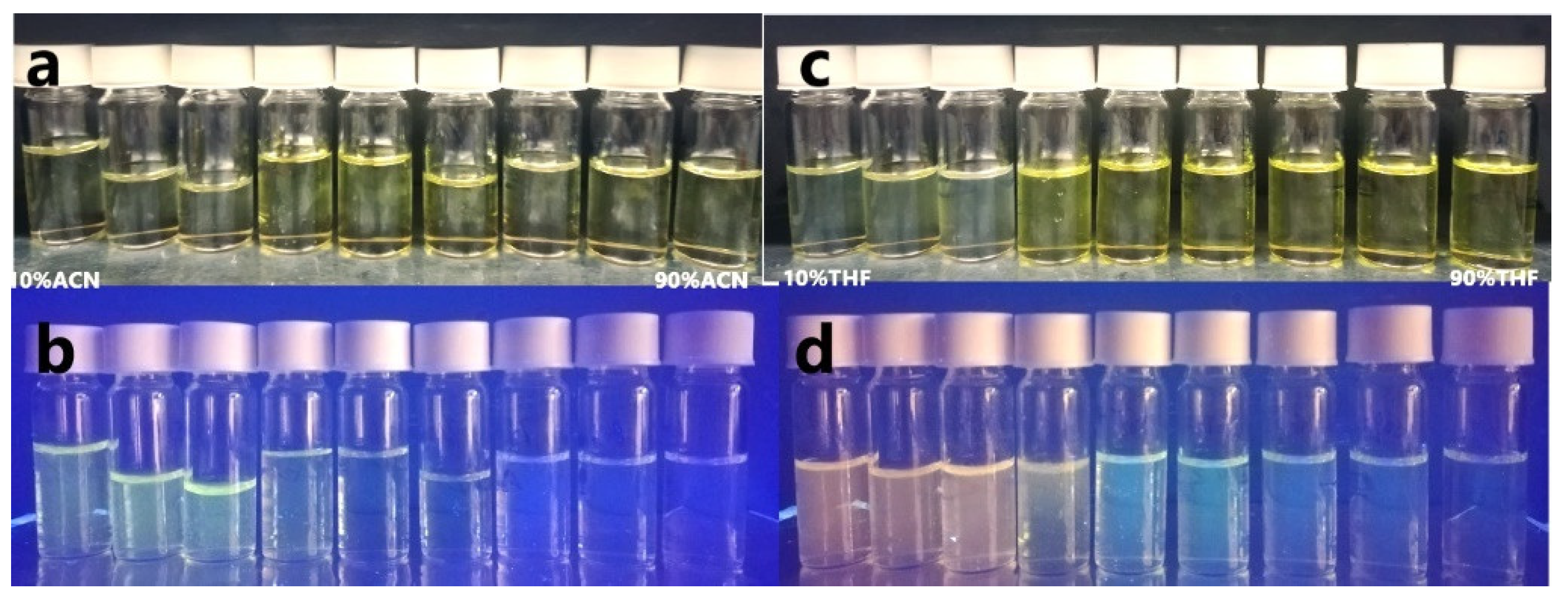
Figure 8.
Dependence of the fluorescence intensity of compounds HetATAP3 (a) and HetATAP4 (b) (200 µM) to aggregating time in ACN/water and THF/water (1:9, v/v), respectively.
Figure 8.
Dependence of the fluorescence intensity of compounds HetATAP3 (a) and HetATAP4 (b) (200 µM) to aggregating time in ACN/water and THF/water (1:9, v/v), respectively.
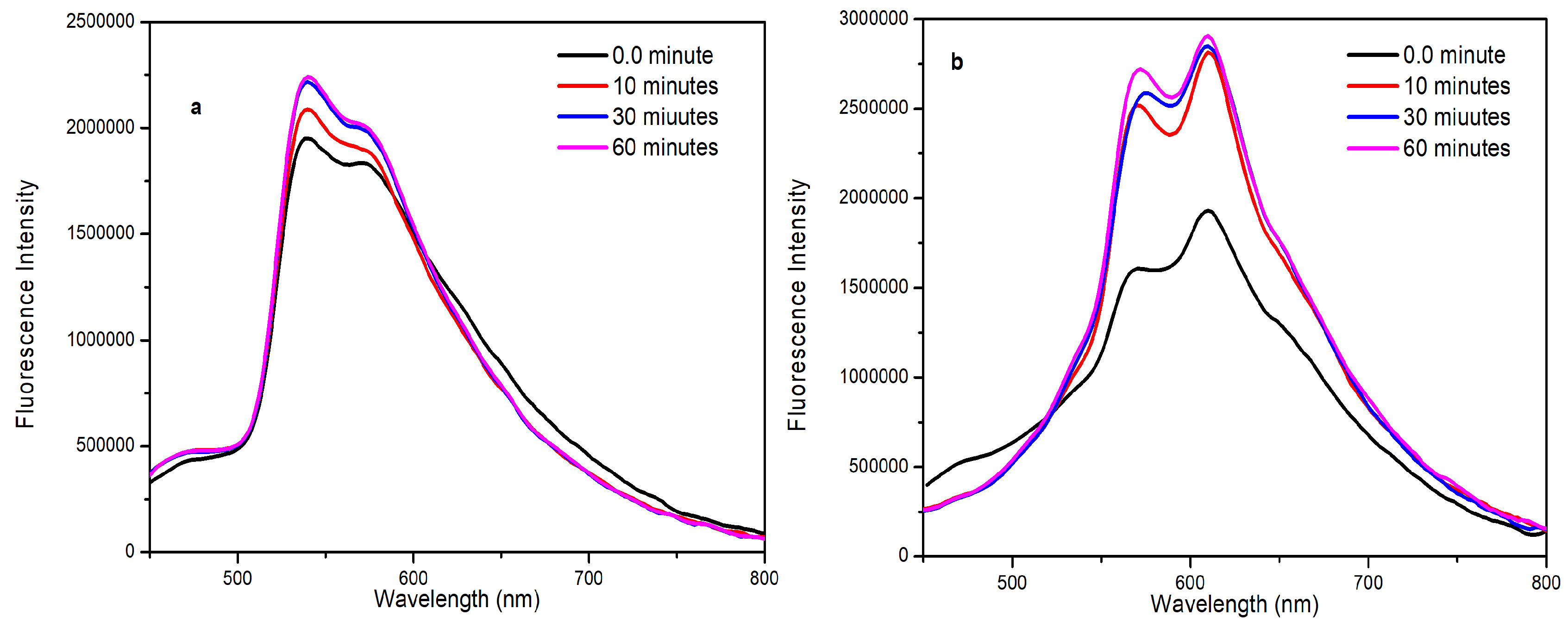

Table 1.
The reaction yields of various pathways towards HetATAPs 2–5.
| HetATAP | R | Yield (%) | ||
| a | b | c | ||
| 2 | H | 53 | 13 | 66 |
| 3 | OMe | 47 | -a | 62 |
| 4 | COOEt | 35 | -a | 51 |
| 5 | N(Me)2 | 30 | -a | 73 |
a Reaction was not carried out. b Experimental conditions: Suzuki cross-coupling reaction: HetATAPs (0.2 mmol, 1 equiv), boronic acids (0.24 mmol, 1.2 equiv), Pd(OAc)2 (27 mg, 0.12 mmol, 0.6 equiv), CuI (15.2 mg, 0.08 mmol, 0.4 equiv), SPhos (10 mg, 0.023, 0.12 equiv) and DMF (2 mL), 12 h; Stille reaction: HetATAP1 (24.3 mg, 0.1 mmol, 1 equiv), PhSnBu3 (44.2 mg, 0.12 mmol, 1.2 equiv), Pd2dba3 (5 mg, 0.005, 0.05 equiv), 24 h; (3). Palladium-catalyzed CH arylations: HetATAP1 (0.2 mmol, 1 equiv), bromoarene reagents (0.2 mmol, 1.0 equiv), Pd(OAc)2 (2.4 mg, 0.01 mmol, 0.05 equiv), Cy3HBF4 (7.8 mg, 0.02 mmol, 0.1 equiv), pivalic acid (6.6 mg, 0.03, 0.3 equiv), K2CO3 (88 mg, 0.6 mmol, 3.0 equiv) and dry toluene (4 mL), 24 h.
Table 2.
Fluorescence properties of HetATAP1-5 in solid state.
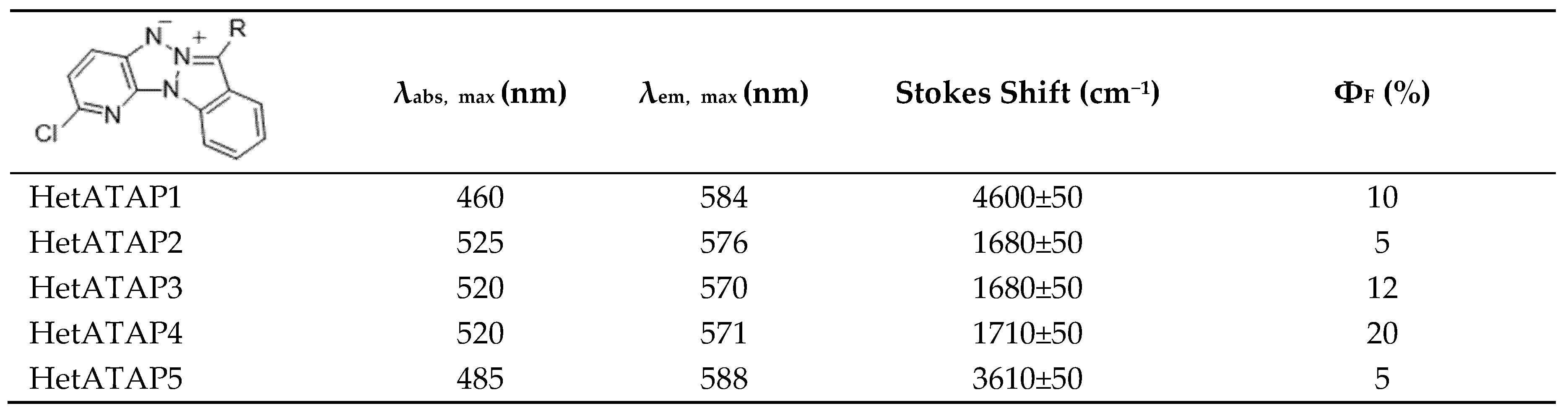 |
Table 3.
Optical data measured in different solutions.
| Dye | Matrix | λabs,max (nm) | ɛ(dm3 mol⁻¹ cm⁻¹) | λem,max (nm) |
|---|---|---|---|---|
| HetATAP3 | DCM | 441 | 39, 194 | 604 |
| CHCl3 | 440 | 30, 454 | 610 | |
| ACN | 438 | 35, 482 | 606 | |
| Toluene | 447 | 30, 799 | 610 | |
| THF | 443 | 29, 989 | 614 | |
| Solid | 570 | |||
| HetATAP4 | DCM | 455 | 37, 524 | 616 |
| CHCl3 | 455 | 36, 420 | 622 | |
| Toluene | 460 | 34, 741 | 606 | |
| THF | 456 | 52, 373 | 642 | |
| Solid | 571 |
Disclaimer/Publisher’s Note: The statements, opinions and data contained in all publications are solely those of the individual author(s) and contributor(s) and not of MDPI and/or the editor(s). MDPI and/or the editor(s) disclaim responsibility for any injury to people or property resulting from any ideas, methods, instructions or products referred to in the content. |
© 2024 by the authors. Licensee MDPI, Basel, Switzerland. This article is an open access article distributed under the terms and conditions of the Creative Commons Attribution (CC BY) license (http://creativecommons.org/licenses/by/4.0/).
Copyright: This open access article is published under a Creative Commons CC BY 4.0 license, which permit the free download, distribution, and reuse, provided that the author and preprint are cited in any reuse.


