

Submitted:
07 October 2024
Posted:
08 October 2024
Read the latest preprint version here
Abstract
The invasion of the golden mussel has resulted in considerable environmental and socioeconomic alterations, which present a considerable threat to the native biodiversity and sustainability of the region. It is of the utmost importance to gain an understanding of the distribution and biological characteristics of this Asian mussel, as well as its interaction with human activities, in order to develop effective strategies for mitigating and preventing its further spread. This study examines the dispersal route and incidence of golden mussels, tracing their movement from initial populations in Argentina to their arrival in the São Francisco River Basin (SFR). The presence of the mussel was confirmed through an integrative assessment, which included shell taxonomic analyses and mitochondrial DNA signatures. This identified populations located 7.5 km from the river's mouth, in proximity to the Atlantic Ocean, in areas such as shrimp farms, artisanal ports, and marinas. The analysis of mitochondrial DNA revealed the presence of South American-specific and shared ancestral haplotypes in the SFR, Grande River, and Argentina. These findings indicate that intracontinental colonisation towards the northeast of South America originated from Asian populations that entered South America via Argentina. The absence of Asian-specific signatures in the RSF, combined with its geomorphological structure, which is unsuitable for large ports or transoceanic vessels, supports the hypothesis of intercontinental dispersal of Limnoperna fortunei.
Keywords:
bioinvasion
; exotic invasive species
; watersheds
; human facilitation
; intercontinental dispersal
; bridgehead effects
; mitochondrial DNA signatures
; invasion genetics
; gene flow
1. Introduction
When introduced to a new area, mussels can become an environmental issue [1,2] these species are often transported via ballast water [3,4], and their introduction can lead to the extinction of local species [5]. For instance, Mytella charruana (d'Orbigny, 1842) = Mytella strigata (Hanley, 1843) has been found in estuarine environments in North America and Asia [6,7,8], while Limnoperna fortunei (Dunker, 1857) has been found in freshwater environments in South America (SA) [9,10]. According to [10], Brazil reportedly spent at least USD 105.53 billion over 35 years (1984-2019), with an average annual expenditure of USD 3.02 (± 9.8) billion. Invaders caused damages and losses amounting to USD USD 104.33 billion, while stakeholders only invested USD 1.19 billion in their prevention, control, or eradication [10] Limnoperna fortunei, also known as golden mussel, is native to China and Southeastern Asia and is an invasive species in different ecosystems worldwide [11,12,13]. It can be found in mussel banks (juveniles and adults) with highly dense populations [14,15] adhering to natural and artificial substrates [16,17] in environments presenting low salinity (< 3PSU) water [18,19,20,21] and temperatures ranging from 0° C to 33° C [22,23,24]. Its sexual maturation happens at 3 to 4 months when the shell length of these individuals reaches 6 mm [25,26].
The dispersion and introduction of the golden mussel are often linked to pelagic larvae in ballast water discharged by ships in SA in 1990 [12]. The presence of L. fortunei in SA has resulted in economic and environmental losses [27,28]. The expenses reported for Brazil totaled USD 9.97 million and were solely related to control, damage repair, prevention, and research by L. fortunei [10]. Itaipu Hydroelectric Power Plant (HPP) is an example of this impact, having to stop for three days for the mechanical cleaning of golden mussels, resulting in a loss of approximately USD 750,000 [29].
Human activities are a significant factor in the dispersion of this species [30,31,32]. Additionally, the proliferation of L. fortunei severely affects drainage systems and flooded lake reservoirs used for power generation [33] and fishery production [17]. The species has been dispersed successfully upstream in South American rivers so frequently that its current frontier lies on the margin of the Amazon basin [34]. It has already been identified in the São Francisco River (SFR) basin [17,35] and a large portion of the Rio de La Plata basin [36]. The species advances an average of 240 km/year upstream in the middle and lower Paraná River [37] and 30 km/year in the Uruguay River basin [38]. The golden mussel has been shown to cause changes in biological diversity, leading to imbalances in the food chain and alterations in the structure and dynamics of species living in limnic environments [33,39]. [25] state that the impact of golden mussels on native populations is due to their attachment to the structures of other organisms, such as mollusks and crustaceans.
Shell morphology (conchology) and molecular tools are currently utilized to identify golden mussels [40,41,42]. Molecular tools have become increasingly crucial in bioinvasion studies [43]. They aid mitigation efforts and provide baseline data on the structure of golden mussel populations [29,41,44,45,46,47,48,49]. Research on the population structure of the golden mussel indicates that the initial L. fortunei propagules were introduced to Argentina and Brazil via ballast water from Japan and Korea [45,46]. To analyze the evolutionary processes related to each animal model, Cox1 barcode haplotypes are necessary for population genetics [50,51,52], and fragmentation standards of 600 to 800 bp should be maintained [51]. The absence of such a condition can lead to the emergence of artifacts that affect the comparison or identification of haplotypes within a given species [51]. Haplotypes of L. fortunei Cox1 barcode have been identified in Asia and SA [29,44,45,46,47,48,49]. Reports indicate that exclusive haplotypes derived from Asia [48] share ancestral haplotypes (Lfm03) from Asia. Additionally, exclusive haplotypes (Lfm04) from SA populations have been observed [29,45,46,47].
This study aims to (1) identify and discuss an intercontinental dispersal route for golden mussels, tracing their movement from initial populations in Argentina to their arrival in the estuarine region of the São Francisco River; (2) use integrated conchological and molecular approaches (DNA footprints) to identify populations established in this newly invaded region; and (3) discuss and list the human factors facilitating their spread in this river basin in South America.
2. Materials and Methods
2.1. São Francisco River
The São Francisco River (SFR) basin spans 2,863 km and covers 639,219 km2, equivalent to 7.5% of Brazil's national territory (Figure 1) and located in the Northeast of South America (SA). The basin comprises four physiographic sectors: Upper, Middle, Sub-Middle, and Lower. [53] describes the end portion of the basin as the Lower São Francisco River (LSFR). In the early 1960s, the course of the Piumhi River, a tributary of the Grande River (GR) at the head of the Paraná River (PR) basin, was reversed to the Upper sector of the SFR basin [54]. The LSFR basin covers a total area of 30,337 km2 and extends for 274 km (5% of the basin). It includes the area between the power plant complex in Paulo Afonso County (Bahia State) and its mouth in the Atlantic Ocean (see Text S1, Figures S1 and S2). Studies have shown that coastal stretches in the LSFR, specifically the SFR delta, are undergoing erosion (see Text S1). The LSFR has a longitudinal gradient and fauna closer to an estuarine environment than an estuary. The reduction and regulation of the flow, resulting from the various dams along the course of the SFR, especially the Xingó dam located just 180 kilometers from the mouth, probably caused the salt wedge intrusion [55]. The alterations to the ichthyofauna assessed by [55] show the changes caused by river damming in this region. Notably, this region has no reports of intercontinental port activity (see Text S1).
2.2. Collected Specimens
Golden mussels were first observed in LSFR during ichthyological studies [55]. The mollusks were found in April 2017 and November 2018 as bycatch collected through manual fish trawling (dimension: 30m x 2.8m; 5mm mesh between nodes) carried out every month from May 2017 to April 2018 in shallow areas of LSFR during spring tide. Apnea diving was subsequently used in an active search near specific points at the mouth of SFR in the counties of Brejo Grande and Ilha das Flores (see Figure S1 and Table S1).
Specimens were collected at these locations for molecular analysis on natural and artificial substrates. The points searched were at landing ports for artisanal fishing and marinas (see Figures S2 and S3). The rate of advance (RA) of the golden mussel in the watersheds of SA was calculated using the distance obtained from Google Earth and the number of months between mussel observation dates described in publications, multiplied by 12. The first month of the year is considered to be the month not reported in the references (see Table S1). One hundred specimens were manually collected at each point where the populations had established themselves. Salinity was measured using the Atago® manual refractometer. The specimens were fixed in ethanol and refrigerated at -20°C for preservation. Molecular identification was performed using adductor muscle tissues.
2.3. Identification and Biometry
Ninety specimens were identified using the conchological criteria suggested by [42]. Pictures of the collected specimens were taken using a Leica® M205 C stereomicroscope equipped with an MC170 HD real-time digital camera (Leica®) and LAS 4.8.0 software (Leica®). Specimen size (umbo-ventral axis) was measured using a digital caliper (see Figure S4), modified from [56]. Fifty-six specimens were genetically identified from the three localities sampled.
2.4. Searching for DNA Footprints and Dispersal Route
These fifty-six specimens were analyzed with adaptations using the phenol-chloroform protocol [57]. The mitochondrial gene Cox1 fragment was amplified using the primers [58] described. Polymerase Chain Reaction (PCR) was performed according to a protocol defined by [49,50]. The PCR product was purified, and all specimens' fragments (both strands) were sequenced using the automatic ABI PRISM TM 377 DNA Sequencer by Macrogen (www.Macrogen.com). After sequencing, all electropherograms were checked manually. Finally, consensus strings were generated and compared with reference L. fortunei sequences available in GenBank (www.ncbi.nlm.nih.gov/nuccore/) - the BLASTn tool (www.ncbi.nlm.nih.gov/BLAST/) was used to confirm the identity of haplotypes (Figure 2; see Table S2), according to [45,48].
To assess the dispersal route of the golden mussel was conducted based on studies that provided or published Cox1 sequences, summarizing a total of 2,160 specimens (735 from Asia and 1,425 from SA). By comparing the available sequences and the haplotypes described in the literature, a standardization of the nomenclature was carried out, as presented in Table S2. Thus, the analysis of the golden mussel's dispersal route was traced by comparing the presence of haplotypes and the collection sites of the populations (see Table S2).
3. Results
3.1. Mussel Occurrence
The occurrence of golden mussels was reported at two different times (April 2017 and November 2018) at three other locations in the LSFR basin (VIF - Village Ilha das Flores, BGM - Brejo Grande Marine; MRS - Mouth of the São Francisco River). These sites were the most easterly in SA. The occurrence of the mussel in the LSFR extended its distribution by 500 km in the largest exclusively Brazilian hydrographic basin. The occurrence of golden mussels in nearby estuaries (7.5 km) of the SFR estuary had never been reported in the estuaries of northeastern SA (Figure 1; see Figure S1). This expanded distribution resulted in a species advance of approximately 375 km/year downstream of the LSFR (see Table S1). Living mussels were collected from low salinity collection sites such as estuarine (MRS: 4PSU) and freshwater (VIF and BGM) beaches associated with artisanal fishermen, landing ports, and drainage channels used for fish and white shrimp [Litopeneus vanammei (Boone, 1931)] farming (see Figures S1 and S2). Live bivalves were collected from the underwater areas of marinas, artisanal fishing ports, and drainage channels used for fish farming. They were attached to unconsolidated (coarse sand and gravel), artificial (bricks and cement fragments), and naturally consolidated substrates (rocks). About the natural consolidated substrate, it was possible to see golden mussels associated with native estuarine species [Crassotrea sp. and Vitta virginea (Linnaeus, 1758)] able to survive in low salinity estuarine environments associated with river outlets. In Ilha das Flores (VIF), clusters of mussels were recorded, some of which were collected and observed next to aquatic macrophytes (see Figures S1, S2, and S3). Population densities were not assessed at these sites.
3.2. Mussel Identification and DNA Footprints
The shells of the collected specimens were formed by two equal valves with a triangular contour and an elongated base. The subterminal umbo, smooth, simple joint ligament, and very thin, straight, and toothless hinge (see Figure S4) confirm the identification of L. fortunei by [40,42]. Voucher specimens were deposited in the mollusk collections of the Universidade Estadual de Ponta Grossa in the Coleção de Moluscos (UEPG-CMo: CMo 1120; CMo 1121; CMo 1122) and the Museu de Ciências Naturais of the Universidade Federal do Paraná (MCN-UFPR: MCN.Z 777). Individuals with carapace lengths ranging from 5.25 to 23.79 mm (mean 9.81±4.57 mm) were observed at the site (Table 1) in the VIF, it is possible to observe the presence of the largest individuals, indicating banks with adult specimens and older and better-established population compared to the other two populations (BGM and MSR, see Figure S3).
Here, we present for the first time the annotation of fragments of the cytochrome oxidase gene (Cox1) gene in the mitogenome of L. fortunei (Figure 2). Partial sequences of the Cox1 from the collected samples (VIF-18, BGM-19, and MRS-19; see Table S2 and FS5) resulted in length alignments of 457 (one sequence), 530 (one sequence) and 555 (54 sequences) bp, located between positions 8,761 and 9,315 of the L. fortunei mitogenome (KP756905). Four L. fortunei haplotypes (99.70% to 100% similarity) were identified for Lfm01, Lfm02, Lfm03, and Lfm4 and deposited in GenBank and BOLDSystem (references XX000000.0 to XX000000.0).
4. Discussion
4.1. Cox1 Barcode Annotation and Haplotypes in Golden Mussel
The annotation of Cox1 fragments in the mitogenome of L. fortunei indicated, that their position affects haplotype identification. The position and length of these Cox1 fragments in golden mussels are not the same as the polymorphic regions observed in haplotypes described in this gene by [45] and [48]. The sequences described in the literature and deposited in Cox1 gene databases range from 382 bp to 1,509 bp in length and are located in different positions in the L. fortunei mitogenome (Figure 2). To avoid artifacts in the analysis of the dispersal route, it is essential to verify whether there is overlap across all Cox1 barcode loci when describing a haplotype for the specimen referenced in the studies. However, some polymorphic sites that could indicate a specific haplotype were not evaluated (Figure 2; see Table S2 and Figure S5). Therefore, it is crucial to emphasize the importance of accessing reference sequences [41,45,46,47,48,60,66] to analyze and identify L. fortunei haplotypes. If a new haplotype is described, it must be made available to the scientific community.
4.2. Identified Footprints and Possible Origins
Integrated molecular and morphological identification played a crucial role in confirming the L. fortunei in estuarine and freshwater regions of LSFR. The exclusive haplotype found in this site (Lfm01 and Lfm04) is consistent with SA populations [29,46], providing evidence of the species' successful invasion of new hydrographic environments. In the study by [29], it was observed that the exclusive haplotype (Lfm39) was present in SA populations in the SFR and PR basins (see Figure S5 and Tables S2 and S3).
Native distribution of L. fortunei is probably limited to the Pearl River basin in China [11,13]. This invasive species can be found in several Asian (Japan and Korea) and SA regions [31,46,48,67]. [46] analyzed the genetic structure of 24 L. fortunei populations (ten from Asia and fourteen from SA) living in invaded and native areas based on Cox1 gene sequences (~510bp), and eight microsatellite markers concluded that bivalve populations living in Asia had greater diversity (23 haplotypes) than those living in SA (18 haplotypes), suggesting that Asia has been subject to a more significant number of introduction events for invasive populations. The authors also reported the fine genetic structure of L. fortunei on both continents, suggesting strong post-introduction selection and stochastic events inherent to the species' biology. These events contribute to the structure of its population and the occurrence of Cox1 haplotypes exclusive to SA (Lfm01, Lfm04, and Lfm39). In the LSFR, two haplotypes exclusive to SA (Lfm01, Lfm04) were identified (see Figure S5 and Table S2).
The Cox1 haplotypes (457bp to 555bp) observed in specimens collected from LSFR and Sobradinho [29] exhibit features that are characteristic of populations from SA (Lfm02, Lfm03, Lfm11, Lfm15, Lfm36, and Lfm38), Taiwan, Korea, Japan, and China [29,45,46,47,48]. Based on the haplotypes analyzed in LSFR, it can be inferred that the observed population in VIF (Lfm02, Lfm03, and Lfm04), BGM (Lfm02, Lfm03, and Lfm04), and MRS (Lfm01, Lfm02, Lfm03, and Lfm04) originated from populations located further south in the American continent. [68] observed similar conditions when comparing mussel populations from five different Brazilian reservoirs using the double digest restriction-site associated DNA sequencing (ddRAD-seq) protocol for the golden mussel. These authors indicated connectivity between basins and absent geographic structure [68]. Same as the data presented here with the Cox1 gene. Exclusive SA haplotypes in SFR and PR basins support the hypothesis of upward colonization towards hydrographic basins in Northeastern Brazil (Figure 1 and see Table S2). It is essential to emphasize the lack of port areas for ships that are not navigable by large vessels at the mouth of the SFR [55,69]. The presence of the golden mussel after thirty years (from 1991 to 2020) in Argentina confirms the theory of the intercontinental spread of the mussel in SA [21]. This fact virtually excludes golden mussel reintroduction due to maritime cabotage (Figure 1), as supported by [36,70,71] (see Figures S1 and S2). The absence of golden mussels in coastal watersheds in Southeast and Northeast Brazil port areas, as confirmed by [29,31], supports the theory of intracontinental dispersal.
Furthermore, the specimens genotyped by LSFR have haplotypes Lfm02 and Lfm03 (Figure 1; see Figure S5 and Table S2). This data supports the hypothesis that Asian specimens [72] initially invaded SA from Argentina [12,14]. The dispersion process of the golden mussel is indicated by the flow of the targeted gene of haplotypes from Asia to SA (see Table S2). There were no exclusive haplotypes from SA in Asia, as reported by [29,45,46,47,48,49]. This may be related to the export of grains, such as soybeans and sugar, from SA to Asia [73]. According to [74], some grain-loaded ships do not require ballast water to achieve stability. However, vessels arriving from Asia require ballast water to achieve stability; this feature facilitates directional genetic flow from Asia to SA (Figure 1; see Table S2). Studies have shown that M. strigata, another invasive mussel in the world, has invaded different areas of America and Asia [7,8]. Notably, L. fortunei and M. strigata can coexist in low salinities [20,75]. However, it is essential to note that only the golden mussel exhibits directional flow from its native to the invaded area, as demonstrated by various studies [7,8,45,46,47].
4.3. An Intercontinental Route to Northeastern Brazil
The reversal of the course of the Piumhi River (a tributary of the GR at the head of the PR basin) into the SFR basin in the early 1960s [54] is thought to have facilitated the invasion of the golden mussel, as well as the connectivity of these basins (Figure 1). Invasion risk factors were observed in the studied environment (see Figure S2). This anthropogenic change, which eliminated the natural barrier between these basins, allowed the introduction of species and the genetic flow of fish (Hypostomus regani and Astyanax "bimaculatus group") from the PR basin to the SFR basin [76,77]. The Capitólio dam interfaces the two river basins [54]. The proximity of these two basins, changes in water flow (Moreira Filho, personal communication), and the transit of ships between the basins may have contributed to the invasion of the golden mussel towards the northeastern region of SA. The tributaries of the GR aren´t navigable for commercial vessels, despite other dispersal vectors such as small recreational and fishing boats, fish farming, and the use of sand recovered from mussel-infested areas, such as the Tietê River and other sites in the PR basin [36]. Recently, the presence of the golden mussel in the communication channels of these two interconnected hydrographic basins has been observed in the SFR [35].
In addition, the presence of haplotypes in SA (Lfm01 to Lfm04, Lfm15, and Lfm38) close to the Piumhi River (observed at two sites in the GR tributary by [29] indicates the likely connection between the two basins (Figure 1; see Figure S5 and Table S2). This evidence reinforces the concerns of the expert committee (participants in the National Plan for the Prevention, Control, and Monitoring of the Golden Mussel in Brazil) about the role of water transport from the SFR to the Tocantins River basins as a vector for the invasion of golden mussel larvae and adults [28]. It cannot be excluded that there are other ways of introducing these mussels into the SFR basin, other than the likely dispersal jumps from southeastern to northeastern Brazil in freshwater fish transport tanks [35,68,78].
4.4. Golden Mussel and Human Activities in Northeastern Brazil
Invasion risk factors were observed in the studied environment (see Figures S2C and S3); therefore, they need to be taken into account at this point to implement plans focused on mitigating the occurrence of this invasive species in LSFR. Monitoring and early detection of invasive species is a prerequisite for developing bioinvasion prevention and management plans [79]. The mussel species live in different freshwater environments such as streams, rivers, dams, lakes, coastal lagoons, lagoons in low salinity scenarios, and river deltas [28,80]. Thus, the risk posed by each dispersal vector observed in the watershed is related to economic activities [31], social arrangements, local practices, and habits, which may differ between hydrographic systems and result in different invasion routes or corridors [81].
Confirming golden mussel occurrence in inland regions closer to the coast suggests the vectors of recurrent dispersal in Northeastern Brazil. Similar to the process observed in Japan [48], the introduction of mussels in Northeastern Brazil is also associated with aquaculture [82]. [83] observed golden mussel banks in tilapia (Oreochromis niloticus) aquaculture tank nets used in southern/southeastern Brazil reservoirs. Curimatã (Prochilodus argenteus), tambaqui (Colossoma macropomum), tilapia, and common carp (Ciprinus carpio) stand out among the fish species farmed in freshwater tanks dug in LSFR. These tanks enable the subsistence of about 2,000 regional families [84].
The LSFR presented small golden mussel beds in low salinity water channels associated with ponds dug to cultivate the grey shrimp species L. vanammei (see Figures S2 and S3). The Northeast region represents the central Brazilian pole for grey shrimp farming in marine and freshwater environments, thus contributing to the social and economic development of the region [85,86]. The presence of L. fortunei can affect this production chain, as mussel fouling can affect pumping systems, reduce water flow in tanks, and intensify disease transmission processes. [87] developed a model to predict the distribution of golden mussels based on air temperature and rainfall. The scenarios generated have shown a high potential for L. fortunei to invade aquatic environments in Central America, North America, Europe, Africa, and Oceania, as well as the expansion of golden mussel occurrence areas in Asia and SA. According to the authors, the Amazon, Tocantins, Araguaia, and SFR river basins have the most tremendous potential for invasion in Brazil. [17] confirmed the occurrence of golden mussels in 2015 at two sites near the Sobradinho hydroelectric plant and another at the crossing (transposition system) of the SFR (Table 1). Similar observations were made in the Mato da Onça Reserve, close to the Xingó Hydroelectric Plant [88,89]. The current identification of golden mussel populations in freshwater (VIF and BGM) and in an estuarine area (MRS) of the LSFR (average salinity 14.67 PSU, with a maximum of 26.43PSU and a minimum of 3.59PSU; [90]) in 2017 confirms the predictions of [87] regarding the expanded distribution of golden mussels in the LSFR basin. Similar conditions have been observed for Lagoa dos Patos and the La Plata River [15,20]. However, the results of the present study are 10 years ahead of the projections made by some predictive models [78,87].
The dispersal rate of the golden mussel observed in the SFR basin is higher than that recorded for the Paraná basin (see Table S1), which may be explained by the initial colonization of the golden mussel in the upper SFR. The three populations identified in the LSFR showed a mean shell length of reproductive age specimens (Table 1, see Figure S3). In SA, sexual maturity varies seasonally, starting at 5-6 mm shell length in winter-spring and 7-10 mm in autumn [25]. The downstream dispersal of planktonic larvae [39] or juvenile/adult individuals associated with floating substrates, such as macrophytes, observed in the LSFR ([88], Figure 1, see Figures S1–S3) is a favorable and opposite condition to the upstream distribution of this invasive species in other hydrographic basins, such as the Paraná-Paraguay system, reported in Japan [48].
5. Conclusions
The present study has confirmed the presence of L. fortunei populations in different LSFR localities and their range's rapid expansion. These findings indicate route intracontinental colonization towards the Northeast of SA. The data analyzed showed that the populations of golden mussels living in the LSFR originate from populations established in other places in SA, which originated from Asian populations that entered SA via Argentina and reached the study area through human vectors. It´s, therefore, necessary to carry out further studies focusing on monitoring possible vectors of introduction and spread and the occurrence of golden mussels in river basins located in the north and northeast of Brazil. In addition, measures to educate and make people (especially water users) aware of the problem could be considered to allow for the most efficient management. The situation in the Tocantins and Araguaia River basins is similar to that observed in the SFR, and the presence of the gold mussel in these basins is the reality.
Supplementary Materials
The following supporting information can be downloaded at the website of this paper posted on Preprints.org. Table S1. Rate of advance (RA) of golden mussel in watersheds of South America., and Table S2. Sampling details and Haplotypes Codes for mitochondrial cytochrome c oxidase subunit I (Cox1) gene for the golden mussel Limnoperna fortunei. https://docs.google.com/document/d/1_D9itXHi2z90mEK9pIrHiOShhEBKyzz1C4IPzUtqK24/edit; Figure S1. Dispersion of the golden mussel (Limnoperna fortunei) in the Lower São Francisco River (LSFR) basin., Figure S2. Example of factors that may have contributed to the dispersion of the golden mussel in the Lower São Francisco River basin., Figure S3. Limnoperna fortunei present in different substrates in the Lower São Francisco River basin., Figure S4. Biometry and Conchiology of Limnoperna fortunei obtained in the Lower São Francisco River., and Figure S5. Neighbor-Joining (NJ) tree for mitochondrial cytochrome c oxidase subunit I (Cox1) gene for the golden mussel. https://docs.google.com/document/d/1RO7Wi9TukBv0LRz9M_zBxM7YEPNZi10EKGAjgDClqp0/edit; Text S1. The Lower São Francisco River (LSFR) region.; Text S2. Methodology. https://docs.google.com/document/d/1lO3uAcnviMT2L-B1tkWBBDLil_BEUyO1JUUdLSinHKA/edit.
Author Contributions
Conceptualization, ALFJ, RBN, SWC, and RFA; methodology, ALFJ, RBN, VMR, and SWC; software, ALFJ, and RBN; formal analysis, ALFJ, and RBN; resources, ALFJ, RBN, VMR, LR, MCA, PDB, SWC and RFA.; writing—original draft preparation, ALFJ, and RBN; writing—review and editing, VMR, LR, MCA, PDB, SWC and RFA.; visualization, SWC, and RFA; supervision, SWC, and RFA; funding acquisition, MCA, SWC, and RFA. All authors have read and agreed to the published version of the manuscript.
Funding
ALFJ has been awarded a Ph.D. scholarship by the Brazilian National Council for Scientific and Technological Development (CNPq - 142155/2019-5). This research was funded by CNPq grant number 308748/2021-2, Fundação Araucária NAPI-Bioinformática grant number 033/2021 and INCT/ADAPTA grant number 465540/2014-7. ALFJ received a grant from CNPq.
Institutional Review Board Statement
The study was conducted in accordance with Portaria ICMBio 748/2022 and approved by the Instituto Chico Mendes de Conservação da Biodiversidade through the Biodiversity Authorization and Information System (ICMBio/SISBIO): license number 6625. In Brazil, the animal study protocol does not apply to studies involving invertebrate animals; it is only required for studies involving vertebrate animals or humans.
Informed Consent Statement
Not applicable.
Acknowledgments
To the entire technical, administrative, and manager team of Ponta Grossa State University (UEPG) and the Foundation for Support of Institutional, Scientific, and Technological Development of UEPG (FAUEPG), and in particular to Karina Aparecida Soares, Acir da Cruz Camargo, Amélia Harmatiuk De Oliveira, Professor Giovani Marino Favero and Sinvaldo Baglie.
Conflicts of Interest
The authors declare no conflicts of interest.
References
- McKindsey, C. W.; Landry, T.; O'Beirn, F. X.; Davies, I. M. Bivalve aquaculture and exotic species: a review of ecological considerations and management issues. Journal of Shellfish Research 2007, 26, 281–294. [Google Scholar] [CrossRef]
- Joyce, P. W.; Kregting, L.; Dick, J. T. Relative impacts of the invasive Pacific oyster, Crassostrea gigas, over the native blue mussel, Mytilus edulis, are mediated by flow velocity and food concentration. NeoBiota 2019, 45, 19–37. [Google Scholar] [CrossRef]
- Silva, J. S. V.; Fernandes, F. C.; Souza, R. C. C. L.; Larsen, K. T. S.; Danelon, O. M. (Eds.) Água de Lastro e Bioinvasão; Interciência: Rio de Janeiro, Brazil, 2004; pp. 33–38. [Google Scholar]
- Carlton, J. T. Marine Bioinvasions: The alteration of marine ecosystems by non-indigenous species. Oceanography 1996, 9, 36–43. [Google Scholar] [CrossRef]
- Boltovskoy, D.; Correa, N. M.; Burlakova, L. E.; Karatayev, A. Y.; Thuesen, E. V.; Sylvester, F.; Paolucci, E. M. Traits and impacts of introduced species: a quantitative review of meta-analyses. Hydrobiologia 2020, 18, 1–34. [Google Scholar] [CrossRef]
- Stenyakina, A.; Walters, L. J.; Hoffman, E. A.; Calestani, C. Food availability and sex reversal in Mytella charruana, an introduced bivalve in the southeastern United States. Molecular Reproduction and Development: Incorporating Gamete Research 2010, 77, 222–230. [Google Scholar] [CrossRef]
- Calazans, C. S. H.; Walters, L. J.; Fernandes, F. C.; Ferreira, C. E.; Hoffman, E. A. Genetic structure provides insights into the geographic origins and temporal change in the invasive charru mussel (Sururu) in the southeastern United States. PLOS ONE 2017, 12, e0180619. [Google Scholar] [CrossRef]
- Lim, J. Y.; Tay, T. S.; Lim, C. S.; Lee, S. S.; Teo, S. M.; Tan, K. S. Mytella strigata (Bivalvia: Mytilidae): an alien mussel recently introduced to Singapore and spreading rapidly. Molluscan Research 2018, 38, 170–186. [Google Scholar] [CrossRef]
- Giglio, M. L.; Dreher Mansur, M. C.; Damborenea, C.; Penchaszadeh, P. E.; Darrigran, G. Reproductive pattern of the aggressive invader Limnoperna fortunei (Bivalvia, Mytilidae) in South America. Invertebrate Reproduction & Development 2016, 60, 175–184. [Google Scholar]
- Adelino, J. R. P.; Heringer, G.; Diagne, C.; Courchamp, F.; Faria, L. D. B.; Zenni, R. D. The economic costs of biological invasions in Brazil: a first assessment. NeoBiota 2021, 67, 349–374. [Google Scholar] [CrossRef]
- Morton, B. Some aspects of the biology and functional morphology of the organs of feeding and digestion of Limnoperna fortunei (Dunker) (Bivalvia: Mytilacea). Malacologia 1973, 12, 265–281. [Google Scholar]
- Pastorino, G.; Darrigran, G.; Martín, S. M.; Lunaschi, L. Limnoperna fortunei (Dunker, 1857) (Mytilidae), nuevo bivalvo invasor en aguas del Río de la Plata. Neotropica 1993, 39, 101–102. [Google Scholar]
- Xu, M. Distribution and spread of Limnoperna fortunei in China. In Limnoperna Fortunei; Springer International Publishing: 2015; pp. 313–320.
- Mansur, M. C. D.; Santos, C. P.; Darrigran, G.; Heydrich, I.; Callil, C. T.; Cardoso, F. R. Primeiros dados quali-quantitativos do mexilhão-dourado, Limnoperna fortunei (Dunker), no Delta do Jacuí, no Lago Guaíba e na Laguna dos Patos, Rio Grande do Sul, Brasil e alguns aspectos de sua invasão no novo ambiente. Revista Brasileira de Zoologia 2003, 20, 75–84. [Google Scholar] [CrossRef]
- Barbosa, F. G.; Melo, A. S. Modelo preditivo de sobrevivência do Mexilhão Dourado (Limnoperna fortunei) em relação a variações de salinidade na Laguna dos Patos, RS, Brasil. Biota Neotropica 2009, 9, 407–412. [Google Scholar] [CrossRef]
- Santos, F. J. M.; Peña, A. P.; Luz, V. L. F. Considerações biogeográficas sobre a herpetofauna do submédio e da foz do rio São Francisco, Brasil. Estudos 2008, 35, 57–78. [Google Scholar]
- Barbosa, N. P. U.; Silva, F. A.; De Oliveira, M. D.; Neto, M. A. S.; De Carvalho, M. D.; Cardoso, A. V. Limnoperna fortunei (Dunker, 1857) (Mollusca, Bivalvia, Mytilidae): first record in the São Francisco River basin, Brazil. Check List 2016, 12, 1846. [Google Scholar] [CrossRef]
- Deaton, L. E.; Derby, J. G.; Subhedar, N.; Greenberg, M. J. Osmoregulation and salinity tolerance in two species of bivalve mollusc: Limnoperna fortunei and Mytilopsis leucophaeta. Journal of Experimental Marine Biology and Ecology 1989, 133, 67–79. [Google Scholar] [CrossRef]
- Angonesi, L. G.; Rosa, N. G.; Bemvenuti, C. E. Tolerance to salinities shocks of the invasive mussel Limnoperna fortunei under experimental conditions. Iheringia Série Zoologia 2008, 98, 66–69. [Google Scholar] [CrossRef]
- Sylvester, F.; Cataldo, D. H.; Notaro, C.; Boltovskoy, D. Fluctuating salinity improves survival of the invasive freshwater golden mussel at high salinity: implications for the introduction of aquatic species through estuarine ports. Biological Invasions 2013, 15, 1355–1366. [Google Scholar] [CrossRef]
- Lucía, M.; Darrigran, G.; Gutierrez Gregoric, D. E. The most problematic freshwater invasive species in South America, Limnoperna fortunei (Dunker, 1857), and its status after 30 years of invasion. Aquatic Sciences 2023, 85, 5. [Google Scholar] [CrossRef]
- Morton, B. Some aspects of the biology and functional morphology of the organs of feeding and digestion of Limnoperna fortunei (Dunker) (Bivalvia: Mytilacea). J Zool 1982, 206, 23–34. [Google Scholar] [CrossRef]
- Darrigran, G. Potential impact of filter-feeding invaders on temperate inland freshwater environments. Biological Invasions 2002, 4, 145–156. [Google Scholar] [CrossRef]
- Karatayev, A. Y.; Boltovskoy, D.; Burlakova, L. E.; Padilla, D. K. Parallels and contrasts between Limnoperna fortunei and dreissena species. In Limnoperna fortunei: The Ecology, Distribution and Control of a Swiftly Spreading Invasive Fouling Mussel; Springer International Publishing: 2015; pp. 261–297.
- Darrigran, G.; Penchaszadeh, P.; Damborenea, C. The reproductive cycle of Limnoperna fortunei (Dunker, 1857) (Mytilidae) from a Neotropical Temperate Locality. Journal of Shellfish Research 1999, 18, 361–365. [Google Scholar]
- Karatayev, A. Y.; Boltovskoy, D.; Padilla, D. K.; Burlakova, L. E. The invasive bivalves dreissena polymorpha and Limnoperna fortunei: parallels, contrasts, potential spread and invasion impacts. Journal of Shellfish Research 2007, 26, 205–213. [Google Scholar] [CrossRef]
- Darrigran, G.; Damborenea, C. A South American bioinvasion case history: Limnoperna fortunei (Dunker, 1857), the golden mussel. Amer Malac Bull 2005, 20, 105–112. [Google Scholar]
- Ministério do Meio Ambiente - MMA. Diagnóstico sobre a invasão do mexilhão-dourado (Limnoperna fortunei) no Brasil; Ministério do Meio Ambiente – Instituto do Meio Ambiente e dos Recursos Naturais Renováveis – IBAMA: Brasília, Brazil, 2017; 159 pp. [Google Scholar]
- Ludwig, S.; Sari, E. H.; Paixão, H.; Montresor, L. C.; Araújo, J.; Brito, C. F.; ...; Martinez, C. B. High connectivity and migration potentiate the invasion of Limnoperna fortunei (Mollusca: Mytilidae) in South America. Hydrobiologia 2021, 848, 499–513. [Google Scholar] [CrossRef]
- Oliveira, M. D.; Ayroza, D. M. R.; Castellani, D.; Campos, M. C. S.; Mansur, M. C. D. O mexilhão dourado nos tanques-rede das pisciculturas das Regiões Sudeste e Centro-Oeste. Panorama Da Aqüicultura 2014, 24, 22–29. [Google Scholar]
- Darrigran, G.; Agudo-Padrón, I.; Baez, P.; Belz, C.; Cardoso, F.; Carranza, A.; ..; Damborenea, C. Non-native mollusks throughout South America: emergent patterns in an understudied continent. Biological Invasions 2020, 22, 853–871. [Google Scholar] [CrossRef]
- Mansano, C. F. M.; Pereira, B. C. A.; Gonçalves, G. S.; ...; Nascimento, T. M. T. Sustainable alternative for the use of invasive species of golden mussel (Limnoperna fortunei) in the feeding of Nile tilapia (Oreochromis niloticus). Latin American Journal of Aquatic Research 2023, 51, 692–702. [Google Scholar]
- Darrigran, G.; Damborenea, C. Ecosystem Engineering Impact of Limnoperna fortunei in South America. Zoological Science 2011, 28, 1–7. [Google Scholar] [CrossRef]
- Oliveira, M.; Hamilton, S.; Jacobi, C. Forecasting the expansion of the invasive golden mussel Limnoperna fortunei in Brazilian and North American rivers based on its occurrence in the Paraguay River and Pantanal wetland of Brazil. Aquatic Invasions 2010, 5, 59–73. [Google Scholar] [CrossRef]
- Santos, A. M. E.; Theodoro Junior, N.; Souza, R. F. M. Ocorrência do mexilhão-dourado (Limnoperna fortunei, Dunker 1857) no Canal do Sertão, Delmiro Gouveia-AL, Brasil. Revista de Gestão de Água da América Latina 2022, 19, e18. [Google Scholar] [CrossRef]
- Oliveira, M. D.; Campos, M. C. S.; Paolucci, E. M.; Mansur, M. C. D.; Hamilton, S. K. Colonization and Spread of Limnoperna fortunei in South America. In Boltovskoy, D. (Ed.), Limnoperna Fortunei; Springer International Publishing: 2015; pp. 333–355. [CrossRef]
- Darrigran, G.; de Drago, I. E. Distribución de Limnoperna fortunei (Dunker, 1857) (Mytilidae), en La Cuenca Del Plata, Region Neotropical. Medio Ambiente 2000, 13, 75–79. [Google Scholar]
- Boltovskoy, D.; Correa, N.; Cataldo, D.; Sylvester, F. Dispersion and Ecological Impact of the Invasive Freshwater Bivalve Limnoperna fortunei in the Río de la Plata Watershed and Beyond. Biological Invasions 2006, 8, 947–963. [Google Scholar] [CrossRef]
- Boltovskoy, D. Limnoperna fortunei: the ecology, distribution and control of a swiftly spreading invasive fouling mussel; Springer International Publishing: 2015; 476 pp.
- Morton, B. The Biology and Anatomy of Limnoperna fortunei, a Significant Freshwater Bioinvader: Blueprints for Success. In Boltovskoy, D. (Ed.), Limnoperna fortunei; Springer International Publishing: 2015; pp. 3–41. [CrossRef]
- Pie, M. R.; Boeger, W. A.; Patella, L.; Falleiros, R. M. A fast and accurate molecular method for the detection of larvae of the golden mussel Limnoperna fortunei (Mollusca: Mytilidae) in plankton samples. Journal of Molluscan Studies 2006, 72, 218–219. [Google Scholar] [CrossRef]
- Mansur, M. C. D. Bivalves invasores límnicos: morfologia comparada de Limnoperna fortunei e espécies de Corbicula spp. In Moluscos Límnicos Invasores No Brasil: Biologia, Prevencão, Controle; Redes Editora: 2012; pp. 61–74.
- Vidigal, T. H. D. A.; Coscarelli, D.; Monstresor, L. C. Molecular studies in Brazilian malacology: tools, trends and perspectives. Lundiana 2013, 11, 47–63. [Google Scholar] [CrossRef]
- Tominaga, A.; Goka, K.; Kimura, T.; Ito, K. Genetic structure of Japanese introduced populations of the golden mussel, Limnoperna fortunei, and the estimation of their range expansion process. Biodiversity 2009, 10, 61–66. [Google Scholar] [CrossRef]
- Zhan, A.; Perepelizin, P. V.; Ghabooli, S.; Paolucci, E.; Sylvester, F.; Sardiña, P.; Cristescu, M. E.; MacIsaac, H. J. Scale-dependent post-establishment spread and genetic diversity in an invading mollusc in South America: invasion genetics of Limnoperna fortunei. Diversity and Distributions 2012, 18, 1042–1055. [Google Scholar] [CrossRef]
- Ghabooli, S.; Zhan, A.; Sardiña, P.; Paolucci, E.; Sylvester, F.; Perepelizin, P. V. .; Cristescu, M. E. Genetic diversity in introduced golden mussel populations corresponds to vector activity. PLoS ONE 2013, 8, e59328. [Google Scholar] [CrossRef]
- Paolucci, E. M.; Sardiña, P.; Sylvester, F.; Perepelizin, P. V.; Zhan, A.; Ghabooli, S.; Cristescu, M. E.; Oliveira, M. D.; MacIsaac, H. J. Morphological and genetic variability in an alien invasive mussel across an environmental gradient in South America. Limnology and Oceanography 2014, 59, 400–412. [Google Scholar] [CrossRef]
- Nakano, D.; Baba, T.; Endo, N.; Nagayama, S.; Fujinaga, A.; Uchida, A.; Shiragane, A.; Urabe, M.; Kobayashi, T. Invasion, dispersion, population persistence and ecological impacts of a freshwater mussel (Limnoperna fortunei) in the Honshu Island of Japan. Biological Invasions 2015, 17, 743–759. [Google Scholar] [CrossRef]
- Borges, P. D.; Ludwig, S.; Boeger, W. A. Testing hypotheses on the origin and dispersion of Limnoperna fortunei (Bivalvia, Mytilidae) in the Iguassu River (Paraná, Brazil): molecular markers in larvae and adults. Limnology 2017, 18, 31–39. [Google Scholar] [CrossRef]
- Ovenden, J. Mitochondrial DNA and marine stock assessment: A review. Marine and Freshwater Research 1990, 41, 835. [Google Scholar] [CrossRef]
- Rubinoff, D. Utility of mitochondrial DNA barcodes in species conservation: DNA barcodes and conservation. Conservation Biology 2006, 20, 1026–1033. [Google Scholar] [CrossRef]
- Pečnikar, F. Ž.; Buzan, E. V. 20 years since the introduction of DNA barcoding: from theory to application. Journal of Applied Genetics 2014, 55, 43–52. [Google Scholar] [CrossRef]
- Junqueira, R. A. C. Mapeamento temático de uso da terra no baixo São Francisco. Projeto de Gerenciamento Integrado das Atividades Desenvolvidas em Terra na Bacia do São Francisco São Francisco, 2002.
- Moreira Filho, O.; Buckup, P. A. A poorly known case of watershed transposition between the São Francisco and upper Paraná river basins. Neotropical Ichthyology 2005, 3, 449–452. [Google Scholar] [CrossRef]
- Bot Neto, R. L.; Cattani, A. P.; Spach, H. L.; Contente, R. F.; Cardoso, O. R.; Marion, C.; Schwarz Júnior, R. Patterns in composition and occurrence of the fish fauna in shallow areas of the São Francisco River mouth. Biota Neotropica 2023, 23, e20221387. [Google Scholar] [CrossRef]
- Christo, S. W.; Ferreira-Junior, A. L.; Absher, T. M. Aspectos reprodutivos de mexilhões (Bivalvia, Mollusca) no complexo estuarino de Paranaguá, Paraná, Brasil. Boletim do Instituto de Pesca 2016, 42, 924–936. [Google Scholar] [CrossRef]
- Sambrook, J.; Fritsch, E. F.; Maniatis, T. Extraction and purification of plasmid DNA. In Molecular Cloning: A Laboratory Manual; Cold Spring Harbor: Nova York, 1989; pp. 21–152. [Google Scholar]
- Folmer, O.; Black, M.; Hoeh, W.; Lutz, R.; Vrijenhoek, R. DNA primers for amplification of mitochondrial cytochrome c oxidase subunit I from diverse metazoan invertebrates. Molecular Marine Biology and Biotechnology 1994, 3, 294–299. [Google Scholar]
- Alves, F. A.; Beasley, C. R.; Hoeh, W. R.; Rocha, R. M. da; Simone, L. R.; Tagliaro, C. H. Detection of mitochondrial DNA heteroplasmy suggests a doubly uniparental inheritance pattern in the mussel Mytella charruana. Revista Brasileira de Biociências 2012, 10, 176. [Google Scholar]
- Endo, N.; Sato, K.; Nogata, Y. Molecular based method for the detection and quantification of larvae of the golden mussel Limnoperna fortunei using real-time PCR. Plankton and Benthos Research 2009, 4, 125–128. [Google Scholar]
- Vermulm Junior, H.; Giamas, M. T. D. Ocorrência do mexilhão-dourado Limnoperna fortunei (Dunker, 1857) (Mollusca; Bivalvia; Mytilidae), no trato digestivo do “Armal” Pterodoras granulosus (Valenciennes, 1821) (Siluriformes; Doradidae), do Rio Paraná, São Paulo, Brasil. Boletim do Instituto de Pesca 2008, 34, 175–179. [Google Scholar]
- Canzi, C.; Fialho, N. S.; Bueno, G. W. Monitoramento e ocorrência do mexilhão dourado (Limnoperna fortunei) na hidrelétrica da Itaipu binacional, Paraná (BR). Revista Ibero-Americana de Ciências Ambientais 2014, 5, 117–122. [Google Scholar] [CrossRef]
- Andrade, J.; Cordeiro, N. I.; Montressor, L. C.; Luz, D. M.; Luz, R. C.; Martinez, C. B. ;...; Vidigal, T. H. Effect of temperature on behavior, glycogen content, and mortality in Limnoperna fortunei (Dunker, 1857) (Bivalvia: Mytilidae).
- Vieira, J. P.; Lopes, M. N. Size-selective predation of the catfish Pimelodus pintado (Siluriformes: Pimelodidae) on the golden mussel Limnoperna fortunei (Bivalvia: Mytilidae). Zoologia (Curitiba) 2013, 30, 43–48. [Google Scholar] [CrossRef]
- Lopes, M.; Vieira, J. Predadores potenciais para o controle do mexilhão-dourado. In Moluscos Límnicos Invasores No Brasil: Biologia, Prevenção, Controle; Redes Editora: 2012; pp. 357–363.
- Uliano-Silva, M.; Americo, J. A.; Costa, I.; Schomaker-Bastos, A.; de Freitas Rebelo, M.; Prosdocimi, F. The complete mitochondrial genome of the golden mussel Limnoperna fortunei and comparative mitogenomics of Mytilidae. Gene 2016, 577, 202–208. [Google Scholar] [CrossRef]
- Pessotto, M. A.; Nogueira, M. G. More than two decades after the introduction of Limnoperna fortunei (Dunker 1857) in La Plata Basin. Brazilian Journal of Biology 2018, 78, 773–784. [Google Scholar] [CrossRef]
- Ferreira, J. G.; Soares-Souza, G. B.; Americo, J. A.; Dumaresq, A.; Rebelo, M. F. Population structure of the invasive golden mussel (Limnoperna fortunei) on reservoirs from five Brazilian drainage basins. bioRxiv. [CrossRef]
- Correia, I. O.; da Silva Andrade, A. C.; de Rezende, P. S. Erosão costeira e faixas de proteção no delta do rio São Francisco. Quaternary and Environmental Geosciences 2023, 14, 26–42. [Google Scholar] [CrossRef]
- Silva, W. F. Determinação da carga de material em suspensão no rio São Francisco: ano hidrológico 2007. Maceió, 2009.
- Castro, C. N. de; Pereira, C. N. Revitalização da bacia hidrográfica do rio São Francisco: histórico, diagnóstico e desafios. Instituto de Pesquisa Econômica Aplicada: Brasília, 2019; 366 pp.
- Darrigran, G.; Pastorino, G. The recent introduction of a freshwater asiatic bivalve Limnoperna fortunei (Mytilidae) into South America. The Veliger 1995, 32, 171–175. [Google Scholar]
- Giraudo, M. E. Dependent development in South America: China and the soybean nexus. Journal of Agrarian Change 2020, 20, 60–78. [Google Scholar] [CrossRef]
- Costa Fernandes, F.; Mansur, M. C. D.; Pereira, D.; de Godoy Fernandes, L. V.; Campos, S. C.; Danelon, O. M. Abordagem conceitual dos moluscos invasores nos ecossistemas límnicos brasileiros. In Moluscos Límnicos Invasores No Brasil: Biologia, Prevenção, Controle; Redes Editora: Porto Alegre, 2012; pp. 19–23. [Google Scholar]
- Yuan, W.; Walters, L. J.; Schneider, K. R.; Hoffman, E. A. Exploring the survival threshold: a study of salinity tolerance of the nonnative mussel Mytella charruana. Journal of Shellfish Research 2010, 29, 415–422. [Google Scholar] [CrossRef]
- Peres, W. A. M.; Bertollo, L. A. C.; Buckup, P. A.; Blanco, D. R.; Kantek, D. L. Z.; Moreira-Filho, O. Invasion, dispersion and hybridization of fish associated to river transposition: karyotypic evidence in “Astyanax bimaculatus group” (Characiformes: Characidae). Reviews in Fish Biology and Fisheries 2012, 22, 519–526. [Google Scholar] [CrossRef]
- Mendes-Neto, E. de O.; Vicari, M. R.; Artoni, R.; Moreira-Filho, O. Description of karyotype in Hypostomus regani (Ihering, 1905) (Teleostei, Loricariidae) from the Piumhi river in Brazil with comments on karyotype variation found in Hypostomus. Comparative Cytogenetics 2011, 5, 133–142. [Google Scholar] [CrossRef]
- Barbosa, N. P. U.; Ferreira, J. A.; Nascimento, C. A. R.; Silva, F. A.; Carvalho, V. A.; Xavier, E. R. S.; Ramon, L.; Almeida, A. C.; Carvalho, M. D.; Cardoso, A. V. Prediction of future risk of invasion by Limnoperna fortunei (Dunker, 1857) (Mollusca, Bivalvia, Mytilidae) in Brazil with cellular automata. Ecological Indicators 2018, 92, 30–39. [Google Scholar] [CrossRef]
- Davidson, A.; Fusaro, A.; Sturtevant, R.; Kashian, D. Development of a risk assessment framework to predict invasive species establishment for multiple taxonomic groups and vectors of introduction. Management of Biological Invasions 2017, 8, 25–36. [Google Scholar] [CrossRef]
- Correa, N.; Sardiña, P.; Perepelizin, P. V.; Boltovskoy, D. Limnoperna fortunei colonies: structure, distribution and dynamics. In Boltovskoy, D. (Ed.), Limnoperna Fortunei; Springer International Publishing: 2015; pp. 119–143.
- Darrigran, G.; Damborenea, C.; Drago, E. C.; Ezcurra de Drago, I.; Paira, A.; Archuby, F. Invasion process of Limnoperna fortunei (Bivalvia: Mytilidae): the case of Uruguay River and emissaries of the Esteros del Iberá Wetland, Argentina. Zoologia (Curitiba) 2012, 29, 531–539. [Google Scholar] [CrossRef]
- Ito, K. Distribution and spread of Limnoperna fortunei in Japan. In Limnoperna Fortunei - The Ecology, Distribution and Control of a Swiftly Spreading Invasive Fouling Mussel; Springer International Publishing: 2015; pp. 321–332.
- Furlan-Murari, P. J.; Ruas, C. D. F.; Ruas, E. A.; Benício, L. M.; Urrea-Rojas, A. M.; Poveda-Parra, A. R. .; Lopera-Barrero, N. M. Structure and genetic variability of golden mussel (Limnoperna fortunei) populations from Brazilian reservoirs. Ecology and Evolution 2019, 9, 2706–2714. [Google Scholar] [CrossRef]
- Ribeiro-Neto, T. F.; Silva, A. H. G. D.; Guimarães, I. M.; Gomes, M. V. T. Piscicultura familiar extensiva no baixo São Francisco, estado de Sergipe, Brasil. Acta of Fisheries and Aquatic Resources 2016, 4, 62–69. [Google Scholar] [CrossRef]
- Costa, E. de F.; Sampaio, Y. Direct and indirect job generation in the farmed shrimp production chain 1. Aquaculture Economics & Management 2004, 8, 143–155. [Google Scholar] [CrossRef]
- Sá, T. D.; Sousa, R. R. de; Rocha, Í. R. C. B.; Lima, G. C. de; Costa, F. H. F. Brackish Shrimp Farming in Northeastern Brazil: The Environmental and Socio-Economic Impacts and Sustainability. Natural Resources 2013, 4, 538–550. [Google Scholar] [CrossRef]
- Campos, M. C. S.; Andrade, A. F. A.; Kunzmann, B.; Galvão, D. D.; Silva, F. A.; Cardoso, A. V.; Carvalho, M. D.; Mota, H. R. Modelling of the potential distribution of Limnoperna fortunei (Dunker, 1857) on a global scale. Aquatic Invasions 2014, 9, 253–265. [Google Scholar] [CrossRef]
- CTSSBSF. 2016a. [Online] Available at: https://issuu.com/canoadocs/docs/alertamexdou-01-2016 [Accessed 16 September 2024].
- CTSSBSF. 2016b. [Online] Available at: https://issuu.com/canoadocs/docs/alertamexdou-02-2016 [Accessed 16 September 2024].
- Luciano, P. S. Ocorrência e distribuição de indivíduos pertencentes a família Carangide (Actinopterygii, Perciformes) nas áreas rasas da foz do rio São Francisco - SE/AL. São Cristóvã, 2018.
- Campos, S.C.; Danelon, O.M. Abordagem conceitual dos moluscos invasores nos ecossistemas límnicos brasileiros. In Moluscos Límnicos Invasores No Brasil: Biologia, Prevenção, Controle; Redes Editora: Porto Alegre, Brasil, 2012; pp. 19–23. [Google Scholar]
- Castro, C.N. de; Pereira, C.N. Revitalização da bacia hidrográfica do rio São Francisco: histórico, diagnóstico e desafios. Instituto de Pesquisa Econômica Aplicada: Brasília, Brasil, 2019; 366 pp.
- Pereira, C.N.; Souza, J. A.; Almeida, F. G. Aspectos econômicos da região do São Francisco. In Revitalização da bacia hidrográfica do rio São Francisco: histórico, diagnóstico e desafios; Castro, C.N., de, Pereira, C.N., Eds.; Instituto de Pesquisa Econômica Aplicada: Brasília, Brasil, 2003; pp. 100–120. [Google Scholar]
- Diegues, A.C. An inventory of Brazilian wetlands. IUCN: Switzerland, 1994; 216 pp.
- Sato, Y.; Godinho, H.P. Peixes da bacia do São Francisco. In Estudos Ecológicos de Comunidades de Peixes Tropicais; Edusp: São Paulo, Brasil, 1999; pp. 401–413. [Google Scholar]
- Sato, Y.; Godinho, H.P. Migratory fishes of the São Francisco River. In Migratory Fishes of South America: Biology, Fisheries and Conservation Status; IDRC: Ottawa, Canadá, 2004; p. 380. [Google Scholar]
- Silva, W.F. Determinação da carga de material em suspensão no rio São Francisco: ano hidrológico 2007. Maceió, Brasil, 2009.
- Ribeiro-Neto, T.F.; Silva, A.H.G.D.; Guimarães, I.M.; Gomes, M.V.T. Piscicultura familiar extensiva no baixo São Francisco, estado de Sergipe, Brasil. Acta Fish. Aquat. Res. 2016, 4, 62–69. [Google Scholar] [CrossRef]
- Barbosa, L.M.; de Lima, C.C.U.; Santos, R.C.D.L.; de Carvalho, J.B.; Santos, C.F.; Albuquerque, A.L. As variações morfológicas do campo de dunas ativas entre Pontal do Peba e a foz do rio São Francisco (AL). Rev. Bras. Geociênc. 2003. [Google Scholar]
- Bittencourt, A.C.S.P.; Martin, L.; Dominguez, J.M.L.; Ferreira, Y.D.A. Evolução paleogeográfica quaternária da costa do Estado de Sergipe e da costa sul do Estado de Alagoas. Rev. Bras. Geociênc. 1983, 13, 93–97. [Google Scholar] [CrossRef]
- Bittencourt, A.C.D.S.P.; Dominguez, J.M.L.; Fontes, L.C.S.; Sousa, D.L.; Silva, I.R.; Da Silva, F.R. Wave refraction, river damming, and episodes of severe shoreline erosion: The São Francisco river mouth, Northeastern Brazil. J. Coast. Res. 2007, 23, 930–938. [Google Scholar] [CrossRef]
- Medeiros, P.P.; dos Santos, M.M.; Cavalcante, G.H.; De Souza, W.F.L.; da Silva, W.F. Características ambientais do Baixo São Francisco (AL/SE): efeitos de barragens no transporte de materiais na interface continente-oceano. Geochimica Brasiliensis 2014, 28, 65–65. [Google Scholar] [CrossRef]
- Correia, I.O.; da Silva Andrade, A.C.; de Rezende, P.S. Erosão costeira e faixas de proteção no delta do rio São Francisco. Quat. Environ. Geosci. 2023, 14, 26–42. [Google Scholar] [CrossRef]
- Fontes, A.L. Processos erosivos na desembocadura do Rio São Francisco. In Boletim de Resumos, VIII Congresso da ABEQUA; ABEQUA: São Paulo, Brasil, 2001; pp. 66–67. [Google Scholar]
- Vieira, C.L.; Gonçalves, V.; Vieira, R.C.; Beserra, M.L. Plano de manejo para Área de Proteção Ambiental de Piaçabuçu. Ministério do Meio Ambiente: Brasília, Brasil, 2010.
- Barreto, S.A.; Rodrigues, T.K. Usos e conflitos na Reserva Biológica de Santa Isabel no trecho da zona costeira do Grupo de Bacias Costeiras 01-Sergipe. Seminários Espaços Costeiros, 2016. [Google Scholar]
- Santos, E.A.P.D.; Landim, M.F.; Oliveira, E.V.D.S.; Silva, A.C.C.D.D. Conservação da zona costeira e áreas protegidas: a Reserva Biológica de Santa Isabel (Sergipe) como estudo de caso. Rev. Ambiental 2017. [Google Scholar]
- Kumar, S.; Stecher, G.; Li, M.; Knyaz, C.; Tamura, K. MEGA X: Molecular Evolutionary Genetics Analysis across Computing Platforms. Mol. Biol. Evol. 2018, 35, 1547–1549. [Google Scholar] [CrossRef]
- Kimura, M. A simple method for estimating evolutionary rates of base substitutions through comparative studies of nucleotide sequences. J. Mol. Evol. 1980, 16, 111–120. [Google Scholar] [CrossRef]
- Saitou, N.; Nei, M. The neighbor-joining method: A new method for reconstructing phylogenetic trees. Mol. Biol. Evol. 1987, 4, 406–425. [Google Scholar]
- Felsenstein, J. Confidence limits on phylogenies: an approach using the bootstrap. Evolution 1985, 39, 783–791. [Google Scholar] [CrossRef]
- Meyer, C.P.; Paulay, G. DNA barcoding: error rates based on comprehensive sampling. PLoS Biol. 2005, 3, e422. [Google Scholar] [CrossRef]
- Collins, R.A.; Boykin, L.M.; Cruickshank, R.H.; Armstrong, K.F. Barcoding’s next top model: an evaluation of nucleotide substitution models for specimen identification. Methods Ecol. Evol. 2012, 3, 457–465. [Google Scholar] [CrossRef]
- Posada, D. jModelTest: phylogenetic model averaging. Mol. Biol. Evol. 2008, 25, 1253–1256. [Google Scholar] [CrossRef]
- Puillandre, N.; Lambert, A.; Brouillet, S.; Achaz, G.J. ABGD, Automatic Barcode Gap Discovery for primary species delimitation. Mol. Ecol. 2012, 21, 1864–1877. [Google Scholar] [CrossRef]
- Huelsenbeck, J.P.; Ronquist, F. MRBAYES: Bayesian inference of phylogenetic trees. Bioinformatics 2001, 17, 754–755. [Google Scholar] [CrossRef]
- Rambaut, A.; Drummond, A. FigTree: Tree figure drawing tool, v1.4.2. Institute of Evolutionary Biology, University of Edinburgh, 2012.
Figure 1.
Occurrence of the golden mussel (red shaded areas) in ecoregions (according to [29] and [31], distribution of haplotypes and new occurrence (red circle; see Figure S1) of Limnoperna fortunei in South America (SA), with emphasis on its presence in the hydrographic basins of the Paraná River (in orange line) and the São Francisco River (in red line). Blue arrows indicate the occurrence of the Asian ancestral haplotypes (shares of Asia and SA) (Hpt-A/SA); red arrows indicate the South American derived haplotypes (exclusively SA) (Hpt-SA); green arrows indicate the river direction; the green circle indicates the region of the Capitólio dam and the Piumhi watershed transposition, see in [54,77]; vessels: bulk cargo transport; red squares indicate ports with golden mussel occurrence; black squares indicate ports without occurrence; lines indicate cargo cabotage routes between ports with (continuous) and without mussels (dotted); X - doubts about the flow of the common haplotype in the sea routes absence of Hpt-SA to Asian populations; ? - Doubts about the flow of Hpt-A/SA in the sea routes.
Figure 1.
Occurrence of the golden mussel (red shaded areas) in ecoregions (according to [29] and [31], distribution of haplotypes and new occurrence (red circle; see Figure S1) of Limnoperna fortunei in South America (SA), with emphasis on its presence in the hydrographic basins of the Paraná River (in orange line) and the São Francisco River (in red line). Blue arrows indicate the occurrence of the Asian ancestral haplotypes (shares of Asia and SA) (Hpt-A/SA); red arrows indicate the South American derived haplotypes (exclusively SA) (Hpt-SA); green arrows indicate the river direction; the green circle indicates the region of the Capitólio dam and the Piumhi watershed transposition, see in [54,77]; vessels: bulk cargo transport; red squares indicate ports with golden mussel occurrence; black squares indicate ports without occurrence; lines indicate cargo cabotage routes between ports with (continuous) and without mussels (dotted); X - doubts about the flow of the common haplotype in the sea routes absence of Hpt-SA to Asian populations; ? - Doubts about the flow of Hpt-A/SA in the sea routes.
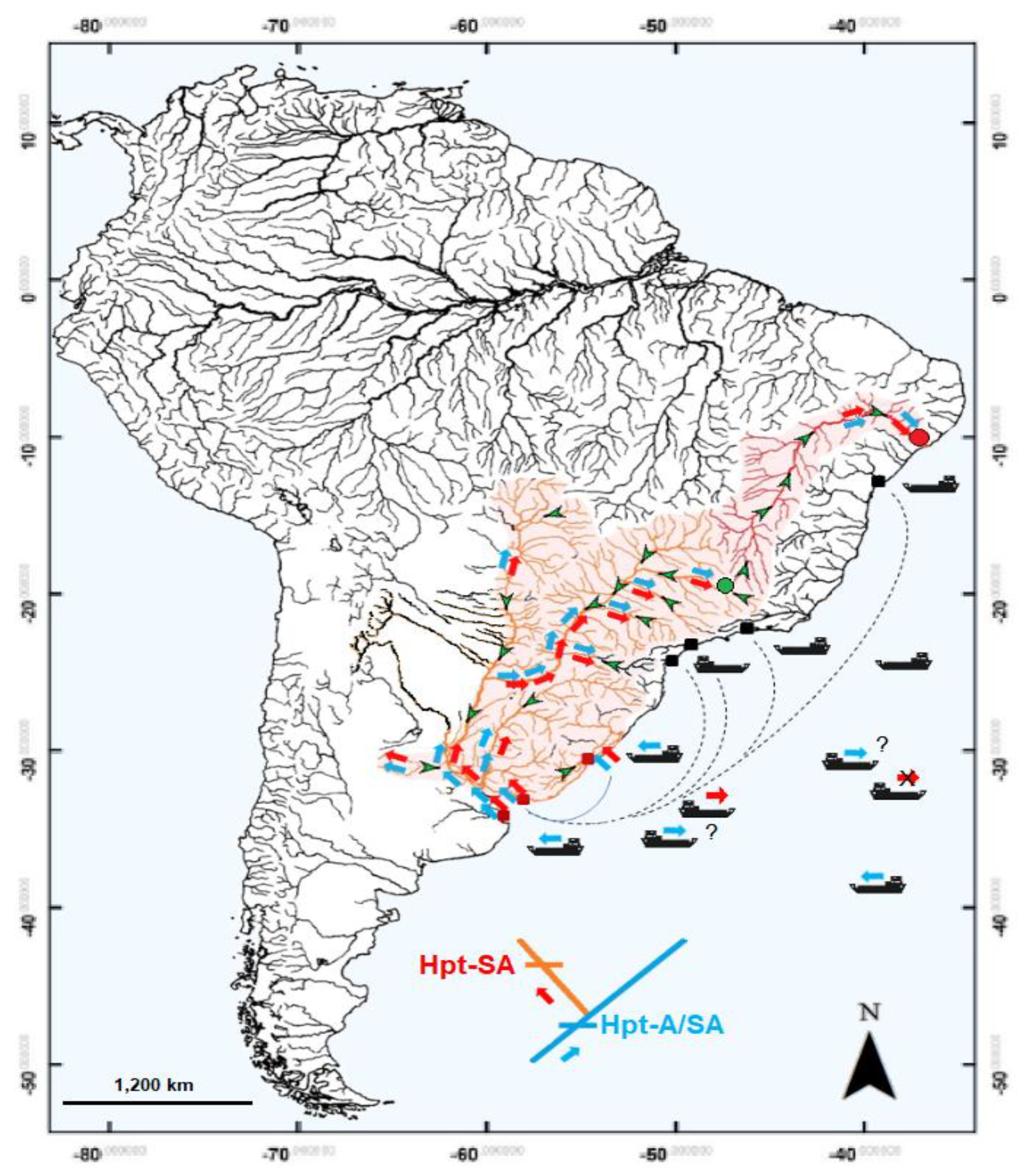
Figure 2.
Position of the sample barcode (Cox1) from the Lower São Francisco River and the sequence barcodes available from Genbank and BOLD systems of the Limnoperna fortunei mitogenome (KP756905). bp: base pairs; Haplotypes: K01-21 (see 48) and Lfm01-Lf43 (see [29,45,46,47]; Genbank and BOLD systems accessions: KP756905 [66], AB520611-AB520627, HQ843794 - HQ843810, JX177086 - JX177102 [29,45,46,47], AB828679-AB828682 [48], FW369972 , DQ264395 [41], AB498011 [60].
Figure 2.
Position of the sample barcode (Cox1) from the Lower São Francisco River and the sequence barcodes available from Genbank and BOLD systems of the Limnoperna fortunei mitogenome (KP756905). bp: base pairs; Haplotypes: K01-21 (see 48) and Lfm01-Lf43 (see [29,45,46,47]; Genbank and BOLD systems accessions: KP756905 [66], AB520611-AB520627, HQ843794 - HQ843810, JX177086 - JX177102 [29,45,46,47], AB828679-AB828682 [48], FW369972 , DQ264395 [41], AB498011 [60].
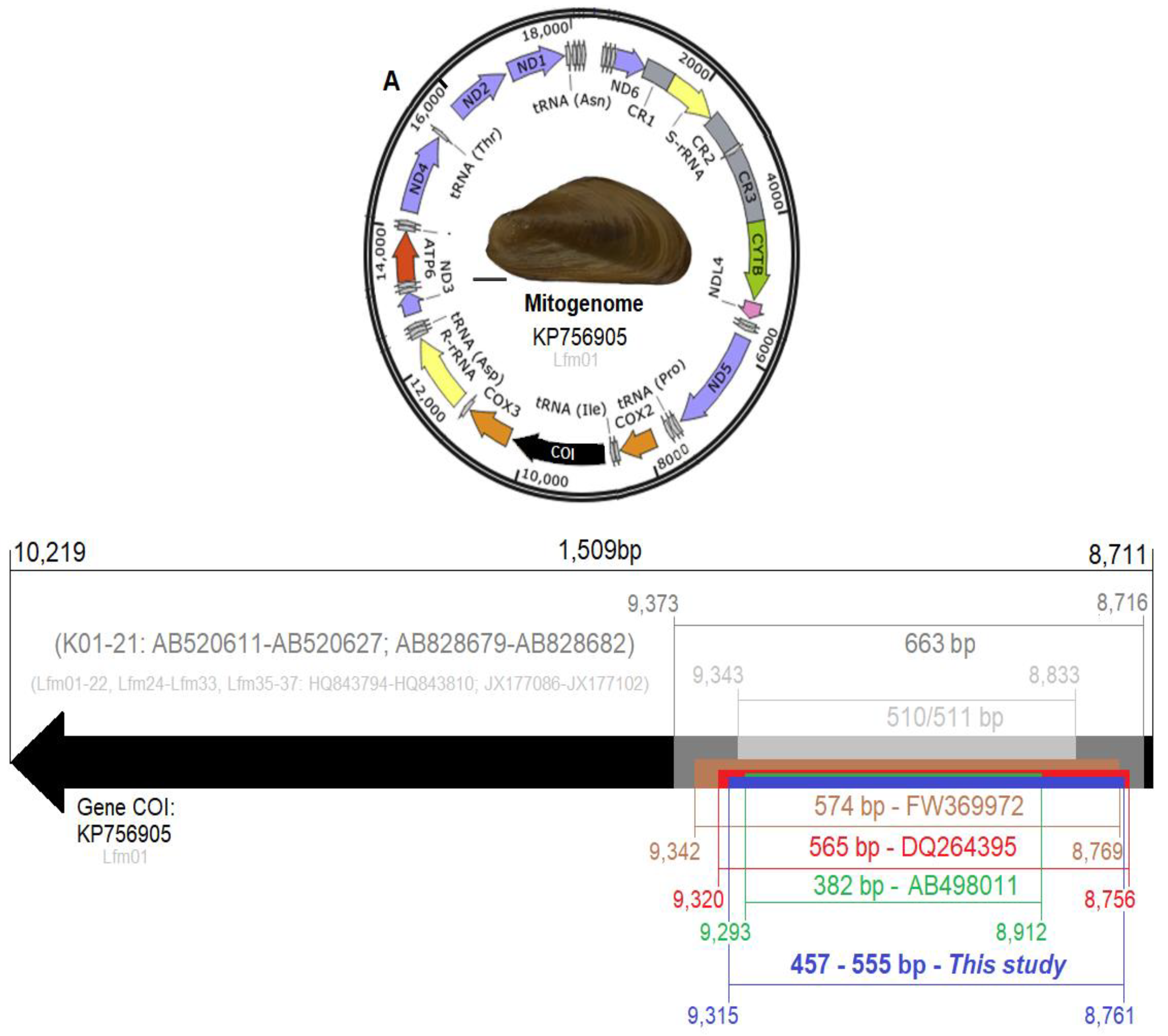

Table 1.
Biometrics of Limnoperna fortunei shells found in Brazil. n - number of mussels collected. LA - mean shell length; SD - standard deviation; LR - shell length range.
Table 1.
Biometrics of Limnoperna fortunei shells found in Brazil. n - number of mussels collected. LA - mean shell length; SD - standard deviation; LR - shell length range.
| Location | n | LA ±SD (mm) | LR (mm) a | References |
|---|---|---|---|---|
| São Francisco River ts (-8.54°; -39.456°) | 5 | - - c | 15.00 to 30.00 | 17 |
| Sobradinho reservoir (-9.409; -40.817) | 5 | - - c | 15.00 to 30.00 | 17 |
| Sobradinho hydroelectric (-9.433; -40.828) | 5 | - - c | 15.00 to 30.00 | 17 |
| Ilha da Flores (-10.435°; -36.531°) | 30 | 12.84 ±4.95* | 7.44 to 23.79 | This study |
| Brejo Grande marine (-10.421°; -36.464°) | 30 | 7.42 ±1.82* | 5.36 to 11.75 | This study |
| São Francisco River mouth (-10.445°; -36.426°) | 30 | 9.37 ±4.45* | 5.25 to 20.14 | This study |
| Porto Primavera hydroelectric ( -22.474°; -52.474°) | 61 | - - c | 4.00 to 27.00 | [61] b |
| Itaipu reservoir - Paraná river (-24°; -54°) | - - c | - - c | 6.00 to 35.00 | [62] |
| Paraná River (-25.437°; -54.512°) | 800 | - - c | 21.00 to 27.00 | [63] |
| Mirim Lake (-31.799°; -52.382° and -32.116°; - 52.582°) | 7,789 | - - c | 3.00 to 32.00 | [64] d |
| Mirim Lake (-31.799°; -52.382° and -32.116°; - 52.582°) | 147 | - - c | 3.00 to 14.00 | [64] e |
| São Gonçalo channel (-32.148°; -52.625°) | 7,776 | - - c | 4.00 to 32.00 | [65] d |
ts – transposition system; * total average for the site (9.81±4.57mm); a variation in shell length; b Inside the stomach of Pterodoras granulosus; c not cited by the authors; d depth from 3 to 6 m; e Inside the stomach of Pimelodus pintado.
Disclaimer/Publisher’s Note: The statements, opinions and data contained in all publications are solely those of the individual author(s) and contributor(s) and not of MDPI and/or the editor(s). MDPI and/or the editor(s) disclaim responsibility for any injury to people or property resulting from any ideas, methods, instructions or products referred to in the content. |
© 2024 by the authors. Licensee MDPI, Basel, Switzerland. This article is an open access article distributed under the terms and conditions of the Creative Commons Attribution (CC BY) license (http://creativecommons.org/licenses/by/4.0/).
Copyright: This open access article is published under a Creative Commons CC BY 4.0 license, which permit the free download, distribution, and reuse, provided that the author and preprint are cited in any reuse.