

Submitted:
24 September 2024
Posted:
07 October 2024
You are already at the latest version
Abstract
Harmful algal blooms are increasing globally and pose serious health concerns releasing cyanotoxins. Microcystin-LR (MC-LR), one of the most frequently produced cyanotoxins, has recently been detected in aerosols generated by the normal motions of affected bodies of water. MC-LR aerosol exposure has been linked to a pro-inflammatory influence on the airways of mice, however little is understood about the underlying mechanism or the potential consequences. This study aimed to investigate the pro-inflammatory effects of aerosolized MC-LR on murine airways. C57BL/6 and BALB/c mice were exposed to MC-LR aerosols, as these strains are predisposed to type 1/type 17 and type 2 immune responses, respectively. Exposure to MC-LR induced granulocytic inflammation in C57BL/6 but not BALB/c mice, as observed by increased expression of cytokines MIP-1α, CXCL1, CCL2, and GM-CSF compared with their respective vehicle controls. Furthermore, the upregulation of interleukins IL-17A and IL-12 is consistent with Th1 and Th17 driven type 1/type 17 inflammation. Histological analysis confirmed inflammation in the C57BL/6 lungs, with elevated neutrophils and macrophages in the bronchoalveolar lavage fluid and increased pro-inflammatory oxidized lipids. In contrast, BALB/c mice showed no significant airway inflammation. These results highlight the ability of aerosolized MC-LR to trigger harmful airway inflammation, requiring further research.
Keywords:
Microcystin
; MC-LR
; aerosol
; harmful algal bloom
; inflammation
1. Introduction
Harmful algal blooms (HABs) are on the rise world-wide in regions experiencing water warming and eutrophication or an increase in nutrients due to runoff and wastewater mismanagement [1,2,3]. These are often overgrowths of cyanobacteria, also referred to as blue-green algae, which is an ancient phylum of photosynthetic bacteria. While cyanobacteria have an important role in the ecosystem, many species are also capable of producing toxins, named cyanotoxins, such as microcystins, cylindrospermopsin, anatoxins, saxitoxins, and nodularins [4,5,6,7].
In this study, we focus on microcystin-LR (MC-LR), as this is one of the most abundant and toxic congeners of microcystin and is often used as a surrogate for all microcystins in governmental advisories [8]. Animal exposure models for MC-LR have primarily investigated the oral and systemic exposure routes, which leads to hepatotoxicity, as demonstrated by increased liver weight, slight to moderate liver necrosis, and hemorrhaging in the exposed animals[9,10]. Furthermore, there is growing evidence that MC-LR is toxic to the kidneys [11]. Our own investigations have found that oral MC-LR exposure exacerbates hepatic injury in a murine model of non-alcoholic fatty liver disease (NAFLD) and that pre-existing colitis (DSS-induced) is worsened by MC-LR oral exposure [12,13,14,15].
Importantly, it was recently reported that HAB toxins can be aerosolized from lake water by bubble-bursting [16]. Survey reports and case studies describe detectable concentrations of microcystins in airway mucosa and irritation in subjects who have been near affected bodies of water for short periods; however, we are only aware of one study that has modeled MC-LR aerosol inhalation exposure [17,18,19,20,21]. Nose-only inhalation exposure to 260-265 μg/m3 for 0.5, 1, or 2 hours each day for 7 days resulted in minimal to moderate multifocal degeneration, neutrophilic inflammation, and necrosis within the nasal cavity. Of note, the investigators were unable to confirm delivery of the aerosol to the central or peripheral airways [20]. A subsequent study was reported in which 6-7 week-old male Swiss mice were exposed via intranasal instillation of 10 μL of 6.7 ng/kg MC-LR or distilled water (vehicle) control once a day for 30 days, after which significant increases in granulocytes were observed upon histological analysis of the lung tissue [22]. Similarly, in other studies of systemic exposure, the effects on lungs were primarily granulocytic inflammation [23,24]. The consistent observation of granulocytic inflammation in pulmonary tissues following MC-LR exposure regardless of route of exposure suggests that an aerosol exposure may induce a similar response. Indeed, we recently reported that MC-LR aerosol exposures in a primary human airway epithelium model resulted in pro-inflammatory gene expression and the production of chemokines that attract neutrophils [25].
It remains uncertain whether MC-LR aerosol exposures in a whole organism model will have a pro-inflammatory impact on the airways and if said inflammation could be biased toward a type 1 or type 2 immune response. Understanding the type of immune response involved is crucial for estimating the risk associated with MC-LR aerosol exposure. Type 2 driven human asthma is typically medically controllable with corticosteroid treatment, whereas type 1 driven asthma does not respond to corticosteroid treatment and is often associated with worse outcomes [26]. Importantly, strain differences in mice can lead to a predisposition in the immune response. For example, it is well-established that C57BL/6 mice respond in a type 1 biased fashion, to the same provocation that would cause BALB/c mice to respond with type 2 [27,28,29]. In this current study, we took advantage of these strain differences to thoroughly investigate the potential pro-inflammatory impact of MC-LR aerosol on murine airways.
2. Results
2.1. Murine Strains Exposed to MC-LR via Aerosol Inhalation
To thoroughly characterize the immune responses to MC-LR and any biasing therein, we performed a strain and sex comparison with the type 1 immunity prone C57BL/6 and the type 2 immunity prone BALB/c mice. Male and female mice of each strain were exposed to MC-LR aerosol or vehicle by nose-only inhalation one hour a day for 14 days (Figure 1A). The estimated deposition of MC-LR to the lungs each day was 13 µg/m2 (see Section 2.1). Lung tissues were prepared for histology and molecular evaluation within one hour after the final exposure. Body weights were monitored over the course of the study. While slight decreases were found for all groups throughout the study, female C57BL/6 mice were found to lose significantly less weight than their respective vehicle control (Figure 1B).
2.2. Microcystin-LR Aerosol Inhalation Induces Upregulation of Type 1/Type 17 Inflammation Related Proteins in Murine Lung
Cytokines and chemokines were measured in lung lysates of MC-LR and vehicle exposed mice to investigate the type of inflammation involved. Grouping these analytes into type 1 (blue), type 2 (yellow), or mixed immunity (green), a significant increase in type 1 and mixed immunity was found in the MC-LR exposed lung lysate of the C57BL/6 mice compared with the vehicle exposed (Figure 2A). Specifically, in the male mice the upregulated markers for type 1 were IL-17A (FC = 6.0, p = 0.001), IL-12 (FC = 2.3, p = 0.003), and IFNγ (FC = 2.0, p = 0.007). The upregulated markers for mixed immunity were MIP-1α (FC = 8.6, p < 0.001), CXCL1 (FC = 5.4, p < 0.001), IL-1α (FC = 3.7, p < 0.001), MIP-2 (FC = 3.3, p = 0.002), CCL2 (FC = 3.3, p = 0.017), CCL17 (FC = 3.1 , p < 0.001), GM-CSF (FC = 2.8, p < 0.001), and CCL22 (FC = 2.6, p < 0.001). These alterations were greater in the male than the female C57BL/6 mice. However, lung lysates of the females still contained upregulated type 1 [(IL-17A; FC = 5.2, p = 0.034), and (IFNγ; FC = 2.6, p = 0.018)] and mixed immunity markers [(MIP-1 α; FC = 5.3, p = 0.001), (CXCL1; FC = 4.7, p = 0.002), and (MIP-2; FC = 2.8, p = 0.014)]. While type 2 markers IL-4 (FC = 1.4, p = 0.040), and IL-5 (FC = 1.4, p = 0.018) were statistically significantly upregulated in the male C57BL/6 mouse lung, these increases were minimal and did not occur in the female mice. Importantly, exposures did not significantly increase cytokine or chemokine expression in the BALB/c mice, which are prone to type 2 immune responses (Figure 2B). In fact, slight but significant decreases were observed in MC-LR exposed BALB/c mice compared with vehicle. These male BALB/c had decreased IL-17A (FC = 0.64, p = 0.036), and IFNγ (FC = 0.67, p = 0.014), while the female mice had decreased IL-13 (FC = 0.75, p = 0.029).
2.3. Microcystin-LR Aerosol Exposure Induces Airway Inflammation
There is no existing information concerning the gravitational effects on the deposition of MC-LR aerosol. Therefore, the left lung was formalin fixed and serially sectioned (from dorsal to ventral) at a thickness of 5 microns in the coronal plane and histology from the ventral, medial, and dorsal regions were reviewed by a board-certified pathologist. Because there were no apparent differences between these sections (Not Shown), the medial region was taken as representative for histopathologic analysis. There was significantly increased inflammation found in the MC-LR exposed lung compared with the vehicle, and this was more evident in the male compared with the female C57BL/6 mice (Figure 3A,B). Consistent with the molecular findings, the BALB/c lung sections did not contain noticeable inflammation (Not Shown). Immunohistochemical staining revealed increased macrophage infiltration in the MC-LR exposed C57BL/6 lung, reaching significance in the male and trending in the female mice (Figure 3C,D). Red arrows indicate positively stained cells and terminal bronchioles show non-specific stain which was consistent across all samples (Figure 3C).
To further characterize the immune infiltrates, bronchoalveolar lavage (BAL) was performed. A separate set of male C57BL/6 mice was used to avoid complicating the histological examination. A significant increase in total cells was found in the lavage fluid recovered from the MC-LR exposed mice compared with the vehicle exposed mice (Figure 4A). Consistent with the upregulated chemokines (Figure 2), this was due to a significantly greater presence of neutrophils and macrophages (Figure 4B,E). While some eosinophils and lymphocytes were identified in select MC-LR exposed specimen, these findings were not found to be significant (Figure 4C,D).
2.4. Microcystin-LR Aerosol Inhalation Alters the Lipidomic Profile of the Lungs
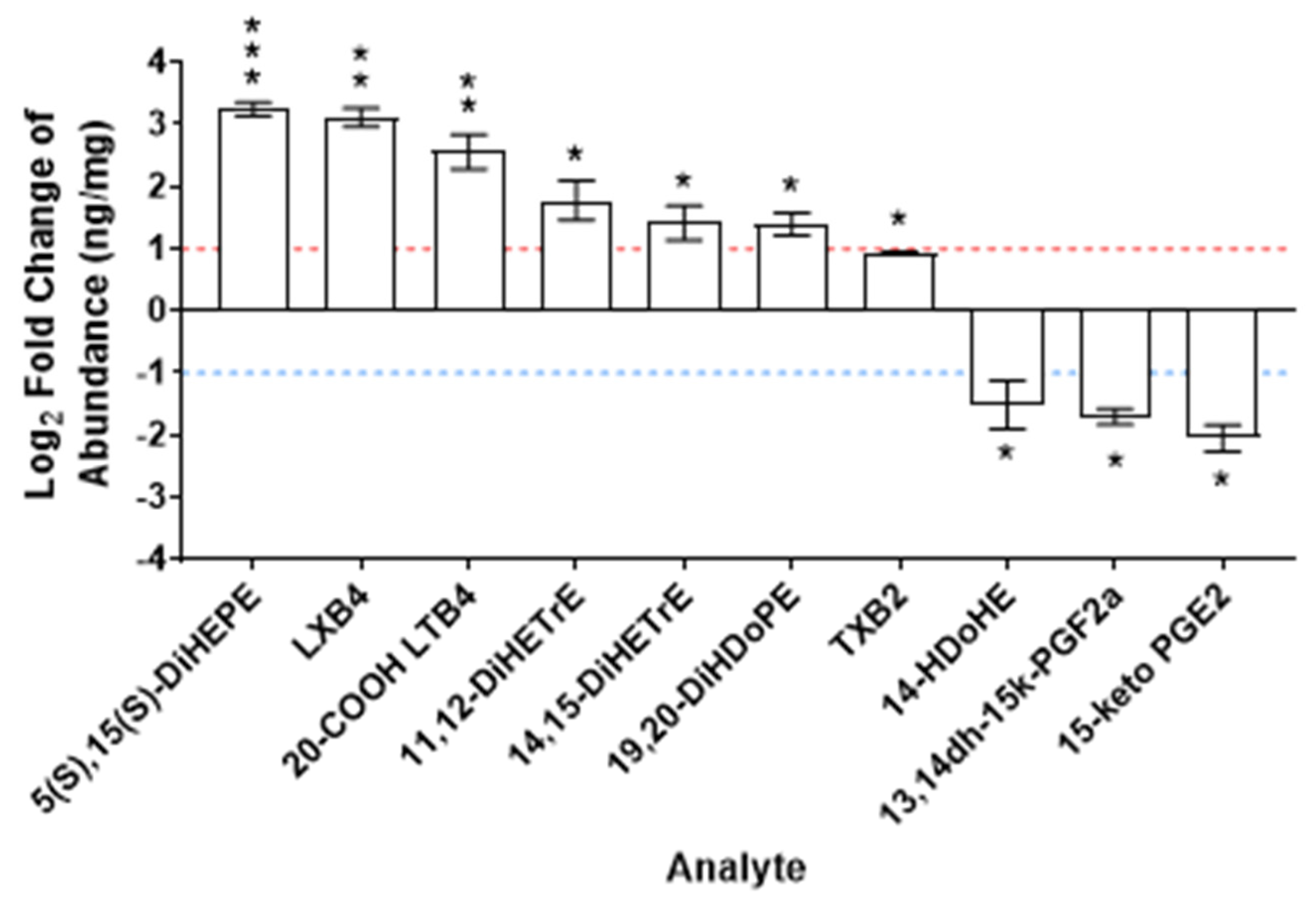
Lastly, the lipid profile of exposed lungs was evaluated due to its important and contemporary role in airway inflammation (Figure 5). Seven oxidized lipids were significantly increased in MC-LR exposed male C57BL/6 mouse lung compared with vehicle [(5(S),15(S)-DiHEPE; log2FC = 3.3, p < 0.001), (LXB4; log2FC = 3.1, p = 0.004), (20-COOH LTB4; log2FC = 2.6, p = 0.008), (11,12-DiHETrE; log2FC = 1.9, p = 0.011), (14,15-DiHETrE; log2FC = 1.5, p = 0.022), (19,20-DiHDoPE; log2FC = 1.4, p = 0.034), and (TXB2; log2FC = 0.93, p = 0.036)]. Three were found to be decreased [(14-HDoHE; log2FC = -1.5, p = 0.040), (13,14dh-15k-PGF2α; log2FC = -1.7, p = 0.040), and (15-keto PGE2; log2FC = -2.0, p = 0.053)]. Results for all analytes are available in the Supplemental Material Table S2.
3. Discussion
Overall, these results support previous claims that MC-LR exposure to airways may be pro-inflammatory [22,23,24,30,31,32]. Here for the first time, we report that inhalation exposure to MC-LR aerosol elicits an inflammatory response in mouse lung tissue. We also report the first sex and strain comparison in murine MC-LR exposures.
After MC-LR aerosol exposure daily for 14 days, lungs were collected within one hour after the final exposure and assessed. A molecular immune profile was found by the measurement of immune-relevant cytokines and chemokines. In this profile in C57BL/6 mice, we found increases in markers associated with type 1/type 17 inflammation and mixed immunity, while there were no or only slight increases in type 2 markers. To further dissect the type 1/type 17 and type 2 responses, BALB/c mice were also assessed after following the same regimen of MC-LR exposure. While C57BL/6 mice are prone to type 1 responses, BALB/c are prone to type 2 [27,28,29]. Therefore, a response in BALB/c mice would support a non-biased or mixed influence of MC-LR. However, the BALB/c mice did not respond with type 2 immunity, supporting a conclusion that MC-LR exposure drives a type 1/type 17 biased immune response.
Histological assessment supported the current literature in demonstrating that MC-LR is pro-inflammatory in murine airways after intranasal instillation [22]. Because we have previously reported increases in macrophages in gastrointestinal tissues exposed to MC-LR and the activation of macrophages in response to MC-LR in vitro, we performed an IHC stain for F4/80+ macrophages in the lung tissue, demonstrating their infiltration [33].
Consistent with the evidence of immune infiltration in the lung tissue, bronchoalveolar lavage of a separate set of male C57BL/6 mice revealed increased immune cells in the airways. Importantly, these immune cells (neutrophils and macrophages) coincide with the cytokine and chemokine profile observed. Specifically, the chemokines found to be upregulated in the MC-LR exposed C57BL/6 mice (MIP-1α, CXCL1, CXCL2, and CCL2) are well-documented as powerful chemoattractant molecules for neutrophils and macrophages [34]. Notably, CCL17 and CCL22 are often associated with type 2 immunity but are also reportedly produced by neutrophils or contribute to their recruitment indirectly [35,36]. Additionally, IL-1α is a pro-inflammatory cytokine capable of neutrophil recruitment [37,38]. IL-17 is the prototypical lymphokine produced by type 17 helper T cells and can even drive neutrophilic airway inflammation on its own when delivered intratracheally [39,40,41]. Finally, IL-12 leads to the differentiation of type 1 helper T cells, which go on to activate macrophages [42].
Sexual dimorphism of the immune system is an important area of investigation and may be evident in the findings of this work in which the overall inflammation was less in the female than the male mice [43]. Although the dose was adjusted for the size of the mice, differing sizes likely impacts the diameter of their airways, and therefore the basic transport phenomena may account for these differences as the age-matched females were slightly smaller than the males. Regardless, because of these and the strain comparison results, the bronchoalveolar lavage and lipid-omics analyses were only performed in male C57BL/6 mice.
One driver of the increased unresolved inflammation from MC-LR can be explained through the understanding of the critical physiological and pathological mediators of inflammation: oxidized lipids. In fact, in a model of endotoxin-induced lung injury in mice, inhibition of arachidonic acid (AA) release from the phospholipid membrane via inhibition of phospholipase A2 (PLA2) prevented lung injury. This supports a model of rapid-onset increased capillary permeability mediated via the PLA2 pathways instead of, or in addition to, the common paradigm of cytokine-induced inflammation [44,45]. The increased capillary permeability can then lead to release of cytokines that propagate further lung injury [44,46,47]. In this way, PLA2 primarily mediates inflammation via catalyzing the hydrolysis of phospholipids to AA. AA is further metabolized by cyclooxygenase (COX), lipoxygenase (LOX), and cytochrome P-450 (CYP450) into prostaglandins (PGs), thromboxanes (TXs), leukotrienes (LTs), and epoxyeicosatrienoic acids (EETs).
Inflammation can be mediated by an increase in the biosynthesis of inflammatory mediators such as LTB4 or PGE2 and/or exacerbated by an inhibition of their catabolism. Presence of downstream, less active metabolite of LTB4 (20-COOH LTB4) (Figure 5) suggests the inflammatory lipid biosynthesis triggered by neutrophils but also an attempt by the system to mitigate the inflammation [48,49]. Increased LXB4 and 20-COOH LTB4 demonstrate a yin and yang effect where the macrophage and neutrophil mediated-inflammation elicited by LTB4 is directly opposed by pro-resolutory, granulocyte-inhibitory LXB4 [50,51,52,53]. Epoxy fatty acids are known anti-inflammatory lipids, and these are inactivated by hydrolysis to their corresponding dihydroxy fatty acids (DiHETrEs and DiHOPE) by epoxide hydrolase [54,55,56]. Increase in the DiHETrEs and DiHOPE also contribute to the exacerbation of inflammation by the inflammatory mediators in a process called unalamation [57]. In the present study, increased 5(s),15(s)-DiHEPE in the lung of MC-LR exposed mice (Figure 5) is consistent with the increased eosinophils also observed (Figure 4), as this metabolite is a potent chemotactic agent for eosinophils [58,59,60]. An increase in TXB2 in the MC-LR mice compared to the vehicle mice also signifies increased inflammation, as TXB2 is a potent activator of platelet aggregation and cytokine storm [61,62,63,64]. Additionally, increased concentration of pro-inflammatory 11,12- and 14,15-DiHETrEs (Figure 5) may signify increased inflammation in the MC-LR mice, as these metabolites have been studied to be significantly associated with worsening hepatic injury and fibrosis [65,66]. Although they have not been studied in lung tissue, it is plausible to assume that their elevated levels may be playing a role in the progression of inflammation in MC-LR mice. Conversely, decreased 15-keto PGE2 in the exposed mouse lung (Figure 5) can be correlated to negative regulation of neutrophil-mediated inflammation, as PGE2 has potent anti-inflammatory effects [67,68,69]. Thus, the lipidomic profile highlights a multidimensional system where MC-LR exposure leads to an inflammatory lipid mediator response (LTB4 and PGE2 biosynthesis), exacerbation of the inflammatory response (decreased catabolism of PGE2 and increased metabolism of epoxy fatty acids), suppression of resolution response (decrease in the SPM precursor 14-HDoHE), and an attempt to resolve the inflammation (LXB4 and 5(S),15(S)-DiHEPE biosynthesis) with the inflammatory state ultimately prevailing as evidenced by the inflammatory cytokine release.
The human relevance of these results is clear, as we have previously reported findings which are consistent with this pro-inflammatory effect in healthy human primary airway epithelium [25]. In this previous work, MC-LR was found to upregulate gene expression related to inflammation, such as chemokines, and conditioned media was found to attract primary human neutrophils.
4. Conclusions
In conclusion, we report that MC-LR aerosol exposure induces inflammation in the murine lung. Furthermore, this appears to be driven by a type 1/type 17 immune response, resulting in the attraction of neutrophils and macrophages to the airways. Taken together, we believe that this work further supports the need to assess the risk of inhalation exposure to harmful algal bloom toxins, especially in the context of type 1/type 17 inflammation.
5. Materials and Methods
5.1. Animals and Aerosol Exposures
Male and female C57BL/6 (C57BL/6J) and BALB/c (BALB/cJ) mice (000664 and 000651; The Jackson Laboratory, ME, USA) were 13-14 weeks old at the beginning of this exposure study. All mice were caged socially in microisolator cages, given access to food and water ad libitum, and kept on a 12:12- hour dark-light cycle. Protocols for animal experimentation were approved by The University of Toledo Institutional Animal Care and Use Committee (IACUC protocol #108663, approval date 9 February 2016).
Mice were exposed to MC-LR (item no. 10007188; Cayman Chemical, Ann Arbor, MI, USA) aerosol or vehicle (water or saline) aerosol using an inExpose (SCIREQ; Montréal, Canada) animal exposure system equipped with a nose-only adapter and a small particle (2.5-4 µm) VMD Aeroneb Lab ultrasonic nebulizer. Exposures were one hour each day for 14 days, and tissues were harvested within one hour after the final exposure. Lung deposition of 13 µg/m2 per day was chosen to mimic mass deposition of MC-LR in our previous in vitro study [25]. The concentration of solution required to achieve the mass deposited were related by the following:
where,
Qneb = output rate of nebulizer = 0.3 mL/min
Csol = concentration of MC-LR in solution
DC = duty cycle = 50%
Qbias = bias flow = 3.5 L/min
Vmin = minute volume of mouse = 0.04 L/min [70]
t = exposure time = 60 min
Df = deposition fraction = 0.2
A = surface area of mouse lung = 0.02 m2
5.2. Histology Preparation and Stain
The left lung of each mouse was fixed by gentle perfusion with 10% buffered formalin through the left bronchus before complete submersion in 10 mL of fixative for 24 hours on a rocker. Afterward, the formalin fixative was replaced with 70% histological grade ethanol for at least 24 hours before paraffin embedding. Whole lungs were sectioned serially (from dorsal to ventral) at a thickness of 5 microns in the coronal/frontal plane and stained by hematoxylin and eosin (H&E).
Immunohistochemistry stains for F4/80+ macrophages were adapted from a previous publication [71]. Briefly, slides were deparaffinized via incubation in 100% xylene for 10 minutes. Rehydration was facilitated by incubation in 100%, 90%, and 80% ethanol followed by DI water for 5, 3, 3, and 6 minutes, respectively. Epitopes were recovered by 5 minutes treatment with proteinase K (S302080-2; DAKO, Santa Clara, CA, USA). Slides were then washed for 10 minutes in phosphate-buffered saline (PBS). Endogenous peroxidase activity was quenched with a 30-minute incubation with freshly prepared 0.3% H2O2 in methanol. Slides were washed again for 10 minutes in PBS and then blocked with 2.5% goat serum (Normal Goat Serum Blocking Solution, 2.5%; S-1012-50; Vector Laboratories, CA, USA) for 45 minutes. The slides were then treated with primary antibody [250 µL PBS + 5 µL serum (2.5% goat serum) + 2.5 µL primary antibody (F4/80 clone: A3-1; Bio-Rad, Hercules, CA, USA)] and [250 µL PBS + 5 µL 2.5% goat serum] on minus primary controls, for 90 minutes. The antibody was vacuumed off to prevent accidental mixing. Slides were washed again for 10 minutes in PBS before treatment with secondary antibody [500 µL PBS + 10 µL serum (2.5% goat serum) + 2.5 µL secondary antibody (biotinylated anti-rat goat IgG, BA-9401; Vector Laboratories, CA, USA)] for 30 minutes. The slides were washed again for 10 minutes in PBS before incubation with horseradish peroxidase (HRP) kit [1 mL PBS + 20 µL Reagent A + 20 µL Reagent B] from the VECTASTAIN ABC kit (VECTASTAIN Elite ABC-HRP Kit; PK-6101; Vector Laboratories, CA, USA) for 30 minutes. Slides were washed again for 10 minutes in PBS. DAB substrate (DAB Substrate Kit, HRP; SK-4100; Vector Laboratories, CA, USA) was prepared without nickel and added while observing precipitate development under microscope (roughly 6–10 minutes). The reaction was stopped by washing in a large volume of DI water. Slides were counterstained for 2 seconds in Harris modified hematoxylin followed by 10 dips in differentiation agent [acid alcohol; 2 mL glacial acetic acid in 400 mL ethanol] and finally 10 dips in bluing agent [ammonium water; 1 mL ammonium hydroxide in 500 mL DI water]. Finally, dehydration was performed by reverse incubations through ethanol gradient and finish in xylene. For best results, each PBS wash should begin with 5 dips and then a 10-minute incubation in fresh PBS and all steps should be performed at room temperature with room temperature reagents.
Images of all stained slides were collected at 20X on a VS120 Virtual Slide Microscope (Olympus, Tokyo, Japan).
5.3. Histology Scoring
Histology slides of H&E-stained lung were graded by a board-certified, blinded pathologist following a published method [72]. Briefly, interstitial/perivascular inflammation, intra-alveolar inflammation, endothelialitis, and bronchitis were graded on a scale of 0-3, with 0: absent, 1: mild, 2: moderate, 3: severe. A total inflammation score was then found as a sum.
Immunohistochemical stains were scored via automated image analysis adapted from a method for evaluating fibrosis [73,74]. Using features built-in to Image-Pro Plus 7.0.1 (Media Cybernetics, Rockville, MD, USA), a macro was trained to process images of whole lung sections stained for F4/80+ macrophages, as described above, to enumerate the positively stained cells or the whole tissue area. The numbers of detected cells throughout each whole section were then divided by the calculated whole tissue area to achieve a normalized macrophage count for each specimen.
5.4. Bronchoalveolar Lavage
In a separate cohort of mice than was used for histology, bronchoalveolar lavage was performed and adapted from a published method [75]. After euthanasia by exsanguination under isoflurane anesthesia, airways were lavaged with sterile normal saline (0.9% NaCl). Briefly, the trachea was exposed by midline incision and cannulated with a custom device [a 23 G needle inserted into a segment of transparent plastic polyethylene 21 G tubing, (inner diameter: 0.58 mm, outer diameter: 0.965 mm, and length: 0.5 cm)]. A segment of thin polyester thread was tightened around the trachea to hold the cannulated device in place and assist the seal. Over the course of 30-45 seconds, 1 mL of sterile normal saline was injected. The bronchoalveolar lavage fluid (BALF) was then aspirated over the course of 30-45 seconds while gently pumping the thorax. The fluid recovered was centrifuged at 200 x g for 10 minutes and red blood cells were lysed by 3-minute incubation with ACK lysing buffer (A1049201; Thermo Fisher; Waltham, MA, USA). After washing with 10 mL PBS, cells were resuspended and total cell counts were obtained by TC20 automated cell counter (Bio-Rad; Hercules, CA, USA). For BALF differential cell counts, slides were prepared by cytospin (2000 RPM for 3 minutes) and stained 24 hours later with Hema 3 Manual Staining System (22-122911; Fisher Scientific; Hampton, NH, USA). 200 cells per slide were assessed by a board-certified, blinded pathologist who categorized each cell type based on various features including size, shape, and nuclear/cytoplasmic characteristics. All cell counts were normalized by the recovered BALF volume of each animal.
5.5. Protein Measurements
Chemokines and cytokines were evaluated at the protein level from lung lobe lysates of exposed and vehicle control mice. Whole lung lobes were placed in 2 mL round-bottom centrifuge tubes with 1 mL DMEM cell medium (DML28; Caisson Laboratories, Inc., Smithfield, UT, USA) along with a stainless steel bead. Tissues were mechanically lysed using a TissueLyser II (QIAGEN; Hilden, Germany) at 25 Hz for 10 minutes. Protein measurement services were performed by Quansys Biosciences (Logan, UT, USA). Custom multiplex ELISA-based Q-Plex™ technology delivered quantification of murine protein cytokines and chemokines: IL-1α, IL-1β, IL-2, IL-3, IL-4, IL-5, IL-6, IL-10, IL-12p70, IL-13, IL-17A, MCP-1 (CCL2), IFNγ, TNFα, MIP-1α (CCL3), GM-CSF, RANTES (CCL5), Eotaxin (CCL11), MIP-2 (CXCL2), KC (CXCL1), MDC (CCL22), TARC (CCL17), TCA-3 (CCL1). For results of all analytes, please see the appendices Table S1. All protein concentrations were calculated as pg analyte per mg total protein.
5.6. Lipidomics by Mass Spectroscopy
Lung lobe homogenate samples were spiked with internal standards (5 ng each of 15(S)-HETE-d8,14(15)-EpETrE-d8, Resolvin D2-d5, Leukotriene B4-d4, and Prostaglandin E1-d4) for recovery and quantitation. Polyunsaturated fatty acid metabolites were extracted using C18 columns and analyzed by LC-MS as described previously [76,77,78]. Briefly, HPLC was performed on a Prominence XR system (Shimadzu; Kyoto, Japan) using a Luna C18 (3μ, 2.1x150 mm) column (Phenomenex; Torrance, CA, USA). Via electrospray ionization, the HPLC eluate was delivered to a QTRAP5500 mass analyzer (ABSCIEX) run in negative ion mode with the following conditions: curtain gas: 35 psi, GS1: 35 psi, GS2: 65 psi, temperature: 600 ˚C, ion spray voltage: -1500 V, collision gas: low, declustering potential: -60 V, and entrance potential: -7 V. The data were collected using Analyst 1.6.2 and analyzed using MultiQuant software [both from Sciex (Framingham, MA, USA)]. Each analyte was normalized against the total protein in each sample and was reported as ng/mg protein and is displayed as the log base 2 of the fold change (log2FC) between MC-LR exposed and vehicle control.
5.6. Statistics
The statistical tests in this work were completed in GraphPad Prism version 7.0.5 for Windows (GraphPad Software; San Diego, California, USA, https://www.graphpad.com). All comparisons were made between two groups, the MC-LR exposed and the respective vehicles. In all cases unpaired Student’s t-tests were applied and significance is demarcated as a p value < 0.05 and marked as *, **, ***, **** indicating p ≤ 0.05, 0.01, 0.001, 0.0001, respectively.
Supplementary Materials
The following supporting information can be downloaded at the website of this paper posted on Preprints.org, The supplemental tables are included with the file names Supplementary Tables S1 (10.6084/m9.figshare.26206955) and Supplementary Tables S2 (10.6084/m9.figshare.26206958).
Author Contributions
Conceptualization, JDB, BWF, DJK, and STH; methodology, JDB, BWF, LMS, JPL, KRM, SHP, DBR, BT, SCP, AL, IS, ALK, TMB, AG, PD, and SZ; formal analysis, JDB, BWF, KRM, VA and FKK; writing, review and editing, DF; JDB, BWF, BT, DJK, and STH; supervison, DI, RMW, JCW, JRH, NNM, DM, LDD, DJK, and STH; funding acquisition, JDB, DJK, and STH. All authors proofread, edited, and approved of the manuscript.
Institutional Review Board Statement
The study was conducted in accordance with the Institutional Animal Care and Use Committee (IACUC) protocol and approved by the Institutional Review Board of University of Toledo (108663-05; April 11, 2022).
Data Availability Statement
The raw data supporting the conclusions of this article will be made available by the authors, without undue reservation. The supplementary data are available through public repository.
Acknowledgments
Graphical abstract and Illustrations in Figure 1 were created with BioRender.com. The authors would like to thank the Women & Philanthropy Genetic Analysis Instrumentation Center for providing the facilities for transcriptional analysis. Special thanks to Dr. Joshua Englert and Emily Shalosky of the Ohio State University for their technical expertise.
Conflicts of Interest
The authors declare that the research was conducted in the absence of any commercial or financial relationships that could be construed as a potential conflict of interest.
References
- Xiao, X.; et al. Warming Amplifies the Frequency of Harmful Algal Blooms with Eutrophication in Chinese Coastal Waters. Environmental Science & Technology 2019, 53, 13031–13041. [Google Scholar]
- Nwankwegu, A.S.; et al. Harmful algal blooms under changing climate and constantly increasing anthropogenic actions: the review of management implications. 3 Biotech 2019, 9, 449. [Google Scholar] [CrossRef] [PubMed]
- Anderson, D.M.; et al. Harmful algal blooms and eutrophication: Examining linkages from selected coastal regions of the United States. Harmful Algae 2008, 8, 39–53. [Google Scholar] [CrossRef] [PubMed]
- Mazard, S.; et al. Tiny Microbes with a Big Impact: The Role of Cyanobacteria and Their Metabolites in Shaping Our Future. Mar Drugs 2016, 14. [Google Scholar] [CrossRef]
- Abdallah, M.F.; et al. Cyanotoxins and Food Contamination in Developing Countries: Review of Their Types, Toxicity, Analysis, Occurrence and Mitigation Strategies. Toxins (Basel) 2021, 13. [Google Scholar] [CrossRef]
- Gӓrtner, G.; et al. Algal Toxic Compounds and Their Aeroterrestrial, Airborne and other Extremophilic Producers with Attention to Soil and Plant Contamination: A Review. Toxins (Basel) 2021, 13. [Google Scholar] [CrossRef]
- Dittmann, E.; et al. Cyanobacterial toxins: biosynthetic routes and evolutionary roots. FEMS Microbiol Rev 2013, 37, 23–43. [Google Scholar] [CrossRef]
- Chernoff, N.; et al. The Comparative Toxicity of 10 Microcystin Congeners Administered Orally to Mice: Clinical Effects and Organ Toxicity. Toxins (Basel) 2020, 12. [Google Scholar] [CrossRef]
- Woolbright, B.L.; et al. Microcystin-LR induced liver injury in mice and in primary human hepatocytes is caused by oncotic necrosis. Toxicon 2017, 125, 99–109. [Google Scholar] [CrossRef]
- Chernoff, N.; et al. Lack of teratogenicity of microcystin-LR in the mouse and toad. J Appl Toxicol 2002, 22, 13–17. [Google Scholar] [CrossRef]
- Arman, T.; et al. Sub-chronic microcystin-LR renal toxicity in rats fed a high fat/high cholesterol diet. Chemosphere 2021, 269, 128773–10. [Google Scholar] [CrossRef] [PubMed]
- Lad, A.; et al. Chronic Low Dose Oral Exposure to Microcystin-LR Exacerbates Hepatic Injury in a Murine Model of Non-Alcoholic Fatty Liver Disease. Toxins (Basel) 2019, 11. [Google Scholar] [CrossRef] [PubMed]
- Lad, A.; et al. Antioxidant Therapy Significantly Attenuates Hepatotoxicity following Low Dose Exposure to Microcystin-LR in a Murine Model of Diet-Induced Non-Alcoholic Fatty Liver Disease. Antioxidants (Basel) 2022, 11. [Google Scholar] [CrossRef] [PubMed]
- Su, R.C.; et al. Exposure to the Harmful Algal Bloom (HAB) Toxin Microcystin-LR (MC-LR) Prolongs and Increases Severity of Dextran Sulfate Sodium (DSS)-Induced Colitis. Toxins (Basel) 2019, 11. [Google Scholar] [CrossRef]
- Su, R.C.; et al. CD40 Receptor Knockout Protects against Microcystin-LR (MC-LR) Prolongation and Exacerbation of Dextran Sulfate Sodium (DSS)-Induced Colitis. Biomedicines 2020, 8. [Google Scholar] [CrossRef]
- Olson, N.E.; et al. Harmful Algal Bloom Toxins in Aerosol Generated from Inland Lake Water. Environ Sci Technol 2020, 54, 4769–4780. [Google Scholar] [CrossRef]
- Backer, L.C.; et al. Recreational exposure to microcystins during algal blooms in two California lakes. Toxicon 2010, 55, 909–921. [Google Scholar] [CrossRef]
- Stewart, I.; et al. Epidemiology of recreational exposure to freshwater cyanobacteria--an international prospective cohort study. BMC Public Health 2006, 6, 93–10. [Google Scholar] [CrossRef]
- Giannuzzi, L.; et al. An acute case of intoxication with cyanobacteria and cyanotoxins in recreational water in Salto Grande Dam, Argentina. Mar Drugs 2011, 9, 2164–2175. [Google Scholar] [CrossRef]
- Benson, J.M.; et al. The toxicity of microcystin LR in mice following 7 days of inhalation exposure. Toxicon 2005, 45, 691–698. [Google Scholar] [CrossRef]
- Schaefer, A.M.; et al. Exposure to microcystin among coastal residents during a cyanobacteria bloom in Florida. Harmful Algae 2020, 92, 101769–10. [Google Scholar] [CrossRef] [PubMed]
- Oliveira, V.R.; et al. Repeated intranasal exposure to microcystin-LR affects lungs but not nasal epithelium in mice. Toxicon 2015, 104, 14–18. [Google Scholar] [CrossRef] [PubMed]
- Picanco, M.R.; et al. Toxicity of a cyanobacterial extract containing microcystins to mouse lungs. Braz J Med Biol Res 2004, 37, 1225–1229. [Google Scholar] [CrossRef] [PubMed]
- Soares, R.M.; et al. Effects of microcystin-LR on mouse lungs. Toxicon 2007, 50, 330–338. [Google Scholar] [CrossRef]
- Breidenbach, J.D.; et al. Microcystin-LR aerosol induces inflammatory responses in healthy human primary airway epithelium. Environ Int 2022, 169, 107531. [Google Scholar] [CrossRef]
- Henderson, I.; et al. Why do some asthma patients respond poorly to glucocorticoid therapy? Pharmacol Res 2020, 160, 105189. [Google Scholar] [CrossRef]
- Fukushima, A.; et al. Genetic background determines susceptibility to experimental immune-mediated blepharoconjunctivitis: comparison of Balb/c and C57BL/6 mice. Exp Eye Res 2006, 82, 210–218. [Google Scholar] [CrossRef]
- Gueders, M.M.; et al. Mouse models of asthma: a comparison between C57BL/6 and BALB/c strains regarding bronchial responsiveness, inflammation, and cytokine production. Inflamm Res 2009, 58, 845–854. [Google Scholar] [CrossRef]
- Mosmann, T.R. and Coffman, R.L. TH1 and TH2 cells: different patterns of lymphokine secretion lead to different functional properties. Annu Rev Immunol 1989, 7, 145–173. [Google Scholar] [CrossRef]
- Carvalho, G.M.; et al. Pulmonary and hepatic injury after sub-chronic exposure to sublethal doses of microcystin-LR. Toxicon 2016, 112, 51–58. [Google Scholar] [CrossRef]
- Oliveira, V.R.; et al. Lung and liver responses to 1- and 7-day treatments with LASSBio-596 in mice subchronically intoxicated by microcystin-LR. Toxicon 2018, 141, 1–8. [Google Scholar] [CrossRef] [PubMed]
- Carvalho, G.M.; et al. Can LASSBio 596 and dexamethasone treat acute lung and liver inflammation induced by microcystin-LR? Toxicon 2010, 56, 604–612. [Google Scholar] [CrossRef] [PubMed]
- Su, R.C.; et al. Microcystin-LR (MC-LR) Triggers Inflammatory Responses in Macrophages. Int J Mol Sci 2021, 22. [Google Scholar] [CrossRef] [PubMed]
- Metzemaekers, M.; et al. Neutrophil chemoattractant receptors in health and disease: double-edged swords. Cell Mol Immunol 2020, 17, 433–450. [Google Scholar] [CrossRef]
- Mishalian, I.; et al. Neutrophils recruit regulatory T-cells into tumors via secretion of CCL17--a new mechanism of impaired antitumor immunity. Int J Cancer 2014, 135, 1178–1186. [Google Scholar] [CrossRef]
- Richter, J.R.; et al. Macrophage-derived chemokine (CCL22) is a novel mediator of lung inflammation following hemorrhage and resuscitation. Shock 2014, 42, 525–531. [Google Scholar] [CrossRef]
- Lee, P.Y.; et al. IL-1alpha modulates neutrophil recruitment in chronic inflammation induced by hydrocarbon oil. J Immunol 2011, 186, 1747–1754. [Google Scholar] [CrossRef]
- Tumpey, T.M.; et al. Role for macrophage inflammatory protein 2 (MIP-2), MIP-1alpha, and interleukin-1alpha in the delayed-type hypersensitivity response to viral antigen. J Virol 2002, 76, 8050–8057. [Google Scholar] [CrossRef]
- Laan, M.; et al. Neutrophil recruitment by human IL-17 via C-X-C chemokine release in the airways. J Immunol 1999, 162, 2347–2352. [Google Scholar] [CrossRef]
- Harrington, L.E.; et al. Interleukin 17-producing CD4+ effector T cells develop via a lineage distinct from the T helper type 1 and 2 lineages. Nat Immunol 2005, 6, 1123–1132. [Google Scholar] [CrossRef]
- Park, H.; et al. A distinct lineage of CD4 T cells regulates tissue inflammation by producing interleukin 17. Nat Immunol 2005, 6, 1133–1141. [Google Scholar] [CrossRef] [PubMed]
- Trinchieri, G.; et al. Natural killer cell stimulatory factor (NKSF) or interleukin-12 is a key regulator of immune response and inflammation. Prog Growth Factor Res 1992, 4, 355–368. [Google Scholar] [CrossRef] [PubMed]
- Shepherd, R.; et al. Sexual Dimorphism in Innate Immunity: The Role of Sex Hormones and Epigenetics. Front Immunol 2020, 11, 604000–10. [Google Scholar] [CrossRef]
- Yoshikawa, S.; et al. Clara cell secretory protein and phospholipase A2 activity modulate acute ventilator-induced lung injury in mice. J Appl Physiol (1985) 2005, 98, 1264–1271. [Google Scholar] [CrossRef]
- Nagase, T.; et al. Acute lung injury by sepsis and acid aspiration: a key role for cytosolic phospholipase A2. Nat Immunol 2000, 1, 42–46. [Google Scholar] [CrossRef]
- Yoshikawa, S.; et al. Time and pressure dependence of transvascular Clara cell protein, albumin, and IgG transport during ventilator-induced lung injury in mice. Am J Physiol Lung Cell Mol Physiol 2004, 286, L604–L612. [Google Scholar] [CrossRef]
- Parker, J.C.; et al. Gadolinium prevents high airway pressure-induced permeability increases in isolated rat lungs. J Appl Physiol (1985) 1998, 84, 1113–1118. [Google Scholar] [CrossRef]
- Clancy, R.M.; et al. Oxidation of leukotrienes at the omega end: demonstration of a receptor for the 20-hydroxy derivative of leukotriene B4 on human neutrophils and implications for the analysis of leukotriene receptors. Proceedings of the National Academy of Sciences 1984, 81, 5729–5733. [Google Scholar] [CrossRef]
- Berry, K.A.Z.; et al. Urinary Metabolites of Leukotriene B4 in the Human Subject. J. Biol. Chem. 2003, 278, 24449–24460. [Google Scholar] [CrossRef]
- Qian, J.; et al. Leukotriene B4 Activates Pulmonary Artery Adventitial Fibroblasts in Pulmonary Hypertension. Hypertension 2015, 66, 1227–1239. [Google Scholar] [CrossRef]
- Al-Husseini, A.; et al. Increased eicosanoid levels in the Sugen/chronic hypoxia model of severe pulmonary hypertension. PLoS One 2015, 10, e0120157. [Google Scholar] [CrossRef] [PubMed]
- Lee, T.H.; et al. Lipoxin A4 and lipoxin B4 inhibit chemotactic responses of human neutrophils stimulated by leukotriene B4 and N-formyl-L-methionyl-L-leucyl-L-phenylalanine. Clin Sci (Lond) 1989, 77, 195–203. [Google Scholar] [CrossRef] [PubMed]
- Levy, B.D.; et al. Multi-pronged inhibition of airway hyper-responsiveness and inflammation by lipoxin A(4). Nat Med 2002, 8, 1018–1023. [Google Scholar] [CrossRef] [PubMed]
- Node, K.; et al. Anti-inflammatory properties of cytochrome P450 epoxygenase-derived eicosanoids. Science 1999, 285, 1276–1279. [Google Scholar] [CrossRef]
- Thomson, S.J.; et al. Anti-inflammatory effects of epoxyeicosatrienoic acids. International journal of vascular medicine 2012, 2012, 605101. [Google Scholar] [CrossRef]
- Bellien, J. and Joannides, R. Epoxyeicosatrienoic acid pathway in human health and diseases. J. Cardiovasc. Pharmacol. 2013, 61, 188–196. [Google Scholar] [CrossRef]
- Maddipati, K.R. Non-inflammatory Physiology of “Inflammatory” Mediators—Unalamation, a New Paradigm. Front Immunol 2020, 11, 580117. [Google Scholar] [CrossRef]
- Green, F.A. Transformations of 5-HETE by activated keratinocyte 15-lipoxygenase and the activation mechanism. Lipids 1990, 25, 618–623. [Google Scholar] [CrossRef]
- O’Flaherty, J.T. and Thomas, M.J. Effect of 15-lipoxygenase-derived arachidonate metabolites on human neutrophil degranulation. Prostaglandins Leukot Med 1985, 17, 199–212. [Google Scholar] [CrossRef]
- Morita, E.; et al. Identification of a novel and highly potent eosinophil chemotactic lipid in human eosinophils treated with arachidonic acid. J Immunol 1990, 144, 1893–1900. [Google Scholar] [CrossRef]
- Thomas, D.W.; et al. Proinflammatory actions of thromboxane receptors to enhance cellular immune responses. J Immunol 2003, 171, 6389–6395. [Google Scholar] [CrossRef] [PubMed]
- Cheng, Y.; et al. Role of prostacyclin in the cardiovascular response to thromboxane A2. Science 2002, 296, 539–541. [Google Scholar] [CrossRef] [PubMed]
- Belhassen, L.; et al. Improved endothelial function by the thromboxane A2 receptor antagonist S 18886 in patients with coronary artery disease treated with aspirin. J Am Coll Cardiol 2003, 41, 1198–1204. [Google Scholar] [CrossRef] [PubMed]
- Lumley, P.; et al. GR32191, a highly potent and specific thromboxane A2 receptor blocking drug on platelets and vascular and airways smooth muscle in vitro. Br J Pharmacol 1989, 97, 783–794. [Google Scholar] [CrossRef]
- Loomba, R.; et al. Polyunsaturated fatty acid metabolites as novel lipidomic biomarkers for noninvasive diagnosis of nonalcoholic steatohepatitis. J Lipid Res 2015, 56, 185–192. [Google Scholar] [CrossRef]
- Cao, L.; et al. Effects of Microcystin-LR on the Microstructure and Inflammation-Related Factors of Jejunum in Mice. Toxins (Basel) 2019, 11. [Google Scholar] [CrossRef]
- Frolov, A.; et al. Anti-inflammatory properties of prostaglandin E2: deletion of microsomal prostaglandin E synthase-1 exacerbates non-immune inflammatory arthritis in mice. Prostaglandins Leukot Essent Fatty Acids 2013, 89, 351–358. [Google Scholar] [CrossRef]
- Birrell, M.A.; et al. Anti-inflammatory effects of PGE2 in the lung: role of the EP4 receptor subtype. Thorax 2015, 70, 740–747. [Google Scholar] [CrossRef]
- Tang, T.; et al. Macrophage responses to lipopolysaccharide are modulated by a feedback loop involving prostaglandin E2, dual specificity phosphatase 1 and tristetraprolin. Sci Rep 2017, 7, 4350. [Google Scholar] [CrossRef]
- Notter, R.H. (2000) Introduction. In Lung Surfactants: Basic Science and Clinical Applications (Lenfant, C., ed), pp. 2.
- Nakagawa, T.; et al. Optimum immunohistochemical procedures for analysis of macrophages in human and mouse formalin fixed paraffin-embedded tissue samples. J Clin Exp Hematop 2017, 57, 31–36. [Google Scholar] [CrossRef]
- Knapp, S.; et al. Pulmonary lipopolysaccharide (LPS)-binding protein inhibits the LPS-induced lung inflammation in vivo. J Immunol 2006, 176, 3189–3195. [Google Scholar] [CrossRef] [PubMed]
- Zhang, S.; et al. Renal Fibrosis Is Significantly Attenuated Following Targeted Disruption of Cd40 in Experimental Renal Ischemia. J Am Heart Assoc 2020, 9, e014072. [Google Scholar] [CrossRef] [PubMed]
- Kennedy, D.J.; et al. Elevated Plasma Marinobufagenin, An Endogenous Cardiotonic Steroid, Is Associated With Right Ventricular Dysfunction and Nitrative Stress in Heart Failure. Circ Heart Fail 2015, 8, 1068–1076. [Google Scholar] [CrossRef] [PubMed]
- Lee, H.; et al. mTORC1 is a mechanosensor that regulates surfactant function and lung compliance during ventilator-induced lung injury. JCI Insight 2021, 6. [Google Scholar] [CrossRef] [PubMed]
- Maddipati, K.R. and Zhou, S.L. Stability and analysis of eicosanoids and docosanoids in tissue culture media. Prostaglandins Other Lipid Mediat 2011, 94, 59–72. [Google Scholar] [CrossRef] [PubMed]
- Markworth, J.F.; et al. Human inflammatory and resolving lipid mediator responses to resistance exercise and ibuprofen treatment. Am J Physiol Regul Integr Comp Physiol 2013, 305, R1281–R1296. [Google Scholar] [CrossRef]
- Maddipati, K.R.; et al. Eicosanomic profiling reveals dominance of the epoxygenase pathway in human amniotic fluid at term in spontaneous labor. FASEB J 2014, 28, 4835–4846. [Google Scholar] [CrossRef]
Figure 1.
Overview of MC-LR aerosol exposures. A) Timeline of the exposure study. B) Body weight changes over the course of the 14-day study displayed as grams compared with the initial body weights of each animal. n=4; Student’s t-test between MC-LR exposed (red) and respective vehicle (blue), * indicates p ≤ 0.05.
Figure 1.
Overview of MC-LR aerosol exposures. A) Timeline of the exposure study. B) Body weight changes over the course of the 14-day study displayed as grams compared with the initial body weights of each animal. n=4; Student’s t-test between MC-LR exposed (red) and respective vehicle (blue), * indicates p ≤ 0.05.
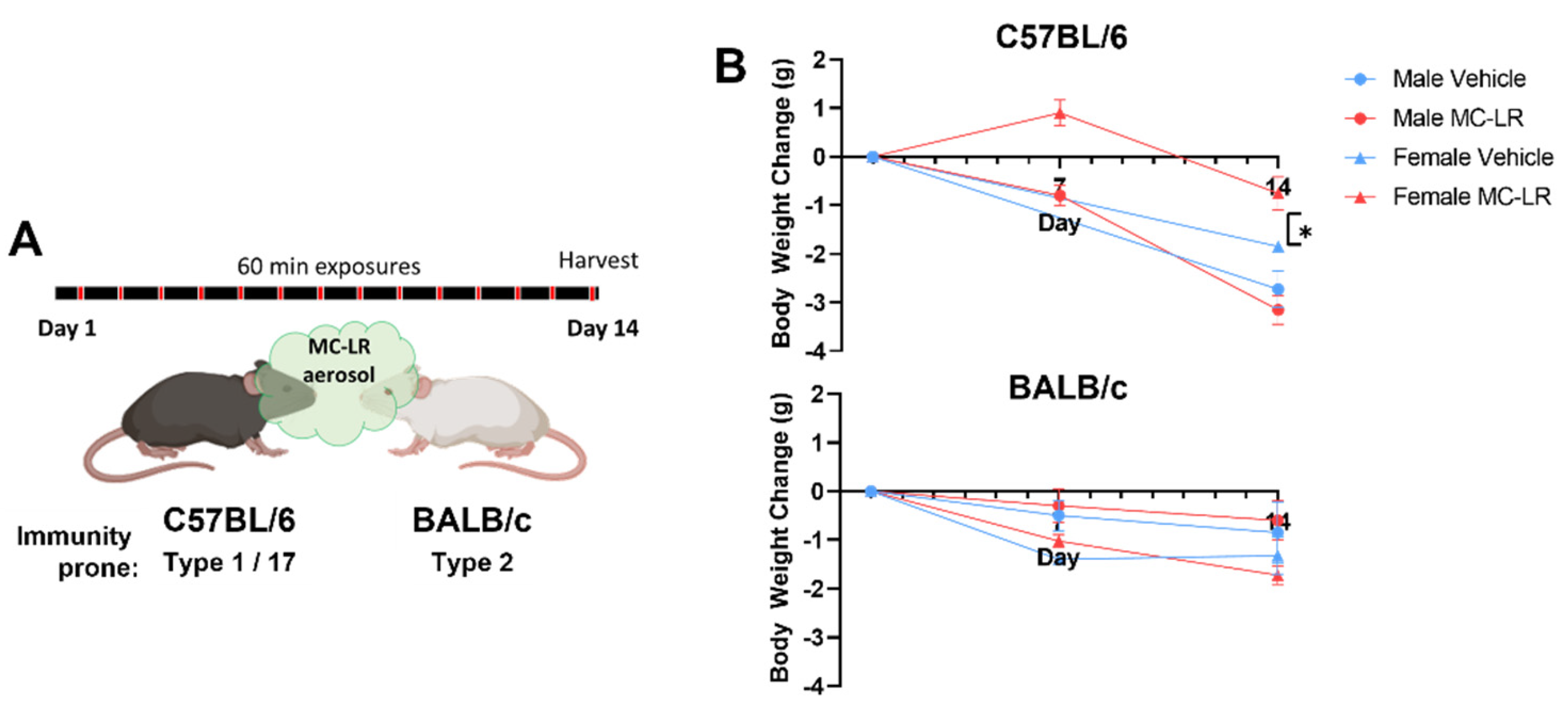
Figure 2.
Molecular markers of inflammation in the lung tissue. Concentration of cytokine and chemokine proteins from lung lysate of male and female C57BL/6 (A) and BALB/c (B) mice. Values indicate fold change (FC) in concentrations from MC-LR exposed mice compared with vehicle exposed mice. Red dashed line indicates unchanged (FC of 1). Type of immunity associated with protein analyte: type 1 (blue), type 2 (yellow), mixed (green). *, **, ***, **** indicates p ≤ 0.05, 0.01, 0.001, 0.0001, respectively. Statistics by Student’s t-test between MC-LR exposed and respective vehicle controls. n = 4 in all measurements.
Figure 2.
Molecular markers of inflammation in the lung tissue. Concentration of cytokine and chemokine proteins from lung lysate of male and female C57BL/6 (A) and BALB/c (B) mice. Values indicate fold change (FC) in concentrations from MC-LR exposed mice compared with vehicle exposed mice. Red dashed line indicates unchanged (FC of 1). Type of immunity associated with protein analyte: type 1 (blue), type 2 (yellow), mixed (green). *, **, ***, **** indicates p ≤ 0.05, 0.01, 0.001, 0.0001, respectively. Statistics by Student’s t-test between MC-LR exposed and respective vehicle controls. n = 4 in all measurements.
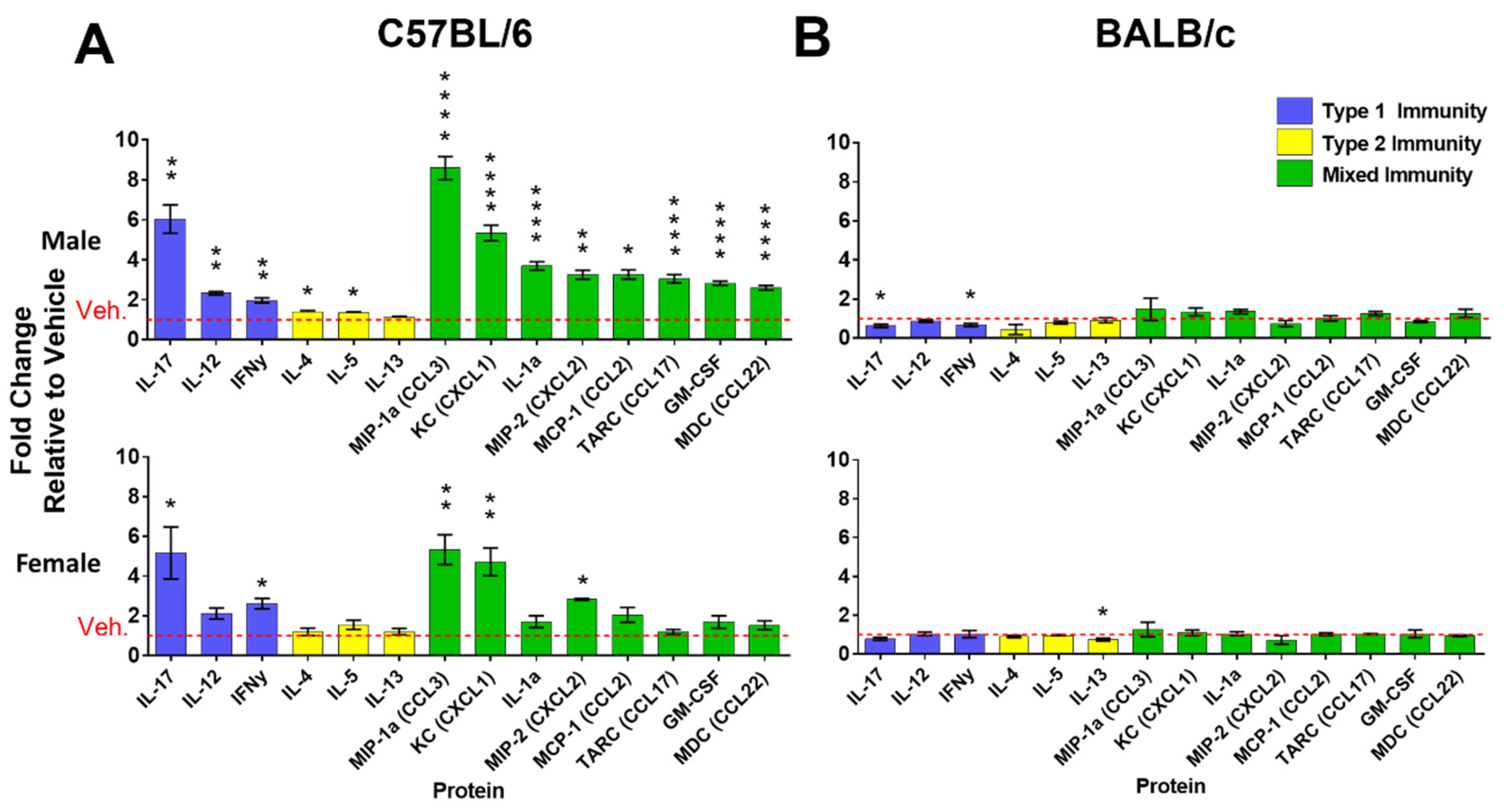
Figure 3.
Histological evaluation of the lung. A) Representative images of H&E-stained sections of male and female C57BL/6 mouse lung after MC-LR or vehicle aerosol exposure. B) Pathologist’s scoring of inflammation severity in the H&E-stained sections. C) Representative images of sections stained by IHC for F4/80 (a murine macrophage marker) in male and female C57BL/6 mouse lung after MC-LR or vehicle aerosol exposure. Red arrows indicate positively stained cells. D) Results of an image analysis software-assisted enumeration of F4/80+ cells, normalized to the tissue area of each section. *, **, **** indicates p ≤ 0.05, 0.01, 0.0001, respectively. Statistics by Student’s t-test between MC-LR exposed and respective vehicle controls.
Figure 3.
Histological evaluation of the lung. A) Representative images of H&E-stained sections of male and female C57BL/6 mouse lung after MC-LR or vehicle aerosol exposure. B) Pathologist’s scoring of inflammation severity in the H&E-stained sections. C) Representative images of sections stained by IHC for F4/80 (a murine macrophage marker) in male and female C57BL/6 mouse lung after MC-LR or vehicle aerosol exposure. Red arrows indicate positively stained cells. D) Results of an image analysis software-assisted enumeration of F4/80+ cells, normalized to the tissue area of each section. *, **, **** indicates p ≤ 0.05, 0.01, 0.0001, respectively. Statistics by Student’s t-test between MC-LR exposed and respective vehicle controls.
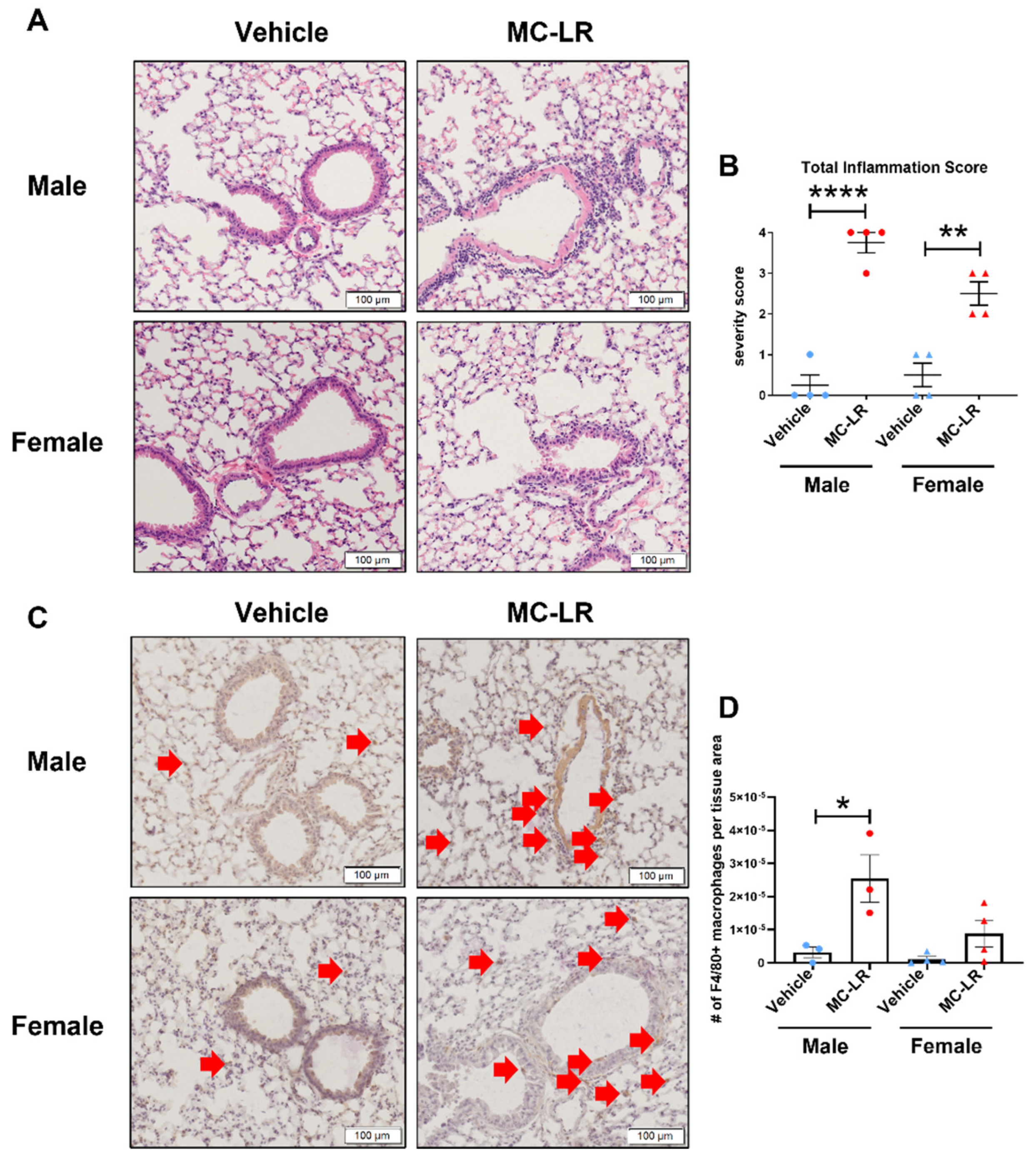
Figure 4.
Bronchoalveolar lavage fluid analysis. Cellular constituents of BAL fluid normalized to the recovered volume. A) total cells, B) neutrophils, C) eosinophils, D) lymphocytes, and E) macrophages. * and ** indicates p ≤ 0.05 and 0.01, respectively. Statistics by Student’s t-test between MC-LR exposed and respective vehicle controls.
Figure 4.
Bronchoalveolar lavage fluid analysis. Cellular constituents of BAL fluid normalized to the recovered volume. A) total cells, B) neutrophils, C) eosinophils, D) lymphocytes, and E) macrophages. * and ** indicates p ≤ 0.05 and 0.01, respectively. Statistics by Student’s t-test between MC-LR exposed and respective vehicle controls.
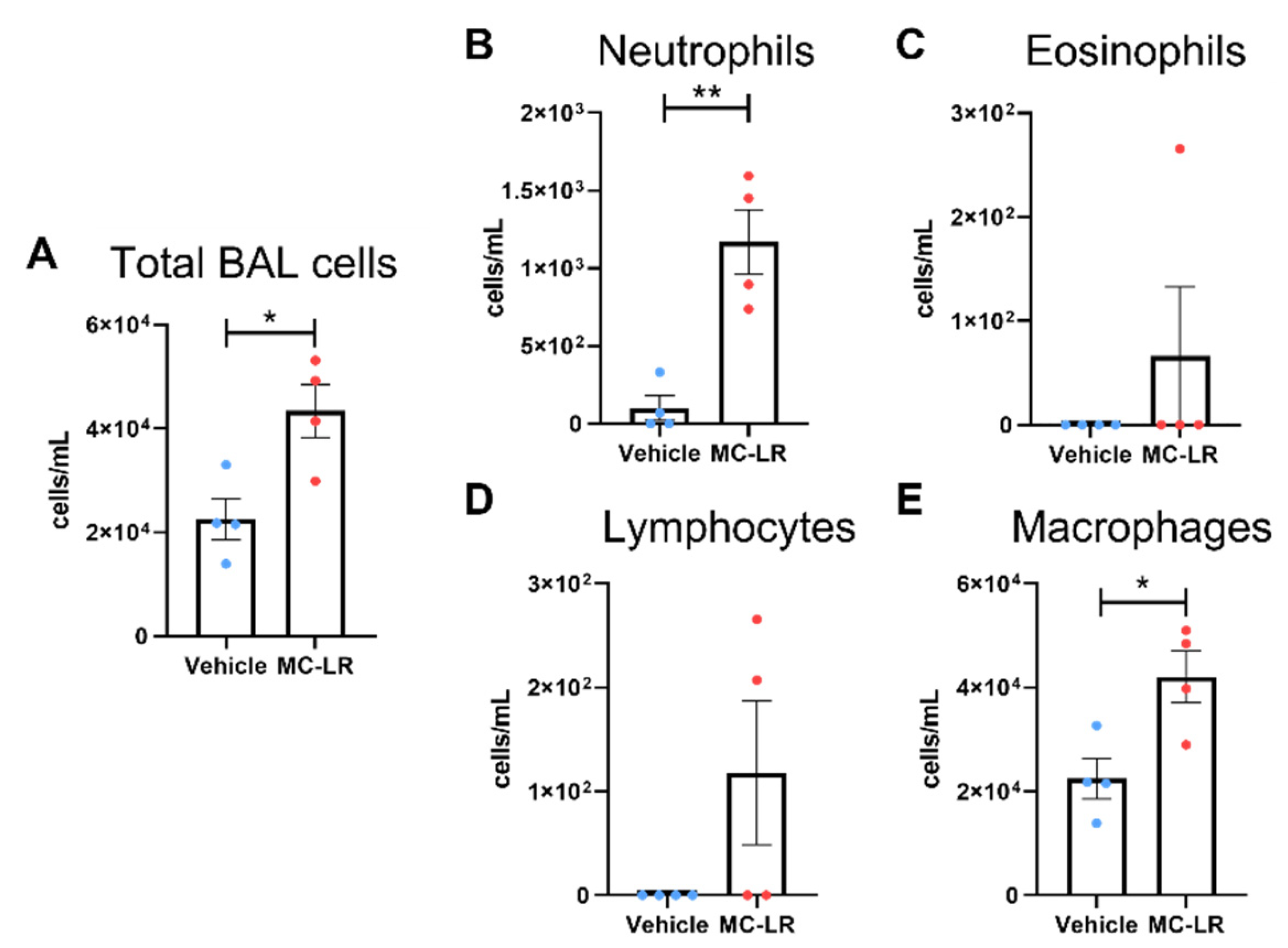
Figure 5.
Lipid markers of inflammation in lung tissue. Concentration of arachidonic acid metabolites from lung lysate of male C57BL/6 mice. Values indicate log2FC in concentrations from MC-LR exposed mice compared with vehicle. Dashed lines indicate Log2FC of 1 or -1, which correspond with a FC of 2 or -2, respectively. *, **, *** indicates p ≤ 0.05, 0.01, 0.001, respectively. Statistics by Student’s t-test between MC-LR exposed and respective vehicle controls. n = 4 in all measurements.
Figure 5.
Lipid markers of inflammation in lung tissue. Concentration of arachidonic acid metabolites from lung lysate of male C57BL/6 mice. Values indicate log2FC in concentrations from MC-LR exposed mice compared with vehicle. Dashed lines indicate Log2FC of 1 or -1, which correspond with a FC of 2 or -2, respectively. *, **, *** indicates p ≤ 0.05, 0.01, 0.001, respectively. Statistics by Student’s t-test between MC-LR exposed and respective vehicle controls. n = 4 in all measurements.
Disclaimer/Publisher’s Note: The statements, opinions and data contained in all publications are solely those of the individual author(s) and contributor(s) and not of MDPI and/or the editor(s). MDPI and/or the editor(s) disclaim responsibility for any injury to people or property resulting from any ideas, methods, instructions or products referred to in the content. |
© 2024 by the authors. Licensee MDPI, Basel, Switzerland. This article is an open access article distributed under the terms and conditions of the Creative Commons Attribution (CC BY) license (http://creativecommons.org/licenses/by/4.0/).
Copyright: This open access article is published under a Creative Commons CC BY 4.0 license, which permit the free download, distribution, and reuse, provided that the author and preprint are cited in any reuse.


