

Submitted:
04 October 2024
Posted:
04 October 2024
You are already at the latest version
Abstract
Small and Medium Enterprises (SMEs) play a crucial role in the European economy, yet their ability to sustain coopetition networks—collaborative arrangements between competitors—remains underexplored. This study addresses the gap by developing a reference model and an instantiation methodology for coopetition networks explicitly tailored to the needs of SMEs, grounded in the Service-Dominant (S-D) Logic framework. The reference model provides a structured approach for SMEs to coopetition throughout their entire lifecycle, from initiation to dissolution, focusing on value co-creation and resource exchange. To validate the model, a Proof-of-Concept (PoC) was conducted in the Portuguese ornamental stone sector, demonstrating significant improvements in manufacturing effectiveness and confirming the model’s practical applicability. The findings highlight the potential of coopetition networks to enhance the competitiveness and performance of SMEs. While the reference model successfully addresses key challenges SMEs face, the study acknowledges certain limitations. It suggests areas for further research, particularly regarding the long-term sustainability of these networks and the role of interpersonal dynamics.
Keywords:
Coopetition
; SME
; Networks
; Service-Dominant Logic
; Service Ecosystems
1. Introduction
Small and Medium Enterprises (SMEs) form the backbone of the European economy, accounting for 99.8% of all non-financial businesses and over 65% of employment within the EU27 (Muller et al., 2021). As the global economy moves toward increasingly digital supply chains, coopetition—a strategy where competitors collaborate—has emerged as a crucial approach for business survival and growth (Di Bella et al., 2023). Although coopetition has gained recognition in academic research (Corbo et al., 2023) and policy discussions, its potential to enhance firm performance, particularly in the SME context, remains significantly underexplored (Bouncken et al., 2024).
Current literature examines coopetition through various theoretical frameworks, such as Game Theory, Resource-Based View, Paradox Theory, Transaction Cost Theory, and Network Theory, shedding light on its economic, strategic, and organizational dimensions (Meena et al., 2023). However, a critical issue persists despite these contributions: approximately 85% of coopetition networks fail to achieve their long-term objectives, as reported by the BCG Henderson Institute in the MIT Sloan Management Review (Reeves et al., 2022). This high failure rate highlights the fragility of coopetition networks, particularly over time.
While large enterprises often anchor these networks, acting as keystone players that support and benefit from the ecosystem (Razmdoost et al., 2023), SMEs encounter distinct challenges in sustaining coopetition. Lacking the dominant players in large enterprises, SMEs need help establishing long-term, stable networks (Destefanis et al., 2023). Various approaches to enhancing network interdependence have been suggested (Shao & Cao, 2024). However, no consensus exists on a robust, adaptable model explicitly tailored to the needs of SMEs (Bouncken et al., 2024). This gap in the literature points to a clear need for a model that SMEs can use to build and sustain coopetition networks effectively.
This paper addresses this research gap by developing and evaluating a reference model and instantiation methodology for coopetition networks specifically designed for SMEs. Grounded in the Service-Dominant (S-D) Logic framework (Stephen L. Vargo & Lusch, 2004), which focuses on reciprocal value propositions and co-creation rather than transactional exchanges (Stephen L. Vargo et al., 2024), the study aims to create a model that enables effective resource exchange and mutual value creation within SME networks.
The methodology of this paper follows several vital steps. First, a literature review will position coopetition networks within the context of S-D Logic, conceptualizing these networks as dynamic ecosystems that evolve from initiation to dissolution. This theoretical foundation emphasizes how coopetition enables reciprocal value creation among SMEs, enhancing their operational and strategic capabilities.
Building on this framework, the paper introduces a reference model designed to help SMEs implement and sustain coopetition networks. The model addresses common SME challenges, such as limited resources and the need for flexibility in collaborative ventures, offering a practical and adaptable blueprint for successful coopetition.
To evaluate the model, the study will use the instantiation methodology to conduct a proof-of-concept (PoC) in the Portuguese ornamental stone sector. This sector was chosen due to its relevance in illustrating the practical applications of coopetition networks. The PoC will include a detailed functional acceptance survey followed by structured data collection and analysis over predefined periods, comparing performance metrics under traditional operations versus within a coopetition framework.
The paper concludes with a discussion that synthesizes the findings from the PoC, explores broader implications, and suggests directions for future research. This paper aims to develop a practical, adaptable framework that enables SMEs to thrive within coopetition networks, enhancing their competitiveness and operational efficiency in an increasingly interconnected and digitalized business environment.
2. A Service Dominant Logic View for Coopetition
Vargo and Lusch (2004) revolutionized the understanding of “service” by defining it as the application of competencies for the benefit of others, a perspective that forms the cornerstone of this approach to coopetition networks (Stephen L. Vargo & Lusch, 2004).
Building on this paradigm, S-D Logic literature further elaborates that value is always cocreated with the beneficiary (R. Lusch & Vargo, 2007). This perspective emphasizes the importance of resource integration and service exchange, coordinated and constrained by institutions and institutional arrangements, as central to value co-creation in ecosystems (S. Vargo & Lusch, 2016)
Anchored on this service ecosystem’s view, to S-D Logic, networks are formed through the spontaneous creation of spatial and temporal structures (Stephen L Vargo & Lusch, 2010). These structures emerge from the interactions of social and economic actors, influenced by institutions and technology (R. Lusch & Nambisan, 2015). These networks are characterized by adaptive interactions among actors, who are driven by the intrinsic goal of creating value and maintaining the viability of the ecosystem (R. F. Lusch et al., 2010). S-D Logic views value creation as a mutual and adaptive service provision process, self-adjustable and interconnected within a framework of shared institutions and institutional arrangements (S. Vargo & Akaka, 2012). This conceptual framework leads to understanding service ecosystems, where value is cocreated in a dynamic and interconnected environment (S. L. Vargo & Lusch, 2017).
Traditionally perceived as merely physical devices, the role of technology in ecosystems has undergone a significant reevaluation in recent years. Hunt (2000) emphasizes the social dimensions of technology (Hunt, 2000). He argues that social groups play a crucial role in shaping technology and, more broadly, constructing value perceptions. Complementing this view, Arthur (2009) challenges the conventional view by describing technology as a physical tool and an assemblage of practices and components aimed at fulfilling human purposes and technological advancement as the recombination of helpful knowledge (Arthur, 2009). These insights shed light on how technology, as a component of ecosystems, is not just a tool but a dynamic element shaped by and shaping social practices and value creation.
Service literature increasingly recognizes the pivotal role of technology in enhancing and transforming networks. Maglio (2009) emphasizes technology as a key enabler of innovation within service contexts (P. Maglio et al., 2009). He notes that technological advancements have been instrumental in transforming the interactions between firms. This transformation extends to creating technology-supported ecosystems, as Breidbach et al. (2013) identified, where technology plays a central role in facilitating and exploring new avenues for value creation within networks (C. F. Breidbach et al., 2013). Understanding this dynamic role of technology is crucial for coopetition networks, where technological integration can significantly influence the mechanisms of value creation and collaboration among competing firms.
The literature on coopetition networks consistently acknowledges the role of technology in fostering innovation within these networks. Rusko (2014) identifies technology-based strategic networks as vital for coopetition innovation (Rusko, 2014). Similarly, Bicen et al. (2021) emphasize technology's role as a facilitator for interaction among network members (Bicen et al., 2021), enabling the formation of shared understandings, as supported by the work of Chesbrough & Rosenbloom (2002) among other authors (Chesbrough & Rosenbloom, 2002) (Doganova & Eyquem-Renault, 2009) (Storbacka & Nenonen, 2011).
This collective viewpoint aligns closely with the S-D Logic perspective, where technology is seen not only as an enabler (operand) but also as a starter (operant) in service ecosystems, contributing to resource integration and value creation (R. Lusch & Nambisan, 2015) (Sklyar et al., 2019). In the context of coopetition networks, this dual role of technology is crucial in enabling and enhancing collaborative yet competitive interactions among firms.
3. Constructs for Coopetition Networks for Value Co-Creation
Reference models are abstract representations of domain knowledge, capturing prescriptive and descriptive design knowledge pertinent to sociotechnical problems (Schermann et al., 2009). Hevner (2004) underscores the importance of substantial academic knowledge in creating relevant reference models, which are instrumental in addressing complex real-world problems (Hevner et al., 2004). In the context of coopetition networks, the performative nature of S-D Logic is particularly relevant, providing a robust framework for addressing real-world problems, especially those involving service objects, technology systems, organizations, and people collaboratively creating value (vom Brocke et al., 2020) (S. L. Vargo & Lusch, 2017). In coopetition networks, this approach facilitates the understanding and shaping evolving value propositions among a broad system of interacting actors.
3.1. Enabling Coopetition
Orlikowski (1992) offers a nuanced understanding of the interaction between technology and organizations (W. J. Orlikowski, 1992). She posits that technology both influences and is influenced by institutional factors and the practices of social and economic actors. At the same time, S-D Logic conceptualizes a service ecosystem as a self-contained, self-adjusting system. This system comprises resource-integrating actors interconnected by shared institutional logic, facilitating mutual value creation through service exchange (Stephen L. Vargo & Lusch, 2011). This perspective emphasizes the role of institutions in value creation, drawing attention to how technology, as an operant resource, actively interacts with other resources to cocreate value and innovate services (M. A. Akaka & Vargo, 2014).
Building upon the convergence of technology's role as established in S-D Logic, reference models for coopetition networks can designed for practical applications. Supported by the foundational principles of S-D Logic, this reference model must integrate the crucial role of technology, reflecting its importance in service ecosystems. Transporting this service ecosystem perspective to networks allows the synthesis of diverse viewpoints into a cohesive framework emphasizing the integration and application of resources as central to value creation, driving interactions and exchanges in coopetition networks.
3.2. Actors and Resources in Coopetition
Embracing the S-D Logic perspective, it is recognized that all economic and social actors function as resource integrators (R. Lusch et al., 2016). Under this view, service ecosystems comprise a variety of actors, such as customers, providers, and competitors. These actors apply specialized competencies through deeds, processes, and performances and integrate multiple resources, including market-facing, technological, financial, and public resources, thereby creating value (R. F. Lusch et al., 2010) to cocreate mutual benefits, establishing economic relations fundamentally based on service exchange (Stephen L. Vargo & Lusch, 2008) (Stephen L. Vargo & Akaka, 2009). In these ecosystems, technology is a resource that plays a crucial role in these exchanges. It is an integral element, enabling individuals and organizations to participate in the value-creation process and function as resource integrators within these networks (Chandler & Vargo, 2011).
Transposing this perspective to coopetition networks, the traditional roles of providers and competitors often converge, leading to a unique dynamic where providers can also become competitors and vice versa (Afuah, 2004). Within these networks, firms, customers, and other actors engage in economic exchanges, each acting as resource-integrating, service-providing entities. This collaboration is driven by a shared value co-creation goal (Stephen L. Vargo & Lusch, 2014). Arguably, actors in coopetition networks integrate resources in a manner that can be characterized by a loosely coupled architecture that facilitates the formation of service and information flow frameworks, thereby creating value networks (Zott & Amit, 2008). Value creation within these networks occurs through dynamic interactions among multiple entities. Actors continuously configure resources to initiate and sustain interactions that lead to the creation of value (P. P. Maglio & Spohrer, 2013).
Expanding upon the S-D Logic's classification of resources, the service literature recognizes any potentially useful entity, tangible or intangible, as a resource. This encompasses aspects like ephemerality and the cost of usufruct, especially pertinent in coopetition networks (J. C. Spohrer & Maglio, 2010). Building on this S-D Logic understanding can be identified the actor and resources’ constructs for coopetition networks for value co-creation:
Construct #1 (actors as resource integrators) - The first construct posits that actors in coopetition networks function as resource integrators. They actively engage with available resources to create value for themselves and others, fostering new and improved ways of value creation (R. Lusch & Vargo, 2007). Systemic mechanisms underpin this process of resource integration. These mechanisms facilitate service exchanges, ensuring that all actors in the ecosystem can act as resource integrators. This is achieved through reconfiguring access rights and forming mutually agreed-upon value propositions (Stephen L. Vargo & Akaka, 2009) (Stephen L. Vargo & Lusch, 2014).
Construct #2 (technology as operant and operand resource) - The second construct explores the dual role of technology in coopetition networks. Technology serves both as a facilitator or enabler (operand) and as an initiator or actor (operant) (Barile et al., 2019) (Pakkala et al., 2020) (M. A. Akaka & Vargo, 2014). As an operant resource, technology initiates and drives new forms of interaction and value creation. As an operand resource, it facilitates and supports these processes, enabling actors to engage more effectively in coopetition networks ((Nambisan, 2013). This positioning of technology allows actors, such as rival firms and individual customers, to extend and reconfigure their patterns of resource integration. It enables them to access resources across rival firms in a mutually beneficial manner, thereby facilitating value creation in the network (Sklyar et al., 2019). This strategic use of technology can be instrumental in alleviating the inherent tensions in coopetition networks, as it fosters a more collaborative, transparent and integrated approach to resource sharing (Raza-Ullah et al., 2014).
3.3. Service-Exchange in Coopetition Networks
In the realm of S-D Logic, service exchange among actors is fundamental to the emergence of value (S. Vargo & Akaka, 2012). This perspective is echoed broadly in service literature, emphasizing the centrality of service exchange and resource integration in economic exchanges (C. Breidbach & Maglio, 2016). This view is central to this reference model. Value co-creation occurs within networks of relationships and resources, understood as a dynamic process involving resource integration, application, and transformation (Pongsakornrungsilp, 2010).
Understanding how economic actors engage in value co-creation necessitates focusing on the knowledge mechanisms and processes involved in resource integration (Payne et al., 2008). Maglio and Spohrer (2007) underscore the significance of the rights nature of resources, pointing out the crucial distinction between resources capable of entering contracts or agreements and those that cannot (J. Spohrer et al., 2007). This distinction is crucial as only people and firms, as imputable actors, can legally bind themselves in such ways. They further argue that specific configurations of resources can actively initiate interactions, adding a dynamic layer to how resources are utilized in economic exchanges (P. P. Maglio & Spohrer, 2008). In scenarios where complex resource configurations lead to initiating actions, people and technology collaboratively compute and adjust to the evolving value of knowledge, reflecting the dynamic nature of service ecosystems (J. C. Spohrer & Maglio, 2010).
As envisioned in S-D Logic, the service process is inherently interactive and collaborative, involving multiple economic actors ((S. Vargo & Akaka, 2012). This perspective aligns with the broader view that all social and economic actors are resource integrators (Stephen L. Vargo et al., 2020). Successful value co-creation hinges on the ability of these actors to engage in meaningful interactions. This involves exchanging resources and integrating them effectively within their contexts (Prahalad & Ramaswamy, 2000).
The efficacy of these interactions, and thus the value cocreated, is contingent upon each actor's capability to exchange and apply service information in relevant and beneficial ways within their respective realities (Ballantyne & Varey, 2006). Building on this foundational understanding of service exchange among rivals can be identified the second set of constructs for coopetition networks for value co-creation:
Construct #3 (interactions among rivals) - In coopetition networks, rival interactions are critical in value co-creation. Integrating technology, both as operant and operand resources, is instrumental in simultaneously facilitating cooperation and competition among rivals (Tidström, 2014). Reliable technology serves as a guide and enabler in formulating proposals between competitors. It allows rivals to rely more on objective, technology-driven processes rather than direct interactions with competitors, thereby increasing the likelihood of mutual acceptance of proposals and reducing direct competitive friction. This indirect approach facilitated by technology enhances the probability of acceptance and successful collaboration among rivals, leading to more effective and efficient value co-creation.
Construct #4 (service-exchange intensity) – In coopetition networks, the intensity of service exchange is essential to enhance the cocreation of value. Integrating competitors' resources, facilitated by operant and operand technology, can significantly amplify this intensity (Storbacka & Nenonen, 2011) (Ng & Wakenshaw, 2017). This heightened level of resource integration aligns with the broader value creation process, as conceptualized in S-D Logic. Value creation in this context arises from intricate value configurations, constantly refined and enhanced through the interactions among rival actors (Stephen L Vargo & Lusch, 2010).
Within service ecosystems, the interplay among actors at multiple levels significantly enhances the value cocreated. Increasing interactions in coopetition networks within and across different aggregation levels contribute to a more dynamic and enriched value co-creation process (Stephen L Vargo & Lusch, 2008).
3.4. Coopetition Networks as a Particular Case of Service Ecosystems
In service ecosystems, institutions are understood as humanly devised rules, norms, and beliefs. These elements enable and constrain actions, thereby making social life predictable and meaningful, as described by Scott (2008) and further elaborated by Vargo and Lusch (2016) (Scott, 2013) (S. Vargo & Lusch, 2016).
Building upon this foundational understanding, S-D Logic literature has evolved to adopt a dynamic perspective that focuses on how institutions shape value creation through service exchange, offering insights into the structural intricacies of ecosystems that go beyond dyadic or micro-level interactions (Chandler & Vargo, 2011) (S. Vargo & Lusch, 2016). According to the S-D Logic, this institutional view is crucial for comprehending how value is cocreated in service ecosystems, as it provides a lens to understand the broader, systemic interactions and constraints that shape economic and social exchanges.
Establishing a bridge between technology and knowledge, in a broader sense, technology is often applied to enhance and utilize valuable knowledge (Mokyr, 2002), further positing that knowledge itself forms a part of the institutional structure of society, an idea echoed in S-D Logic ((S. Vargo & Lusch, 2016). Moreover, drawing from Simon's (1988) concept of design as resource reconfiguration to address problems (Simon, 1988), technology resources can be viewed as assemblages of practices and components to fulfil human purposes (Arthur, 2009). In this context, social technologies are often conceptualized as institutions (Nelson & Nelson, 2002). Orlikowski (2000) provides a nuanced view of this interplay, describing how technology and actors collaboratively affect, transform, and maintain institutions (Wanda J Orlikowski, 2000). Drawing on Giddens' (1984) structuration theory, this perspective positions technology as both a product and an enabler of human action (Wanda J. Orlikowski, 1992). This conceptualization of technology as an institutional phenomenon aligns with the S-D Logic perspective on institutions within service ecosystems (S. Vargo et al., 2015), from which it may be argued that in the context of coopetition networks, technology can facilitate institutionalization, enabling interactions among rivals while also helping to manage and constrain potential tensions. Building on this foundational understanding of the service ecosystem can be identified two additional constructs for coopetition networks for value co-creation:
Construct #5 (technology as institutionalization mechanism) - This construct explores the role of technology as a mechanism for institutionalization within coopetition networks. This involves viewing and using technology as both an operand (enabler) and operant (initiator) resource in the process of value creation (R. Lusch & Nambisan, 2015), (S. L. Vargo & Lusch, 2017) (Barile et al., 2019). Drawing from Simon's (1988) concept of designed artefacts, technology systems are not just tools but repositories of embedded knowledge and skills, as discussed by Wanda J. Orlikowski (1992). In this capacity, technology acts as an institutionalization mechanism, facilitating the endogenous generation of new institutions. This is crucial for shaping the context in which resource integration and service exchange occur, enabling effective coopetition and value co-creation in ecosystems (S. Vargo et al., 2015).
Construct #6 (institutionalized networks) – As coordination mechanisms, institutions are crucial in coopetition networks. Here, operant and operand technology facilitate rival interaction and act as mechanisms for institutionalization within service ecosystems (S. Vargo & Lusch, 2016). Once institutionalized, the coopetition networks are guided by sets of institutions or institutional arrangements that shape the thinking and behaviour of the actors by providing a framework of value assumptions, cognitive frames, rules, and routines, thereby establishing nested and interlocking service ecosystems. Within this framework, operant and operand technology are not just tools but are conceptualized as repositories of potentially helpful knowledge. This knowledge is instrumental for future interactions within service ecosystems, facilitating the exchange and innovation (S. Vargo et al., 2015). This perspective on institutionalized networks is particularly relevant in dynamic and changing industries. Innovations, characterized by loosely coupled systems, enable rapid adaptation and evolution of behaviour patterns, often keeping pace with or outstripping the rate of technological advancements (M. A. Akaka & Vargo, 2014).
4. Coopetition Networks Lifecycle
A key component of a reference model is its lifecycle, which delineates the various stages a coopetition network undergoes from inception to dissolution. Figure 1 illustrates this lifecycle, providing a visual representation of each stage.
The Creation Stage encompasses strategic planning, governance establishment, and the development of a common ontology. It also involves setting up the necessary technology and network infrastructure. The Initiation Phase includes the installation of network infrastructure and motivator teams, launching the coopetition network, and undertaking activities like actor recruitment and conformity checking. In the Operation Stage, technology facilitates the integration of resources and service exchange among rivals. This stage is characterized by forming service ecosystems driven by the actors' interactions within the network. The Metamorphosis Stage The metamorphosis stage is prompted by significant changes within the network, necessitating a strategic overhaul and potentially leading to the network's relaunch. The Dissolution Stage is when the network ceases to create value or when the value generated falls short of the actors' expectations, leading to disengagement and the eventual collapse of the service ecosystem - the actors rapidly quit involvement in resource integration and service exchange, resulting in in in in the service ecosystem death and consequent coopetition network closure.
Linking value co-creation to resource integrators (actors) to service exchange (S. Vargo & Akaka, 2012), a coopetition network can be viewed as a relatively self-contained, self-adjusting system of resource-integrating rivals and customers connected by technology that ensures institutional arrangements for mutual value creation through service exchange (S. Vargo & Lusch, 2016).
5. Coopetition Networks Instantiation
Instantiation refers to the process of creating a specific occurrence or realization of an abstract concept. It involves developing a concrete instance or application based on a theoretical reference model or architecture. In the case of this research, the instantiation process is applied to coopetition networks. This process involves characterizing new technology-based networks by leveraging the lifecycle outlined above and considering the unique aspects of coopetition. The instantiation process for coopetition networks encompasses a systematic set of steps. These steps are designed to specify and generate a customized version of the coopetition networks for value co-creation, fully describing its components. Collectively, these components constitute an instance of the reference model, operationalizing the theoretical framework within a practical context.
5.1. Initiation Stage
The Initiation Stage of coopetition networks for value co-creation is the starting phase. It can be subdivided into creation and initiation phases, each with distinct objectives and activities (Figure 2).
The creation phase primarily focuses on strategic planning, starting with evaluating the environmental context. This step is essential for preparing and facilitating all subsequent operational activities. Key aspects, such as technology requirements, play a vital role at this stage, particularly in establishing a standard ontology for the network. This process includes defining governance structures, determining common ontologies, and setting technology standards and requirements, such as cybersecurity, interoperability, and maintenance protocols. The final steps in this phase involve addressing the network system's enabling requirements. This includes setting up the necessary infrastructure, hosting arrangements, and forming teams responsible for recruiting actors and motivating participation in the network.
The initiation phase is crucial in developing coopetition networks for value co-creation, focusing on network launching, infrastructure setup, and forming motivator teams for actor recruitment and conformity checking. A critical trigger for launching a coopetition network is the establishment of clear and shared expectations among the rival actors (Ghobadi & D’Ambra, 2012) (Dagnino & Padula, 2002). This phase ensures that the management principles and the common ontology, previously established in the creation phase, are well-understood and committed to by all participating actors. Moreover, the network's initiation involves the network motivator team setting up the necessary technology-enabling infrastructure. This setup is a foundational step that precedes the actual launching of the coopetition network. Following the network launch, the focus shifts to recruiting actors and checking their compliance with essential requirements. This process includes thorough interoperability and cybersecurity assessments to ensure that each actor's technology aligns with the network's standards and is fully compliant.
5.2. Operation Stage
The Operation Stage represents the phase when coopetition networks for value co-creation emerge. Their evolution involves recruiting and integrating resources for service exchange among rivals. These networks operate within the S-D Logic framework of institutions and institutional arrangements, forming interconnected service ecosystems.
Micro-Level (network activity): When an actor (rival) engages with technology, it gains the capability to integrate its skills, knowledge, operand resources, and other resources voluntarily. These actors engage in service exchange with others in the network, involving multi-level interactions. The interactions are enabled and constrained by the institutions and institutional arrangements endogenously generated at a meso-level.
Meso-Level – (institutions) - at a meso-level, some behaviour patterns start to appear (institutions) as humanly devised rules, norms, and meanings guiding and shaping the interactions among actors in the network. Coordinated by these institutions and institutional arrangements sets, a service ecosystem of actors is established, creating the context for future resource integration and service exchange involving more rivals (Figure 3).
This resource integration view within coopetition networks for value co-creation is guided by five fundamental axioms of S-D Logic (M. Akaka et al., 2013), which illuminate the intricate and dynamic context in which value is cocreated in service ecosystems (S. Vargo & Lusch, 2016). (1) Service is the fundamental basis of exchange: This axiom emphasizes that all economic and social activities can be viewed as services exchanged between actors. (2) Value is cocreated by multiple actors, always including the beneficiary: This axiom highlights that value creation involves collaboration among various actors, with the beneficiary playing a central role. (3) All social and economic actors are resource integrators: This axiom recognizes that actors in service ecosystems integrate and utilize resources to cocreate value. (4) Value is always uniquely and phenomenologically determined by the beneficiary: This axiom underscores that the perception of value is subjective and varies from beneficiary to beneficiary. (5) Value co-creation is coordinated through actor-generated institutions and institutional arrangements: This axiom emphasizes the role of institutions and arrangements in guiding and coordinating value co-creation.
5.3. Metamorphosis Stage
The metamorphosis stage represents a crucial phase in evolving coopetition networks for value co-creation. Coopetition networks undergo strategic adaptations during this stage to respond effectively to evolving market conditions and maintain competitiveness (Figure 4).
Among other reasons behind a coopetition network starting a Metamorphosis Stage, it may be found that (1) Network Reshaping: A coopetition network undergoes a transformation or reshaping process. This transformation is triggered when the existing institutions and institutional arrangements within the network cannot establish the desired nested and interlocking service ecosystems; (2) Identifying the Need for Change: The network's leadership and stakeholders recognize the need for change. This recognition may stem from challenges in achieving the intended service ecosystems, changes in market dynamics, or other factors affecting the network's performance. (3) Strategic Planning: A new strategic plan addresses the identified issues and challenges. This plan outlines the changes, improvements, or innovations needed to enhance the network's competitiveness and value creation capabilities; (4) Improving Key Components: The strategic plan may focus on various aspects, including technology enhancements, governance adjustments, ontology refinement, and other relevant issues. These improvements aim to boost the network's capacity to create value through service ecosystems; (5) Reactivation of Network Infrastructure: Once the strategic planning phase is completed, the network-enabling infrastructure is reactivated. This involves implementing the technological, structural, and organizational changes outlined in the strategic plan. (6) Re-launching: The network undergoes a re-launching phase with the updated infrastructure. This phase signifies the network's readiness to operate under the new strategic framework. (Re)Initiation Steps: The (re)initiation steps are carried out to ensure that all actors and stakeholders are aligned with the revised plan. This may involve recruiting new participants, reaffirming commitments, and conducting interoperability and cybersecurity checks to ensure compliance with the updated technology requirements. In summary, the Metamorphosis Stage is a pivotal phase in the life of a coopetition network for value co-creation. It involves adapting the network's strategy, technology, governance, and ontology to respond effectively to changing market conditions and trends. By embracing these adaptations, the network aims to remain competitive and continue its mission of value creation through service ecosystems.
5.4. Dissolution Stage
The Dissolution Stage, illustrated in Figure 5, signifies the network's closure when its activities cease. This stage is typically triggered when the network's value creation exceeds the actors' expectations. In response, actors withdraw from resource integration and service exchange activities, leading to the eventual death of the service ecosystem and the closure of the coopetition network.
During the dissolution process, the primary focus is concluding affairs and contracts with all participants, including customers. This involves shutting down the coopetition-enabling infrastructure and formally announcing the network's closure, thus marking the end of the network's lifecycle.
6. Coopetition Networks for Value Co-Creation Evaluation
The ornamental stone sector, a pillar of Portugal's esteemed cultural heritage and progressive innovation, has played a crutial role in the creation of iconic stone monuments worldwide since the 15th century (Carvalho & Lisboa, 2018). Recent figures from the Portuguese Stone Federation (2022) highlight the sector's notable economic influence: exporting to 116 countries, it is ranked as the ninth largest in the World International Stone Trade and holds the second position globally for international trade per capita (Silva & Marques Cardoso, 2023). With exports exceeding imports by 660% and a substantial portion of these exports destined for markets outside Europe, the industry generates a turnover of €1.230 million. It provides over 16,600 direct jobs, serving as a vital source of employment, especially in inland regions (Silva & Pata, 2022).
6.1. Preliminary Survey
To assess the acceptance level of the coopetition network reference model among Portuguese ornamental stone companies, a survey was conducted across a sample representing 16.2% of the industry. These SMEs are recognized for their substantial contributions to the economy and innovations in digital technologies (Silva et al., 2020). Each participating company was assigned a digital level (DL) for the study based on site visits.
DL#0: No digital machines are used. DL#1: At least one computerized machine on the manufacturing floor. DL#2: All machines are computerized. DL#3: All machines are computerized and connected to the SME management system. DL#4: All machines are connected and can interface with Building Information Modelling (BIM) architects' stations.
The evaluation involved thoroughly assessing each company's digital production equipment, management practices, integration processes with production, and participation in digital marketplaces. The survey was organized into four key actions: (1) Introduction - emphasizing the industry's transition to BIM platforms and the imperative for stone companies to scale up, offer competitive pricing, and ensure rapid delivery. (2) Hypothesis - presenting a theoretical scenario where companies join a network technology that facilitates market search collaboration with competitors while maintaining commercial confidentiality. (3) Question - inquiring if companies would be willing to collaborate with competitors under the proposed "network technology" framework. The survey, conducted throughout 2023, assessed the willingness of companies at various DLs to join such networks under a proposed "network technology" that ensures market search collaboration with competitors while maintaining commercial confidentiality.
The detailed breakdown of responses across different digital levels is detailed in Figure 6. The results indicate that 64.9% of respondents strongly inclined to join coopetition networks, signifying a general acceptance of the reference model. This widespread acceptance underscores the industry's recognition of the potential benefits of such collaborations in enhancing scale, competitive pricing, and rapid delivery.
A detailed analysis of the findings reveals a strong correlation between a company's digital maturity and its inclination to participate in coopetition networks. Companies with higher digital maturity levels (DL#3 and DL#4) exhibit a notably higher acceptance rate of 86.8%, highlighting the crucial role of digital advancement in promoting openness to collaborative innovations. These digitally advanced companies, equipped with integrated computerized systems and BIM capabilities, are more adept at leveraging technological networks for value co-creation. In contrast, only 7.8% of respondents were reluctant to join the proposed networks, indicating minimal rejection of the hypothesis. This low rejection rate further underscores the broad recognition of the strategic benefits that coopetition networks can offer.
This favourable initial assessment of coopetition networks for value co-creation, particularly among DL#4 respondents, paves the way for advancing to the proof-of-concept (PoC) stage.
6.2. Proof-of-Concept (PoC)
The previously described instantiation methodology was utilized to implement the PoC for Coopetition Networks for Value Co-creation. Given the lower acceptance rates among companies at digital maturity levels DL#0, DL#1, and DL#2, these companies are not yet prepared for integration due to a need for further development of a digital mindset. Consequently, this PoC was strategically executed in two DL#4 companies. These companies, equipped with ERP-connected machines interfacing with BIM architects' stations, were invited to participate. This setup exemplifies best practices within the Portuguese ornamental stone sector. To safeguard sensitive information, a comprehensive confidentiality agreement was established.
For evaluating the potential of coopetition networks for value co-creation, among the numerous indicators recommended by the management and manufacturing literature (Slavic et al., 2024), effectiveness was chosen as the key performance indicator (KPIEFECT) (Briglauer & Grajek, 2023). Given that this is a proof of concept, this single KPI was selected due to its relevance in incorporating the element of time. BIM has changed project management and coordination in the construction industry (Abdumutalibovich & Lutfillaevna, 2023). To meet the competitivity requirements as imposed by BIM, stone providers must improve their production effectiveness (Aliyari & Ayele, 2023). Thus, KPIEFECT was selected to assess how stone manufacturers adapt to global BIM procurement requirements. The KPIEFECT metric measures the effectiveness by calculating the ratio of daily good parts produced (GPP) to the number of production hours (PT) utilized (Eq.1).
Improvements in KPIEFECT indicate increased production effectiveness, allowing firms to offer stone parts at more competitive prices.
This PoC employed a comprehensive data collection strategy over two separate fifty-four-day periods to evaluate the transition from state-of-the-art (SoA) practices to a Coopetition Network for Value Co-creation (CNVC) practices. The comparative analysis highlights the potential of coopetition networks to enhance performance efficiency. It demonstrates how these networks' shared resources and collaborative efforts can lead to superior operational outcomes. By improving the KPIEFECT, firms can better align with BIM requirements, co-creating value through enhanced project execution and timely delivery. This underscores the strategic advantage of adopting coopetition networks to drive value co-creation and operational excellence in the construction sector.
To collect data for assessing KPIEFECT, an Internet of Things (IoT) prototype was deployed with two ornamental stone producers (Mosch et al., 2023). This PoC aimed to showcase the benefits of coopetition networks for value co-creation. The implementation allowed these SMEs to experience enhanced digital connectivity and collaboration within their operations. Figure 7 illustrates the digital connectivity and operational synergies achieved through the network.
To assess the shift from SoA to CNVC, this PoC utilized a structured data collection approach over two 54-day periods. This framework facilitated a detailed analysis of KPIEFECT before and after the implementation of the coopetition network for value co-creation.
The first phase aimed to document operational metrics under the SoA conditions. During this period, each company operated independently, managing its production and delivery processes without any collaborative interactions. This phase established a baseline of traditional practices, serving as a reference point for later comparisons.
The second phase marked the transition to CNVC practices, where companies engaged in an IoT-enabled network. The CNVC practices blend competition and cooperation among companies, fostering an environment of shared resources and technological collaboration. Using IoT technology, companies could enhance their operational efficiencies and innovate together. In this phase, companies were encouraged to leverage each other's strengths and technological capabilities within a secure and adaptable framework. The structured sharing and secure communication practices fostered an environment conducive to collective innovation and operational improvement. The following practices were implemented: (1) SMEs confidentially shared and accessed each other's resources, such as stock and machinery, enabling more efficient use of assets and mutual support within the network; (2) Companies had the flexibility to join or leave the network at any time, maintaining their autonomy while participating in the collaborative ecosystem; (3) All interactions and data exchanges were conducted using secure OPC-UA protocols (Hoppe, 2023), ensuring confidentiality and protection of proprietary information; (5) Companies provided and gained access to resources based on a reciprocal model, fostering cooperation while preserving competitive integrity; and, (6) The network was designed to integrate with BIM systems used by architects seamlessly (Wijeratne et al., 2024), enhancing coordination across different stages of production and delivery.
Adherence to confidentiality agreements was critical throughout this phase. All data were stored and handled to ensure privacy and security, facilitating a robust evaluation of CNVC's impact on operational efficiencies.
Data were collected and managed rigorously, focusing on privacy and security compliance. All data were anonymized and referenced only by company labels. Collection, recording, and export procedures were meticulously followed, with results stored in Excel files for secure and consistent handling. This approach enabled a detailed analysis while safeguarding the privacy and proprietary information of the participating companies.
The study aimed to highlight the tangible benefits of coopetition practices within SMEs by contrasting operational metrics between the SoA and CNVC phases. Table 1 summarizes the collected data.
Under the SoA conditions, the KPIEFECT was 22.48 good parts per hour. During the CNVC phase, this efficiency significantly increased to 31.20 good parts per hour, representing a substantial gain of 38.8%.
Figure 8.
Impact Trend of Coopetition Networks on Performance Efficiency (good parts per hour).
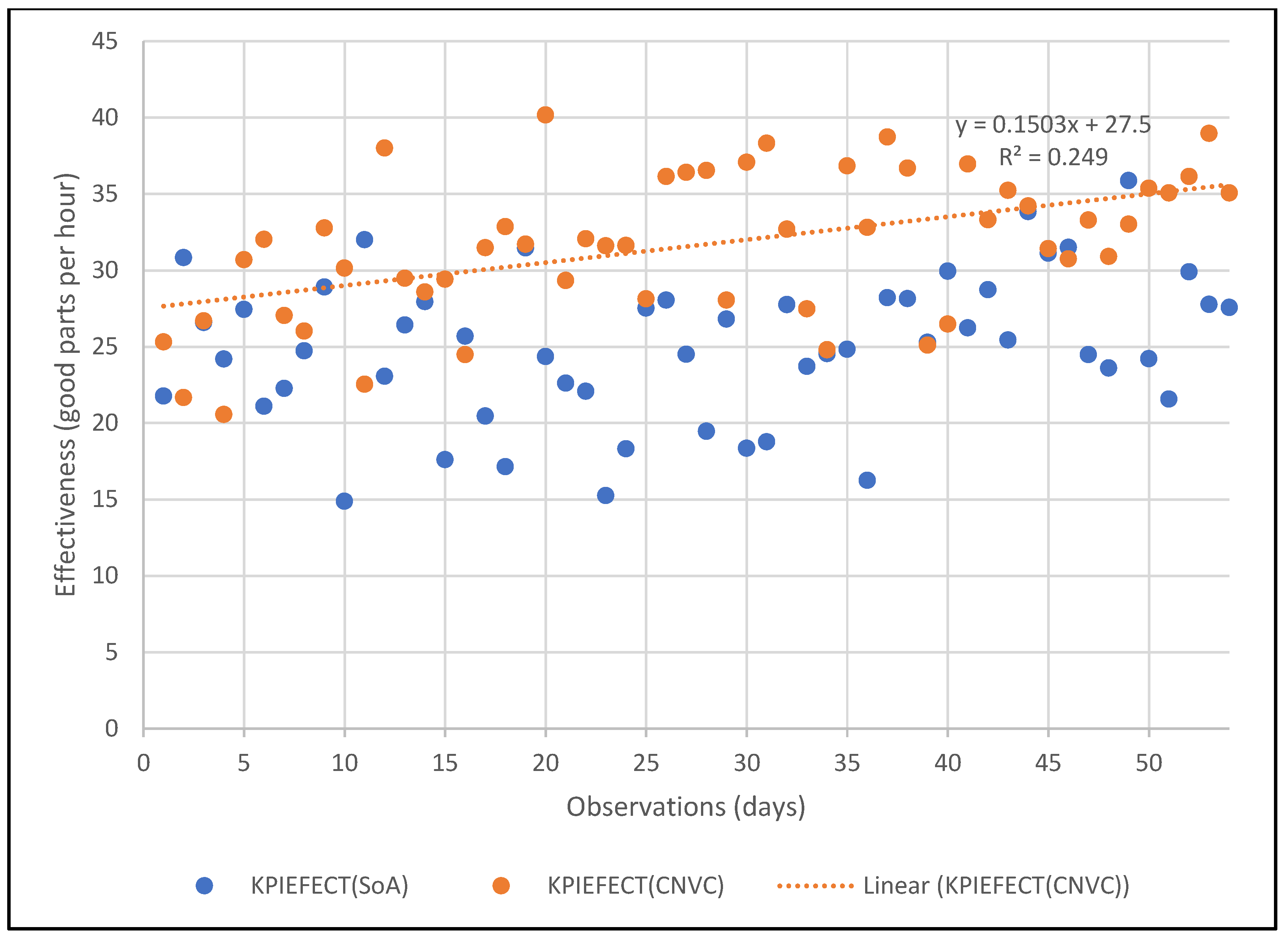
These results show a moderate positive correlation between coopetition networks and effectiveness (Pearson’s r = 0.499), suggesting that as coopetition integration increases, so does KPIEFECT. The trend line indicates that each unit increase in coopetition network integration boosts effectiveness by approximately 0.1503 good parts per hour, starting from a baseline of 27.5 good parts per hour. In contrast, coopetition networks account for about 24.9% of the variability in effectiveness. While significant, other factors also play a crucial role in influencing effectiveness.
These results demonstrate that transitioning to a coopetition network for value co-creation can enhance effectiveness, but SMEs should also consider other factors and strategies to maximize performance improvements.
This PoC confirmed the preliminary survey results, suggesting that by addressing areas for improvement and leveraging existing strengths, the coopetition network for the value cocreation concept is well-positioned to significantly influence the digital transformation of the ornamental stone sector in Portugal. Specifically, the coopetition network enhances dynamic and secure competition networks, which are essential for navigating the evolving competitive landscapes in the industry.
7. Conclusions
This study addresses a significant research gap in coopetition networks, particularly within the context of SMEs. While coopetition has been widely studied in large enterprises, its potential to enhance performance in SMEs still needs to be explored. The unique challenges SMEs face, such as limited resources and the absence of dominant players within their networks, make sustaining coopetition particularly difficult. This study aimed to fill this gap by developing a reference model for coopetition networks explicitly tailored for SMEs, grounded in the S-D Logic framework, which emphasizes co-creation and reciprocal value exchange.
The primary objective of this research was to create a practical, adaptable framework that enables SMEs to build, manage, and sustain coopetition networks effectively. By integrating S-D Logic, the model shifts the focus from transactional interactions to service-based exchanges, enabling SMEs to overcome resource limitations and collaborate more efficiently within a network. The proposed model spans the entire lifecycle of coopetition networks, from initiation through to dissolution, and provides actionable guidelines to help SMEs navigate these collaborative ventures.
A PoC was conducted in the Portuguese ornamental stone sector to validate the proposed model, chosen for its relevance and representativeness. The PoC played a crucial role in testing the model's real-world applicability. Results from a preliminary survey indicated a 92.3% approval rate among sector participants, demonstrating strong acceptance of the model and its practical utility for SMEs. This high level of endorsement provided critical validation for the model's relevance and effectiveness in facilitating coopetition.
Moreover, the PoC revealed substantial improvements in effectiveness when SMEs implemented the coopetition network model. Under standard operational conditions, effectiveness was recorded at 22.48 good parts per hour. When the coopetition network for value co-creation practices was applied, this metric increased significantly to 31.20 good parts per hour—representing a 38.8% improvement in effectiveness. This substantial gain confirms the model’s ability to enhance operational performance and validates its utility in real-world settings, demonstrating how coopetition networks can drive tangible benefits for SMEs.
By applying S-D Logic to the study of coopetition, this research highlights the importance of technology as an enabler of service exchange rather than simply a tool. This perspective deepens the understanding of coopetition networks as service ecosystems, enriching the discourse on value co-creation within SME networks. The findings underscore the critical role of technology in enhancing collaborative interactions and facilitating mutual value creation, particularly in the SME context where resource constraints are prevalent.
Despite the successful validation of the model, several limitations remain. The study did not fully explore the complex dynamics of human relationships within coopetition networks, which can significantly influence their sustainability. Future research should investigate how interpersonal and inter-organizational relationships affect the long-term success of these networks. Additionally, while this study focused on short-term gains in production efficiency, future research could examine the long-term sustainability of coopetition networks and their broader impacts on innovation and competitiveness over time. Another area for further investigation is the economic implications, including the costs and time associated with adopting and maintaining coopetition networks.
In conclusion, this study fills a critical gap in the coopetition literature by offering a reference model for coopetition among SMEs. The proposed model, grounded in S-D Logic and tested through a PoC, demonstrates the significant potential of coopetition networks to improve SME performance. The insights and methodologies developed here provide both a theoretical and practical foundation for enhancing the competitiveness of SMEs through strategic collaboration. The findings offer valuable contributions to the field and lay the groundwork for future research in the evolving digitalized, network-based business ecosystems landscape.
References
- Abdumutalibovich, K.A.; Lutfillaevna, B.M. The Role of Bim Technologies in the Information System of Education. European Journal of Contemporary Business Law & Technology: Cyber Law, Blockchain, and Legal Innovations 2023, 1, 9–13. [Google Scholar] [CrossRef]
- Afuah, A. Does a focal firm’s technology entry timing depend on the impact of the technology on co-opetitors? Research Policy 2004, 33, 1231–1246. [Google Scholar] [CrossRef]
- Akaka, M.A.; Vargo, S.L. Technology as an operant resource in service (eco)systems. Information Systems and E-Business Management 2014, 12, 367–384. [Google Scholar] [CrossRef]
- Akaka, M.; Vargo, S.; Lusch, R. The Complexity of Context: A Service Ecosystems Approach for International Marketing. Journal of International Marketing 2013, 21. [Google Scholar] [CrossRef]
- Aliyari, M.; Ayele, Y.Z. Application of Artificial Neural Networks for Power Load Prediction in Critical Infrastructure: A Comparative Case Study. Applied System Innovation 2023, 6, 115. [Google Scholar] [CrossRef]
- Arthur, W. B. THE NATURE of TECHNOLOGY (S. A. Penguin Books (South Africa) (Pty) Ltd, 24 Sturdee Avenue, Rosebank, Johannesburg 2196 (ed.)). Penguin Books Ltd, Registered Offices: 80 Strand, London WC2R 0RL, England. https://edisciplinas.usp.br/pluginfile.php/4210376/mod_resource/content/1/Brian Arthur-The nature of technology-2009.pdf. 2009. [Google Scholar]
- Ballantyne, D.; Varey, R.J. Creating value-in-use through marketing interaction: the exchange logic of relating, communicating and knowing. Marketing Theory 2006, 6, 335–348. [Google Scholar] [CrossRef]
- Barile, S.; Piciocchi, P.; Bassano, C.; Spohrer, J.; Pietronudo, M.C. Re-defining the role of artificial intelligence (AI) in wiser service systems. Advances in Intelligent Systems and Computing 2019, 787, 159–170. [Google Scholar] [CrossRef]
- Bicen, P.; Hunt, S.; Madhavaram, S. Coopetitive innovation alliance performance: Alliance competence, alliance’s market orientation, and relational governance. Journal of Business Research 2021, 123, 23–31. [Google Scholar] [CrossRef]
- Bouncken, R.; Kumar, A.; Connell, J.; Bhattacharyya, A.; He, K. Coopetition for corporate responsibility and sustainability: does it influence firm performance? International Journal of Entrepreneurial Behavior & Research 2024, 30, 128–154. [Google Scholar] [CrossRef]
- Breidbach, C.F.; Kolb, D.G.; Srinivasan, A. Connectivity in Service Systems: Does Technology-Enablement Impact the Ability of a Service System to Co-Create Value? Journal of Service Research 2013, 16, 428–441. [Google Scholar] [CrossRef]
- Breidbach, C.; Maglio, P. Technology-enabled value co-creation: An empirical analysis of actors, resources, and practices. Industrial Marketing Management 2016, 56, 73–85. [Google Scholar] [CrossRef]
- Briglauer, W.; Grajek, M. Effectiveness and efficiency of state aid for new broadband networks: evidence from OECD member states. Economics of Innovation and New Technology 2023, 1–29. [Google Scholar] [CrossRef]
- Carvalho JM, F.; Lisboa, J.V. Ornamental stone potential areas for land use planning: a case study in a limestone massif from Portugal. Environmental Earth Sciences 2018, 77, 206. [Google Scholar] [CrossRef]
- Chandler, J.; Vargo, S. Contextualization and Value-in-Context: How Context Frames Exchange. Marketing Theory 2011, 11, 35–49. [Google Scholar] [CrossRef]
- Chesbrough, H.; Rosenbloom, R. The role of the business model in capturing value from innovation: evidence from Xerox Corporation’s technology spin-off companies. Industrial and Corporate Change 2002, 11, 529–555. [Google Scholar] [CrossRef]
- Dagnino, G.; Padula, G. Coopetition Strategy. Towards a New Kind of Interfirm Dynamics? EURAM – The European Academy of Management Second Annual Conference - “Innovative Research in Management 2002, 9–11. [Google Scholar]
- Destefanis, S.; Maietta, O. W.; Mazzotta, F.; Parisi, L. Firm survival and innovation: direct and indirect effects of knowledge for SMEs. Economics of Innovation and New Technology 2023, 1–29. [Google Scholar] [CrossRef]
- Di Bella, L.; Katsinis, A.; Lagüera-González, J.; Odenthal, L.; Hell, M.; Lozar, B. Annual Report on European SMEs 2022/2023, 2023.
- Doganova, L.; Eyquem-Renault, M. What do business models do? Research Policy 2009, 38, 1559–1570. [Google Scholar] [CrossRef]
- Ghobadi, S.; D’Ambra, J. Coopetitive relationships in cross-functional software development teams: How to model and measure? Journal of Systems and Software 2012, 85, 1096–1104. [Google Scholar] [CrossRef]
- Hevner, A.; March, S.; Park, J.; Ram, S. Design Science in Information Systems Research. MIS Quarterly 2004, 28, 75. [Google Scholar] [CrossRef]
- Hoppe, S. OPC Unified Architecture-Interoperability for Industrie 4.0 and the Internet of Things. https://opcfoundation.org/wp-content/uploads/2023/05/OPC-UA-Interoperability-For-Industrie4-and-IoT-EN.pdf. 2023. [Google Scholar]
- Hunt, S. D. A General Theory of Competition: Resources, Competences, Productivity, Economic Growth. Thousand Oaks - Sage Publications 2000, 385–393. [Google Scholar]
- Lusch, R.F.; Vargo, S.L.; Tanniru, M. Service, value networks and learning. Journal of the Academy of Marketing Science 2010, 38, 19–31. [Google Scholar] [CrossRef]
- Lusch, R.; Nambisan, S. Service Innovation: A Service-Dominant Logic Perspective. MIS Quarterly 2015, 39, 155–175. [Google Scholar] [CrossRef]
- Lusch, R.; Vargo, S. Service-dominant logic: Continuing the evolution. Journal of the Academy of Marketing Science 2007, 36, 1–10. [Google Scholar] [CrossRef]
- Lusch, R.; Vargo, S.; Gustafsson, A. Fostering a trans-disciplinary perspectives of service ecosystems. Journal of Business Research 2016, 69, 2957–2963. [Google Scholar] [CrossRef]
- Maglio, P.P.; Spohrer, J. Fundamentals of service science. Journal of the Academy of Marketing Science 2008, 36, 18–20. [Google Scholar] [CrossRef]
- Maglio, P.P.; Spohrer, J. A service science perspective on business model innovation. Industrial Marketing Management 2013, 42, 665–670. [Google Scholar] [CrossRef]
- Maglio, P.; Vargo, S.; Caswell, N.; Spohrer, J. The service system is the basic abstraction of service science. Information Systems and E-Business Management 2009, 7, 395–406. [Google Scholar] [CrossRef]
- Meena, A.; Dhir, S.; Sushil, S. A review of coopetition and future research agenda. Journal of Business and Industrial Marketing 2023, 38, 118–136. [Google Scholar] [CrossRef]
- Mokyr, J. The Gifts of Athena; Princeton University Press, 2002; Available online: http://www.jstor.org/stable/j.ctt7rz25.
- Mosch, P.; Majocco, P.; Obermaier, R. Contrasting value creation strategies of industrial-IoT-platforms – a multiple case study. International Journal of Production Economics 2023, 263, 108937. [Google Scholar] [CrossRef]
- Muller, P.; Shaan, D.; Ladher, R.; Cannings, J.; Murphy, E.; Robin, N.; Illán, S.; Carsa, F.; Gorgels, S.; Priem, M.; Econ, D.; Smid, S.; Bohn, N.; Lefebvre, V.; Frizis, I. Annual Report on European SMEs, 2021.
- Nambisan, S. Information Technology and Product/Service Innovation: A Brief Assessment and Some Suggestions for Future Research. Journal of the Association of Information Systems 2013, 14, 215–226. [Google Scholar] [CrossRef]
- Nelson, R.R.; Nelson, K. Technology, institutions, and innovation systems. Research Policy 2002, 31, 265–272. [Google Scholar] [CrossRef]
- Ng, I.; Wakenshaw, S. The Internet-of-Things: Review and research directions. International Journal of Research in Marketing 2017, 34, 3–21. [Google Scholar] [CrossRef]
- Orlikowski, W.J. The Duality of Technology: Rethinking the Concept of Technology in Organizations. Organization Science 1992, 3, 398–427. [Google Scholar] [CrossRef]
- Orlikowski, W.J. The Duality of Technology: Rethinking the Concept of Technology in Organizations. Organization Science 1992, 3, 398–427. [Google Scholar] [CrossRef]
- Orlikowski, W.J. Using technology and constituting structures: A practice lens for studying technology in organizations. Organization Science 2000, 11, 404–428. [Google Scholar] [CrossRef]
- Pakkala, D.; Koivusaari, J.; Pääkkönen, P.; Spohrer, J. An Experimental Case Study on Edge Computing Based Cyber-Physical Digital Service Provisioning with Mobile Robotics. Proceedings of the 53rd Hawaii International Conference on System Sciences 2020, 1165–1174. [Google Scholar] [CrossRef]
- Payne, A.F.; Storbacka, K.; Frow, P. Managing the co-creation of value. Journal of the Academy of Marketing Science 2008, 36, 83–96. [Google Scholar] [CrossRef]
- Pongsakornrungsilp, S. Value Co-Creation Process: Reconciling S-D Logic of Marketing and Consumer Culture Theory within the Co-Consuming Group [University of Exeter]. http://hdl.handle.net/10036/113457. 2010. [Google Scholar]
- Prahalad, C. K. ;, & Ramaswamy. Co-opting Customer Competence. charts CO-OPTING CUSTOMER COMPETENCE. Harvard Business Review 2000, 78, 79–9. [Google Scholar]
- Raza-Ullah, T.; Bengtsson, M.; Kock, S. The coopetition paradox and tension in coopetition at multiple levels. Industrial Marketing Management 2014, 43, 189–198. [Google Scholar] [CrossRef]
- Razmdoost, K.; Alinaghian, L.; Chandler, J. D.; Mele, C. Service ecosystem boundary and boundary work. Journal of Business Research 2023, 156, 113489. [Google Scholar] [CrossRef]
- Reeves, M.; Lotan, H.; Legrand, J.; Jacobides, M. G. Chapter 3 How Business Ecosystems Rise (and Often Fall). In Business Ecosystems; De Gruyter, 2022; pp. 27–34. [Google Scholar] [CrossRef]
- Rusko, R. Mapping the perspectives of coopetition and technology-based strategic networks: A case of smartphones. Industrial Marketing Management 2014, 43, 801–812. [Google Scholar] [CrossRef]
- Schermann, M.; Böhmann, T.; Krcmar, H. Explicating Design Theories with Conceptual Models: Towards a Theoretical Role of Reference Models. In Wissenschaftstheorie und gestaltungsorientierte Wirtschaftsinformatik; Becker, J., Krcmar, H., Niehaves, B., Eds.; Physica-Verlag HD, 2009; pp. 175–194. [Google Scholar] [CrossRef]
- Scott, W. Institutions and Organizations - Ideas, Interests, and Identities; SAGE Publications, Inc., 2013. [Google Scholar]
- Shao, S.; Cao, D. Contagion of BIM Implementation Practices in Interproject Networks: An Empirical Study in China. Journal of Management in Engineering 2024, 40. [Google Scholar] [CrossRef]
- Silva, A.; Dionísio, A.; Coelho, L. Flexible-lean processes optimization : A case study in stone sector. Results in Engineering 2020, 6, 100129. [Google Scholar] [CrossRef]
- Silva, A.; Marques Cardoso, A. BIM-based Supply Chain in AEC - Threats on the Portuguese Stone sector. In I. 978-972-778-327-4 (Ed.), Proceedings of the 7th Globalstone Congress, Batalha, 2023; ISBN 978-972-778-327-4. https://repositorio.lneg.pt/bitstream/10400.9/4150/1/GSC2023_PT Natural Stones-Commercial Names harmonization.pdf.
- Silva, A.; Pata, A. Value Creation in Technology Service Ecosystems - Empirical Case Study. In Innovations in Industrial Engeneering II; Machado, J., Soares, F., Trojanowska, J., Ivanov, V., Antosz, K., Ren, Y., Manupati, V. K., Pereira, A., Eds.; Springer International Publishing; pp. 26–36. [CrossRef]
- Simon, H. A. The Science of Design: Creating the Artificial. Design Issues 1988, 4, 67. [Google Scholar] [CrossRef]
- Sklyar, A.; Kowalkowski, C.; Sörhammar, D.; Tronvoll, B. Resource integration through digitalization: a service ecosystem perspective. Journal of Marketing Management 2019, 35, 974–991. [Google Scholar] [CrossRef]
- Slavic, D.; Marjanovic, U.; Medic, N.; Simeunovic, N.; Rakic, S. The Evaluation of Industry 5.0 Concepts: Social Network Analysis Approach. Applied Sciences 2024, 14, 1291. [Google Scholar] [CrossRef]
- Spohrer, J. C.; Maglio, P. P. Toward a Science of Service Systems; 2010; pp. 157–194. [Google Scholar] [CrossRef]
- Spohrer, J.; Maglio, P.; Bailey, J.; Gruhl, D. Steps Toward a Science of Service Systems. IEE Computer Society 2007, 40, 71–77. [Google Scholar] [CrossRef]
- Storbacka, K.; Nenonen, S. Scripting markets: From value propositions to market propositions. Industrial Marketing Management 2011, 40, 255–266. [Google Scholar] [CrossRef]
- Tidström, A. Managing tensions in coopetition. Industrial Marketing Management 2014, 43, 261–271. [Google Scholar] [CrossRef]
- Vargo, S.; Akaka, M. Value Cocreation and Service Systems (Re)Formation: A Service Ecosystems View. Service Science 2012, 4, 207–217. [Google Scholar] [CrossRef]
- Vargo, S.L.; Lusch, R. Service-dominant logic 2025. International Journal of Research in Marketing 2017, 34, 46–67. [Google Scholar] [CrossRef]
- Vargo, S.; Lusch, R. Institutions and axioms: an extension and update of service-dominant logic. Journal of the Academy of Marketing Science 2016, 44, 5–23. [Google Scholar] [CrossRef]
- Vargo, S.; Wieland, H.; Akaka, M. Innovation through institutionalization: A service ecosystems perspective. Industrial Marketing Management 2015, 44, 63–72. [Google Scholar] [CrossRef]
- Vargo, S.L.; Akaka, M. A. Service-Dominant Logic as a Foundation for Service Science: Clarifications. Service Science 2009, 1, 32–41. [Google Scholar] [CrossRef]
- Vargo, S.L.; Akaka, M. A.; Wieland, H. Rethinking the process of diffusion in innovation: A service-ecosystems and institutional perspective. Journal of Business Research 2020, 116, 526–534. [Google Scholar] [CrossRef]
- Vargo, S.L.; Fehrer, J. A.; Wieland, H.; Nariswari, A. The nature and fundamental elements of digital service innovation. Journal of Service Management 2024, 35, 227–252. [Google Scholar] [CrossRef]
- Vargo, S.L.; Lusch, R. F. Evolving to a New Dominant Logic for Marketing. Journal of Marketing 2004, 68, 1–17. [Google Scholar] [CrossRef]
- Vargo, S.L.; Lusch, R. F. From goods to service(s): Divergences and convergences of logics. Industrial Marketing Management 2008, 37, 254–259. [Google Scholar] [CrossRef]
- Vargo, S.L.; Lusch, R. F. It’s all B2B…and beyond: Toward a systems perspective of the market. Industrial Marketing Management 2011, 40, 181–187. [Google Scholar] [CrossRef]
- Vargo, S.L.; Lusch, R. F. Inversions of service-dominant logic. Marketing Theory 2014, 14, 239–248. [Google Scholar] [CrossRef]
- Vargo, S.L.; Lusch, R. F. Why “service”? Journal of the Academy of Marketing Science 2008, 36, 25–38. [Google Scholar] [CrossRef]
- Vargo, S.L.; Lusch, R. F. Advancing Service Science with Service-Dominant Logic; 2010; Volume 2008. [Google Scholar] [CrossRef]
- vom Brocke, J.; Hevner, A.; Maedche, A. Introduction to Design Science Research; 2020; pp. 1–13. [Google Scholar] [CrossRef]
- Wijeratne, P. U.; Gunarathna, C.; Yang, R. J.; Wu, P.; Hampson, K.; Shemery, A. BIM enabler for facilities management: a review of 33 cases. International Journal of Construction Management 2024, 24, 251–260. [Google Scholar] [CrossRef]
- Zott, C.; Amit, R. The fit between product market strategy and business model: implications for firm performance. Strategic Management Journal 2008, 29, 1–26. [Google Scholar] [CrossRef]
Figure 1.
Coopetition Network Lifecycle: A Service Ecosystems Perspective.
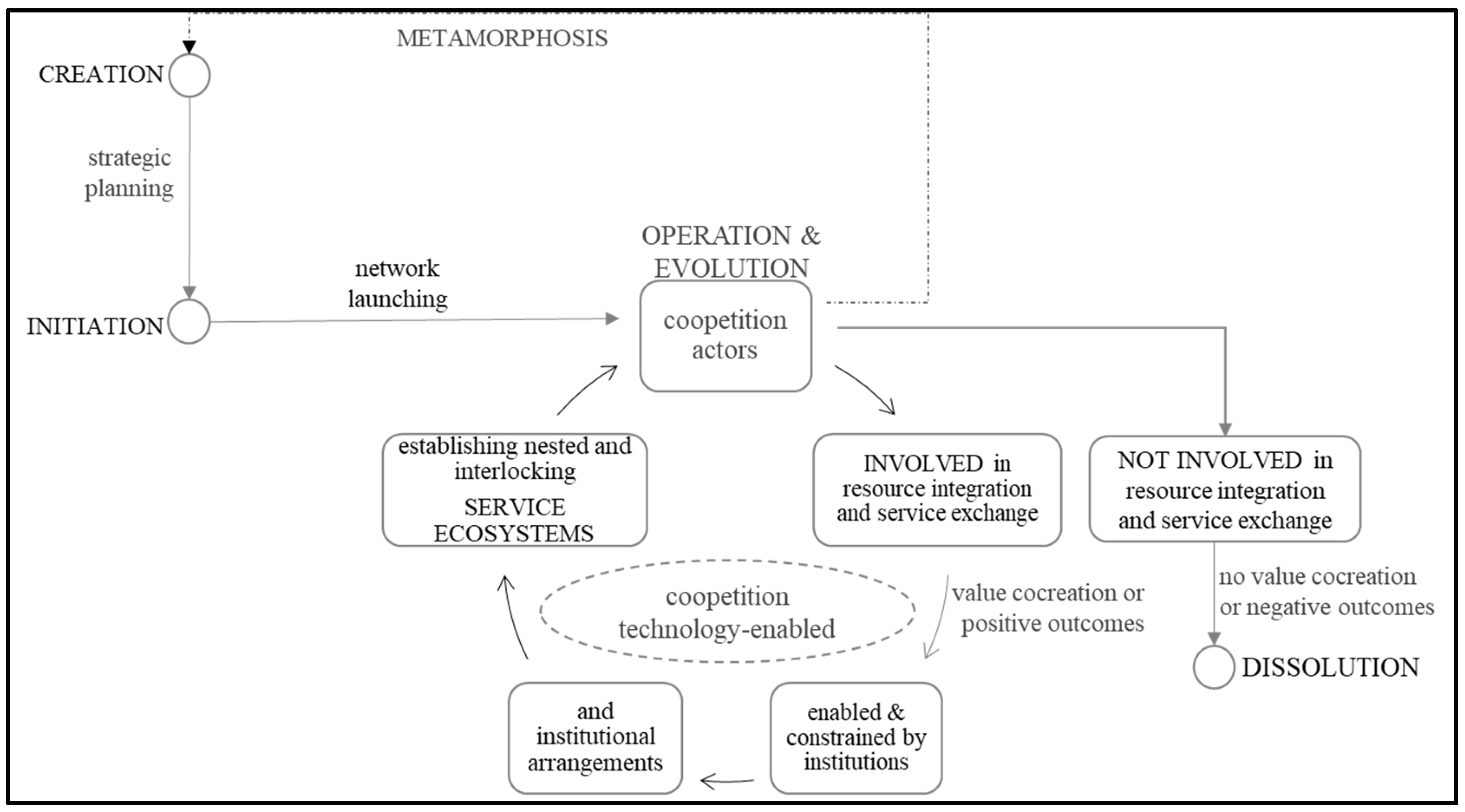
Figure 2.
The Initiation Stage of the coopetition networks for value co-creation.
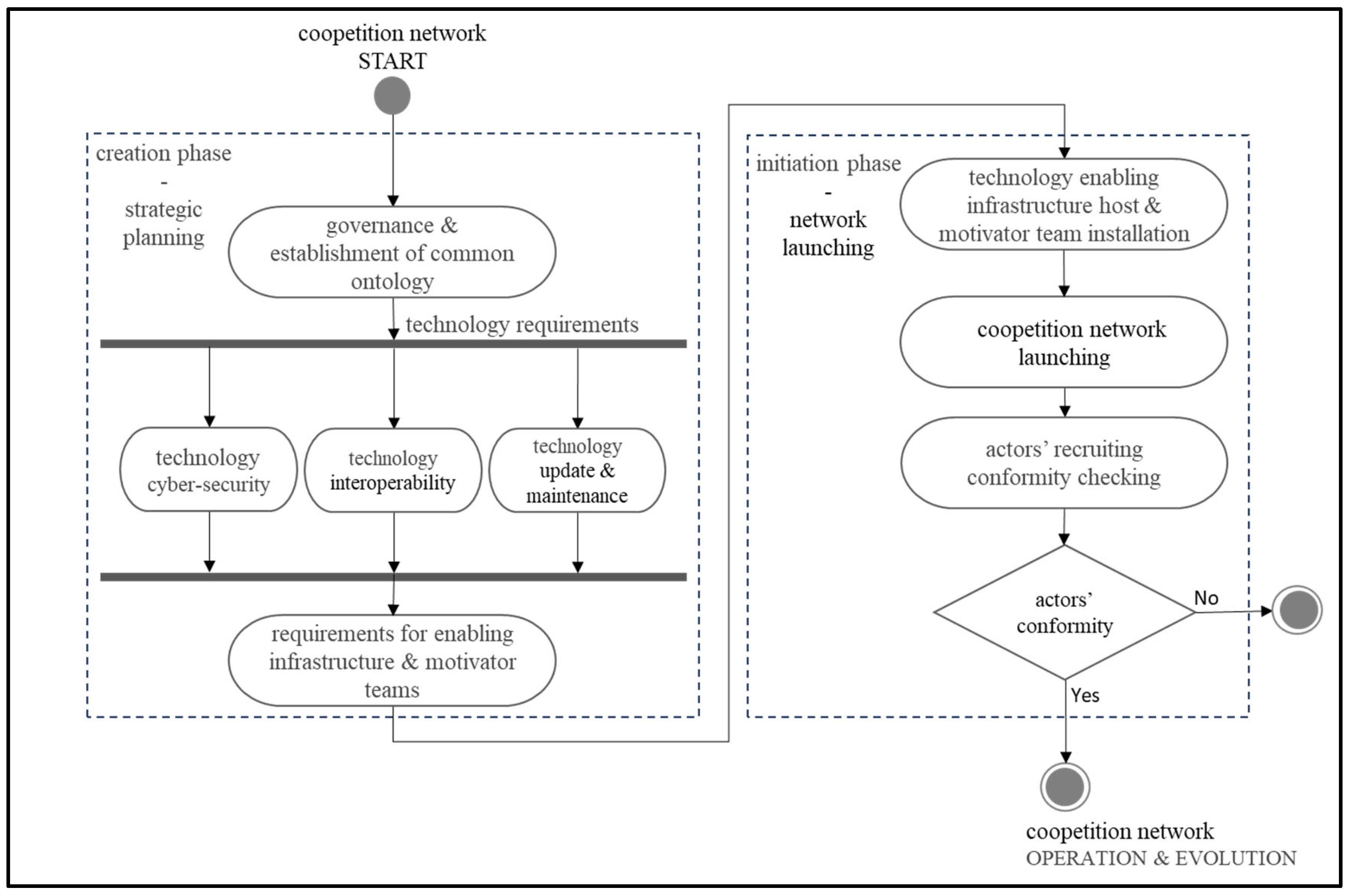
Figure 3.
The Operation and Evolution stage of the coopetition networks for value co-creation.
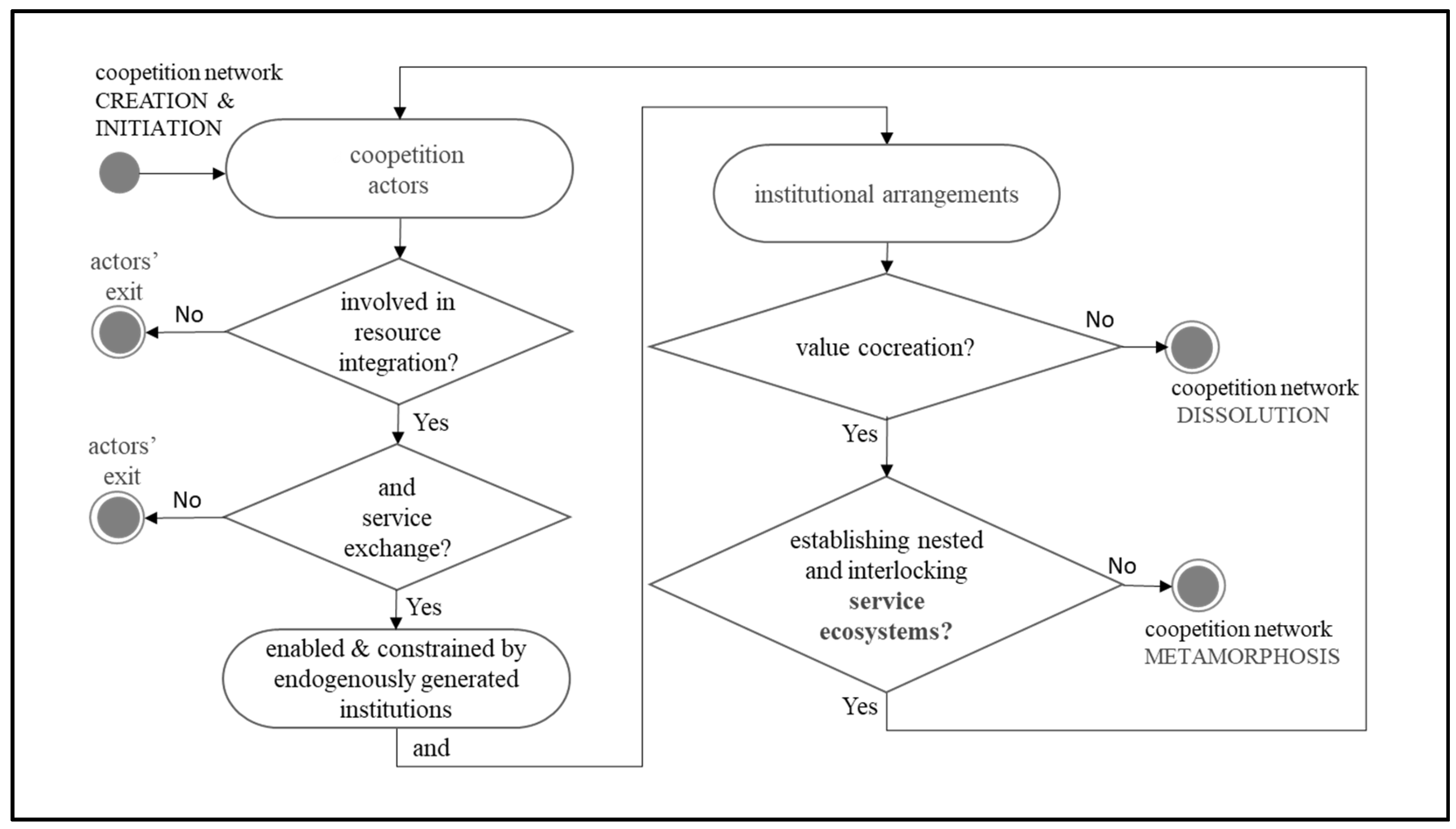
Figure 4.
Metamorphosis stage of the coopetition networks for value co-creation.
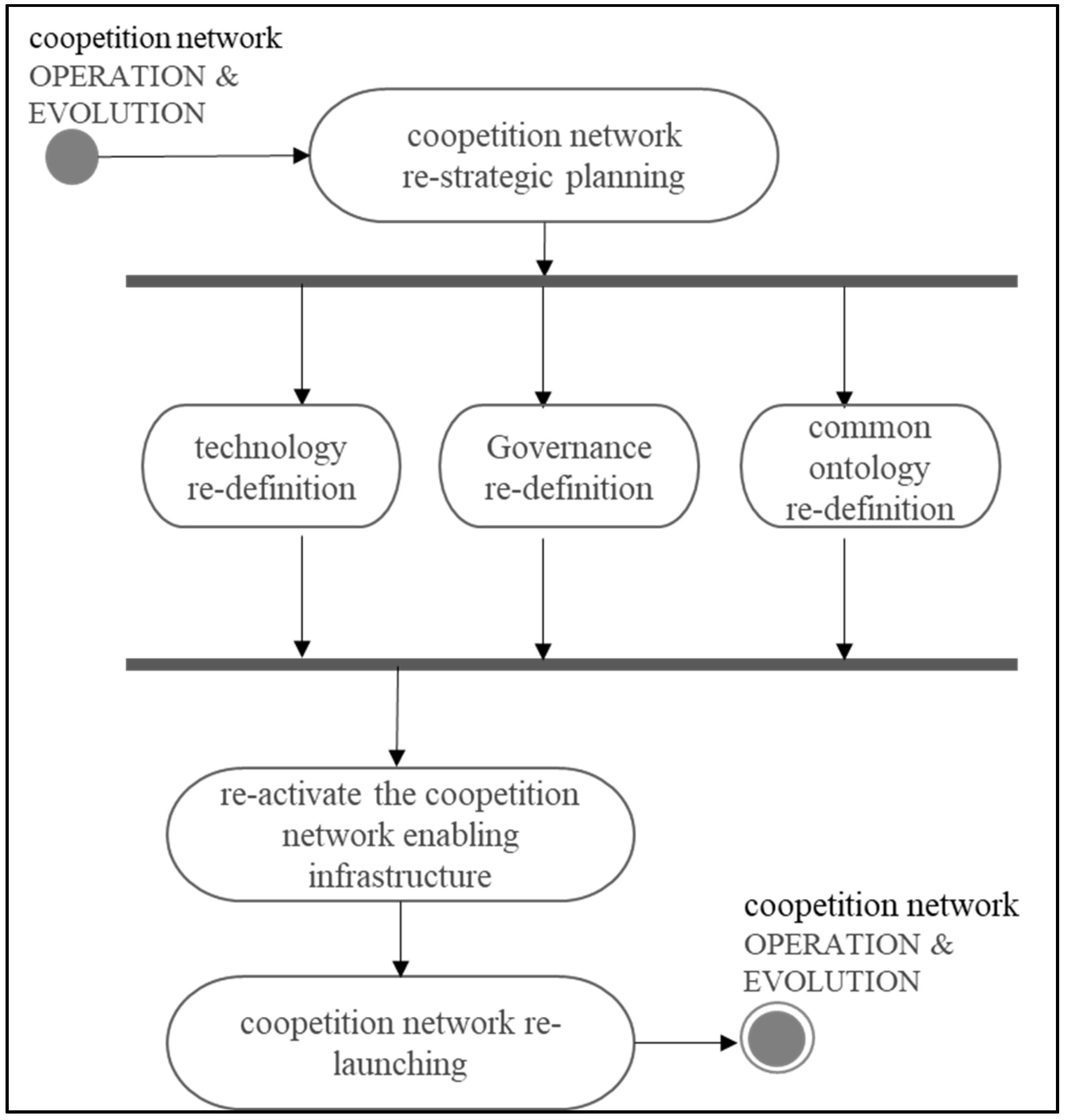
Figure 5.
Dissolution stage of the coopetition for value co-creation.
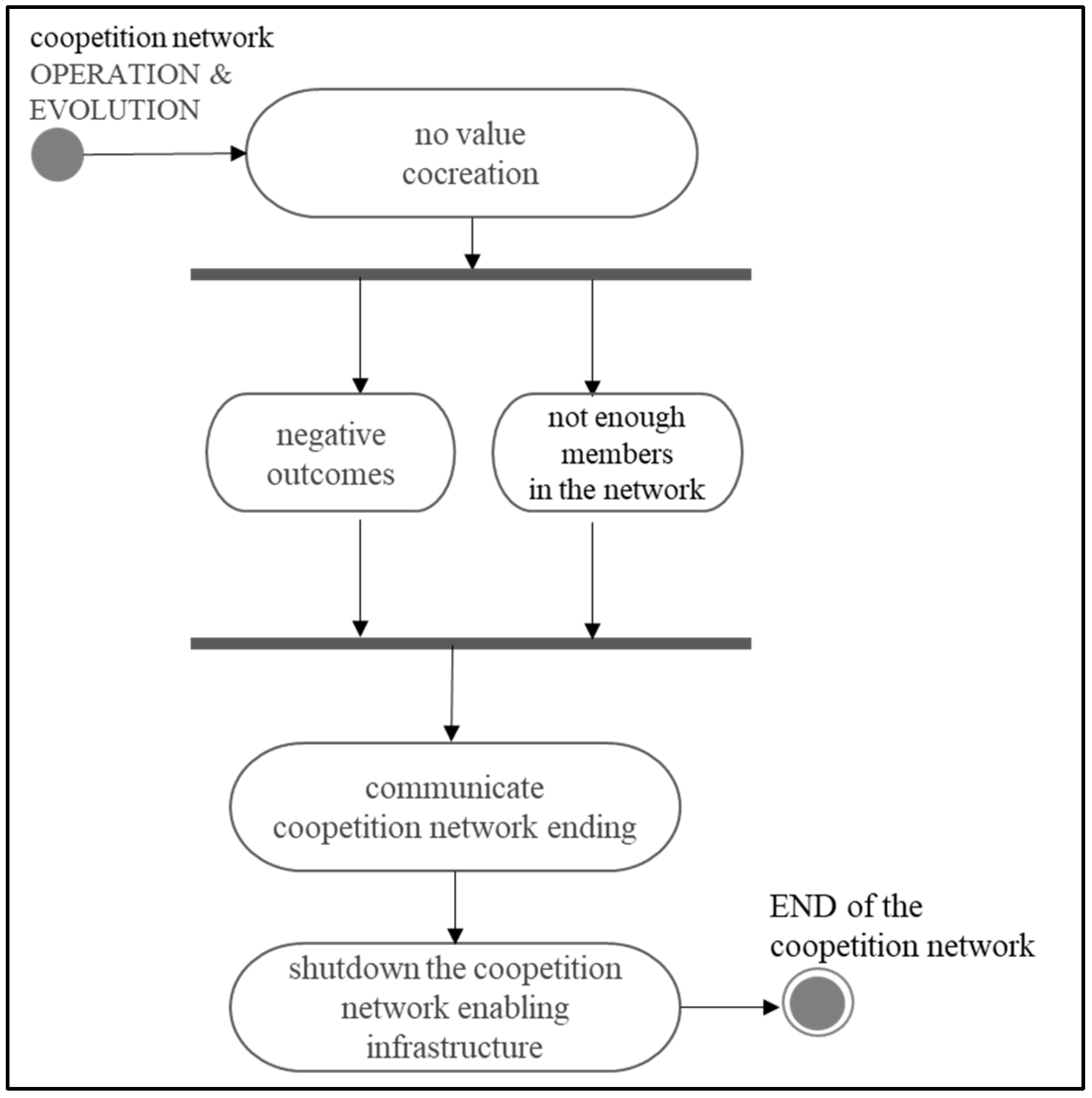
Figure 6.
Functional Acceptance of Coopetition Networks for Value Co-creation.
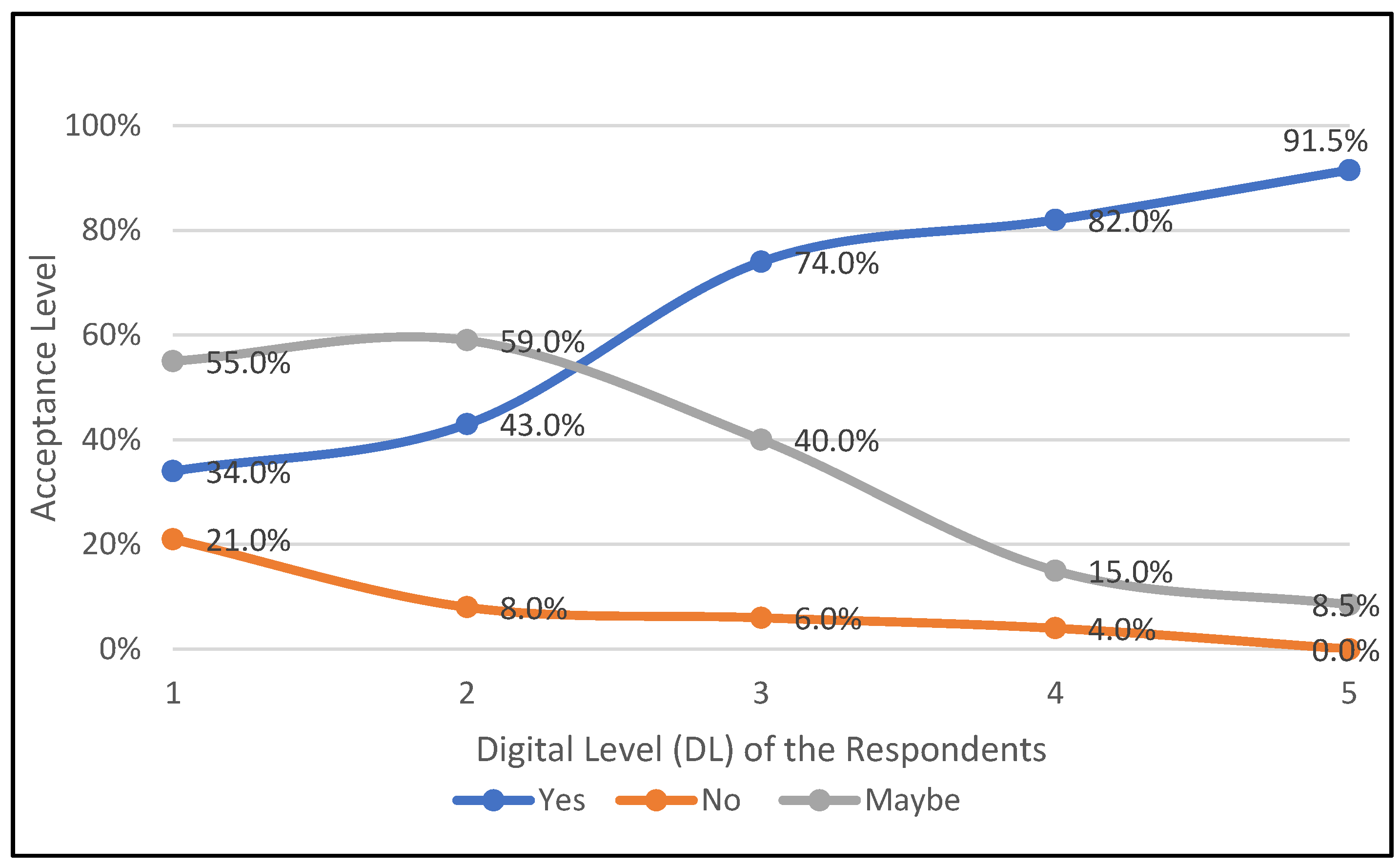
Figure 7.
The IoT-enabled coopetition networks for value co-creation.
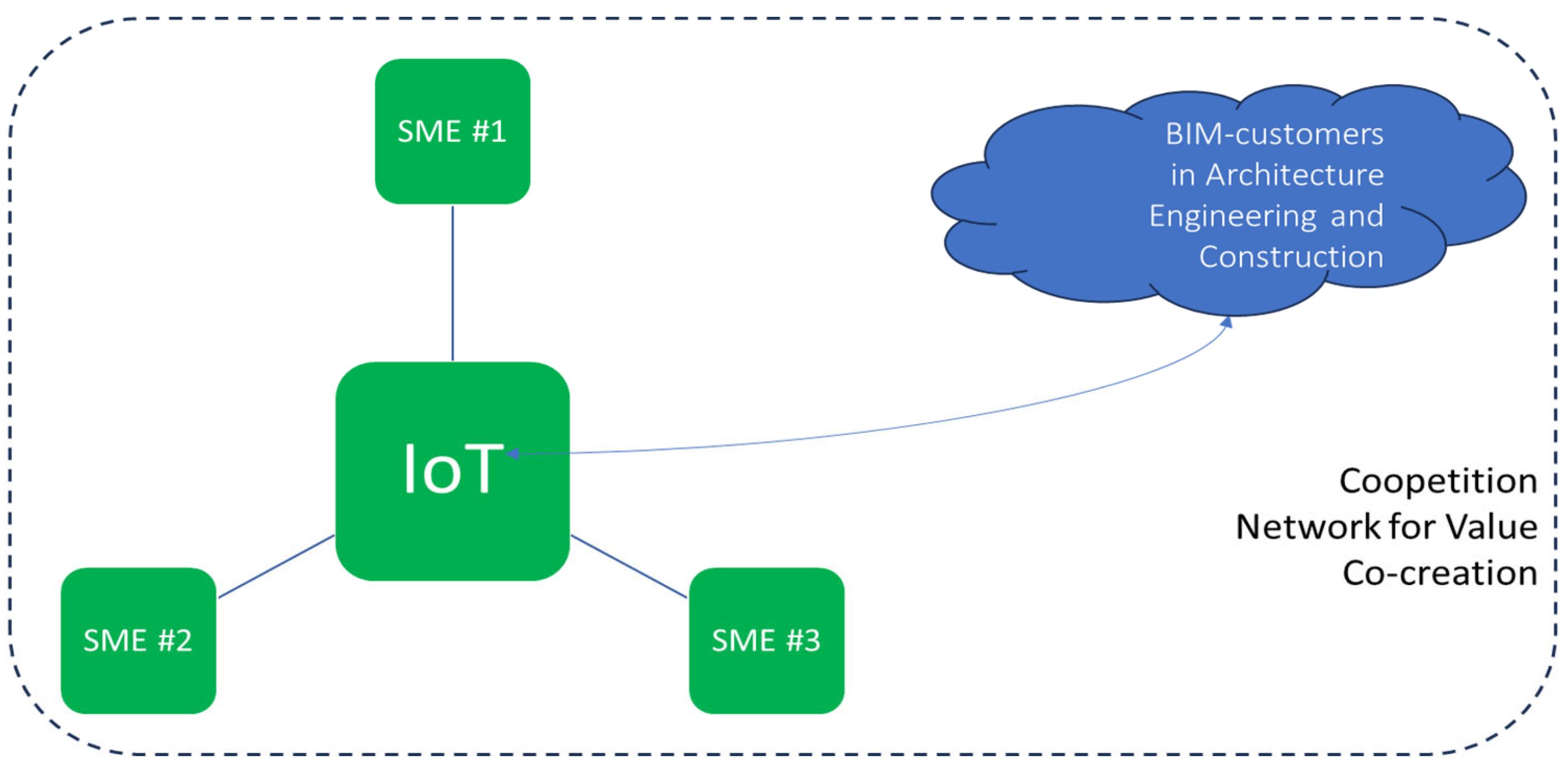

Table 1.
Summary of Data Collected During the Proof-of-Concept.
| Data | Description | Daily average (SoA) | Daily average (CNVC) |
|---|---|---|---|
| Data 1 | Good Parts Produced (good parts) | 299.2 | 415.8 |
| Data 2 | Production Time (hours/day) | 13.3 | 13.3 |
| KPIEFECT | Efficiency (good parts/hour) | 22.48 | 31.20 |
Disclaimer/Publisher’s Note: The statements, opinions and data contained in all publications are solely those of the individual author(s) and contributor(s) and not of MDPI and/or the editor(s). MDPI and/or the editor(s) disclaim responsibility for any injury to people or property resulting from any ideas, methods, instructions or products referred to in the content. |
© 2024 by the authors. Licensee MDPI, Basel, Switzerland. This article is an open access article distributed under the terms and conditions of the Creative Commons Attribution (CC BY) license (http://creativecommons.org/licenses/by/4.0/).
Copyright: This open access article is published under a Creative Commons CC BY 4.0 license, which permit the free download, distribution, and reuse, provided that the author and preprint are cited in any reuse.


