

Submitted:
30 September 2024
Posted:
01 October 2024
You are already at the latest version
Abstract
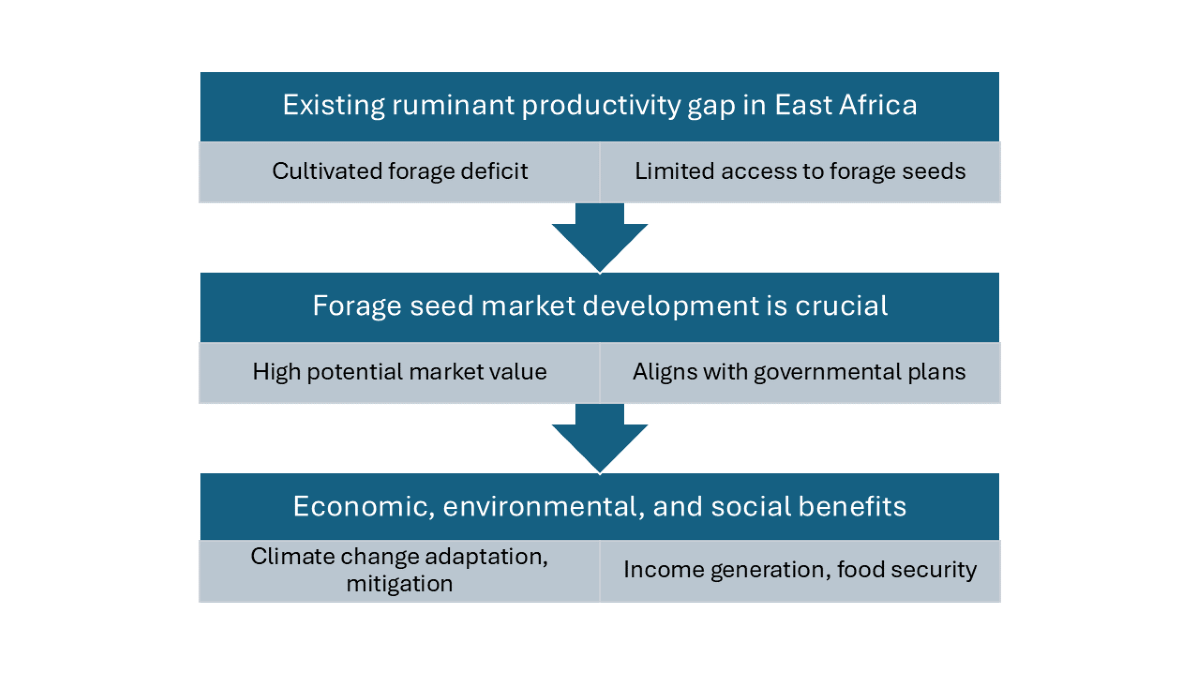
In this study, we address key challenges in enhancing ruminant productivity across Ethiopia, Tanzania, Kenya, Uganda, Rwanda, and Burundi in eastern Africa. A critical focus is on improving access to forage seeds essential for cattle systems. Key factors such as ruminant population, feed deficits, and governmental priorities are examined. The primary challenge lies in inadequate access to affordable forage seeds, compounded by reluctance to invest in perceived expensive elite varieties. Many farmers rely on outdated planting materials, lacking purity and vigor. To overcome these barriers, our analysis stresses the urgency of transitioning to recently improved seed varieties through rigorous selection and breeding. Promoting domestic seed production within Africa is crucial to mitigate high import costs and logistical complexities like variety registration. A coordinated regional approach to seed production could enhance economic viability and foster widespread adoption of improved forages. Such initiatives align with governmental agendas for sector development, offering triple benefits: increased productivity, environmental gains through reduced methane emissions, and regional economic growth.
Keywords:
market potential
; feed deficit
; cultivated forages
; ruminants
; food security
; seed systems
Highlights
- Governments prioritize forages to boost livestock productivity and sustainability
- East Africa faces a 40% annual feed deficit, impacting food security and livelihoods
- Cultivated forage seed requirement: 95,605 tons for 10% adoption over 10 years
- 2M hectares and 1.5M farmers are needed to close the forage deficit in the region
- Regional forage seed market could reach US$877 billion over 10 years
1. Introduction
Livestock farming is essential in Africa, where most producers are small-scale farmers who rely on their animals for income, nutrition, insurance, and savings (Felis, 2020; Bahta & Malope, 2014; FAO, 2018). The continent is projected to experience a significant rise in demand for animal-sourced foods (ASF), with milk consumption expected to increase from 30 liters to 64 liters per capita annually by 2050, and meat consumption from 14 kg to 26 kg (Paul et al., 2021; Little et al., 2014; Njuki and Mburu, 2013; Moritz, 2013). In East Africa, livestock supports millions of livelihoods by providing food, income, and employment (East African Community, 2022), and the region counts on Africa’s largest cattle herd and is the main exporter of cattle on the continent (DAI, 2023).
When it comes to feeding these large numbers of livestock, mixed feed baskets are the main source of animal nutrition and feed makes up approximately 60-70% of the overall production costs (Maina et al., 2022; Strauch and Stockton, 2017). Literature is abundant with information on the limitations in the quality and quantity of livestock feed, its impact on animal productivity in Africa, and the influence of climate change on feed production (e.g., de Oto et al., 2019; Paul et al., 2020). This issue has persisted for several decades and remains prevalent across most sub-Saharan African countries. Despite the existence of technologies, such as adapted forages that could potentially address these gaps, the intentional cultivation of forages has lagged (Flórez et al., 2024; Ahumuza et al., 2022; Dey, 2021). Furthermore, business models for seed distribution that could stimulate market demand for quality cultivated forages and increase technology access are underdeveloped and lead to high shares of labor-intense vegetative propagation through splits (Flórez et al., 2024; Creemers and Opinya, 2022).
Mixed farming and pastoral systems, both of which strongly rely on ruminants, are widespread but lack strategies to bridge feed deficits, leading to animal losses in severe cases, a situation strongly aggravated by climate change. Notably, forage cultivation is limited in mixed systems (Fuglie et al., 2021), and pastoral areas depend on natural grasses without large-scale conservation efforts for the dry seasons. In some countries, like Rwanda, livestock populations continue to grow despite these challenges, adding pressure to the production systems (Habiyaremye et al., 2021).
To put the low levels of cultivation into perspective, Ethiopia, Tanzania, Kenya, Uganda, Rwanda, and Burundi together have a cultivated forage area of about 1.5 million hectares, compared to Colombia’s 8.9 million hectares, which is 5.8 times higher despite eastern Africa having significantly more agricultural land compared to Colombia (273 million vs. 42.7 million hectares) (Fuglie et al., 2021). The reasons for low forage cultivation are diverse and include limited land availability due to competition with food crops, lack of seeds and planting materials (Flórez et al., 2024), high seed prices and unwillingness to pay for improved forage seeds (Osiemo et al., 2024; Flórez et al., 2024), adverse weather conditions, lack of skills and technology (Flórez et al., 2024; Creemers and Alvarez-Aranguiz, 2019; Maina et al., 2022; Fuglie et al., 2021), and other socio-cultural factors.
Addressing these key bottlenecks is essential. For instance, integrating forages into mixed systems at a maximum of 33% could support sustainable food production (Dey et al., 2022). In addition, mitigation strategies are urgently needed to address adverse climatic conditions and contribute to greenhouse gas (GHG) emission reduction. Cultivated forages can help in carbon sequestration, reduce methane emissions per unit of animal product, and in general, sustainably increase meat and milk productivity (Rao et al., 2015; Karimi et al., 2022; Paul et al., 2020; Maina et al., 2020; Schiek et al., 2018). Some forages, like certain Urochloa species, possess Biological Nitrification Inhibition (BNI) properties that reduce nitrate denitrification to nitrous oxide, a potent GHG (Arango et al., 2013). Cultivated forages can alleviate land pressure by boosting productivity per hectare, thereby helping to prevent the encroachment of agricultural expansion into vital ecosystems like forests and protected areas (Cohn et al., 2014; Edwards et al., 2021). In addition to their mitigation potential, improved forages also enhance system adaptation to adverse climatic conditions, such as severe droughts or waterlogging, thereby increasing resilience (Macedo Pezzopane et al., 2019; Naranjo Ramírez et al., 2014; Montagnini et al., 2013;).
The shortage of forage seeds and limited access to them could be addressed through local seed production initiatives. This would lower seed costs compared to imports, making them more affordable for farmers and reducing their reluctance to invest in them (Osiemo et al., 2024). For example, Urochloa seeds cost US$40-50 per kilo in Kenya (Flórez et al., 2024) compared to about US$15-30 in Latin America, where most of the seeds are being produced. A conducive policy environment that fosters access to forage seeds through efficient variety registration processes is key for further seed sector development and stronger private seed sector involvement (Flórez et al., 2024). Local seed production business models can also boost income generation and diversification, thereby improving the livelihoods of people in rural areas and contributing to reducing migration of youth to cities (Narjes Sanchez et al., 2021).
Against this background, this article aims at providing evidence for improving access to forage seeds for ruminant systems in several East African countries, specifically Ethiopia, Tanzania, Kenya, Uganda, Rwanda, and Burundi. Drawing on existing literature, we address the following research questions: (i) What governmental plans exist to promote the livestock sector in the region, and how are forage seeds integrated into these plans? (ii) What is the current cultivated forage dry matter deficit in the region, and how many forage seeds are needed to close this gap? (iii) How much land and how many farmers would be required to implement the adoption of forage cultivation? (iv) Can vegetative propagation through splits be a viable alternative to seeds in addressing the forage deficit? (v) What is the estimated economic value of the forage seed market, and how much value could forage crops generate over time? (vi) What would be necessary to develop a functioning regional forage seed system and ensure widespread forage adoption?
We begin by examining the governmental priorities for the livestock sector in the studied countries to identify future goals and needs. Next, we calculate the annual feed demand for ruminant livestock and the existing feed deficit. Following this, we select two forage grasses—Urochloa hybrids and Megathyrsus maximus—and two forage legumes—Lablab purpureus and Vigna unguiculata (cowpea)—chosen for their adaptability to the predominantly tropical agroclimatic conditions of these countries, their provision of essential nutrients for ruminants, and the availability of their seeds. We then calculate the quantity of forage seeds needed to bridge the estimated feed deficit. Afterward, we estimate the land area required to cultivate these forages, the number of farmers needed for adoption, the economic value of this potential forage seed market, and the value that forage crop adoption could generate over a 10-year period. Finally, we outline the steps necessary to develop a functional forage seed system to support widespread adoption.
This article is structured as follows: Section two highlights the materials and methods applied in each section, Section three provides a combined results and discussion section in which we answer the research questions, and Section four provides concluding remarks and recommendations.
2. Materials and Methods
First, we examined the most recent governmental plans, such as Livestock Master Plans, across the six countries under analysis. Using qualitative content analysis, we summarized these plans, highlighting key aspects relevant to future development.
Second, we reviewed recent scientific and grey literature to gather data on total ruminant populations (including cattle, sheep, goats, and camels), Tropical Livestock Units (TLU), annual feed demand, and annual feed deficit (see Table 4). Using this data and following the methodology outlined by Dey et al. (2022), we estimated the portion of the annual feed deficit that could be addressed by the selected forage grasses and legumes (referred to as the annual cultivated forage deficit) for each country using the following equation:
where is the annual cultivated forage deficit per country in tons of dry matter and is the total annual feed deficit per country in tons of dry matter. is the share of roughages of the total diet, which is estimated to be 70% (30% concentrates) (Dey et al., 2022). is the share of accounting for recommended cultivated forage inclusion and is 33% (Dey et al., 2022).
Third and prior to estimating the amount of forage seeds needed to bridge the projected feed deficits, we selected two forage grasses and two forage legumes that (i) are adaptable to the (largely tropical) agroclimatic conditions of the countries, (ii) supply key nutrients required by ruminants, i.e., metabolizable energy and crude protein, and (iii) have seed availability in the region, either through the seed private sector or other sources (e.g., informal seed system, development projects, governmental programs). The selected grass species are Urochloa hybrids and Megathyrsus maximus, and the selected legume species are Lablab purpureus and Vigna unguiculata (cowpea) both of which in some cases are used for human food and can also do well in relatively marginal areas. Their attributes, such as growth type, seed rate, days to first cut, days to regrowth cutting, days to cutting after sowing, and potential yields, were extracted from Dey et al. (2022).
Fourth, we estimated the amount of forage seeds required for the four selected species to address the identified . For this purpose, we calculated different scenarios:
- Scenario 1: Where 100% of the identified is covered in the first year by simultaneously planting the two grass species at 35% each and the two legume species at 15% each. This scenario considers a 10-year evaluation horizon, the annual seed requirements for reseeding the legumes, and regeneration seed for the grasses for the last three years at 100%.
- Scenario 2: Where 10% of the identified is covered in the first year by simultaneously planting the two grass species at 35% each and the two legume species at 15% each. We projected a 10% annual increase in covering the and a lifespan of 7 years for the perennial grasses (Jank et al., 2014). For the two longer-term perennial grasses (Megathyrsus maximus, Urochloa hybrids), we included annual regeneration seed in the calculation after year 7 at 100%. The projected horizon for our calculations is 10 years.
The following equations were estimated for Scenario 1:
where is the annual forage seed requirement of a country (in tons), is the annual forage seed requirement for Urochloa hybrids (in tons), is the annual forage seed requirement for Megathyrsus maximus (in tons), is the annual forage seed requirement for Lablab purpureus (in tons), and is the annual forage seed requirement for Vigna unguiculata (in tons).
where is the general annual forage seed requirement for Urochloa hybrids, is the forage seed requirement for Urochloa hybrids for regeneration purposes, is the general annual forage seed requirement for Megathyrsus maximus, is the forage seed requirement for Megathyrsus maximus for regeneration purposes, is the total annual cultivated forage deficit of a country (in t), is the share of area that could be covered with Urochloa hybrids (35%), is the Urochloa hybrid seed rate (in t ha-1), is the Urochloa hybrid yield (in t ha-1), is the share of area that could be covered with Megathyrsus maximus (35%), is the Megathyrsus maximus seed rate (in t ha-1), is the Megathyrsus maximus yield (in t ha-1), is the share of area that could be covered with Lablab purpureus (15%), is the Lablab purpureus seed rate (in t ha-1), is the Lablab purpureus yield (in t ha-1), is the share of area that could be covered with Vigna unguiculata (15%), is the Vigna unguiculata seed rate (in t ha-1), is the Vigna unguiculata yield (in t ha-1), is the number of years in which regeneration seed is being used (3 years), and is the evaluation horizon (10 years).
For Scenario 2, we broke down and by year by multiplying and by 10% to reflect the projected adoption rate and their perennial character. For the inclusion of regeneration seed, for the years 8, 9, and 10, we divided and by and added the respective values to the and for years 8, 9, and 10. To reflect the annual seeding of the selected legumes, we divided and by and then multiplied it by the respective year of analysis.
Fifth, we estimated the amount of land that would be required for the adoption of the suggested cultivated forages as well as the number of farmers that would be needed. For this, we estimated the following equations:
where is the amount of land required in the adoption process (in ha), , , , are the total forage seed requirements (in tons) for Urochloa hybrids, Megathyrsus maximus, Lablab purpureus, and Vigna unguiculata, , , , are the seed rates (in tons ha-1) for Urochloa hybrids, Megathyrsus maximus, Lablab purpureus, and Vigna unguiculata, is the total number farmers needed in the adoption process, and is the average farm size (in hectares) per country.
Sixth, we estimated both the total and annual economic values of the cultivated forage seed market, applying two scenarios. For Scenario 1, we used current seed prices to reflect the current situation. For Scenario 2, we applied reduced seed prices by 25% to reflect a scenario in which a) some of the seed is produced locally and b) economies of scale apply due to higher seed purchases. The following equation was calculated:
where is the economic value of the forage seed market in US$, and , , , are the average seed prices (in 2023 US$) for Urochloa hybrids, Megathyrsus maximus, Lablab purpureus, and Vigna unguiculata.
Seventh, we estimated the potential cultivated forage value in 2015 US$ according to the method described by Fuglie et al. (2021). We applied a forage price equivalent to 18% of the global maize price (as leading feed grain). The global average maize price was consulted with FAO for 2014-2016 (US$201 t-1) and the resulting average forage price was US$36 per ton dry matter (in 2015 US$). For this, we estimated the following equation:
where FCV refers to the cultivated forage crop value (in 2015 US$), to the estimated area to be cultivated with Urochloa hybrids, Megathyrsus maximus, Lablab purpureus, and Vigna unguiculata (ha), , , , to the forage dry matter yield for Urochloa hybrids, Megathyrsus maximus, Lablab purpureus, and Vigna unguiculata (t ha-1 y-1), and p to the average forage price per ton of dry matter (in 2015 US$).
3. Results and Discussion
3.1. Governmental Plans for the Livestock Sector in the Studied Countries
Table 1 summarizes the governmental plans for the livestock sector in the studied countries. It highlights that governments in the region aim to increase the sector’s contribution to their Gross Domestic Products, while emphasizing the need for sustainably boosting livestock productivity with a commercial focus and prioritizing environmental stewardship in some cases. Likewise, emphasis is put on the role of feeding improvements to reach the planned aims, which corresponds to the strong contribution of feed to the overall production cost (Maina et al., 2022; Strauch & Stockton, 2017) and its enormous potential for climate change mitigation and adaptation (Rao et al., 2015). Governments in the studied countries are increasingly prioritizing the use of forages in their livestock policies, recognizing their critical role in improving livestock productivity and sustainability. Through policies that promote forage cultivation, seed system development, and farmer training, these countries are addressing the persistent challenges of feed shortages and low livestock productivity. The emphasis on forages is a clear indication that sustainable livestock development in East Africa depends on improved feed resources, with far-reaching implications for food security, rural livelihoods, and economic growth.

Table 3.
Governmental plans for the livestock sector.
| Country | Focus and aspirations |
| Ethiopia | The Ethiopian government plans to quadruple milk production by 2031 by enhancing the productivity of dairy cows, camels, and goats. This goal is a key focus of the government’s ten-year strategic plan for the dairy sector. The plan aims to address significant challenges related to genetics, technology, feeding, health, marketing of inputs and outputs, value addition, product quality, and consumer safety (Legese et al., 2023). Ethiopia’s Livestock Master Plan (Shapiro et al., 2015) emphasizes the importance of forages in improving livestock productivity. The plan addresses forage shortages, particularly during dry periods, by promoting the cultivation of improved forage varieties and better pasture management. The government supports research and development of high-yielding forage crops and the integration of forage production into mixed farming systems. Additionally, there are efforts to enhance the dissemination of forage technologies and improve farmers’ access to quality seeds. By prioritizing forages, Ethiopia aims to boost livestock productivity and support the livelihoods of pastoral and agro-pastoral communities. |
| Tanzania | By 2025, the livestock sector is expected to be largely commercial, modern, and sustainable, leveraging improved and highly productive livestock to ensure food security, boost household and national income, and support environmental conservation (Ministry of Livestock Development Tanzania, 2006). Both Tanzania’s National Livestock Policy (Ministry of Livestock Development Tanzania, 2006) and Livestock Sector Transformation Plan (Ministry of Livestock and Fisheries Tanzania, 2022) prioritize the development and use of forages to modernize the livestock sector. The policy emphasizes the need for improved forage resources and sustainable feed management practices. The government promotes the cultivation of high-quality forage crops and supports research on forage technologies. Additionally, there are initiatives to enhance the availability of forage seeds and improve pasture management. By focusing on forages, Tanzania seeks to address feed scarcity, increase livestock productivity, and contribute to the overall development of the sector. |
| Kenya | Kenya’s Livestock Policy (Ministry of Agriculture, Livestock, Fisheries and Cooperatives Kenya, 2020) aims to harness livestock resources to enhance food and nutrition security and improve livelihoods while protecting the environment. This objective will be met through several measures, including improved management of livestock, feed, and rangeland resources, as well as promoting social inclusion and environmental resilience. Interventions in livestock nutrition, feeds, and feeding will involve various measures focused on roughage and concentrate feed resources. These measures will ensure the availability of adequate forage resources by enhancing the productivity and utilization of diverse roughage materials. Forages are thus a key component in improving livestock productivity and sustainability. The plan advocates for the development of improved forage varieties and the adoption of better forage management practices. The government supports the cultivation of forage crops, the use of high-quality feed supplements, and the establishment of forage banks to ensure availability during dry periods. Furthermore, there are initiatives to educate farmers on effective forage management through extension services. By prioritizing forages, Kenya aims to enhance livestock performance and support pastoral and agro-pastoral livelihoods. |
| Uganda | Uganda’s National Animal Feeds Policy (Ministry of Agriculture, Animal Industry and Fisheries Uganda, 2005) aims to address challenges in the livestock sector by improving the quality, availability, and affordability of animal feeds. This policy, first introduced in 2005, aligns with Uganda’s broader agricultural development strategy, particularly its Plan for the Modernization of Agriculture. The policy seeks to ensure optimal use of local feed resources, which would improve livestock productivity and increase the supply of animal products. The recent Animal Feeds Act (The Republic of Uganda, 2024) builds on this policy by introducing more stringent regulations for the production, sale, and transportation of animal feeds. It mandates licensing for all stakeholders involved in these activities and seeks to control the quality of animal feeds by regulating imports and exports. The Act also includes provisions for penalties for non-compliance, especially in cases involving counterfeit or low-quality feeds, which have been problematic in the sector. Additionally, inspectors will be empowered to ensure that feeds meet safety and nutritional standards. This policy and its legislative updates are expected to enhance Uganda’s livestock productivity by improving feed quality, reducing animal diseases linked to poor nutrition, and ultimately supporting the country’s growing livestock sector Uganda’s Livestock Sector Prioritization under the Agriculture Sector Strategic Plan (ASSP) (Ministry of Agriculture, Animal Industry and Fisheries Uganda, 2016) recognizes the role of forages in enhancing livestock productivity. The plan includes strategies to boost forage production through the development of improved forage varieties and the promotion of sustainable forage management practices. The government supports research and development in forage technologies and encourages private sector involvement in forage production. Additionally, efforts are made to improve the distribution of forage seeds and enhance farmers’ knowledge of forage cultivation. By prioritizing forages, Uganda aims to address feed shortages and support smallholder farmers. |
| Rwanda | Rwanda’s 5th Strategic Plan for Agricultural Transformation (PSTA5) highlights the crucial role of the livestock sector in the country’s economic growth and development from 2024 to 2030. The Rwandan government has established several targets for the sector, including boosting milk production from 785 million liters in 2018 to 1.5 billion liters by 2024, and expanding the national herd size from 1.5 million to 2.5 million (FAO, 2024). Rwanda’s National Livestock Policy and Livestock Master Plan (Shapiro et al., 2017) emphasize the importance of forages in increasing livestock productivity and sustainability. The plans focus on improving forage resources and management practices, including the cultivation of high-quality forage crops and the development of forage technologies. The government also supports integrated approaches that combine forage production with other agricultural activities to maximize resource use. By prioritizing forages, Rwanda aims to enhance livestock performance and contribute to food security and rural development. |
| Burundi | Burundi’s National Plan for Development (PND, 2018) focuses on enhancing productivity, encouraging private sector investment, and strengthening the capabilities of public and private institutions. Burundi’s National Agricultural Investment Plan (Ministere de L’Agriculture et de L’Elevage Burundi, 2011) places a strong emphasis on increasing livestock productivity through improved feeding systems, including the use of cultivated forages. The plan highlights the need for expanding forage cultivation to reduce the country’s dependence on natural pastures, which are often overgrazed and degraded. |
3.2. Annual Ruminant Feed Demand, Feed Deficit, and Cultivated Forage Deficit in the Region
The annual ruminant feed demand is determined by the total ruminant population of a country, the equivalent number of Tropical Livestock Units (TLU), and the animals’ requirements for body maintenance, growth, production, and reproduction. The annual feed deficit is calculated as the difference between annual feed demand and the available feed resources. Table 4 presents these indicators for the six countries studied, showing a total regional annual feed demand of 353 million tons of dry matter and a significant regional annual feed deficit of nearly 40% of this amount, which equates to 136 million tons of dry matter.
This situation is concerning because ruminants, particularly cattle, are vital for food security, combating hunger and poverty, and supporting the livelihoods of millions in the region (Junca et al., 2023). Additionally, dryland cattle holders, who typically have a limited number of Tropical Livestock Units (TLU) per capita, are highly vulnerable to external shocks like climate change (de Haan, 2016). Such shocks can rapidly threaten their livelihoods and exacerbate the regional feed deficit.
In the region, farms often lack adequate land for grazing, leading to widespread reliance on cut-and-carry forages and stall feeding (Schiek et al., 2018). Forage is generally scarce and of low quality, a problem that intensifies during dry seasons and is further aggravated by climate change, thus impacting food security over time (Paul et al., 2020; de Oto et al., 2019). This issue has been notably evident in 2022 in Kenya, Ethiopia, and Somalia (WFP, 2022). Table 4 also indicates that the regional annual cultivated forage deficit exceeds 31 million tons of dry matter, with Tanzania, Kenya, and Ethiopia having the highest deficits.
This scenario underscores the urgent need to address the forage gap to enhance regional food security and reduce poverty. One potential solution is to increase the availability and accessibility of forage seeds, particularly as demand currently exceeds supply (Flórez et al., 2024). The following section will estimate the forage seed requirements for the studied countries to address the cultivated forage deficit.
3.3. Annual Forage Seed Requirements for Bridging the Regional Cultivated Forage Deficit
According to Table 5, for Scenario 1, which assumes a 100% adoption rate, the regional Annual Forage Seed Requirement (AFSR) for the adoption year would be 22,612 tons. This figure does not account for the additional forage seeds needed for annual legume replacement or regeneration seeds for perennial forage grasses. Including these additional requirements, the total regional Forage Seed Requirement (FSR) for Scenario 1 amounts to 166,543 tons over a 10-year period. The highest seed requirements would be in Tanzania (8,863 tons in the adoption year; 65,280 tons over 10 years), followed by Kenya (6,383 tons; 47,009 tons), Ethiopia (6,321 tons; 46,556 tons), Uganda (715 tons; 5,266 tons), Rwanda (228 tons; 1,683 tons), and Burundi (102 tons; 750 tons). However, this scenario appears highly unrealistic given the current low seed availability in the region, high seed prices, and the generally underdeveloped seed systems (Flórez et al., 2024; Junca Paredes et al., 2023; Creemers et al., 2021; Creemers and Alvarez-Aranguiz, 2019; Tekalign, 2014; Dey et al., 2022; Dey, 2021).
Scenario 2 offers a more realistic estimate by applying a 10% adoption rate, which would allow the cultivated forage deficit to be gradually addressed over 10 years. Under this scenario, the total regional FSR would be 95,605 tons. The distribution of this requirement is as follows: Tanzania would need 37,474 tons, Kenya 26,986 tons, Ethiopia 26,726 tons, Uganda 3,023 tons, Rwanda 966 tons, and Burundi 430 tons. The Annual Forage Seed Requirement AFSR for the adoption year totals 2,261 tons at the regional level. Although this is still a significant amount, it is more manageable compared to the 22,612 tons required under Scenario 1, considering the current limitations in the seed sector.
3.4. Land and farmers required in the forage adoption process
As shown in Table 6, addressing the cultivated forage deficit in the region would require nearly 2 million hectares of land across the six countries, with the majority needed in Tanzania (779,648 hectares), Kenya (561,438 hectares), and Ethiopia (556,027 hectares). Although a gradual adoption scenario with a 10% adoption rate would not require all this land at once, the annual land requirement would still be around 200,000 hectares.
Given the production pressures faced by farmers in the region, along with the strong competition for land between livestock farming and crop production (Mekuria et al., 2018; Alemu et al., 2015; Eleni et al., 2013), and the increasing impacts of climate change, this target might be ambitious. Burkart (2024) highlights this challenge by noting that Urochloa hybrid adoption in Africa between 2005 and 2023 covered only 30,141 hectares, including vegetative propagation. Additionally, while some authors like Flórez et al. (2024), Junca Paredes et al. (2023), and Burkart (2023) describe the forage seed market in the region as emerging with significant potential, Creemers and Opinya (2022) characterize the Ugandan forage seed market as small.
Based on average farm sizes in the studied countries, our analysis indicates that closing the forage deficit would require the participation of approximately 1.5 million farmers, with the majority located in Kenya (652,835), Tanzania (412,512), and Ethiopia (397,162) (see Table 7). In a gradual adoption scenario with a 10% adoption rate, this would translate to over 150,000 farmers annually adopting the recommended forage technologies.
Reaching this number of adopters may be challenging due to several factors. Farmers are typically risk-averse, forage seeds are expensive and often difficult to access, willingness to pay is low, and there is limited technical assistance for technology adoption (Flórez et al., 2024; Osiemo et al., 2024; Tekalign, 2014). For example, Urochloa hybrids were adopted by approximately 65,000 farmers in Africa between 2005 and 2023, including vegetative propagation (Burkart, 2024). Furthermore, Ahumuza et al. (2022) and Dey (2021) reported low adoption rates for forage seeds in Uganda and Ethiopia, respectively. The African Seed Access Index highlights that forage seeds are notably absent from focus areas, which are predominantly centered on food crops like maize (TASAI, 2024). Flórez et al. (2024) noted a strong demand for improved forage seeds in East Africa but limited access, mainly due to availability and high prices. In Ethiopia, Tekalign (2014) identified an underdeveloped and informal forage seed system unable to meet the growing demand, while Creemers et al. (2021) reported limited seed availability in Kenya. Similarly, Ahumuza et al. (2022) emphasized the need for improved seed dissemination in Uganda. These observations align with our findings, indicating that while there is significant demand for cultivated forage seeds, issues of accessibility (price and availability) are major barriers to higher adoption rates.
3.5. The Role of Vegetative Propagation in the Forage Adoption Process
Not all cultivated forages on farmers’ fields come from purchased seed. In Sub-Saharan Africa, it is common for farmers to sell, purchase, or distribute vegetative material in the form of splits, largely due to high seed prices and limited seed availability (Flórez et al., 2024). A conservative estimate for the split-to-seed ratio in the study region is 3:1, meaning that for every plant sown from purchased seed, three additional plants are propagated vegetatively (S. Mwendia, P. Karimi, M. Peters, personal communication). This highlights the significant role of vegetative propagation in the current adoption of cultivated forages. Burkart (2024) also noted that over 22,000 hectares of the total 30,000 hectares of Urochloa hybrid adoption in Africa by 2023 were derived from vegetative material.
However, vegetative propagation has its drawbacks. It requires substantial labor and often involves additional transportation, especially when converting large areas with splits, which significantly increases costs. For example, Tiley (1959, 1969) reported that cultivating a single hectare of Cenchrus purpureus (Napier grass), an example that could apply to Megathyrsus maximus and Urochloa hybrids, with vegetative material required 20,000 splits. This material weighs about 10 tons (transportation cost), must be sourced from an area of 1,000 m² (land requirement), and involves approximately 445-1,000 man-hours for sourcing, transportation, and planting (labor cost). For large-scale adoption, such as the 2 million hectares proposed, relying solely on vegetative propagation seems impractical. Instead, the primary source of planting material should be seeds, with vegetative propagation serving as a supplementary method to support the adoption process.
3.6. Estimated Value of the Regional Forage Seed Market and Potential Forage Crop Value Generation
The development of seed systems largely depends on the willingness of seed companies, particularly when aiming for large-scale adoption. These companies seek to maximize profits and thus require economic incentives to enter a market. Additionally, markets must be of a sufficient size to be profitable.
Table 8 provides an overview of the estimated forage seed market value for the studied countries. The data indicates that the regional seed market holds significant potential, even with a conservative adoption rate of 10%. At current seed prices, this market is valued at approximately US$877 million over 10 years. Even if seed prices were reduced by 25%, the market value would remain substantial at around US$658 million.
Table 9 details the estimated value of cultivated forages that could be generated over 10 years. At the regional level, this value ranges from US$5.6 billion to US$10.2 billion, depending on the adoption rate. This equates to annual values of between US$560 million and US$1.02 billion. Tanzania, Kenya, and Ethiopia are expected to contribute the highest values. The two grass species being analyzed account for the largest share of the total estimated values.
The potential forage crop value would make a substantial contribution to the estimated US$63 billion annual value of cultivated forage crops in the developing world, as reported by Fuglie et al. (2021). Specifically, for Urochloa hybrids, the potential annual forage crop value in the studied region would be between US$219 million and US$397 million. This would also significantly add to the estimated annual forage crop value of US$1.14 billion for Urochloa hybrids already adopted in the global tropics (Burkart, 2024).
3.7. Developing the Forage Seed Market and Ensuring Forage Adoption
A recent position paper by the Intergovernmental Authority on Development (IGAD, 2022), which includes eight member states—Djibouti, Ethiopia, Kenya, Somalia, South Sudan, Sudan, Uganda, and Eritrea—emphasizes the need to focus on forage seed value chain development and demand creation, given the region’s large livestock population and the livelihoods tied to livestock. This recognition highlights the critical importance of ensuring forage seed availability. One key aspect is the registration of forage varieties in individual countries, which is essential to encourage private sector involvement and to tap into the region’s market potential. However, registering forage varieties can be a time-consuming process, often involving significant bureaucracy (Flórez et al., 2024; Creemers and Alvarez-Aranguiz, 2019; Mwendia et al., 2020; Creemers and Opinya, 2022; Maina et al., 2022; Dey et al., 2022; Creemers et al., 2021).
A more efficient approach would involve leveraging regional trade blocs to expedite the registration process. For instance, under COMESA (Common Market for Eastern and Southern Africa), a forage variety registered in two member countries can be accepted in a third member country without undergoing lengthy and resource-intensive national performance trials (COMESA and ACTESA, 2014). Extending this approach to other trade blocs, such as the East African Community (EAC), IGAD, or the Southern African Development Community (SADC), could present a significant opportunity for the easier movement of developed forage varieties across borders. Given the overlapping memberships of many countries in these trade blocs, such harmonization would facilitate smoother regional trade and agricultural integration. Table 10 gives an overview of the membership of several African countries in regional trade blocs.
To lower seed costs, boosting production within the continent and targeting regional markets is a promising strategy. This involves identifying the most suitable locations for such production. For some forage species, achieving synchronized flowering and seed setting requires longer photoperiods (Hare et al., 2015). Zambia has been suggested as a suitable location due to its longer day lengths and strong ties to regional trade blocs like COMESA and SADC, which together encompass 37 member countries, providing enhanced market linkages. Additionally, Zambia’s well-established seed production sector, particularly for maize, a staple food in the region, and the involvement of numerous private companies in its production and marketing (Smale et al., 2015) make it a strategic choice.
Once seeds are registered in a country, establishing effective distribution logistics is crucial, which remains a challenge in the current forage seed system (Flórez et al., 2024; Creemers and Opinya, 2022). Distribution models involving seed companies and producer associations could address issues related to bulk seed purchases, distribution in rural areas, and providing essential information for successful technology adoption. Livestock producers in the region often lack knowledge about forage cultivation (Flórez et al., 2024; Creemers and Alvarez-Aranguiz, 2019; Maina et al., 2022; Fuglie et al., 2021), which can lead to poor adoption outcomes and technology rejection. Collaboration on technical assistance and extension among stakeholders—such as seed companies, public entities, NGOs, and producer associations—could bridge this knowledge gap and support effective technology adoption.
However, establishing a functional seed system alone will not guarantee widespread adoption of cultivated forages. Existing modest adoption rates are influenced by a complex interplay of social, economic, political, cultural, and environmental factors, including risk aversion, labor availability, access to inputs and credit, land tenure, regulatory frameworks, market dynamics, and gender dynamics. Addressing these complexities requires a comprehensive strategy that considers the multifaceted influences on adoption, which is essential for designing effective approaches to promote the large-scale use of forage innovations.
4. Conclusions and Recommendations
The livestock sector across East Africa is recognized as a key contributor to economic growth and rural livelihoods, with governments in the region focusing on improving productivity and sustainability through various initiatives and policies. These efforts increasingly prioritize the use of forages due to their potential to enhance livestock production and mitigate environmental impacts. However, the region faces significant challenges, notably the vast feed and cultivated forage deficits, which threaten food security and economic stability.
Efforts to close the feed gap reveal that over 40% of feed demand remains unmet, exacerbated by climate change and limited land availability, especially in smallholder farming systems. This critical shortage underscores the urgency of increasing forage cultivation and seed availability, although the current seed systems are underdeveloped and characterized by lacking accessibility – a result of limited seed availability and high prices.
Closing the cultivated forage feed gap over 10 years seems to be an ambitious endeavor since challenges related to land requirements, farmer participation, and access to inputs persist. Vegetative propagation remains a supplementary but costly method, emphasizing the need for a robust seed system to scale up forage adoption.
Despite these significant hurdles, the forage seed market holds considerable economic potential, with an estimated seed value of up to US$877 million over 10 years at a slow adoption rate of 10%, which could lead to significant economic gains in terms of forage crop values. To realize this potential, governments and private entities must work together to improve seed systems, lower costs, and streamline registration processes, particularly by leveraging regional trade blocs.
For widespread adoption, addressing socio-economic barriers, including risk aversion, access to credit, and gender dynamics, will be crucial. A comprehensive, multi-stakeholder approach is necessary to build an inclusive and sustainable forage seed market that supports the region’s livestock sector, food security, and rural development goals.
From this, we propose the following recommendations:
- Enhance feed and forage policy integration: Governments should enhance the integration of feed and forage policies with broader livestock sector strategies. This includes aligning forage production initiatives with overall livestock productivity and environmental sustainability goals. They should also emphasize the adoption of sustainable forage management practices to improve feed quality and availability. Likewise, policies that balance economic, environmental, and social objectives in forage production should be developed.
- Address feed and forage deficits: Strategies to significantly boost the availability of forage seeds should be developed. This could involve supporting seed production initiatives, reducing seed prices, and improving seed distribution channels. Investments in research to develop high-yielding and climate-resilient forage varieties is essential. Collaboration with international research organizations can help accelerate the development of suitable forage crops for the region.
- Improve seed systems and distribution: Regional trade blocs such as COMESA and EAC should be used to streamline the registration and movement of forage varieties across borders. This can reduce bureaucratic delays and enhance seed accessibility. Efficient seed distribution models that involve seed companies and producer associations should be developed to improve access to seeds in rural areas. Logistics and supply chain solutions to ensure timely delivery of forage seeds should be established.
- Support of farmers and land use: Comprehensive training and extension services to farmers on forage cultivation and management are essential. This should include practical advice on the use of forage technologies and addressing common challenges in forage production. Innovative land management practices should be explored to maximize the use of available land for forage cultivation. Policies that mitigate competition between livestock and crop production and promote sustainable land use planning should be developed.
- Enhance market incentives: Economic incentives for seed companies to enter and invest in the forage seed market should be created. This could involve subsidies, tax breaks, or public-private partnerships to support the development of the seed industry. The forage seed value chain should be developed by encouraging private sector involvement, improving market infrastructure, and fostering demand creation for forage crops.
- Address adoption barriers: Barriers related to high seed prices and limited seed availability should be addressed. This could involve subsidies or financial support mechanisms (e.g., credits) for farmers adopting improved forage varieties. Likewise, social, economic, and environmental factors that influence adoption rates must be addressed, e.g., through developing targeted interventions to overcome risk aversion, labor constraints, and other barriers to successful technology adoption.
- Monitor and evaluate adoption: Robust monitoring and evaluation systems to track progress in forage adoption, seed distribution, and impact on livestock productivity should be established. Data derived from such systems can be used to refine strategies and make evidence-based adjustments to policies and programs.
Author Contributions
SM, SB: Conceptualization. SM, SB: Methodology. SM, SB: Formal analysis. SM, SB: Writing the original draft and review and editing. SM, SB: Resources. SM, SB: Supervision. SM, SB: Funding acquisition. SM, SB: Project administration. All authors contributed to the article and approved the submitted version. The authors confirm that the content of the manuscript has not been published or submitted for publication elsewhere.
Funding
This work was funded by the CGIAR Initiatives on Market Intelligence (MI), Accelerated Breeding (ABI), Livestock & Climate (L&C), Sustainable Animal Productivity (SAP), and Sustainable Intensification of Mixed Farming Systems (SI-MFS). The funders had no role in the design of the study in the collection, analyses, or interpretation of data; in the writing of the manuscript, or in the decision to publish the results.
Data Availability Statement
Data will be made available upon reasonable request.
Acknowledgments
This work was carried out as part of the CGIAR Initiatives on Market Intelligence (MI), Accelerated Breeding (ABI), Livestock & Climate (L&C), Sustainable Animal Productivity (SAP), and Sustainable Intensification of Mixed Farming Systems (SI-MFS). We thank all donors who globally support our work through their contributions to the CGIAR System. The views expressed in this document may not be taken as the official views of these organizations. CGIAR is a global research partnership for a food-secure future. Its science is carried out by 15 Research Centers in close collaboration with hundreds of partners across the globe.
Conflicts of Interest
The authors declare that the research was conducted in the absence of any commercial or financial relationships that could be construed as a potential conflict of interest.
References
- Agroduka Limited (2024a). Brachiaria Hybrid Grass. Brachiaria Mulato II. https://agroduka.com/bracharia-hybrid-grass?srsltid=AfmBOooMq-FgEut_PQ_lO8VH5GAz_BFtsGUlxbSeDvzObp3QelMM3NJF.
- Agroduka Limited (2024b). Mombasa Grass (Panicum siambasa). https://agroduka.com/mombasa-grass-1kg-uf-?srsltid=AfmBOoqc63scT23wtzyTxselKMjRxU2JJCO-ReSLVI0tnt83cju3Jrz_.
- Alemu, B., Efrem, G., Zewudu, E., Habtemariam, K. (2015). Land use and land cover changes and associated driving forces in North Western Lowlands of Ethiopia. International Research Journal of Agricultural Science and Soil Science, 5 (1), 28-44. [CrossRef]
- Arango, J., Moreta, D., Nuñez, J., Hartmann, K., Dominguez, M., Ishitani, M., Miles, J., Subbarao, G., Peters, M., Rao, I. (2013). Developing methods to evaluate phenotypic variability in Biological Nitrification Inhibition (BNI) capacity of Brachiaria grasses. In: Michalk, D.L., Millar, G.D., Badgery, W.B. and Broadfoot, K.M. (eds.). 2013. Revitalising grasslands to sustain our communities: Proceedings of the XXII International Grassland Congress, Sydney, Australia, 15-19 September 2013. Australia: New South Wales Department of Primary Industry: 1517. [CrossRef]
- Bacigale, S.B., Nabahungu N.L., Okafor, C., Manyawu, G.J., Duncan, A. (2018). Assessment of livestock feed resources and potential feed options in the farming systems of Eastern DR Congo and Burundi. CLiP Working Paper 1. Nairobi, Kenya: ILRI. https://hdl.handle.net/10568/100726.
- Bahta, S., Malope, P. (2014). Measurement of competitiveness in smallholder livestock systems and emerging policy advocacy: An application to Botswana. Food Policy, 49(Pt 2), 408–417. [CrossRef]
- Burkart, S. (2024). Global estimated CIAT Urochloa hybrid adoption, 2001-2023. LINK to come soon.
- Burkart, S. (2023). A public-private partnership for the dissemination of Urochloa hybrids: Impacts, potential, constraints. International Center for Tropical Agriculture (CIAT). https://hdl.handle.net/10568/132674.
- Cohn, A.S., Mosnier, A., Havlík, P., Valin, H., Herrero, M., Schmid, E., O’Hare, M., Obersteiner, M. (2014). Cattle ranching intensification in Brazil can reduce global greenhouse gas emissions by sparing land from deforestation. Proceedings of the National Academy of Sciences United States of America, 111(20), 7236–7241. 7236. [CrossRef]
- COMESA, ACTESA (2014) COMESA Seed Trade Harmonization Regulations. Lusaka, Zambia: Alliance for Commodity Trade in Eastern and Southern Africa (ACTESA). https://www.aatf-africa.org/wp-content/uploads/2021/02/COMESA-Seed-Trade-Harmonisation-Regulations-English.pdf.
- Creemers, J., Opinya, F.A. (2022). Advancing forage seed market in Uganda.
- Creemers, J., Alvarez-Aranguiz, A. (2019). Regional dairy policy brief. “Dairy the motor for healthy growth”. East Africa’s Forage Sub-Sector—Pathways to intensified sustainable forage production. Report. NEADAP. https://edepot.wur.nl/511474.
- Creemers, J., Maina, D., Opinya, F., Maosa, S. (2021). Forage value chain analysis for the counties of Taita Taveta, Kajiado and Narok. Final report of a scan of forage seed suppliers in Kenya (private companies and research institutions). SNV, KALRO. https://cowsoko.com/storage/publications/gisjh5y2lbDg.
- DAI. (2023). Improving livestock markets to generate economic growth and resilience in East Africa. https://dai-global-developments.com/articles/improving-livestock-markets-to-generate-economic-growth-and-resilience-in-east-africa/.
- de Haan, C. (2016). Prospects for Livestock-Based Livelihoods in Africa’s Drylands. A World Bank Study. World Bank: Washington, DC, USA. https://documents1.worldbank.org/curated/en/485591478523698174/pdf/109810-PUB-Box396311B-PUBLIC-DOCDATE-10-28-16.pdf?_gl=1*oba2d5*_gcl_au*OTM4MzI1NTYxLjE3MjY1OTQ1NjM.
- de Oto, L., Vrieling, A., Fava, F., de Bie, K.C.A.J.M. (2019). Exploring improvements to the design of an operational seasonal forage scarcity index from NDVI time series for livestock insurance in East Africa. International Journal of Applied Earth Observation and Geoinformation, 82, 101885. [CrossRef]
- Dey, B. (2021). Adoption of cultivated forages and potential impact: The case of ethiopia. AgriLinks. https://www.agrilinks.org/post/adoption-cultivated-forages-and-potential-impact-case-ethiopia.
- Dey, B., Notenbaert, A., Makkar, H., Mwendia, S., Sahlu, Y., Peters, M. (2022). Realizing economic and environmental gains from cultivated forages and feed reserves in Ethiopia. CABI Reviews, 17(010). [CrossRef]
- East African Community. (2022). Livestock development. Agriculture & Food Security. https://www.eac.int/agriculture/livestock-development/63-sector/agriculture-food-security.
- Edwards, F.A., Massam, M.R., Cosset, C.C.P., Cannon, P.G., Haugaasen, T., Gilroy, J.J., Edwards, D.P. (2021). Sparing land for secondary forest regeneration protects more tropical biodiversity than land sharing in cattle farming landscapes. Current Biology, 31(6), 1284–1293. [CrossRef]
- Eleni, Y., Wolfgang, W., Michael, E., Dagnachew, L., Gunter, B. (2013). Identifying Land Use/Cover Dynamics in the Koga Catchment, Ethiopia, from Multi-Scale Data, and Implications for Environmental Change. ISPRS International Journal of Geo-Information 2(2), 302–323. [CrossRef]
- FAO (2018). Ethiopia: Report on feed inventory and feed balance 2018. Rome, IT: FAO. https://openknowledge.fao.org/server/api/core/bitstreams/d9d97dc5-6414-4dc2-8365-858c797de6b5/content.
- FAO (2018). World livestock: Transforming the livestock sector through the sustainable development goals. Rome, IT: FAO. https://www.fao.org/documents/card/en/c/ca1201.
- FAO (2024). Family Farming Knowledge Platform. Smallholders dataportrait. Rome, IT: FAO. https://www.fao.org/family-farming/data-sources/dataportrait/farm-size/en/.
- FAO (2024). Rwanda’s 5th Strategic Plan for Agricultural Transformation (PSTA5). Rome, IT: FAO. https://www.fao.org/food-systems/news-events/news-detail/en/c/1641280/.
- FAO and IGAD (2019). East Africa Animal Feed Action Plan. Rome, IT: FAO. https://openknowledge.fao.org/server/api/core/bitstreams/19c3471b-fdb8-4dfd-83da-0ee5c80c3544/content#:~:text=The%20Animal%20Feed%20Action%20Plan,competitiveness%20and%20profitability%20and%20ensuring.
- Felis, A. (2020). The multidimensional role of livestock in Africa. ICE, Economic Journal, 914, 79–96. [CrossRef]
- Florez, J.F., Karimi, P., Paredes, J.J.J., Ángel, N.T., Burkart, S. (2024). Developments, bottlenecks, and opportunities in seed markets for improved forages in East Africa: The case of Kenya. Grassland Research 3(10, 79-96. [CrossRef]
- Greenspoon (2024). Pearl Lablab Beans (Njahi) – 1Kg. https://greenspoon.co.ke/product/pearl-lablab-beans-njahi-1kg/.
- Habiyaremye, N., Ouma, E.A., Mtimet, N., Obare, G.A. (2021). A Review of the Evolution of Dairy Policies and Regulations in Rwanda and Its Implications on Inputs and Services Delivery. Frontiers in Veterinary Science 8, 1–12. [CrossRef]
- Hare, M.D., Pizarro, E.A., Phengphet, S., Songsiri, T. and Sutin, N. (2015). Evaluation of new hybrid brachiaria lines in Thailand. 2. Seed production. Tropical Grasslands-Forrajes Tropicales 3(2), 94–103. [CrossRef]
- IGAD (2021). Seed Systems Analysis in the IGAD region. Final report.
- Jank, L., Barrious, S., do Valle, C., Simeao, R., Alves, G. (2014). The value of improved pastures to Brazilian beef production. Crop Pasture Science 65, 1132–1137. [CrossRef]
- Junca Paredes, J.J., Florez, J.F., Enciso Valencia, K.J., Hernández Mahecha, L.M., Triana Ángel, N., Burkart, S. (2023). Potential Forage Hybrid Markets for Enhancing Sustainability and Food Security in East Africa. Foods, 12, 1607. [CrossRef]
- Karimi, P., Ugbede, J., Enciso, K., Burkart, S. (2022). Cost-benefit analysis for on-farm management options of improved forage varities in western Kenya. Alliance of Bioversity International and CIAT. https://hdl.handle.net/10568/119258.
- Legese, G., Gelmesa, U., Jembere, T., Degefa, T., Bediye, S., Teka, T., Temesgen, D., Tesfu, Y., Berhe, A., Gemeda, L., Takele, D., Beyene, G., Belachew, G. Hailu, G., Chemeda, S. (2023). Ethiopia National Dairy Development Strategy 2022–2031. Addis Ababa, Ethiopia: Ministry of Agriculture, Federal Democratic Republic of Ethiopia. https://hdl.handle.net/10568/135703.
- Little, P.D., Debsu, D.N., Tiki, W. (2014). How pastoralists perceive and respond to market opportunities: The case of the horn of Africa. Food Policy 49, 389–397. [CrossRef]
- Macedo Pezzopane, J.R., Nicodemo, M.L.F., Bosi, C., Garcia, A.R., Lulu, J. (2019). Animal thermal comfort indexes in silvopastoral systems with different tree arrangements. Journal of Thermal Biology 79, 103–111. [CrossRef]
- Maina, K.W., Ritho, C.N., Lukuyu, B.A., Rao, E.J.O. (2022). Opportunity cost of adopting improved planted forage: Evidence from the adoption of Brachiaria grass among smallholder dairy farmers in Kenya. African Journal of Agricultural and Resource Economics 17(1), 48–63. [CrossRef]
- Mary, T., Ewa, W., Elly, N.S., Denis, M. (2016). Feed resource utilization and dairy cattle productivity in the agro-pastoral system of South Western Uganda. African Journal of Agricultural Research 11(32), 2957–2967. [CrossRef]
- Mekuria, W., Mekonnen, K., Thorne, P. et al. (2018). Competition for land resources: driving forces and consequences in crop-livestock production systems of the Ethiopian highlands. Ecol Process 7, 30. [CrossRef]
- Ministere de L’Agriculture et de L’Elevage Burundi (2011). Plan National D’Investissement Agricole (PNIA) 2012-2017. Bujumbura, Burundi: Ministere de L’Agriculture et de L’Elevage. https://www.resakss.org/sites/default/files/pdfs//burundi-national-agricultural-investment-plan-2012-50991.pdf.
- Ministry of Agriculture and Livestock Burundi (2012). Global Agriculture and Food Security Program. Bujumbura: Ministry of Agriculture and Livestock Burundi. https://www.gafspfund.org/sites/default/files/inline-files/2-Burundi%20GAFSP%20Proposal.pdf.
- Ministry of Agriculture, Animal Industry and Fisheries Uganda (2005). The national animal feeds policy. Kampala, Uganda: Ministry of Agriculture, Animal Industry and Fisheries. https://faolex.fao.org/docs/pdf/uga181883.pdf. =.
- Ministry of Agriculture, Animal Industry and Fisheries Uganda (2016). Agriculture Sector Strategic Plan 2015/16-2019/2020. Kampala, Uganda: Ministry of Agriculture, Animal Industry and Fisheries. https://faolex.fao.org/docs/pdf/uga181565.pdf.
- Ministry of Agriculture, Livestock, Fisheries and Cooperatives Kenya (2020). Sessional Paper No. 3 of 2020 on The Livestock Policy. Nairobi, Kenya: Ministry of Agriculture, Livestock, Fisheries and Cooperatives. https://kilimo.go.ke/wp-content/uploads/2023/11/Livestock-Policy-Sessional-Paper-Number-3-of-2020-2.pdf.
- Ministry of Livestock and Fisheries Tanzania (2022). Livestock Sector Transformation Plan (LSTP) 2022/23-2026/27. Dodoma, Tanzania: Ministry of Livestock and Fisheries. https://www.mifugouvuvi.go.tz/uploads/publications/sw1675840376-LIVESTOCK%20SECTOR%20TRANSFORMATION%20PLAN%20(LSTP)%20202223%20-%20202627.pdf.
- Montagnini, F., Ibrahim, M., Murgueitio Restrepo, E. (2013). Silvopastoral systems and climate change mitigation in Latin America. Bois & Forêts des Tropiques, 67(316), 3–16. [CrossRef]
- Moritz, M. (2013). Livestock transfers, risk management, and human careers in a West African pastoral system. Human Ecology, 41(2), 205–219. [CrossRef]
- Mwendia, S., Ohmstedt, U., & Peters, M. (2020). Review of forage seed regulation framework in Kenya. Alliance of Bioversity and CIAT. https://hdl.handle.net/10568/111371.
- Naranjo Ramírez, J.F., Tarazona Morales, A.M., Murgueitio Restrepo, E., Chará Orozco, J.D., Ku Vera, J., Solorio Sánchez, F.J., Flores Estrada, M.X., Solorio Sánchez, B., Barahona Rosales, R. (2014). Contribution of intensive silvopastoral systems to animal performance and to adaptation and mitigation of climate change. Revista Colombiana de Ciencias Pecuarias, 27(2), 76–94. [CrossRef]
- Narjes Sanchez, M.E., Cardoso Arango, J.A., Burkart, S. (2021). Promoting forage legume–pollinator interactions: Integrating crop pollination management, native beekeeping and silvopastoral systems in tropical Latin America. Frontiers in Sustainable Food Systems 5, 725981. [CrossRef]
- Ngango, J., Hong, S. (2022). Assessing production efficiency by farm size in Rwanda: A zero-inefficiency stochastic frontier approach. Scientific African 16, e01143. [CrossRef]
- Njuki, J., Mburu, S. (2013). Gender and ownership of livestock assets. In J. Njuki, E. Waithanji, J. Lyimo-Macha, J. Kariuki, Mburu, S. (Eds.), Women, livestock ownership and markets: Bridging the gender gap in Eastern and Southern Africa. Routledge. [CrossRef]
- Osiemo, J., Waluse, K., Karanja, S., An, M., Notenbaert, O. (2024). Are dairy farmers willing to pay for improved forage varieties? Experimental evidence from Kenya. Food Policy, 102615. [CrossRef]
- Paul, B.K., Butterbach-Bahl, K., Notenbaert, A., Nduah Nderi, A., Ericksen, P. (2021). Sustainable livestock development in low- and middle-income countries: Shedding light on evidence-based solutions. Environmental Research Letters 16(1), 011001. [CrossRef]
- Paul, B.K., Koge, J., Maass, B.L., Notenbaert, A., Peters, M., Groot, J.C.J., Tittonell, P. (2020). Tropical forage technologies can deliver multiple benefits in sub-Saharan Africa. A meta-analysis. Agronomy for Sustainable Development 40, 22. [CrossRef]
- PND (2018). National Plan for the Development of Burundi 2018-2027. https://climate-laws.org/documents/national-plan-for-the-development-of-burundi-2018-2027-pnd-burundi-2018-2027_dfc5?id=national-plan-for-the-development-of-burundi-2018-2027-pnd-burundi-2018-2027_e36c.
- Rao, I., Peters, M., Castro, A., Schultze-Kraft, R., White, D., Fisher, M., Miles, J., Lascano, C., Blummel, M., Bungenstab, D., Tapasco, J., Hyman, G., Bolliger, A., Paul, B., Van Der Hoek, R., Maass, B., Tiemann, T., Cuchillo, M., Douxchamps, S., … Rudel, T. (2015). LivestockPlus—The sustainable intensification of forage-based agricultural systems to improve livelihoods and ecosystem services in the tropics. Tropical Grasslands-Forrajes Tropicales 3, 59–82. [CrossRef]
- Robran Mall (2024). Lablab per kg. https://robranmall.com/product/lablab-per-kg/.
- Schiek, B., González, C., Mwendia, S., Prager, S.D. (2018). Got forages? Understanding potential returns on investment in Brachiaria spp. for dairy producers in Eastern Africa. Tropical Grasslands-Forrajes Tropicales 6(3), 117–133. [CrossRef]
- Selina Wamucii (2024a). Tanzania Cow Peas (Black Eyed Peas) Prices. https://www.selinawamucii.com/insights/prices/tanzania/cow-peas-black-eyed-peas/.
- Selina Wamucii (2024b). Ethiopia Cow Peas (Black Eyed Peas) Prices. https://www.selinawamucii.com/insights/prices/ethiopia/cow-peas-black-eyed-peas/.
- Selina Wamucii (2024c). Uganda Cow Peas (Black Eyed Peas) Prices. https://www.selinawamucii.com/insights/prices/uganda/cow-peas-black-eyed-peas/.
- Selina Wamucii (2024d). Rwanda Cow Peas (Black Eyed Peas) Prices. https://www.selinawamucii.com/insights/prices/rwanda/cow-peas-black-eyed-peas/.
- Selina Wamucii (2024e). Burundi Cow Peas (Black Eyed Peas) Prices. https://www.selinawamucii.com/insights/prices/burundi/cow-peas-black-eyed-peas/. =.
- Shapiro, B.I, Getachew, G., Solomon, D., Nigussie, K. (2017). Rwanda Livestock Master Plan. https://faolex.fao.org/docs/pdf/rwa172923.pdf.
- Shapiro, B.I., Gebru, G., Desta, S., Negassa, A., Negussie, K., Aboset, G., Mechal, H. (2015). Ethiopia Livestock Master Plan. Roadmaps for Growth and Transformation. A Contribution to the Growth and Transformation Plan II (2015-2020). Adis Ababa, Ethiopia: International Livestock Research Institute. https://hdl.handle.net/10568/68037.
- Simlaw Seeds (2024a). Brachiaria Hybrid Grass 1kg. https://simlaw.co.ke/product-details/210/69.
- Simlaw Seeds (2024b). cowpeas k.k.1 1kg. https://www.simlaw.co.ke//product-details/296/99.
- Smale, M., Simpungwe, E., Biroi, E., Sassie, G.T., Groote, H. (2014). The Changing Structure of the Maize Seed Industry in Zambia: Prospects for Orange Maize. Agribusiness 31(1), 132-146. [CrossRef]
- Strauch, B.A., Stockton, M.C. (2017). Feed cost Cow-Q-Lator. NebGuide University of Nebraska. https://extensionpublications.unl.edu/assets/pdf.
- TASAI (The Africa Seed Access Index) (2024). TASAI Dashboard. https://www.tasai.org/en/dashboard/cross-country-dashboard/.
- Tekalign, E. (2014). Forage seed systems in Ethiopia: A scoping study. ILRI. https://hdl.handle.net/10568/65142.
- The Republic of Uganda (2024). The Animal Feeds Act, 2024. Kampala, Uganda: The Republic of Uganda. https://www.parliament.go.ug/cmis/views/e014e205-9cc5-4d21-8e5c-3a0ea6a64024%253B1.0.
- The United Republic of Tanzania (2021). National Sample Census of Agriculture 2019/20. Key findings Report. https://www.nbs.go.tz/index.php/en/census-surveys/agriculture-statistics/659-2019-20-national-sample-census-of-agriculture-key-findings-report#:~:text=The%20National%20Sample%20Census%20of,were%20involved%20in%20agricultural%20activities.
- Tiley, G.E.D. (1959). Elephant grass in Uganda. Kawanda report.
- Tiley, G.E.D. (1969). Elephant Grass. Kawanda Technical Communication No.23, Kawanda Research Station.
- WFP (World Food Programme of the United Nations) (2022). Regional Food Security and Nutrition Update Eastern Africa Region 2022. World Food Programme of the United Nations: Rome, Italy.
Table 1.
Data used for each variable and some characteristics of the forage species.
| Characteristic | Forage | |||
| Urochloa hybrid | Megathyrsus maximus | Lablab purpureus | Vigna unguiculata | |
| Share of forage deficit to cover (%) | 35 | 35 | 15 | 15 |
| Seed rate (t ha-1) | 0.008 | 0.003 | 0.02 | 0.02 |
| Yield (dry matter t ha-1) | 17 | 20 | 8 | 8 |
| Growth type | Perennial | Perennial | Annual | Annual |
| Days to first cut | 90 | 75-90 | n.a. | n.a. |
| Days to regrowth cutting | 30-45 | 30-45 | n.a. | n.a. |
| Days to cutting after sowing | n.a. | n.a. | 90 | 70-90 |
| Lifespan (years) | 8 | 8 | 1 | 1 |
| Adoption rate (%) | 10 | 10 | 10 | 10 |
| Regeneration seed | 100% after year 7 | 100% after year 7 | n.a. | n.a. |
| Source: based on Dey et al. (2022) | ||||
Table 2.
Seed prices for the studied forage grasses and legumes.
| Country |
Urochloa hybrids (cv. Mulato II) |
Megathyrsus maximus (cv. Mombasa) |
Lablab purpureus | Vigna unguiculata | ||||
| Current price (US$ t-1) |
Reduced price** (US$ t-1) |
Current price (US$ t-1) |
Reduced price** (US$ t-1) |
Current price (US$ t-1) |
Reduced price** (US$ t-1) |
Current price (US$ t-1) |
Reduced price** (US$ t-1) |
|
| Ethiopia | 50,460 | 37,845 | 48,670 | 36,503 | 6,245* | 4,684* | 9,426 | 7,070 |
| Tanzania | 50,460 | 37,845 | 48,670 | 36,503 | 6,245* | 4,684* | 4,378 | 3,284 |
| Kenya | 43,660 | 32,745 | 48,670 | 36,503 | 2,291 | 1,718 | 1,975 | 1,481 |
| Uganda | 50,460 | 37,845 | 48,670 | 36,503 | 10,199 | 7,649 | 1,485 | 1,113 |
| Rwanda | 50,460 | 37,845 | 48,670 | 36,503 | 6,245* | 4,684* | 4,442 | 3,332 |
| Burundi | 50,460 | 37,845 | 48,670 | 36,503 | 6,245* | 4,684* | 2,719 | 2,040 |
| Notes: all prices in 2023 US$; *no price available, the average price was built for Kenya and Uganda and applied to the countries with no information on prices; **reduced price by 25% to reflect a scenario in which a) some of the seed is produced locally and b) economies of scale apply due to higher seed purchases. Sources: Agroduka Limited (2024a, 2024b); Simlaw Seeds (2024a, 2024b); Robran Mall (2024); Greenspoon (2024); Selina Wamucii (2024a, 2024b, 2024c, 2024d, 2024e). | ||||||||
Table 4.
Annual feed demand, feed deficit, and cultivated forage deficit in the selected countries.
| Country | Ruminant population | Tropical Livestock Units (TLU) |
Dry matter deficit (%) |
Annual feed demand (dry matter t y-1) |
Annual feed deficit (dry matter t y-1) |
Annual cultivated forage deficit (dry matter t y-1) |
| Ethiopia | 156,968,403 | 64,524,901 | 21.6 | 176,636,918 | 38,153,574 | 8,813,476 |
| Tanzania | 66,900,000 | 27,030,000 | 72.3 | 73,994,625 | 53,498,114 | 12,358,064 |
| Kenya | 69,481,459 | 23,455,031 | 60 | 64,208,147 | 38,524,888 | 8,899,249 |
| Uganda | 32,461,107 | 12,126,138 | 13 | 33,195,304 | 4,315,389 | 996,855 |
| Rwanda | 4,758,591 | 1,199,288 | 42 | 3,283,051 | 1,378,881 | 318,522 |
| Burundi | 2,673,929 | 621,212 | 35 | 1,755,316 | 614,361 | 141,917 |
| Notes: Ruminants include cattle, sheep, goats, and camels. 1 TLU = 250kg Sources: FAO (2018); Federal Democratic of Ethiopia (2022); The United Republic of Tanzania (2021); FAO & IGAD (2019); Mary et al. (2016); Bacigale et al. (2018). | ||||||
Table 5.
Estimated annual forage seed requirement to bridge the roughage dry matter gap in Ethiopia, Tanzania, Kenya, Uganda, Rwanda, and Burundi using selected forages.
Table 5.
Estimated annual forage seed requirement to bridge the roughage dry matter gap in Ethiopia, Tanzania, Kenya, Uganda, Rwanda, and Burundi using selected forages.
| Country | Forages |
Scenario 1: 100% adoption rate, AFSR (t/y1) / FSR (t/10y) |
Scenario 2: 10% adoption rate, AFSR for 10 years (t) | ||||||||||
| Year 1 | Year 2 | Year 3 | Year 4 | Year 5 | Year 6 | Year 7 | Year 8 | Year 9 | Year 10 | FSR (t/10y) | |||
| Ethiopia | Megathyrsus maximus | 463 / 463 | 46 | 46 | 46 | 46 | 46 | 46 | 46 | 46 | 46 | 46 | 463 |
| Urochloa hybrids | 1,452 / 1,452 | 145 | 145 | 145 | 145 | 145 | 145 | 145 | 145 | 145 | 145 | 1,452 | |
| Vigna unguiculata | 2,203 / 22,030 | 220 | 441 | 661 | 881 | 1,102 | 1,322 | 1,542 | 1,763 | 1,983 | 2 | 12,119 | |
| Lablab purpureus | 2,203 / 22,030 | 220 | 441 | 661 | 881 | 1,102 | 1,322 | 1,542 | 1,763 | 1,983 | 2 | 12,119 | |
| Regeneration seed M. maximus | 0 / 139 | - | - | - | - | - | - | - | 46 | 46 | 46 | 139 | |
| Regeneration seed Urochloa hybrids | 0 / 436 | - | - | - | - | - | - | - | 145 | 145 | 145 | 436 | |
| Total | 6,321 / 46,556 | 632 | 1,073 | 1,514 | 1,954 | 2,395 | 2,836 | 3,276 | 3,908 | 4,349 | 4,790 | 26,726 | |
| Tanzania | Megathyrsus maximus | 649 / 649 | 65 | 65 | 65 | 65 | 65 | 65 | 65 | 65 | 65 | 65 | 649 |
| Urochloa hybrids | 2,035 / 2,035 | 204 | 204 | 204 | 204 | 204 | 204 | 204 | 204 | 204 | 204 | 2,035 | |
| Vigna unguiculata | 3,090 / 30,900 | 309 | 618 | 927 | 1,236 | 1,545 | 1,854 | 2,163 | 2,472 | 2,781 | 3,090 | 3,090 | |
| Lablab purpureus | 3,090 / 30,900 | 309 | 618 | 927 | 1,236 | 1,545 | 1,854 | 2,163 | 2,472 | 2,781 | 3,090 | 3,090 | |
| Regeneration seed M. maximus | 0 / 195 | - | - | - | - | - | - | - | 65 | 65 | 65 | 195 | |
| Regeneration seed Urochloa hybrids | 0 / 611 | - | - | - | - | - | - | - | 204 | 204 | 204 | 611 | |
| Total | 8,863 / 65,280 | 886 | 1,504 | 2,122 | 2,740 | 3,358 | 3,976 | 4,594 | 5,480 | 6,098 | 6,716 | 37,474 | |
| Kenya | Megathyrsus maximus | 467 / 467 | 47 | 47 | 47 | 47 | 47 | 47 | 47 | 47 | 47 | 47 | 467 |
| Urochloa hybrids | 1,466 / 1,466 | 147 | 147 | 147 | 147 | 147 | 147 | 147 | 147 | 147 | 147 | 1,466 | |
| Vigna unguiculata | 2,225 / 22,250 | 223 | 445 | 667 | 890 | 1,112 | 1,335 | 1,557 | 1,780 | 2,002 | 2,225 | 12,236 | |
| Lablab purpureus | 2,225 / 22,250 | 223 | 445 | 667 | 890 | 1,112 | 1,335 | 1,557 | 1,780 | 2,002 | 2,225 | 12,236 | |
| Regeneration seed M. maximus | 0 / 140 | - | - | - | - | - | - | - | 47 | 47 | 47 | 140 | |
| Regeneration seed Urochloa hybrids | 0 / 440 | - | - | - | - | - | - | - | 147 | 147 | 147 | 440 | |
| Total | 6,383 / 47,009 | 638 | 1,083 | 1,528 | 1,973 | 2,418 | 2,863 | 3,308 | 3,946 | 4,391 | 4,836 | 26,986 | |
| Uganda | Megathyrsus maximus | 52 / 52 | 5.2 | 5.2 | 5.2 | 5.2 | 5.2 | 5.2 | 5.2 | 5.2 | 5.2 | 5.2 | 52 |
| Urochloa hybrids | 164 / 164 | 16 | 16 | 16 | 16 | 16 | 16 | 16 | 16 | 16 | 16 | 164 | |
| Vigna unguiculata | 249 / 2,490 | 25 | 50 | 75 | 100 | 125 | 150 | 174 | 199 | 224 | 249 | 1,371 | |
| Lablab purpureus | 249 / 2,490 | 25 | 50 | 75 | 100 | 125 | 150 | 174 | 199 | 224 | 249 | 1,371 | |
| Regeneration seed M. maximus | 0 / 16 | - | - | - | - | - | - | - | 5.2 | 5.2 | 5.2 | 16 | |
| Regeneration seed Urochloa hybrids | 0 / 49 | - | - | - | - | - | - | - | 16 | 16 | 16 | 49 | |
| Total | 715 / 5,266 | 72 | 121 | 171 | 221 | 271 | 321 | 371 | 442 | 492 | 542 | 3,023 | |
| Rwanda | Megathyrsus maximus | 17 / 17 | 1.7 | 1.7 | 1.7 | 1.7 | 1.7 | 1.7 | 1.7 | 1.7 | 1.7 | 1.7 | 17 |
| Urochloa hybrids | 53 / 53 | 5.2 | 5.2 | 5.2 | 5.2 | 5.2 | 5.2 | 5.2 | 5.2 | 5.2 | 5.2 | 53 | |
| Vigna unguiculata | 80 / 800 | 8 | 16 | 24 | 32 | 40 | 48 | 56 | 64 | 72 | 80 | 438 | |
| Lablab purpureus | 80 / 800 | 8 | 16 | 24 | 32 | 40 | 48 | 56 | 64 | 72 | 80 | 438 | |
| Regeneration seed M. maximus | 0 / 6 | - | - | - | - | - | - | - | 2 | 2 | 2 | 5 | |
| Regeneration seed Urochloa hybrids | 0 / 15 | - | - | - | - | - | - | - | 5 | 5 | 5 | 16 | |
| Total | 228 / 1,683 | 23 | 39 | 55 | 71 | 87 | 103 | 118 | 141 | 157 | 173 | 966 | |
| Burundi | Megathyrsus maximus | 7 / 7 | 0.7 | 0.7 | 0.7 | 0.7 | 0.7 | 0.7 | 0.7 | 0.7 | 0.7 | 0.7 | 7 |
| Urochloa hybrids | 23 / 23 | 2.3 | 2.3 | 2.3 | 2.3 | 2.3 | 2.3 | 2.3 | 2.3 | 2.3 | 2.3 | 23 | |
| Vigna unguiculata | 36 / 360 | 4 | 7 | 11 | 14 | 18 | 21 | 25 | 28 | 32 | 36 | 195 | |
| Lablab purpureus | 36 / 360 | 4 | 7 | 11 | 14 | 18 | 21 | 25 | 28 | 32 | 36 | 195 | |
| Regeneration seed M. maximus | 0 / 2 | - | - | - | - | - | - | - | 0.7 | 0.7 | 0.7 | 2 | |
| Regeneration seed Urochloa hybrids | 0 / 7 | - | - | - | - | - | - | - | 2.3 | 2.3 | 2.3 | 7 | |
| Total | 102 / 750 | 10 | 17 | 24 | 32 | 39 | 46 | 53 | 63 | 70 | 77 | 430 | |
| Grand Total | 22,612 / 166,543 | 2,261 | 3,838 | 5,414 | 6,990 | 8,566 | 10,143 | 11,720 | 13,981 | 15,557 | 17,134 | 95,605 | |
Table 6.
Land required for the cultivation of forages to close the forage deficit in the region.
| Forage | Ethiopia (ha) | Tanzania (ha) | Kenya (ha) | Uganda (ha) | Rwanda (ha) | Burundi (ha) | Total (ha) |
| Megathyrsus maximus | 154,236 | 216,266 | 155,737 | 17,445 | 5,574 | 2,484 | 551,741 |
| Urochloa hybrids | 181,454 | 254,431 | 183,220 | 20,523 | 6,558 | 2,922 | 649,108 |
| Vigna unguiculata | 110,168 | 154,476 | 111,241 | 12,461 | 3,982 | 1,774 | 394,101 |
| Lablab purpureus | 110,168 | 154,476 | 111,241 | 12,461 | 3,982 | 1,774 | 394,101 |
| Total (ha) | 556,027 | 779,648 | 561,438 | 62,890 | 20,095 | 8,953 | 1,989,051 |
| Notes: Based on Dey et al. (2022), the following seed rates were applied: Megathyrsus maximus 3kg/ha; Urochloa hybrids 8kg/ha; Vigna unguiculata and Lablab purpureus 20kg/ha | |||||||
Table 7.
Estimated number of farmers required to be involved in the adoption process.
| Country | Average farm size (ha) | Number of farms (total) |
Number of farms (annual, 10% adoption rate) |
| Ethiopia | 1.4 | 397,162 | 39,716 |
| Tanzania | 1.89 | 412,512 | 41,251 |
| Kenya | 0.86 | 652,835 | 65,284 |
| Uganda | 1.51 | 41,649 | 4,165 |
| Rwanda | 0.72 | 27,910 | 2,791 |
| Burundi | 0.5 | 17,907 | 1,791 |
| Total | 1,549,974 | 154,998 | |
| Note: For this analysis, we estimated that each farm is led by a single farmer. Sources: Average farm sizes were consulted from the Family Farming Knowledge Platform of FAO (2024) for Ethiopia, Tanzania, Kenya, and Uganda; for Rwanda, we used Ngango and Hong (2022); for Burundi we used information provided by the Ministry of Agriculture and Livestock Burundi (2012). | |||
Table 8.
Estimated seed market value for the selected countries.
| Country | Scenario | Seed market value (in millions 2023 US$) | ||||
| Megathyrsus maximus* | Urochloa hybrids* | Vigna unguiculata | Lablab purpureus | Total | ||
| Ethiopia | 1a / 1b | 29.28 / 21.96 | 95.22 / 71.42 | 207.69 / 155.77 | 137.60 / 103.20 | 469.79 / 352.34 |
| 2a / 2b | 29.28 / 21.96 | 95.22 / 71.42 | 114.23 / 85.67 | 75.68 / 56.76 | 314.41 / 235.81 | |
| Tanzania | 1a / 1b | 41.05 / 30.79 | 133.52 / 100.14 | 135.26 / 101.45 | 192.94 / 144.70 | 502.78 / 377.08 |
| 2a / 2b | 41.05 / 30.79 | 133.52 / 100.14 | 74.40 / 55.80 | 106.12 / 79.59 | 355.08 / 266.31 | |
| Kenya | 1a / 1b | 29.56 / 22.17 | 83.19 / 62.40 | 43.94 / 32.95 | 50.96 / 38.22 | 207.66 / 155.74 |
| 2a / 2b | 29.56 / 22.17 | 83.19 / 62.40 | 24.16 / 18.12 | 28.03 / 21.02 | 164.95 / 123.71 | |
| Uganda | 1a / 1b | 3.31 / 2.48 | 10.77 / 8.08 | 3.70 / 2.77 | 25.42 / 19.06 | 43.20 / 32.40 |
| 2a / 2b | 3.31 / 2.48 | 10.77 / 8.08 | 2.03 / 1.53 | 13.98 / 10.48 | 30.10 / 22.57 | |
| Rwanda | 1a / 1b | 1.06 / 0.79 | 3.44 / 2.58 | 3.54 / 2.65 | 4.97 / 3.73 | 13.01 / 9.76 |
| 2a / 2b | 1.06 / 0.79 | 3.44 / 2.58 | 1.95 / 1.46 | 2.74 / 2.05 | 9.18 / 6.89 | |
| Burundi | 1a / 1b | 0.47 / 0.35 | 1.53 / 1.15 | 0.96 / 0.72 | 2.22 / 1.66 | 5.19 / 3.89 |
| 2a / 2b | 0.47 / 0.35 | 1.53 / 1.15 | 0.53 / 0.40 | 1.22 / 0.91 | 3.75 / 2.82 | |
| Total | 1a / 1b | 104.73 / 78.55 | 327.68 / 245.76 | 395.09 / 296.32 | 414.11 / 310.58 | 1,241.62 / 931.21 |
| 2a / 2b | 104.73 / 78.55 | 327.68 / 245.76 | 217.30 / 162.98 | 227.76 / 170.82 | 877.47 / 658.11 | |
| Notes: Scenario 1a: 100% adoption rate, 10 years evaluation horizon, current seed prices; Scenario 1b: 100% adoption rate, 10 years evaluation horizon, reduced seed prices by 25%; Scenario 2a: 10% adoption rate, 10 years evaluation horizon, current seed prices; Scenario 2b: 10% adoption rate, 10 years evaluation horizon, reduced seed prices by 25%. *Regeneration seed included. | ||||||
Table 9.
Estimated cultivated forage crop value for the selected countries.
| Country | Scenario | Estimated cultivated forage crop value (in millions 2015 US$) | ||||
| Megathyrsus maximus* | Urochloa hybrids* | Vigna unguiculata | Lablab purpureus | Total | ||
| Ethiopia | 1 / 2 | 1,110 / 611 | 1,110 / 611 | 317 / 175 | 317 / 175 | 2,856 / 1,571 |
| Tanzania | 1 / 2 | 1,557 / 856 | 1,557 / 856 | 445 / 245 | 445 / 245 | 4,004 / 2,202 |
| Kenya | 1 / 2 | 1,121 / 617 | 1,121 / 617 | 320 / 167 | 320 / 167 | 2,883 / 1,586 |
| Uganda | 1 / 2 | 126 / 69 | 126 / 69 | 36 / 20 | 36 / 20 | 323 / 178 |
| Rwanda | 1 / 2 | 40 / 22 | 40 / 22 | 11 / 6 | 11 / 6 | 103 / 57 |
| Burundi | 1 / 2 | 18 / 10 | 18 / 10 | 5 / 3 | 5 / 3 | 46 / 25 |
| Total | 1 / 2 | 3,972 / 2,185 | 3,972 / 2,185 | 1,134 / 616 | 1,134 / 616 | 10,215 / 5,619 |
| Notes: Scenario 1: 100% adoption rate, 10 years evaluation horizon; Scenario 2: 10% adoption rate, 10 years evaluation horizon. | ||||||
Table 10.
Membership of African countries in the regional trade blocs COMESA, IGAD, EAC, SADC.
| Country | COMESA | IGAD | EAC | SADC | Total memberships |
| Angola | 1 | ||||
| Botswana | 1 | ||||
| Burundi | 2 | ||||
| Comoros | 2 | ||||
| Djibouti | 2 | ||||
| Democratic Republic of Congo | 3 | ||||
| Egypt | 1 | ||||
| Eritrea | 2 | ||||
| Eswatini | 2 | ||||
| Ethiopia | 2 | ||||
| Kenya | 3 | ||||
| Lesotho | 1 | ||||
| Libya | 1 | ||||
| Madagascar | 2 | ||||
| Malawi | 2 | ||||
| Mauritius | 2 | ||||
| Mozambique | 1 | ||||
| Namibia | 1 | ||||
| Rwanda | 2 | ||||
| Seychelles | 2 | ||||
| Somalia | 3 | ||||
| South Africa | 1 | ||||
| South Sudan | 2 | ||||
| Sudan | 2 | ||||
| Tanzania | 2 | ||||
| Tunisia | 1 | ||||
| Uganda | 3 | ||||
| Zambia | 2 | ||||
| Zimbabwe | 2 | ||||
| Total member countries | 21 | 8 | 8 | 16 | |
| Note: Shaded cells indicate membership | |||||
Disclaimer/Publisher’s Note: The statements, opinions and data contained in all publications are solely those of the individual author(s) and contributor(s) and not of MDPI and/or the editor(s). MDPI and/or the editor(s) disclaim responsibility for any injury to people or property resulting from any ideas, methods, instructions or products referred to in the content. |
© 2024 by the authors. Licensee MDPI, Basel, Switzerland. This article is an open access article distributed under the terms and conditions of the Creative Commons Attribution (CC BY) license (https://creativecommons.org/licenses/by/4.0/).
Copyright: This open access article is published under a Creative Commons CC BY 4.0 license, which permit the free download, distribution, and reuse, provided that the author and preprint are cited in any reuse.


