

Submitted:
28 September 2024
Posted:
30 September 2024
You are already at the latest version
Abstract
The transformative influence of digital engineering on photonic technologies is significant, es-pecially regarding advancements in laser processing through digital models, artificial intelli-gence (AI), and freeform optics. It presents a comprehensive review of how these technologies enhance efficiency, precision, and control in manufacturing processes. Digital models are pivotal for predicting and optimizing thermal effects in laser processing, thereby reducing material de-formation and defects. The integration of AI further refines these models, improving productiv-ity and quality in applications such as micro-machining and cladding. Additionally, the combi-nation of AI with freeform optics advances laser technology by enabling real-time adjustments and customizable beam profiles, which enhance processing versatility and reduce material damage. The use of digital twins is also examined as a key development in laser-based manu-facturing, offering significant improvements in process optimization, defect reduction, and sys-tem efficiency. By incorporating real-time monitoring, machine learning, and physics-based modeling, digital twins facilitate precise simulations and predictions, leading to more effective and reliable manufacturing practices. Overall, the integration of digital twins, AI, and freeform optics into laser processing marks a significant progression in manufacturing technology. These advancements collectively enhance precision, efficiency, and adaptability, resulting in improved product quality and reduced operational costs. The continued evolution of these technologies is expected to drive further advancements in manufacturing practices, offering more robust solu-tions for complex production environments.
Keywords:
digital models
; artificial intelligence (AI)
; freeform optics
; digital twins
; laser processing
; manufacturing efficiency
; photonics
1. Introduction
Digital Engineering represents a new paradigm in the design and development of industrial systems, where traditional engineering approaches are integrated with digital technologies to create more precise, adaptive, and efficient manufacturing processes. At the core of Digital Engineering are the use of digital twins, big data, artificial intelligence (AI), and the Internet of Things (IoT), which allow for the simulation and optimization of production before it even begins in the physical world [1]. This field is particularly relevant for high-precision processes, such as photonic technologies, where both accurate simulations and reproducible experimental data are crucial for effective design and optimization [2,3,4].
A key aspect of digital engineering is the use of digital models (or digital twins) that can accurately represent the behavior of physical objects and processes. These models integrate large volumes of data obtained from sensors, control systems, and other real-time sources, converting them into what is known as “smart data” [5]. This enables predictive maintenance, adaptive control, and process optimization, which is particularly important in complex and dynamic industries such as aviation and automotive manufacturing [6,7].
Lasers serve as a fundamental tool within the realm of photonics, which encompasses the generation, manipulation, and detection of photons for various applications, including data transmission, sensing, and material processing. As a specific application of photonics, laser technology utilizes coherent light to achieve high precision and control in material processing tasks [8]. By leveraging lasers for diverse tasks, including advanced material modification, this technology drives progress in various fabrication and processing techniques [9,10,11,12]. This capability enables advanced manipulation and modification of materials, driving progress in various fabrication and processing techniques. The integration of laser systems with digital technologies, such as computer-aided design (CAD) and real-time process monitoring, significantly enhances their functionality. This synergy provides highly accurate digital control, supports adaptive manufacturing processes, and facilitates the implementation of Industry 4.0 principles. Consequently, it drives innovations in automated and precision-driven production environments, leading to more efficient and adaptable manufacturing systems [13,14,15].
Laser processing plays a central role in advanced manufacturing systems due to its high precision, speed, and ability to work with a wide range of materials, from metals to polymers and ceramics. When combined with digital technologies such as modeling and AI, laser processing becomes more controllable and efficient [16]. Key aspects include the use of digital models to predict the thermal effects of laser processing, which allows for the optimization of heating and cooling processes, preventing material deformation and defects. The use of freeform optics and AI-based feedback systems enables precise control of energy distribution, improving processing quality and reducing the risk of material damage [17].
Laser technologies are employed to alter surface structures, synthesize nanostructures, and develop smart materials that can adapt to changing operational conditions. In this context, the integration of data obtained during laser processing, such as temperature, laser scan speed, and processing quality, into digital twins is crucial for enhancing manufacturing efficiency. Digital twins are virtual replicas of physical processes that allow for real-time monitoring and simulation of these processes. By collecting and analyzing data from sensors and other real-time sources, digital twins enable precise adjustment of processing parameters and contribute to the development of new materials and processes. This approach not only improves the accuracy and efficiency of manufacturing but also supports the creation of adaptive, high-performance materials that respond effectively to varying conditions [18,19].
The main purpose of this article is to provide systematized information on the transformative role of digital engineering in photonic technologies, focusing on how digital models enhance efficiency and precision, reviewing the integration of AI and freeform optics, and analyzing the application of digital twin technology for improved control and effectiveness. This analysis is intended to highlight the advancements and future directions in the integration of digital engineering into photonic technologies.
2. The Role of Digital Models in Enhancing Laser Processing Efficiency and Precision
Designing systems based on digital models plays a crucial role in improving the efficiency and precision of laser machining processes. The use of digital models enables the prediction of thermal effects during processing, helping to optimize heating and cooling cycles, thereby preventing material deformation and the occurrence of defects. Laser machining is accompanied by localized intense heating, causing complex thermal effects within the material [20]. Through predictive modeling, it is possible to gain a deeper understanding of the material’s behavior under laser exposure, including heat transfer, phase transitions, and temperature distribution across the surface. This allows for more precise control of parameters such as laser power, its spatial distribution, and scanning speed, leading to reduced thermal distortion [21,22].
Numerical modeling techniques, such as the finite element method (FEA), are widely used to simulate the thermal behavior of materials during laser machining. These models predict temperature gradients, heat-affected zones, and cooling rates, helping to avoid excessive heating and subsequent deformation. Integrating such models into the process allows for the optimization of key parameters to preserve material integrity, minimize the risk of defects such as cracks or residual stresses, and improve the overall quality of the final product. Predictive modeling also opens up possibilities for real-time process monitoring and adaptive control of laser machining to achieve consistent and high-quality results [23].
Studies underscore the significance of digital models in enhancing laser machining processes by improving precision and optimizing key parameters. Short and ultrashort pulsed laser microdrilling, for instance, relies on digital models to analyze the effects of process parameters on hole quality, such as pulse width and scanning speed, thereby improving the precision and surface integrity of drilled holes [24]. In laser beam cutting, digital models are essential for understanding and optimizing kerf characteristics, including geometrical and metallurgical aspects, to achieve better cutting performance [25]. Additionally, the use of digital models in understanding the effects of laser-induced shockwaves highlights their role in predicting processing outcomes and enhancing surface properties. These models are crucial for accurately forecasting how shockwaves influence material surfaces, thus enabling precise control over surface treatment processes and optimizing the effectiveness of non-ablative surface modifications [26].
Digital models are essential for optimizing laser processing techniques by enabling precise predictions and adjustments of process parameters. For example, numerical simulations of laser annealing in aluminum alloys can forecast the impact of localized laser heating on properties such as hardness and microstructure [27]. Finite element (FE) modeling of anisotropic behavior in sheet metals under heat treatment provides a thorough framework for predicting material responses, which is key for enhancing formability [28]. Ref. [29] focused on the use of digital models to optimize the laser surface treatment of high-strength aluminum alloys, improving their formability in car manufacturing. An FE model was developed to simulate the laser treatment process under various conditions. The thermal cycles derived from these simulations were validated through physical experiments. The FE model effectively predicted how laser parameters, such as speed and temperature, influenced the material’s softening. Figure 1 illustrates the peak temperature distribution and hardness distribution on the blank during the multiple rectangular path strategy at a traverse speed of 5 mm/s, under maximum softening conditions with a peak temperature of 430°C. The use of digital models to predict thermal processes and structural changes enhances the accuracy of laser treatments. Predicting thermal processes and structural changes in materials by modeling temperature fields enhances the accuracy of laser treatments Algorithms used to calculate the power density distribution of the laser beam ensure that desired thermal effects and uniform temperature fields are achieved during treatment [30]. Freeform optics enable customized heating patterns. In simulations, power density can be modeled as either constant or variable over time. For instance, in Ref. [31], the simulation assumed the heat source moved at a constant speed relative to the stationary sample. Data management was handled using a parametric subprogram in ANSYS Multiphysics, with the power density distribution visualized in Figure 2.
Models that predict hardness and depth of processing zone during laser surface hardening are confirmed against experimental data, offering insights into phase evolution and microstructure changes [32]. Advances in modeling laser surface hardening include streamlined methods for real-time process optimization, enhancing accuracy and efficiency [33]. Additionally, advanced computational methods, including machine learning, further improve simulation accuracy and process control [34]. Multiphysics modeling of pulsed laser surface treatments allows detailed analysis of heat flux and surface morphology, contributing to optimized processing parameters [35]. Lastly, volumetric models of temperature distribution in laser hardening processes provide detailed insights into temperature profiles and phase changes, crucial for precise process control [36].
The importance of digital models in laser processes is highlighted, emphasizing their role in optimizing for techniques such as welding and additive manufacturing. These models are crucial for assessing the mechanical, metallurgical, and geometrical characteristics of laser-processed materials, thereby improving industrial applications [37]. Progress in laser beam welding process modeling underscores the critical role of digital tools in meeting the complex demands of modern materials and welding processes. This includes various aspects of weld joint modeling and monitoring, demonstrating the need for advanced digital methods to enhance welding technology [38]. Advancements in digital modeling significantly enhance the understanding and optimization of laser welding processes. So, numerical simulations are instrumental in analyzing oscillating laser welding, providing detailed insights into temperature fields and flow dynamics, which clarify phenomena such as defect formation and solidification behaviors [39]. Furthermore, dimensional analysis provides a systematic approach to digital modeling in welding processes, offering a method to relate welding variables and refine experimental design through matrix operations [40].
In the field of laser-assisted welding, digital models are crucial for analyzing and improving the joining of dissimilar materials, such as aluminum and steel. These models help manage the formation of brittle intermetallic compounds by optimizing factors like beam power and scanning speed to achieve an ultrathin diffusion zone with minimal intermetallic layers [41,42]. The development of multiphysical simulation models is also critical for high-speed micro-welding. These models, which simulate laser beam propagation, heat transfer, and phase changes, provide insights into welding defects and help optimize machining parameters to prevent issues like the humping effect [43]. Similarly, the Mass-of-Fluid model advances the simulation of compressible multiphase flows in laser-based processes, enhancing the accuracy of predictions related to phase changes and fluid dynamics [44]. Further, innovations in digital modeling have significantly improved the monitoring and control of laser and laser-arc hybrid welding processes. These models facilitate a better understanding of complex physical phenomena, such as laser beam interactions, molten pool dynamics, and defect formation, thus aiding in achieving high-quality welds [45].
In metal additive manufacturing, digital models using particle methods are essential for simulating processes like powder bed fusion (PBF) and directed energy deposition (DED). These models enhance process control by accurately representing fluid flows and thermal dynamics at the powder or melt pool scale [46]. Figure 3 illustrates the different scales in modeling these processes and the fundamental physical phenomena at the powder scale. It shows how the interaction between the external heat source (e.g., laser or electron beam) and the material leads to energy absorption, conduction, convection, and radiation. The beam melts the powder particles, forming a liquid melt pool that solidifies as it cools. The energy input can also vaporize the top layer and generate a gas flow above the liquid surface. The melt pool behavior is influenced by thermo-hydrodynamic effects such as heat transfer, surface tension, and Marangoni convection. Rapid phase changes at the solid-liquid interface affect grain boundary formation and can lead to mechanical failures like cracking due to significant thermal stresses and extreme cooling rates [47,48]. This highlights the need for high-fidelity modeling that incorporates metallurgical, thermal, and mechanical effects.
Additionally, residual stress modeling in selective laser melting has progressed, providing insights into stress balancing techniques and contributing to the development of more reliable additive manufacturing processes [49]. Finally, simulations of melt pool behavior during additive manufacturing are essential for optimizing part quality. These models detail the flow and heat transfer in the melt pool, highlighting key physical theories and assumptions to improve the accuracy and reliability of component qualification [50]. Overall, these advancements in digital modeling are crucial for enhancing the efficiency, quality, and application of laser and additive manufacturing technologies.
Thus, the use of digital models significantly enhances the efficiency and precision of laser processing. These models enable the prediction of thermal effects, optimizing heating and cooling cycles to prevent material deformation and defect formation. Simulating complex thermal phenomena such as heat transfer and phase transitions allows for precise control of key parameters like laser power and scanning speed, reducing thermal distortion and improving process outcomes. Numerical modeling techniques, including finite element methods, play a crucial role in predicting temperature gradients and heat-affected zones, enabling real-time monitoring and adaptive control. The integration of digital models into laser and additive manufacturing processes not only improves process management but also enhances the quality and performance of the final products.
3. Integration of Digital Models and AI in Laser Material Processing
Examinations of optimization techniques for laser beam machining (LBM) demonstrate how digital models enhance process efficiency and sustainability by allowing precise predictions and adjustments of various parameters [51]. The variety of LBM optimization methods includes both classical algorithms and modern approaches based on AI, such as simulation, modeling, and hybrid methods. Each of these approaches has its own advantages and limitations, which are detailed in the article. Classical methods include Design of Experiments (DoE) and Response Surface Methodology (RSM), which involve systematic parameter changes and analysis of their industrial performance. Evolutionary algorithms, such as Genetic Algorithms (GA), and nature-inspired methods like Particle Swarm Optimization (PSO) enable the exploration of extensive parameter spaces and finding optimal solutions. Recent advances in AI, including machine learning and neural networks, further extend the capabilities of optimization by more effectively addressing multi-objective problems.
Optimization in LBM involves parameters such as laser power, cutting speed, and gas pressure, which balance material removal, surface temperature, and thermal damage. This is crucial for industries such as aerospace and medicine, where high efficiency and precision are vital. The review also points to future research directions, including the development of AI methods and hybrid approaches, which could lead to more advanced LBM systems. Challenges such as the need for accurate data for training AI models, interpretability of results, and the complexity of applying optimization technologies in industry are explored. It highlighted the innovative aspects of laser machining optimization methods, showcasing how modern techniques enhance precision, quality, and efficiency in manufacturing processes [51].
Mathematical modeling approaches in laser micro-machining, such as response surface methodology and heat flow models, help in optimizing process parameters and predicting the results [52]. Studies on laser microdrilling highlight the critical role of digital models in comprehending key variables and steering future research efforts [53]. Pulsed laser drilling benefits from digital models to enhance productivity and quality across diverse materials [54]. Digital models are also pivotal in predicting quality and performance in the drilling of structural ceramics, assisting in the refinement of drilling techniques [55]. Finite element simulations are critical in additive manufacturing, with digital models providing insights for process optimization [56].
The integration of machine learning with digital models in laser machining enables real-time process adjustments and enhances predictive accuracy [57]. The effectiveness of neural networks in this field depends on three key factors: (i) the availability of computing power, (ii) the quality and quantity of training data, and (iii) advancements in neural network architecture and algorithms. As these factors improve, the capabilities of neural networks for modeling laser machining processes are expected to grow significantly. The current focus has shifted from optimizing individual laser parameters to utilizing neural networks for predictive surface visualizations and managing complex effects like diffraction. A significant future development would be the creation of a neural network capable of modeling all aspects of laser machining across various materials and laser settings. Such a network, trained on extensive experimental data, would integrate all relevant light–matter interactions, including heating, ablation, and ionization, as well as light propagation effects such as diffraction and interference. This advanced model would facilitate simulations that are processed several orders of magnitude faster than traditional methods. Figure 4 demonstrates the concept of an advanced neural network designed to model all parameters of laser machining rapidly and accurately.
In the field of ultrafast laser machining, deep learning techniques have greatly improved real-time feedback and precision [58]. As shown in Figure 5, a convolutional neural network (CNN) analyzes camera images captured during the laser machining process. This CNN identifies material types (e.g., silica and nickel), counts the number of laser pulses, and assesses laser fluence, enabling real-time adjustments and enhancing machining accuracy. By monitoring and adjusting for experimental noise, such as fluctuations in laser fluence, this approach allows for more precise and adaptive laser processing, especially for complex multi-material structures.
The integration of deep learning methods for predicting three-dimensional surface profiles of target materials represents a notable advancement in ultrafast laser machining [59]. Neural networks are employed to convert laser intensity distribution profiles into predicted 3D surface profiles of the processed material. This approach accounts for complex nonlinear interactions and diffraction effects. Training the network requires a specialized experimental setup with laser intensity distribution control and a setup for accurate measurement of the target surface after machining. This method allows for more precise prediction of surface shape and improved accuracy in laser processing. Figure 6 illustrates the approaches for data collection used in training the neural network. The application of computational intelligence and AI in laser materials processing highlights how digital models and AI algorithms contribute to effective process modeling and optimization [60].
AI techniques in LBM highlight the critical role of digital models in advancing process modeling and achieving optimal results. LBM, which includes applications such as cutting, grooving, turning, milling, and drilling, is characterized by its complex and non-linear behavior due to varying input variables – system, material, and process parameters – and their impact on output variables like geometry, surface roughness, and material removal rate. AI has proven to be a crucial tool in addressing these challenges, with methods such as artificial neural networks (ANN), fuzzy logic (FL), and metaheuristic optimization algorithms enhancing the accuracy of predictions and the quality of laser-machined components. These AI techniques significantly improve process modeling, parameter optimization, and overall machining efficiency and precision. Future research should focus on advancing AI methodologies and exploring hybrid approaches to further enhance LBM processes and tackle their inherent complexities [61].
Digital models play a crucial role in optimizing laser cladding (LC) processes, enabling precise control over coating quality and process parameters, which directly impacts the final product [62,63]. Figure 7 shows the laser scanning patterns: transverse and longitudinal. LC involves applying a material layer to a surface using a high-powered laser beam, with applications spanning aerospace, automotive, medical, and energy industries. The integration of AI into LC significantly enhances this technology. AI, particularly through machine learning, leverages data from sensors and cameras to predict and manage the quality of the deposited material, optimizing parameters such as laser power, feed rate, and powder flow rate. By enhancing process optimization, machine learning models enable precise control over the cladding process, reducing development time and costs. The application of AI in laser cladding not only improves efficiency and accuracy but also transforms manufacturing practices, facilitating the production of complex and high-quality components [64].
To build upon the integration of AI, digital models offer further precision in controlling LC processes. These models enable the refinement of both traditional and intelligent optimization methods, such as neural networks and genetic algorithms, allowing for better management of key parameters like laser power, feed rate, and powder flow rate. Through simulations, they help fine-tune the process, ensuring consistent, high-quality coating outcomes [65]. In [66], a back propagation (BP) neural network was applied to predict the dilution rate of AlCoCrFeNi coatings in laser cladding (Figure 8). The model demonstrated that, with optimal process parameters, the coating formed a simple body-centered cubic (BCC) solid solution phase with equiaxed grains and no significant element segregation. In laser-directed energy deposition (DED-LB), real-time monitoring and feedback systems are supported by these models, allowing for immediate adjustments based on sensor data to maintain process stability and prevent defects [67]. Additionally, digital models can be crucial in advancing wear-resistant when cladding nickel-based coatings by simulating the effects of material additives, such as ceramic phases and solid lubricants, thereby enhancing performance under extreme conditions [68].
As a result, digital models significantly enhance the efficiency and accuracy of laser processing by enabling precise optimization and adjustments through both traditional and AI-based methods. They improve productivity and quality in micro-machining, drilling, and cladding, and support the development of advanced materials. The integration of digital models and AI results in more efficient, accurate, and cost-effective manufacturing practices.
4. Enhancing Laser Processing with AI and Freeform Optics Integration
The application of AI in conjunction with freeform optics and feedback systems enables precise control over energy distribution in laser processing. This integration enhances processing quality by optimizing beam profiles and adjusting parameters in real-time, significantly reducing the risk of material damage. AI-driven feedback systems analyze data from sensors to fine-tune the input of laser energy and focus, ensuring consistent and high-quality results. By leveraging advanced algorithms, these systems adapt to varying material properties and processing conditions, leading to improved accuracy and efficiency in laser applications. Moreover, the use of AI enables predictive maintenance by analyzing trends in sensor data to foresee potential issues before they affect production. This proactive approach not only extends the lifespan of the equipment but also reduces downtime and operational costs. Additionally, AI-driven systems facilitate the customization of processing parameters for different materials and geometries, enhancing versatility and precision in complex applications.
As highlighted in [69], future manufacturing sites will increasingly leverage AI and the Internet of Things (IoT) to automate processes, with lasers playing a crucial role due to their capability for digital control and the generation of large volumes of data for AI training. This advancement will enhance prediction and optimization in industrial applications, thereby improving efficiency and reducing errors. Laser processing involves numerous tunable parameters, which complicates the identification of optimal settings for specific objectives. Currently, parameters are selected based on expert experience, a method that does not scale for future mass customization needs. Therefore, it is crucial to transfer this expertise into cyberspace and focus on utilizing automated data acquisition systems combined with AI to bridge this technological gap. Figure 9 illustrates the data collection cycle for determining optimal laser processing parameters, which includes selecting parameters, processing, analyzing with measurement equipment, and recording data. After numerous cycles, optimal parameters can be identified. A digital neural network (DNN) can then function as a simulator, providing real-time predictions and reducing the need for physical experiments. Addressing traditional laser processing issues such as speed, quality, and energy consumption is essential for advancing both AI and laser technologies. Research efforts are focused on improving processing speed and accuracy, enhancing material quality, reducing energy consumption, integrating AI for real-time monitoring, and developing new laser technologies for specific industrial applications, which will not only enhance laser processing but also accelerate AI development by providing richer datasets and more sophisticated control mechanisms [69].
Integrating AI-enabled post-quantum models into quantum cyber-physical systems (QCPS) involves the convergence of cyber components, AI models, and post-quantum cryptography algorithms to assess the overall performance and efficiency of these systems. This integration provides valuable insights into how these elements interact, highlighting both the opportunities and challenges associated with their combined use. Ref. [70] explores this integration in detail, emphasizing how AI methodologies combined with quantum computing can enhance cyber-physical systems (CPS) by improving security measures, optimizing resource allocation, and increasing operational efficiency, while addressing critical issues such as quantum decoherence and the interpretability of AI models. Overcoming these challenges will be crucial for advancing QCPS and revolutionizing various sectors of the economy and society.
The integration of AI-driven and data-based approaches for optimizing laser processing parameters highlights the growing role of AI in enhancing manufacturing efficiency [71]. Ref. [72] specifically emphasizes the importance of combining AI and scientific simulations in CPS for laser manufacturing. It notes that optimizing laser processing, characterized by numerous adjustable parameters, previously relied heavily on human expertise. To meet future demands for mass customization and advanced manufacturing, adopting data-driven approaches and advanced simulations is essential. This integration represents a significant advancement in laser processing, combining theoretical and experimental knowledge to improve both the efficiency and accuracy of laser applications, thereby substantially enhancing the performance and capabilities of laser processing systems. Studies on the microscopic mechanisms of ultrafast laser ablation and predictive simulation methods illustrate the impact of digital engineering. Advances in deep learning-based simulators for optimizing laser drilling parameters have led to more energy-efficient and accurate processing techniques [73]. The exploration of GHz burst mode femtosecond lasers aims to improve ablation efficiency and quality, addressing the limitations of conventional methods [74]. Overall, these developments underscore the transformative potential of digital engineering and AI in advancing precision manufacturing and material processing, reflecting a broader trend toward integrating sophisticated computational models and advanced technologies [75]. Figure 10 illustrates an experiment where the laser beam’s intensity and spatial profile are digitally controlled to drill a hole. An in situ camera captures the ablated hole, and image processing is used to detect the hole’s edge and calculate a scalar evaluation value. This evaluation, along with the laser settings, is fed into a Bayesian optimization algorithm, which determines the next set of parameters. The process iterates to optimize the drilling of circular and elliptical holes.
In combination with freeform optics, AI-driven systems offer advanced solutions for managing energy distribution in laser applications, resulting in significant improvements in processing quality of materials. The development of application-adapted beam shaping techniques, utilizing state-of-the-art optical elements, further enhances laser processing by tailoring beam profiles to specific needs, thus improving quality and efficiency [76]. Design methods for freeform optics also facilitate more effective control of laser beam profiles, addressing complex beam shaping challenges [77,78,79], and AI systems allow enhancing laser processing by optimizing beam profiles and dynamically adjusting laser parameters in real-time. This ensures consistent energy distribution, which is critical for high-quality results. For instance, AI algorithms adjust the focus and energy input based on sensor data, improving overall processing accuracy [80]. Freeform optics, coupled with AI, address the limitations of traditional Gaussian beam profiles. These advanced optical designs enable precise tailoring of laser beams to meet specific processing requirements. The use of freeform lenses and surfaces allows for customized beam profiles, which can improve the efficiency and effectiveness of laser material processing [81,82]. Advancements in beam shaping technologies have been discussed in the context of laser-powder bed fusion, emphasizing how tailored beam profiles can significantly impact process stability and product quality [83]. The optimization of laser beam profiles to achieve specific temperature distributions, such as in laser hardening processes, underscores the practical benefits of integrating digital models with advanced optical design [84]. Figure 11 illustrates the simulated temperature distribution at a depth of 0.1 mm in 42CrMo4 (AISI 4140) for both top-hat and optimized laser profiles. The top-hat profile consistently shows a central temperature peak, while the optimized profile shifts this peak in the direction of the feed motion, especially at higher speeds. The use of diffractive optics in aerospace material processing has demonstrated significant advancements in precision and material properties. This approach has improved the wear resistance of processed materials and expanded the forming options for aluminum and titanium alloys, contributing to enhanced manufacturing capabilities in the aerospace sector [85].
AI-driven feedback systems analyze real-time data from sensors to fine-tune laser operations. This capability helps maintain optimal performance by continuously adjusting energy output and focus. The result is enhanced processing stability and reduced risk of defects or inconsistencies. AI role extends to predictive maintenance by analyzing trends in sensor data to forecast potential issues before they disrupt production. This proactive approach enables timely interventions, extending equipment lifespan and reducing unexpected downtime and maintenance costs [86]. The integration of AI allows for the customization of processing parameters to suit various materials and geometries. This adaptability enhances the versatility of laser applications, making it possible to handle complex tasks with greater precision and flexibility. Overall, integrating AI with freeform optics and feedback systems represents a significant advancement in laser technology. This combination not only enhances processing quality and efficiency but also supports predictive maintenance and customization, resulting in more reliable and cost-effective manufacturing solutions.
So, the integration of AI with freeform optics and feedback systems represents a major advancement in laser technology, enhancing processing quality and efficiency while reducing risks associated with material damage. The ability to dynamically adjust processing parameters and customize beam profiles for various materials and geometries further extends the versatility and precision of laser applications. As the industry moves towards more automated and intelligent manufacturing processes, the continued development of these technologies will play a crucial role in achieving higher efficiency and adaptability in complex production environments.
5. Applying Digital Twin Technology for Enhanced Control and Efficiency in Laser Manufacturing
The integration of data into digital twins is a fundamental aspect of the development and optimization of laser technologies. Laser technologies are utilized for modifying surface structures, synthesizing nanostructures, and developing “smart” materials capable of adapting to changing operational conditions. These technologies require precise control over processing parameters and continuous monitoring of various factors such as temperature, laser scanning speed, and processing quality. To enhance manufacturing efficiency, it is essential to integrate the data obtained during laser processing into digital twins. A digital twin is a virtual model of a physical object or process that can be used for analyzing and predicting its behavior under different conditions [87]. In the context of laser processing, digital twins enable real-time tracking of process parameters, such as temperature fields and laser beam distribution, as well as assessing processing quality and the effectiveness of laser technologies [88].
The process of data integration into digital twins involves collecting and analyzing information from sensors installed on equipment, such as thermocouples, speed sensors, and cameras monitoring processing quality. This data is used to create and update virtual models, allowing for simulations and predictions of material behavior under various laser processing conditions. This approach not only enhances the understanding of the processes occurring during laser processing but also aids in optimizing equipment parameters, reducing defects, and improving overall manufacturing efficiency [89]. Furthermore, data integration allows digital twins to adapt to changes in operational conditions, which is critical for developing “smart” materials. These materials can alter their properties in response to external factors like temperature or mechanical stress. Using digital twins for monitoring and managing such materials ensures a more accurate alignment of their behavior with real-world conditions and enhances their functional characteristics [90].
Digital twin technology is rapidly becoming an essential tool for optimizing and innovating laser-based manufacturing processes, particularly in the context of additive manufacturing and laser processing systems. The integration of digital twins enables real-time monitoring, predictive modeling, and adaptive control, which collectively improve the quality, efficiency, and reliability of manufacturing systems. By creating virtual replicas of physical processes and systems, digital twins allow for a comprehensive understanding of process dynamics and provide a framework for the optimization of critical parameters without extensive trial-and-error experimentation [91]. Below is an exploration of how digital twins are applied in various laser-based manufacturing techniques, as discussed in the selected studies.
One of the primary areas where digital twins are proving valuable is in predicting defects and optimizing the fabrication process of functional composite materials (FCMs) using laser additive remanufacturing (LARM). A deep learning-empowered digital twin model has been developed to predict both visible and invisible defects in the fabrication process. This model utilizes a multi-task learning approach to predict key defects, such as cracks and thermal damage, while simultaneously providing a dynamic visualization of the manufacturing process, facilitating real-time monitoring and control [92].
Digital twins also play a critical role in laser material removal processes, particularly in ultrafast laser systems. Molecular dynamics simulations are combined with machine learning algorithms to model the laser-material interactions, enabling the optimization of laser ablation processes. These simulations are then integrated into a digital twin, allowing for accurate predictions and adjustments during the laser removal process. This approach significantly improves the precision and adaptability of the laser system, as illustrated in Figure 12, which depicts the digital twin framework and its connections with various external manufacturing modules and technologies [93]. In the fabrication of laser-induced graphene (LIG), digital twins assist in overcoming the complexities associated with the integration of high-quality graphene materials into existing manufacturing processes. By using a digital twin to simulate the graphitization process, manufacturers can optimize the laser parameters necessary for producing LIG with desired properties, such as conductivity and morphology. This method not only reduces the need for extensive preliminary testing but also enhances the efficiency and accuracy of the laser fabrication process [94].
In laser welding and cutting, particularly in keyhole-based processes, digital twins enable fast-running simulations that account for the effects of laser defocusing and changes in material reflectivity. This approach allows for the prediction of key parameters such as cutting depth and heat-affected zone width, making it possible to optimize the laser process in real-time with reduced computational cost [95]. Furthermore, in additive manufacturing using Directed Energy Deposition (DED), digital twins are employed for real-time model predictive control, where machine learning models predict temperature distributions and optimize laser power profiles, thus improving part quality and consistency [96]. The development of multiscale digital twins for Laser-Directed Energy Deposition (DED-L) is another significant advancement. By coupling global and local models, digital twins can simulate both the overall heating of the part and the specific laser-powder interactions at a high resolution. This multiscale approach reduces the need for trial-and-error testing and provides a detailed understanding of the process, thereby enhancing the accuracy of the manufacturing process [97].
In seam tracking for laser welding, digital twins have been used to build a predictive control model that reduces tracking errors. By utilizing Gaussian process modeling, the system predicts future seam positions and compensates for potential errors, thus enhancing the accuracy and robustness of the welding process [98]. Another critical application of digital twins is in optimizing the Laser Powder Bed Fusion (LPBF) process to prevent defects such as lack of fusion. A novel digital twin framework combining finite element modeling with machine learning techniques, such as reinforcement learning, has been developed. This framework allows real-time adjustments to process parameters based on sensor data, thus minimizing defects and improving part quality [99]. In the realm of Laser Metal Deposition (LMD), digital twins have been instrumental in predicting the geometry of single tracks produced during the process. A digital twin that integrates machine learning models with physics-based simulations was developed to provide accurate predictions of track geometries, significantly reducing the experimental effort required for process optimization [100]. Digital twins have been applied to improve the design and development process of LMD equipment. Through virtual assembly, motion setting, and collision detection, digital twins facilitate the efficient testing and debugging of LMD systems, reducing the time and cost associated with their development. This highlights the role of digital twins in advancing intelligent manufacturing systems [101].
The integration of Digital Twin technology in additive manufacturing processes, particularly Laser-Directed Energy Deposition (DED-L) and LPBF, represents a significant advancement in optimizing these techniques and reducing costs associated with experimental testing. For DED-L, a multiscale Digital Twin approach has been developed to address the high costs and time required for trial-and-error testing. This approach involves coupling a global model, which simulates the overall heating of the part, with a local model that focuses on specific regions of the geometry. The local model uses a high-density mesh to accurately represent the interactions between the laser and the powder, including the fast-cooling rates characteristic of DED-L. By integrating the results from the global model, the Digital Twin captures the evolving process conditions, which is crucial for simulating multi-clad depositions accurately. This Digital Twin was validated with an industrial-grade DED-L machine, showing high correlation with experimental data while maintaining reasonable computational costs [102]. In LPBF, a novel Digital Twin approach has been proposed to tackle the challenge of lack-of-fusion defects. This research combines finite element modeling with machine learning techniques, specifically recurrent neural networks and reinforcement learning, to predict and address fusion issues in real-time. By varying process parameters and integrating sensor data into the Digital Twin, the system can optimize the LPBF process by adjusting parameters to avoid defects. This innovative Digital Twin architecture improves the control and predictability of the fusion process, offering a more efficient alternative to traditional trial-and-error methods [103]. These advancements illustrate how Digital Twin technology can transform additive manufacturing by enhancing process control, reducing experimental costs, and improving overall production quality.
For femtosecond laser inscription, digital twins offer an innovative solution to the complexity of laser-matter interactions. A digital twin of the processed material predicts the outcome of laser exposure, enabling the precise control of refractive index modulation. This facilitates the creation of intricate patterns and waveplates with sub-micron resolution, illustrating the power of digital twins in achieving high precision in laser processing [104]. In the broader field of ultrafast laser manufacturing, digital twins are used to bridge the gap between the theoretical understanding of laser-matter interactions and their industrial applications. By simulating the complex, nonlinear optical phenomena that occur during laser processing, digital twins enhance the efficiency of micro and nanofabrication techniques, making them more applicable to industrial settings [105].
Overall, digital twins represent a transformative approach in laser-based manufacturing, offering significant improvements in process optimization, defect reduction, and system efficiency. Their ability to integrate real-time monitoring, machine learning, and physics-based modeling allows for unprecedented levels of precision and control in advanced manufacturing environments.
6. Discussion
The integration of Digital Engineering into modern manufacturing has notably enhanced precision, efficiency, and adaptability through the application of digital twins, AI, and advanced optical technologies. This discussion examines the impact of these advancements on laser processing and manufacturing, their current applications, and future potential.
Digital twins play a crucial role in optimizing manufacturing processes by creating virtual models that reflect the real-time performance of physical systems. These models utilize data from sensors to simulate and predict various parameters, improving process control and reducing defects. In laser processing, digital twins enable accurate tracking of factors such as temperature fields and laser beam distribution. By continuously updating these virtual models, manufacturers can identify and address potential issues before they affect production. This capability allows for better control and optimization of processing parameters, leading to improved product quality and reduced material waste.
The incorporation of AI into laser processing enhances process efficiency and precision by complementing traditional optimization methods with advanced computational techniques. While classical methods like DoE and RSM are useful, AI approaches such as machine learning and neural networks offer more effective solutions for parameter optimization. AI systems can dynamically adjust variables like laser power, cutting speed, and gas pressure in real-time, leading to improved outcomes and fewer defects. This integration is particularly valuable in high-precision industries such as aerospace and medicine, where accuracy and efficiency are critical.
Freeform optics have contributed significantly to the improvement of laser processing capabilities. Traditional Gaussian beam profiles may not meet specific processing needs, but freeform optics allow for customized beam profiles that enhance processing quality. When combined with AI-driven systems, freeform optics enable precise control over energy distribution, which improves both efficiency and accuracy. This integration supports advanced beam shaping techniques necessary for applications such as laser-powder bed fusion and aerospace material processing. The ability to tailor beam profiles to specific requirements helps in achieving better results in material processing.
Despite these advancements, several challenges remain in the integration of digital twins, AI, and freeform optics into laser processing. The complexity of optimizing numerous parameters and managing large datasets requires advanced data management and computational resources. Future research should focus on improving AI methods and hybrid approaches to enhance real-time process adjustments and predictive maintenance. Additionally, addressing the interpretability of AI models and integrating these technologies into industry standards will be important for broader adoption. The development of new laser technologies designed for specific industrial needs will also be essential for further progress.
The integration of digital twins, AI, and freeform optics in laser processing represents a significant development in manufacturing. These technologies collectively improve precision, efficiency, and adaptability, leading to higher-quality results and lower operational costs. Digital twins provide a framework for accurate simulation and prediction, AI enhances optimization and real-time adjustments, and freeform optics enable precise beam profiling. As these technologies continue to evolve, they will drive further advancements in manufacturing practices, offering more reliable and effective solutions for complex production environments.
7. Conclusions
The integration of Digital Engineering into manufacturing processes has introduced substantial improvements in precision, efficiency, and adaptability. Key developments in digital twins, artificial intelligence (AI), and advanced optical technologies, including freeform optics, have significantly impacted the field of laser processing and other manufacturing applications.
Digital twins have proven to be instrumental in enhancing manufacturing processes by providing a virtual representation of physical systems. This approach allows for real-time tracking and simulation of various parameters, which leads to better optimization and reduced defects. The ability to predict and adjust process conditions before physical production begins is a notable advantage, offering a deeper understanding of material behavior and process dynamics.
AI has brought transformative changes to process optimization. By employing machine learning algorithms and neural networks, AI systems can analyze complex data sets and adjust parameters in real-time. This capability improves process accuracy, reduces material waste, and enhances overall efficiency. The application of AI in laser processing, for instance, allows for fine-tuning of parameters based on real-time feedback, leading to more consistent and high-quality results.
Freeform optics, when combined with AI, have introduced new possibilities for customizing beam profiles and optimizing energy distribution. This integration supports precise control over laser processing, addressing complex challenges such as beam shaping and energy distribution. The developments in freeform optics enhance applications ranging from laser-powder bed fusion to aerospace material processing, demonstrating their broad impact across different manufacturing sectors.
Despite these advancements, challenges remain in effectively integrating and utilizing these technologies. The complexity of managing numerous parameters and data points requires ongoing research and refinement. Future research should focus on improving the interpretability of AI models, exploring hybrid optimization methods, and developing new laser technologies to address specific industrial needs. Addressing these challenges will be crucial for maximizing the benefits of digital engineering in manufacturing.
Looking ahead, the continued evolution of digital twins, AI, and optical technologies will likely drive further improvements in manufacturing practices. The integration of these technologies is expected to enhance the adaptability and efficiency of manufacturing processes, leading to more precise and reliable outcomes. Ongoing innovation and development in these areas will be key to advancing the state of manufacturing technology and meeting the demands of increasingly complex production environments.
In summary, the advancements in digital engineering, particularly through the use of digital twins, AI, and freeform optics, have significantly improved manufacturing processes. These technologies offer enhanced precision, efficiency, and adaptability, positioning them as central components in the future of manufacturing. Continued research and development will be essential to fully realize their potential and address existing challenges.
Funding
This research received no external funding.
Institutional Review Board Statement
Not applicable.
Informed Consent Statement
Not applicable.
Data Availability Statement
The data presented in this study are available in this article.
Conflicts of Interest
The authors declare no conflict of interest.
References
- Yu, Y.; Xiao, M.; Fieser, D.; Zhou, W.; Hu, A. Nanoscale memristor devices: materials, fabrication, and artificial intelligence. J. Mater. Chem. C 2024, 12(11), 3770–3810. [Google Scholar] [CrossRef]
- Nof, S.Y. , Weiner, A.M., Cheng, G.J. (Eds.) Laser and Photonic Systems: Design and Integration, 1st ed.; CRC Press: Boca Raton, FL, USA, 2017; 427p. [Google Scholar]
- Lawrence, J.R. (Ed.) Advances in Laser Materials Processing: Technology, Research and Applications, 2nd ed.; Woodhead Publishing: Oxford, UK, 2017; 802p. [Google Scholar]
- Sennaroglu, A. Photonics and Laser Engineering: Principles, Devices, and Applications; McGraw-Hill Professional: New York, NY, USA, 2010; 704p. [Google Scholar]
- Santos-Ceballos, J.C.; Salehnia, F.; Romero, A.; Vilanova, X. Application of digital twins for simulation-based tailoring of laser-induced graphene. Sci. Rep. 2024, 14(1), 10363. [Google Scholar] [CrossRef] [PubMed]
- Ossi, P.M. Advances in the Application of Lasers in Materials Science, 1st ed.; Springer International Publishing: Cham, Switzerland, 2018; 395p. [Google Scholar]
- Vishnoi, M.; Kumar, P.; Murtaza, Q. Surface texturing techniques to enhance tribological performance: A review. Surf. Interfaces 2021, 27, 101463. [Google Scholar] [CrossRef]
- Stratakis, E.; Bonse, J.; Heitz, J.; Siegel, J.; Tsibidis, G.D.; Skoulas, E.; Papadopoulos, A.; Mimidis, A.; Joel, A.-C.; Comanns, P.; Krüger, J.; Florian, C. Laser engineering of biomimetic surfaces. Mater. Sci. Eng. R Rep. 2020, 141, 100562. [Google Scholar] [CrossRef]
- Kannatey-Asibu, E., Jr. Principles of Laser Materials Processing: Developments and Applications, 2nd ed.; John Wiley & Sons: Hoboken, NJ, USA, 2023; 608p. [Google Scholar]
- Sefene, E.M. State-of-the-art of selective laser melting process: A comprehensive review. J. Manuf. Syst. 2022, 63, 250–274. [Google Scholar] [CrossRef]
- He, Z.; Lei, L.; Lin, S.; Tian, S.; Tian, W.; Yu, Z.; Li, F. Metal material processing using femtosecond lasers: Theories, principles, and applications. Materials 2024, 17(14), 3386. [Google Scholar] [CrossRef]
- Yu, Y.; Bai, S.; Wang, S.; Hu, A. Ultra-short pulsed laser manufacturing and surface processing of microdevices. Eng. 2018, 4(6), 779–786. [Google Scholar] [CrossRef]
- McCann, R.; Obeidi, M.A.; Hughes, C.; McCarthy, É.; Egan, D.S.; Vijayaraghavan, R.K.; Joshi, A.M.; Acinas Garzon, V.; Dowling, D.P.; McNally, P.J.; Brabazon, D. In-situ sensing, process monitoring and machine control in laser powder bed fusion: A review. Addit. Manuf. 2021, 45, 102058. [Google Scholar] [CrossRef]
- Herzog, T.; Brandt, M.; Trinchi, A.; Sola, A.; Molotnikov, A. Process monitoring and machine learning for defect detection in laser-based metal additive manufacturing. J. Intell. Manuf. 2024, 35(4), 1407–1437. [Google Scholar] [CrossRef]
- Chen, L.; Bi, G.; Yao, X.; Su, J.; Tan, C.; Feng, W.; Benakis, M.; Chew, Y.; Moon, S.K. In-situ process monitoring and adaptive quality enhancement in laser additive manufacturing: A critical review. J. Manuf. Syst. 2024, 74, 527–574. [Google Scholar] [CrossRef]
- Ukwaththa, J.; Herath, S.; Meddage, D.P.P. A review of machine learning (ML) and explainable artificial intelligence (XAI) methods in additive manufacturing (3D printing). Mater. Today Commun. 2024, 41, 110294. [Google Scholar] [CrossRef]
- Murzin, S.P.; Stiglbrunner, C. Fabrication of smart materials using laser processing: analysis and prospects. Appl. Sci. 2024, 14, 85. [Google Scholar] [CrossRef]
- Afazov, S.; Roberts, A.; Wright, L.; Jadhav, P.; Holloway, A.; Basoalto, H.; Milne, K.; Brierley, N. Metal powder bed fusion process chains: an overview of modelling techniques. Prog. Addit. Manuf. 2022, 7(2), 289–314. [Google Scholar] [CrossRef]
- Di Meglio, A.; Massarotti, N.; Nithiarasu, P. A physics-driven and machine learning-based digital twinning approach to transient thermal systems. Int. J. Numer. Methods Heat Fluid Flow 2024, 34, 2229–2256. [Google Scholar] [CrossRef]
- Parandoush, P.; Hossain, A. A review of modeling and simulation of laser beam machining. Int. J. Mach. Tools Manuf. 2014, 85, 135–145. [Google Scholar] [CrossRef]
- Dowden, J.M. The Mathematics of Thermal Modeling: An Introduction to the Theory of Laser Material Processing: Second Edition. CRC Press: Boca Raton, FL, USA, 2024; 274p.
- Dutta, J.; Kundu, B.; Soni, H.; Mashinini, P.M. Analytical Modelling for Laser Heating for Materials Processing and Surface Engineering. In Surface Engineering of Modern Materials: Engineering Materials; Gupta, K., Ed.; Springer: Cham, Switzerland, 2020; pp. 103–123. [Google Scholar]
- Wu, D.; Zhang, P.; Yu, Z.; Gao, Y.; Zhang, H.; Chen, H.; Chen, S.; Tian, Y. Progress and perspectives of in-situ optical monitoring in laser beam welding: sensing, characterization, and modeling. J. Manuf. Process. 2023, 75, 767–791. [Google Scholar] [CrossRef]
- Deepu, P.; Jagadesh, T. A review on short and ultrashort pulsed laser microdrilling: materials, mechanism, methods, and applications. J. Braz. Soc. Mech. Sci. Eng. 2024, 46(7), 408. [Google Scholar]
- Nabavi, S.F., Farshidianfar, A., Dalir, H. An applicable review on recent laser beam cutting process characteristics modeling: geometrical, metallurgical, mechanical, and defect. Int. J. Adv. Manuf. Technol. 2024, 130(5-6), 2159–2217.
- Zhang, Z., Qiu, W., Zhang, G., Liu, D., Wang, P. Progress in applications of shockwave induced by short pulsed laser on surface processing. Opt. Laser Technol. 2023, 157, 108760. [CrossRef]
- Piccininni, A.; Palumbo, G. Numerical modelling of the annealing determined by short-term laser treatment using a physical simulation-based approach. CIRP J. Manuf. Sci. Technol. 2023, 45, 210–224. [Google Scholar] [CrossRef]
- Lattanzi, A.; Piccininni, A.; Rossi, M.; Palumbo, G. Modeling the anisotropy evolution in sheet metals with heterogeneous properties. Int. J. Mech. Sci. 2024, 279, 109479. [Google Scholar] [CrossRef]
- Palmieri, M.E.; Tricarico, L. Investigation of two laser heat treatment strategies for local softening of a sheet in age-hardening aluminum alloy by means of physical simulation. J. Mater. Eng. Perform. 2024. (In press) [Google Scholar]
- Murzin, S.P.; Bielak, R.; Liedl, G. Algorithm for calculation of the power density distribution of the laser beam to create a desired thermal effect on technological objects. Comput. Opt. 2016, 40, 679–684. [Google Scholar] [CrossRef]
- Murzin, S.; Kazanskiy, N.; Liedl, G.; Bielak, R.; Melnikov, A.; Osipov, S. Study of structure of dual phase steel after laser heat treatment using moving distributed surface heat sources. Proceedings of ITNT 2020 - 6th IEEE International Conference on Information Technology and Nanotechnology 2020, 9253361. [Google Scholar]
- Castro Cerda, F.M.; Goulas, C.; Jones, D.; Méndez, P.; Wood, G. Modelling the laser surface hardening process in a steel with a spheroidized initial microstructure. J. Manuf. Process. 2024, 125, 364–373. [Google Scholar] [CrossRef]
- Orazi, L.; Rota, A.; Reggiani, B. Experimental investigation on a novel approach for laser surface hardening modelling. Int. J. Mech. Mater. Eng. 2021, 16, 2. [Google Scholar] [CrossRef]
- Łach, Ł. Recent advances in laser surface hardening: Techniques, modeling approaches, and industrial applications. Crystals 2024, 14, 726. [Google Scholar] [CrossRef]
- Sun, S.-Y.; Zhang, Y.-L.; Liu, G.-S.; Yang, R. Multiphysics modelling and verification of pulse laser surface treatment of an Al alloy. Lasers Eng. 2023, 55, 371–388. [Google Scholar]
- Mosavi, A.; Salehi, F.; Nadai, L.; Karoly, S.; Gorji, N.E. Modeling the temperature distribution during laser hardening process. Results Phys. 2020, 16, 102883. [Google Scholar] [CrossRef]
- Farshidianfar, A.; Nabavi, S.F.; Farshidianfar, M.H. The Laser Manufacturing Process: Fundamentals of Process and Applications; CRC Press: Boca Raton, FL, USA, 2024; 218p. [Google Scholar]
- Nabavi, S.F.; Farshidianfar, A.; Dalir, H. A comprehensive review on recent laser beam welding process: geometrical, metallurgical, and mechanical characteristic modeling. Int. J. Adv. Manuf. Technol. 2023, 129((11-12)), 4781–4828. [Google Scholar]
- Wang, Z.; Gao, M. Numerical simulations of oscillating laser welding: A review. J. Manuf. Process. 2024, 119, 744–757. [Google Scholar] [CrossRef]
- Liang, Z.; Shi, Y.; Xu, T.; Wang, Z.; Zhan, J. A complementary approach to experimental modeling and analysis of welding processes: dimensional analysis. Int. J. Adv. Manuf. Technol. 2023, 127((7-8)), 3077–3095. [Google Scholar]
- Liedl, G.; Vázquez, R.G.; Murzin, S.P. Joining of aluminium alloy and steel by laser assisted reactive wetting. Lasers Manuf. Mater. Process. 2018, 5(1), 1–15. [Google Scholar] [CrossRef]
- Wallerstein, D.; Salminen, A.; Lusquiños, F.; Badaoui, A.; Pou, J. Recent developments in laser welding of aluminum alloys to steel. Metals 2021, 11(4), 622. [Google Scholar] [CrossRef]
- Otto, A.; Vázquez, R.G. Fluid dynamical simulation of high speed micro welding. J. Laser Appl. 2018, 30(3), 032411. [Google Scholar] [CrossRef]
- Zenz, C.; Buttazzoni, M.; Florian, T.; Liedl, G.; Otto, A. A Compressible multiphase mass-of-fluid model for the simulation of laser-based manufacturing processes. Comput. Fluids 2024, 268, 106109. [Google Scholar] [CrossRef]
- Ma, Z.-X.; Cheng, P.-X.; Ning, J.; Zhang, L.-J.; Na, S.-J. Innovations in monitoring, control and design of laser and laser-arc hybrid welding processes. Metals 2021, 11(12), 1910. [Google Scholar] [CrossRef]
- Afrasiabi, M.; Bambach, M. Modelling and simulation of metal additive manufacturing processes with particle methods: A review. Virtual Phys. Prototyp. 2023, 18(1), e2274494. [Google Scholar] [CrossRef]
- Steen, W.M.; Mazumder, J. Laser Material Processing, 4th ed.; Springer: London, UK, 2010; 558p. [Google Scholar]
- Gu, D.D.; Meiners, W.; Wissenbach, K.; Poprawe, R. Laser additive manufacturing of metallic components: Materials, processes and mechanisms. Int. Mater. Rev. 2012, 57(3), 133–164. [Google Scholar] [CrossRef]
- Fang, Z.-C.; Wu, Z.-L.; Huang, C.-G.; Wu, C.-W. Review on residual stress in selective laser melting additive manufacturing of alloy parts. Optics Laser Technol. 2020, 129, 106283. [Google Scholar] [CrossRef]
- Cook, P.S.; Murphy, A.B. Simulation of melt pool behaviour during additive manufacturing: underlying physics and progress. Addit. Manuf. 2020, 31, 100909. [Google Scholar] [CrossRef]
- Kharche, P.P.; Patil, V.H. Systematic review of optimization techniques for laser beam machining. Eng. Res. Express 2024, 6(2), 022507. [Google Scholar] [CrossRef]
- Kar, T.; Goswami, A. Mathematical modeling approaches and new development in laser micro machining process: A review. Lasers Manuf. Mater. Process. 2022, 9(4), 532–568. [Google Scholar] [CrossRef]
- Pattanayak, S.; Panda, S. Laser beam micro drilling – A review. Lasers Manuf. Mater. Process. 2018, 5(4), 366–394. [Google Scholar] [CrossRef]
- Gautam, G.D.; Pandey, A.K. Pulsed Nd:YAG laser beam drilling: A review. Opt. Laser Technol. 2018, 100, 183–215. [Google Scholar] [CrossRef]
- Wang, H., Lin, H., Wang, C., Zheng, L., Hu, X. Laser drilling of structural ceramics – A review. J. Eur. Ceram. Soc. 2017, 37(4), 1157–1173. [CrossRef]
- Schoinochoritis, B.; Chantzis, D.; Salonitis, K. Simulation of metallic powder bed additive manufacturing processes with the finite element method: A critical review. Proc. Inst. Mech. Eng., Part B 2017, 231(1), 96–117. [Google Scholar] [CrossRef]
- Mills, B.; Grant-Jacob, J.A. Lasers that learn: The interface of laser machining and machine learning. IET Optoelectron. 2021, 15(5), 207–224. [Google Scholar] [CrossRef]
- Mills, B.; Heath, D.J.; Grant-Jacob, J.A.; Xie, Y.; Eason, R.W. Image-based monitoring of femtosecond laser machining via a neural network. JPhys Photonics 2018, 1(1), 015008. [Google Scholar] [CrossRef]
- Heath, D.J.; Grant-Jacob, J.A.; Xie, Y.; Mackay, B.S.; Baker, J.A.G.; Eason, R.W.; Mills, B. Machine learning for 3D simulated visualization of laser machining. Opt. Express 2018, 26(17), 21574–21584. [Google Scholar] [CrossRef]
- Casalino, G. Computational intelligence for smart laser materials processing. Opt. Laser Technol. 2018, 100, 165–175. [Google Scholar] [CrossRef]
- Bakhtiyari, A.N.; Wang, Z.; Wang, L.; Zheng, H. A Review on applications of artificial intelligence in modeling and optimization of laser beam machining. Optics Laser Technol. 2021, 135, 106721. [Google Scholar] [CrossRef]
- Gong, J., Shu, L., Wang, J., Li, J., Qin, J. Research status and development trend of laser cladding process optimization method. Laser Optoelectron. Prog. 2023, 60(19), 1900003.
- Kang, L.; Song, P.; Liu, X.; Chen, H. Mechanical properties and cooperation mechanism of corroded steel plates retrofitted by laser cladding additive manufacturing under tension. Materials 2024, 17(15), 3690. [Google Scholar] [CrossRef]
- Prashar, G.; Vasudev, H. Artificial intelligence revolutionizing the laser cladding industry. In Thermal Claddings for Engineering Applications; Thakur, L., Singh, J., Vasudev, H., Eds.; CRC Press: Boca Raton, FL, USA, 2024; pp. 63–76. [Google Scholar]
- Wang, K.; Liu, W.; Hong, Y.; Sohan, H.M.S.; Tong, Y.; Hu, Y.; Zhang, M.; Zhang, J.; Xiang, D.; Fu, H.; Ju, J. An overview of technological parameter optimization in the case of laser cladding. Coatings 2023, 13(3), 496. [Google Scholar] [CrossRef]
- Li, Y.; Wang, K.; Fu, H.; Zhi, X.; Guo, X.; Lin, J. Prediction for dilution rate of AlCoCrFeNi coatings by laser cladding based on a BP Neural Network. Coatings 2021, 11(11), 1402. [Google Scholar] [CrossRef]
- Liu, W.; Wang, T.; Liu, B.; Li, W.; Hu, G.; Lyu, Z. Research of on-line monitoring technology and control strategy for laser-directed energy deposition: a review. Int. J. Adv. Manuf. Technol. 2024, 133((7-8)), 3105–3132. [Google Scholar] [CrossRef]
- Liu, Y.; Wang, K.; Fu, H. Improvement of the high temperature wear resistance of laser cladding nickel-based coating: A review. Metals 2023, 13(5), 840. [Google Scholar] [CrossRef]
- Kobayashi, Y.; Takahashi, T.; Nakazato, T.; Sakurai, H.; Tamaru, H.; Ishikawa, K.; Sakaue, K.; Tani, S. Fully automated data acquisition for laser production cyber-physical system. IEEE J. Sel. Top. Quantum Electron. 2021, 27(6), 9411653. [Google Scholar] [CrossRef]
- Goyal, S.B.; Rajawat, A.S.; Mittal, R.; Shrivastava, D.P. Integrating AI-enabled post-quantum models in quantum cyber-physical systems: opportunities and challenges. In Applied Data Science and Smart Systems; Singh, J., Goyal, S.B., Kaushal, R.K., Kumar, N., Sehra, S.S., Eds.; CRC Press: London, UK, 2024; pp. 491–498. [Google Scholar]
- Shimahara, K.; Tani, S.; Sakurai, H.; Kobayashi, Y. A deep learning-based predictive simulator for the optimization of ultrashort pulse laser drilling. Communications Engineering 2023, 2(1), 1. [Google Scholar] [CrossRef]
- Ishikawa, K.L. Building artificial intelligence and science-and-theory-based simulations toward cyber-physical-system (CPS) laser manufacturing. Prog. Biomed. Opt. Imaging - Proc. SPIE 2024, 12873, 128730D. [Google Scholar]
- Tanaka, Y.; Tsuneyuki, S. Microscopic mechanism of ultrashort-pulse laser ablation of metals: A molecular dynamics study incorporating electronic entropy effects. J. Phys. D Appl. Phys. 2023, 56(38), 385310. [Google Scholar] [CrossRef]
- Sugioka, K. Will GHz burst mode create a new path to femtosecond laser processing? Int. J. Extreme Manuf. 2021, 3(4), 043001. [Google Scholar] [CrossRef]
- Bamoto, K.; Sakurai, H.; Tani, S.; Kobayashi, Y. Autonomous parameter optimization for femtosecond laser micro-drilling. Opt. Express 2022, 30(1), 243–254. [Google Scholar] [CrossRef]
- Völl, A.; Buske, P.; Stollenwerk, J.; Holly, C. Application-adapted beam shaping with cutting-edge optical elements in laser materials processing. Proc. SPIE 2023, 12414, 124140H. [Google Scholar]
- Qi, Y.; Zhu, Y.; Zhang, J.; Han, W.; Wang, Y. Research progress of laser beam shaping technology. Laser Optoelectron. Prog. 2024, 61(5), 0500005. [Google Scholar]
- Madrid-Sánchez, A.; Duerr, F.; Nie, Y.; Thienpont, H.; Ottevaere, H. Freeform optics design method for illumination and laser beam shaping enabled by least squares and surface optimization. Optik 2022, 269, 169941. [Google Scholar] [CrossRef]
- Feng, Z.; Froese, B.D.; Liang, R.; Cheng, D.; Wang, Y. Simplified freeform optics design for complicated laser beam shaping. Appl. Opt. 2017, 56(33), 9308–9314. [Google Scholar] [CrossRef] [PubMed]
- Zhang, Y.; Zhong, Z.; Cao, J.; Zhou, Y.; Guan, Y. Artificial intelligence empowered laser: research progress of intelligent laser manufacturing equipment and technology. Chin. J. Lasers 2023, 50(11), 1101005. [Google Scholar] [CrossRef]
- Shen, F.; Yang, L.; She, J.; Wu, R.; Meuret, Y. Tailoring freeform beam-shaping lenses for edge-emitting lasers. Opt. Lasers Eng. 2023, 167, 107603. [Google Scholar] [CrossRef]
- Ji, K.; Shou, H.; Liu, Y. Designing Freeform optical surfaces by the monge-ampère equations: A review. Recent Pat. Eng. 2022, 16(6), e061221198594. [Google Scholar] [CrossRef]
- Bakhtari, A.R.; Sezer, H.K.; Canyurt, O.E.; Shah, M.; Marimuthu, S. A Review on laser beam shaping application in laser-powder bed fusion. Adv. Eng. Mater. 2024, 26(14), 2302013. [Google Scholar] [CrossRef]
- Klocke, F.; Schulz, M.; Gräfe, S. Optimization of the laser hardening process by adapting the intensity distribution to generate a top-hat temperature distribution using freeform optics. Coatings 2017, 7(6), 77. [Google Scholar] [CrossRef]
- Murzin, S.P.; Kazanskiy, N.L.; Stiglbrunner, C. Analysis of the advantages of laser processing of aerospace materials using diffractive optics. Metals 2021, 11(6), 963. [Google Scholar] [CrossRef]
- Maev, R.G.; Chertov, A.; Scott, R.; Denisov, A.; Oberdorfer, Y. NDE in the Automotive Sector. In Handbook of Nondestructive Evaluation 4.0; Meyendorf, N., Ida, N., Singh, R., Vrana, J., Eds.; Springer Cham: Switzerland, 2022; pp. 979–1010. [Google Scholar]
- Liu, S.; Bao, J.; Zheng, P. A review of digital twin-driven machining: From digitization to intellectualization. J. Manuf. Syst. 2023, 67, 361–378. [Google Scholar] [CrossRef]
- Stavropoulos, P.; Sabatakakis, K.; Bikas, H.; Papacharalampopoulos, A. Monitoring and quality assurance of laser welding: From offline sample-based testing to in-process real-time AI inference and digital twins. In A Guide to Laser Welding; Pereira, A.M.B., Marques, E.S.V., Silva, F.J.G., Eds.; Nova Science Publishers: Hauppauge, NY, USA, 2023; pp. 329–357. [Google Scholar]
- Poka, K.; Merz, B.; Epperlein, M.; Hilgenberg, K. Integration of the Whole Digital Chain in a Unique File for PBF-LB/M: Practical Implementation Within a Digital Thread and Its Advantages. In Industrializing Additive Manufacturing. AMPA 2023; Klahn, C., Meboldt, M., Ferchow, J., Eds.; Springer Tracts in Additive Manufacturing; Springer: Cham, Switzerland, 2024; pp. 91–114. [Google Scholar]
- Psulkowski, S.; Pollard, M.; Jackson, S.; Tran, P.; Dickens, T. Intelligent Processes and Operational Monitoring of Composite Systems. In Structural Health Monitoring 2019: Enabling Intelligent Life-Cycle Health Management for Industry Internet of Things (IIOT) - Proceedings of the 12th International Workshop on Structural Health Monitoring; 2019; Vol. 1, pp. 955–962.
- Es-haghi, M.S.; Anitescu, C.; Rabczuk, T. Methods for enabling real-time analysis in digital twins: A literature review. Comput. Struct. 2024, 297, 107342. [Google Scholar] [CrossRef]
- Huang, H.; Xu, H.; Liu, Z. Multi-task deep learning-empowered digital twin for functional composite materials fabricated by laser additive remanufacturing. CIRP Annals 2024, 73(1), 125–128. [Google Scholar] [CrossRef]
- Stavropoulos, P.; Papacharalampopoulos, A.; Athanasopoulou, L. A molecular dynamics based digital twin for ultrafast laser material removal processes. Int. J. Adv. Manuf. Technol. 2020, 108((1-2)), 413–426. [Google Scholar]
- Santos-Ceballos, J.C.; Salehnia, F.; Romero, A.; Vilanova, X. Application of digital twins for simulation based tailoring of laser induced graphene. Sci. Rep. 2024, 14(1), 10363. [Google Scholar] [CrossRef] [PubMed]
- Stavropoulos, P.; Pastras, G.; Tzimanis, K.; Bekiaris, T.; Souflas, T. An approach to modelling defocusing and keyhole reflectivity in keyhole laser processes. Int. J. Adv. Manuf. Technol. 2024, 134(1-2), 949–968.
- Karkaria, V.; Goeckner, A.; Zha, R.; Chen, J.; Zhang, J.; Zhu, Q.; Cao, J.; Gao, R.X.; Chen, W. Towards a digital twin framework in additive manufacturing: Machine learning and Bayesian optimization for time series process optimization. J. Manuf. Syst. 2024, 75, 322–332. [Google Scholar] [CrossRef]
- Imran, M.M.; Che Idris, A.; De Silva, L.C.; Kim, Y.-B.; Abas, P.E. Advancements in 3D Printing: Directed Energy Deposition Techniques, Defect Analysis, and Quality Monitoring. Technologies 2024, 12(6), 86. [Google Scholar] [CrossRef]
- Zhang, Z.; Malashkhia, L.; Zhang, Y.; Shevtshenko, E.; Wang, Y. Design of Gaussian process based model predictive control for seam tracking in a laser welding digital twin environment. J. Manuf. Process. 2022, 80, 816–828. [Google Scholar] [CrossRef]
- Chen, L.; Bi, G.; Yao, X.; Su, J.; Tan, C.; Feng, W.; Benakis, M.; Chew, Y.; Moon, S.K. In-situ process monitoring and adaptive quality enhancement in laser additive manufacturing: A critical review. J. Manuf. Syst. 2024, 74, 527–574. [Google Scholar] [CrossRef]
- Hermann, F.; Chen, B.; Ghasemi, G.; Graf, T.; Weyrich, M. A Digital twin approach for the prediction of the geometry of single tracks produced by laser metal deposition. Procedia CIRP 2022, 107, 83–88. [Google Scholar] [CrossRef]
- Feng, A.; Chen, C.; Wu, C.; Wei, Y.; Wang, Y. Modeling of laser melting deposition equipment based on digital twin. Metals 2022, 12(2), 169. [Google Scholar] [CrossRef]
- Hartmann, S.; Murua, O.; Arrizubieta, J.I.; Lamikiz, A.; Mayr, P. Digital Twin of the laser-DED process based on a multiscale approach. Simul. Model. Pract. Theory 2024, 132, 102881. [Google Scholar] [CrossRef]
- Malik, A.W.; Mahmood, M.A.; Liou, F. Digital twin – driven optimization of laser powder bed fusion processes: a focus on lack-of-fusion defects. Rapid Prototyp. J. 2024. (In press) [Google Scholar]
- Bernard, O.; Bellouard, Y. On the use of a digital twin to enhance femtosecond laser inscription of arbitrary phase patterns. J. Phys. Photonics 2021, 3(3), 035003. [Google Scholar] [CrossRef]
- Orazi, L.; Romoli, L.; Schmidt, M.; Li, L. Ultrafast laser manufacturing: from physics to industrial applications. CIRP Annals 2021, 70(2), 543–566. [Google Scholar] [CrossRef]
Figure 1.
(a) Peak temperature distribution and (b) hardness distribution on the blank during the multiple rectangular path strategy at a traverse speed of 5 mm/s, with a peak temperature of 430°C. (c) Schematic of the multiple rectangular path strategy for laser heat treatment [29].
Figure 1.
(a) Peak temperature distribution and (b) hardness distribution on the blank during the multiple rectangular path strategy at a traverse speed of 5 mm/s, with a peak temperature of 430°C. (c) Schematic of the multiple rectangular path strategy for laser heat treatment [29].
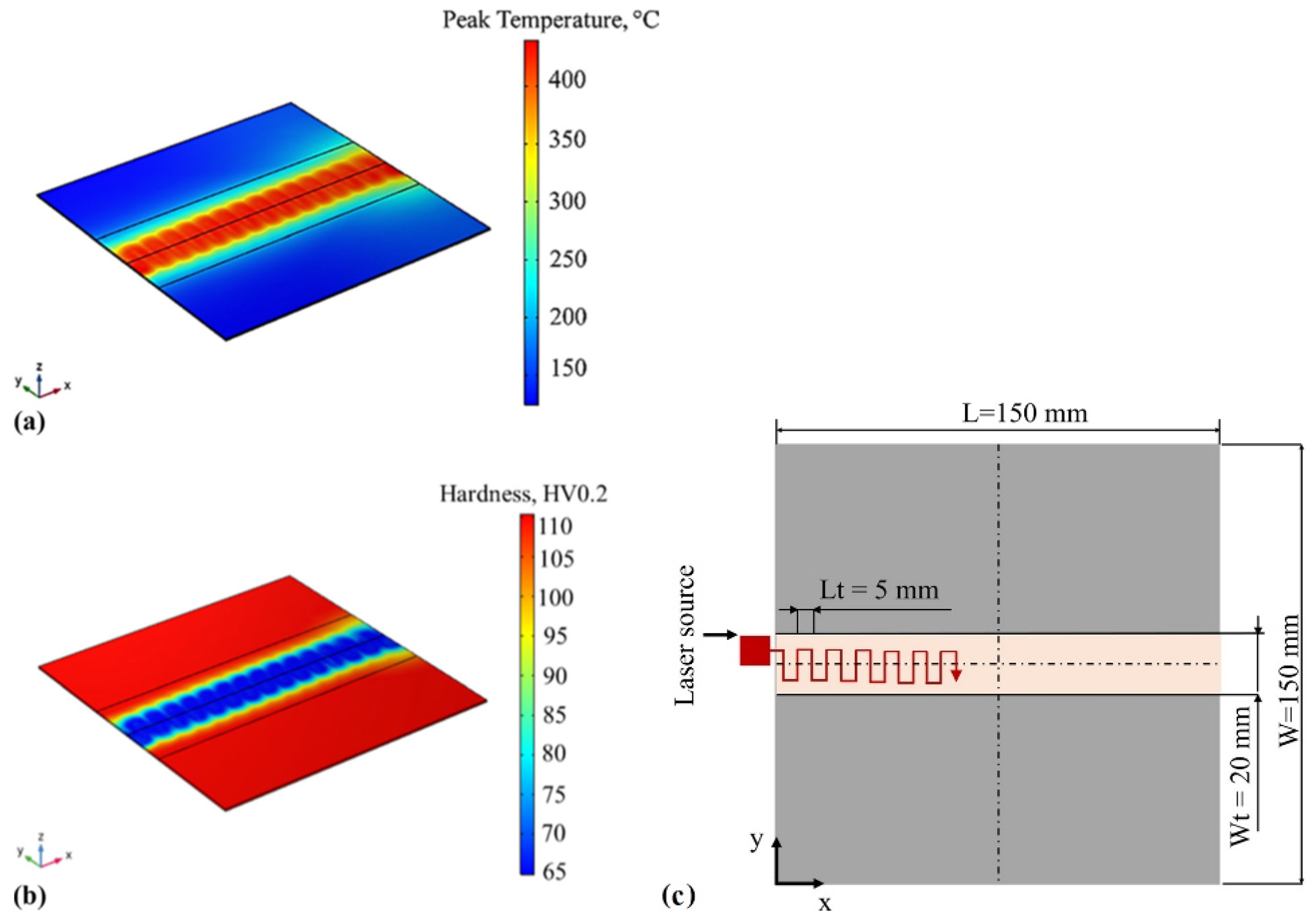
Figure 2.
Treatment process schema showing temperature field in the heat-affected zone (left) and distribution of laser beam power density in the processing area (right) [31].
Figure 2.
Treatment process schema showing temperature field in the heat-affected zone (left) and distribution of laser beam power density in the processing area (right) [31].
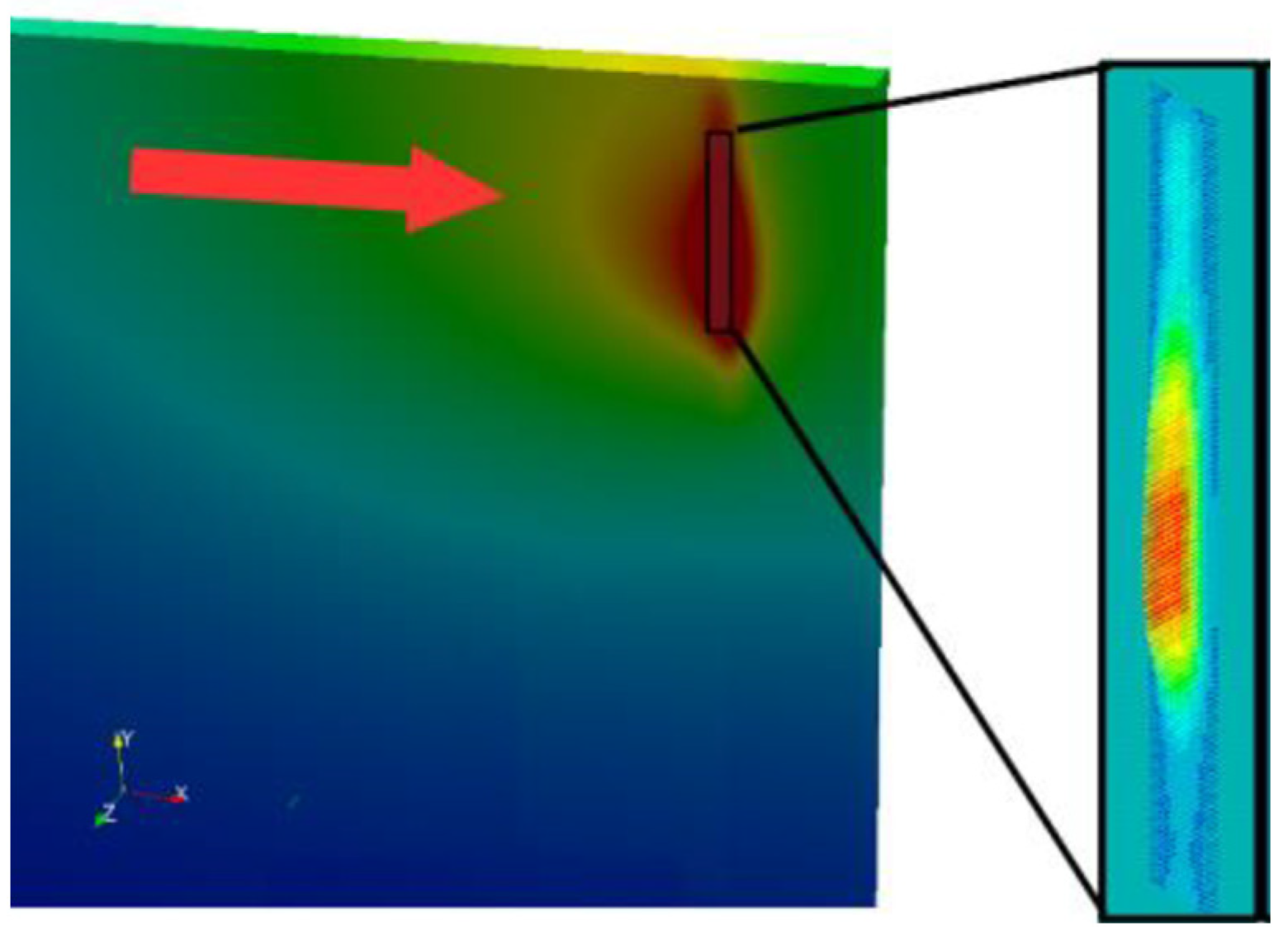
Figure 3.
Various scales of analysis in modeling metal additive manufacturing processes (top) and key physical phenomena in and around the melt pool region at the powder scale (bottom) [46].
Figure 3.
Various scales of analysis in modeling metal additive manufacturing processes (top) and key physical phenomena in and around the melt pool region at the powder scale (bottom) [46].
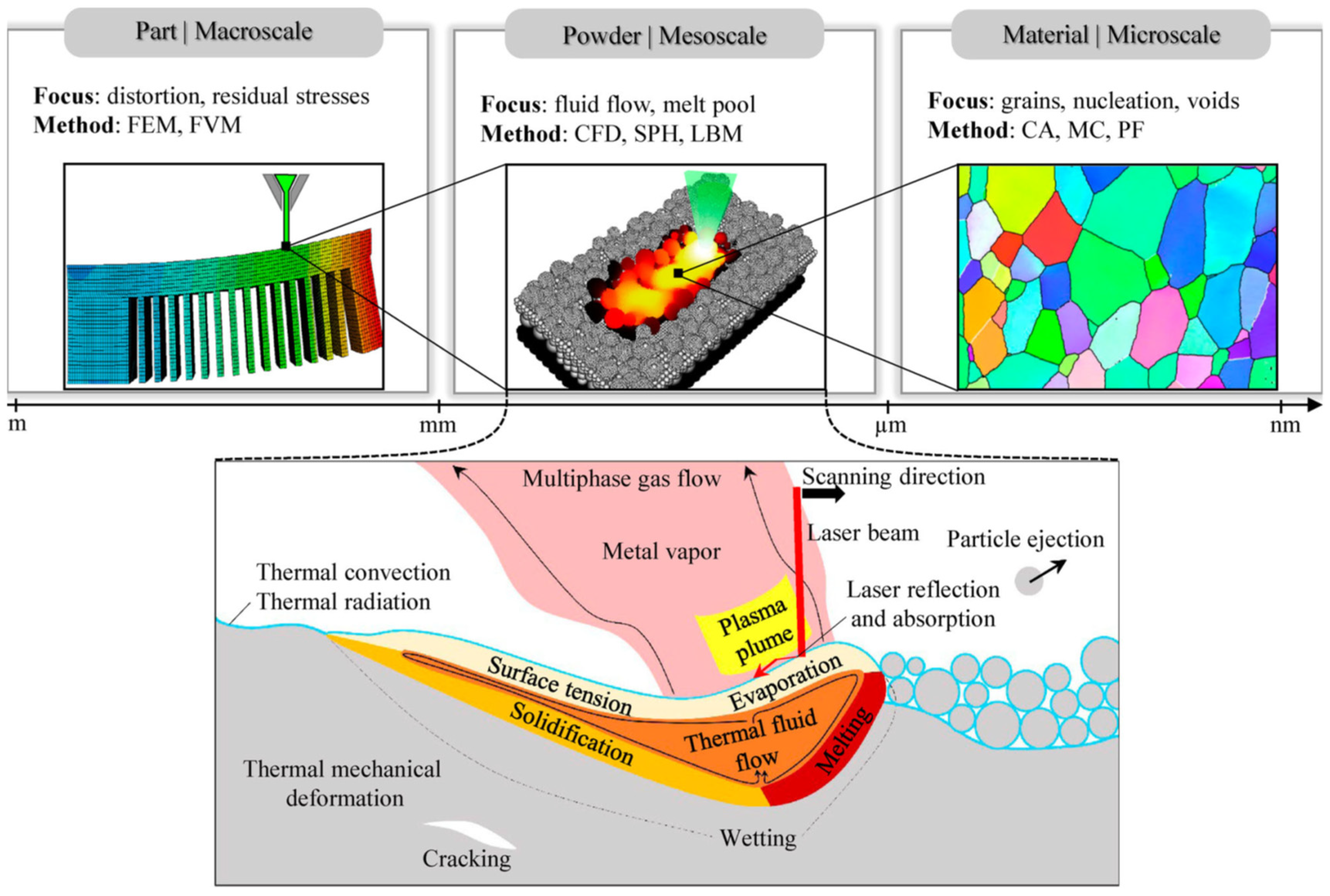
Figure 4.
Conceptual illustration of an advanced neural network designed to model all aspects of laser machining [57].
Figure 4.
Conceptual illustration of an advanced neural network designed to model all aspects of laser machining [57].
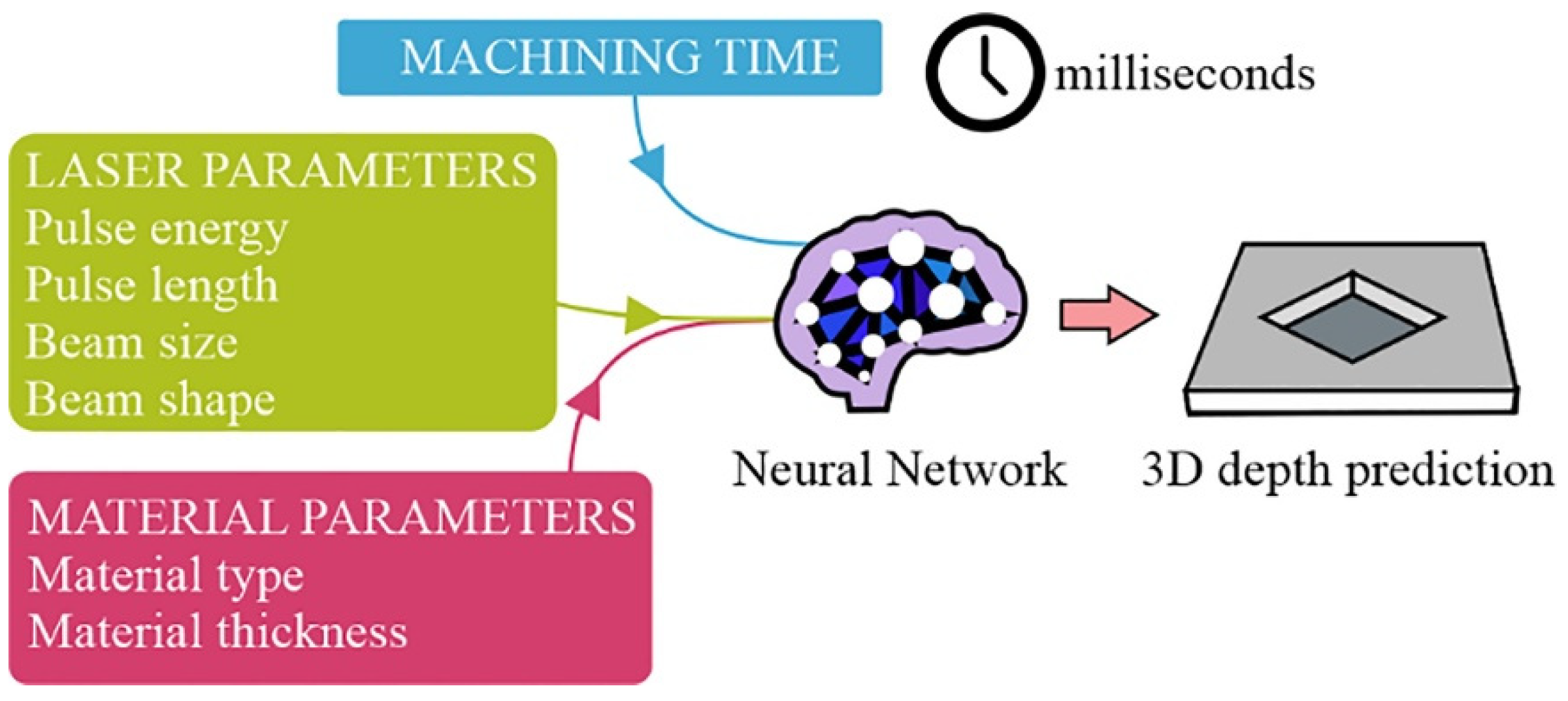
Figure 5.
Schematic illustrating the use of a convolutional neural network (CNN) to analyze camera images for real-time monitoring of material type, pulse count, and laser fluence during laser machining [58].
Figure 5.
Schematic illustrating the use of a convolutional neural network (CNN) to analyze camera images for real-time monitoring of material type, pulse count, and laser fluence during laser machining [58].
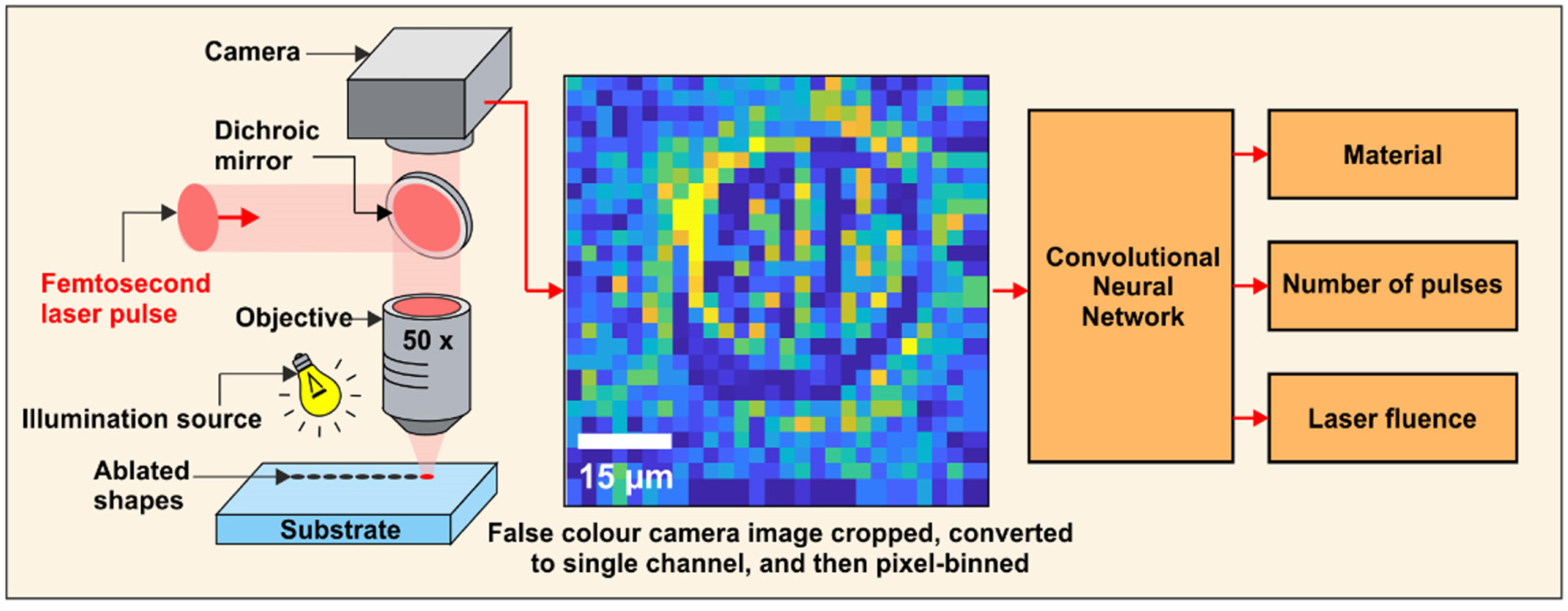
Figure 6.
Illustration of data collection approaches for neural network training, including: (a) schematic of the setup for controlling laser intensity distribution; (b) method for measuring surface profiles after machining; (c) examples of data showing processed surfaces with measurements in nanometers [59].
Figure 6.
Illustration of data collection approaches for neural network training, including: (a) schematic of the setup for controlling laser intensity distribution; (b) method for measuring surface profiles after machining; (c) examples of data showing processed surfaces with measurements in nanometers [59].
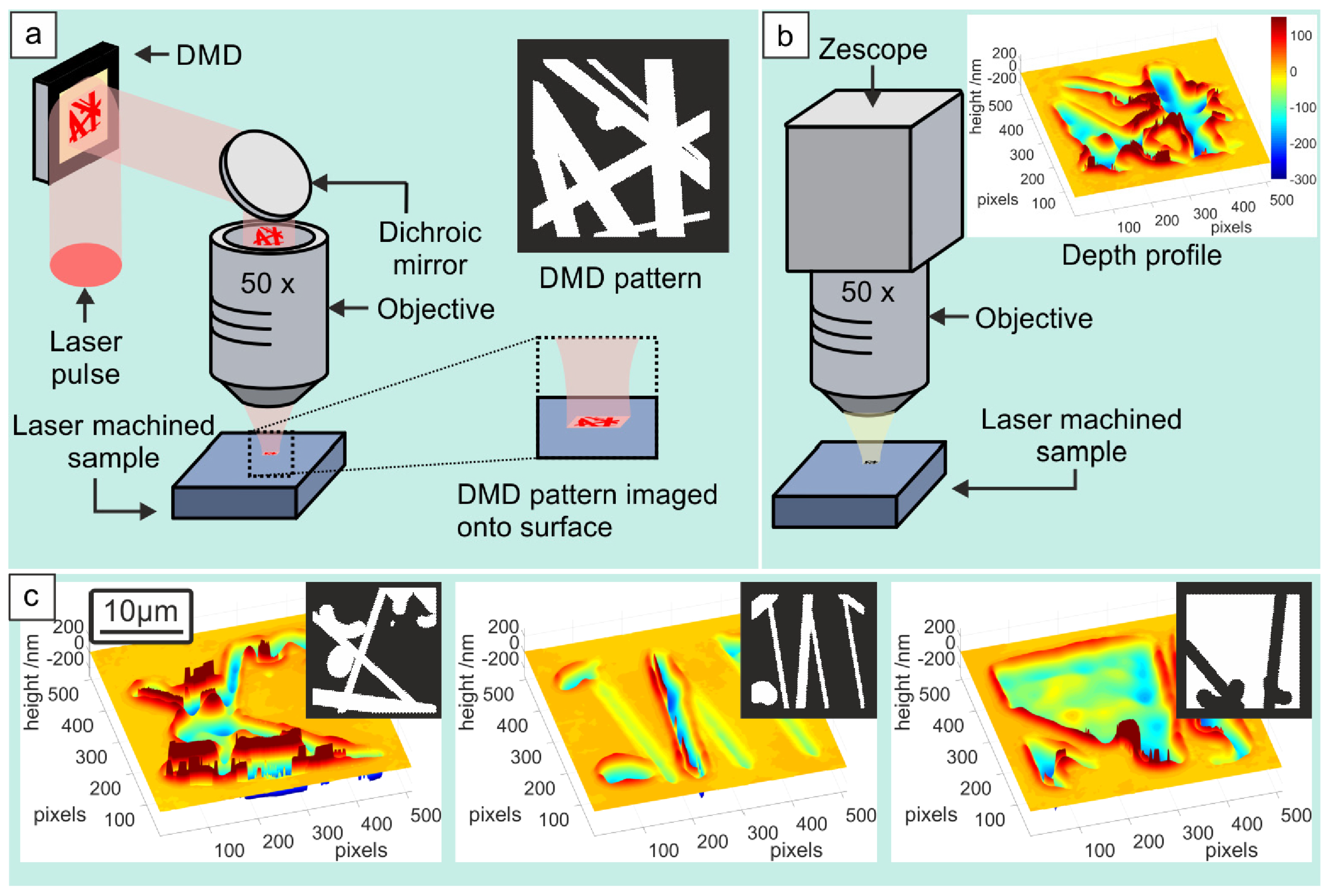
Figure 7.
Illustration of data collection approaches for neural network training, including: (a) schematic of the setup for controlling laser intensity distribution; (b) method for measuring surface profiles after machining; (c) examples of data showing processed surfaces with measurements in nanometers [59].
Figure 7.
Illustration of data collection approaches for neural network training, including: (a) schematic of the setup for controlling laser intensity distribution; (b) method for measuring surface profiles after machining; (c) examples of data showing processed surfaces with measurements in nanometers [59].
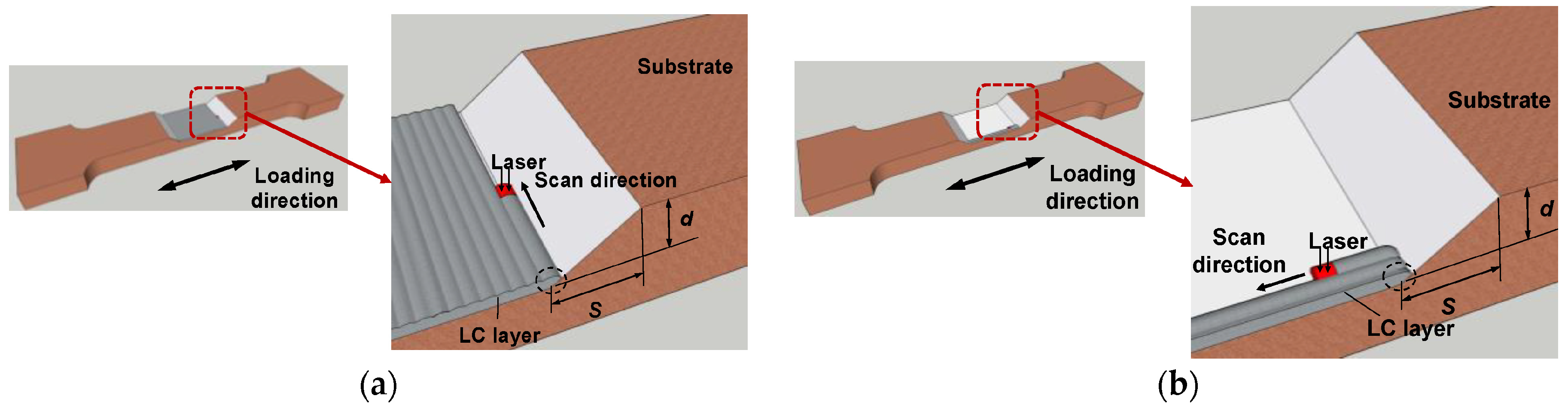
Figure 8.
BP neural network training process [66].
Figure 8.
BP neural network training process [66].
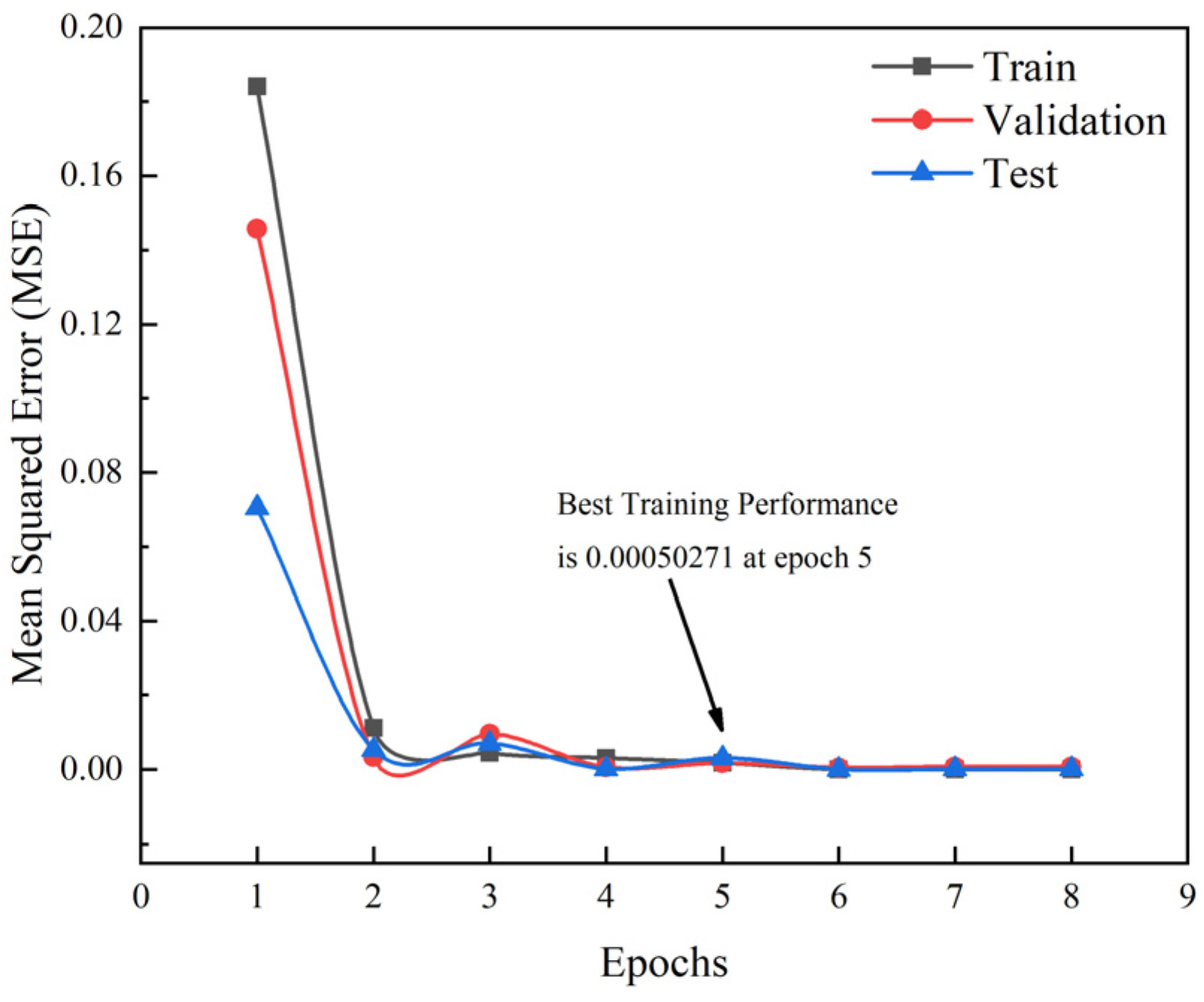
Figure 9.
Schematic of the data collection cycle for determining optimal laser processing parameters [69].
Figure 9.
Schematic of the data collection cycle for determining optimal laser processing parameters [69].
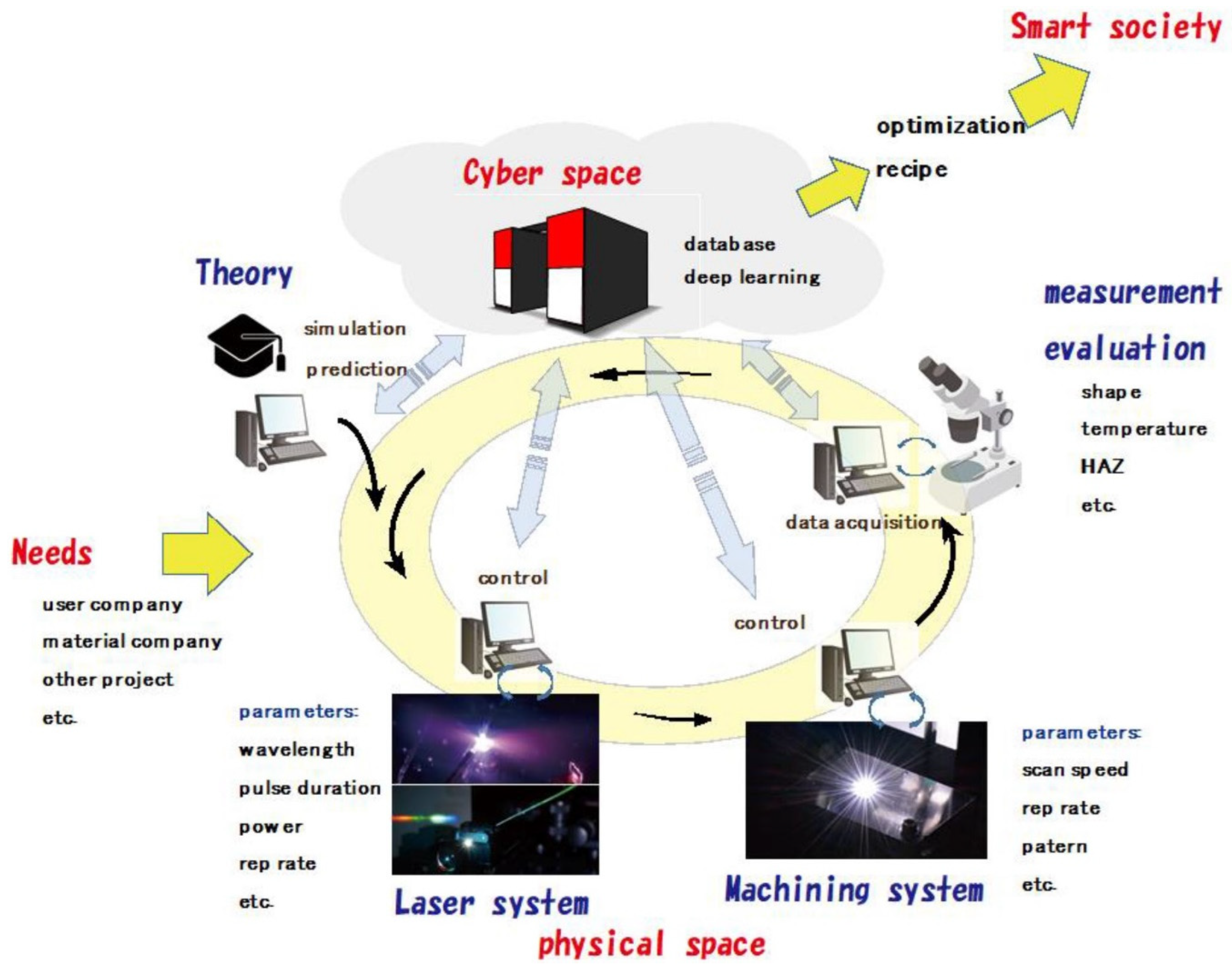
Figure 10.
Bayesian optimization for laser drilling: (I) Digital control of intensity and beam profile; (II) hole observation and evaluation; (III) optimization algorithm adjusts parameters [75].
Figure 10.
Bayesian optimization for laser drilling: (I) Digital control of intensity and beam profile; (II) hole observation and evaluation; (III) optimization algorithm adjusts parameters [75].
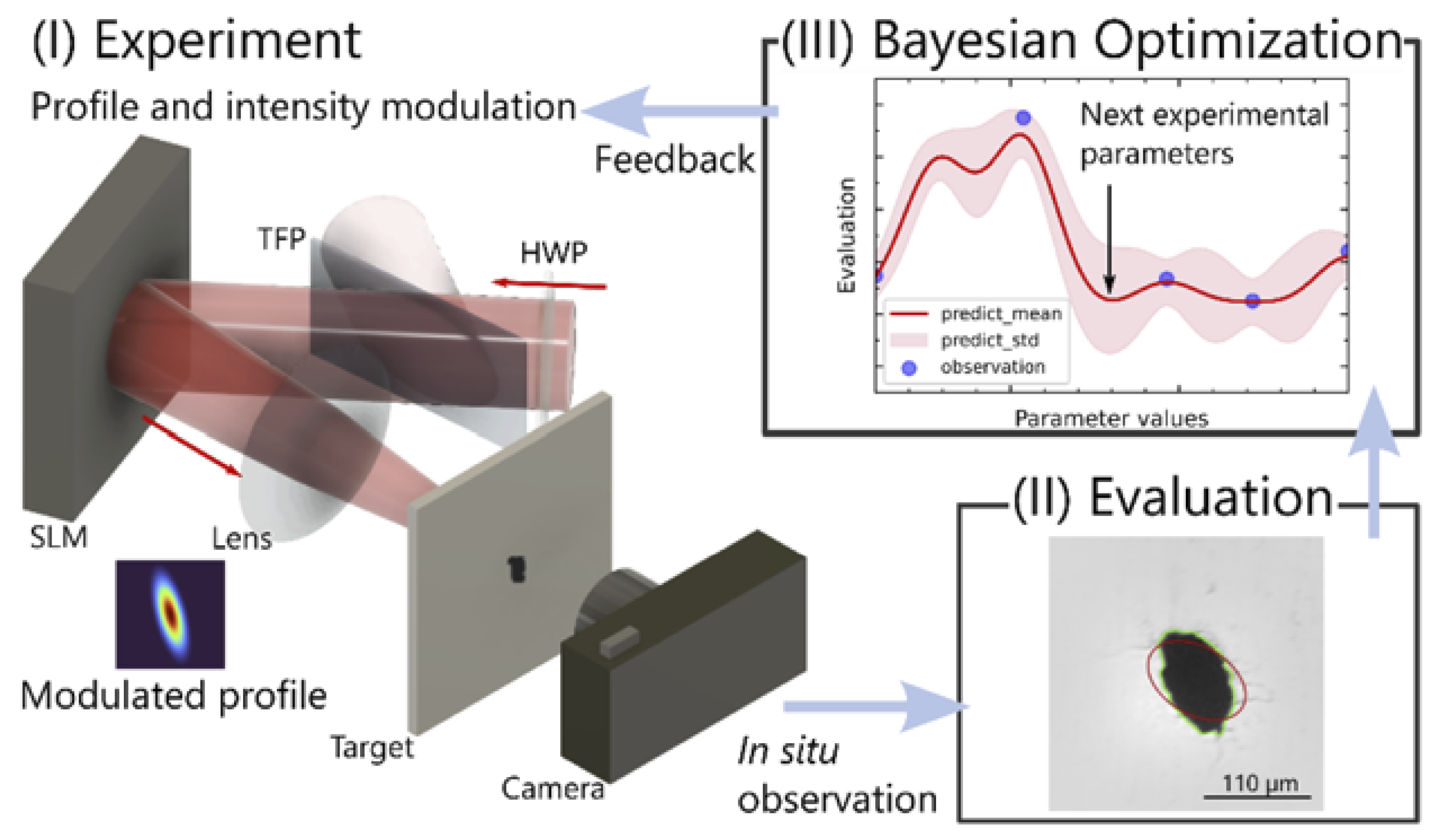
Figure 11.
Simulated temperature distribution at 0.1 mm depth in 42CrMo4 (AISI 4140) for top-hat (a, c, e) and optimized profiles (b, d, f) at feed rates of 300, 400, and 500 mm/min [84].
Figure 11.
Simulated temperature distribution at 0.1 mm depth in 42CrMo4 (AISI 4140) for top-hat (a, c, e) and optimized profiles (b, d, f) at feed rates of 300, 400, and 500 mm/min [84].
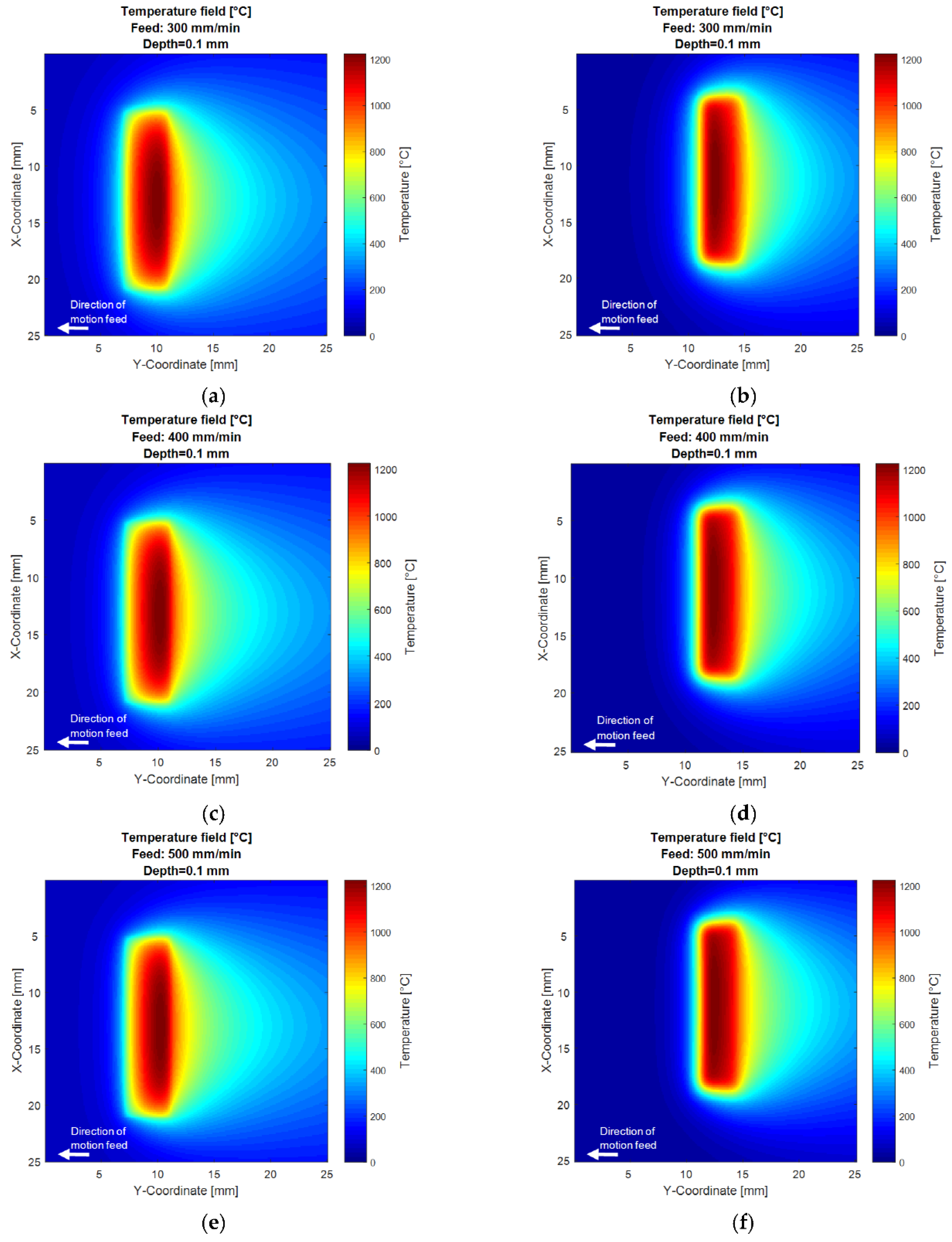
Figure 12.
The digital twin framework along with its connections to various external manufacturing modules and technologies [93].
Figure 12.
The digital twin framework along with its connections to various external manufacturing modules and technologies [93].
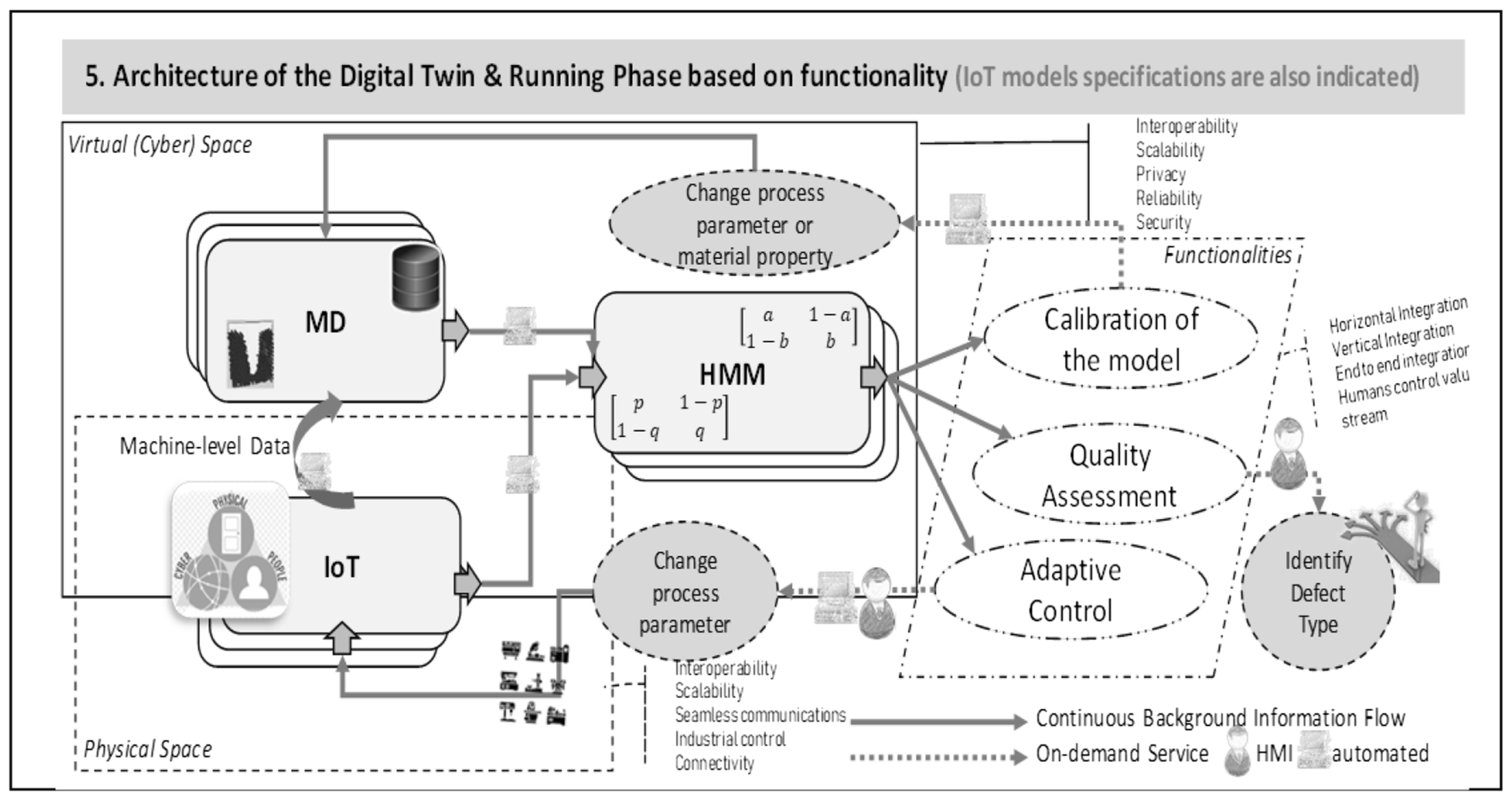
Disclaimer/Publisher’s Note: The statements, opinions and data contained in all publications are solely those of the individual author(s) and contributor(s) and not of MDPI and/or the editor(s). MDPI and/or the editor(s) disclaim responsibility for any injury to people or property resulting from any ideas, methods, instructions or products referred to in the content. |
© 2024 by the author. Licensee MDPI, Basel, Switzerland. This article is an open access article distributed under the terms and conditions of the Creative Commons Attribution (CC BY) license (https://creativecommons.org/licenses/by/4.0/).
Copyright: This open access article is published under a Creative Commons CC BY 4.0 license, which permit the free download, distribution, and reuse, provided that the author and preprint are cited in any reuse.


