

Submitted:
26 September 2024
Posted:
29 September 2024
You are already at the latest version
Abstract
Complexity of issues in cancer research has led to the introduction of powerful computational tools for helping experimental in vivo and in vitro methods. These tools, typically focused on studying cell behavior and dynamic cell populations, range from systems of differential equations solved numerically, to lattice models and agent-based simulations. In particular, agent-based models (ABMs) are increasingly used for they capability to incorporate multi-scale features ranging from the individual up to the population level, thus combining statistically aggregated assumptions with individual heterogeneity. In this work, we present an ABM that simulates tumor progression in a colonic crypt, with the aim of providing an experimental in silico environment for testing results achieved in traditional laboratory research and developing alternative scenarios of tumor development. The model also allows some speculations about causal relationships in biologically inspired systems.
Keywords:
Agent-based Models
; Colorectal cancer (CRC)
; Biological evolution
1. Introduction
The construction of a generalized model that simulates tumor development in a given tissue of human organism is a challenging task, encompassing various analytical and computational difficulties. These difficulties arise from issues related to data availability, modeling and organization, as well as to the complexity and irregularity of genomic and histological features observed in different tumors [1]. Consequently, researchers have tried to analyze various tumors as quasi-isolated phenomena, considering their specific cellular functions, genotypes and phenotypes [2].
Among all cancer types, colorectal cancer (CRC) stands out as the only one for which a clear progression model exists. This model describes the progression from physiological-neoplastic epithelium to metastasis in terms of the activation and suppression of a series of specific genes [3], on the basis of statistical data on genetic mutation frequencies and chromosome deletions. Subsequent discoveries identified three genetic agents present in every human tumor: oncogenes (e.g., KRAS), tumor suppressors (e.g., APC and TP53) and stability genes [4].
CRC progression is also characterized by other important genomic features, such as chromosomal instability (CIN), microsatellite instability (MSI), DNA mismatch repair deficiency (MMR) and DNA methylation, which is a well-studied epigenetic cause of tumor development [5]. The oncogenic multi-step process begins with the deregulation of the -catenin pathway due to an APC mutation, followed by additional somatic mutations that enhance cell proliferation (KRAS mutation) and apoptosis resistance (TP53 mutation) [4]. These genomic deregulations occur with varying frequencies in the ideal timeline of CRC development [6].
Efforts to describe, classify and predict the origins and evolution of CRC have led to the development of various experimental tools, including in vivo, in vitro and in silico models [7,8,9,10,11,12,13,14]. Each approach has its own strengths and limitations. In vivo animal models provide strong evidence on molecular and genetic alterations, or on how therapies contrast tumor development. However, they may not always accurately represent human responses due to genetic complexity and differences in lifestyle [15,16]. In vitro models allow direct observation and control at the cellular level, however, standardization of cellular features is required for reliable results. Even though there has been an increase in the bio-engineering of 2D and 3D tissue models for evaluation of drug efficacy, some aspects, e.g., colonic flora, remain an issue [8,15,17,18]. Recently, in silico models have offered several opportunities for a different approach.
In the last two decades, advancements in computational power have facilitated the development of various computational methods, such as lattice models, off-lattice models and cell-based models, which simulate key characteristics of cancer and processes involved with it, including hypoxia, angiogenesis, drug delivery, cancer stem cells origination, immune system interactions, invasion of adjacent tissues and metastasis [19]. For instance, the phenomenon of anoikis1, a well-studied process, can be effectively simulated using lattice models, where cells have their own defined space. When inter-cellular adhesion is weakened by mutations and the pressure between cells exceeds a specific threshold, related to a minimal distance from these cells to the basement membrane, detached cells undergo cell death [20].
Among these methodologies, an interesting approach is represented by agent-based models (ABMs). By simulating individual agents, interacting in virtual environments through simple dynamical rules, ABMs allow the study of emergent phenomena in complex systems at different spatial scales and. If opportunely calibrated with real data, these models are able to produce results coherent with observed stylized facts and can be used for simulating different counterfactual scenarios. ABMs have demonstrated their effectiveness in several contexts, from the socioeconomic level to the ecological and biological ones [21,22,23,24,25,26,27,28,29]. In the biological context, which is what we are interested in here, ABMs have been also applied to cancer development. For example, mono-crypt models have been extended to incorporate proliferation in multiple crypts, trying to simulate the dynamics of an entire portion of the colon tissue [30]. Other approaches involve comparing cell-based spatial models, incorporating cell-cell adhesion and proliferation changes in response to Wnt-signals, with stochastic one-dimensional models predicting the evolution of monoclonal conversion [31]. Genetic-focused models study the dynamics of cell populations within the crypt, considering them as evolving populations due to changes in genotype frequencies. The output of these models can be compared with that of genomic analysis and with the output of agent-based models in which sub-clones are generated as a result of driver mutations [32].
Building upon these existing models and the theoretical work of Fearon-Vogelstein [3], our purpose is to develop an agent-based model that simulates cell dynamics in the colonic crypt, as an experimental environment for testing various scenarios related to CRC development. Furthermore, our approach aims to integrate genetic triggers, spatial and population constraints, as well as interactions with other species (such as immune system-like cells). The model is designed to represent a biological evolutionary system, considering cells in the crypt microenvironment as individuals belonging to different populations and types [33], subjected to evolutionary mechanisms 2. This perspective is based on the idea that biological systems can be viewed as hierarchically nested networks, where each network represents a particular level. Following this perspective, cells, as independent agents, could be considered as networks composed by molecular elements at a lower level (such as DNA and the various RNA), but also, at a higher level, as nodes of a cellular populations network, working together to carry out tissue and organ functions [35].
The remainder of the paper is organized as follows: Section 2 provides a brief description of the crypt dynamics from a biological perspective and outlines the features of the proposed model. In Section 3, we describe and explain the results obtained from the simulations. Section 4 discusses the implications of the results. Finally, Section 5 summarizes the work and presents future directions.
2. Methods
2.1. Biological Background
Colonic crypts represent invaginations within the colon tissue, measuring approximately in lenght with a diameter of [36]. Crypts are dynamic structures where enterocytes, which are the intestinal epithelial cells, undergo a series of coordinated movements. These enterocytes are generated by stem cells located at the base of the crypt and ascend towards the crypt mouth, ultimately reaching the lumen of the colon. During this continuous movement, enterocytes receive signaling molecules known as Wnt-ligands from neighboring mesenchymal cells; this process plays a crucial role in stimulating the production of -catenin, a protein that exhibits a descending gradient along the crypt, with higher concentrations at the base [2,37]. Enterocytes possessing elevated levels of -catenin are referred to as transit-amplifying cells. These cells display characteristics similar to stem cells and exhibit an higher proliferation activity, thereby ensuring a constant supply of new enterocytes in the crypt. As enterocytes undergo upward migration, there is a gradual reduction in the concentration of -catenin. This decline occurs because -catenin is continuously targeted for degradation by a protein complex known as the destruction complex, thereby impeding its nuclear translocation. This reduction allows the cells eventually to undergo differentiation, assuming specific functions and eventually undergoing apoptosis within a span of 3 to 5 days [2,38]. This process represents an extraordinary mechanism for safeguarding against cellular dysfunctions resulting from DNA damage or other challenges arising within the intestinal microenvironment [2].
2.2. The Agent-Based Model
To model the above-described process we have chosen the software NetLogo [39], an interactive, fully programmable multi-platform environment specifically designed for agent-based simulations. Figure 1 shows a 2D representation of the colonic crypt in the NetLogo virtual World, arranged as if the crypt were an unfolded cylinder.
2.2.1. World Structure
Our case study corresponds to the median crypt, typically consisting of 2000–2500 cells arranged in 100 layers (lines along the vertical axis) with 25 cells per layer, see Figure 1. Since each cell has a length of 3 patches and a width of 2, the World size is set at 300 × 50 patches. These patches represent the surface where cells are positioned. In reality, this surface includes stromal cells responsible for constructing the supportive extracellular matrix for enterocytes. These stromal cells are believed to transmit Wnt signals to the stem cells located at the base of the crypt [2,37]. In the crypt-world, physiological cells are distributed in a predefined proportion, with approximately 75% being differentiated cells and 25% being transit-amplifying cells, as reported in literature (see [20,40,41,42,43] and references therein for more details). The simulated -catenin quantity is 1 at the bottom of the crypt and 0 at the top, decreasing of an arbitrary amount chosen to keep constant the proportion between transit-amplifying and differentiated cells. In the model, the epithelium goes through renewal every 3–5 days, indicating that each cell has a timeframe of 72–120 h to either reach the crypt mouth or undergo cell death [44]. Thus we assign to physiological cells a timelife consistent with this constraint, see Table 1. At each simulated time step (1 tick), corresponding to 1 h of real time, the physiological cells move towards the top of the crypt of one layer. By assigning an age equal to 0 for cells in the first line and equal to 100 for the cells in the last line that have not died during migration, the maximum migration time closely aligns with reality, which is between 100 and 120 h [45,46]. Notice that, considering the crypt as an unfolded cylinder, the model adopts horizontal periodic boundary conditions for the World, therefore, the first cell starting from the left side of the crypt is adjacent to the first cell starting from the right side of the crypt. When cells reach the topmost cell line, they exit the simulation and are no longer considered in the model dynamics.
2.2.2. Agents Behavior
NetLogo agents represent cells. They are divided into two physiological typologies, transit-amplifying cells and differentiated cells (already introduced), and into three neoplastic typologies, pre-adenoma, adenoma and tumoral cells, that arise only when a genetic trigger occurs. The list of the values for the relevant dynamic variables of cells is reported in Table 1 and includes both physiological and neoplastic typologies. Further details about APC, KRAS and TP53 genes, which appears in the assignment of the values, will be addressed in the next subsection and are exposed in Table 2.
Each individual cell carries out its activities autonomously while occupying a specific position (patch) within the World. In Figure 2 the algorithm followed by each cell is reported as a flowchart. It includes normal movements and replication, addressed below, and the possibility of mutation, that will be addressed in the next subsection.
The movement and replication (mitosis) of cells are influenced by their interactions with neighboring cells. This modeling approach is chosen to preserve the individual heterogeneity of cell behavior while capturing population-level characteristics such as the integrity of the entire epithelium of the crypt, which remains unaltered in its structure. In the physiological state, cells have a single degree of freedom for movement. They are allowed to advance one patch forward only if the patch ahead of them is unoccupied, as illustrated in the first panel on the left of Figure 3. This movement mechanism ensures a continuous flow of cells from the bottom to the top of the crypt.
Since every cell can have different lifespan due to random events such as being killed by other cells or for having reached the maximum lifetime, some of them leaves empty spaces within the cell line. To address this issue, all cell types are capable of entering mitosis to fill these gaps. When an empty space occurs, a neighboring cell, from either right or left, randomly undergoes mitosis activity to occupy the vacant position. Another challenge arises when a cell reaches its mitosis time but patches to the left and to the right are not empty. In such cases, the mitosis cell eliminates a neighboring cell with a lower number of mitosis activities or a higher lifetime. These processes align with biological plausibility, as a cell can be eliminated based on the number of times it has replicated (linked to its fitness) or its age. This allows for more fitted or younger cells to take their place, as observed in biological systems [48].
2.2.3. Genetic Features and Mutation Effects
Every cell has a set of genes, see Table 2, chosen following the CRC progression model already described in the Introduction.
We adopt the one-hit hypothesis for oncogenes (KRAS in this model) and the two-hit hypothesis for tumor suppressor genes (APC and TP53). According to these hypotheses, a single allele mutation is sufficient to enhance the function of oncogenes, while both alleles of a tumor suppressor gene must be mutated for its function to be affected [4]. To incorporate the characteristic of Loss of Heterozygosity (LOH) [49], we set the probability of point mutation in the second allele to be one order of magnitude higher than the probability of mutation in the first allele [50]. Specifically, if the probability of mutation in the first allele is , then the probability of mutation in the second allele, if the first is mutated, is . In our model, each of the three genes controls a simplified action to avoid excessive complexity.
The tumor suppressor gene APC, even when heterozygous, has a positive function in controlling the differentiation of cells from transit-amplifying to differentiated state. However, mutation of both alleles in APC disrupts the regulation of -catenin, preventing cells from differentiating. This can lead to the migration of transit-amplifying cells into regions of the crypt where only differentiated cells should be present. Additionally, we introduce a slight deviation in the forward movement of cells to simulate a slower rate of migration, which may contribute to cell accumulation after mitosis.
Regarding the KRAS gene, mutation of one allele increases the mean proliferation time [51]; refer to Table 1 for the directions of movement and replication.
The wild type version of TP53, known as the genome Gatekeeper [2,52], plays a crucial role in cell regulation. In its wild type homozygote form, it ensures that cells with significant DNA errors undergo apoptosis. In this model, the process develops as follows: each of the 50 regulation genes comprises a list (structured similarly to the driver genes). When a mutation occurs, the values in the list change from 0 to 1. Consequently, the total sum of the list can only increase. If the sum exceeds a certain threshold and TP53 is a wild-type homozygote, the cell dies. However, when both alleles of TP53 are mutated, it increases the probability of mutation in all other genes. Specifically, the probability exponent decreases by 0.5 unit for each mitosis until cellular death. The precise quantitative analysis for this phenomenon is not available in the literature, so we have chosen a decrease rate that is neither too pronounced nor insufficient to simulate DNA deregulations realistically. It is worth noting that TP53 is described in the literature as a tumor suppressor gene involved in crucial aspects of neoplastic and metastatic processes, such as proliferation, resistance to apoptosis and migration [2,53]. Therefore, it seemed appropriate to simulate the various functions of TP53 by augmenting the overall probability of mutation in other genes, even though to an arbitrary extent.
Although there is no specific temporal order for the occurrence of mutated genes in neoplastic typologies, various combinations of mutated genes lead to different types of neoplastic variants. When a cell acquires the pre-adenoma typology, instead of moving in a straight line, it inclines randomly to the right or left, as depicted in the second panel from the left in Figure 3. If, in addition to APC mutation, the KRAS gene also undergoes mutation, the cell transitions to the adenoma typology. Cells with the adenoma typology exhibit the same movement pattern as pre-adenoma cells but proliferate at a faster rate, as shown in the third panel, Figure 3. The final phenotypic change occurs with the addition of TP53 mutation, resulting in the tumoral typology. In this state, cells are unable to move around but can proliferate in all positions rather than just adjacent spaces, as illustrated in the fourth panel of Figure 3.
2.2.4. Micro-Environmental Features
Genetic factors are well-known triggers of cancer evolution in many types of cancer, and despite the fact that representing these factors sometimes can be challenging, modeling the influence of environmental factors poses an even greater challenge.
Our current understanding of the tumor micro-environment (TME) highlights the complexity of elements present in our body from the early stages of tumor development to metastasis [54]. These elements play roles in either promoting or inhibiting tumor progression. Simulating every specific molecular interaction within the TME would be impractical and inconsistent with the intended scope of the model. Therefore, we have chosen to represent immune system cells as a combination of some functions belonging to natural killer cells (NK) and macrophages (M1 and M2) to account for the complexity of the TME [55]. In particular, the NK function used is to patrol the body, constantly surveying for abnormal cells, identifying and killing cells that have become cancerous, while the M1 and M2 function is to eliminate cellular debris from the body.
Another important environmental feature of the crypt structure is the number of cells present in a patch. Physiological cell disposition is rigid and is set up to one cell for every spot (the spot dimension is patches). Thus, when a cell with typology belonging to neoplastic variants moves or proliferates in the spot of another cell, the threshold counter starts. In real crypts, over-proliferating cells tend to create hypoxic niches, where cells situated at a certain distance from the nearest blood vessel are subjected to a lack of oxygen eventually dying [56]. To capture this phenomenon, we incorporate a hypoxia threshold and its effects on cell survival. The interaction between epithelial cells and environmental features follows specific rules. A cell count is performed in each patch, and when a threshold is reached, immune system cells appear and move randomly within the crypt. If these immune cells encounter a non-physiological cell, they move towards it and eliminate it, mimicking NK cells and macrophages interactions. The same cell count procedure also activates another threshold, which represents the maximum number of non-hypoxic cells allowed in a given spot. By incorporating these rules, we aim to capture the essential aspects of the interaction between epithelial cells and the TME while simplifying the representation of spatial dynamics and avoiding the simulation of complex molecular interactions.
3. Results
In our model, the starting values of cellular genotypes can be set to homozygous wild-type or heterozygous (e.g., [0 0] or [0 1], [1 0]). The initial probability distribution for these genotypes can be adjusted using a slider in the model interface, ranging from 0 to 1. A value of 0 indicates that all cells start with a homozygous wild-type genotype, while a value of 1 means that all cells start with a heterozygous genotype. This feature is designed to account for the stem-niche hypothesis, which suggests that mutations can also occur within stem cells, allowing stem cell clones to invade the entire crypt [37]. Although stem cells are not explicitly included in the model dynamics, this characteristic preserves the possibility of stem cell involvement, ensuring that if a stem cell mutation occurs, it would be inherited by the daughter transit-amplifying cells. To observe changes in the dynamics of cell population growth, the rate of cell death due to physiological and environmental causes (e.g., immune system-mediated killing or overcrowding), and the rate of cell death due to aging of tumoral cells, we conducted several runs with three different stop conditions: a) one year has passed; b) the proportion of transit-amplifying and differentiated cells is inverted; c) the crypt population reaches 10,000 individuals [4].
[4]These stop conditions are arbitrary and not derived from the literature. The reasons behind them are as follows: a) given the model characteristics, one year (365 ticks) is sufficient to observe the effects of the programmed behavior; b) it is reasonable to think that if the proportion of transit-amplifying and differentiated cells is reversed, the crypt structure would be compromised, thus justifying the cessation of the simulation; c) considering the physiological size of the population (2500 cells), reaching a number of 10,000 cells would make the crypt resemble a real crypt completely filled with neoplastic cells.
To analyze the effects of varying mutation probabilities, we adjusted the probability of gene mutation from to while keeping the other parameters constant. This range covers a wide spectrum of mutation probabilities and allows for meaningful comparisons with other models that have used similar values [11,50]. By examining seven scenarios (, , , , , , ) with different mutation probabilities, we gained insights into how changes in mutation rates impact cell behavior and overall system dynamics. The other fixed parameters were:
- number of immune system’s cells: 1 / hour
- number of cells that a killer cells eliminates before die: 5 cells
- hypoxic threshold: 5 cells / patch
- immune-system threshold: 5 cells / patch
- probability of starting genotype: P = 0.5
The chosen parameter values are based on qualitative and quantitative descriptions from the literature [56,57]. Since some parameters, such as the concentration of immune system cells produced per hour and the number of tumoral cells that an immune system cell can kill before dying, are not known at the level of individual cells, we have set them into the model as arbitrary values susceptible of manipulation. Therefore, an immune system cell cannot kill more than one neoplastic cell at a time and has a lifetime expressed in the number of neoplastic cells killed. Similarly, while the real hypoxic threshold is stated at 150 , the exact number of epithelial cells from a hypothetical blood vessel is not necessary in the context of our model. This characteristic pertains to the real three-dimensional structure of the crypt, which is not effectively reproducible in a two-dimensional model.
The population dynamics variations are depicted in Figure 4. Panel (a) illustrates the constant population trends of transit-amplifying and differentiated cells observed throughout the simulation period of one model year (365 ticks), with mutation probabilities ranging from to . This panel provides an overview of the constant trend and proportions when the probability of mutation is low, indicating that mutational events are rare. When the mutation probability is within a physiological range [58], we observe the expected steady flow of cells differentiating in the correct positions, thus maintaining the imposed proportions.
In panel (b), with a mutation probability of , minor expansions of the transit-amplifying population occur, attributed to the emergence of adenoma and pre-adenoma mutations. These expansions cause a restriction of the differentiated population and a corresponding increase in transit-amplifying cells.
Panel (c) shows that cellular populations are subjected to fluctuations, alternating between growth and regression of adenoma and pre-adenoma phenotypes, resulting in a homeostatic behavior where immune system cells fight back against neoplastic variants. Additionally, it is observable that neoplastic expansions increase in frequency but not in amplitude; that is, as time passes, there are more neoplastic events but no significant increase in the size of the neoplastic populations.
Panels (d), (e) and (f) exhibit similar trends, with a significant increase in both the tumoral and adenoma populations. The system’s tendency to bounce back towards a stable physiological equilibrium is challenged by the high probability of mutation, which leads to the uncontrolled proliferation of tumoral phenotypes, especially in scenarios e) and f). Furthermore, in scenario d), we observe an increase not only in the frequency but also in the number of tumoral variant cells. Scenarios with non-physiological variants show a periodic trend in the immune system cell population, closely matching the pre-adenoma, adenoma, and tumoral phenotypes in terms of timing. This periodicity exhibits characteristics resembling a predator-prey relationship, consistent with how the interactions between immune system cells and neoplastic cells are conceived.
In all the simulations conducted with mutation probabilities ranging from to , there were no significant differences in the death rates per hour. As depicted in Figure 5 (a) the death rate remained relatively constant at approximately 140 cells per hour. In the scenario with a mutation probability of , significant changes in the death rates were noted. There was an increase in the rate of physiological deaths, up to 160 per hour, along with a rise in other modes of death, such as death resulting from local overcrowding (referred to as Hypoxic death) and cells being killed by the immune system (Immune sys death). An interesting observation is the absence of a significant death rate among aged tumoral cells, possibly due to the fact that very few, if any, can evade the environmental factors causing their demise, as shown in Figure 5 (b).
The analysis of genotype frequencies as function of time revealed a correspondence between the flow of the various genotype values within the population and the dynamics of the population itself, as shown in Figure 6.
In panel (a), the genetic flow remains constant, reflecting stable population dynamics when the probability of mutation ranges from to . During the first 120 h of total renewal of the crypt epithelium, we observe a concentration of genotypes mostly at frequencies of 0.25 and 0.50. After that period, all genotypes maintain the same frequency throughout the entire simulation. In panel (b), the frequency changes correspond to the clonal expansions observed in the population plot. Several expansions are attributed to adenoma mutations, with an interesting increase in the wild-type version of KRAS (pink line) following the first adenoma expansion (light green line). Panel (c) illustrates the gene flow within the crypt when the mutation probability is set to . In this scenario, the most prevalent genotypes are those with APC = [0-0], KRAS = [1-1] and P53 = [1-1], indicating that the most common phenotype is adenoma with completely mutated TP53.
Interesting results emerged concerning also the number of mitosis events for each phenotype, as seen in Figure 7. Physiological cells, for example, exhibit a skewed distribution, see panel A, while pre-adenoma and adenoma cells show a very wide distribution with a nearly shared maximum value, see panel B. In panel C, tumoral cells present an analogous size but a less wide distribution (a maximum of 15 mitoses per cell, compared to 22 for pre-adenoma and 25 for adenoma cells). Observing the distributions of neoplastic variants in both panels B and C, we notice that the proportions between pre-adenoma and adenoma population sizes remain almost unaltered as the mutation probability increases. These features are likely due to the sparse spatial arrangement of pre-adenoma and adenoma phenotypes, whose movement creates random mitosis spots where environmental conditions differ (see Figure 8), combined with the programmed mitosis time (see Table 1).
In Figure 9 the distribution of the number of cells per patch at the time of the maximum tumor expansion is reported in both linear (a) and semilogarithmic (b) scale for the scenario with mutation probability . It is interesting to notice that the number of patches containing a given number of cells decreases exponentially with the number of cells contained therein (the behavior is linear in the log-lin scale). This means that most mitosis events occur in a few specific sites, while the rest of the crypt’s surface shows fewer or no mitosis events per site.
3.1. Discussion
The purpose of developing this model was to create a tool for theoretical investigations, hypothesis generation and experimental design related to a biological phenomenon. Modeling complex biological phenomena is inherently challenging, therefore, we would like to reflect on the variable choices, parameter ranges, and the consistency of our results with other studies.
The variables within the model are intentionally designed to allow extensive manipulation of parameters, even in scenarios that may not have immediate biological relevance or experimental basis. However, these choices could be motivated by the fact that this model serves as more than just a computational environment for the replication of colorectal cancer (CRC) development. In fact, it provides a platform for theoretical inquiries into causal relationships within a biologically inspired system. For example, one might want to set the physiological cell lifespan to just 1 h or allow physiological cells to enter mitosis activity regardless of their neighborhood. While these are not realistic scenarios, biologically speaking, they are possible within the model context. Another example is the activation or deactivation of the immune system cell response, to observe whether population-specific tendencies emerge from the interaction between neoplastic cells and immune system cells. Hence, instead of focusing only on positive results, a researcher could use the model to eliminate all biologically meaningless scenarios.
Identifying causal relationships in traditional in vivo and in vitro research can be difficult due to the complex nature of the entities and interactions involved, as well as the difficulty of performing counterfactual experiments keeping some variables unchanged while adjusting the value of others. However, within the precisely controlled environment offered by this model, an interventionist account of causality [59,60] can be effectively applied. Within this approach, causation is understood through the potential to manipulate one variable to bring about a change in another. If changing X through an intervention leads to a change in Y, then X is considered a cause of Y. The theory relies on counterfactuals, meaning it examines what would happen to Y if X were manipulated differently. This helps to determine the causal impact of X on Y. Moreover, the manipulability of the model allows for the exploration of intrinsic and extrinsic interactions that contribute to the neoplastic phenomenon [61]. For example, the current model represents driver genes as causal agents with precise effects (intrinsic factors), without considering any reciprocal influence such as epistasis. This means, for instance, that the altered movement resulting from APC suppression does not directly affect the proliferation time, which only increases after a KRAS mutation. Regarding extrinsic factors, the large population of cells in the same location influencing each other and potentially leading to cell death can be considered an environmental influence, or constraint, shaping subsequent cell behavior within the spatial context [35,62,63].
Concerning the initial genotype frequency, all the runs were conducted with a starting probability of heterozygosity set at 0.5, meaning that every first-line cell has a 1/2 probability of being heterozygous. Therefore, it is necessary to perform tests with other starting values, such as a completely healthy population of first-line cells with wild-type genes (i.e., a probability of heterozygosity set to zero). It is also worth mentioning that the model represents an idealized crypt without specific characteristics unique to any particular human or murine individual. Therefore, aspects such as the one-year simulation period or the number of cells required to trigger the population stop condition (10,000 cells) do not reflect the characteristics of patients at specific ages or tumor stages.
Further testing is needed for parameters related to immune system cells and overcrowding deaths. For example, a minimal genetic model of tumor development can be explored by setting the number of immune cells to zero and the hypoxic threshold to a large number. In this scenario, we would expect to observe distinct tumor development once the first neoplastic cell arises. Consistent with the Vogelstein model, we observed that in all simulations where neoplastic phenotypes emerged, cells initially assumed the adenoma phenotype (i.e., KRAS mutation). This is possibly due to the fact that KRAS acts as an oncogene even with one mutated allele and genotype frequencies indicate that the majority of the population is heterozygous for KRAS.
A model constructed using data and assumptions from the literature should provide results that are, at least, consistent with the current state of the art. From our perspective, this consistency is evident from two aspects. Firstly, the visual representation of the cell arrangement in the crypt within the NetLogo environment aligns with the phenomenon known as Intra-tumoral Heterogeneity (ITH) [64], as depicted in Figure 8, 1-6. The visual aspect of the crypts reveals a significant difference between those with a probability of mutation set at , see panel (1) in Figure 8, and those with a probability of mutation set at or higher, see panels (2-6) in Figure 8. If we compare images of crypt states with the population dynamics in the range of to , as shown in Figure 4, we observe a phenomenon similar to a phase transition with clusters of neoplastic variants sprouting at scenario. Furthermore, within the range of to , we observe behavior associated with cells exhibiting chromosomal instability (CIN) [49]. This behavior is characterized by a rapid growth of the total cellular population (4,000-6,000 individuals) occurring within 100-150 h.
4. Conclusions
In this work we have tried to develop a model that takes into account both genetic and environmental components in colorectal cancer development. SMT (somatic mutation theory) and TOFT (tissue organization field theory) are the two main paradigms used in cancer research that represent these two aspects. The first theory posits that multiple consecutive gene mutations in a single cell, which then proliferates more rapidly than others, are the primary drivers of the tumoral phenotype’s spread and the main cause of tumor emergence and development. The second theory suggests that environmental factors cause alterations in the signaling between cellular populations in adjacent tissues, leading to gene mutations [65,66]. The connection between these two aspects, even if it is oversimplified, is built in a way that is consistent with what cancer research indicates, namely that it is not just a matter of mutation and hyperproliferation. The presence of immune system cells can favors the rise of one cell typology over another and an elevated number of cells in a small space causes cells to die. Additional research should provide more precise evidence of correlations (and hopefully causal relationships) between system variables and environmental factors that affect the dynamics of different cell typologies. Moreover, future work will aim to incorporate additional features at the genetic and cellular levels, such as energy consumption based on cell typology, a more detailed model of gene regulatory networks for driver genes and a more sophisticated interaction between crypt cells and immune system
Author Contributions
All authors contributed equally to this work, approving the final content.
Data Availability Statement
The original data presented in the study are openly available in Zenodo at https://doi.org/10.5281/zenodo.10669907 and https://doi.org/10.5281/zenodo.13837071.
Conflicts of Interest
The authors declare no conflicts of interest.
Abbreviations
The following abbreviations are used in this manuscript:
| CRC | Colorectal Cancer |
| SMT | Somatic Mutation Theory |
| TOFT | Tissue Organization Field Theory |
| TME | Tumor Micro Environment |
References
- Plutynski, A. How is cancer complex? Eur. J. Philos. Sci. 2021, 11, 1–30. [Google Scholar] [CrossRef]
- Weinberg, R. A. The Biology of Cancer. Unpublished 2013. [Google Scholar]
- Fearon, E. R.; Vogelstein, B. A genetic model for colorectal tumorigenesis. Cell 1990, 61, 759–767. [Google Scholar] [CrossRef] [PubMed]
- Vogelstein, B.; Kinzler, K. W. Cancer genes and the pathways they control. Nat. Med. 2004, 10, 789–799. [Google Scholar] [CrossRef]
- Grady, W. M.; Carethers, J. M. Genomic and epigenetic instability in colorectal cancer pathogenesis. Gastroenterology 2008, 135, 1079–1099. [Google Scholar]
- Nguyen, H. T.; Duong, H.-Q. The molecular characteristics of colorectal cancer: Implications for diagnosis and therapy. Oncol. Lett. 2018, 16, 9–18. [Google Scholar] [CrossRef] [PubMed]
- Bürtin, F.; Mullins, C. S.; Linnebacher, M. Mouse models of colorectal cancer: Past, present and future perspectives. World J. Gastroenterol. 2020, 26, 1394. [Google Scholar] [CrossRef] [PubMed]
- Williams, A. C.; Hague, A.; Manning, A. M.; Van der Stappen, J. W.; Paraskeva, C. In vitro models of human colorectal cancer. Cancer Surveys 1993, 16, 15–29. [Google Scholar]
- Chen, H.; Cheng, Y.; Wang, X.; Wang, J.; Shi, X.; Li, X.; Tan, W.; Tan, Z. 3D printed in vitro tumor tissue model of colorectal cancer. Theranostics 2020, 10, 12127. [Google Scholar] [CrossRef]
- Johnston, M. D.; Edwards, C. M.; Bodmer, W. F.; Maini, P. K.; Chapman, S. J. Mathematical modeling of cell population dynamics in the colonic crypt and in colorectal cancer. Proc. Natl. Acad. Sci. U.S.A. 2007, 104, 4008–4013. [Google Scholar] [CrossRef]
- Michor, F.; Iwasa, Y.; Lengauer, C.; Nowak, M. A. Dynamics of colorectal cancer. In Seminars in Cancer Biology; Elsevier, 2005; Vol. 15, pp 484–493.
- Meineke, F.A.; Potten, C.S.; Loeffler, M. Cell migration and organization in the intestinal crypt using a lattice-free model. In Cell Proliferation, Wiley Online Library, 2001, 34, 253–266. [Google Scholar] [CrossRef] [PubMed]
- Haupt, S.; Gleim, N.; Ahadova, A.; Bl"aker, H.; von Knebel Doeberitz, M.; Kloor, M.; Heuveline, V. A computational model for investigating the evolution of colonic crypts during Lynch syndrome carcinogenesis. In Computational and Systems Oncology, Wiley Online Library, 2021, 1, e1020. [Google Scholar] [CrossRef]
- Van Leeuwen, I.M.M.; Mirams, G.R.; Walter, A.; Fletcher, A.; Murray, P.; Osborne, J.; Varma, S.; Young, S.J.; Cooper, J.; Doyle, B.; <i>, *!!! REPLACE !!!*; et al. An integrative computational model for intestinal tissue renewal. In Cell Proliferation, Wiley Online Library, 2009, 42, 617–636. [Google Scholar] [CrossRef] [PubMed]
- Banerjee, A.; Quirke, P. Experimental models of colorectal cancer. Dis. Colon Rectum 1998, 41, 490–505. [Google Scholar] [CrossRef] [PubMed]
- McIntyre, R.E.; Buczacki, S.J.A.; Arends, M.J.; Adams, D.J. Mouse models of colorectal cancer as preclinical models. In Bioessays, Wiley Online Library, 2015, 37, 909–920. [Google Scholar] [CrossRef]
- Leystra, A.A.; Clapper, M.L. Gut microbiota influences experimental outcomes in mouse models of colorectal cancer. Genes 2019, 10, 900. [Google Scholar] [CrossRef]
- Sensi, F.; D’Angelo, E.; D’Aronco, S.; Molinaro, R.; Agostini, M. Preclinical three-dimensional colorectal cancer model: The next generation of in vitro drug efficacy evaluation. Journal of Cellular Physiology 2019, 234, 181–191. [Google Scholar] [CrossRef]
- Metzcar, J.; Wang, Y.; Heiland, R.; Macklin, P. A review of cell-based computational modeling in cancer biology. JCO Clin. Cancer Inform. 2019, 2, 1–13. [Google Scholar] [CrossRef]
- Ingham-Dempster, T.; Walker, D. C.; Corfe, B. M. An agent-based model of anoikis in the colon crypt displays novel emergent behaviour consistent with biological observations. R. Soc. Open Sci. 2017, 4, 160858. [Google Scholar] [CrossRef]
- Pluchino, A.; Rapisarda, A.; Garofalo, C. Efficient promotion strategies in hierarchical organizations. Physica A: Statistical Mechanics and its Applications 2011, 390, 3496–3511. [Google Scholar] [CrossRef]
- Camillen, F.; Caprií, S.; Garofalo, C.; Ignaccolo, M.; Inturri, G.; Pluchino, A.; Rapisarda, A.; Tudisco, S. Multi agent simulation of pedestrian behavior in closed spatial environments. Journal of Artificial Societies and Social Simulations 2014, 17, 16. [Google Scholar]
- Le Pira, M.; Inturri, G.; Ignaccolo, M.; Pluchino, A.; Rapisarda, A. Finding shared decisions in stakeholder networks: An agent-based approach. In Physica A: Statistical Mechanics and its Applications, Elsevier, 2017, 466, 277–287. [Google Scholar] [CrossRef]
- Fichera, A.; Pluchino, A.; Volpe, R. A multi-layer agent-based model for the analysis of energy distribution networks in urban areas. In Physica A: Statistical Mechanics and its Applications, Elsevier, 2018, 508, 710–725. [Google Scholar] [CrossRef]
- Fazio, M.; Pluchino, A.; Inturri, G.; Le Pira, M.; Giuffrida, N.; Ignaccolo, M. Exploring the impact of mobility restrictions on the COVID-19 spreading through an agent-based approach. In Journal of Transport & Health, Elsevier, 2022, 25, 101373. [Google Scholar]
- Conti, E.; Di Mauro, L.S.; Pluchino, A.; Mulder, C. Testing for top-down cascading effects in a biomass-driven ecological network of soil invertebrates. In Ecology and Evolution, Wiley Online Library, 2020, 10, 7062–7072. [Google Scholar] [CrossRef] [PubMed]
- Zhang, B.; DeAngelis, D.L. An overview of agent-based models in plant biology and ecology. In Annals of Botany, Oxford University Press US, 2020, 126, 539–557. [Google Scholar] [CrossRef] [PubMed]
- Glen, C.M.; Kemp, M.L.; Voit, E.O. Agent-based modeling of morphogenetic systems: Advantages and challenges. In PLoS Computational Biology, Public Library of Science, 2019, 15, e1006577. [Google Scholar] [CrossRef]
- An, G.; Mi, Q.; Dutta-Moscato, J.; Vodovotz, Y. Agent-based models in translational systems biology. WIREs Syst. Biol. Med. 2009, 1, 159–171. [Google Scholar] [CrossRef]
- Ingham-Dempster, T. A.; Rosser, R.; Corfe, B. M.; Walker, D. C. From cell to multi-crypt: Agent-based models of the human colon suggests novel processes of Field cancerisation. J. Comput. Sci. 2020, 41, 101066. [Google Scholar] [CrossRef]
- Mirams, G.R.; Fletcher, A.G.; Maini, P.K.; Byrne, H.M. A theoretical investigation of the effect of proliferation and adhesion on monoclonal conversion in the colonic crypt. In Journal of Theoretical Biology, Elsevier, 2012, 312, 143–156. [Google Scholar] [CrossRef]
- Niida, A.; Mimori, K.; Shibata, T.; Miyano, S. Modeling colorectal cancer evolution. J. Hum. Genet. 2021, 66, 869–878. [Google Scholar] [CrossRef]
- Doyle, J.J. Cell types as species: Exploring a metaphor. In Frontiers in Plant Science, Frontiers, 2022, 13, 868565. [Google Scholar] [CrossRef] [PubMed]
- Zeng, H. What is a cell type and how to define it? Cell 2022, 185, 2739–2755. [Google Scholar] [CrossRef] [PubMed]
- Tëmkin, I.; Eldredge, N. Networks and hierarchies: Approaching complexity in evolutionary theory. In Macroevolution; Springer, 2015; pp 183–226.
- Bernstein, C.; Facista, A.; Nguyen, H.; Zaitlin, B.; Hassounah, N.; Loustaunau, C.; Payne, C.M.; Banerjee, B.; Goldschmid, S.; Tsikitis, V.L.; <i>, *!!! REPLACE !!!*; et al. Cancer and age-related colonic crypt deficiencies in cytochrome c oxidase I. In World Journal of Gastrointestinal Oncology, Baishideng Publishing Group Inc, 2010, 2, 429. [Google Scholar] [CrossRef] [PubMed]
- Humphries, A.; Wright, N. A. Colonic crypt organization and tumorigenesis. Nat. Rev. Cancer 2008, 8, 415–424. [Google Scholar] [CrossRef] [PubMed]
- Van Der Flier, L.G.; Clevers, H. Stem cells, self-renewal, and differentiation in the intestinal epithelium. In Annual Review of Physiology, Annual Reviews, 2009, 71, 241–260. [Google Scholar] [CrossRef]
- Wilensky, U. NetLogo; http://ccl.northwestern.edu/netlogo/, 1999.
- Potten, C.S.; Chwalinski, S.; Swindell, R.; Palmer, M. The spatial organization of the hierarchical proliferative cells of the crypts of the small intestine into clusters of ‘synchronized’ cells. In Cell Proliferation, Wiley Online Library, 1982, 15, 351–370. [Google Scholar] [CrossRef]
- Potten, C.S.; Kellett, M.; Rew, D.A.; Roberts, S.A. Proliferation in human gastrointestinal epithelium using bromodeoxyuridine in vivo: Data for different sites, proximity to a tumour, and polyposis coli. In Gut, BMJ Publishing Group, 1992, 33, 524. [Google Scholar] [CrossRef]
- Bravo, R.; Axelrod, D.E. A calibrated agent-based computer model of stochastic cell dynamics in normal human colon crypts useful for in silico experiments. In Theoretical Biology and Medical Modelling, Springer, 2013, 10, 1–24. [Google Scholar] [CrossRef]
- Zhao, R.; Michor, F. Patterns of proliferative activity in the colonic crypt determine crypt stability and rates of somatic evolution. In PLoS Computational Biology, Public Library of Science, 2013, 9, e1003082. [Google Scholar] [CrossRef]
- Yatabe, Y.; Tavaré, S.; Shibata, D. Investigating stem cells in human colon by using methylation patterns. Proc. Natl. Acad. Sci. U.S.A. 2001, 98, 10839–10844. [Google Scholar] [CrossRef] [PubMed]
- Nowak, M. A. Evolutionary dynamics: Exploring the equations of life. Harvard Univ. Press 2006. [Google Scholar]
- Baker, A.-M.; Cereser, B.; Melton, S.; Fletcher, A. G.; Rodriguez-Justo, M.; Tadrous, P. J.; Humphries, A.; Elia, G.; McDonald, S. A. C.; Wright, N. A.; et al. Quantification of crypt and stem cell evolution in the normal and neoplastic human colon. Cell Rep. 2014, 8, 940–947. [Google Scholar] [CrossRef] [PubMed]
- Loeffler, M.; Stein, R.; Wichmann, H.-E.; Potten, C.S.; Kaur, P.; Chwalinski, S. Intestinal cell proliferation. I. A comprehensive model of steady-state proliferation in the crypt. Cell Proliferation 1986, 19, 627–645. [Google Scholar] [CrossRef] [PubMed]
- Di Gregorio, A.; Bowling, S.; Rodriguez, T. A. Cell competition and its role in the regulation of cell fitness from development to cancer. Dev. Cell 2016, 38, 621–634. [Google Scholar] [CrossRef]
- Nowak, M.A.; Komarova, N.L.; Sengupta, A.; Jallepalli, P.V.; Shih, I.-M.; Vogelstein, B.; Lengauer, C. The role of chromosomal instability in tumor initiation. Proceedings of the National Academy of Sciences, National Acad Sciences 2002, 99, 16226–16231. [Google Scholar] [CrossRef]
- Michor, F.; Iwasa, Y.; Nowak, M.A. Dynamics of cancer progression. In Nature Reviews Cancer, Nature Publishing Group UK, 2004, 4, 197–205. [Google Scholar] [CrossRef]
- Liu, X.; Jakubowski, M.; Hunt, J.L. KRAS gene mutation in colorectal cancer is correlated with increased proliferation and spontaneous apoptosis. In American Journal of Clinical Pathology, Oxford University Press, 2011, 135, 245–252. [Google Scholar] [CrossRef]
- Mantovani, F.; Collavin, L.; Del Sal, G. Mutant p53 as a guardian of the cancer cell. In Cell Death & Differentiation, Nature Publishing Group UK London, 2019, 26, 199–212. [Google Scholar]
- Rivlin, N.; Brosh, R.; Oren, M.; Rotter, V. Mutations in the p53 tumor suppressor gene: Important milestones at the various steps of tumorigenesis. In Genes & Cancer, SAGE Publications, 2011, 2, 466–474. [Google Scholar]
- Anderson, N.M.; Simon, M.C. The tumor microenvironment. In Current Biology, Elsevier, 2020, 30, R921–R925. [Google Scholar] [CrossRef] [PubMed]
- Zhou, J.; Zhang, S.; Guo, C. Crosstalk between macrophages and natural killer cells in the tumor microenvironment. In International Immunopharmacology, Elsevier, 2021, 101, 108374. [Google Scholar] [CrossRef]
- Al Tameemi, W.; Dale, T.P.; Al-Jumaily, R.M.Kh.; Forsyth, N.R. Hypoxia-modified cancer cell metabolism. In Frontiers in Cell and Developmental Biology, Frontiers Media SA, 2019, 7, 4. [Google Scholar] [CrossRef]
- Guo, G.; Wang, Y.; Zhou, Y.; Quan, Q.; Zhang, Y.; Wang, H.; Zhang, B.; Xia, L. Immune cell concentrations among the primary tumor microenvironment in colorectal cancer patients predicted by clinicopathologic characteristics and blood indexes. In Journal for ImmunoTherapy of Cancer, BioMed Central, 2019, 7, 1–13. [Google Scholar] [CrossRef] [PubMed]
- Sieber, O.; Heinimann, K.; Tomlinson, I. Genomic stability and tumorigenesis. In Seminars in Cancer Biology, Elsevier, 2005, 15, 61–66. [Google Scholar] [CrossRef] [PubMed]
- Woodward, J.; Woodward, J.F. Making Things Happen: A Theory of Causal Explanation; Oxford University Press, 2005.
- Woodward, J. Causation in biology: Stability, specificity, and the choice of levels of explanation. In Biology & Philosophy, Springer, 2010, 25, 287–318. [Google Scholar]
- Rondeau, E.; Larmonier, N.; Pradeu, T.; Bikfalvi, A. Characterizing causality in cancer. In Elife, eLife Sciences Publications, Ltd, 2019, 8, e53755. [Google Scholar] [CrossRef] [PubMed]
- Bechtel, W. Explicating top-down causation using networks and dynamics. In Philosophy of Science, Cambridge University Press, 2017, 84, 253–274. [Google Scholar] [CrossRef]
- Ellis, G.F.R. Top-down causation and emergence: Some comments on mechanisms. In Interface Focus, The Royal Society, 2012, 2, 126–140. [Google Scholar] [CrossRef]
- Zheng, Z.; Yu, T.; Zhao, X.; Gao, X.; Zhao, Y.; Liu, G. Intratumor heterogeneity: A new perspective on colorectal cancer research. In Cancer Medicine, Wiley Online Library, 2020, 9, 7637–7645. [Google Scholar] [CrossRef]
- Bertolaso, M. Philosophy of Cancer; Springer, 2016.
- Soto, A.M.; Sonnenschein, C. The tissue organization field theory of cancer: A testable replacement for the somatic mutation theory. In Bioessays, Wiley Online Library, 2011, 33, 332–340. [Google Scholar] [CrossRef] [PubMed]
| 1 |
Anoikis is a particular form of programmed cell death, triggered when a tissue cell detaches from the extracellular matrix. |
| 2 | There is still an important ongoing debate about necessary and sufficient conditions to assess whether it is possible to talk about cellular species or cellular types [34]. However, in this work the terminology will be used since the simulated cells are conceived as general asexual organisms, missing all the complex molecular, genetic and morphological characteristics that make them so difficult to be classified in real organisms. |
| 3 | Mitosis is the process of replication of a single cell, which produces two genetically identical cells. We opted to model the distribution of mitosis time as approximately Normal, influenced by its implementation in other computational models, see [20,43]. This choice was also prompted by the limited availability of specific data on the population distribution of this feature in the literature, despite the existence of numerous studies exploring the life cycle and division timing of individual cells, see for example [31,37,47]. |
Figure 1.
The colonic crypt simulated in the NetLogo World is represented as an unfolded cylinder (rectangle) with 100 layers in height and 25 cells per layer. Cell typologies: blue cells, representing transit-amplifying cells, and green cells, representing differentiated cells. Orange arrow indicates the movement direction. The white dots in the center of the cells and different green shades are only aesthetic additions with no influence on cellular behavior.
Figure 1.
The colonic crypt simulated in the NetLogo World is represented as an unfolded cylinder (rectangle) with 100 layers in height and 25 cells per layer. Cell typologies: blue cells, representing transit-amplifying cells, and green cells, representing differentiated cells. Orange arrow indicates the movement direction. The white dots in the center of the cells and different green shades are only aesthetic additions with no influence on cellular behavior.
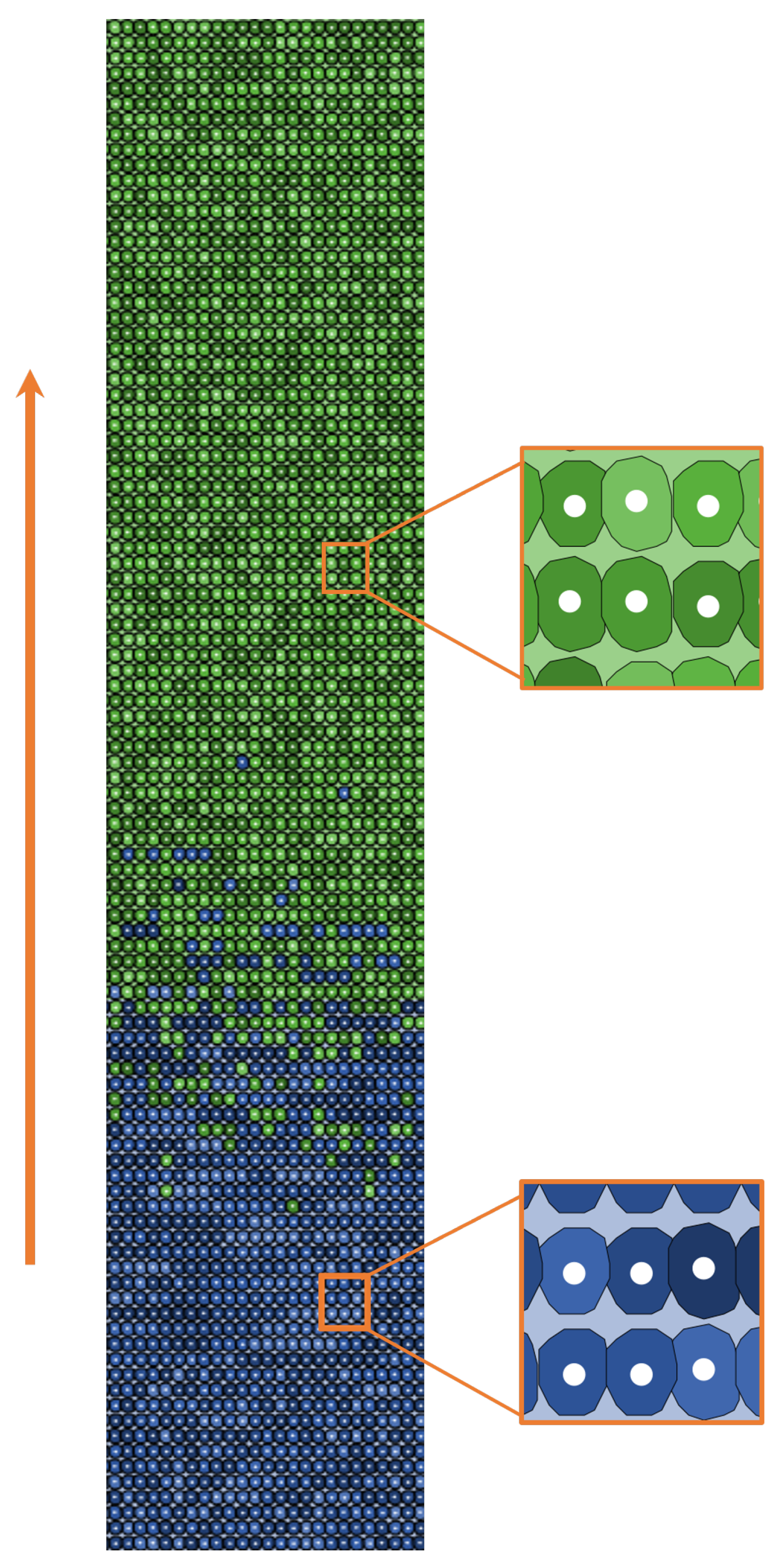
Figure 2.
Flowchart of the basic cell behavior algorithm.
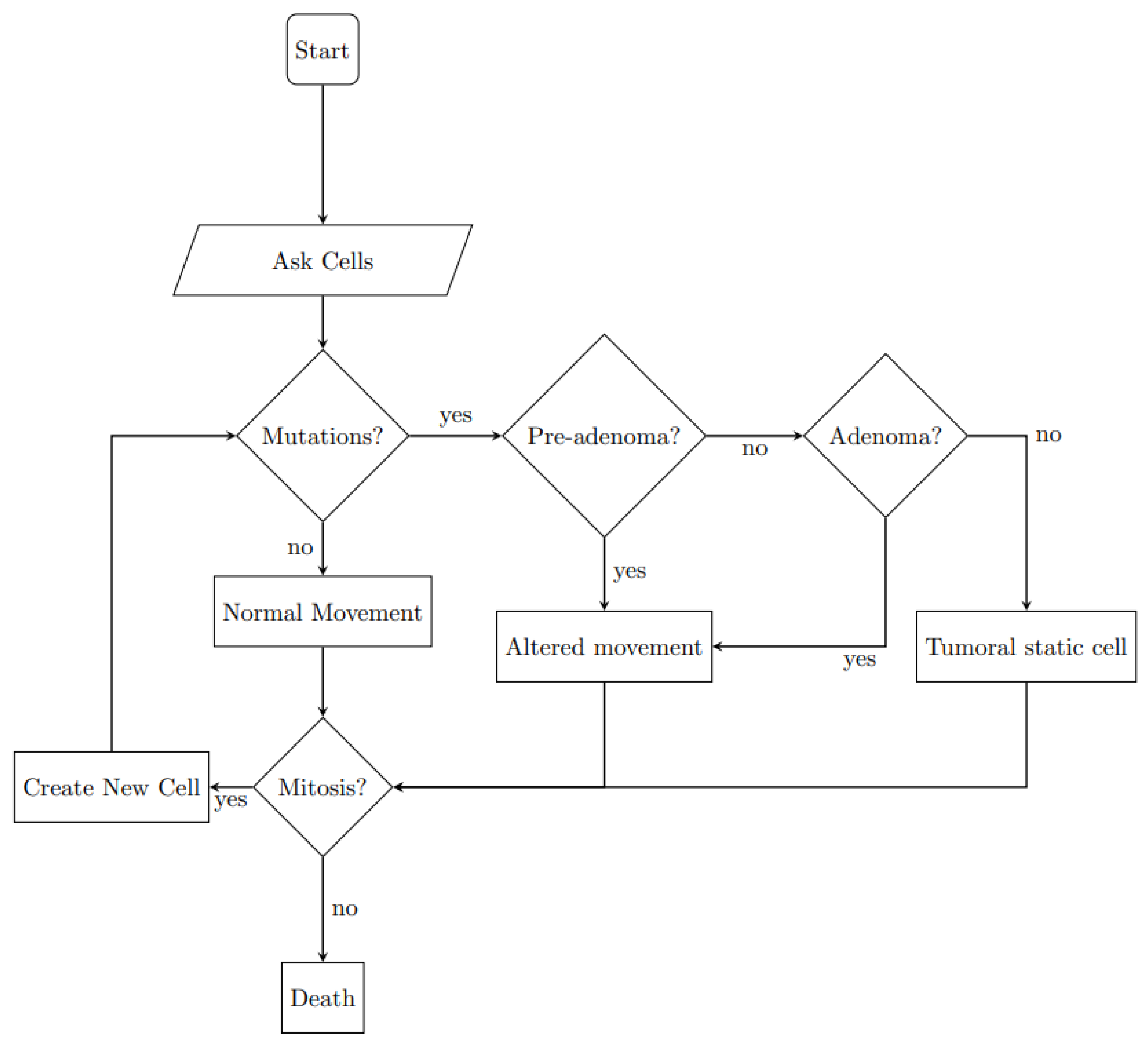
Figure 3.
Cell movement based on cell type: transit-amplifying cells are represented by blue cells, differentiated cells by green cells, adenoma cells by orange cells and tumoral cells by violet cells. Arrows indicate the degree of angular freedom during movement and mitosis. In the last panel, the arrows are dashed red lines because tumoral cells can only enter mitosis in the allowed direction, but they can no longer move. The arrows depicted here are the visual representation, within the crypt, of the movement directions exposed in Table 1.
Figure 3.
Cell movement based on cell type: transit-amplifying cells are represented by blue cells, differentiated cells by green cells, adenoma cells by orange cells and tumoral cells by violet cells. Arrows indicate the degree of angular freedom during movement and mitosis. In the last panel, the arrows are dashed red lines because tumoral cells can only enter mitosis in the allowed direction, but they can no longer move. The arrows depicted here are the visual representation, within the crypt, of the movement directions exposed in Table 1.
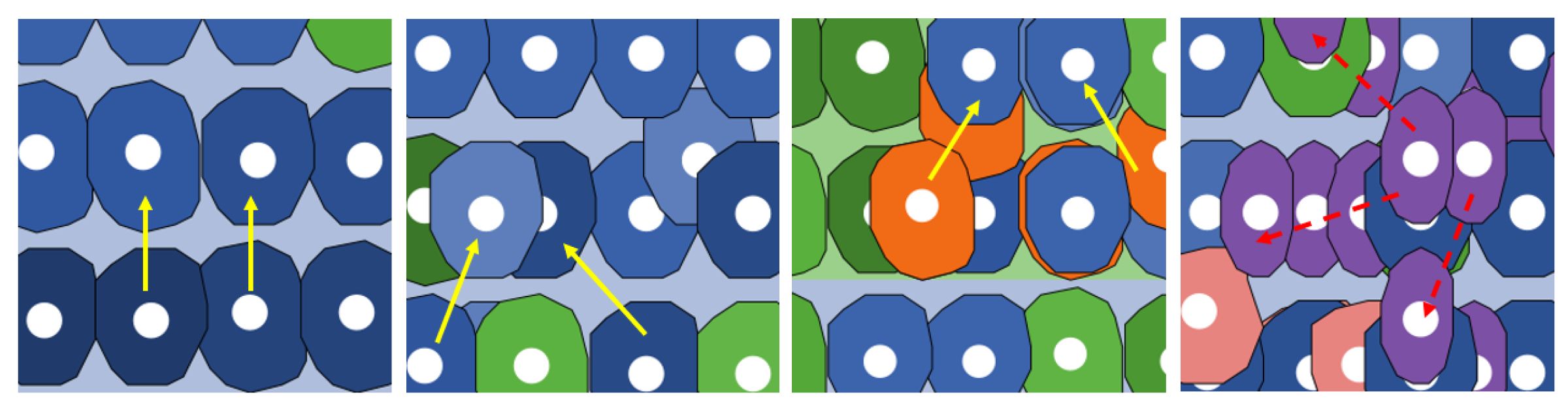
Figure 4.
Population dynamics in function of the hours. Abbreviations are referred to cells typologies: transit-amplifying, differentiated, pre-adenoma, adenoma, tumoral, immune-system cells. Different panels show the size of the cell populations in crypts with a decreasing gene probability of mutation, from (a) to (f).
Figure 4.
Population dynamics in function of the hours. Abbreviations are referred to cells typologies: transit-amplifying, differentiated, pre-adenoma, adenoma, tumoral, immune-system cells. Different panels show the size of the cell populations in crypts with a decreasing gene probability of mutation, from (a) to (f).
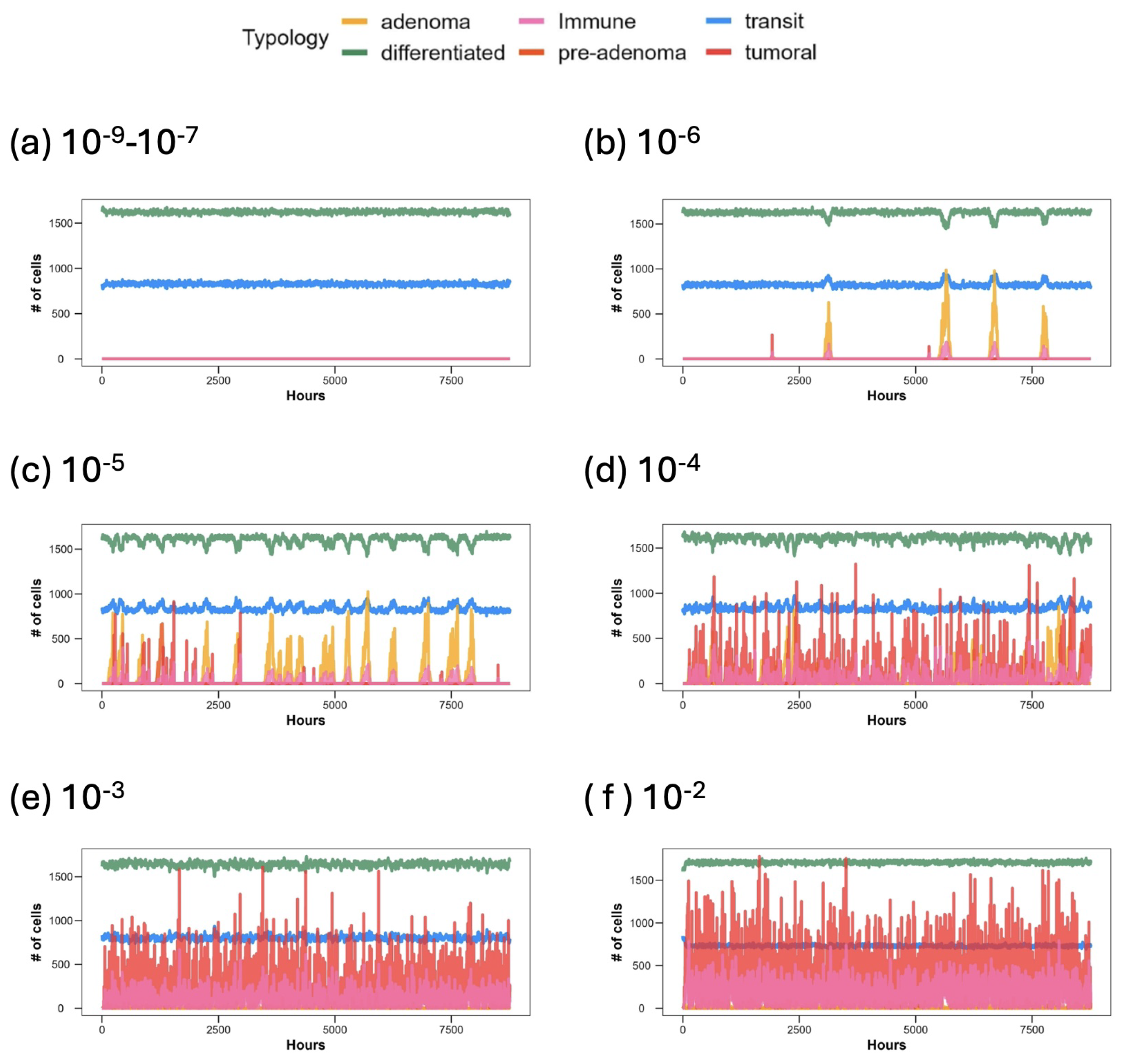
Figure 5.
Here, various types of cell deaths occurring per hour are presented. Physiological death indicates the number of cells that have died due to physiological causes, such as reaching their maximum life threshold or being killed by another physiological cell to facilitate mitosis activity. Hypoxic death refers to cells that have died after the hypoxic threshold is reached. Immune sys death represents the number of cells killed by the immune system. Tumoral death accounts for tumoral cells that have died due to reaching the age threshold, which is set at 150 h. Panel (a) illustrates different scenarios, ranging from crypts with a probability of mutation as low as up to . Panel (b) specifically focuses on the scenario with a probability of mutation set at .
Figure 5.
Here, various types of cell deaths occurring per hour are presented. Physiological death indicates the number of cells that have died due to physiological causes, such as reaching their maximum life threshold or being killed by another physiological cell to facilitate mitosis activity. Hypoxic death refers to cells that have died after the hypoxic threshold is reached. Immune sys death represents the number of cells killed by the immune system. Tumoral death accounts for tumoral cells that have died due to reaching the age threshold, which is set at 150 h. Panel (a) illustrates different scenarios, ranging from crypts with a probability of mutation as low as up to . Panel (b) specifically focuses on the scenario with a probability of mutation set at .
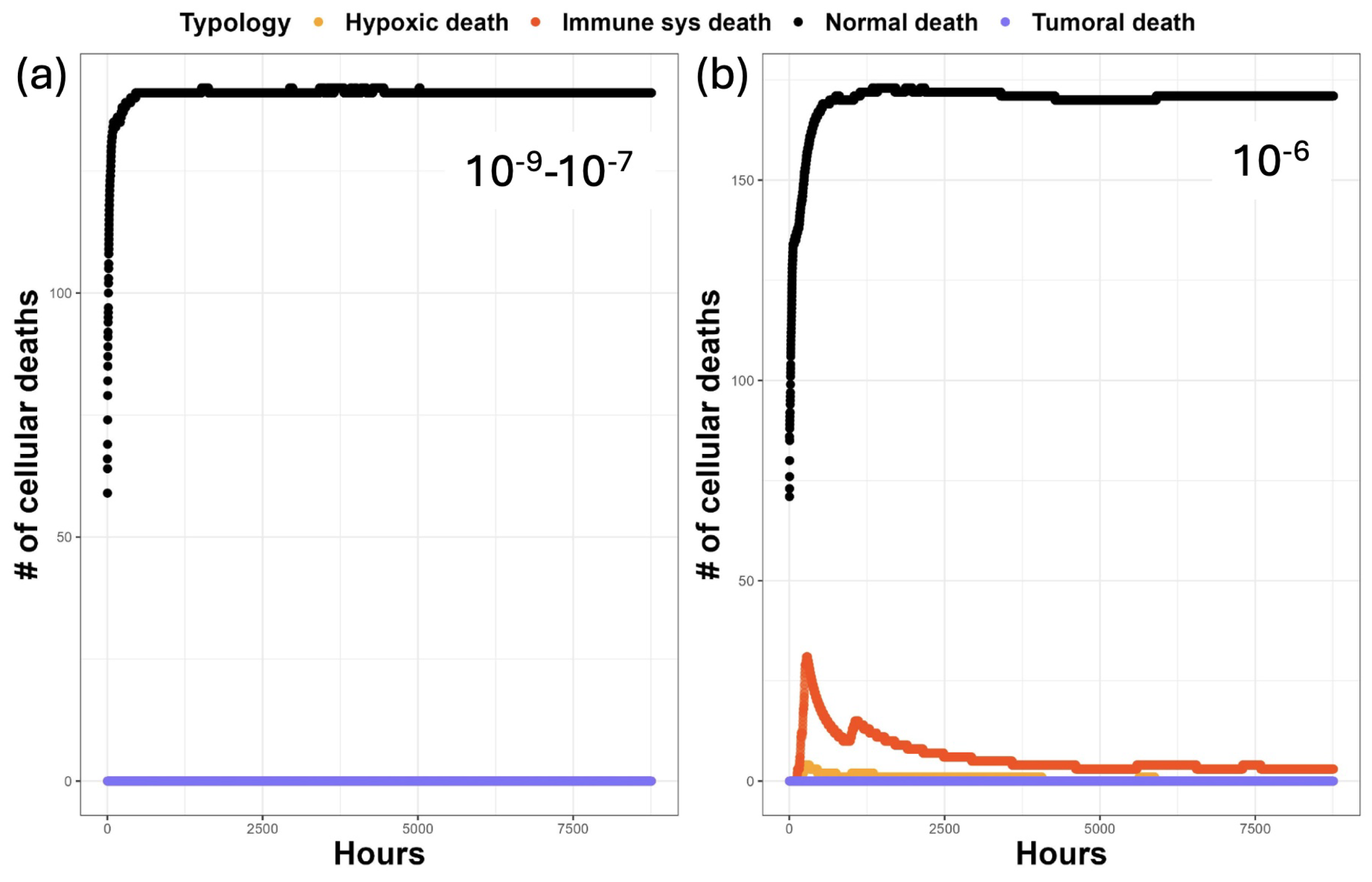
Figure 6.
Genotype frequency of the genes in the cell population as function of time for three different scenarios, with the following values of the mutation probability: from to (a), (b) and (c). The abbreviations used refer to the names of genes. For example, apc 00 represents the gene APC with both alleles being wild type, apc 10 and apc 01 represent heterozygosity and apc 11 represents both alleles being mutated. The same conventions apply to the other two genes, KRAS and P53.
Figure 6.
Genotype frequency of the genes in the cell population as function of time for three different scenarios, with the following values of the mutation probability: from to (a), (b) and (c). The abbreviations used refer to the names of genes. For example, apc 00 represents the gene APC with both alleles being wild type, apc 10 and apc 01 represent heterozygosity and apc 11 represents both alleles being mutated. The same conventions apply to the other two genes, KRAS and P53.
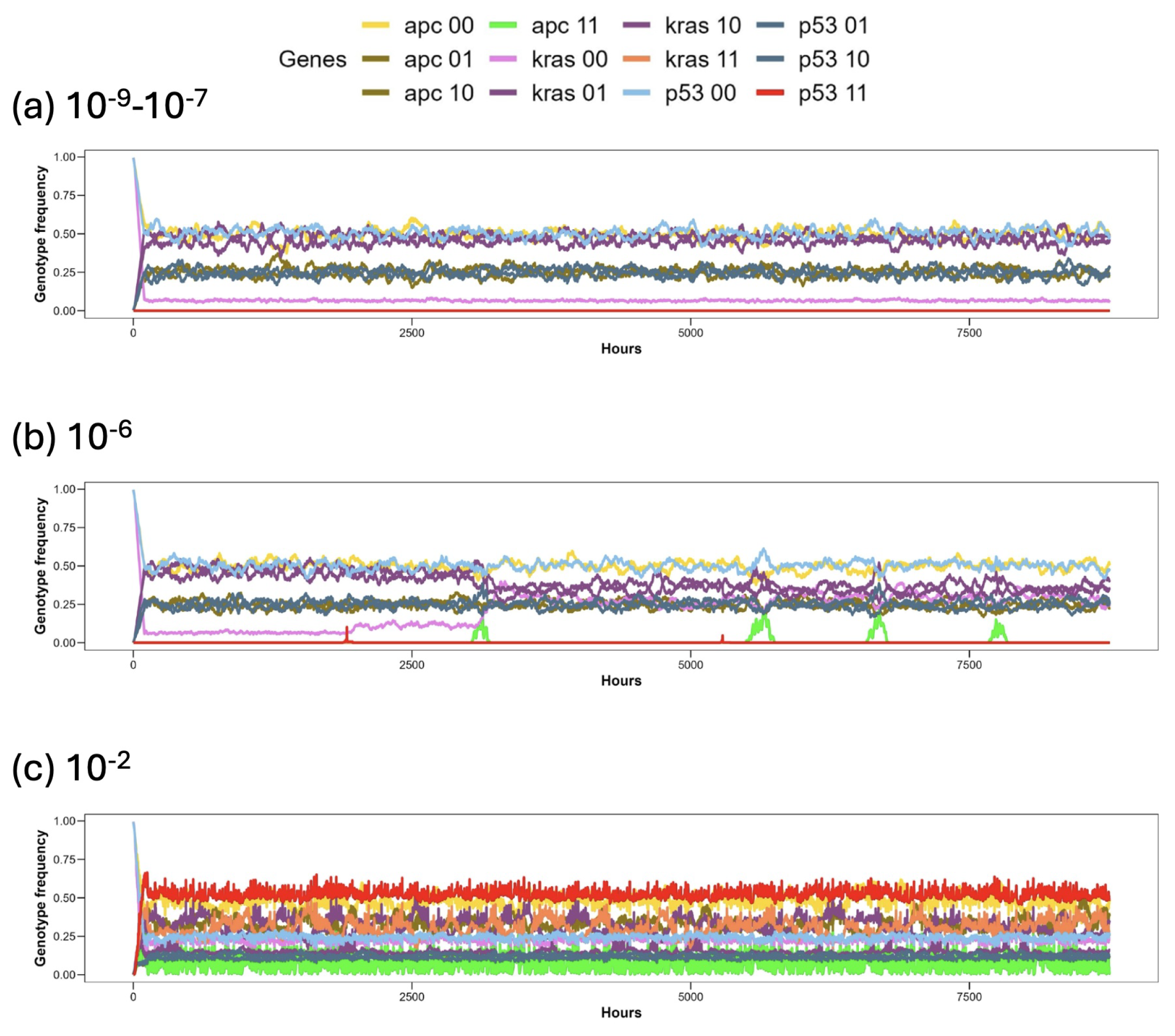
Figure 7.
Proliferation distributions. Panel A shows the mitosis distribution in the physiological scenario. Panel B shows the scenario at with the emergence of both, pre-adenoma and adenoma cells. Panel C shows the scenario at , where all the neoplastic typologies are present.
Figure 7.
Proliferation distributions. Panel A shows the mitosis distribution in the physiological scenario. Panel B shows the scenario at with the emergence of both, pre-adenoma and adenoma cells. Panel C shows the scenario at , where all the neoplastic typologies are present.
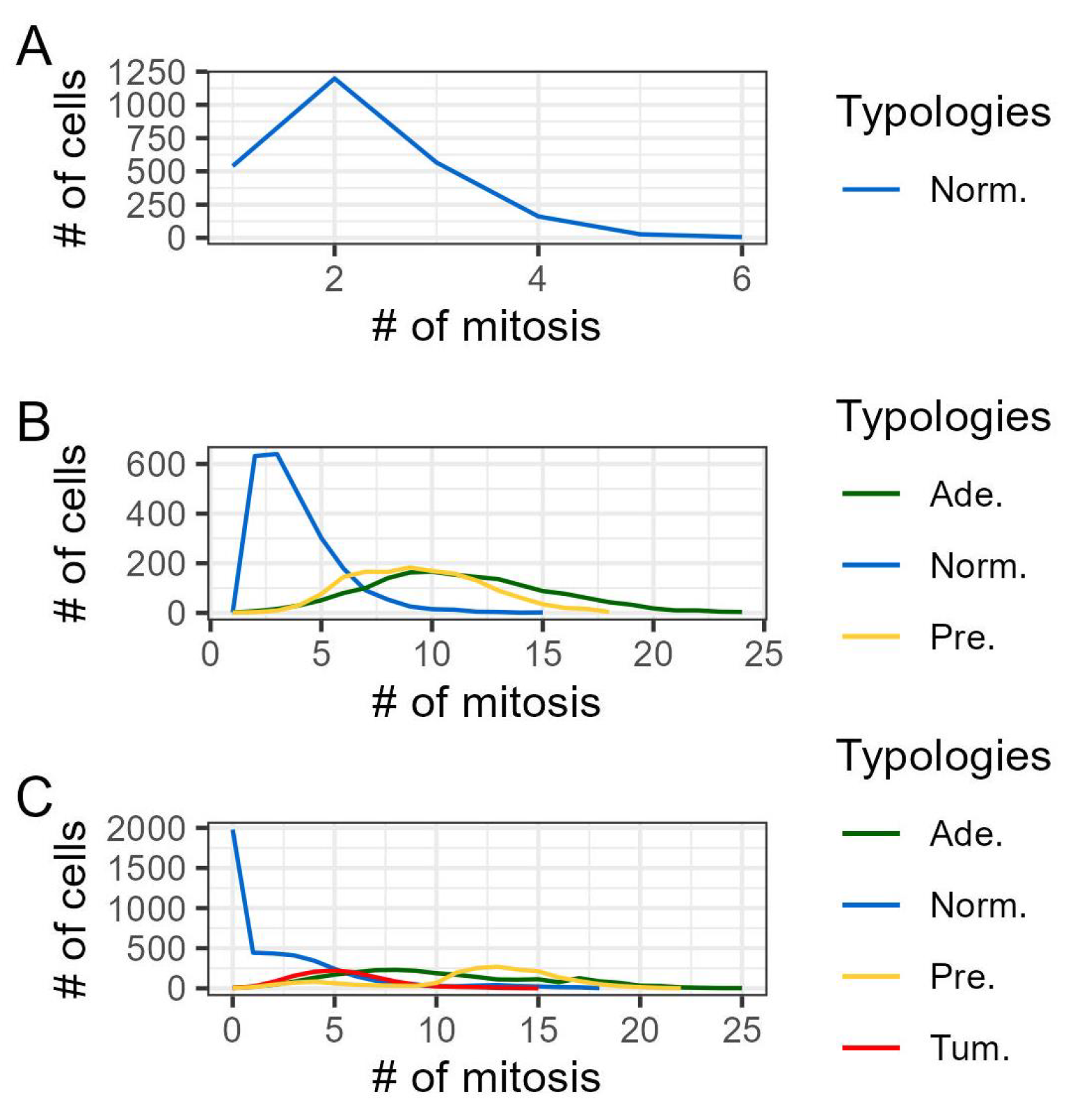
Figure 8.
Crypt final states: starting from the left panel we have six snapshots of the nine final stages simulated scenarios. 1) This scenario represents the physiological state of a healthy crypt, with transit-amplifying and differentiated cells positioned correctly along the height of the crypt and in the appropriate proportions. This physiological state remains the same even when the probability of mutation is fixed at and . 2) In this scenario, changes occur and we observe a cluster of adenomatous cells being attacked by immune-system cells. 3) This scenario represents a probability of mutation of , with no qualitative changes in the emergence and types of mutated phenotypes. 4) In this scenario, the probability of mutation is and a distinction arises between two mutated phenotypes with different local displacements. 5) This scenario corresponds to a probability of mutation of , where there is a much more pronounced Intratumor Heterogeneity (ITH), with the first mutated cells emerging at the level of differentiated cells. 6) Here, the probability of mutation is and we observe a completely deregulated crypt with evident ITH. Additionally, ransit-amplifying cells keep migrating towards the crypt mouth without differentiating.
Figure 8.
Crypt final states: starting from the left panel we have six snapshots of the nine final stages simulated scenarios. 1) This scenario represents the physiological state of a healthy crypt, with transit-amplifying and differentiated cells positioned correctly along the height of the crypt and in the appropriate proportions. This physiological state remains the same even when the probability of mutation is fixed at and . 2) In this scenario, changes occur and we observe a cluster of adenomatous cells being attacked by immune-system cells. 3) This scenario represents a probability of mutation of , with no qualitative changes in the emergence and types of mutated phenotypes. 4) In this scenario, the probability of mutation is and a distinction arises between two mutated phenotypes with different local displacements. 5) This scenario corresponds to a probability of mutation of , where there is a much more pronounced Intratumor Heterogeneity (ITH), with the first mutated cells emerging at the level of differentiated cells. 6) Here, the probability of mutation is and we observe a completely deregulated crypt with evident ITH. Additionally, ransit-amplifying cells keep migrating towards the crypt mouth without differentiating.
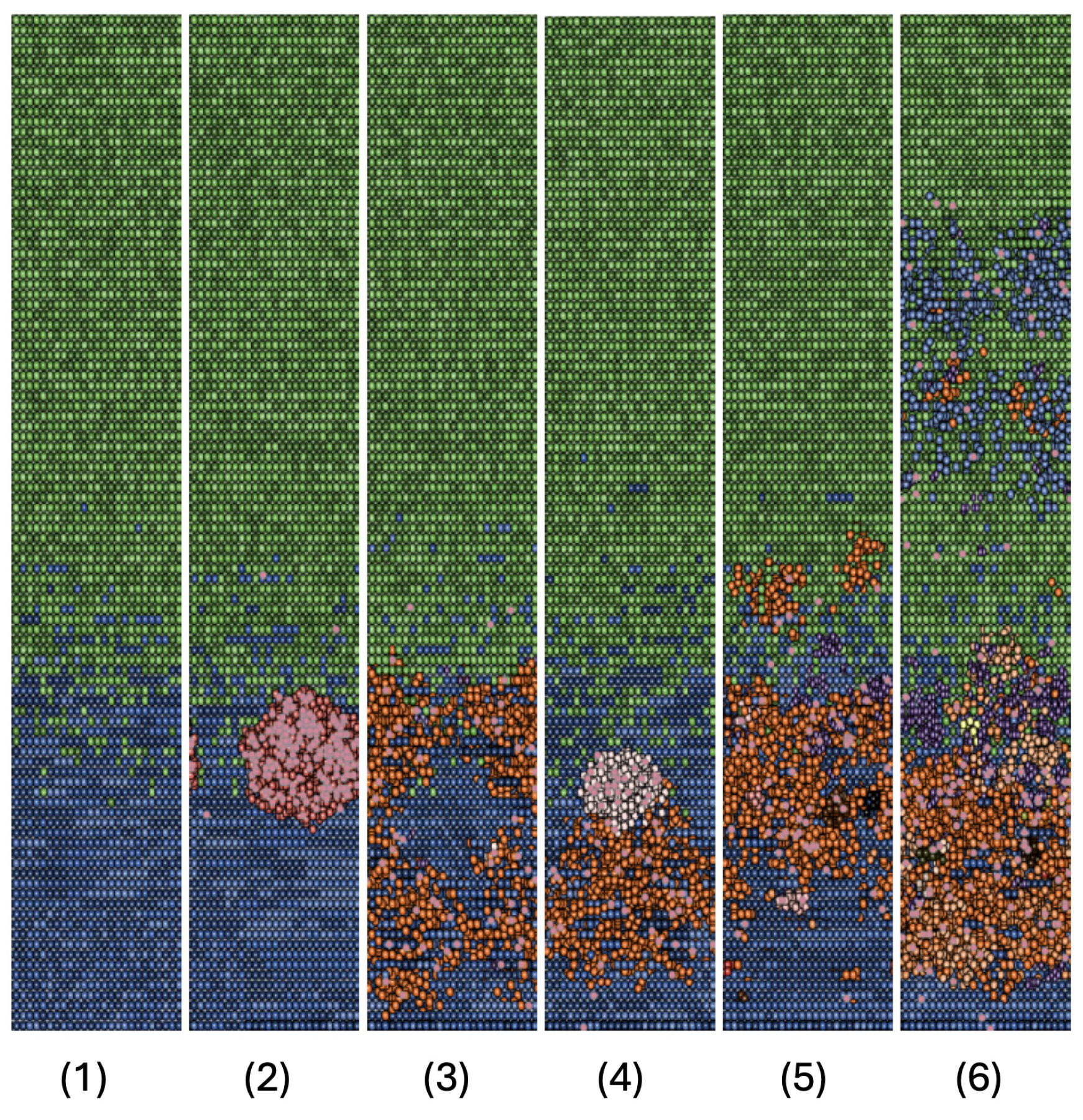
Figure 9.
The frequency distribution of the number of cells per patch is reported for the scenario with mutation probability at the time of maximum tumoral expansion. (a) Lin-Lin plot; (b) Log-Lin plot. It is evident the exponential behavior of the curve, which decreases linearly in semilogarithmic scale, meaning that mitosis mostly occurs in a very small number of sites within the crypt.
Figure 9.
The frequency distribution of the number of cells per patch is reported for the scenario with mutation probability at the time of maximum tumoral expansion. (a) Lin-Lin plot; (b) Log-Lin plot. It is evident the exponential behavior of the curve, which decreases linearly in semilogarithmic scale, meaning that mitosis mostly occurs in a very small number of sites within the crypt.
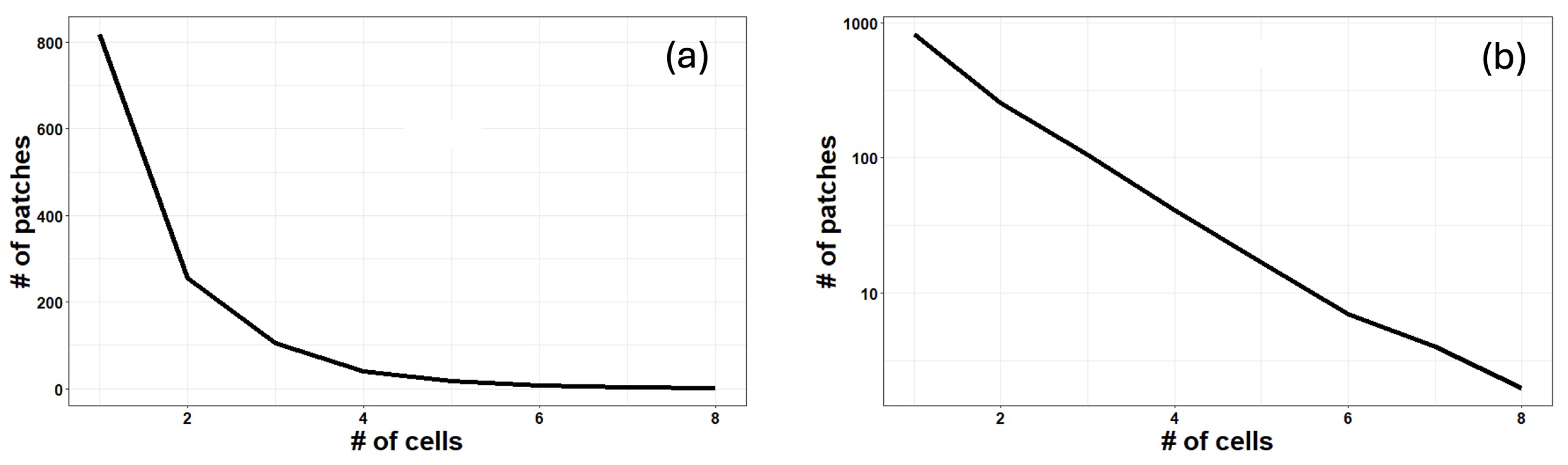
Figure 10.
Mitosis activity based on crypt height. The height of the crypt is measured in number of patches (0-300). The distribution shows the total number of mitosis in the physiological scenario (probability of mutation ranging from to ).
Figure 10.
Mitosis activity based on crypt height. The height of the crypt is measured in number of patches (0-300). The distribution shows the total number of mitosis in the physiological scenario (probability of mutation ranging from to ).
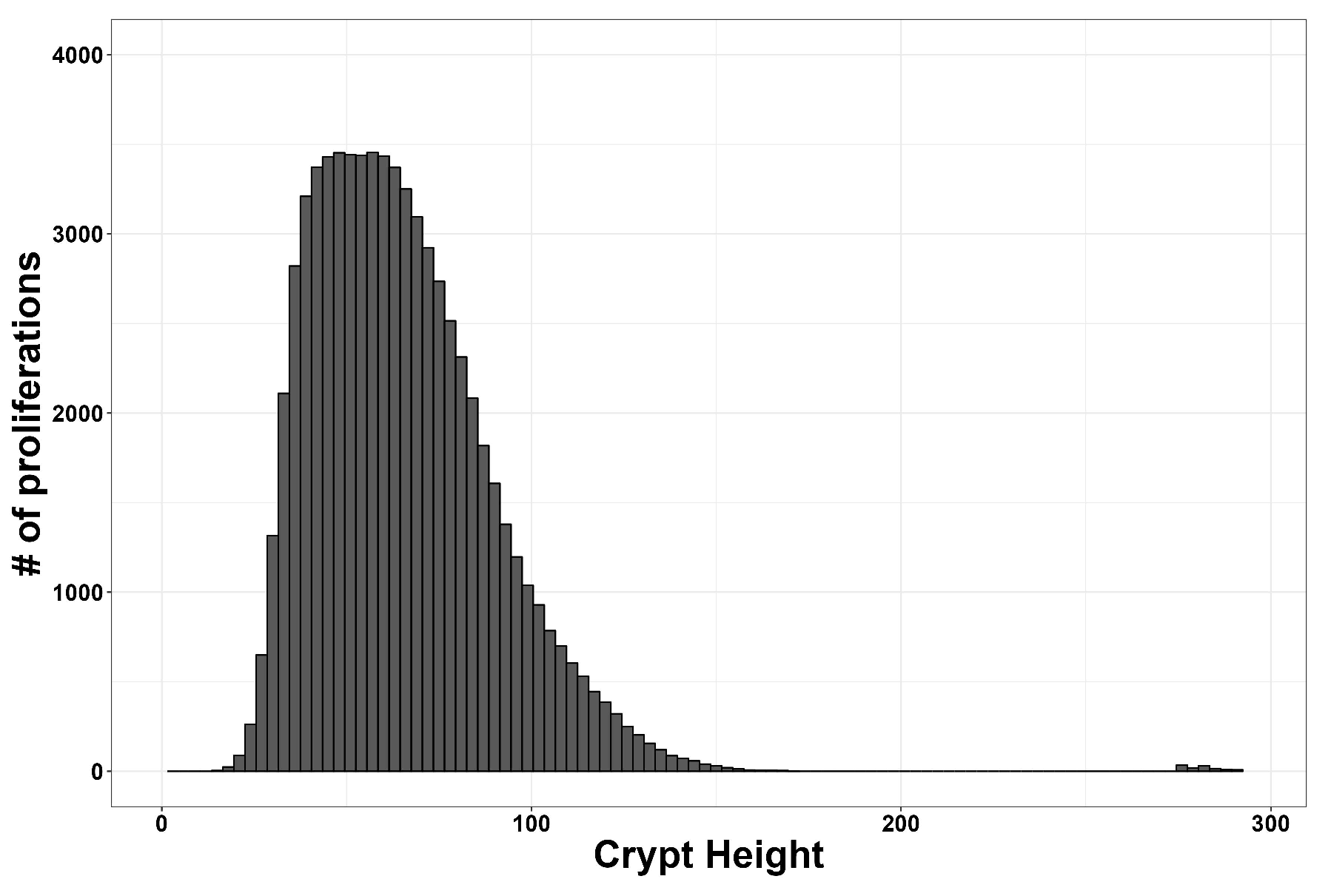

Table 1.
Values of the main cell variables. Arrows represent the movement of the cells in the crypt and the direction where the daughter cell is placed. Details about APC, KRAS and TP53 are reported in Table 2.
Table 1.
Values of the main cell variables. Arrows represent the movement of the cells in the crypt and the direction where the daughter cell is placed. Details about APC, KRAS and TP53 are reported in Table 2.
| Main Cell Variables | Values |
|---|---|
| Lifetime | physiological = min 96 h (hours), max 120 h; Tumoral = min 96 h, max 150 h. |
| Mitosis time3 | Normal distribution, mean = Mitosis mean time, variance 1. |
| Mitosis mean time | physiological (transit-amplifying, differentiated cells) = 24 h; with KRAS heterozygote = 12 h; with typology tumoral = 10 h. |
| -cat | Descendent gradient: 1 at the bottom, 0 at the top of the crypt. |
| Neoplastic typologies | pre-adenoma: true if APC = [1 1] |
| adenoma: true if APC = [1 1] and K-ras = [1 0] or [0 1] | |
| tumoral: true if APC = [1 1], K-ras = [1 0] and TP53 = [1 1] | |
| Movement | Physiological cells = ↑ |
| pre-adenoma = | |
| adenoma = | |
| tumoral = no movement | |
| Proliferation directions | Physiological cells = ⟷ |
| pre-adenoma = | |
| adenoma = | |
| tumoral = |
Table 2.
Gene characteristics. Shows when, depending on the allele status, the respective function is activated.
Table 2.
Gene characteristics. Shows when, depending on the allele status, the respective function is activated.
| Genes | State |
|---|---|
| APC | wild type = [0 0], heterozygote = [1 0] [0 1], |
| mutated = [1 1] (trigger pre-adenoma typology) | |
| KRAS | wild type = [0 0], heterozygote = [1 0] [0 1] |
| (trigger adenoma typology) | |
| TP53 | wild type = [0 0], heterozygote = [1 0] [0 1], |
| mutated = [1 1] (trigger tumoral typology) | |
| Regulation genes (N = 50) | N = [ [0 0], [0 1], ..., [1 0] ] |
| if a given threshold x is passed | |
| and TP53 = [1 1], trigger cells death |
Disclaimer/Publisher’s Note: The statements, opinions and data contained in all publications are solely those of the individual author(s) and contributor(s) and not of MDPI and/or the editor(s). MDPI and/or the editor(s) disclaim responsibility for any injury to people or property resulting from any ideas, methods, instructions or products referred to in the content. |
© 2024 by the authors. Licensee MDPI, Basel, Switzerland. This article is an open access article distributed under the terms and conditions of the Creative Commons Attribution (CC BY) license (http://creativecommons.org/licenses/by/4.0/).
Copyright: This open access article is published under a Creative Commons CC BY 4.0 license, which permit the free download, distribution, and reuse, provided that the author and preprint are cited in any reuse.


