

Submitted:
26 September 2024
Posted:
27 September 2024
You are already at the latest version
Abstract
New allyl derivative of curcumin containing three allyl groups (1E,6E)-4-allyl-1,7-bis(4’-allyloxy-3’-methoxyphenyl)hepta-1,6-diene-3,5-dione was synthesized by the reaction of curcumin with the excess of allyl bromide in the presence of K2CO3 in acetone under reflux. The triple allylated curcumin was characterized by 1H and 13C NMR spectroscopy and single-crystal X-ray diffraction study.
Keywords:
curcumin
; allyl derivative
; synthesis
; NMR spectra
; single crystal X-ray diffraction
1. Introduction
Natural compounds currently serve as a source of new drugs for the prevention and treatment of various diseases [1]. Among the large number of natural compounds, a special place is occupied by curcumin, which is the main component of the plant Curcuma longa (Zingiberaceae) [2]. It should be noted that curcumin itself and its derivatives exhibit various types of biological activity [3]. Curcumin is known to have antioxidant [4], anti-inflammatory [5,6], antitumor [7,8] and antiangiogenic [9,10] properties, and can also be used in the treatment of HIV [11] and Alzheimer's disease [12]. Such a wide medical use of curcumin is due to its chemical structure, which contains several functional groups, namely o-methoxy phenol groups associated by a seven-carbon linker comprised of an α,β-unsaturated β-diketone moiety that demonstrates keto-enol tautomerism in solution [13]. These functional groups are good sites for any chemical modification using various methods of organic chemistry, which makes the curcumin molecule a promising candidate for medicine, while depending on the modification site, curcumin derivatives can exhibit various pharmacological properties [14]. Therefore, the synthesis of new curcumin derivatives is of continuous interest.
In this contribution we describe synthesis, spectral characteristics and solid state structure of (1E,6E)-4-allyl-1,7-bis(4’-allyloxy-3’-methoxyphenyl)hepta-1,6-diene-3,5-dione.
2. Results and Discussion
2.1. Synthesis of Triallyl Derivative of Curcumin 2
The literature describes the synthesis of several curcumin derivatives containing allyl groups in different positions of the molecule. A curcumin derivative with allyl substituent at the central methylene carbon, (1E,6E)-4-allyl-1,7-bis(4’-hydroxy-3’-methoxyphenyl)-hepta-1,6-diene-3,5-dione, was prepared by the condensation of allyl substituted acetylacetone with 4-hydroxy-3-methoxybenzaldehyde in the presence of tributylborate and boric acid [15,16]. A curcumin derivative with two allyl substituents at the central methylene carbon, (1E,6E)-4,4-diallyl-1,7-bis(4’-hydroxy-3’-methoxyphenyl)-hepta-1,6-diene-3,5-dione, was prepared by multi-step synthesis involving esterification of curcumin with 2,2,5-trimethyl-1,3-dioxane-5-carboxylic acid, reaction of the resulting ester with allyl bromide in the presence of K2CO3, followed by two-step deprotection of the phenoxy groups [17,18,19]. A curcumin derivative with two allyl substituents at the periphery of the molecule, (1E,6E)-1,7-bis(4’-allyloxy-3’-methoxyphenyl)hepta-1,6-diene-3,5-dione, was prepared using two different approaches. The first one includes allylation of 4-hydroxy-3-methoxybenzaldehyde with allyl bromide followed by condensation of the resulting aldehyde with acetylacetone [20]. The second approach is based on direct allylation of curcumin. The reaction of curcumin with allyl bromide in the presence of t-BuOK at 50 °C leads to the desired product in 33% yield [21], while a similar reaction in the presence of K2CO3 in tetrahydrofuran under reflux gives the target product in 46% yield [22]. The reaction of curcumin with allyl bromide in the presence of K2CO3 under reflux results in the diallyl derivative in 46% yield, along with the corresponding monoallyl derivative (1E,6E)-1-(4’-allyloxy-3’-methoxyphenyl)-7-(4’-hydroxy-3’-methoxyphenyl)hepta-1,6-diene-3,5-dione in 33% yield [23]. The formation of a triallyl derivative of curcumin by refluxing curcumin with allyl bromide in the presence of EtONa in ethanol has been reported, but this product has not been isolated and characterized [24].
We found that the reaction of curcumin (1) with large excess of allyl bromide in the presence of K2CO3 in refluxing acetone for 24 h results in the triple allylated curcumin (1E,6E)-4-allyl-1,7-bis(4’-allyloxy-3’-methoxyphenyl)hepta-1,6-diene-3,5-dione (2), which was isolated as a yellow solid in 85 % yield by column chromatography on silica with a mixture of dichloromethane and acetonitrile as eluent (Scheme 1).
The triple allylated curcumin 2 was characterized by 1H and 13C NMR spectroscopy, IR-spectroscopy, and high-resolution mass spectrometry (see Supplementary Materials). The 1H NMR spectrum of 2 in chloroform-d3, in addition to the characteristic signal [25] of the enol hydrogen atom at 17.61 ppm and a set of signals of the curcumin skeleton, contains signals of the 4-allyl group at 3.31 (CH2CH=CH2), 6.04 (CH2CH=CH2), and 5.13 (CH2CH=CH2) ppm and the 4’-allyloxy groups at 4.64 (OCH2CH=CH2), 6.04 (OCH2CH=CH2), and 5.40 and 5.29 (OCH2CH=CH2) ppm. The 13C-NMR spectrum of 2 shows the characteristic signals of the C=O groups and the C(4) carbon of the curcumin skeleton at 183.2 and 107.8 ppm, respectively, as well as signals of the O-CH2 and C-CH2 allyl carbons at 69.8 and 30.0 ppm, respectively.
2.2. Single-Crystal X-ray Diffraction Studies of Allyl Derivative of Curcumin 2
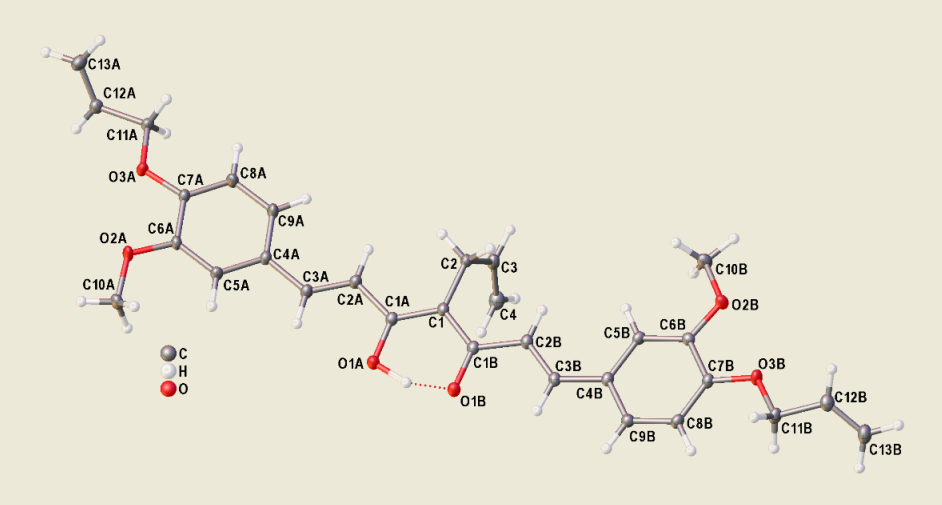
The solid-state structure of the triple allylated curcumin 2 was determined by single-crystal X-ray diffraction study (Figure 1).
The compound 2 crystallizes in the monoclinic space group P21/c. The unit cell contains four molecules. The molecule is almost planar, the value of angle between the planes of two benzene rings is about 4.5°. The 1,3-diketone linker between the benzene rings possesses the keto-enol form: the position of hydrogen atom is closer to the O1A oxygen atom (1.11 Å vs. 1.36 Å for O1B-H).
It is known that curcumin can form several different polymorphic crystalline modifications, differing in the rotation of the phenyl rings and the substituents in them [25,26,27,28,29,30,31,32,33,34]. To elucidate the role of intra- and intermolecular factors in the stabilization of conformation of 2 in crystal, the quantum-chemical calculation of the 2 molecule were carried out using the Gaussian program [35] at the PBE0/6-311++G(d,p) level. Calculations have shown that in the gas phase the dihedral angle between the benzene rings does not exceed 1° with the RMSD for the non-hydrogen atoms of two structures (gas-phase and crystalline) being only 0.67 Å. This implies a negligible influence of crystal packing forces on the molecular structure of 2.
The molecules of 2 are packed into infinite chains by the C-H…O intermolecular hydrogen bonds (C…O 3.48 Å). These chains, in turn, are held together by C-H…O hydrogen bonds with the oxygen of the ether group (3.49 Å) and weak C-H…π interactions with an average length of 3.73 Å (C…C), and, as a result, the formation of a three-dimensional network can be observed. Hydroxy groups O(1A)-H and O(1B)-H also participate in the formation of the three-dimensional structure: they form C-H…O intermolecular hydrogen bonds with a length of 3.21 to 3.48 Å.
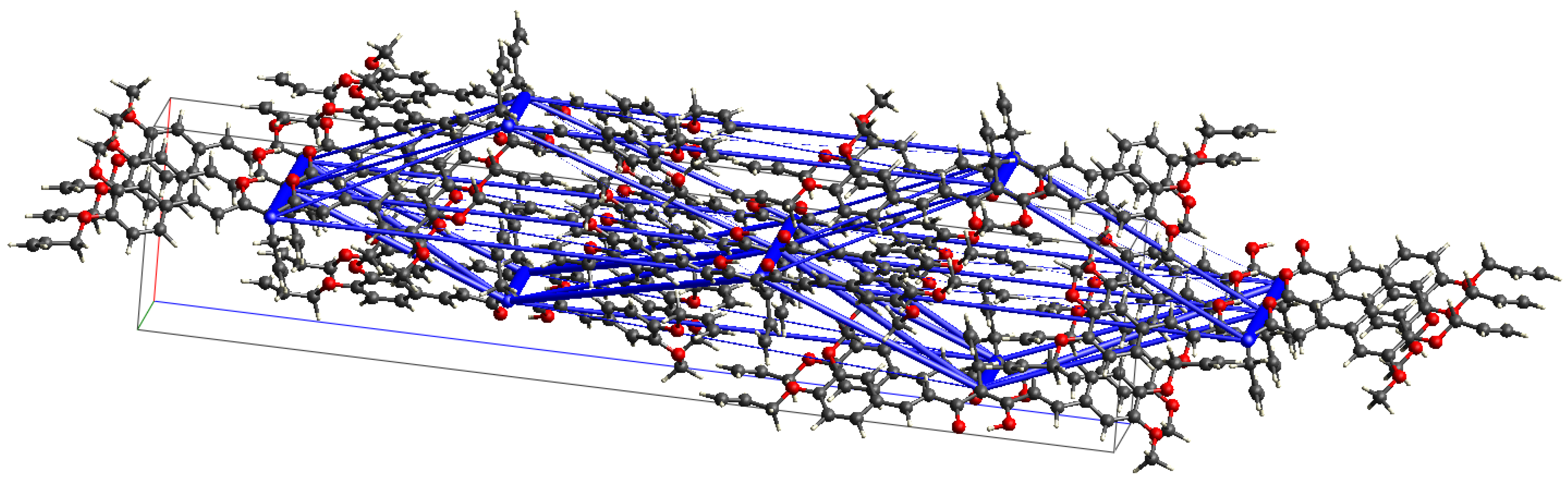
The consideration based on the geometry criteria was confirmed by the analysis of energy frameworks (Crystal Explorer program [36], HF/3-21G, Figure 2) which allows us to conclude that intermolecular interactions within the chains of molecules are indeed stronger than the interchain interactions. Note that the crystal lattice energy calculated by means of the energy frameworks approach equals to -30.7 kcal/mol.
In order to estimate contributions of bonding interactions into the crystal lattice energy, the energy of intermolecular interactions was estimated using the “Atoms in Molecules” framework and the approximation based on the electronic potential energy density (V(r)) at (3,-1) critical points of electron density (E=1/2V(r), [37]). The search for (3,-1) critical points was carried out in the Multiwfn program [38] using the HF/3-21G electron density for a cluster of molecules. The strongest interactions turned out to be the C–H…O hydrogen bonds with its energy varies from -1 kcal/mol to -2.2 kcal/mol. The energies of C–C, C–H, H–H or C–H…π interactions do not exceed 1.6 kcal/mol in magnitude while their average value is equal to -0.8 kcal/mol. The crystal lattice energy, estimated by means of this approximation, equals to -28.4 kcal/mol that agrees well with the energy framework approach discussed above. This once again confirms the performance of the electron density based analysis of intermolecular interactions.
3. Materials and Methods
3.1. General Methods
Curcumin (Acros Organics, Loughborough, U.K.) was used without further purification. CH3CN, CH2Cl2, allyl bromide, acetone and K2CO3 were commercially analytical grade reagents. The reaction progress was monitored by thin-layer chromatography (Merck F245 silica gel on aluminum plates). Acros Organics silica gel (0.060-0.200 mm) was used for column chromatography. The NMR spectra at 400.1 MHz (1H) and 100.0 MHz (13C) were recorded with a Varian Inova 400. The residual signal of the NMR solvent relative to Me4Si was taken as the internal reference for 1H- and 13C-NMR spectra. Infrared spectra were recorded on Spectra SF 2000 instrument. High resolution mass spectra (HRMS) were measured on a microOTOF II instrument using electrospray ionization (ESI). The measurements were done in a positive ion mode (interface capillary voltage 3200 V); mass range from m/z 50 to m/z 3000. External or internal calibration was performed with the ESI Tuning Mix, produced by Agilent. A syringe injection was used for the addition of the solutions to acetonitrile (flow rate 3 µL/min). Nitrogen was applied as a dry gas; the interface temperature was set at 180 °C.
3.2. Synthesis of (1E,6E)-4-allyl-1,7-bis(4’-allyloxy-3’-methoxyphenyl)hepta-1,6-diene-3,5-dione 2
To a solution of curcumin 1 (1 g, 2.7 mmol) in acetone (40 mL) the allyl bromide (10 mL, 14.0 g, 115.6 mmol) and K2CO3 (3.7 g, 27 mmol) were added. The reaction mixture was heated under reflux conditions for 24 h. After cooling to room temperature, the precipitate was filtered off and the solvent was evaporated in vacuo. The residue purified by column chromatography on silica with a mixture of CH2Cl2-CH3CN (5/1). The major fraction was collected and vacuum dried to give the target products 2 as yellow solid (1.1 g, yield 85%) of pure of (1E,6E)-4-allyl-1,7-bis(4’-allyloxy-3’-methoxyphenyl)hepta- 1,6-diene-3,5-dione as colorless crystals. 1H NMR (400 MHz, CDCl3), δ: 17.61 (1H, s, C-OH…О=С), 7.67 (2H, d, 2×СH=CH, J = 14.3), 7.11 (2H, d, 2×CHAr), 7.04 (2H, s, 2×CHAr), 6.85 (4H, m, 2×СH=CH, 2×CHAr), 6.04 (3H, m, С-СН2-СН=CH2, 2×ОСН2-СН=CH2), 5.40 (2H, d, 2×ОСН2-СН=CHH, J = 18.0), 5.29 (2H, d, 2×ОСН2-СН=CHH, J = 10.5), 5.13 (2H, m, С-СН2-СН=CH2), 4.64 (4H, m, 2×ОСН2-СН=CH2) 3.90 (6H, с, 2×OСН3), 3.31 (2H, m, С-СН2-СН=CH2) ppm. 13C NMR (101 MHz, CDCl3), δ: 183.2 (С=О), 150.0 (OCAr), 149.5 (OCAr), 141.4 (СH=CH), 137.2 (C-CH2-СH=CH2), 132.8 (OCH2-СH=CH2), 128.7 (C-CAr), 122.1 (CHAr), 118.8 (СH=CH), 118.3 (OCH2-СH=CH2), 116.0 (C-CH2-СH=CH2), 113.1 (CHAr), 110.8 (CHAr), 107.8 (CO-С=COH), 69.8 (OCH2), 56.0 (OCH3), 30.0 (С-CH2) ppm. IR (solid, ν, cm−1): 3091-2868 (C-H), 1624-1585 (C=O). HRMS (ESI) m/z for [C30H32О6]+ calcd 489.2272 [M]+, found: 489.2287 [M]+.
3.3. Single Crystal X-ray Diffraction Study
The single crystal of (1E,6E)-4-allyl-1,7-bis(4’-allyloxy-3’-methoxyphenyl)hepta- 1,6-diene-3,5-dione (2) was grown by crystallization from dichloromethane/hexane. Single crystal X-ray diffraction experiments were carried out using Bruker APEX II CCD diffractometer (λ(Mo-Kα) = 0.71073 Å, graphite monochromator, ϖ-scans) at 100 K. Collected data were processed by the SAINT and SADABS programs incorporated into the APEX2 program package [39]. The structure was solved by the direct methods and refined by the full matrix least-squares procedure against F2 in anisotropic approximation. The refinement was carried out with the SHELXTL program [40].
Crystallographic data for (1E,6E)-4-allyl-1,7-bis(4’-allyloxy-3’-methoxyphenyl)- hepta-1,6-diene-3,5-dione (2): C30H32O6 is monoclinic, space group P21/c: a = 10.1509(2) Å, b = 5.24040(10) Å, c = 47.4444(10) Å, β = 90.4900(10)°, V = 2523.70(9) Å3, Z = 4, M = 688.55, dcryst = 1.286 g/cm3. wR2 = 0.0592 calculated on F2hkl for all 7377 independent reflections with 2θ < 60.0°, (GOF = 1.125, R = 0.0506 calculated on Fhkl for 6466 reflections with I > 2s(I)). The CCDC number 2385869 contains the supplementary crystallographic data for this paper. These data can be obtained free of charge via www.ccdc.cam.ac.uk/data_request/cif.
Supplementary Materials
The following supporting information can be downloaded at the website of this paper posted on Preprints.org. 1H, 13C NMR, IR and HRMS-ESI spectra of (1E,6E)-4-allyl-1,7-bis(4’-allyloxy-3’-methoxyphenyl)hepta-1,6-diene-3,5-dione 2.
Author Contributions
Conceptualization, A.A.D. and I.B.S.; methodology, A.A.D. and I.V.A.; validation, O.B.Z. and E.V.D.; formal analysis, X-ray diffraction, S.A.A. and I.V.A.; writing—original draft, A.A.D., I.V.A.; review and editing, S.V., I.B.S. and V.I.B. All authors have read and agreed to the published version of the manuscript.
Funding
This work was supported by the Ministry of Science and Higher Education of the Russian.
Data Availability Statement
The Supplementary Materials for this paper are available.
Acknowledgments
The NMR spectra were obtained using equipment from the Center for Molecular Structure Studies at A.N. Nesmeyanov Institute of Organoelement Compounds, operating with financial support from the Ministry of Science and Higher Education of the Russian Federation. The single crystal X-ray diffraction study and theoretical calculations were supported by the Ministry of Science and Higher Education of the Russian Federation as part of the State Assignment of the N. S. Kurnakov Institute of General and Inorganic Chemistry of the Russian Academy of Sciences. The structural study was performed using the equipment of the Center for the Shared Use of Physical Methods for Studying Substances and Materials at the N. S. Kurnakov Institute of General and Inorganic Chemistry of the Russian Academy of Sciences.
Conflicts of Interest
The authors declare no conflict of interest.
References
- Dias, D.A.; Urban, S.; Roessner, U. A historical overview of natural products in drug discovery. Metabolites. 2012, 2, 303–336. [Google Scholar] [CrossRef] [PubMed]
- Henriques, M.C.; Faustino, M.A.F.; Braga, S.S. Curcumin innovative delivery forms: paving the ‘yellow brick road’ of antitumoral phytotherapy. Appl. Sci. 2020, 10, 8990–9019. [Google Scholar] [CrossRef]
- Urošević, M.; Nikolić, L.; Gajić, I.; Nikolić, V.; Dinić, A.; Miljković, V. Curcumin: biological activities and modern pharmaceutical forms. Antibiotics. 2022, 11, 135–161. [Google Scholar] [CrossRef] [PubMed]
- Motterlini, R.; Foresti, R.; Bassi, R.; Green, C.J. Curcumin, an antioxidant and anti-inflammatory agent, induces heme oxygenase-1 and protects endothelial cells against oxidative stress. Free Radical Biol. Med. 2000, 28, 1303–1312. [Google Scholar] [CrossRef] [PubMed]
- Yang, Z.; Zhao, T.; Zou, Y.; Zhang, J.H.; Feng, H. Curcumin inhibits microglia inflammation and confers neuroprotection in intracerebral hemorrhage. Immunol. Lett. 2014, 160, 89–95. [Google Scholar] [CrossRef]
- Wang, Y.F.; Zu, J.N.; Li, J.; Chen, C.; Xi, C.Y.; Yan, J.L. Curcumin promotes the spinal cord repair via inhibition of glial scar formation and inflammation. Neurosci. Lett. 2014, 560, 51–56. [Google Scholar] [CrossRef]
- Oelkrug, C. , Lange, C.M.; Wenzel, E.; Fricke, S.; Hartke, M.; Simasi, J.; Schubert, A. Analysis of the tumoricidal and anti-cachectic potential of curcumin. Anticancer Res. 2014, 34, 4781–4788. [Google Scholar] [PubMed]
- Ohtsu, H.; X. Zhiyan; Ishida, J.; Nagai, M.; Wang, H.K.; Itokawa, H.; Su, C.Y.; Shih, C.; Chiang, T.; Chang, E.; Lee, Y.; et al. Antitumor agents. 217. Curcumin analogues as novel androgen receptor antagonists with potential as anti-prostate cancer agents. J. Med. Chem., 2002, 45, 5037–5042. [Google Scholar] [CrossRef]
- Fan, X.; Zhang, C.; Liu, D.; Yan, J.; Liang, H. The clinical applications of curcumin: current state and the future. Curr. Pharm. Des. 2013, 19, 2011–2031. [Google Scholar] [PubMed]
- Adams, B.; Ferstl, E.M.; Davis, M.C.; Herold, M.; Kurtkaya, S.; Camalier, R.F.; Hollingshead, M.G.; Kaur, G. , Sausville, E.A.; Rickles, F.R.; et al. Synthesis and biological evaluation of novel curcumin analogs as anti-cancer and anti-angiogenesis agents. Bioorg. Med. Chem. 2004, 12, 3871–3883. [Google Scholar] [CrossRef]
- Conteas, C.N.; Panossian, A.M.; Tran, T.T.; Singh, H.M. Treatment of HIV-associated diarrhea with curcumin. Dig. Dis. Sci. 2009, 2009. 54, 2188–2191. [Google Scholar] [CrossRef]
- Kesharwani, R.K.; Srivastava, V.; Singh, P.; Rizvi, S.I.; Adeppa, K.; Misra, K. A Novel approach for overcoming drug resistance in breast cancer chemotherapy by targeting new synthetic curcumin analogues against aldehyde dehydrogenase 1 (ALDH1A1) and glycogen synthase kinase-3 β (GSK-3β). Appl. Biochem. Biotechnol. 2015, 54, 2188–2191. [Google Scholar] [CrossRef] [PubMed]
- Priyadarsini, K.I. The chemistry of curcumin: from extraction to therapeutic agent. Molecules. 2014, 19, 20091–20112. [Google Scholar] [CrossRef] [PubMed]
- Prasad, S.; DuBourdieu, D.; Srivastava, A.; Kumar. P.; Lall, R. Metal-curcumin complexes in therapeutics: An approach to enhance pharmacological effects of curcumin. Int. J. Mol. Sci. 2021, 22, 7094. [Google Scholar] [CrossRef] [PubMed]
- Pedersen, U.; Rasmussen, P.B.; Lawesson, S.-O. Synthesis of naturally occurring curcuminoids and related compounds. Liebigs Ann. Chem. 1985, 1985, 1557–1569. [Google Scholar] [CrossRef]
- Kim, M.K.; Jeong, W.; Kang, J.; Chong, Y. Significant enhancement in radical-scavenging activity of curcuminoids conferred by acetoxy substituent at the central methylene carbon. Bioorg. Med. Chem. 2011, 19, 3793–3800. [Google Scholar] [CrossRef]
- Hsieh, M.-T.; Chang, L.-C.; Hung, H.-Y.; Lin, H.-Y.; Shih, M.-H.; Tsai, C.-H.; Kuo, S.C.; Lee, K.-H. New bis(hydroxymethyl) alkanoate curcuminoid derivatives exhibit activity against triple-negative breast cancer in vitro and in vivo. Eur. J. Med. Chem. 2017, 131, 141–151. [Google Scholar] [CrossRef]
- Lee, D.-Y.; Hou, Y.-C.; Yang, J.-S.; Lin, H.-Y.; Chang, T.-Y.; Lee, K.-H.; Kuo, S.-C.; Hsieh, M.-T. Synthesis, anticancer activity, and preliminary pharmacokinetic evaluation of 4,4-disubstituted curcuminoid 2,2-bis(hydroxymethyl)propionate derivatives. Molecules 2020, 25, 479. [Google Scholar] [CrossRef]
- Yang, L.-C.; Wang, C.-C.; Lee,D. -Y.; Lin, W.-C.; Kuo, S.-C.; Juang, S.-H.; Hsieh, M.-T. 4,4-Diallyl curcumin bis(2,2-hydroxymethyl)propanoate ameliorates nonalcoholic steatohepatitis in methionine-choline-deficient diet and Western diet mouse models. Chem. Biol. Drug Design 2024, 193, e14532. [Google Scholar] [CrossRef]
- Kesharwani, R.K.; Srivastava, V.; Singh, P.; Rizvi, S.I.; Adeppa, K.; Misra, K. A novel approach for overcoming drug resistance in breast cancer chemotherapy by targeting new synthetic curcumin analogues against aldehyde dehydrogenase 1 (ALDH1A1) and glycogen synthase kinase-3 β (GSK-3β). Appl. Biochem. Biotechnol. 2015, 176, 1996–2017. [Google Scholar] [CrossRef]
- Barthelemy, S.; Vergnes, L.; Moynier, M.; Guyot, D.; Labidalle, S.; Bahraoui, E. Curcumin and curcumin derivatives inhibit Tat-mediated transactivation of type 1 human immunodeficiency virus long terminal repeat. Res. Virol. 1998, 149, 43–52. [Google Scholar] [CrossRef] [PubMed]
- Somsakeesit, L.; Senawong, T.; Kumboonm, P.; Saenglee, S.; Samankul, A.; Senawong, G.; Yenjai, C.; Phaosiri, C. Influence of side-chain changes on histone deacetylase inhibitory and cytotoxicity activities of curcuminoid derivatives. Bioorg. Med. Chem. Lett. 2020, 30, 127171. [Google Scholar] [CrossRef] [PubMed]
- Changtam, C. , Koning, H.P.; Ibrahim, H.; Sajid, M.S.; Gould, M.K.; Suksamrarn, A. Curcuminoid analogs with potent activity against Trypanosoma and Leishmania species. Eur. J. Med. Chem. 2010, 45, 941–956. [Google Scholar] [CrossRef] [PubMed]
- Arkles, B.C.; Curcumin and its derivatives for use as silicone colorants. US 2007/0204412, 6 September 2007. Available online: https://patents.google.com/patent/US20070204412A1/en (accessed on 22 September 2024).
- Galer, P.; Golobič, A.; Koller, J.; Košmrlj, B.; Šket, B. Structures in solid state and solution of dimethoxy curcuminoids: Regioselective bromination and chlorination. Chem. Centr. J. 2013, 7, 107. [Google Scholar] [CrossRef] [PubMed]
- Tønnesen, H.H.; Karlsen, J.; Mostad, A. Structural studies of curcuminoids. I. The crystal structure of curcumin. Acta Chem. Scand. 1982, 36, 475–479. [Google Scholar] [CrossRef]
- Ishigami, Y.; Goto, M.; Masuda, T.; Takizawa, Y.; Suzum, S. The crystal structure and the fluorescent properties of curcumin. J. Jpn. Soc. Colour Mater. 1999, 72, 71–77. [Google Scholar] [CrossRef]
- Lozada, M.C.; Lobato, C.E.; Enriquez, R.G.; Ortiz, B.; Gnecco, D.; Reynolds, W.F.; Soriano-Garsia, M. Crystal structures and synthesis of 5-hydroxy-1,7-bis(4-hydroxy-3-methoxyphenyl) hept-1,4,6-trien-3-one. Anal. Sci.: X-Ray Struct. Anal. Online 2005, 21, x59–x60. [Google Scholar] [CrossRef]
- Parimita, S.P.; Ramshankar, Y.V.; Suresh, S.; Row, T.N.G. Redetermination of curcumin: (1E,4Z,6E)-5-hydroxy-1,7-bis(4-hydroxy-3-methoxy-phenyl)hepta-1,4,6-trien-3-one. Acta Cryst. E 2007, 63, o860–o862. [Google Scholar] [CrossRef]
- Sanphui, P.; Goud, N.R.; Khandavilli, U.B.R.; Bhanoth, S.; Nangia, A. New polymorphs of curcumin. Chem. Commun. 2011, 47, 5013–5015. [Google Scholar] [CrossRef]
- Parameswari, A.R.; Devipriya, B.; Jenniefer, S.J.; Muthiah, P.T.; Kumaradhas, P. Low temperature crystal structure of 5-hydroxy-1,7-bis-(4-hydroxy-3-methoxy-phenyl)-hepta-1,6-dien-3-one. J. Chem. Cryst. 2012, 42, 227–231. [Google Scholar] [CrossRef]
- Thorat, A.A.; Dalvi, S.V. Solid-state phase transformations and storage stability of curcumin polymorphs. Cryst. Growth Des. 2015, 15, 1757–1770. [Google Scholar] [CrossRef]
- Matlinska, M.A.; Wasylishen, R.E.; Bernard, G.M.; Terskikh, V.V.; Brinkmann, A.; Michaelis, V.K. Capturing elusive polymorphs of curcumin: A structural characterization and computational study. Cryst. Growth Des. 2018, 18, 5556–5563. [Google Scholar] [CrossRef]
- Sanphui, P.; Bolla, G. Curcumin, a biological wonder molecule: A crystal engineering point of view. Cryst. Growth Des. 2018, 18, 5690–5711. [Google Scholar] [CrossRef]
- Frisch, M.J.; Trucks, G.W.; Schlegel, H.B.; Scuseria, G.E.; Robb, M.A.; Cheeseman, J.R.; Montgomery, J.A.; Kudin, K.N., Jr.; Burant, J.C.; Millam, J.M.; et al. Gaussian 03; Revision E.01; Gaussian, Inc.: Wallingford, UK, 2004. [Google Scholar]
- Spackman, P.R.; Turner, M.J.; McKinnon, J.J.; Wolff, S.K.; Grimwood, D.J.; Jayatilaka, D.; Spackman, M.A. CrystalExplorer: a program for Hirshfeld surface analysis, visualization and quantitative analysis of molecular crystals. J. Appl. Cryst. 2021, 54, 1006–1011. [Google Scholar] [CrossRef]
- Espinosa, E.; Molins, E.; Lecomte, C. Hydrogen bond strengths revealed by topological analyses of experimentally observed electron densities. Chem. Phys. Lett. 1998, 285, 170–173. [Google Scholar] [CrossRef]
- Lu, T.; Chen, F. Multiwfn: A multifunctional wavefunction analyzer. J. Comput. Chem. 2012, 33, 580–592. [Google Scholar] [CrossRef]
- APEX2 and SAINT; Bruker AXS: Madison, WI, USA, 2014.
- Sheldrick, G.M. Crystal structure refinement with SHELXL. Acta Cryst. C 2015, 71, 3–8. [Google Scholar] [CrossRef]
Scheme 1.
.

Figure 1.
The independent unit in crystal of 2 in the representation of non-hydrogen atoms as probability ellipsoids of atomic displacements (p = 0.5). The H-bond is shown by a dotted line.
Figure 1.
The independent unit in crystal of 2 in the representation of non-hydrogen atoms as probability ellipsoids of atomic displacements (p = 0.5). The H-bond is shown by a dotted line.
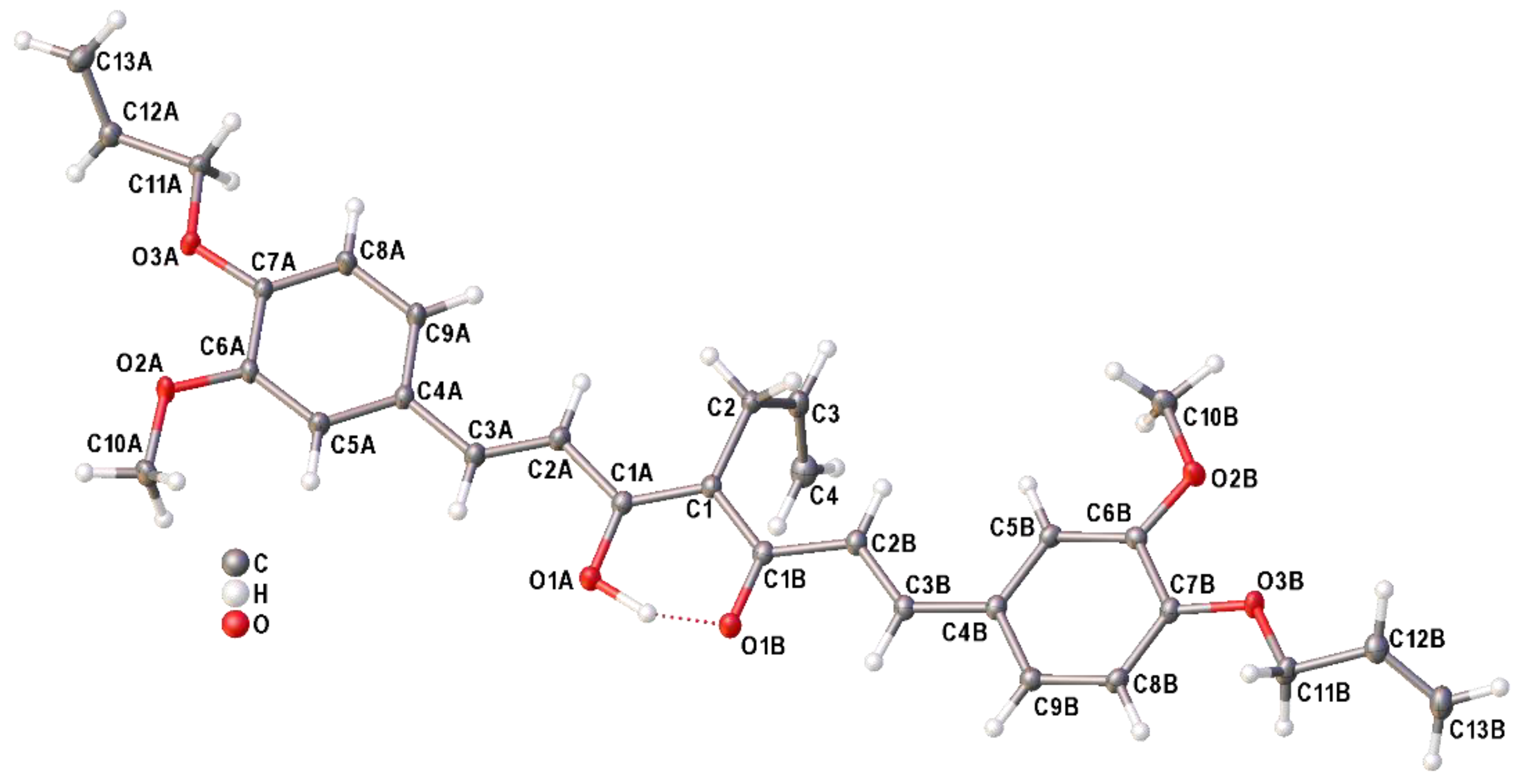
Figure 2.
The energy frameworks in the crystal packing of (1E,6E)-4-allyl-1,7-bis(4’-allyloxy-3’-methoxyphenyl)hepta-1,6-diene-3,5-dione (2).
Figure 2.
The energy frameworks in the crystal packing of (1E,6E)-4-allyl-1,7-bis(4’-allyloxy-3’-methoxyphenyl)hepta-1,6-diene-3,5-dione (2).
Disclaimer/Publisher’s Note: The statements, opinions and data contained in all publications are solely those of the individual author(s) and contributor(s) and not of MDPI and/or the editor(s). MDPI and/or the editor(s) disclaim responsibility for any injury to people or property resulting from any ideas, methods, instructions or products referred to in the content. |
© 2024 by the authors. Licensee MDPI, Basel, Switzerland. This article is an open access article distributed under the terms and conditions of the Creative Commons Attribution (CC BY) license (http://creativecommons.org/licenses/by/4.0/).
Copyright: This open access article is published under a Creative Commons CC BY 4.0 license, which permit the free download, distribution, and reuse, provided that the author and preprint are cited in any reuse.


