

Submitted:
25 September 2024
Posted:
26 September 2024
You are already at the latest version
Abstract
Biobutanol is becoming more relevant as a promising alternative biofuel, primarily due to its advantageous characteristics. These include a higher energy content and density compared to traditional biofuels, as well as its ability to mix effectively with gasoline, further enhancing its viability as a potential replacement. A viable strategy for attaining carbon neutrality, reducing reliance on fossil fuels, and utilizing sustainable and renewable resources is the use of biomass to produce biobutanol. Lignocellulosic materials have gained widespread recognition as highly suitable feedstocks for the synthesis of butanol, together with various value-added byproducts. The successful generation of biobutanol hinges on three crucial factors: effective feedstock pretreatment, the choice of fermentation techniques, and the subsequent enhancement of the produced butanol. While biobutanol holds promise as an alternative biofuel, it is important to acknowledge certain drawbacks associated with its production and utilization. One significant limitation is the relatively high cost of production compared to other biofuels, additionally, the current reliance on lignocellulosic feedstocks necessitates significant advancements in pretreatment and bioconversion technologies to enhance overall process efficiency. Furthermore, the limited availability of biobutanol-compatible infrastructure, such as distribution and storage systems, poses a barrier to its widespread adoption. Addressing these drawbacks is crucial for maximizing the potential benefits of biobutanol as a sustainable fuel source. This document presents an extensive review encompassing the historical development of biobutanol production and explores emerging trends in the field.
Keywords:
Biobutanol
; ABE fermentation
; biomass
; biofuel
; clostridium
1. Introduction
As climate crisis worsens and the world’s population grows, there is a growing demand for low-emissions technologies for energy supply, such as wind turbines, solar panels, anaerobic digestion, biomass heating, and residues valorization. Biofuel production has become one of the most viable substitutes to conventional fossil fuels, and it is playing a fundamental role in clean energy production [1]. In 2022, the demand for biofuels reached 4,3 EJ (1,7 x 10¹¹ litres), and, according to IEA, for 2030 it’s projected to achieve 10 EJ under a scenario of 11% growth per year [2]. Biofuels have numerous applications, including transportation, heat generation, and electricity production [3]. They offer several benefits over petroleum-based fuels, such as a reduction in carbon dioxide emissions, the ability to use residues as feedstock, a lower potential for greenhouse gases, greater environmental sustainability, and increased energy mix diversification [4]. Currently, bioethanol, and biodiesel represent the vast majority of biofuel production worldwide, being 2,5 EJ and 1,4 EJ respectively [2].
Most of the fossil-fuels used for transportation consist of liquid hydrocarbons, mainly gasoline (C4-C12) and diesel (C9-C25). Thus, biofuels like bio-alcohols and biodiesel can be viable substitutes for conventional liquid fossil fuels, and, currently, they are produced on large-scale in most of developed countries in the world, using edible commodities such as sugarcane, corn starch and palm oil as raw material. Polysaccharide-rich biomasses are the most attractive feedstock for biofuels production due to their ease of use [5]. First-generation biofuels are those that are produced from this kind of edible feedstock [6], and they conflict with the food industry, posing economic and sustainability barriers [7]. As a result, first-generation biofuels are limited and only represents 3% of transport fuel consumption worldwide [8]. To overcome this issue, the use of nonedible biomass as feedstock is the approach the most investigated for biofuel synthesis, and, under this perspective, the final products obtained are known as second-generation biofuels [9].
Biomass, in the context of bioenergy, refers to the biodegradable components found in materials and waste originating from biological sources like agriculture (including animal and plant matter), forestry, and related industries. It also encompasses the biodegradable portion of industrial and municipal waste [10]. Biomass can be classified based on its composition (lignocellulosic, rich in protein, rich in sugars, starchy), origin (agriculture, forestry, waste, etc.), and final use (transport biofuels, biomass for heat and power generation, and biomass for biorefineries and intermediates or energy carriers) [11]. Residual biomass from agroindustry or municipal waste could have a significant role in bioenergy and biofuel production, given the great availability of waste and the slight environmental impact on soil as no lands are required for crops and there is no competition with food and other manufacturing sectors [12,13,14]. Therefore, the primary feedstock for the production of second-generation biofuels usually is low-value biomass; and the use of lignocellulosic materials prevails, which possess high contents of cellulose, and hemicellulose. Furthermore, residual oils and fats (yellow grease, and residues from slaughter industry) are also utilized [15]. Biofuels, such as biohydrogen [16], biomethane [17], biogas [18], biodiesel, bioethanol [19], and biobutanol [20], can be produced through biological (e.g., fermentation and anerobic digestion), chemical (e.g., transesterification), or physical treatment (e.g., pyrolysis, gasification, hydrothermal reaction) of nonedible biomass. Therefore, second-generation represents a promising alternative to fossil fuels for energy production. Additionally, biomass valorization can reduce the amount of waste disposed of in dumping grounds, thereby reducing the environmental impact on soils. This is particularly important for the energy sector, which is currently seeking sustainable and environmentally friendly energy alternatives due to climate change [21]. Among all these energy carriers, liquid biofuels have the main concern, as they represent 40% of world energy consumption [22].
Alcohols, such as methanol, ethanol, and butanol, are considered sustainable biofuels since they can be produced by biological processes using renewable raw materials as feedstock. Due to existence of hydroxyl groups, alcohols can supply a greater quantity of oxygen to the combustion process, improving the theoretical air requirement, enhancing heat of evaporation, and reducing PM and NOx emissions [23]. The benefits of blending bio-alcohols, mainly ethanol, and conventional fossil fuels, especially gasoline, are widely reported in the literature [24]. For this reason, many nations, such China, the United States, Brazil, India, Colombia, and Mexico, have implemented laws to mix gasoline with bio-alcohols as a measure to combat climate change [25].
One of the most promising biofuels compared to others, such as bioethanol, is Butanol (C4H9OH), which is formed by four carbon atoms and one hydroxyl group. This is caused by its high combustion heat, boiling point, and capacity to mix with gasoline in higher proportions without requiring any change in prevailing Otto cycle engines [26]. These characteristics give butanol many advantages over other conventional fuels. Furthermore, butanol has a broad range of other applications as an intermediary for different manufactured products (polymers, brake fluids, lubricants, synthetic rubber, epoxies, paints, etc.) and is employ in the cosmetics and pharmaceutical industries [27].
Currently, most of the butanol produced worldwide is obtained from petroleum-derived chemicals, making this industry susceptible to fluctuations in crude oil prices due to conflicts in producing countries, environmental policies, financial speculation, among other factors [28]. The global market volume of n-butanol, the most widely commercialized isomer, reached 5.2 million metric tons in 2021. Projections indicate that this market is expected to continue its growth trajectory over the next decade [29].
In addition to other methods, butanol can be synthetized via acetone-butanol-ethanol (ABE) fermentation, which is an anaerobic bioprocess that utilizes strains of the solventogenic bacteria. ABE fermentation involves the conversion of various carbon sources into solvents, including butanol, acetone, and ethanol, through metabolic pathways within the Clostridia bacteria. This process offers an alternative and sustainable approach to produce butanol, further highlighting the versatility of Clostridia strains in biotechnological applications. This method has been known for more than a century, and after the First World War, it became an important way to produce acetone, which was utilized for cordite synthesis before falling into disuse caused by the rise of the petrochemical industry in the 1950s decade [30]. Nonetheless, biobutanol still unable to compete with the petrochemical industry because of its high manufacturing costs. As a result, researchers are actively focused on overcoming these limitations to enhance the profitability of the entire procedure [31]. To approach these barriers, researchers usually work on improving ABE fermentation processes, novel pretreatment technologies, and choosing low-cost biomass and non-edible waste materials, mostly agricultural and municipal residues, as feedstock [30].
The aim of this document is to review biobutanol production from biomass, specially from agro-industrial waste, discussing the history of this industry, the recent advances on pretreatment and fermentation process, and the different approaches and trends.
2. Biobutanol as an Advanced Fuel Option
Biobutanol presents promising prospects as an energy source due to its thermodynamic and ecological advantages, which typically surpass those of other common fuels. Butanol can be utilized as an independent fuel or mixed with gasoline at different ratios. It is important to highlight that using high blending levels (up to 85%) of butanol may require engine modifications due to its low vapor pressure [32]. Compared to ethanol, butanol’s miscibility is quite superior, as ethanol can only be blended in up to 15% concentrations without requiring changes in conventional engines. Additionally, butanol has an energy content that is equivalent to gasoline and 30% higher than that of ethanol [33]. Some of the most important properties of biobutanol, compared to those of other fuels, are shown in Error! Reference source not found.. Nevertheless, parameters such as performance properties of GI motors, emissions, combustion conditions, and material compatibility must be considered to evaluate the feasibility of using this biofuel.
In general, the blending of bio-alcohols with gasoline has been shown to have positive effects on motor performance, combustion conditions, and pollutant emissions. Comparing butanol to other bio-alcohols like methanol, ethanol, and propanol; butanol exhibits numerous advantages in key parameters such as Break Thermal Efficiency (BTE), Break Specific Fuel Consumption (BSFC), and carbon monoxide emissions. Generally, blending bio-alcohols with gasoline has shown positive effects on motor performance, combustion conditions, and pollutant emissions. However, when specifically comparing butanol to ethanol, methanol, and propanol, butanol stands out with its superior performance in terms of BTE, BSFC, and carbon monoxide emission [34]. The current approach focuses on utilizing butanol-gasoline blends to enhance engine performance and environmental characteristics. Butanol has been proven to be an effective additive for gasoline, making it a favorable choice for improving the overall qualities of engines [27]. Error! Reference source not found. show some research done on this respect.
Not only have the effects of blending butanol with gasoline been extensively researched, but investigations on butanol-diesel-biodiesel blends have also been conducted. The literature presents diverse results regarding engine performance; however, it has been proven that butanol blending leads to reduction in the emissions of PM, CO, CO2, NOx, and other compounds. Zhang and Balasubramanian [52] evaluated the effects of mixing n-butanol at 5%, 10%, and 15% v/v with 20% palm oil methyl ester blended with ultralow sulfur diesel fuel mixed with (B20). The findings indicated an increase in BTE at medium and high engine loads, while BSFC increased across all scenarios. The inclusion of n-butanol led to decreased emissions of PM2.5 and PAHs, which are known for their carcinogenic and cytotoxic properties. These favorable results could be associated to the high oxygen content present in n-butanol. In a study by Xiao et al. [53] focusing on iso-butanol/biodiesel blends, a reduction in BSFC and an augmentation in BTE were observed, indicating improved evaporation and atomization performance. However, iso-butanol blending was found to increase NOx and HC emissions, albeit with varying impacts depending on engine loads. Thakkar et al. [54] investigated an innovative ternary mixture of petro-diesel, castor oil methyl ester and n-butanol, analyzing its effects on combustion, performance, and emission concentrations. The results showed decreased BSFC due to the favorable features of butanol, such as lower density and viscosity, which leads to proper atomization, enhancing combustion efficiency. Low blending ratios of n-butanol (<15%) resulted in reduced CO emissions, whereas higher blending ratios led to increased CO concentrations due to lower combustion temperatures. Consequently, NOx emissions decreased. The study concluded that the best results were obtained with a blend of 15% biodiesel and 15% n-butanol (B15Bu15) and using more than 15% butanol in diesel engines could adversely affect engine performance. Overall, the effects of butanol on diesel engines depend on various factors, including engine load, heat value, cetane number, cooling effect, torque, and biodiesel source. However, the consensus in the literature suggests that butanol improves performance and emissions characteristics due to its beneficial oxygenation and physicochemical properties [55].
In addition, it is worth noting that the biological process employed for biobutanol production also yields acetone and ethanol as byproducts. Consequently, prior to utilizing biobutanol, it must undergo separation and purification procedures to isolate it from the other fermentation byproducts. This necessity for separation and purification entails the application of specialized techniques. An alternative approach involves using a blend of the three solvents, acetone, butanol, and ethanol (ABE), as an additive for conventional fossil fuels, especially gasoline. Dinesha et al. [56] carried out a study investigating the impact of ABE-gasoline blends on a SI engine, considering varying blend percentages and engine speeds. They observed significant reductions of 51% and 14% in CO and HC emissions, respectively, for the ABE10 blend at 2000 rpm, while no substantial differences in BTE were noted. However, NOx emissions showed to be 40% higher under the same conditions. Additionally, certain strains of solventogenic bacteria can produce IBE as well [57]. Guo et al. [58] conducted a comparative experiment to evaluate the combustion performance and emissions of SI engines using ABE, IBE, and n-butanol blends with gasoline. Their findings revealed that IBE blends exhibited the best results in terms of BTE, achieving values 2.5% higher than those of pure gasoline port injections, particularly at an 80% direct injection ratio. IBE blends also demonstrated improved power performance, while ABE blends exhibited reduced particulate matter emissions. Therefore, the direct utilization of ABE and IBE in internal combustion engines shows promise as a potential solution to overcome the drawbacks associated with the recovery process. Although numerous investigations have been carried out in this area with promising results, they are still in the early stages. Veza et al. [59] provided a comprehensive review of the primary findings on the use of ABE in gasoline and diesel engines, encompassing its impacts on performance, combustion, and emissions.
In recent decades, numerous countries, including the United States, Canada, Sweden, India, Australia, Thailand, China, Peru, Paraguay, and Brazil, have enacted legislation mandating the blending of alcohols, predominantly ethanol, with gasoline and diesel. These laws permit ethanol blends of up to 15% without requiring any modifications to conventional engines [60]. However, a key advantage of butanol, in comparison to ethanol, lies in its ability to be blended with gasoline at higher concentrations, reaching up to 85%. This is primarily due to its lower vapor pressure [61]. Furthermore, it is possible to directly supply and store butanol using existing gasoline pipelines, providing additional logistical convenience [62].
Finally, it is important to note that, in terms of ecological footprints, it is difficult to establish a comparison, as the overall carbon and water footprints depend on the feedstock selected, pretreatments, and separation techniques for each case
[192]. According to the EPA [193], 2.35 kg of CO2eq is produced when 1 L of gasoline is burned. Using the energy density shown in Table 1, it is possible to calculate the emissions per unit of energy, resulting in 73.43 g CO2eq MJ-1 for gasoline. For corn and lignocellulosic ethanol, this value is 51.4 gCO2eq MJ−1 [193] and 28–44 g CO2eq MJ−1 [194] respectively. These results are estimated considering the different emissions during the overall process of gasoline and bioethanol production, from feedstock selection and transportation to the final product supply [1]. That is the reason why lignocellulosic bioethanol proves to be more sustainable in terms of carbon emissions. Both corn and lignocellulosic ethanol generate lower GHG emissions compared to gasoline. For biobutanol from corn and sugarcane, the results are 79–122 gCO2eqMJ-1 and –55—18 gCO2eqMJ-1, respectively [195]. It is noted that sugarcane butanol represents much lower GHG emissions compared to sugarcane biobutanol, despite being a first-generation biofuel. This is due to the utilization of bagasse as the primary energy source in the process. On the other hand, corn biobutanol requires more energy for pretreatment steps since starch needs to be converted to sugars before ABE fermentation [195].Then, although both corn and sugarcane biobutanol are biofuels from renewable sources, the first one generates GHG emissions similar to gasoline. Therefore, even considering all the advantages in terms of combustion performance, biofuels can still have a carbon footprint equal to or higher than conventional fossil fuels. For lignocellulosic biobutanol, there is limited information in the literature. Levasseur et al. [196] estimated the GHG emission of biobutanol from a Kraft dissolving pulp mill at ≈72 – 113 gCO2eqMJ-1. This indicates that, regardless of whether biobutanol is produced from cellulosic or starchy feedstocks, it does not necessarily mean that the overall CO2eq emissions will be lower than those of gasoline. More investigation is required in this respect to properly compare GHG emissions of biobutanol, to other biofuels.
Regarding the water footprint, the situation differs. King and Webber [7], along with Scown et al. [8], documented that the water footprint required to produce gasoline from conventional petroleum sources is approximately 13 liters per liter (L H2O/L) of gasoline. Referring to the data presented in Table 1, a water footprint in terms of MJ can be calculated, resulting in 416 H2O/MJ for gasoline. For biobutanol derived from wheat straw, corn grain, corn stover, and pine, the water footprints are 271, 108, 240 [197], and 145.96 [198] L H2O/MJ, respectively, which is significantly lower than that of gasoline. Similar results are reported for lignocellulosic ethanol, with a range of 72 – 120 H2O/MJ [194].
Therefore, even though the carbon footprints from the biobutanol and bioethanol processes may not necessarily be lower than those of conventional fossil fuels, the situation is different when it comes to water requirements, representing an advantage over gasoline.
3. Brief History of Biobutanol Production
The traditional process is ABE fermentation, also called solventogenic fermentation, was a powerful industry during the first half of 20th century, especially after 1915 when Weizmann isolated an anaerobic bacteria which was named Clostridium acetobutylicum, from which an efficient process for the synthesis of acetone, ethanol and butanol was developed [63], and had an strategic importance not just in Europe (United Kingdom, France and the United States) but also in Asia (Japan and Taiwan) [64]. This industry had a significant impact on Word War I, because It was the most profitable supply of acetone, used in cordite production, and latter it became a process utilized worldwide for the synthesis of solvents using renewable feedstock, such as potato starch, nevertheless, this industry went into decline in the late 1950s due to the rise on petrochemical industry as ABE fermentation was unable to compete because of its low yields, and high operation costs [65].
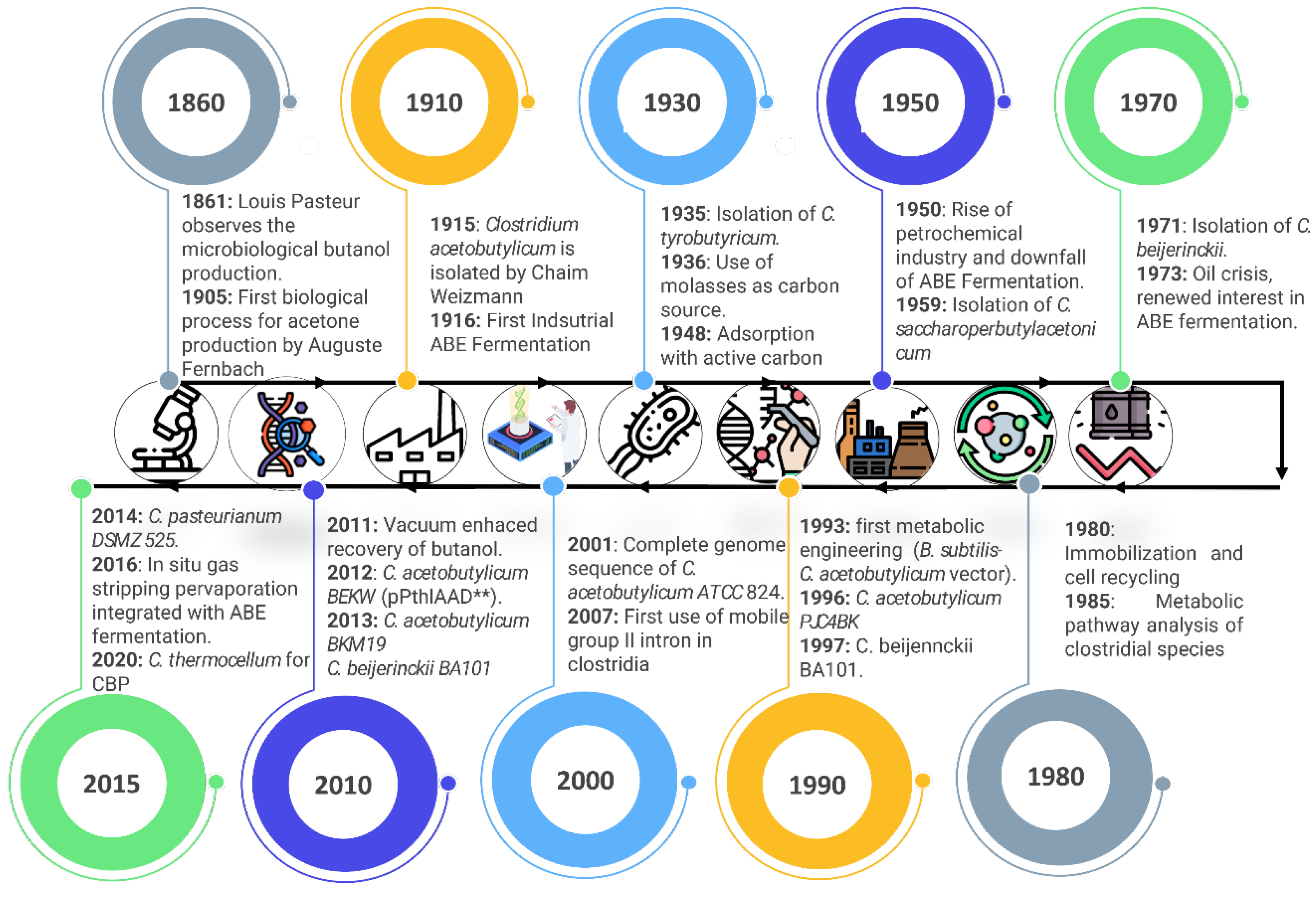
After the oil crisis in 1973, there was a global interest for reducing the dependence of fossil fuels, so that fermentative processes for alcohols, especially ethanol, using renewable and agricultural resources grew up significantly in countries like the United States and Brazil [66]. Consequently, at beginning of 2000s-decade, ABE fermentation attracted the attention of researchers in the framework of sustainable development, as this method can be carried out using renewable sources and represents a promising opportunity to reduce the dependence on fossil fuels [67]. On the other hand, due to the current high production costs, manufacturers tend to focus on the development of chemical applications of higher economic value, for example, butanol can be used for the manufacturing of a wide range of polymers and plastics, and as solvent in paintings and chemical stabilizer [68]. Error! Reference source not found. shows the most remarkable events in biobutanol production history.
Figure 1.
Timeline of most important events in biobutanol production across the last century. Adapted from [69]. The figure shows a timeline, describing the most important achievements related to biological production of ABE (Acetone-butanol-ethanol), throughout history.
Figure 1.
Timeline of most important events in biobutanol production across the last century. Adapted from [69]. The figure shows a timeline, describing the most important achievements related to biological production of ABE (Acetone-butanol-ethanol), throughout history.
4. Overall Biobutanol Production Process
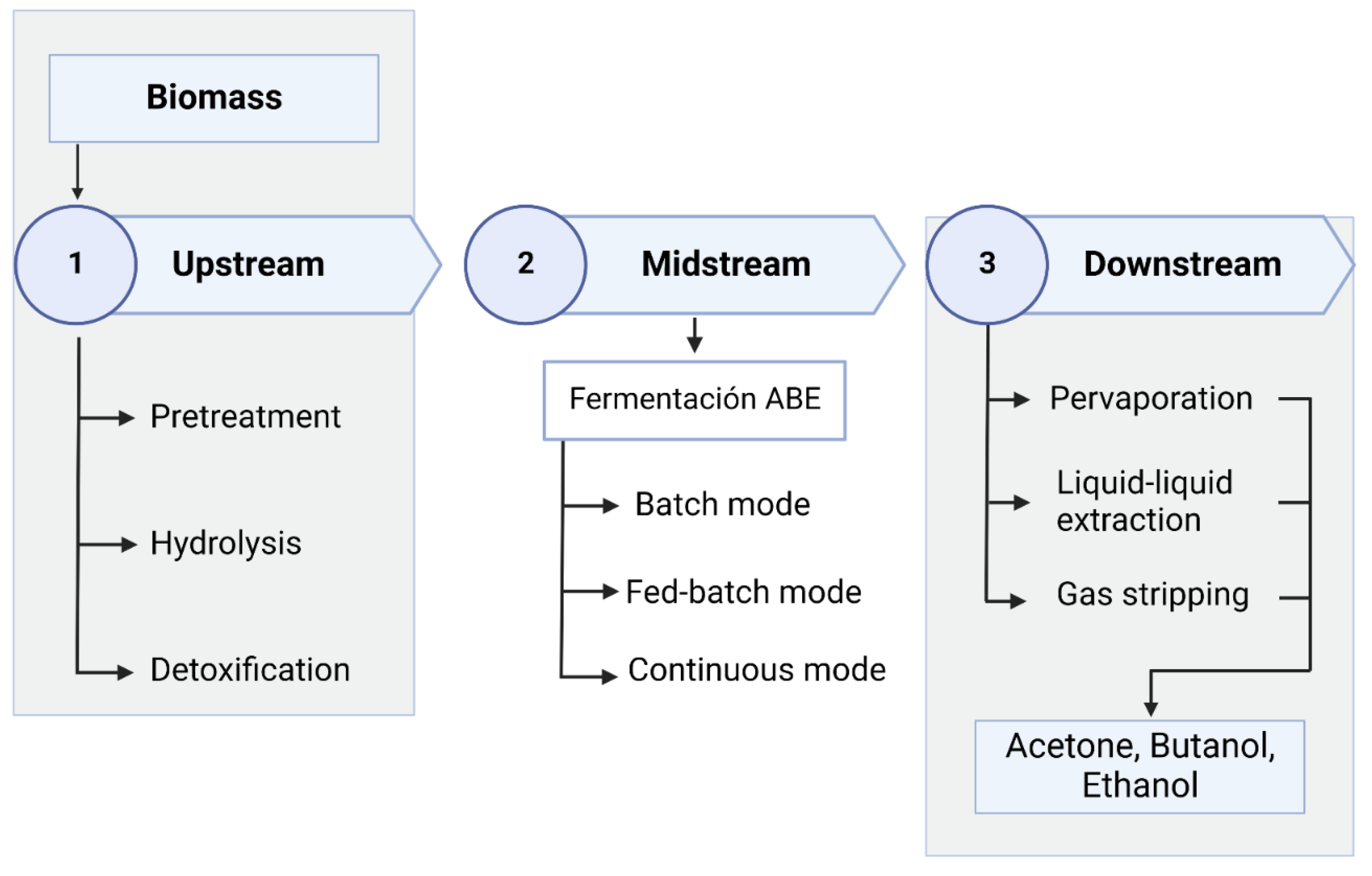
A typical biobutanol production process is based on three main stages: upstream, midstream, and downstream, as it’s shown in Error! Reference source not found.. The kind of biomass selected as feedstock determines the type of upstream process and its number of steps. Since ABE fermentation in midstream requires reducing sugars, and optimal condition for bacteria such pH, temperature, turbidity, moisture, among others, this first stage in the biobutanol production process is focused in obtain sugars from the biomass [70].
The traditional ABE fermentation process is carried out in Batch-type reactors, with initial substrate concentrations of approximately 60 gL-1. After a reaction time of between 36 and 72 hours, a concentration of <20 gL-1 of solvents (acetone, butanol, and ethanol) is obtained, resulting in a productivity of between 0.5 and 0.6 gL-1h-1 and an efficiency of 0.3. These results are very low compared to the production of bioethanol, which reaches a productivity of between 2 and 3 gL-1h-1 and in addition to that, the final concentration of the product can reach 130 gL-1, or higher [71]. These limitations are mostly due to the toxicity of microorganisms towards solvents, specifically butanol, which begins to inhibit cell activity from concentrations of 5-10 gL-1. In addition to the above, substrate pretreatments also produce hundreds of inhibitors, such as hydroxymethylfurfural and lignin derivatives, which are also toxic to bacteria. That is why recent research on this topic focuses on overcoming these barriers and turning the biological production of butanol into an economically viable industry [72]. Error! Reference source not found. presents different approaches to overcome the most common hurdles for biobutanol production.

Table 3.
Drawbacks of ABE fermentation and different strategies to overcome them. Adapted from [73]. This table shows some of the most common obstacles in biobutanol production, and the approaches reported in literature to overcome them.
Table 3.
Drawbacks of ABE fermentation and different strategies to overcome them. Adapted from [73]. This table shows some of the most common obstacles in biobutanol production, and the approaches reported in literature to overcome them.
| Drawbacks of ABE Fermentation | Strategies to improve biobutanol production |
| High Feedstock costs due to competence with alimentary industry |
|
| Product inhibition due to butanol toxicity to strains |
|
| Low butanol titer concentration, and, thus, low yield and productivity |
|
| High cost for downstream processes. |
|
Figure 2.
conventional ABE fermentation process stages. The figure shows the traditional steps for biobutanol productions, which is similar to other by-products obtained by fermentation.
Figure 2.
conventional ABE fermentation process stages. The figure shows the traditional steps for biobutanol productions, which is similar to other by-products obtained by fermentation.
4.1. Feedstock Selection for Biobutanol Production
The first substrates used in the biobutanol production process were biomasses rich in starch and sugars. At the beginning of the century, and prior to the process proposed by Weizmann, Auguste Fernbach patented a fermentation methodology to obtain acetone and butanol as a by-product, in which he used potato starch as raw material, and which was a precursor to the traditional ABE fermentation process [69]. For his part, Weizmann found that C. acetobutylicum was able to operate successfully using rice, wheat, oats, rye, potatoes, and corn as substrate, without requiring the addition of nutrients or stimulants [74]. In the industry that followed and prevailed during the first half of the 20th century, substrates such as cassava, sugar cane and soy molasses, cheese whey, Jerusalem artichokes, liquefied corn starch, apple pulp and algae biomass. During the second half of the 20th century, molasses, which was one of the most used substrates in the ABE Fermentation industry, began to be used as livestock feed, increasing its value in the market. This, along with the high costs of other traditional raw materials, contributed to the decline of this industry [71].
Considering the selection of carbon sources, biobutanol production follows the same trends of other biofuels, and the raw materials for ABE fermentation can be classified in four generations. The first one use food crops, such as sugarcane, maize, and cereal grains, requiring simple pretreatment processes, obtaining higher yields and productivity, but occupying large lands for cultivation, and competing with food industry. Starchy materials, such as cassava, potatoes, and sweet potatoes, are the most used for first generation butanol production [75,76,77,78,79]. Beyond that, it’s rare to find other kind of first-generation feedstock for biobutanol production in literature, with some exceptions. Niglio et al. [80] used commercial corn syrup, evaluating the individual performance of three clostridium strains, obtaining the best results with C. saccharobutylicum, showing a titter butanol concentration of 12,46 gL-1, a yield of 0,30 g/g and a productivity of 0,19 gL-1h-1. They also improved fermentation using a fed-batch mode.
Biobutanol Production from Lignocellulosic Biomass
Second-generation biobutanol utilizes non-edible biomass, which can predominantly be obtained from agricultural, forestry, and municipal residues. The advantages of using this type of raw material are its low cost and minimal impact on the food supply. However, the major challenges lie in obtaining fermentable sugars. Complex physicochemical processes are required to break down the recalcitrant structures of this biomass, and detoxification steps are necessary to remove inhibitors, which increase costs and reduce productivity [30]. Most of the research in this field focuses on lignocellulosic and hemicellulosic biomass. Wheat straw [81], rice staws [82,83,84], barley straws [85], corn stover [86,87,88]; potato [89], orange [90], and pineapple peels [91]; fruit pomace [92], bagasse [93], bamboo [94], palm kernel cake [95], corncob [96,97,98], lettuce residues [99], are some of the most commonly reported substrates in the literature. Nevertheless, several studies have explored different feedstocks than lignocellulosic biomass. Ebrahimian et al. [100] utilized municipal solid waste to produce biobutanol, along with hydrogen, butanediol, ethanol, and biogas, achieving a yield of 121.9 g per kg of the biodegradable fraction of municipal solid waste. Díez et al. [101] evaluated the effect of nutrient supplements (cysteine, yeast extract, and salts) using cheese whey as a substrate, obtaining a butanol titer of 9.11 gL-1, a yield of 0.31 g of butanol per g of lactose, and a conversion rate of 49% under optimal nutritional supply conditions. Glycerol has also been employed as a biobutanol feedstock due to its high availability as a by-product of biodiesel production through transesterification. Initial studies using this substrate yielded low butanol titers; therefore, subsequent research focused on optimizing fermentation conditions [102]. Recently, T. Chen et al. [103] utilized a novel Clostridium strain to ferment glycerol and employed an in-situ membrane-coupled pervaporation process for butanol recovery, resulting in high titer concentrations of butanol (41.9 gL-1), primarily attributed to the thin polydimethylsiloxane layer used. The co-utilization of lignocellulosic and non-lignocellulosic biomass has also been investigated. Branska et al. [104] used wheat straw hydrolysates as a carbon source and chicken feathers as a nitrogen supply for bacteria. No detoxification steps were employed, and the hydrolysis of both substrates was carried out simultaneously. Among the thirteen solventogenic strains tested, C. beijerinckii was able to produce a final butanol titer of 4.6 gL-1.
4.2. Upstream
As mentioned above, the trend in feedstock selection primarily focuses on lignocellulosic biomass. However, owing to its recalcitrant structure, a suitable pretreatment process is required to facilitate the biodegradation of the cell wall structure by microbes and enzymes [105]. Pretreatment steps involve the removal of lignin from biomass, thereby rendering hemicellulose and cellulose accessible for microbial attack. However, these polysaccharides remain challenging for assimilation by microorganisms. Consequently, an additional hydrolysis step is essential to break down cellulose and hemicellulose into reducing sugars before preceding to fermentation stages [106].
The objective of pretreatment and hydrolysis is to obtain fermentable sugars from the feedstock, which can be utilized as a carbon source for microorganisms in subsequent bioprocessing steps. This is done to ensure that (i) the sugars can be assimilated by the selected strain and (ii) there is no concentration of byproducts that can inhibit microbiological activity. Generally, pretreatment can be categorized into four main types: (i) physical or mechanical treatment, such as milling, microwave, ultrasound, pyrolysis, and pulse electric field; (ii) chemical treatment, including the use of diluted or concentrated acids, ionic liquids, mild alkalis, deep eutectic solvents, organosolv, and ozonolysis; (iii) physicochemical treatment. Lignocellulosic feedstock often requires multiple pretreatment steps to overcome compositional barriers and the complex structure of lignocellulosic biomass for efficient hydrolysis. Common pretreatment methods for lignocellulosic biomass include steam explosion, liquid hot water, ammonia fiber expansion (AFEX), CO2 explosion, and oxidative pretreatment; (iv) Biological treatment refers to the use of living organisms such as fungi, yeast, and bacteria to treat the biomass [107].
Hydrolysis is typically performed using enzymatic or acid reactions. Acid hydrolysis can easily dissolve lignin without prior chemical pretreatment. However, the byproducts of this reaction (e.g., acetic acid, formic acid, hydroxymethylfurfural, phenolic compounds, etc.) tend to be toxic to microorganisms. Enzymatic hydrolysis, on the other hand, avoids these drawbacks, but it requires different enzymes and specific conditions (pH, temperature, etc.) for each substrate due to the high specificity of enzymes. The inhibitors generated during pretreatment and hydrolysis processes can completely halt microbial activity or reduce yields and productivity. Therefore, a detoxification step is necessary to facilitate subsequent biological processes. Detoxification techniques widely reported in the literature include electrodialysis [108], evaporation [109], over-liming [110] adsorption [111], and combinations thereof [112,113,114]. Error! Reference source not found. summarizes some of the recent research findings on the production of biobutanol using different pretreatment and detoxification processes.
Table 4.
Comparison of pretreatment and detoxification processes in different biobutanol production studies. This table shows some research in biobutanol production, focusing on the upstream processes, specifically in pretreatment and detoxification stages.
Table 4.
Comparison of pretreatment and detoxification processes in different biobutanol production studies. This table shows some research in biobutanol production, focusing on the upstream processes, specifically in pretreatment and detoxification stages.
| Pretreatment | Hydrolysis | Feedstock and strain | Detoxification process | Novelty | Major Findings | Reference |
| Dilute sulfuric acid | - | Bamboo C.acetobutylicum YM1 |
Overliming adsorption bacterial | Multiple detoxification processes were considered: i) Overliming, ii) adsorption with activated charcoal, iii) bacterial adaptation, and iii) vacuum evaporation. | Overliming did not significantly altered the concentration of inhibitor, since aliphatic acids remained the same, and HMF, was reduced just 20%. Also, the concentration of reducing sugars was 10% less. On the other hand, char coal process was able to reduce 98% and 50% HMF and furfural respectively. Despite that, same result with reducing sugars were obtained comparing to Overliming. |
[95] |
| crushing and sieving | Acid hydrolysis | Corncob Clostridium sp. strain LJ4 |
Electrochemical detoxification | Electrochemical detoxification for the removal of phenolic inhibitors. Use of a novel solventogenic strain isolated by the authors, Clostridium sp. strain LJ4. |
Electrochemical detoxification could eliminate inhibitors without causing sugar loss. The employed strain exhibited resistance to high concentrations of HMF and furfural, resulting in a 60% increase in the final butanol titer. |
[98] |
| Alkaline NaOH pretreatment | Enzymatic hydrolysis with Cellic CTec 2 (Novozyme) | Lettuce residues Clostridium acetobutylicum DSMZ 792 | - | Use of residues from the packaging process of lettuce (Lactuca sativa) as a feedstock for biobutanol production. | I was possible to obtain a 19.5 gL-1 sugar concentration in the hydrolysate. The pre-treatment’s optimal NaOH concentration was 80 gL-1. |
[99] |
| Hydrothermal | Enzymatic Hydrolysis (Cellulase and hemicellulase) | Orange WasteC. acetobutylicum NRRL B-591 | Overliming | A Novel refinery was proposed for sustainable valorization of orange waste for biobutanol, H2 and biogas production. | The efficient conversion of untreated orange waste into biofuels was found to be challenging. Hydrothermal pretreatment was identified as a critical step in facilitating ABE fermentation. Through the process of overliming, successful fermentation of the substrate was achieved. The proposed biorefinery yielded significant results, producing 42.3 g of biobutanol, 33.1 g of acetone, 13.4 g of ethanol, 104.5 L of biohydrogen, and 28.3 L of biomethane per kg of orange waste, which contained an energy content of 4560 kJ. |
[90] |
| Microwave assisted dilute sulfuric acid pretreatment | Enzymatic Hydrolysis (cellulolytic complex) | Spent coffee groundsC. beijerinckii DSM 6422 | - | The valorization of cellulosic and hemicellulosic sugars derived from spent coffee grounds, followed by their subsequent utilization in ABE fermentation, has been explored. |
The integration of microwave and dilute sulfuric acid proved to be suitable for recovering both cellulosic and hemicellulosic sugars.A extraction of 79% and 98% of hemicellulosic and cellulosic sugar, respectively, was achieved after enzymatic hydrolysis. | [115] |
| Liquid hot water extraction | Enzymatic Hydrolysis (Cellulase) | Cassia fistula pods C. acetobutylicum TISTR 2375 | - | The utilization of roadside ornamental tree waste, specifically Cassia fistula pods, for solvent production. | Liquid hot water demonstrated to be a good method for extracting sugars from the pods residue. The final butanol yield was low (0,0006g butanol/ g pods). | [116] |
| Organosolv | Enzymatic Hydrolysis (Cellulase and hemicellulase) | Municipal solid wasteC. acetobutylicum | Organosolv (Simultaneous organosolv pretreatment and detoxification) | The valorization of the organic fraction of municipal solid waste (OFMSW) from a compost plant and the use of an ethanol organosolv process for both detoxification and pretreatment | Biological activity of the strain was inhibited by tannins.Using organosolv process, it was possible to remove tannins, and obtain a 70% starch recovery, which led to a yield of 150 g ABE /kg municipal solid waste. | [117] |
| Acid-catalyzed steam explosion | Enzymatic hydrolysis(Cellulose) | Phenolic-rich willow biomassC. acetobutylicum NRRL B-527 | Activated carbon detoxification | First time that a strategy of prior removal of phenolic extractives by water extraction (debarking) from willow is proposed, showing positive results, not only for enzymatic hydrolysis but for ABE fermentation as well. | The final acetone-butanol-ethanol (ABE) titer concentration obtained for the detoxified willow wood was 12 gL-1, which is considered relatively high compared to the literature reports for this type of biomass. The prior removal of phenolic extractives through debarking or hot water extraction proved to be a beneficial method for preventing the formation of phenol-aldehyde precipitates during steam explosion. This, in turn, resulted in improved enzymatic hydrolysis and ABE fermentation yields. |
[118] |
| Liquid hot water | Enzymatic hydrolysis(Cellulose) | Sugarcane strawC. acetobutylicum NRRL B-527 | Activated charcoal treatment | Search of the optimal condition of biomass load for hydrothermal pretreatment of sugarcane straw, in order of not requiring any detoxification step before fermentation. | Detoxification step was not necessary when 10 % solids were used for fermentation.A concentration of 13 gL-1 of ABE was obtained using 10% of biomass loading.Simultaneous saccharification and fermentation enhanced ABE productivity, compared to separated hydrolysis and fermentation. | [119] |
| Ammonium sulfite pretreatment | Enzymatic hydrolysis(Cellulose and Xylanase) - It was developed separate and simultaneous with Fermentation | Wheat strawClostridium acetobutylicum ATCC 824 | - | There are few studies of ABE fermentation using ammonium sulfite pretreated biomass. This study also aimed to assess the potential of integrating enzymatic hydrolysis (saccharification) and fermentation into a single step. |
The utilization of ammonium sulfite pretreatment proved to be effective in enhancing the digestibility of wheat straw. Simultaneous saccharification and fermentation had a better performance (approximately 14% higher) compared to separated hydrolysis and fermentation. |
[120] |
| Hydrothermal microwave-assisted extraction | Enzymatic Hydrolysis (Cellulolytic complex) | Sugar beet pulpClostridium beijerinckii DSM 6422 | - | The pretreatment accomplished to extract pectooligosaccharides from the selected biomass. Since Hydrothermal pretreatment don’t use acids or alkaline solvents, this is and promising and environmentally friendly alternative to valorize sugar beet pulp. | Under the optimal conditions, hydrothermal microwave-assisted pretreatment was able to recover almost 60% of the pectooligosaccharides from the selected biomass. A yield of 53 kg of butanol per ton of sugar beet pulp was achieved in this study. | [121] |
| Sun-dried at greenhouse. | Enzymatic Hydrolysis (Cellulose and Lysases) | Saccharina latissima (macroalgae)Clostridium acetobutylicum ATCC 824 | Hydrophobic adsorption resin | This study addresses the complete valorization of S. latissima from cultivation to biobutanol production. | Enzymatic hydrolysis led to a recovery of 80% of glucose from the biomass.The hydrolysis process was successfully scaled up to a volume of 100 L in this study. The detoxification step implemented in the fermentation process had a notable influence on the lag time, ultimately leading to a yield of 0.23 ABE g/g sugar. |
[122] |
| Microwave assisted dilute sulfuric acid pretreatment | Enzymatic Hydrolysis | Brewers Spent GrainC. beijerinckii DSM 6422 | Activated charcoal. Ion-exchange resins |
A novel approach was employed to valorize all the sugars, including both cellulosic and hemicellulosic, from brewers spent grain. | The optimal conditions for pretreatment were 147 °C, 2 minutes, and 1,26% (w/v) H2SO4. After hydrolysis and detoxification, the slurry sugar concentration achieved 73,9 gL-1 for a biomass loading of 15%. The study achieved a titer concentration of 11 gL-1, accompanied by a yield of 91 kg of butanol and 139 kg of ABE per ton of brewers spent grain. |
[123] |
| Ultrasound-assisted dilute acid hydrolysis | Dilute acid hydrolysis | Puerariae slag Clostridium beijerinckii YBS3 |
- | Diluted acid hydrolysis in combination with ultrasound has not wide research. | The pretreatment-hydrolysis method proposed in this study obtained a high concentration of reducing sugars, specifically 85,79 gL-1. In the absence of detoxification, the study achieved a final titer butanol concentration of 8.79 gL-1. Furthermore, this research reported a yield of 0.19 g butanol/g hydrolysate |
[124] |
| Freeze drying through sublimation | Acid hydrolysis | Wastewater microalgae Clostridium saccharoperbutylacetonicum N1-4 |
- | The optimization of acid hydrolysis as a saccharification method for wastewater microalgae feedstock, followed by valorization through ABE fermentation, remains an area with limited research. | The study determined that the optimal conditions for acid hydrolysis of the algae biomass were as follows: a concentration of 1.0 M H2SO4, a reaction time of 120 minutes, and a temperature range of 80-90°C. These parameters were found to be most effective in breaking down the complex carbohydrates present in the algae biomass and releasing fermentable sugars. Under these optimal conditions, a yield of 166.1 g sugar per kg of dry algae biomass was achieved. Additionally, a titer concentration of 3.74 gL-1 of butanol was obtained. The economic analysis led to rate of USD $ 12,54 per dry algae. |
[125] |
4.3. Midstream—ABE Fermentation
Solventogenic bacteria belonging to the Clostridium genus, including C. pasteurianum, C. acetobutylicum and C. beijerinckii, are widely utilized for the biological synthesis of butanol. These anaerobic bacteria possess similar metabolic pathways capable of fermenting a broad range of carbon substrates, such as disaccharides (sucrose, cellobiose, lactose, etc.), pentoses (xylose and arabinose), hexoses (glucose, galactose, and fructose), and starch fuels [126]. In ABE fermentation, Clostridium acetobutylicum ATCC 824 (most investigated organism in this respect), the same strain isolated by Weizmann in the early 20th century, predominantly produces three types of compounds: solvents (acetone, ethanol, and butanol), organic acids (acetate, lactate, and butyrate), and gases (carbon dioxide and hydrogen) [127], [128]. Consequently, ABE fermentation is characterized by two distinct phases: acidogenesis and solventogenesis [127]. Figure 3 illustrates a typical metabolic pathway for solvent-producing clostridial bacteria, highlighting the sequence of metabolites and enzymes involved. During acidogenesis, the bacteria undergo exponential growth, utilizing glucose for biomass generation and producing acetic and butyric acid as byproducts. The synthesis of these acids is essential for ATP generation, which is necessary for cellular metabolism [129]. Subsequently, in the solventogenesis phase, triggered in response to the high acid concentration in the environment [71], acetate and butyrate are re-assimilated as substrates for solvent biosynthesis, leading to a cessation of bacterial growth [130]. The primary product of this stage is butanol, along with a mixture of acetone and ethanol, with a typical molar ratio of 6:3:1, respectively. The solvents affect the bacterial cell membrane, and once the concentration of butanol and other products reaches a certain level (>13 gL-1), bacterial metabolism is inhibited [131] [129].
Most of research focused on ABE fermentation uses batch mode due to its simplicity, and suitability for small scale production, since it requires less maintenance and monitoring. Fed-batch and continuous fermentation processes has been also explored, and each mode represents different advantages and drawbacks. In addition to its versatility, batch mode represents a low risk of contamination and strain mutation. Fed-Batch has shown the best results for substrate inhibition, a prolonged logarithmic and stationary phase for the microorganisms, and the possibility of using concentrated substrates, but, consequently, the solvent concentration its higher, resulting in product inhibition, thus, fed-bach mode is usually integrated with separations processes [133,134,135,136]. Continuous fermentation enhances the productivity and reduces biobutanol inhibition of the strains by removing the no-production time from the bioreactor sterilization and inoculum preparation, but it requires close process control [30]. The performance of several studies on biobutanol synthesis using various strains and fermentation methods is shown in Error! Reference source not found..
Table 5.
Performance of different strains for biobutanol synthesis utilizing various feedstocks and fermentation modes. This table shows some investigations on ABE fermentation, detailing the microorganisms and raw material used, the upstream processes, fermentation mode, and the solvent concentration, yield, and productivity. The abbreviations used in the table are the followed: DF: Direct fermentation. DFiR: Direct fermentation within situ recovery. IBE: Isopropanol-n-butanol-ethanol. SHF: Separate hydrolysis and fermentation. SHFiR: Separate hydrolysis and fermentation within situ recovery. SSF: Simultaneous saccharification and fermentation. SSFiR: Simultaneous saccharification and fermentation within situ recovery.
Table 5.
Performance of different strains for biobutanol synthesis utilizing various feedstocks and fermentation modes. This table shows some investigations on ABE fermentation, detailing the microorganisms and raw material used, the upstream processes, fermentation mode, and the solvent concentration, yield, and productivity. The abbreviations used in the table are the followed: DF: Direct fermentation. DFiR: Direct fermentation within situ recovery. IBE: Isopropanol-n-butanol-ethanol. SHF: Separate hydrolysis and fermentation. SHFiR: Separate hydrolysis and fermentation within situ recovery. SSF: Simultaneous saccharification and fermentation. SSFiR: Simultaneous saccharification and fermentation within situ recovery.
| Operation mode | Substrate | Strain | Culture type | Process Integration | Pretreatment and Detoxification | Solvents Concentration (gL-1) | Novelty |
Butanol yield (gg-1) |
Solvent yield (gg-1) |
Butanol productivity (gL-1h-1) |
Solvent productivity (gL-1h-1) |
Reference | |
| Butanol | Solvents | ||||||||||||
| Batch | wheat straw | Clostridium acetobutylicum CH02 | Suspension | SHF | Hydrotropic pretreatment with xylene sulfonate. Enzymatic hydrolysis with cellulase. | - | 12,41b | Evaluation of a hydrotropic pretreatment using sodium xylene sulfonate on wheat straw. | - | 0,10b | - | - | [81] |
| Batch | rice straw |
Clostridium beijerinckii F-6 and S. cerevisiae |
Co-culture Suspended |
SHF | Thermo-alkaline Dilute acid NaOH/Urea |
4,22 | 5,40b | The utilization of a co-culture system consisting of C. beijerinckii and S. cerevisiae presents a promising alternative approach to enhance butanol production. | 0,13 | 0,18b | 0,152 | - | [84] |
| Batch | Tea waste | C. beijerinckii DSMZ | Suspended | SHF | Diluted acid | 6,21 | 9,73b | The utilization of industrial tea waste as a feedstock and evaluates various factors that impact butanol production. Specifically, they investigate the effects of sugar loading, fermentation time, and nutrient concentrations in the production medium | 0,258 | - | 0,065 | 0,101b | [137] |
| Batch | Bamboo |
Clostridium beijerinckii ATCC 55025-E604 |
Suspended | SHF | Enzymatic hydrolysis with laccase and cellulases | 6,45 | - | Simultaneous pretreatment and saccharification of bamboo. | 0,095 | - | 0,089 | - | [94] |
| Batch | Glucose | Clostridium beijerinckii DSM 6423 | Immobilized | DFiR | N. A | 27,2 a c | 45,4 a c | The production of IBE was achieved using a cell immobilization system comprising concentric annular baskets packed with bagasse. | 0,18 | 0,31c | - | 0,35 c | [138] |
| Fed-batch | brewer’s spent grain | Clostridium beijerinckii DSM 6422 | Suspended | SHFiR | Sulfuric acid pretreatment Enzymatic hydrolysis |
10,20 65 a |
13,70b | Integration of a in-situ gas-stripping with ABE fermentation process, and evaluation of two feeding strategies: i) pulses of sugar and ii) continuous feeding of pretreatment liquids. | 0,14 | 0,20b | 0,11 | 0,15b | [133] |
| Fed-batch | Crude sugarcane bagasse and molasses | C. saccharoperbutylacetonicum DSM 14923 | Suspended | SHF | Diluted sulfuric acid for bagasse. Molasses did not require any previous hydrolysis | 10,80 | - | Use of molasses as a initial stage for bacteria growing before feeding of hydrolysates. | 0,31 | - | 0,15 | - | [139] |
| Fed-batch | Corn syrup | C. saccharobutylicum DSM 13864 | Suspended | DF | N. A | 8,70 | 16,68b | Evaluation of four clostridium strains for solvent production using corn syrup as substrate. | 0,18 | 0,34b | 0,24 | 0,47b | [80] |
| Fed-batch | Steam-exploded corn stover | C. acetobutylicum ABE-P 1201 | Suspended | SHF | Steam explosion Enzymatic hydrolysis with cellulase. Absorption with activated carbon. |
11,75 | 17,75b | A novel fed-batch process was employed, which combined pH adjusting and intermittent feeding, to address the limitations associated with steam explosion pre-treatment of corn stover. | 0,24 | 0,36b | 0,24 | 0,37b | [140] |
| Continuous | Glucose and butyric acid | C. acetobutylicum ATCC55025 | Immobilized | DF | N. A | 10,37 | 14,98b | Use of an asporogenous strain for butanol production in a single-pass fibrous-bed bioreactor. | 0,24 | 0,35b | 1,24 | 1,79b | [141] |
| Continuous | Glucose | Clostridium acetobutylicum DSM 792 | Immobilized | DFiR | N. A | 24 | - | Packed bed biofilm reactor with an integrated recovery using and absorption column. | 0,33 | - | 22 | - | [142] |
| Continuous | Glucose | Clostridium beijerinckii DSM6423 | Immobilized | DFiR | N. A | 7.5 | 13.5c | In this study, a fixed-bed bioreactor system was implemented using polyurethane foams as a solid support for the production of IBE. A model was successfully employed for describing fermentation performance. | 0,22 | 0,35c | 2.5 | - | [143] |
| Continuous | Food Waste | C. saccharoperbutylacetonicum deltptabuk | Immobilized | SHF | Liquefaction and Saccharification with enzymes (amylase and glucoamylase) | 9,46 (Dilution rate of 0,2 h-1) |
17,61b | Low-cost food wasted was used as a raw material for solvent production in batch and continuous bioreactors using a modified strain. | - | 0,43b | 1,90 | 3,45b | [144] |
| a: Condensate concentration, b: ABE, c: IBE | |||||||||||||
4.4. Downstream
The separation and purification of biobutanol present greater complexity and higher costs compared to the conventional downstream stages of ethanol production for several reasons. Firstly, the concentration of butanol in the fermentation broth is significantly lower, typically around 2 w/w%, in contrast to the 15 w/w% concentration of ethanol. This disparity poses challenges for efficient separation. Secondly, the boiling point of the butanol/water azeotrope is very close to that of water (93 °C vs. 100 °C) at atmospheric pressure, making distillation-based separation more difficult compared to the ethanol/water azeotrope, which has a boiling point of 78.2 °C. Lastly, the final concentration of butanol in the distilled aqueous azeotrope is only 55.5 w/w%, which is notably lower than the 95.5 w/w% concentration achieved for ethanol. These factors contribute to the increased complexity and higher costs associated with the separation and purification of biobutanol [145]. Hence, it is crucial to develop cost-effective and efficient separation or recovery techniques for biobutanol production to enhance its economic feasibility. The successful implementation of such techniques would not only address the complexities and higher costs associated with biobutanol separation and purification but also contribute to the overall viability and competitiveness of biobutanol as a sustainable biofuel.
ABE separation process can be categorized in four main methods: vapor, liquid, adsorbent and membrane-based techniques. Error! Reference source not found. overviews this classification detailing the physicochemical principle, and the advantages and disadvantages of every technique. The technologies for ABE separation were recently reviewed by Cai et al. [146].
Table 6.
Summary, advantages, and drawbacks of techniques for ABE separation. Adapted from [146]. This table shows the different process and technologies employed for the separation and purification of solvents (acetone, butanol, and ethanol), detailing their advantages and drawbacks.
Table 6.
Summary, advantages, and drawbacks of techniques for ABE separation. Adapted from [146]. This table shows the different process and technologies employed for the separation and purification of solvents (acetone, butanol, and ethanol), detailing their advantages and drawbacks.
| Method | Technique | Principle | Advantages | Drawbacks |
| Vapor-based | Gas stripping | Removing volatile solvents using gases and subsequent cooling to promote condensation. | Versatile, does not result in fouling, and poses no damage to the culture. | Poor selectivity, requires a lot of energy, and is restricted by the vapor-liquid equilibrium. |
| Vacuum fermentation/stripping | Decreasing the pressure of the vapor phase, altering the vapor-liquid equilibrium and solvents partition coefficient. | This technique is simple to use and does not harm the culture. | Low selectivity, high energy requirements, is constrained by vapor-liquid equilibrium, and high costs. | |
| Distillation | Solvents are fractionated based on their varying volatility levels. | Industrial-scale operation is simple, yielding dehydrated solvents of high purity and recovery rates. | The process is energy-intensive and requires high temperatures. | |
| Liquid-based | Liquid-liquid extraction | Differences in solubility between ABE and extractants enable selective separation. | High selectivity | The separation process is expensive and poses toxicity risks to the culture. |
| Salting-out | Salts are added to the aqueous phase in the two-aqueous phase extraction process to reduce ABE solubility. | Feasible, highly selective, and minimally impacts microbes due to its elevated osmotic pressure. | High salt dosage rate, poor continuity, equipment corrosion, and energy-intensive salt recycling | |
| Cloud point extraction | Above the cloud point temperature, a coacervate phase and a surfactant diluted phase are generated. | The process is easy to operate and does not result in fouling | The process is expensive, and surfactant recovery is complex, leading to issues with continuity and reliability. | |
| Adsorbent-based | Adsorption | Hydrophobic solids can be used to adsorb ABE | Ease of operation | High costs and has limited efficiency, capacity, and selectivity. |
| Membrane-based | Reverse osmosis | Semi-permeable membranes are utilized to selectively separate ABE from the fermentation broth. | This process offers high selectivity and does not harm the culture. | Elevated equipment costs and fouling problems. |
| Perstraction | ABE can be extracted into an extractant on the opposite side of a membrane. | High selectivity and has a low impact on the culture | High costs, fouling problems, and the formation of an extractant emulsion | |
| Pervaporation | ABE solvents can pass through a membrane via solution-diffusion by applying vacuum or sweeping gases. | High selectivity, high flux, and does not cause damage to the culture. | Membrane fouling, high costs, and the complexity of the processes involved | |
| Membrane distillation | Separating ABE via a microporous hydrophobic membrane at different temperatures. | No damage to the culture. | It is limited by vapor-liquid equilibrium, has small selectivity, and is a complicated process. | |
| Petlyuk system | Wall column distillation | This method requires different stages, in the preparation of the sample the temperature and pressure are regulated to avoid evaporation, subsequently the sample is heated, favoring the volatilization of the sample belonging to biobutanol. This wall column allows the components to be separated and fractionated, indicating degrees of purity. | Allow the separation of many substances depending on their boiling point and the constant purification of the biobutanol obtained |
It is an expensive, slow process that consumes a large amount of energy and time in the process of heating and cooling the sample. . |
5. New Approaches and Trends for Biobutanol
5.1. Use of Microalgae as Feedstock
Microalgae consist in an extensive number of autotrophic organisms and, like starchy crops, can be used for energy valorization through direct oil recovery, and as feedstock for the production of by-products, via fermentation process [147]. Microalgae can grow faster than terrestrial crops due to its higher photosynthetic efficiency, and it doesn’t compete with food industry since it can be cultivated using ponds, seawater, and wastewater, and do not need lands like conventional agriculture. Furthermore, as microalgae are photosynthetic, they can reduce CO2 emissions, and their biomass can provide valuable substrates for fermentative bacteria, such as starch, carbohydrates, and glycerol. Third-generation biofuels are those that are produced from microalgae biomass and represent a remarkable advantage since it addresses the conversion of atmospheric CO2 to energy carriers [148]. Several species can be chosen for biofuel production, nevertheless, the desirability of each one depends on the starch, lignin, hemicellulose, and the convertible sugars from the cell wall [149]. Onay [150] reviewed the novel studies of biobutanol from microalgae. Finally, the term fourth-generation biofuel is used for several researchers for various types of biofuels or their production technologies, which includes fuels obtained from genetically modified algae, photobiological solar fuels and electrofuels [151]. For biobutanol, there is low investigation using fourth-generation feedstock, and most of it focuses on the use of micro and macroalgae biomass as a raw material [152].
Various algal species have been investigated for their potential in biobutanol production. Microalgae, including Chlorella [153,154,155], Neochloris [156], and Nannochloropsis [157], have demonstrated high lipid content, making them suitable candidates for biobutanol production. Efficient pretreatment methods are required to disrupt the rigid algal cell wall structure thus facilitating the obtention of fermentable sugars or lipids. Various physical, chemical, and biological pretreatment techniques, including thermal, mechanical, enzymatic, and acid/alkali treatments, have been employed to improve the accessibility of algal biomass for subsequent hydrolysis [158]. Error! Reference source not found. shows some research on ABE fermentation using algal biomass.
The possibility of employing microalgae for biofuel synthesis is hindered by various barriers, necessitating more research in genetic engineering to optimize productivity and develop favorable strains. Out of 40,000 microalgae species, only 3,000 have shown biofuel potential. Manipulating photon conversion efficiencies can reduce land requirements and fuel production costs. To facilitate genetic manipulation, expressed sequence tag (EST) databases containing nuclear, mitochondria, and chloroplast genome data have been established. These databases serve as a window for introducing genetic modifications that enhance biofuel traits in algae. Consequently, more than 30 strains have been successfully genetically transformed using such constructions [159].
Table 7.
Some studies on biobutanol production using algal biomass. This table shows the results of some studies that used algal biomass to produce biobutanol, describing the algae strain, mode of fermentation, and the titer concentration obtained.
Table 7.
Some studies on biobutanol production using algal biomass. This table shows the results of some studies that used algal biomass to produce biobutanol, describing the algae strain, mode of fermentation, and the titer concentration obtained.
| Strain used for ABE fermentation | Microalgae specie as substrate | Type of pretreatment. | Titer concentration of butanol gL-1 | ABE concentration (gL-1) | Source |
| C. acetobutylicum | Chlorella vulgaris JSC-6 | Alkali / acidic treatment with H2SO4 and NaOH | 13,1 | 19,9 | [155] |
| C. acetobutylicum ATCC824 | Biodiesel microalgae residues (Chlorella sorokiniana CY1) | Microwave. 2% H2SO4 heated at 121 °C, 60 min, and then 2% NaOH was added, during 60°C. |
3,9 | 6,3 | [153] |
| C. acetobutylicum ATCC824 | Chlorella sorokiniana | Dilute acid using H2SO4 at 0,5, 1, 5, and 2% (w/v) at 121°C. Enzymatic hydrolysis using α-amylase and amyloglucosidase. |
2,5 | 7,2 | [154] |
| C. acetobutylicum |
Chlorococcum humicola |
Dilute acid with 5% (w/v) H2SO4, and neutralization using CaCO3. | - | - | [160] |
| C. acetobutylicum ATCC824 | Neochloris aquatica | Pretreated with 1% NaOH, followed with 3% of H2SO4. | 12 | 19,6 | [156] |
| (C. acetobutylicum + C. thermocellum) a (C. beijerinckii + C. thermocellum) b |
Stichococcus sp. | Milling with mortar and pestle. Soaking in 2% H2SO4. Enzymatic hydrolysis with β-glucosidase. |
7,4a 8b |
12,3 a 14 b |
[161] |
| Not specified | Nannochloropsis gaditana | Acid treatment using H2SO4, H3PO4 and HCl (1, 2, 3, 4 and 5%). | 3 | - | [157] |
| C. acetobutylicum CGMCC1.0134 | Chlorella vulgaris | Dilute acid with 2% (v/v) H2SO4. Autoclave at 121°C. Neutralization with NaHCO3. |
8,5 | 14,2 | [162] |
5.2. Electron Donors in Fermentation to Enhance Butanol Productivity
To enhance yields and productivities in biobutanol production, the optimization of the production medium has been suggested. One approach is the addition of reducing agents or electron acceptors, which can improve the productivity and yield of the strain. These agents have an impact on the redox potential, ATP, and co-factors like NADH, thereby influencing the expression of specific genes. By acting as electron donors, reducing agents enable the metabolic flux towards the aimed metabolite or final product [163]. Chandgude et al. [164] evaluated the effects of ascorbic acid, L-cystine, dithiothreitol on ABE fermentation employing a fed-batch mode using a strain of Clostridium acetobutylicum. They observed an augmentation in NADH, butanol dehydrogenase, and ATP levels, which led to improved ABE titters and yields. For L-cysteine and dithiothreitol, the final solvent concentration was twice higher than the controls, achieving 24,33 and 22,98 gL-1 with solvents yields of 0,38 and 0,37 gg-1, respectively, demonstrating that addition of reducing agents enhances the utilization of the substrate (glucose) leading to better solvent production. Similar findings were obtained by Ding et al. [165], who added sodium sulfate (Na2SO4) as an electron receptor to a 7 liters fermenter, using C. acetobutylicum and corn meal medium as substrate, increasing the final butanol concentration to 12,96 gL-1, which was 34,8 higher than the control.
5.3. Improving ABE Fermentation Using Co-Cultures
To overcome the hurdles in biobutanol production, a promising approach is to use Clostridium co-cultures. This involves introducing a second strain into a Clostridium culture to perform desired functions. In nature, microbes form ecological networks and interact with each other to carry out complementary roles. Taking inspiration from these natural systems, the utilization of Clostridium co-culture has gained attention as a viable approach to facilitate complex operations that are challenging to achieve with a single strain. By distributing tasks among different microorganisms and employing the unique strengths of multiple strains, Clostridium co-culture holds the potential to significantly enhance the efficiency of biobutanol production [166].
One of approaches for Clostridium co-culture is the use of cellulolytic strains. In this process, the cellulolytic strain is responsible for producing reducing sugars, including glucose, from lignocellulosic biomass. These monosaccharides can then be utilized by the solventogenic bacteria for its own growth and solvent production [167]. Wen et al. [168] optimized a co-culture from C. thermocellum and C. beijerinckii to produce solvents from alkali extracted cobs after a simple pretreatment, obtaining a butanol titer of 10,9 gL-1, and a productivity of 0,101 gL-1h-1. This study did not add butyrate to the medium, which is an important highlight, since co-cultures with some solventogenic bacteria fail to produce solvents and requires butyric acid feeding to carry out solventogenesis. This co-culture techniques can use other kind of microorganisms, not just bacteria. Tri & Kamei [169] utilized a white-rot fungus Phelbia sp. MG-60. This genre of fungi can produce ethanol from lignocellulosic biomass, then, the approach in this study is to knockout the pyruvate decarboxylase gene, to produce the KO77 transformant line resulted in the inhibition of ethanol fermentation, accompanied by a substantial accumulation of saccharified cellobiose and glucose from cellulose. Thus, C. saccharoperbutylacetonicum was used aiming the production of butanol. The results shows that KO77 co-culture considerably improved solvent titter, achieving 3,2 gL-1 of butanol, compared to 2,5 gL-1 from MG-60 culture.
Another approach in Clostridium co-cultures in enhancing the oxygen tolerance of solventogenic strains [170]. For ABE fermentation, is necessary to eliminate the oxygen present in the medium, due to its toxicity to bacteria. Therefore, bubbling with inert gases, reducing agents, and complex equipment are required to guarantee anaerobiosis. Then, co-culturing aerobic organisms with Clostridium strains, could be an efficient technique to remove oxygen from the medium [166]. Bacillus genre is a popular in this respect since its high oxygen consumption rates during growth phase. C. acetobutylicum and C. beijerinckii were studied for a co-culture with Bacillus subtilis by Oliva et al. [171], using agave hydrolysates as substrate. They demonstrated that co-culturing increased the final butanol titter up to 8,28 gL-1 for C. acetobutylicum, being 37% higher than one-strain ABE fermentation. Mai et al. [172] use corn mash, a starchy substrate, as feedstock for co-culturing Bacillus Cereus CGMCC 1.895, and C. beijerinckii. B. cereus strain has amylase; thus, it could help both hydrolyzing the corn flour, and depleting de oxygen in the medium, without requiring any pretreatment for biomass. Pure C. beijerinckii ABE fermentation achieved just 1,5 gL-1 of butanol, but the co-culture increased titter up to 10,52 and 6,78 gL-1 for solvents and butanol, respectively. Furthermore, by analyzing the behavior of dissolved oxygen levels, it was shown that the presence of B. cereus led to the consumption of oxygen in the broth, resulting in the required anaerobic environment for C. beijerinckii. In addition to Bacillus, other microorganisms have been used for co-culturing with clostridium, such as Saccharomyces cerevisiae [173], Nesterenkonia sp. [174], [175], Caldibacillus debilis [176].
In addition to feedstock cost and oxygen tolerance, co-cultures can also approach the problem of low butanol titer and yield of ABE fermentation. Increased solvent production can be achieved by the addition of a partner strain [166]. For example, Saccharomyces cerevisiae, have the capacity of secrete secondary metabolites such as amino acids, organic acids, under stress conditions, such as high temperature, and hypertonic conditions [177]. Research has demonstrated that certain species of anaerobic bacteria can utilize amino acids as a primary source of energy. This can promote microbial metabolism and enhance the yield of byproducts [178]. Wu et at. [179], studied the effect of addition of S. cerevisiae on ABE fermentation using butanol-resistant C. beijerinckii strain. Results showed an augmentation in final butanol titer and productivity, being 203% and 155% compared to monoculture control. Moreover, quantification of amino acids conducted throughout fermentation have revealed that the addition of yeast at optimal levels can enhance butanol manufacturing by intensifying the accumulation of aspartic and aromatic acids. Luo et al. [180] demonstrated that butyrate re-assimilation, butanol and tolerance could be enhanced adding certain amino acids. They also utilized a C. acetobutylicum/S. cerevisiae co-culture system, achieving high concentrations of ABE and butanol, 24,8 gL-1 and 16,3 gL-1 respectively, showing a great potential for butanol production.
5.4. In-Situ Recovery and Multi-Stage Separation
Although the separation techniques mentioned above have demonstrated positive results in separating ABE from dilute aqueous solutions or fermentation broth, the bacterial growth inhibition up to 13 gL-1 butanol concentrations still a challenge to overcome [181]. Thus, the main approach to overcome this drawback is to integrate fermentation and separation processes, utilizing integrated stages to extract solvents and concentrate them. The process was simulated using Aspen Plus, and the results demonstrated that this approach could achieve a 60% energy saving compared to conventional separation techniques. Additionally, despite the higher costs associated with the addition of a compressor, the payback period is only 10 months, making it economically feasible and sustainable shows some investigations reported in the literature on this respect.
In addition to what is shown in The process was simulated using Aspen Plus, and the results demonstrated that this approach could achieve a 60% energy saving compared to conventional separation techniques. Additionally, despite the higher costs associated with the addition of a compressor, the payback period is only 10 months, making it economically feasible and sustainable, the are other emerging technologies for biobutanol separation and purification. For example, Dividing Wall Columns (DWC), which are distillation columns that consolidates the functions of two conventional columns within a single shell. The separation of a three-component (or more) mixture into its individual constituents is facilitated by incorporating a vertical wall in the middle of the column [182]. For biobutanol, Patraşcu et al. [183] proposed a novel heat pump assisted azeotropic dividing-wall column, for solvent separation. The process was simulated using Aspen Plus, and the results demonstrated that this approach could achieve a 60% energy saving compared to conventional separation techniques. Additionally, despite the higher costs associated with the addition of a compressor, the payback period is only 10 months, making it economically feasible and sustainable.
Table 8.
Performance of in-situ recovery and multi-stage methods for solvent separation. This table shows some investigations that used in-situ recovery or multi-stage methods for solvent extraction and purification following ABE fermentation. The concentration of solvents before, and after the process are detailed. The nomenclature of the table is detailed as follows: a: ABE (acetone-butanol-ethanol). b: Butanol. c: IBE (Isopropanol-n-butanol-ethanol).
Table 8.
Performance of in-situ recovery and multi-stage methods for solvent separation. This table shows some investigations that used in-situ recovery or multi-stage methods for solvent extraction and purification following ABE fermentation. The concentration of solvents before, and after the process are detailed. The nomenclature of the table is detailed as follows: a: ABE (acetone-butanol-ethanol). b: Butanol. c: IBE (Isopropanol-n-butanol-ethanol).
| Fermentation operation mode | Separation technique | Approach | Solvent in the reactor (gL-1) | Concentrated solvent (gL-1) | References |
| Solvents of laboratory grade were used. | Gas stripping – Condensation | The ABE recovery system integrates gas stripping and a two-stage condensation process, incorporating an absorption section aiming the recovery of butanol. | 20a 13b |
204a 113b |
[184] |
| Fed-batch | in situ extraction-gas stripping | Oleyl acid is used for liquid-liquid extraction in the medium. Then, butanol is continuously removed by nitrogen stripping. The productivity of ABE fermentation is enhanced. | - ≈ 20b |
109,4a 63,8b |
[185] |
| Batch | - - |
360 – 460 a 200 – 250 b |
|||
| Immobilized Fed-Batch | Gas stripping–pervaporation | An immobilized bioreactor is connected to a condenser to recycle its vapor phase. After an initial fermentation of 30 hours, the gas stripping process was initiated, and the fist condensate is collected. Then, this condensate is separated by pervaporation using a Hydrophobic Polydimethylsiloxane membrane. | ≈17-22 a 10-12 b |
177,6 a 108,3 b |
[186] |
| Fed-Batch | Pervaporation and salting-out | The permeate was treated and separated using salting-out. After the in-situ recovery of ABE by pervaporation. | - | 805,5a 486,7b |
[187] |
| Fed-Batch | Gas stripping and salting-out | Recovery of solvents from a stage of gas stripping condensate was achieved using K4P2O7 and K2HPO4. | ≈ 12 -14a ≈ 9-10 b |
747,6a 520,3b |
[188] |
| Fed-batch fermentation with cell immobilization | Pervaporation - pervaporation | Following a first stage pervaporation, the permeate was utilized for feeding the second stage pervaporation, which used hydrophilic and hydrophobic membranes in this study. The permeate obtained from the second stage was collected. | ≈ 20 -23 a 8,9 b |
671,1 a 515.3 b |
[189] |
| Batch | Gas stripping-pervaporation | Butanol was continuously extracted from the fermentation broth using gas stripping, followed by further concentration of the extracted butanol through pervaporation. | ≈ 16,5c ≈ 10b |
712,4 c 558,9 b |
[190] |
| An aqueous butanol solution, close to the current tolerance limit for biofuel microbes. | Membrane vapor extraction | In membrane vapor extraction, the feed and solvent liquids remain unconnected, separated by vapor. A semi-volatile aqueous solute (butanol) undergoes vaporization at the upstream side of a membrane. It then diffuses as a vapor through the membrane pores, subsequently condensing and dissolving into a high-boiling nonpolar solvent that is favorable to the solute but not to water. |
20b | 970b | [191] |
|
Petlyuk arrangement |
Wall column distillation | ||||
| Membrane vapor extraction | |||||
| Gas entrapment membranes | |||||
| Direct steam distillation | |||||
| aABE, b Butanol, c IBE | |||||
6. Conclusions
Biobutanol possesses significant potential in reducing greenhouse gas emissions and contributing to renewable solutions. Research in the discipline of environment and energy is crucial, as these domains are closely intertwined and essential for addressing humanity’s needs. Biorefineries provide a remarkable alternative for producing environmentally friendly fuels from low-cost biomass that are plentifully available and can be processed with lower energy requirements and contamination. Lignocellulosic materials play an essential role in achieving carbon neutrality in the biofuel sectors. ABE fermentation, which emerged as a significant industry in the 20th century, is now advancing with novel methods and technologies, focusing on isolating and developing new strains capable of yielding higher production and exhibiting resistance to toxic compounds and fermentation conditions. By researching novel pretreatment processes for the efficient removal of lignocellulose together with conversion of second-generation substrates into biobutanol; and enhancing biofuel quality, biorefinery approaches have the potential to become promising pathways for achieving carbon neutrality in fuel generation.
Acknowledgments
This review work was funded by National University of Colombia, and Cundinamarca University, under the project called “Use of potato residues for the fermentative production of organic solvents” and the Call for Joint Research Projects between the University of Cundinamarca and the National University of Colombia Bogotá Headquarters – 2020.
Nomenclature
| ABE | Acetone-butanol-ethanol |
| ATP | Adenosine triphosphate |
| BSFC | Break Specific Fuel Consumption |
| BTE | Break Thermal Efficiency |
| CO | Carbon Monoxide |
| CO2 | Carbon dioxide |
| DF | Direct fermentation |
| DFiR | Direct fermentation within situ recovery |
| FAME | Fatty Acid Methyl Ester |
| H2O | Water |
| HC | Hydrocarbons |
|
IBE IEA |
Isopropanol-n-butanol-ethanol International Energy Agency |
| NOX | Nitrogen Oxides |
| PAH | Polycyclic aromatic hydrocarbon |
| PM | Particulate matter |
| RPM | Revolutions per minute |
| SHF | Separate hydrolysis and fermentation |
| SHFiR | Separate hydrolysis and fermentation within situ recovery |
| SSF | Simultaneous saccharification and fermentation |
| SSFiR | Simultaneous saccharification and fermentation within situ recovery |
References
- IHS Markit, “Integrated intelligence for the biofuels sector including market reporting, price assessment, trends analysis, and medium to long-term fundamentals-based forecasting across the biofuels value chain.” Accessed: May 16, 2022. [Online]. Available: https://ihsmarkit.com/products/biofuels.html?utm_source=google&utm_medium=ppc&utm_campaign=PC021957&utm_term=biodiesel outlook&utm_network=g&device=c&matchtype=b.
- IEA, “Biofuels,” Low-Emission Fuels. Accessed: Aug. 31, 2023. [Online]. Available: https://www.iea.org/energy-system/low-emission-fuels/biofuels.
- V. C. A. Ward, “Biofuels,” in New and Future Developments in Microbial Biotechnology and Bioengineering, Elsevier, 2020, pp. 153–162. [CrossRef]
- L. Casas-Godoy et al., “Biofuels,” in Biobased Products and Industries, Elsevier, 2020, pp. 125–170. [CrossRef]
- N. Srivastava et al., “Role of Compositional Analysis of Lignocellulosic Biomass for Efficient Biofuel Production,” in New and Future Developments in Microbial Biotechnology and Bioengineering, Elsevier, 2019, pp. 29–43. [CrossRef]
- P. Zhu, O. Y. Abdelaziz, C. P. Hulteberg, and A. Riisager, “New synthetic approaches to biofuels from lignocellulosic biomass,” Curr Opin Green Sustain Chem, vol. 21, pp. 16–21, Feb. 2020. [CrossRef]
- J. Hill, E. Nelson, D. Tilman, S. Polasky, and D. Tiffany, “Environmental, economic, and energetic costs and benefits of biodiesel and ethanol biofuels,” Proceedings of the National Academy of Sciences, vol. 103, no. 30, pp. 11206–11210, Jul. 2006. [CrossRef]
- A. K. Chandel and O. V. Singh, “Weedy lignocellulosic feedstock and microbial metabolic engineering: advancing the generation of ‘Biofuel,’” Appl Microbiol Biotechnol, vol. 89, no. 5, pp. 1289–1303, Mar. 2011. [CrossRef]
- R. Pant, A. Gupta, G. Pant, K. K. Chaubey, G. Kumar, and N. Patrick, “Second-generation biofuels: Facts and future,” in Relationship Between Microbes and the Environment for Sustainable Ecosystem Services, Volume 3, Elsevier, 2023, pp. 97–115. [CrossRef]
- European Parliament, “Directive 2009/28/EC of the European Parliament and of. Council of 23 April 2009 on the promotion of the use of energy from renewable sources and amending and subsequently repealing Directives 2001/77/EC and 2003/30/EC.” 2009. [Online]. Available: ttps://eur-lex.europa.eu/legal-content/EN/ALL/?uri=celex%3A32009L0028.
- J. Sánchez, M. D. Curt, N. Robert, and J. Fernández, “Biomass Resources,” in The Role of Bioenergy in the Bioeconomy, Elsevier, 2019, pp. 25–111. [CrossRef]
- N. Scarlat, F. Fahl, and J.-F. Dallemand, “Status and Opportunities for Energy Recovery from Municipal Solid Waste in Europe,” Waste Biomass Valorization, vol. 10, no. 9, pp. 2425–2444, Sep. 2019. [CrossRef]
- Y. A. Situmorang and G. Guan, “Power Production from Biomass,” in Reference Module in Earth Systems and Environmental Sciences, Elsevier, 2022. [CrossRef]
- C. Loha, M. K. Karmakar, H. Chattopadhyay, and G. Majumdar, “Renewable Biomass: A Candidate for Mitigating Global Warming,” in Encyclopedia of Renewable and Sustainable Materials, Elsevier, 2020, pp. 715–727. [CrossRef]
- P. Zhu, O. Abdelaziz, C. P. Hulteberg, and A. Riisager, “New synthetic approaches to biofuels from lignocellulosic biomass,” Curr Opin Green Sustain Chem, vol. 21, pp. 16–21, 2020. [CrossRef]
- A. Karim, M. A. Islam, P. Mishra, A. Yousuf, C. K. M. Faizal, and Md. M. R. Khan, “Technical difficulties of mixed culture driven waste biomass-based biohydrogen production: Sustainability of current pretreatment techniques and future prospective,” Renewable and Sustainable Energy Reviews, vol. 151, p. 111519, Nov. 2021. [CrossRef]
- J. Thamizhakaran Stanley et al., “Potential pre-treatment of lignocellulosic biomass for the enhancement of biomethane production through anaerobic digestion- A review,” Fuel, vol. 318, p. 123593, Jun. 2022. [CrossRef]
- L. J. R. Nunes, “Biomass gasification as an industrial process with effective proof-of-concept: A comprehensive review on technologies, processes and future developments,” Results in Engineering, vol. 14, p. 100408, Jun. 2022. [CrossRef]
- J. Chen et al., “A review on recycling techniques for bioethanol production from lignocellulosic biomass,” Renewable and Sustainable Energy Reviews, vol. 149, p. 111370, Oct. 2021. [CrossRef]
- A. Kushwaha et al., “Waste biomass to biobutanol: recent trends and advancements,” in Waste-to-Energy Approaches Towards Zero Waste, Elsevier, 2022, pp. 393–423. [CrossRef]
- S. K. Hoekman, “Biofuels in the U.S. – Challenges and Opportunities,” Renew Energy, vol. 34, no. 1, pp. 14–22, Jan. 2009. [CrossRef]
- S. H. Mohd Azhar et al., “Yeasts in sustainable bioethanol production: A review,” Biochem Biophys Rep, vol. 10, pp. 52–61, Jul. 2017. [CrossRef]
- A. K. Das, S. K. Sahu, and A. K. Panda, “Current status and prospects of alternate liquid transportation fuels in compression ignition engines: A critical review,” Renewable and Sustainable Energy Reviews, vol. 161, p. 112358, Jun. 2022. [CrossRef]
- R. Kunwer, S. Ranjit Pasupuleti, S. Sureshchandra Bhurat, S. Kumar Gugulothu, and N. Rathore, “Blending of ethanol with gasoline and diesel fuel – A review,” Mater Today Proc, Oct. 2022. [CrossRef]
- P. Sakthivel, K. A. Subramanian, and R. Mathai, “Experimental study on unregulated emission characteristics of a two-wheeler with ethanol-gasoline blends (E0 to E50),” Fuel, vol. 262, p. 116504, Feb. 2020. [CrossRef]
- N. Mishra and A. Dubey, “Biobutanol: An Alternative Biofuel,” in Advances in Biofeedstocks and Biofuels, Hoboken, NJ, USA: John Wiley & Sons, Inc., 2017, pp. 155–175. [CrossRef]
- X. Zhen, Y. Wang, and D. Liu, “Bio-butanol as a new generation of clean alternative fuel for SI (spark ignition) and CI (compression ignition) engines,” Renew Energy, vol. 147, pp. 2494–2521, Mar. 2020. [CrossRef]
- H. Choi, J. Han, and J. Lee, “Renewable Butanol Production via Catalytic Routes,” Int J Environ Res Public Health, vol. 18, no. 22, p. 11749, Nov. 2021. [CrossRef]
- L. Fernandez, “Global n-Butanol market volume 2015-2029,” Statista. [Online]. Available: https://www.statista.com/statistics/1245211/n-butanol-market-volume-worldwide/.
- C. Karthick and K. Nanthagopal, “A comprehensive review on ecological approaches of waste to wealth strategies for production of sustainable biobutanol and its suitability in automotive applications,” Energy Convers Manag, vol. 239, p. 114219, Jul. 2021. [CrossRef]
- Y. Jiang et al., “Current status and perspectives on biobutanol production using lignocellulosic feedstocks,” Bioresour Technol Rep, vol. 7, p. 100245, Sep. 2019. [CrossRef]
- R. C. Patil, P. G. Suryawanshi, R. Kataki, and V. V. Goud, “Current challenges and advances in butanol production,” in Sustainable Bioenergy, Elsevier, 2019, pp. 225–256. [CrossRef]
- S. Nanda, A. K. Dalai, and J. A. Kozinski, “Butanol and ethanol production from lignocellulosic feedstock: biomass pretreatment and bioconversion,” Energy Sci Eng, vol. 2, no. 3, pp. 138–148, Aug. 2014. [CrossRef]
- M. Göktas, M. K. Balki, C. Sayin, and M. Canakci, “An evaluation of the use of alcohol fuels in SI engines in terms of performance, emission and combustion characteristics: A review,” Fuel, vol. 286, no. 2021, 2020. [CrossRef]
- S. Gupta, P. Mondal, V. B. Borugadda, and A. K. Dalai, “Advances in upgradation of pyrolysis bio-oil and biochar towards improvement in bio-refinery economics: A comprehensive review,” Environ Technol Innov, vol. 21, p. 101276, Feb. 2021. [CrossRef]
- S. C. Gad, “Diesel Fuel,” in Encyclopedia of Toxicology, 2014, pp. 115–118. [CrossRef]
- Anna and G. Wypych, “Fatty acid methyl esters,” in Databook of Green Solvents, Elsevier, 2014, pp. 135–203. [CrossRef]
- G.-L. Xu, C.-D. Yao, and C. J. Rutland, “Simulations of diesel–methanol dual-fuel engine combustion with large eddy simulation and Reynolds-averaged Navier–Stokes model,” International Journal of Engine Research, vol. 15, no. 6, pp. 751–769, Sep. 2014. [CrossRef]
- K. Bay, H. Wanko, and J. Ulrich, “Absorption of Volatile Organic Compounds in Biodiesel,” Chemical Engineering Research and Design, vol. 84, no. 1, pp. 22–28, Jan. 2006. [CrossRef]
- S. K. Hoekman, A. Broch, C. Robbins, E. Ceniceros, and M. Natarajan, “Review of biodiesel composition, properties, and specifications,” Renewable and Sustainable Energy Reviews, vol. 16, no. 1, pp. 143–169, Jan. 2012. [CrossRef]
- D. Singh, D. Sharma, S. L. Soni, S. Sharma, and D. Kumari, “Chemical compositions, properties, and standards for different generation biodiesels: A review,” Fuel, vol. 253, pp. 60–71, Oct. 2019. [CrossRef]
- I. E. Yousif and A. M. Saleh, “Butanol-gasoline blends impact on performance and exhaust emissions of a four stroke spark ignition engine,” Case Studies in Thermal Engineering, vol. 41, p. 102612, Jan. 2023. [CrossRef]
- World Nuclear Association, “Heat Values of Various Fuels.” [Online]. Available: https://world-nuclear.org/information-library/facts-and-figures/heat-values-of-various-fuels.aspx.
- E. Torres-Jimenez, M. S. Jerman, A. Gregorc, I. Lisec, M. P. Dorado, and B. Kegl, “Physical and chemical properties of ethanol–diesel fuel blends,” Fuel, vol. 90, no. 2, pp. 795–802, Feb. 2011. [CrossRef]
- A. Krishnasamy and K. R. Bukkarapu, “A comprehensive review of biodiesel property prediction models for combustion modeling studies,” Fuel, vol. 302, p. 121085, Oct. 2021. [CrossRef]
- M. N. A. M. Yusoff et al., “Performance and emission characteristics of a spark ignition engine fuelled with butanol isomer-gasoline blends,” Transp Res D Transp Environ, vol. 57, pp. 23–38, Dec. 2017. [CrossRef]
- Z. Tian, X. Zhen, Y. Wang, L. Daming, and X. Li, “Combustion and emission characteristics of n-butanol-gasoline blends in SI direct injection gasoline engine,” Renew Energy, vol. 146, pp. 267–279, 2020. [CrossRef]
- C. Sayin and M. K. Balki, “Effect of compression ratio on the emission, performance and combustion characteristics of a gasoline engine fueled with iso-butanol/gasoline blends,” Energy, vol. 82, pp. 550–555, Mar. 2015. [CrossRef]
- N. Mittal, R. Leslie Athony, R. Bansal, and K. C. Ramesh, “Study of performance and emission characteristics of a partially coated LHR SI engine blended with n-butanol and gasoline,” Alexandria Engineering Journal, vol. 53, no. 3, pp. 285–293, 2013. [CrossRef]
- I. E. Yousif and A. M. Saleh, “Butanol-gasoline blends impact on performance and exhaust emissions of a four stroke spark ignition engine,” Case Studies in Thermal Engineering, vol. 41, p. 102612, Jan. 2023. [CrossRef]
- Z. Şahin, O. Nazım Aksu, and C. Bayram, “The effects of n-butanol/gasoline blends and 2.5% n-butanol/gasoline blend with 9% water injection into the intake air on the SIE engine performance and exhaust emissions,” Fuel, vol. 303, p. 121210, Nov. 2021. [CrossRef]
- Z.-H. Zhang and R. Balasubramanian, “Influence of butanol addition to diesel–biodiesel blend on engine performance and particulate emissions of a stationary diesel engine,” Appl Energy, vol. 119, pp. 530–536, Apr. 2014. [CrossRef]
- H. Xiao, F. Guo, R. Wang, X. Yang, S. Li, and J. Ruan, “Combustion performance and emission characteristics of diesel engine fueled with iso-butanol/biodiesel blends,” Fuel, vol. 268, p. 117387, May 2020. [CrossRef]
- K. Thakkar, S. S. Kachhwaha, P. Kodgire, and S. Srinivasan, “Combustion investigation of ternary blend mixture of biodiesel/n-butanol/diesel: CI engine performance and emission control,” Renewable and Sustainable Energy Reviews, vol. 137, p. 110468, Mar. 2021. [CrossRef]
- G. Goga, B. S. Chauhan, S. K. Mahla, and H. M. Cho, “Performance and emission characteristics of diesel engine fueled with rice bran biodiesel and n-butanol,” Energy Reports, vol. 5, pp. 78–83, Nov. 2019. [CrossRef]
- P. Dinesha, S. Mohan, and S. Kumar, “Experimental investigation of SI engine characteristics using Acetone-Butanol-Ethanol (ABE) – Gasoline blends and optimization using Particle Swarm Optimization,” Int J Hydrogen Energy, vol. 47, no. 8, pp. 5692–5708, Jan. 2022. [CrossRef]
- C. F. dos Santos Vieira, F. Maugeri Filho, R. Maciel Filho, and A. Pinto Mariano, “Acetone-free biobutanol production: Past and recent advances in the Isopropanol-Butanol-Ethanol (IBE) fermentation,” Bioresour Technol, vol. 287, p. 121425, Sep. 2019. [CrossRef]
- Z. Guo, X. Yu, Y. Du, and T. Wang, “Comparative study on combustion and emissions of SI engine with gasoline port injection plus acetone-butanol-ethanol (ABE), isopropanol-butanol-ethanol (IBE) or butanol direct injection,” Fuel, vol. 316, p. 123363, May 2022. [CrossRef]
- I. Veza, M. F. M. Said, and Z. A. Latiff, “Progress of acetone-butanol-ethanol (ABE) as biofuel in gasoline and diesel engine: A review,” Fuel Processing Technology, vol. 196, p. 106179, Dec. 2019. [CrossRef]
- M. Balat, H. Balat, and C. Öz, “Progress in bioethanol processing,” Prog Energy Combust Sci, vol. 34, no. 5, pp. 551–573, Oct. 2008. [CrossRef]
- H. Yun, K. Choi, and C. S. Lee, “Effects of biobutanol and biobutanol–diesel blends on combustion and emission characteristics in a passenger car diesel engine with pilot injection strategies,” Energy Convers Manag, vol. 111, pp. 79–88, Mar. 2016. [CrossRef]
- V. L. Pachapur, S. J. Sarma, S. K. Brar, and E. Chaabouni, “Platform Chemicals,” in Platform Chemical Biorefinery, Elsevier, 2016, pp. 1–20. [CrossRef]
- C. Weizmann, “PRODUCTION OF ACETONE AND ALCOHOL BY BACTEBIOLOGTCAL PROCESSES.,” US1315585A, 1919 [Online]. Available: https://patents.google.com/patent/US1315585A/en?oq=Patent+1%2C315%2C585%2C+1919.
- D. T. JONES, “THE STRATEGIC IMPORTANCE OF BUTANOL FOR JAPAN DURING WWII: A CASE STUDY OF THE BUTANOL FERMENTATION PROCESS IN TAIWAN AND JAPAN,” in Systems Biology of Clostridium, IMPERIAL COLLEGE PRESS, 2014, pp. 220–272. [CrossRef]
- N.-P.-T. Nguyen, C. Raynaud, I. Meynial-Salles, and P. Soucaille, “Reviving the Weizmann process for commercial n-butanol production,” Nat Commun, vol. 9, no. 1, p. 3682, Dec. 2018. [CrossRef]
- N. Qureshi, “Solvent (Acetone–Butanol: AB) Production ☆,” in Reference Module in Life Sciences, Elsevier, 2017. [CrossRef]
- H. Amiri and K. Karimi, “Biobutanol Production,” in Advanced Bioprocessing for Alternative Fuels, Biobased Chemicals, and Bioproducts, Elsevier, 2019, pp. 109–133. [CrossRef]
- R. Vinoth Kumar, K. Pakshirajan, and G. Pugazhenthi, “Petroleum Versus Biorefinery-Based Platform Chemicals,” in Platform Chemical Biorefinery, Elsevier, 2016, pp. 33–53. [CrossRef]
- H. G. Moon, Y.-S. Jang, C. Cho, J. Lee, R. Binkley, and S. Y. Lee, “One hundred years of clostridial butanol fermentation,” FEMS Microbiol Lett, p. fnw001, Jan. 2016. [CrossRef]
- C. Birgen, P. Dürre, H. A. Preisig, and A. Wentzel, “Butanol production from lignocellulosic biomass: revisiting fermentation performance indicators with exploratory data analysis,” Biotechnol Biofuels, vol. 12, no. 1, p. 167, Dec. 2019. [CrossRef]
- N. Qureshi, “Solvent (Acetone–Butanol: AB) Production ☆,” in Reference Module in Life Sciences, Elsevier, 2017. [CrossRef]
- P. K. Sarangi and S. Nanda, “Recent Developments and Challenges of Acetone-Butanol-Ethanol Fermentation,” in Recent Advancements in Biofuels and Bioenergy Utilization, Singapore: Springer Singapore, 2018, pp. 111–123. [CrossRef]
- B. O. Abo, M. Gao, Y. Wang, C. Wu, Q. Wang, and H. Ma, “Production of butanol from biomass: recent advances and future prospects,” Environmental Science and Pollution Research, vol. 26, no. 20, pp. 20164–20182, Jul. 2019. [CrossRef]
- R. Nandhini, S. S. Rameshwar, B. Sivaprakash, N. Rajamohan, and R. S. Monisha, “Carbon neutrality in biobutanol production through microbial fermentation technique from lignocellulosic materials – A biorefinery approach,” J Clean Prod, vol. 413, p. 137470, Aug. 2023. [CrossRef]
- G. Qi et al., “Solvents production from cassava by co-culture of Clostridium acetobutylicum and Saccharomyces cerevisiae,” J Environ Chem Eng, vol. 6, no. 1, pp. 128–133, Feb. 2018. [CrossRef]
- D. B. da Silva, B. S. Fernandes, and A. J. da Silva, “Butanol production by Clostridium acetobutylicum DSMZ 792 from cassava starch,” Environmental Sustainability, vol. 5, no. 1, pp. 91–102, Mar. 2022. [CrossRef]
- V. H. Thang and G. Kobayashi, “A Novel Process for Direct Production of Acetone–Butanol–Ethanol from Native Starches Using Granular Starch Hydrolyzing Enzyme by Clostridium saccharoperbutylacetonicum N1-4,” Appl Biochem Biotechnol, vol. 172, no. 4, pp. 1818–1831, Feb. 2014. [CrossRef]
- A. Zuleta-Correa, M. S. Chinn, and J. M. Bruno-Bárcena, “Application of raw industrial sweetpotato hydrolysates for butanol production by Clostridium beijerinckii NCIMB 8052,” Biomass Convers Biorefin, Aug. 2022. [CrossRef]
- A. Avcı, A. Kamiloğlu, and S. Dönmez, “Efficient production of acetone butanol ethanol from sole fresh and rotten potatoes by various Clostridium strains,” Biomass Convers Biorefin, May 2021. [CrossRef]
- S. Niglio, A. Marzocchella, and L. Rehmann, “Clostridial conversion of corn syrup to Acetone-Butanol-Ethanol (ABE) via batch and fed-batch fermentation,” Heliyon, vol. 5, no. 3, p. e01401, Mar. 2019. [CrossRef]
- G. Qi et al., “Hydrotropic pretreatment on wheat straw for efficient biobutanol production,” Biomass Bioenergy, vol. 122, pp. 76–83, Mar. 2019. [CrossRef]
- L. D. Gottumukkala, B. Parameswaran, S. K. Valappil, K. Mathiyazhakan, A. Pandey, and R. K. Sukumaran, “Biobutanol production from rice straw by a non acetone producing Clostridium sporogenes BE01,” Bioresour Technol, vol. 145, pp. 182–187, Oct. 2013. [CrossRef]
- S. Mohapatra, R. Ranjan Mishra, B. Nayak, B. Chandra Behera, and P. K. Das Mohapatra, “Development of co-culture yeast fermentation for efficient production of biobutanol from rice straw: A useful insight in valorization of agro industrial residues,” Bioresour Technol, vol. 318, p. 124070, Dec. 2020. [CrossRef]
- J. Wu et al., “A novel integrated process to convert cellulose and hemicellulose in rice straw to biobutanol,” Environ Res, vol. 186, p. 109580, Jul. 2020. [CrossRef]
- S. Kuittinen et al., “Technoeconomic analysis and environmental sustainability estimation of bioalcohol production from barley straw,” Biocatal Agric Biotechnol, vol. 43, p. 102427, Aug. 2022. [CrossRef]
- M. Desta, T. Lee, and H. Wu, “Well-to-wheel analysis of energy use and greenhouse gas emissions of acetone-butanol-ethanol from corn and corn stover,” Renew Energy, vol. 170, pp. 72–80, Jun. 2021. [CrossRef]
- X. Lin, Y. Liu, X. Zheng, and N. Qureshi, “High-efficient cellulosic butanol production from deep eutectic solvent pretreated corn stover without detoxification,” Ind Crops Prod, vol. 162, p. 113258, Apr. 2021. [CrossRef]
- C. Zhang et al., “Impact of corn stover harvest time and cultivars on acetone-butanol-ethanol production,” Ind Crops Prod, vol. 139, p. 111500, Nov. 2019. [CrossRef]
- A. Abedini, H. Amiri, and K. Karimi, “Efficient biobutanol production from potato peel wastes by separate and simultaneous inhibitors removal and pretreatment,” Renew Energy, vol. 160, pp. 269–277, Nov. 2020. [CrossRef]
- F. Saadatinavaz, K. Karimi, and J. F. M. Denayer, “Hydrothermal pretreatment: An efficient process for improvement of biobutanol, biohydrogen, and biogas production from orange waste via a biorefinery approach,” Bioresour Technol, vol. 341, p. 125834, Dec. 2021. [CrossRef]
- M. A. Khedkar, P. R. Nimbalkar, S. P. Kamble, S. G. Gaikwad, P. V. Chavan, and S. B. Bankar, “Process intensification strategies for enhanced holocellulose solubilization: Beneficiation of pineapple peel waste for cleaner butanol production,” J Clean Prod, vol. 199, pp. 937–947, Oct. 2018. [CrossRef]
- Q. Jin, N. Qureshi, H. Wang, and H. Huang, “Acetone-butanol-ethanol (ABE) fermentation of soluble and hydrolyzed sugars in apple pomace by Clostridium beijerinckii P260,” Fuel, vol. 244, pp. 536–544, May 2019. [CrossRef]
- S. J. Chacón, G. Matias, T. C. Ezeji, R. Maciel Filho, and A. P. Mariano, “Three-stage repeated-batch immobilized cell fermentation to produce butanol from non-detoxified sugarcane bagasse hemicellulose hydrolysates,” Bioresour Technol, vol. 321, p. 124504, Feb. 2021. [CrossRef]
- S. Kumar, L. K. S. Gujjala, and R. Banerjee, “Simultaneous pretreatment and saccharification of bamboo for biobutanol production,” Ind Crops Prod, vol. 101, pp. 21–28, Jul. 2017. [CrossRef]
- A. I. Al-Tabib, N. K. N. Al-Shorgani, H. A. Hasan, A. A. Hamid, and M. S. Kalil, “Assessment of the detoxification of palm kernel cake hydrolysate for butanol production by Clostridium acetobutylicum YM1,” Biocatal Agric Biotechnol, vol. 13, pp. 105–109, Jan. 2018. [CrossRef]
- W. Luo et al., “A facile and efficient pretreatment of corncob for bioproduction of butanol,” Bioresour Technol, vol. 140, pp. 86–89, Jul. 2013. [CrossRef]
- K. Gao and L. Rehmann, “ABE fermentation from enzymatic hydrolysate of NaOH-pretreated corncobs,” Biomass Bioenergy, vol. 66, pp. 110–115, Jul. 2014. [CrossRef]
- Y. Jiang et al., “Inhibitors tolerance analysis of Clostridium sp. strain LJ4 and its application for butanol production from corncob hydrolysate through electrochemical detoxification,” Biochem Eng J, vol. 167, p. 107891, Mar. 2021. [CrossRef]
- A. Procentese, F. Raganati, G. Olivieri, M. Elena Russo, and A. Marzocchella, “Pre-treatment and enzymatic hydrolysis of lettuce residues as feedstock for bio-butanol production,” Biomass Bioenergy, vol. 96, pp. 172–179, Jan. 2017. [CrossRef]
- F. Ebrahimian, K. Karimi, and I. Angelidaki, “Coproduction of hydrogen, butanol, butanediol, ethanol, and biogas from the organic fraction of municipal solid waste using bacterial cocultivation followed by anaerobic digestion,” Renew Energy, vol. 194, pp. 552–560, Jul. 2022. [CrossRef]
- R. Díez, M. Hijosa, A. Paniagua, and X. Gómez, “Effect of nutrient supplementation on biobutanol production from cheese whey by ABE (Acetone-Butanol-Ethanol) fermentation,” Chem Eng Trans, vol. 49, pp. 217–222, 2016. [CrossRef]
- L. D. Gottumukkala, A. K. Mathew, A. Abraham, and R. K. Sukumaran, “Biobutanol Production: Microbes, Feedstock, and Strategies,” in Biofuels: Alternative Feedstocks and Conversion Processes for the Production of Liquid and Gaseous Biofuels, Elsevier, 2019, pp. 355–377. [CrossRef]
- T. Chen et al., “High butanol production from glycerol by using Clostridium sp. strain CT7 integrated with membrane assisted pervaporation,” Bioresour Technol, vol. 288, p. 121530, Sep. 2019. [CrossRef]
- B. Branska et al., “Chicken feather and wheat straw hydrolysate for direct utilization in biobutanol production,” Renew Energy, vol. 145, pp. 1941–1948, Jan. 2020. [CrossRef]
- J. Zhang, H. Zhou, D. Liu, and X. Zhao, “Pretreatment of lignocellulosic biomass for efficient enzymatic saccharification of cellulose,” in Lignocellulosic Biomass to Liquid Biofuels, Elsevier, 2020, pp. 17–65. [CrossRef]
- G. P. Naik, A. K. Poonia, and P. K. Chaudhari, “Pretreatment of lignocellulosic agricultural waste for delignification, rapid hydrolysis, and enhanced biogas production: A review,” Journal of the Indian Chemical Society, vol. 98, no. 10, p. 100147, Oct. 2021. [CrossRef]
- A. K. Kumar and S. Sharma, “Recent updates on different methods of pretreatment of lignocellulosic feedstocks: a review,” Bioresour Bioprocess, vol. 4, no. 1, p. 7, Dec. 2017. [CrossRef]
- S.-Y. Jeong, L. T. P. Trinh, H.-J. Lee, and J.-W. Lee, “Improvement of the fermentability of oxalic acid hydrolysates by detoxification using electrodialysis and adsorption,” Bioresour Technol, vol. 152, pp. 444–449, Jan. 2014. [CrossRef]
- T. Llano, N. Quijorna, and A. Coz, “Detoxification of a Lignocellulosic Waste from a Pulp Mill to Enhance Its Fermentation Prospects,” Energies (Basel), vol. 10, no. 3, p. 348, Mar. 2017. [CrossRef]
- Y. Wu, Z. Wang, X. Ma, and C. Xue, “High temperature simultaneous saccharification and fermentation of corn stover for efficient butanol production by a thermotolerant Clostridium acetobutylicum,” Process Biochemistry, vol. 100, pp. 20–25, Jan. 2021. [CrossRef]
- B. F. do Nascimento et al., “Detoxification of sisal bagasse hydrolysate using activated carbon produced from the gasification of açaí waste,” J Hazard Mater, vol. 409, p. 124494, May 2021. [CrossRef]
- A. Devi, A. Singh, S. Bajar, D. Pant, and Z. U. Din, “Ethanol from lignocellulosic biomass: An in-depth analysis of pre-treatment methods, fermentation approaches and detoxification processes,” J Environ Chem Eng, vol. 9, no. 5, p. 105798, Oct. 2021. [CrossRef]
- S. Maiti et al., “Two-phase partitioning detoxification to improve biobutanol production from brewery industry wastes,” Chemical Engineering Journal, vol. 330, pp. 1100–1108, Dec. 2017. [CrossRef]
- T. Raj et al., “Critical challenges and technological breakthroughs in food waste hydrolysis and detoxification for fuels and chemicals production,” Bioresour Technol, vol. 360, p. 127512, Sep. 2022. [CrossRef]
- J. C. López-Linares, M. T. García-Cubero, M. Coca, and S. Lucas, “Efficient biobutanol production by acetone-butanol-ethanol fermentation from spent coffee grounds with microwave assisted dilute sulfuric acid pretreatment,” Bioresour Technol, vol. 320, p. 124348, Jan. 2021. [CrossRef]
- K. Khunchit, S. Nitayavardhana, R. Ramaraj, V. K. Ponnusamy, and Y. Unpaprom, “Liquid hot water extraction as a chemical-free pretreatment approach for biobutanol production from Cassia fistula pods,” Fuel, vol. 279, p. 118393, Nov. 2020. [CrossRef]
- S. Farmanbordar, H. Amiri, and K. Karimi, “Simultaneous organosolv pretreatment and detoxification of municipal solid waste for efficient biobutanol production,” Bioresour Technol, vol. 270, pp. 236–244, Dec. 2018. [CrossRef]
- J. Dou, V. Chandgude, T. Vuorinen, S. Bankar, S. Hietala, and H. Q. Lê, “Enhancing Biobutanol Production from biomass willow by pre-removal of water extracts or bark,” J Clean Prod, vol. 327, p. 129432, Dec. 2021. [CrossRef]
- B. Pratto, V. Chandgude, R. de Sousa, A. J. G. Cruz, and S. Bankar, “Biobutanol production from sugarcane straw: Defining optimal biomass loading for improved ABE fermentation,” Ind Crops Prod, vol. 148, p. 112265, Jun. 2020. [CrossRef]
- G. Qi, D. Huang, J. Wang, Y. Shen, and X. Gao, “Enhanced butanol production from ammonium sulfite pretreated wheat straw by separate hydrolysis and fermentation and simultaneous saccharification and fermentation,” Sustainable Energy Technologies and Assessments, vol. 36, p. 100549, Dec. 2019. [CrossRef]
- E. del Amo-Mateos, J. C. López-Linares, M. T. García-Cubero, S. Lucas, and M. Coca, “Green biorefinery for sugar beet pulp valorisation: Microwave hydrothermal processing for pectooligosaccharides recovery and biobutanol production,” Ind Crops Prod, vol. 184, p. 115060, Sep. 2022. [CrossRef]
- A. Schultze-Jena et al., “Production of acetone, butanol, and ethanol by fermentation of Saccharina latissima: Cultivation, enzymatic hydrolysis, inhibitor removal, and fermentation,” Algal Res, vol. 62, p. 102618, Mar. 2022. [CrossRef]
- J. López-Linares, M. T. Garcia-Cubero, S. Lucas, and M. Coca, “Integral valorization of cellulosic and hemicellulosic sugars for biobutanol production: ABE fermentation of the whole slurry from microwave pretreated brewer’s spent grain,” Biomass Bioenergy, vol. 135, pp. 1–12, 2020. [CrossRef]
- Z. Zhou, S. Yang, C. D. Moore, Q. Zhang, S. Peng, and H. Li, “Acetone, butanol, and ethanol production from puerariae slag hydrolysate through ultrasound-assisted dilute acid by Clostridium beijerinckii YBS3,” Bioresour Technol, vol. 316, p. 123899, Nov. 2020. [CrossRef]
- Y. A. Castro, J. T. Ellis, C. D. Miller, and R. C. Sims, “Optimization of wastewater microalgae saccharification using dilute acid hydrolysis for acetone, butanol, and ethanol fermentation,” Appl Energy, vol. 140, pp. 14–19, Feb. 2015. [CrossRef]
- H. Amiri and K. Karimi, “Biobutanol Production,” in Advanced Bioprocessing for Alternative Fuels, Biobased Chemicals, and Bioproducts, Elsevier, 2019, pp. 109–133. [CrossRef]
- H. Janssen, Y. Wang, and H. P. Blaschek, “CLOSTRIDIUM | Clostridium acetobutylicum,” in Encyclopedia of Food Microbiology, Elsevier, 2014, pp. 449–457. [CrossRef]
- Y.-N. Zheng et al., “Problems with the microbial production of butanol,” J Ind Microbiol Biotechnol, vol. 36, no. 9, pp. 1127–1138, Sep. 2009. [CrossRef]
- R. K. Sukumaran, L. D. Gottumukkala, K. Rajasree, D. Alex, and A. Pandey, “Butanol Fuel from Biomass,” in Biofuels, Elsevier, 2011, pp. 571–586. [CrossRef]
- B. Kolesinska et al., “Butanol Synthesis Routes for Biofuel Production: Trends and Perspectives,” Materials, vol. 12, no. 3, p. 350, Jan. 2019. [CrossRef]
- S. Y. Lee, J. H. Park, S. H. Jang, L. K. Nielsen, J. Kim, and K. S. Jung, “Fermentative butanol production by clostridia,” Biotechnol Bioeng, vol. 101, no. 2, pp. 209–228, Oct. 2008. [CrossRef]
- C. Xue and C. Cheng, “Butanol production by Clostridium,” 2019, pp. 35–77. [CrossRef]
- P. E. Plaza, M. Coca, S. L. Yagüe, G. Gutiérrez, E. Rochón, and M. T. García-Cubero, “Bioprocess intensification for acetone-butanol-ethanol fermentation from brewer’s spent grain: Fed-batch strategies coupled with in-situ gas stripping,” Biomass Bioenergy, vol. 156, p. 106327, Jan. 2022. [CrossRef]
- A. Valles, J. Álvarez-Hornos, M. Capilla, P. San-Valero, and C. Gabaldón, “Fed-batch simultaneous saccharification and fermentation including in-situ recovery for enhanced butanol production from rice straw,” Bioresour Technol, vol. 342, p. 126020, Dec. 2021. [CrossRef]
- L. Liu et al., “Process optimization of acetone-butanol-ethanol fermentation integrated with pervaporation for enhanced butanol production,” Biochem Eng J, vol. 173, p. 108070, Sep. 2021. [CrossRef]
- D. Cai, C. Chen, C. Zhang, Y. Wang, H. Wen, and P. Qin, “Fed-batch fermentation with intermittent gas stripping using immobilized Clostridium acetobutylicum for biobutanol production from corn stover bagasse hydrolysate,” Biochem Eng J, vol. 125, pp. 18–22, Sep. 2017. [CrossRef]
- N. Tekin, S. E. Karatay, and G. Dönmez, “Optimization studies about efficient biobutanol production from industrial tea waste by Clostridium beijerinckii,” Fuel, vol. 331, p. 125763, Jan. 2023. [CrossRef]
- C. Ferreira dos Santos Vieira, A. Duzi Sia, F. Maugeri Filho, R. Maciel Filho, and A. Pinto Mariano, “Isopropanol-butanol-ethanol production by cell-immobilized vacuum fermentation,” Bioresour Technol, vol. 344, p. 126313, Jan. 2022. [CrossRef]
- S. J. Chacón, G. Matias, C. F. dos S. Vieira, T. C. Ezeji, R. Maciel Filho, and A. P. Mariano, “Enabling butanol production from crude sugarcane bagasse hemicellulose hydrolysate by batch-feeding it into molasses fermentation,” Ind Crops Prod, vol. 155, p. 112837, Nov. 2020. [CrossRef]
- C. Su et al., “Combination of pH adjusting and intermittent feeding can improve fermentative acetone-butanol-ethanol (ABE) production from steam exploded corn stover,” Renew Energy, vol. 200, pp. 592–600, Nov. 2022. [CrossRef]
- W. Chang, W. Hou, M. Xu, and S. Yang, “High-rate continuous n -butanol production by Clostridium acetobutylicum from glucose and butyric acid in a single-pass fibrous-bed bioreactor,” Biotechnol Bioeng, vol. 119, no. 12, pp. 3474–3486, Dec. 2022. [CrossRef]
- F. Raganati, A. Procentese, G. Olivieri, M. E. Russo, P. Salatino, and A. Marzocchella, “A novel integrated fermentation/recovery system for butanol production by Clostridium acetobutylicum,” Chemical Engineering and Processing - Process Intensification, vol. 173, p. 108852, Mar. 2022. [CrossRef]
- M. Carrié, H. Velly, F. Ben-Chaabane, and J.-C. Gabelle, “Modeling fixed bed bioreactors for isopropanol and butanol production using Clostridium beijerinckii DSM 6423 immobilized on polyurethane foams,” Biochem Eng J, vol. 180, p. 108355, Mar. 2022. [CrossRef]
- Q. Jin et al., “High Acetone-Butanol-Ethanol Production from Food Waste by Recombinant Clostridium saccharoperbutylacetonicum in Batch and Continuous Immobilized-Cell Fermentation,” ACS Sustain Chem Eng, vol. 8, no. 26, pp. 9822–9832, Jul. 2020. [CrossRef]
- M. Chadni, M. Moussa, V. Athès, F. Allais, and I. Ioannou, “Membrane contactors-assisted liquid-liquid extraction of biomolecules from biorefinery liquid streams: A case study on organic acids,” Sep Purif Technol, vol. 317, p. 123927, Jul. 2023. [CrossRef]
- D. Cai et al., “Review of alternative technologies for acetone-butanol-ethanol separation: Principles, state-of-the-art, and development trends,” Sep Purif Technol, vol. 298, p. 121244, Oct. 2022. [CrossRef]
- Y. Wang et al., “Current advances on fermentative biobutanol production using third generation feedstock,” Biotechnol Adv, vol. 35, no. 8, pp. 1049–1059, Dec. 2017. [CrossRef]
- T. Bradley, J. Ling-Chin, D. Maga, L. G. Speranza, and A. P. Roskilly, “Life Cycle Assessment (LCA) of Algae Biofuels,” in Comprehensive Renewable Energy, Elsevier, 2022, pp. 387–404. [CrossRef]
- T. K. Yeong, K. Jiao, X. Zeng, L. Lin, S. Pan, and M. K. Danquah, “Microalgae for biobutanol production – Technology evaluation and value proposition,” Algal Res, vol. 31, pp. 367–376, Apr. 2018. [CrossRef]
- M. Onay, “Biobutanol from microalgae,” in 3rd Generation Biofuels, Elsevier, 2022, pp. 547–569. [CrossRef]
- H. Shokravi et al., “Fourth generation biofuel from genetically modified algal biomass for bioeconomic development,” J Biotechnol, vol. 360, pp. 23–36, Dec. 2022. [CrossRef]
- S. Shanmugam et al., “Recent developments and strategies in genome engineering and integrated fermentation approaches for biobutanol production from microalgae,” Fuel, vol. 285, p. 119052, Feb. 2021. [CrossRef]
- H.-H. Cheng et al., “Biological butanol production from microalgae-based biodiesel residues by Clostridium acetobutylicum,” Bioresour Technol, vol. 184, pp. 379–385, May 2015. [CrossRef]
- J. Yang et al., “Glucose Conversion for Biobutanol Production from Fresh Chlorella sorokiniana via Direct Enzymatic Hydrolysis,” Fermentation, vol. 9, no. 3, p. 284, Mar. 2023. [CrossRef]
- Y. Wang, W. Guo, C.-L. Cheng, S.-H. Ho, J.-S. Chang, and N. Ren, “Enhancing bio-butanol production from biomass of Chlorella vulgaris JSC-6 with sequential alkali pretreatment and acid hydrolysis,” Bioresour Technol, vol. 200, pp. 557–564, Jan. 2016. [CrossRef]
- Y. Wang et al., “Nutrients and COD removal of swine wastewater with an isolated microalgal strain Neochloris aquatica CL-M1 accumulating high carbohydrate content used for biobutanol production,” Bioresour Technol, vol. 242, pp. 7–14, Oct. 2017. [CrossRef]
- M. Onay, “Enhancing carbohydrate productivity from Nannochloropsis gaditana for bio-butanol production,” Energy Reports, vol. 6, pp. 63–67, Feb. 2020. [CrossRef]
- Y. Liu et al., “A review on the promising fuel of the future – Biobutanol; the hindrances and future perspectives,” Fuel, vol. 327, p. 125166, Nov. 2022. [CrossRef]
- E. Phillips, “Algal Butanol Production,” 2020, pp. 33–50. [CrossRef]
- G. Narchonai, C. Arutselvan, F. LewisOscar, and N. Thajuddin, “Enhancing starch accumulation/production in Chlorococcum humicola through sulphur limitation and 2,4- D treatment for butanol production,” Biotechnology Reports, vol. 28, p. e00528, Dec. 2020. [CrossRef]
- A. Fiayaz and Y. Dahman, “Greener approach to the comprehensive utilization of algal biomass and oil using novel Clostridial fusants and bio-based solvents,” Engineering Microbiology, vol. 3, no. 2, p. 100068, Jun. 2023. [CrossRef]
- B. Mao and B. Zhang, “Combining ABE fermentation and anaerobic digestion to treat with lipid extracted algae for enhanced bioenergy production,” Science of The Total Environment, vol. 875, p. 162691, Jun. 2023. [CrossRef]
- C.-G. Liu, J.-C. Qin, and Y.-H. Lin, “Fermentation and Redox Potential,” in Fermentation Processes, InTech, 2017. [CrossRef]
- V. Chandgude et al., “Reducing agents assisted fed-batch fermentation to enhance ABE yields,” Energy Convers Manag, vol. 227, p. 113627, Jan. 2021. [CrossRef]
- J. Ding, H. Luo, F. Xie, H. Wang, M. Xu, and Z. Shi, “Electron receptor addition enhances butanol synthesis in ABE fermentation by Clostridium acetobutylicum,” Bioresour Technol, vol. 247, pp. 1201–1205, Jan. 2018. [CrossRef]
- Y. Cui, K.-L. Yang, and K. Zhou, “Using Co-Culture to Functionalize Clostridium Fermentation,” Trends Biotechnol, vol. 39, no. 9, pp. 914–926, Sep. 2021. [CrossRef]
- C. Cheng, T. Bao, and S.-T. Yang, “Engineering Clostridium for improved solvent production: recent progress and perspective,” Appl Microbiol Biotechnol, vol. 103, no. 14, pp. 5549–5566, Jul. 2019. [CrossRef]
- Z. Wen, M. Wu, Y. Lin, L. Yang, J. Lin, and P. Cen, “A novel strategy for sequential co-culture of Clostridium thermocellum and Clostridium beijerinckii to produce solvents from alkali extracted corn cobs,” Process Biochemistry, vol. 49, no. 11, pp. 1941–1949, Nov. 2014. [CrossRef]
- C. L. Tri and I. Kamei, “Butanol production from cellulosic material by anaerobic co-culture of white-rot fungus Phlebia and bacterium Clostridium in consolidated bioprocessing,” Bioresour Technol, vol. 305, p. 123065, Jun. 2020. [CrossRef]
- T. Pinto, X. Flores-Alsina, K. V. Gernaey, and H. Junicke, “Alone or together? A review on pure and mixed microbial cultures for butanol production,” Renewable and Sustainable Energy Reviews, vol. 147, p. 111244, Sep. 2021. [CrossRef]
- A. G. Oliva-Rodríguez et al., “Clostridium strain selection for co-culture with Bacillus subtilis for butanol production from agave hydrolysates,” Bioresour Technol, vol. 275, pp. 410–415, Mar. 2019. [CrossRef]
- S. Mai et al., “Interactions between Bacillus cereus CGMCC 1.895 and Clostridium beijerinckii NCIMB 8052 in coculture for butanol production under nonanaerobic conditions,” Biotechnol Appl Biochem, vol. 64, no. 5, pp. 719–726, Sep. 2017. [CrossRef]
- G. Qi et al., “Solvents production from cassava by co-culture of Clostridium acetobutylicum and Saccharomyces cerevisiae,” J Environ Chem Eng, vol. 6, no. 1, pp. 128–133, Feb. 2018. [CrossRef]
- E. Ebrahimi, H. Amiri, M. A. Asadollahi, and S. A. Shojaosadati, “Efficient butanol production under aerobic conditions by coculture of Clostridium acetobutylicum and Nesterenkonia sp. strain F,” Biotechnol Bioeng, vol. 117, no. 2, pp. 392–405, Feb. 2020. [CrossRef]
- E. Ebrahimi, H. Amiri, and M. A. Asadollahi, “Enhanced aerobic conversion of starch to butanol by a symbiotic system of Clostridium acetobutylicum and Nesterenkonia,” Biochem Eng J, vol. 164, p. 107752, Dec. 2020. [CrossRef]
- S. Wushke, D. B. Levin, N. Cicek, and R. Sparling, “Facultative Anaerobe Caldibacillus debilis GB1: Characterization and Use in a Designed Aerotolerant, Cellulose-Degrading Coculture with Clostridium thermocellum,” Appl Environ Microbiol, vol. 81, no. 16, pp. 5567–5573, Aug. 2015. [CrossRef]
- Y. Zhao, S. Liu, X. Han, Z. Zhou, and J. Mao, “Combined effects of fermentation temperature and Saccharomyces cerevisiae strains on free amino acids, flavor substances, and undesirable secondary metabolites in huangjiu fermentation,” Food Microbiol, vol. 108, p. 104091, Dec. 2022. [CrossRef]
- H. A. Barker, “Amino Acid Degradation by Anaerobic Bacteria,” Annu Rev Biochem, vol. 50, no. 1, pp. 23–40, Jun. 1981. [CrossRef]
- J. Wu et al., “Developing a coculture for enhanced butanol production by Clostridium beijerinckii and Saccharomyces cerevisiae,” Bioresour Technol Rep, vol. 6, pp. 223–228, Jun. 2019. [CrossRef]
- H. Luo et al., “High-efficient n-butanol production by co-culturing Clostridium acetobutylicum and Saccharomyces cerevisiae integrated with butyrate fermentative supernatant addition,” World J Microbiol Biotechnol, vol. 33, no. 4, p. 76, Apr. 2017. [CrossRef]
- S. Behera, K. Konde, and S. Patil, “Methods for bio-butanol production and purification,” in Advances and Developments in Biobutanol Production, Elsevier, 2023, pp. 279–301. [CrossRef]
- J. G. Segovia-Hernández, S. Hernández, E. Sánchez-Ramírez, and J. Mendoza-Pedroza, “A Short Review of Dividing Wall Distillation Column as an Application of Process Intensification: Geographical Development and the Pioneering Contribution of Prof. Arturo Jimenez in Latin America,” Chemical Engineering and Processing - Process Intensification, vol. 160, p. 108275, Mar. 2021. [CrossRef]
- I. Patraşcu, C. S. Bîldea, and A. A. Kiss, “Eco-efficient Downstream Processing of Biobutanol by Enhanced Process Intensification and Integration,” ACS Sustain Chem Eng, vol. 6, no. 4, pp. 5452–5461, Apr. 2018. [CrossRef]
- P. Kongjan, N. Tohlang, S. Khaonuan, B. Cheirsilp, and R. Jariyaboon, “Characterization of the integrated gas stripping-condensation process for organic solvent removal from model acetone-butanol-ethanol aqueous solution,” Biochem Eng J, vol. 182, p. 108437, May 2022. [CrossRef]
- K.-M. Lu, Y.-S. Chiang, Y.-R. Wang, R.-Y. Chein, and S.-Y. Li, “Performance of fed-batch acetone–butanol–ethanol (ABE) fermentation coupled with the integrated in situ extraction-gas stripping process and the fractional condensation,” J Taiwan Inst Chem Eng, vol. 60, pp. 119–123, Mar. 2016. [CrossRef]
- D. Cai et al., “Gas stripping–pervaporation hybrid process for energy-saving product recovery from acetone–butanol–ethanol (ABE) fermentation broth,” Chemical Engineering Journal, vol. 287, pp. 1–10, Mar. 2016. [CrossRef]
- H. Wen et al., “Hybrid pervaporation and salting-out for effective acetone-butanol-ethanol separation from fermentation broth,” Bioresour Technol Rep, vol. 2, pp. 45–52, Jun. 2018. [CrossRef]
- H. Wen et al., “Integrated in situ gas stripping–salting-out process for high-titer acetone–butanol–ethanol production from sweet sorghum bagasse,” Biotechnol Biofuels, vol. 11, no. 1, p. 134, Dec. 2018. [CrossRef]
- C. Xue et al., “Characterization of gas stripping and its integration with acetone–butanol–ethanol fermentation for high-efficient butanol production and recovery,” Biochem Eng J, vol. 83, pp. 55–61, Feb. 2014. [CrossRef]
- E. Rochón et al., “Bioprocess intensification for isopropanol, butanol and ethanol (IBE) production by fermentation from sugarcane and sweet sorghum juices through a gas stripping-pervaporation recovery process,” Fuel, vol. 281, p. 118593, Dec. 2020. [CrossRef]
- J. Chen et al., “Recovery of dilute aqueous butanol by membrane vapor extraction with dodecane or mesitylene,” J Memb Sci, vol. 528, pp. 103–111, Apr. 2017. [CrossRef]
- Callegari, S. Bolognesi, D. Cecconet, and A. G. Capodaglio, “Production technologies, current role, and future prospects of biofuels feedstocks: A state-of-the-art review,” Crit Rev Environ Sci Technol, vol. 50, no. 4, pp. 384–436, Feb. 2020. [CrossRef]
- EPA, “Greenhouse Gas Emissions from a Typical Passenger Vehicle,” Green Vehicle Guide. [Online]. Available: https://www.epa.gov/greenvehicles/greenhouse-gas-emissions-typical-passenger-vehicle.
- M. J. Scully, G. A. Norris, T. M. Alarcon Falconi, and D. L. MacIntosh, “Carbon intensity of corn ethanol in the United States: state of the science,” Environmental Research Letters, vol. 16, no. 4, p. 043001, Apr. 2021. [CrossRef]
- B. Holmatov, J. F. Schyns, M. S. Krol, P. W. Gerbens-Leenes, and A. Y. Hoekstra, “Can crop residues provide fuel for future transport? Limited global residue bioethanol potentials and large associated land, water and carbon footprints,” Renewable and Sustainable Energy Reviews, vol. 149, p. 111417, Oct. 2021. [CrossRef]
- S. Väisänen, J. Havukainen, V. Uusitalo, M. Havukainen, R. Soukka, and M. Luoranen, “Carbon footprint of biobutanol by ABE fermentation from corn and sugarcane,” Renew Energy, vol. 89, pp. 401–410, Apr. 2016. [CrossRef]
- A. Levasseur, O. Bahn, D. Beloin-Saint-Pierre, M. Marinova, and K. Vaillancourt, “Assessing butanol from integrated forest biorefinery: A combined techno-economic and life cycle approach,” Appl Energy, vol. 198, pp. 440–452, Jul. 2017. [CrossRef]
- C. W. King and M. E. Webber, “The Water Intensity of the Plugged-In Automotive Economy,” Environ Sci Technol, vol. 42, no. 12, pp. 4305–4311, Jun. 2008. [CrossRef]
- C. D. Scown, A. Horvath, and T. E. McKone, “Water Footprint of U.S. Transportation Fuels,” Environ Sci Technol, vol. 45, no. 7, pp. 2541–2553, Apr. 2011. [CrossRef]
- G. Li, S. Ma, X. Xue, S. Yang, F. Liu, and Y. Zhang, “Life cycle water footprint analysis for second-generation biobutanol,” Bioresour Technol, vol. 333, p. 125203, Aug. 2021. [CrossRef]
- G. Li, N. Li, F. Liu, and X. Zhou, “Development of life cycle water footprint for lignocellulosic biomass to biobutanol via thermochemical method,” Renew Energy, vol. 198, pp. 222–227, Oct. 2022. [CrossRef]
Figure 3.
Metabolic pathway for clostridial acetone-butanol-ethanol production from Clostridium acetobutylicum ATCC 824. Enzymes are marked using numbers. Adapted from [132]. This Figure shows the metabolic steps of Clostridium acetobutylicum to produce solvents, and the phases of the fermentation. The enzyme used in every step is marked using numbers.
Figure 3.
Metabolic pathway for clostridial acetone-butanol-ethanol production from Clostridium acetobutylicum ATCC 824. Enzymes are marked using numbers. Adapted from [132]. This Figure shows the metabolic steps of Clostridium acetobutylicum to produce solvents, and the phases of the fermentation. The enzyme used in every step is marked using numbers.
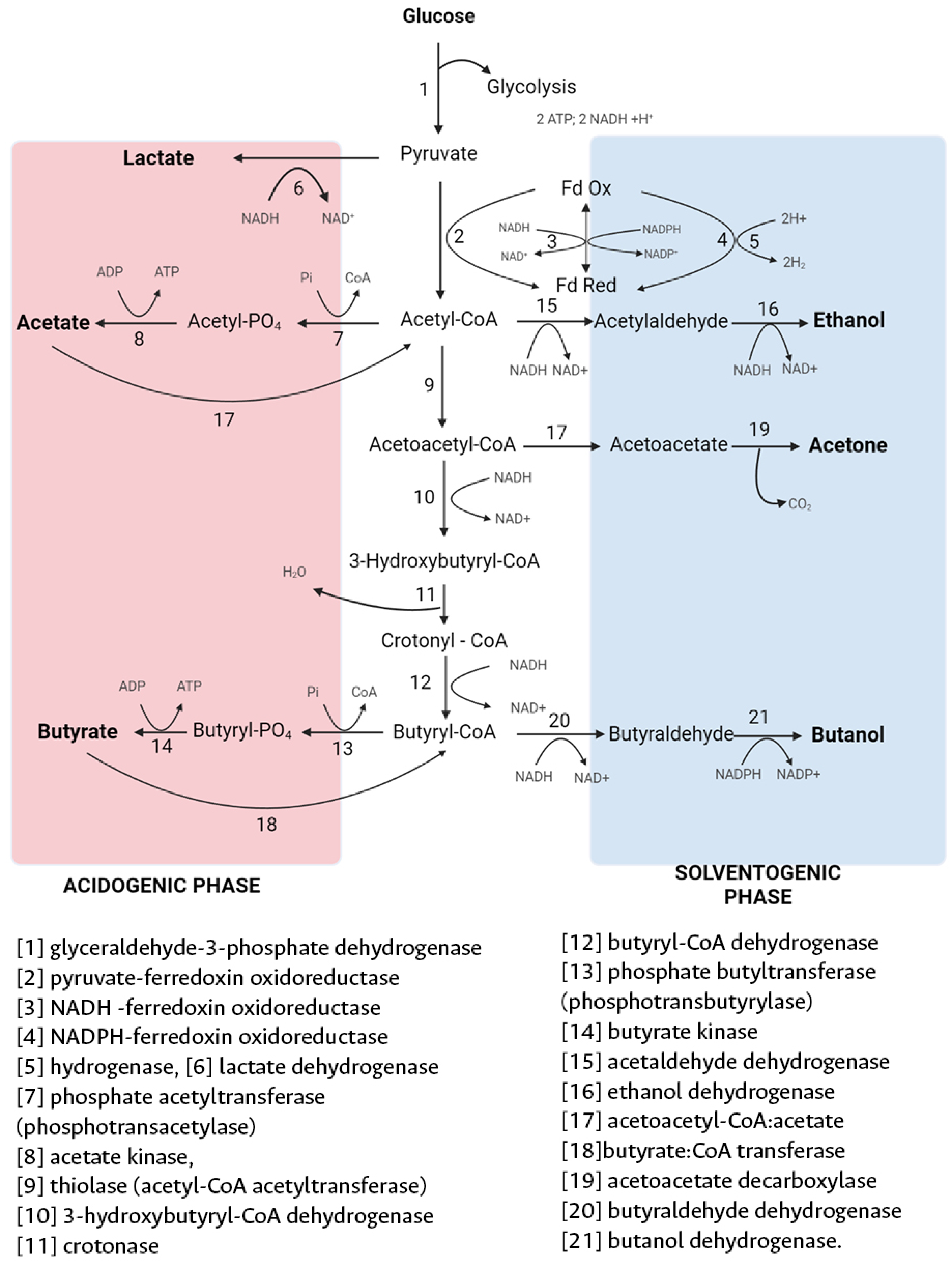
Table 1.
Properties of Butanol compared to those of other fuel [31]. The table shows a list of the most important features of butanol, compared to other biofuels (ethanol, and methanol) and gasoline.
Table 1.
Properties of Butanol compared to those of other fuel [31]. The table shows a list of the most important features of butanol, compared to other biofuels (ethanol, and methanol) and gasoline.
| Properties | Petroleum- based | Oil-based | Bio-alcohols | ||||
| Gasoline | Diesel |
FAME (biodiesel) |
Bio-oil [35] |
Methanol | Ethanol | Butanol | |
| Molecular formula | C4 -C12 | C9 – C20 [36] | C6-C22 [37] | - | CH3OH | C2H5OH | C4H9OH |
| Molecular weight (g/gmol) | 95 - 120 | 190 -220 [38] | ≈295 [39] | - | 32 | 46 | 74 |
| Mass composition of C, H, O (%) | 86, 14, 0 | 86.8, 13.2, 0 [40] | 76.2, 12.6, 11.2 [40] | 54, 5, 34 | 37.5, 12.5, 50 | 52, 13, 35 | 65, 13.5, 21.5 |
| Heating Value (MJ/kg) | 44 – 46 | 43 [40] | 20.8 – 45.6 [41] | 16 - 20 | 22.7 [42] | 24.8[42] | 36.4 [43] |
| Boiling point(°C) | 200 | ≈ 163 -357 [36] | 340 – 375 [37] | - | 65 | 78 | 118 |
| Freezing point (°C) | -40 | -3 a -9 b [44] |
-25 to 26 a -28 to 18 b |
-10 to -20 b | -97 | -114 | -89 |
| Heat of vaporization (MJ/kg) | 0.36 | - | - | - | 1.20 | 0.92 | 0.43 |
| Energy density (MJ/L) | 32 | 36,3 [40] | 33,75 [40] | - | 16 | 19 | 30 |
| Density (Kg/m3) | 760 | 820 – 860 [45] | 860 -890 [45] | 1200 - 1300 | 796 | 790 | 810 |
| Air: fuel ratio | 15:1 | 14.5:1 [36] | 13:1 | - | 7:1 | 9:1 | 12 |
| Cetane number | - | 40 – 45 [40] | 45 – 55[40] | - | - | - | - |
| Motor octane number (MON) | 90 | - | - | - | 92 | 89 | 78 |
| Rating octane number (RON) | 95 | - | - | - | 106 | 107 | 96 |
| Flash point (°C) | -42 | 55 – 65 [41] | >150 [41] | 60 - 80 | 12 | 13 | 35 |
| Lubricity (µm) | - | 448 [44] | 351 – 567 [40] | - | 1100 | 1057 | 591 |
| Auto-ignition temperature (°C) | 257 | 210 | - | - | 463 | 423 | 397 |
a Cloud point: The temperature at which fuel begins to exhibit a cloudy appearance because of wax solidification. b Pour point: The temperature at which the wax content in the fuel reaches a level that causes gelation, rendering the fuel non-pumpable.
Table 2.
Effects of different butanol blending in environmental and performance parameters. The table shows some research about the effects in combustion performance (break thermal efficiency -BTE- and break specific fuel consumption – BSFC-) and emissions of pollutants (carbon monoxide -CO-, carbon dioxide -CO2-, hydrocarbons -HC- and nitrogen oxides -NOx) using butanol blended with gasoline on different types of engines.
Table 2.
Effects of different butanol blending in environmental and performance parameters. The table shows some research about the effects in combustion performance (break thermal efficiency -BTE- and break specific fuel consumption – BSFC-) and emissions of pollutants (carbon monoxide -CO-, carbon dioxide -CO2-, hydrocarbons -HC- and nitrogen oxides -NOx) using butanol blended with gasoline on different types of engines.
| Fuel blending | Engine features | BTE | BSFC | CO | CO2 | HC | NOx | Source |
| N-Butanol 20% | Four cylinder SI engine. 1000-5000 RPM |
≈▼2% | ≈▲ 8% | ≈▼9,07% | ≈▲3,21% | ≈▼18,86% | ≈▼6,41% | [46] |
| Sec-butanol 20% | ≈▲2% | ≈▲15% | ≈▼8,87% | ≈▲5,17% | ≈▼17,67% | ≈▼20,26% | ||
| Tert-butanol 20% | ≈▲2% | ≈▲10% | ≈▼3,07% | ≈▲2,33% | ≈▼12,50% | ≈▼27,79% | ||
| Iso-butanol 20% | ≈▲4% | ≈▲11% | ≈▼14,54% | ≈▲15,53% | ≈▼18,80% | ≈▲43,55% | ||
| n-butanol 10% | Four cylinders turbocharged GDI engine. Urban conditions (throttle opening 10% and 35%), using GT-power simulations software. 1000-5000 RPM |
≈▲1,5% | - | ≈▼3% | - | ≈▲10 % | ≈▼1,5% | [47] |
| n-butanol 20% | ≈▲3,2% | - | ≈▼4% | - | ≈▲20 % | ≈▼2,1% | ||
| n-butanol 30% | ≈▲3,5% | - | ≈▼5% | - | ≈▲28 % | ≈▼3,9% | ||
| n-butanol 40% | ≈▲4,2% | - | ≈▼5% | - | ≈▲34 % | ≈▼4,5% | ||
| n-butanol 100% | ≈▲10,3% | - | ≈▼20% | - | ≈▲85% | ≈▼10% |
||
| Iso-butanol 10% | Single cylinder 2600 RPM. The wide-open throttle condition was investigated at three different compression ratios (CR): 9:1, 10:1, and 11:1. |
≈▲1% | ≈▲5% | ≈▼4% | ≈▲5% | ≈▼8% | - | [48] |
| Iso-butanol 30% | ≈▲2% | ≈▲11% | ≈▼13% | ≈▲12% | ≈▼25% | - | ||
| Iso-butanol 50% | ≈▲12% | ≈▲15% | ≈▼30% | ≈▲22,5% | ≈▼27% | - | ||
| n-butanol 10 % | 10 hp single cylinder 3000 RPM Uncoated |
≈▲2% | ≈▲1% | ≈▼5% | - | ≈▼10% | ≈▲5% | [49] |
| n-butanol 15% | ≈▲2% | ≈▲1,4% | ≈▼9% | - | ≈▼14% | ≈▲10% | ||
| n-butanol 10 % | 10 hp single cylinder 3000 RPM Ceramic coated |
≈▲5,6 | ≈▲1% | ≈▼4% | - | ≈▼12% | ≈▲2% | |
| n-butanol 15% | ≈▲5,6 | ≈▲1% | ≈▼7% | - | ≈▼19% | ≈▲10% | ||
| n-butanol 25% | Four stroke spark ignition engines, under operation conditions of variable engine speed (between 1250 and 3000 RPM). |
≈▲3,6% | ≈▼2% | ▼27,8% | ▼15,9% | ▼3,9% | [50] | |
| n-butanol 50% | ≈▲1,8% | ≈▲2,4 | ▼39,1% | - | ▼28% | ▼1,6% | ||
| n-butanol 2,5% | Four cylinders SI engine operating at different loads and speeds (3000- 5000 RPM). | - | ≈▼7,2% | ≈▼4,8% | - | ≈▼16% | ≈▼10,3% | [51] |
| n-butanol 5% | - | ≈▼ 1% | ≈▼7,8% | - | ≈▼25% | ≈▼3,9% | ||
| n-butanol 7,5% | - | ≈▲5% | ≈▼8% | - | ≈▼15% | ≈▲13,5% |
Disclaimer/Publisher’s Note: The statements, opinions and data contained in all publications are solely those of the individual author(s) and contributor(s) and not of MDPI and/or the editor(s). MDPI and/or the editor(s) disclaim responsibility for any injury to people or property resulting from any ideas, methods, instructions or products referred to in the content. |
© 2024 by the authors. Licensee MDPI, Basel, Switzerland. This article is an open access article distributed under the terms and conditions of the Creative Commons Attribution (CC BY) license (http://creativecommons.org/licenses/by/4.0/).
Copyright: This open access article is published under a Creative Commons CC BY 4.0 license, which permit the free download, distribution, and reuse, provided that the author and preprint are cited in any reuse.


