

Submitted:
24 September 2024
Posted:
24 September 2024
You are already at the latest version
Abstract
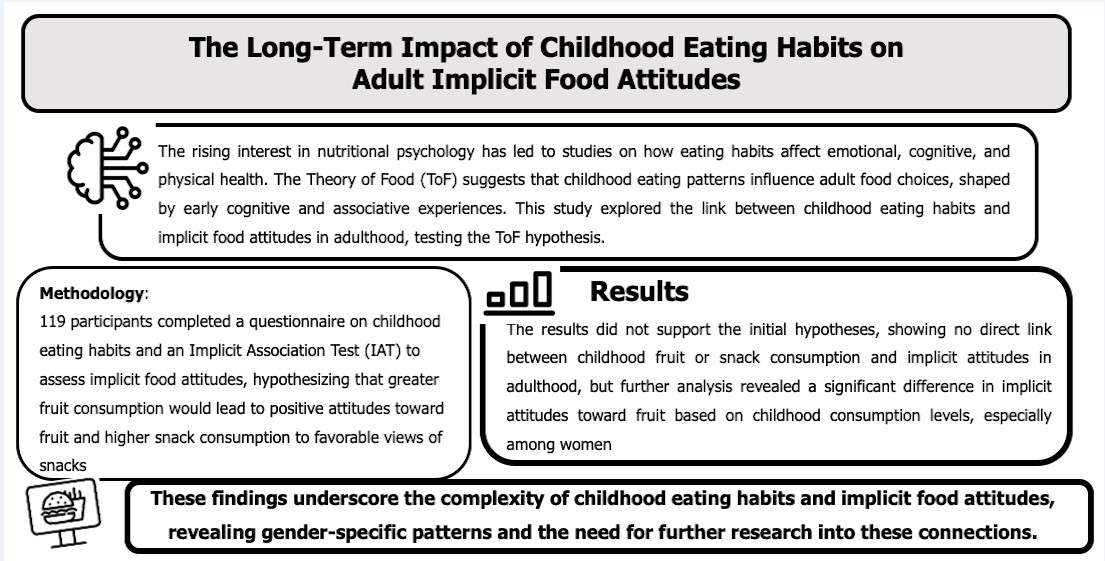
Background/Objectives: The growing interest in nutritional psychology has sparked exploration into how eating habits impact emotional, cognitive, and physical health. The Theory of Food (ToF) posits that childhood eating patterns shape food choices in adulthood, influenced by cognitive and associative representations formed early in life. This study examined the relationship between childhood eating habits and implicit attitudes toward food in adulthood, testing the ToF hypothesis. Methods: One hundred nineteen participants completed a recall questionnaire about their childhood eating habits and an Implicit Association Test (IAT) to assess implicit attitudes toward food groups. The primary hypotheses were that greater fruit consumption in childhood would lead to more positive attitudes toward fruit, and higher snack consumption would result in more favorable attitudes toward snacks. Results: The results did not support the initial hypotheses, indicating no direct relationship between childhood consumption of fruits or snacks and implicit attitudes in adulthood. However, further analyses revealed a significant difference in implicit attitudes toward fruit between participants with low versus high childhood fruit consumption, particularly among women. Conclusions: These findings highlight the complexity of the relationship between childhood eating habits and implicit food attitudes. While no direct associations were found for the overall sample, the significant differences in attitudes based on childhood fruit consumption in women suggest gender-specific patterns. These results emphasize the need for further research to unravel the intricate connections between early eating behaviours and later food attitudes.
Keywords:
nutritional psychology
; theory of food
; childhood eating habits
; implicit attitudes
; food choices
1. Introduction
In recent years, there has been growing interest in nutritional psychology, particularly in understanding how dietary habits influence mental, emotional, and cognitive states. Numerous studies have highlighted the role of diet in shaping cognitive, behavioral, and physical health, as well as mental well-being and social relationships [1,2,3]. These effects are deeply intertwined with the social context of food consumption [4].
Since the development of the Implicit Association Test (IAT) by Greenwald [5], it has become widely accepted that individual behaviour is guided not only by explicit attitudes but also by implicit attitudes—associations that operate below conscious awareness [6]. Implicit attitudes, which influence various behaviours, including nutritional choices, have been explored across multiple domains [7]. According to the Theory of Food (ToF), individuals develop a “food language” during childhood, shaped by the foods they consume and the surrounding social and environmental contexts. This “food language” can have long-lasting effects that persist into adulthood [8,9]. Consequently, childhood dietary patterns may influence implicit attitudes towards food in later life.
This study aims to explore aspects of the ToF by examining the relationship between childhood eating habits and implicit food attitudes in adulthood. Specifically, it investigates whether childhood dietary experiences shape implicit attitudes towards certain food groups in adulthood.
Theory of Food (ToF)
The ToF posits that eating habits and food choices create cognitive associations, similar to how the Theory of Mind (ToM) addresses the understanding of mental states like beliefs and intentions [10]. ToF suggests that early childhood food experiences form cognitive networks that persist into adulthood, influencing future food preferences and behaviours. Just as children learn about the social world through observation and interaction, they develop associations with food that become part of their cognitive framework as adults.
Research has consistently shown connections between food choices, mood, physical health, and mental well-being [11,12]. Eating patterns are shaped by visible factors such as food cost and taste and hidden influences like culture and branding [13]. Tools like the IAT help reveal implicit food preferences that are not always consciously acknowledged. For example, IAT results can predict food choices and show how implicit attitudes influence behaviour differently from explicit attitudes [7]. Additionally, implicit attitudes can steer attention towards taste-related features of food packaging, particularly among those with positive associations toward unhealthy foods [14]. IAT tests are beneficial in socially sensitive contexts, where implicit attitudes may impact behaviour more than explicit ones [5]. Overall, IAT has proven to be a reliable tool in predicting dietary choices and revealing the influence of implicit attitudes on consumer behaviour [15,16].
Implicit Attitudes
The study of implicit processes—automatic and unconscious judgments that shape behaviour—began in the mid-20th century [17]. The human mind categorizes information naturally, leading to implicit attitudes that often go unrecognized but still influence behaviour [18,19,20,21]. An attitude is a psychological tendency expressed through an individual’s positive or negative evaluation of a particular object, encompassing emotions like desire, aversion, and preference [22]. Attitudes are generally categorized into cognitive, emotional, and behavioural components [6,23]. While these components are often conscious, social context can cause certain attitudes to remain implicit [24].
The relationship between implicit and explicit attitudes is complex. While some studies have shown alignment between the two, particularly in social cognition [24], others suggest they often diverge [25]. Despite this, implicit attitudes have been found to predict spontaneous behaviours, such as maintaining social distance in certain situations [26,27,28]. By measuring explicit and implicit attitudes, researchers gain a deeper understanding of behaviour that may be influenced by social or subconscious factors [29]. IAT tasks are precious in uncovering attitudes that individuals may not be aware of or willing to report.
The Current Study
When combined with explicit measures like questionnaires, the IAT provides a more comprehensive understanding of an individual’s attitudes. This study examines the relationship between childhood dietary habits and implicit food attitudes in adulthood, which is in line with the theory of food. We hypothesize that greater childhood consumption of fruits will correlate with more positive implicit attitudes towards fruits in adulthood. In comparison, higher childhood snack consumption will be associated with more positive implicit attitudes towards snacks.
2. Materials and Methods
2.1. Participants
The initial sample consisted of 204 participants. After data cleaning and excluding those who did not complete the study, the final sample comprised 119 participants for statistical analysis. The sample included 80 women and 39 men, all over 18 (M = 28.35, SD = 10.5). Participants were recruited via convenience sampling, primarily from students at Tel-Hai Academic College and through social media and WhatsApp messages. Students from Tel-Hai Academic College received 0.5 credit points for their participation through the SONA system. The Tel-Hai Academic College Ethics Committee approved all procedures.
2.2. Measures
2.2.1. Demographics
The demographic questionnaire collected data on age, sex, religion, height, weight, childhood and current place of residence, diet status (yes/no; if yes, type of diet), vegetarian/vegan status, health status, medication use (yes/no; if yes, type of medication), and presence of psychological disorders.
2.2.2. Childhood Food Preferences Questionnaire (CFPQ)
We used the CFPQ, a self-report questionnaire developed in our lab, to assess the frequency of food consumption during participants’ childhoods [8]. The questionnaire covers seven food categories: bread and cereals, fast food, dairy products, sweets and snacks, drinks, fruits and vegetables, and meat and fish. Each category contains various food items (e.g., pizza, fries, and hamburgers in the fast food category). Participants rated the frequency of consumption for each item on a four-point Likert scale, ranging from 1 (“never”) to 4 (“very often”). Scores for each category were summed to represent overall consumption in childhood. Internal consistency was assessed using Cronbach’s alpha, yielding the following results: grains (α = .739), fast food (α = .842), dairy products (α = .706), snacks (α = .901), drinks (α = .733), fruits and vegetables (α = .922), meat (α = .861), and overall (α = .814).
2.2.3. Implicit Association Test (IAT)
The Implicit Association Test (IAT) measures the strength of mental associations between target and attribute categories by recording reaction times during a classification task. For this study, the IAT was adapted to assess implicit attitudes toward food, translated into Hebrew, and developed using Iatgen software. The test included two target categories (‘snacks’ and ‘fruits’) and two attribute categories (‘pleasant’ and ‘unpleasant’), each containing five items. Participants used designated keys to complete seven blocks of classification tasks, which included a mix of training and combined blocks. Reaction times were recorded, and errors prompted immediate correction. The data analysis focused on the combined blocks. D-scores were calculated for each participant, indicating the strength of associations: a positive D-score suggests favourable implicit attitudes toward fruits, while a negative D-score suggests the opposite. A D-score of zero reflects no bias. The IAT demonstrated high internal consistency (α = .80-.88) and was a significant predictor of behavioural choices (B = 0.39, p < .001). Iatgen software also showed strong reliability (α = .83-.85) and convergent validity [7]. In the current study, the IAT measures exhibited high reliability (α = .86). (Figure 1).
2.3. Experimental Design
Participants completed the study using a laptop or desktop computer with a keyboard. They participated from home or another location of their choice. After signing an informed consent form, participants filled out a demographic questionnaire, followed by the Childhood Food Preferences Questionnaire (CFPQ), in which they rated the frequency of their childhood food consumption. Finally, participants completed the Implicit Association Test (IAT), which involved classifying food-related items to assess implicit attitudes. Instructions were provided before each of the seven blocks. After completing the IAT, participants saw a thank-you message.
2.4. Data Analysis
Descriptive Statistics: For categorical variables, summary tables are provided, giving sample size and relative frequencies, and for continuous variables, summary tables are provided, giving arithmetic mean (M), standard deviation (SD), and range depending on the data distribution.
Inferential Statistics: Chi-squared was applied to test the correlations between the study group, socio-demographics, and personal characteristics. For the continuous variables related to questionnaires (subscales), Cronbach’s alpha coefficients were calculated to assess the internal consistency for each subscale of the questionnaires.
Pearson correlation coefficients were calculated to explore potential relationships between participant characteristics and food preferences. To explore potential differences in implicit attitudes, participants were divided into quartiles based on their childhood fruit consumption. An independent samples t-test was conducted to compare the D-scores of participants in the highest and lowest quartiles of fruit consumption. The data were further stratified by gender to investigate whether the observed effects varied between men and women. Independent samples t-tests were conducted separately for men and women to compare D-scores between high and low-fruit consumption groups. A p-value of 5% or less was considered statistically significant. The data were analyzed using SPSS version 28 (IBM).
3. Results
A preliminary chi-square analysis of the participants’ demographics was performed, and the results indicated a non-significant association among the variables under investigation. Therefore, the statistical analyses included none of the demographic variables as covariates (Table 1).
Table 2 exhibits the means and standard deviations of the childhood consumption of fruits and snacks and the ‘D-score’ found in the sample. Also, 104 subjects were found to have a positive D-score, that is, to have positive latent attitudes toward fruits and negative toward snacks, and 15 subjects were found to have a negative D-score, that is, to have positive latent attitudes toward snacks and negative toward fruits.
The first research hypothesis proposed a positive relationship between fruit consumption in childhood and the D-score, suggesting that participants who ate more fruits as children would have more positive implicit attitudes toward fruits. The second hypothesis suggested a negative relationship between snack consumption in childhood and the D-score, indicating that participants who consumed more snacks in childhood would have more positive implicit attitudes toward snacks.
To test these hypotheses, the correlations among the three variables—D-score, childhood fruit consumption, and childhood snack consumption—were examined using Pearson’s correlation coefficient (see Table 3). No correlation between childhood fruit consumption and the participants’ D-scores was found. Additionally, there was no correlation between childhood snack consumption and the D-scores. Based on these findings, the research hypotheses were not supported.
For further analysis, participants were divided into quartiles based on their fruit consumption during childhood. Differences between the highest and lowest quartiles were examined using an independent samples t-test (see Table 4). A statistically significant difference was found between the two groups, with the D-scores of participants in the high fruit consumption quartile being higher than those in the low consumption quartile. This indicates that participants who consumed more fruits during childhood held more positive implicit attitudes toward fruits than those with lower fruit consumption.
Additionally, the sample was divided into quartiles based on snack consumption during childhood, and differences between the highest and lowest consumption quartiles were examined using an independent samples t-test (see Table 5). No significant difference was found between the two groups.
To understand the differences between the high and low fruit consumption groups in childhood, we examined the differences by gender. Among women, a statistically significant difference was found between the consumption groups (see Table 6), with the D-score of women with high fruit consumption in childhood being higher than that of women with low fruit consumption. This indicates that women who consumed more fruits during childhood had more positive implicit attitudes toward fruits than those with lower consumption. In contrast, no significant difference was observed among men between the high and low fruit consumption groups in childhood (see Table 7).
4. Discussion
The current study investigated the relationship between childhood eating habits and implicit attitudes toward foods in adulthood. Contrary to the research hypotheses, no significant relationship was found between childhood fruit consumption and participants’ D-scores. Similarly, no association was observed between childhood snack consumption and D-scores. This suggests that childhood eating habits may not directly influence implicit attitudes toward foods in adulthood. However, additional analyses revealed that participants with high childhood fruit consumption had significantly higher D-scores than those with low fruit consumption. This indicates that individuals who ate more fruits as children had more positive implicit attitudes toward fruits than their counterparts. Moreover, a gender-based analysis found similar results among women.
This study focused on a specific aspect of the Theory of Food (ToF) [8,9], namely the relationship between childhood eating habits and implicit attitudes toward foods in adulthood. This highlights how the foods consumed during childhood may be linked to the “food theory” individuals develop in adulthood. However, ToF proposes additional variables that might influence this “food theory,” such as the cultural context, family and social experiences related to food, and the emotional context of food consumption [9]. Therefore, the findings of this study may not necessarily indicate a flaw in the theory but rather suggest that factors beyond childhood eating habits influenced participants’ implicit attitudes toward foods.
Indeed, the literature provides evidence of other variables affecting implicit attitudes toward foods. For instance, implicit attitudes can be influenced by an individual’s knowledge about the healthiness of foods, where exposure to images of health risks associated with unhealthy foods affects participants’ implicit attitudes toward those foods [30]. Additionally, values and beliefs also play a role, with vegan participants exhibiting more negative implicit attitudes toward animal-based foods than vegetarians and vegetarians demonstrating more negative attitudes than omnivores. Other factors, such as moral views on food and personality traits like empathy, have also been shown to affect implicit food attitudes [31].
Furthermore, ongoing dietary restrictions influence implicit attitudes toward foods. Individuals on long-term restrictive diets tend to display less positive implicit attitudes toward tasty foods than control groups [32]. Additionally, childhood food-related memories, such as being rewarded with food or having a controlled diet, have been linked to higher consumption of sweet and salty snacks in adulthood. On the other hand, guidance toward healthy eating and restrictions were associated with higher consumption of fruits and vegetables [33]. Given that implicit attitudes are connected to eating habits and dietary choices [7], it can be inferred that childhood eating memories influence food consumption habits and implicit attitudes in adulthood.
Another potential explanation for the lack of association between childhood eating habits and implicit attitudes in this study may be related to the validity of the ToF. The findings of this study could be seen as a partial challenge to the theory, suggesting that further research is needed to understand better the complex relationships between childhood dietary habits and various cognitive and emotional variables.
When the sample was divided into quartiles reflecting low versus high fruit consumption, differences emerged in D-scores, with the high-consumption group displaying higher D-scores. This finding suggests a trend toward the research hypothesis, and increasing the sample size in future studies could reveal the anticipated effect in correlation and difference analyses.
To further explore these differences, the sample was analyzed by gender. Among women, those with high childhood fruit consumption had significantly higher D-scores than those with low fruit consumption. This difference was not observed among men. However, it is important to interpret this result cautiously, given the small sample size, particularly in the quartile analysis where each group contained fewer than 30 participants. This may lead to potential issues with the normality assumption required for statistical tests.
Nonetheless, the more positive implicit attitudes of women in the high fruit consumption group could be influenced by additional variables. For example, a study found that women who enjoyed shopping for and preparing food consumed more fruits and vegetables than those who did not enjoy these activities [34]. This suggests that such behaviours influence women’s implicit attitudes and explain the observed differences.
Previous research has also indicated gender differences in food-related attitudes, with women reported to consume more fruits, avoid high-fat foods, and limit salty food intake compared to men [35]. Women tend to place greater importance on the healthiness of foods, while men often prioritize taste [36]. Additionally, women generally know more about the health effects of the foods they consume than men [37]. These attitude differences are likely reflected at the implicit level, potentially accounting for the gender differences observed in this study. Other research has shown that women’s preferences for healthy food are primarily driven by more excellent nutritional knowledge and a higher motivation to maintain weight than men [38], further supporting the bias in women’s implicit attitudes toward healthier foods.
The current study’s findings may also be influenced by limitations related to the tools used. One primary limitation concerns the validity and reliability of the Implicit Association Test (IAT). Some have identified issues with the generalizability and reproducibility of the IAT [39]. In contrast, others have noted low test-retest reliability [40], potentially due to the reliance on reaction times, where even a tenth of a second can significantly affect scores. Additionally, the IAT’s relative nature complicates interpretation, as a strong association between “fruits” and “pleasant” may also reflect a solid opposite association between “snacks” and “unpleasant” [41]. Another limitation is the reliance on recall questionnaires for childhood eating habits, which may have led to inaccuracies due to the passage of time [42,43,44]. The sample characteristics may also limit the generalizability of the findings, as the average D-score was notably higher than that found in previous research [7], with fewer participants showing negative D-scores, suggesting a tendency toward positive implicit attitudes toward fruits and negative attitudes toward snacks.
While this study did not fully validate the ToF, it provides avenues for further research into additional variables that may influence implicit food attitudes. Future studies should explore these factors and employ different methodologies, such as longitudinal studies, to assess childhood dietary habits and their impact on adult implicit attitudes. Psycho-physiological measures (e.g., EEG, skin conductance, heart rate) could also be used to evaluate participants’ responses to various foods in adulthood. Additionally, increasing the sample size could help clarify the differences between high and low-fruit consumption groups by allowing subgroup analyses based on gender and dietary preferences (e.g., vegan, vegetarian).
5. Conclusions
In conclusion, although the research hypotheses were not fully supported, this study contributes to our understanding of the role of childhood eating habits in shaping implicit attitudes toward foods in adulthood. Childhood exposure to healthy foods like fruits may lead to more positive implicit attitudes toward these foods later in life. Given that previous studies have found a correlation between implicit attitudes and dietary choices [7], it can be inferred that early exposure to healthy foods may promote healthier dietary choices throughout life. Conversely, limited exposure to healthy foods during childhood may result in more negative implicit attitudes, potentially leading to lower consumption and adverse health outcomes.
Author Contributions
Conceptualization, OH; Writing—Original Draft Preparation, OH.; Writing—Review & Editing, OH.
Funding
This research received no external funding.
Institutional Review Board Statement
This study was conducted according to the guidelines laid down in the Declaration of Helsinki, and the Tel-Hai Academic College approved all procedures involving research study participants.
Informed Consent Statement
Participants gave their consent.
Data Availability Statement
The datasets generated and/or analyzed during the current study are not publicly available due to their containing information that could compromise the privacy of research participants but are available from the corresponding author upon reasonable request.
Acknowledgments
The Authors would like to thank Mrs. Lotem Doron, and Mr. Gilad Rothschild.
Conflicts of Interest
The authors declare no conflict of interest.
References
- Marx W, Moseley G, Berk M, et al. Nutritional psychiatry: the present state of the evidence. Proc Nutr Soc 2017; 76: 427–436. [CrossRef]
- Grajek M, Krupa-Kotara K, Białek-Dratwa A, et al. Nutrition and mental health: A review of current knowledge about the impact of diet on mental health. Front Nutr 2022; 9: 943998. [CrossRef]
- Canetti L, Bachar E, Berry EM. Food and emotion. Behavioural Processes 2002; 60: 157–164.
- Higgs S, Thomas J. Social influences on eating. Current Opinion in Behavioral Sciences 2016; 9: 1–6.
- Greenwald AG, McGhee DE, Schwartz JLK. Measuring individual differences in implicit cognition: The implicit association test. Journal of Personality and Social Psychology 1998; 74: 1464–1480.
- Karpinski A, Hilton JL. Attitudes and the Implicit Association Test. Journal of Personality and Social Psychology 2001; 81: 774–788.
- Richetin J, Perugini M, Prestwich A, et al. The IAT as a predictor of food choice: The case of fruits versus snacks. Int J Psychol 2007; 42: 166–173. [CrossRef]
- Horovitz O. Theory of Food: Unravelling the Lifelong Impact of Childhood Dietary Habits on Adult Food Preferences across Different Diet Groups. Nutrients 2024; 16: 428. [CrossRef]
- Allen JS. “Theory of food” as a neurocognitive adaptation. American J Hum Biol 2012; 24: 123–129.
- Premack D, Woodruff G. Does the chimpanzee have a theory of mind? Behav Brain Sci 1978; 1: 515–526.
- Ares G, De Saldamando L, Giménez A, et al. Consumers’ associations with wellbeing in a food-related context: A cross-cultural study. Food Quality and Preference 2015; 40: 304–315. [CrossRef]
- Firth J, Gangwisch JE, Borsini A, et al. Food and mood: how do diet and nutrition affect mental wellbeing? BMJ 2020; m2382.
- Montanari M. Food is culture. New York: Columbia University Press, 2006.
- Songa G, Russo V. IAT, consumer behaviour and the moderating role of decision-making style: An empirical study on food products. Food Quality and Preference 2018; 64: 205–220. [CrossRef]
- Gallucci A, Del Mauro L, Pisoni A, et al. A systematic review of implicit attitudes and their neural correlates in eating behaviour. Social Cognitive and Affective Neuroscience 2023; 18: nsaa156.
- Songa G, Slabbinck H, Vermeir I, et al. How do implicit/explicit attitudes and emotional reactions to sustainable logo relate? A neurophysiological study. Food Quality and Preference 2019; 71: 485–496. [CrossRef]
- Allport GW. The nature of prejudice. Nachdr. Reading, Mass.: Addison-Wesley, 1985.
- Kawakami K, Young H, Dovidio JF. Automatic Stereotyping: Category, Trait, and Behavioral Activations. Pers Soc Psychol Bull 2002; 28: 3–15.
- Crisp RJ, Hewstone M. Multiple Social Categorization. In: Advances in Experimental Social Psychology. Elsevier, pp. 163–254.
- Brown R, Croizet J-C, Bohner G, et al. Automatic Category Activation and Social Behavior: The Moderating Role of Prejudiced Beliefs. Social Cognition 2003; 21: 167–193. [CrossRef]
- Schmader T, Johns M, Forbes C. An integrated process model of stereotype threat effects on performance. Psychological Review 2008; 115: 336–356. [CrossRef]
- Eagly AH, Chaiken S. Attitude structure and function. In: The handbook of social psychology, Vols. 1-2, 4th ed. New York, NY, US: McGraw-Hill, 1998, pp. 269–322.
- Albarracin D. The Handbook of Attitudes, Volume 1: Basic Principles: 2nd Edition. 2nd ed. Routledge. Epub ahead of print 3 September 2018. DOI: 10.4324/9781315178103.
- Greenwald AG, Banaji MR. Implicit social cognition: Attitudes, self-esteem, and stereotypes. Psychological Review 1995; 102: 4–27.
- Cvencek D, Meltzoff AN, Maddox CD, et al. Meta-Analytic Use of Balanced Identity Theory to Validate the Implicit Association Test. Pers Soc Psychol Bull 2021; 47: 185–200. [CrossRef]
- Dovidio JF, Kawakami K, Gaertner SL. Implicit and explicit prejudice and interracial interaction. Journal of Personality and Social Psychology 2002; 82: 62–68.
- McConnell AR, Leibold JM. Relations among the Implicit Association Test, Discriminatory Behavior, and Explicit Measures of Racial Attitudes. Journal of Experimental Social Psychology 2001; 37: 435–442.
- Rydell RJ, McConnell AR. Understanding implicit and explicit attitude change: A systems of reasoning analysis. Journal of Personality and Social Psychology 2006; 91: 995–1008. [CrossRef]
- Friese M, Hofmann W, Schmitt M. When and why do implicit measures predict behaviour? Empirical evidence for the moderating role of opportunity, motivation, and process reliance. European Review of Social Psychology 2008; 19: 285–338. [CrossRef]
- Hollands GJ, Prestwich A, Marteau TM. Using aversive images to enhance healthy food choices and implicit attitudes: An experimental test of evaluative conditioning. Health Psychology 2011; 30: 195–203. [CrossRef]
- Cliceri D, Spinelli S, Dinnella C, et al. The influence of psychological traits, beliefs and taste responsiveness on implicit attitudes toward plant- and animal-based dishes among vegetarians, flexitarians and omnivores. Food Quality and Preference 2018; 68: 276–291. [CrossRef]
- Papies EK, Stroebe W, Aarts H. Who likes it more? Restrained eaters’ implicit attitudes towards food. Appetite 2009; 53: 279–287. [CrossRef]
- Małachowska A, Jeżewska-Zychowicz M. Does Examining the Childhood Food Experiences Help to Better Understand Food Choices in Adulthood? Nutrients 2021; 13: 983.
- Crawford D, Ball K, Mishra G, et al. Which food-related behaviours are associated with healthier intakes of fruits and vegetables among women? Public Health Nutr 2007; 10: 256–265.
- Chambers S, Lobb A, Butler LT, et al. The influence of age and gender on food choice: a focus group exploration. Int J Consumer Studies 2008; 32: 356–365. [CrossRef]
- Rappoport L, Peters GR, Downey R, et al. Gender and Age Differences in Food Cognition. Appetite 1993; 20: 33–52. [CrossRef]
- Fagerli RAa, Wandel M. Gender Differences in Opinions and Practices with Regard to a ‘Healthy Diet’>. Appetite 1999; 32: 171–190.
- Westenhoefer J. Age and Gender Dependent Profile of Food Choice. In: Elmadfa I (ed) Forum of Nutrition. S. Karger AG, pp. 44–51.
- Blanton H, Jaccard J, Klick J, et al. Strong claims and weak evidence: Reassessing the predictive validity of the IAT. Journal of Applied Psychology 2009; 94: 567–582.
- Rezaei AR. Validity and reliability of the IAT: Measuring gender and ethnic stereotypes. Computers in Human Behavior 2011; 27: 1937–1941. [CrossRef]
- Blanton H, Jaccard J, Christie C, et al. Plausible assumptions, questionable assumptions and post hoc rationalizations: Will the real IAT, please stand up? Journal of Experimental Social Psychology 2007; 43: 399–409.
- Bel-Serrat S, Mouratidou T, Pala V, et al. Relative validity of the Children’s Eating Habits Questionnaire–food frequency section among young European children: the IDEFICS Study. Public Health Nutr 2014; 17: 266–276. [CrossRef]
- Coughlin SS. Recall bias in epidemiologic studies. Journal of Clinical Epidemiology 1990; 43: 87–91.
- Mancuso CA, Charlson ME. Does recollection error threaten the validity of cross-sectional studies of effectiveness? Med Care 1995; 33: AS77-88.
Figure 1.
Food-related IAT task.
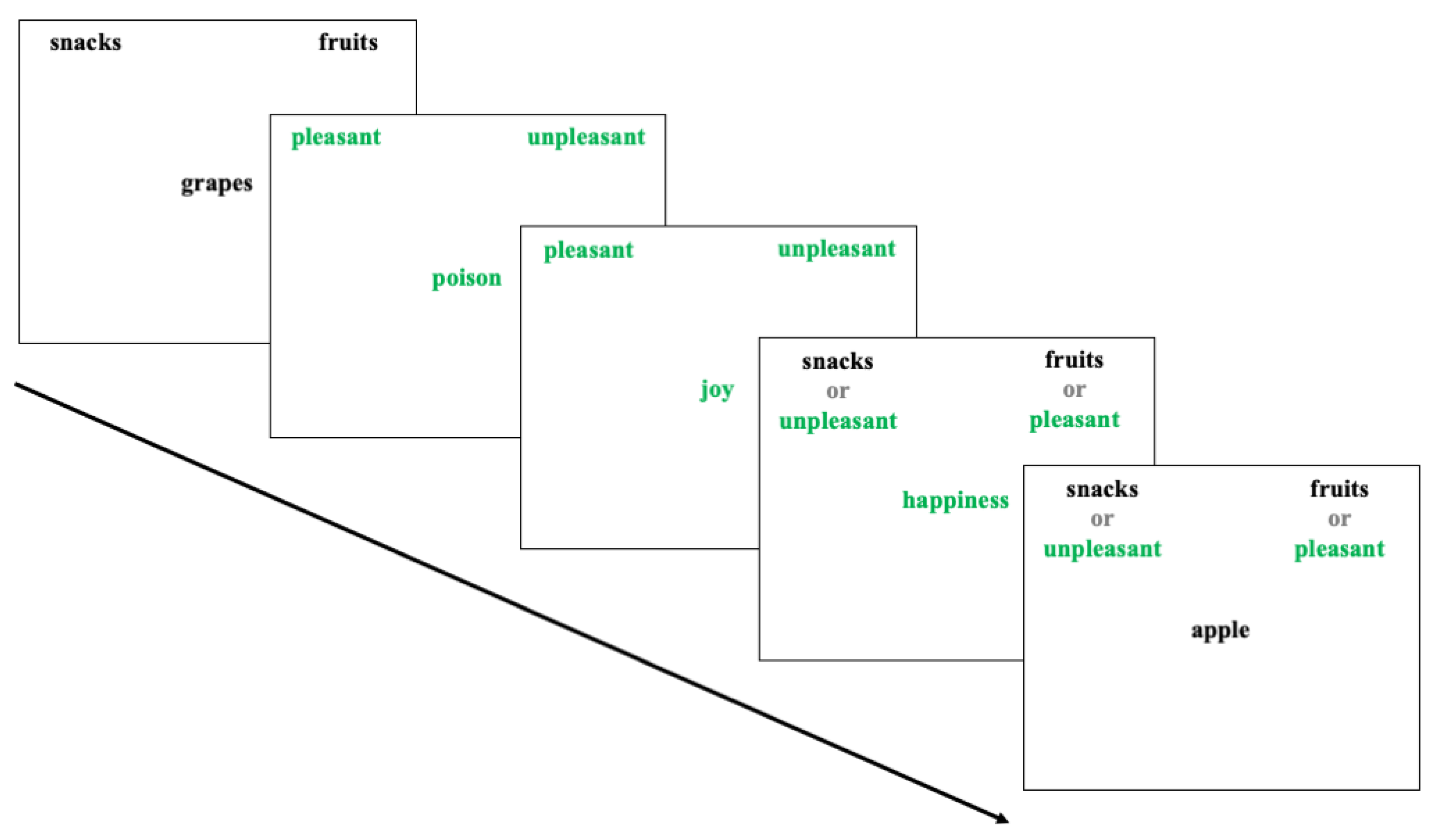

Table 1.
presents the demographics and characteristics of the study’s sample.
| Mean | STDEV | Range | |||
| Age | 28.35 | 10.50 | 19-81 | ||
| Males | Females | ||||
| Gender | 36 (32.77%) | 80 (67.23%) | |||
| City | Kibbutz | Cooperative Settlement | Other | ||
| Current living place | 58 (48.74%) | 30 (25.21%) | 14 (11.76%) | 17 (14.29%) | |
| Childhood living place | 63 (52.94%) | 11 (9.24%) | 15 (12.61%) | 30 (25.21%) | |
| Muslim | Christian | Jew | Druze | Other | |
| Religion | 5 (4.2%) | 2 (1.68%) | 104 (87.39%) | 3 (2.52%) | 5 (4.21%) |
| Yes | No | ||||
| Health Diet | 26 (21.85%) | 93 (78.15%) | |||
| Excellent | Good | Reasonable | Not so Good | Bad | |
| Health Status | 49 (41.18%) | 58 (48.74%) | 9 (7.56%) | 2 (1.68%) | 1 (0.84%) |
| Carnivore | Vegetarian | Vegan | |||
| Diet Preference | 73 (61.34%) | 32 (26.89%) | 14 (11.77%) |
Table 2.
Means and standard deviations of childhood fruits and snacks consumption and ‘D-score.’.
| Variable | Mean | SD |
|---|---|---|
| Childhood Fruits Consumption | 3.01 | 0.765 |
| Childhood Snacks Consumption | 2.519 | 0.705 |
| D-Score | 0.504 | 0.443 |
Table 3.
Pearson correlations between the variables ‘D-score’, childhood fruit consumption’ and ‘childhood snack consumption’ (N=119).
Table 3.
Pearson correlations between the variables ‘D-score’, childhood fruit consumption’ and ‘childhood snack consumption’ (N=119).
| M | SD | 1 | 2 | ||||
| r | p-value | r | p-value | ||||
| 1 | D-Score | 0.50 | 0.44 | --- | |||
| 2 | Childhood fruits consumption | 3.01 | 0.76 | .118 | .201 | --- | |
| 3 | Childhood snacks consumption | 2.51 | 0.70 | .000 | .996 | .335 | <.001 |
Table 4.
Differences in D-score between the groups ‘low fruit consumption in childhood’ and ‘high fruit consumption in childhood’.
Table 4.
Differences in D-score between the groups ‘low fruit consumption in childhood’ and ‘high fruit consumption in childhood’.
| Low childhood fruits consumption (n=32) | High childhood fruits consumption (n=29) | |||||||
|---|---|---|---|---|---|---|---|---|
| M | SD | M | SD | t(59) | p-value | Cohen’s d | ||
| D-Score | 0.36 | 0.56 | 0.57 | 0.37 | -1.67 | .005 | 0.44 | |
Table 5.
Differences in D-score between the groups ‘low snack consumption in childhood’ and ‘high snack consumption in childhood’.
Table 5.
Differences in D-score between the groups ‘low snack consumption in childhood’ and ‘high snack consumption in childhood’.
| Low childhood snacks consumption (n=34) | High childhood snacks consumption (n=25) | |||||||
|---|---|---|---|---|---|---|---|---|
| M | SD | M | SD | t(57) | p-value | Cohen’s d | ||
| D-Score | 0.58 | 0.43 | 0.48 | 0.41 | 0.81 | 0.20 | 0.23 | |
Table 6.
Differences in D-score between the groups ‘low fruit consumption in childhood’ and ‘high fruit consumption in childhood’, among women.
Table 6.
Differences in D-score between the groups ‘low fruit consumption in childhood’ and ‘high fruit consumption in childhood’, among women.
| Low childhood fruits consumption (n=18) | High childhood fruits consumption (n=20) | |||||||
|---|---|---|---|---|---|---|---|---|
| M | SD | M | SD | t(36) | p-value | Cohen’s d | ||
| D-Score | 0.30 | 0.57 | 0.58 | 0.42 | -1.72 | .040 | 0.55 | |
Table 7.
Differences in D-score between the groups ‘low fruit consumption in childhood’ and ‘high fruit consumption in childhood’, among men.
Table 7.
Differences in D-score between the groups ‘low fruit consumption in childhood’ and ‘high fruit consumption in childhood’, among men.
| Low childhood fruits consumption (n=14) | High childhood fruits consumption (n=9) | |||||||
|---|---|---|---|---|---|---|---|---|
| M | SD | M | SD | t(36) | p-value | Cohen’s d | ||
| D-Score | 0.44 | 0.55 | 0.54 | 0.26 | -0.51 | .30 | 0.23 | |
Disclaimer/Publisher’s Note: The statements, opinions and data contained in all publications are solely those of the individual author(s) and contributor(s) and not of MDPI and/or the editor(s). MDPI and/or the editor(s) disclaim responsibility for any injury to people or property resulting from any ideas, methods, instructions or products referred to in the content. |
© 2024 by the authors. Licensee MDPI, Basel, Switzerland. This article is an open access article distributed under the terms and conditions of the Creative Commons Attribution (CC BY) license (http://creativecommons.org/licenses/by/4.0/).
Copyright: This open access article is published under a Creative Commons CC BY 4.0 license, which permit the free download, distribution, and reuse, provided that the author and preprint are cited in any reuse.