

Submitted:
20 September 2024
Posted:
23 September 2024
You are already at the latest version
Abstract
The high performance of liquid chromatography(HPLC) has long been an indispensable tool for vigilance and analysis across range disciplines such as pharmaceuticals, environmental monitoring, food safety attributes etc. We will discuss about HPLC method development and validation, types of liquid chromatography methods focusing on proper use of a mobile phase like an eluent selection, how to optimize the conditions as well take it through its various procedures required for approval from regulatory bodies. Strategies to improve method robustness, sensitivity and reproducibility are highlighted. The future breakthroughs in HPLC technology and some innovative trends have also been speculated to limit this fundamental methodology.
Keywords:
Method Development
; Method Optimization
; Chromatographic Conditions
; Mobile Phase
; Stationary Phase
; Gradient Elution
; Isocratic Elution
; Sample Preparation
; Detection Methods
; UV-Vis Detection
Introduction
High-Performance Liquid Chromatography (HPLC) is a powerful and indispensable analytical tool that serves as an essential workhouse for nearly every scientific discipline. As a toolgap for separation, identification and quantification of compounds in complex mixtures. Its high resolution, accuracy and flexibility makes it indispensable in industries like Pharmacueticals, Environmental Science, Food Safety or Biochemistry. The basic principle of HPLC is that a liquid sample pass through solid adsorbent material inside the column. The adsorbent material interacts with different components in the sample differently so they stay separate based on their affinities. Several factors affect this process such as the mobile phase, stationary phase column temperature and detection methods. The right selection and optimization of these parameters are important for efficient development in a new method (HPLC).
The main objective of HPLC method development is to identify an optimum set up that ensures good accuracy and precision in the determination characterization analysis study on specific analytes. Such a process usually relates to ensuring optimal chromatographic behaviour: e.g., choice of solvents, pH, gradients and column types. Moreover application in terms of sample preparation which is usually used and the detection technique being applied are important for best performance during method development.
Rigorous validation of a method is then required once developed to verify that it can be used for the purpose envisaged. Validation parameters consist of accuracy, precision specificity, sensitivity linearity range robustness and system suitability. These metrics are assessed based on ICH and USP regulatory guidelines. The method has been developed in accordance with these principles to satisfy the high quality and reliability standards that must be met for analytical procedures.
Over the years, technology took HPLC to one step ahead. So that, In recent times it has become highly advanced as a result of various technological advancements in this field. Technological advancements, such as Ultra-High-Performance Liquid Chromatography (UHPLC), and HPLC-Mass Spectrometry (HPLC-MS/MS) have improved limits of detection (~ 0.5 ng/ml for many compounds). Increasing focus towards green chemistry in the recent years have spurred development of environmentally sustainable HPLC methods. The successful method development of automation and artificial intelligence (AI) integration also new trends in the market offer better opportunities to increase their performance, accuracy with decreased process time making testing processes more efficient.
In this context, the overall objective of the present review is to provide an insight into method development and validation by using HPLC as chromatographic technique where a deep overview will be structured in key aspects or components that needs attention when developing such methods. Through its compilation of knowledge, it facilitates access for both students and experienced practitioners to the newest advances in HPLC testing as well, thus maintaining High Performance Liquid Chromatography as a standard tool within modern analytical science.
HPLC Method Development
High-Performance Liquid Chromatography (HPLC) method development is a systematic process aimed at creating a robust analytical procedure for the separation and quantification of components in a sample. The method development process involves several key steps and considerations to optimize chromatographic conditions and ensure accurate results.
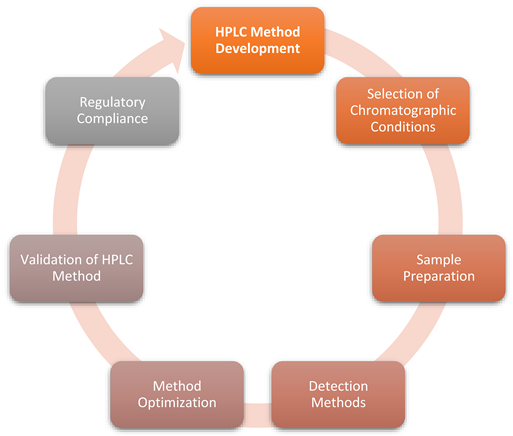
- Selection of Chromatographic Conditions.
Mobile Phase:
- -
- Choosing appropriate solvents based on the polarity of analytes.
- -
- pH and buffer selection to control ionization and retention times.
- -
- Gradient elution vs. isocratic elution for optimizing separation efficiency.
Stationary Phase:
- -
- Selection of column type (e.g., C18, C8, phenyl, cyano) based on analyte characteristics.
- -
- Particle size and pore size considerations for resolution and analysis time.
Temperature:
- -
- Control of column temperature to maintain consistent retention times and improve separation.
- 2.
-
Sample Preparation
- -
- Techniques such as filtration, centrifugation, and solid-phase extraction to remove matrix components and enhance analyte recovery.
- -
- Minimizing sample degradation and matrix effects to ensure accurate quantification.
- 3.
-
Detection Methods
- -
- Selection of appropriate detection techniques based on analyte properties (e.g., UV-Vis, fluorescence, mass spectrometry).
- -
- Optimizing detector settings for sensitivity, linearity, and specificity.
- 4.
-
Method Optimization
- -
- Resolution: Maximizing separation between analyte peaks.
- -
- Efficiency: Ensuring narrow peak widths for precise quantification.
- -
- Selectivity: Tailoring conditions to resolve closely eluting peaks.
- -
- Robustness: Testing method robustness against small variations in parameters like pH, temperature, and flow rate.
- -
- Speed: Balancing analysis time with method sensitivity and resolution.
- 5.
-
Validation of HPLC Method
- -
- Accuracy: Comparing measured values to true values or reference methods.
- -
- Precision: Assessing repeatability (intra-day) and reproducibility (inter-day).
- -
- Specificity: Ensuring analyte detection in the presence of matrix components.
- -
- Linearity: Establishing a linear relationship between analyte concentration and detector response.
- -
- Limit of Detection (LOD) and Limit of Quantification (LOQ): Determining the lowest concentration reliably detectable and quantifiable.
- -
- Range: Validating the upper and lower limits of the method's analytical range.
- -
- System Suitability: Evaluating chromatographic parameters to ensure consistent performance.
- 6.
-
Regulatory Compliance
- -
- Adhering to guidelines such as ICH Q2(R1) and USP <1225> for method validation.
- -
- Documenting and reporting validation results to demonstrate method reliability and compliance.
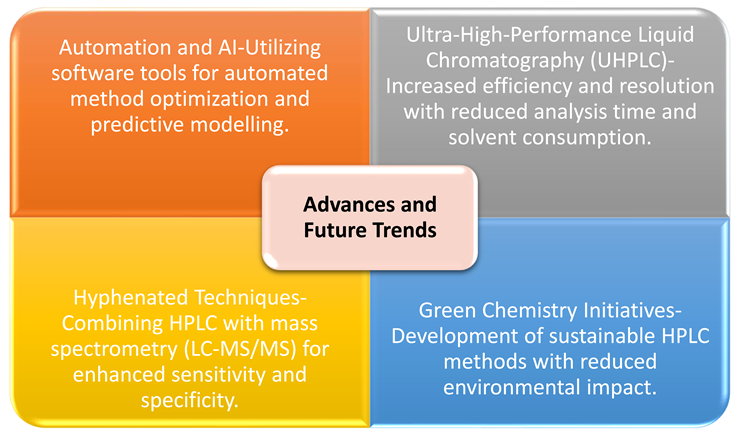
The development of the HPLC method is a very strict procedure that requires quantication of chromatographic parameters, approbation of method performance, and conformity of the method with the regulations. New technologies and approach concern the improvement of the HPLC methods regarding to their effectiveness, detection, and environmental friendly.
HPLC Method Validation
Method validation is a critical process in High-Performance Liquid Chromatography (HPLC) to ensure that the developed analytical method is suitable for its intended purpose and produces reliable and accurate results. Validation verifies that the method meets predefined acceptance criteria and complies with regulatory guidelines. Here's an overview of the key aspects involved in HPLC method validation:
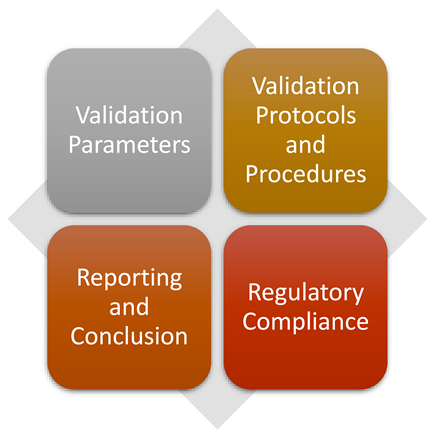
- 1.
-
Validation Parameters
- -
- Accuracy: Determines the closeness of test results to the true value. Accuracy is typically assessed by comparing the measured value to a known standard or reference material.
- -
-
Precision:
- -
- Repeatability: Also known as intra-day precision, evaluates the variation in results obtained within a short time period under the same conditions by the same analyst using the same equipment.
- -
- Intermediate Precision: Assesses the variation in results obtained within the same laboratory but under different conditions (e.g., different days, different analysts, different equipment).
- -
- Reproducibility: Evaluates the variation in results obtained in different laboratories using the same method.
- -
- Specificity: Determines the ability of the method to distinguish the analyte from other components in the sample matrix. Specificity is often assessed through peak purity tests and interference studies.
- -
-
Limit of Detection (LOD) and Limit of Quantification (LOQ):
- -
- LOD: The lowest concentration of analyte that can be reliably detected but not necessarily quantified.
- -
- LOQ: The lowest concentration of analyte that can be quantitatively determined with acceptable accuracy and precision.
- -
- Linearity: Evaluates the relationship between analyte concentration and detector response over a specified range. Linearity is assessed by analyzing multiple calibration standards and plotting a calibration curve.
- -
- Range: Defines the concentration range over which the method demonstrates acceptable linearity, accuracy, and precision.
- -
- Robustness: Determines the reliability of the method with respect to small variations in method parameters such as pH, mobile phase composition, flow rate, and column temperature.
- -
- System Suitability: Ensures that the HPLC system is capable of providing adequate resolution, sensitivity, and reproducibility for the intended analysis. System suitability parameters include retention time, resolution between peaks, and column efficiency.
- 2.
-
Validation Protocols and Procedures
- -
- Design of Experiments (DoE): Statistical techniques such as factorial designs used to systematically evaluate and optimize method parameters during validation.
- -
- Validation Plan: Detailed document outlining the validation objectives, acceptance criteria, experimental protocols, and responsibilities of personnel involved in the validation process.
- -
- Validation Samples: Prepared to evaluate specificity, accuracy, precision, linearity, and robustness. Samples may include standard solutions, placebo samples, and spiked samples at different concentrations.
- -
- Documentation: Comprehensive documentation of validation results, including raw data, calculations, chromatograms, and a final validation report summarizing all findings.
- 3.
-
Regulatory Compliance
- -
- ICH Guidelines (Q2(R1)) and USP <1225>: International guidelines providing a framework for method validation in pharmaceutical analysis. These guidelines outline specific requirements for validation parameters, acceptance criteria, and documentation.
- -
- Good Laboratory Practices (GLP): Adherence to GLP principles ensures that the validation process is well-documented, controlled, and reproducible.
- 4.
-
Reporting and Conclusion
- -
- Validation Report: A detailed summary of validation results, conclusions, and recommendations for the use of the validated method in routine analysis.
- -
- Conclusion: Validation confirms that the HPLC method is fit for purpose, providing reliable and accurate results for its intended application. It ensures confidence in the method's performance and compliance with regulatory standards.
High-Performance Liquid Chromatography (HPLC) method development and validation are integral processes in analytical chemistry, ensuring the accuracy, reliability, and reproducibility of analytical results. This review has explored the essential components of both method development and validation, highlighting key considerations, challenges, and advancements in the field.
Summary of Methodology Enhancement
Developing an HPLC method is a systematic process of optimizing chromatographic conditions to provide suitable resolution and quantification for analytes. Some of the key ones are mobile phase composition, stationary phase type, and its properties along with detection techniques & also temperature specify flow rate optimization. To achieve this, it is essential to develop a method that balances resolution with sensitivity and speed while preserving robustness for different analytical needs.
Method Validation Essentials
Method validation is a critical step following method development to ensure its suitability for routine use. Validation parameters such as accuracy, precision, specificity, linearity, LOD, LOQ, range, robustness, and system suitability are rigorously evaluated according to regulatory guidelines (e.g., ICH Q2(R1), USP <1225>). Through validation protocols, experimental design, and statistical analysis, analysts verify that the method reliably produces accurate results within defined acceptance criteria.
Regulatory Compliance and Quality Assurance
Adherence to regulatory guidelines and good laboratory practices (GLP) is essential throughout method development and validation. Compliance ensures that methods are robust, reproducible, and suitable for their intended applications, particularly in highly regulated industries such as pharmaceuticals and environmental monitoring.
Progress and Emerging Pathways
Recent advancements in HPLC technology, such as UHPLC systems, hyphenated techniques (e.g., LC-MS/MS), and automation through AI-driven software, have significantly enhanced method efficiency, sensitivity, and sustainability. Green analytical chemistry initiatives also promote environmentally friendly practices, reducing solvent consumption and waste generation.
Prospective Vision
What Does the Future of HPLC Hold for Analytical Chemistry Meanwhile, three emerging trends - automated method development, advanced data processing and sustainability practices in labs-have the potential to enhance efficiencies within workflows and lead to better outcomes for analytical measurements. Not only do these advances improve method performance overall, but they also open up new avenues of application for research in pharmaceutical development and environmental monitoring and beyond as well.
So far as laboratory practices are concerned, the development and validation of HPLC methodology matters greatly. Integration of robust method development along with extensive validation protocols ensures that the HPLC methods offer precise, accurate and reproducible results. By leveraging the latest technological developments and ensuring compliance with regulatory requirements, analytical chemistry remains a discipline that continuously advances; it continues to produce novel insights into our world as well as meet the changing needs of industry.
Conclusions
Thus, the method development and validation of HPLC are important for good analytical practices. Analysts ensure that the HPLC methods provide precise, accurate and reproducible results by employing rigorous method development along with thorough validation protocols. Adopting new technologies and regulatory requirements for analytical chemistry enable a culture of continued learning, innovation in science as well as the changing needs from different industries.
Acknowledgments
The author would like to thank all his mentors. The paper compiled here are collected over a period of time and may have been reproduced verbatim. Apologize to all researchers if in-advertently failed to acknowledge them in the references.
References
- Snyder, L. R. , Kirkland, J. J., & Dolan, J. W. (2010). Introduction to Modern Liquid Chromatography. John Wiley & Sons.
- Skoog, D. A. , West, D. M., Holler, F. J., & Crouch, S. R. (2013). Fundamentals of Analytical Chemistry. Cengage Learning.
- Ahuja, S. , & Dong, M. (2006). Handbook of Pharmaceutical Analysis by HPLC. Elsevier.
- Kazakevich, Y. V. , & LoBrutto, R. (2007). HPLC for Pharmaceutical Scientists. Wiley-Interscience.
- Tiwari, S. , & Talreja, S. (). Thin Layer Chromatography (TLC) VS. Paper Chromatography: A Review. Acta Scientific Pharmaceutical Sciences (ISSN: 2581-5423).
- International Conference on Harmonisation (ICH). (2005). Validation of Analytical Procedures: Text and Methodology Q2(R1).
- United States Pharmacopeia (USP). (2019). General Chapter Validation of Compendial Procedures.
- Swartz, M. E. , & Krull, I. S. (2017). Analytical Method Development and Validation. CRC Press.
- Talreja, S. , & Tiwari, S. From One to Millions: The Revolution of Combinatorial Chemistry. Journal of Analytical Techniques and Research 2024, 6, 37–42. [Google Scholar]
- European Pharmacopoeia (Ph. Eur.). (2020). Chapter 2.2.46. Chromatographic Techniques.
Disclaimer/Publisher’s Note: The statements, opinions and data contained in all publications are solely those of the individual author(s) and contributor(s) and not of MDPI and/or the editor(s). MDPI and/or the editor(s) disclaim responsibility for any injury to people or property resulting from any ideas, methods, instructions or products referred to in the content. |
© 2024 by the authors. Licensee MDPI, Basel, Switzerland. This article is an open access article distributed under the terms and conditions of the Creative Commons Attribution (CC BY) license (http://creativecommons.org/licenses/by/4.0/).
Copyright: This open access article is published under a Creative Commons CC BY 4.0 license, which permit the free download, distribution, and reuse, provided that the author and preprint are cited in any reuse.